
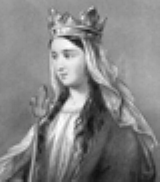
Matilda of Flanders (c. 1031 – 2 November 1083) was the wife of
William the ConquerorWilliam I , also known as William the Conqueror , was the first Norman King of England from Christmas 1066 until his death. He was also Duke of Normandy from 3 July 1035 until his death, under the name William II...
and, as such,
Queen consortA queen consort is the wife of a reigning king. A queen consort usually shares her husband's rank and holds the feminine equivalent of the king's monarchical titles. Historically, queens consort do not share the king regnant's political and military powers. Most queens in history were queens consort...
of the
Kingdom of EnglandThe Kingdom of England was, from 927 to 1707, a sovereign state to the northwest of continental Europe. At its height, the Kingdom of England spanned the southern two-thirds of the island of Great Britain and several smaller outlying islands; what today comprises the legal jurisdiction of England...
. She bore William nine/ten children, including two kings,
William IIWilliam II , the third son of William I of England, was King of England from 1087 until 1100, with powers over Normandy, and influence in Scotland. He was less successful in extending control into Wales...
and
Henry IHenry I was the fourth son of William I of England. He succeeded his elder brother William II as King of England in 1100 and defeated his eldest brother, Robert Curthose, to become Duke of Normandy in 1106...
.
Marriage
Matilda, or Maud, was the daughter of
Baldwin V, Count of FlandersBaldwin V of Flanders was Count of Flanders from 1035 until his death.He was the son of Baldwin IV, Count of Flanders, who died in 1035.-History:...
and Adèle of France, herself daughter of
Robert II of FranceRobert II , called the Pious or the Wise , was King of France from 996 until his death. The second reigning member of the House of Capet, he was born in Orléans to Hugh Capet and Adelaide of Aquitaine....
. According to legend, when Duke
William II of NormandyWilliam I , also known as William the Conqueror , was the first Norman King of England from Christmas 1066 until his death. He was also Duke of Normandy from 3 July 1035 until his death, under the name William II...
(later known as William the Conqueror) sent his representative to ask for Matilda's hand in marriage, she told the representative that she was far too high-born, to consider marrying a
bastardAt common law, legitimacy is the status of a child who is born to parents who are legally married to one another; and of a child who is born shortly after the parents' divorce. In canon and in civil law, the offspring of putative marriages have been considered legitimate children...
. After hearing this response, William rode from Normandy to
BrugesBruges is the capital and largest city of the province of West Flanders in the Flemish Region of Belgium. It is located in the northwest of the country....
, found Matilda on her way to church, and dragged her off her horse by her long
braidA braid is a complex structure or pattern formed by intertwining three or more strands of flexible material such as textile fibres, wire, or human hair...
s, threw her down in the street in front of her flabbergasted attendants, and rode off. Another version of the story states that William rode to Matilda's father's house in
LilleLille is a city in northern France . It is the principal city of the Lille Métropole, the fourth-largest metropolitan area in the country behind those of Paris, Lyon and Marseille. Lille is situated on the Deûle River, near France's border with Belgium...
, threw her to the ground in her room (again, by the braids), and hit her (or violently battered her) before leaving. Naturally, Baldwin took offense at this but, before they
drew swordsA duel is an arranged engagement in combat between two individuals, with matched weapons in accordance with agreed-upon rules.Duels in this form were chiefly practised in Early Modern Europe, with precedents in the medieval code of chivalry, and continued into the modern period especially among...
, Matilda settled the matter by agreeing to marry him, and even a papal ban on the grounds of
consanguinityConsanguinity refers to the property of being from the same kinship as another person. In that respect, consanguinity is the quality of being descended from the same ancestor as another person...
did not dissuade her. They were married in 1053.
There were rumors that Matilda had been in love with the English ambassador to
FlandersFlanders is the community of the Flemings but also one of the institutions in Belgium, and a geographical region located in parts of present-day Belgium, France and the Netherlands. "Flanders" can also refer to the northern part of Belgium that contains Brussels, Bruges, Ghent and Antwerp...
, a Saxon named Brihtric, who declined her advances. Whatever the truth of the matter, years later when she was acting as
RegentA regent, from the Latin regens "one who reigns", is a person selected to act as head of state because the ruler is a minor, not present, or debilitated. Currently there are only two ruling Regencies in the world, sovereign Liechtenstein and the Malaysian constitutive state of Terengganu...
for William in England, she used her authority to confiscate Brihtric's lands and throw him into prison, where he died.
Duchess of Normandy
When William was preparing to invade England, Matilda outfitted a ship, the
Mora, out of her own money and gave it to him. This indicated that she must have owned rich lands in Normandy to be able to do so. Even after William conquered England and became its king, it took her more than a year to visit her new kingdom. Even after she had been crowned queen, she would spend most of her time in Normandy and sponsor ecclestial houses there.
Queen
Matilda was crowned queen in 1068 in
WestminsterWestminster is an area of central London, within the City of Westminster, England. It lies on the north bank of the River Thames, southwest of the City of London and southwest of Charing Cross...
, in a ceremony presided over by the archbishop of York. During the ceremony she was said to be sharing in power with her husband and the people were said to be fortunate to be ruled by the ability and wisdom of the queen.
For many years it was thought that she had some involvement in the creation of the
Bayeux TapestryThe Bayeux Tapestry is an embroidered cloth—not an actual tapestry—nearly long, which depicts the events leading up to the Norman conquest of England concerning William, Duke of Normandy and Harold, Earl of Wessex, later King of England, and culminating in the Battle of Hastings...
(commonly called
La Tapisserie de la Reine Mathilde in French), but historians no longer believe that; it seems to have been commissioned by William's half-brother Odo, Bishop of Bayeux, and made by English artists in
KentKent is a county in southeast England, and is one of the home counties. It borders East Sussex, Surrey and Greater London and has a defined boundary with Essex in the middle of the Thames Estuary. The ceremonial county boundaries of Kent include the shire county of Kent and the unitary borough of...
.
Matilda bore William eleven children, and he was believed to have been faithful to her, at least up until the time their son Robert rebelled against his father and Matilda sided with Robert against William.
She stood as godmother for Matilda of Scotland, who would become Queen of England after marrying Matilda's son
Henry IHenry I was the fourth son of William I of England. He succeeded his elder brother William II as King of England in 1100 and defeated his eldest brother, Robert Curthose, to become Duke of Normandy in 1106...
. During the christening, the baby pulled Queen Matilda's headress down on top of herself, which was seen as an omen that the younger Matilda would be queen some day as well.
After she died, in 1083 at the age of 51, William became tyrannical, and people blamed it on his having lost her.
Contrary to the belief that she was buried at St. Stephen's, also called l'
Abbaye-aux-HommesThe Abbaye aux Hommes is a former abbey church in the French city of Caen, Normandy. Dedicated to Saint Stephen , it is considered, along with the neighbouring Abbaye aux Dames , to be one of the most notable Romanesque buildings in Normandy. Like all the major abbeys in Normandy, it was Benedictine...
in
CaenCaen is a commune in northwestern France. It is the prefecture of the Calvados department and the capital of the Basse-Normandie region. It is located inland from the English Channel....
,
NormandyNormandy is a geographical region corresponding to the former Duchy of Normandy. It is in France.The continental territory covers 30,627 km² and forms the preponderant part of Normandy and roughly 5% of the territory of France. It is divided for administrative purposes into two régions:...
, where William was eventually buried, she is intombed at l'
Abbaye aux DamesThe Abbaye aux Dames is a former abbey in Caen, Normandy, northern France, now home to the Conseil Régional de Basse Normandie...
, which is the Sainte-Trinité church, also in Caen. Of particular interest is the 11th century slab, a sleek black stone decorated with her epitaph, marking her grave at the rear of the church. It is of special note since the grave marker for William was replaced as recently as the beginning of the 19th century.
Height
Reputed to be 4'2" (127 cm) tall, Matilda was England's smallest queen, according to the
Guinness Book of Records. However, in 1819 and 1959 Matilda's incomplete skeleton was examined in France, and her bones were measured to determine her height. The 1819 estimate was under five feet, while the 1959 estimate was 5' (152 cm) tall. A reputed height of 4' 2" (127 cm) appeared at some point after 1959 in the non-scientific literature, misrepresenting the 1959 measurement.
Issue
Some doubt exists over how many daughters there were. This list includes some entries which are obscure.
- Robert Curthose (c. 1054–1134), Duke of Normandy, married Sybil of Conversano, daughter of Geoffrey of Conversano
- Adeliza (or Alice) (c. 1055 – ?), reportedly betrothed to Harold II of England (Her existence is in some doubt.)
- Cecilia
Cecilia of Normandy was thought to be the eldest daughter of William I of England and Matilda of Flanders. She was entered into the Abbey of Caen at a young age by her parents. She became Abbess of Holy Trinity in 1112. Cecilia died on 30 July 1126 and was buried within the abbey walls...
(or Cecily) (c. 1056–1126), Abbess of Holy Trinity, Caen
- William Rufus
William II , the third son of William I of England, was King of England from 1087 until 1100, with powers over Normandy, and influence in Scotland. He was less successful in extending control into Wales...
(1056–1100), King of the English
- Richard
Richard of Normandy was the second son of William the Conqueror and Matilda of Flanders, and a potential heir to the English throne. However, Richard predeceased his father and the throne was eventually inherited by his younger brother William II "Rufus"....
(1057 – c. 1081), killed by a stag in New ForestThe New Forest is an area of southern England which includes the largest remaining tracts of unenclosed pasture land, heathland and forest in the heavily-populated south east of England. It covers south-west Hampshire and extends into south-east Wiltshire....
- Adela (c. 1062–1138), married Stephen, Count of Blois
- Agatha
Agatha, mentioned by Ordericus Vitalis as one of the daughters of William I of England and Matilda of Flanders, Agatha, who had been betrothed to Harold II , was afterwards demanded in marriage by Alphonso VI of Castile and delivered to his proxies to be conducted to him...
(c. 1064 – c. 1080), betrothed to (1) Harold of WessexThe Kingdom of Wessex or Kingdom of the West Saxons was an Anglo-Saxon kingdom of the West Saxons, in South West England, from the 6th century, until the emergence of a united English state in the 10th century, under the Wessex dynasty. It was to be an earldom after Canute the Great's conquest...
, (2) Alfonso VI of CastileAlfonso VI , nicknamed the Brave or the Valiant, was King of León from 1065, King of Castile and de facto King of Galicia from 1072, and self-proclaimed "Emperor of all Spain". After the conquest of Toledo he was also self-proclaimed victoriosissimo rege in Toleto, et in Hispania et Gallecia...
- Constance
Constance of Normandy was a daughter of William I of England and Matilda of Flanders, it was said she was the most highly gifted of all of the Conqueror's daughters. As she was favourite of her mother she was offered later in marriage to Alan IV of Brittany, the year being 1086...
(c. 1066–1090), married Alan IV FergentAlan IV was Duke of Brittany, from 1084 until his abdication in 1112. He was also Count of Nantes and Count of Rennes. He was son of Hawise, Duchess of Brittany and Duke Hoel II. He was known as Alan Fergant, which in Breton means "Alan the Strong"...
, Duke of BrittanyThe Duchy of Brittany was a medieval tribal and feudal state covering the northwestern peninsula of Europe,bordered by the Alantic Ocean on the west and the English Channel to the north with less definitive borders of the Loire River to the south and Normandy to the east...
; poisoned, possibly by her own servants
- Maud (very obscure, her existence is in some doubt)
- Henry Beauclerc
Henry I was the fourth son of William I of England. He succeeded his elder brother William II as King of England in 1100 and defeated his eldest brother, Robert Curthose, to become Duke of Normandy in 1106...
(1068–1135), King of England, married (1) Edith of ScotlandMatilda of Scotland , born Edith, was the first wife and Queen consort of Henry I of England.-Early life:Matilda was born around 1080 in Dunfermline, the daughter of Malcolm III of Scotland and Saint Margaret. She was christened Edith, and Robert Curthose stood as godfather at the ceremony...
, daughter of Malcolm III, King of ScotlandMáel Coluim mac Donnchada , was King of Scots...
, (2) Adeliza of LouvainAdeliza of Louvain, sometimes known in England as Adelicia of Louvain, also called Adela and Aleidis; was queen consort of the Kingdom of England from 1121 to 1135, the second wife of Henry I...
GundredGundred or Gundreda was probably born in Flanders, sister of Gerbod the Fleming, 1st Earl of Chester...
(c. 1063–1085), wife of
William de WarenneWilliam de Warenne, 1st Earl of Surrey, Seigneur de Varennes is one of the very few proven Companions of William the Conqueror known to have fought at the Battle of Hastings in 1066...
(c. 1055–1088), was formerly thought of as being yet another of Matilda's daughters, with speculation that she was William I's full daughter, a stepdaughter, or even a foundling or adopted daughter. However, this connection to William I has now been firmly debunked.
Matilda was a seventh generation direct descendent of
Alfred the GreatAlfred the Great was King of Wessex from 871 to 899.Alfred is noted for his defence of the Anglo-Saxon kingdoms of southern England against the Vikings, becoming the only English monarch still to be accorded the epithet "the Great". Alfred was the first King of the West Saxons to style himself...
. Her marriage to William strengthened his claim to the throne. All sovereigns of England, Great Britain and the United Kingdom have been descended from her, as is the present Queen Elizabeth II.
In popular culture
Her love for her husband is referenced in the Award-winning play,
Angels in AmericaAngels in America: A Gay Fantasia on National Themes is the 1993 Pulitzer Prize winning play in two parts by American playwright Tony Kushner. It has been made into both a television miniseries and an opera by Peter Eötvös.-Characters:...
.
On screen, Matilda has been portrayed by
Jane WenhamJane Wenham is an English actress.Ann Jane Wenham Figgins was born in Southampton, Hampshire and led a long career in film, television and the stage. She made her film debut in the film adaptation of J. B. Priestley's An Inspector Calls...
in the two-part
BBCThe British Broadcasting Corporation is a British public service broadcaster. Its headquarters is at Broadcasting House in the City of Westminster, London. It is the largest broadcaster in the world, with about 23,000 staff...
TV play
Conquest (1966), part of the series
Theatre 625Theatre 625 is a British television drama anthology series, produced by the BBC and transmitted on BBC2 from 1964 to 1968. It was one of the first regular programmes in the line-up of the channel, and the title referred to its production and transmission being in the higher-definition 625-line...
, by
Anna Calder-MarshallAnna Calder-Marshall is a British actress.Her husband is actor David Burke and her son is actor Tom Burke.-Filmography:-External links:...
in the TV drama
Blood Royal: William the Conqueror (1990), and by Martha Howe Douglas on the popular comedy sketch show
Horrible HistoriesHorrible Histories is a series of illustrated history books published in the United Kingdom by Scholastic. They are designed to engage children in history by concentrating on the unusual, gory, or unpleasant. The series has proved exceptionally successful in commercial terms...
Ancestry
Footnotes
|-