


First Intermediate Period of Egypt

Encyclopedia
The First Intermediate Period, often described as a “dark period” in ancient Egypt
ian history, spanned approximately one hundred years after the end of the Old Kingdom
from ca. 2181-2055 BC. It included the seventh, eighth
, ninth
, tenth
, and part of the eleventh
dynasties. Very little monumental evidence survives from this period, especially towards the beginning of the era. The First Intermediate Period was a dynamic time in history where rule of Egypt was roughly divided between two competing power bases. One of those bases resided at Heracleopolis
in Lower Egypt
, a city just south of the Faiyum region. The other resided at Thebes
in Upper Egypt
. It is believed that during this time, the temples were pillaged and violated, their existing artwork was vandalized, and the statues of kings were broken or destroyed as a result of this alleged political chaos. These two kingdoms would eventually come into conflict, with the Theban kings conquering the north, resulting in reunification of Egypt under a single ruler during the second part of the eleventh dynasty.
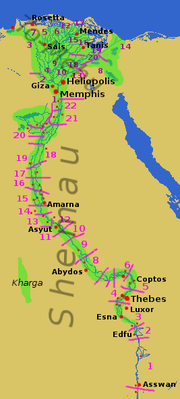 The fall of the Old Kingdom
is often described as a period of chaos and disorder by some literature in the First Intermediate Period, but mostly by literature written in successive eras of ancient Egyptian history. The causes that brought about the downfall of the Old Kingdom
are numerous, but some are merely hypothetical. One reason that is often quoted is the extremely long reign of Pepi II
, the last major pharaoh
of the 6th Dynasty
. He ruled until he was very elderly (100 years), outliving many of his heirs and therefore, created problems with succession in the royal household. Thus, the regime of the Old Kingdom disintegrated amidst this disorganization. Another major problem was the rise in power of the provincial nomarch
s. Towards the end of the Old Kingdom the positions of the nomarchs had become hereditary, so families often held onto the position of power in their respective provinces. As these nomarchs grew increasingly powerful and influential, they became more independent from the king. They erected tombs in their own domains and often raised armies. The rise of these numerous nomarchs inevitably created conflicts between neighboring provinces, often resulting in intense rivalries and warfare between them. A third reason for the dissolution of centralized kingship that is mentioned was the low levels of the Nile inundation
which may have resulted in a drier climate
and lower crop yield
s bringing about famine
across ancient Egypt. See 4.2 kiloyear event
.
, a historian and priest from the Ptolemaic era, describes 70 kings who ruled for 70 days. This is most likely an exaggeration to describe the disorganization of the kingship during this time period. The seventh dynasty was most likely an oligarchy
based in Memphis that attempted to retain control of the country. The eighth dynasty rulers, claiming to be the descendants of the sixth dynasty kings, also ruled from Memphis. Little is known about these two dynasties since very little textual or architectural evidence survives to describe the period. However, a few artifacts have been found, including scarabs that have been attributed to king Neferkara I
of the seventh dynasty as well as a green jasper
cylinder of Syrian influence which has been credited to the eighth dynasty. Also, a small pyramid
believed to have been constructed by King Ibi
of the eighth dynasty has been identified at Saqqara
.
in Lower Egypt, reigning for approximately 594 years. These kings comprise the ninth and tenth dynasties, each with nineteen listed rulers. They were believed to have descended from Libya
n invaders who came into Egypt from the west through the Fayum region. This is often viewed as a foreshadowing of the Hyksos
invasion of the Delta which would occur during the Second Intermediate Period. The Heracleopolitan kings eventually overwhelmed the weak Memphite rulers to create the ninth dynasty.
The founder of the ninth dynasty, Kheti I, is often described as an evil and violent ruler, most notably in Manetho’s writing. Also known as Akhthoes or Akhtoy, Kheti I was described as a king who caused much harm to the inhabitants of Egypt, was seized with madness, and was eventually killed by a crocodile
. This may have simply been a myth, but he is listed as a king in both the Abydos King List
s as well as the Turin Canon. Kheti I was succeeded by Kheti II, also known as Meryibre. His reign was essentially peaceful, but experienced problems in the Delta. It was his successor, Kheti III, who would bring some degree of order to the Delta, although the power and influence of these ninth dynasty kings were still relatively insignificant compared to that of the Old Kingdom pharaohs.
A distinguished line of nomarchs rose out of Siut (or Asyut), which was a powerful and wealthy province in the south of the Heracleopolitan kingdom. These warrior princes maintained a close relationship with the kings of the Heracleopolitan royal household, as evidenced by the inscriptions in their tombs. These inscriptions provide a glimpse at the political situation that was present during their reigns. They describe the Siut nomarchs digging canal
s, reducing taxation, reaping rich harvests, raising cattle herds, and maintaining an army and fleet. The Siut province acted as a buffer state between the northern and southern rulers and the Siut princes would bear the brunt of the attacks from the Theban kings.
dynasties. This line of kings is believed to have been descendants of Intef
or Inyotef, who was the nomarch of Thebes, often called the "keeper of the Door of the South". He is credited for organizing Upper Egypt into an independent ruling body in the south, although he himself did not appear to have tried to claim the title of king. However, his successors in the eleventh and twelfth dynasty would later do so for him. One of them, Intef II, begins the assault on the north, particularly at Abydos
. Intef III completes this attack on the north and eventually captures Abydos, moving into Middle Egypt against the Heracleopolitan kings. The first three kings of the eleventh dynasty (all named Intef) were, therefore, also the last three kings of the First Intermediate Period and would be succeeded by a line of kings who were all called Mentuhotep. Mentuhotep II
, also known as Nebhepetra, would eventually defeat the Heracleopolitan kings around 2033 BC and unify the country to continue the eleventh dynasty, bringing Egypt into the Middle Kingdom.
. A particularly important piece is the Ipuwer Papyrus, often called the Lamentations of Ipuwer or the Admonitions of Ipuwer, which is attributed to the tenth or eleventh dynasty. The text is written in first person, with Ipuwer speaking in the presence of a king, or possibly the god Atum
, as he tries to waken in the king or deity a sense of responsibility for the dismal condition of the state. Ipuwer complains about the break-down of law and the disorderly fashion in which the government is currently being run. He also talks about noble ladies having to beg for food while former servant girls are being clothed in gold
and lapis lazuli
. He speaks of foreigners who are coming into the country and becoming Egyptians. Ipuwer is especially upset with the fact that ships are no longer sailing to Byblos
and that trade with other nations was ebbing. A line in the text reads, "It is grief that walketh through the land, mingled with lamentations". The text, whether it is a fictional or historically accurate text, paints a very dismal and disordered picture of Egypt during the First Intermediate Period.
The building projects of the Heracleopolitan kings in the North was very limited. Only one pyramid believed to belong to King Merikare
(2065-2045 BC) has been identified at Saqqara
. Also, private tombs that were built during the time pale in comparison to the Old Kingdom monuments, in quality and size. There are still relief scenes of servants making provisions for the deceased as well as the traditional offering scenes which mirror those of the Old Kingdom Memphite tombs. However, they are of a lower quality and are much simpler than their Old Kingdom parallels. Wooden rectangular coffins were still being used, but their decorations became more elaborate during the rule of the Heracleopolitan kings. New Coffin Texts
were painted on the interiors, providing spells and maps for the deceased to use in the afterlife.
The rise of the Theban kings around 2123 BC brought about an original more provincial style of art. This new style is often described as clumsy and unrefined and may have been due to the lack of skilled artisans. However, the artworks that survived show that the artisans took on new interpretations of traditional scenes. They employed the use of bright colors in their paintings and changed and distorted the proportions of the human figure. This distinctive style was especially evident in the rectangular slab stela
e found in the tombs at Naga el-Deir. In terms of royal architecture, the Theban kings of the early eleventh dynasty constructed rock cut tombs called saff tombs at El-Tarif
on the west bank of the Nile
. This new style of mortuary architecture consisted of a large courtyard with a rock-cut colonnade
at the far wall. Rooms were carved into the walls facing the central courtyard where the deceased were buried, allowing for multiple people to be buried in one tomb. The undecorated burial chambers may have been due to the lack of skilled artists in the Theban kingdom.
.
Ancient Egypt
Ancient Egypt was an ancient civilization of Northeastern Africa, concentrated along the lower reaches of the Nile River in what is now the modern country of Egypt. Egyptian civilization coalesced around 3150 BC with the political unification of Upper and Lower Egypt under the first pharaoh...
ian history, spanned approximately one hundred years after the end of the Old Kingdom
Old Kingdom
Old Kingdom is the name given to the period in the 3rd millennium BC when Egypt attained its first continuous peak of civilization in complexity and achievement – the first of three so-called "Kingdom" periods, which mark the high points of civilization in the lower Nile Valley .The term itself was...
from ca. 2181-2055 BC. It included the seventh, eighth
Seventh and eighth dynasties of Egypt
The seventh and eighth dynasties of ancient Egypt are often combined with Dynasties IX, X and XI under the group title First Intermediate Period...
, ninth
Ninth dynasty of Egypt
The ninth dynasty of ancient Egypt is often combined with Dynasties VII, VIII, X and XI under the group title First Intermediate Period...
, tenth
Tenth dynasty of Egypt
The tenth dynasty of ancient Egypt is often combined with Dynasties VII, VIII, IX and XI under the group title First Intermediate Period...
, and part of the eleventh
Eleventh dynasty of Egypt
The eleventh dynasty of ancient Egypt was one group of rulers, whose earlier members are grouped with the four preceding dynasties to form the First Intermediate Period, while the later members are considered part of the Middle Kingdom...
dynasties. Very little monumental evidence survives from this period, especially towards the beginning of the era. The First Intermediate Period was a dynamic time in history where rule of Egypt was roughly divided between two competing power bases. One of those bases resided at Heracleopolis
Herakleopolis Magna
Heracleopolis or Herakleopolis Magna is the Greek name of the capital of the Twentieth nome of ancient Egypt. It was called Henen-nesut, Nen-nesu, or Hwt-nen-nesu in ancient Egyptian, meaning 'house of the royal child.' Later, it was called Hnas in Coptic, and Ahnas in medieval Arabic writings...
in Lower Egypt
Lower Egypt
Lower Egypt is the northern-most section of Egypt. It refers to the fertile Nile Delta region, which stretches from the area between El-Aiyat and Zawyet Dahshur, south of modern-day Cairo, and the Mediterranean Sea....
, a city just south of the Faiyum region. The other resided at Thebes
Thebes, Egypt
Thebes is the Greek name for a city in Ancient Egypt located about 800 km south of the Mediterranean, on the east bank of the river Nile within the modern city of Luxor. The Theban Necropolis is situated nearby on the west bank of the Nile.-History:...
in Upper Egypt
Upper Egypt
Upper Egypt is the strip of land, on both sides of the Nile valley, that extends from the cataract boundaries of modern-day Aswan north to the area between El-Ayait and Zawyet Dahshur . The northern section of Upper Egypt, between El-Ayait and Sohag is sometimes known as Middle Egypt...
. It is believed that during this time, the temples were pillaged and violated, their existing artwork was vandalized, and the statues of kings were broken or destroyed as a result of this alleged political chaos. These two kingdoms would eventually come into conflict, with the Theban kings conquering the north, resulting in reunification of Egypt under a single ruler during the second part of the eleventh dynasty.
Events leading to the First Intermediate Period
Old Kingdom
Old Kingdom is the name given to the period in the 3rd millennium BC when Egypt attained its first continuous peak of civilization in complexity and achievement – the first of three so-called "Kingdom" periods, which mark the high points of civilization in the lower Nile Valley .The term itself was...
is often described as a period of chaos and disorder by some literature in the First Intermediate Period, but mostly by literature written in successive eras of ancient Egyptian history. The causes that brought about the downfall of the Old Kingdom
Old Kingdom
Old Kingdom is the name given to the period in the 3rd millennium BC when Egypt attained its first continuous peak of civilization in complexity and achievement – the first of three so-called "Kingdom" periods, which mark the high points of civilization in the lower Nile Valley .The term itself was...
are numerous, but some are merely hypothetical. One reason that is often quoted is the extremely long reign of Pepi II
Pepi II Neferkare
Pepi II was a pharaoh of the Sixth dynasty in Egypt's Old Kingdom. His throne name, Neferkare , means "Beautiful is the Ka of Re". He succeeded to the throne at age six, after the death of Merenre I, and is generally credited with having the longest reign of any monarch in history at 94 years...
, the last major pharaoh
Pharaoh
Pharaoh is a title used in many modern discussions of the ancient Egyptian rulers of all periods. The title originates in the term "pr-aa" which means "great house" and describes the royal palace...
of the 6th Dynasty
Sixth dynasty of Egypt
The sixth dynasty of ancient Egypt is often combined with Dynasties III, IV and V under the group title the Old Kingdom.-Pharaohs:...
. He ruled until he was very elderly (100 years), outliving many of his heirs and therefore, created problems with succession in the royal household. Thus, the regime of the Old Kingdom disintegrated amidst this disorganization. Another major problem was the rise in power of the provincial nomarch
Nomarch
Nomarchs were the semi-feudal rulers of Ancient Egyptian provinces. Serving as provincial governors, they each held authority over one of the 42 nomes into which the country was divided. Both nome and nomarch are terms derived from the Greek nomos, meaning a province or district...
s. Towards the end of the Old Kingdom the positions of the nomarchs had become hereditary, so families often held onto the position of power in their respective provinces. As these nomarchs grew increasingly powerful and influential, they became more independent from the king. They erected tombs in their own domains and often raised armies. The rise of these numerous nomarchs inevitably created conflicts between neighboring provinces, often resulting in intense rivalries and warfare between them. A third reason for the dissolution of centralized kingship that is mentioned was the low levels of the Nile inundation
Flooding of the Nile
has been an important natal cycle in Egypt since ancient times. It is celebrated by Egyptians as an annual holiday for two weeks starting August 15, known as Wafaa El-Nil. It is also celebrated in the Coptic Church by ceremonially throwing a martyr's relic into the river, hence the name, Esba`...
which may have resulted in a drier climate
Climate change
Climate change is a significant and lasting change in the statistical distribution of weather patterns over periods ranging from decades to millions of years. It may be a change in average weather conditions or the distribution of events around that average...
and lower crop yield
Crop yield
In agriculture, crop yield is not only a measure of the yield of cereal per unit area of land under cultivation, yield is also the seed generation of the plant itself...
s bringing about famine
Famine
A famine is a widespread scarcity of food, caused by several factors including crop failure, overpopulation, or government policies. This phenomenon is usually accompanied or followed by regional malnutrition, starvation, epidemic, and increased mortality. Every continent in the world has...
across ancient Egypt. See 4.2 kiloyear event
4.2 kiloyear event
The 4.2 kiloyear BP aridification event was one of the most severe climatic events of the Holocene period in terms of impact on cultural upheaval. Starting in ≈2200 BC, it probably lasted the entire 22nd century BC. It is very likely to have caused the collapse of the Old Kingdom in Egypt as...
.
The 7th and 8th dynasties at Memphis
The seventh and eighth dynasties are often overlooked because very little is known about the rulers of these two periods. ManethoManetho
Manetho was an Egyptian historian and priest from Sebennytos who lived during the Ptolemaic era, approximately during the 3rd century BC. Manetho wrote the Aegyptiaca...
, a historian and priest from the Ptolemaic era, describes 70 kings who ruled for 70 days. This is most likely an exaggeration to describe the disorganization of the kingship during this time period. The seventh dynasty was most likely an oligarchy
Oligarchy
Oligarchy is a form of power structure in which power effectively rests with an elite class distinguished by royalty, wealth, family ties, commercial, and/or military legitimacy...
based in Memphis that attempted to retain control of the country. The eighth dynasty rulers, claiming to be the descendants of the sixth dynasty kings, also ruled from Memphis. Little is known about these two dynasties since very little textual or architectural evidence survives to describe the period. However, a few artifacts have been found, including scarabs that have been attributed to king Neferkara I
Neferkara I
Neferkara I is the cartouche name of a king who is said to have ruled during the 2nd dynasty of Ancient Egypt. The exact length of his reign is unknown since the Turin canon lacks the years of rulership and the ancient Greek historian Manetho suggests that Neferkara´s reign lasted 25 years...
of the seventh dynasty as well as a green jasper
Jasper
Jasper, a form of chalcedony, is an opaque, impure variety of silica, usually red, yellow, brown or green in color; and rarely blue. This mineral breaks with a smooth surface, and is used for ornamentation or as a gemstone. It can be highly polished and is used for vases, seals, and at one time for...
cylinder of Syrian influence which has been credited to the eighth dynasty. Also, a small pyramid
Pyramid
A pyramid is a structure whose outer surfaces are triangular and converge at a single point. The base of a pyramid can be trilateral, quadrilateral, or any polygon shape, meaning that a pyramid has at least three triangular surfaces...
believed to have been constructed by King Ibi
Qakare Ibi
Qakare Ibi was an ancient Egyptian ruler of the 8th Dynasty. The name Qa-ka-Re means "strong is the soul of Re".His existence was established by the discovery of his small pyramid in South Saqqara which also continues the late Old Kingdom tradition of listing pyramid texts in his tomb. His name is...
of the eighth dynasty has been identified at Saqqara
Saqqara
Saqqara is a vast, ancient burial ground in Egypt, serving as the necropolis for the Ancient Egyptian capital, Memphis. Saqqara features numerous pyramids, including the world famous Step pyramid of Djoser, sometimes referred to as the Step Tomb due to its rectangular base, as well as a number of...
.
Rise of the Heracleopolitan Kings
After the obscure reign of the seventh and eighth dynasties kings, a group of rulers rose out of HeracleopolisHeracleopolis
Heracleopolis may refer to:* Herakleopolis Magna, Egypt* Sulusaray, Turkey...
in Lower Egypt, reigning for approximately 594 years. These kings comprise the ninth and tenth dynasties, each with nineteen listed rulers. They were believed to have descended from Libya
Libya
Libya is an African country in the Maghreb region of North Africa bordered by the Mediterranean Sea to the north, Egypt to the east, Sudan to the southeast, Chad and Niger to the south, and Algeria and Tunisia to the west....
n invaders who came into Egypt from the west through the Fayum region. This is often viewed as a foreshadowing of the Hyksos
Hyksos
The Hyksos were an Asiatic people who took over the eastern Nile Delta during the twelfth dynasty, initiating the Second Intermediate Period of ancient Egypt....
invasion of the Delta which would occur during the Second Intermediate Period. The Heracleopolitan kings eventually overwhelmed the weak Memphite rulers to create the ninth dynasty.
The founder of the ninth dynasty, Kheti I, is often described as an evil and violent ruler, most notably in Manetho’s writing. Also known as Akhthoes or Akhtoy, Kheti I was described as a king who caused much harm to the inhabitants of Egypt, was seized with madness, and was eventually killed by a crocodile
Nile crocodile
The Nile crocodile or Common crocodile is an African crocodile which is common in Somalia, Ethiopia, Uganda, Kenya, Egypt, Tanzania, Zambia, Zimbabwe, Gabon, South Africa, Malawi, Sudan, Botswana, and Cameroon...
. This may have simply been a myth, but he is listed as a king in both the Abydos King List
Abydos King List
The Abydos King List, also called the Abydos Table is a list of the names of seventy-six kings and pharaohs of Ancient Egypt, found on the walls of the Temple of Seti I at Abydos, Egypt. It consists of three rows of thirty-eight cartouches on each row...
s as well as the Turin Canon. Kheti I was succeeded by Kheti II, also known as Meryibre. His reign was essentially peaceful, but experienced problems in the Delta. It was his successor, Kheti III, who would bring some degree of order to the Delta, although the power and influence of these ninth dynasty kings were still relatively insignificant compared to that of the Old Kingdom pharaohs.
A distinguished line of nomarchs rose out of Siut (or Asyut), which was a powerful and wealthy province in the south of the Heracleopolitan kingdom. These warrior princes maintained a close relationship with the kings of the Heracleopolitan royal household, as evidenced by the inscriptions in their tombs. These inscriptions provide a glimpse at the political situation that was present during their reigns. They describe the Siut nomarchs digging canal
Canal
Canals are man-made channels for water. There are two types of canal:#Waterways: navigable transportation canals used for carrying ships and boats shipping goods and conveying people, further subdivided into two kinds:...
s, reducing taxation, reaping rich harvests, raising cattle herds, and maintaining an army and fleet. The Siut province acted as a buffer state between the northern and southern rulers and the Siut princes would bear the brunt of the attacks from the Theban kings.
Rise of the Theban Kings
It has been suggested that an invasion of Upper Egypt occurred contemporaneous with the founding of the Heracleopolitan kingdom, which would establish the Theban line of kings, constituting the eleventh and twelfthTwelfth dynasty of Egypt
The twelfth dynasty of ancient Egypt is often combined with Dynasties XI, XIII and XIV under the group title Middle Kingdom.-Rulers:Known rulers of the twelfth dynasty are as follows :...
dynasties. This line of kings is believed to have been descendants of Intef
Intef
Intef was a common ancient Egyptian name, normally transliterated: jnj-jt, translated: he, who brings father with him, common vocalizations: Intef, Antef, Inyotef, Anyotef.-11th dynasty:* Intef, Theban Nomarch.* Intef I, Se-her-taui....
or Inyotef, who was the nomarch of Thebes, often called the "keeper of the Door of the South". He is credited for organizing Upper Egypt into an independent ruling body in the south, although he himself did not appear to have tried to claim the title of king. However, his successors in the eleventh and twelfth dynasty would later do so for him. One of them, Intef II, begins the assault on the north, particularly at Abydos
Abydos, Egypt
Abydos is one of the most ancient cities of Upper Egypt, and also of the eight Upper Nome, of which it was the capital city. It is located about 11 kilometres west of the Nile at latitude 26° 10' N, near the modern Egyptian towns of el-'Araba el Madfuna and al-Balyana...
. Intef III completes this attack on the north and eventually captures Abydos, moving into Middle Egypt against the Heracleopolitan kings. The first three kings of the eleventh dynasty (all named Intef) were, therefore, also the last three kings of the First Intermediate Period and would be succeeded by a line of kings who were all called Mentuhotep. Mentuhotep II
Mentuhotep II
Nebhepetre Mentuhotep II was a Pharaoh of the 11th dynasty, the son of Intef III of Egypt and a minor queen called Iah. His own wife was the 'king's mother' Tem. Other wives were Neferu and several secondary wives, one or more who it has been suggested were possibly Nubian, buried in his...
, also known as Nebhepetra, would eventually defeat the Heracleopolitan kings around 2033 BC and unify the country to continue the eleventh dynasty, bringing Egypt into the Middle Kingdom.
The Ipuwer Papyrus
The emergence of what is considered literature by modern standards seems to have occurred during the First Intermediate Period, with a flowering of new literary genres in the Middle KingdomMiddle Kingdom of Egypt
The Middle Kingdom of Egypt is the period in the history of ancient Egypt stretching from the establishment of the Eleventh Dynasty to the end of the Fourteenth Dynasty, between 2055 BC and 1650 BC, although some writers include the Thirteenth and Fourteenth dynasties in the Second Intermediate...
. A particularly important piece is the Ipuwer Papyrus, often called the Lamentations of Ipuwer or the Admonitions of Ipuwer, which is attributed to the tenth or eleventh dynasty. The text is written in first person, with Ipuwer speaking in the presence of a king, or possibly the god Atum
Atum
Atum, sometimes rendered as Atem or Tem, is an important deity in Egyptian mythology.- Name :Atum's name is thought to be derived from the word 'tem' which means to complete or finish. Thus he has been interpreted as being the 'complete one' and also the finisher of the world, which he returns to...
, as he tries to waken in the king or deity a sense of responsibility for the dismal condition of the state. Ipuwer complains about the break-down of law and the disorderly fashion in which the government is currently being run. He also talks about noble ladies having to beg for food while former servant girls are being clothed in gold
Gold
Gold is a chemical element with the symbol Au and an atomic number of 79. Gold is a dense, soft, shiny, malleable and ductile metal. Pure gold has a bright yellow color and luster traditionally considered attractive, which it maintains without oxidizing in air or water. Chemically, gold is a...
and lapis lazuli
Lapis lazuli
Lapis lazuli is a relatively rare semi-precious stone that has been prized since antiquity for its intense blue color....
. He speaks of foreigners who are coming into the country and becoming Egyptians. Ipuwer is especially upset with the fact that ships are no longer sailing to Byblos
Byblos
Byblos is the Greek name of the Phoenician city Gebal . It is a Mediterranean city in the Mount Lebanon Governorate of present-day Lebanon under the current Arabic name of Jubayl and was also referred to as Gibelet during the Crusades...
and that trade with other nations was ebbing. A line in the text reads, "It is grief that walketh through the land, mingled with lamentations". The text, whether it is a fictional or historically accurate text, paints a very dismal and disordered picture of Egypt during the First Intermediate Period.
Art and architecture of the First Intermediate Period
As stated above, the First Intermediate Period in Egypt was generally divided into two main geographical and political regions, one centered at Memphis and the other at Thebes. The Memphite kings, although weak in power, held on to the Memphite artistic traditions that had been in place throughout the Old Kingdom. This was a symbolic way for the weakened Memphite state to hold on to the vestiges of glory in which the Old Kingdom had reveled. On the other hand, the Theban kings, physically isolated from Memphis, had no access to these Memphite artworks and thus, were able to craft new artistic styles that reflected the creativity of the artists who were no longer controlled by the state.The building projects of the Heracleopolitan kings in the North was very limited. Only one pyramid believed to belong to King Merikare
Merikare
Merikare was a pharaoh in the Ninth or Tenth dynasty of Egypt, during the First Intermediate Period in about 2075 BC. His name is not mentioned in the Turin King List; also his dates are uncertain....
(2065-2045 BC) has been identified at Saqqara
Saqqara
Saqqara is a vast, ancient burial ground in Egypt, serving as the necropolis for the Ancient Egyptian capital, Memphis. Saqqara features numerous pyramids, including the world famous Step pyramid of Djoser, sometimes referred to as the Step Tomb due to its rectangular base, as well as a number of...
. Also, private tombs that were built during the time pale in comparison to the Old Kingdom monuments, in quality and size. There are still relief scenes of servants making provisions for the deceased as well as the traditional offering scenes which mirror those of the Old Kingdom Memphite tombs. However, they are of a lower quality and are much simpler than their Old Kingdom parallels. Wooden rectangular coffins were still being used, but their decorations became more elaborate during the rule of the Heracleopolitan kings. New Coffin Texts
Coffin Texts
The Coffin Texts are a collection of ancient Egyptian funerary spells written on coffins beginning in the First Intermediate Period. The texts are derived in part from the earlier pyramid texts, reserved for royal use only, but they contain substantial new material related to everyday desires that...
were painted on the interiors, providing spells and maps for the deceased to use in the afterlife.
The rise of the Theban kings around 2123 BC brought about an original more provincial style of art. This new style is often described as clumsy and unrefined and may have been due to the lack of skilled artisans. However, the artworks that survived show that the artisans took on new interpretations of traditional scenes. They employed the use of bright colors in their paintings and changed and distorted the proportions of the human figure. This distinctive style was especially evident in the rectangular slab stela
Slab stela
The slab stela was an original form of the steles of ancient Egypt, but in a horizontal dimension. Some of the earliest ones from mid- to late-3rd millennium BC were painted Slab Steles...
e found in the tombs at Naga el-Deir. In terms of royal architecture, the Theban kings of the early eleventh dynasty constructed rock cut tombs called saff tombs at El-Tarif
El-Tarif
The necropolis of El-Tarif is located on the West Bank of the Nile at Thebes, Egypt. It is the farthest north of the Tombs of the Nobles, and contains tombs of the late First Intermediate Period, Second Intermediate Period and early Middle Kingdom....
on the west bank of the Nile
Nile
The Nile is a major north-flowing river in North Africa, generally regarded as the longest river in the world. It is long. It runs through the ten countries of Sudan, South Sudan, Burundi, Rwanda, Democratic Republic of the Congo, Tanzania, Kenya, Ethiopia, Uganda and Egypt.The Nile has two major...
. This new style of mortuary architecture consisted of a large courtyard with a rock-cut colonnade
Colonnade
In classical architecture, a colonnade denotes a long sequence of columns joined by their entablature, often free-standing, or part of a building....
at the far wall. Rooms were carved into the walls facing the central courtyard where the deceased were buried, allowing for multiple people to be buried in one tomb. The undecorated burial chambers may have been due to the lack of skilled artists in the Theban kingdom.
End of the First Intermediate Period
The end of the First Intermediate Period is placed at the time when Mentuhotep II of the eleventh dynasty defeats the Heracleopolitan kings of Lower Egypt and reunites Egypt under a single ruler. This act helps usher in a period of great wealth and prosperity, known as the Middle KingdomMiddle Kingdom of Egypt
The Middle Kingdom of Egypt is the period in the history of ancient Egypt stretching from the establishment of the Eleventh Dynasty to the end of the Fourteenth Dynasty, between 2055 BC and 1650 BC, although some writers include the Thirteenth and Fourteenth dynasties in the Second Intermediate...
.