


Wheel

Encyclopedia
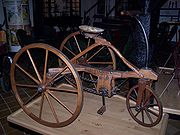
Transport
Transport or transportation is the movement of people, cattle, animals and goods from one location to another. Modes of transport include air, rail, road, water, cable, pipeline, and space. The field can be divided into infrastructure, vehicles, and operations...
applications. A wheel, together with an axle
Axle
An axle is a central shaft for a rotating wheel or gear. On wheeled vehicles, the axle may be fixed to the wheels, rotating with them, or fixed to its surroundings, with the wheels rotating around the axle. In the former case, bearings or bushings are provided at the mounting points where the axle...
, overcomes friction
Friction
Friction is the force resisting the relative motion of solid surfaces, fluid layers, and/or material elements sliding against each other. There are several types of friction:...
by facilitating motion by rolling
Rolling
Rolling is a combination of rotation and translation of that object with respect to a surface , such that the two are in contact with each other without sliding. This is achieved by a rotational speed at the cylinder or circle of contact which is equal to the translational speed...
. In order for wheels to rotate, a moment
Moment (physics)
In physics, the term moment can refer to many different concepts:*Moment of force is the tendency of a force to twist or rotate an object; see the article torque for details. This is an important, basic concept in engineering and physics. A moment is valued mathematically as the product of the...
needs to be applied to the wheel about its axis, either by way of gravity, or by application of another external force. More generally the term is also used for other circular objects that rotate or turn, such as a ship's wheel
Ship's wheel
A ship's wheel is the modern method of adjusting the angle of a boat or ship's rudder in order to cause the vessel to change its course. Together with the rest of the steering mechanism it forms part of the helm. It is typically connected to a mechanical, electric servo, or hydraulic system...
, steering wheel
Steering wheel
A steering wheel is a type of steering control in vehicles and vessels ....
and flywheel
Flywheel
A flywheel is a rotating mechanical device that is used to store rotational energy. Flywheels have a significant moment of inertia, and thus resist changes in rotational speed. The amount of energy stored in a flywheel is proportional to the square of its rotational speed...
.
Etymology
The English word wheel comes from the Old English word hweol, hweogol, from Proto-GermanicProto-Germanic language
Proto-Germanic , or Common Germanic, as it is sometimes known, is the unattested, reconstructed proto-language of all the Germanic languages, such as modern English, Frisian, Dutch, Afrikaans, German, Luxembourgish, Danish, Norwegian, Icelandic, Faroese, and Swedish.The Proto-Germanic language is...
, from Proto-Indo-European
Proto-Indo-European language
The Proto-Indo-European language is the reconstructed common ancestor of the Indo-European languages, spoken by the Proto-Indo-Europeans...
, an extended form of the root "to revolve, move around".
Cognates within Indo-European include Greek
Greek language
Greek is an independent branch of the Indo-European family of languages. Native to the southern Balkans, it has the longest documented history of any Indo-European language, spanning 34 centuries of written records. Its writing system has been the Greek alphabet for the majority of its history;...
kýklos, "wheel", Sanskrit
Sanskrit
Sanskrit , is a historical Indo-Aryan language and the primary liturgical language of Hinduism, Jainism and Buddhism.Buddhism: besides Pali, see Buddhist Hybrid Sanskrit Today, it is listed as one of the 22 scheduled languages of India and is an official language of the state of Uttarakhand...
, Old Church Slavonic
Old Church Slavonic
Old Church Slavonic or Old Church Slavic was the first literary Slavic language, first developed by the 9th century Byzantine Greek missionaries Saints Cyril and Methodius who were credited with standardizing the language and using it for translating the Bible and other Ancient Greek...
kolo, all meaning "circle" or "wheel",
The Latin word is from the Proto-Indo-European , the extended o-grade form of the root meaning "to roll, revolve".
History
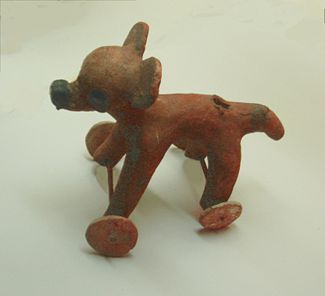
4th millennium BC
The 4th millennium BC saw major changes in human culture. It marked the beginning of the Bronze Age and of writing.The city states of Sumer and the kingdom of Egypt were established and grew to prominence. Agriculture spread widely across Eurasia...
, near-simultaneously in Mesopotamia, the Northern Caucasus (Maykop culture
Maykop culture
The Maykop culture , ca. 3700 BC—2500 BC, was a major Bronze Age archaeological culture situated in Southern Russia running from the Taman Peninsula at the Kerch Strait nearly to the modern border of Dagestan, centered approximately on the modern Republic of Adygea in the Kuban River valley...
) and Central Europe, so that the question of which culture originally invented the wheeled vehicle remains unresolved and under debate.
The earliest well-dated depiction of a wheeled vehicle (here a wagon—four wheels, two axles), is on the Bronocice pot
Bronocice pot
The Bronocice pot is a ceramic vase incised with the earliest known image of what may be a wheeled vehicle. It was dated by the radiocarbon method to 3500-3350 BC and is attributed to the Funnelbeaker archaeological culture...
, a ca. 3500–3350 BC clay pot excavated in a Funnelbeaker culture
Funnelbeaker culture
The Funnelbeaker culture, short TRB from Trichterbecherkultur is the principal north central European megalithic culture of late Neolithic Europe.- Predecessor and successor cultures :...
settlement in southern Poland.
The wheeled vehicle spread from the area of its first occurrence (Mesopotamia, Caucasus, Balkans, Central Europe) across Eurasia, reaching the Indus Valley
Indus Valley Civilization
The Indus Valley Civilization was a Bronze Age civilization that was located in the northwestern region of the Indian subcontinent, consisting of what is now mainly modern-day Pakistan and northwest India...
by the 3rd millennium BC. During the 2nd millennium BC, the spoke-wheeled chariot
Chariot
The chariot is a type of horse carriage used in both peace and war as the chief vehicle of many ancient peoples. Ox carts, proto-chariots, were built by the Proto-Indo-Europeans and also built in Mesopotamia as early as 3000 BC. The original horse chariot was a fast, light, open, two wheeled...
spread at an increased pace, reaching both China and Scandinavia
Nordic Bronze Age
The Nordic Bronze Age is the name given by Oscar Montelius to a period and a Bronze Age culture in Scandinavian pre-history, c. 1700-500 BC, with sites that reached as far east as Estonia. Succeeding the Late Neolithic culture, its ethnic and linguistic affinities are unknown in the absence of...
by 1200 BC.
In China, the wheel was certainly present with the adoption of the chariot in ca. 1200 BC, although Barbieri-Low argues for earlier Chinese wheeled vehicles, circa 2000 BC.
Although they did not develop the wheel proper, the Olmec
Olmec
The Olmec were the first major Pre-Columbian civilization in Mexico. They lived in the tropical lowlands of south-central Mexico, in the modern-day states of Veracruz and Tabasco....
and certain other western hemisphere cultures seem to have approached it, as wheel-like worked stones have been found on objects identified as children's toys dating to about 1500 BC. It is thought that the primary obstacle to large-scale development of the wheel in the Western hemisphere was the absence of domesticated large animals which could be used to pull wheeled carriages. (The closest relative of cattle
Cattle
Cattle are the most common type of large domesticated ungulates. They are a prominent modern member of the subfamily Bovinae, are the most widespread species of the genus Bos, and are most commonly classified collectively as Bos primigenius...
present in Americas in pre-Columbian times, the American Bison
American Bison
The American bison , also commonly known as the American buffalo, is a North American species of bison that once roamed the grasslands of North America in massive herds...
, is difficult to domesticate and was never domesticated by Native Americans; several horse species existed until about 12,000 years ago, but ultimately went extinct, likely due to overhunting by newly-arrived humans. The only large animal that was domesticated in the Western hemisphere, the llama
Llama
The llama is a South American camelid, widely used as a meat and pack animal by Andean cultures since pre-Hispanic times....
, did not spread far beyond the Andes
Andes
The Andes is the world's longest continental mountain range. It is a continual range of highlands along the western coast of South America. This range is about long, about to wide , and of an average height of about .Along its length, the Andes is split into several ranges, which are separated...
by the time of the arrival of Columbus.)
Early antiquity Nubia
Nubia
Nubia is a region along the Nile river, which is located in northern Sudan and southern Egypt.There were a number of small Nubian kingdoms throughout the Middle Ages, the last of which collapsed in 1504, when Nubia became divided between Egypt and the Sennar sultanate resulting in the Arabization...
ns used wheels for spinning pottery
Pottery
Pottery is the material from which the potteryware is made, of which major types include earthenware, stoneware and porcelain. The place where such wares are made is also called a pottery . Pottery also refers to the art or craft of the potter or the manufacture of pottery...
and as waterwheels. It is thought that Nubian waterwheels may have been ox-driven It is also known that Nubians used horse-driven chariots imported from Egypt
Egypt
Egypt , officially the Arab Republic of Egypt, Arabic: , is a country mainly in North Africa, with the Sinai Peninsula forming a land bridge in Southwest Asia. Egypt is thus a transcontinental country, and a major power in Africa, the Mediterranean Basin, the Middle East and the Muslim world...
.
The invention of the wheel thus falls in the late Neolithic
Neolithic
The Neolithic Age, Era, or Period, or New Stone Age, was a period in the development of human technology, beginning about 9500 BC in some parts of the Middle East, and later in other parts of the world. It is traditionally considered as the last part of the Stone Age...
, and may be seen in conjunction with other technological advances that gave rise to the early Bronze Age
Bronze Age
The Bronze Age is a period characterized by the use of copper and its alloy bronze as the chief hard materials in the manufacture of some implements and weapons. Chronologically, it stands between the Stone Age and Iron Age...
. Note that this implies the passage of several wheel-less millennia even after the invention of agriculture
Neolithic Revolution
The Neolithic Revolution was the first agricultural revolution. It was the transition from hunting and gathering to agriculture and settlement. Archaeological data indicates that various forms of plants and animal domestication evolved independently in 6 separate locations worldwide circa...
and of pottery:
- 9500–6500 BC: Aceramic Neolithic
- 6500–4500 BC: Ceramic NeolithicNeolithicThe Neolithic Age, Era, or Period, or New Stone Age, was a period in the development of human technology, beginning about 9500 BC in some parts of the Middle East, and later in other parts of the world. It is traditionally considered as the last part of the Stone Age...
(Halafian) - ca. 4500 BC: invention of the potter's wheelPotter's wheelIn pottery, a potter's wheel is a machine used in asma of round ceramic ware. The wheel may also be used during process of trimming the excess body from dried ware and for applying incised decoration or rings of color...
, beginning of the Chalcolithic (Ubaid periodUbaid periodThe Ubaid period is a prehistoric period of Mesopotamia. The tell of al-`Ubaid west of nearby Ur in southern Iraq's Dhi Qar Governorate has given its name to the prehistoric Pottery Neolithic to Chalcolithic culture, which represents the earliest settlement on the alluvial plain of southern...
) - 4500–3300 BC: Chalcolithic, earliest wheeled vehicles, domestication of the horseDomestication of the horseThere are a number of hypotheses on many of the key issues regarding the domestication of the horse. Although horses appeared in Paleolithic cave art as early as 30,000 BCE, these were truly wild horses and were probably hunted for meat. How and when horses became domesticated is disputed...
- 3300–2200 BC: Early Bronze Age
- 2200–1550 BC: Middle Bronze Age, invention of the spokeSpokeA spoke is one of some number of rods radiating from the center of a wheel , connecting the hub with the round traction surface....
d wheel and the chariot
Wide usage of the wheel was probably delayed because smooth road
Road
A road is a thoroughfare, route, or way on land between two places, which typically has been paved or otherwise improved to allow travel by some conveyance, including a horse, cart, or motor vehicle. Roads consist of one, or sometimes two, roadways each with one or more lanes and also any...
s were needed for wheels to be effective. Carrying goods on the back would have been the preferred method of transportation over surfaces that contained many obstacles. The lack of developed roads prevented wide adoption of the wheel for transportation until well into the 20th century in less developed areas.
Early wheels were simple wooden disks with a hole for the axle. Because of the structure of wood
Wood
Wood is a hard, fibrous tissue found in many trees. It has been used for hundreds of thousands of years for both fuel and as a construction material. It is an organic material, a natural composite of cellulose fibers embedded in a matrix of lignin which resists compression...
, a horizontal slice of a tree trunk is not suitable, as it does not have the structural strength to support weight without collapsing; rounded pieces of longitudinal boards are required. The oldest known example of a wooden wheel and its axle were found in 2003 at the Ljubljana Marshes some 20 km south of Ljubljana
Ljubljana
Ljubljana is the capital of Slovenia and its largest city. It is the centre of the City Municipality of Ljubljana. It is located in the centre of the country in the Ljubljana Basin, and is a mid-sized city of some 270,000 inhabitants...
, the capital of Slovenia. According to the radiocarbon dating
Radiocarbon dating
Radiocarbon dating is a radiometric dating method that uses the naturally occurring radioisotope carbon-14 to estimate the age of carbon-bearing materials up to about 58,000 to 62,000 years. Raw, i.e. uncalibrated, radiocarbon ages are usually reported in radiocarbon years "Before Present" ,...
, it is between 5,100 and 5,350 years old.
The spoke
Spoke
A spoke is one of some number of rods radiating from the center of a wheel , connecting the hub with the round traction surface....
d wheel was invented more recently, and allowed the construction of lighter and swifter vehicles. In the Harappan civilization of the Indus Valley and Northwestern India, we find toy-cart wheels made of clay with spokes painted or in relief, and the symbol of the spoked wheel in the script of the seals, already in the second half of the 3rd millennium BC.
The earliest known examples of wooden spoked wheels are in the context of the Andronovo culture
Andronovo culture
The Andronovo culture, is a collection of similar local Bronze Age cultures that flourished ca. 21200–1400 BCE in western Siberia and the west Asiatic steppe. It is probably better termed an archaeological complex or archaeological horizon...
, dating to ca 2000 BC. Soon after this, horse cultures of the Caucasus
Caucasus
The Caucasus, also Caucas or Caucasia , is a geopolitical region at the border of Europe and Asia, and situated between the Black and the Caspian sea...
region used horse-drawn spoked-wheel war chariots for the greater part of three centuries. They moved deep into the Greek peninsula where they joined with the existing Mediterranean peoples to give rise, eventually, to classical Greece after the breaking of Minoan
Minoan civilization
The Minoan civilization was a Bronze Age civilization that arose on the island of Crete and flourished from approximately the 27th century BC to the 15th century BC. It was rediscovered at the beginning of the 20th century through the work of the British archaeologist Arthur Evans...
dominance and consolidations led by pre-classical Sparta
Sparta
Sparta or Lacedaemon, was a prominent city-state in ancient Greece, situated on the banks of the River Eurotas in Laconia, in south-eastern Peloponnese. It emerged as a political entity around the 10th century BC, when the invading Dorians subjugated the local, non-Dorian population. From c...
and Athens
Athens
Athens , is the capital and largest city of Greece. Athens dominates the Attica region and is one of the world's oldest cities, as its recorded history spans around 3,400 years. Classical Athens was a powerful city-state...
. Celt
Celt
The Celts were a diverse group of tribal societies in Iron Age and Roman-era Europe who spoke Celtic languages.The earliest archaeological culture commonly accepted as Celtic, or rather Proto-Celtic, was the central European Hallstatt culture , named for the rich grave finds in Hallstatt, Austria....
ic chariots introduced an iron
Iron
Iron is a chemical element with the symbol Fe and atomic number 26. It is a metal in the first transition series. It is the most common element forming the planet Earth as a whole, forming much of Earth's outer and inner core. It is the fourth most common element in the Earth's crust...
rim around the wheel in the 1st millennium BC. The spoked wheel was in continued use without major modification until the 1870s, when wire wheels and pneumatic tire
Tire
A tire or tyre is a ring-shaped covering that fits around a wheel rim to protect it and enable better vehicle performance by providing a flexible cushion that absorbs shock while keeping the wheel in close contact with the ground...
s were invented.
The invention of the wheel has also been important for technology
Technology
Technology is the making, usage, and knowledge of tools, machines, techniques, crafts, systems or methods of organization in order to solve a problem or perform a specific function. It can also refer to the collection of such tools, machinery, and procedures. The word technology comes ;...
in general, important applications including the water wheel
Water wheel
A water wheel is a machine for converting the energy of free-flowing or falling water into useful forms of power. A water wheel consists of a large wooden or metal wheel, with a number of blades or buckets arranged on the outside rim forming the driving surface...
, the cogwheel (see also antikythera mechanism
Antikythera mechanism
The Antikythera mechanism is an ancient mechanical computer designed to calculate astronomical positions. It was recovered in 1900–1901 from the Antikythera wreck. Its significance and complexity were not understood until decades later. Its time of construction is now estimated between 150 and 100...
), the spinning wheel
Spinning wheel
A spinning wheel is a device for spinning thread or yarn from natural or synthetic fibers. Spinning wheels appeared in Asia, probably in the 11th century, and very gradually replaced hand spinning with spindle and distaff...
, and the astrolabe
Astrolabe
An astrolabe is an elaborate inclinometer, historically used by astronomers, navigators, and astrologers. Its many uses include locating and predicting the positions of the Sun, Moon, planets, and stars, determining local time given local latitude and longitude, surveying, triangulation, and to...
or torquetum
Torquetum
The torquetum or turquet is a medieval astronomical instrument designed to take and convert measurements made in three sets of coordinates: Horizon, equatorial, and ecliptic...
. More modern descendants of the wheel include the propeller
Propeller
A propeller is a type of fan that transmits power by converting rotational motion into thrust. A pressure difference is produced between the forward and rear surfaces of the airfoil-shaped blade, and a fluid is accelerated behind the blade. Propeller dynamics can be modeled by both Bernoulli's...
, the jet engine
Jet engine
A jet engine is a reaction engine that discharges a fast moving jet to generate thrust by jet propulsion and in accordance with Newton's laws of motion. This broad definition of jet engines includes turbojets, turbofans, rockets, ramjets, pulse jets...
, the flywheel
Flywheel
A flywheel is a rotating mechanical device that is used to store rotational energy. Flywheels have a significant moment of inertia, and thus resist changes in rotational speed. The amount of energy stored in a flywheel is proportional to the square of its rotational speed...
(gyroscope
Gyroscope
A gyroscope is a device for measuring or maintaining orientation, based on the principles of angular momentum. In essence, a mechanical gyroscope is a spinning wheel or disk whose axle is free to take any orientation...
) and the turbine
Turbine
A turbine is a rotary engine that extracts energy from a fluid flow and converts it into useful work.The simplest turbines have one moving part, a rotor assembly, which is a shaft or drum with blades attached. Moving fluid acts on the blades, or the blades react to the flow, so that they move and...
.
Mechanics and function
The wheel is a device that enables efficient movement of an object across a surface where there is a force pressing the object to the surface. Common examples are a cart pulled by a horse, and the rollers on an aircraft flap mechanism.Wheels are used in conjunction with axle
Axle
An axle is a central shaft for a rotating wheel or gear. On wheeled vehicles, the axle may be fixed to the wheels, rotating with them, or fixed to its surroundings, with the wheels rotating around the axle. In the former case, bearings or bushings are provided at the mounting points where the axle...
s, either the wheel turns on the axle, or the axle turns in the object body. The mechanics are the same in either case.
The low resistance to motion (compared to dragging) is explained as follows (refer to friction
Friction
Friction is the force resisting the relative motion of solid surfaces, fluid layers, and/or material elements sliding against each other. There are several types of friction:...
):
- the normal force at the sliding interface is the same.
- the sliding distance is reduced for a given distance of travel.
- the coefficient of friction at the interface is usually lower.
Bearings
Bearing (mechanical)
A bearing is a device to allow constrained relative motion between two or more parts, typically rotation or linear movement. Bearings may be classified broadly according to the motions they allow and according to their principle of operation as well as by the directions of applied loads they can...
are used to help reduce friction at the interface. In the simplest and oldest case the bearing is just a round hole through which the axle passes (a "plain bearing
Plain bearing
A plain bearing, also known as a plane bearing or a friction bearing is the simplest type of bearing, comprising just a bearing surface and no rolling elements. Therefore the journal slides over the bearing surface. The simplest example of a plain bearing is a shaft rotating in a hole...
").
Example:
- If a 100 kgKilogramThe kilogram or kilogramme , also known as the kilo, is the base unit of mass in the International System of Units and is defined as being equal to the mass of the International Prototype Kilogram , which is almost exactly equal to the mass of one liter of water...
object is dragged for 10 mMetreThe metre , symbol m, is the base unit of length in the International System of Units . Originally intended to be one ten-millionth of the distance from the Earth's equator to the North Pole , its definition has been periodically refined to reflect growing knowledge of metrology...
along a surface with the coefficient of friction μ = 0.5, the normal forceNormal forceIn mechanics, the normal force F_n\ is the component, perpendicular to the surface of contact, of the contact force exerted on an object by, for example, the surface of a floor or wall, preventing the object from penetrating the surface.The normal force is one of the components of the ground...
is 981 N and the workMechanical workIn physics, work is a scalar quantity that can be described as the product of a force times the distance through which it acts, and it is called the work of the force. Only the component of a force in the direction of the movement of its point of application does work...
done (required energyEnergyIn physics, energy is an indirectly observed quantity. It is often understood as the ability a physical system has to do work on other physical systems...
) is (work=force x distance) 981 × 0.5 × 10 = 4905 jouleJouleThe joule ; symbol J) is a derived unit of energy or work in the International System of Units. It is equal to the energy expended in applying a force of one newton through a distance of one metre , or in passing an electric current of one ampere through a resistance of one ohm for one second...
s. - Now give the object 4 wheels. The normal force between the 4 wheels and axles is the same (in total) 981 N. Assume, for wood, μ = 0.25, and say the wheel diameterDiameterIn geometry, a diameter of a circle is any straight line segment that passes through the center of the circle and whose endpoints are on the circle. The diameters are the longest chords of the circle...
is 1000 mm and axle diameter is 50 mm. So while the object still moves 10 m the sliding frictional surfaces only slide over each other a distance of 0.5 m. The work done is 981 × 0.25 × 0.5 = 123 joules; the friction is reduced to 1/40 of that of dragging.
Additional energy is lost from the wheel-to-road interface. This is termed rolling resistance
Rolling resistance
Rolling resistance, sometimes called rolling friction or rolling drag, is the resistance that occurs when a round object such as a ball or tire rolls on a flat surface, in steady velocity straight line motion. It is caused mainly by the deformation of the object, the deformation of the surface, or...
which is predominantly a deformation loss.
A wheel can also offer advantages in traversing irregular surfaces if the wheel radius is sufficiently large compared to the irregularities.
The wheel alone is not a machine, but when attached to an axle
Axle
An axle is a central shaft for a rotating wheel or gear. On wheeled vehicles, the axle may be fixed to the wheels, rotating with them, or fixed to its surroundings, with the wheels rotating around the axle. In the former case, bearings or bushings are provided at the mounting points where the axle...
in conjunction with bearing, it forms the wheel and axle
Wheel and axle
The wheel and axle is one of six simple machines developed in ancient times and is in the category of a second- or third-class lever. In its simplest form it consists of a rod attached to a wheel so that their movements are coupled when one of the parts is turned...
, one of the simple machine
Simple machine
A simple machine is a mechanical device that changes the direction or magnitude of a force.In general, they can be defined as the simplest mechanisms that use mechanical advantage to multiply force. A simple machine uses a single applied force to do work against a single load force...
s. A driven wheel is an example of a wheel and axle. Note that wheels pre-date driven wheels by about 6000 years.
Stability
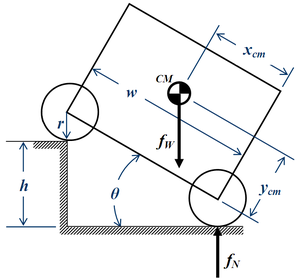
For front-to-back stability, the maximum height of an obstacle which an unarticulated wheeled vehicle can climb is a function of the wheelbase
Wheelbase
In both road and rail vehicles, the wheelbase is the distance between the centers of the front and rear wheels.- Road :In automobiles, the wheelbase is the horizontal distance between the center of the front wheel and the center of the rear wheel...
and the horizontal and vertical position of the center of mass
Center of mass
In physics, the center of mass or barycenter of a system is the average location of all of its mass. In the case of a rigid body, the position of the center of mass is fixed in relation to the body...
(CM).
The critical angle is the angle at which the center of mass of the vehicle begins to pass outside of the contact points of the wheels. Past the critical angle, the reaction forces at the wheels can no longer counteract the moment
Moment (physics)
In physics, the term moment can refer to many different concepts:*Moment of force is the tendency of a force to twist or rotate an object; see the article torque for details. This is an important, basic concept in engineering and physics. A moment is valued mathematically as the product of the...
created by the vehicle's weight, and the vehicle will tip over. At the critical angle, the vehicle is marginally stable. The critical angle
 can be found by solving the equation:
where
 is the horizontal distance (on level terrain) of the center of mass from the lower axle; and
 is the vertical distance (on level terrain) of the center of mass from lower axle.
The maximum height
 of an obstacle can thus be found by the equation:
where
 is the wheelbase.
Alternatives
While wheels are very widely used for ground transport, there are alternatives, some of which are suitable for terrain where wheels are ineffective. Alternative methods for ground transport without wheels (wheel-less transport) include:- Being raised by electromagnetic energy (maglev trainMaglev trainMaglev , is a system of transportation that uses magnetic levitation to suspend, guide and propel vehicles from magnets rather than using mechanical methods, such as friction-reliant wheels, axles and bearings...
and other vehicles) - Dragging with runners (sledSledA sled, sledge, or sleigh is a land vehicle with a smooth underside or possessing a separate body supported by two or more smooth, relatively narrow, longitudinal runners that travels by sliding across a surface. Most sleds are used on surfaces with low friction, such as snow or ice. In some cases,...
) or without (travoisTravoisA travois is a frame used by indigenous peoples, notably the Plains Indians of North America, to drag loads over land...
) - Being raised by air pressure (hovercraftHovercraftA hovercraft is a craft capable of traveling over surfaces while supported by a cushion of slow moving, high-pressure air which is ejected against the surface below and contained within a "skirt." Although supported by air, a hovercraft is not considered an aircraft.Hovercraft are used throughout...
) - RidingEquestrianismEquestrianism more often known as riding, horseback riding or horse riding refers to the skill of riding, driving, or vaulting with horses...
an animalWorking animalA working animal is an animal, usually domesticated, that is kept by humans and trained to perform tasks. They may be close members of the family, such as guide or service dogs, or they may be animals trained strictly to perform a job, such as logging elephants. They may also be used for milk, a...
such as a horseHorseThe horse is one of two extant subspecies of Equus ferus, or the wild horse. It is a single-hooved mammal belonging to the taxonomic family Equidae. The horse has evolved over the past 45 to 55 million years from a small multi-toed creature into the large, single-toed animal of today... - Human powered:
- WalkWALKWALK may refer to:*WALK , a radio station licensed to East Patchogue, New York, United States*WALK-FM, a radio station licensed to Patchogue, New York, United States...
ing on one's own legs - Being carried (litter/sedan chairLitter (vehicle)The litter is a class of wheelless vehicles, a type of human-powered transport, for the transport of persons. Examples of litter vehicles include lectica , jiao [较] , sedan chairs , palanquin , Woh , gama...
or stretcherStretcherA stretcher is a medical device used to carry casualties or an incapacitated person from one place to another. It is a simple type of litter, and still called by that name in some cases....
)
- Walk
- A walking machine
- Caterpillar tracks (although it is still operated by wheels)
- Pedrail wheels, using aspects of both wheel and caterpillar track
- SphereSphereA sphere is a perfectly round geometrical object in three-dimensional space, such as the shape of a round ball. Like a circle in two dimensions, a perfect sphere is completely symmetrical around its center, with all points on the surface lying the same distance r from the center point...
s, as used by Dyson vacuum cleaners and hamster ballHamster ballHamster balls are hollow spheres made of clear plastic into which hamsters, gerbils, degus and other small rodent pets are placed, allowing them to run around outside their cages without the risk of running away, getting lost under furniture or in walls...
s
In semiotics

Chakra
Chakra is a concept originating in Hindu texts, featured in tantric and yogic traditions of Hinduism and Buddhism. Its name derives from the Sanskrit word for "wheel" or "turning" .Chakra is a concept referring to wheel-like vortices...
, reincarnation
Reincarnation
Reincarnation best describes the concept where the soul or spirit, after the death of the body, is believed to return to live in a new human body, or, in some traditions, either as a human being, animal or plant...
, Yin and Yang
Yin and yang
In Asian philosophy, the concept of yin yang , which is often referred to in the West as "yin and yang", is used to describe how polar opposites or seemingly contrary forces are interconnected and interdependent in the natural world, and how they give rise to each other in turn. Opposites thus only...
among others). As such and because of the difficult terrain, wheeled vehicles were forbidden in old Tibet
History of Tibet
Tibetan history, as it has been recorded, is particularly focused on the history of Buddhism in Tibet. This is partly due to the pivotal role this religion has played in the development of Tibetan, Mongol, and Manchu cultures, and partly because almost all native historians of the country were...
.
The winged wheel is a symbol of progress, seen in many contexts including the coat of arms of Panama
Coat of arms of Panama
The Panamanian coat of arms is a heraldic symbol for the Central American nation of Panama. These arms were adopted provisionally and then definitively by the same laws that adopted the Panamanian flag.-Description:...
and the logo of the Ohio State Highway Patrol
Ohio State Highway Patrol
The Ohio State Highway Patrol is a division of the Ohio Department of Public Safety and is the official highway patrol agency of Ohio. The several missions of the Patrol include providing roadway patrol, emergency response to all public lands, the investigation of crimes which occur on state...
.
The introduction of spoked (chariot
Chariot
The chariot is a type of horse carriage used in both peace and war as the chief vehicle of many ancient peoples. Ox carts, proto-chariots, were built by the Proto-Indo-Europeans and also built in Mesopotamia as early as 3000 BC. The original horse chariot was a fast, light, open, two wheeled...
) wheels in the Middle Bronze Age appear to have carried somewhat of a prestige. The sun cross
Sun cross
The sun cross, also known as the wheel cross, Odin's cross, or Woden's cross, a cross inside a circle, is a common symbol in artifacts of the Americas and Prehistoric Europe, particularly during the Neolithic to Bronze Age periods.-Stone Age:...
appears to have a significance in Bronze Age religion, replacing the earlier concept of a Solar barge with the more "modern" and technologically advanced solar chariot.
The wheel is also the prominent figure on the flag of India
Flag of India
The National flag of India is a horizontal rectangular tricolour of deep saffron, white and India green; with the Ashok Chakra, a 24-spoke wheel, in navy blue at its centre. It was adopted in its present form during a meeting of the Constituent Assembly held on 22 July 1947, when it became the...
. The wheel in this case represents law (dharma
Dharma
Dharma means Law or Natural Law and is a concept of central importance in Indian philosophy and religion. In the context of Hinduism, it refers to one's personal obligations, calling and duties, and a Hindu's dharma is affected by the person's age, caste, class, occupation, and gender...
). It also appears in the flag of the Romani people, hinting to their nomadic history and their Indian origins. The wheel can also appears in the flag of Mair kshatriyas
Mair kshatriyas
Mair Kshatriyas have their ancestry in the the Lord Brahama dynasty king Ajmenid. According to Bhagvata and Vishnu Puran, Medes or Mair Kshatriyas are one of the oldest warriors of Aryan origin...
Kings (kattiri buvana maha radun).
See also
- Alloy wheelAlloy wheelAlloy wheels are automobile wheels which are made from an alloy of aluminium or magnesium. They are typically lighter for the same strength...
- Artillery wheelArtillery wheelThe artillery wheel was developed for use on gun carriages when it was found that the lateral forces involved in horse artillery manoeuvres caused normally-constructed cart wheels to collapse. Rather than having its spokes mortised into a wooden nave , it has them fitted together then bolted into...
- AxleAxleAn axle is a central shaft for a rotating wheel or gear. On wheeled vehicles, the axle may be fixed to the wheels, rotating with them, or fixed to its surroundings, with the wheels rotating around the axle. In the former case, bearings or bushings are provided at the mounting points where the axle...
- Bicycle wheelBicycle wheelA bicycle wheel is a wheel, most commonly a wire wheel, designed for bicycle. A pair is often called a wheelset, especially in the context of ready built "off the shelf" performance-oriented wheels....
- Big wheel
- Breaking wheelBreaking wheelThe breaking wheel, also known as the Catherine wheel or simply the wheel, was a torture device used for capital punishment in the Middle Ages and early modern times for public execution by bludgeoning to death...
, a form of tortureTortureTorture is the act of inflicting severe pain as a means of punishment, revenge, forcing information or a confession, or simply as an act of cruelty. Throughout history, torture has often been used as a method of political re-education, interrogation, punishment, and coercion... - CasterCasterA caster is an undriven, single, double, or compound wheel that is designed to be mounted to the bottom of a larger object so as to enable that object to be easily moved...
- cdCompact DiscThe Compact Disc is an optical disc used to store digital data. It was originally developed to store and playback sound recordings exclusively, but later expanded to encompass data storage , write-once audio and data storage , rewritable media , Video Compact Discs , Super Video Compact Discs ,...
- Color wheelColor wheelA color wheel or color circle is an abstract illustrative organization of color hues around a circle that shows relationships between primary colors, secondary colors, complementary colors, etc....
- Pressed Steel wheelDisteelDisteel brand pressed-steel automobile wheels were manufactured by the Detroit Pressed Steel Company, and were introduced in 1917 as an alternative to wooden artillery wheels with demountable rims. Pressed steel wheels were an alternative to fragile wooden wheels which would crack on impact with...
- Driving wheelDriving wheelOn a steam locomotive, a driving wheel is a powered wheel which is driven by the locomotive's pistons...
- Ferris wheelFerris wheelA Ferris wheel is a nonbuilding structure consisting of a rotating upright wheel with passenger cars attached to the rim in such a way that as the wheel turns, the cars are kept upright, usually by gravity.Some of the largest and most modern Ferris wheels have cars mounted on...
- The Horse, The Wheel and LanguageThe Horse, The Wheel and LanguageThe Horse, The Wheel and Language is a book by David W. Anthony, which won the Society for American Archaeology's 2010 Book Award.The book explores the origins of Indo-European languages in the context of the domestication of the horse and invention of the wheel.The book tries to explain the...
(book) - Hubless wheelHubless wheelA hubless wheel is a type of wheel with no center hub. To be precise, however, the hub is actually almost as big as the wheel itself. The axle is hollow, following the wheel at very close tolerances...
- Magnetic levitationMagnetic levitationMagnetic levitation, maglev, or magnetic suspension is a method by which an object is suspended with no support other than magnetic fields...
- Mansell wheelMansell WheelThe Mansell Wheel is a railway wheel patented by Richard Mansell, the Carriage and Wagon superintendent of the South Eastern Railway in the UK.Dendy Marshall, C.F., History of the Southern Railway, Ian Allan 1963, ISBN 0 7110 0059 X The design was created in the 1840s and was eventually widely used...
- Mecanum wheelMecanum wheelThe Mecanum wheel is one design for a wheel which can move in any direction. It is sometimes called the Ilon wheel after its Swedish inventor, Bengt Ilon, who came up with the idea in 1973 when he was an engineer with the Swedish company Mecanum AB....
- Omni wheelOmni wheelOmni wheels or poly wheels, similar to Mecanum wheels, are wheels with small discs around the circumference which are perpendicular to the rolling direction. The effect is that the wheel will roll with full force, but will also slide laterally with great ease...
- Reinventing the wheelReinventing the wheelTo reinvent the wheel is to duplicate a basic method that has already previously been created or optimized by others.The inspiration for this idiomatic metaphor lies in the fact that the wheel is the archetype of human ingenuity, both by virtue of the added power and flexibility it affords its...
- RimRim (wheel)The rim of a wheel is the outer circular design of the metal on which the inside edge of the tire is mounted on vehicles such as automobiles. For example, on a bicycle wheel the rim is a large hoop attached to the outer ends of the spokes of the wheel that holds the tire and tube.In the 1st...
- Rolling resistance, r. friction, r. dragRolling resistanceRolling resistance, sometimes called rolling friction or rolling drag, is the resistance that occurs when a round object such as a ball or tire rolls on a flat surface, in steady velocity straight line motion. It is caused mainly by the deformation of the object, the deformation of the surface, or...
- Rotating locomotion in living systems
- Ship's wheelShip's wheelA ship's wheel is the modern method of adjusting the angle of a boat or ship's rudder in order to cause the vessel to change its course. Together with the rest of the steering mechanism it forms part of the helm. It is typically connected to a mechanical, electric servo, or hydraulic system...
- Simple machineSimple machineA simple machine is a mechanical device that changes the direction or magnitude of a force.In general, they can be defined as the simplest mechanisms that use mechanical advantage to multiply force. A simple machine uses a single applied force to do work against a single load force...
- Square wheelSquare wheelA square wheel is a wheel that, instead of being circular, has the shape of a square. While literal square wheels exist, a more common use is as a metaphor meaning stereotypically bad or naïve engineering ....
- Steering wheelSteering wheelA steering wheel is a type of steering control in vehicles and vessels ....
- Terrestrial locomotion in animals: Rolling
- TireTireA tire or tyre is a ring-shaped covering that fits around a wheel rim to protect it and enable better vehicle performance by providing a flexible cushion that absorbs shock while keeping the wheel in close contact with the ground...
- TweelTweelThe Tweel is an experimental tire design developed by the French tire company Michelin. The tire uses no air, and therefore cannot burst or become flat...
- Wagon-wheel effectWagon-wheel effectThe wagon-wheel effect is an optical illusion in which a spoked wheel appears to rotate differently from its true rotation. The wheel can appear to rotate more slowly than the true rotation, it can appear stationary, or it can appear to rotate in the opposite direction from the true rotation...
- WheelbarrowWheelbarrowA wheelbarrow is a small hand-propelled vehicle, usually with just one wheel, designed to be pushed and guided by a single person using two handles to the rear, or by a sail to push the ancient wheelbarrow by wind. The term "wheelbarrow" is made of two words: "wheel" and "barrow." "Barrow" is a...
- Wheel and axleWheel and axleThe wheel and axle is one of six simple machines developed in ancient times and is in the category of a second- or third-class lever. In its simplest form it consists of a rod attached to a wheel so that their movements are coupled when one of the parts is turned...
- Wheel sizingWheel sizingThe wheel size for a motor vehicle or similar wheel has a number of parameters.-Bolt pattern:The bolt pattern is the number of lug nuts or wheel studs on the wheel hub. As the bolts are most often evenly spaced, the number of bolts determines the pattern. For example: smaller cars have three...
- Wire wheelsWire wheelsThe rims of wire wheels are connected to their hubs by wire spokes. Although these wires are generally stiffer than a typical wire rope, they function mechanically the same as tensioned flexible wires, keeping the rim true while supporting applied loads.Wire wheels are used on most bicycles and...
- Wheel of Fortune
- Wheelset (rail transport)