Home      Discussion      Topics      Dictionary      Almanac
Signup       Login
Lake Van

Lake Van

Overview
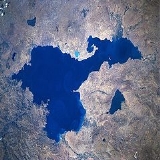
Lake Van is the largest lake in Turkey, located in the far east of the country in Van district. It is a saline and soda lake, receiving water from numerous small streams that descend from the surrounding mountains. Lake Van is one of the world's largest endorheic lakes (having no outlet). The original outlet from the basin was blocked by an ancient volcanic eruption. Although Lake Van is situated at an altitude of 1640 m (5,380.6 ft) with harsh winters, it does not freeze due to its high salinity except occasionally the shallow northern section.
Discussion
Ask a question about 'Lake Van'
Start a new discussion about 'Lake Van'
Answer questions from other users
Full Discussion Forum
 
Unanswered Questions
Encyclopedia
Lake Van is the largest lake in Turkey, located in the far east of the country in Van district. It is a saline and soda lake, receiving water from numerous small streams that descend from the surrounding mountains. Lake Van is one of the world's largest endorheic lakes (having no outlet). The original outlet from the basin was blocked by an ancient volcanic eruption. Although Lake Van is situated at an altitude of 1640 m (5,380.6 ft) with harsh winters, it does not freeze due to its high salinity except occasionally the shallow northern section.

Hydrology and chemistry


Lake Van is 119 kilometres (73.9 mi) across at its widest point, averaging a depth of 171 metres (561 ft) with a maximum recorded depth of 451 metres (1,479.7 ft). The lake surface lies 1640 metres (5,380.6 ft) above sea level and the shore length is 430 kilometres (267.2 mi). Lake Van has an area of 3755 km² (1,449.8 sq mi) and a volume of 607 cubic kilometres (145.6 cu mi).

The western portion of the lake is deepest, with a large basin deeper than 400 m (1,312.3 ft) lying northeast of Tatvan
Tatvan
Tatvan is a city at the western end of Lake Van, and is the regional center of the identically-named district within Bitlis Province in eastern Turkey. It has about 96,000 inhabitants. The mayor is Abdullah Ok .- Transport :...

 and south of Ahlat
Ahlat
Ahlat is a historic town and a district in Turkey's Bitlis Province in Eastern Anatolia Region. The center town of Ahlat is situated on the northwestern coast of the Lake Van. She was the district in Van Province between 1929-1936...

. The eastern arms of the lake are shallower. The Van-Ahtamar portion shelves gradually, with a maximum depth of about 250 m (820.2 ft) on its northwest side where it joins the rest of the lake. The Erciş arm is much shallower, mostly less than 50 m (164 ft), with a maximum depth of about 150 m (492.1 ft).

The lake water is strongly alkaline (pH
PH
In chemistry, pH is a measure of the acidity or basicity of an aqueous solution. Pure water is said to be neutral, with a pH close to 7.0 at . Solutions with a pH less than 7 are said to be acidic and solutions with a pH greater than 7 are basic or alkaline...

 9.7–9.8) and rich in sodium carbonate
Sodium carbonate
Sodium carbonate , Na2CO3 is a sodium salt of carbonic acid. It most commonly occurs as a crystalline heptahydrate, which readily effloresces to form a white powder, the monohydrate. Sodium carbonate is domestically well-known for its everyday use as a water softener. It can be extracted from the...

 and other salts, which are extracted by evaporation and used as detergent
Detergent
A detergent is a surfactant or a mixture of surfactants with "cleaning properties in dilute solutions." In common usage, "detergent" refers to alkylbenzenesulfonates, a family of compounds that are similar to soap but are less affected by hard water...

s.

Geology


The lake's outlet was blocked at some time during the Pleistocene
Pleistocene
The Pleistocene is the epoch from 2,588,000 to 11,700 years BP that spans the world's recent period of repeated glaciations. The name pleistocene is derived from the Greek and ....

, when lava flows from Nemrut
Nemrut (volcano)
Nemrut is a dormant volcano in Eastern Turkey, close to Lake Van, at .The volcano is named after King Nimrod who is said to have ruled this area in about 2100 BC.- Description :...

 volcano blocked westward outflow towards the Muş Plain
Mus Province
Muş Province is a province in eastern Turkey. It is 8,196 km² in area, and has a population of 406,886 . The population was 453,654 in 2000. The provincial capital is the city of Muş...

. Now dormant, Nemrut Dağı
Nemrut (volcano)
Nemrut is a dormant volcano in Eastern Turkey, close to Lake Van, at .The volcano is named after King Nimrod who is said to have ruled this area in about 2100 BC.- Description :...

 is close to the western shore of the lake, and another dormant stratovolcano
Stratovolcano
A stratovolcano, also known as a composite volcano, is a tall, conical volcano built up by many layers of hardened lava, tephra, pumice, and volcanic ash. Unlike shield volcanoes, stratovolcanoes are characterized by a steep profile and periodic, explosive eruptions...

, Süphan Dağı
Mount Süphan
Mount Süphan , is a stratovolcano located in eastern Turkey, immediately north of Lake Van. It is the second highest volcano in Turkey, after the mount Ararat.-External links:*...

 dominates the northern side of the lake.

The water level of the lake has often altered dramatically: near Tatvan, Oswald (see Geology of Armenia, 1901) noted a raised beach high above the present level of the lake as well as recently drowned trees. Investigation by Degens and others in the early 1980s determined that the highest lake levels (72 metres (236.2 ft) above the current height) had been during the last ice age, about 18,000 years ago. About 9,500 years ago there was a dramatic drop to more than 300 metres (984.3 ft) below the present level. This was followed by an equally dramatic rise around 6,500 years ago.

Similar but smaller fluctuations have been seen recently. The level of the lake rose by at least three metres during the 1990s, drowning much agricultural land, and (after a brief period of stability and then retreat) seems to be rising again. The level rose about two meters in the ten years immediately prior to 2004.

As a deep lake with no outlet, Lake Van has accumulated great amounts of sediment washed in from surrounding plains and valleys, and occasionally deposited as ash from eruptions of nearby volcanoes.
This layer of sediment is estimated to be up to 400 metres (1,312.3 ft) thick in places, and has attracted climatologists and vulcanologists interested in drilling cores to examine the layered sediments.

In 1989 and 1990, an international team of geologists led by Dr. Stephan Kempe from the University of Hamburg (now Professor at the Technische Universität Darmstadt) retrieved ten sediment cores from depths up to 446 m (1,463.3 ft). Although these cores only penetrated the first few meters of sediment, they provided sufficient varves to give proxy climate data for up to 14,570 years BP
Before Present
Before Present years is a time scale used in archaeology, geology, and other scientific disciplines to specify when events in the past occurred. Because the "present" time changes, standard practice is to use AD 1950 as the origin of the age scale, reflecting the fact that radiocarbon...

.

A team of scientists headed by palaeontologist Professor Thomas Litt at the University of Bonn
University of Bonn
The University of Bonn is a public research university located in Bonn, Germany. Founded in its present form in 1818, as the linear successor of earlier academic institutions, the University of Bonn is today one of the leading universities in Germany. The University of Bonn offers a large number...

 has applied for funding from the International Continental Scientific Drilling Program
International Continental Scientific Drilling Program
The International Continental Scientific Drilling Program is a multinational program to further and fund geosciences in the field of Continental Scientific Drilling. Scientific drilling is a critical tool in understanding of Earth processes and structure. It provides direct insight into Earth...

 (ICDP) for a new, deeper drilling project to examine the lake's sediments. Litt expects to find that "Lake Van stores the climate history of the last 800,000 years—an incomparable treasure house of data which we want to tap for at least the last 500,000 years." A test drilling in 2004 detected evidence of 15 volcanic eruptions in the past 20,000 years.

Climate


Lake Van is situated in the highest and largest region
Eastern Anatolia Region
The Eastern Anatolia Region is one of seven non-administrative subdivisions of Turkey and encompasses its eastern provinces.The region and the name "Doğu Anadolu Bölgesi" were first defined at the First Geography Congress in 1941. It has the highest average altitude, largest geographical area, and...

 of Turkey, which has a harsh continental climate
Continental climate
Continental climate is a climate characterized by important annual variation in temperature due to the lack of significant bodies of water nearby...

. Average temperatures in July are between 22 and 25 °C, and in January between -3 °C to -12 °C. In particularly cold winter nights the temperature reaches -30 °C. Lake Van mitigates the climate somewhat, so in the city of Van, on the shore of the lake, the average temperature in July is 22.5 °C, and in January -3.5 °C. The average annual rainfall in the basin of Lake Van, ranges from 400 to 700 mm.

Ecology


The only fish known to live in the brackish water
Brackish water
Brackish water is water that has more salinity than fresh water, but not as much as seawater. It may result from mixing of seawater with fresh water, as in estuaries, or it may occur in brackish fossil aquifers. The word comes from the Middle Dutch root "brak," meaning "salty"...

 of Lake Van is Chalcalburnus tarichi the Pearl Mullet or inci kefalı, a Cyprinid
Cyprinid
The family Cyprinidae, from the Ancient Greek kyprînos , consists of the carps, the true minnows, and their relatives . Commonly called the carp family or the minnow family, its members are also known as cyprinids...

 fish related to chub
European chub
The European chub , sometimes called the round chub, fat chub, chevin, pollard or simply "the" chub, is a freshwater fish of the family Cyprinidae...

 and dace
Common dace
The common dace , also known as the dace or the Eurasian dace, is a fresh- or brackish-water fish belonging to the family Cyprinidae. It is an inhabitant of the rivers and streams of Europe north of the Alps as well as in Asia. It is most abundant in France and Germany, and has also spread to...

, which is caught during the spring floods. In May and June, these fish migrate from the lake to less alkaline water, spawning either near the mouths of the rivers feeding the lake or in the rivers themselves. After spawning season it returns to the lake.

103 species of phytoplankton
Phytoplankton
Phytoplankton are the autotrophic component of the plankton community. The name comes from the Greek words φυτόν , meaning "plant", and πλαγκτός , meaning "wanderer" or "drifter". Most phytoplankton are too small to be individually seen with the unaided eye...

 have been recorded in the lake including flagellate
Flagellate
Flagellates are organisms with one or more whip-like organelles called flagella. Some cells in animals may be flagellate, for instance the spermatozoa of most phyla. Flowering plants do not produce flagellate cells, but ferns, mosses, green algae, some gymnosperms and other closely related plants...

s, diatom
Diatom
Diatoms are a major group of algae, and are one of the most common types of phytoplankton. Most diatoms are unicellular, although they can exist as colonies in the shape of filaments or ribbons , fans , zigzags , or stellate colonies . Diatoms are producers within the food chain...

s, bacteria, cyanobacteria, green algae
Green algae
The green algae are the large group of algae from which the embryophytes emerged. As such, they form a paraphyletic group, although the group including both green algae and embryophytes is monophyletic...

 and brown algae
Brown algae
The Phaeophyceae or brown algae , is a large group of mostly marine multicellular algae, including many seaweeds of colder Northern Hemisphere waters. They play an important role in marine environments, both as food and for the habitats they form...

. 36 species of zooplankton
Zooplankton
Zooplankton are heterotrophic plankton. Plankton are organisms drifting in oceans, seas, and bodies of fresh water. The word "zooplankton" is derived from the Greek zoon , meaning "animal", and , meaning "wanderer" or "drifter"...

 have also been recorded including Rotatoria, Cladocera
Cladocera
Cladocera is an order of small crustaceans commonly called water fleas. Around 620 species have been recognised so far, with many more undescribed. They are ubiquitous in inland aquatic habitats, but rare in the oceans. Most are long, with a down-turned head, and a carapace covering the apparently...

 and Copepoda in the lake.

In 1991, researchers reported the discovery of 40 m (131.2 ft) tall microbialites
Stromatolite
Stromatolites or stromatoliths are layered accretionary structures formed in shallow water by the trapping, binding and cementation of sedimentary grains by biofilms of microorganisms, especially cyanobacteria ....

 in Lake Van. These are solid towers on the lake bed created by mats of coccoid cyanobacteria (Pleurocapsa group) that create aragonite
Aragonite
Aragonite is a carbonate mineral, one of the two common, naturally occurring, crystal forms of calcium carbonate, CaCO3...

 in combination with calcite
Calcite
Calcite is a carbonate mineral and the most stable polymorph of calcium carbonate . The other polymorphs are the minerals aragonite and vaterite. Aragonite will change to calcite at 380-470°C, and vaterite is even less stable.-Properties:...

 precipitating out of the lake water.

The Lake Van region is the home of the rare Van Cat
Van Cat
The Van Cat is a distinctive breed of domestic cat that is found mainly in the Lake Van region of eastern Turkey. It is large, all-white, and frequently odd eyed.- History :...

 breed of cat, noted for among other things its unusual fascination with water.

Since about 1995 there have been reported sightings of a 'Lake Van monster'
Lake Van Monster
The Lake Van Monster is a legendary creature that allegedly lives in Turkey.235px|right|thumb|Lake Van-History:The Lake Van Monster was not reported until 1995 in Lake Van, a large alkaline lake in Eastern Turkey...

 about 15 metres (49.2 ft) in length named Van Gölü Canavarı ("Monster of Lake Van").

The lake is surrounded by fruit and grain
Cereal
Cereals are grasses cultivated for the edible components of their grain , composed of the endosperm, germ, and bran...

-growing agricultural areas.

History


Tushpa
Tushpa
Tushpa was the 9th century BC capital of Urartu, later becoming known as Van which is derived from Biaina the native name of Urartu...

, the capital of Urartu
Urartu
Urartu , corresponding to Ararat or Kingdom of Van was an Iron Age kingdom centered around Lake Van in the Armenian Highland....

, was located near the shores of Lake Van, on the site of what became medieval Van's castle, west of present-day Van city. The ruins of the medieval city of Van are still visible below the southern slopes of the rock on which Van Castle is located.

Armenian kingdoms


The lake was the centre of the Armenian
Armenians
Armenian people or Armenians are a nation and ethnic group native to the Armenian Highland.The largest concentration is in Armenia having a nearly-homogeneous population with 97.9% or 3,145,354 being ethnic Armenian....

 kingdom of Ararat
Urartu
Urartu , corresponding to Ararat or Kingdom of Van was an Iron Age kingdom centered around Lake Van in the Armenian Highland....

 from about 1000 BC, afterwards of the Satrapy of Armina, Kingdom of Greater Armenia, and the Armenian Kingdom of Vaspurakan
Vaspurakan
Vaspurakan was the first and biggest province of Greater Armenia, which later became an independent kingdom during the Middle Ages, centered around Lake Van...

.

Along with Lake Sevan
Lake Sevan
Lake Sevan is the largest lake in Armenia and the Caucasus region. It is one of the largest high-altitude lakes in the world.Lake Sevan is situated in the central part of the Republic of Armenia, inside the Gegharkunik Province, at the altitude of 1,900m above sea level...

 in today's Armenia
Armenia
Armenia , officially the Republic of Armenia , is a landlocked mountainous country in the Caucasus region of Eurasia...

 and Lake Urmia
Lake Urmia
Lake Urmia , ancient name: Lake Matiene) is a salt lake in northwestern Iran, near Iran's border with Turkey. The lake is between the Iranian provinces of East Azerbaijan and West Azerbaijan, west of the southern portion of the similarly shaped Caspian Sea...

 in today's Iran
Iran
Iran , officially the Islamic Republic of Iran , is a country in Southern and Western Asia. The name "Iran" has been in use natively since the Sassanian era and came into use internationally in 1935, before which the country was known to the Western world as Persia...

, Van was one of the three great lakes of the Armenian Kingdom, referred to as the seas of Armenia
Armenia
Armenia , officially the Republic of Armenia , is a landlocked mountainous country in the Caucasus region of Eurasia...

(in ancient Assyrian sources: "tâmtu ša mât Nairi" (Upper Sea of Nairi
Nairi
Nairi is an Armenian given name, it may also refer to:*Nairi, Armenian tribe.*Nairi , an informal synonym for Armenia, which in turn gave rise to a number of modern usages:*The town of Hatsik, Armavir was called Nairi from 1963 till 1991...

), the Lower Sea being Lake Urmia
Lake Urmia
Lake Urmia , ancient name: Lake Matiene) is a salt lake in northwestern Iran, near Iran's border with Turkey. The lake is between the Iranian provinces of East Azerbaijan and West Azerbaijan, west of the southern portion of the similarly shaped Caspian Sea...

). Over time, the lake was known by various Armenian names, including .

Byzantine empire


By the 11th century the region around Lake Van was on the border between the Byzantine
Byzantine
Byzantine usually refers to the Roman Empire during the Middle Ages.Byzantine may also refer to:* A citizen of the Byzantine Empire, or native Greek during the Middle Ages...

 empire, with its capital at Constantinople
Constantinople
Constantinople was the capital of the Roman, Eastern Roman, Byzantine, Latin, and Ottoman Empires. Throughout most of the Middle Ages, Constantinople was Europe's largest and wealthiest city.-Names:...

, and the Seljuk
Great Seljuq Empire
The Great Seljuq Empire was a medieval Persianate, Turko-Persian Sunni Muslim empire, originating from the Qynyq branch of Oghuz Turks. The Seljuq Empire controlled a vast area stretching from the Hindu Kush to eastern Anatolia and from Central Asia to the Persian Gulf...

 Turkish empire, with its capital at Isfahan. In the uneasy peace between the two empires, local Armenian-Byzantine landowners employed Turcoman
Turkmen people
The Turkmen are a Turkic people located primarily in the Central Asian states of Turkmenistan, Afghanistan, and northeastern Iran. They speak the Turkmen language, which is classified as a part of the Western Oghuz branch of the Turkic languages family together with Turkish, Azerbaijani, Qashqai,...

 gazis and Byzantine akritoi
Akritoi
The Akritai is a term used in the Byzantine Empire in the 9th-11th centuries to denote the army units guarding the Empire's eastern border, facing the Muslim states of the Middle East...

 for protection.

In the second half of the 11th century Emperor Romanus IV Diogenes launched a campaign to re-conquer Armenia and head off growing Seljuk control. Diogenes and his large army crossed the Euphrates
Euphrates
The Euphrates is the longest and one of the most historically important rivers of Western Asia. Together with the Tigris, it is one of the two defining rivers of Mesopotamia...

 and confronted a much smaller Seljuk force led by Alp Arslan
Alp Arslan
Alp Arslan was the third sultan of the Seljuq dynasty and great-grandson of Seljuk, the eponymous founder of the dynasty...

 at the Battle of Manzikert
Battle of Manzikert
The Battle of Manzikert , was fought between the Byzantine Empire and Seljuq Turks led by Alp Arslan on August 26, 1071 near Manzikert...

, north of Lake Van on 26 August 1071. Despite their greater numbers, the cumbersome Byzantine force was defeated by the more mobile Turkish horsemen and Diogenes was captured.

Seljuk empire


Alp Arslan
Alp Arslan
Alp Arslan was the third sultan of the Seljuq dynasty and great-grandson of Seljuk, the eponymous founder of the dynasty...

 divided the conquered eastern portions of the Byzantine empire among his Turcoman generals, with each ruled as a hereditary bey
Bey
Bey is a title for chieftain, traditionally applied to the leaders of small tribal groups. Accoding to some sources, the word "Bey" is of Turkish language In historical accounts, many Turkish, other Turkic and Persian leaders are titled Bey, Beg, Bek, Bay, Baig or Beigh. They are all the same word...

lik, under overall sovereignty of the Great Seljuq Empire
Great Seljuq Empire
The Great Seljuq Empire was a medieval Persianate, Turko-Persian Sunni Muslim empire, originating from the Qynyq branch of Oghuz Turks. The Seljuq Empire controlled a vast area stretching from the Hindu Kush to eastern Anatolia and from Central Asia to the Persian Gulf...

. Alp Arslan gave the region around Lake Van to his commander Sökmen el Kutbî (literally Sökmen the Slave), who set up his capital at Ahlat on the western side of the lake. The dynasty of Ahlatshahs
Ahlatshahs
Ahlahshahs were the 11th-12th century rulers of an Anatolian beylik of the first period founded after the Battle of Manzikert, and centered in Ahlat on the northwestern shore of the Lake Van in Eastern Anatolia...

 (also known as Sökmenler) ruled this area from 1085 to 1192.

The Ahlatshahs were succeeded by the Ayyubid dynasty.

Architecture


Near the Van Castle and the southern shore, on Akdamar Island
Akdamar Island
Akdamar Island also known as Aght'amar or Akhtamar, is the second by size of four islands in Lake Van in the south of Eastern Anatolia Region, Turkey, about 0.7 km2 in size, situated about 3 km from the shoreline. At the western end of the island a hard, grey, limestone cliff rises 80 m...

 lies the 10th century Church of the Holy Cross , which served as a royal church to the Armenian Vaspurakan
Vaspurakan
Vaspurakan was the first and biggest province of Greater Armenia, which later became an independent kingdom during the Middle Ages, centered around Lake Van...

 kingdom. The ruins of Armenian monasteries also exist on the other three islands of Lake Van: Lim, Arter, and Ktuts. The area around Lake Van was also the home to a large number Armenian monasteries, among the most prominent of these being the 10th century Narekavank
Narekavank
Narekavank ) was a tenth century Armenian monastery in the Vaspurakan province of historical Armenia near the southern shores of Lake Van . It was founded during the reign of King Gagik I of the kingdom of Vaspurakan...

 and the 11th century Varagavank
Varagavank
Varagavank , also known as Yedi Kilise , was a prominent Armenian monastery founded in the 11th century on the slopes of Mount Varag 9 km east of the city of Van in Turkey's Eastern Anatolia region....

, both now destroyed.

The Ahlatshahs left a large number of historic tombstones in and around the town of Ahlat
Ahlat
Ahlat is a historic town and a district in Turkey's Bitlis Province in Eastern Anatolia Region. The center town of Ahlat is situated on the northwestern coast of the Lake Van. She was the district in Van Province between 1929-1936...

. Local administrators are currently trying to have the tombstones included in UNESCO
UNESCO
The United Nations Educational, Scientific and Cultural Organization is a specialized agency of the United Nations...

's World Heritage List, where they are currently listed tentatively.

Transportation


The railway connecting Turkey and Iran
Iran
Iran , officially the Islamic Republic of Iran , is a country in Southern and Western Asia. The name "Iran" has been in use natively since the Sassanian era and came into use internationally in 1935, before which the country was known to the Western world as Persia...

 built in the 1970s uses a train ferry
Train ferry
A train ferry is a ship designed to carry railway vehicles. Typically, one level of the ship is fitted with railway tracks, and the vessel has a door at the front and/or rear to give access to the wharves. In the United States, train ferries are sometimes referred to as "car ferries", as...

 across Lake Van between the cities Tatvan
Tatvan
Tatvan is a city at the western end of Lake Van, and is the regional center of the identically-named district within Bitlis Province in eastern Turkey. It has about 96,000 inhabitants. The mayor is Abdullah Ok .- Transport :...

 and Van, rather than building railway tracks around the rugged shore line. Transfer from train to ship and back again limits the total carrying capacity.

In May, 2008 talks started between Iran and Turkey to replace the ferry with a double track electrified railway.

Further reading