


Kadesh

Encyclopedia
This article is about Kadesh in the lands of the Amurru, bordering on Damascus Syria up to Hammath; see also Kadesh (South of Israel)
or Kedesh
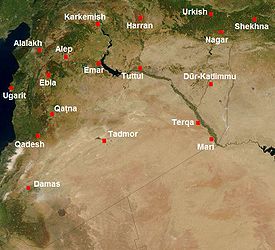 Kadesh (also Qadesh or Qadesh-on-the-Orontes; Hittite
: Kadeš
) was an ancient city
of the Levant
, located on or near the headwaters or ford of the Orontes River
. It is surmised by Kenneth Kitchen to be the ruins at Tell Nebi Mend, about 24 kilometres (14.9 mi) southwest of Homs
(ca. 34°35′N 36°31′E) near Al Qusayr in what is now western Syria
but is located in the text of the inscriptions at the Battle of Kadesh
as near Tunip
in the land of the Amurru. Kadesh was the target of military campaigns by most of the pharaohs of the Eighteenth dynasty of Egypt
and one of many outlying vassals won by the southerly encroachments of the Hittite Empire between 1500 and 1285 BC. Between 1504 and 1492 BC Thutmosis I campaigned north into Syria against the Mitanni a vassal of the Hittites and along with Aram an ally of Kadesh. In 1479 BC Thutmoses III fought against the king of Kadesh in the Battle of Megiddo. In the time of Hatshepsut
there were no campaigns against Kadesh as she was focused on developing trade across the Red Sea and southward. Although Amenophis II campaigned in the djadi from then on until the reign of Haremhab 1319-1307 for a century and a half Canaan
was in virtual rebellion and the Egyptians could do little about it. In 1306 BC Seti I
succeeded in taking the city. In 1274 BC, the fifth year of Ramesses' reign, he led a large force of chariot
s and infantry 1000 miles (1,609.3 km) to retake the walled city. In the Battle of Kadesh
, the two forces clashed in what is widely regarded as the largest chariot vs. chariot battle (5,000—6,000 between both sides) in history on the plain south of the city and west of the Orontes River.
ite cities (the other being Megiddo
) that led a coalition of city-state
s opposing the conquest of the Levant
by Thutmose III
. In mounting this opposition, Kadesh (known as Qidshu in the Akkadian language
Amarna letters
) was probably guided by the ruler of Mittani, Egypt's primary foreign rival in control of the Levant
. Defeat in the subsequent Battle of Megiddo
ultimately led to the extension of Egyptian hegemony over the city, as well as the rest of southern Syria. Correspondence between the ruler of Kadesh and the pharaoh Akhenaten
is preserved amongst the Amarna letters. The names of three kings of Kadesh survive from contemporary sources: Suttarna (fl. c. 1350 BC); Etakkama
(c. 1340s) and Ari-Teshub (fl. c. 1330-1325).
The city was captured by the great pharaoh Seti I
during his campaign to Syria. Kadesh had been lost to Egypt
since the time of Akhenaten
. Tutankhamun
and Horemheb
had both failed to recapture the city from the Hittites
. Seti I was successful here and defeated a Hittite army that tried to defend it. He triumphantly entered the city together with his son Ramesses II
and erected a victory stela at the site. His success was only temporary. As soon as Seti I
returned to Egypt, the Hittite king, Mursilis II, marched south to take Kadesh and make it a stronghold of the Hittite defenses in Syria
. The Hittites ruled through a viceroy in Carchemish
.
, staged between the superpowers of the 13th century BC
: the Egyptian
and the Hittite
Empires. An Egyptian vassal for approximately 150 years, Kadesh eventually defected to Hittite suzerainty
, thereby placing the city on the contested frontier between the two rival empires. In response to this Hittite ascendancy and expansion southwards, the Egyptian pharaoh Ramesses II
prepared an aggressive military response and captured the coastal state of Amurru
. The next year, the Hittites moved south to recover Amurru, while the Egyptians moved north to continue their expansion into Syria. The inhabitants of the city of Kadesh had cut a channel from the river to a stream south of town, which had turned the town into a virtual island. The subsequent battle, fought at Kadesh, very nearly witnessed an Egyptian military disaster. After Hittite spies convinced the Egyptians that the Hittites were further away than they were, the Hittites surprised the Egyptians in their own camp. The Egyptian army was only saved by the arrival of a supporting force from coastal Amurru
. Ramesses II was able to recover the initiative, and the two armies withdrew in stalemate, both claiming victory. Kadesh, however, remained under Hittite overlordship, Amurru returned to the Hittite fold, and the Hittite army continued its conquests southward as far as Upi, the territory around Damascus.
The subsequent impasse between Egypt and Hatti ultimately led to what is now recognised as one of the earliest surviving international peace treaties, concluded several decades later between Ramesses II and his Hittite counterpart, Hattusili III
.
in around 1178 BC. However, Hellenistic remains have been found in the upper levels of the tell (ruin-mound), and the summit is still occupied today. Continuous occupation throughout the Islamic period is likely, the mound having been named after a local Muslim saint or prophet, Nebi Mend. In Byzantine times, widespread occupation is evidenced by extensive remains at the foot of the tell, which is believed to represent the city of Laodicea ad Libanum
.
Kadesh (South of Israel)
Kadesh or Qadhesh in Classical , also known as Qadesh-Barneʿa , was a place in the south of Ancient Israel. The name "Kodesh" means holy. The name "Barnea" may mean desert of wandering...
or Kedesh
Kedesh
The ruins of the ancient Canaanite village of Kedesh are located within the modern Kibbutz Malkiya in Israel on the Israeli-Lebanese border....
Hittite language
Hittite is the extinct language once spoken by the Hittites, a people who created an empire centred on Hattusa in north-central Anatolia...
: Kadeš
Š
The grapheme Š, š is used in various contexts, usually denoting the voiceless postalveolar fricative. In the International Phonetic Alphabet this sound is denoted with , but the lowercase š is used in the Americanist phonetic notation, as well as in the Uralic Phonetic Alphabet.For use in computer...
) was an ancient city
Cities of the ancient Near East
The largest cities in the Bronze Age ancient Near East housed several tens of thousands. Memphis in the Early Bronze Age with some 30,000 inhabitants was the largest city of the time by far...
of the Levant
Levant
The Levant or ) is the geographic region and culture zone of the "eastern Mediterranean littoral between Anatolia and Egypt" . The Levant includes most of modern Lebanon, Syria, Jordan, Israel, the Palestinian territories, and sometimes parts of Turkey and Iraq, and corresponds roughly to the...
, located on or near the headwaters or ford of the Orontes River
Orontes River
The Orontes or ‘Āṣī is a river of Lebanon, Syria and Turkey.It was anciently the chief river of the Levant, also called Draco, Typhon and Axius...
. It is surmised by Kenneth Kitchen to be the ruins at Tell Nebi Mend, about 24 kilometres (14.9 mi) southwest of Homs
Homs
Homs , previously known as Emesa , is a city in western Syria and the capital of the Homs Governorate. It is above sea level and is located north of Damascus...
(ca. 34°35′N 36°31′E) near Al Qusayr in what is now western Syria
Syria
Syria , officially the Syrian Arab Republic , is a country in Western Asia, bordering Lebanon and the Mediterranean Sea to the West, Turkey to the north, Iraq to the east, Jordan to the south, and Israel to the southwest....
but is located in the text of the inscriptions at the Battle of Kadesh
Battle of Kadesh
The Battle of Kadesh took place between the forces of the Egyptian Empire under Ramesses II and the Hittite Empire under Muwatalli II at the city of Kadesh on the Orontes River, in what is now the Syrian Arab Republic....
as near Tunip
Tunip
Tunip was a city/'city-state' in western Syria during the 1350-1335 BC, , Amarna letters correspondence. The name "Syria" did not exist, though Assyria was beginning...
in the land of the Amurru. Kadesh was the target of military campaigns by most of the pharaohs of the Eighteenth dynasty of Egypt
Eighteenth dynasty of Egypt
The eighteenth dynasty of ancient Egypt is perhaps the best known of all the dynasties of ancient Egypt...
and one of many outlying vassals won by the southerly encroachments of the Hittite Empire between 1500 and 1285 BC. Between 1504 and 1492 BC Thutmosis I campaigned north into Syria against the Mitanni a vassal of the Hittites and along with Aram an ally of Kadesh. In 1479 BC Thutmoses III fought against the king of Kadesh in the Battle of Megiddo. In the time of Hatshepsut
Hatshepsut
Hatshepsut also Hatchepsut; meaning Foremost of Noble Ladies;1508–1458 BC) was the fifth pharaoh of the eighteenth dynasty of Ancient Egypt...
there were no campaigns against Kadesh as she was focused on developing trade across the Red Sea and southward. Although Amenophis II campaigned in the djadi from then on until the reign of Haremhab 1319-1307 for a century and a half Canaan
Canaan
Canaan is a historical region roughly corresponding to modern-day Israel, Palestine, Lebanon, and the western parts of Jordan...
was in virtual rebellion and the Egyptians could do little about it. In 1306 BC Seti I
Seti I
Menmaatre Seti I was a Pharaoh of Ancient Egypt , the son of Ramesses I and Queen Sitre, and the father of Ramesses II...
succeeded in taking the city. In 1274 BC, the fifth year of Ramesses' reign, he led a large force of chariot
Chariot
The chariot is a type of horse carriage used in both peace and war as the chief vehicle of many ancient peoples. Ox carts, proto-chariots, were built by the Proto-Indo-Europeans and also built in Mesopotamia as early as 3000 BC. The original horse chariot was a fast, light, open, two wheeled...
s and infantry 1000 miles (1,609.3 km) to retake the walled city. In the Battle of Kadesh
Battle of Kadesh
The Battle of Kadesh took place between the forces of the Egyptian Empire under Ramesses II and the Hittite Empire under Muwatalli II at the city of Kadesh on the Orontes River, in what is now the Syrian Arab Republic....
, the two forces clashed in what is widely regarded as the largest chariot vs. chariot battle (5,000—6,000 between both sides) in history on the plain south of the city and west of the Orontes River.
History
The site of Kadesh was first occupied during the Chalcolithic period. Kadesh is first noted as one of two CanaanCanaan
Canaan is a historical region roughly corresponding to modern-day Israel, Palestine, Lebanon, and the western parts of Jordan...
ite cities (the other being Megiddo
Megiddo (place)
Megiddo is a tell in modern Israel near Megiddo Kibbutz, known for its historical, geographical, and theological importance especially under its Greek name Armageddon. In ancient times Megiddo was an important city-state. Excavations have unearthed 26 layers of ruins, indicated a long period of...
) that led a coalition of city-state
City-state
A city-state is an independent or autonomous entity whose territory consists of a city which is not administered as a part of another local government.-Historical city-states:...
s opposing the conquest of the Levant
Levant
The Levant or ) is the geographic region and culture zone of the "eastern Mediterranean littoral between Anatolia and Egypt" . The Levant includes most of modern Lebanon, Syria, Jordan, Israel, the Palestinian territories, and sometimes parts of Turkey and Iraq, and corresponds roughly to the...
by Thutmose III
Thutmose III
Thutmose III was the sixth Pharaoh of the Eighteenth Dynasty. During the first twenty-two years of Thutmose's reign he was co-regent with his stepmother, Hatshepsut, who was named the pharaoh...
. In mounting this opposition, Kadesh (known as Qidshu in the Akkadian language
Akkadian language
Akkadian is an extinct Semitic language that was spoken in ancient Mesopotamia. The earliest attested Semitic language, it used the cuneiform writing system derived ultimately from ancient Sumerian, an unrelated language isolate...
Amarna letters
Amarna letters
The Amarna letters are an archive of correspondence on clay tablets, mostly diplomatic, between the Egyptian administration and its representatives in Canaan and Amurru during the New Kingdom...
) was probably guided by the ruler of Mittani, Egypt's primary foreign rival in control of the Levant
Levant
The Levant or ) is the geographic region and culture zone of the "eastern Mediterranean littoral between Anatolia and Egypt" . The Levant includes most of modern Lebanon, Syria, Jordan, Israel, the Palestinian territories, and sometimes parts of Turkey and Iraq, and corresponds roughly to the...
. Defeat in the subsequent Battle of Megiddo
Battle of Megiddo (15th century BC)
The Battle of Megiddo was fought between Egyptian forces under the command of Pharaoh Thutmose III and a large Canaanite coalition under the king of Kadesh. It is the first battle to have been recorded in what is accepted as relatively reliable detail. Megiddo is also the first recorded use of the...
ultimately led to the extension of Egyptian hegemony over the city, as well as the rest of southern Syria. Correspondence between the ruler of Kadesh and the pharaoh Akhenaten
Akhenaten
Akhenaten also spelled Echnaton,Ikhnaton,and Khuenaten;meaning "living spirit of Aten") known before the fifth year of his reign as Amenhotep IV , was a Pharaoh of the Eighteenth dynasty of Egypt who ruled for 17 years and died perhaps in 1336 BC or 1334 BC...
is preserved amongst the Amarna letters. The names of three kings of Kadesh survive from contemporary sources: Suttarna (fl. c. 1350 BC); Etakkama
Etakkama
Etakkama, as a common name, but also, Aitukama, Atakama, Etakama, and Itakama is the name for the 'mayor' of Qidšu, of the 1350-1335 BC Amarna letters correspondence....
(c. 1340s) and Ari-Teshub (fl. c. 1330-1325).
The city was captured by the great pharaoh Seti I
Seti I
Menmaatre Seti I was a Pharaoh of Ancient Egypt , the son of Ramesses I and Queen Sitre, and the father of Ramesses II...
during his campaign to Syria. Kadesh had been lost to Egypt
Egypt
Egypt , officially the Arab Republic of Egypt, Arabic: , is a country mainly in North Africa, with the Sinai Peninsula forming a land bridge in Southwest Asia. Egypt is thus a transcontinental country, and a major power in Africa, the Mediterranean Basin, the Middle East and the Muslim world...
since the time of Akhenaten
Akhenaten
Akhenaten also spelled Echnaton,Ikhnaton,and Khuenaten;meaning "living spirit of Aten") known before the fifth year of his reign as Amenhotep IV , was a Pharaoh of the Eighteenth dynasty of Egypt who ruled for 17 years and died perhaps in 1336 BC or 1334 BC...
. Tutankhamun
Tutankhamun
Tutankhamun , Egyptian , ; approx. 1341 BC – 1323 BC) was an Egyptian pharaoh of the 18th dynasty , during the period of Egyptian history known as the New Kingdom...
and Horemheb
Horemheb
Horemheb was the last Pharaoh of the 18th Dynasty from either 1319 BC to late 1292 BC, or 1306 to late 1292 BC although he was not related to the preceding royal family and is believed to have been of common birth.Before he became pharaoh, Horemheb was the commander in chief...
had both failed to recapture the city from the Hittites
Hittites
The Hittites were a Bronze Age people of Anatolia.They established a kingdom centered at Hattusa in north-central Anatolia c. the 18th century BC. The Hittite empire reached its height c...
. Seti I was successful here and defeated a Hittite army that tried to defend it. He triumphantly entered the city together with his son Ramesses II
Ramesses II
Ramesses II , referred to as Ramesses the Great, was the third Egyptian pharaoh of the Nineteenth dynasty. He is often regarded as the greatest, most celebrated, and most powerful pharaoh of the Egyptian Empire...
and erected a victory stela at the site. His success was only temporary. As soon as Seti I
Seti I
Menmaatre Seti I was a Pharaoh of Ancient Egypt , the son of Ramesses I and Queen Sitre, and the father of Ramesses II...
returned to Egypt, the Hittite king, Mursilis II, marched south to take Kadesh and make it a stronghold of the Hittite defenses in Syria
Syria
Syria , officially the Syrian Arab Republic , is a country in Western Asia, bordering Lebanon and the Mediterranean Sea to the West, Turkey to the north, Iraq to the east, Jordan to the south, and Israel to the southwest....
. The Hittites ruled through a viceroy in Carchemish
Carchemish
Carchemish or Kargamış was an important ancient city of the Mitanni, Hittite and Neo Assyrian Empires, now on the frontier between Turkey and Syria. It was the location of an important battle between the Babylonians and Egyptians, mentioned in the Bible...
.
Battle of Kadesh
The city is best known as the location of one of the best documented battles of the ancient world, the Battle of KadeshBattle of Kadesh
The Battle of Kadesh took place between the forces of the Egyptian Empire under Ramesses II and the Hittite Empire under Muwatalli II at the city of Kadesh on the Orontes River, in what is now the Syrian Arab Republic....
, staged between the superpowers of the 13th century BC
13th century BC
The 13th century BC was the period from 1300 to 1201 BC.-Events:*1300 BC: Cemetery H culture comes to an end.*1292 BC: End of the Eighteenth dynasty of Egypt, start of the Nineteenth Dynasty....
: the Egyptian
New Kingdom
The New Kingdom of Egypt, also referred to as the Egyptian Empire is the period in ancient Egyptian history between the 16th century BC and the 11th century BC, covering the Eighteenth, Nineteenth, and Twentieth Dynasties of Egypt....
and the Hittite
Hittites
The Hittites were a Bronze Age people of Anatolia.They established a kingdom centered at Hattusa in north-central Anatolia c. the 18th century BC. The Hittite empire reached its height c...
Empires. An Egyptian vassal for approximately 150 years, Kadesh eventually defected to Hittite suzerainty
Suzerainty
Suzerainty occurs where a region or people is a tributary to a more powerful entity which controls its foreign affairs while allowing the tributary vassal state some limited domestic autonomy. The dominant entity in the suzerainty relationship, or the more powerful entity itself, is called a...
, thereby placing the city on the contested frontier between the two rival empires. In response to this Hittite ascendancy and expansion southwards, the Egyptian pharaoh Ramesses II
Ramesses II
Ramesses II , referred to as Ramesses the Great, was the third Egyptian pharaoh of the Nineteenth dynasty. He is often regarded as the greatest, most celebrated, and most powerful pharaoh of the Egyptian Empire...
prepared an aggressive military response and captured the coastal state of Amurru
Amurru
Amurru and Martu are names given in Akkadian and Sumerian texts to the god of the Amorite/Amurru people, often forming part of personal names. He is sometimes called Ilu Amurru . He was the patron god of the Mesopotamian city of Ninab, whose exact location is unknown.-Description:Amurru/Martu was...
. The next year, the Hittites moved south to recover Amurru, while the Egyptians moved north to continue their expansion into Syria. The inhabitants of the city of Kadesh had cut a channel from the river to a stream south of town, which had turned the town into a virtual island. The subsequent battle, fought at Kadesh, very nearly witnessed an Egyptian military disaster. After Hittite spies convinced the Egyptians that the Hittites were further away than they were, the Hittites surprised the Egyptians in their own camp. The Egyptian army was only saved by the arrival of a supporting force from coastal Amurru
Amurru
Amurru and Martu are names given in Akkadian and Sumerian texts to the god of the Amorite/Amurru people, often forming part of personal names. He is sometimes called Ilu Amurru . He was the patron god of the Mesopotamian city of Ninab, whose exact location is unknown.-Description:Amurru/Martu was...
. Ramesses II was able to recover the initiative, and the two armies withdrew in stalemate, both claiming victory. Kadesh, however, remained under Hittite overlordship, Amurru returned to the Hittite fold, and the Hittite army continued its conquests southward as far as Upi, the territory around Damascus.
The subsequent impasse between Egypt and Hatti ultimately led to what is now recognised as one of the earliest surviving international peace treaties, concluded several decades later between Ramesses II and his Hittite counterpart, Hattusili III
Hattusili III
Hattusili III was a king of the Hittite empire ca. 1267–1237 BC . He was the fourth and last son of Mursili II...
.
The End of Kadesh
Kadesh vanishes from history after it was destroyed by the invading Sea PeoplesSea Peoples
The Sea Peoples were a confederacy of seafaring raiders of the second millennium BC who sailed into the eastern Mediterranean, caused political unrest, and attempted to enter or control Egyptian territory during the late 19th dynasty and especially during year 8 of Ramesses III of the 20th Dynasty...
in around 1178 BC. However, Hellenistic remains have been found in the upper levels of the tell (ruin-mound), and the summit is still occupied today. Continuous occupation throughout the Islamic period is likely, the mound having been named after a local Muslim saint or prophet, Nebi Mend. In Byzantine times, widespread occupation is evidenced by extensive remains at the foot of the tell, which is believed to represent the city of Laodicea ad Libanum
Laodicea ad Libanum
Laodicea ad Libanum – ), also transliterated as Laodiceia or Laodikeia; also Cabrosa, Scabrosa and Cabiosa Laodiceia – was an ancient Hellenistic city on the Orontes in Coele-Syria, the remains of which are found approximately 25 km southwest of Homs, Syria. The city is mentioned by...
.