
All Topics  
Nineteenth dynasty of Egypt


   Email Print
   Bookmark   Link


Nineteenth dynasty of Egypt


The Eighteenth, Nineteenth, and Twentieth Dynasties of ancient Egypt are often combined under the group title, New Kingdom
New Kingdom

The New Kingdom, sometimes referred to as the Egyptian Empire, is the period in ancient Egyptian History of Ancient Egypt between the 16th century BC and the 11th century BC, covering the Eighteenth dynasty of Egypt, Nineteenth dynasty of Egypt, and Twentieth dynasty of Egypt....
.

Nineteenth Dynasty was founded by Vizier
Vizier (Ancient Egypt)

The vizier was the highest official in Ancient Egypt to serve the king, or pharaoh during the Old, Middle, and New Kingdoms. Vizier is the generally accepted rendering of ancient Egyptian tjati, tjaty etc, among Egyptologists....
 Ramesses I
Ramesses I

Menpehtyre Ramesses I was the founding Pharaoh of Ancient Egypt's Nineteenth dynasty of Egypt. The dates for his short reign are not completely known but the time-line of late 1290s BC is frequently cited as well as 1290s BC....
, whom Pharaoh
Pharaoh

Pharaoh is a title used in many modern discussions of the ancient Egyptian rulers of all periods. In antiquity this title began to be used for the ruler who was the religious and political leader of united ancient Egypt, only during the New Kingdom, specifically, during the middle of the Eighteenth dynasty of Egypt....
 Horemheb
Horemheb

Horemheb was the last Pharaoh of the Eighteenth dynasty of Egypt from 1319 BC to late 1292 BC, although he was not related to the preceding royal family and is believed to have been of common birth....
 chose as his successor to the throne. This dynasty is best known for its military conquests in modern Israel
Israel

Israel officially the State of Israel , is a country in the Middle East located on the eastern shore of the Mediterranean Sea. It borders Lebanon in the north, Syria in the northeast, Jordan in the east, and Egypt on the southwest, and contains geographically diverse features within its relatively small area....
, Lebanon
Lebanon

Lebanon , officially the Republic of Lebanon or Lebanese Republic , is a country in Western Asia, on the eastern shore of the Mediterranean Sea....
, and Syria
Syria

Syria , officially the Syrian Arab Republic , is an Arab-majority country in Southwest Asia, bordering Lebanon and the Mediterranean Sea to the west, Israel to the southwest, Jordan to the south, Iraq to the east, and Turkey to the north....
. The warrior kings of the early 18th Dynasty
Eighteenth dynasty of Egypt

The Eighteenth Dynasty is perhaps the best known of all the dynasties of ancient Egypt. As well as a number of Egypt's most powerful pharaohs, it included Tutankhamun, whose tomb, uncovered by Howard Carter in 1922, was one of the greatest of all archaeological discoveries, being completely undisturbed by tomb robbers....
 had encountered only little resistance from neighbouring kingdoms, allowing them to expand their realm of influence easily.

Towards the end of the 18th Dynasty, the situation had changed radically.


Discussion
Ask a question about 'Nineteenth dynasty of Egypt'
Start a new discussion about 'Nineteenth dynasty of Egypt'
Answer questions from other users
Full Discussion Forum


Encyclopedia


The Eighteenth, Nineteenth, and Twentieth Dynasties of ancient Egypt are often combined under the group title, New Kingdom
New Kingdom

The New Kingdom, sometimes referred to as the Egyptian Empire, is the period in ancient Egyptian History of Ancient Egypt between the 16th century BC and the 11th century BC, covering the Eighteenth dynasty of Egypt, Nineteenth dynasty of Egypt, and Twentieth dynasty of Egypt....
.

Rulers

The Nineteenth Dynasty was founded by Vizier
Vizier (Ancient Egypt)

The vizier was the highest official in Ancient Egypt to serve the king, or pharaoh during the Old, Middle, and New Kingdoms. Vizier is the generally accepted rendering of ancient Egyptian tjati, tjaty etc, among Egyptologists....
 Ramesses I
Ramesses I

Menpehtyre Ramesses I was the founding Pharaoh of Ancient Egypt's Nineteenth dynasty of Egypt. The dates for his short reign are not completely known but the time-line of late 1290s BC is frequently cited as well as 1290s BC....
, whom Pharaoh
Pharaoh

Pharaoh is a title used in many modern discussions of the ancient Egyptian rulers of all periods. In antiquity this title began to be used for the ruler who was the religious and political leader of united ancient Egypt, only during the New Kingdom, specifically, during the middle of the Eighteenth dynasty of Egypt....
 Horemheb
Horemheb

Horemheb was the last Pharaoh of the Eighteenth dynasty of Egypt from 1319 BC to late 1292 BC, although he was not related to the preceding royal family and is believed to have been of common birth....
 chose as his successor to the throne. This dynasty is best known for its military conquests in modern Israel
Israel

Israel officially the State of Israel , is a country in the Middle East located on the eastern shore of the Mediterranean Sea. It borders Lebanon in the north, Syria in the northeast, Jordan in the east, and Egypt on the southwest, and contains geographically diverse features within its relatively small area....
, Lebanon
Lebanon

Lebanon , officially the Republic of Lebanon or Lebanese Republic , is a country in Western Asia, on the eastern shore of the Mediterranean Sea....
, and Syria
Syria

Syria , officially the Syrian Arab Republic , is an Arab-majority country in Southwest Asia, bordering Lebanon and the Mediterranean Sea to the west, Israel to the southwest, Jordan to the south, Iraq to the east, and Turkey to the north....
. The warrior kings of the early 18th Dynasty
Eighteenth dynasty of Egypt

The Eighteenth Dynasty is perhaps the best known of all the dynasties of ancient Egypt. As well as a number of Egypt's most powerful pharaohs, it included Tutankhamun, whose tomb, uncovered by Howard Carter in 1922, was one of the greatest of all archaeological discoveries, being completely undisturbed by tomb robbers....
 had encountered only little resistance from neighbouring kingdoms, allowing them to expand their realm of influence easily.

Towards the end of the 18th Dynasty, the situation had changed radically. Helped by Akhenaten
Akhenaten

Akhenaten , was a Pharaoh of the Eighteenth dynasty of Egypt, who died 1336 BC or 1334 BC. He is especially noted for attempting to compel the Egyptian population in the monotheism worship of Aten, although there are doubts as to how successful he was at this....
's apparent lack of interest in international affairs, the Hittites
Hittites

The Hittites were an ancient Anatolian people who spoke a Hittite language of the Anatolian languages of the Indo-European languages family, and established a kingdom centered at Hattusa in north-central Anatolia ca....
 had gradually extended their influence into Syria and Palestine
Palestine

Palestine is a name which has been widely used since Roman times to refer to the region between the Mediterranean Sea and the Jordan River. It is derived from a name used already much earlier for a narrower geographical region, mainly along the coastal region....
 to become a major power in international politics, a power that both Seti I
Seti I

Menmaatre Seti I was a Pharaoh of Ancient Egypt , the son of Ramesses I and Queen Sitre, and the father of Ramesses II. As with all dates in Ancient Egypt, the actual dates of his reign are unclear, and various historians claim different dates, with 1294 BC – 1279 BC and 1290 BC to 1279 BC being the most commonly used by scholars today...
 and his son Ramesses II
Ramesses II

Ramesses II was the third Egyptian pharaoh of the Nineteenth dynasty of Egypt. He is often regarded as Ancient Egypt's greatest, most celebrated, and most powerful pharaoh....
 would need to deal with.

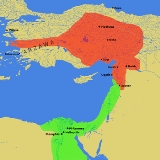
Seti I and Ramesses II

Hitt Egypt Perseus
New Kingdom Egypt reached the zenith of its power under Seti I
Seti I

Menmaatre Seti I was a Pharaoh of Ancient Egypt , the son of Ramesses I and Queen Sitre, and the father of Ramesses II. As with all dates in Ancient Egypt, the actual dates of his reign are unclear, and various historians claim different dates, with 1294 BC – 1279 BC and 1290 BC to 1279 BC being the most commonly used by scholars today...
 and Ramesses II
Ramesses II

Ramesses II was the third Egyptian pharaoh of the Nineteenth dynasty of Egypt. He is often regarded as Ancient Egypt's greatest, most celebrated, and most powerful pharaoh....
 ("The Great"), who campaigned vigorously against the Libyans
Libyans

The Libyans are a female-fronted hardcore punk band formed in early 2007 in Somerville, Massachusetts, Massachusetts. The band uses a completely-DIY approach to music, having self-released every recording....
 and the Hittites
Hittites

The Hittites were an ancient Anatolian people who spoke a Hittite language of the Anatolian languages of the Indo-European languages family, and established a kingdom centered at Hattusa in north-central Anatolia ca....
. The famous city of Kadesh
Kadesh

This article is about Kadesh in the lands of the Amurru, bordering on Damascus Syria up to Hammath; see also Kadesh orKedesh Kadesh was an Cities of the Ancient Near East of the Levant, located on or near the headwaters or ford of the Orontes River It is surmised by Kenneth Kitchen to be the ruins at Tell Nebi Mend, about south...
 was first captured by Seti I before this king decided to concede it to Muwatalli of Hatti
Hatti

Hatti in Bronze Age Anatolia refers to:*the area of Hattusa, roughly delimited by the Halys bend*the Hattians of the 3rd millennium BC and 2nd millennium BC millennia BC...
 in an informal peace treaty between Egypt and Hatti. Ramesses II later attempted unsuccessfully to alter this situation in his fifth regnal year by launching an attack on Kadesh
Battle of Kadesh

The Battle of Kadesh took place between the forces of the Egyptian Empire under Ramesses II and the Hittite Empire under Muwatalli II at the city of Kadesh on the Orontes River, in what is now the Syrian Arab Republic....
 in his Second Syrian campaign in 1274 BC, and was caught in history's first recorded military ambush, but thanks to the arrival of the Ne'arin, Ramesses was able to rally his troops and turn the tide of battle against the Hittites. Ramesses II later profited from the Hittites' internal difficulties during his eighth and ninth regnal years, when he campaigned against their Syrian possessions, capturing Kadesh and portions of Southern Syria, and advancing as far north as Tunip
Tunip

Tunip was a city/'city-state' in western Syria during the 1350 BC-1335 BC, , Amarna letters Text corpus. The name "Syria" did not exist, though Assyria was beginning....
 where no Egyptian soldier had been seen for 120 years. He ultimately accepted that a campaign against the Hittites was an unsupportable drain on Egypt's treasury and military. In his 21st regnal year, Ramesses signed the first recorded peace treaty with Urhi-Teshub's successor, Hattusili III
Hattusili III

Hattusili III was a king of the Hittite empire ca. 1267 ? 1237 BC . He was the fourth and last son of Mursili II. Mursili appointed Hattusili as priest of Sausga of Samuha, and Hattusili remained loyal to the "Ishtar of Samuha" to the end of his days....
 and with that act Egypt-Hittite relations improved significantly. Ramesses II even married two Hittite princesses, the first after his second Sed Festival
Sed festival

The sed festival was an ancient Egyptian ceremony which was held to celebrate the continued rule of a pharaoh. The name derives from the name of an Egyptian wolf god, one of whose names was Wepwawet or Sed....
. At least as early as Josephus
Josephus

Josephus , also known as Yosef Ben Matityahu and, after he became a Roman citizenship, as Titus Flavius Josephus, was a first-century Jewish historian and apologist of priestly and royal ancestry who survived and recorded the destruction of Jerusalem in AD 70....
, it was believed that Moses
Moses

Moses is a Hebrew Bible Hebrews religious leader, lawgiver, prophet, to whom the Mosaic authorship of the Torah is traditionally attributed. Also called Moshe Rabbeinu in Hebrew , he is the most important prophet in Judaism, and also an important prophet of Christianity, Islam, the Bah?'? Faith, Rastafari movement, Chrislam and many ot...
 lived during the reign of Ramesses II (though the time of the Eighteenth Dynasty
Eighteenth dynasty of Egypt

The Eighteenth Dynasty is perhaps the best known of all the dynasties of ancient Egypt. As well as a number of Egypt's most powerful pharaohs, it included Tutankhamun, whose tomb, uncovered by Howard Carter in 1922, was one of the greatest of all archaeological discoveries, being completely undisturbed by tomb robbers....
 has also been suggested).

Merneptah

This dynasty declined as internal fighting between the heirs of Merneptah
Merneptah

Merneptah was the fourth ruler of the Nineteenth dynasty of Egypt of Ancient Egypt. He ruled Egypt for almost ten years between late July or early August 1213 to May 2, 1203 BC, according to contemporary historical records....
 for the throne increased. Amenmesse
Amenmesse

Amenmesse was the 5th ruler of the Nineteenth dynasty of Egypt in Ancient Egypt, possibly the son of Merneptah and Queen Takhat. Others consider him to be one of the innumerable sons of Ramesses II....
 apparently usurped the throne from Merneptah's son and successor, Seti II
Seti II

Seti II , was the fifth ruler of the Nineteenth dynasty of Egypt and reigned from 1203 BC - 1197 BC. His throne name, Userkheperure Setepenre, meant "Powerful are the Manifestations of Ra, Chosen by Re.' He was the son of Merneptah and wife Isisnofret and sat on the throne during a period known for dynastic intrigue and short reigns, and his...
, but he ruled Egypt for only 4 years. After his death, Seti regained power and destroyed most of Amenmesse's monuments. Seti was served at Court by Chancellor Bay
Chancellor Bay

Chancellor Bay was an important Asiatic official in ancient Egypt, who rose to prominence and high office under Seti II Userkheperure Setepenre and later became an influential powerbroker in the closing stages of the Nineteenth dynasty of Egypt....
, who was originally just a 'royal scribe' but quickly became one of the most powerful men in Egypt gaining the unprecedented privilege of constructing his own tomb in the Valley of the Kings
Valley of the Kings

The Valley of the Kings is a valley in Egypt where, for a period of nearly 500 years from the 16th century BC to 11th century BC, tombs were constructed for the Pharaoh and powerful nobles of the Conventional Egyptian chronology#New Kingdom ....
 (KV17
KV17

Tomb KV17, located in Egypt's Valley of the Kings and also known by the names "Belzoni's tomb", "the Tomb of Apis", and "the Tomb of Psammis, son of Nechois", is the tomb of Pharaoh Seti I of the Nineteenth dynasty of Egypt....
). Both Bay and Seti's chief wife Twosret
Twosret

Queen Twosret was the last known female king of Egypt of a local indigenous dynasty and the final Pharaoh of the Nineteenth Dynasty. She is recorded in Manetho's Epitome as a certain Thuoris who ruled Egypt for seven years, but this figure included the nearly six year reign of Siptah, her predecessor....
 reportedly had a sinister reputation in Ancient Egyptian folklore. After Siptah
Siptah

Akhenre Setepenre Siptah or Merneptah Siptah was the penultimate ruler of the 19th Dynasty and the son of an obscure Queen named Sutailja, of Asiatic origin....
's death Twosret ruled Egypt for two more years, but she proved unable to maintain her hold on power amid the conspiracies and powerplays being hatched at the royal court. She was likely ousted in a revolt led by Setnakhte
Setnakhte

Userkhaure-setepenre Setnakhte was the first Pharaoh of the Twentieth Dynasty of the New Kingdom of Ancient Egypt and the father of Ramesses III....
, founder of the Twentieth Dynasty
Twentieth dynasty of Egypt

The Eighteenth, Nineteenth, and Twentieth Dynasties of ancient Egypt are often combined under the group title, New Kingdom. This dynasty is considered to be the last one of the New Kingdom of Egypt, and was followed by the Third Intermediate Period....
.

Nineteenth Dynasty timeline


See also

  • Nineteenth dynasty of Egypt Family Tree
    Nineteenth dynasty of Egypt Family Tree

    The family tree of the Ancient Egypt Nineteenth dynasty of Egypt is the usual mixture of conjecture and interpretation. The family history starts with the appointment of Ramesses I as the successor to Horemheb, the last king of the Eighteenth dynasty of Egypt who had no heirs ....