

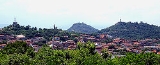
Plovdiv

Encyclopedia
Plovdiv is the second-largest city in Bulgaria
Bulgaria
Bulgaria , officially the Republic of Bulgaria , is a parliamentary democracy within a unitary constitutional republic in Southeast Europe. The country borders Romania to the north, Serbia and Macedonia to the west, Greece and Turkey to the south, as well as the Black Sea to the east...
after Sofia
Sofia
Sofia is the capital and largest city of Bulgaria and the 12th largest city in the European Union with a population of 1.27 million people. It is located in western Bulgaria, at the foot of Mount Vitosha and approximately at the centre of the Balkan Peninsula.Prehistoric settlements were excavated...
with a population of 338,153 inhabitants according to Census 2011. Plovdiv's history spans some 6,000 years, with traces of a Neolithic settlement dating to roughly 4000 BC; it is one of the oldest cities in Europe. It is the administrative center of Plovdiv Province
Plovdiv Province
Plovdiv Province is a province in central southern Bulgaria. It comprises 18 municipalities on a territory of 5,972.9 km² with a total population, as of December 2009, of 701,684 inhabitants...
in southern Bulgaria and three municipalities (Plovdiv-city, Maritsa
Maritsa municipality
Maritsa Municipality is located in the Plovdiv Province, southern Bulgaria on the northern bank of the Maritsa River. It has 30,676 inhabitants and consists only of villages. The municipality has thriving industry with around €400 000 000 invested in the recent years...
and Rodopi
Rodopi municipality
Rodopi municipality is situated in the Plovdiv Province, southern Bulgaria. the population is 33,111.It occupies parts of the Upper Thracian Plain to the south of Plovdiv and the northern-most slopes of the central Rhodopi mountains. Its territory is ....
) and Bulgaria's Yuzhen tsentralen
Yuzhen tsentralen
Yuzhen tsentralen is a Bulgarian region. The capital is Plovdiv, the second-largest city in Bulgaria. It includes five Bulgarians provinces : Plovdiv Province, Pazardzhik Province, Smolyan Province, Kardzhali Province and Haskovo Province....
planning region (NUTS II), as well as the largest and most important city in Northern Thrace
Northern Thrace
North Thrace or Northern Thrace constitutes the northern and the largest part of the historical region of Thrace...
and the wider international historical region of Thrace
Thrace
Thrace is a historical and geographic area in southeast Europe. As a geographical concept, Thrace designates a region bounded by the Balkan Mountains on the north, Rhodope Mountains and the Aegean Sea on the south, and by the Black Sea and the Sea of Marmara on the east...
. The city is an important economic, transport, cultural and educational center. The oldest American educational institution outside the United States was founded in Plovdiv in 1860, it was later moved to Sofia – today's American College of Sofia.
Known in the West for most of its history by the Greek
Greek language
Greek is an independent branch of the Indo-European family of languages. Native to the southern Balkans, it has the longest documented history of any Indo-European language, spanning 34 centuries of written records. Its writing system has been the Greek alphabet for the majority of its history;...
name Philippoupolis, it was originally a Thracian
Thracians
The ancient Thracians were a group of Indo-European tribes inhabiting areas including Thrace in Southeastern Europe. They spoke the Thracian language – a scarcely attested branch of the Indo-European language family...
settlement before becoming a major Roman
Ancient Rome
Ancient Rome was a thriving civilization that grew on the Italian Peninsula as early as the 8th century BC. Located along the Mediterranean Sea and centered on the city of Rome, it expanded to one of the largest empires in the ancient world....
city. In the Middle Ages, it retained its strategic regional importance, changing hands between the Byzantine
Byzantine Empire
The Byzantine Empire was the Eastern Roman Empire during the periods of Late Antiquity and the Middle Ages, centred on the capital of Constantinople. Known simply as the Roman Empire or Romania to its inhabitants and neighbours, the Empire was the direct continuation of the Ancient Roman State...
and Bulgarian Empire
Bulgarian Empire
Bulgarian Empire is a term used to describe two periods in the medieval history of Bulgaria, during which it acted as a key regional power in Europe in general and in Southeastern Europe in particular, rivalling Byzantium...
s. It came under Ottoman
Ottoman Empire
The Ottoman EmpireIt was usually referred to as the "Ottoman Empire", the "Turkish Empire", the "Ottoman Caliphate" or more commonly "Turkey" by its contemporaries...
rule in the 14th century. In 1878, Plovdiv was made the capital of the autonomous Ottoman region of Eastern Rumelia
Eastern Rumelia
Eastern Rumelia or Eastern Roumelia was an administratively autonomous province in the Ottoman Empire and Principality of Bulgaria from 1878 to 1908. It was under full Bulgarian control from 1885 on, when it willingly united with the tributary Principality of Bulgaria after a bloodless revolution...
; in 1885, it became part of Bulgaria with the unification
Bulgarian unification
The Unification of Bulgaria was the act of unification of the Principality of Bulgaria and the then-Ottoman province of Eastern Rumelia in the autumn of 1885. It was co-ordinated by the Bulgarian Secret Central Revolutionary Committee...
of that region and the Principality of Bulgaria
Principality of Bulgaria
The Principality of Bulgaria was a self-governing entity created as a vassal of the Ottoman Empire by the Treaty of Berlin in 1878. The preliminary treaty of San Stefano between the Russian Empire and the Porte , on March 3, had originally proposed a significantly larger Bulgarian territory: its...
.
Plovdiv is situated in the southern part of the Plovdiv Plain on the two banks of the Maritsa River. The city has historically developed on seven syenite
Syenite
Syenite is a coarse-grained intrusive igneous rock of the same general composition as granite but with the quartz either absent or present in relatively small amounts Syenite is a coarse-grained intrusive igneous rock of the same general composition as granite but with the quartz either absent or...
hills, some of which are 250 m (820.21 ft) high. Because of these seven hills, Plovdiv is often referred to in Bulgaria as "The City of the Seven Hills".
Plovdiv is host to economic and cultural events such as the International Fair Plovdiv
International Fair Plovdiv
International Fair Plovdiv , held in Plovdiv, is Bulgaria's largest and oldest international trade fair. It was established in August 1892 as an industrial and agricultural show....
, the international theatrical festival
Festival
A festival or gala is an event, usually and ordinarily staged by a local community, which centers on and celebrates some unique aspect of that community and the Festival....
"A stage on a crossroad", the TV festival "The golden chest". There are many remains preserved from Antiquity
Classical antiquity
Classical antiquity is a broad term for a long period of cultural history centered on the Mediterranean Sea, comprising the interlocking civilizations of ancient Greece and ancient Rome, collectively known as the Greco-Roman world...
such as the Ancient amphitheatre
Plovdiv Roman amphitheatre
The Plovdiv Antique theater is a historical building in the city center of Plovdiv, Bulgaria. Although this structure is commonly referred to as an amphitheatre, it is actually a traditional Roman theatre...
, Roman odeon, Roman Stadium
Plovdiv Roman Stadium
The Roman Stadium is an ancient building in Plovdiv, Bulgaria, among the largest Roman structures in the Balkans. The massive edifice is 180 long and had a capacity of over 30,000 It is believed to have been built during the reign of Septimus Severus .Today, the stadium is located in the centre of...
, the archaeological complex Eirene and others.
Name
Thracians
The ancient Thracians were a group of Indo-European tribes inhabiting areas including Thrace in Southeastern Europe. They spoke the Thracian language – a scarcely attested branch of the Indo-European language family...
settlement by the name of Eumolpias, named after the mythical Thracian king Eumolpos, son of Poseidon
Poseidon
Poseidon was the god of the sea, and, as "Earth-Shaker," of the earthquakes in Greek mythology. The name of the sea-god Nethuns in Etruscan was adopted in Latin for Neptune in Roman mythology: both were sea gods analogous to Poseidon...
. Philip II of Macedon
Philip II of Macedon
Philip II of Macedon "friend" + ἵππος "horse" — transliterated ; 382 – 336 BC), was a king of Macedon from 359 BC until his assassination in 336 BC. He was the father of Alexander the Great and Philip III.-Biography:...
conquered the area in 342-341 BC and renamed the city Philippoupolis , of which the later Thracian name for the city, Pulpudeva, is a translation. After the Romans took control of the area, the city was named , meaning the Three Hills. During the Middle Ages the city was known as Philippoupolis in Byzantine Greek and Paldin (Пълдин) or Plavdiv (Плъвдив) in Old Bulgarian, variations of the town's earlier Thracian
Thracian language
The Thracian language was the Indo-European language spoken in ancient times in Southeastern Europe by the Thracians, the northern neighbors of the Ancient Greeks. The Thracian language exhibits satemization: it either belonged to the Satem group of Indo-European languages or it was strongly...
name. The city was known as Philippopolis in Western Europe well into the early 20th century. The city was known as Filibe in Turkish
Turkish language
Turkish is a language spoken as a native language by over 83 million people worldwide, making it the most commonly spoken of the Turkic languages. Its speakers are located predominantly in Turkey and Northern Cyprus with smaller groups in Iraq, Greece, Bulgaria, the Republic of Macedonia, Kosovo,...
during the Ottoman Empire
Ottoman Empire
The Ottoman EmpireIt was usually referred to as the "Ottoman Empire", the "Turkish Empire", the "Ottoman Caliphate" or more commonly "Turkey" by its contemporaries...
.
The asteroid
Asteroid
Asteroids are a class of small Solar System bodies in orbit around the Sun. They have also been called planetoids, especially the larger ones...
(minor planet
Minor planet
An asteroid group or minor-planet group is a population of minor planets that have a share broadly similar orbits. Members are generally unrelated to each other, unlike in an asteroid family, which often results from the break-up of a single asteroid...
) 3860 Plovdiv is named after the city. It was discovered by the Bulgarian
Bulgarians
The Bulgarians are a South Slavic nation and ethnic group native to Bulgaria and neighbouring regions. Emigration has resulted in immigrant communities in a number of other countries.-History and ethnogenesis:...
astronomer Violeta G. Ivanova
Violeta G. Ivanova
Violeta Ivanova is a Bulgarian astronomer. She sometimes signs Violeta G. Ivanova.She has discovered numerous asteroids. She works at the Institute of Astronomy, Bulgarian Academy of Sciences and has made her discoveries at the Smolyan Observatory, which became the Rozhen National Observatory some...
on 8 August 1986. Plovdiv Peak
Plovdiv Peak
Plovdiv Peak is a peak rising to 1,040 m in the east extremity of Levski Ridge, Tangra Mountains, Livingston Island in the South Shetland Islands, Antarctica...
(1040 m (3,412 ft)) on Livingston Island in the South Shetland Islands
South Shetland Islands
The South Shetland Islands are a group of Antarctic islands, lying about north of the Antarctic Peninsula, with a total area of . By the Antarctic Treaty of 1959, the Islands' sovereignty is neither recognized nor disputed by the signatories and they are free for use by any signatory for...
, Antarctica is also named after Plovdiv.
Geography

Maritsa
The Maritsa or Evros , ) is, with a length of 480 km, the longest river that runs solely in the interior of the Balkans. It has its origin in the Rila Mountains in Western Bulgaria, flowing southeast between the Balkan and Rhodope Mountains, past Plovdiv and Parvomay to Edirne, Turkey...
river, approximately 152 km (94 mi) southeast of the Bulgarian capital Sofia
Sofia
Sofia is the capital and largest city of Bulgaria and the 12th largest city in the European Union with a population of 1.27 million people. It is located in western Bulgaria, at the foot of Mount Vitosha and approximately at the centre of the Balkan Peninsula.Prehistoric settlements were excavated...
. The city is situated in the southern part of the Plain of Plovdiv, an alluvial plain
Alluvial plain
An alluvial plain is a relatively flat landform created by the deposition of sediment over a long period of time by one or more rivers coming from highland regions, from which alluvial soil forms...
forming the western portion of the Upper Thracian Plain
Upper Thracian Plain
The Upper Thracian Plain constitutes the northern part of the historical region of Thrace. It is located in southern Bulgaria, between the Sredna Gora mountains to the north and west; the Rhodopes, Sakar and Strandzha to the south; and the Black Sea to the east. A fertile agricultural region, the...
. The heights of Sredna Gora
Sredna Gora
Sredna Gora is a mountain range in central Bulgaria, situated south of and parallel to Balkan mountain range and extending from the river Iskar to the west and the elbow of Tundzha north of Yambol to the east. Sredna Gora is 285 km long, reaching 50 km at its greatest width...
rise to the northwest, to the east are the Chirpan Heights and the Rhodope mountains
Rhodope Mountains
The Rhodopes are a mountain range in Southeastern Europe, with over 83% of its area in southern Bulgaria and the remainder in Greece. Its highest peak, Golyam Perelik , is the seventh highest Bulgarian mountain...
surround the plain from the south. The city had originally developed to the south of Maritsa and it spawned across the river in the last 100 years. Modern Plovdiv covers an area of 101 km² (39 sq mi), which is less than 0.1% of Bulgaria's total area. This makes the city is the most densely populated in the country with 3,769 inhabitants per km².
Inside the city proper are located six syenite hills, called tepeta. In the beginning of the 20th century there used to be seven of them, but one (Markovo tepe
Markovo tepe
Markovo tepe was one of the seven syenite hills of Bulgaria's second largest city, Plovdiv. It was destroyed in the beginning of the 20th century and the material was used for the pavement of most streets in Plovdiv. Currently the Markovo Tepe Mall is under construction on the site of the hill and...
) was destroyed. Traditionally the citizens have called them Dzhendem tepe, Bunardzhik, Sahat tepe, Nebet tepe, Dzhambaz tepe and Taksim tepe. The last three form the area of the Three Hills , a lively section of the city centre.
Climate
Plovdiv has a humid continental climateHumid continental climate
A humid continental climate is a climatic region typified by large seasonal temperature differences, with warm to hot summers and cold winters....
with considerable humid subtropical influences. There are four distinct seasons during the year and large temperature jumps between seasons are common.
Summer (late May to mid September) is hot, moderately dry and sunny with a July and August average of 31 °C (88 °F). Plovdiv sometimes experiences very hot days typical in the interior of the country. Summer nights are also mild.
Autumn starts in mid or late September; days are long and relatively warm in early autumn. However the nights become chilly by September. The first frost occurs on average by November.
Winter is normally cold and snow is common. The average number of days with snow cover in Plovdiv is 33. The average depth of snow cover is 2 to 4 cm (0.78740157480315 to 1.6 in) and the maximum is normally 6 to 13 cm (2.4 to 5.1 in) but in some winters it can reach 70 cm (28 in) or more. Average January temperature is 1 °C (34 °F).
Spring arrives in March but that season is cooler than autumn. The frost season ends in March or in April at the latest.
The days are mild and relatively warm in mid spring.
The average relative humidity is 73%, being highest in December with 86% and lowest in August with 62%. The total precipitation is 540 mm and is fairly evenly distributed throughout the year. The wettest months of the year are May and June with an average precipitation of 66.2 mm, while the driest month is August with an average precipitation of 31 mm.
Gentle winds (0 to 5 m/s) are predominant in the city with wind speeds of up to 1 m/s representing 95% of all winds during the year. Mists are common in the cooler months especially along the banks of the Maritsa. On average there are 33 days with mist
Mist
Mist is a phenomenon of small droplets suspended in air. It can occur as part of natural weather or volcanic activity, and is common in cold air above warmer water, in exhaled air in the cold, and in a steam room of a sauna. It can also be created artificially with aerosol canisters if the...
during the year.
Climate table:
Antiquity
Plovdiv has settlement traces dating from the Neolithic, roughly 6000 BC. Archaeologists have discovered fine potteryand other objects of everyday life from as early as the Neolithic Age, showing that in the end of the 4th millennium BC. there already was an established settlement there. According to Ammianus Marcellinus
Ammianus Marcellinus
Ammianus Marcellinus was a fourth-century Roman historian. He wrote the penultimate major historical account surviving from Antiquity...
, Plovdiv's written post-Bronze Age history lists it as a Thracian
Thracians
The ancient Thracians were a group of Indo-European tribes inhabiting areas including Thrace in Southeastern Europe. They spoke the Thracian language – a scarcely attested branch of the Indo-European language family...
fortified settlement named Eumolpias. In 4th century BC the city was a centre of a trade fair (called panegyreis). In 342 BC, it was conquered by Philip II of Macedon
Philip II of Macedon
Philip II of Macedon "friend" + ἵππος "horse" — transliterated ; 382 – 336 BC), was a king of Macedon from 359 BC until his assassination in 336 BC. He was the father of Alexander the Great and Philip III.-Biography:...
, the father of Alexander the Great, who renamed it "Φιλιππόπολις", Philippopolis or "the city of Philip" in his own honour. Later, it was reconquered by the Thracians
Thracians
The ancient Thracians were a group of Indo-European tribes inhabiting areas including Thrace in Southeastern Europe. They spoke the Thracian language – a scarcely attested branch of the Indo-European language family...
who called it Pulpudeva (a reconstructed translation of Philipopolis)
In 72 BC it was seized by the Roman general Marcus Lucullus
Marcus Terentius Varro Lucullus
Marcus Terentius Varro Lucullus , younger brother of the more famous Lucius Licinius Lucullus, was a supporter of Lucius Cornelius Sulla and consul of ancient Rome in 73 BC. As proconsul of Macedonia in 72 BC, he defeated the Bessi in Thrace and advanced to the Danube and the west coast of the...
but was soon restored to Thracian control. In 46 AD the city was finally incorporated into the Roman Empire
Roman Empire
The Roman Empire was the post-Republican period of the ancient Roman civilization, characterised by an autocratic form of government and large territorial holdings in Europe and around the Mediterranean....
by emperor Claudius
Claudius
Claudius , was Roman Emperor from 41 to 54. A member of the Julio-Claudian dynasty, he was the son of Drusus and Antonia Minor. He was born at Lugdunum in Gaul and was the first Roman Emperor to be born outside Italy...
, it was called Trimontium (City of Three Hills) and served as metropolis (capital) of the province of Thrace
Thrace
Thrace is a historical and geographic area in southeast Europe. As a geographical concept, Thrace designates a region bounded by the Balkan Mountains on the north, Rhodope Mountains and the Aegean Sea on the south, and by the Black Sea and the Sea of Marmara on the east...
. It gained a city status in late 1st century. Trimontium was an important crossroad for the Roman Empire and was called "The largest and most beautiful of all cities" by Lucian
Lucian
Lucian of Samosata was a rhetorician and satirist who wrote in the Greek language. He is noted for his witty and scoffing nature.His ethnicity is disputed and is attributed as Assyrian according to Frye and Parpola, and Syrian according to Joseph....
. Although it was not the capital of the Province of Thrace, the city was the largest and most important centre in the province. In those times, the Via Militaris
Via Militaris
Via Militaris or Via Diagonalis was an ancient Roman road, starting from Singidunum , passing by Danube coast to Viminacium , through Naissus , Serdica , Philippopolis , Adrianopolis , and reaching Constantinople...
(or Via Diagonalis), the most important military road in the Balkans
Balkans
The Balkans is a geopolitical and cultural region of southeastern Europe...
, passed through the city.
The Roman times were a period of growth and cultural excellence. The ancient ruins tell a story of a vibrant, growing city with numerous public buildings, shrines, baths, and theatres. The city had an advanced water system and sewerage
Sanitary sewer
A sanitary sewer is a separate underground carriage system specifically for transporting sewage from houses and commercial buildings to treatment or disposal. Sanitary sewers serving industrial areas also carry industrial wastewater...
. It was defended with a double wall. Many of those are still preserved and can be seen by tourists. Today only a small part of the ancient city has been excavated.
Middle Ages
The SlavsSlavic peoples
The Slavic people are an Indo-European panethnicity living in Eastern Europe, Southeast Europe, North Asia and Central Asia. The term Slavic represents a broad ethno-linguistic group of people, who speak languages belonging to the Slavic language family and share, to varying degrees, certain...
had fully settled in the area by the middle of the 6th century and changed the ethnic proportions of the region. With the establishment of Bulgaria
Bulgaria
Bulgaria , officially the Republic of Bulgaria , is a parliamentary democracy within a unitary constitutional republic in Southeast Europe. The country borders Romania to the north, Serbia and Macedonia to the west, Greece and Turkey to the south, as well as the Black Sea to the east...
in 681 Philipopolis became an important border fortress of the Byzantine Empire
Byzantine Empire
The Byzantine Empire was the Eastern Roman Empire during the periods of Late Antiquity and the Middle Ages, centred on the capital of Constantinople. Known simply as the Roman Empire or Romania to its inhabitants and neighbours, the Empire was the direct continuation of the Ancient Roman State...
. It was captured by Khan Krum
Krum of Bulgaria
Krum the Horrible was Khan of Bulgaria, from after 796, but before 803, to 814 AD. During his reign the Bulgarian territory doubled in size, spreading from the middle Danube to the Dnieper and from Odrin to the Tatra Mountains. His able and energetic rule brought law and order to Bulgaria and...
in 812 but the region was fully incorporated into the Bulgarian Empire
First Bulgarian Empire
The First Bulgarian Empire was a medieval Bulgarian state founded in the north-eastern Balkans in c. 680 by the Bulgars, uniting with seven South Slavic tribes...
in 834 during the reign of Khan Malamir
Malamir of Bulgaria
Malamir was the ruler of Bulgaria 831–836.Malamir was a son of Omurtag and a grandson of Krum. His name may be of Slavic origin, and is claimed to be the first Bulgar khan to possess a Slavic name; however another theory is that it was an Iranian name, as there is an Iranian city named Malamir...
. It remained in Bulgarian hands for a relatively short time until it was reconquered by the Byzantine Empire
Byzantine Empire
The Byzantine Empire was the Eastern Roman Empire during the periods of Late Antiquity and the Middle Ages, centred on the capital of Constantinople. Known simply as the Roman Empire or Romania to its inhabitants and neighbours, the Empire was the direct continuation of the Ancient Roman State...
in 855-856. Under Byzantine control the city became the centre of Paulician heretics transported from the eastern borders of the empire to serve as military settlers on the European frontier with Bulgaria. From Philippopolis the influence of dualistic doctrines spread to Bulgaria forming the basis of the Bogomil heresy. Under tsar Simeon the Great
Simeon I of Bulgaria
Simeon I the Great ruled over Bulgaria from 893 to 927, during the First Bulgarian Empire. Simeon's successful campaigns against the Byzantines, Magyars and Serbs led Bulgaria to its greatest territorial expansion ever, making it the most powerful state in contemporary Eastern Europe...
(893–927) the city and most of the Byzantine possessions in the Balkans were conquered by the Bulgarian Empire. The city remained in Bulgarian hands under Simeon's son, Peter I
Peter I of Bulgaria
Peter I was emperor of Bulgaria from 27 May 927 to 969.-Early reign:Peter I was the son of Simeon I of Bulgaria by his second marriage to Maria Sursuvul, the sister of George Sursuvul. Peter had been born early in the 10th century, but it appears that his maternal uncle was very influential at...
(927–969).
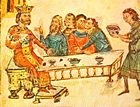
In 970 the Asian army of the Byzantine Empire under the eunuch Peter was destroyed by the Bulgarians near Plovdiv. The city again came to be known as Philippopolis and became Byzantine in character. Aime de Varennes in 1180 encountered the singing of Byzantine songs in the city that recounted the deeds of Alexander the great and his predecessors, over 1300 years before.
Latin Empire
The Latin Empire or Latin Empire of Constantinople is the name given by historians to the feudal Crusader state founded by the leaders of the Fourth Crusade on lands captured from the Byzantine Empire. It was established after the capture of Constantinople in 1204 and lasted until 1261...
in 1204, and there were two short interregnum periods as the city was twice occupied by Kaloyan of Bulgaria
Kaloyan of Bulgaria
Kaloyan the Romanslayer , Ivan II , ruled as emperor of Bulgaria 1197-1207. He is the third and youngest brother of Peter IV and Ivan Asen I who managed to restore the Bulgarian Empire...
before his death in 1207. In 1208 Kaloyan's successor Boril
Boril of Bulgaria
Boril reigned as emperor of Bulgaria from 1207 to 1218. He was the son of an unnamed sister of his predecessor Kaloyan.-Biography:It is unclear whether Boril was party to the murder of Kaloyan in front of the walls of Thessalonica in 1207, but Kaloyan's intended heirs, his nephews Ivan Asen and...
was defeated by the Latins in the Battle of Philippopolis. Under Latin rule, Plovdiv was the capital of the Duchy of Philippopolis
Duchy of Philippopolis
The Duchy of Philippopolis was a short-lived duchy of the Latin Empire founded after the collapse and partition of the Byzantine Empire in 1204. It included the city of Plovdiv and the surrounding region. It was liberated for a short time by Emperor Kaloyan of Bulgaria in 1207 but was lost by his...
governed by Renier de Trit, and later on by Gerard de Strem. Bulgarian rule was reestablished during the reign of Ivan Asen II
Ivan Asen II of Bulgaria
-Early rule:He was a son of Ivan Asen I of Bulgaria and Elena . Elena, who survived until after 1235, is sometimes alleged to be a daughter of Stefan Nemanja of Serbia, but this relationship is questionable and would have caused various canonical impediments to marriages between various descendants...
between 1225 and 1229. In 1263 Plovdiv was conquered by the restored Byzantine Empire
Byzantine Empire
The Byzantine Empire was the Eastern Roman Empire during the periods of Late Antiquity and the Middle Ages, centred on the capital of Constantinople. Known simply as the Roman Empire or Romania to its inhabitants and neighbours, the Empire was the direct continuation of the Ancient Roman State...
and remained in Byzantine hands until it was re-conquered by George Terter II
George II of Bulgaria
George Terter II reigned as emperor of Bulgaria 1321–1322. The date of his birth is unknown, but he was born not long before 1307.George Terter II was the son of Theodore Svetoslav and Euphrosyne, and was named after his paternal grandfather George Terter I. It is possible that he was associated...
of Bulgaria in 1322. Byzantine rule was restored once again in 1323, but in 1344 the city and eight other cities were surrendered to Bulgaria by the regency for John V Palaiologos
John V Palaiologos
John V Palaiologos was a Byzantine emperor, who succeeded his father in 1341, at age nine.-Biography:...
as the price for Ivan Alexander of Bulgaria
Ivan Alexander of Bulgaria
Ivan Alexander , also known as John Alexander, ruled as Emperor of Bulgaria from 1331 to 1371, during the Second Bulgarian Empire. The date of his birth is unknown. He died on February 17, 1371. The long reign of Ivan Alexander is considered a transitional period in Bulgarian medieval history...
's support in the Byzantine civil war.
Ottoman Rule
In 1364 the Ottoman TurksOttoman Turks
The Ottoman Turks were the Turkish-speaking population of the Ottoman Empire who formed the base of the state's military and ruling classes. Reliable information about the early history of Ottoman Turks is scarce, but they take their Turkish name, Osmanlı , from the house of Osman I The Ottoman...
under Lala Shakhin Pasha seized Plovdiv. The Turks called the city Filibe. It was the capital of Rumelia until 1382 when the Ottomans captured Sofia
Sofia
Sofia is the capital and largest city of Bulgaria and the 12th largest city in the European Union with a population of 1.27 million people. It is located in western Bulgaria, at the foot of Mount Vitosha and approximately at the centre of the Balkan Peninsula.Prehistoric settlements were excavated...
which became the main city of the province. Plovdiv survived as one of the major cultural centers for Bulgarian culture and tradition. The name Plovdiv first appeared around that time and is derived from the city's Thracian name Pulpudeva (assumed to be a translation of Philippopolis, from Pulpu = Philippou and deva = city), which was rendered by the Slavs first as Pəldin (Пълдин) or Pləvdin.
National revival

Ottoman Empire
The Ottoman EmpireIt was usually referred to as the "Ottoman Empire", the "Turkish Empire", the "Ottoman Caliphate" or more commonly "Turkey" by its contemporaries...
, Plovdiv was a focal point for the Bulgarian national movement in the Eastern Rumelia
Eastern Rumelia
Eastern Rumelia or Eastern Roumelia was an administratively autonomous province in the Ottoman Empire and Principality of Bulgaria from 1878 to 1908. It was under full Bulgarian control from 1885 on, when it willingly united with the tributary Principality of Bulgaria after a bloodless revolution...
province of the Empire. During that period Plovdiv was a major economic center along with Istanbul
Istanbul
Istanbul , historically known as Byzantium and Constantinople , is the largest city of Turkey. Istanbul metropolitan province had 13.26 million people living in it as of December, 2010, which is 18% of Turkey's population and the 3rd largest metropolitan area in Europe after London and...
, Odrin and Solun
Thessaloniki
Thessaloniki , historically also known as Thessalonica, Salonika or Salonica, is the second-largest city in Greece and the capital of the region of Central Macedonia as well as the capital of the Decentralized Administration of Macedonia and Thrace...
. The richer citizens constructed beautiful houses many of which can still be seen in the Architectural reserve Old Plovdiv. Plovdiv was a sanjak
Sanjak
Sanjaks were administrative divisions of the Ottoman Empire. Sanjak, and the variant spellings sandjak, sanjaq, and sinjaq, are English transliterations of the Turkish word sancak, meaning district, banner, or flag...
centre of Rumelia
Rumelia
Rumelia was an historical region comprising the territories of the Ottoman Empire in Europe...
Province between 1364–1864 and was the sanjak centre of Edirne
Edirne
Edirne is a city in Eastern Thrace, the northwestern part of Turkey, close to the borders with Greece and Bulgaria. Edirne served as the capital city of the Ottoman Empire from 1365 to 1453, before Constantinople became the empire's new capital. At present, Edirne is the capital of the Edirne...
Vilayet between 1864–1878 during Ottoman Rule.
Plovdiv had an important role in the struggle for Church independence which was according to some historians a peaceful bourgeois revolution. Plovdiv became the center of that struggle with leaders such as Nayden Gerov
Nayden Gerov
Nayden Gerov , born Nayden Gerov Hadzhidobrevich February 23, 1823, Koprivshtitsa–October 9, 1900, Plovdiv) was a Bulgarian linguist, folklorist, writer and public figure during the Bulgarian National Revival....
, Dr Valkovich, Joakim Gruev
Joakim Gruev
Joakim Gruev was a Bulgarian teacher and translator. He was born on 9 September 1828 in the town of Koprivshtitsa. He was a teacher at the leading Bulgarian high school in Plovdiv. He was the author of a number of textbooks.-References:...
and whole families. In 1836 the first Bulgarian school was inaugurated and in 1850 modern secular education began when the "St Cyrill and Metodius" school was opened. On 11 May 1858 the day of Saints Cyril and Methodius
Saints Cyril and Methodius
Saints Cyril and Methodius were two Byzantine Greek brothers born in Thessaloniki in the 9th century. They became missionaries of Christianity among the Slavic peoples of Bulgaria, Great Moravia and Pannonia. Through their work they influenced the cultural development of all Slavs, for which they...
was celebrated for the first time, this later became a National holiday which is still celebrated today. In 1858 in the Church of Virgin Mary
Church of the Holy Mother of God, Plovdiv
The Church of the Holy Mother of God is a Bulgarian National Revival church in Bulgaria's second largest city Plovdiv. The church is situated in the Old town of Plovdiv on one of the city's seven hills, Nebet Tepe....
the Christmas liturgy was served for the first time in the Bulgarian language
Bulgarian language
Bulgarian is an Indo-European language, a member of the Slavic linguistic group.Bulgarian, along with the closely related Macedonian language, demonstrates several linguistic characteristics that set it apart from all other Slavic languages such as the elimination of case declension, the...
since the beginning of the Ottoman occupation. In 1868 the school expanded into the first grammar school. Some of the intellectuals, politicians and spiritual leaders of the nation graduated that school.
The city was liberated from the Ottomans during the Battle of Philippopolis in 1878.
Eastern Rumelia
According to the Treaty of San StefanoTreaty of San Stefano
The Preliminary Treaty of San Stefano was a treaty between Russia and the Ottoman Empire signed at the end of the Russo-Turkish War, 1877–78...
on 3 March 1878 the Principality of Bulgaria included the lands with predominantly Bulgarian population. Plovdiv which was the biggest and most vibrant Bulgarian city was selected as a capital of the restored country and for a seat of the Temporary Russian Government. Great Britain and Austria-Hungary
Austria-Hungary
Austria-Hungary , more formally known as the Kingdoms and Lands Represented in the Imperial Council and the Lands of the Holy Hungarian Crown of Saint Stephen, was a constitutional monarchic union between the crowns of the Austrian Empire and the Kingdom of Hungary in...
, however, did not approve that treaty and the final result of the war was concluded in the Congress of Berlin
Congress of Berlin
The Congress of Berlin was a meeting of the European Great Powers' and the Ottoman Empire's leading statesmen in Berlin in 1878. In the wake of the Russo-Turkish War of 1877–78, the meeting's aim was to reorganize the countries of the Balkans...
which divided the newly liberated country into several parts. It separated the autonomous region of Eastern Rumelia
Eastern Rumelia
Eastern Rumelia or Eastern Roumelia was an administratively autonomous province in the Ottoman Empire and Principality of Bulgaria from 1878 to 1908. It was under full Bulgarian control from 1885 on, when it willingly united with the tributary Principality of Bulgaria after a bloodless revolution...
from Bulgaria and Plovdiv became its capital. The Ottoman Empire created a constitution and appointed a governor. As of 1 January 1885, the city of Plovdiv had a population of 33,442, of which 16,752 were Bulgarians
Bulgarians
The Bulgarians are a South Slavic nation and ethnic group native to Bulgaria and neighbouring regions. Emigration has resulted in immigrant communities in a number of other countries.-History and ethnogenesis:...
(50%), 7,144 Turks
Turkish people
Turkish people, also known as the "Turks" , are an ethnic group primarily living in Turkey and in the former lands of the Ottoman Empire where Turkish minorities had been established in Bulgaria, Cyprus, Bosnia and Herzegovina, Georgia, Greece, Kosovo, Macedonia, and Romania...
(21%), 5,497 Greeks
Greeks
The Greeks, also known as the Hellenes , are a nation and ethnic group native to Greece, Cyprus and neighboring regions. They also form a significant diaspora, with Greek communities established around the world....
(16%), 2,168 Jews (6%), 1,061 Armenians
Armenians
Armenian people or Armenians are a nation and ethnic group native to the Armenian Highland.The largest concentration is in Armenia having a nearly-homogeneous population with 97.9% or 3,145,354 being ethnic Armenian....
(3%), 151 Italians, 112 Germans
Germans
The Germans are a Germanic ethnic group native to Central Europe. The English term Germans has referred to the German-speaking population of the Holy Roman Empire since the Late Middle Ages....
, 112 Romani people, 80 French people
French people
The French are a nation that share a common French culture and speak the French language as a mother tongue. Historically, the French population are descended from peoples of Celtic, Latin and Germanic origin, and are today a mixture of several ethnic groups...
, 61 Russians
Russians
The Russian people are an East Slavic ethnic group native to Russia, speaking the Russian language and primarily living in Russia and neighboring countries....
and 304 people of other nationalities.
In the spring of 1885 Zahari Stoyanov
Zahari Stoyanov
Zahari Stoyanov , born Dzhendo Stoyanov Dzhedev , was a Bulgarian revolutionary, writer, and historian. A participant in the April Uprising of 1876, he became its first historiographer with his book Memoirs of the Bulgarian Uprisings...
formed the Secret Bulgarian Central Revolutionary Committee in the city which actively conducted propaganda for the unification of Bulgaria and Eastern Rumelia. On 5 September several hundred armed rebels from Golyamo Konare (now Saedinenie) marched to Plovdiv. In the night of 5–6 September these men led by Danail Nikolaev took control of the city and removed from office the General-Governor Gavril Krastevich
Gavril Krastevich
Gavril Krastevich was a Bulgarian politician. He was born in Kotel in 1813. He was a general governor of Eastern Rumelia between 1884 and 1885 when it was part of the Ottoman Empire. Krastevich died in Istanbul on 16 November 1898....
. A provisional government was formed led by Georgi Stranski
Georgi Stranski
Georgi Ivanov Stranski was a Bulgarian physician and politician. A close friend of Hristo Botev, Stranski was an active member of various organizations founded by Bulgarian emigrants in Romania...
and universal mobilization was announced. After the Serbs were defeated in the Serbo-Bulgarian War
Serbo-Bulgarian War
The Serbo-Bulgarian War was a war between Serbia and Bulgaria that erupted on 14 November 1885 and lasted until 28 November the same year. Final peace was signed on 19 February 1886 in Bucharest...
, Bulgaria and Turkey reached an agreement according to which the Principality of Bulgaria and Eastern Rumelia had a common government, Parliament, administration and army. Today 6 September is celebrated as the Unification Day and the Day of Plovdiv.
Recent history
After the unification, Plovdiv remained the second city in Bulgaria in population and significance after the capital SofiaSofia
Sofia is the capital and largest city of Bulgaria and the 12th largest city in the European Union with a population of 1.27 million people. It is located in western Bulgaria, at the foot of Mount Vitosha and approximately at the centre of the Balkan Peninsula.Prehistoric settlements were excavated...
. The first railway in the city was built in 1874 and in 1888 it was linked with Sofia. In 1892 Plovdiv became host of the First Bulgarian Fair with international participation which was succeeded by the International Fair Plovdiv
International Fair Plovdiv
International Fair Plovdiv , held in Plovdiv, is Bulgaria's largest and oldest international trade fair. It was established in August 1892 as an industrial and agricultural show....
. After the liberation the first brewery was inaugurated in the city.
In the beginning of the 20th century Plovdiv grew as a significant industrial and commercial center with well-developed light and food industry. German, French and Belgian
Belgium
Belgium , officially the Kingdom of Belgium, is a federal state in Western Europe. It is a founding member of the European Union and hosts the EU's headquarters, and those of several other major international organisations such as NATO.Belgium is also a member of, or affiliated to, many...
capital was invested in the city in development of modern trade, banking and industry. In 1939 there were 16,000 craftsmen and 17,000 workers in manufacturing factories, mainly for food and tobacco processing. During the Second World War the tobacco industry expanded as well as the export of fruit and vegetables. In 1943 1,500 Jews were saved from deportation in concentration camps by the archbishop of Plovdiv, Cyril
Patriarch Cyril of Bulgaria
Patriarch Cyril , born Konstantin Markov , was the first Patriarch of the restored Bulgarian Patriarchate....
, who later became the Bulgarian Patriarch.
On 6 April 1956 the first trolleybus line was opened and in the 1950s the Trimontsium Hotel was constructed. In the 1960s and 1970s there was a construction boom and many of the modern neighborhoods took shape. In the 1970s and 1980s antique remains were excavated and the Old Town was fully restored. In 1990 the Sports complex "Plovdiv" was finished, it included the largest stadium and rowing canal in the country. In that period Plovdiv became the birthplace of Bulgaria's movement for democratic reform, which by 1989 had garnered enough support to enter government.
Plovdiv has hosted specialized exhibitions of the World's Fair
World's Fair
World's fair, World fair, Universal Exposition, and World Expo are various large public exhibitions held in different parts of the world. The first Expo was held in The Crystal Palace in Hyde Park, London, United Kingdom, in 1851, under the title "Great Exhibition of the Works of Industry of All...
in 1981, 1985, and 1991.
Population
The population by permanent address for the municipality of Plovdiv for 2007 is 380,682, which makes it the second in population in the nation. According to the data of NSI (National Institute of Statistics) the people who actually live in Plovdiv are 346,790. There have a been a number of reports in recent years contending that Plovdiv has been surpassed by VarnaVarna
Varna is the largest city and seaside resort on the Bulgarian Black Sea Coast and third-largest in Bulgaria after Sofia and Plovdiv, with a population of 334,870 inhabitants according to Census 2011...
in population. None of them, however, have been confirmed by official statistics.
Population of Plovdiv:
- 1880 - 24,053
- 1884 - 33,442
After the Unification Plovdiv became the largest city in the country for several years with 33,032 inhabitants compared to 30,428 for Sofia. According to the 1946 census Plovdiv was the second largest city with 126,563 inhabitants compared to 487,000 for the capital.
Ethnicity and religion
.jpg)
Bulgarians
The Bulgarians are a South Slavic nation and ethnic group native to Bulgaria and neighbouring regions. Emigration has resulted in immigrant communities in a number of other countries.-History and ethnogenesis:...
after Sofia
Sofia
Sofia is the capital and largest city of Bulgaria and the 12th largest city in the European Union with a population of 1.27 million people. It is located in western Bulgaria, at the foot of Mount Vitosha and approximately at the centre of the Balkan Peninsula.Prehistoric settlements were excavated...
and Varna
Varna
Varna is the largest city and seaside resort on the Bulgarian Black Sea Coast and third-largest in Bulgaria after Sofia and Plovdiv, with a population of 334,870 inhabitants according to Census 2011...
. Some Gypsies (See: "The Roma in Plovdiv
The Roma in Plovdiv
The Roma in Plovdiv live in their four own neighborhoods : Stolipinovo, Sheker Mahala, Hadji Hassan Mahala and Arman Mahala. In the 2001 Census, those who identified themselves ethnical as Roma are 5192 people and this is 1.5% of city's population...
"), Turks
Turkish people
Turkish people, also known as the "Turks" , are an ethnic group primarily living in Turkey and in the former lands of the Ottoman Empire where Turkish minorities had been established in Bulgaria, Cyprus, Bosnia and Herzegovina, Georgia, Greece, Kosovo, Macedonia, and Romania...
, Armenians
Armenians
Armenian people or Armenians are a nation and ethnic group native to the Armenian Highland.The largest concentration is in Armenia having a nearly-homogeneous population with 97.9% or 3,145,354 being ethnic Armenian....
, Jews
Jews
The Jews , also known as the Jewish people, are a nation and ethnoreligious group originating in the Israelites or Hebrews of the Ancient Near East. The Jewish ethnicity, nationality, and religion are strongly interrelated, as Judaism is the traditional faith of the Jewish nation...
and Greeks
Greeks
The Greeks, also known as the Hellenes , are a nation and ethnic group native to Greece, Cyprus and neighboring regions. They also form a significant diaspora, with Greek communities established around the world....
form different minorities. According to the 2001 census from population of 338 224 inhabitants the Bulgarians were 302 858 (89.5%), followed by 22 501 from the Turkish minority (6.7%), 5 192 from the Roma minority (1.5%) and 7 673 others and unspecified (2.3%); it should be noted that most of these 6,7% Turks are Roma from the gettho quarters who self-identify as Turks on census.
At the first census after liberation from Ottoman rule in 1884, from population of 33,442 inhabitants the majority were 16,752 Bulgarians (50%), followed by 7,144 Turks (21%), 5,497 Greeks (16%), 2,168 Jews (6%), 1,061 Armenians (3%), 151 Italians, 112 Germans, 112 Roma, 80 Frenchs, 61 Russians and 304 people of other nationalities.
After the Wars for National Union (Balkan Wars
Balkan Wars
The Balkan Wars were two conflicts that took place in the Balkans in south-eastern Europe in 1912 and 1913.By the early 20th century, Montenegro, Bulgaria, Greece and Serbia, the countries of the Balkan League, had achieved their independence from the Ottoman Empire, but large parts of their ethnic...
and World War I) the city became home for thousands of refugees from the occupied Bulgarian lands in Macedonia
Macedonia (region)
Macedonia is a geographical and historical region of the Balkan peninsula in southeastern Europe. Its boundaries have changed considerably over time, but nowadays the region is considered to include parts of five Balkan countries: Greece, the Republic of Macedonia, Bulgaria, Albania, Serbia, as...
, Western
Western Thrace
Western Thrace or simply Thrace is a geographic and historical region of Greece, located between the Nestos and Evros rivers in the northeast of the country. Together with the regions of Macedonia and Epirus, it is often referred to informally as northern Greece...
and Eastern Thrace. Many of the old neighbourhoods are still referred to as Belomorski, Vardarski. Most of the Jews left the city after the foundation of Israel
Israel
The State of Israel is a parliamentary republic located in the Middle East, along the eastern shore of the Mediterranean Sea...
in 1948, as well as most of the Turks and Greeks.
The vast majority of the inhabitants are Christians - mostly Eastern Orthodox, but there are also Catholics, Eastern Catholics and Protestant trends (Adventists
Seventh-day Adventist Church
The Seventh-day Adventist Church is a Protestant Christian denomination distinguished by its observance of Saturday, the original seventh day of the Judeo-Christian week, as the Sabbath, and by its emphasis on the imminent second coming of Jesus Christ...
, Baptists and others). There are also some Muslims and Jews. In Plovdiv there are many churches, two mosques and a synagogue.
City government
Plovdiv is the administrative center of Plovdiv ProvincePlovdiv Province
Plovdiv Province is a province in central southern Bulgaria. It comprises 18 municipalities on a territory of 5,972.9 km² with a total population, as of December 2009, of 701,684 inhabitants...
, Municipality of Plovdiv, Maritsa municipality
Maritsa municipality
Maritsa Municipality is located in the Plovdiv Province, southern Bulgaria on the northern bank of the Maritsa River. It has 30,676 inhabitants and consists only of villages. The municipality has thriving industry with around €400 000 000 invested in the recent years...
and Rodopi municipality
Rodopi municipality
Rodopi municipality is situated in the Plovdiv Province, southern Bulgaria. the population is 33,111.It occupies parts of the Upper Thracian Plain to the south of Plovdiv and the northern-most slopes of the central Rhodopi mountains. Its territory is ....
. The Mayor of the Municipality of Plovdiv Slavcho Atanasov
Slavcho Atanasov
Slavcho Atanasov is a Bulgarian politician, member of IMRO-BNM and mayor of Plovdiv .He was born on 14 February 1968 in Karlovo. In 2003 he was elected a mayor of Plovdiv's largest district Trakiya....
, together with the six district mayors represent the local executive authorities. The Municipal Council which consists of 51 municipal counselors, represents the legislative power and is elected according to the proportional system by parties’ lists. The executive government of the Municipality of Plovdiv consists of a mayor who is elected by majority representation, five deputy mayors and one administrative secretary. All the deputy mayors and the secretary control their administrative structured units.
According to the Law for the territorial subdivision of the Capital municipality and the large cities the territory of Plovdiv Municipality is subdivided into six district administrations, their mayors being appointed following approval by the Municipal Council.
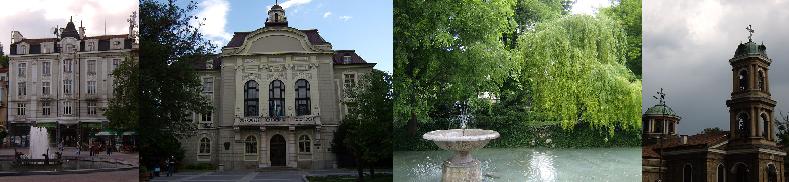

| District | Neighbourhoods |
|---|---|
| Central Central district, Plovdiv Central district is one of the six districts of Plovdiv in southern Bulgaria. It has 84,431 inhabitants. Most of Plovdiv's major sights are situated in the district - Roman stadium, Roman Odeon, Ancient theatre, the Watchtower on Sahat tepe , the central street and many others... |
Kapana, Stariya grad, Marasha, Centar |
| Northern Northern district, Plovdiv Northern district is a district of Plovdiv, southern Bulgaria. It is often referred by the citizens as Karshiaka meaning "the other bank" in Turkish. It has 53,870 inhabitants... |
Karshiaka, Gagarin, Filipovo, Zaharna Fabrika |
| Southern Southern district, Plovdiv Southern district is one of the six districts of Plovdiv in southern Bulgaria. It has 79,330. The district includes the so called "Kyuchuk Paris" and Komatevo.- "Kyuchuk Paris" name origin :... |
Hristo Botev - Yug, Hristo Botev - Sever, Vastanecheski, Uhoto, Yuzhen, Komatevo, Ostromila, Belomorski |
| Eastern Eastern district, Plovdiv Eastern district is a district of Plovdiv, southern Bulgaria. It has 60,535 inhabitants. The stadium of PFC Botev Plovdiv and the beer factory of Kamenitza are located in the district. The infamous neighbourhoods of Stolipinovo and Izgrev are also situated there.... |
Kamenitsa, Izgrev, Stolipinovo |
| Western Western district, Plovdiv Western district is a district of Plovdiv, southern Bulgaria. The district includes the quarters Proslav, Hristo Smirnenski, Mladeshki Halm and Mladost, and has 39,158 inhabitants. The largest sports complex in Eastern Europe is located in a pleasant park on the southern banks of the Maritsa river... |
Hristo Smirnenski, Proslav, Mladezhki Halm, Mladost |
| Trakiya Trakiya district Trakiya is the largest neighbourhood of Plovdiv as well as one of the six districts of the city located in its south-eastern parts. It has 61,920 inhabitants. Its construction began in 1973, in 1976 it was inaugurated as a neighbourhoods and in 1983 it became a district... |
Olga Skobeleva, Lauta |
In 1969 the villages of Proslav
Proslav
Proslav is a neighbourhood of Plovdiv, southern Bulgaria. It was a village up to 1969 when it was incorporated into Plovdiv along with Komatevo. The most convenient road to Plovdiv is the Peshtera Highway. Another major transport link is Sofia-Plovdiv highway....
and Komatevo
Komatevo
Komatevo is a neighbourhood of the city of Plovdiv, southern Bulgaria. It has 6,500 inhabitants.Komatevo was a village up to 1969 when it was incorporated into Plovdiv together with Proslav. The neighbourhood is connected to the city center through the Komatevo highway. There are also roads to the...
were incorporated into the city. In 1987 the municipalities of Maritsa and Rodopi were separated from Plovdiv which remained their administrative center. In the last several years the inhabitants from those villages had taken steps to rejoin the "urban" municipality.
Main sights
The city has more than 200 archaeological sites, 30 of which are of national importance. There are many remains from antiquity - Plovdiv is among the few cities with two ancient theatres; remains of the medieval walls and towers; Ottoman baths and mosques; a well-preserved old quarter from the National Revival period with beautiful houses, churches and narrow paved streets. There are numerous museums, art galleries and cultural institutions. Plovdiv is host to musical, theatrical and film events.The city is a starting point for trips to places in the region, such as the Bachkovo Monastery
Bachkovo Monastery
The Bachkovo Monastery , archaically the Petritsoni Monastery or Monastery of the Mother of God Petritzonitissa in Bulgaria is an important monument of Christian architecture and one of the largest and oldest Eastern Orthodox monasteries in Europe...
at 30 km to the south, the ski-resort Pamporovo
Pamporovo
Pamporovo is a popular ski resort in Smolyan Province, southern Bulgaria, one of the best-known in Southeastern Europe. It is set amongst magnificent pine forests and is primarily visited during the winter for skiing and snowboarding. It is also a popular tourist place in summer. The hub of...
at 90 km (56 mi) to the south or the spa resorts to the north Hisarya, Banya
Banya, Plovdiv Province
Banya is a town in Southern Bulgaria. It is located in Plovdiv oblast and is close to Karlovo.-SPA resorts:The pretty health resort village of Banya is situated amidst a large park at the foot of the "Sashtinska Sredna gora" mountain, near the geographic centre of the country in the Valley of...
, Krasnovo, Strelcha
Strelcha
Strelcha is a small Bulgarian town with a population of 4,858 . The town lies 13 km to the east of Panagyurishte and 41 km to the north of Pazardzhik and is part of Pazardzhik Province...
.
Roman Town
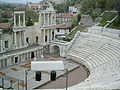


Plovdiv Roman amphitheatre
The Plovdiv Antique theater is a historical building in the city center of Plovdiv, Bulgaria. Although this structure is commonly referred to as an amphitheatre, it is actually a traditional Roman theatre...
is probably the best known monument from Antiquity
Classical antiquity
Classical antiquity is a broad term for a long period of cultural history centered on the Mediterranean Sea, comprising the interlocking civilizations of ancient Greece and ancient Rome, collectively known as the Greco-Roman world...
in Bulgaria. It was built in the beginning of the 2nd century during the reign of the Roman
Roman Empire
The Roman Empire was the post-Republican period of the ancient Roman civilization, characterised by an autocratic form of government and large territorial holdings in Europe and around the Mediterranean....
Emperor Trajan
Trajan
Trajan , was Roman Emperor from 98 to 117 AD. Born into a non-patrician family in the province of Hispania Baetica, in Spain Trajan rose to prominence during the reign of emperor Domitian. Serving as a legatus legionis in Hispania Tarraconensis, in Spain, in 89 Trajan supported the emperor against...
. It is situated in the natural saddle between the Dzhambaz Tepe and Taksim Tepe hills. It is divided into two parts with 14 rows each divided with a horizontal lane. The theatre could accommodate up to 7,000 people. The three-story scene is located on the southern part and is decorated with frieze
Frieze
thumb|267px|Frieze of the [[Tower of the Winds]], AthensIn architecture the frieze is the wide central section part of an entablature and may be plain in the Ionic or Doric order, or decorated with bas-reliefs. Even when neither columns nor pilasters are expressed, on an astylar wall it lies upon...
s, cornices and statues. The theatre was studied, conserved and restored between 1968 and 1984. Many events are still held on the scene including the Verdi festival and the International Folklore festival. The Roman Odeon was restored in 2004. It was built in the 2nd-5th centuries and is the second (and smaller) antique theatre of Philipopolis with 350 seats. It was initially built as a bulevterion - edifice of the city council - and was later reconstructed as a theatre.
The Roman Stadium
Plovdiv Roman Stadium
The Roman Stadium is an ancient building in Plovdiv, Bulgaria, among the largest Roman structures in the Balkans. The massive edifice is 180 long and had a capacity of over 30,000 It is believed to have been built during the reign of Septimus Severus .Today, the stadium is located in the centre of...
is another important monument of the ancient city. It is situated between Sahat Tepe and the Three Hills in the modern Dzhumaya Square. It was built in the 2nd century and modeled after the stadium in Delphi
Delphi
Delphi is both an archaeological site and a modern town in Greece on the south-western spur of Mount Parnassus in the valley of Phocis.In Greek mythology, Delphi was the site of the Delphic oracle, the most important oracle in the classical Greek world, and a major site for the worship of the god...
. In Roman times it could hold 30,000 spectators. Only a small part of the northern section with 13 seat rows can be seen nowadays - the larger part lies under the main street and a number of buildings.
The Roman forum dates from the reign of Vespasian
Vespasian
Vespasian , was Roman Emperor from 69 AD to 79 AD. Vespasian was the founder of the Flavian dynasty, which ruled the Empire for a quarter century. Vespasian was descended from a family of equestrians, who rose into the senatorial rank under the Emperors of the Julio-Claudian dynasty...
in 1st century and was finished in the 2nd century. It is located near the modern post office next to the Odeon. It has an area of 11 hectares and was surrounded by shops and public buildings. The forum was a focal point of the streets of the ancient city.
The Eirene Archaeological complex is located in the southern part of the Three Hills on the northern part of an ancient street in the Arheologicheski underpass. It includes remains of a public building from the 3rd-4th centuries which belonged to a noble citizen. Eirene is the Christian name for Penelopa - a maiden from Megadon who was converted to Christianity in 2nd century. There are colourful mosaics which have geometrical forms and figures.
On Nebet Tepe are found remains of the first settlement on the Three Hills which in 12th century BC grew to the Thracian
Thrace
Thrace is a historical and geographic area in southeast Europe. As a geographical concept, Thrace designates a region bounded by the Balkan Mountains on the north, Rhodope Mountains and the Aegean Sea on the south, and by the Black Sea and the Sea of Marmara on the east...
city of Eumolpias, one of the first cities in South-eastern Europe. Massive walls surrounding a temple and a palace have been excavated. The oldest part of the fortress was constructed from large syenite blocks - the so called "cyclop construction".
Museums and protected sites
The Archaeological Museum was established in 1882 as a People's Museum of Eastern Rumelia. In 1928 the museum was moved to a 19th century edifice on Saedinenie Square built by the famous Plovdiv architect Josef SchnitterJosef Schnitter
Josef Schnitter was a Czech–Bulgarian architect, engineer and geodesist credited with shaping the modern appearance of Plovdiv, Bulgaria's second-largest city....
. The museum contains a rich collection of Thracian art. The three sections "Prehistory", "Antiquity" and "Middle Ages" contain precious artifacts from the Paleolithic
Paleolithic
The Paleolithic Age, Era or Period, is a prehistoric period of human history distinguished by the development of the most primitive stone tools discovered , and covers roughly 99% of human technological prehistory...
to the early Ottoman period (15th-16th centuries). The famous Panagyurishte treasure
Panagyurishte treasure
The Panagyurishte Treasure is a Thracian treasure excavated on December 8, 1949 by three brothers, Pavel, Petko and Michail Deikov who worked together at the region of “Merul” tile factory near the town of Panagyurishte, Bulgaria. It consists of a phiale, an amphora and seven rhytons with total...
is part of the museum's collection.
The Historical Museum
Plovdiv Regional Historical Museum
The Plovdiv Regional Historical Museum is a historical museum in the city of Plovdiv, Bulgaria. Established in 1951, it covers the history of Plovdiv from the 15th century until today...
of Plovdiv was founded in 1951 as a scientific and cultural institute for collecting, saving, and researching historical evidence about Plovdiv and the region from 16th to 20th centuries. The exhibition is situated in three buildings.
The Regional Ethnographic Museum - Plovdiv
Plovdiv Regional Ethnographic Museum
The Plovdiv Regional Ethnographic Museum is a museum of ethnography in Plovdiv, Bulgaria. Since 1938, it has occupied the 1847 house of the rich merchant Argir Kuyumdzhioglu in the city's Old Town...
was inaugurated in 1917. On 14 October 1943 it was moved to a house in the Old Town. In 1949 the Municipal House-museum was reorganized as a People's Ethnographic Museum and in 1962 it was renovated. There are more than 40,000 objects.
The Museum of Natural Science was inaugurated in 1955 in the old edifice of the Plovdiv Municipality built in 1880. It is among the most important museums in the country with rich collections in Paleontology
Paleontology
Paleontology "old, ancient", ὄν, ὀντ- "being, creature", and λόγος "speech, thought") is the study of prehistoric life. It includes the study of fossils to determine organisms' evolution and interactions with each other and their environments...
, Mineralogy
Mineralogy
Mineralogy is the study of chemistry, crystal structure, and physical properties of minerals. Specific studies within mineralogy include the processes of mineral origin and formation, classification of minerals, their geographical distribution, as well as their utilization.-History:Early writing...
and Botanic
Botany
Botany, plant science, or plant biology is a branch of biology that involves the scientific study of plant life. Traditionally, botany also included the study of fungi, algae and viruses...
sections. There are several rooms for wildlife and it contains Bulgaria's largest freshwater aquarium with 40 fish species. It has a collection of minerals from the Rhodope mountains
Rhodope Mountains
The Rhodopes are a mountain range in Southeastern Europe, with over 83% of its area in southern Bulgaria and the remainder in Greece. Its highest peak, Golyam Perelik , is the seventh highest Bulgarian mountain...
.
The Museum of Aviation was established on 21 September 1991 on the territory of the Krumovo airbase 12 km to the south-east of the city. The museum possesses 59 aircraft and both indoor and outdoor exhibitions.
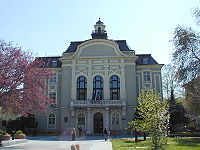
The Old Town of Plovdiv is a historic preservation site known for its Bulgarian Renaissance architectural style. The Old Town covers the area of the three central hills (Трихълмие, Trihalmie) —Nebet Tepe, Dzhambaz Tepe and Taksim Tepe. Almost every house in the Old Town has its characteristic exterior and interior decoration.
Churches, mosques and temples
There are a number of 19th century churches, most of which follow the distinctive Eastern Orthodox construction style. Those are the Saint Constantine and Saint Helena, the Saint Marina, the Saint Nedelya, the Saint Petka and the Holy Mother of God Churches. There are also Roman Catholic Cathedrals in Plovdiv, the largest of them being the Cathedral of St LouisCathedral of St Louis, Plovdiv
The Cathedral of St Louis is a Roman Catholic cathedral in the city of Plovdiv, Bulgaria. Co-cathedral of the Diocese of Sofia and Plovdiv together with the Cathedral of St Joseph in Sofia, it is one of the largest and most important Roman Catholic places of worship in the country...
. There are several more modern Baptist, Methodist, Presbyterian, and other Protestant churches, as well as older style Apostolic churches. Two mosques remain in Plovdiv from the time of the Ottoman rule. Of them the Djumaya Mosque, is considered the oldest European mosque outside Moorish Spain.
The Sephardic synagogue is located at Tsar Kaloyan Street 13, in the remnants of a small courtyard in what was once a large Jewish quarter. Dating to the 19th century, it is one of the best-preserved examples of the so-called "Ottoman-style" synagogues in the Balkans. According to author Ruth E. Gruber, the interior is a "hidden treasure…a glorious, if run-down, burst of color." An exquisite Venetian glass chandelier hangs from the center of the ceiling, which has a richly painted dome. All surfaces are covered in elaborate, Moorish-style, geometric designs in once-bright greens and blues. Torah scrolls are kept in the gilded Aron-ha-Kodesh.
Theatre and music
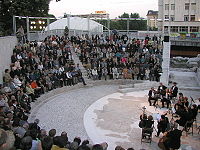
Another post of Plovdiv's culture is the Philharmonic, founded in 1945. Soloists such as Dmitri Shostakovich
Dmitri Shostakovich
Dmitri Dmitriyevich Shostakovich was a Soviet Russian composer and one of the most celebrated composers of the 20th century....
, Sviatoslav Richter
Sviatoslav Richter
Sviatoslav Teofilovich Richter was a Soviet pianist well known for the depth of his interpretations, virtuoso technique, and vast repertoire. He is widely considered one of the greatest pianists of the 20th century.-Childhood:...
, Mstislav Rostropovich
Mstislav Rostropovich
Mstislav Leopoldovich Rostropovich, KBE , known to close friends as Slava, was a Soviet and Russian cellist and conductor. He was married to the soprano Galina Vishnevskaya. He is widely considered to have been the greatest cellist of the second half of the 20th century, and one of the greatest of...
, Yuri Boukov and Mincho Minchev have worked with the Plovdiv Philharmonic. The orchestra has toured in almost all of the European countries. The Trakiya Folklore Ensemble, founded in 1974, has performed thousands of concerts in Bulgaria and more than 42 countries. The Trakiya Traditional Choir was nominated for a Grammy Award
Grammy Award
A Grammy Award — or Grammy — is an accolade by the National Academy of Recording Arts and Sciences of the United States to recognize outstanding achievement in the music industry...
. The Detska Kitka Choir
Detska Kitka Choir
The Detska Kitka Choir is a girls’ choir based in Plovdiv, Bulgaria.- Biography :Founded in 1946 by Anastas Marinkev, the Detska Kitka Choir is one of the oldest and best known youth choirs in Bulgaria....
is one of the oldest and best known youth choirs in Bulgaria, winner of numerous awards from international choral competitions. The Evmolpeya choir
Evmolpeya
-History:The Evmolpeya Choir was established in July 2006. Its creator and conductor is the composer Rada Slavinska. The choir was named "Evmolpeya", which translates into "a beautifully singing young girl." The patron of the choir became the then mayor of Plovdiv Ivan Chomakov...
is another girls' choir from Plovdiv, whose patron when it was established in 2006 became the then mayor Ivan Chomakov
Ivan Chomakov
Dr. Ivan Chomakov was the mayor of the city of Plovdiv, Bulgaria from 1999 to 2007.Before entering political office, Chomakov was an assistant professor of anaesthesiology....
. The choir was appointed a Goodwill Ambassador
Goodwill Ambassador
Goodwill Ambassador is a collective term sometimes used as a substitute honorific title or a title of honor for an Ambassador of Goodwill; but, most appropriately for a generic recognition, it is a job position or description that is usually indicated following the name of the individual recognized...
and a municipal choir.
Literature
Plovdiv is among the nation's primary literary centres - in 1855 Hristo G. DanovHristo G. Danov
Hristo Gruev Danov was a Bulgarian enlightener, teacher and book publisher of the Bulgarian National Revival who is regarded as the father of organized book publishing in the Bulgarian lands and hailed as the "Bulgarian Gutenberg"...
created the first Bulgarian publishing company and later the first printing-press. The city's traditions as a literary centre are preserved by the first public library in Bulgaria, the Ivan Vazov National Library
Ivan Vazov National Library
The Ivan Vazov National Library is a library situated in Bulgaria's second largest city, Plovdiv. It is named after the famous Bulgarian writer and poet Ivan Vazov....
, by the 19 chitalishta (cultural centres) and by numerous booksellers and publishers. The library was founded in 1879 and named after the famous Bulgarian writer and poet Ivan Vazov
Ivan Vazov
Ivan Minchov Vazov was a Bulgarian poet, novelist and playwright, often referred to as "the Patriarch of Bulgarian literature". He was born in Sopot, a town in the Rose Valley of Bulgaria ....
who worked there for five years creating some of his best works. Today the Ivan Vazov National Library is the second largest national library institution with more than 1,5 million books, owning rare Bulgarian and European publications.
Arts
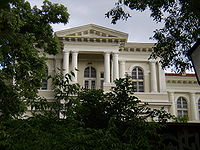
Iconography
Iconography is the branch of art history which studies the identification, description, and the interpretation of the content of images. The word iconography literally means "image writing", and comes from the Greek "image" and "to write". A secondary meaning is the painting of icons in the...
since the Middle Ages. During the Period of National Revival a number of notable icon-painters (called in Bulgarian zografi, зографи) from all regions of the country worked in Plovdiv - Dimitar Zograf
Dimitar Zograf
Dimitar Hristov , better known as Dimitar Zograf , was a noted 19th-century Bulgarian painter known for his icons....
and his son Zafir Zograf, Zahari Zograf
Zahari Zograf
Zahariy Hristovich Dimitrov , better known as Zahari Zograf is arguably the most famous Bulgarian painter of the Bulgarian National Revival, noted for his church mural paintings and icons and often regarded as the founder of secular art in Bulgaria due to the introduction of everyday life...
, Georgi Danchov and others. After the Liberation the famous Bulgarian painter of Czech origin Ivan Mrkvička
Ivan Mrkvicka
Ivan Mrkvička was a Czech-born painter and an active contributor to the artistic life of newly-liberated Bulgaria in the late 19th and early 20th century...
came to work in the city. The Painters' Society was established there by artists from Southern Bulgaria in 1912 whose members included the prominent painters Zlatyu Boyadzhiev
Zlatyu Boyadzhiev
Zlatio Georgiev Boiadjiev was a Bulgarian painter. He is known for his portraits and landscapes, depicting mainly the Old Town of Plovdiv and village life in its vicinity....
, Sirak Skitnik, Tsanko Lavrenov.
Today the city has 30 art galleries. The Art Gallery of Plovdiv was founded in the late 19th century. It possesses 5,000 pieces of art in 4 separate buildings. Since 1981 it has a section for Mexican
Culture of Mexico
Mexico has changed rapidly during the 20th century. In many ways, contemporary life in its cities has become similar to that in neighboring United States and Europe. Most Mexican villagers follow the older way of life more than the city people do. More than 45% of the people of Mexico live in...
Art donated by Mexican painters in honour of the 1,300-year anniversary of the Bulgarian State.
Economy

Food processing
Food processing is the set of methods and techniques used to transform raw ingredients into food or to transform food into other forms for consumption by humans or animals either in the home or by the food processing industry...
, tobacco, brewing and textiles were the main pillars of the industry. During Communist rule the city's economy greatly expanded and was dominated by heavy industry - it still produces lead and zinc
Zinc
Zinc , or spelter , is a metallic chemical element; it has the symbol Zn and atomic number 30. It is the first element in group 12 of the periodic table. Zinc is, in some respects, chemically similar to magnesium, because its ion is of similar size and its only common oxidation state is +2...
, machinery, electronics
Electronics
Electronics is the branch of science, engineering and technology that deals with electrical circuits involving active electrical components such as vacuum tubes, transistors, diodes and integrated circuits, and associated passive interconnection technologies...
, motor trucks, chemicals
Chemical industry
The chemical industry comprises the companies that produce industrial chemicals. Central to the modern world economy, it converts raw materials into more than 70,000 different products.-Products:...
and cosmetics. After the fall of Communism in 1989 and the collapse of Bulgaria's planned economy
Planned economy
A planned economy is an economic system in which decisions regarding production and investment are embodied in a plan formulated by a central authority, usually by a government agency...
, a number of industrial complexes were closed.
Plovdiv has one of the country's fastest growing economies with average GDP growth of 12-13%. As of 2005 the total revenues are 9.4 billion lev
Bulgarian lev
The lev is the currency of Bulgaria. It is divided in 100 stotinki . In archaic Bulgarian the word "lev" meant "lion".It is speculated that Bulgaria, as a member of the European Union will adopt the Euro in 2015 .- First lev, 1881–1952 :...
a (approximately 4.8 billion euro), which is with 88% more than in 2001. The profits for the same period rose 4.5 times. Unemployment is 6,5% which is lower than the national average. One recent problem is the municipality's administrative borders, which almost completely coincide with the city limits. Due to the constant increase of investments which are $465,000,000 for 2005 some of the businesses have to be redirected to the Maritsa or Rodopi municipalities such as the industrial zone of Radinovo
Radinovo
Radinovo is a village in the Maritsa municipality, Plovdiv Province, Bulgaria. As of 2006 the population is 720. There is a large plant producing refrigerators owned by Liebherr , as well as a tobacco processings plant and several other industrial enterprises....
village.
Industry has been expanding again since the late 1990s, with manufacturing plants built in the city or in its outskirts, mainly the municipality of Maritsa. In this period, some €500,000,000 has been invested in construction of new factories. Some of the new plants include the Liebherr
Liebherr
* The Liebherr Group, a German manufacturing complex established in 1949 by Hans Liebherr* Liebherr Grazer AK* Liebherr T 282B, an off- highway, ultra class, rigid frame, two- axle, diesel/electricappointed...
refrigerator plant with 1,850 employees and a capacity of 450,000 items per year, the Socotab tobacco processing plant (2,000 employees), a bicycle plant (500 workers, capacity 500,000 units), а Schneider
Schneider Electric
Schneider Electric is a French global company. It was founded in 1836 by two brothers, Eugène and Adolphe Schneider.In the first part of the 20th century, Schneider et Cie associated itself with Westinghouse Systems, a major international electrical group at the time. The group began manufacturing...
electronics factory, a biodiesel plant, the Bulsaphil textile plant (790 workers), and several electronics and high-tech plants producing CD players and other electronic equipment. The largest electronics plant in the Balkans
Balkans
The Balkans is a geopolitical and cultural region of southeastern Europe...
was inaugurated in the nearby village of Voivodinovo
Voivodinovo
Voivodinovo is a village in the Plovdiv Province, southern Bulgaria. As of 2006 it has 2,018 inhabitants. It is one of the biggest villages in the Maritsa municipality and is at 2 km to the east of Plovdiv...
.
Due to the demand for business office space Business Park Plovdiv
Business Park Plovdiv
Business Park Plovdiv is a business park which is going to be built in Bulgaria's second largest city, Plovdiv. It will be located in the Trakiya district in the south-eastern parts of the city. Construction is expected to begin in 2008....
is going to be constructed in the district of Trakiya
Trakiya district
Trakiya is the largest neighbourhood of Plovdiv as well as one of the six districts of the city located in its south-eastern parts. It has 61,920 inhabitants. Its construction began in 1973, in 1976 it was inaugurated as a neighbourhoods and in 1983 it became a district...
. The investment is for €68,000,000 and the park will occupy an area of 110000 m² (131,558.91 sq yd). A commercial and industrial park is to be built in the village of Radinovo
Radinovo
Radinovo is a village in the Maritsa municipality, Plovdiv Province, Bulgaria. As of 2006 the population is 720. There is a large plant producing refrigerators owned by Liebherr , as well as a tobacco processings plant and several other industrial enterprises....
at several km to the north-west of the city with a built-up area of 50000 m² (59,799.5 sq yd).
Shopping and commerce
Shopping mall
A shopping mall, shopping centre, shopping arcade, shopping precinct or simply mall is one or more buildings forming a complex of shops representing merchandisers, with interconnecting walkways enabling visitors to easily walk from unit to unit, along with a parking area — a modern, indoor version...
s under construction - the €40 million Mall of Plovdiv with a shopping area of 40000 m² (47,839.6 sq yd), 11 cinemas and parking for 700 cars, €50 mln. Central Mall Markovo tepe, a huge €60 mln. mall and hotel complex in the district of Trakiya as well as several other projects planned or under construction.
Several hypermarkets have been built mainly on the outskirts of the city: Metro
Metro AG
Metro AG is a diversified retail and wholesale/cash and carry group based in Düsseldorf, Germany. It has the largest market share in its home market, and is one of the most globalised retail and wholesale corporations. It is the fourth-largest retailer in the world measured by revenues . In English...
, Kaufland
Kaufland
Kaufland is a German hypermarket chain part of the same group as Lidl and Handelshof. It opened its first store in 1984 in Neckarsulm and quickly expanded to become a leader in what was formerly East Germany...
, Sani
Sani
Sani may refer to:*Sani Resort, a resort in the peninsula of Halkidiki, Greece*Sani, Greece, a beach community south of Thessalonike*Sani, Mauritania*Sani Pass, pass in the Drakensberg linking Lesotho to South Africa*Shani, in Hindu astrology, Saturn...
(2 outlets), Praktiker
Praktiker
Praktiker is a German hypermarket chain offering home improvement and do-it-yourself goods. It is based in Kirkel, Saarland, and opened its first store in 1978. Initially owned by ASKO, the chain became a division of Metro AG after the merger of ASKO with Metro Cash & Carry in 1995...
, Billa, Mr. Bricolage
Mr. Bricolage
Mr. Bricolage is a French retail chain offering home improvement and do-it-yourself goods. The chain operates over 500 stores in these countries: France Serbia Bulgaria Romania Spain Andorra Belgium Argentina Uruguay Morocco Madagascar Mauritius...
, Baumax
BauMax
bauMax is an Austrian hypermarket chain offering home improvement and do-it-yourself goods. It is based in Kindberg, Austria, and opened its first store in 1976.-Baumax in Europe:...
, Technopolis, Technopark Europa, and others. The main shopping area is the central street with its shops, cafés and restaurants. A number of cafés, craftsmen workshops and souvenir shops are situated in the Old Town and the small streets in the centre, known among the locals as "The trap" .
The Plovdiv International Fair, held annually since 1892, is the largest and oldest fair in the country and all of southeastern Europe, gathering companies from all over the world in an exhibition area of 138000 m² (165,046.63 sq yd) located on a territory of 352000 m² (420,988.5 sq yd) on the northern banks of the Maristsa river. It attracts more than 600,000 visitors from different countries.
The city also has a duty-free zone since 1987. It has a customs terminal handling cargo from trucks and trains.
Transport

Pan-European corridors
The ten Pan-European transport corridors were defined at the second Pan-European transport Conference in Crete, March 1994, as routes in Central and Eastern Europe that required major investment over the next ten to fifteen years. Additions were made at the third conference in Helsinki in 1997...
run into or near the city - Corridor IV (Dresden
Dresden
Dresden is the capital city of the Free State of Saxony in Germany. It is situated in a valley on the River Elbe, near the Czech border. The Dresden conurbation is part of the Saxon Triangle metropolitan area....
–Bucharest
Bucharest
Bucharest is the capital municipality, cultural, industrial, and financial centre of Romania. It is the largest city in Romania, located in the southeast of the country, at , and lies on the banks of the Dâmbovița River....
–Sofia
Sofia
Sofia is the capital and largest city of Bulgaria and the 12th largest city in the European Union with a population of 1.27 million people. It is located in western Bulgaria, at the foot of Mount Vitosha and approximately at the centre of the Balkan Peninsula.Prehistoric settlements were excavated...
-Plovdiv- Istanbul
Istanbul
Istanbul , historically known as Byzantium and Constantinople , is the largest city of Turkey. Istanbul metropolitan province had 13.26 million people living in it as of December, 2010, which is 18% of Turkey's population and the 3rd largest metropolitan area in Europe after London and...
), Corridor VIII (Durrës
Durrës
Durrës is the second largest city of Albania located on the central Albanian coast, about west of the capital Tirana. It is one of the most ancient and economically important cities of Albania. Durres is situated at one of the narrower points of the Adriatic Sea, opposite the Italian ports of Bari...
-Sofia-Plovdiv-Varna
Varna
Varna is the largest city and seaside resort on the Bulgarian Black Sea Coast and third-largest in Bulgaria after Sofia and Plovdiv, with a population of 334,870 inhabitants according to Census 2011...
/Burgas
Burgas
-History:During the rule of the Ancient Romans, near Burgas, Debeltum was established as a military colony for veterans by Vespasian. In the Middle Ages, a small fortress called Pyrgos was erected where Burgas is today and was most probably used as a watchtower...
) and Corridor X (Salzburg
Salzburg
-Population development:In 1935, the population significantly increased when Salzburg absorbed adjacent municipalities. After World War II, numerous refugees found a new home in the city. New residential space was created for American soldiers of the postwar Occupation, and could be used for...
–Belgrade
Belgrade
Belgrade is the capital and largest city of Serbia. It is located at the confluence of the Sava and Danube rivers, where the Pannonian Plain meets the Balkans. According to official results of Census 2011, the city has a population of 1,639,121. It is one of the 15 largest cities in Europe...
-Plovdiv-Istanbul). A major tourist center, Plovdiv lies at the foot of the Rhodope Mountains
Rhodope Mountains
The Rhodopes are a mountain range in Southeastern Europe, with over 83% of its area in southern Bulgaria and the remainder in Greece. Its highest peak, Golyam Perelik , is the seventh highest Bulgarian mountain...
, and most people wishing to explore the mountains choose it as their trip's starting point.
Plovdiv is a major road and railway hub in southern Bulgaria: the Trakiya motorway
Trakiya motorway
The Trakia motorway or Thrace motorway, designated A1, is a motorway currently in construction in Bulgaria. It is planned to connect the capital of Sofia with Burgas on the Black Sea through Plovdiv and with Kalotina on the Serbian border. The motorway is named after the historical region of...
(A1) is only at 5 km (3 mi) to the north. It lies on the important national route from Sofia to Burgas via Stara Zagora. First-class roads lead to Sofia to the west, Karlovo
Karlovo
Karlovo is a picturesque and a historically important town in central Bulgaria located in a fertile valley along the river Stryama at the southern foot of the Balkan Mountains...
to the north, Asenovgrad
Asenovgrad
Asenovgrad is a town in central southern Bulgaria, part of Plovdiv Province.-History:Asenovgrad was founded by the Thracians as Stenímachos around 300–400 BC. In 72 BC the city was captured by the troops of the Roman Empire as part of the Roman expansion towards the Black Sea. After a long period...
and Kardzhali
Kardzhali
Kardzhali or Kurdzhali is a town in Bulgaria, capital of Kardzhali Province in the Eastern Rhodopes. Near the town is the noted Kardzhali Dam.-Geography:...
to the south, Stara Zagora
Stara Zagora
Stara Zagora is the sixth largest city in Bulgaria, and a nationally important economic center. Located in Southern Bulgaria, it is the administrative capital of the homonymous Stara Zagora Province...
and Haskovo
Haskovo
Haskovo , is a city, an administrative centre of the homonymous Haskovo Province in southern Bulgaria, not far from the borders with Greece and Turkey. As of February 2011, it has a population of 74,843 inhabitants....
to the east. There are intercity bus
Intercity bus
An intercity bus is a bus that carries passengers significant distances between different cities, towns, or other populated areas. Unlike a municipal bus, which has frequent stops throughout a city or town, an intercity bus generally has a single stop at a centralized location within the city, and...
es which link Plovdiv with cities and towns all over the country and many European countries. They are based in three bus station
Bus station
A bus station is a structure where city or intercity buses stop to pick up and drop off passengers. It is larger than a bus stop, which is usually simply a place on the roadside, where buses can stop...
s: South, Rodopi and North.
Railway transportation in the city dates back to 1872 when it became a station on the Lyubimets
Lyubimets
Lyubimets is a small town in Haskovo Province, southern-central Bulgaria. It is the administrative centre of the homonymous Lyubimets Municipality. As of December 2009, the town has a population of 7,670 inhabitants....
–Belovo
Belovo, Bulgaria
Belovo is a town in South West Bulgaria. It is located in Pazardzhik Province, where the Yadenitza flows into the Maritza river, at the foot of three mountain ranges , on the western end of the Thracian Plain...
railway line. There are railways to Sofia, Panagyurishte
Panagyurishte
Panagyurishte is a town in Pazardzhik Province, Southern Bulgaria, situated in a small valley in the Sredna Gora mountains. It is 91 km east of Sofia, 43 km north of Pazardzhik, and 37 km south of Zlatitsa. The town is the administrative centre of the homonymous Panagyurishte...
, Karlovo, Peshtera
Peshtera
Peshtera is a town in southwestern Bulgaria, part of Pazardzhik Province, located in the Upper Thracian Lowlands at the foot of the Western Rhodopes. It takes its name from the many caves found in the vicinity. The town is the administrative centre of the homonymous Peshtera Municipality...
, Stara Zagora, Dimitrovgrad
Dimitrovgrad, Bulgaria
Dimitrovgrad is a town in Haskovo Province, South-central Bulgaria, located close to the province capital - Haskovo. It is a newly founded settlement, built in the end of the 1940s. and named after the communist leader Georgi Dimitrov. The town is the administrative centre of the homonymous...
and Asenovgrad. There are three train station
Train station
A train station, also called a railroad station or railway station and often shortened to just station,"Station" is commonly understood to mean "train station" unless otherwise qualified. This is evident from dictionary entries e.g...
s - Plovdiv Central
Plovdiv Central railway station
Plovdiv Central railway station is the main station serving the city and municipality of Plovdiv, the second most populous city in Bulgaria....
, Trakiya and Filipovo as well as a Freight Station.
Plovdiv has an extensive public transport system, including around 40 bus and trolleybus
Trolleybus
A trolleybus is an electric bus that draws its electricity from overhead wires using spring-loaded trolley poles. Two wires and poles are required to complete the electrical circuit...
lines. Six bridges span over the Maritsa
Maritsa
The Maritsa or Evros , ) is, with a length of 480 km, the longest river that runs solely in the interior of the Balkans. It has its origin in the Rila Mountains in Western Bulgaria, flowing southeast between the Balkan and Rhodope Mountains, past Plovdiv and Parvomay to Edirne, Turkey...
river including a railroad bridge and a covered bridge
Covered bridge
A covered bridge is a bridge with enclosed sides and a roof, often accommodating only a single lane of traffic. Most covered bridges are wooden; some newer ones are concrete or metal with glass sides...
. There are important road junctions to the south, south-west and north.
Plovdiv International Airport
Plovdiv International Airport
Plovdiv Airport is the airport of the second largest city in Bulgaria, Plovdiv. Often referred to as Plovdiv Krumovo Airport, a small village located 12 km south-east away from the city on the main highway Plovdiv-Asenovgrad....
is located near the village of Krumovo
Krumovo
Krumovo is a village in the Plovdiv Province, southern Bulgaria. As of 2006 it has 3,378 inhabitants. The village is located at 2 km to the south of the Maritsa river and at 12 km to the south-east of Plovdiv. The Plovdiv International Airport is located in the vicinity of the village...
, 5 km (3 mi) southeast of the city. It takes charter flights from Europe and has scheduled services with Ryanair to London,Milan and Frankfurt-Hahn and S7 to Moscow. Many small airports are located in the surroundings of the city including the important military airbase
Airbase
An airbase is a military airfield that provides basing and support of military aircraft....
in Graf Ignatievo
Graf Ignatievo
Graf Ignatievo is a village in the Maritsa municipality, southern Bulgaria. As of 2006 it has 2015 inhabitants. There is the major military Graf Ignatievo Air Base of great importance used by the Bulgarian Air Force and the US.- External links :* * * *...
to the north of Plovdiv.
BIAF Airshow
BIAF Airshow
BIAF is an international airshow held on Krumovo Airbase, the military part of Plovdiv International Airport. It has been held every 2 years since 2007...
is held every two years on the Krumovo
Krumovo
Krumovo is a village in the Plovdiv Province, southern Bulgaria. As of 2006 it has 3,378 inhabitants. The village is located at 2 km to the south of the Maritsa river and at 12 km to the south-east of Plovdiv. The Plovdiv International Airport is located in the vicinity of the village...
airbase, on of the biggest airshows in the balkans.
Education
Around two thirds of the citizens (62,38%) have secondary, specialized or higher education. That percentage has increased in the period 1992–2001.Plovdiv has 78 schools including elementary, high, foreign language, mathematics, technical and art schools. There are also 10 private schools and a seminary
Seminary
A seminary, theological college, or divinity school is an institution of secondary or post-secondary education for educating students in theology, generally to prepare them for ordination as clergy or for other ministry...
. The number of pupils for 2005 is 36,964 and is constantly decreasing since the mid 1990 due to lower birth-rate. Among the most prestigious schools are: English Language School, High School of Mathematics, Ivan Vazov Language School, National Schools of Commerce - Plovdiv, the English Academy, National School for Music and Dance Art Plovdiv, French High School of Plovdiv.
The city has 6 universities and a number of state and private colleges and branches of other universities. Those include Plovdiv University
Plovdiv University
The Plovdiv University "Paisiy Hilendarski" is a university located in Plovdiv, Bulgaria. It was founded in 1962 and has nine faculties.- History and Profile :...
with 900 lecturers and employees and 13,000 students, the Plovdiv Medical University
Plovdiv Medical University
The Medical University – Plovdiv , more popular until recently under the name of VMI , was established in 1945 in Plovdiv, Bulgaria. It includes the Faculties of Medicine, Dental medicine, and Health Care, a Medical College and a hospital of its own with a capacity of 2000 beds...
with 2,600 students, the Medical College, Technical University of Sofia - Branch Plovdiv, Agricultural University - Plovdiv, University of Food Technologies, the Academy for Music, Dance and Fine Arts and others.
International Olympiad in Informatics
International Olympiad in Informatics
The International Olympiad in Informatics is an annual computer science competition for secondary school students. The first IOI was held in 1989 in Pravetz, Bulgaria....
(IOI) in 2009 took place at University of Plovdiv "Paisiy Hilendarski"
Plovdiv University
The Plovdiv University "Paisiy Hilendarski" is a university located in Plovdiv, Bulgaria. It was founded in 1962 and has nine faculties.- History and Profile :...
, during 8–15 August 2009. Honorary Patron of IOI 2009 is Georgi Parvanov
Georgi Parvanov
Georgi Sedefchov Parvanov is a President of Bulgaria, whose second and last mandate expires on January 22, 2012; he was elected after defeating his predecessor Petar Stoyanov in the second round of the presidential elections in November 2001 and he came into office on January 22, 2002...
President of Bulgaria.
Between 1875 and 1906, the Zariphios School
Zariphios School
The Zariphios School was a Greek educational institution established in 1875 in Plovdiv , then in the Ottoman Empire and now in Bulgaria. It became one of the most significant Greek educational centres in the region of Thrace, attracting teachers from Greece and Western Europe and existed until 1906...
provided education in the Greek language for Plovdiv's Greek community.
Sports and recreation
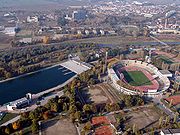
Plovdiv Stadium
Plovdiv Stadium , formerly known as 9th September Stadium, is a multi-purpose stadium in Plovdiv, Bulgaria. It is currently used mostly for athletics championships. The stadium holds 55,000. The stadium was built in 1950....
with several additional football fields, tennis courts, swimming pool
Swimming pool
A swimming pool, swimming bath, wading pool, or simply a pool, is a container filled with water intended for swimming or water-based recreation. There are many standard sizes; the largest is the Olympic-size swimming pool...
s, rowing base
Rowing (sport)
Rowing is a sport in which athletes race against each other on rivers, on lakes or on the ocean, depending upon the type of race and the discipline. The boats are propelled by the reaction forces on the oar blades as they are pushed against the water...
with 3 km long channel, restaurants, cafés situated in a spacious park in the western part of the city just south of the Maritza
Maritza
Maritza may refer to:*Maritza Correia , a Puerto Rican swimmer*Maritza Salas , a Puerto Rican track and field athlete*Maritza Olivares, a Mexican actress*Maritza Rodríguez, a Mexican actress...
river. There are also playgrounds for the children. It is popular among the citizens of Plovdiv and the guests of the city who use it for jogging, walking and relaxation. The Plovdiv Stadium has 55,000 seats which makes it the largest football venue in Bulgaria.
Other stadiums include Botev Stadium (22,000 seats), Lokomotiv Stadium (11,000 seats), Maritsa Stadium (5,000 seats) and Todor Diev Stadium (7,000 seats). There are also six indoor sports halls - Lokomotiv, Dunav, Stroitel, Chaika, Akademik, Total Sport. In 2006 a water park was opened near the city centre called Aqualand. Several smaller water parks are situated in the city as well.

Hristo Botev
Hristo Botev , born Hristo Botyov Petkov , was a Bulgarian poet and national revolutionary. Botev is widely considered by Bulgarians to be a symbolic historical figure and national hero.-Early years:...
. The city also has PFC Lokomotiv
PFC Lokomotiv Plovdiv
PFC Lokomotiv Plovdiv is a Bulgarian football club from the city of Plovdiv, which competes in Bulgaria's top football league, the A PFG. The club was founded on July 25, 1926 when two of the oldest Plovdiv clubs - Atletic and Karadzha united into a new club named Sports Club Plovdiv...
, founded in 1936. Both teams are a regular fixture in the top Bulgarian league
Bulgarian A Professional Football Group
The Bulgarian A Professional Football Group commonly known as A PFG is the top division of the Bulgarian football league system. The league is sponsored by Victoria FATA Insurance and therefore is officially known as Victoria A Football Group since 2011...
. The rivalry between them is considered to be even more fierce than the one between Levski
PFC Levski Sofia
"Levski Sofia" redirects here. For the sports club, see Levski Sofia .PFC Levski Sofia, otherwise simply known as Levski or Levski Sofia, is a professional football club based in Sofia, Bulgaria...
and CSKA
PFC CSKA Sofia
PFC CSKA Sofia , commonly known as CSKA or CSKA Sofia is a professional football club based in Sofia, Bulgaria. The club was officially founded on May 5, 1948. CSKA's abbreviation stands for Central Sports Club of the Army...
of Sofia
Sofia
Sofia is the capital and largest city of Bulgaria and the 12th largest city in the European Union with a population of 1.27 million people. It is located in western Bulgaria, at the foot of Mount Vitosha and approximately at the centre of the Balkan Peninsula.Prehistoric settlements were excavated...
. There are also two other football clubs in the city – Maritsa FC (founded in 1921) and Spartak Plovdiv (1947).
Plovdiv is host of the international boxing
Boxing
Boxing, also called pugilism, is a combat sport in which two people fight each other using their fists. Boxing is supervised by a referee over a series of between one to three minute intervals called rounds...
tournament "Strandzha" which takes place since 1949. In 2007 ninety-six boxers from 20 countries participated in the tournament. There is a horse racing
Horse racing
Horse racing is an equestrian sport that has a long history. Archaeological records indicate that horse racing occurred in ancient Babylon, Syria, and Egypt. Both chariot and mounted horse racing were events in the ancient Greek Olympics by 648 BC...
club and a horse base near the city. Plovdiv has several volleyball and basketball teams.
Three of the city's seven hills are protected natural territories since 1995. Two of the first parks in Bulgaria are located in the city center - Tsar Simeon garden (also known as the City garden) and Dondukov garden. Some of the larger parks include the Botanical garden, Beliz Brezi, Ribnitsa and Lauta.
Notable citizens
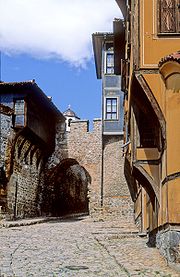

- Anjel VagensteinAnjel VagensteinAngel Raymond Wagenstein is a Bulgarian film director and author. Wagenstein was born in Plovdiv, Bulgaria, but spent his childhood in France where his Sephardic Jewish family emigrated for political reasons due to their leftist politics.Angel Wagenstein returned to Bulgaria due to an amnesty,...
, writer - Asen KisimovAsen KisimovAsen Kisimov was a Bulgarian actor. He appeared in 30 films between 1956 and 2000.-External links:...
, actor - Boris ChristoffBoris ChristoffBoris Christoff was a Bulgarian opera singer...
, basso - Dinko Dermendjiev, football player
- Filibeli Hafız Ahmed PashaFilibeli Hafiz Ahmed PashaHafiz Ahmed Pasha was an Ottoman Grand Vizier. Born as son of a Pomak Muezzin, he went to Istanbul in the age of 15 and was an employee in the Sultan's palace for many years...
, Ottoman Grand Vizier - George Ganchev, fencer, actor, writer, politician
- Georgi Slavchev, pianist, composer
- Hristo Danov, publisher
- Hristo StoichkovHristo StoichkovHristo Stoichkov Stoichkov , sometimes Stoitchkov; born 8 February 1966 in Plovdiv) is a retired Bulgarian footballer. He is regarded as one of the best footballers of his generation and the greatest Bulgarian footballer of all time. Nicknamed The Dagger , The Dog , The Modern Left...
, football player, winner of the European Footballer of the Year award (1994) - Isaac PassyIsaac PassyIsaac Passy was a Bulgarian philosopher specializing in aesthetics. He was a professor at Sofia University from 1952 until 1993. He was the most prolific philosopher in the history of Bulgaria. He published over 40 monographs and over 80 volumes of the philosophical classics...
, Bulgarian philosopher - Jean Videnov, ex-prime minister of BulgariaBulgariaBulgaria , officially the Republic of Bulgaria , is a parliamentary democracy within a unitary constitutional republic in Southeast Europe. The country borders Romania to the north, Serbia and Macedonia to the west, Greece and Turkey to the south, as well as the Black Sea to the east...
- Yordan Yovchev, gymnast
- Maria PetrovaMaria Petrova (rhythmic gymnast)Maria Petrova is a Bulgarian rhythmic gymnast. She shares the world record for the most individual world all-around rhythmic gymnastics titles of all time and has never placed lower than seventh in any competition in her entire career.-Career:Petrova began her training at the age of five at...
, three times World Champion in rhythmic gymnastics - Milcho LevievMilcho LevievMilcho Leviev is a Bulgarian composer, arranger, jazz performer and pianist.Milcho Leviev graduated from the State Academy of Music in 1960 majoring in Composition under Professor Pancho Vladigerov and in Piano under Professor Andrei Stoyanov...
, musician and composer - Milen DobrevMilen DobrevMilen Dobrev is a Bulgarian weightlifter. He became Olympic champion in 2004 in the middle heavyweight class. In same year he won the European Championship in Kiev.-References:...
, weightlifter - Nayden GerovNayden GerovNayden Gerov , born Nayden Gerov Hadzhidobrevich February 23, 1823, Koprivshtitsa–October 9, 1900, Plovdiv) was a Bulgarian linguist, folklorist, writer and public figure during the Bulgarian National Revival....
, linguist, folklorer and writer - Nayden TodorovNayden TodorovNayden Todorov is a Bulgarian conductor.- Positions :*Plovdiv Youth Orchestra *Vratza Philharmonic Orchestra *Sofia Festival Orchestra...
, conductor - Nikolay Argirov, Bear Wrestler, Radio DJ, School Teacher and part time President
- Nikolay Buhalov, Olympic canoeing champion
- Ognyana Petkova, Olympic canoeing bronze medalist
- Nonka MatovaNonka MatovaNonka Decheva Matova , is a Bulgarian police officer and rifle shooter who won silver at the 1992 Olympics and fourteen medals at World Championships...
, six-time Olympian and Olympic shooting silver medalist - Petar StoyanovPetar StoyanovPetar Stefanov Stoyanov is a former President of Bulgaria from 1997 until 2002. He was elected as a candidate of the Union of Democratic Forces...
, ex-president of Bulgaria - The birthplace of Silvena RoweSilvena RoweSilvena Rowe is a British chef, food writer, television personality and restaurateur.-Biography:Rowe was born in Plovdiv, Bulgaria to a Bulgarian mother and a Turkish father. Rowe's father, who was a newspaper editor of the largest Bulgarian newspaper, Bulgarianised his name due to Bulgaria's...
, world-famous celebrity television chef and food writer - Solomon PassySolomon PassySolomon Isaac Passy is a Bulgarian politician, foreign minister of Bulgaria from July 2001 until August 2005, and the Chairman-in-Office of the OSCE in 2004. Dr. Passy is also a member of the Advisory Board of the Institute for Cultural Diplomacy.- Summary :Solomon Passy was born in Plovdiv. He...
, mathematician, activist and politician - Stefka KostadinovaStefka KostadinovaStefka Kostadinova is a Bulgarian retired athlete and the current women's world record holder in the high jump. She is the current president of the Bulgarian Olympic Committee.-Career:...
, world record holder in the women's high jump - Tanya Gramatikova, photographic artist
- Tzvetana ManevaTzvetana ManevaTzvetana Maneva is a Bulgarian actress. She was born in Plovdiv and her artistic career started here. The eminent Bulgarian actress made her debut in cinema in the 1960s and has appeared in more than 50 Bulgarian films.Her parents are Nadejda Maneva and Georgi Manev. Her sister is Maria...
, actress - Tsvetana PironkovaTsvetana PironkovaTsvetana Kirilova Pironkova is a female Bulgarian tennis player. She was born and lives in Plovdiv, Bulgaria. Pironkova is right-handed and plays with a two-handed backhand....
, Bulgarian number 1 tennis player and World number 40 - Zlatyu BoyadzhievZlatyu BoyadzhievZlatio Georgiev Boiadjiev was a Bulgarian painter. He is known for his portraits and landscapes, depicting mainly the Old Town of Plovdiv and village life in its vicinity....
, painter - Irien Trendafilov, cartoonist
- Georgi IvanovGeorgi IvanovMajor general Georgi Ivanov Kakalov is a retired Bulgarian military officer and the first Bulgarian cosmonaut. He was a member of the National Assembly of Bulgaria in 1990.-Early life and military career:...
, cosmonaut
- Veneta Rangelova, pop singer and music pedagog(10.3.1957)
- Blagovest and Svetoslav Argirov,[23.4.1959],pop singers and composers
- Stoyan Zahariev, pop singer and composer
- Toma Sprostranov, radio and TV journalist
- Maria Neykova, pop singer and composer{b.21.12.1941-1.8.2002}
- Hristo Kidikov, pop singer (b.16.10.1946)
- Apostolos Nikolaidis (1896–1980), athlete
- Christos TsigiridisChristos TsigiridisChristos Tsigiridis was a Greek electrical engineer and technological pioneer of his era. He was the first who imported the technology of sound reinforcement systems to Greece and led the installation of the first sound system in the Greek Parliament...
(1877–1947) electrical engineer and technological pioneer
Twin towns – Sister cities
Plovdiv is twinnedTown twinning
Twin towns and sister cities are two of many terms used to describe the cooperative agreements between towns, cities, and even counties in geographically and politically distinct areas to promote cultural and commercial ties.- Terminology :...
with the following cities:
| Brno Brno Brno by population and area is the second largest city in the Czech Republic, the largest Moravian city, and the historical capital city of the Margraviate of Moravia. Brno is the administrative centre of the South Moravian Region where it forms a separate district Brno-City District... , Czech Republic. Columbia Columbia, South Carolina Columbia is the state capital and largest city in the U.S. state of South Carolina. The population was 129,272 according to the 2010 census. Columbia is the county seat of Richland County, but a portion of the city extends into neighboring Lexington County. The city is the center of a metropolitan... , United States. Daegu Daegu Daegu , also known as Taegu, and officially the Daegu Metropolitan City, is a city in South Korea, the fourth largest after Seoul, Busan, and Incheon, and the third largest metropolitan area in the country with over 2.5 million residents. The city is the capital and principal city of the... , South Korea. Gyumri Gyumri Gyumri is the capital and largest city of the Shirak Province in northwest Armenia. It is located about 120 km from the capital Yerevan, and, with a population of 168,918 , is the second-largest city in Armenia.The name of the city has been changed many times in history... , Armenia. Jeddah Jeddah Jeddah, Jiddah, Jidda, or Jedda is a city located on the coast of the Red Sea and is the major urban center of western Saudi Arabia. It is the largest city in Makkah Province, the largest sea port on the Red Sea, and the second largest city in Saudi Arabia after the capital city, Riyadh. The... , Saudi Arabia. Istanbul Istanbul Istanbul , historically known as Byzantium and Constantinople , is the largest city of Turkey. Istanbul metropolitan province had 13.26 million people living in it as of December, 2010, which is 18% of Turkey's population and the 3rd largest metropolitan area in Europe after London and... , Turkey. Ivanovo Ivanovo Ivanovo is a city and the administrative center of Ivanovo Oblast, Russia. Population: Ivanovo has traditionally been called the textile capital of Russia. Since most textile workers are women, it has also been known as the "City of Brides"... , Russia |
Košice Košice Košice is a city in eastern Slovakia. It is situated on the river Hornád at the eastern reaches of the Slovak Ore Mountains, near the border with Hungary... , Slovakia. (since 2000) Kumanovo Kumanovo Kumanovo is a city in the Republic of Macedonia and is the seat of Kumanovo Municipality which is the largest municipality in the country. Municipal institutions include a city council, mayor and other administrative bodies.-Name:... , Мacedonia. Kutaisi Kutaisi Kutaisi is Georgia's second largest city and the capital of the western region of Imereti. It is 221 km to the west of Tbilisi.-Geography:... , Georgia. Leskovac Leskovac Leskovac is a city and municipality in southern Serbia. It is the administrative center of the Jablanica District of Serbia... , Serbia. Luoyang Luoyang Luoyang is a prefecture-level city in western Henan province of Central China. It borders the provincial capital of Zhengzhou to the east, Pingdingshan to the southeast, Nanyang to the south, Sanmenxia to the west, Jiyuan to the north, and Jiaozuo to the northeast.Situated on the central plain of... , China. Ohrid Ohrid Ohrid is a city on the eastern shore of Lake Ohrid in the Republic of Macedonia. It has about 42,000 inhabitants, making it the seventh largest city in the country. The city is the seat of Ohrid Municipality. Ohrid is notable for having once had 365 churches, one for each day of the year and has... , Macedonia. |
Okayama, Japan. Petra Petra Petra is a historical and archaeological city in the Jordanian governorate of Ma'an that is famous for its rock cut architecture and water conduits system. Established sometime around the 6th century BC as the capital city of the Nabataeans, it is a symbol of Jordan as well as its most visited... , Jordan. Poznań Poznan Poznań is a city on the Warta river in west-central Poland, with a population of 556,022 in June 2009. It is among the oldest cities in Poland, and was one of the most important centres in the early Polish state, whose first rulers were buried at Poznań's cathedral. It is sometimes claimed to be... , Poland. Rome, Italy Saint Petersburg Saint Petersburg Saint Petersburg is a city and a federal subject of Russia located on the Neva River at the head of the Gulf of Finland on the Baltic Sea... , Russia. Thessaloniki Thessaloniki Thessaloniki , historically also known as Thessalonica, Salonika or Salonica, is the second-largest city in Greece and the capital of the region of Central Macedonia as well as the capital of the Decentralized Administration of Macedonia and Thrace... , Greece. Valencia Valencia, Venezuela Valencia is the capital city of Carabobo State, and the third largest city of Venezuela.The city is an economic hub that contains Venezuela's top industries and manufacturing companies. The population of Valencia reached some 1.5 million in the year 2003, and it is expected to grow dramatically... , Venezuela. |