

IMAX

Encyclopedia
IMAX is a motion picture
film format
and a set of proprietary cinema projection standards created by the Canadian
company IMAX Corporation
. IMAX has the capacity to record and display images of far greater size and resolution
than conventional film systems. Since 2002, some feature films have been upconverted into IMAX format for display in IMAX theatres and some have also been partially shot in IMAX.
 IMAX is the most widely used system for special-venue film presentations. , there were 528 IMAX theatres in 46 countries.
(1953) and VistaVision
(1954) widened the image from 35 mm film, following multi-projector
systems such as Cinerama
(1952). While impressive, Cinerama was difficult to install, and the seams between adjacent projected images were difficult to hide.
The IMAX system was developed by Graeme Ferguson
, Roman Kroitor
, Robert Kerr, and William C. Shaw.
During Expo 67
in Montreal, Kroitor's In the Labyrinth
and Ferguson's Man and the Polar Regions both used multi-projector, multi-screen systems. Each encountered technical difficulties that led them to found a company, initially called "Multiscreen", with a primary goal of designing and developing a simpler approach. The single-projector/single-camera system they eventually settled upon was designed and built by Shaw, based upon a novel "Rolling Loop" film-transport technology purchased from Australian inventor Ronald Jones
. Later, when it became clear that a single, large-screen image had far more impact than multiple smaller ones, Multiscreen changed its name to IMAX.
Tiger Child
, the first IMAX film, was demonstrated at Expo '70
in Osaka, Japan. The first permanent IMAX was in the Cinesphere
at Ontario Place
in Toronto
in 1971, and is still in operation. During Expo '74
in Spokane, Washington
, a very large IMAX screen that measured 90 by 65 m (295.3 by 213.3 ft) was featured in the US Pavilion (the largest structure in the expo). About 5 million visitors viewed the screen, which covered the viewer's total vision field when looking directly forward. This created a sensation of motion in most viewers, and motion sickness
in some. An IMAX 3D theatre also is in operation near the former Expo 67 site at the "Montreal Science Centre
" in the Port of Old Montreal.
The first permanent IMAX Dome installation, the Eugene Heikoff and Marilyn Jacobs Heikoff Dome Theatre at the Reuben H. Fleet Science Center
, opened in San Diego's Balboa Park in 1973. It doubles as a planetarium
. The first permanent IMAX 3D theatre was built in Vancouver
, British Columbia
for Transitions
at Expo '86, and was in use until 30 September 2009. It was located at the tip of Canada Place
, a Vancouver landmark.
As China
is now the second largest market after USA with roughly 25 IMAX theatres located throughout the country, IMAX aims to attract more viewers by decreasing the admission prices in China.
of producing and presenting IMAX films has led to approximately 40 minute shorter running times than conventional films. The majority tend to be documentaries that are suited for institutional venues such as museums and science centers. IMAX cameras have orbited the earth, climbed Mount Everest
, explored the bottom of the Atlantic Ocean
, and visited the Antarctic
. An IMAX documentary about the success of the Mars Exploration Rovers was released in 2006, titled Roving Mars
and used exclusive data from the Rovers.
One of the first attempts at presenting entertainment in the IMAX format was The Rolling Stones: Live at the Max
(1991), an 85-minute compilation of concert footage filmed in IMAX during the band's 1990 Steel Wheels tour
, edited to give the impression of a single concert.
In the 1990s more entertainment short films were created, notably T-Rex: Back to the Cretaceous
(directed by Brett Leonard
), in 1998 and Haunted Castle, released in 2001 (both in 3D). In 1999, The Old Man and the Sea
became the first IMAX animated film and proceeded to win an Oscar. The same year, Disney
produced Fantasia 2000
, the first full-length animated feature initially released exclusively in the IMAX format. Disney released the first 2D live–action IMAX entertainment film, Young Black Stallion, in late 2003.
 IMAX increases the resolution
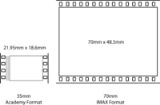
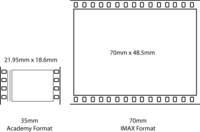
of the image by using a much larger film frame. To achieve this, 65 mm film stock passes horizontally through the cameras. Traditional cameras pass film vertically. 65 mm film has an image area that is 48.5 by 22.1 mm (1.9 by 0.87007874015748 in) (for Todd-AO
), in IMAX the image is 69.6 by 48.5 mm (2.7 by 1.9 in) tall. In order to match standard film speed of 24 frames per second
, three times the length of film moves through the camera.
) base. The reason is for precision more than strength. Developing chemicals do not change the size or shape of ESTAR, and IMAX's pin registration (especially the cam mechanism) does not tolerate either sprocket
-hole or film-thickness variations. The IMAX format is generically called "15/70" film, the name referring to the 15 sprocket holes per frame. The film's bulk requires platters rather than conventional film reels. IMAX platters range from 1.2 to 1.83 m (3.9 to 6 ft) diameter to accommodate 1 to 2.75 hours of film. Platters with a 2.5 hour feature film weigh 250 kilograms (551.2 lb).
. Instead, the IMAX system specifies a separate six-channel 35mm (1.377 inch) magnetic film synchronized to the film. This is the same technology as was used to provide the 7-channel soundtrack for Cinerama
. By the early 1990s, a separate digital 6-track source was used, locked to the projector by a SMPTE time code
synchronization system. The audio plays off a hard disk drive as a single uncompressed audio
file containing the 6 channels, which are converted directly to analogue rather than using a decoding method such as Dolby Digital
. IMAX theatres place speakers both directly behind the screen and around the theatre to create a three-dimensional effect.
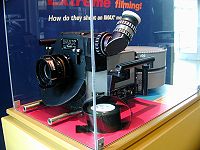
 Drawing the large film through the projector presented challenges for both the camera and the projector. Conventional 70 mm systems were not steady enough for the 586× magnification. On the projector side, William Shaw adapted an Australian patent for film transport called the "rolling loop" by adding a compressed air
"puffer" to accelerate the film, and put a cylindrical lens
in the projector's "aperture block". The projector uses a vacuum
to pull the film into contact with this lens. Thus the "field flattener
" flattens the image field. The lens is twice the height of the film and connects to a pneumatic piston
so it can be moved up or down while the projector is running. This way, if a piece of dust comes off the film and sticks to the lens, the projectionist can switch to the clean side of the lens at the push of a button. The lens also has "wiper bars" made of a felt
or brush-like material which can wipe dust off the lens as it moves up or down. IMAX projectors are pin
stabilized, meaning four registration pins engage the perforation
s at the corners of the projected frame to ensure perfect alignment. Shaw added cam
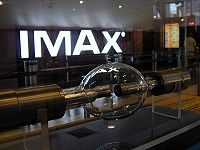
–controlled arms to decelerate each frame to eliminate the microscopic shaking as the frame "settled" onto the registration pins. The projector's shutter is open around 20% longer than in conventional equipment and the light source is brighter. The xenon short-arc lamps
are made of a thin layer of fused quartz
and contain xenon
gas at a pressure of about 25 atmospheres (367 PSI); because of this, projectionists are required to wear protective body armor when changing or handling these in case the lamp breaks (e.g., due to a drop to the floor) because of the danger from flying quartz
shards when propelled by the high pressure of the Xenon gas within.
An IMAX projector weighs up to 1.8 MT (2 ST) and at over 178 cm (70 in) tall and 195 cm (77 in) long.
IMAX Corporation has released four projector types that use its 15-perforation, 70 mm film format: GT (Grand Theatre), GT 3D (dual rotor), SR (Small Rotor), and MPX, which was designed for retrofitted theatres. In July 2008, the company introduced a digital projection system, which it has not given a distinct name or brand, designed for multiplex theatres with screens no wider than 21.3 m (69.9 ft). All IMAX projectors, except the standard GT system, can project 3D images.
A standard IMAX screen is 22 by 16.1 m (72.2 by 52.8 ft), but can be larger. The world's largest cinema screen (a 15/70 mm IMAX) is the LG IMAX Theatre in Sydney
, Australia
. It is approximately eight stories high, with dimensions of 35.73 by 29.42 m (117.2 by 96.5 ft) and covers an area of more than 1015 m² (10,925.4 sq ft). The largest digital IMAX screen, almost 100 feet (30.5 m) wide, is located at the Warren Theatres in Wichita, Kansas
.
IMAX theatres are described as either "Classic Design" (purpose-built structures), or "Multiplex Design" (retrofitted auditoriums).
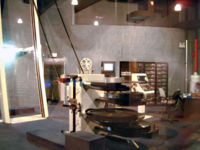 In the late 1960s the San Diego Hall of Science (now known as the Reuben H. Fleet Science Center
) began searching North America for a large-format film system to project on the dome of their planned 76 ft (23.2 m) tilted dome
planetarium
. The standard IMAX projector was unsuitable for use inside a dome because it had a 12 ft (3.7 m) tall lamp house on top. IMAX Corporation redesigned its system, adding an elevator
to lift the projector to the center of the dome from the projection booth below. Spectra Physics designed a suitable lamphouse that took smaller, 18 in (45.7 cm) lamps and placed the bulb behind the lens instead of above the projector. In 1970, Ernst Leitz Canada, Ltd. (now ELCAN Optical Technologies
) won a contract to develop and manufacture a fisheye lens
projection system optimized to project an image onto a dome instead of a flat screen.
The dome system, which the San Diego Hall of Science called OMNIMAX, uses films shot with a camera equipped with a fisheye lens on the camera that squeezes a highly distorted 180° field of view onto the 65 mm IMAX film. The lens is aligned below the center of the frame and most of the bottom half of the circular field falls beyond the edge of the film. The part of the field that would fall below the edge of the dome is masked. When filming, the camera is aimed upward at an angle that matches the tilt of the dome. When projected through a matching fisheye lens onto a dome, the original panoramic view is recreated. OMNIMAX wraps 180° horizontally, 100° above the horizon and 22° below the horizon for a viewer at the center of the dome. OMNIMAX premiered in 1973 showing Voyage to the Outer Planets
(produced by Graphic Films) and Garden Isle
(by Roger Tilton Films) on a double bill. The biggest IMAX dome theater in the world is the Hackworth IMAX Dome theater at the Tech Museum in San Jose, CA.
IMAX has since renamed the system IMAX Dome. However, some theatres continue to call it OMNIMAX.
OMNIMAX theatres inhabit theme parks and North American museums, particularly those with a scientific focus, where the technical aspects of the system may be highlighted as part of the attraction. The projection room is often windowed to allow public viewing and accompanied by informational placards like other exhibits. The screen may be a permanent fixture, such as at the St. Louis Science Center
and Boston's Museum of Science; or lowered and raised as needed, such as at the Science Museum of Minnesota
(where it shares an auditorium with a standard IMAX screen). Before the feature begins, the screen can be backlit to show the speakers and girders behind it. While the majority of museum installations focus on educational and documentary film
s, on special occasions, entertainment films are also shown, such as Charlie and the Chocolate Factory
at the Oregon Museum of Science and Industry
. The largest in North America are at the Liberty Science Center
in Jersey City, New Jersey and the Telus World of Science in Vancouver, BC, both of which have 88 feet (26.8 m) dome screens.
process uses separate camera lenses to represent the left and right eyes. The two lenses are separated by an interocular distance of 64 mm (2.5 in), the average distance between a human's eyes. Each lens feeds a separate roll of film. By projecting the two films simultaneously, viewers experience seeing a 3D image on a 2D screen. The IMAX 3D camera weighs over 113 kg (249.1 lb).
One method of creating the 3D illusion involves polarizing
the light from the two images. During projection, the left and right eye images are linearly polarized
as they are projected. Eyeglasses with right and left lenses polarized to match the projection present each eye with just the image intended for that eye since the polarization cancels out the other eye's image.
Alternatively the two projectors take turns displaying each frame (while one projector's image is displayed, the other is blocked) at an effective rate of 48 frames per second. The viewer dons LCD shutter glasses
that contain LCD panels that block or transmit light in each eye in sync with the projector, such that each eye only sees the image intended for it.
Several films produced in a smaller-format 3D process for release in conventional theatres have also been presented in IMAX 3D, including Toy Story 3
, Tron: Legacy, Transformers: Dark of the Moon and Avatar.
Some IMAX theatres further enhance the viewing experience by moving and/or vibrating the seats at opportune moments.
IMAX HD process, which sought to reduce strobing and offer higher definition by doubling the normal film rate. The IMAX HD system was tested in 1992 at the Canada Pavilion of the Seville Expo '92
with the film Momentum
. High costs doomed it but not before many theatres had been retrofitted to project at 48 frames, especially in Canada, in order to play Momentum. In the 1990s theme parks in Thailand, Germany, and Las Vegas used IMAX HD for their Motion Simulator rides. The Disney parks attraction Soarin' Over California
features a modification of both IMAX HD and IMAX Dome, projecting in 48 frames per second.
released an IMAX-format version of the 1995 film Apollo 13
, the first application of IMAX's proprietary DMR (Digital Media Remastering) process, which allows conventional films to be upconverted into IMAX format. This special digital intermediate
technology allowed films shot on 35mm for conventional theatres to be shown in IMAX venues. Because of a technical limitation on the size of the film reel, several early DMR releases were shortened to less than two hours. Later releases did not have this limitation; current IMAX platters allow a run time of up to 170 minutes where films could run longer in IMAX Digital venues.
Reviewers have generally praised the results of the DMR blowup process, which are visually and audibly superior to the same films projected in 35mm. But some filmmakers, such as producer Frank Marshall, point out that DMR blowups are not comparable to films created directly in the 70 mm 15 perf IMAX format, and that directors Ron Howard
and George Lucas
expected better. They note that the decline of Cinerama
coincided roughly with its replacement by a simpler, cheaper, technically inferior version, and view DMR with alarm. IMAX originally reserved the phrase "the IMAX experience" for true 70 mm productions, but now allows its use on DMR productions as well.
Since 2002 many Hollywood films have been remastered for IMAX. Warner Brothers (WB) has especially embraced the format with the two Matrix sequels, and since 2004 has been releasing its Harry Potter film franchise
in IMAX to strong financial success. Also in 2004 the company released the animated film The Polar Express
in IMAX 3D. Express became the most successful film ever to be released in IMAX theatres, producing at least a quarter of the film's gross of $302 million from less than 100 IMAX screens. This success has led to annual holiday season re-release. In 2005 WB released Batman Begins
simultaneously in conventional theatres and IMAX, helping the film reach $200M at the domestic box office. In summer 2006 WB released the highly anticipated Superman Returns
remastered for IMAX, with some effects scenes transformed into 3D. Spider-Man 3
broke the IMAX gross record in 2007 by a huge margin.
The July 2008 Batman Begins sequel The Dark Knight
(partially shot on IMAX—see below) broke box office records for IMAX, taking in about $6.3 million from 94 theatres in the U.S. and Canada over the opening weekend. The record for an IMAX opening weekend was again broken in May 2009 by Star Trek: The IMAX Experience, which took in $8.3 million. The current IMAX opening weekend record (as of July 2011) is held by Harry Potter and the Deathly Hallows Part 2, which brought in $15.5 million.
The Dark Knight
featured six sequences (a total of 30 minutes) shot using IMAX. According to the film's press notes, this was the "first time ever that a major feature film has been even partially shot using IMAX cameras".
Michael Bay
's 2009 film Transformers: Revenge of the Fallen
also included scenes shot in IMAX. The slightly longer version playing in IMAX theatres included about nine minutes of IMAX footage.
Upcoming films that will be partially shot in IMAX include Christopher Nolan
's The Dark Knight Rises
(the sequel to The Dark Knight
), John Woo
's Flying Tigers and Brad Bird
's Mission: Impossible – Ghost Protocol.
or IMAX digital format (which in itself is a superset of DCI). The digital system alleviates the need for film reels and facilitates inexpensive distribution of IMAX features.
The digital installations have caused some controversy, as many theatres, notably AMC
and Regal
, have branded their screens as IMAX after merely retrofitting standard auditoriums with IMAX digital projectors. The screen sizes in these auditoriums are much smaller than those in the purpose-built auditoriums of the original 15/70 IMAX format. These theatres charge the same premium pricing as the purpose-built IMAX theatres, resulting in consumer confusion. IMAX marketing makes no distinction between the new smaller digital installations and the original format. Some high profile figures such as actor Aziz Ansari
and film critic Roger Ebert
have also actively voiced their concerns.
Another disadvantage is a lower resolution than normal IMAX film, estimated to be about 12,000 × 8,700 theoretical pixels or 6,120 × 4,500 actually discernible pixels.
IMAX digital currently uses two 2K-resolution Christie
projectors with Texas Instruments
Digital Light Processing technology alongside parts of IMAX's proprietary technologies. The two 2K images are projected over each other, producing an image that is potentially brighter 2K digital cinema. Originally, IMAX considered using two Sony 4K projectors. Some reviewers note that this approach does not produce image quality higher than single 4K projectors, which are available for some non-IMAX theatres.
. The award cited IMAX's innovations in creating and developing a method of filming and exhibiting large-format, wide-angle motion pictures.
To date, ten native-format IMAX format films have received Academy Awards
nomination, with one winner, the animated short, The Old Man and the Sea
. Nominated films:
format (cropped to fit into HDTV's 16:9
aspect ratio) for the MOJO HD, HDNet
and HD Theatre networks.
In July 2005 the BFI IMAX Cinema
in London
became the first to host live music concerts, using a digital non-IMAX projector. The Science Museum London and BFI IMAX Cinema have also hosted computer game tournaments
using digital projectors.
Several amusement park attractions have integrated IMAX film segments, including Back to the Future: The Ride
formerly at Universal Studios
in Florida and California, Horizons
, formerly at Epcot Center, Soarin' Over California
at Disney's California Adventure
and Epcot
and Harry Potter and the Forbidden Journey
at the Wizarding World of Harry Potter within Islands of Adventure
in Florida.
IMAX Dome/OMNIMAX
Same as IMAX except:
Film
A film, also called a movie or motion picture, is a series of still or moving images. It is produced by recording photographic images with cameras, or by creating images using animation techniques or visual effects...
film format
Film format
A film format is a technical definition of a set of standard characteristics regarding image capture on photographic film, for either stills or movies. It can also apply to projected film, either slides or movies. The primary characteristic of a film format is its size and shape.In the case of...
and a set of proprietary cinema projection standards created by the Canadian
Canada
Canada is a North American country consisting of ten provinces and three territories. Located in the northern part of the continent, it extends from the Atlantic Ocean in the east to the Pacific Ocean in the west, and northward into the Arctic Ocean...
company IMAX Corporation
IMAX Corporation
IMAX Corporation is a Canadian theatre company which designs and manufactures IMAX cameras and projection systems as well as film development, production, post production and distribution to IMAX affiliated theatres worldwide. It was founded in 1968 as a result of Expo 67 in Montreal...
. IMAX has the capacity to record and display images of far greater size and resolution
Image resolution
Image resolution is an umbrella term that describes the detail an image holds. The term applies to raster digital images, film images, and other types of images. Higher resolution means more image detail....
than conventional film systems. Since 2002, some feature films have been upconverted into IMAX format for display in IMAX theatres and some have also been partially shot in IMAX.
History
The desire to increase the visual impact of film has a long history. In 1929, Fox introduced Fox Grandeur, the first 70 mm film format, but it quickly fell from use. In the 1950s CinemaScopeCinemaScope
CinemaScope was an anamorphic lens series used for shooting wide screen movies from 1953 to 1967. Its creation in 1953, by the president of 20th Century-Fox, marked the beginning of the modern anamorphic format in both principal photography and movie projection.The anamorphic lenses theoretically...
(1953) and VistaVision
VistaVision
VistaVision is a higher resolution, widescreen variant of the 35mm motion picture film format which was created by engineers at Paramount Pictures in 1954....
(1954) widened the image from 35 mm film, following multi-projector
Film projector
Film projection or Film projector may refer to:*Movie projector for projection of moving images from film*Slide projector for projection of still images from film...
systems such as Cinerama
Cinerama
Cinerama is the trademarked name for a widescreen process which works by simultaneously projecting images from three synchronized 35 mm projectors onto a huge, deeply-curved screen, subtending 146° of arc. It is also the trademarked name for the corporation which was formed to market it...
(1952). While impressive, Cinerama was difficult to install, and the seams between adjacent projected images were difficult to hide.
The IMAX system was developed by Graeme Ferguson
Graeme Ferguson
Ivan Graeme Ferguson, CM is a Canadian filmmaker and inventor who co-invented IMAX. Ferguson was appointed a Member of the Order of Canada in 1993...
, Roman Kroitor
Roman Kroitor
Roman Kroitor is a Canadian filmmaker who is known as an early practitioner of Cinéma vérité, as co-founder of IMAX, and as creator of the Sandde hand-drawn stereoscopic animation system...
, Robert Kerr, and William C. Shaw.
During Expo 67
Expo 67
The 1967 International and Universal Exposition or Expo 67, as it was commonly known, was the general exhibition, Category One World's Fair held in Montreal, Quebec, Canada, from April 27 to October 29, 1967. It is considered to be the most successful World's Fair of the 20th century, with the...
in Montreal, Kroitor's In the Labyrinth
In the Labyrinth
In the Labyrinth was a groundbreaking multi-screen presentation at Expo 67 in Montreal, Quebec, Canada. It used 35mm and 70mm film projected simultaneously on multiple screens and was the precursor of today's IMAX format.The film split elements across the five screens and also combined them for a...
and Ferguson's Man and the Polar Regions both used multi-projector, multi-screen systems. Each encountered technical difficulties that led them to found a company, initially called "Multiscreen", with a primary goal of designing and developing a simpler approach. The single-projector/single-camera system they eventually settled upon was designed and built by Shaw, based upon a novel "Rolling Loop" film-transport technology purchased from Australian inventor Ronald Jones
Ronald Jones
Ronald Jones may refer to:* Ronald W. Jones, American professor of economics* Ronald Jones * Ronald Jones * Ronald Jones * Ronald Jones -See also:*Ron Jones...
. Later, when it became clear that a single, large-screen image had far more impact than multiple smaller ones, Multiscreen changed its name to IMAX.
Tiger Child
Tiger Child
Tiger Child was the first IMAX movie ever made. It was directed by Canadian filmmaker Donald Brittain and produced by Roman Kroitor and Kichi Ichikawa. It premiered at Expo '70 in Osaka, Japan at the Fuji Group Pavilion....
, the first IMAX film, was demonstrated at Expo '70
Expo '70
was a World's Fair held in Suita, Osaka, Japan between March 15 and September 13, 1970. The theme of the Expo was "Progress and Harmony for Mankind." In Japanese Expo '70 is often referred to as Ōsaka Banpaku...
in Osaka, Japan. The first permanent IMAX was in the Cinesphere
Cinesphere
Cinesphere is the world's first permanent IMAX movie theatre, built in 1971. Its design is of a triodetic-domed structure, akin to a Geodesic Dome, similar to that of the later Spaceship Earth, the icon of Walt Disney World's Epcot theme park...
at Ontario Place
Ontario Place
Ontario Place is a multiple use entertainment and seasonal waterfront park attraction located in Toronto, Ontario, and owned by the Crown in Right of Ontario. It is administered as an agency of the Ontario Ministry of Tourism and Culture. Located on the shore of Lake Ontario, just south of...
in Toronto
Toronto
Toronto is the provincial capital of Ontario and the largest city in Canada. It is located in Southern Ontario on the northwestern shore of Lake Ontario. A relatively modern city, Toronto's history dates back to the late-18th century, when its land was first purchased by the British monarchy from...
in 1971, and is still in operation. During Expo '74
Expo '74
Expo '74 was an environmentally themed world's fair in Spokane, Washington that ran from 4 May to 3 November 1974.Expo '74, in proclaiming itself the first exposition on an environmental theme, distanced itself from the more techno-centric world's fairs of the sixties...
in Spokane, Washington
Spokane, Washington
Spokane is a city located in the Northwestern United States in the state of Washington. It is the largest city of Spokane County of which it is also the county seat, and the metropolitan center of the Inland Northwest region...
, a very large IMAX screen that measured 90 by 65 m (295.3 by 213.3 ft) was featured in the US Pavilion (the largest structure in the expo). About 5 million visitors viewed the screen, which covered the viewer's total vision field when looking directly forward. This created a sensation of motion in most viewers, and motion sickness
Motion sickness
Motion sickness or kinetosis, also known as travel sickness, is a condition in which a disagreement exists between visually perceived movement and the vestibular system's sense of movement...
in some. An IMAX 3D theatre also is in operation near the former Expo 67 site at the "Montreal Science Centre
Montreal Science Centre
The Montreal Science Centre is a science museum in Montreal, Quebec, Canada. It is located on the King Edward Pier in the Old Port of Montreal. Established in 2000 and originally known as the iSci Centre, the museum changed its name to the Montreal Science Centre in 2002. The museum is managed by...
" in the Port of Old Montreal.
The first permanent IMAX Dome installation, the Eugene Heikoff and Marilyn Jacobs Heikoff Dome Theatre at the Reuben H. Fleet Science Center
Reuben H. Fleet Science Center
The Reuben H. Fleet Science Center is a science museum in Balboa Park in San Diego, California. Established in 1973, it was the first science museum to combine interactive science exhibits with a planetarium and an IMAX Dome theater, setting the standard that most major science museums follow today...
, opened in San Diego's Balboa Park in 1973. It doubles as a planetarium
Planetarium
A planetarium is a theatre built primarily for presenting educational and entertaining shows about astronomy and the night sky, or for training in celestial navigation...
. The first permanent IMAX 3D theatre was built in Vancouver
Vancouver
Vancouver is a coastal seaport city on the mainland of British Columbia, Canada. It is the hub of Greater Vancouver, which, with over 2.3 million residents, is the third most populous metropolitan area in the country,...
, British Columbia
British Columbia
British Columbia is the westernmost of Canada's provinces and is known for its natural beauty, as reflected in its Latin motto, Splendor sine occasu . Its name was chosen by Queen Victoria in 1858...
for Transitions
Transitions (film)
Transitions was the world's first IMAX film in 3D. It was created for Expo 86 in Vancouver. The film was co-directed by Colin Low and Tony Ianzelo and produced by the National Film Board of Canada.-External links:*...
at Expo '86, and was in use until 30 September 2009. It was located at the tip of Canada Place
Canada Place
Canada Place is a building situated on the Burrard Inlet waterfront of Vancouver, British Columbia. It is the home of the Vancouver Convention Centre, the Pan Pacific Hotel, Vancouver's World Trade Centre, and the world's first permanent IMAX 3D theatre . The building's exterior is covered by...
, a Vancouver landmark.
As China
China
Chinese civilization may refer to:* China for more general discussion of the country.* Chinese culture* Greater China, the transnational community of ethnic Chinese.* History of China* Sinosphere, the area historically affected by Chinese culture...
is now the second largest market after USA with roughly 25 IMAX theatres located throughout the country, IMAX aims to attract more viewers by decreasing the admission prices in China.
Entertainment films
The IMAX format in the USA has traditionally been employed for specialty applications. The expense and logisticsLogistics
Logistics is the management of the flow of goods between the point of origin and the point of destination in order to meet the requirements of customers or corporations. Logistics involves the integration of information, transportation, inventory, warehousing, material handling, and packaging, and...
of producing and presenting IMAX films has led to approximately 40 minute shorter running times than conventional films. The majority tend to be documentaries that are suited for institutional venues such as museums and science centers. IMAX cameras have orbited the earth, climbed Mount Everest
Mount Everest
Mount Everest is the world's highest mountain, with a peak at above sea level. It is located in the Mahalangur section of the Himalayas. The international boundary runs across the precise summit point...
, explored the bottom of the Atlantic Ocean
Atlantic Ocean
The Atlantic Ocean is the second-largest of the world's oceanic divisions. With a total area of about , it covers approximately 20% of the Earth's surface and about 26% of its water surface area...
, and visited the Antarctic
Antarctic
The Antarctic is the region around the Earth's South Pole, opposite the Arctic region around the North Pole. The Antarctic comprises the continent of Antarctica and the ice shelves, waters and island territories in the Southern Ocean situated south of the Antarctic Convergence...
. An IMAX documentary about the success of the Mars Exploration Rovers was released in 2006, titled Roving Mars
Roving Mars
Roving Mars is an IMAX documentary film about the development, launch, and operation of the Mars Exploration Rovers, Spirit and Opportunity. The film uses few actual photographs from Mars, opting to use computer generated animation based on the photographs and data from the rovers and other Mars...
and used exclusive data from the Rovers.
One of the first attempts at presenting entertainment in the IMAX format was The Rolling Stones: Live at the Max
Stones at the Max
Stones at the Max is a live concert film by The Rolling Stones released in 1991. It was specially filmed in IMAX during the Urban Jungle Tour in Europe in 1990....
(1991), an 85-minute compilation of concert footage filmed in IMAX during the band's 1990 Steel Wheels tour
Steel Wheels/Urban Jungle Tour
The Rolling Stones' Steel Wheels Tour was a concert tour which was launched in North America in August 1989 to promote the band's album Steel Wheels; it continued to Japan in February 1990, with ten shows at the Tokyo Dome. The European leg of the tour, which featured a different stage and logo,...
, edited to give the impression of a single concert.
In the 1990s more entertainment short films were created, notably T-Rex: Back to the Cretaceous
T-Rex: Back to the Cretaceous
T-Rex: Back to the Cretaceous is a 1998 edu-tainment feature filmed for the IMAX 3D format. The film is directed by Brett Leonard, renowned for his Computer-generated imagery special effects productions. Executive producer/co-writer Andrew Gellis and producers Antoine Compin and Charis Horton also...
(directed by Brett Leonard
Brett Leonard
Brett Leonard is an American film director, producer and music video director specializing in the science-fiction and horror genres. A few of his films such as The Lawnmower Man and Virtuosity feature groundbreaking computer animation and visual effects...
), in 1998 and Haunted Castle, released in 2001 (both in 3D). In 1999, The Old Man and the Sea
The Old Man and the Sea (1999 film)
The Old Man and the Sea is a 1999 paint-on-glass-animated short film directed by Aleksandr Petrov, based on the novel of the same name by Ernest Hemingway. The film won many awards, including the Academy Award for Animated Short Film...
became the first IMAX animated film and proceeded to win an Oscar. The same year, Disney
Walt Disney Pictures
Walt Disney Pictures is an American film studio owned by The Walt Disney Company. Walt Disney Pictures and Television, a subsidiary of the Walt Disney Studios and the main production company for live-action feature films within the Walt Disney Motion Pictures Group, based at the Walt Disney...
produced Fantasia 2000
Fantasia 2000
Fantasia 2000 is a 1999 American animated film produced by Walt Disney Feature Animation and released by Walt Disney Pictures. It was the 38th feature in the Walt Disney Animated Classics series and a sequel to 1940's Fantasia...
, the first full-length animated feature initially released exclusively in the IMAX format. Disney released the first 2D live–action IMAX entertainment film, Young Black Stallion, in late 2003.
Camera
Image resolution
Image resolution is an umbrella term that describes the detail an image holds. The term applies to raster digital images, film images, and other types of images. Higher resolution means more image detail....
of the image by using a much larger film frame. To achieve this, 65 mm film stock passes horizontally through the cameras. Traditional cameras pass film vertically. 65 mm film has an image area that is 48.5 by 22.1 mm (1.9 by 0.87007874015748 in) (for Todd-AO
Todd-AO
Todd-AO is a post-production company founded in 1953, providing sound-related services to the motion picture and television industries. The company operates three facilities in the Los Angeles area.-History:...
), in IMAX the image is 69.6 by 48.5 mm (2.7 by 1.9 in) tall. In order to match standard film speed of 24 frames per second
Frame rate
Frame rate is the frequency at which an imaging device produces unique consecutive images called frames. The term applies equally well to computer graphics, video cameras, film cameras, and motion capture systems...
, three times the length of film moves through the camera.
Film
IMAX uses "ESTAR" (Kodak's trade name for PET filmPET film (biaxially oriented)
BoPET is a polyester film made from stretched polyethylene terephthalate and is used for its high tensile strength, chemical and dimensional stability, transparency, reflectivity, gas and aroma barrier properties and electrical insulation.A variety of companies manufacture boPET and other...
) base. The reason is for precision more than strength. Developing chemicals do not change the size or shape of ESTAR, and IMAX's pin registration (especially the cam mechanism) does not tolerate either sprocket
Sprocket
A sprocket or sprocket-wheel is a profiled wheel with teeth, cogs, or even sprockets that mesh with a chain, track or other perforated or indented material. The name 'sprocket' applies generally to any wheel upon which are radial projections that engage a chain passing over it...
-hole or film-thickness variations. The IMAX format is generically called "15/70" film, the name referring to the 15 sprocket holes per frame. The film's bulk requires platters rather than conventional film reels. IMAX platters range from 1.2 to 1.83 m (3.9 to 6 ft) diameter to accommodate 1 to 2.75 hours of film. Platters with a 2.5 hour feature film weigh 250 kilograms (551.2 lb).
Soundtrack
In order to use more of the image area, IMAX film does not include an embedded soundtrackSoundtrack
A soundtrack can be recorded music accompanying and synchronized to the images of a motion picture, book, television program or video game; a commercially released soundtrack album of music as featured in the soundtrack of a film or TV show; or the physical area of a film that contains the...
. Instead, the IMAX system specifies a separate six-channel 35mm (1.377 inch) magnetic film synchronized to the film. This is the same technology as was used to provide the 7-channel soundtrack for Cinerama
Cinerama
Cinerama is the trademarked name for a widescreen process which works by simultaneously projecting images from three synchronized 35 mm projectors onto a huge, deeply-curved screen, subtending 146° of arc. It is also the trademarked name for the corporation which was formed to market it...
. By the early 1990s, a separate digital 6-track source was used, locked to the projector by a SMPTE time code
SMPTE time code
SMPTE timecode is a set of cooperating standards to label individual frames of video or film with a time code defined by the Society of Motion Picture and Television Engineers in the SMPTE 12M specification...
synchronization system. The audio plays off a hard disk drive as a single uncompressed audio
Audio file format
An audio file format is a file format for storing digital audio data on a computer system. This data can be stored uncompressed, or compressed to reduce the file size. It can be a raw bitstream, but it is usually a container format or an audio data format with defined storage layer.-Types of...
file containing the 6 channels, which are converted directly to analogue rather than using a decoding method such as Dolby Digital
Dolby Digital
Dolby Digital is the name for audio compression technologies developed by Dolby Laboratories. It was originally called Dolby Stereo Digital until 1994. Except for Dolby TrueHD, the audio compression is lossy. The first use of Dolby Digital was to provide digital sound in cinemas from 35mm film prints...
. IMAX theatres place speakers both directly behind the screen and around the theatre to create a three-dimensional effect.
Projectors
Compressed air
Compressed air is air which is kept under a certain pressure, usually greater than that of the atmosphere. In Europe, 10 percent of all electricity used by industry is used to produce compressed air, amounting to 80 terawatt hours consumption per year....
"puffer" to accelerate the film, and put a cylindrical lens
Cylindrical lens
A cylindrical lens is a lens which focuses light which passes through on to a line instead of on to a point, as a spherical lens would. The curved face or faces of a cylindrical lens are sections of a cylinder, and focus the image passing through it onto a line parallel to the intersection of the...
in the projector's "aperture block". The projector uses a vacuum
Vacuum
In everyday usage, vacuum is a volume of space that is essentially empty of matter, such that its gaseous pressure is much less than atmospheric pressure. The word comes from the Latin term for "empty". A perfect vacuum would be one with no particles in it at all, which is impossible to achieve in...
to pull the film into contact with this lens. Thus the "field flattener
Field Flattener Lens
Field flattener lens is a type of lens used in modern binocular designs and in astronomic telescopes....
" flattens the image field. The lens is twice the height of the film and connects to a pneumatic piston
Piston
A piston is a component of reciprocating engines, reciprocating pumps, gas compressors and pneumatic cylinders, among other similar mechanisms. It is the moving component that is contained by a cylinder and is made gas-tight by piston rings. In an engine, its purpose is to transfer force from...
so it can be moved up or down while the projector is running. This way, if a piece of dust comes off the film and sticks to the lens, the projectionist can switch to the clean side of the lens at the push of a button. The lens also has "wiper bars" made of a felt
Felt
Felt is a non-woven cloth that is produced by matting, condensing and pressing woollen fibres. While some types of felt are very soft, some are tough enough to form construction materials. Felt can be of any colour, and made into any shape or size....
or brush-like material which can wipe dust off the lens as it moves up or down. IMAX projectors are pin
Pin
A pin is a device used for fastening objects or material together.Pin may also refer to:* Award pin, a small piece of metal or plastic with a pin attached given as an award for some achievement...
stabilized, meaning four registration pins engage the perforation
Perforation
A perforation is a small hole in a thin material or web. There is usually more than one perforation in an organized fashion, where all of the holes are called a perforation...
s at the corners of the projected frame to ensure perfect alignment. Shaw added cam
Cam
A cam is a rotating or sliding piece in a mechanical linkage used especially in transforming rotary motion into linear motion or vice-versa. It is often a part of a rotating wheel or shaft that strikes a lever at one or more points on its circular path...
–controlled arms to decelerate each frame to eliminate the microscopic shaking as the frame "settled" onto the registration pins. The projector's shutter is open around 20% longer than in conventional equipment and the light source is brighter. The xenon short-arc lamps
Xenon arc lamp
A xenon arc lamp is a specialized type of gas discharge lamp, an electric light that produces light by passing electricity through ionized xenon gas at high pressure to produce a bright white light that closely mimics natural sunlight...
are made of a thin layer of fused quartz
Fused quartz
Fused quartz and fused silica are types of glass containing primarily silica in amorphous form. They are manufactured using several different processes...
and contain xenon
Xenon
Xenon is a chemical element with the symbol Xe and atomic number 54. The element name is pronounced or . A colorless, heavy, odorless noble gas, xenon occurs in the Earth's atmosphere in trace amounts...
gas at a pressure of about 25 atmospheres (367 PSI); because of this, projectionists are required to wear protective body armor when changing or handling these in case the lamp breaks (e.g., due to a drop to the floor) because of the danger from flying quartz
Quartz
Quartz is the second-most-abundant mineral in the Earth's continental crust, after feldspar. It is made up of a continuous framework of SiO4 silicon–oxygen tetrahedra, with each oxygen being shared between two tetrahedra, giving an overall formula SiO2. There are many different varieties of quartz,...
shards when propelled by the high pressure of the Xenon gas within.
An IMAX projector weighs up to 1.8 MT (2 ST) and at over 178 cm (70 in) tall and 195 cm (77 in) long.
IMAX Corporation has released four projector types that use its 15-perforation, 70 mm film format: GT (Grand Theatre), GT 3D (dual rotor), SR (Small Rotor), and MPX, which was designed for retrofitted theatres. In July 2008, the company introduced a digital projection system, which it has not given a distinct name or brand, designed for multiplex theatres with screens no wider than 21.3 m (69.9 ft). All IMAX projectors, except the standard GT system, can project 3D images.
Theatre
IMAX theatre construction differs significantly from conventional theatres. The increased resolution allows the audience to be much closer to the screen; typically all rows are within one screen height; conventional theatre seating runs 8 to 12 screen heights. Also, the rows of seats are set at a steep angle (up to 30° in some domed theatres) so that the audience is facing the screen directly.A standard IMAX screen is 22 by 16.1 m (72.2 by 52.8 ft), but can be larger. The world's largest cinema screen (a 15/70 mm IMAX) is the LG IMAX Theatre in Sydney
Sydney
Sydney is the most populous city in Australia and the state capital of New South Wales. Sydney is located on Australia's south-east coast of the Tasman Sea. As of June 2010, the greater metropolitan area had an approximate population of 4.6 million people...
, Australia
Australia
Australia , officially the Commonwealth of Australia, is a country in the Southern Hemisphere comprising the mainland of the Australian continent, the island of Tasmania, and numerous smaller islands in the Indian and Pacific Oceans. It is the world's sixth-largest country by total area...
. It is approximately eight stories high, with dimensions of 35.73 by 29.42 m (117.2 by 96.5 ft) and covers an area of more than 1015 m² (10,925.4 sq ft). The largest digital IMAX screen, almost 100 feet (30.5 m) wide, is located at the Warren Theatres in Wichita, Kansas
Wichita, Kansas
Wichita is the largest city in the U.S. state of Kansas.As of the 2010 census, the city population was 382,368. Located in south-central Kansas on the Arkansas River, Wichita is the county seat of Sedgwick County and the principal city of the Wichita metropolitan area...
.
IMAX theatres are described as either "Classic Design" (purpose-built structures), or "Multiplex Design" (retrofitted auditoriums).
IMAX Dome / OMNIMAX
Reuben H. Fleet Science Center
The Reuben H. Fleet Science Center is a science museum in Balboa Park in San Diego, California. Established in 1973, it was the first science museum to combine interactive science exhibits with a planetarium and an IMAX Dome theater, setting the standard that most major science museums follow today...
) began searching North America for a large-format film system to project on the dome of their planned 76 ft (23.2 m) tilted dome
Dome
A dome is a structural element of architecture that resembles the hollow upper half of a sphere. Dome structures made of various materials have a long architectural lineage extending into prehistory....
planetarium
Planetarium
A planetarium is a theatre built primarily for presenting educational and entertaining shows about astronomy and the night sky, or for training in celestial navigation...
. The standard IMAX projector was unsuitable for use inside a dome because it had a 12 ft (3.7 m) tall lamp house on top. IMAX Corporation redesigned its system, adding an elevator
Elevator
An elevator is a type of vertical transport equipment that efficiently moves people or goods between floors of a building, vessel or other structures...
to lift the projector to the center of the dome from the projection booth below. Spectra Physics designed a suitable lamphouse that took smaller, 18 in (45.7 cm) lamps and placed the bulb behind the lens instead of above the projector. In 1970, Ernst Leitz Canada, Ltd. (now ELCAN Optical Technologies
ELCAN Optical Technologies
ELCAN is a Canadian optics and electronics company owned by Raytheon.The company manufactures devices for civilian and military markets. The company has locations in Midland, Ontario, Richardson, Texas and Málaga, Spain....
) won a contract to develop and manufacture a fisheye lens
Fisheye lens
In photography, a fisheye lens is a wide-angle lens that takes in a broad, panoramic and hemispherical image. Originally developed for use in meteorology to study cloud formation and called "whole-sky lenses", fisheye lenses quickly became popular in general photography for their unique, distorted...
projection system optimized to project an image onto a dome instead of a flat screen.
The dome system, which the San Diego Hall of Science called OMNIMAX, uses films shot with a camera equipped with a fisheye lens on the camera that squeezes a highly distorted 180° field of view onto the 65 mm IMAX film. The lens is aligned below the center of the frame and most of the bottom half of the circular field falls beyond the edge of the film. The part of the field that would fall below the edge of the dome is masked. When filming, the camera is aimed upward at an angle that matches the tilt of the dome. When projected through a matching fisheye lens onto a dome, the original panoramic view is recreated. OMNIMAX wraps 180° horizontally, 100° above the horizon and 22° below the horizon for a viewer at the center of the dome. OMNIMAX premiered in 1973 showing Voyage to the Outer Planets
Voyage to the Outer Planets
"Voyage to the Outer Planets" was an early multimedia experiment combining Omnimax film, 70 mm film and Planetarium special effects. The special effects and stills on standard and zoom equipped slide projectors were provided by the Reuben H. Fleet Space Theater, and their Spitz Space Transit...
(produced by Graphic Films) and Garden Isle
Garden Isle
Garden Isle is a 1973 short film which was the first short film made using the Omnimax or IMAX cinematographic process. It was directed by Roger Tilton....
(by Roger Tilton Films) on a double bill. The biggest IMAX dome theater in the world is the Hackworth IMAX Dome theater at the Tech Museum in San Jose, CA.
IMAX has since renamed the system IMAX Dome. However, some theatres continue to call it OMNIMAX.
OMNIMAX theatres inhabit theme parks and North American museums, particularly those with a scientific focus, where the technical aspects of the system may be highlighted as part of the attraction. The projection room is often windowed to allow public viewing and accompanied by informational placards like other exhibits. The screen may be a permanent fixture, such as at the St. Louis Science Center
St. Louis Science Center
The Saint Louis Science Center is a collection of buildings including a science museum and planetarium in St. Louis, Missouri, on the southeastern corner of Forest Park. The Planetarium opened in 1963, and it was expanded and renamed as the Saint Louis Science Center in 1983...
and Boston's Museum of Science; or lowered and raised as needed, such as at the Science Museum of Minnesota
Science Museum of Minnesota
The Science Museum of Minnesota is an American museum focused on topics in technology, natural history, physical science and mathematics education. Founded in 1907 and located in Saint Paul, Minnesota, the 501 nonprofit institution is staffed by over 500 employees and over 1,600 volunteers...
(where it shares an auditorium with a standard IMAX screen). Before the feature begins, the screen can be backlit to show the speakers and girders behind it. While the majority of museum installations focus on educational and documentary film
Documentary film
Documentary films constitute a broad category of nonfictional motion pictures intended to document some aspect of reality, primarily for the purposes of instruction or maintaining a historical record...
s, on special occasions, entertainment films are also shown, such as Charlie and the Chocolate Factory
Charlie and the Chocolate Factory (film)
Charlie and the Chocolate Factory is a 2005 film adaptation of the 1964 book of the same name by Roald Dahl. The film was directed by Tim Burton. The film stars Freddie Highmore as Charlie Bucket and Johnny Depp as Willy Wonka...
at the Oregon Museum of Science and Industry
Oregon Museum of Science and Industry
The Oregon Museum of Science and Industry is a museum located in Portland, Oregon, United States. It contains two auditoriums, including an IMAX Dome theatre, and a variety of hands-on permanent exhibits focused on natural sciences, industry, and technology...
. The largest in North America are at the Liberty Science Center
Liberty Science Center
Liberty Science Center is an interactive science museum and learning center located in Liberty State Park in Jersey City, New Jersey.The center, which first opened in 1993 as New Jersey's first major state science museum, has science exhibits, the largest IMAX Dome theater in the United States,...
in Jersey City, New Jersey and the Telus World of Science in Vancouver, BC, both of which have 88 feet (26.8 m) dome screens.
IMAX 3D
To create the illusion of depth, the IMAX 3DStereoscopy
Stereoscopy refers to a technique for creating or enhancing the illusion of depth in an image by presenting two offset images separately to the left and right eye of the viewer. Both of these 2-D offset images are then combined in the brain to give the perception of 3-D depth...
process uses separate camera lenses to represent the left and right eyes. The two lenses are separated by an interocular distance of 64 mm (2.5 in), the average distance between a human's eyes. Each lens feeds a separate roll of film. By projecting the two films simultaneously, viewers experience seeing a 3D image on a 2D screen. The IMAX 3D camera weighs over 113 kg (249.1 lb).
One method of creating the 3D illusion involves polarizing
Polarizer
A polarizer is an optical filter that passes light of a specific polarization and blocks waves of other polarizations. It can convert a beam of light of undefined or mixed polarization into a beam with well-defined polarization. The common types of polarizers are linear polarizers and circular...
the light from the two images. During projection, the left and right eye images are linearly polarized
Linear polarization
In electrodynamics, linear polarization or plane polarization of electromagnetic radiation is a confinement of the electric field vector or magnetic field vector to a given plane along the direction of propagation...
as they are projected. Eyeglasses with right and left lenses polarized to match the projection present each eye with just the image intended for that eye since the polarization cancels out the other eye's image.
Alternatively the two projectors take turns displaying each frame (while one projector's image is displayed, the other is blocked) at an effective rate of 48 frames per second. The viewer dons LCD shutter glasses
LCD shutter glasses
Liquid crystal shutter glasses are glasses used in conjunction with a display screen to create the illusion of a three dimensional image, an example of stereoscopy. Each eye's glass contains a liquid crystal layer which has the property of becoming dark when voltage is applied, being otherwise...
that contain LCD panels that block or transmit light in each eye in sync with the projector, such that each eye only sees the image intended for it.
Several films produced in a smaller-format 3D process for release in conventional theatres have also been presented in IMAX 3D, including Toy Story 3
Toy Story 3
Toy Story 3 is a 2010 American 3D computer-animated comedy-adventure film, and the third installment in the Toy Story series. It was produced by Pixar and released by Walt Disney Pictures. It was directed by Lee Unkrich. The film was released worldwide from June through October in Disney Digital...
, Tron: Legacy, Transformers: Dark of the Moon and Avatar.
Some IMAX theatres further enhance the viewing experience by moving and/or vibrating the seats at opportune moments.
IMAX HD
Variations on IMAX included the 48 frames per secondFrame rate
Frame rate is the frequency at which an imaging device produces unique consecutive images called frames. The term applies equally well to computer graphics, video cameras, film cameras, and motion capture systems...
IMAX HD process, which sought to reduce strobing and offer higher definition by doubling the normal film rate. The IMAX HD system was tested in 1992 at the Canada Pavilion of the Seville Expo '92
Seville Expo '92
The Universal Exposition of Seville took place from Monday, April 20 to Monday, October 12, 1992 on La Isla de La Cartuja , Seville, Spain. The theme for the Expo was "The Age of Discovery" and over 100 countries were represented...
with the film Momentum
Momentum (IMAX film)
Momentum was the first film shot and released in the IMAX HD film format, which ran at 48 frames per second.The film was created for the Canada pavilion at Seville Expo '92....
. High costs doomed it but not before many theatres had been retrofitted to project at 48 frames, especially in Canada, in order to play Momentum. In the 1990s theme parks in Thailand, Germany, and Las Vegas used IMAX HD for their Motion Simulator rides. The Disney parks attraction Soarin' Over California
Soarin' Over California
Soarin' Over California is a simulator attraction at Disney California Adventure . It debuted with the park on February 8, 2001...
features a modification of both IMAX HD and IMAX Dome, projecting in 48 frames per second.
Production issues
The doubled IMAX HD frame rate means that each IMAX HD reel lasts half as long, and the logistical implications of this reach throughout the film production chain. IMAX production by default is at least 3 to 5 times more expensive than common 35 mm production. The further increase in IMAX HD has prevented significant adoption.IMAX Digital Media Remastering
In 2002, IMAX and Universal StudiosUniversal Studios
Universal Pictures , a subsidiary of NBCUniversal, is one of the six major movie studios....
released an IMAX-format version of the 1995 film Apollo 13
Apollo 13 (film)
Apollo 13 is a 1995 American drama film directed by Ron Howard. The film stars Tom Hanks, Kevin Bacon, Bill Paxton, Gary Sinise, Kathleen Quinlan and Ed Harris. The screenplay by William Broyles, Jr...
, the first application of IMAX's proprietary DMR (Digital Media Remastering) process, which allows conventional films to be upconverted into IMAX format. This special digital intermediate
Digital intermediate
Digital intermediate is a motion picture finishing process which classically involves digitizing a motion picture and manipulating the color and other image characteristics. It often replaces or augments the photochemical timing process and is usually the final creative adjustment to a movie...
technology allowed films shot on 35mm for conventional theatres to be shown in IMAX venues. Because of a technical limitation on the size of the film reel, several early DMR releases were shortened to less than two hours. Later releases did not have this limitation; current IMAX platters allow a run time of up to 170 minutes where films could run longer in IMAX Digital venues.
Reviewers have generally praised the results of the DMR blowup process, which are visually and audibly superior to the same films projected in 35mm. But some filmmakers, such as producer Frank Marshall, point out that DMR blowups are not comparable to films created directly in the 70 mm 15 perf IMAX format, and that directors Ron Howard
Ron Howard
Ronald William "Ron" Howard is an American actor, director, and producer. He came to prominence as a child actor, playing Opie Taylor in the sitcom The Andy Griffith Show for eight years, and later the teenaged Richie Cunningham in the sitcom Happy Days for six years...
and George Lucas
George Lucas
George Walton Lucas, Jr. is an American film producer, screenwriter, and director, and entrepreneur. He is the founder, chairman and chief executive of Lucasfilm. He is best known as the creator of the space opera franchise Star Wars and the archaeologist-adventurer character Indiana Jones...
expected better. They note that the decline of Cinerama
Cinerama
Cinerama is the trademarked name for a widescreen process which works by simultaneously projecting images from three synchronized 35 mm projectors onto a huge, deeply-curved screen, subtending 146° of arc. It is also the trademarked name for the corporation which was formed to market it...
coincided roughly with its replacement by a simpler, cheaper, technically inferior version, and view DMR with alarm. IMAX originally reserved the phrase "the IMAX experience" for true 70 mm productions, but now allows its use on DMR productions as well.
Since 2002 many Hollywood films have been remastered for IMAX. Warner Brothers (WB) has especially embraced the format with the two Matrix sequels, and since 2004 has been releasing its Harry Potter film franchise
Harry Potter (film series)
The Harry Potter film series is a British-American film series based on the Harry Potter novels by the British author J. K. Rowling...
in IMAX to strong financial success. Also in 2004 the company released the animated film The Polar Express
The Polar Express
The Polar Express is a 1985 children's book written and illustrated by Chris Van Allsburg, a former professor at the Rhode Island School of Design. It was adapted as an Oscar-nominated motion-capture film in 2004....
in IMAX 3D. Express became the most successful film ever to be released in IMAX theatres, producing at least a quarter of the film's gross of $302 million from less than 100 IMAX screens. This success has led to annual holiday season re-release. In 2005 WB released Batman Begins
Batman Begins
Batman Begins is a 2005 American superhero action film based on the fictional DC Comics character Batman, directed by Christopher Nolan. It stars Christian Bale as Batman, along with Michael Caine, Gary Oldman, Liam Neeson, Katie Holmes, Cillian Murphy, Morgan Freeman, Ken Watanabe, Tom Wilkinson,...
simultaneously in conventional theatres and IMAX, helping the film reach $200M at the domestic box office. In summer 2006 WB released the highly anticipated Superman Returns
Superman Returns
Superman Returns is a 2006 superhero film directed by Bryan Singer. It is the fifth and final installment in the original Superman film series and serves as a alternate sequel to Superman and Superman II by ignoring the events of Superman III and Superman IV: The Quest for Peace .The film stars...
remastered for IMAX, with some effects scenes transformed into 3D. Spider-Man 3
Spider-Man 3
Spider-Man 3 is a 2007 American superhero film written and directed by Sam Raimi, with a screenplay by Ivan Raimi and Alvin Sargent. It is the third film in the Sam Raimi Spider-Man trilogy based on the fictional Marvel Comics character Spider-Man...
broke the IMAX gross record in 2007 by a huge margin.
The July 2008 Batman Begins sequel The Dark Knight
The Dark Knight (film)
The Dark Knight is a 2008 superhero film directed, produced and co-written by Christopher Nolan. Based on the DC Comics character Batman, the film is part of Nolan's Batman film series and a sequel to 2005's Batman Begins...
(partially shot on IMAX—see below) broke box office records for IMAX, taking in about $6.3 million from 94 theatres in the U.S. and Canada over the opening weekend. The record for an IMAX opening weekend was again broken in May 2009 by Star Trek: The IMAX Experience, which took in $8.3 million. The current IMAX opening weekend record (as of July 2011) is held by Harry Potter and the Deathly Hallows Part 2, which brought in $15.5 million.
Feature films partially shot on IMAX cameras
Some recent features have employed IMAX cameras for selected scenes, however no full-length feature film has yet been shot entirely using IMAX cameras due to the numerous difficulties presented with the format - the cameras are much larger and heavier than standard cameras and as they are noisier it makes dialogue recording difficult. The cameras have short film loads ranging from 30 seconds to two minutes and the cost of the film stock is much greater than standard 35mm film.The Dark Knight
The Dark Knight (film)
The Dark Knight is a 2008 superhero film directed, produced and co-written by Christopher Nolan. Based on the DC Comics character Batman, the film is part of Nolan's Batman film series and a sequel to 2005's Batman Begins...
featured six sequences (a total of 30 minutes) shot using IMAX. According to the film's press notes, this was the "first time ever that a major feature film has been even partially shot using IMAX cameras".
Michael Bay
Michael Bay
Michael Benjamin Bay is an American film director and producer. He is known for directing high-budget action films characterized by their fast edits, stylistic visuals and substantial practical special effects...
's 2009 film Transformers: Revenge of the Fallen
Transformers: Revenge of the Fallen
Transformers: Revenge of the Fallen is a 2009 American science fiction-action film directed by Michael Bay and produced by Steven Spielberg. It is the sequel to the 2007 film Transformers and the second installment in the live-action Transformers series...
also included scenes shot in IMAX. The slightly longer version playing in IMAX theatres included about nine minutes of IMAX footage.
Upcoming films that will be partially shot in IMAX include Christopher Nolan
Christopher Nolan
Christopher Jonathan James Nolan is a British-American film director, screenwriter and producer.He received serious notice after his second feature Memento , which he wrote and directed based on a story idea by his brother, Jonathan Nolan. Jonathan went to co-write later scripts with him,...
's The Dark Knight Rises
The Dark Knight Rises
The Dark Knight Rises is an upcoming epic superhero film. Based on the DC Comics character Batman, the film will be the third and final installment in Nolan's Batman film series, and is a sequel to Batman Begins and The Dark Knight...
(the sequel to The Dark Knight
The Dark Knight (film)
The Dark Knight is a 2008 superhero film directed, produced and co-written by Christopher Nolan. Based on the DC Comics character Batman, the film is part of Nolan's Batman film series and a sequel to 2005's Batman Begins...
), John Woo
John Woo
John Woo Yu-Sen SBS is a Hong Kong-based film director and producer. Recognized for his stylised films of highly choreographed action sequences, Mexican standoffs, and use of slow-motion, Woo has directed several notable Hong Kong action films, among them, A Better Tomorrow, The Killer, Hard...
's Flying Tigers and Brad Bird
Brad Bird
Phillip Bradley "Brad" Bird is an Academy Award-winning American director, voice actor, animator and screenwriter. He is best known for writing and directing Disney/Pixar's The Incredibles and Ratatouille . He also adapted and directed the critically acclaimed 2D animated 1999 Warner Brothers...
's Mission: Impossible – Ghost Protocol.
IMAX Digital Theatre System and Screen Size Controversy
A digital version debuted in 2008. The new system is a projection standard only. Digital IMAX systems can show either 2D or 3D content in DCIDigital Cinema Initiatives
Digital Cinema Initiatives, LLC or DCI is a joint venture of major motion picture studios, formed to establish a standard architecture for digital cinema systems.The organization was formed in March 2002 by the following studios:* Metro-Goldwyn-Mayer...
or IMAX digital format (which in itself is a superset of DCI). The digital system alleviates the need for film reels and facilitates inexpensive distribution of IMAX features.
The digital installations have caused some controversy, as many theatres, notably AMC
AMC Theatres
AMC Theatres , officially known as AMC Entertainment, Inc., is the second largest movie theater chain in North America with 5,325 screens, second only to Regal Entertainment Group, and one of the United States's four national cinema chains AMC Theatres (American Multi-Cinema), officially known as...
and Regal
Regal Entertainment Group
Regal Entertainment Group also known as REG is a movie theater chain headquartered in Knoxville, Tennessee. Regal operates the largest and most geographically diverse theater circuit in the United States, consisting of 6,775 screens in 548 locations in 39 states and the District of Columbia as of...
, have branded their screens as IMAX after merely retrofitting standard auditoriums with IMAX digital projectors. The screen sizes in these auditoriums are much smaller than those in the purpose-built auditoriums of the original 15/70 IMAX format. These theatres charge the same premium pricing as the purpose-built IMAX theatres, resulting in consumer confusion. IMAX marketing makes no distinction between the new smaller digital installations and the original format. Some high profile figures such as actor Aziz Ansari
Aziz Ansari
Aziz Ansari is an American actor, writer, and stand-up comedian. He currently stars as Tom Haverford on the NBC show Parks and Recreation....
and film critic Roger Ebert
Roger Ebert
Roger Joseph Ebert is an American film critic and screenwriter. He is the first film critic to win a Pulitzer Prize for Criticism.Ebert is known for his film review column and for the television programs Sneak Previews, At the Movies with Gene Siskel and Roger Ebert, and Siskel and Ebert and The...
have also actively voiced their concerns.
Another disadvantage is a lower resolution than normal IMAX film, estimated to be about 12,000 × 8,700 theoretical pixels or 6,120 × 4,500 actually discernible pixels.
IMAX digital currently uses two 2K-resolution Christie
Christie (company)
The Christie group of companies are part of the Ushio group of companies, the ultimate parent of which is Ushio Inc., a publicly traded Japanese company, Japan...
projectors with Texas Instruments
Texas Instruments
Texas Instruments Inc. , widely known as TI, is an American company based in Dallas, Texas, United States, which develops and commercializes semiconductor and computer technology...
Digital Light Processing technology alongside parts of IMAX's proprietary technologies. The two 2K images are projected over each other, producing an image that is potentially brighter 2K digital cinema. Originally, IMAX considered using two Sony 4K projectors. Some reviewers note that this approach does not produce image quality higher than single 4K projectors, which are available for some non-IMAX theatres.
3D digital camera
In early January 2010, IMAX announced a 3D digital camera, with expected availability in 2011. The camera is expected to reduce production and projection costs by eliminating the use of film.Awards
In 1996 IMAX was awarded the Oscar for Scientific and Technical Achievement by the Academy of Motion Picture Arts and SciencesAcademy of Motion Picture Arts and Sciences
The Academy of Motion Picture Arts and Sciences is a professional honorary organization dedicated to the advancement of the arts and sciences of motion pictures...
. The award cited IMAX's innovations in creating and developing a method of filming and exhibiting large-format, wide-angle motion pictures.
To date, ten native-format IMAX format films have received Academy Awards
Academy Awards
An Academy Award, also known as an Oscar, is an accolade bestowed by the American Academy of Motion Picture Arts and Sciences to recognize excellence of professionals in the film industry, including directors, actors, and writers...
nomination, with one winner, the animated short, The Old Man and the Sea
The Old Man and the Sea (1999 film)
The Old Man and the Sea is a 1999 paint-on-glass-animated short film directed by Aleksandr Petrov, based on the novel of the same name by Ernest Hemingway. The film won many awards, including the Academy Award for Animated Short Film...
. Nominated films:
- The Eruption of Mount St. Helens!The Eruption of Mount St. Helens!The Eruption of Mount St. Helens! is a 1980 short documentary film directed by George Casey. It was nominated for an Academy Award for Best Documentary Short....
, 1980 Documentary (Short Subject) - Fires of KuwaitFires of KuwaitFires of Kuwait is a 1992 documentary film directed by David Douglas. It was nominated for an Academy Award for Best Documentary Feature. It played in Imax theatres. The film was the winner of the 2005 Hall of Fame Award from Giant Screen Cinema Association....
, 1992 Documentary (Feature) - The Living SeaThe Living SeaThe Living Sea is a 70mm American documentary film exploring marine locales intended to show the importance of protecting the ocean, released to IMAX theaters in 1995...
, 1995 Documentary (Short Subject) - Special Effects: Anything Can HappenSpecial Effects: Anything Can HappenSpecial Effects: Anything Can Happen is an American documentary film directed by Academy Award-winning sound designer Ben Burtt and narrated by John Lithgow. It was released to IMAX theaters in 1996.-Overview:...
, 1996 Documentary (Short Subject) - Cosmic VoyageCosmic VoyageCosmic Voyage is a 1996 short documentary produced in the IMAX format, directed by Bayley Silleck, produced by Jeffrey Marvin, and narrated by Morgan Freeman. The film was presented by the Smithsonian Institution's National Air and Space Museum,...
, 1996 Documentary (Short Subject) - AmazonAmazon (1997 film)Amazon is a 1997 short documentary film directed by Kieth Merrill. It was nominated for an Academy Award for Best Documentary Short.The film features ethnobiologist Mark Plotkin, who discusses the role of rainforest conservation and the benefits of investigating it further in the interest of...
, 1997 Documentary (Short Subject) - Alaska: Spirit of the WildAlaska: Spirit of the WildAlaska: Spirit of the Wild is a 70mm Academy Award-nominated American documentary film featuring the landscape and wildlife of Alaska. It is narrated by Charlton Heston and released to IMAX theaters in 1997....
, 1997 Documentary (Short Subject) - MoreMore (short)More is a 1998 short film created by Mark Osborne using stop motion animation. More has won several awards, and was nominated for an Academy Award as Best Animated Short Film in 1998.- Plot :...
, 1998 Short Film (Animated) - DolphinsDolphins (film)Dolphins is an IMAX documentary produced in 2000. The film was nominated for an Academy Award for Best Documentary Short Subject. Directed by Greg MacGillivray, with Chris Palmer serving as executive producer, this feature follows a few scientists studying dolphins as...
, 2000 Documentary (Short Subject)
Other uses
Many IMAX films have been remastered into HDTVHigh-definition television
High-definition television is video that has resolution substantially higher than that of traditional television systems . HDTV has one or two million pixels per frame, roughly five times that of SD...
format (cropped to fit into HDTV's 16:9
16:9
16:9 is an aspect ratio with a width of 16 units and height of 9. Since 2009, it has become the most common aspect ratio for sold televisions and computer monitors and is also the international standard format of HDTV, Full HD, non-HD digital television and analog widescreen television ...
aspect ratio) for the MOJO HD, HDNet
HDNet
HDNet is a men's interest television channel in the United States, broadcasting exclusively in high-definition format and available via cable and satellite television...
and HD Theatre networks.
In July 2005 the BFI IMAX Cinema
London IMAX
The London IMAX is an IMAX cinema in the South Bank district of London, England, just north of Waterloo Station. It is operated by the British Film Institute.The cinema is located in the centre of a roundabout on Waterloo Road...
in London
London
London is the capital city of :England and the :United Kingdom, the largest metropolitan area in the United Kingdom, and the largest urban zone in the European Union by most measures. Located on the River Thames, London has been a major settlement for two millennia, its history going back to its...
became the first to host live music concerts, using a digital non-IMAX projector. The Science Museum London and BFI IMAX Cinema have also hosted computer game tournaments
Electronic sports
Electronic sports comprises the competitive play of video games. Other terms include competitive gaming, professional gaming and cybersports...
using digital projectors.
Several amusement park attractions have integrated IMAX film segments, including Back to the Future: The Ride
Back to the Future: The Ride
Back to the Future: The Ride is a simulator ride based on and inspired by the Back to the Future trilogy and is a mini-sequel to 1990's Back to the Future Part III. In the United States, it was replaced by The Simpsons Ride...
formerly at Universal Studios
Universal Studios
Universal Pictures , a subsidiary of NBCUniversal, is one of the six major movie studios....
in Florida and California, Horizons
Horizons (Epcot attraction)
Horizons was the name of a dark ride attraction at Epcot , a theme park at Walt Disney World in Lake Buena Vista, Florida USA. Located on the eastern side of the "Future World" section of Epcot, the attraction used Disney's Omnimover conveyance system, which took guests past show scenes depicting...
, formerly at Epcot Center, Soarin' Over California
Soarin' Over California
Soarin' Over California is a simulator attraction at Disney California Adventure . It debuted with the park on February 8, 2001...
at Disney's California Adventure
Disney's California Adventure
Disney California Adventure, or simply California Adventure, is a theme park in Anaheim, California, adjacent to Disneyland Park and part of the larger Disneyland Resort. It opened on February 8, 2001 as Disney's California Adventure Park. The park is owned and operated by the Walt Disney Parks and...
and Epcot
Epcot
Epcot is a theme park in the Walt Disney World Resort, located near Orlando, Florida. The park is dedicated to the celebration of human achievement, namely international culture and technological innovation. The second park built at the resort, it opened on October 1, 1982 and was initially named...
and Harry Potter and the Forbidden Journey
Harry Potter and the Forbidden Journey
Harry Potter and the Forbidden Journey is an attraction at the Islands of Adventure theme park in Orlando, Florida, United States. It is the signature ride of The Wizarding World of Harry Potter area of the theme park, and takes riders through scenes and environments in and around Hogwarts Castle...
at the Wizarding World of Harry Potter within Islands of Adventure
Islands of Adventure
Universal's Islands of Adventure is a theme park located in Orlando, Florida. It opened May 28, 1999 as part of an expansion that, along with CityWalk Entertainment District, the Portofino Bay Hotel, and Hard Rock hotel, converted Universal Studios Florida into the Universal Orlando Resort...
in Florida.
Technical specifications
IMAX (15/70)- spherical lenses
- 70 mm film, 15 perforations per frame
- horizontal rolling loop movement, from right to left (viewed from base side)
- 24 frames per second
- camera aperture: 70.41 by 52.63 mm (2.8 by 2.1 in)
- projection aperture: at least 20.3 mm (0.799212598425197 in) less than camera aperture on the vertical axis and at least 0.016 in (0.4064 mm) less on the horizontal axis
- aspect ratio: 1.44:1
IMAX Dome/OMNIMAX
Same as IMAX except:
- fisheye lensFisheye lensIn photography, a fisheye lens is a wide-angle lens that takes in a broad, panoramic and hemispherical image. Originally developed for use in meteorology to study cloud formation and called "whole-sky lenses", fisheye lenses quickly became popular in general photography for their unique, distorted...
es - lens optically centered 9.4 mm (0.37007874015748 in) above film horizontal center line
- projected elliptically on a dome screen, 20° below and 110° above perfectly centered viewers
See also
- List of IMAX DMR films
- List of IMAX films
- List of IMAX venues
- List of IMAX-based rides
- RealD Cinema
- VFX Creative DirectorVFX Creative DirectorThe VFX creative director is a position common in films, television programs and games utilizing a high amount of visual Effects.For movies which are fully CG or partly CG a VFX creative director works closely with the director. On smaller VFX-intensive productions such as music videos or some TV...
- Ultra High Definition Television (UHDTV) – has roughly similar resolution to 15/70 mm IMAX.
External links
- IMAX.com, the official Web site
- IMAX.com.au, LG IMAX - Sydney, NSW Australia
- ODEON IMAX
- IMAX iPad App, IMAX iPad App
- Large Formats, Describes the differences between the three different "large-format" or "giant-screen" formats, the IMAX Digital format, and the conventional formats.
- The-Numbers.com, IMAX box office figures
- IMAX in Russia, Moscow IMAX Web site
- Behind the Scenes Tour of The IMAX at the Maryland Science Center
- Map of theatres that are or aren't actual IMAX formats
- IMAX Soundtracks Database, IMAX Soundtracks Database
- IMAX Films, downloads