

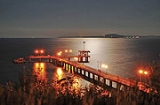
Burgas

Encyclopedia
History
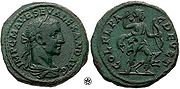
Ancient Rome
Ancient Rome was a thriving civilization that grew on the Italian Peninsula as early as the 8th century BC. Located along the Mediterranean Sea and centered on the city of Rome, it expanded to one of the largest empires in the ancient world....
, near Burgas, Debeltum (or Dibaltum) was established as a military colony for veterans by Vespasian
Vespasian
Vespasian , was Roman Emperor from 69 AD to 79 AD. Vespasian was the founder of the Flavian dynasty, which ruled the Empire for a quarter century. Vespasian was descended from a family of equestrians, who rose into the senatorial rank under the Emperors of the Julio-Claudian dynasty...
. In the Middle Ages
Middle Ages
The Middle Ages is a periodization of European history from the 5th century to the 15th century. The Middle Ages follows the fall of the Western Roman Empire in 476 and precedes the Early Modern Era. It is the middle period of a three-period division of Western history: Classic, Medieval and Modern...
, a small fortress called Pyrgos was erected where Burgas is today and was most probably used as a watchtower. It was only in the 17th century that a settlement named Ahelo-Pirgas grew in the modern area of the city. It was later renamed to Bourgas and had only about 3,000 inhabitants. The city was a township in İslimye
Sliven
Sliven is the eighth-largest city in Bulgaria and the administrative and industrial centre of Sliven Province and municipality. It is a relatively large town with 89,848 inhabitants, as of February 2011....
(Sliven) sanjak in at first Rumelia Eyalet
Rumelia Eyalet
The eyalet of Rumeli or eyalet of Rumelia , also known as Rumeli Beylerbeyliği was a eyalet of the Ottoman Empire. The capital was in Adrianople , Monastir and Sofia. Its reported area in the 19th century was .It was formed during the reign of Murad I as the first Beylerbeylik of the Ottoman Empire...
, after that in the Silistra Eyalet and Edirne Eyalet
Edirne Eyalet
The Eyalet of Adrianople or Edirne was constituted from parts of the eyalets of Silistra and Rumelia in 1826. The region later became part of the Adrianople Vilayet.-Administrative divisions:Sanjaks of the Eyalet in the mid-19th century:...
before the liberation in 1878. It was a department centre in Eastern Rumelia
Eastern Rumelia
Eastern Rumelia or Eastern Roumelia was an administratively autonomous province in the Ottoman Empire and Principality of Bulgaria from 1878 to 1908. It was under full Bulgarian control from 1885 on, when it willingly united with the tributary Principality of Bulgaria after a bloodless revolution...
before incorporated in the Principality of Bulgaria
Principality of Bulgaria
The Principality of Bulgaria was a self-governing entity created as a vassal of the Ottoman Empire by the Treaty of Berlin in 1878. The preliminary treaty of San Stefano between the Russian Empire and the Porte , on March 3, had originally proposed a significantly larger Bulgarian territory: its...
in 1885.
Later, it became a major centre on the southern Bulgarian Black Sea Coast
Bulgarian Black Sea Coast
The Bulgarian Black Sea Coast covers the entire eastern bound of Bulgaria stretching from the Romanian Black Sea resorts in the north to European Turkey in the south, along 378 km of coastline. White and golden sandy beaches occupy approximately 130 km of the 378 km long coast...
and a city of well-developed industry and trade. A number of oil and chemical companies were gradually built. Salt and iron are also mined and traded abroad.
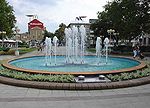
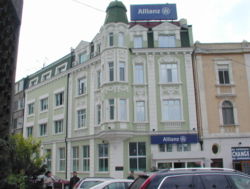
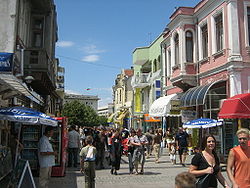
In the 19th century, with the increasing maritime trade in the Black Sea, Burgas became one of the most important port cities. However, it has lost some of its importance with the shift of the trade between Balkans-Istanbul-Trabzon to Southern port cities with the construction of Salonica-Istanbul railways. In 1903, the Burgas Central railway station
Burgas Central railway station
Burgas Central railway station is the main station serving the Black Sea city and municipality of Burgas, the fourth most populous city, and the largest and most important port, in Bulgaria....
opened, giving an additional boost to the city's expansion. Burgas, unlike many other Bulgarian cities, was not much affected by Communist-type urbanization and has kept much of its 19th- and early-20th-century architecture.
Today the local port is the largest in Bulgaria adding significantly to the regional economy. Burgas also holds annual national exhibitions and international festivals and has a vibrant student population of over 6,000 that add to the city's appeal. The historical society also maintains an open-air museum at Beglik Tash
Beglik tash
Beglik Tash is a Thracian rock sanctuary situated on the southern Black Sea coast of Bulgaria, a few kilometers north of the city of Primorsko....
.
Several countries have consulates in Burgas, among them Turkey
Turkey
Turkey , known officially as the Republic of Turkey , is a Eurasian country located in Western Asia and in East Thrace in Southeastern Europe...
, Belarus
Belarus
Belarus , officially the Republic of Belarus, is a landlocked country in Eastern Europe, bordered clockwise by Russia to the northeast, Ukraine to the south, Poland to the west, and Lithuania and Latvia to the northwest. Its capital is Minsk; other major cities include Brest, Grodno , Gomel ,...
, Romania
Romania
Romania is a country located at the crossroads of Central and Southeastern Europe, on the Lower Danube, within and outside the Carpathian arch, bordering on the Black Sea...
, Russia
Russia
Russia or , officially known as both Russia and the Russian Federation , is a country in northern Eurasia. It is a federal semi-presidential republic, comprising 83 federal subjects...
and Ukraine
Ukraine
Ukraine is a country in Eastern Europe. It has an area of 603,628 km², making it the second largest contiguous country on the European continent, after Russia...
.
Burgas Peninsula
Burgas Peninsula
Burgas Peninsula is a predominantly ice-covered peninsula forming the east extremity of Livingston Island in the South Shetland Islands, Antarctica extending 10 km in the east-northeast direction towards Renier Point and 4.7 km wide...
on Livingston Island in the South Shetland Islands
South Shetland Islands
The South Shetland Islands are a group of Antarctic islands, lying about north of the Antarctic Peninsula, with a total area of . By the Antarctic Treaty of 1959, the Islands' sovereignty is neither recognized nor disputed by the signatories and they are free for use by any signatory for...
, Antarctica is named after the city of Burgas.
Main sights
- Burgas Regional Historical Museum
- Ethnographic Museum
- Museum of Nature and Science
- Art Gallery
- Opera House
- International Folklore Festival
Economy
Burgas is an important industrial center. The most notable industrial enterprise is LUKOIL Neftochim BurgasLUKOIL Neftochim Burgas
LUKOIL Neftochim Burgas , based in Burgas, Bulgaria, is the largest oil refinery in Southeastern Europe and the largest industrial enterprise in Bulgaria. Owned by Russian oil giant LUKOIL, the refinery has the biggest contribution among the privately owned enterprises to the country's GDP and to...
- the largest oil refinery
Oil refinery
An oil refinery or petroleum refinery is an industrial process plant where crude oil is processed and refined into more useful petroleum products, such as gasoline, diesel fuel, asphalt base, heating oil, kerosene, and liquefied petroleum gas...
in South-eastern Europe and the largest manufacturing plant in the Balkans
Balkans
The Balkans is a geopolitical and cultural region of southeastern Europe...
.
Notable natives
- Apostol KaramitevApostol KaramitevApostol Milev Karamitev was a Bulgarian actor, popular throughout the 1960s. He finished acting under the guidance of B. Danovski. Later he specialized in Moscow, Leningrad, Prague and Warsaw. His debut was in the movie "Utro nad rodinata" in 1951...
(1923–1973), actor - Boris AprilovBoris AprilovBoris Aprilov was a Bulgarian writer, playwright, satirist and humourist, dramaturge, well known for his novels, plays and screenplays, and mostly for his children's literature....
(1921–1995), writer - Dimitar DimitrovDimitar Dimitrov (football manager)Dimitar Dimitrov , nicknamed Héro, is a Bulgarian football coach and currently manager of Bulgarian Chernomorets Burgas. He has managed Neftohimik Burgas, Litex Lovech, the Bulgarian national team, Levski Sofia, Lokomotiv Plovdiv, Chernomorets Burgas, FC Amkar Perm and Al-Qadisiya. Known for his...
(b. 1959),football coach - Rousy ChanevRousy ChanevRousy Chanev is a Bulgarian actor. He has appeared in 30 films since 1966. He starred in the 1977 film Advantage, which was entered into the 28th Berlin International Film Festival where it won the Silver Bear for Best Director....
(b. 1945), actor - Georgi ChilikovGeorgi ChilikovGeorgi Chilikov in Burgas is a retired Bulgarian football.He was part of the Bulgarian 2004 European Football Championship team, which exited in the first round, finishing bottom of Group C, having finished top of Qualifying Group 8 in the pre-tournament phase...
(b. 1978), footballer - Georgi DjulgerovGeorgi DjulgerovGeorgi Djulgerov is an award-winning Bulgarian film director, screenwriter, producer, and professor at the Krastyo Sarafov National Academy for Theatre and Film Arts. Born in Burgas, Bulgaria, on September 30, 1943...
(b. 1943), film director - Georgi KostadinovGeorgi KostadinovGeorgi Kostadinov is a former boxer from Bulgaria.-Amateur career:Kostadinov won the Olympic Flyweight gold medal at the 1972 Munich Olympic Games for Bulgaria...
(b. 1950), first Bulgarian boxing Olympic champion - Georgi KaloyanchevGeorgi KaloyanchevGeorgi Todorov Kaloyanchev is a Bulgarian actor. He was born in the city of Burgas on January 13 1925. He studied in the former theatrical school in Sofia. Immediately after graduating he started playing in the Ivan Vazov National Theatre...
(b. 1925), actor - Georgi MihalevGeorgi MihalevGeorgi Petrov Mihalev is a retired backstroke swimmer from Bulgaria. He was a member of the Bulgarian National Swimming Team for the period of 1981 to 1994.-Major Achievements:...
(b. 1968), competitive swimmer - Hristo Fotev (1934–2002), poet
- Kostas VarnalisKostas VarnalisKostas Varnalis was a Greek poet.-Life:Varnalis was born in Burgas, Bulgaria, in 1884. As his name suggests, his family originated from Varna. He completed his elementary studies in the Zariphios Greek high school in Plovdiv and then moved to Athens to study literature at the National and...
(1884–1974) Greek poet - Nedyalko YordanovNedyalko YordanovNedyalko Yordanov is a famous Bulgarian poet, playwright, and publicist.-External links:...
(b. 1940), writer - Nikola StanchevNikola StanchevNikola Nikolov Stanchev was a Bulgarian freestyle wrestler.He was born in Tvarditsa, Burgas province.He was the 1956 Olympic Games middle weight freestyle wrestling champion - the first Bulgarian Olympics gold medal - and silver medal winner at the World championship in Istanbul the same...
(b. 1930), first Bulgarian Olympic champion - Petya DubarovaPetya DubarovaPetya Stoykova Dubarova was a Bulgarian poet. She was born and lived in the seaside town of Burgas. Dubarova published poems in youth newspapers and magazines such as: Septemvriyche, Rodna Rech, and Mladezh .Dubarova's poems have a style of certain frivolity, full of pastel colours and romanticism...
(1962–1979), poetess - Prodan GardzhevProdan GardzhevProdan Stoyanov Gardzhev is a Bulgarian former Olympic Champion in freestyle wrestling in the 1964 Olympics. He also won a bronze medal and finished behind gold medalist Boris Michail Gurevich of the Soviet Union and silver medalist Jigjidiin Mönkhbat of Mongolia at the 1968 Summer Olympics...
(1936–2003), Bulgarian Olympic champion - wrestling - Raina KabaivanskaRaina KabaivanskaRaina Kabaivanska is a Bulgarian opera singer, one of the leading lyrico-spinto sopranos of her generation, particularly associated with Verdi and Puccini, although she sang a wide range of roles....
(b. 1934), Bulgarian Opera singer - Radostin KishishevRadostin KishishevRadostin Prodanov Kishishev is a Bulgarian footballer, who is currently playing for Chernomorets Burgas in the A PFG.-Career:Kishishev, born in the Bulgarian city of Burgas, began his career with local sides Chernomorets Burgas and Neftochimic Burgas...
(b. 1974), footballer - Zlatko YankovZlatko YankovZlatko Yankov is a retired Bulgarian football midfielder.He was capped 80 times and scored 4 goals for the Bulgarian national team between 1989 and 1999. He played eight games at the World Cups in 1994 and 1998, and he was also in the Bulgarian Euro 1996 squad...
, (b.1966), football player - Irena PetkovaIrena PetkovaIrena Petkova is a Bulgarian opera singer. The mezzo-soprano Irena Petkova was born in Bourgas, Bulgaria. She graduated from the Pancho Vladigerov State Music Academy, Sofia under professor Lilly Stefanova....
, opera singer
Twin cities
RotterdamRotterdam
Rotterdam is the second-largest city in the Netherlands and one of the largest ports in the world. Starting as a dam on the Rotte river, Rotterdam has grown into a major international commercial centre...
, Netherlands Yantai
Yantai
Yantai is a prefecture-level city in northeastern Shandong province, People's Republic of China. Located on the southern coast of the Bohai Sea and the eastern coast of the Laizhou Bay, Yantai borders the cities of Qingdao and Weihai to the southwest and east respectively.The largest fishing...
, People's Republic of China Krasnodar
Krasnodar
Krasnodar is a city in Southern Russia, located on the Kuban River about northeast of the Black Sea port of Novorossiysk. It is the administrative center of Krasnodar Krai . Population: -Name:...
, Russia Alexandroupoli
Alexandroupoli
Alexandroupoli , is a city of Greece and the capital of the Evros peripheral unit in Thrace. Named after King Alexander, it is an important port and commercial center of northeastern Greece.-Name:...
, Greece Miskolc
Miskolc
Miskolc is a city in northeastern Hungary, mainly with heavy industrial background. With a population close to 170,000 Miskolc is the fourth largest city of Hungary It is also the county capital of Borsod-Abaúj-Zemplén and the regional centre of Northern Hungary.- Geography :Miskolc is located...
, Hungary Beşiktaş
Besiktas
Beşiktaş is a municipality of Istanbul, Turkey, located on the European shore of the Bosphorus. It is bordered on the north by Sarıyer and Şişli, on the west by Kağıthane and Şişli, on the south by Beyoğlu, and on the east by the Bosphorus...
, Turkey Mali Mokri Lug
Mali Mokri Lug
Mali Mokri Lug is an urban neighborhood of Belgrade, the capital of Serbia. It is located in the south-eastern section of Belgrade's municipality of Zvezdara. It marks the border with the municipality of Grocka. It mostly stretches between Bulevar kralja Aleksandra and the Highway Belgrade–Niš,...
, Serbia
See also
- Bulgarian Black Sea CoastBulgarian Black Sea CoastThe Bulgarian Black Sea Coast covers the entire eastern bound of Bulgaria stretching from the Romanian Black Sea resorts in the north to European Turkey in the south, along 378 km of coastline. White and golden sandy beaches occupy approximately 130 km of the 378 km long coast...
- Burgas AirportBurgas AirportBurgas International Airport , is the airport of Burgas , Bulgaria.In 2009, the airport handled 1,683,786 passengers. In 2010, it handled 1,872,618 passengers, a 11.2% increase compared to 2009.-Future plans and expansion:...
- Lake BurgasLake BurgasLake Burgas or Lake Vaya , located near the Black Sea west of the city of Burgas, is the largest natural lake in Bulgaria, with an area of 27.60 km², a length of 9.6 km and a width of 2.5 to 5 km. It is up to 103 feet deep....
- List of cities in Bulgaria