

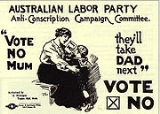

A peace movement is a social movement
that seeks to achieve ideals such as the ending of a particular war
(or all wars), minimize inter-human violence in a particular place or type of situation, often linked to the goal of achieving world peace
. Means to achieve these ends include advocacy of pacifism
, non-violent resistance, diplomacy
, boycott
s, moral purchasing, supporting anti-war
political candidates, creating open government
and transparency tools, demonstrations
, and national political lobbying groups to create legislation. The political cooperative is an example of an organization that seeks to merge all peace movement organizations and green organizations which may have some diverse goals, but all of whom have the common goal of peace and humane sustainability. A concern, of some peace activists, is the challenge of attaining peace when those that oppose it often use violence as their means of communication and empowerment.
Some people refer to the global loose affiliation of activists and political interests as having a shared purpose and this constituting a single movement, "the peace movement", an all encompassing "anti-war movement". Seen this way, the two are often indistinguishable and constitutes a loose, responsive and event-driven collaboration between groups with motivations as diverse as humanism
, environmentalism
, veganism
, anti-racism
, anti-sexism
, decentralization
, hospitality
, ideology
, theology
, and faith
.
Diversity of ideals
There are different ideas over what "peace" is (or should be), which results in a plurality of movements seeking diverse ideals of peace. Particularly, "anti-war" movements often have short-term goals, while peace movements advocate an on-going life-style and proactive government policy.It is often not clear whether a movement or a particular protest is against war in general, as in pacifism
, or against ones own governments participation in a war. Indeed, some observers feel that this lack of clarity or long term continuity has represented a key part of the strategy of those seeking to end a war, e.g., the Vietnam War
.
Global protests against the US invasion of Iraq in early 2003 are an example of a more specific, short term and loosely-affiliated single-issue "movement" —with relatively scattered ideological priorities, ranging from absolutist pacifism
to Islamism
and Anti-Americanism
(see Human shield action to Iraq
). Nonetheless, some of those who are involved in several such short term movements and build up trust relationships with others within them, do tend to eventually join more global or long-term movements.
By contrast, some elements of the global peace movement seek to guarantee health security
by ending war and assuring what they see as basic human rights
including the right of all people to have access to air, water, food, shelter and health care
. A number of activists seek social justice
in the form of equal protection under the law and equal opportunity under the law for groups that have previously been disenfranchised, such as the founding fathers of the United States.
The Peace movement is primarily characterized by a belief that humans should not wage war on each other or engage in violent ethnic cleansing
s over language, race or natural resources
or ethical conflict
over religion
or ideology
. Long-term opponents of war preparations are primarily characterized by a belief that military power
is not the equivalent of justice
.
The Peace movement tends to oppose the proliferation of dangerous technologies and weapons of mass destruction
, in particular nuclear weapons and biological warfare
, for example the 43rd president of the United States efforts pursued nonproliferation in the middle east. Moreover, many object to the export of weapons including hand-held machine guns and grenades by leading economic nation's to lesser developed nations. Some, like SIPRI
, have voiced special concern that artificial intelligence
, molecular engineering
, genetics
and proteomics
have even more vast destructive potential. Thus there is intersection between peace movement elements and Neo-Luddites
or primitivism
, but also with the more mainstream technology critics such as the Green parties, Greenpeace
and the ecology movement
they are part of.
It is one of several movements that led to the formation of Green Party political associations in many democratic countries near the end of the 20th century. The peace movement has a very strong influence in some countries' green parties, such as in Germany
, perhaps reflecting that country's negative experiences with militarism
in the 20th century
.
Current events
Some believe that as of the Iraq War and Occupation, peace movements could be seen as part of a global effort to cohere "public opinion as a superpower" to compete with perceived U.S. unilateralism
.
Peace movements are also generally thought to have benefited from the rise of Internet
communication and coordination, the so-called smart mob
technology. It was the outrage reported and blogged over the internet
that resulted in the cable news outlets abandoning their sensationalism of the Iraq War in 2003.
History
These histories will begin with the countries that suffered during World War II, and which effectively began the postwar period in a submitted position, and wrote peace into their constitutions. They will then deal with the English-speaking world
and the arguments more familiar to the English speaking reader, which intersect with current events most strongly, and are the current focus of the peace movement worldwide.
Germany
Such Green parties and related political associations were formed in many democratic countries near the end of the 20th century. The peace movement has a very strong influence in some countries' green parties, such as in Germany. These can sometimes exercise decisive influence over policy, e.g., as during 2002 when the German Greens influenced German Chancellor Gerhard Schröder
, via their control of the German Foreign Ministry under Joschka Fischer
(a Green and the single most popular politician in Germany at the time), to limit his involvement in the War on Terrorism
and eventually to unite with French President Jacques Chirac
whose opposition in the UN Security Council was decisive in limiting support for the U.S. plan to invade Iraq
.
Peace Now
The Israeli-Palestinian and Arab-Israeli conflict have existed since the mid-nineteenth century creation of Zionism, and especially since the 1948 formation of the state of Israel
, and the 1967 occupation of Palestinian and other Arab lands
. The mainstream peace movement in Israel is Peace Now (Shalom Akhshav), whose supporters tend to vote for the Labour Party or Meretz.
Peace Now was founded in the aftermath of Egyptian President Anwar Sadat
’s historic visit to Jerusalem, when many people felt that the chance for peace might be missed. PM Begin acknowledged that the Peace Now rally in Tel-Aviv at the eve of his departure for the Camp David
Summit with Presidents Sadat and Carter – drawing a crowd of 100,000, the largest peace rally in Israel until then – had a part in his decision to withdraw from Sinai and dismantle Israeli settlements there. Peace Now supported Begin for a time, and hailed him as a peace-maker, but turned against him when withdrawal from Sinai was accompanied by an accelerated campaign of land confiscation and settlement building in the West Bank.
Peace Now advocates a negotiated peace with the Palestinians. Originally this was worded vaguely, with no definition of who “the Palestinians” are and who represents them. Peace Now was quite tardy in joining the dialogue with the PLO, started by such groups as the Israeli Council for Israeli-Palestinian Peace and the Hadash
communist party. Only in 1988 did Peace Now accept that the PLO is the body regarded by the Palestinians themselves as their representative.
During the first Intifada, Peace Now held numerous protests and rallies to protest the army's cruelty and call for a negotiated withdrawal from the Occupied Territories. At the time Peace Now strongly targeted then for Defence Minister Yitzhak Rabin
for his infamous order to "break the bones of Palestinian trouble-makers." However, after Rabin became Prime Minister, signed the Oslo Agreement and shook Yasser Arafat’s hand on the White House lawn, Peace Now strongly supported him and mobilized public support for him against the settlers’ increasingly vicious attacks. Peace Now had a central role in the November 4, 1995 rally after which Rabin was assassinated by Yigal Amir
, an extreme-right militant.
Since then the annual Rabin memorial rallies, held every year at the beginning of November, have become the main event of the Israeli Peace Movement, always certain to draw a crowd in the tens or hundreds of thousands. While officially organized by the Rabin Family Foundation, Peace Now presence in these annual rallies is always conspicuous.
Nowadays, Peace Now is especially known for its struggle against the expansion of settlement outposts on the West Bank.
Gush Shalom and the Israeli Council for Israeli-Palestinian Peace
Gush Shalom, the Israeli Peace Bloc, is a radical movement to the left of Peace Now. In its present name and structure, Gush Shalom grew out of the Jewish-Arab Committee Against Deportations, which protested the deportation without trial of 415 Palestinian Islamic activists to Lebanon in December 1992, and erected a protest tent in front of the Prime Minister's office in Jerusalem for two months – until the government consented to let the deportees return. Members then decided to continue as a general peace movement with a program strongly opposing the occupation and advocating the creation of an independent Palestine side-by-side with Israel in its pre-1967 borders (“The Green Line
”) and with an undivided Jerusalem serving as the capital of both states.
While existing under the name Gush Shalom only since 1992, this movement is in fact the lineal descendant of various groups, movements and action committees which espoused much the same program since 1967, and which occupied the same space on the political scene. In particular, Gush Shalom is the descendant of the Israeli Council for Israeli-Palestinian Peace (ICIPP) which was founded in 1975. The ICIPP founders included: a group of dissidents from the Israeli establishment, among them were Major-General Mattityahu Peled
, who was member of the IDF
General Staff during the 1967 Six Day War and after being dishcarged from the army in 1969 turned increasingly in the direction of peace; Dr. Ya'akov Arnon
, a well-known economist who headed the Zionist Federation in Holland before coming to Israel in 1948, and was for many years Director-General of the Israeli Ministry of Finance and afterwards chaired the Board of Directors of the Israeli Electricity Company; and Aryeh Eliav
who was Secretary-General of the Labour Party until he broke with the then PM Golda Meir
over the issue of whether or not a Palestinian People existed and had national rights.
These three and some two hundred more people became radicalised and came to the conclusion that arrogance was a threat to Israel’s future and that dialogue with the Palestinians must be opened. They came together with a group of younger, grassroots peace activists who had been active against the occupation since 1967. The bridge between the two groups was Uri Avnery
, a well known mud-raking journalist who had been member of the Knesset
(Israeli Parliament) between 1965 and 1973, at the head of his own radical one-man party.
The main achievement of the ICIPP was the opening of dialogue with the Palestine Liberation Organization
(PLO), with the aim of making Israelis understand the need of talking and reaching a peace deal with the Palestinians, and conversely making Palestinians aware of the need to talk to and eventually reach a deal with Israel.
At present, Gush Shalom activists are mainly involved in daily struggle at Palestinian West Bank villages which have their land confiscated by the Separation barrier
, erected to stop suicide bombers. Gush activists are to be found, together with those of other Israeli movements like Ta'ayush
and Anarchists Against the Wall
, joining the Palestinian villagers of Bil'in
in the weekly non-violent protest marches held to protest confiscation of more than half of the village lands.
Although Gush Shalom
earned itself respect among peace-seeking Israelis as well as in the United States
and Europe, it is regarded by mainstream Israelis as a purely pro-Palestinian movement.
Canada
The Canadian Peace Congress(1949–1990) was a leading organizer in the peace movement for many years, particularly when it was under the leadership of James Gareth Endicott
who was its president until 1971.
Currently, Canada has a diverse peace movement, with coalitions and networks in many cities, towns and regions. The largest cross-country umbrella coalition is the Canadian Peace Alliance
, whose 140 member groups include large city-based coalitions, small grassroots groups, national and local unions, faith, environmental, and student groups, with a combined membership of over 4 million Canadians. The Canadian Peace Alliance has been a leading voice, along with its member groups opposing the "War on Terror." In particular, the CPA opposes Canada's participation in the war in Afghanistan and Canadian complicity in what it views as misguided and destructive US foreign policy.
Canada has also been home to a growing movement of Palestinian solidarity, marked by an increasing number of grassroots Jewish groups opposed to Israel's policies, in many cases likening them to Apartheid, war crimes, and ethnic cleansing.
The concept of 'Environmental Peace' was created by Professor Biswajit(Bob)Ganguly along with Professor Roger IC.Hansell at the University of Toronto,in the year 1999. They started an International Scholarly 'Journal of Environmental Peace'http://www.library.utoronto.ca/iip/journal/home.htm published from the library of University of Toronto.The editorial board of 'Journal of Environmental Peace' consists of many Internationally Scholars including five Noble Laureates. Environmental Peace is the condition of relaxation to minimum conflict which develops as a balance when resources and services are adequate to the populations involved. It is most easily perceived from the violation of these conditions. For example unusually high temperatures increase the number of Police arrests for violent crimes in Canada and increase the number of court cases for domestic violence in the Indian subcontinent. In the USA major urban riots are associated with heat waves. These conditions are made worse of climate change which may be caused by loss of natural forests, urban sprawl, carbon dioxide increase from burning fossil fuels and other human activities. Wholesale migrations of people as in Northern Africa and inevitable conflicts are the results of this environmental degradation. 'Noble Instititution for Environmental Peace'http://www.niep.ca/index.html is not for profit organization for global benefit based in Canada supporting education and research into 'Environmental Peace'. Professor Ganguly and Professor Hansell also founded Noble International University
devoted to 'Environmental Peace'.
McGill Middle East Program in Civil Society and Peace Building
Borne of the Montreal Consortium of Human Rights Advocacy Training (MCHRAT), the McGill Middle East Program (MMEP) is modelled on one of Montreal's most celebrated efforts of civil society and peace building, Project Genesis. Project Genesis comes from a growing school that sees Social Work and Peace-Building as inseparable projects.The MMEP takes this Canadian model to the Middle East, not only promoting but actively engaging communities - Jordanian, Palestinian, and Israel - in the process of civil society and peace building. Taking advantage of Canada's reputation as a peacemaker, Fellows from the Middle East come to Montreal to participate in a year-long Masters of Social Work program that includes fieldwork at Canadian organizations like Project Genesis as well as an intensive peace-building class between the fellows themselves.
Iraq War resisters
During the Iraq War, which began with the 2003 invasion of Iraq, there were United States
military personnel who refused to participate, or continue to participate, in that specific war. Their refusal meant that they faced the possibility of punishment in the United States according to the US Uniform Code of Military Justice
. For that reason some of them chose to come to Canada
as a place of refuge.
The choice of these US Iraq war resisters to come to Canada has led to considerable debate in Canada's social, media, legal and political arenas. On June 3, 2008 and March 30, 2009, two motions were passed in the Parliament of Canada
in support of the war resisters' efforts to stay in Canada. An Angus Reid Strategies
poll taken on June 6 and 7, 2008, showed that 64% of Canadians agreed with that motion. But the motions' recommendation was non-binding and was never implemented by the minority
Conservative
government.
The War Resisters Support Campaign
has made major efforts to support these war resisters.
United Kingdom
The National Peace Councilwas founded in after the 17th Universal Peace Congress in London (July August 1908). It brought together representatives of a considerable number of national voluntary organisations with a common interest in peace, disarmament and international and race relations. The primary function of the NPC was to provide opportunities for consultation and joint activities between its affiliated members, to help create an informed public opinion on the issues of the day and to convey to the government of the day the views of the substantial section of British life represented by its affiliated membership. The NPC folded in 2000 to be replaced in 2001 by Network for Peace, which was set up to continue the networking role of NPC.
From 1934 the Peace Pledge Union
gained many adherents to its pledge, "I renounce war and will never support or sanction another". Its support diminished considerably with the outbreak of war in 1939, but it remained the focus of pacifism in the post-war years.
Post–World War II peace-movement efforts in the United Kingdom were initially focused on the dissolution of the British Empire
and the rejection of imperialism
by the United States and Union of Soviet Socialist Republics. The anti-nuclear movement sought to "opt out" of the Cold War
(see below under U.S.) and rejected such ideas as "Britain's Little Independent Nuclear Deterrent" in part on the grounds that it (BLIND) was in contradiction even with MAD (see below).
Anti-nuclear
campaigning in the early 1950s was at first focused on the small Direct Action Committee (DAC), who organised the first of the Aldermaston Marches
in 1958. The DAC were later to merge into the much larger Committee of 100. The formation of CND tapped widespread popular fear and opposition to nuclear weapons following the development of the first hydrogen bomb, and in the late 1950s and early 1960s anti-nuclear marches attracted large followings, especially to the annual Aldermaston march at Easter.
Popular opposition to nuclear weapons produced a Labour Party resolution for unilateral nuclear disarmament at the 1960 Party Conference, but it was overturned the following year and did not appear on later agendas. This experience disillusioned many anti-nuclear protesters with the Labour Party, in whom they had previously put their hopes. Subsequently there was a strong anti-parliamentary current in the British peace movement, and it has been argued that during the 1960s anarchism became as influential as socialism.
Two years after the formation of CND Bertrand Russell
, its president, resigned to form the Committee of 100, which was to undertake civil disobedience in the form of sit-down demonstrations in central London and at nuclear bases around the UK. Russell said that these were needed because the press had grown indifferent to CND and because large scale direct action could force the government to change its policy. A hundred prominent people, many in the arts, put their names to the organisation. Very large numbers of demonstrators were essential to this strategy, but the violence of the police, the arrest and imprisonment of demonstrators, and pre-emptive arrests for conspiracy made support dwindle rapidly. Although several eminent people took part in sit-down demonstrations (including Russell, whose imprisonment at the age of 89 was widely reported) many of the 100 signatories were inactive.
As the Committee of 100 had a non-hierarchical structure and no formal membership, many local groups sprang up calling themselves Committee of 100
. This helped the promulgation of civil disobedience but it produced policy confusion and, as the decade progressed, Committee of 100 groups engaged in actions on many social issues not directly related to war and peace.
The VSC (Vietnam Solidarity Campaign
) led by Tariq Ali
mounted several very large and violent demonstrations against the Vietnam war in 67/68 but the first anti Vietnam demonstration was at the American Embassy in London and took place in 1965.
The peace movement was later associated with the Peace camp
movement as Labour moved "more to the centre" under Prime Minister Tony Blair
.
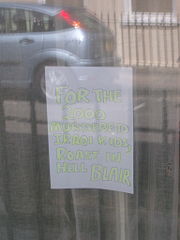
, was powerful enough to cause several of Blair's cabinet to resign, and hundreds of Labour Party MPs to vote against their government. Blair's motion to support militarily the U.S. plan to invade Iraq
continued only due to support from the UK Conservative Party
. Protests against the invasion of Iraq were particularly vocal in Britain. Polls suggested that without UN Security Council approval, the UK public was very much opposed to involvement, and over two million people protested in Hyde Park (the previous largest demonstration in the UK having had around 600,000).
Antebellum Era
Substantial anti-war sentiment developed in America during the period roughly falling between the end of the War of 1812and the commencement of the Civil War, or what is called the antebellum era. (A similar movement developed in England during the same period.) The movement reflected both strict pacifist
and more moderate non-interventionist
positions. Many prominent intellectuals of the time, including Ralph Waldo Emerson
, Henry David Thoreau
(see Civil Disobedience
and William Ellery Channing
contributed literary works against war. Other names associated with the movement include William Ladd
, Noah Worcester
, Thomas Cogswell Upham
and Asa Mahan
. Many peace societies were formed throughout the United States, the most prominent of which being the American Peace Society
. Numerous periodicals (e.g., The Advocate of Peace)) and books were also produced. The Book of Peace, an anthology produced by the American Peace Society in 1845, must surely rank as one of the most remarkable works of anti-war literature ever produced.
A recurring theme in this movement was the call for the establishment of an international court which would adjudicate disputes between nations. Another distinct feature of antebellum anti-war literature was the emphasis on how war contributed to a moral decline and brutalization of society in general.
World War I
With the end of World War I, there was widespread weariness with war. This led to an isolationist policy in America, marked by the passage of the Neutrality Act and congressional investigations into munition makers, who were charged with instigating wars for profit. Popular films of the era, such as All Quiet on the Western Front, promoted the view that war was futile and should never happen again. Some argue this isolationism contributed to the supposed "appeasement
" of Hitler, due to the lack of will to go to war.
World War II
Opposition to World War II was limited in the United States, but included the War Resisters League, the Fellowship of Reconciliation
and the Catholic Worker Movement
.
Cold War
With Cold War tensions rising, the Progressive Partybecame a home for the peace movement. Like the American Peace Mobilization
before the war, they were accused of harboring communist sympathies. In the election campaign of 1948, the Progressive Party supported appeasement of the Soviet Union and a ban on nuclear weapon
s. They opposed the Berlin airlift and the Marshall Plan
. They received over one million popular votes but no electoral votes.
There was a relatively small amount of domestic protest relevant to the Cold War in the 1950s, which saw a large buildup of both nuclear and conventional weapons in both the United States and its adversary, the Soviet Union
. The lack of protest was in part due to McCarthyism
and general disdain for those who did not view communist expansion as a threat. It was during this time that the Eisenhower administration
developed the policy of Mutual Assured Destruction
, in which both the U.S. and the USSR held enough nuclear weapons to obliterate each other should they become embroiled in nuclear war. According to this notion, the two superpowers' possession of nuclear weapons was viewed as a deterrent
that would prevent any such war from taking place. MAD also became a central doctrine to the U.S.'s foreign policy of containing Communism
.
One may reasonably date the open explicit and public resistance to this process to the departing comments of U.S. President Dwight D. Eisenhower (1960) who warned that the United States was in peril of being politically dominated by a military-industrial complex
. Shortly into the Kennedy era, the world experienced white-knuckled nuclear brinksmanship during the Cuban Missile Crisis
(October 1962). To the delight of anti-militarism activists and the relief of ordinary citizens worldwide, a test ban treaty and nuclear arms control talks ensued soon after.
Anti-nuclear movement
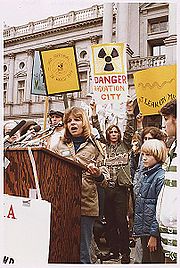
The anti-nuclear movement in the United States
consists of more than seventy groups which have acted to oppose nuclear power
and/or nuclear weapons in the USA. Initially, the nuclear debate was mainly about nuclear weapons policy and was located within the scientific community. Professional associations such as the Federation of Atomic Scientists and the Pugwash Conference on Science and World Affairs were involved. In 1962, Linus Pauling
won the Nobel Peace Prize
for his work to stop the atmospheric testing of nuclear weapons, and the "Ban the Bomb" movement spread throughout the United States.
The anti-nuclear power movement has delayed construction or halted commitments to build some new nuclear plants, and has pressured the Nuclear Regulatory Commission
to enforce and strengthen the safety regulations for nuclear power plants.
The American public were concerned about the release of radioactive gas from the Three Mile Island accident
in 1979 and many mass demonstrations took place across the country in the following months. The largest one adfadfadfwas held in New York City in September 1979 and involved two hundred thousand people; speeches were given by Jane Fonda
and Ralph Nader
.
Vietnam War
The peace movement in the 1960s in the United States succeeded in ending U.S. involvement in the Vietnam War. The decision of Lyndon Johnson not to run for re election as president is the direct result of anti-war protests. Some advocates within this movement advocated a unilateral withdrawal of U.S. forces from Vietnam
. One reason given for the withdrawal is that it would contribute to a lessening of tensions in the region and thus less human bloodshed. Another, contrasting reason was that the Vietnamese should work out their problems independent of foreign influence. Independent venues were summed up by the collective effort in opposing the Vietnam War.
The first USA anti-Vietnam protest was led in 1962 by Sam Marcy
, founder of Workers World Party
, a demonstration whose importance was noted by Ho Chi Minh
in an interview published in the National Guardian newspaper.
Opposition to the Vietnam War tended to unite groups opposed to U.S. anti-communism, imperialism
and colonialism
and, for those involved with the New Left
, capitalism
itself, such as the Catholic Worker Movement
. Others, such as Stephen Spiro
opposed the war based on the theory of Just War
. Although he was convicted of avoiding conscription
, he received a suspended sentence
, and was later pardoned by President Gerald Ford
.
Some critics of U.S. withdrawal predicted that it would not contribute to peace but rather vastly increased bloodshed. These critics advocated U.S. forces remain until all threats from the Viet Cong and North Vietnamese Army had been eliminated.
Advocates of U.S. withdrawal were generally known as "doves", and they called their opponents "hawks
", following nomenclature dating back to the War of 1812. The imagery was intended to present the withdrawal advocates as peace-seeking and the withdrawal opponents as bad and predatory. The idea of a chickenhawk
refers back to this time, to describe those who had avoided dangerous military service
before they entered politics, but then advocated aggressive stances once in office.
In 1965 the movement began to gain national prominence. Provocative actions by police and by protesters turned anti-war demonstrations in Chicago at the 1968 Democratic National Convention
into a riot. Explosive news reports of American military abuses, such as the 1968 My Lai Massacre
, brought new attention and support to the anti-war movement bringing it to its height. The movement continued to prosper over the span of the conflict.
High-profile opposition to the Vietnam war turned to street protests in an effort to turn U.S. political opinion against the war. The protests gained momentum from the Civil Rights Movement that had organized to oppose segregation
laws, which had laid a foundation of theory and infrastructure on which the anti-war movement grew. Protests were fueled by a growing network of independently published newspapers (known as "underground papers") and the timely advent of large venue rock'n'roll festivals such as Woodstock
and Grateful Dead
shows, attracting younger people in search of generational togetherness. The movement progressed from college campuses to middle-class suburbs, government institutions, and labor unions.
The fatal shooting of four anti-war protesters at Kent State University
cemented the resolve of many protesters. The Kent State shootings
saw campuses erupt all across the country; in May 1970 most universities were strike-bound, for example at Wayne State University
. The late 1960s in the U.S. became a time of youth rebellion, mass gatherings and riots, many of which began in response to the assassination
of Dr. Martin Luther King, Jr.
, but which ignited in an atmosphere of open opposition to a wartime government.
Veterans of the Vietnam War returned home to join the movement, including John Kerry
, who spearheaded Vietnam Veterans Against the War
and testified before Congress in televised hearings. Other U.S. veterans returned from the war saying that nobody wants to be in a war where people are suffering and dying, but that they found peace in their own minds by knowing they served their country. Some cited the words of George Washington
's 1790 State of the Union Address
: "To be prepared for war is one of the most effectual means of preserving peace."
Anti-war protests ended with the end of conscription
and the final withdrawal of troops after the Paris Peace Accords
were signed in 1973. Momentum from the protest organizations became a main force for the growth of an environmental movement
in the United States. The Peace Accords failed to bring Peace to Vietnam, as fighting resumed between the South Vietnamese government and the National Liberation Front. The United States resumed bombing of Vietnam and provided funds and arms to the South Vietnamese government, but did not send ground troops back to Vietnam. Many South Vietnamese who had collaborated with the U.S. fled to the United States. The peace movement had difficulty getting momentum to protest the renewed bloodshed. The North launched an offensive in 1975 that defeated Saigon and reunited the country. Laos and Cambodia were overrun by Pathet Lao
and Khmer Rouge troops that same spring.
1980s and 1990s
During the 1980s U.S. peace activists largely concentrated on slowing the superpower arms racein the belief that this would reduce the possibility of nuclear war between the U.S. and the USSR. As the Reagan Administration
accelerated military spending and adopted a tough, challenging stance to the Russians, peace groups such as the Nuclear Freeze and Beyond War sought to educate the public on the what they believed was the inherent riskiness and ruinous cost of this policy. Outreach to individual citizens in the Soviet Union and mass meetings, using then-new satellite link technology, were part of peacemaking activities in the 1980s.
In response to Iraq's invasion of Kuwait
in 1990, President George H.W. Bush began preparations for a mideast war. Peace activists were starting to find their groove just before the Gulf War
was launched in February 1991, with well-attended rallies, especially on the west coast. However, the ground war was over in less than a week. A lopsided Allied victory and a media-incited wave of patriotic sentiment washed over the protest movement before it could develop traction.
The 1990s began with the Gulf War and the dissolution of the Soviet Union
(November 1991), removing one of the main focuses of peace activism. The U.S. government of Bill Clinton
adopted a more conciliatory tone and presided over a decade of perceived peace and prosperity — one in which corporate rule quietly advanced. Peacemakers' priorities during the Nineties included seeking a solution to the Israeli-Palestinian impasse
, belated efforts at humanitarian assistance to war-torn regions such as Bosnia and Rwanda, and mitigating the harm caused by U.N. sanctions on Iraq. These sanctions — in effect from 1990 to 2003 — led to the deaths of some 500,000 children from fully preventable causes, including common infections and malnutrition{fact}; American peace activists brought medicine into Iraq in defiance of U.S. law, in some cases enduring heavy fines and imprisonment in retaliation. Some of the principal groups involved were Voices in the Wilderness
and the Fellowship of Reconciliation
.
Iraq War
Before, during, and after the War in Iraq began, a concerted protest effort has existed in the United States. On February 15, 2003a series of protests across the globe took place with events in approximately 800 cities. In March 2003, just before the U.S. and British Military led invasion of Iraq, a protest mobilization called "The World Says No to War" led to as many as 500,000 protestors in cities across the U.S. Alleged incidents of initimidation, spying, and police harassment toward protesters have discouraged some members of the movement , and have led to lawsuits against the U.S. Government's policies related to privacy and freedom of speech. However, many protest organizations have persisted as the United States has maintained a military and corporate presence in Iraq.
U.S. activist groups including United for Peace and Justice
, CODEPINK (Women Say No To War), Iraq Veterans Against the War
, Military Families Speak Out
(MFSO), Not In Our Name
, A.N.S.W.E.R.
, Veterans for Peace
, and The World Can't Wait
continue to protest against the Iraq War. Methods of protest include rallies and marches, impeachment petitions, the staging of a war-crimes tribunal in New York (to investigate crimes and alleged abuses of power of the Bush administration), bringing Iraqi women to tour the U.S. and tell their side of the story, street theater and independent filmmaking, high-profile appearances by anti-war activists such as Scott Ritter
, Janis Karpinski
, and Dahr Jamail
, resisting military recruiting on college campuses, withholding tax monies, mass letter-writing to legislators and newspapers, blogging, music, and guerrilla theater. Independent media producers continue to broadcast, podcast and Web-host programs about the movement against the Iraq War.
Popular music
While Americans stood divided on the issue of war in Iraq, media was the medium and the message for communicating presidential speeches, patriotic propaganda, terrorism alerts, death statistics and war images. Gradually,division and uncertainty turned to public discontent, protest and change. This process is evident through the changes and novelties in American pop culture. Most significantly, peace is being communicated by the music industry through musical lyrics, special concerts and celebrity influence.Though not quite a rebirth of The Beatles
era, artists of the 21st century are voicing society’s need and desire for peace, through their lyrics. Countless songs protesting war and communicating peace have been played and promoted via mainstream media. U2
’s “Love and Peace or Else” and “City of Blinding Lights,” both released in 2004 are prime examples of communicating peace. The following year was a big one for peace and music. John Mayer
released “Waiting on the World to Change” and the Dixie Chicks
released “I Hope.” Most recently, Will.I.Am. released “It’s A New Day.” The lyrics express a celebration of the new presidency and the messages of hope and peace associated with it: “I woke up this morning - Feeling brand new - 'Cause the dreams that I've been dreaming - Have finally came true.” With numerous artists keeping the trend alive, the emphasis on peace has arguably become a permanent addition to popular music.
The best way that music communicates peace at a mass level is by televised concerts endorsed by celebrity singers and bands. A model example of this is the “global multimedia event staged in the summer of 2005—the concerts/conscious- ness-raising/political-economic configuration called Live 8.” (Compton, 30). Viewers watched in awe, as reporters switched from Andrea Bocelli
singing in Paris, to Madonna
in London, and back again to Our Lady Peace in Barrie. The trend has reached Canada, as exemplified by the televised “Me 2 We” special held in Toronto; a huge concert aimed at Canada’s youth to make a positive difference in the world. Finally, though intertwined with politics, President Barack Obama
’s inauguration concert was definitely a spectacle created to celebrate and promote peace, hope and change.
Celebrities of the music industry are a major influence, even when they are not singing. Speaking against war and for peace has become something most celebrities will do before or after a performance, during the acceptance of an award or during an interview. In 2003, Natalie Maines
lead singer of the Dixie Chicks
, set the stage for freedom of speech against the war. She uttered the infamous phrase “Just so you know, we’re on the good side with y’all. We do not want this war, this violence, and we’re ashamed that the President of the United States is from Texas.” It soon became much more acceptable to speak out against war when more artists started doing it. The trend climaxed during Barack Obama
’s presidential campaign. An overwhelming number of celebrities, including Chris Rock
and The Black Eyed Peas
, turned the campaign into a movement for change and peace.
Threat of military action against Iran
Starting in 2005, opposition to military action against Iranstarted in the United States, the United Kingdom and elsewhere, including the creation of the Campaign Against Sanctions and Military Intervention in Iran
. By August 2007, fears of an imminent United States and/or Israel
i attack on Iran
had increased to the level that several Nobel Prize
winners, Shirin Ebadi
(Nobel Peace Prize 2003), Mairead Corrigan-Maguire
and Betty Williams (joint Nobel Peace Prize 1976), Harold Pinter
(Nobel Prize for Literature 2005) and Jody Williams
(Nobel Peace Prize 1997), along with several anti-war
groups, including The Israeli Committee for a Middle East Free from Atomic, Biological and Chemical Weapons, Campaign for Nuclear Disarmament
, CASMII
, Code Pink
and many others, warned about what they believed was the imminent risk of a "war of an unprecedented scale, this time against Iran", especially expressing concern that an attack on Iran using nuclear weapon
s had "not been ruled out". They called for "the dispute about Iran's nuclear program, to be resolved through peaceful means" and a call for Israel
, "as the only Middle Eastern state suspected of possession of nuclear weapons
", to join the Nuclear Non-Proliferation Treaty
.
Politics
The progress of peace movements may be measured by the slow steady growth of congressional legislation to create the United States Department of Peace and Nonviolence, and the number of legislators becoming cosponsors.- In 1793, Dr. Benjamin RushBenjamin RushBenjamin Rush was a Founding Father of the United States. Rush lived in the state of Pennsylvania and was a physician, writer, educator, humanitarian and a Christian Universalist, as well as the founder of Dickinson College in Carlisle, Pennsylvania....
, a Founding Father and signer of the Declaration of IndependenceDeclaration of independenceA declaration of independence is an assertion of the independence of an aspiring state or states. Such places are usually declared from part or all of the territory of another nation or failed nation, or are breakaway territories from within the larger state...
authored a "A plan of a Peace-Office for the United States". First published in a 1793 almanac that Benjamin BannekerBenjamin BannekerBenjamin Banneker was a free African American astronomer, mathematician, surveyor, almanac author and farmer.-Family history and early life:It is difficult to verify much of Benjamin Banneker's family history...
authored, the plan stated:
1. Let a Secretary of Peace be appointed to preside in this office; ...; let him be a genuine republican and a sincere Christian ....
2. Let a power be given to the Secretary to establish and maintain free schools in every city, village and township in the United States; ... Let the youth of our country be instructed in reading, writing, and arithmetic, and in the doctrines of a religion of some kind; the Christian religion should be preferred to all others; for it belongs to this religion exclusively to teach us not only to cultivate peace with all men, but to forgive—nay more, to love our very enemies....
3. Let every family be furnished at public expense, by the Secretary of this office, with an American edition of the Bible....
4. Let the following sentence be inscribed in letters of gold over the door of every home in the United States: The Son of Man Came into the World, Not To Destroy Men's Lives, But To Save Them.
5. ....
- In 1925, Carrie Chapman CattCarrie Chapman CattCarrie Chapman Catt was a women's suffrage leader who campaigned for the Nineteenth Amendment to the United States Constitution which gave U.S. women the right to vote in 1920...
suffragetteSuffragette"Suffragette" is a term coined by the Daily Mail newspaper as a derogatory label for members of the late 19th and early 20th century movement for women's suffrage in the United Kingdom, in particular members of the Women's Social and Political Union...
leader, first proposed a Department of Peace headed by a Cabinet level Secretary of Peace at the First Conference on the Cause and Cure of War, which she organized. It was held in Washington DC, from January 18–25, 1925, and had 450 delegates from nine organizations representing five million women members.
- In 1935, 1937, and 1939, Senator Matthew Neely of West VirginiaWest VirginiaWest Virginia is a state in the Appalachian and Southeastern regions of the United States, bordered by Virginia to the southeast, Kentucky to the southwest, Ohio to the northwest, Pennsylvania to the northeast and Maryland to the east...
introduced bills calling for a Department of Peace. In 1943, Senator Alexander WileyAlexander WileyAlexander Wiley was a member of the Republican Party who served four terms in the United States Senate for the state of Wisconsin from 1939 to 1963. When he left the Senate, he was its most senior Republican member.-Biography:...
of WisconsinWisconsinWisconsin is a U.S. state located in the north-central United States and is part of the Midwest. It is bordered by Minnesota to the west, Iowa to the southwest, Illinois to the south, Lake Michigan to the east, Michigan to the northeast, and Lake Superior to the north. Wisconsin's capital is...
spoke on the Senate floor calling for the United States of America to be the first government on the world to have a Secretary of Peace.
Over 100 bills have been introduced into Congress since the end of World War II to create a Department of Peace in the federal government:
- 1945 Representative Louis LudlowLouis LudlowLouis Leon Ludlow was a Democratic Indiana congressman; he proposed a constitutional amendment early in 1938 requiring a national referendum on any U.S. declaration of war except in cases of direct attack...
of Indiana introduced a bill that would establish a Department of Peace. - 1946 Representative Randolf Jennings introduced legislation to establish a Department of Peace with the goal of strengthening America's capacity to resolve and manage international conflicts by both military and nonmilitary means. In the 1970s and 1980s he joined Senators Mark HatfieldMark HatfieldMark Odom Hatfield was an American politician and educator from the state of Oregon. A Republican, he served for 30 years as a United States Senator from Oregon, and also as chairman of the Senate Appropriations Committee...
and Spark MatsunagaSpark MatsunagaSpark Masayuki Matsunaga was a United States Senator from Hawaii. He was an American Democrat whose legislation in the United States Senate led to the creation of the Commission on Wartime Relocation and Internment of Civilians.-Career:Matsunaga became a United States Army Reservist in 1941,...
and Congressman Dan GlickmanDan GlickmanDaniel Robert "Dan" Glickman is an American businessman and politician. He served as the United States Secretary of Agriculture from 1995 until 2001, prior to which he represented the Fourth Congressional District of Kansas as a Democrat in Congress for 18 years. He was Chairman and CEO of the...
in efforts to create a national institution dedicated to peace. After he had announced his retirement from Congress in 1984, Randolph played a key role in the passage and enactment of the United States Institute of PeaceUnited States Institute of PeaceThe United States Institute of Peace was created by Congress as a non-partisan, federal institution that works to prevent or end violent conflict around the world...
Act. To guarantee its passage and funding, the legislation was attached to the Department of Defense Authorization Act of 1985. Approval of the legislation was in part a tribute to Randolph's long career in public service. The Jennings Randolph Program, which awards fellowships to enable outstanding scholars, policymakers, journalists, and other professionals from around the world to conduct research at the U.S. Institute of Peace, has been named in his honor. - 1947 Representative Everett Dirkson of Illinois introduced a bill for “A Peace Division in the State Department”.
- President Dwight Eisenhower named Harold StassenHarold StassenHarold Edward Stassen was the 25th Governor of Minnesota from 1939 to 1943. After service in World War II, from 1948 to 1953 he was president of the University of Pennsylvania...
to be his Cabinet Level Advisor for Peace & Disarmament in March, 1953. - 1955-1968 Eighty-five bills calling for a Department of Peace were introduced in the House or the Senate.
- 1969 Senator Vance HartkeVance HartkeRupert Vance Hartke was a Democratic United States Senator from Indiana from 1959 until 1977.-Early life, education, military service:...
of Indiana and Representative Seymour HalpernSeymour HalpernSeymour Halpern was a United States Representative from New York. He was born in New York City November 19, 1913. He graduated from Richmond Hill High School and attended Seth Low College of Columbia University from 1932 to 1934...
of New York introduced legislation to create a Department of Peace in the House of Representatives and the Senate. - 1984 President Ronald ReaganRonald ReaganRonald Wilson Reagan was the 40th President of the United States , the 33rd Governor of California and, prior to that, a radio, film and television actor....
signed into law the creation of the United States Institute of PeaceUnited States Institute of PeaceThe United States Institute of Peace was created by Congress as a non-partisan, federal institution that works to prevent or end violent conflict around the world...
. - 2001 and 2003 Representative Dennis KucinichDennis KucinichDennis John Kucinich is the U.S. Representative for , serving since 1997. He was furthermore a candidate for the Democratic nomination for President of the United States in the 2004 and 2008 presidential elections....
of Ohio introduced legislation to create a Department of Peace. - September 2005 Representative Dennis Kucinich of Ohio and Senator Mark DaytonMark DaytonMark Brandt Dayton is an American politician, the 40th and current Governor of the state of Minnesota. Dayton previously served as United States Senator from Minnesota from 2001 to 2007 in the 107th, 108th, and 109th Congresses...
of Minnesota introduced legislation to create a Department of Peace and Nonviolence in the House of Representatives and the Senate, respectively.
The 21st century legislation to create the United States Department of Peace & Nonviolence introduced in July 2001, gained 45 Cosponsors during that session of congress. With the 108th Congress the movement grew to 53 congressional cosponsors, and 75 Congressional sponsors in the 109th congress. A list of the Congressional cosponsors can be viewed at the Library of Congress.
The peace movement hopes to gain federal endorsement and join the ranks of other government programs such as: Pollution awareness – from the 1960s “Give a Hoot don’t pollute”, to today’s global warming
movement. The Anti-Tobacco movement began with a the mild surgeon general's warning, “Smoking MAY be hazardous to your health” to today with many States and municipalities outlawing smoking, within common use buildings. If successful, proponents believe the United States Department of Peace and Nonviolence may be as significant a social change as the Emancipation proclamation
- Freeing the slaves and the Women's suffrage
movement - Granting women the right to vote.
Social organizations
The peace movement in the United States is perhaps less popular in the media but supported by professionals in many areas. Gang violence prevention is primarily a regional effort led by local law enforcement and special programs within schools. Domestic abuse counseling is supported by many non-profit organizations. Character educationis a growing program in American primary school education. Recognized as a pillar of strength in the foundation of our society along with a strong family support, character education resources are used broadly to shape young minds.
Day of Silence for Peace
Also known as the Peace Movement, the Day of Silence for Peace follows the tradition of rallies that use silence to be noticed. Participants wear a piece of white cloth across their mouths with Peace written on it to symbolize their unity and readiness to change their world. It means they are tired of the status quo, and are willing to challenge it. It hopes to achieve unity and a sense of empowerment for its participants - including the knowledge that they can have an impact without traveling to the far reaches of the earth. The first Day of Silence for Peace took place on October 23, 2007.See also
- :Category:Peace movements
- :Category:Peace
- :Category:Peace organizations
- :Category:Peace awards
- :Category:Anti-war
- :Category:Anti-war protests
- :Category:Anti-nuclear movement
- American Friends Service CommitteeAmerican Friends Service CommitteeThe American Friends Service Committee is a Religious Society of Friends affiliated organization which works for peace and social justice in the United States and around the world...
- Conscientious objectorConscientious objectorA conscientious objector is an "individual who has claimed the right to refuse to perform military service" on the grounds of freedom of thought, conscience, and/or religion....
- Conscientious objection throughout the world
- Global citizens movementGlobal citizens movementIn most discussions, the global citizens movement is a socio-political process rather than a political organization or party structure. The term is often used synonymously with the anti-globalization movement or the global justice movement. Colloquially the term is also used in this imprecise manner...
- International Campaign to Abolish Nuclear WeaponsInternational Campaign to Abolish Nuclear WeaponsThe International Campaign to Abolish Nuclear Weapons is a civil society campaign with the goal of eliminating nuclear weapons through a legally binding nuclear weapons convention. It was launched internationally in Vienna in 2007 at a meeting of parties to the Treaty on the Non-Proliferation of...
- Mohandas Gandhi
- Nuclear-free zoneNuclear-free zoneA nuclear-free zone is an area where nuclear weapons and nuclear power are banned. The specific ramifications of these depend on the locale in question....
- PeacePeacePeace is a state of harmony characterized by the lack of violent conflict. Commonly understood as the absence of hostility, peace also suggests the existence of healthy or newly healed interpersonal or international relationships, prosperity in matters of social or economic welfare, the...
- Peace Organisation of AustraliaPeace Organisation of AustraliaThe Peace Organisation of Australia was a non-profit and non-religious organisation based in Melbourne, Australia which was active from 2005 to 2009. Its stated objective was the promotion of world peace through education. The organisation was established in May 2005 by a group of students from the...
- Peace Pledge UnionPeace Pledge UnionThe Peace Pledge Union is a British pacifist non-governmental organization. It is open to everyone who can sign the PPU pledge: "I renounce war, and am therefore determined not to support any kind of war...
- Peace symbolPeace symbolA number of peace symbols have been used in various cultures and contexts, one of the most ancient being the olive branch. The dove and olive branch was used by early Christians and was later adopted as a secular symbol. It was popularised by Pablo Picasso in 1949 and became widely used in the...
- Peace flagPeace flagThere have been several designs for a peace flag.-White-bordered national flag:The white flag is recognized in most of the world as a flag of surrender, truce or ceasefire. The first mention of a white flag used in this context is made during the Eastern Han dynasty...
- War resisterWar resisterA war resister is a person who resists war. The term can mean several things: resisting participation in all war, or a specific war, either before or after enlisting in, being inducted into, or being conscripted into a military force....
- White RoseWhite RoseThe White Rose was a non-violent/intellectual resistance group in Nazi Germany, consisting of students from the University of Munich and their philosophy professor...
- World peaceWorld peaceWorld Peace is an ideal of freedom, peace, and happiness among and within all nations and/or people. World peace is an idea of planetary non-violence by which nations willingly cooperate, either voluntarily or by virtue of a system of governance that prevents warfare. The term is sometimes used to...
Further reading
- Scott H. Bennett, Radical Pacifism: The War Resisters League and Gandhian Nonviolence in America, 1915-45 (Syracuse Univ. Press, 2003).
- Charles Chatfield, editor, Peace Movements in America (New York: Schocken Books, 1973). ISBN 0-8052-0386-0
- Charles Chatfield with Robert Kleidman, The American Peace Movement: Ideals and Activism (New York: Twayne Publishers, 1992). ISBN 0-8057-3852-5
- Eastman, Carolyn, “Fight Like a Man: Gender and Rhetoric in the Early Nineteenth-Century American Peace Movement,” American Nineteenth Century History 10 (Sept. 2009), 247–71.
- Elsie Locke, Peace People: A History of Peace Activities in New Zealand (Christchurch, NZ: Hazard Press, 1992). ISBN 0-908790-20-1
- Sam Marullo and John LoflandJohn Lofland (sociologist)John Lofland is an American sociologist, professor, and author best known for his studies of the peace movement and for his first book, Doomsday Cult: A Study of Conversion, Proselytization, and Maintenance of Faith which was based on field work among a group of Unification Church members in...
, editors, Peace Action in the Eighties: Social Science Perspectives (New Brunswick: Rutgers University Press, 1990). ISBN 0-8135-1561-0 - Caroline Moorehead, Troublesome People: The Warriors of Pacifism (Bethesda, MD: Adler & Adler, 1987).
- Roger C. Peace III, A Just and Lasting Peace: The U.S. Peace Movement from the Cold War to Desert Storm (Chicago: The Noble Press, 1991). ISBN 0-9622683-8-0
- Lawrence S. Wittner, Rebels Against War: The American Peace Movement, 1933-1983 (Philadelphia: Temple University Press, 1984). ISBN 0-87722-342-4
- Nancy Zaroulis and Gerald Sullivan, Who Spoke Up? American Protest Against the War in Vietnam, 1963-1975 (New York: Holt, Rinehart and Winston, 1984). ISBN 0-03-005603-9
- André Durand: Gustave Moynier and the peace societies. In: International Review of the Red Cross, no 314, p. 532-550 (31-10-1996)
External links
- Leading Peace Organizations in the United States
- International People's Initiative for Departments of Peace
- Linus Pauling and the International Peace Movement: A Documentary History Die Friedens-Warte, Journal of International Peace and Organization
- US Peace Memorial - Will build and maintain the US Peace Memorial in Washington DC and publish the US Peace Registry
- US Peace Registry - Recognizes and documents the peace activities of US citizens and organizations
- Chicago FreeSpeechZone - Documents the post-9/11 Chicago-area peace movement
- Cultrual Peace Group
- Character Education Resources - Program utilized by the best schools in the United States.
- Getting Local and Keeping Positive in the Anti-War Movement –Zoltan Grossman, Znet, Nov. 2, 2006
- Speaking Different Languages: How the Peace Movement Works With the Military Community – Zoltan Grossman, ZNet, Nov. 2, 2007
- Challenges for the Antiwar Movement – Zoltan Grossman, Counterpunch, Jan. 5, 2006
- WorldWalk-Peacetour - A walking tour around the world in name of peace, friendship and brotherhood.
- Essays and speeches from the Antebellum Era peace movement]