
All Topics  
Weapons of mass destruction


   Email Print
   Bookmark   Link


Weapons of mass destruction


A weapon of mass destruction (WMD) is a weapon
Weapon

A weapon is a tool used to apply or threaten to apply force for the purpose of hunting, attack or defense in combat, subduing enemy personnel, or to destroy enemy weapons, equipment and defensive structures....
 that can kill large numbers of humans and/or cause great damage to man-made structures (e.g. buildings), natural structures (e.g. mountains), or the biosphere
Biosphere

The biosphere is the global sum of all ecosystems. From the broadest Geophysiology point of view, the biosphere is the global ecology system integrating all living beings and their relationships, including their interaction with the elements of the lithosphere, hydrosphere, and Earth's atmosphere....
 in general.

The term is often used to cover several weapon types, including nuclear, biological, chemical (NBC), and radiological weapons. Additional terms used in a military context include atomic, biological, and chemical (ABC) warfare and chemical, biological, radiological, and nuclear (CBRN
CBRN

CBRN is an acronym for chemical, biological, radiological, and nuclear. It is in common use worldwide, to refer to incidents or weapons in which any of these four hazards have presented themselves....
) warfare.

The phrase was predominantly used in reference to nuclear weapons during the Cold War
Cold War

The Cold War was the continuing state of conflict, tension and competition that existed between a number of world powers, including the United States, the Soviet Union, People's Republic of China, France, United Kingdom and those countries' respective allies from the mid-1940s to the early 1990s....
; following the collapse of the Soviet Union and increasing tensions between the Middle East
Middle East

File:GreaterMiddleEast1.pngThe Middle East is a region that spans southwestern Asia, western Asia, and northeastern Africa. It has no clear boundaries, often used as a synonym to Near East, in opposition to Far East....
 and the Western powers, the term broadened to its modern, more inclusive definition.


Discussion
Ask a question about 'Weapons of mass destruction'
Start a new discussion about 'Weapons of mass destruction'
Answer questions from other users
Full Discussion Forum


Encyclopedia


A weapon of mass destruction (WMD) is a weapon
Weapon

A weapon is a tool used to apply or threaten to apply force for the purpose of hunting, attack or defense in combat, subduing enemy personnel, or to destroy enemy weapons, equipment and defensive structures....
 that can kill large numbers of humans and/or cause great damage to man-made structures (e.g. buildings), natural structures (e.g. mountains), or the biosphere
Biosphere

The biosphere is the global sum of all ecosystems. From the broadest Geophysiology point of view, the biosphere is the global ecology system integrating all living beings and their relationships, including their interaction with the elements of the lithosphere, hydrosphere, and Earth's atmosphere....
 in general.

The term is often used to cover several weapon types, including nuclear, biological, chemical (NBC), and radiological weapons. Additional terms used in a military context include atomic, biological, and chemical (ABC) warfare and chemical, biological, radiological, and nuclear (CBRN
CBRN

CBRN is an acronym for chemical, biological, radiological, and nuclear. It is in common use worldwide, to refer to incidents or weapons in which any of these four hazards have presented themselves....
) warfare.

The phrase was predominantly used in reference to nuclear weapons during the Cold War
Cold War

The Cold War was the continuing state of conflict, tension and competition that existed between a number of world powers, including the United States, the Soviet Union, People's Republic of China, France, United Kingdom and those countries' respective allies from the mid-1940s to the early 1990s....
; following the collapse of the Soviet Union and increasing tensions between the Middle East
Middle East

File:GreaterMiddleEast1.pngThe Middle East is a region that spans southwestern Asia, western Asia, and northeastern Africa. It has no clear boundaries, often used as a synonym to Near East, in opposition to Far East....
 and the Western powers, the term broadened to its modern, more inclusive definition. It entered widespread usage in relation to the U.S.-led
Multinational force in Iraq

The Multi-National Force - Iraq is a military command , led by the United States, that is fighting the Iraq War against Iraqi insurgency. Multi-National Force - Iraq replaced the previous force, Combined Joint Task Force 7, on May 15, 2004....
 2003 invasion of Iraq
2003 invasion of Iraq

The 2003 invasion of Iraq, from March 20 to May 1, 2003, was spearheaded by the United States, backed by United Kingdom forces and smaller contingents from Australia, Spain, Poland and Denmark....
.

Early uses of the term

The first use of the term "weapons of mass destruction" on record is from The Times
The Times

The Times is a daily national newspaper published in the United Kingdom since 1785 when it was known as The Daily Universal Register.The Times and its sister paper The Sunday Times are published by Times Newspapers Limited, a subsidiary of News International....
 (London) in 1937 in reference to the aerial bombardment of Guernica
Bombing of Guernica

The bombing of Guernica was an Aerial bombing of cities on the Basque Country town of Guernica , causing widespread destruction and civilian deaths during the Spanish Civil War....
, Spain
Spain

Spain or the Kingdom of Spain , is a country located in Southern Europe on the Iberian Peninsula.The Spanish constitution does not establish any official denomination of the country, even though Espa?a , Estado espa?ol and Naci?n espa?ola are used interchangeably....
:

At that time, there were no nuclear weapons; biological weapons were already being researched by Japan
Japan

Japan is an island country in East Asia. Located in the Pacific Ocean, it lies to the east of the Sea of Japan, People's Republic of China, North Korea, South Korea and Russia, stretching from the Sea of Okhotsk in the north to the East China Sea and Taiwan in the south....
 (see Unit 731
Unit 731

was a covert biological warfare and chemical warfare research and development unit of the Imperial Japanese Army that undertook lethal Japanese human experimentation on the Chinese during the Second Sino-Japanese War and World War II....
), and chemical weapons had seen wide use, most notably in World War I
World War I

World War I, or the First World War , was a global military conflict which involved the Great powers, organized into two opposing military alliances: the Allies of World War I and the Central Powers....
.

Following the atomic bombings of Hiroshima and Nagasaki
Atomic bombings of Hiroshima and Nagasaki

The atomic bombings of Hiroshima and Nagasaki were nuclear warfares near the end of World War II against the Empire of Japan by the United States at the executive order of President of the United States Harry S....
, and progressing through the Cold War
Cold War

The Cold War was the continuing state of conflict, tension and competition that existed between a number of world powers, including the United States, the Soviet Union, People's Republic of China, France, United Kingdom and those countries' respective allies from the mid-1940s to the early 1990s....
, the term came to refer more to non-conventional weapon
Conventional weapon

A conventional weapon or conventional arm is a weapon that is not forbidden according to conventions, such as the Convention on Cluster Munitions or the Ottawa Treaty....
s. The application of the term to specifically nuclear and radiological weapons is traced by William Safire
William Safire

William L. Safire is an United States author, semi-retired columnist, and former journalist and President of the United States speechwriter.He is perhaps best known as a long-time print syndication political columnist for The New York Times and a regular contributor to "On Language" in the New York Times Magazine, a column on popul...
 to the Russian phrase oruziye massovovo porazheniya.

He credits James Goodby (of the Brookings Institution
Brookings Institution

The Brookings Institution is a Non-profit organization public policy organization based in Washington, D.C. One of Washington's oldest think tanks, Brookings conducts research and education in the social sciences, primarily in economics, metropolitan policy, governance, foreign policy, and global economy and development....
) with tracing what he considers the earliest known English-language use soon after the nuclear bombing of Hiroshima
Hiroshima

The Japanese city of is the capital of Hiroshima Prefecture, and the largest city in the Chugoku region of western Honshu, the largest of Japan's islands....
 and Nagasaki (although it is not quite verbatim): a communique from a November 15, 1945 meeting of Harry Truman, Clement Attlee
Clement Attlee

Clement Richard Attlee, 1st Earl Attlee, Order of the Garter, Order of Merit, Order of the Companions of Honour, Her Majesty's Most Honourable Privy Council, Fellow of the Royal Society was a British people politician, who served as Prime Minister of the United Kingdom from 1945 to 1951, and leader of the Labour Party from 1935 to 1955....
 and Mackenzie King (probably drafted by Vannevar Bush
Vannevar Bush

Vannevar Bush was an United States engineer and science administrator known for his work on analog computer, his political role in the development of the atomic bomb, and the idea of the memex, which was seen decades later as a pioneering concept for the World Wide Web....
 or so Bush claimed in 1970) referred to "weapons adaptable to mass destruction".

That exact phrase, says Safire, was also used by Bernard Baruch
Bernard Baruch

Bernard Mannes Baruch was an American financier, stock market speculator, statesman, and presidential advisor. After his success in business, he devoted his time toward advising Democratic presidents Woodrow Wilson and Franklin D....
 in 1946 (in a speech at the United Nations
United Nations

The United Nations is an international organization whose stated aims are to facilitate cooperation in international law, international security, economic development, Social change, human rights and achieving world peace....
 probably written by Herbert Bayard Swope
Herbert Bayard Swope

Herbert Bayard Swope was a United States of America editor and journalist. Born in St. Louis, Missouri, he was the younger brother of businessman Gerard Swope....
). The same phrase found its way into the UN resolution to create the Atomic Energy Commission
United Nations Atomic Energy Commission

The United Nations Atomic Energy Commission was founded on 24 January 1946 by the first resolution of the United Nations General Assembly "to deal with the problems raised by the discovery of atomic energy."...
 (predecessor of the International Atomic Energy Agency (IAEA)
International Atomic Energy Agency

The International Atomic Energy Agency is an international organization that seeks to promote the peaceful use of nuclear technology and to inhibit its use for nuclear weapon....
), which used the wording "…atomic weapons and of all other weapons adaptable to mass destruction".

An exact use of this term was given in a lecture "Atomic Energy
Nuclear reaction

In nuclear physics, a nuclear reaction is the process in which two atomic nucleus or subatomic particles collide to produce products different from the initial particles....
 as an Atomic Problem" by J. Robert Oppenheimer. The lecture was delivered to the Foreign Service
United States Foreign Service

The United States Foreign Service is the diplomatic service of the United States government, under the aegis of the United States Department of State....
 and the State Department, on September 17th, 1947. The lecture is reprinted in The Open Mind (New York: Simon and Schuster, 1955).
"It is a very far reaching control which would eliminate the rivalry between nations in this field, which would prevent the surreptitious arming of one nation against another, which would provide some cushion of time before atomic attack, and presumably therefore before any attack with weapons of mass destruction, and which would go a long way toward removing atomic energy at least as a source of conflict between the powers".


An early use of the exact phrase in an international treaty was in the Outer Space Treaty
Outer Space Treaty

The Outer Space Treaty, formally known as the Treaty on Principles Governing the Activities of States in the Exploration and Use of Outer Space, including the Moon and Other Celestial Bodies, is a treaty that forms the basis of international space law....
 of 1967, however no definition was provided.

Evolution of its use


During the Cold War
Cold War

The Cold War was the continuing state of conflict, tension and competition that existed between a number of world powers, including the United States, the Soviet Union, People's Republic of China, France, United Kingdom and those countries' respective allies from the mid-1940s to the early 1990s....
, the term "weapons of mass destruction" was primarily a reference to nuclear weapons. At the time, the US arsenal of thermonuclear weapons were regarded as a necessary deterrent against nuclear or conventional attack from the Soviet Union
Soviet Union

The Union of Soviet Socialist Republics was a Constitution of the Soviet Union socialist state that existed in Eurasia from 1922 to 1991.The name is a translation of the , romanization of Russian Soyuz Sovetskikh Sotsialisticheskikh Respublik, abbreviated ????, SSSR....
 (see Mutual Assured Destruction
Mutual assured destruction

Mutually assured destruction is a doctrine of military strategy in which a full-scale use of nuclear weapons by two opposing sides would effectively result in the destruction of both the attacker and the defender....
), and the euphemism "strategic weapons" was used to refer to the American
United States

The United States of America is a Federal government constitutional republic comprising U.S. state and a federal district. The country is situated mostly in central North America, where its Contiguous United States and Washington, D.C., the Capital districts and territories, lie between the Pacific Ocean and Atlantic Oceans, Borders of the U...
 nuclear arsenal.

The term "weapons of mass destruction" continued to see periodic use throughout this time, usually in the context of nuclear arms control
Arms control

Arms control is an umbrella term for restrictions upon the development, production, stockpiling, proliferation, and usage of weapons, especially weapons of mass destruction....
; Ronald Reagan
Ronald Reagan

Ronald Wilson Reagan was the List of Presidents of the United States President of the United States and the 33rd Governor of California . Born in Illinois, Reagan moved to Los Angeles, California in the 1930s, where he was an actor, president of the Screen Actors Guild , and a spokesman for General Electric ....
 used it during the 1986 Reykjavík Summit
Reykjavik Summit

The Reykjavik Summit was a Summit between U.S. president Ronald Reagan and Soviet premier Mikhail Gorbachev, held in the famous house of H?f?i in Reykjav?k, the capital city of Iceland, on 11 October-12, 1986....
, when referring to the 1967 Outer Space Treaty
Outer Space Treaty

The Outer Space Treaty, formally known as the Treaty on Principles Governing the Activities of States in the Exploration and Use of Outer Space, including the Moon and Other Celestial Bodies, is a treaty that forms the basis of international space law....
. Reagan's successor, George H.W. Bush, used the term in an 1989 speech to the United Nations
United Nations

The United Nations is an international organization whose stated aims are to facilitate cooperation in international law, international security, economic development, Social change, human rights and achieving world peace....
, using it primarily in reference to chemical arms.

The end of the Cold War reduced U.S. reliance on nuclear weapons as a deterrent, causing it to shift its focus to disarmament. This period coincided with an increasing threat to U.S. interests from Islamic nations and independent Islamic groups. With the 1990 invasion of Kuwait
Invasion of Kuwait

The Invasion of Kuwait, also known as the Iraq-Kuwait War, was a major conflict between the Republic of Iraq and the State of Kuwait which resulted in the seven-month long Iraqi occupation of Kuwait which subsequently led to direct Persian Gulf War by United States-led forces in the Persian Gulf War....
 and 1991 Gulf War
Gulf War

"Persian Gulf War" and "First Gulf War" redirect here. For other uses, see Persian Gulf War .The Persian Gulf War was a United Nations-authorized military conflict between Iraq and a Coalition of Gulf War from 34 nations commissioned with expelling Iraqi forces from Kuwait after Iraq's Invasion of Kuwait of Kuwait in August 1990....
, Iraq
Iraq

Iraq , officially the Republic of Iraq , is a country in Western Asia spanning most of the northwestern end of the Zagros Mountains, the eastern part of the Syrian Desert and the northern part of the Arabian Desert....
's nuclear, biological, and chemical weapons programs became a particular concern of the first Bush Administration
George H. W. Bush

George Herbert Walker Bush served as the List of Presidents of the United States President of the United States from 1989 to 1993. Bush held a variety of political positions prior to his presidency, including Vice President of the United States in the administration of Ronald Reagan and Director of Central Intelligence under Gerald R....
. Following the war, the Clinton Administration and other western politicians and media continued to use the term, usually in reference to ongoing attempts to dismantle Iraq's weapons programs
Iraq and weapons of mass destruction

This article concerns the Iraqi government's use, possession, and alleged intention of acquiring more types of weapons of mass destruction during the presidency of Saddam Hussein....
.

After the September 11, 2001 attacks and the 2001 anthrax attacks
2001 anthrax attacks

The 2001 anthrax attacks in the United States, also known as Amerithrax from its Federal Bureau of Investigation case name, occurred over the course of several weeks beginning on September 18, 2001....
, an increased fear of non-conventional weapons and asymmetrical warfare took hold of the United States and other Western powers. This fear reached a crescendo with the 2002 Iraq disarmament crisis
Iraq disarmament crisis

The issue of Iraq's disarmament reached a crisis in 2002-2003, when President of the United States George W. Bush demanded a complete end to what he alleged was Iraq and weapons of mass destruction and that Iraq comply with UN Resolutions requiring UN inspectors unfettered access to areas those inspectors thought might have weapons p...
 and the alleged existence
Yellowcake forgery

The Niger uranium forgeries refers to forged documents initially revealed by Sismi. These documents purport to depict an attempt by the regime of Saddam Hussein in Iraq to purchase "yellowcake" uranium ore from Niger during the Iraq disarmament crisis....
 of weapons of mass destruction in Iraq that became the primary justification for the 2003 invasion of Iraq
2003 invasion of Iraq

The 2003 invasion of Iraq, from March 20 to May 1, 2003, was spearheaded by the United States, backed by United Kingdom forces and smaller contingents from Australia, Spain, Poland and Denmark....
.

Because of its prolific use during this period, the American Dialect Society
American Dialect Society

The American Dialect Society, founded in 1889, is a learned society "dedicated to the study of the English language in North America, and of other languages, or dialects of other languages, influencing it or influenced by it." The Society publishes the academic journal, American Speech....
 voted "weapons of mass destruction" (and its abbreviation, "WMD") the word of the year
Word of the year

The word of the year, sometimes capitalized as Word of the Year and abbreviated WOTY or WotY, refers to any of various assessments as to the most important word or expression in the public sphere during a specific year....
 in 2002, and in 2003 Lake Superior State University
Lake Superior State University

Lake Superior State University is a small public university in Sault Sainte Marie, Michigan. It is colloquially referred to as Lake State, Lake Superior State and LSSU....
 added WMD to its list of terms banished for "Mis-use, Over-use and General Uselessness".

Definitions of the term

The most widely used definition of "weapons of mass destruction" is that of nuclear, biological or chemical weapons (NBC), although there is no treaty
Treaty

A Treaty is an agreement under international law entered into by actors in international law, namely states and international organizations. A Treaty may also be known as: agreement, protocol, covenant, convention, exchange of letters, etc....
 or customary international law
International law

Public international law concerns the structure and conduct of states and intergovernmental organizations. To a lesser degree, international law also may affect multinational corporations and individuals, an impact increasingly evolving beyond domestic legal interpretation and enforcement....
 that contains an authoritative definition. Instead, international law has been used with respect to the specific categories of weapons within WMD, and not to WMD as a whole.

The acronym NBC (for nuclear, biological and chemical) is used with regards to battlefield protection systems for armored vehicles, because all three involve insidious toxins that can be carried through the air and can be protected against with vehicle air filtration systems.

However, there is an argument that nuclear and biological weapons do not belong in the same category as chemical and "dirty bomb
Dirty bomb

The term dirty bomb is primarily used to refer to a radiological dispersal device , a speculative radiological weapon which combines radioactive material with conventional explosive material....
" radiological weapons, which have limited destructive potential (and close to none, as far as property is concerned), whereas nuclear and biological weapons have the unique ability to kill large numbers of people with very small amounts of material, and thus could be said to belong in a class by themselves.

The NBC definition has also been used in official U.S. documents, by the U.S. President
President of the United States

The President of the United States is the head of state and head of government of the United States and is the highest political official in the United States by influence and recognition....
, the U.S. Central Intelligence Agency, the U.S. Department of Defense
United States Department of Defense

The United States Department of Defense is the federal department charged with coordinating and supervising all agencies and functions of the government relating directly to national security and the Military of the United States....
, and the U.S. Government Accountability Office
Government Accountability Office

The Government Accountability Office is the audit, evaluation, and investigative arm of the United States Congress. It is located in the Legislative branch of the Federal government of the United States....
.

Other documents expand the definition of WMD to also include radiological or conventional weapon
Conventional weapon

A conventional weapon or conventional arm is a weapon that is not forbidden according to conventions, such as the Convention on Cluster Munitions or the Ottawa Treaty....
s. The U.S. military refers to WMD as:
Weapons that are capable of a high order of destruction and/or of being used in such a manner as to destroy large numbers of people. Weapons of mass destruction can be high explosives or nuclear, biological, chemical, and radiological weapons, but exclude the means of transporting or propelling the weapon where such means is a separable and divisible part of the weapon.


The significance of the words separable and divisible part of the weapon is that missiles such as the Pershing II and the SCUD
Scud

Scud is a series of tactical ballistic missiles developed by the Soviet Union during the Cold War and exported widely to other countries. The term comes from the NATO reporting name SS-1 Scud which was attached to the missile by Western intelligence agencies....
 are considered weapons of mass destruction, while aircraft capable of carrying bombloads are not.

Within U.S. civil defense
Civil defense

Civil defense, civil defence or civil protection is an effort to prepare civilians for military attack. It uses the principles of emergency operations: prevention, mitigation, preparation, response, or emergency evacuation, and recovery....
 organizations, the category is now Chemical, Biological, Radiological, Nuclear, and Explosive (CBRNE), which defines WMD as:
(1) Any explosive, incendiary
Incendiary device

Incendiary devices or incendiary bombs are bombs designed to start fires or destroy sensitive equipment using materials such as napalm, thermite, chlorine trifluoride, or white phosphorus incendiary....
, poison gas, bomb
Bomb

A bomb is any of a range of explosive devices that typically rely on the exothermic chemical reaction of an explosive material to produce an extremely sudden and violent release of energy....
, grenade, or rocket
Rocket

A rocket or rocket vehicle is a missile, aircraft or other vehicle which obtains thrust by the Reaction of the rocket to the ejection of fast moving fluid exhaust from a rocket engine....
 having a propellant
Propellant

A propellant is a material that is used to move an object. This will often involve a chemical reaction. It may be a gas, liquid, Plasma , or, before the chemical reaction, a solid....
 charge of more than four ounces [113 g], missile
Missile

A guided missile is a self-propelled projectile used as a weapon. Missiles are typically propelled by rockets or jet engines. Missiles generally have one or more explosive warheads, although other weapon types may also be used....
 having an explosive or incendiary charge of more than one-quarter ounce [7 g], or mine
Land mine

A land mine is an explosive device designed to be placed on or in the ground to explode when triggered by an operator or the proximity of a vehicle, person, or animal....
 or device similar to the above. (2) Poison gas. (3) Any weapon involving a disease organism. (4) Any weapon that is designed to release radiation
Radioactive contamination

Radioactive contamination is the uncontrolled distribution of radioactive decay material in a given environment. The amount of radioactive material released in an accident is called the source term....
 at a level dangerous to human life.
This definition derives from US law, 18 U.S.C. Section 2332a and the referenced 18 USC 921. Indictments and convictions for possession and use of WMD such as truck bombs, pipe bombs, shoe bombs, cactus needles coated with botulin toxin, etc. have been obtained under 18 USC 2332a.


The Federal Bureau of Investigation
Federal Bureau of Investigation

The Federal Bureau of Investigation is the primary unit in the United States United States Department of Justice, serving as both a Law enforcement agency body and a domestic intelligence agency....
 of the United States also considers conventional weapons (i.e. bombs) as WMD: "A weapon crosses the WMD threshold when the consequences of its release overwhelm local responders". Gustavo Bell Lemus, the Vice President of Colombia
Colombia

Colombia , officially the Republic of Colombia , is a country in north-western South America. Colombia is bordered to the east by Venezuela and Brazil; to the south by Ecuador and Peru; to the north by the Caribbean Sea; to the north west by Panama; and to the west by the Pacific Ocean....
, at the 2001 United Nations Conference on the Illicit Trade in Small Arms and Light Weapons in All Its Aspects, quoted the Millennium Report of the UN Secretary-General to the General Assembly
General assembly

General assembly could be:...
, in which Kofi Annan
Kofi Annan

Kofi Atta Annan, Order of St Michael and St George is a Ghanaian diplomat who served as the seventh United Nations Secretary-General of the United Nations from 1 January 1997 to 1 January 2007....
 said that small arms
Small arms

Small arms is a general term used by the armed forces to refer to infantry weapons, such as the firearms that an individual soldier can carry....
 could be described as WMD because the fatalities they cause "dwarf that of all other weapons systems - and in most years greatly exceed the toll of the atomic bombs that devastated Hiroshima
Hiroshima

The Japanese city of is the capital of Hiroshima Prefecture, and the largest city in the Chugoku region of western Honshu, the largest of Japan's islands....
 and Nagasaki
".

Chemical weapons expert Gert G. Harigel considers only nuclear weapons true weapons of mass destruction, because "only nuclear weapons are completely indiscriminate by their explosive power, heat radiation and radioactivity, and only they should therefore be called a weapon of mass destruction". He prefers to call chemical and biological weapons "weapons of terror" when aimed against civilians and "weapons of intimidation" for soldiers.

Testimony of one such soldier expresses the same viewpoint. For a period of several months in the winter of 2002-2003, U.S. Deputy Secretary of Defense Paul Wolfowitz
Paul Wolfowitz

Paul Dundes Wolfowitz is a former United States Ambassador to Indonesia, United States Deputy Secretary of Defense, and President of the World Bank....
 frequently used the term "weapons of mass terror," apparently also recognizing the distinction between the psychological and the physical effects of many things currently falling into the WMD category.

An additional condition often implicitly applied to WMD is that the use of the weapons must be strategic. In other words, they would be designed to "have consequences far outweighing the size and effectiveness of the weapons themselves". The strategic nature of WMD also defines their function in the military doctrine of total war
Total war

Total war is a war of unlimited scope in which a belligerent engages in a mobilization of all available Factors of productions at their disposal, whether human, industrial, agricultural, military, natural, technological, or otherwise, in order to entirely destroy or render beyond use their rival's capacity to continue resistance....
 as targeting the means a country would use to support and supply its war effort, specifically its population, industry, and natural resources.

The Washington Post
The Washington Post

The Washington Post is the newspaper with the largest circulation in Washington, D.C., United States and is the city's oldest paper, founded in 1877....
 reported on 3/30/2006: "Jurors asked the judge in the death penalty trial of Zacarias Moussaoui
Zacarias Moussaoui

Zacarias Musavi is a France citizen who was convicted of conspiring to kill citizens of the USA as part of the September 11, 2001, terrorist attacks....
 today to define the term "weapons of mass destruction" and were told it includes airplanes used as missiles". Moussaoui was indicted and tried for the use of airplanes as WMD.(see above).

WMD use and control

The development and use of WMD is governed by international conventions and treaties, although not all countries have signed and ratified them:
  • Partial Test Ban Treaty
    Partial Test Ban Treaty

    The Treaty banning Nuclear Weapon Tests In The Atmosphere, In Outer Space And Under Water, often abbreviated as the Partial Test Ban Treaty , Limited Test Ban Treaty , or Nuclear Test Ban Treaty is a treaty prohibiting all nuclear testing of nuclear weapons Underground nuclear testing....
  • Outer Space Treaty
    Outer Space Treaty

    The Outer Space Treaty, formally known as the Treaty on Principles Governing the Activities of States in the Exploration and Use of Outer Space, including the Moon and Other Celestial Bodies, is a treaty that forms the basis of international space law....
  • Nuclear Non-Proliferation Treaty
    Nuclear Non-Proliferation Treaty

    The Treaty on the Non-Proliferation of Nuclear Weapons, also Nuclear Non-Proliferation Treaty is a treaty to limit the spread of nuclear weapons, opened for signature on July 1, 1968....
     (NPT)
  • Seabed Arms Control Treaty
    Seabed Arms Control Treaty

    The Seabed Arms Control Treaty is a multilateral agreement between the United States, Soviet Union, United Kingdom, and 84 other countries banning the emplacement of nuclear weapons or "weapons of mass destruction" on the ocean floor beyond a 12-mile coastal zone....
  • Comprehensive Test Ban Treaty
    Comprehensive Test Ban Treaty

    The Comprehensive Nuclear-Test-Ban Treaty bans all nuclear weapon explosions in all environments, for military or civilian purposes....
     (CTBT)
  • Biological and Toxin Weapons Convention (BWC)
  • Chemical Weapons Convention
    Chemical Weapons Convention

    The Chemical Weapons Convention is an arms control agreement which outlaws the production, stockpiling and use of chemical warfares. Its full name is the Convention on the Prohibition of the Development, Production, Stockpiling and Use of Chemical Weapons and on their Destruction....
     (CWC)


In 1996 the International Court of Justice provided an advisory opinion regarding the use and threat of use of nuclear weapons. The statement is an authoritative legal pronouncement but not legally binding. It stated that any threat of the use of force, or the use of force, by means of nuclear weapons that is contrary to Article 2, paragraph 4 of the United Nations Charter
United Nations Charter

The United Nations Charter is the treaty that forms and establishes the international organization called the United Nations. It was signed at the United Nations Conference on International Organization in San Francisco, California, United States, on June 26, 1945, by 50 of the 51 original member countries ....
 or that fails to meet all the requirements of Article 51 would be unlawful.

Adopted by the UN Security Council on April 28, 2004, UN Resolution 1540 recognizes the threat posed to international peace and security by nuclear, chemical and biological weapons, as well as their means of delivery. It calls upon greater effort by nations to limit proliferation of such weapons.

WMD use, possession and access


Nuclear weapons

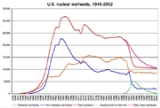
Us Nuclear Warheads 1945 2002 Graph
The only country to have used a nuclear weapon in war is the United States. There are eight countries that have declared they possess nuclear weapons and are known to have tested a nuclear weapon, only five of which are members of the NPT. The eight include: People's Republic of China; France
France and weapons of mass destruction

France is one of the five "Nuclear Weapons States" under the Nuclear Non-Proliferation Treaty but is not known to possess or develop any chemical weapons or biological weapons....
; India
India and weapons of mass destruction

India possesses an arsenal of nuclear weapons and maintains Intermediate-range ballistic missile ballistic missiles, long range strategic bombers, ships and cruise missile submarines to deliver them....
; Pakistan
Pakistan and weapons of mass destruction

The Islamic Republic of Pakistan began focusing on nuclear development in January 1972 under the leadership of Prime Minister of Pakistan Zulfiqar Ali Bhutto ....
; Russia
Russia and weapons of mass destruction

Russia possesses the largest stockpile of weapons of mass destruction in the world. Russia declared an arsenal of 28,000 tons of chemical weapons in 2008 and is said to have had around 5,200 nuclear weapons deployed in early 2008, making its Stockpile the largest in the world....
; The United Kingdom; the United States of America
Nuclear weapons and the United States

The United States was the first country in the world to develop nuclear weapons, and is the only country to have used them as Atomic bombings of Hiroshima and Nagasaki, during the two bombings of Hiroshima and Nagasaki in World War II....
; and North Korea
North Korea

North Korea, officially the Democratic People's Republic of Korea , is a state in East Asia, occupying the northern half of the Korean Peninsula....
.

Israel
Israel and weapons of mass destruction

Israel is widely believed to possess an estimated 75 to 200 nuclear warheads and medium-range ballistic missiles capable of delivering those warheads....
 is considered by most analysts to have nuclear weapons numbering in the low hundreds as well, but maintains an official policy of nuclear ambiguity, neither denying nor confirming its nuclear status.

Iran
Iran and weapons of mass destruction

Iran is not known to possess weapons of mass destruction, and has signed treaties repudiating possession of them, including the Biological Weapons Convention, the Chemical Weapons Convention, and the Nuclear Non-Proliferation Treaty ....
 is suspected by western countries of seeking nuclear weapons, a claim that it denies. While the truth is unknown, the Nov 2007 NIE on Iran stated that Iran halted its nuclear weapons progam in the fall of 2003 .

South Africa
South Africa and weapons of mass destruction

During the 1970s and 1980s, South Africa pursued research into nuclear weapon, biological weapon, and chemical weapons. Six nuclear weapons were assembled....
 developed a small nuclear arsenal in the 1980s but disassembled them in the early 1990s, making it the only country to have fully given up an independently-developed nuclear weapons arsenal. Belarus
Belarus

Belarus is a landlocked country in Eastern Europe, bordered by Russia to the north and east, Ukraine to the south, Poland to the west, and Lithuania and Latvia to the north....
, Kazakhstan
Kazakhstan

Kazakhstan, also Kazakstan , officially the Republic of Kazakhstan, is a large Eurasian country in Central Asia and Eastern Europe. Ranked as the List of countries by area as well as the world's largest landlocked country, it has a territory of 2,727,300 km? ....
, and Ukraine
Ukraine

Ukraine is a country in Eastern Europe. It is bordered by Russia to the east; Belarus to the north; Poland, Slovakia, and Hungary to the west; Romania and Moldova to the southwest; and the Black Sea and Sea of Azov to the south....
 inherited stockpiles of nuclear arms following the break-up of the Soviet Union
Soviet Union

The Union of Soviet Socialist Republics was a Constitution of the Soviet Union socialist state that existed in Eurasia from 1922 to 1991.The name is a translation of the , romanization of Russian Soyuz Sovetskikh Sotsialisticheskikh Respublik, abbreviated ????, SSSR....
, but relinquished them to the Russian Federation.

Countries with access to nuclear weapons through nuclear sharing
Nuclear sharing

Nuclear sharing is a concept in NATO's policy of nuclear Deterrence theory, which involves member countries without nuclear weapons of their own in the planning for the use of nuclear weapons by NATO, and in particular provides for the armed forces of these countries to be involved in delivering these weapons in the event of their use....
 agreements include: Belgium
Belgium

* A small German-speaking Community of Belgium exists in eastern Wallonia. Belgium's linguistic diversity and related political and cultural conflicts are reflected in the history of Belgium and a complex Communities and regions of Belgium....
, Germany
Germany and weapons of mass destruction

Though Germany is one of the most technologically advanced countries in the world, since World War II it has generally refrained from using this technology to outfit its own armed forces with weapons of mass destruction , although it participates in the NATO nuclear weapons sharing arrangements and trains for delivering nuclear weapons....
, Italy
Italy

Italy , officially the Italian Republic , is a country located on the Italian Peninsula in Southern Europe and on the two largest islands in the Mediterranean Sea, Sicily and Sardinia....
, the Netherlands
Netherlands and weapons of mass destruction

Although the Netherlands do not have weapons of mass destruction made by itself, the country participates in the NATO nuclear weapons sharing arrangements and trains for delivering U.S....
, and Turkey
Turkey

Turkey , known officially as the Republic of Turkey , is a Eurasian country that stretches across the Anatolian peninsula in southwest Asia and Thrace in the Balkans region of Southern Europe....
. North Korea
North Korea and weapons of mass destruction

North Korea claims to possess nuclear weapons, and the CIA asserts that it has a substantial arsenal of chemical weapons. North Korea was a member of the Nuclear Non-Proliferation Treaty but withdrew in 2003, citing the failure of the United States to fulfill its end of the Agreed Framework, a 1994 agreement between the states to limit North...
 has claimed to have developed and tested nuclear devices. Although outside sources have been unable to unequivocally support the state's claims, North Korea has officially been identified to have nuclear weapons.

United States politics

Due to the indiscriminate impact of WMDs, the fear of a WMD attack has shaped political policies and campaigns, fostered social movements, and has been the central theme of many films. Support for different levels of WMD development and control varies nationally and internationally. Yet understanding of the nature of the threats is not high, in part because of imprecise usage of the term by politicians and the media.

Fear of WMD, or of threats diminished by the possession of WMD, has long been used to catalyze public support for various WMD policies. They include mobilization of pro- and anti-WMD campaigners alike, and generation of popular political support. The term WMD may be used as a powerful buzzword, or to generate a culture of fear
Culture of fear

Culture of fear is a term that refers to a perceived prevalence of fear and anxiety in public discourse and relationships, and how this may affect the way people interact with one another as individuals and as democratic agents....
.. It is also used ambiguously, particularly by not distinguishing among the different types of WMD.

A television commercial called Daisy
Daisy (television commercial)

"Daisy," sometimes known as "Daisy Girl" or "Peace, Little Girl," was a controversial political campaign television advertisement. Though aired only once , during a September 7, 1964, telecast of David and Bathsheba on The NBC Monday Movie, it was a factor in President Lyndon B....
, promoting Democrat Lyndon Johnson's 1964 presidential candidacy, invoked the fear of a nuclear war and was an element in Johnson's subsequent election.

More recently, the threat of potential WMD in Iraq was used by President George W. Bush to generate public support for the 2003 invasion of Iraq. Broad reference to Iraqi WMD in general was seen as an element of President Bush's arguments.

As Paul Wolfowitz explained: "For bureaucratic reasons, we settled on one issue, weapons of mass destruction, because it was the one reason everyone could agree on." To date, however, Coalition forces
Multinational force in Iraq

The Multi-National Force - Iraq is a military command , led by the United States, that is fighting the Iraq War against Iraqi insurgency. Multi-National Force - Iraq replaced the previous force, Combined Joint Task Force 7, on May 15, 2004....
 have found mainly degraded artillery shells.

On June 21, 2006, United States Senator Rick Santorum
Rick Santorum

Richard John Santorum, Sovereign Military Order of Malta is a former United States Senate from the Commonwealth of Pennsylvania....
 claimed that "We have found weapons of mass destruction in Iraq, chemical weapons." According to the Washington Post, he was referring to 500 such shells "that had been buried near the Iranian border, and then long forgotten, by Iraqi troops during their eight-year war with Iran, which ended in 1988." That night, "intelligence officials reaffirmed that the shells were old and were not the suspected weapons of mass destruction sought in Iraq after the 2003 invasion of Iraq." The shells had been uncovered and reported on in 2004.

In 2004 Polish troops found 17 1980s-era rocket warheads, thwarting an attempt by militants to buy them at $5000 each. Some of the rockets contained extremely deteriorated nerve agent.

Media coverage of WMD

In 2004 the Center for International and Security Studies at Maryland (CISSM) released a report examining the media’s coverage of WMD issues during three separate periods: India’s
India

India, officially the Republic of India , is a country in South Asia. It is the List of countries and outlying territories by total area country by geographical area, the List of countries by population country, and the most populous liberal democracy in the world....
 nuclear weapons tests
Nuclear testing

File:Damage and Destruction of nuclear tests.oggNuclear weapons tests are experiments carried out to determine the effectiveness, yield and explosive capability of nuclear weapons....
 in May 1998; the US announcement of evidence of a North Korean nuclear weapons program
North Korea and weapons of mass destruction

North Korea claims to possess nuclear weapons, and the CIA asserts that it has a substantial arsenal of chemical weapons. North Korea was a member of the Nuclear Non-Proliferation Treaty but withdrew in 2003, citing the failure of the United States to fulfill its end of the Agreed Framework, a 1994 agreement between the states to limit North...
 in October 2002; and revelations about Iran's nuclear program in May 2003. The CISSM report notes that poor coverage resulted less from political bias among the media
Media bias

Media bias is a term used to describe the reality and perception bias of journalists and news producers within the mass media, in the selection of which events will be reported and how they are covered....
 than from tired journalistic conventions. The report’s major findings were that:
  1. Most media outlets represented WMD as a monolithic menace, failing to adequately distinguish between weapons programs and actual weapons or to address the real differences among chemical, biological, nuclear, and radiological weapons.
  2. Most journalists accepted the Bush administration’s
    Foreign policy of the George W. Bush administration

    File:Romanian children greet Bushes 2002.jpgDuring his campaign for election as President of the United States, George W. Bush's foreign policy platform included support for a stronger economic and political relationship with Latin America, especially Mexico, and a reduction of involvement in "nation building" and other small-scale military engage...
     formulation of the “War on Terror
    War on Terrorism

    The War on Terrorism or War on Terror are the common terms for the military, political, legal and ideological conflict against Islamic terrorism and Muslim militants, and specifically used in reference to operations by the United States, since the September 11 attacks....
    ” as a campaign against WMD, in contrast to coverage during the Clinton
    Bill Clinton

    William Jefferson "Bill" Clinton served as the List of Presidents of the United States President of the United States from 1993 to 2001. He was the fifteenth Democrat elected to that office....
     era, when many journalists made careful distinctions between acts of terrorism
    Terrorism

    Terrorism, according to the Merriam-Webster online dictionary, is the systematic use of terror, "violent or destructive acts committed by groups in order to intimidate a population or government into granting their demands." At present, there is no internationally agreed upon definition of terrorism....
     and the acquisition and use of WMD.
  3. Many stories stenographically reported the incumbent administration’s perspective on WMD, giving too little critical examination of the way officials framed the events, issues, threats, and policy options.
  4. Too few stories proffered alternative perspectives to official line, a problem exacerbated by the journalistic
    Journalism

    Journalism is the craft of conveying news, descriptive material and editorial via a widening spectrum of Media . These include newspapers, magazines, radio and television, the internet and, more recently, the cellphone....
     prioritizing of breaking-news stories and the “inverted pyramid
    Inverted pyramid

    The inverted pyramid is a metaphor used to illustrate how information should be arranged or presented within a text, in particular within a news style....
    ” style of storytelling.


In a separate study published in 2005, a group of researchers assessed the effects reports and retractions in the media had on people’s memory
Memory

In psychology, memory is an organism's mental ability to store, retain and recall information. Traditional studies of memory began in the fields of philosophy, including techniques of mnemonic....
 regarding the search for WMD in Iraq
Iraq and weapons of mass destruction

This article concerns the Iraqi government's use, possession, and alleged intention of acquiring more types of weapons of mass destruction during the presidency of Saddam Hussein....
 during the 2003 Iraq War. The study focused on populations in two coalition
Coalition of the willing

The term coalition of the willing is a post-1990 political phrase used to describe military or military/humanitarian interventions for which the United Nations Security Council cannot agree to mount a full UN peacekeeping operation....
 countries (Australia
Australia

Australia, officially the Commonwealth of Australia, is a country in the southern hemisphere comprising the Australia of the world's smallest continent, the major island of Tasmania, and numerous list of islands of Australia in the Indian Ocean and Pacific Oceans....
 and USA) and one opposed to the war (Germany
Germany

Germany , officially the Federal Republic of Germany , is a country in Central Europe. It is bordered to the north by the North Sea, Denmark, and the Baltic Sea; to the east by Poland and the Czech Republic; to the south by Austria and Switzerland; and to the west by France, Luxembourg, Belgium, and the Netherlands....
). Results showed that US citizens generally did not correct initial misconceptions regarding WMD, even following disconfirmation; Australian and German citizens were more responsive to retractions. Dependence on the initial source of information led to a substantial minority of Americans exhibiting false memory that WMD were indeed discovered, while they were not. This led to three conclusions:
  1. The repetition of tentative news stories, even if they are subsequently disconfirmed, can assist in the creation of false memories in a substantial proportion of people.
  2. Once information is published, its subsequent correction does not alter people's beliefs unless they are suspicious about the motives underlying the events the news stories are about.
  3. When people ignore corrections, they do so irrespective of how certain they are that the corrections occurred.


A poll conducted between June and September 2003 asked people whether they thought WMD had been discovered in Iraq since the war ended. They were also asked which media sources they relied upon. Those who obtained their news primarily from Fox News were three times as likely to believe that evidence confirming WMD had been discovered in Iraq than those who relied on PBS and NPR for their news, and one third more likely than those who primarily watched CBS.

Media source Respondents believing evidence of WMD had been found in Iraq since the war ended
Fox33%
CBS
CBS

CBS Broadcasting Inc. is an American radio network and television network. The name is derived from the initials of Columbia Broadcasting System, its former legal name....
23%
NBC20%
CNN
CNN

Cable News Network, almost always referred to by its initialism CNN, is a major US Cable News Network founded in 1980 by Ted Turner. Upon its launch, CNN was the first station to provide 24-hour television news coverage, and the first all-news television network in the United States....
20%
ABC19%
Print media17%
PBS
Public Broadcasting Service

The Public Broadcasting Service is an United States non-profit public broadcasting television service with 354 member TV stations in the United States....
-NPR
National Public Radio

National Public Radio is a privately and publicly funded non-profit membership media organization that serves as a national Radio syndication to 797 public radio List of NPR stations in the United States....
11%
Based on a series of polls taken from June-September 2003.

In 2006 Fox News reported the claims of two Republican lawmakers that WMDs had been found in Iraq, based upon unclassified portions of a report by the National Ground Intelligence Center
National Ground Intelligence Center

The National Ground Intelligence Center is part of the United States Army Intelligence and Security Command. The NGIC provides technical intelligence and general military intelligence on foreign ground forces in support of the war fighting commanders, force and material developers, Department of the Army, Department of Defense, and Nationa...
. Quoting from the report Senator Rick Santorum
Rick Santorum

Richard John Santorum, Sovereign Military Order of Malta is a former United States Senate from the Commonwealth of Pennsylvania....
 said "Since 2003, coalition forces have recovered approximately 500 weapons munitions which contain degraded mustard or sarin nerve agent". According to David Kay, who appeared before the US House Armed Services Committee to discuss these badly corroded munitions, they were leftovers, many years old, improperly stored or destroyed by the Iraqis. Charles Duelfer agreed, stating on NPR's
Talk of the Nation: "When I was running the ISG – the Iraq Survey Group – we had a couple of them that had been turned in to these IEDs, the improvised explosive devices. But they are local hazards. They are not a major, you know, weapon of mass destruction."

Many news agencies, including Fox News, reported the conclusions of the CIA that, based upon the investigation of the Iraq Survey Group
Iraq Survey Group

The Iraq Survey Group was a fact-finding mission sent by the multinational force in Iraq after the 2003 Invasion of Iraq to find the alleged Iraq and weapons of mass destruction that had been the main ostensible reason for the invasion....
, WMDs have yet to be found in Iraq.

Note:

From US Code Title 18.2332a

(2) the term “weapon of mass destruction” means— any destructive device as defined in section 921 of this title; any weapon that is designed or intended to cause death or serious bodily injury through the release, dissemination, or
impact of toxic or poisonous chemicals, or their precursors;
any weapon involving a biological agent, toxin, or vector (as those terms are defined in section 178 of this title); or any weapon that is designed to release radiation or radioactivity at a level dangerous to human life;

From Title 18.921

(4) The term “destructive device” means— any explosive, incendiary, or poison gas—
bomb,
grenade,
rocket having a propellant charge of more than four ounces,
missile having an explosive or incendiary charge of more than one-quarter ounce,
mine, or
device similar to any of the devices described in the preceding clauses;
any type of weapon (other than a shotgun or a shotgun shell which the Attorney General finds is generally recognized as
particularly suitable for sporting purposes) by whatever name known which will, or which may be readily converted to, expel
a projectile by the action of an explosive or other propellant, and which has any barrel with a bore of more than one-half
inch in diameter; and


any combination of parts either designed or intended for use in converting any device into any destructive device described
in subparagraph (A) or (B) and from which a destructive device may be readily assembled.
The term “destructive device” shall not include any device which is neither designed nor redesigned for use as a weapon; any
device, although originally designed for use as a weapon, which is redesigned for use as a signaling, pyrotechnic, line throwing,
safety, or similar device; surplus ordnance sold, loaned, or given by the Secretary of the Army pursuant to the provisions of
section 4684 (2), 4685, or 4686 of title 10; or any other device which the Attorney General finds is not likely to be used as a
weapon, is an antique, or is a rifle which the owner intends to use solely for sporting, recreational or cultural purposes.


From Title 18.178

(1) the term “biological agent” means any microorganism (including, but not limited to, bacteria, viruses, fungi, rickettsiae or protozoa), or infectious substance, or any naturally occurring, bioengineered or synthesized component of any such microorganism or infectious substance, capable of causing— death, disease, or other biological malfunction in a human, an animal, a plant, or another living organism; deterioration of food, water, equipment, supplies, or material of any kind; or deleterious alteration of the environment; (2) the term “toxin” means the toxic material or product of plants, animals, microorganisms (including, but not limited to, bacteria, viruses, fungi, rickettsiae or protozoa), or infectious substances, or a recombinant or synthesized molecule, whatever their origin and method of production, and includes— any poisonous substance or biological product that may be engineered as a result of biotechnology produced by a living
organism; or
any poisonous isomer or biological product, homolog, or derivative of such a substance; (3) the term “delivery system” means— any apparatus, equipment, device, or means of delivery specifically designed to deliver or disseminate a biological agent,
toxin, or vector; or
any vector; (4) the term “vector” means a living organism, or molecule, including a recombinant or synthesized molecule, capable of carrying a biological agent or toxin to a host; and (5) the term “national of the United States” has the meaning prescribed in section 101(a)(22) of the Immigration and Nationality Act (8 U.S.C. 1101 (a)(22)).

Based on this the sarin and mustard gas found DO classify as weapons of mass destruction.

Public perceptions of WMD

Awareness and opinions of WMD have varied during the course of their history. Their threat is a source of unease, security and pride to different people. The anti-WMD movement is embodied most in nuclear disarmament
Nuclear disarmament

Nuclear disarmament is the proposed dismantling of nuclear weapons.Proponents of nuclear disarmament say that it would lessen the probability of Nuclear warfare occurring, especially accidentally....
, and led to the formation of the Campaign for Nuclear Disarmament
Campaign for Nuclear Disarmament

The Campaign for Nuclear Disarmament is an organisation that advocates unilateral nuclear disarmament by Britain. It also campaigns for international nuclear disarmament and tighter international arms regulation through agreements such as the Nuclear Non-Proliferation Treaty....
.

In 1998 University of New Mexico
University of New Mexico

The University of New Mexico is a public university in Albuquerque, New Mexico, New Mexico, USA. It was founded in 1889. It offers multiple bachelor's, master's, doctoral, and professional degree programs in all areas of the arts, sciences, and engineering....
's Institute for Public Policy released their third report on US perceptions - including the general public, politicians and scientists - of nuclear weapons since the break up of the Soviet Union
Soviet Union

The Union of Soviet Socialist Republics was a Constitution of the Soviet Union socialist state that existed in Eurasia from 1922 to 1991.The name is a translation of the , romanization of Russian Soyuz Sovetskikh Sotsialisticheskikh Respublik, abbreviated ????, SSSR....
. Risks of nuclear conflict, proliferation, and terrorism were seen as substantial.

While maintenance of a nuclear US arsenal was considered above average in importance, there was widespread support for a reduction in the stockpile, and very little support for developing and testing new nuclear weapons.

Also in 1998, but after the UNM survey was conducted, nuclear weapons became an issue in India's election of March, in relation to political tensions with neighboring Pakistan
Pakistan

Pakistan , officially the Islamic Republic of Pakistan, is a country located in South Asia and borders Central Asia and the Middle East. It has a 1,046 kilometre coastline along the Arabian Sea and Gulf of Oman in the south, and is bordered by Afghanistan and Iran in the west, India in the east and People's Republic of China in th...
. Prior to the election the Bharatiya Janata Party
Bharatiya Janata Party

The Bharatiya Janata Party , founded in 1980, is a major political party of India. Designed to represent the country's Hinduism and Centre-right in nature, the party advocates Conservatism social policies, self reliance, robust economic growth, foreign policy driven by a nationalist agenda, and strong national defense....
 (BJP) announced it would “declare India a nuclear weapon state” after coming to power.

BJP won the elections, and on May 14, three days after India tested nuclear weapons for the second time, a public opinion poll reported that a majority of Indians favored the country’s nuclear build-up.

On April 15, 2004, the Program on International Policy Attitudes
Program on International Policy Attitudes

The Program on International Policy Attitudes is an institution devoted toresearch on the public opinion of international politics. It is jointly run by the Center on Policy Attitudes and the Center for International and Security Studies at Maryland at the School of Public Affairs, University of Maryland, College Park....
 (PIPA) reported that US citizens showed high levels of concern regarding WMD, and that preventing the spread of nuclear weapons
Nuclear proliferation

Nuclear proliferation is a term now used to describe the spread of nuclear weapons, fissile material, and weapons-applicable nuclear technology and information, to nations which are not recognized as "nuclear weapon States" by the Treaty on the Nonproliferation of Nuclear Weapons, also known as the Nuclear Nonproliferation Treaty or NPT....
 should be "a very important US foreign policy goal", accomplished through multilateral arms control rather than the use of military threats.

A majority also believed the US should be more forthcoming with its biological research and its Nuclear Non-Proliferation Treaty
Nuclear Non-Proliferation Treaty

The Treaty on the Non-Proliferation of Nuclear Weapons, also Nuclear Non-Proliferation Treaty is a treaty to limit the spread of nuclear weapons, opened for signature on July 1, 1968....
 commitment of nuclear arms reduction, and incorrectly thought the US was a party to various non-proliferation treaties.

A Russian opinion poll conducted on August 5, 2005 indicated half the population believes new nuclear powers have the right to possess nuclear weapons. 39% believes the Russian stockpile should be reduced, though not fully eliminated.

WMD in popular culture

Weapons of mass destruction and their related impacts have been a mainstay of popular culture
Popular culture

Popular culture is the totality of Distinction memes, ideas, Perspective s and Attitude s that are deemed preferred per an informal consensus within the mainstream of a given culture....
 since the beginning of the Cold War
Cold War

The Cold War was the continuing state of conflict, tension and competition that existed between a number of world powers, including the United States, the Soviet Union, People's Republic of China, France, United Kingdom and those countries' respective allies from the mid-1940s to the early 1990s....
, as both political commentary and humorous outlet.

Main article: Weapons of mass destruction in popular culture
Weapons of mass destruction in popular culture

Weapons of mass destruction and their related impacts have been a mainstay of popular culture since the beginning of the Cold War, as both political commentary and humorous outlet....


Common hazard symbols

See main article: Hazard symbol
Hazard symbol

Hazard symbols are easily recognizable symbols designed to warn about hazardous materials or locations. The use of hazard symbols is often regulated by law and directed by standards organizations....
Toxic
Skull and crossbones

A skull and crossbones is a symbol consisting of a human skull and two bones crossed together under the skull. Today, it is generally used as a warning of danger ....
 symbol
?U+2620
Skull and Crossbones
Radioactive symbol?U+2622
Radiation Warning Symbol
Biohazard
Biological hazard

A biological hazard or biohazard is an organism, or substance derived from an organism, that poses a threat to human health. This can include medical waste or samples of a microorganism, virus or toxin that can impact human health....
 symbol
?U+2623
Biohazard Symbol
Chemical warfare
Chemical warfare

Chemical warfare involves using the poison of chemical substances as weapons to kill, injure, or incapacitate an Enemy .This type of warfare is distinct from the use of conventional weapons or nuclear weapons because the destructive effects of chemical weapons are not primarily due to their explosion force....
 symbol
N/AN/A
Wmd Chemical


Radioactive weaponry/hazard symbol

Radiation Warning Symbol
The international radioactivity symbol (also known as trefoil
Trefoil

Trefoil is a graphic form composed of the outline of three overlapping rings used in architecture and Christian symbolism. The term is also applied to other symbols of three-fold shape....
) first appeared in 1946, at the University of California, Berkeley
University of California, Berkeley

The University of California, Berkeley is a public university research university located in Berkeley, California, California, United States. The oldest of the ten major campuses affiliated with the University of California, Berkeley offers some 300 undergraduate and graduate degree programs in a wide range of disciplines....
 Radiation Laboratory. At the time, it was rendered as magenta
Magenta

Magenta is a purplish pink color evoked by lights with less power in yellowish-green wavelengths than in blue and red wavelengths . In light experiments, magenta can be produced by removing the lime-green wavelengths from white light....
, and was set on a blue
Blue

Blue is a colour, the perception of which is evoked by light having a spectrum dominated by energy with a wavelength of roughly 440?490 Nanometre....
 background.

It is drawn with a central circle of radius
R, the blades having an internal radius of 1.5R and an external radius of 5R, and separated from each other by 60°. It is meant to represent a radiating atom.

The International Atomic Energy Agency
International Atomic Energy Agency

The International Atomic Energy Agency is an international organization that seeks to promote the peaceful use of nuclear technology and to inhibit its use for nuclear weapon....
 found, however, that the symbol is unintuitive and can be variously interpreted by those uneducated in its meaning, and that its role as a hazard warning was compromised as it did not clearly indicate "danger" to many non-Westerners and children who encountered it. As a result of research, a new radiation hazard symbol was developed to be placed near the most dangerous parts of radiation sources featuring a skull, someone running away, and using the color red rather than yellow as the background.

Biological weaponry/hazard symbol

Biohazard Symbol
Developed by Dow Chemical company in the 1960s for their containment products.

According to Charles Dullin, an environmental-health engineer who contributed to its development:

(how to draw it)

The symbol used today as the biohazard sign is in fact a Japanese family crest, or
mon. It can be found on page 195 of the book "Japanese Design Motifs: 4,260 Illustrations of Japanese Crests" translated by Fumie Adachi and published by Dover.

See also

  • Iraq and weapons of mass destruction
    Iraq and weapons of mass destruction

    This article concerns the Iraqi government's use, possession, and alleged intention of acquiring more types of weapons of mass destruction during the presidency of Saddam Hussein....
  • Khamisiyah
    Khamisiyah

    Khamisiyah is an area in southern Iraq located approximately 350 km south east of Baghdad, 200 km north-west of Kuwait City and 270 km north of Al Qaysumah at lat 30.790013 and longitude 46.489149 and which falls under the province of Dhi Qar ....
    , the location of a Chemical Weapons storage facility in Iraq bombed during the First Gulf War
  • Survivalism
    Survivalism

    Survivalism is a commonly used term for the preparedness strategy and subculture of individuals or groups anticipating and making preparations for future possible disruptions in local, regional or worldwide social or political order....
  • NBC suit
    NBC suit

    An NBC suit is a type of military personal protective equipment designed to provide protection against direct contact with and contamination by Radioactive contamination, biological weapons or chemical weapons substances, and may provide protection against radiation, depending on the design....
  • Survive To Fight
    Survive To Fight

    Survive To Fight is the title of a British Army publication which details the use of NBC suit protective equipment and other procedures to be carried in the event of an attack with nuclear weapon, biological weapon or chemical weapons....
  • Nuclear terrorism
    Nuclear terrorism

    Nuclear terrorism denotes the use, or threat of the use, of nuclear weapons or radiological weapons in acts of terrorism, includingattacks against facilities where radioactive materials are present....
  • Fallout shelter
    Fallout shelter

    A fallout shelter is an enclosed space specially designed to protect occupants from radioactive debris or nuclear fallout resulting from a nuclear explosion....


Further reading


Debate

Weapons of Mass Destruction was the 2001-2002 Debate Resolution (policy debate)
Resolution (policy debate)

In policy debate, a resolution or topic is a Norm statement which the affirmative affirms and the negative negates. Resolutions are selected annually by affiliated schools....
.

"Resolved: The United States federal government should establish a foreign policy significantly limiting the use of weapons of mass destruction. (2001-2002)"

Definition and origin

  • , by Will Mallon, 2003, History News Network.
  • , Monterey Institute's Center for Nonproliferation Studies, September, 2004.
  • , BBC News, February 12, 2003.
  • , by Michael Evans, The Times
    The Times

    The Times is a daily national newspaper published in the United Kingdom since 1785 when it was known as The Daily Universal Register.The Times and its sister paper The Sunday Times are published by Times Newspapers Limited, a subsidiary of News International....
    , February 06, 2004.


International law

  • , FAS.
  • , by David P. Fidler, February 2003.
  • , by Duncan Currie, May 5, 2004
  • , by Elizabeth Rindskopf Parker and Bryan Pate.
  • , by Joanne Mariner, 2001.


Media

  • , by Susan D. Moeller, Center for International and Security Studies at Maryland, 2004.
  • , by Stephan Lewandowsky, Werner G.K. Stritzke, Klaus Oberauer, and Michael Morales, Psychological Science, 16(3): 190-195, 2005.


Public perceptions

  • , The PIPA/Knowledge Networks Poll, April 15, 2004.


External links

  • : Homeland Security Watch policy and current events resource
  • , Official Department of Defense web site that provides information about the DoD Chemical Biological Defense Program
  • , PBS
  • (Payvand News Agency)
  • These tables describe the effects of various nuclear blast sizes. All figures are for winds. Thermal burns represent injuries to an unprotected person. The legend describes the data.
  • The types of organisms used in biological weapons and how they can be destroyed.
  • The types of chemicals used in chemical weapons and how they can be destroyed.
  • Gareth Porter, Documents linking Iran to nuclear weapons push may have been fabricated, TheRawStory, November 10, 2008, .