
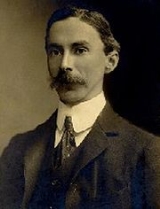
Bertrand Arthur William Russell, 3rd Earl Russell, OM, FRS (18 May 1872 – 2 February 1970) was a British philosopher,
logicianMathematical logic is a subfield of mathematics with close connections to foundations of mathematics, theoretical computer science and philosophical logic. The field includes both the mathematical study of logic and the applications of formal logic to other areas of mathematics...
,
mathematicianA mathematician is a person whose primary area of study is the field of mathematics. Mathematicians are concerned with quantity, structure, space, and change....
,
historianA historian is a person who studies and writes about the past and is regarded as an authority on it. Historians are concerned with the continuous, methodical narrative and research of past events as relating to the human race; as well as the study of all history in time. If the individual is...
, and social critic. At various points in his life he considered himself a
liberalLiberalism is the belief in the importance of liberty and equal rights. Liberals espouse a wide array of views depending on their understanding of these principles, but generally, liberals support ideas such as constitutionalism, liberal democracy, free and fair elections, human rights,...
, a socialist, and a pacifist, but he also admitted that he had never been any of these things in any profound sense. He was born in Monmouthshire, into one of the most prominent aristocratic families in Britain.
Russell led the British "revolt against
idealismIn philosophy, idealism is the family of views which assert that reality, or reality as we can know it, is fundamentally mental, mentally constructed, or otherwise immaterial. Epistemologically, idealism manifests as a skepticism about the possibility of knowing any mind-independent thing...
" in the early 1900s. He is considered one of the founders of
analytic philosophyAnalytic philosophy is a generic term for a style of philosophy that came to dominate English-speaking countries in the 20th century...
along with his predecessor
Gottlob FregeFriedrich Ludwig Gottlob Frege was a German mathematician, logician and philosopher. He is considered to be one of the founders of modern logic, and made major contributions to the foundations of mathematics. He is generally considered to be the father of analytic philosophy, for his writings on...
and his protégé
Ludwig WittgensteinLudwig Josef Johann Wittgenstein was an Austrian philosopher who worked primarily in logic, the philosophy of mathematics, the philosophy of mind, and the philosophy of language. He was professor in philosophy at the University of Cambridge from 1939 until 1947...
, and is widely held to be one of the 20th century's premier logicians. He co-authored, with A. N. Whitehead,
Principia MathematicaThe Principia Mathematica is a three-volume work on the foundations of mathematics, written by Alfred North Whitehead and Bertrand Russell and published in 1910, 1912, and 1913...
, an attempt to ground mathematics on logic. His philosophical essay "
On Denoting"On Denoting", written by Bertrand Russell, is one of the most significant and influential philosophical essays of the 20th century. It was published in the philosophy journal Mind in 1905; then reprinted, in both a special 2005 anniversary issue of the same journal and in Russell's Logic and...
" has been considered a "paradigm of philosophy." His work has had a considerable influence on
logicIn philosophy, Logic is the formal systematic study of the principles of valid inference and correct reasoning. Logic is used in most intellectual activities, but is studied primarily in the disciplines of philosophy, mathematics, semantics, and computer science...
,
mathematicsMathematics is the study of quantity, space, structure, and change. Mathematicians seek out patterns and formulate new conjectures. Mathematicians resolve the truth or falsity of conjectures by mathematical proofs, which are arguments sufficient to convince other mathematicians of their validity...
,
set theorySet theory is the branch of mathematics that studies sets, which are collections of objects. Although any type of object can be collected into a set, set theory is applied most often to objects that are relevant to mathematics...
,
linguisticsLinguistics is the scientific study of human language. Linguistics can be broadly broken into three categories or subfields of study: language form, language meaning, and language in context....
,
computer scienceComputer science or computing science is the study of the theoretical foundations of information and computation and of practical techniques for their implementation and application in computer systems...
(see
type theoryIn mathematics, logic and computer science, type theory is any of several formal systems that can serve as alternatives to naive set theory, or the study of such formalisms in general...
and
type systemA type system associates a type with each computed value. By examining the flow of these values, a type system attempts to ensure or prove that no type errors can occur...
), and
philosophyPhilosophy is the study of general and fundamental problems, such as those connected with existence, knowledge, values, reason, mind, and language. Philosophy is distinguished from other ways of addressing such problems by its critical, generally systematic approach and its reliance on rational...
, especially
philosophy of languagePhilosophy of language is the reasoned inquiry into the nature, origins, and usage of language. As a topic, the philosophy of language for analytic philosophers is concerned with four central problems: the nature of meaning, language use, language cognition, and the relationship between language...
,
epistemology, and
metaphysicsMetaphysics is a branch of philosophy concerned with explaining the fundamental nature of being and the world, although the term is not easily defined. Traditionally, metaphysics attempts to answer two basic questions in the broadest possible terms:...
.
Russell was a prominent
anti-warAn anti-war movement is a social movement, usually in opposition to a particular nation's decision to start or carry on an armed conflict, unconditional of a maybe-existing just cause. The term can also refer to pacifism, which is the opposition to all use of military force during conflicts. Many...
activistActivism consists of intentional efforts to bring about social, political, economic, or environmental change. Activism can take a wide range of forms from writing letters to newspapers or politicians, political campaigning, economic activism such as boycotts or preferentially patronizing...
; he championed
free tradeUnder a free trade policy, prices emerge from supply and demand, and are the sole determinant of resource allocation. 'Free' trade differs from other forms of trade policy where the allocation of goods and services among trading countries are determined by price strategies that may differ from...
and
anti-imperialismAnti-imperialism, strictly speaking, is a term that may be applied to a movement opposed to any form of colonialism or imperialism. Anti-imperialism includes opposition to wars of conquest, particularly of non-contiguous territory or people with a different language or culture; it also includes...
. Russell went to prison for his pacifism during World War I. Later, he campaigned against
Adolf HitlerAdolf Hitler was an Austrian-born German politician and the leader of the National Socialist German Workers Party , commonly referred to as the Nazi Party). He was Chancellor of Germany from 1933 to 1945, and head of state from 1934 to 1945...
, then criticised Stalinist
totalitarianismTotalitarianism is a political system where the state recognizes no limits to its authority and strives to regulate every aspect of public and private life wherever feasible...
, attacked the United States of America's involvement in the
Vietnam WarThe Vietnam War was a Cold War-era military conflict that occurred in Vietnam, Laos, and Cambodia from 1 November 1955 to the fall of Saigon on 30 April 1975. This war followed the First Indochina War and was fought between North Vietnam, supported by its communist allies, and the government of...
, and was an outspoken proponent of
nuclear disarmamentNuclear disarmament refers to both the act of reducing or eliminating nuclear weapons and to the end state of a nuclear-free world, in which nuclear weapons are completely eliminated....
. One of his last acts was to issue a statement which condemned Israeli aggression in the Middle East.
In 1950, Russell was awarded the
Nobel Prize in LiteratureSince 1901, the Nobel Prize in Literature has been awarded annually to an author from any country who has, in the words from the will of Alfred Nobel, produced "in the field of literature the most outstanding work in an ideal direction"...
, "in recognition of his varied and significant writings in which he champions humanitarian ideals and
freedom of thoughtFreethought is a philosophical viewpoint that holds that opinions should be formed on the basis of science, logic, and reason, and should not be influenced by authority, tradition, or other dogmas...
."
Ancestry
Bertrand Russell was born on 18 May 1872 at Ravenscroft,
TrellechTrellech is a village in Monmouthshire, south-east Wales, near Monmouth and the location of an archaeological site. The village is designated as a Conservation Area....
,
MonmouthshireMonmouthshire , also known as the County of Monmouth , is one of thirteen ancient counties of Wales and a former administrative county....
, Wales, into an influential and liberal family of the British aristocracy. His paternal grandfather,
John Russell, 1st Earl RussellJohn Russell, 1st Earl Russell, KG, GCMG, PC , known as Lord John Russell before 1861, was an English Whig and Liberal politician who served twice as Prime Minister of the United Kingdom in the mid-19th century....
, was the third son of
John Russell, 6th Duke of BedfordJohn Russell, 6th Duke of Bedford KG, PC, LLD, FSA , known as Lord John Russell until 1802, was a British Whig politician and notably served as Lord Lieutenant of Ireland in the Ministry of All the Talents...
, and had twice been asked by Queen Victoria to form a government, serving her as
Prime MinisterThe Prime Minister of the United Kingdom of Great Britain and Northern Ireland is the Head of Her Majesty's Government in the United Kingdom. The Prime Minister and Cabinet are collectively accountable for their policies and actions to the Sovereign, to Parliament, to their political party and...
in the 1840s and 1860s.
The Russells had been prominent in England for several centuries before this, coming to power and the peerage with the rise of the
Tudor dynastyThe Tudor dynasty or House of Tudor was a European royal house of Welsh origin that ruled the Kingdom of England and its realms, including the Lordship of Ireland, later the Kingdom of Ireland, from 1485 until 1603. Its first monarch was Henry Tudor, a descendant through his mother of a legitimised...
. They established themselves as one of Britain's leading
WhigThe Whigs were a party in the Parliament of England, Parliament of Great Britain, and Parliament of the United Kingdom, who contested power with the rival Tories from the 1680s to the 1850s. The Whigs' origin lay in constitutional monarchism and opposition to absolute rule...
families, and participated in every great political event from the
Dissolution of the MonasteriesThe Dissolution of the Monasteries, sometimes referred to as the Suppression of the Monasteries, was the set of administrative and legal processes between 1536 and 1541 by which Henry VIII disbanded monasteries, priories, convents and friaries in England, Wales and Ireland; appropriated their...
in 1536–40 to the
Glorious RevolutionThe Glorious Revolution, also called the Revolution of 1688, is the overthrow of King James II of England by a union of English Parliamentarians with the Dutch stadtholder William III of Orange-Nassau...
in 1688–89 to the Great Reform Act in 1832.
Russell's mother Katharine Louisa (1844–1874) was the daughter of
Edward Stanley, 2nd Baron Stanley of AlderleyEdward John Stanley, 2nd Baron Stanley of Alderley PC , known as The Lord Eddisbury between 1848 and 1850, was a British politician.-Background:...
, and was the sister of Rosalind Howard, Countess of Carlisle. Kate and Rosalind's mother was one of the founders of
Girton College, CambridgeGirton College is one of the 31 constituent colleges of the University of Cambridge. It was England's first residential women's college, established in 1869 by Emily Davies and Barbara Bodichon. The full college status was only received in 1948 and marked the official admittance of women to the...
.
Russell's parents were radical for their times. Russell's father,
Viscount AmberleyJohn Russell, Viscount Amberley was the eldest son of John Russell, 1st Earl Russell. As such, from 1861 he took his father's junior title of Viscount Amberley, but he did not live to inherit the earldom; this passed, after his death, to his eldest son John Francis Stanley Russell, 2nd Earl Russell...
, was an atheist and consented to his wife's affair with their children's tutor, the biologist
Douglas SpaldingDouglas Alexander Spalding was an English biologist. He was born in Islington in London in 1841, and began life as a manual labourer. Subsequently he lived in Scotland, near Aberdeen; the philosopher Alexander Bain persuaded the University of Aberdeen to allow him to attend courses without charge....
. Both were early advocates of
birth controlBirth control is an umbrella term for several techniques and methods used to prevent fertilization or to interrupt pregnancy at various stages. Birth control techniques and methods include contraception , contragestion and abortion...
at a time when this was considered scandalous. John Russell's atheism was evident when he asked the philosopher
John Stuart MillJohn Stuart Mill was a British philosopher, economist and civil servant. An influential contributor to social theory, political theory, and political economy, his conception of liberty justified the freedom of the individual in opposition to unlimited state control. He was a proponent of...
to act as Russell's secular
godfatherA godparent, in many denominations of Christianity, is someone who sponsors a child's baptism. A male godparent is a godfather, and a female godparent is a godmother...
. Mill died the year after Russell's birth, but his writings had a great effect on Russell's life.
Childhood and adolescence
Russell had two siblings:
FrankJohn Francis Stanley Russell, 2nd Earl Russell known as Frank Russell, was the elder surviving son of Viscount Amberley and his wife the Honourable Katharine Stanley, and was raised by his paternal grandparents after his non-conventional parents both died young...
(nearly seven years older than Bertrand), and Rachel (four years older). In June 1874 Russell's mother died of
diphtheriaDiphtheria is an upper respiratory tract illness caused by Corynebacterium diphtheriae, a facultative anaerobic, Gram-positive bacterium. It is characterized by sore throat, low fever, and an adherent membrane on the tonsils, pharynx, and/or nasal cavity...
, followed shortly by Rachel's death. In January 1876, his father also died of
bronchitisAcute bronchitis is an inflammation of the large bronchi in the lungs that is usually caused by viruses or bacteria and may last several days or weeks. Characteristic symptoms include cough, sputum production, and shortness of breath and wheezing related to the obstruction of the inflamed airways...
following a long period of depression. Frank and Bertrand were placed in the care of their staunchly
VictorianVictorian morality is a distillation of the moral views of people living at the time of Queen Victoria's reign and of the moral climate of the United Kingdom throughout the 19th century in general, which contrasted greatly with the morality of the previous Georgian period...
grandparents, who lived at
Pembroke LodgePembroke Lodge is a magnificent Georgian mansion in Richmond Park, London. It is located on high ground with spectacular views across the Thames valley to Windsor and Surrey...
in
Richmond ParkRichmond Park is a 2,360 acre park within London. It is the largest of the Royal Parks in London and Britain's second largest urban walled park after Sutton Park, Birmingham. It is close to Richmond, Ham, Kingston upon Thames, Wimbledon, Roehampton and East Sheen...
.
John Russell, 1st Earl RussellJohn Russell, 1st Earl Russell, KG, GCMG, PC , known as Lord John Russell before 1861, was an English Whig and Liberal politician who served twice as Prime Minister of the United Kingdom in the mid-19th century....
, his grandfather, who had been
Prime MinisterA prime minister is the most senior minister of cabinet in the executive branch of government in a parliamentary system. In many systems, the prime minister selects and may dismiss other members of the cabinet, and allocates posts to members within the government. In most systems, the prime...
, died in 1878, and was remembered by Russell as a kindly old man in a wheelchair. As a result, his widow, the Countess Russell (née Lady Frances Elliot), was the dominant family figure for the rest of Russell's childhood and youth.
The countess was from a Scottish Presbyterian family, and successfully petitioned the
Court of ChanceryThe Court of Chancery was a court of equity in England and Wales that followed a set of loose rules to avoid the slow pace of change and possible harshness of the common law. The Chancery had jurisdiction over all matters of equity, including trusts, land law, the administration of the estates of...
to set aside a provision in Amberley's
willA will or testament is a legal declaration by which a person, the testator, names one or more persons to manage his/her estate and provides for the transfer of his/her property at death...
requiring the children to be raised as agnostics. Despite her religious conservatism, she held progressive views in other areas (accepting
DarwinismDarwinism is a set of movements and concepts related to ideas of transmutation of species or of evolution, including some ideas with no connection to the work of Charles Darwin....
and supporting
Irish Home RuleHome rule is the power of a constituent part of a state to exercise such of the state's powers of governance within its own administrative area that have been devolved to it by the central government....
), and her influence on Bertrand Russell's outlook on
social justiceSocial justice generally refers to the idea of creating a society or institution that is based on the principles of equality and solidarity, that understands and values human rights, and that recognizes the dignity of every human being. The term and modern concept of "social justice" was coined by...
and standing up for principle remained with him throughout his life — her favourite Bible verse, 'Thou shalt not follow a multitude to do evil' (Exodus 23:2), became his motto. The atmosphere at Pembroke Lodge was one of frequent prayer, emotional repression and formality; Frank reacted to this with open rebellion, but the young Bertrand learned to hide his feelings.
Russell's
adolescenceAdolescence is a transitional stage of physical and mental human development generally occurring between puberty and legal adulthood , but largely characterized as beginning and ending with the teenage stage...
was very lonely, and he often contemplated suicide. He remarked in his autobiography that his keenest interests were in religion and mathematics, and that only the wish to know more mathematics kept him from suicide. He was educated at home by a series of tutors. His brother Frank introduced him to the work of
EuclidEuclid , fl. 300 BC, also known as Euclid of Alexandria, was a Greek mathematician, often referred to as the "Father of Geometry". He was active in Alexandria during the reign of Ptolemy I...
, which transformed Russell's life.
Also, during these formative years, he discovered the works of
Percy Bysshe ShelleyPercy Bysshe Shelley was one of the major English Romantic poets and is critically regarded as among the finest lyric poets in the English language. Shelley was famous for his association with John Keats and Lord Byron...
. In his autobiography, he writes: "I spent all my spare time reading him, and learning him by heart, knowing no one to whom I could speak of what I thought or felt, I used to reflect how wonderful it would have been to know Shelley, and to wonder whether I should meet any live human being with whom I should feel so much sympathy." Russell claimed that beginning at age 15, he spent considerable time thinking about the validity of
ChristianA Christian is a person who adheres to Christianity, an Abrahamic, monotheistic religion based on the life and teachings of Jesus of Nazareth as recorded in the Canonical gospels and the letters of the New Testament...
religious dogma, and by 18 had decided to discard the last of it.
University and first marriage
Russell won a scholarship to read for the Mathematical Tripos at
Trinity College, CambridgeTrinity College is a constituent college of the University of Cambridge. Trinity has more members than any other college in Cambridge or Oxford, with around 700 undergraduates, 430 graduates, and over 170 Fellows...
, and commenced his studies there in 1890. He became acquainted with the younger
G.E. MooreGeorge Edward Moore OM, was an English philosopher. He was, with Bertrand Russell, Ludwig Wittgenstein, and Gottlob Frege, one of the founders of the analytic tradition in philosophy...
and came under the influence of
Alfred North WhiteheadAlfred North Whitehead, OM FRS was an English mathematician who became a philosopher. He wrote on algebra, logic, foundations of mathematics, philosophy of science, physics, metaphysics, and education...
, who recommended him to the
Cambridge ApostlesThe Cambridge Apostles, also known as the Cambridge Conversazione Society, is an intellectual secret society at the University of Cambridge founded in 1820 by George Tomlinson, a Cambridge student who went on to become the first Bishop of Gibraltar....
. He quickly distinguished himself in mathematics and philosophy, graduating as a high Wrangler in 1893 and becoming a Fellow in the latter in 1895.
Russell first met the American
QuakerThe Religious Society of Friends, or Friends Church, is a Christian movement which stresses the doctrine of the priesthood of all believers. Members are known as Friends, or popularly as Quakers. It is made of independent organisations, which have split from one another due to doctrinal differences...
Alys Pearsall SmithAlyssa Whitall Pearsall Smith was the first wife of Bertrand Russell.Born in Philadelphia, Pennsylvania, she was the daughter of Robert Pearsall Smith and Hannah Whitall Smith, prominent figures in the Holiness movement in America and the Higher Life movement in Great Britain...
when he was 17 years old. He became a friend of the Pearsall Smith family—they knew him primarily as 'Lord John's grandson' and enjoyed showing him off—and travelled with them to the continent; it was in their company that Russell visited the Paris Exhibition of 1889 and was able to climb the
Eiffel TowerThe Eiffel Tower is a puddle iron lattice tower located on the Champ de Mars in Paris. Built in 1889, it has become both a global icon of France and one of the most recognizable structures in the world...
soon after it was completed.
He soon fell in love with the puritanical, high-minded Alys, who was a graduate of
Bryn Mawr CollegeBryn Mawr College is a women's liberal arts college located in Bryn Mawr, a community in Lower Merion Township, Pennsylvania, ten miles west of Philadelphia. The name "Bryn Mawr" means "big hill" in Welsh....
near Philadelphia, and, contrary to his grandmother's wishes, married her on 13 December 1894. Their marriage began to fall apart in 1901 when it occurred to Russell, while he was cycling, that he no longer loved her. She asked him if he loved her and he replied that he didn't. Russell also disliked Alys's mother, finding her controlling and cruel. It was to be a hollow shell of a marriage and they finally divorced in 1921, after a lengthy period of separation.
During this period, Russell had passionate (and often simultaneous) affairs with a number of women, including Lady Ottoline Morrell and the actress Lady Constance Malleson.
Early career
Russell began his published work in 1896 with
German Social Democracy, a study in politics that was an early indication of a lifelong interest in political and social theory. In 1896, he taught German social democracy at the
London School of EconomicsThe London School of Economics and Political Science is a public research university specialised in the social sciences located in London, United Kingdom, and a constituent college of the federal University of London...
, where he also lectured on the science of power in the autumn of 1937. He was also a member of the
Coefficients dining club The Coefficients was a dining club founded in 1902 at a dinner given by the Fabian campaigners Sidney and Beatrice Webb. It was a forum for the meeting of British socialist reformers and imperialists of the Edwardian era...
of social reformers set up in 1902 by the
FabianThe Fabian Society is a British socialist movement, whose purpose is to advance the principles of democratic socialism via gradualist and reformist, rather than revolutionary, means. It is best known for its initial ground-breaking work beginning late in the 19th century and continuing up to World...
campaigners Sidney and
Beatrice WebbMartha Beatrice Webb, Lady Passfield was an English sociologist, economist, socialist and social reformer. Although her husband became Baron Passfield in 1929, she refused to be known as Lady Passfield...
.
He now started an intensive study of the
foundations of mathematicsFoundations of mathematics is a term sometimes used for certain fields of mathematics, such as mathematical logic, axiomatic set theory, proof theory, model theory, type theory and recursion theory...
at Trinity during which he discovered
Russell's paradoxIn the foundations of mathematics, Russell's paradox , discovered by Bertrand Russell in 1901, showed that the naive set theory created by Georg Cantor leads to a contradiction...
which challenged the foundations of
set theorySet theory is the branch of mathematics that studies sets, which are collections of objects. Although any type of object can be collected into a set, set theory is applied most often to objects that are relevant to mathematics...
. In 1903 he published his first important book on mathematical logic,
The Principles of MathematicsThe Principles of Mathematics is a book written by Bertrand Russell in 1903. In it he presented his famous paradox and argued his thesis that mathematics and logic are identical....
showing that mathematics could be deduced from a very small number of principles, and contributing significantly to the cause of
logicismLogicism is one of the schools of thought in the philosophy of mathematics, putting forth the theory that mathematics is an extension of logic and therefore some or all mathematics is reducible to logic. Bertrand Russell and Alfred North Whitehead championed this theory fathered by Richard Dedekind...
.
In 1905 he wrote the essay "
On Denoting"On Denoting", written by Bertrand Russell, is one of the most significant and influential philosophical essays of the 20th century. It was published in the philosophy journal Mind in 1905; then reprinted, in both a special 2005 anniversary issue of the same journal and in Russell's Logic and...
", which was published in the philosophical journal
MindMind is a British journal, currently published by Oxford University Press on behalf of the Mind Association, which deals with philosophy in the analytic tradition...
. Russell became a fellow of the
Royal SocietyThe Royal Society of London for Improving Natural Knowledge, known simply as the Royal Society, is a learned society for science, and is possibly the oldest such society in existence. Founded in November 1660, it was granted a Royal Charter by King Charles II as the "Royal Society of London"...
in 1908. The first of three volumes of
Principia MathematicaThe Principia Mathematica is a three-volume work on the foundations of mathematics, written by Alfred North Whitehead and Bertrand Russell and published in 1910, 1912, and 1913...
, written with Whitehead, was published in 1910, which, along with the earlier
The Principles of Mathematics, soon made Russell world famous in his field.
In 1910 he became a lecturer in the
University of CambridgeThe University of Cambridge is a public research university located in Cambridge, United Kingdom. It is the second-oldest university in both the United Kingdom and the English-speaking world , and the seventh-oldest globally...
where he soon received an approach from the Austrian engineering student
Ludwig WittgensteinLudwig Josef Johann Wittgenstein was an Austrian philosopher who worked primarily in logic, the philosophy of mathematics, the philosophy of mind, and the philosophy of language. He was professor in philosophy at the University of Cambridge from 1939 until 1947...
, who became his
PhDPHD may refer to:*Ph.D., a doctorate of philosophy*Ph.D. , a 1980s British group*PHD finger, a protein sequence*PHD Mountain Software, an outdoor clothing and equipment company*PhD Docbook renderer, an XML renderer...
student and whom he viewed as a genius and a successor who would continue his work on logic. He spent hours dealing with Wittgenstein's various
phobiaA phobia is a type of anxiety disorder, usually defined as a persistent fear of an object or situation in which the sufferer commits to great lengths in avoiding, typically disproportional to the actual danger posed, often being recognized as irrational...
s and his frequent bouts of despair. This was often a drain on Russell's energy, but Russell continued to be fascinated by him and encouraged his academic development, including the publication of Wittgenstein's
Tractatus Logico-PhilosophicusThe Tractatus Logico-Philosophicus is the only book-length philosophical work published by the Austrian philosopher Ludwig Wittgenstein in his lifetime. It was an ambitious project: to identify the relationship between language and reality and to define the limits of science...
in 1922. Russell delivered his lectures on
Logical AtomismLogical atomism is a philosophical belief that originated in the early 20th century with the development of analytic philosophy. Its principal exponents were the British philosopher Bertrand Russell, the early work of his Austrian-born pupil and colleague Ludwig Wittgenstein, and his German...
, his version of these ideas, in 1918 before the end of the First World War and whilst Wittgenstein was still a prisoner of war.
First World War
During the
First World WarWorld War I , which was predominantly called the World War or the Great War from its occurrence until 1939, and the First World War or World War I thereafter, was a major war centred in Europe that began on 28 July 1914 and lasted until 11 November 1918...
, Russell was one of a very small number of intellectuals engaged in
pacifist activitiesOpposition to World War I was mainly by left-wing groups, but there was also opposition by Christian pacifist and nationalist groups.The trade union and socialist movements had declared before the war their determined opposition to a war which they said could only mean workers killing each other in...
, and, in 1916, he was dismissed from Trinity College following his conviction under the Defence of the Realm Act.
He was charged a fine of £100 which he refused to pay, hoping that he would be sent to prison, but they instead sold his books at auction to raise the money. The books were bought by friends and he later treasured his copy of the King James Bible that was stamped "Confiscated by Cambridge Police." Russell was released from prison in September 1918. He was reinstated in 1919, resigned in 1920, was Tarner Lecturer 1926, and became a Fellow again 1944–1949.
A later conviction for publicly lecturing against inviting the US to enter the war on Britain's side, resulted in six months' imprisonment in
Brixton prisonHM Prison Brixton is a local men's prison, located in Brixton area of the London Borough of Lambeth, in inner-South London, England. The prison is operated by Her Majesty's Prison Service.-History:...
(see
Bertrand Russell's views on societyThe aspects of Bertrand Russell's views on society cover the changing viewpoints of philosopher/mathematician and social activist Bertrand Russell , from his early writings in 1896 and long-term political or social activism, until his death in February 1970.-Activism:Political and social activism...
).
Between the wars, and second marriage
In August 1920, Russell travelled to Russia as part of an official delegation sent by the British government to investigate the effects of the
Russian RevolutionThe Russian Revolution is the collective term for a series of revolutions in Russia in 1917, which destroyed the Tsarist autocracy and led to the creation of the Soviet Union. The Tsar was deposed and replaced by a provisional government in the first revolution of February 1917...
. He met
Vladimir LeninVladimir Ilyich Lenin was a Russian Marxist revolutionary and communist politician who led the October Revolution of 1917. As leader of the Bolsheviks, he headed the Soviet state during its initial years , as it fought to establish control of Russia in the Russian Civil War and worked to create a...
and had an hour-long conversation with him. In his autobiography, he mentions that he found Lenin rather disappointing, sensing an "impish cruelty" in him and comparing him to "an opinionated professor". He also cruised down the Volga on a steamship. Russell's lover
Dora BlackDora Black, Lady Russell was a British author, a feminist and socialist campaigner, and the second wife of the eminent philosopher Bertrand Russell....
also visited Russia independently at the same time — she was enthusiastic about the revolution, but Russell's experiences destroyed his previous tentative support for it. He wrote a book "The Practice and Theory of Bolshevism" about his experiences on this trip, which included 24 others from Britain, all of whom came home thinking well of the regime, despite Russell's attempts to change their mind. For example, he told them that he heard shots fired in the middle of the night and was sure these were clandestine executions, but the others maintained that it was only cars backfiring.
Russell subsequently lectured in
BeijingBeijing , also known as Peking , is the capital of the People's Republic of China and one of the most populous cities in the world, with a population of 19,612,368 as of 2010. The city is the country's political, cultural, and educational center, and home to the headquarters for most of China's...
on philosophy for one year, accompanied by Dora. He went there with optimism and hope, as
ChinaChinese civilization may refer to:* China for more general discussion of the country.* Chinese culture* Greater China, the transnational community of ethnic Chinese.* History of China* Sinosphere, the area historically affected by Chinese culture...
was then on a new path. Among other scholars there was
Rabindranath TagoreRabindranath Tagore , sobriquet Gurudev, was a Bengali polymath who reshaped his region's literature and music. Author of Gitanjali and its "profoundly sensitive, fresh and beautiful verse", he became the first non-European Nobel laureate by earning the 1913 Prize in Literature...
, the
IndiaIndia , officially the Republic of India , is a country in South Asia. It is the seventh-largest country by geographical area, the second-most populous country with over 1.2 billion people, and the most populous democracy in the world...
n poet and also a Nobel Laureate. While in China, Russell became gravely ill with
pneumoniaPneumonia is an inflammatory condition of the lung—especially affecting the microscopic air sacs —associated with fever, chest symptoms, and a lack of air space on a chest X-ray. Pneumonia is typically caused by an infection but there are a number of other causes...
, and
incorrect reports of his death were published in the
JapanJapan is an island nation in East Asia. Located in the Pacific Ocean, it lies to the east of the Sea of Japan, China, North Korea, South Korea and Russia, stretching from the Sea of Okhotsk in the north to the East China Sea and Taiwan in the south...
ese press. When the couple visited Japan on their return journey, Dora notified the world that "Mr. Bertrand Russell, having died according to the Japanese press, is unable to give interviews to Japanese journalists." The press were not amused and did not appreciate the sarcasm.
On the couple's return to England on 26 August 1921, Dora was six months pregnant, and Russell arranged a hasty divorce from Alys, marrying Dora six days after the divorce was finalised, on 27 September 1921. Their children were John Conrad Russell, 4th Earl Russell, born on 16 November 1921 and Katharine Jane Russell (now Lady Katharine Tait) born on 29 December 1923. Russell supported himself during this time by writing popular books explaining matters of
physicsPhysics is a natural science that involves the study of matter and its motion through spacetime, along with related concepts such as energy and force. More broadly, it is the general analysis of nature, conducted in order to understand how the universe behaves.Physics is one of the oldest academic...
,
ethicsEthics, also known as moral philosophy, is a branch of philosophy that addresses questions about morality—that is, concepts such as good and evil, right and wrong, virtue and vice, justice and crime, etc.Major branches of ethics include:...
, and
educationEducation in its broadest, general sense is the means through which the aims and habits of a group of people lives on from one generation to the next. Generally, it occurs through any experience that has a formative effect on the way one thinks, feels, or acts...
to the
laymanA layperson or layman is a person who is not an expert in a given field of knowledge. The term originally meant a member of the laity, i.e. a non-clergymen, but over the centuries shifted in definition....
. Some have suggested that at this point he had an affair with Vivienne Haigh-Wood, first wife of
T. S. EliotThomas Stearns "T. S." Eliot OM was a playwright, literary critic, and arguably the most important English-language poet of the 20th century. Although he was born an American he moved to the United Kingdom in 1914 and was naturalised as a British subject in 1927 at age 39.The poem that made his...
.
Together with Dora, he also founded the experimental Beacon Hill School in 1927. The school was run from a succession of different locations, including its original premises at the Russells' residence, Telegraph House, near
HartingHarting is a civil parish in the Chichester District of West Sussex, England, situated on northern flank of the South Downs. It comprises four settlements namely Nyewood plus South, East and West Harting....
,
West SussexWest Sussex is a county in the south of England, bordering onto East Sussex , Hampshire and Surrey. The county of Sussex has been divided into East and West since the 12th century, and obtained separate county councils in 1888, but it remained a single ceremonial county until 1974 and the coming...
. On 8 July 1930 Dora gave birth to her third child, a daughter, Harriet Ruth. After he left the school in 1932, Dora continued it until 1943.
Upon the death of his elder brother Frank, in 1931, Russell became the 3rd Earl Russell. He once said that his title was primarily useful for securing hotel rooms.
Russell's marriage to Dora grew increasingly tenuous, and it reached a breaking point over her having two children with an American journalist, Griffin Barry. They separated in 1932 and finally divorced. On 18 January 1936, Russell married his third wife, an
OxfordThe University of Oxford is a university located in Oxford, United Kingdom. It is the second-oldest surviving university in the world and the oldest in the English-speaking world. Although its exact date of foundation is unclear, there is evidence of teaching as far back as 1096...
undergraduate named
Patricia ("Peter") SpencePatricia Russell, , was the third wife of the philosopher Bertrand Russell. She was a significant contributor to Russell's work, History of Western Philosophy....
, who had been his children's
governessA governess is a girl or woman employed to teach and train children in a private household. In contrast to a nanny or a babysitter, she concentrates on teaching children, not on meeting their physical needs...
since 1930. Russell and Peter had one son,
Conrad Sebastian Robert RussellConrad Sebastian Robert Russell, 5th Earl Russell was a British historian and politician. His parents were the philosopher and mathematician Bertrand Russell and Patricia Russell...
, 5th Earl Russell, who became a prominent historian and one of the leading figures in the
Liberal DemocraticThe Liberal Democrats are a social liberal political party in the United Kingdom which supports constitutional and electoral reform, progressive taxation, wealth taxation, human rights laws, cultural liberalism, banking reform and civil liberties .The party was formed in 1988 by a merger of the...
party.
During the 1930s, Russell also became a close friend and collaborator of V.K. Krishna Menon, then secretary of the India League, the foremost lobby for Indian independence in Great Britain.
Second World War
Russell opposed rearmament against
Nazi GermanyNazi Germany , also known as the Third Reich , but officially called German Reich from 1933 to 1943 and Greater German Reich from 26 June 1943 onward, is the name commonly used to refer to the state of Germany from 1933 to 1945, when it was a totalitarian dictatorship ruled by...
, but in 1940 changed his view that avoiding a full scale
world warA world war is a war affecting the majority of the world's most powerful and populous nations. World wars span multiple countries on multiple continents, with battles fought in multiple theaters....
was more important than defeating Hitler. He concluded that Adolf Hitler taking over all of Europe would be a permanent threat to democracy. In 1943, he adopted a stance toward large-scale warfare, "Relative Political Pacifism": War was always a great evil, but in some particularly extreme circumstances, it may be the lesser of two evils.
Post-Second World War
Before the
Second World WarWorld War II, or the Second World War , was a global conflict lasting from 1939 to 1945, involving most of the world's nations—including all of the great powers—eventually forming two opposing military alliances: the Allies and the Axis...
, Russell taught at the
University of ChicagoThe University of Chicago is a private research university in Chicago, Illinois, USA. It was founded by the American Baptist Education Society with a donation from oil magnate and philanthropist John D. Rockefeller and incorporated in 1890...
, later moving on to Los Angeles to lecture at the
University of California, Los AngelesThe UCLA Department of Philosophy is a constituent department of the Division of Humanities in the UCLA College of Letters and Science. From the mid-20th century, the department has been a leading and widely respected center for the study of Analytic Philosophy, especially Mathematical Logic,...
. He was appointed professor at the
City College of New YorkThe City College of the City University of New York is a senior college of the City University of New York , in New York City. It is also the oldest of the City University's twenty-three institutions of higher learning...
in 1940, but after a public outcry, the appointment was annulled by a court judgement: his opinions (especially those relating to sexual morality, detailed in
Marriage and MoralsMarriage and Morals is a 1929 book by the philosopher and mathematician Bertrand Russell that questions the Victorian notions of morality regarding sex and marriage....
ten years earlier) made him "morally unfit" to teach at the college. The protest was started by the mother of a student who would not have been eligible for his graduate-level course in mathematical logic. Many intellectuals, led by
John DeweyJohn Dewey was an American philosopher, psychologist and educational reformer whose ideas have been influential in education and social reform. Dewey was an important early developer of the philosophy of pragmatism and one of the founders of functional psychology...
, protested against his treatment.
Albert EinsteinAlbert Einstein was a German-born theoretical physicist who developed the theory of general relativity, effecting a revolution in physics. For this achievement, Einstein is often regarded as the father of modern physics and one of the most prolific intellects in human history...
's often-quoted aphorism that "Great spirits have always encountered violent opposition from mediocre minds..." originated in his open letter in support of Russell, during this time. Dewey and Horace M. Kallen edited a collection of articles on the CCNY affair in
The Bertrand Russell CaseThe Bertrand Russell Case edited by John Dewey and Horace M Kallen is a collection of articles on the 1940 dismissal of Bertrand Russell as Professor of Philosophy from the College of the City of New York....
. He soon joined the Barnes Foundation, lecturing to a varied audience on the history of philosophy; these lectures formed the basis of
A History of Western Philosophy. His relationship with the eccentric
Albert C. BarnesAlbert Coombs Barnes was an American chemist and art collector. With the fortune made from the development of the antiseptic, anti-blindness drug Argyrol, he founded the Barnes Foundation, an educational institution based on his private collection of art...
soon soured, and he returned to Britain in 1944 to rejoin the faculty of Trinity College.
Later life
During the 1940s and 1950s, Russell participated in many broadcasts over the BBC, particularly
The Brains TrustThe Brains Trust was a popular informational BBC radio and later television programme in the United Kingdom during the 1940s and 50s.- History :...
and the
Third ProgrammeThe BBC Third Programme was a national radio network broadcast by the BBC. The network first went on air on 29 September 1946 and became one of the leading cultural and intellectual forces in Britain, playing a crucial role in disseminating the arts...
, on various topical and philosophical subjects. By this time Russell was world famous outside of academic circles, frequently the subject or author of magazine and newspaper articles, and was called upon to offer up opinions on a wide variety of subjects, even mundane ones. En route to one of his lectures in
TrondheimTrondheim , historically, Nidaros and Trondhjem, is a city and municipality in Sør-Trøndelag county, Norway. With a population of 173,486, it is the third most populous municipality and city in the country, although the fourth largest metropolitan area. It is the administrative centre of...
, Russell was one of 24 survivors (among a total of 43 passengers) in an
aeroplane crash in HommelvikThe Bukken Bruse disaster was the crash of a flying boat upon landing at Hommelvika in Malvik municipality, nearby Trondheim, Trøndelag, Norway, on October 2, 1948. The disaster killed 19 people...
in October 1948.
A History of Western Philosophy (1945) became a best-seller, and provided Russell with a steady income for the remainder of his life.
In a speech in 1948, Russell said that if the USSR's aggression continued, it would be morally worse to go to war after the USSR possessed an atomic bomb than before it possessed one, because if the USSR had no bomb the West's victory would come more swiftly and with fewer casualties than if there were atom bombs on both sides. At that time, only the USA possessed an atomic bomb, and the USSR was pursuing an extremely aggressive policy towards the countries in
Eastern EuropeEastern Europe is the eastern part of Europe. The term has widely disparate geopolitical, geographical, cultural and socioeconomic readings, which makes it highly context-dependent and even volatile, and there are "almost as many definitions of Eastern Europe as there are scholars of the region"...
which it was absorbing into its
sphere of influenceIn the field of international relations, a sphere of influence is a spatial region or conceptual division over which a state or organization has significant cultural, economic, military or political influence....
. Many understood Russell's comments to mean that Russell approved of a
first strikeIn nuclear strategy, a first strike is a preemptive surprise attack employing overwhelming force. First strike capability is a country's ability to defeat another nuclear power by destroying its arsenal to the point where the attacking country can survive the weakened retaliation while the opposing...
in a war with the USSR, including Lawson, who was present when Russell spoke. Others, including Griffin who obtained a transcript of the speech, have argued that he was merely explaining the usefulness of America's atomic arsenal in deterring the USSR from continuing its domination of Eastern Europe.
In 1948, Russell was invited by the BBC to deliver the inaugural Reith Lectures - what was to become an annual series of lectures, still broadcast by the BBC. His series of six broadcasts, titled Authority and the Individual explored themes such as the role of individual initiative in the development of a community and the role of state control in a progressive society. Russell also continued to write about philosophy. He wrote a foreword to
Words and Things by
Ernest GellnerErnest André Gellner was a philosopher and social anthropologist, described by The Daily Telegraph when he died as one of the world's most vigorous intellectuals and by The Independent as a "one-man crusade for critical rationalism."His first book, Words and Things —famously, and uniquely...
which was highly critical of the later thought of
Ludwig WittgensteinLudwig Josef Johann Wittgenstein was an Austrian philosopher who worked primarily in logic, the philosophy of mathematics, the philosophy of mind, and the philosophy of language. He was professor in philosophy at the University of Cambridge from 1939 until 1947...
and of
Ordinary language philosophyOrdinary language philosophy is a philosophical school that approaches traditional philosophical problems as rooted in misunderstandings philosophers develop by distorting or forgetting what words actually mean in everyday use....
.
Gilbert RyleGilbert Ryle , was a British philosopher, a representative of the generation of British ordinary language philosophers that shared Wittgenstein's approach to philosophical problems, and is principally known for his critique of Cartesian dualism, for which he coined the phrase "the ghost in the...
refused to have the book reviewed in the philosophical journal
MindMind is a British journal, currently published by Oxford University Press on behalf of the Mind Association, which deals with philosophy in the analytic tradition...
which caused Russell to respond via
the TimesThe Times is a British daily national newspaper, first published in London in 1785 under the title The Daily Universal Register . The Times and its sister paper The Sunday Times are published by Times Newspapers Limited, a subsidiary since 1981 of News International...
. The result was a month-long correspondence in the Times, between the supporters and detractors of Ordinary language philosophy which was only ended when the Times published an editorial about the matter, which was critical of both sides but agreeing with the opponents of Ordinary language philosophy.
In the King's Birthday Honours of 9 June 1949, Russell was awarded the Order of Merit, and the following year he was awarded the
Nobel Prize in LiteratureSince 1901, the Nobel Prize in Literature has been awarded annually to an author from any country who has, in the words from the will of Alfred Nobel, produced "in the field of literature the most outstanding work in an ideal direction"...
. When he was given the Order of Merit, King George VI was affable but slightly embarrassed at decorating a former
jailA jail is a short-term detention facility in the United States and Canada.Jail may also refer to:In entertainment:*Jail , a 1966 Malayalam movie*Jail , a 2009 Bollywood movie...
bird, saying that "You have sometimes behaved in a manner that would not do if generally adopted." Russell merely smiled, but afterwards claimed that the reply "That's right, just like your
brotherEdward VIII was King of the United Kingdom and the Dominions of the British Commonwealth, and Emperor of India, from 20 January to 11 December 1936.Before his accession to the throne, Edward was Prince of Wales and Duke of Cornwall and Rothesay...
" immediately came to mind.
In 1952, Russell was divorced by Spence, with whom he had been very unhappy. Conrad, Russell's son by Spence, did not see his father between the time of the divorce and 1968 (at which time his decision to meet his father caused a permanent breach with his mother).
Russell married his fourth wife,
Edith FinchEdith Finch, Countess Russell was Bertrand Russell's fourth and last wife, and by all accounts, provided him with the marriage that made him happiest. She was born to Edward Bronson Finch, a physician, and his wife, Delia, in New York City. She was educated at Bryn Mawr College and St. Hilda's...
, soon after the divorce, on 15 December 1952. They had known each other since 1925, and Edith had taught English at
Bryn Mawr CollegeBryn Mawr College is a women's liberal arts college located in Bryn Mawr, a community in Lower Merion Township, Pennsylvania, ten miles west of Philadelphia. The name "Bryn Mawr" means "big hill" in Welsh....
near
Philadelphia, PennsylvaniaPhiladelphia is the largest city in the Commonwealth of Pennsylvania and the county seat of Philadelphia County, with which it is coterminous. The city is located in the Northeastern United States along the Delaware and Schuylkill rivers. It is the fifth-most-populous city in the United States,...
, sharing a house for 20 years with Russell's old friend Lucy Donnelly. Edith remained with him until his death, and, by all accounts, their marriage was a happy, close, and loving one. Russell's eldest son, John, suffered from serious
mental illnessA mental disorder or mental illness is a psychological or behavioral pattern generally associated with subjective distress or disability that occurs in an individual, and which is not a part of normal development or culture. Such a disorder may consist of a combination of affective, behavioural,...
, which was the source of ongoing disputes between Russell and John's mother, Russell's former wife, Dora. John's wife Susan was also mentally ill, and eventually Russell and Edith became the legal guardians of their three daughters (two of whom were later found to have
schizophreniaSchizophrenia is a mental disorder characterized by a disintegration of thought processes and of emotional responsiveness. It most commonly manifests itself as auditory hallucinations, paranoid or bizarre delusions, or disorganized speech and thinking, and it is accompanied by significant social...
).
In 1962, Russell played a public role in the Cuban Missile Crisis: in an exchange of telegrams with the Soviet Union leader
Nikita KhrushchevNikita Sergeyevich Khrushchev led the Soviet Union during part of the Cold War. He served as First Secretary of the Communist Party of the Soviet Union from 1953 to 1964, and as Chairman of the Council of Ministers, or Premier, from 1958 to 1964...
, Khrushchev assured him that the Soviet government would not be reckless.
Russell also wrote to President Kennedy, who returned his telegram unopened.
After the
John F. Kennedy assassinationJohn Fitzgerald Kennedy, the thirty-fifth President of the United States, was assassinated at 12:30 p.m. Central Standard Time on Friday, November 22, 1963, in Dealey Plaza, Dallas, Texas...
- according to historian Peter Knight - in June 1964, Bertrand Russell, "prompted by the emerging work of the lawyer
Mark LaneMark Lane may refer to:*Mark Lane , JFK assassination researcher who wrote Rush to Judgment*Mark Lane , English cricketer now coach of the England women's cricket team*Mark Lane , New Zealand cricketer...
in the US ... rallied support from other noteworthy and left-leaning compatriots to form a
Who Killed Kennedy Committee, members of which included Michael Foot MP, the wife of Tony Benn MP, the publisher
Victor GollanczSir Victor Gollancz was a British publisher, socialist, and humanitarian.-Early life:Born in Maida Vale, London, he was the son of a wholesale jeweller and nephew of Rabbi Professor Sir Hermann Gollancz and Professor Sir Israel Gollancz; after being educated at St Paul's School, London and taking...
, the writers
John ArdenJohn Arden is an award-winning English playwright from Barnsley . His works tend to expose social issues of personal concern. He is a member of the Royal Society of Literature....
and
J. B. PriestleyJohn Boynton Priestley, OM , known as J. B. Priestley, was an English novelist, playwright and broadcaster. He published 26 novels, notably The Good Companions , as well as numerous dramas such as An Inspector Calls...
, and the Oxford history professor Hugh Trevor-Roper. Russell published a highly critical article weeks before the
Warren CommissionThe President's Commission on the Assassination of President Kennedy, known unofficially as the Warren Commission, was established on November 27, 1963, by Lyndon B. Johnson to investigate the assassination of United States President John F. Kennedy on November 22, 1963...
Report was published, setting forth
16 Questions on the Assassination and equating the Oswald case with the
Dreyfus affairThe Dreyfus affair was a political scandal that divided France in the 1890s and the early 1900s. It involved the conviction for treason in November 1894 of Captain Alfred Dreyfus, a young French artillery officer of Alsatian Jewish descent...
of late nineteenth century France in which the state wrongly convicted an innocent man. Russell also criticized the American press for failing to heed any voices critical of the official version."
Political causes
Russell spent the 1950s and 1960s engaged in various political causes, primarily related to nuclear disarmament and opposing the
Vietnam warThe Vietnam War was a Cold War-era military conflict that occurred in Vietnam, Laos, and Cambodia from 1 November 1955 to the fall of Saigon on 30 April 1975. This war followed the First Indochina War and was fought between North Vietnam, supported by its communist allies, and the government of...
(see also
Russell Vietnam War Crimes TribunalThe Russell Tribunal, also known as the International War Crimes Tribunal or Russell-Sartre Tribunal, was a public body organized by British philosopher Bertrand Russell and hosted by French philosopher and playwright Jean-Paul Sartre...
). The 1955 Russell–Einstein Manifesto was a document calling for nuclear disarmament and was signed by 11 of the most prominent nuclear physicists and intellectuals of the time. He wrote a great many letters to world leaders during this period. He was in contact with
Lionel RogosinLionel Rogosin was a maverick independent American filmmaker who helped pioneer a form of non-fiction filmmaking influenced by the traditions of Robert Flaherty and Italian neorealism.-Early life:...
while the latter was filming his anti-war film
Good Times, Wonderful Times in the 1960s. He also became a hero to many of the youthful members of the
New LeftThe New Left was a term used mainly in the United Kingdom and United States in reference to activists, educators, agitators and others in the 1960s and 1970s who sought to implement a broad range of reforms, in contrast to earlier leftist or Marxist movements that had taken a more vanguardist...
. In early 1963, in particular, Russell became increasingly vocal about his disapproval of what he felt to be the US government's near-genocidal policies in South Vietnam. In 1963 he became the inaugural recipient of the
Jerusalem PrizeThe Jerusalem Prize for the Freedom of the Individual in Society is a biennial literary award given to writers whose works have dealt with themes of human freedom in society. It is awarded at the Jerusalem International Book Fair, and the recipient usually delivers an address when accepting the award...
, an award for writers concerned with the freedom of the individual in society. In October 1965 he tore up his
Labour PartyThe Labour Party is a centre-left democratic socialist party in the United Kingdom. It surpassed the Liberal Party in general elections during the early 1920s, forming minority governments under Ramsay MacDonald in 1924 and 1929-1931. The party was in a wartime coalition from 1940 to 1945, after...
card because he suspected the party was going to send soldiers to support the USA in the Vietnam War.
Views on the creation of the state of Israel
In an essay titled 'On Israel and bombing' written in 1970, Russell says:
"...The tragedy of the people of Palestine is that their country was "given" by a foreign Power to another people for the creation of a new State. How much longer is the world willing to endure this spectacle of wanton cruelty? It is abundantly clear that the refugees have every right to the homeland from which they were driven, and the denial of this right is at the heart of the continuing conflict. No people anywhere in the world would accept being expelled en masse from their own country; how can anyone require the people of Palestine to accept a punishment which nobody else would tolerate? A permanent just settlement of the refugees in their homeland is an essential ingredient of any genuine settlement in the Middle East. We are frequently told, "We must sympathize with Israel because of the suffering of the Jews in Europe at the hands of the Nazis." What Israel is doing today cannot be condoned, and to invoke the horrors of the past to justify those of the present is gross hypocrisy. Not only does Israel condemn a vast number of refugees to misery; not only are many Arabs under occupation condemned to military rule; but also Israel condemns the Arab nations only recently emerging from colonial status, to continued impoverishment as military demands take precedence over national development.
All who want to see an end to bloodshed in the Middle East must ensure that any settlement does not contain the seeds of future conflict. Justice requires that the first step towards a settlement must be an Israeli withdrawal from all the territories occupied in June, 1967. A new world campaign is needed to help bring justice to the long-suffering people of the Middle East."
Final years and death
Russell published his three-volume autobiography in 1967, 1968, and 1969. On 23 November 1969 he wrote to
The TimesThe Times is a British daily national newspaper, first published in London in 1785 under the title The Daily Universal Register . The Times and its sister paper The Sunday Times are published by Times Newspapers Limited, a subsidiary since 1981 of News International...
newspaper saying that the preparation for show trials in
CzechoslovakiaCzechoslovakia or Czecho-Slovakia was a sovereign state in Central Europe which existed from October 1918, when it declared its independence from the Austro-Hungarian Empire, until 1992...
was "highly alarming". The same month he appealed to Secretary General
U ThantU Thant was a Burmese diplomat and the third Secretary-General of the United Nations, from 1961 to 1971. He was chosen for the post when his predecessor, Dag Hammarskjöld, died in September 1961....
of the United Nations to support an international war crimes commission to investigate alleged torture and genocide by the USA in South Vietnam. The following month, he protested to Alexei Kosygin over the expulsion of
Aleksandr SolzhenitsynAleksandr Isayevich Solzhenitsyn was aRussian and Soviet novelist, dramatist, and historian. Through his often-suppressed writings, he helped to raise global awareness of the Gulag, the Soviet Union's forced labor camp system – particularly in The Gulag Archipelago and One Day in the Life of...
from the Writers Union.
On 31 January 1970, Russell issued a statement which condemned Israeli aggression in the Middle East and called for Israeli withdrawal from territory occupied in 1967. This was Russell's final political statement or act. It was read out at the International Conference of Parliamentarians in
CairoCairo , is the capital of Egypt and the largest city in the Arab world and Africa, and the 16th largest metropolitan area in the world. Nicknamed "The City of a Thousand Minarets" for its preponderance of Islamic architecture, Cairo has long been a centre of the region's political and cultural life...
on 3 February 1970, the day after his death.
Russell died of
influenzaInfluenza, commonly referred to as the flu, is an infectious disease caused by RNA viruses of the family Orthomyxoviridae , that affects birds and mammals...
on 2 February 1970 at his home, Plas Penrhyn, in
PenrhyndeudraethPenrhyndeudraeth is a village and community in the Welsh county of Gwynedd. It is located between Traeth Mawr , the now largely reclaimed estuary of the Afon Glaslyn, and Traeth Bach , the estuary of the Afon Dwyryd. The village is close to the mouth of the Afon Dwyryd on the A487 from...
,
MerionethshireMerionethshire is one of thirteen historic counties of Wales, a vice county and a former administrative county.The administrative county of Merioneth, created under the Local Government Act 1888, was abolished under the Local Government Act 1972 on April 1, 1974...
, Wales. His body was cremated in
Colwyn Bay- Demography :Prior to local government reorganisation on 1 April 1974 Colwyn Bay was a municipal borough with a population of c.25,000, but in 1974 this designation disappeared leaving five separate parishes, known as communities in Wales, of which the one bearing the name Colwyn Bay encompassed...
on 5 February 1970. In accordance with his will there was no religious ceremony; his ashes were scattered over the Welsh mountains later that year.
In 1980, a memorial to Russell was commissioned by a committee including the philosopher A. J. Ayer. It consists of a bust of Russell in
Red Lion SquareRed Lion Square is a small square on the boundary of Bloomsbury and Holborn in London. The square was laid out in 1698 by Nicholas Barbon, taking its name from the Red Lion Inn. According to some sources the bodies of three regicides - Oliver Cromwell, John Bradshaw and Henry Ireton - were placed...
in
LondonLondon is the capital city of :England and the :United Kingdom, the largest metropolitan area in the United Kingdom, and the largest urban zone in the European Union by most measures. Located on the River Thames, London has been a major settlement for two millennia, its history going back to its...
sculpted by Marcelle Quinton.
Titles and honours from birth
Russell held throughout his life the following styles and honours:
- from birth until 1908: The Honourable Bertrand Arthur William Russell
- from 1908 until 1931: The Honourable Bertrand Arthur William Russell, FRS
- from 1931 until 1949: The Right Honourable The Earl Russell, FRS
- from 1949 until death: The Right Honourable The Earl Russell, OM, FRS
Views on philosophy
Russell is generally credited with being one of the founders of
analytic philosophyAnalytic philosophy is a generic term for a style of philosophy that came to dominate English-speaking countries in the 20th century...
. He was deeply impressed by
Gottfried LeibnizGottfried Wilhelm Leibniz was a German philosopher and mathematician. He wrote in different languages, primarily in Latin , French and German ....
(1646–1716) and wrote on every major area of philosophy except aesthetics. He was particularly prolific in the field of
metaphysicsMetaphysics is a branch of philosophy concerned with explaining the fundamental nature of being and the world, although the term is not easily defined. Traditionally, metaphysics attempts to answer two basic questions in the broadest possible terms:...
, the logic and the philosophy of mathematics, the philosophy of language, ethics and epistemology. When
Brand BlanshardPercy Brand Blanshard was an American philosopher known primarily for his defense of reason. A powerful polemicist, by all accounts he comported himself with courtesy and grace in philosophical controversies and exemplified the "rational temper" he advocated.-Life:Brand Blanshard was born August...
asked Russell why he didn't write on aesthetics, Russell replied that he didn't know anything about it, "but that is not a very good excuse, for my friends tell me it has not deterred me from writing on other subjects."
Views on society
Political and social
activismActivism consists of intentional efforts to bring about social, political, economic, or environmental change. Activism can take a wide range of forms from writing letters to newspapers or politicians, political campaigning, economic activism such as boycotts or preferentially patronizing...
occupied much of Russell's time for most of his life, which makes his prodigious and seminal writing on a wide range of technical and non-technical subjects all the more remarkable. Russell remained politically active almost to the end of his life, writing to and exhorting world leaders and lending his name to various causes. He was also famously noted for saying "No one can sit at the bedside of a dying child and still believe in God."
Russell determined man to be "the product of causes . . . his origin, his growth, his hopes and fears, his loves and his beliefs, are but the outcome of accidental collocations of atoms, that no fire, no heroism, no intensity of thought and feeling, can preserve an individual life beyond the grave; that all the labors of the ages, all the inspiration, all the noonday brightness of human genius are destined to extinction in the vast death of the solar system, that the whole temple of man's achievement must inevitably be buried beneath the debris of a universe in ruins -- all these things, if not quite beyond dispute, are so nearly certain, that no philosophy which rejects them can hope to stand. . . ."
Selected bibliography of Russell's books
This is a selected bibliography of Russell's books in English sorted by year of first publication.
- 1896. German Social Democracy. London: Longmans, Green.
- 1897. An Essay on the Foundations of Geometry. Cambridge: Cambridge University Press.
- 1900. A Critical Exposition of the Philosophy of Leibniz. Cambridge: Cambridge University Press.
- 1903. The Principles of Mathematics, Cambridge University Press.
- 1905. On Denoting
"On Denoting", written by Bertrand Russell, is one of the most significant and influential philosophical essays of the 20th century. It was published in the philosophy journal Mind in 1905; then reprinted, in both a special 2005 anniversary issue of the same journal and in Russell's Logic and...
, Mind, vol. 14. ISSN: 00264425. Basil Blackwell.
- 1910. Philosophical Essays. London: Longmans, Green.
- 1910–1913. http://quod.lib.umich.edu/cgi/t/text/text-idx?c=umhistmath;cc=umhistmath;view=toc;idno=AAT3201.0001.001Principia Mathematica
The Principia Mathematica is a three-volume work on the foundations of mathematics, written by Alfred North Whitehead and Bertrand Russell and published in 1910, 1912, and 1913...
] (with Alfred North WhiteheadAlfred North Whitehead, OM FRS was an English mathematician who became a philosopher. He wrote on algebra, logic, foundations of mathematics, philosophy of science, physics, metaphysics, and education...
). 3 vols. Cambridge: Cambridge University Press.
- 1912. http://www.ditext.com/russell/russell.htmlThe Problems of Philosophy
The Problems of Philosophy is one of Bertrand Russell's attempts to create a brief and accessible guide to the problems of philosophy...
]. London: Williams and Norgate.
- 1914. Our Knowledge of the External World as a Field for Scientific Method in Philosophy. Chicago and London: Open Court Publishing.
- 1916. Why Men Fight. New York: The Century Co.
- 1916. Justice in War-time. Chicago: Open Court.
- 1917. Political Ideals. New York: The Century Co.
- 1918. Mysticism and Logic and Other Essays. London: Longmans, Green.
- 1918. Proposed Roads to Freedom: Socialism, Anarchism, and Syndicalism. London: George Allen & Unwin.
- 1919. Introduction to Mathematical Philosophy. London: George Allen & Unwin. (ISBN 0-415-09604-9 for Routledge paperback) (Copy at Archive.org).
- 1920. The Practice and Theory of Bolshevism. London: George Allen & Unwin.
- 1921. The Analysis of Mind. London: George Allen & Unwin.
- 1922. The Problem of China. London: George Allen & Unwin.
- 1923. The Prospects of Industrial Civilization, in collaboration with Dora Russell. London: George Allen & Unwin.
- 1923. The ABC of Atoms, London: Kegan Paul. Trench, Trubner.
- 1924. Icarus; or, The Future of Science. London: Kegan Paul, Trench, Trubner.
- 1925. The ABC of Relativity. London: Kegan Paul, Trench, Trubner.
- 1925. What I Believe
"What I Believe" is the title of two essays espousing humanism, by Bertrand Russell and by E. M. Forster , respectively.Several other authors have also written works with the same title, alluding to either or both of these essays....
. London: Kegan Paul, Trench, Trubner.
- 1926. On Education, Especially in Early Childhood. London: George Allen & Unwin.
- 1927. The Analysis of Matter. London: Kegan Paul, Trench, Trubner.
- 1927. An Outline of Philosophy. London: George Allen & Unwin.
- 1927. http://www.positiveatheism.org/hist/russell0.htmWhy I Am Not a Christian
Why I Am Not a Christian is a 1927 essay by the British philosopher Bertrand Russell hailed by The Independent as "devastating in its use of cold logic", and listed in the New York Public Library's list of the most influential books of the 20th century....
]. London: Watts.
- 1927. Selected Papers of Bertrand Russell. New York: Modern Library.
- 1928. Sceptical Essays. London: George Allen & Unwin.
- 1929. Marriage and Morals
Marriage and Morals is a 1929 book by the philosopher and mathematician Bertrand Russell that questions the Victorian notions of morality regarding sex and marriage....
. London: George Allen & Unwin.
- 1930. The Conquest of Happiness. London: George Allen & Unwin.
- 1931. The Scientific Outlook. London: George Allen & Unwin.
- 1932. Education and the Social Order, London: George Allen & Unwin.
- 1934. Freedom and Organization, 1814–1914. London: George Allen & Unwin.
- 1935. In Praise of Idleness. London: George Allen & Unwin.
- 1935. Religion and Science. London: Thornton Butterworth.
- 1936. Which Way to Peace?. London: Jonathan Cape.
- 1937. The Amberley Papers: The Letters and Diaries of Lord and Lady Amberley, with Patricia Russell, 2 vols., London: Leonard & Virginia Woolf at the Hogarth Press.
- 1938. Power: A New Social Analysis
Power: A New Social Analysis is a work in social philosophy written by Bertrand Russell. Power, for Russell, is one's ability to achieve goals. In particular, Russell has in mind social power, that is, power over people.The volume contains a number of arguments. However, four themes have a central...
. London: George Allen & Unwin.
- 1940. An Inquiry into Meaning and Truth. New York: W. W. Norton & Company.
- 1945. A History of Western Philosophy and Its Connection with Political and Social Circumstances from the Earliest Times to the Present Day. New York: Simon and Schuster.
- 1948. Human Knowledge: Its Scope and Limits. London: George Allen & Unwin.
- 1949. Authority and the Individual. London: George Allen & Unwin.
- 1950. Unpopular Essays. London: George Allen & Unwin.
- 1951. New Hopes for a Changing World. London: George Allen & Unwin.
- 1952. The Impact of Science on Society. London: George Allen & Unwin.
- 1953. Satan in the Suburbs and Other Stories. London: George Allen & Unwin.
- 1954. Human Society in Ethics and Politics. London: George Allen & Unwin.
- 1954. Nightmares of Eminent Persons and Other Stories. London: George Allen & Unwin.
- 1956. Portraits from Memory and Other Essays. London: George Allen & Unwin.
- 1956. Logic and Knowledge: Essays 1901–1950, edited by Robert C. Marsh. London: George Allen & Unwin.
- 1957. Why I Am Not A Christian and Other Essays on Religion and Related Subjects, edited by Paul Edwards. London: George Allen & Unwin.
- 1958. Understanding History and Other Essays. New York: Philosophical Library.
- 1959. Common Sense and Nuclear Warfare. London: George Allen & Unwin.
- 1959. http://www.archive.org/details/myphilosophicald001521mbpMy Philosophical Development
My Philosophical Development is a book written by Bertrand Russell where he is summing up his philosophical beliefs and how they have changed during his life....
]. London: George Allen & Unwin.
- 1959. Wisdom of the West, edited by Paul Foulkes. London: Macdonald.
- 1960. Bertrand Russell Speaks His Mind, Cleveland and New York: World Publishing Company.
- 1961. The Basic Writings of Bertrand Russell, edited by R.E. Egner and L.E. Denonn. London: George Allen & Unwin.
- 1961. Fact and Fiction. London: George Allen & Unwin.
- 1961. Has Man a Future?, London: George Allen & Unwin.
- 1963. Essays in Skepticism. New York: Philosophical Library.
- 1963. Unarmed Victory. London: George Allen & Unwin.
- 1965. On the Philosophy of Science, edited by Charles A. Fritz, Jr. Indianapolis: The Bobbs-Merrill Company.
- 1967. Russell's Peace Appeals, edited by Tsutomu Makino and Kazuteru Hitaka. Japan: Eichosha's New Current Books.
- 1967. War Crimes in Vietnam. London: George Allen & Unwin.
- 1951–1969. The Autobiography of Bertrand Russell, 3 vols.. London: George Allen & Unwin. Vol 2 1956
- 1969. Dear Bertrand Russell... A Selection of his Correspondence with the General Public 1950–1968, edited by Barry Feinberg and Ronald Kasrils. London: George Allen and Unwin.
Note: These are major publications. Russell also wrote many pamphlets, introductions, articles and letters to the editor. His works also can be found in any number of anthologies and collections, perhaps most notably
The Collected Papers of Bertrand Russell, which
McMaster UniversityMcMaster University is a public research university whose main campus is located in Hamilton, Ontario, Canada. The main campus is located on of land in the residential neighbourhood of Westdale, adjacent to Hamilton's Royal Botanical Gardens...
began publishing in 1983. This collection of his shorter and previously unpublished works is now up to 16 volumes, and many more are forthcoming. An additional three volumes catalogue just his bibliography. The Russell Archives at
McMaster UniversityMcMaster University is a public research university whose main campus is located in Hamilton, Ontario, Canada. The main campus is located on of land in the residential neighbourhood of Westdale, adjacent to Hamilton's Royal Botanical Gardens...
also have more than 30,000 letters that he wrote.
Russell
- 1900, Sur la logique des relations avec des applications à la théorie des séries, Rivista di matematica 7: 115–148.
- 1901, On the Notion of Order, Mind (n.s.) 10: 35–51.
- 1902, (with Alfred North Whitehead
Alfred North Whitehead, OM FRS was an English mathematician who became a philosopher. He wrote on algebra, logic, foundations of mathematics, philosophy of science, physics, metaphysics, and education...
), On Cardinal Numbers, American Journal of Mathematics 23: 367–384.
- 1948, BBC Reith Lectures: Authority and the Individual A series of six radio lectures broadcast on the BBC Home Service in December 1948.
Secondary references
- John Newsome Crossley. A Note on Cantor's Theorem and Russell's Paradox, Australian Journal of Philosophy 51: 70–71.
- Ivor Grattan-Guinness
Ivor Grattan-Guinness, born 23 June 1941, in Bakewell, in England, is a historian of mathematics and logic.He gained his Bachelor degree as a Mathematics Scholar at Wadham College, Oxford, got an M.Sc in Mathematical Logic and the Philosophy of Science at the London School of Economics in 1966...
, 2000. The Search for Mathematical Roots 1870–1940. Princeton University Press.
- Bertrand Russell: A Political Life by Alan Ryan 1981
Books about Russell's philosophy
- Bertrand Russell: Critical Assessments, edited by A. D. Irvine, 4 volumes, London: Routledge, 1999. Consists of essays on Russell's work by many distinguished philosophers.
- Bertrand Russell, by John Slater, Bristol: Thoemmes Press, 1994.
- Bertrand Russell's Ethics. by Michael K. Potter, Bristol: Thoemmes Continuum, 2006. A clear and accessible explanation of Russell's moral philosophy.
- The Philosophy of Bertrand Russell, edited by P.A. Schilpp, Evanston and Chicago: Northwestern University, 1944.
- Russell, by A. J. Ayer, London: Fontana, 1972. ISBN 0-00-632965-9. A lucid summary exposition of Russell's thought.
- The Lost Cause: Causation and the Mind-Body Problem, by Celia Green
Celia Elizabeth Green is a British writer on philosophical skepticism, twentieth-century thought, and psychology.- Biography :...
. Oxford: Oxford Forum, 2003. ISBN 0-9536772-1-4 Contains a sympathetic analysis of Russell's views on causalityCausality is the relationship between an event and a second event , where the second event is understood as a consequence of the first....
.
- Russell's Idealist Apprenticeship, by Nicholas Griffin. Oxford: Oxford University Press, 1991.
Biographical books
- Bertrand Russell: Philosopher and Humanist, by John Lewis
John Lewis was a British Unitarian minister and Marxist philosopher and author of many works on philosophy, anthropology, and religion....
(1968)
- Bertrand Russell, by A. J. Ayer (1972), reprint ed. 1988: ISBN 0-226-03343-0
- The Life of Bertrand Russell, by Ronald W. Clark
Ronald William Clark was a British author of biography, fiction and non-fiction.Born in London, Clark was educated King's College School. In 1933, he embarked on a career as a journalist, and served as a war correspondent during the Second World War after being turned down for military service on...
(1975) ISBN 0-394-49059-2
- Bertrand Russell and His World, by Ronald W. Clark (1981) ISBN 0-500-13070-1
- Bertrand Russell: Mathematics: Dreams and Nightmares by Ray Monk
Ray Monk is a Professor of Philosophy at the University of Southampton, where he has taught since 1992.He won the Mail on Sunday/John Llewellyn Rhys Prize and the 1991 Duff Cooper Prize for Ludwig Wittgenstein: The Duty of Genius. His interests lie in the philosophy of mathematics, the history of...
(1997) ISBN 0-75380-190-6
- Bertrand Russell: 1872–1920 The Spirit of Solitude by Ray Monk
Ray Monk is a Professor of Philosophy at the University of Southampton, where he has taught since 1992.He won the Mail on Sunday/John Llewellyn Rhys Prize and the 1991 Duff Cooper Prize for Ludwig Wittgenstein: The Duty of Genius. His interests lie in the philosophy of mathematics, the history of...
(1997) ISBN 0-09-973131-2
- Bertrand Russell: 1921–1970 The Ghost of Madness by Ray Monk
Ray Monk is a Professor of Philosophy at the University of Southampton, where he has taught since 1992.He won the Mail on Sunday/John Llewellyn Rhys Prize and the 1991 Duff Cooper Prize for Ludwig Wittgenstein: The Duty of Genius. His interests lie in the philosophy of mathematics, the history of...
(2001) ISBN 0-09-927275-X
- Logicomix: An Epic Search for Truth
Logicomix: An Epic Search for Truth is a graphic novel about the foundational quest in mathematics, written by Apostolos Doxiadis, author of Uncle Petros and Goldbach's Conjecture, and theoretical computer scientist Christos Papadimitriou of the University of California, Berkeley. Character design...
by Apostolos DoxiadisApostolos Doxiadis is a Greek writer.Since his early years Doxiadis was drawn to mathematics and at the age of 15 he entered Columbia University in New York City to study maths...
, and Christos PapadimitriouChristos Harilaos Papadimitriou is a Professor in the Computer Science Division at the University of California, Berkeley, United States...
(2009)
Further reading
- Bertrand Russell. 1967–1969, The Autobiography of Bertrand Russell, 3 volumes, London: George Allen & Unwin.
- Wallechinsky, David & Irving Wallace. 1975–1981, "Famous Marriages Bertrand Russell & Alla Pearsall Smith, Part 1" & "Part 3", on "Alys" Pearsall Smith, webpage content from The People's Almanac, webpages: Part 1 & Part 3 (accessed 8 November 2008).
- Russell B, (1944) "My Mental Development", in Schilpp, Paul Arturn "The Philosophy of Betrand Russell", New York, Tudorm 1951, pp 3–20
External links
Other writings available online
Audio
Other
- Pembroke Lodge — childhood home and museum
- The Bertrand Russell Society Quarterly
- The Bertrand Russell Peace Foundation
- Bertrand Russell in Japan
- Photographs at the National Portrait Gallery (London)
- The Bertrand Russell Archives at McMaster University
McMaster University is a public research university whose main campus is located in Hamilton, Ontario, Canada. The main campus is located on of land in the residential neighbourhood of Westdale, adjacent to Hamilton's Royal Botanical Gardens...
- Resource list
- The First Reith Lecture given by Russell (Real Audio)
- Nobel Prize
- Bertrand Russell at 100 Welsh Heroes
- Key Participants: Bertrand Russell – Linus Pauling and the International Peace Movement: A Documentary History
- PM@100: LOGIC FROM 1910 TO 1927 Conference at the Bertrand Russell Research Centre (McMaster University
McMaster University is a public research university whose main campus is located in Hamilton, Ontario, Canada. The main campus is located on of land in the residential neighbourhood of Westdale, adjacent to Hamilton's Royal Botanical Gardens...
, Ontario, Canada), to be held on 21–24 May 2010, celebrating the 100th anniversary of the publication of Principia MathematicaThe Principia Mathematica is a three-volume work on the foundations of mathematics, written by Alfred North Whitehead and Bertrand Russell and published in 1910, 1912, and 1913...
.
- Bertrand Russell Society Bulletin (2011-present)(Kris Notaro and David Blitz)