


Militarism

Encyclopedia
the belief or desire of a government or people that a country should maintain a strong militaryMilitaryA military is an organization authorized by its greater society to use lethal force, usually including use of weapons, in defending its country by combating actual or perceived threats. The military may have additional functions of use to its greater society, such as advancing a political agenda e.g...
capability and be prepared to use it aggressively to defend or promote national interests.
Alternative definitions include "a policy of glorifying military power and keeping a standing army
Standing army
A standing army is a professional permanent army. It is composed of full-time career soldiers and is not disbanded during times of peace. It differs from army reserves, who are activated only during wars or natural disasters...
always prepared for war", "aggressiveness that involves the threat of using military force", the "glorification of the ideas of a professional military class" and the "predominance of the armed forces
Armed forces
The armed forces of a country are its government-sponsored defense, fighting forces, and organizations. They exist to further the foreign and domestic policies of their governing body, and to defend that body and the nation it represents from external aggressors. In some countries paramilitary...
in the administration or policy of the state" (see also: stratocracy
Stratocracy
A stratocracy is a form of government headed by military chiefs; the term is derived from two Greek terms signifying army and power. It is not the same as a military dictatorship where the military's political power is not enforced or even supported by other laws...
and military junta
Military junta
A junta or military junta is a government led by a committee of military leaders. The term derives from the Spanish language junta meaning committee, specifically a board of directors...
).
Militarism has been a significant element of the imperialist
Imperialism
Imperialism, as defined by Dictionary of Human Geography, is "the creation and/or maintenance of an unequal economic, cultural, and territorial relationships, usually between states and often in the form of an empire, based on domination and subordination." The imperialism of the last 500 years,...
or expansionist
Expansionism
In general, expansionism consists of expansionist policies of governments and states. While some have linked the term to promoting economic growth , more commonly expansionism refers to the doctrine of a state expanding its territorial base usually, though not necessarily, by means of military...
ideologies of several nations throughout history. Prominent examples include the Ancient Assyria
Assyria
Assyria was a Semitic Akkadian kingdom, extant as a nation state from the mid–23rd century BC to 608 BC centred on the Upper Tigris river, in northern Mesopotamia , that came to rule regional empires a number of times through history. It was named for its original capital, the ancient city of Assur...
n Empire, the Greek city state of Sparta
Sparta
Sparta or Lacedaemon, was a prominent city-state in ancient Greece, situated on the banks of the River Eurotas in Laconia, in south-eastern Peloponnese. It emerged as a political entity around the 10th century BC, when the invading Dorians subjugated the local, non-Dorian population. From c...
, the Roman Empire
Roman Empire
The Roman Empire was the post-Republican period of the ancient Roman civilization, characterised by an autocratic form of government and large territorial holdings in Europe and around the Mediterranean....
, the Aztec
Aztec
The Aztec people were certain ethnic groups of central Mexico, particularly those groups who spoke the Nahuatl language and who dominated large parts of Mesoamerica in the 14th, 15th and 16th centuries, a period referred to as the late post-classic period in Mesoamerican chronology.Aztec is the...
nation, the Kingdom of Prussia
Kingdom of Prussia
The Kingdom of Prussia was a German kingdom from 1701 to 1918. Until the defeat of Germany in World War I, it comprised almost two-thirds of the area of the German Empire...
, the British Empire
British Empire
The British Empire comprised the dominions, colonies, protectorates, mandates and other territories ruled or administered by the United Kingdom. It originated with the overseas colonies and trading posts established by England in the late 16th and early 17th centuries. At its height, it was the...
, the Empire of Japan
Empire of Japan
The Empire of Japan is the name of the state of Japan that existed from the Meiji Restoration on 3 January 1868 to the enactment of the post-World War II Constitution of...
, the Russian Soviet Federative Socialist Republic
Russian Soviet Federative Socialist Republic
The Russian Soviet Federative Socialist Republic , commonly referred to as Soviet Russia, Bolshevik Russia, or simply Russia, was the largest, most populous and economically developed republic in the former Soviet Union....
(which would later become part of the Soviet Union
Soviet Union
The Soviet Union , officially the Union of Soviet Socialist Republics , was a constitutionally socialist state that existed in Eurasia between 1922 and 1991....
), the Italian Colonial Empire during the reign of Benito Mussolini
Benito Mussolini
Benito Amilcare Andrea Mussolini was an Italian politician who led the National Fascist Party and is credited with being one of the key figures in the creation of Fascism....
, Nazi Germany
Nazi Germany
Nazi Germany , also known as the Third Reich , but officially called German Reich from 1933 to 1943 and Greater German Reich from 26 June 1943 onward, is the name commonly used to refer to the state of Germany from 1933 to 1945, when it was a totalitarian dictatorship ruled by...
and American Imperialism.
After World War II
World War II
World War II, or the Second World War , was a global conflict lasting from 1939 to 1945, involving most of the world's nations—including all of the great powers—eventually forming two opposing military alliances: the Allies and the Axis...
, militarism appeared in many of the post-colonial nations of Asia
Asia
Asia is the world's largest and most populous continent, located primarily in the eastern and northern hemispheres. It covers 8.7% of the Earth's total surface area and with approximately 3.879 billion people, it hosts 60% of the world's current human population...
(i.e. North Korea
North Korea
The Democratic People’s Republic of Korea , , is a country in East Asia, occupying the northern half of the Korean Peninsula. Its capital and largest city is Pyongyang. The Korean Demilitarized Zone serves as the buffer zone between North Korea and South Korea...
, Myanmar
Myanmar
Burma , officially the Republic of the Union of Myanmar , is a country in Southeast Asia. Burma is bordered by China on the northeast, Laos on the east, Thailand on the southeast, Bangladesh on the west, India on the northwest, the Bay of Bengal to the southwest, and the Andaman Sea on the south....
and Thailand
Thailand
Thailand , officially the Kingdom of Thailand , formerly known as Siam , is a country located at the centre of the Indochina peninsula and Southeast Asia. It is bordered to the north by Burma and Laos, to the east by Laos and Cambodia, to the south by the Gulf of Thailand and Malaysia, and to the...
) and Africa
Africa
Africa is the world's second largest and second most populous continent, after Asia. At about 30.2 million km² including adjacent islands, it covers 6% of the Earth's total surface area and 20.4% of the total land area...
(i.e. Liberia
Liberia
Liberia , officially the Republic of Liberia, is a country in West Africa. It is bordered by Sierra Leone on the west, Guinea on the north and Côte d'Ivoire on the east. Liberia's coastline is composed of mostly mangrove forests while the more sparsely populated inland consists of forests that open...
, Nigeria
Nigeria
Nigeria , officially the Federal Republic of Nigeria, is a federal constitutional republic comprising 36 states and its Federal Capital Territory, Abuja. The country is located in West Africa and shares land borders with the Republic of Benin in the west, Chad and Cameroon in the east, and Niger in...
and Uganda
Uganda
Uganda , officially the Republic of Uganda, is a landlocked country in East Africa. Uganda is also known as the "Pearl of Africa". It is bordered on the east by Kenya, on the north by South Sudan, on the west by the Democratic Republic of the Congo, on the southwest by Rwanda, and on the south by...
). Militarist regimes also emerged in Latin America
Latin America
Latin America is a region of the Americas where Romance languages – particularly Spanish and Portuguese, and variably French – are primarily spoken. Latin America has an area of approximately 21,069,500 km² , almost 3.9% of the Earth's surface or 14.1% of its land surface area...
; some, such as the right-wing administration of Augusto Pinochet
Augusto Pinochet
Augusto José Ramón Pinochet Ugarte, more commonly known as Augusto Pinochet , was a Chilean army general and dictator who assumed power in a coup d'état on 11 September 1973...
in Chile
Chile
Chile ,officially the Republic of Chile , is a country in South America occupying a long, narrow coastal strip between the Andes mountains to the east and the Pacific Ocean to the west. It borders Peru to the north, Bolivia to the northeast, Argentina to the east, and the Drake Passage in the far...
, gained power in coups through U.S. support, while others, such as the leftist Hugo Chavez
Hugo Chávez
Hugo Rafael Chávez Frías is the 56th and current President of Venezuela, having held that position since 1999. He was formerly the leader of the Fifth Republic Movement political party from its foundation in 1997 until 2007, when he became the leader of the United Socialist Party of Venezuela...
of Venezuela
Venezuela
Venezuela , officially called the Bolivarian Republic of Venezuela , is a tropical country on the northern coast of South America. It borders Colombia to the west, Guyana to the east, and Brazil to the south...
, were elected.
Germany
Prussia
Prussia was a German kingdom and historic state originating out of the Duchy of Prussia and the Margraviate of Brandenburg. For centuries, the House of Hohenzollern ruled Prussia, successfully expanding its size by way of an unusually well-organized and effective army. Prussia shaped the history...
and the subsequent unification of Germany
German Empire
The German Empire refers to Germany during the "Second Reich" period from the unification of Germany and proclamation of Wilhelm I as German Emperor on 18 January 1871, to 1918, when it became a federal republic after defeat in World War I and the abdication of the Emperor, Wilhelm II.The German...
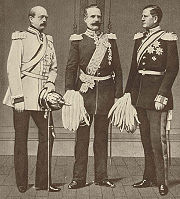
under Prussian leadership. After Napoleon conquered Prussia in 1806, one of the conditions of peace was that Prussia should reduce her army to no more than 42,000 men. In order that the country should not again be so easily conquered, the King of Prussia
King of Prussia
King of Prussia may refer to:* A ruler of the former German state of Prussia**List of rulers of Prussia* Place names** King of Prussia, Pennsylvania* Shopping Centers** King of Prussia Mall...
enrolled the permitted number of men for one year, then dismissed that group, and enrolled another of the same size, and so on. Thus, in the course of ten years, he was able to gather an army of 420,000 men who had at least one year of military training. The officers of the army were drawn almost entirely from among the land-owning nobility
Nobility
Nobility is a social class which possesses more acknowledged privileges or eminence than members of most other classes in a society, membership therein typically being hereditary. The privileges associated with nobility may constitute substantial advantages over or relative to non-nobles, or may be...
. The result was that there was gradually built up a large class of professional officers on the one hand, and a much larger class, the rank and file of the army, on the other. These enlisted men had become conditioned to obey implicitly all the commands of the officers, creating a class
Social class
Social classes are economic or cultural arrangements of groups in society. Class is an essential object of analysis for sociologists, political scientists, economists, anthropologists and social historians. In the social sciences, social class is often discussed in terms of 'social stratification'...
-based culture of deference
Deference
Deference is the condition of submitting to the espoused, legitimate influence of one's superior or superiors. Deference implies a yielding or submitting to the judgment of a recognized superior out of respect or reverence...
.
This system led to several consequences. Since the officer class also furnished most of the officials for the civil administration of the country, the interests of the army came to be considered as identical to the interests of the country as a whole. A second result was that the governing class desired to continue a system which gave them so much power over the common people, contributing to the continuing influence of the Junker
Junker
A Junker was a member of the landed nobility of Prussia and eastern Germany. These families were mostly part of the German Uradel and carried on the colonization and Christianization of the northeastern European territories during the medieval Ostsiedlung. The abbreviation of Junker is Jkr...
noble classes.
Militarism in Germany continued after World War I
World War I
World War I , which was predominantly called the World War or the Great War from its occurrence until 1939, and the First World War or World War I thereafter, was a major war centred in Europe that began on 28 July 1914 and lasted until 11 November 1918...
and the fall of the German monarchy. During the period of the Weimar Republic
Weimar Republic
The Weimar Republic is the name given by historians to the parliamentary republic established in 1919 in Germany to replace the imperial form of government...
(1919–1933), the Kapp Putsch
Kapp Putsch
The Kapp Putsch — or more accurately the Kapp-Lüttwitz Putsch — was a 1920 coup attempt during the German Revolution of 1918–1919 aimed at overthrowing the Weimar Republic...
, an attempted coup d'état
Coup d'état
A coup d'état state, literally: strike/blow of state)—also known as a coup, putsch, and overthrow—is the sudden, extrajudicial deposition of a government, usually by a small group of the existing state establishment—typically the military—to replace the deposed government with another body; either...
against the republican government, was launched by disaffected members of the armed forces. After this event, some of the more radical militarists and nationalists were subsumed into the Nazi Party, while more moderate elements of militarism declined. Nazi Germany
Nazi Germany
Nazi Germany , also known as the Third Reich , but officially called German Reich from 1933 to 1943 and Greater German Reich from 26 June 1943 onward, is the name commonly used to refer to the state of Germany from 1933 to 1945, when it was a totalitarian dictatorship ruled by...
was a strongly militarist state; after its fall in 1945, militarism in German culture was dramatically reduced as a backlash against the Nazi period.
The Federal Republic of Germany today maintains a large, modern military
Bundeswehr
The Bundeswehr consists of the unified armed forces of Germany and their civil administration and procurement authorities...
and has one of the highest defence budgets in the world. Contemporary opinions vary but Germans predominantly oppose unilateral military actions and are suspicious of all claims advocating them.
Japan
In parallel with 20th-century German militarism, Japanese militarism began with a series of events by which the military gained prominence in dictating Japan's affairs. This was evident in 15th-century Japan's Sengoku period or Age of Warring States, where powerful samuraiSamurai
is the term for the military nobility of pre-industrial Japan. According to translator William Scott Wilson: "In Chinese, the character 侍 was originally a verb meaning to wait upon or accompany a person in the upper ranks of society, and this is also true of the original term in Japanese, saburau...
warlords or shogun
Shogun
A was one of the hereditary military dictators of Japan from 1192 to 1867. In this period, the shoguns, or their shikken regents , were the de facto rulers of Japan though they were nominally appointed by the emperor...
played a significant role in Japanese politics. Japan's militarism is deeply rooted in the ancient samurai tradition, centuries before Japan's modernization. Even though a militarist philosophy was intrinsic to the shogunates, a nationalist
Japanese nationalism
encompasses a broad range of ideas and sentiments harbored by the Japanese people over the last two centuries regarding their native country, its cultural nature, political form and historical destiny...
style of militarism developed after the Meiji Restoration
Meiji Restoration
The , also known as the Meiji Ishin, Revolution, Reform or Renewal, was a chain of events that restored imperial rule to Japan in 1868...
, which restored the Emperor
Emperor of Japan
The Emperor of Japan is, according to the 1947 Constitution of Japan, "the symbol of the state and of the unity of the people." He is a ceremonial figurehead under a form of constitutional monarchy and is head of the Japanese Imperial Family with functions as head of state. He is also the highest...
to power and began the Empire of Japan
Empire of Japan
The Empire of Japan is the name of the state of Japan that existed from the Meiji Restoration on 3 January 1868 to the enactment of the post-World War II Constitution of...
. It is exemplified by the 1882 Imperial Rescript to Soldiers and Sailors
Imperial Rescript to Soldiers and Sailors
The was issued by Emperor Meiji of Japan on 4 January 1882.It was the most important document in the development of the Imperial Japanese Army and Imperial Japanese Navy.-Details:...
, which called for all members of the armed forces to have an absolute personal loyalty to the Emperor.
In the 20th century (approximately in the 1920s), two factors contributed both to the power of the military and chaos within its ranks. One was the Cabinet
Cabinet of Japan
The of Japan is the executive branch of the government of Japan. It consists of the Prime Minister and up to fourteen other members, called Ministers of State. The Prime Minister is designated by the Diet, and the remaining ministers are appointed and dismissed by the Prime Minister...
Law, which required the Imperial Japanese Army
Imperial Japanese Army
-Foundation:During the Meiji Restoration, the military forces loyal to the Emperor were samurai drawn primarily from the loyalist feudal domains of Satsuma and Chōshū...
(IJA) and Imperial Japanese Navy
Imperial Japanese Navy
The Imperial Japanese Navy was the navy of the Empire of Japan from 1869 until 1947, when it was dissolved following Japan's constitutional renunciation of the use of force as a means of settling international disputes...
(IJN) to nominate servinet could be formed. This essentially gave the military veto power over the formation of any Cabinet in the ostensibly parliamentary country. Another factor was gekokujo
Gekokujo
is a Japanese term variously translated as the lower rules the higher or the low overcomes the high. The phenomenon became prevalent during the Warring States period , starting with the Ōnin War when the power of the Muromachi Shogunate ended in factional strife and the burning of Kyoto...
, or institutionalized disobedience
Insubordination
Insubordination is the act of willfully disobeying an authority. Refusing to perform an action that is unethical or illegal is not insubordination; neither is refusing to perform an action that is not within the scope of authority of the person issuing the order.Insubordination is typically a...
by junior officers. It was not uncommon for radical junior officers to press their goals, to the extent of assassinating their seniors. In 1936, this phenomenon resulted in the February 26 Incident
February 26 Incident
The was an attempted coup d'état in Japan, from February 26 to 29, 1936 carried out by 1,483 troops of the Imperial Japanese Army. Several leading politicians were killed and the center of Tokyo was briefly occupied by the rebelling troops...
, in which junior officers attempted a coup d'état
Coup d'état
A coup d'état state, literally: strike/blow of state)—also known as a coup, putsch, and overthrow—is the sudden, extrajudicial deposition of a government, usually by a small group of the existing state establishment—typically the military—to replace the deposed government with another body; either...
and killed leading members of the Japanese government. The rebellion enraged Emperor Hirohito
Hirohito
, posthumously in Japan officially called Emperor Shōwa or , was the 124th Emperor of Japan according to the traditional order, reigning from December 25, 1926, until his death in 1989. Although better known outside of Japan by his personal name Hirohito, in Japan he is now referred to...
and he ordered its suppression, which was successfully carried out by loyal members of the military.
In the 1930s, the Great Depression
Great Depression
The Great Depression was a severe worldwide economic depression in the decade preceding World War II. The timing of the Great Depression varied across nations, but in most countries it started in about 1929 and lasted until the late 1930s or early 1940s...
wrecked Japan's economy and gave radical elements within the Japanese military the chance to realize their ambitions of conquering all of Asia
Asia
Asia is the world's largest and most populous continent, located primarily in the eastern and northern hemispheres. It covers 8.7% of the Earth's total surface area and with approximately 3.879 billion people, it hosts 60% of the world's current human population...
. In 1931, the Kwantung Army (a Japanese military force stationed in Manchuria
Manchuria
Manchuria is a historical name given to a large geographic region in northeast Asia. Depending on the definition of its extent, Manchuria usually falls entirely within the People's Republic of China, or is sometimes divided between China and Russia. The region is commonly referred to as Northeast...
) staged the Mukden Incident
Mukden Incident
The Mukden Incident, also known as the Manchurian Incident, was a staged event that was engineered by Japanese military personnel as a pretext for invading the northern part of China known as Manchuria in 1931....
, which sparked the Invasion of Manchuria
Invasion of Manchuria
The Japanese invasion of Manchuria began on September 19, 1931, when Manchuria was invaded by the Kwantung Army of the Empire of Japan immediately following the Mukden Incident...
and its transformation into the Japanese puppet state of Manchukuo
Manchukuo
Manchukuo or Manshū-koku was a puppet state in Manchuria and eastern Inner Mongolia, governed under a form of constitutional monarchy. The region was the historical homeland of the Manchus, who founded the Qing Empire in China...
. Six years later, the Marco Polo Bridge Incident
Marco Polo Bridge Incident
The Marco Polo Bridge Incident was a battle between the Republic of China's National Revolutionary Army and the Imperial Japanese Army, often used as the marker for the start of the Second Sino-Japanese War .The eleven-arch granite bridge, Lugouqiao, is an architecturally significant structure,...
outside Peking
Beijing
Beijing , also known as Peking , is the capital of the People's Republic of China and one of the most populous cities in the world, with a population of 19,612,368 as of 2010. The city is the country's political, cultural, and educational center, and home to the headquarters for most of China's...
sparked the Second Sino-Japanese War
Second Sino-Japanese War
The Second Sino-Japanese War was a military conflict fought primarily between the Republic of China and the Empire of Japan. From 1937 to 1941, China fought Japan with some economic help from Germany , the Soviet Union and the United States...
(1937-1945). Japanese troops streamed into China, conquering Peking, Shanghai
Battle of Shanghai
The Battle of Shanghai, known in Chinese as Battle of Songhu, was the first of the twenty-two major engagements fought between the National Revolutionary Army of the Republic of China and the Imperial Japanese Army of the Empire of Japan during the Second Sino-Japanese War...
, and the national capital of Nanjing
Battle of Nanjing
The Battle of Nanking began after the fall of Shanghai on October 9, 1937, and ended with the fall of the capital city of Nanking on December 13, 1937 to Japanese troops, a few days after the Republic of China Government had evacuated the city and relocated to Wuhan...
; the last conquest was followed by the Nanjing Massacre. In 1940, Japan entered into an alliance
Tripartite Pact
The Tripartite Pact, also the Three-Power Pact, Axis Pact, Three-way Pact or Tripartite Treaty was a pact signed in Berlin, Germany on September 27, 1940, which established the Axis Powers of World War II...
with Nazi Germany
Nazi Germany
Nazi Germany , also known as the Third Reich , but officially called German Reich from 1933 to 1943 and Greater German Reich from 26 June 1943 onward, is the name commonly used to refer to the state of Germany from 1933 to 1945, when it was a totalitarian dictatorship ruled by...
and Fascist Italy, two similarly militaristic states in Europe
Europe
Europe is, by convention, one of the world's seven continents. Comprising the westernmost peninsula of Eurasia, Europe is generally 'divided' from Asia to its east by the watershed divides of the Ural and Caucasus Mountains, the Ural River, the Caspian and Black Seas, and the waterways connecting...
, and advanced out of China and into Southeast Asia
Southeast Asia
Southeast Asia, South-East Asia, South East Asia or Southeastern Asia is a subregion of Asia, consisting of the countries that are geographically south of China, east of India, west of New Guinea and north of Australia. The region lies on the intersection of geological plates, with heavy seismic...
. This brought about the intervention of the United States
United States
The United States of America is a federal constitutional republic comprising fifty states and a federal district...
, which embargoed all petroleum
Petroleum
Petroleum or crude oil is a naturally occurring, flammable liquid consisting of a complex mixture of hydrocarbons of various molecular weights and other liquid organic compounds, that are found in geologic formations beneath the Earth's surface. Petroleum is recovered mostly through oil drilling...
to Japan. The embargo eventually precipitated the Attack on Pearl Harbor
Attack on Pearl Harbor
The attack on Pearl Harbor was a surprise military strike conducted by the Imperial Japanese Navy against the United States naval base at Pearl Harbor, Hawaii, on the morning of December 7, 1941...
and the entry of the U.S. into World War II
World War II
World War II, or the Second World War , was a global conflict lasting from 1939 to 1945, involving most of the world's nations—including all of the great powers—eventually forming two opposing military alliances: the Allies and the Axis...
.
In 1945, Japan surrendered to the United States, beginning the Occupation of Japan and the purging of all militarist influences from Japanese society and politics. In 1947, the new Constitution of Japan
Constitution of Japan
The is the fundamental law of Japan. It was enacted on 3 May, 1947 as a new constitution for postwar Japan.-Outline:The constitution provides for a parliamentary system of government and guarantees certain fundamental rights...
supplanted the Meiji Constitution
Meiji Constitution
The ', known informally as the ', was the organic law of the Japanese empire, in force from November 29, 1890 until May 2, 1947.-Outline:...
as the fundamental law of the country, replacing the rule of the Emperor with parliamentary government. With this event, the Empire of Japan officially came to an end and the modern State of Japan was founded.
United States
In the late nineteenth and early twentieth centuries political and military leaders reformed the US federal government to establish a stronger central government than had ever previously existed for the purpose of enabling the nation to pursue an imperial policy in the Pacific and in the Caribbean and economic militarismEconomic militarism
Economic militarism is a term used to describe the ideology surrounding the use of military expenditure to prop up an economy, or the use of military power to gain control or access to territory or other economic resources.-Brief history of the term:...
to support the development of the new industrial economy. This reform was the result of a conflict between Neo-Hamiltonian Republicans and Jeffersonian-Jacksonian
Jacksonian democracy
Jacksonian democracy is the political movement toward greater democracy for the common man typified by American politician Andrew Jackson and his supporters. Jackson's policies followed the era of Jeffersonian democracy which dominated the previous political era. The Democratic-Republican Party of...
Democrats over the proper administration of the state and direction of its foreign policy. The conflict pitted proponents of professionalism, based on business management principles, against proponents favoring more local control in the hands of laymen and political appointees.
After the end of the American Civil War
American Civil War
The American Civil War was a civil war fought in the United States of America. In response to the election of Abraham Lincoln as President of the United States, 11 southern slave states declared their secession from the United States and formed the Confederate States of America ; the other 25...
the national army fell into disrepair. Reforms based on various European states including Imperial Britain, Imperial Germany, and Switzerland were made so that it would become responsive to control from the central government, prepared for future conflicts, and develop refined command and support structures; it led to the development of professional military thinkers and cadre.
During this time the intellectual ideas of Social Darwinism
Social Darwinism
Social Darwinism is a term commonly used for theories of society that emerged in England and the United States in the 1870s, seeking to apply the principles of Darwinian evolution to sociology and politics...
propelled the development of an American overseas expansion in the Pacific and Caribbean. This required modifications for a more efficient central government due to the added administration requirements.
The enlargement of the U.S. Army
United States Army
The United States Army is the main branch of the United States Armed Forces responsible for land-based military operations. It is the largest and oldest established branch of the U.S. military, and is one of seven U.S. uniformed services...
for the Spanish-American War
Spanish-American War
The Spanish–American War was a conflict in 1898 between Spain and the United States, effectively the result of American intervention in the ongoing Cuban War of Independence...
was considered essential to the occupation and control of the new territories acquired from Spain in its defeat (Guam
Guam
Guam is an organized, unincorporated territory of the United States located in the western Pacific Ocean. It is one of five U.S. territories with an established civilian government. Guam is listed as one of 16 Non-Self-Governing Territories by the Special Committee on Decolonization of the United...
, the Philippines
Philippines
The Philippines , officially known as the Republic of the Philippines , is a country in Southeast Asia in the western Pacific Ocean. To its north across the Luzon Strait lies Taiwan. West across the South China Sea sits Vietnam...
, Puerto Rico
Puerto Rico
Puerto Rico , officially the Commonwealth of Puerto Rico , is an unincorporated territory of the United States, located in the northeastern Caribbean, east of the Dominican Republic and west of both the United States Virgin Islands and the British Virgin Islands.Puerto Rico comprises an...
, and Cuba
Cuba
The Republic of Cuba is an island nation in the Caribbean. The nation of Cuba consists of the main island of Cuba, the Isla de la Juventud, and several archipelagos. Havana is the largest city in Cuba and the country's capital. Santiago de Cuba is the second largest city...
). The previous limit by legislation of 24 000 men was expanded to 60 000 regulars in the new army bill on 2 February 1901, with allowance at that time for expansion to 80 000 regulars by presidential discretion at times of national emergency.
Again, U.S. forces were enlarged immensely for World War I
World War I
World War I , which was predominantly called the World War or the Great War from its occurrence until 1939, and the First World War or World War I thereafter, was a major war centred in Europe that began on 28 July 1914 and lasted until 11 November 1918...
. Officers such as George S. Patton
George S. Patton
George Smith Patton, Jr. was a United States Army officer best known for his leadership while commanding corps and armies as a general during World War II. He was also well known for his eccentricity and controversial outspokenness.Patton was commissioned in the U.S. Army after his graduation from...
were permanent captains at the start of the war and received temporary promotions to colonel.
Between the first and second world wars, the US Marine Corps engaged in questionable activities in the Banana Wars in Latin America. Retired Major General Smedley Butler
Smedley Butler
Smedley Darlington Butler was a Major General in the U.S. Marine Corps, an outspoken critic of U.S. military adventurism, and at the time of his death the most decorated Marine in U.S...
, at the time of his death the most decorated Marine, spoke strongly against a trend to what he considered trends toward fascism and militarism. The Latin America
Latin America
Latin America is a region of the Americas where Romance languages – particularly Spanish and Portuguese, and variably French – are primarily spoken. Latin America has an area of approximately 21,069,500 km² , almost 3.9% of the Earth's surface or 14.1% of its land surface area...
n expeditions ended with Franklin D. Roosevelt
Franklin D. Roosevelt
Franklin Delano Roosevelt , also known by his initials, FDR, was the 32nd President of the United States and a central figure in world events during the mid-20th century, leading the United States during a time of worldwide economic crisis and world war...
's Good Neighbor Policy
Good Neighbor policy
The Good Neighbor policy was the foreign policy of the administration of United States President Franklin Roosevelt toward the countries of Latin America. Its main principle was that of non-intervention and non-interference in the domestic affairs of Latin America...
of 1934.
Butler briefed Congress on what he described as a business plot
Business Plot
The Business Plot was an alleged political conspiracy in 1933. Retired Marine Corps Major General Smedley Butler claimed that wealthy businessmen were plotting to create a fascist veterans' organization and use it in a coup d’état to overthrow United States President Franklin D...
for a military coup, for which he had been suggested as leader; the matter was partially corroborated, but the real threat has been disputed. There is little evidence that any serious military coups were planned in the US. During the American Civil War
American Civil War
The American Civil War was a civil war fought in the United States of America. In response to the election of Abraham Lincoln as President of the United States, 11 southern slave states declared their secession from the United States and formed the Confederate States of America ; the other 25...
those officers who were sympathetic to the Confederacy
Confederate States of America
The Confederate States of America was a government set up from 1861 to 1865 by 11 Southern slave states of the United States of America that had declared their secession from the U.S...
resigned their commissions rather than mutiny.
After World War II
World War II
World War II, or the Second World War , was a global conflict lasting from 1939 to 1945, involving most of the world's nations—including all of the great powers—eventually forming two opposing military alliances: the Allies and the Axis...
, there were major cutbacks, such that units responding early in the Korean War, under United Nations
United Nations
The United Nations is an international organization whose stated aims are facilitating cooperation in international law, international security, economic development, social progress, human rights, and achievement of world peace...
authority (e.g., Task Force Smith) were unprepared, resulting in catastrophic performance. It should be noted that when Harry S. Truman
Harry S. Truman
Harry S. Truman was the 33rd President of the United States . As President Franklin D. Roosevelt's third vice president and the 34th Vice President of the United States , he succeeded to the presidency on April 12, 1945, when President Roosevelt died less than three months after beginning his...
fired Douglas MacArthur
Douglas MacArthur
General of the Army Douglas MacArthur was an American general and field marshal of the Philippine Army. He was a Chief of Staff of the United States Army during the 1930s and played a prominent role in the Pacific theater during World War II. He received the Medal of Honor for his service in the...
, the tradition of civilian control held and MacArthur left without any hint of military coup.
Serious permanent buildups were a result of the Cold War
Cold War
The Cold War was the continuing state from roughly 1946 to 1991 of political conflict, military tension, proxy wars, and economic competition between the Communist World—primarily the Soviet Union and its satellite states and allies—and the powers of the Western world, primarily the United States...
. Dwight D. Eisenhower
Dwight D. Eisenhower
Dwight David "Ike" Eisenhower was the 34th President of the United States, from 1953 until 1961. He was a five-star general in the United States Army...
, a retired top military commander elected as a civilian President, warned of the development of a military-industrial complex
Military-industrial complex
Military–industrial complex , or Military–industrial-congressional complex is a concept commonly used to refer to policy and monetary relationships between legislators, national armed forces, and the industrial sector that supports them...
, more complex than many traditional ideas of militarism. In the Cold War, there emerged many civilian academics and industrial researchers, such as Henry Kissinger
Henry Kissinger
Heinz Alfred "Henry" Kissinger is a German-born American academic, political scientist, diplomat, and businessman. He is a recipient of the Nobel Peace Prize. He served as National Security Advisor and later concurrently as Secretary of State in the administrations of Presidents Richard Nixon and...
and Herman Kahn
Herman Kahn
Herman Kahn was one of the preeminent futurists of the latter third of the twentieth century. In the early 1970s he predicted the rise of Japan as a major world power. He was a founder of the Hudson Institute think tank and originally came to prominence as a military strategist and systems...
, who had significant input into the use of military force.
It has been argued that the United States has shifted to a state of neomilitarism since the end of the Vietnam War. This form of militarism is distinguished by the reliance on a relatively small number of volunteer fighters; heavy reliance on complex technologies; and the rationalization and expansion of government advertising and recruitment programs designed to promote military service.
The Military budget of the United States
Military budget of the United States
The military budget is that portion of the United States discretionary federal budget that is allocated to the Department of Defense, or more broadly, the portion of the budget that goes to any defense-related expenditures...
for 2008 was $740,800,000,000. http://www.gao.gov/financial/fy2008/08stmt.pdf
India
Rise of militarim in IndiaIndia
India , officially the Republic of India , is a country in South Asia. It is the seventh-largest country by geographical area, the second-most populous country with over 1.2 billion people, and the most populous democracy in the world...
dates back to the British Raj
British Raj
British Raj was the British rule in the Indian subcontinent between 1858 and 1947; The term can also refer to the period of dominion...
with the rise of several Indian independence movement
Indian independence movement
The term Indian independence movement encompasses a wide area of political organisations, philosophies, and movements which had the common aim of ending first British East India Company rule, and then British imperial authority, in parts of South Asia...
organizations such as Indian National Army
Indian National Army
The Indian National Army or Azad Hind Fauj was an armed force formed by Indian nationalists in 1942 in Southeast Asia during World War II. The aim of the army was to overthrow the British Raj in colonial India, with Japanese assistance...
led by Subhash Chandra Bose
Subhash Chandra Bose
Subhas Chandra Bose known by name Netaji was an Indian revolutionary who led an Indian national political and military force against Britain and the Western powers during World War II. Bose was one of the most prominent leaders in the Indian independence movement and is a legendary figure in...
. The INA played a crucial role on pressuring the British Raj after it occupied Andaman and Nicobar Islands with the help of Imperial Japan but the movement lost momentum due to lack of support by Indian National Congress
Indian National Congress
The Indian National Congress is one of the two major political parties in India, the other being the Bharatiya Janata Party. It is the largest and one of the oldest democratic political parties in the world. The party's modern liberal platform is largely considered center-left in the Indian...
, Battle of Imphal
Battle of Imphal
The Battle of Imphal took place in the region around the city of Imphal, the capital of the state of Manipur in North-East India from March until July 1944. Japanese armies attempted to destroy the Allied forces at Imphal and invade India, but were driven back into Burma with heavy losses...
and Bose's sudden death.
After India gained independence in 1947, tensions with neighboring Pakistan
Indo-Pakistani relations
Relations between India and Pakistan have been strained by a number of historical and political issues, and are defined by the violent partition of British India in 1947, the Kashmir dispute and the numerous military conflicts fought between the two nations...
over Kashmir dispute also led to rise militarism in India which also saw a boost during the various events that led to the political integration of India
Political integration of India
At the time of Indian independence, India was divided into two sets of territories, the first being the territories of "British India", which were under the direct control of the India Office in London and the Governor-General of India, and the second being the "Princely states", the territories...
. After the Sino-Indian War
Sino-Indian War
The Sino-Indian War , also known as the Sino-Indian Border Conflict , was a war between China and India that occurred in 1962. A disputed Himalayan border was the main pretext for war, but other issues played a role. There had been a series of violent border incidents after the 1959 Tibetan...
in 1962, India dramatically expanded its military prowess which helped India emerge victorious during the Indo-Pakistani War of 1971
Indo-Pakistani War of 1971
The Indo-Pakistani War of 1971 was a military conflict between India and Pakistan. Indian, Bangladeshi and international sources consider the beginning of the war to be Operation Chengiz Khan, Pakistan's December 3, 1971 pre-emptive strike on 11 Indian airbases...
. The rise of Kashmiri insurgency and recent events such as the Kargil War
Kargil War
The Kargil War ,, also known as the Kargil conflict, was an armed conflict between India and Pakistan that took place between May and July 1999 in the Kargil district of Kashmir and elsewhere along the Line of Control...
assured that the Indian government remained committed to military expansion.
Israel
Israel's many security difficulties since the establishment of the StateDeclaration of the Establishment of the State of Israel
The Israeli Declaration of Independence , made on 14 May 1948 , the day before the British Mandate was due to expire, was the announcement by David Ben-Gurion, the Executive Head of the World Zionist Organization and chairman of the Jewish Agency for Palestine, that the new Jewish state named the...
have led to a prominence of security in politics and civil society
Civil society
Civil society is composed of the totality of many voluntary social relationships, civic and social organizations, and institutions that form the basis of a functioning society, as distinct from the force-backed structures of a state , the commercial institutions of the market, and private criminal...
, resulting in many of Israel's top politician
Politics of Israel
The Israeli system of government is based on parliamentary democracy. The Prime Minister of Israel is the head of government and leader of a multi-party system. Executive power is exercised by the government. Legislative power is vested in the Knesset. The Judiciary is independent of the executive...
s being former high ranking military officials
Israel Defense Forces
The Israel Defense Forces , commonly known in Israel by the Hebrew acronym Tzahal , are the military forces of the State of Israel. They consist of the ground forces, air force and navy. It is the sole military wing of the Israeli security forces, and has no civilian jurisdiction within Israel...
(partial list: Yitzhak Rabin
Yitzhak Rabin
' was an Israeli politician, statesman and general. He was the fifth Prime Minister of Israel, serving two terms in office, 1974–77 and 1992 until his assassination in 1995....
, Ariel Sharon
Ariel Sharon
Ariel Sharon is an Israeli statesman and retired general, who served as Israel’s 11th Prime Minister. He has been in a permanent vegetative state since suffering a stroke on 4 January 2006....
, Ezer Weizman
Ezer Weizman
' was the seventh President of Israel, first elected in 1993 and re-elected in 1998. Before the presidency, Weizman was commander of the Israeli Air Force and Minister of Defense.-Biography:...
, Ehud Barak
Ehud Barak
Ehud Barak is an Israeli politician who served as Prime Minister from 1999 until 2001. He was leader of the Labor Party until January 2011 and holds the posts of Minister of Defense and Deputy Prime Minister in Binyamin Netanyahu's government....
, Shaul Mofaz
Shaul Mofaz
Lt. General Shaul Mofaz is an Israeli politician who serves as the Chairman of the Foreign Affairs And Defense Committee at the Knesset...
, Moshe Dayan
Moshe Dayan
Moshe Dayan was an Israeli military leader and politician. The fourth Chief of Staff of the Israel Defense Forces , he became a fighting symbol to the world of the new State of Israel...
, Yitzhak Mordechai
Yitzhak Mordechai
Yitzhak Mordechai is an Israeli former general and politician. He served as a member of the Knesset between 1996 and 2001, and as Minister of Defense and Minister of Transport. He retired from political life after being indicted for sexual assaults during his military service and later...
, Amram Mitzna
Amram Mitzna
Amram Mitzna is an Israeli politician and former general. He is the acting mayor of Yeruham, the former mayor of Haifa and led the Labour Party from 2002 to 2003.-Youth, studies and military service:...
and Menachem Begin
Menachem Begin
' was a politician, founder of Likud and the sixth Prime Minister of the State of Israel. Before independence, he was the leader of the Zionist militant group Irgun, the Revisionist breakaway from the larger Jewish paramilitary organization Haganah. He proclaimed a revolt, on 1 February 1944,...
).
External links
- Military Expenditure by Total, Per Capita, and Percentage of GDP - Nationmaster.com