
All Topics  
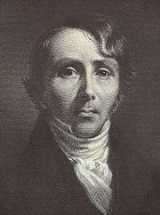
William Ellery Channing


   Email Print
   Bookmark   Link


William Ellery Channing


This article is about Dr. William Ellery Channing, the Unitarian theologian. For the Transcendentalist poet, see William Ellery Channing (poet).
Dr. William Ellery Channing (April 7, 1780 – October 2, 1842) was the foremost Unitarian
Unitarianism

Unitarianism as a theology is the belief in the single personality of God, in contrast to the doctrine of the Trinity . It is the philosophy upon which the modern Unitarian movement was based, and, according to its proponents, is the Early Christianity of Christianity....
 preacher in the United States
United States

The United States of America is a Federal government constitutional republic comprising U.S. state and a federal district. The country is situated mostly in central North America, where its Contiguous United States and Washington, D.C., the Capital districts and territories, lie between the Pacific Ocean and Atlantic Oceans, Borders of the U...
 in the early nineteenth century and, along with Andrews Norton
Andrews Norton

Andrews Norton was an United States preacher and theologian. Along with William Ellery Channing, he was the leader of mainstream Unitarianism of the early and middle 19th century....
, one of Unitarianism's leading theologians. He was known for his articulate and impassioned sermons and public speeches, and as a prominent thinker in the liberal theology of the day.


Discussion
Ask a question about 'William Ellery Channing'
Start a new discussion about 'William Ellery Channing'
Answer questions from other users
Full Discussion Forum


Quotations


The office of government is not to confer happiness, but to give men opportunity to work out happiness for themselves.

Review of Sir Walter Scott, The Life of Napoleon Bonaparte 1827. From the Christian Examiner (September and October 1827)

There are seasons, in human affairs, of inward and outward revolution, when new depths seem to be broken up in the soul, when new wants are unfolded in multitudes, and a new and undefined good is thirsted for. There are periods when...to dare, is the highest wisdom.

The Union (1829)

The mind, in proportion as it is cut off from free communication with nature, with revelation, with God, with itself, loses its life, just as the body droops when debarred from the air and the cheering light from heaven.

Remarks on the Character and Writings of Fénelon (1843)

Another powerful principle of our nature, which is the spring of war, is the passion for superiority, for triumph, for power. The human mind is aspiring, impatient of inferiority, and eager for preeminence and control.


Encyclopedia


This article is about Dr. William Ellery Channing, the Unitarian theologian. For the Transcendentalist poet, see William Ellery Channing (poet).
Dr. William Ellery Channing (April 7, 1780 – October 2, 1842) was the foremost Unitarian
Unitarianism

Unitarianism as a theology is the belief in the single personality of God, in contrast to the doctrine of the Trinity . It is the philosophy upon which the modern Unitarian movement was based, and, according to its proponents, is the Early Christianity of Christianity....
 preacher in the United States
United States

The United States of America is a Federal government constitutional republic comprising U.S. state and a federal district. The country is situated mostly in central North America, where its Contiguous United States and Washington, D.C., the Capital districts and territories, lie between the Pacific Ocean and Atlantic Oceans, Borders of the U...
 in the early nineteenth century and, along with Andrews Norton
Andrews Norton

Andrews Norton was an United States preacher and theologian. Along with William Ellery Channing, he was the leader of mainstream Unitarianism of the early and middle 19th century....
, one of Unitarianism's leading theologians. He was known for his articulate and impassioned sermons and public speeches, and as a prominent thinker in the liberal theology of the day. Dr. Channing's religion and thought were among the chief influences on the New England
New England

New England is a region of the United States located in the northeastern corner of the country, bounded by the Atlantic Ocean, Canada and New York State, and consisting of the modern U.S....
 Transcendentalists, though he never countenanced their views, which he saw as extreme.

Life and work

Channing was born in Newport, Rhode Island
Newport, Rhode Island

Newport is a city on Aquidneck Island in Newport County, Rhode Island, Rhode Island, United States, about 30 miles south of Providence, Rhode Island....
, a grandson of William Ellery
William Ellery

William Ellery , was a signer of the United States United States Declaration of Independence as a representative of Rhode Island....
, a signer of the United States Declaration of Independence
United States Declaration of Independence

The United States Declaration of Independence is a statement adopted by the Second Continental Congress on July 4, 1776, which announced that the Thirteen Colonies then at war with Kingdom of Great Britain were now independent states, and thus no longer a part of the British Empire....
. Channing became a New England
New England

New England is a region of the United States located in the northeastern corner of the country, bounded by the Atlantic Ocean, Canada and New York State, and consisting of the modern U.S....
 liberal
Liberalism

Liberalism is a broad class of political philosophy that considers individualism liberty and equality to be the most important political goals....
, rejecting the Calvinist
Calvinism

Calvinism is a theology system and an approach to the Christian life that emphasizes the rule of God over all things. It was developed by several theologians, but it bears the name of the French Protestant Reformation John Calvin because of his prominent influence on it and because of his role in the confessional and ecclesiastical debates t...
 doctrines of total depravity and divine election.

He graduated from Harvard in 1798. Troubled both by post-revolutionary
French Revolution

The French Revolution was a period of political and social upheaval and radical change in the history of France, during which the French governmental structure, previously an absolute monarchy with feudalism for the aristocracy and Roman Catholic Church clergy, underwent radical change to forms based on Age of Enlightenment principles of cit...
 French radicalism and by American Calvinist orthodoxy, Channing preferred a gentle, loving relationship with God. However, the struggle continued through two years during which Channing lived in Richmond, working as a tutor. He came to his definitive faith only through much spiritual turmoil and difficulty.

In 1803 Channing was called as pastor of what later became known as the Arlington Street Church (Boston)
Arlington Street Church (Boston)

Arlington Street Church is a Unitarian Universalist church located in Boston, Massachusetts. Founded in 1729 as the "Church of the Presbyterian Strangers", it became independent in 1787, taking on a Congregationalist church governance model....
, where he remained for the rest of his life. He lived through the increasing tension between religious liberals and conservatives and took a moderate position, rejecting the extremes of both groups.

Nevertheless he became the primary spokesman and interpreter of Unitarianism
Unitarianism

Unitarianism as a theology is the belief in the single personality of God, in contrast to the doctrine of the Trinity . It is the philosophy upon which the modern Unitarian movement was based, and, according to its proponents, is the Early Christianity of Christianity....
 when he preached the ordination sermon of Jared Sparks
Jared Sparks

Jared Sparks was an United States historian, educator, and Unitarianism minister. He served as President of Harvard University of Harvard University from 1849 to 1853....
 in Baltimore in 1819; it was entitled "Unitarian Christianity". In that address he explicated the distinctive tenets of the Unitarian movement, only one of which was the rejection of the Trinity
Trinity

In Christianity doctrine, the Trinity is the unity of God the Father, God the Son, and Holy Spirit as three persons in monotheism. The doctrine states that God is the Triune God, existing as three persons, or in the Greek hypostasis , but one being....
. Other important tenets were the belief in human goodness and the subjection of theological ideas to the light of reason
Reason

Reason may refer to Mind#Mental faculties that consciously create explanations in order to judge, decide, solve problems, generalize, and give examples, among other activities....
. In 1828 he gave another famous ordination sermon, entitled "Likeness to God". The idea of the human potential to be like God, which Channing advocated as grounded firmly in scripture, was seen as heretical by the Calvinist religious establishment of his day. It is in this address which Channing first advocates the possibility for revelation through reason rather than solely from scripture.

Later years

In later years Channing addressed the topic of slavery
Slavery

Slavery is a form of forced labor where a person is compelled to Labor for another . Slaves are held against their will from the time of their capture, purchase, or birth, and are deprived of the right to leave, to refuse to work, or to receive Remuneration in return for their labor....
, although he was never an ardent abolitionist. In 1835 Channing wrote the book entitled, " SLAVERY," James Munroe and Company, publisher. Channing, however, has been described as a "romantic racist" in Black Abolitionism: A Quest for Human Dignity by Beverly Eileen Mitchell (133-38). He held a common American belief about the inferiority of African slaves and held a belief that once freed, Africans would need overseers. The overseers (largely former slave masters) were necessary because the slaves would lapse into laziness. Furthermore, he did not join the abolitionist movement because he did not agree with their way of conducting themselves, and he felt that voluntary associations limited a person's autonomy. Therefore, he often chose to remain separate from organizations and reform movements. This middle position characterized his attitude about most questions, although his eloquence and strong influence on the religious world incurred the enmity of many extremists. Channing had an enormous influence over the religious (and social) life of New England, and America, in the nineteenth century.

Channing died in Old Bennington, Vermont
Old Bennington, Vermont

Old Bennington is a village in Bennington County, Vermont, Vermont, United States. It is located entirely within the Bennington, Vermont. As of the 2000 United States Census, the village had a population of 232....
, where a cenotaph is placed in his memory. He is buried in Mount Auburn Cemetery
Mount Auburn Cemetery

Founded in 1831 as "America's first garden cemetery", or the first "rural cemetery", Mount Auburn Cemetery is an Elysium where, traditionally, chaste classical monuments were set in rolling landscaped terrain....
, Cambridge, Massachusetts
Cambridge, Massachusetts

Cambridge is a city in the Greater Boston area of Massachusetts, United States. It was named in honor of the University of Cambridge in England....
. Statues of Channing are located on the edge of the Boston Public Garden
Boston Public Garden

The Public Garden, also known as Boston Public Garden, is a large park located in the heart of Boston, Massachusetts, Massachusetts, adjacent to the Boston Common ....
, across the street from the Arlington Street Church that he served, and facing , built in Newport, Rhode Island
Newport, Rhode Island

Newport is a city on Aquidneck Island in Newport County, Rhode Island, Rhode Island, United States, about 30 miles south of Providence, Rhode Island....
 in 1880 to commemorate the 100th anniversary of his birth.

Two of Dr. Channing's nephews were prominent Transcendentalists:
  • William Ellery Channing (poet) (1818–1901), usually known as Ellery Channing, was the son of his brother Walter Channing (1786–1876, a Boston doctor);
  • William Henry Channing
    William Henry Channing

    William Henry Channing was an United States Unitarian clergyman, writer and philosopher....
     was the son of his brother Francis Dana Channing.


In 1880, a younger Unitarian minister in Newport, Charles Timothy Brooks
Charles Timothy Brooks

Charles Timothy Brooks, , was a noted United States translator of German language works, a poet, Transcendentalism and a Unitarianism pastor.Born in Salem, Massachusetts, Massachusetts, he was graduated at Harvard in 1832, then studied theology and in 1835 began to preach in Nahant, Massachusetts....
, published a biography, William Ellery Channing, A Centennial Memory.

External links

  • Channing biography at the Unitarian Universalist Association
  • Online works by Channing, including "Self-Culture," and "Likeness to God."
  • Channing article from the 1911 Encyclopaedia Britannica.
  • E-texts of Channing's collected works.
  • An image of Channing.
  • Channing Memorial Church, Newport, Rhode Island.