

Conscientious objector

Encyclopedia
A conscientious objector (CO) is an "individual who has claimed the right to refuse to perform military service" on the grounds of freedom of thought, conscience, and/or religion.
In some countries, conscientious objectors are assigned to an alternative civilian service
as a substitute for conscription or military service. Some conscientious objectors consider themselves pacifist
, non-interventionist, non-resistant
, or antimilitarist.
The international definition of conscientious objection officially broadened on March 8, 1995 when the United Nations Commission on Human Rights
resolution 1995/83 stated that "persons performing military service should not be excluded from the right to have conscientious objections to military service." That definition was re-affirmed in 1998, when the United Nations
Office of the High Commissioner for Human Rights document called "Conscientious objection to military service, United Nations Commission on Human Rights
resolution 1998/77" officially recognized that "persons [already] performing military service may develop conscientious objections."
Conscientious objection and doing civilian service (i.e. civilian tasks as an alternative to compulsory military service) in Germany grew into a veritable institution, especially in the health service. The suspension of conscription in Germany in 2011 is therefore reported to have caused problems for "caring" activities previously undertaken by objectors doing civilian service. Some conscientious objectors served as smokejumper
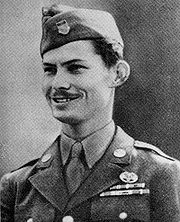
s and aides in mental institutions in the U.S. during World War II and the Korean War.
in Article 18 of the Universal Declaration of Human Rights
. It reads: "Everyone has the right to freedom of thought, conscience and religion; this right includes freedom to change his religion or belief, and freedom, either alone or in community with others and in public or private, to manifest his religion or belief in teaching, practice, worship and observance." The proclamation was ratified during the General Assembly on 10 December 1948 by a vote of 48 in favour, 0 against, with 8 abstentions.
 In 1974, the Assistant Secretary-General of the United Nations, Sean MacBride
said, in his Nobel Lecture, "To the rights enshrined in the Universal Declaration of Human Rights
one more might, with relevance, be added. It is 'The Right to Refuse to Kill.'"
In 1976, the United Nations
treaty
the International Covenant on Civil and Political Rights
entered into force
. It was based on the Universal Declaration of Human Rights
, and was originally created in 1966. Nations that have signed this treaty are bound by it. Its Article 18 begins: "Everyone shall have the right to freedom of thought, conscience and religion. …"
However, the International Covenant on Civil and Political Rights
left the issue of conscientious objection inexplicit, as we see in this quote from War Resisters International: "Article 18 of the Covenant does put some limits on the right [to freedom of thought, conscience and religion], stating that [its] manifestations must not infringe on public safety, order, health or morals. Some states argue that such limitations [on the right to freedom of thought, conscience and religion] would [derivatively] permit them to make conscientious objection during time of war a threat to public safety, or mass conscientious objection a disruption to public order,...[Some states] even [argue] that it is a 'moral' duty to serve the state in its military."
On July 30, 1993, explicit clarification of the International Covenant on Civil and Political Rights
Article 18 was made in the United Nations
Human Rights Committee
general comment 22, Paragraph 11: "The Covenant does not explicitly refer to a right to conscientious objection, but the Committee believes that such a right can be derived from article 18, inasmuch as the obligation to use lethal force may seriously conflict with the freedom of conscience and the right to manifest one's religion or belief." In 2006, the Committee has found for the first time a right to conscientious objection under article 18, although not unanimously.
In 1997, an announcement of Amnesty International
's forthcoming campaign and briefing for the UN Commission on Human Rights included this quote: "The right to conscientious objection to military service is not a marginal concern outside the mainstream of international human rights protection and promotion."
In 1998, the Human Rights Commission reiterated previous statements and added "states should . . . refrain from subjecting conscientious objectors . . . to repeated punishment for failure to perform military service." It also encouraged states "to consider granting asylum to those conscientious objectors compelled to leave their country of origin because they fear persecution owing to their refusal to perform military service . . . ."
were a set of guidelines for determining what constitutes a war crime
. The document was created by the International Law Commission of the United Nations
to recognize the legal principles underlying the Nuremberg Trials
of Nazi
party members following World War II
.
Nuremberg Principle IV states: "The fact that a person acted pursuant to order of his Government or of a superior does not relieve him from responsibility under international law, provided a moral choice was in fact possible to him."
(UNHCR) states:
mentions that Magnus Erlendsson, Earl of Orkney
- the future Saint Magnus - had a reputation for piety and gentleness, and because of his religious convictions refused to fight in a Viking raid on Anglesey
, Wales
, instead staying on board his ship singing psalms.
The reasons for refusing to perform military service are varied. Many conscientious objectors cite religious reasons. Unitarian Universalists object to war in their sixth principle "The goal of world community with peace, liberty and justice for all". Members of the Historic Peace Churches
such as Quakers, Mennonites, Amish
, and Church of the Brethren
object to war from the conviction that Christian
life is incompatible with military action, because Jesus
enjoins his followers to love their enemies and to refuse violence. Since the American Civil War, Seventh-day Adventists
were known as non-combatants, and had done work in hospitals or to give medical care rather than combat roles, and the church has upheld the non-combative position.
Jehovah's Witnesses
, while not pacifist in the strict sense, refuse to participate in the armed services on the grounds that they believe they should be neutral in worldly conflicts and often cite the latter portion of which states, "…neither shall they learn war anymore." Other objections can stem from a deep sense of responsibility toward humanity as a whole, or from simple denial that any government possesses the moral authority to command warlike behavior from its citizens.
In the early Christian Church followers of the Christ refused to take up arms.
After the Roman Empire
officially embraced Christianity
, the Just War
theology was developed in order to reconcile warfare with Christian belief. After Theodosius I made Christianity an official religion of the Empire, this position slowly developed into the official position of the Western Church. In the 11th century, there was a further shift of opinion in the Latin-Christian tradition with the crusades, strengthening the idea and acceptability of Holy War
. Objectors became a minority. Some theologians see the loss of a pacifist position as a great failing of the Church; see Constantinian shift
and Christian pacifism
.
Ben Salmon
was a Catholic conscientious objector during World War I and outspoken critic of Just War theology. The Catholic Church denounced him and the The New York Times described him as a "spy suspect." The US military (in which he was never inducted) charged him with desertion and spreading propaganda, then sentenced him to death (this was later revised to 25 years hard labor). On June 5, 1917, Salmon wrote in a letter to President Wilson:
Because of their conscientious objection to participation in military service, whether armed or unarmed, Jehovah's Witnesses have often faced imprisonment or other penalties. In Greece
, for example, before the introduction of alternative civilian service in 1997, hundreds of Witnesses were imprisoned, some for three years or even more for their refusal. In Armenia
, young Jehovah's Witnesses have been imprisoned (and remain in prison) because of their conscientious objection to military service
. The government of South Korea also imprisons hundreds for refusing the draft. In Switzerland
, virtually every Jehovah's Witness is exempted from military service. The Finnish
government exempts Jehovah's Witnesses from the draft completely.
The following is said of the Seventh-day Adventists
(SDA) by a neutral, non-SDA organization: "Many Seventh-day Adventists refuse to enter the army as combatants, but participate as medics, ambulance drivers, etc. During World War II
in Germany, many SDA conscientious objectors were sent to concentration camps or mental institutions; some were executed. Some Seventh-day Adventists volunteered for the US Army's Operation Whitecoat
, participating in research to help others. The Church preferred to call them "conscientious participants", because they were willing to risk their lives as test subjects in potentially life-threatening research. Over 2,200 Seventh-day Adventists volunteered in experiments involving various infectious agents during the 1950s through the 1970s in Fort Detrick, MD. " A schism
arose during and after World War I between Seventh-day Adventists in Germany who agreed to serve in the military if conscripted and those who rejected all participation in warfare — the latter group eventually forming a separate church (the Seventh Day Adventist Reform Movement
).
For believers in Indian religions, the opposition to warfare may be based on either the general idea of ahimsa
, non-violence, or on an explicit prohibition of violence by their religion, e.g., for a Buddhist, one of the five precepts is "," or "I undertake the precept to refrain from destroying living creatures," which is in obvious opposition to the practice of warfare. The 14th Dalai Lama
has stated that war "should be relegated to the dustbin of history." On the other hand, many Buddhist sects, especially in Japan, have been thoroughly militarized, warrior monks (yamabushi or sóhei) participating in the civil wars. Hindu beliefs do not go against the concept of war, as seen in the Gita. Both Sikhs and Hindus believe war should be a last resort and should be fought to sustain life and morality in society.
Some practitioners of pagan religions
, particularly Wicca
, may object on the grounds of the Wiccan rede
, which states "An it harm none, do what ye will" (or variations). The threefold law may also be grounds for objection.
A notable example of a conscientious objector was the Austrian
devout Roman Catholic Christian
Franz Jägerstätter
, who was executed on August 9, 1943 for openly refusing to serve in the Nazi Wehrmacht
, consciously accepting the penalty of death. He was declared Blessed
by Pope Benedict XVI
in 2007 for dying for his beliefs, and is viewed as a symbol of self-sacrificing resistance.
Air Commodore
Lionel Charlton
served in the military from 1898 to 1928. In 1923 he selectively refused to serve in the RAF Iraq Command
. (He later went on to serve as Air Officer Commanding
No 3 Group
.)
On June 4, 1967, John Courtney Murray
, an American Jesuit
priest
and theologian, delivered an address at Western Maryland College concerning a more specific type of conscientious objection: "the issue of selective conscientious objection, conscientious objection to particular wars, or as it is sometimes called, discretionary armed service."
On March 8, 1971, the Supreme Court of the United States
ruled in the case of Gillette v. United States that "the exemption for those who oppose "participation in war in any form" applies to those who oppose participating in all war and not to those who object to participation in a particular war only."
On September 24, 2003, in Israel
, 27 reserve pilots and former pilots refused to serve in only specific missions. These specific missions included "civilian population centers" in "the [occupied] territories." These pilots clarified: "We ... shall continue to serve in the Israel Defense Forces
and the Air Force for every mission in defense of the state of Israel."
On May 25, 2005, journalist Jack Random wrote the following: "The case of Sergeant Kevin Benderman
(Iraq War Resister) raises the burning issue of selective conscientious objection: While it is universally accepted that an individual cannot be compelled against conscience to war in general, does the same hold for an individual who objects, in the depths of the soul, to a particular war?"
Additional Selective C.O. case: U.S. v. Macintosh, 283 U.S. 605
roles during conscription
or military service
. Alternatives to military or civilian service include serving an imprisonment or other punishment for refusing conscription, falsely claiming unfitness for duty by feigning an allergy or a heart condition, delaying conscription until the maximum drafting age, or seeking refuge in a country which does not extradite those wanted for military conscription. Avoiding military service is sometimes labeled draft dodging
, particularly if the goal is accomplished through dishonesty or evasive maneuvers. However, many people who support conscription will distinguish between "bona fide
" conscientious objection and draft dodging, which they view as evasion of military service without a valid excuse.
Conscientious objection exists since the incorporation of forced military service but was not officially recognized until the twentieth century, when it was gradually recognized as a fundamental human right as a part of the freedom of conscience.
Despite the fact that international institutions like the United Nations
(UN) or the Council of Europe
(CoE) regard and promote conscientious objection as a human right, , it still does not have a legal basis in most countries. Among the roughly one-hundred countries that have conscription, only thirty countries have some legal provisions, 25 of them in Europe. In Europe, most countries with conscription more or less fulfill international guidelines on conscientious objection legislation (except for Greece
, Cyprus
, Turkey
, Finland
and Russia
) today. In many countries outside Europe, especially in armed conflict areas (Israel
, Democratic Republic of the Congo
), conscientious objection is punished severely.
While conscientious objectors used to be seen as deserters, traitors, cowards, slackers or simply un-patriotic, their image has changed drastically in the Western world in past decades. Especially in Europe, where objectors usually serve an alternative civilian service, they are regarded as making an equally important contribution to society as conscripts. Parallel to that, the number of objectors has risen significantly, too : e.g., in Germany
, where conscientious objection is a constitutional right, from less than one percent of all eligible men to more than fifty percent in 2003.
 During the American Revolutionary War
, exemptions varied by state. Pennsylvania required conscientious objectors, who would not join companies of voluntary soldiers called Associations, to pay a fine roughly equal to the time they would have spent in military drill. Quakers who refused this extra tax had their property confiscated.
The first conscription in the United States came with the Civil War
. Although conscientious objection was not part of the draft law, individuals could provide a substitute or pay $300 to hire one. By 1864 the draft act allowed the $300 to be paid for the benefit of sick and wounded soldiers. Conscientious objectors in Confederate States
initially had few options. Responses included moving to northern states, hiding in the mountains, joining the army but refusing to use a weapon or imprisonment. Between late 1862 and 1864 a payment of $500 into the public treasury exempted conscientious objectors from Confederate military duty.
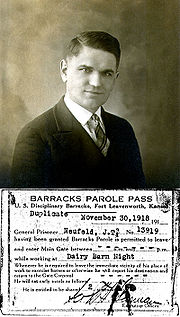
In the United States during World War I, conscientious objectors were permitted to serve in noncombatant military roles. About 2000 absolute conscientious objectors refused to cooperate in any way with the military. These men were imprisoned in military facilities such as Fort Lewis (Washington), Alcatraz Island (California) and Fort Leavenworth (Kansas). Some were subjected to treatment such as short rations, solitary confinement and physical abuse severe enough as to cause the deaths of two Hutterite
draftees.
Eventually, because of the shortage of farm labor, the conscientious objectors were granted furloughs either for farm service or relief work in France under the American Friends Service Committee
. A limited number performed alternative service as fire fighters in the Cascade Range in the vicinity of Camp Lewis, Washington and in a Virginia psychiatric hospital.
During World War II, all registrants were sent a questionnaire covering basic facts about their identification, physical condition, history and also provided a checkoff to indicate opposition to military service because of religious training or belief. Men marking the latter option received a DSS
47 form with ten questions:
 Civilian Public Service
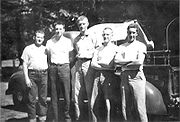
(CPS) provided conscientious objectors in the United States an alternative to military service during World War II. From 1941 to 1947 nearly 12,000 draftees, unwilling to do any type of military service, performed work of national importance in 152 CPS camps throughout the United States and Puerto Rico. The work was initially done in areas isolated from the general population both because of the government's concern that pacifist philosophy would spread and conscientious objectors would not be tolerated in neighboring communities. A constant problem through the duration of the program, especially in camps located in national forests for fire control, was make-work projects designed to occupy the men's time in the off-season and between fires. For instance, men at a camp on the Blue Ridge Parkway
in Virginia shoveled snow from an unused roadway while a snowplow was parked nearby. The uselessness of this type of work led to low morale and loss of experienced men as they requested transfers to other camps hoping for more meaningful work. Draftees from the historic peace churches and other faiths worked in areas such as soil conservation, forestry, fire fighting, agriculture, social services, and mental health.
The CPS men served without wages and minimal support from the federal government. The cost of maintaining the CPS camps and providing for the needs of the men was the responsibility of their congregations and families. CPS men served longer than regular draftees, not being released until well past the end of the war. Initially skeptical of the program, government agencies learned to appreciate the men's service and requested more workers from the program. CPS made significant contributions to forest fire prevention, erosion and flood control, medical science and especially in revolutionizing of the state-run mental health institutions which had previously been very inhumane and often cruel.
Alternatives to war bonds and war savings stamps
were provided for those who would not fund the war for conscientious reasons. National Service Board for Religious Objectors
offered civilian bonds and Mennonite Central Committee
offered Civilian Public Service stamps and War Sufferers' Relief stamps.
Civilian Public Service was disbanded in 1947. By the early 1950s a replacement program, 1-W service, was in place for conscientious objectors classified as 1-W by Selective Service. The new program eliminated the base camps of CPS and provided wages for the men.
1-W service was divided into several categories. The Earning Service involved working in institutions such as hospitals for fairly good wages. Voluntary Service was nonpaying work done in similar institutions, mostly within North America. Pax Service was a nonpaying alternative with assignments overseas. 1-W Mission Supporting Service was like the Earning Service but the wages were used for the support of mission, relief or service projects of the draftees choice. The nonpaying services were promoted by church agencies as a sacrifice to enhance the peace witness of conscientious objectors.
John F. Kennedy
(1917–1963), the thirty-fifth President of the United States
, once wrote in a letter to a Navy
friend,
 A 1971 United States
Supreme Court
decision, Gillette v. United States, broadened U.S. rules beyond religious belief but denied the inclusion of objections to specific wars as grounds for conscientious objection.
Currently, the U.S. Selective Service System states, "Beliefs which qualify a registrant for conscientious objector status may be religious in nature, but don't have to be. Beliefs may be moral or ethical; however, a man's reasons for not wanting to participate in a war must not be based on politics, expediency, or self-interest. In general, the man's lifestyle prior to making his claim must reflect his current claims." In the US, this applies to primary claims, that is, those filed on initial SSS registration. On the other hand, those who apply after either having registered without filing, and/or having attempted or effected a deferral, are specifically required to demonstrate a discrete and documented change in belief, including a precipitant, that converted a non-CO to a CO. The male reference is due to the current "male only" basis for conscription in the United States
.
In the United States, there are two main criteria for classification as a conscientious objector. First, the objector must be opposed to war in any form, Gillette v. United States, 401 U.S. 437. Second, the objection must be sincere, Witmer v. United States
, 348 U.S. 375. That he must show that this opposition is based upon religious training and belief was no longer a criterion after cases broadened it to include non-religious moral belief, United States v. Seeger
, 380 U.S. 163 and Welsh v. United States, 398 U.S. 333. COs willing to perform non-combatant military functions are classed 1-A-O by the U.S.; those unwilling to serve at all are 1-O.
Pursuant to the Treaty between the Government of Canada and the Government of the United States of America on Mutual Legal Assistance in Criminal Matters, US authorities can request Canadian authorities to identify, locate, and take into custody US nationals who have committed a crime that carries a possible sentence of more than a year, and subsequently extradite the target back to the US, as per the Extradition Treaty Between the United States of America and Canada.
However, the US government must promise that those extradited will not receive the death penalty, in accordance with the Supreme Court of Canada
ruling in United States v. Burns
. Thus, deserters who may have had an arrest warrant issued against them in the US are liable for arrest in Canada, unless they legalise their status, which can be done by pursuing a refugee
claim, which the Immigration and Refugee Board of Canada
(IRB) will consider. If the claim is refused, the claimant can appeal the decision in the Federal Court
, the Federal Court of Appeal, and finally, the Supreme Court of Canada, if leave is granted. If, however, appeals do not overturn the decision of the IRB, the claimant must leave Canada within 30 days, if given a removal order. If this is not done, or departure details are not confirmed with the Canada Border Services Agency
, a deportation order is issued, enforceable by any officer of the Queen's peace
in Canada.
From the mid 1960s to the mid 1970s, there was multi-faceted relationship between Canada and the Vietnam War
. Starting in 1965, Canada became a choice haven for American draft resisters and deserters.
Because they were not formally classified as refugees but were admitted as immigrants, there is
no official estimate of how many draft resisters and deserters were admitted to Canada during the
Vietnam War. One informed estimate puts their number between 30,000 and 40,000. Whether or
not this estimate is accurate, the fact remains that immigration from the United States was high as
long as the war raged and that in 1971 and 1972 Canada received more immigrants from the
United States than from any other country. Although some of these transplanted Americans
returned home after the Vietnam War, most of them put down roots in Canada, making up the
largest group Canada
had ever received. Draft resistors were usually college-educated sons of the middle class who
could no longer defer induction into the Selective Service System.
The Canadian government initially refused to admit those who could not prove that they had been discharged from [American] military service.
This changed in 1968.
Noteworthy draft resisters include Jim Green (Vancouver
city councillor and mayoral candidate), Eric Nagler
, and Jesse Winchester
. Distinct from draft resisters, there are also noteworthy deserters from that era, which include Andy Barrie
(Host of Canadian Broadcasting Corporation
Radio's Metro Morning
).
In the years following the 2003 invasion of Iraq
, there was a multi-faceted relationship between Canada and Iraq War resisters.
On June 3, 2008 and March 30, 2009, two motions
were passed in the Parliament of Canada
in support of the war resisters' efforts to stay in Canada. An Angus Reid Strategies
poll taken on June 6 and 7, 2008, showed that 64% of Canadians agreed with that motion. But the motions' recommendation was non-binding and was never implemented by the minority
Conservative
government.
The significance of this issue on Canada's historical international reputation as a place of refuge is illustrated by this quote from United Kingdom
's media, the BBC
, when they reported on the precedent-setting case of Iraq war resister Jeremy Hinzman
in 2004: "Americans in trouble have been running to Canada for centuries… in the wake of the American Revolution… [in the] Underground Railroad
that spirited escaped American slaves
to freedom… and in the 1960s, [when] as many as 60,000 young American men dodged the draft…"
Canada deported several resisters in 2008 and 2009. They were subseuently imprisoned in the United States. The American newsmagazine
Newsweek
reported on this historical shift.
As of July 2009, there were at least 28 public cases of U.S. war resisters in Canada, plus some families. When they first arrived in Canada, they mostly went to Toronto
, Ontario
; or Vancouver
, British Columbia
because that is where the majority of the organizing of the War Resisters Support Campaign
takes place.
There is also an unknown number of U.S. soldiers who have refused to participate in specifically the Iraq war, have come to Canada without going public, and have not applied for legal refugee status. Daniel Sandate
was one of those.
All political parties, except the governing minority
Conservative Party of Canada
, voted twice (in party voting bloc
s) in favor of allowing Iraq war resisters to remain in Canada.
On September 17, 2009, Gerard Kennedy
introduced the binding Bill C-440, which, in his words, was "in response to the refusal of the Minister of Citizenship, Immigration and Multiculturalism, Jason Kenney
to show Canadian sensibility.... It basically takes the spirit of two motions that have already been passed by a majority of Parliament and puts them in the form of law that would have to be followed by the minister and the ministry of immigration and citizenship." (See details.) On Sept 29, 2010, the bill failed to pass at second reading, lacking seven votes (143-136).
, Canadian conscientious objectors were given the options of noncombatant military service, serving in the medical or dental corps under military control or working in parks and on roads under civilian supervision. Over 95% chose the latter and were placed in Alternative Service camps. Initially the men worked on road building, forestry and firefighting projects. After May 1943, as the labour shortage developed within the nation and another Conscription Crisis
burgeoned, men were shifted into agriculture, education and industry. The 10,700 Canadian objectors were mostly Mennonites (63%) and Dukhobors
(20%).
The Russian Empire
allowed Russian Mennonites to run and maintain forestry service
units in South Russia in lieu of their military obligation. The program was under church control from 1881 through 1918, reaching a peak of seven thousand conscientious objectors during World War I. An additional five thousand Mennonites formed complete hospital units and transport wounded from the battlefield to Moscow
and Ekaterinoslav hospitals.
After the Russian Revolution of 1917
, Leon Trotsky
issued a decree allowing alternative service for religious objectors whose sincerity was determined upon examination. Vladimir Chertkov
, a follower of Leo Tolstoy
, chaired the United Council of Religious Fellowships and Groups, which successfully freed 8000 conscientious objectors from military service during the Russian Civil War
. The law was not applied uniformly and hundreds of objectors were imprisoned and over 200 were executed. The United Council was forced to cease activity in December 1920, but alternative service was available under the New Economic Policy
until it was abolished in 1936. Unlike the earlier forestry and hospital service, later conscientious objectors were classified "enemies of the people" and their alternate service was performed in remote areas in a gulag
-like environment in order to break their resistance and encourage enlistment.
After World War II, conscientious objectors in the Soviet Union
and the German Democratic Republic
were typically assigned to construction units, in the absence of a fully civilian alternative to military service.
According to Article 4(3) of the German
constitution (Grundgesetz): "No person shall be compelled against his conscience to render military service involving the use of arms. Details shall be regulated by a federal law."
According to Article 12a, every adult male is obligated to military service called Wehrdienst. The draftee can apply for an alternative service called "Zivildienst
" (civilian service), if he declares conscience reasons. The civil service may not last longer than military service. This rule has been applied since October 1, 2004. Before that date the civilian service was longer than military service, because soldiers could later be called to military exercises (Wehrübungen). In wartime, civilian draftees are expected to replace those on active military duty in their civilian professions.
The Wehrdienst is getting increasingly controversial, because only young men are getting drafted which some consider a violation of the third article of the constitution, that every person is equal before the law, but women are not affected by the Wehrdienst. However, the German constitution also states in Article 12a section 4 that no woman may be forced to serve in the armed forces. Therefore the different treatment of men and women actually has a constitutional basis.
As of 2011 the draft has been halted /discontinued in Germany.
In Czechoslovakia
, those not willing to enter mandatory military service could avoid it by signing a contract for work lasting years in unattractive occupations, such as mining. Those who didn't sign were imprisoned. Both numbers were tiny. After the communist party lost its power
in 1989, alternative civil service was established. As of 2006, both the Czech Republic
and Slovakia
have abolished conscription.
Conscription was mandatory to all able-bodied Belgian
males until 1994, when it was suspended. Civilian service was possible since 1963. Objectors could apply for the status of conscience objector. When granted, they did an alternative service with the civil service or with a socio-cultural organisation. The former would last 1.5 times as long as the shortest military service, the latter twice as long.
After their service, objectors are not allowed to take jobs that require them to carry weapons, such as police jobs.
Since conscription was suspended in 1994 and military service is voluntary, the status of conscience objector can not be granted anymore in Belgium. Women could not get this status either.
The country recognized the right not to fight in the 18th century following problems with attempting to force Quakers
into military service. The Militia Ballot Act of 1757 allowed Quakers to be excluded from military service. It then ceased to be a major issue, since Britain's armed forces were generally all-volunteer. However, press gangs were used to beef up army and navy rolls on occasions from the sixteenth to the early nineteenth centuries. Pressed men did have the right of appeal, in the case of sailors, to the Admiralty
. The Royal Navy
last took pressed men in the Napoleonic War.
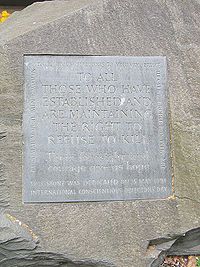
A more general right to refuse military service was not introduced until during World War I, when Britain introduced conscription with the Military Service Act
of March 1916. The Act allowed for objectors to be absolutely exempted, to perform alternative civilian service, or to serve as a non-combatant in the army, according to the extent to which they could convince a Military Service Tribunal
of the quality of their objection.
Around 16,000 men were recorded as conscientious objectors, with Quakers, traditionally pacifist, playing a large role: 4500 objectors were sent to do 'work of national importance' such as farming, 7000 were ordered non-combatant duties, but 6000 were forced into the army, and when they refused orders, they were sent to prison. Cases regarding conscientious objectors formed only a tiny proportion of Military Service Tribunals' cases, estimated at 2%; in the first six months of following the Military Service Act, tribunals heard 750,000 cases, of which 16,000 (the total number of conscience cases for 1916-18) is 2.13%. Tribunals were notoriously harsh towards conscientious objectors, reflecting widespread public opinion that they were lazy, degenerate, ungrateful 'shirkers' seeking to benefit from the sacrifices of others.
Thirty-five objectors were taken to France and formally sentenced to death but immediately reprieved to 10 years in prison; conditions were made very hard for conscientious objector prisoners — ten died in prison, and around seventy died elsewhere as a result of their treatment. Many objectors accepted non-combat service, for example working in the dangerous role of stretcher-bearers. Conscientious objectors who were deemed not to have made any useful contribution were disenfranchised for five years after the war, but there was no administrative machinery to enforce such disenfranchisement.
Britain's 1916 conscription legislation did not apply to Ireland
, despite its then status as part of the United Kingdom
; but see Conscription Crisis of 1918. British conscription in World War II also did not apply to Northern Ireland
, or to the Irish Free State
. Nevertheless, many Irishmen volunteered to fight in both world wars. The various parts of the British Empire
and Commonwealth
had their own laws: in general, all the larger countries of the Empire participated, and some were, in proportion to their population, major participants.
After the war, there was some revulsion at the arbitrary way the law had been applied. In A. J. Cronin
's 1935 novel The Stars Look Down
, there is the following exchange:
He goes to jail, as do others with a more conventionally religious view. This is described as one of the harsher tribunals, but within the range of actual events. The CO's cited stance is clearly derived from a well-known and frequently reprinted World War I article by Dr Alfred Salter
, The Religion of a Conscientious Objector, positing the incongruity of "Christ in khaki" with a bayonet.
In World War II, following the National Service (Armed Forces) Act of 1939
, there were nearly 60,000 registered Conscientious Objectors. Testing by Conscientious Objection Tribunals resumed, this time chaired by a judge, but was much less harsh; if you were not a member of the Quakers or some similar pacifist church, it was generally enough to say that you objected to "warfare as a means of settling international disputes," a phrase from the Kellogg-Briand Pact
of 1928. The tribunals could grant full exemption, exemption conditional on alternative service, exemption only from combatant duties, or dismiss the application. Of the 61,000 only 3,000 were given complete exemption and 18,000 were dismissed as false claimants. Of those directed to non-combatant military service almost 7000 were allocated to the Non-Combatant Corps, set up in mid-1940; its companies worked in clothing and food stores, in transport, or any military project not requiring the handling of "material of an aggressive nature". In November 1940 it was decided to allow troops in the NCC to volunteer for work in bomb disposal
. In total over 350 volunteered. Other non-combatants worked in the Royal Army Medical Corps
. Other acceptable occupations were farm
work, mining
, firefighting, ambulance service. About 5500 objectors were imprisoned, charged with offences relating to their unrecognised objection. A further 1000 were court-martialled by the armed forces and sent to military detention barracks or civil prisons.
Nevertheless, the social stigma attached to 'conchies' (as they were called) was considerable: regardless of the genuineness of their motives, cowardice was often imputed.
Britain retained conscription
, with rights of conscientious objection, as National Service
until 1960. The use of only volunteer soldiers was hoped to remove the need to consider conscientious objectors. Ever since World War I, however, there have been volunteer members of the armed forces who have developed a conscientious objection to continuing in service; a procedure was devised for them in World War II, and, with adaptations, it continues to this day.
Finland introduced conscription in 1881, but its enforcement was suspended in 1903 as part of Russification
. During the Finnish Civil War
in 1918, conscription
was reintroduced for all able-bodied men. In 1922, the option of noncombatant military service was introduced, but service in the military remained compulsory on pain of imprisonment. After the struggle of pacifist Arndt Pekurinen
a law was passed providing for a peacetime-only alternative to military service, or civilian service
(Finnish siviilipalvelus). The law was dubbed "Lex Pekurinen" after him. During the Winter War
, Pekurinen and other conscientious objectors were imprisoned, and Pekurinen was eventually executed at the front in 1941, during the Continuation War
.
After the war, a conscientious objector's civilian service lasted 16 months, whereas military service was 8 months at its shortest. To qualify for civilian service, an objector had to explain his conviction before a board of inspection that included military officers and clergymen. In 1987, the duration of the service was shortened to 13 months and the board of inspection was abolished. In 2008, the term was further shortened to 12 months to match the duration of the longest military service (that of officer trainees and technical crew). Today, a person subject to conscription may apply for civilian service at any time before or during his military service, and the application is accepted as a matter of course. A female performing voluntary military service can quit her service anytime during the first 45 days, however, if she wants to quit after those 45 days she would be treated like a male and assigned to civilian service.
Persons who have completed their civilian service during peacetime have, according to the legislation enacted in 2008, the right to serve in non-military duties also during a crisis situation. They may be called to serve in various duties with the rescue services or other necessary work of a non-military nature. Persons who declare themselves to be conscientious objectors only after a crisis has started must, however, prove their conviction before a special board. Before the new legislation, the right to conscientious objection was acknowledged only in peacetime. The changes to the service term and to the legal status of objectors during a crisis situation were made as a response to human rights concerns voiced by several international bodies, who are overseeing the implementation of human rights
agreements. These organisations had demanded Finland to take measures to improve its legislation concerning conscientious objectors, which they considered discriminatory. None of these organisations have yet raised concerns on the current legislation.
There are a small number of total objectors who refuse even civilian service, and are imprisoned for six months. This is not registered into the person's criminal record.
Until 2004 conscription was mandatory to all able-bodied Italian
males. Those who were born in the last months of the year typically used to serve in the Navy, unless judged unable for ship service (in this case they could be sent back to Army or Air Force). Until 1972, objectors were considered as traitors
and tried by a military tribunal. Since 1972, objectors could choose an alternative civilian service
, which was eight months longer than standard military service (fifteen months, then twelve, as for Army and Air Force, 24 months, then eighteen, then twelve as for the Navy). Since such length was judged too punitive, an arrangement was made to make the civilian service as long as the military service. Since 2004, Italian males no longer need to object because military service has been turned into volunteer for both males and females.
The Spanish Constitution of 1978
acknowledged conscientious objectors. The Spanish parliament established a longer service (Prestación Social Sustitutoria) as an alternative to the Army. In spite of this, a strong movement appeared that refused both services. The Red Cross was the only important organisation employing objectors. Because of this, the waiting lists for the PSS were long, especially in areas like Navarre
, where pacifism
, Basque nationalism
and a low unemployment rate discouraged young males from the army. Thousands of insumisos (non-submittants) publicly refused the PSS, and hundreds were imprisoned. In addition a number of those in the military decided to refuse further duties. A number of people not liable for military service made declarations of self-incrimination, stating that they had encouraged insumisión. The government, fearing popular reaction, reduced the length of service and instead of sentencing insumisos to prison declared them unfit for public service.
Fronting the decreasing birth rate and the popular opposition to the army, the Spanish government tried to modernise the model carried from the Franco
era, professionalizing it. The new army tried to provide an education for civilian life and participated in peace operations in Bosnia
.
The issue is highly controversial in Turkey. Turkey, Armenia and Azerbaijan are the only three countries refusing to recognise conscientious objection and sustain their membership in the Council of Europe
. In January 2006, the European Court of Human Rights
(ECHR) found Turkey had violated article 3 of the European Convention on Human Rights (prohibition of degrading treatment) in a case dealing the conscientious objection of Osman Murat Ulke
. In 2005, Mehmet Tarhan
was sentenced to four years in a military prison as a conscientious objector (he was unexpectedly released in March 2006). Journalist Perihan Magden
was tried by a Turkish court for supporting Tarhan and advocating conscientious objection as a human right; but later, she was acquitted.
As of March 2011, there were 125 objectors including 25 female objectors in Turkey. Another 256 people of Kurdish origin also had announced their conscientious objection to military service.
In 14th November 2011, Ministry of Justice
announced that a draft proposed to legalise the conscientious objector in Turkey
and it is going to be in effect two weeks after the President approves of the law change. This decision for legalization by the Turkish government is because of the pressures coming from European Court of Human Rights
. ECHR gave the deadline to Turkish government until the end of year 2011 to legalize conscientious objection.
. Some simply deserted, or joined organisations such as the End Conscription Campaign
, an anti-war movement banned in 1988, while others fled into exile and joined the Committee on South African War Resistance. Most lived in a state of internal exile, forced to go underground within the borders of the country until a moratorium on conscription was declared in 1993. Opposition to the Angolan War
, "South Africa's Vietnam," was rife in English-speaking campuses, and later the war in the townships became the focus of these groupings.
In 1990 the Republic of Korea ratified a UN treaty, the International Covenant on Civil and Political Rights
, which safeguards the freedoms of thought, conscience, and religion for all people. The Korean Military Service Act, therefore, clearly infringes on constitutional rights—a direct violation of such international standards that honor the right of people to conscientiously object to mandatory military service.
The Korean government’s National Action Plan (NAP) for the Promotion and Protection of Human Rights has not shown a clear stance on the pressing human rights issues such as, among other things, the rights of conscientious objectors to military service.
In September 2007 the South Korea government announced a program to give conscientious objectors an opportunity to participate in alternative civilian service. The program stipulates three years of civilian service that is not connected with the military in any way. Changes in legislation will first be needed to implement the program. As of May 2010, no such changes have been implemented.
On January 15, 2009, the Korean Presidential Commission on Suspicious Deaths in the Military released its decision acknowledging that the Korean government was responsible for the deaths of five young men who were Jehovah’s Witnesses, and were forcibly conscripted into the army. The deaths resulted from "the state's anti-human rights violence" and "its acts of brutality" during the 1970s that continued into the mid-1980s. This decision is significant since it is the first one recognizing the state’s responsibility for deaths resulting from violence within the military.
According to the Commission’s decision, "the beatings and acts of brutality committed against them by military officials were attempts to compel and coerce them to act against their conscience (religion) and were unconstitutional, anti-human rights acts that infringed severely upon the freedom of conscience (religion) guaranteed in the Constitution."
The records of conscientious objectors to military service are kept by a Korean investigative body as criminal files for five years. As a consequence, conscientious objectors are not allowed to enter a government office and apply for any type of national certification exam, it is also very unlikely that they will be employed by any company that inquires about criminal records.
From 2000 to 2008, Korean Military Manpower Administration said that at least 4,958 men have objected to service in the military because of religious beliefs. Among those, 4,925 were Jehovah's Witnesses, 3 were Buddhists, and the other 30 refused the mandatory service because of conscientious objections other than religious reasons.
Since 1950, there have been more than 16,000 Jehovah’s Witnesses sentenced to a combined total of 31,256 years for refusing to perform military service. If alternative service is not provided, some 500 to 900 young men will continue to be added each year to the list of conscientious objectors criminalized in Korea. http://www.jw-media.org/kor/20110902.htm
, Germany
, Greece
and Switzerland
, there is the option of performing Civilian Service, subject to the review of a written application or after a hearing about the state of conscience (see below). In Greece
, Civilian Service is twice as long as the corresponding military service and in Switzerland, the Civilian Service
is one and one-half times longer. In 2005, the Swiss parliament considered whether willingness to serve one and a half times longer than an army recruit was sufficient proof of sincerity, citing that the cost of judging the state of conscience of a few thousand men per year was too great.
In the United States, military personnel who come to a conviction of conscientious objection during their tour of duty must appear in front of a panel of experts, which consists of psychiatrists, military chaplains and officers. In Switzerland
, the panel consists entirely of civilians, and military personnel have no authority whatsoever. In Germany, objections to military service are filed in writing, and an oral hearing is scheduled only if the written testimonials have been unconvincing; in practice, due to the heavy workload—about half of all draftees in a given year file as conscientious objectors—the competent authority reviews written applications only summarily, and it denies the alternative of a civilian service only in cases of grave shortcomings or inconsistencies in the written testimonials. Commonly, once an objector is summoned to a hearing, he has to explain what experiences drove him to recognize a conflict concerning his conscience.
These are common questions from Swiss hearings. By and large, these are asked in many other countries. They help to determine if the objector is politically motivated or if he is just too lazy to serve the country; or if he truly has a conflict stemming from his conscience. Arguments like "The army is senseless," "It is not just to wage wars," or opposition to involvement in a specific war (World War II, the Vietnam War
, the Iraq War; a hypothetical war of West Germany against fellow Germans from the GDR during the Cold War
) will hardly ever be accepted. He has only, and convincingly, to show that his conscience does not allow participation in an organisation which is intended to use violence.
In other examples, the interviewers would ask if one was ready to kill in self-defense or in the defense of a friend or family member or why one had not revoked their driver's license, for driving carries a risk of accidentally killing someone.
In Britain during World War I, there was an argument put forth by a conscientious objector who asked the people who were part of the tribunal if they were Christian. When they all replied in the positive he then remarked, "Could you imagine Christ
in khaki running out into no-mans land?" None of the panelists could, and the man was given total exemption due to 'religious beliefs'.
In various places, questions about such hypothetical situations have come into disuse because they do not explore the present-day state of the objector's conflict of conscience, but possible future actions which, with a great probability, will never take place. In the 1980s, these types of questions were abolished in Germany after the Federal Constitutional Court
found them unconstitutional.
Similar hearings and questions about hypothetical situations were in use in Finland
for most of the history of Finnish conscientious objection, from its introduction in the 1930s to the 1980s, when they were abolished. Today, draftees have to specify whether they are objecting for religious or ethical reasons by marking the appropriate checkbox on a form, but hearings are no longer held. If conscripts turn into conscientious objectors during their service, the Defense Force will inquire of their reasons for internal research purposes, but the objectors are not required to answer unless they wish to do so. Usually, a conscientious objector will be released from the military within a few hours of making the claim.
In some countries, conscientious objectors are assigned to an alternative civilian service
Civilian service
Civilian service is service to a government made as a civilian, particularly such service as an option for conscripted persons who are conscientious objectors and object to military service...
as a substitute for conscription or military service. Some conscientious objectors consider themselves pacifist
Pacifism
Pacifism is the opposition to war and violence. The term "pacifism" was coined by the French peace campaignerÉmile Arnaud and adopted by other peace activists at the tenth Universal Peace Congress inGlasgow in 1901.- Definition :...
, non-interventionist, non-resistant
Nonresistance
Nonresistance is generally defined as "the practice or principle of not resisting authority, even when it is unjustly exercised". At its core is discouragement of, even opposition to, physical resistance to an enemy...
, or antimilitarist.
The international definition of conscientious objection officially broadened on March 8, 1995 when the United Nations Commission on Human Rights
United Nations Commission on Human Rights
The United Nations Commission on Human Rights was a functional commission within the overall framework of the United Nations from 1946 until it was replaced by the United Nations Human Rights Council in 2006...
resolution 1995/83 stated that "persons performing military service should not be excluded from the right to have conscientious objections to military service." That definition was re-affirmed in 1998, when the United Nations
United Nations
The United Nations is an international organization whose stated aims are facilitating cooperation in international law, international security, economic development, social progress, human rights, and achievement of world peace...
Office of the High Commissioner for Human Rights document called "Conscientious objection to military service, United Nations Commission on Human Rights
United Nations Commission on Human Rights
The United Nations Commission on Human Rights was a functional commission within the overall framework of the United Nations from 1946 until it was replaced by the United Nations Human Rights Council in 2006...
resolution 1998/77" officially recognized that "persons [already] performing military service may develop conscientious objections."
Introduction
Historically, many conscientious objectors have been executed, imprisoned, or otherwise penalized when their beliefs led to actions conflicting with their society's legal system or government. The legal definition and status of conscientious objection has varied over the years and from nation to nation. Religious beliefs were a starting point in many nations for legally granting conscientious objector status.Conscientious objection and doing civilian service (i.e. civilian tasks as an alternative to compulsory military service) in Germany grew into a veritable institution, especially in the health service. The suspension of conscription in Germany in 2011 is therefore reported to have caused problems for "caring" activities previously undertaken by objectors doing civilian service. Some conscientious objectors served as smokejumper
Smokejumper
A smokejumper is a wildland firefighter who parachutes into a remote area to combat wildfires.Smokejumpers are most often deployed to fires that are extremely remote. The risks associated with this method of personnel deployment are mitigated by an extremely well developed training program that has...
s and aides in mental institutions in the U.S. during World War II and the Korean War.
Universal Declaration of Human Rights
In 1948, the issue of the right to "conscience" was dealt with by the United Nations General AssemblyUnited Nations General Assembly
For two articles dealing with membership in the General Assembly, see:* General Assembly members* General Assembly observersThe United Nations General Assembly is one of the five principal organs of the United Nations and the only one in which all member nations have equal representation...
in Article 18 of the Universal Declaration of Human Rights
Universal Declaration of Human Rights
The Universal Declaration of Human Rights is a declaration adopted by the United Nations General Assembly . The Declaration arose directly from the experience of the Second World War and represents the first global expression of rights to which all human beings are inherently entitled...
. It reads: "Everyone has the right to freedom of thought, conscience and religion; this right includes freedom to change his religion or belief, and freedom, either alone or in community with others and in public or private, to manifest his religion or belief in teaching, practice, worship and observance." The proclamation was ratified during the General Assembly on 10 December 1948 by a vote of 48 in favour, 0 against, with 8 abstentions.
Seán MacBride
Seán MacBride was an Irish government minister and prominent international politician as well as a Chief of Staff of the IRA....
said, in his Nobel Lecture, "To the rights enshrined in the Universal Declaration of Human Rights
Universal Declaration of Human Rights
The Universal Declaration of Human Rights is a declaration adopted by the United Nations General Assembly . The Declaration arose directly from the experience of the Second World War and represents the first global expression of rights to which all human beings are inherently entitled...
one more might, with relevance, be added. It is 'The Right to Refuse to Kill.'"
In 1976, the United Nations
United Nations
The United Nations is an international organization whose stated aims are facilitating cooperation in international law, international security, economic development, social progress, human rights, and achievement of world peace...
treaty
Treaty
A treaty is an express agreement under international law entered into by actors in international law, namely sovereign states and international organizations. A treaty may also be known as an agreement, protocol, covenant, convention or exchange of letters, among other terms...
the International Covenant on Civil and Political Rights
International Covenant on Civil and Political Rights
The International Covenant on Civil and Political Rights is a multilateral treaty adopted by the United Nations General Assembly on December 16, 1966, and in force from March 23, 1976...
entered into force
Coming into force
Coming into force or entry into force refers to the process by which legislation, regulations, treaties and other legal instruments come to have legal force and effect...
. It was based on the Universal Declaration of Human Rights
Universal Declaration of Human Rights
The Universal Declaration of Human Rights is a declaration adopted by the United Nations General Assembly . The Declaration arose directly from the experience of the Second World War and represents the first global expression of rights to which all human beings are inherently entitled...
, and was originally created in 1966. Nations that have signed this treaty are bound by it. Its Article 18 begins: "Everyone shall have the right to freedom of thought, conscience and religion. …"
However, the International Covenant on Civil and Political Rights
International Covenant on Civil and Political Rights
The International Covenant on Civil and Political Rights is a multilateral treaty adopted by the United Nations General Assembly on December 16, 1966, and in force from March 23, 1976...
left the issue of conscientious objection inexplicit, as we see in this quote from War Resisters International: "Article 18 of the Covenant does put some limits on the right [to freedom of thought, conscience and religion], stating that [its] manifestations must not infringe on public safety, order, health or morals. Some states argue that such limitations [on the right to freedom of thought, conscience and religion] would [derivatively] permit them to make conscientious objection during time of war a threat to public safety, or mass conscientious objection a disruption to public order,...[Some states] even [argue] that it is a 'moral' duty to serve the state in its military."
On July 30, 1993, explicit clarification of the International Covenant on Civil and Political Rights
International Covenant on Civil and Political Rights
The International Covenant on Civil and Political Rights is a multilateral treaty adopted by the United Nations General Assembly on December 16, 1966, and in force from March 23, 1976...
Article 18 was made in the United Nations
United Nations
The United Nations is an international organization whose stated aims are facilitating cooperation in international law, international security, economic development, social progress, human rights, and achievement of world peace...
Human Rights Committee
Human Rights Committee
The United Nations Human Rights Committee is a United Nations body of 18 experts that meets three times a year for four-week sessions to consider the five-yearly reports submitted by 162 UN member states on their compliance with the International Covenant on Civil and Political Rights,...
general comment 22, Paragraph 11: "The Covenant does not explicitly refer to a right to conscientious objection, but the Committee believes that such a right can be derived from article 18, inasmuch as the obligation to use lethal force may seriously conflict with the freedom of conscience and the right to manifest one's religion or belief." In 2006, the Committee has found for the first time a right to conscientious objection under article 18, although not unanimously.
In 1997, an announcement of Amnesty International
Amnesty International
Amnesty International is an international non-governmental organisation whose stated mission is "to conduct research and generate action to prevent and end grave abuses of human rights, and to demand justice for those whose rights have been violated."Following a publication of Peter Benenson's...
's forthcoming campaign and briefing for the UN Commission on Human Rights included this quote: "The right to conscientious objection to military service is not a marginal concern outside the mainstream of international human rights protection and promotion."
In 1998, the Human Rights Commission reiterated previous statements and added "states should . . . refrain from subjecting conscientious objectors . . . to repeated punishment for failure to perform military service." It also encouraged states "to consider granting asylum to those conscientious objectors compelled to leave their country of origin because they fear persecution owing to their refusal to perform military service . . . ."
Nuremberg Principle IV
The Nuremberg PrinciplesNuremberg Principles
The Nuremberg principles were a set of guidelines for determining what constitutes a war crime. The document was created by the International Law Commission of the United Nations to codify the legal principles underlying the Nuremberg Trials of Nazi party members following World War II.- Principle...
were a set of guidelines for determining what constitutes a war crime
War crime
War crimes are serious violations of the laws applicable in armed conflict giving rise to individual criminal responsibility...
. The document was created by the International Law Commission of the United Nations
United Nations
The United Nations is an international organization whose stated aims are facilitating cooperation in international law, international security, economic development, social progress, human rights, and achievement of world peace...
to recognize the legal principles underlying the Nuremberg Trials
Nuremberg Trials
The Nuremberg Trials were a series of military tribunals, held by the victorious Allied forces of World War II, most notable for the prosecution of prominent members of the political, military, and economic leadership of the defeated Nazi Germany....
of Nazi
Nazism
Nazism, the common short form name of National Socialism was the ideology and practice of the Nazi Party and of Nazi Germany...
party members following World War II
World War II
World War II, or the Second World War , was a global conflict lasting from 1939 to 1945, involving most of the world's nations—including all of the great powers—eventually forming two opposing military alliances: the Allies and the Axis...
.
Nuremberg Principle IV states: "The fact that a person acted pursuant to order of his Government or of a superior does not relieve him from responsibility under international law, provided a moral choice was in fact possible to him."
Handbook on Procedures and Criteria for Determining Refugee Status
The Handbook on Procedures and Criteria for Determining Refugee Status (the Handbook) of the Office of the United Nations High Commissioner for RefugeesUnited Nations High Commissioner for Refugees
The Office of the United Nations High Commissioner for Refugees , also known as The UN Refugee Agency is a United Nations agency mandated to protect and support refugees at the request of a government or the UN itself and assists in their voluntary repatriation, local integration or resettlement to...
(UNHCR) states:
"171. Not every conviction, genuine though it may be, will constitute a sufficient reason for claiming refugeeRefugeeA refugee is a person who outside her country of origin or habitual residence because she has suffered persecution on account of race, religion, nationality, political opinion, or because she is a member of a persecuted 'social group'. Such a person may be referred to as an 'asylum seeker' until...
status after desertionDesertionIn military terminology, desertion is the abandonment of a "duty" or post without permission and is done with the intention of not returning...
or draft-evasion. It is not enough for a person to be in disagreement with his government regarding the political justification for a particular military action. Where, however, the type of military action, with which an individual does not wish to be associated, is condemned by the international communityInternational communityThe international community is a term used in international relations to refer to all peoples, cultures and governments of the world or to a group of them. The term is used to imply the existence of common duties and obligations between them...
as contrary to basic rules of human conduct, punishment for desertionDesertionIn military terminology, desertion is the abandonment of a "duty" or post without permission and is done with the intention of not returning...
or draft-evasion could, in the light of all other requirements of the definition, in itself be regarded as persecution."
Religious motives
Cases of behaviour which could be considered as religiously motivated conscientious objection are historically attested long before the modern term appeared. For example, the Medieval Orkneyinga SagaOrkneyinga saga
The Orkneyinga saga is a historical narrative of the history of the Orkney Islands, from their capture by the Norwegian king in the ninth century onwards until about 1200...
mentions that Magnus Erlendsson, Earl of Orkney
Magnus Erlendsson, Earl of Orkney
Saint Magnus, Earl Magnus Erlendsson of Orkney, sometimes known as Magnus the Martyr, was the first Earl of Orkney to bear that name, and ruled from 1108 to about 1115...
- the future Saint Magnus - had a reputation for piety and gentleness, and because of his religious convictions refused to fight in a Viking raid on Anglesey
Anglesey
Anglesey , also known by its Welsh name Ynys Môn , is an island and, as Isle of Anglesey, a county off the north west coast of Wales...
, Wales
Wales
Wales is a country that is part of the United Kingdom and the island of Great Britain, bordered by England to its east and the Atlantic Ocean and Irish Sea to its west. It has a population of three million, and a total area of 20,779 km²...
, instead staying on board his ship singing psalms.
The reasons for refusing to perform military service are varied. Many conscientious objectors cite religious reasons. Unitarian Universalists object to war in their sixth principle "The goal of world community with peace, liberty and justice for all". Members of the Historic Peace Churches
Peace churches
Peace churches are Christian churches, groups or communities advocating Christian pacifism. The term historic peace churches refers specifically only to three church groups among pacifist churches: Church of the Brethren, Mennonites including the Amish, and Religious Society of Friends and has...
such as Quakers, Mennonites, Amish
Amish
The Amish , sometimes referred to as Amish Mennonites, are a group of Christian church fellowships that form a subgroup of the Mennonite churches...
, and Church of the Brethren
Church of the Brethren
The Church of the Brethren is a Christian denomination originating from the Schwarzenau Brethren organized in 1708 by eight persons led by Alexander Mack, in Schwarzenau, Bad Berleburg, Germany. The Brethren movement began as a melding of Radical Pietist and Anabaptist ideas during the...
object to war from the conviction that Christian
Christian
A Christian is a person who adheres to Christianity, an Abrahamic, monotheistic religion based on the life and teachings of Jesus of Nazareth as recorded in the Canonical gospels and the letters of the New Testament...
life is incompatible with military action, because Jesus
Jesus
Jesus of Nazareth , commonly referred to as Jesus Christ or simply as Jesus or Christ, is the central figure of Christianity...
enjoins his followers to love their enemies and to refuse violence. Since the American Civil War, Seventh-day Adventists
Seventh-day Adventist Church
The Seventh-day Adventist Church is a Protestant Christian denomination distinguished by its observance of Saturday, the original seventh day of the Judeo-Christian week, as the Sabbath, and by its emphasis on the imminent second coming of Jesus Christ...
were known as non-combatants, and had done work in hospitals or to give medical care rather than combat roles, and the church has upheld the non-combative position.
Jehovah's Witnesses
Jehovah's Witnesses
Jehovah's Witnesses is a millenarian restorationist Christian denomination with nontrinitarian beliefs distinct from mainstream Christianity. The religion reports worldwide membership of over 7 million adherents involved in evangelism, convention attendance of over 12 million, and annual...
, while not pacifist in the strict sense, refuse to participate in the armed services on the grounds that they believe they should be neutral in worldly conflicts and often cite the latter portion of which states, "…neither shall they learn war anymore." Other objections can stem from a deep sense of responsibility toward humanity as a whole, or from simple denial that any government possesses the moral authority to command warlike behavior from its citizens.
In the early Christian Church followers of the Christ refused to take up arms.
After the Roman Empire
Roman Empire
The Roman Empire was the post-Republican period of the ancient Roman civilization, characterised by an autocratic form of government and large territorial holdings in Europe and around the Mediterranean....
officially embraced Christianity
Christianity
Christianity is a monotheistic religion based on the life and teachings of Jesus as presented in canonical gospels and other New Testament writings...
, the Just War
Just War
Just war theory is a doctrine of military ethics of Roman philosophical and Catholic origin, studied by moral theologians, ethicists and international policy makers, which holds that a conflict ought to meet philosophical, religious or political criteria.-Origins:The concept of justification for...
theology was developed in order to reconcile warfare with Christian belief. After Theodosius I made Christianity an official religion of the Empire, this position slowly developed into the official position of the Western Church. In the 11th century, there was a further shift of opinion in the Latin-Christian tradition with the crusades, strengthening the idea and acceptability of Holy War
Religious war
A religious war; Latin: bellum sacrum; is a war caused by, or justified by, religious differences. It can involve one state with an established religion against another state with a different religion or a different sect within the same religion, or a religiously motivated group attempting to...
. Objectors became a minority. Some theologians see the loss of a pacifist position as a great failing of the Church; see Constantinian shift
Constantinian shift
Constantinian shift is a term used by Anabaptist and Post-Christendom theologians to describe the political and theological aspects of the 4th-century process of Constantine's legalization of Christianity. The term was popularized by the Mennonite theologian John H...
and Christian pacifism
Christian pacifism
Christian pacifism is the theological and ethical position that any form of violence is incompatible with the Christian faith. Christian pacifists state that Jesus himself was a pacifist who taught and practiced pacifism, and that his followers must do likewise.There have been various notable...
.
Ben Salmon
Ben Salmon
Ben Joseph Salmon was an American Christian pacifist, Roman Catholic, conscientious objector and outspoken critic of Just War theology....
was a Catholic conscientious objector during World War I and outspoken critic of Just War theology. The Catholic Church denounced him and the The New York Times described him as a "spy suspect." The US military (in which he was never inducted) charged him with desertion and spreading propaganda, then sentenced him to death (this was later revised to 25 years hard labor). On June 5, 1917, Salmon wrote in a letter to President Wilson:
Because of their conscientious objection to participation in military service, whether armed or unarmed, Jehovah's Witnesses have often faced imprisonment or other penalties. In Greece
Greece
Greece , officially the Hellenic Republic , and historically Hellas or the Republic of Greece in English, is a country in southeastern Europe....
, for example, before the introduction of alternative civilian service in 1997, hundreds of Witnesses were imprisoned, some for three years or even more for their refusal. In Armenia
Armenia
Armenia , officially the Republic of Armenia , is a landlocked mountainous country in the Caucasus region of Eurasia...
, young Jehovah's Witnesses have been imprisoned (and remain in prison) because of their conscientious objection to military service
Conscription
Conscription is the compulsory enlistment of people in some sort of national service, most often military service. Conscription dates back to antiquity and continues in some countries to the present day under various names...
. The government of South Korea also imprisons hundreds for refusing the draft. In Switzerland
Switzerland
Switzerland name of one of the Swiss cantons. ; ; ; or ), in its full name the Swiss Confederation , is a federal republic consisting of 26 cantons, with Bern as the seat of the federal authorities. The country is situated in Western Europe,Or Central Europe depending on the definition....
, virtually every Jehovah's Witness is exempted from military service. The Finnish
Finland
Finland , officially the Republic of Finland, is a Nordic country situated in the Fennoscandian region of Northern Europe. It is bordered by Sweden in the west, Norway in the north and Russia in the east, while Estonia lies to its south across the Gulf of Finland.Around 5.4 million people reside...
government exempts Jehovah's Witnesses from the draft completely.
The following is said of the Seventh-day Adventists
Seventh-day Adventist Church
The Seventh-day Adventist Church is a Protestant Christian denomination distinguished by its observance of Saturday, the original seventh day of the Judeo-Christian week, as the Sabbath, and by its emphasis on the imminent second coming of Jesus Christ...
(SDA) by a neutral, non-SDA organization: "Many Seventh-day Adventists refuse to enter the army as combatants, but participate as medics, ambulance drivers, etc. During World War II
World War II
World War II, or the Second World War , was a global conflict lasting from 1939 to 1945, involving most of the world's nations—including all of the great powers—eventually forming two opposing military alliances: the Allies and the Axis...
in Germany, many SDA conscientious objectors were sent to concentration camps or mental institutions; some were executed. Some Seventh-day Adventists volunteered for the US Army's Operation Whitecoat
Operation Whitecoat
Operation Whitecoat was the name given to a medical research program carried out by the US Army at Fort Detrick, Maryland during the period 1954–1973. The program involved conducting medical research using volunteer enlisted personnel who eventually became nicknamed "White Coats"...
, participating in research to help others. The Church preferred to call them "conscientious participants", because they were willing to risk their lives as test subjects in potentially life-threatening research. Over 2,200 Seventh-day Adventists volunteered in experiments involving various infectious agents during the 1950s through the 1970s in Fort Detrick, MD. " A schism
Schism (religion)
A schism , from Greek σχίσμα, skhísma , is a division between people, usually belonging to an organization or movement religious denomination. The word is most frequently applied to a break of communion between two sections of Christianity that were previously a single body, or to a division within...
arose during and after World War I between Seventh-day Adventists in Germany who agreed to serve in the military if conscripted and those who rejected all participation in warfare — the latter group eventually forming a separate church (the Seventh Day Adventist Reform Movement
Seventh Day Adventist Reform Movement
The Seventh Day Adventist Reform Movement is a Protestant Christian denomination, part of the Sabbatarian adventist movement, and formed as the result of a schism within the Seventh-day Adventist Church in Europe during World War I over the position its leadership took on proper Sabbath observance...
).
For believers in Indian religions, the opposition to warfare may be based on either the general idea of ahimsa
Ahimsa
Ahimsa is a term meaning to do no harm . The word is derived from the Sanskrit root hims – to strike; himsa is injury or harm, a-himsa is the opposite of this, i.e. non harming or nonviolence. It is an important tenet of the Indian religions...
, non-violence, or on an explicit prohibition of violence by their religion, e.g., for a Buddhist, one of the five precepts is "," or "I undertake the precept to refrain from destroying living creatures," which is in obvious opposition to the practice of warfare. The 14th Dalai Lama
14th Dalai Lama
The 14th Dalai Lama is the 14th and current Dalai Lama. Dalai Lamas are the most influential figures in the Gelugpa lineage of Tibetan Buddhism, although the 14th has consolidated control over the other lineages in recent years...
has stated that war "should be relegated to the dustbin of history." On the other hand, many Buddhist sects, especially in Japan, have been thoroughly militarized, warrior monks (yamabushi or sóhei) participating in the civil wars. Hindu beliefs do not go against the concept of war, as seen in the Gita. Both Sikhs and Hindus believe war should be a last resort and should be fought to sustain life and morality in society.
Some practitioners of pagan religions
Paganism
Paganism is a blanket term, typically used to refer to non-Abrahamic, indigenous polytheistic religious traditions....
, particularly Wicca
Wicca
Wicca , is a modern Pagan religious movement. Developing in England in the first half of the 20th century, Wicca was popularised in the 1950s and early 1960s by a Wiccan High Priest named Gerald Gardner, who at the time called it the "witch cult" and "witchcraft," and its adherents "the Wica."...
, may object on the grounds of the Wiccan rede
Wiccan Rede
The Wiccan Rede is a statement that provides the key moral system in the Neopagan religion of Wicca and other related Witchcraft-based faiths. A common form of the Rede is An it harm none, do what ye will....
, which states "An it harm none, do what ye will" (or variations). The threefold law may also be grounds for objection.
A notable example of a conscientious objector was the Austrian
Austrians
Austrians are a nation and ethnic group, consisting of the population of the Republic of Austria and its historical predecessor states who share a common Austrian culture and Austrian descent....
devout Roman Catholic Christian
Christian
A Christian is a person who adheres to Christianity, an Abrahamic, monotheistic religion based on the life and teachings of Jesus of Nazareth as recorded in the Canonical gospels and the letters of the New Testament...
Franz Jägerstätter
Franz Jägerstätter
Blessed Franz Jägerstätter, O.F.S., was an Austrian conscientious objector during World War II. Jägerstätter was sentenced to death and executed...
, who was executed on August 9, 1943 for openly refusing to serve in the Nazi Wehrmacht
Wehrmacht
The Wehrmacht – from , to defend and , the might/power) were the unified armed forces of Nazi Germany from 1935 to 1945. It consisted of the Heer , the Kriegsmarine and the Luftwaffe .-Origin and use of the term:...
, consciously accepting the penalty of death. He was declared Blessed
Beatification
Beatification is a recognition accorded by the Catholic Church of a dead person's entrance into Heaven and capacity to intercede on behalf of individuals who pray in his or her name . Beatification is the third of the four steps in the canonization process...
by Pope Benedict XVI
Pope Benedict XVI
Benedict XVI is the 265th and current Pope, by virtue of his office of Bishop of Rome, the Sovereign of the Vatican City State and the leader of the Catholic Church as well as the other 22 sui iuris Eastern Catholic Churches in full communion with the Holy See...
in 2007 for dying for his beliefs, and is viewed as a symbol of self-sacrificing resistance.
Selective conscientious objection
United KingdomUnited Kingdom
The United Kingdom of Great Britain and Northern IrelandIn the United Kingdom and Dependencies, other languages have been officially recognised as legitimate autochthonous languages under the European Charter for Regional or Minority Languages...
Air Commodore
Air Commodore
Air commodore is an air-officer rank which originated in and continues to be used by the Royal Air Force...
Lionel Charlton
Lionel Charlton
Air Commodore Lionel Evelyn Oswald Charlton CB, CMG, DSO, RAF was a British infantry officer who served in the Second Boer War. During World War I, Charlton held several command and staff posts in the Royal Flying Corps, finishing the war as a brigadier-general...
served in the military from 1898 to 1928. In 1923 he selectively refused to serve in the RAF Iraq Command
RAF Iraq Command
Iraq Command was the RAF commanded inter-service command in charge of British forces in Iraq in the 1920s and early 1930s, during the period of the British Mandate of Mesopotamia. It continued as British Forces in Iraq until 1941 when it was replaced by AHQ Iraq...
. (He later went on to serve as Air Officer Commanding
Air Officer Commanding
Air Officer Commanding is a title given in the air forces of Commonwealth nations to an air officer who holds a command appointment. Thus, an air vice marshal might be the AOC 38 Group...
No 3 Group
No. 3 Group RAF
Number 3 Group of the Royal Air Force was an RAF group first active in 1918, again in 1923-26, part of RAF Bomber Command from 1936 to 1967, and part of RAF Strike Command from 2000 until it disbanded on 1 April 2006.-The 1930s and World War II:...
.)
On June 4, 1967, John Courtney Murray
John Courtney Murray
John Courtney Murray, , was an American Jesuit priest and theologian, who was especially known for his efforts to reconcile Catholicism and religious pluralism, particularly focusing on the relationship between religious freedom and the institutions of a democratically structured modern...
, an American Jesuit
Society of Jesus
The Society of Jesus is a Catholic male religious order that follows the teachings of the Catholic Church. The members are called Jesuits, and are also known colloquially as "God's Army" and as "The Company," these being references to founder Ignatius of Loyola's military background and a...
priest
Priesthood (Catholic Church)
The ministerial orders of the Catholic Church include the orders of bishops, deacons and presbyters, which in Latin is sacerdos. The ordained priesthood and common priesthood are different in function and essence....
and theologian, delivered an address at Western Maryland College concerning a more specific type of conscientious objection: "the issue of selective conscientious objection, conscientious objection to particular wars, or as it is sometimes called, discretionary armed service."
On March 8, 1971, the Supreme Court of the United States
Supreme Court of the United States
The Supreme Court of the United States is the highest court in the United States. It has ultimate appellate jurisdiction over all state and federal courts, and original jurisdiction over a small range of cases...
ruled in the case of Gillette v. United States that "the exemption for those who oppose "participation in war in any form" applies to those who oppose participating in all war and not to those who object to participation in a particular war only."
On September 24, 2003, in Israel
Israel
The State of Israel is a parliamentary republic located in the Middle East, along the eastern shore of the Mediterranean Sea...
, 27 reserve pilots and former pilots refused to serve in only specific missions. These specific missions included "civilian population centers" in "the [occupied] territories." These pilots clarified: "We ... shall continue to serve in the Israel Defense Forces
Israel Defense Forces
The Israel Defense Forces , commonly known in Israel by the Hebrew acronym Tzahal , are the military forces of the State of Israel. They consist of the ground forces, air force and navy. It is the sole military wing of the Israeli security forces, and has no civilian jurisdiction within Israel...
and the Air Force for every mission in defense of the state of Israel."
On May 25, 2005, journalist Jack Random wrote the following: "The case of Sergeant Kevin Benderman
Kevin Benderman
Kevin Benderman was born and raised in Alabama. He held the rank of Sergeant and was a mechanic in the United States Army. Kevin Benderman first enlisted in the Army in 1987 and served until 1991 when he accepted his discharge; however, nine years later in 2000 he chose to reenlist...
(Iraq War Resister) raises the burning issue of selective conscientious objection: While it is universally accepted that an individual cannot be compelled against conscience to war in general, does the same hold for an individual who objects, in the depths of the soul, to a particular war?"
Additional Selective C.O. case: U.S. v. Macintosh, 283 U.S. 605
Alternatives for objectors
Some conscientious objectors are unwilling to serve the military in any capacity, while others accept noncombatant roles. While conscientious objection is usually the refusal to collaborate with military organizations, as a combatant in war or in any supportive role, some advocate compromising forms of conscientious objection. One compromising form is to accept non-combatantNon-combatant
Non-combatant is a term in the law of war describing civilians not taking a direct part in hostilities, as well as persons such as medical personnel and military chaplains who are regular soldiers but are protected because of their function as well as soldiers who are hors de combat ; that is, sick,...
roles during conscription
Conscription
Conscription is the compulsory enlistment of people in some sort of national service, most often military service. Conscription dates back to antiquity and continues in some countries to the present day under various names...
or military service
Military service
Military service, in its simplest sense, is service by an individual or group in an army or other militia, whether as a chosen job or as a result of an involuntary draft . Some nations require a specific amount of military service from every citizen...
. Alternatives to military or civilian service include serving an imprisonment or other punishment for refusing conscription, falsely claiming unfitness for duty by feigning an allergy or a heart condition, delaying conscription until the maximum drafting age, or seeking refuge in a country which does not extradite those wanted for military conscription. Avoiding military service is sometimes labeled draft dodging
Draft dodger
Draft evasion is a term that refers to an intentional failure to comply with the military conscription policies of the nation to which he or she is subject...
, particularly if the goal is accomplished through dishonesty or evasive maneuvers. However, many people who support conscription will distinguish between "bona fide
Bona Fide
Bona Fide is a studio album from rock band Wishbone Ash. It is the first studio album in six years and is the only studio album to feature guitarist Ben Granfelt...
" conscientious objection and draft dodging, which they view as evasion of military service without a valid excuse.
Conscientious objection exists since the incorporation of forced military service but was not officially recognized until the twentieth century, when it was gradually recognized as a fundamental human right as a part of the freedom of conscience.
Despite the fact that international institutions like the United Nations
United Nations
The United Nations is an international organization whose stated aims are facilitating cooperation in international law, international security, economic development, social progress, human rights, and achievement of world peace...
(UN) or the Council of Europe
Council of Europe
The Council of Europe is an international organisation promoting co-operation between all countries of Europe in the areas of legal standards, human rights, democratic development, the rule of law and cultural co-operation...
(CoE) regard and promote conscientious objection as a human right, , it still does not have a legal basis in most countries. Among the roughly one-hundred countries that have conscription, only thirty countries have some legal provisions, 25 of them in Europe. In Europe, most countries with conscription more or less fulfill international guidelines on conscientious objection legislation (except for Greece
Conscription in Greece
As of 2009, Greece has mandatory military service of 9 months for men between the ages of 18 and 45. Citizens discharged from active service are normally placed in the Reserve and are subject to periodic recall of 1–10 days at irregular intervals.-Duration:Universal conscription was introduced in...
, Cyprus
Conscription in Cyprus
Military service in the National Guard of the Republic of Cyprus is mandatory for males born of a Cypriot parent, members of the Greek Cypriot community. Its duration is 24 months. Until 2007, conscription was optional for members of the three religious groups, i.e. Armenians, Roman Catholics , and...
, Turkey
Conscription in Turkey
In Turkey, compulsory military service applies to all male citizens from twenty to forty one years of age. Those who are engaged in higher education or vocational training programs prior to their military drafting are allowed to delay service until they have completed the programs or reach a...
, Finland
Conscription in Finland
Conscription in Finland is part of a wider, general "national defense duty" defined in the 127§ of the Constitution of Finland.Conscription can take the form of military or of civilian service. Currently, c.66% of males reaching military age do their military service, while a growing number of ...
and Russia
Conscription in Russia
Conscription in Russia is presently a 12 month draft, mandatory for all male citizens age 18-27, with a number of exceptions. The mandatory term of service was reduced from 18 months at the beginning of 2008.- Russian Empire and earlier times :...
) today. In many countries outside Europe, especially in armed conflict areas (Israel
Israel
The State of Israel is a parliamentary republic located in the Middle East, along the eastern shore of the Mediterranean Sea...
, Democratic Republic of the Congo
Democratic Republic of the Congo
The Democratic Republic of the Congo is a state located in Central Africa. It is the second largest country in Africa by area and the eleventh largest in the world...
), conscientious objection is punished severely.
While conscientious objectors used to be seen as deserters, traitors, cowards, slackers or simply un-patriotic, their image has changed drastically in the Western world in past decades. Especially in Europe, where objectors usually serve an alternative civilian service, they are regarded as making an equally important contribution to society as conscripts. Parallel to that, the number of objectors has risen significantly, too : e.g., in Germany
Germany
Germany , officially the Federal Republic of Germany , is a federal parliamentary republic in Europe. The country consists of 16 states while the capital and largest city is Berlin. Germany covers an area of 357,021 km2 and has a largely temperate seasonal climate...
, where conscientious objection is a constitutional right, from less than one percent of all eligible men to more than fifty percent in 2003.
United States
American Revolutionary War
The American Revolutionary War , the American War of Independence, or simply the Revolutionary War, began as a war between the Kingdom of Great Britain and thirteen British colonies in North America, and ended in a global war between several European great powers.The war was the result of the...
, exemptions varied by state. Pennsylvania required conscientious objectors, who would not join companies of voluntary soldiers called Associations, to pay a fine roughly equal to the time they would have spent in military drill. Quakers who refused this extra tax had their property confiscated.
The first conscription in the United States came with the Civil War
American Civil War
The American Civil War was a civil war fought in the United States of America. In response to the election of Abraham Lincoln as President of the United States, 11 southern slave states declared their secession from the United States and formed the Confederate States of America ; the other 25...
. Although conscientious objection was not part of the draft law, individuals could provide a substitute or pay $300 to hire one. By 1864 the draft act allowed the $300 to be paid for the benefit of sick and wounded soldiers. Conscientious objectors in Confederate States
Confederate States of America
The Confederate States of America was a government set up from 1861 to 1865 by 11 Southern slave states of the United States of America that had declared their secession from the U.S...
initially had few options. Responses included moving to northern states, hiding in the mountains, joining the army but refusing to use a weapon or imprisonment. Between late 1862 and 1864 a payment of $500 into the public treasury exempted conscientious objectors from Confederate military duty.
In the United States during World War I, conscientious objectors were permitted to serve in noncombatant military roles. About 2000 absolute conscientious objectors refused to cooperate in any way with the military. These men were imprisoned in military facilities such as Fort Lewis (Washington), Alcatraz Island (California) and Fort Leavenworth (Kansas). Some were subjected to treatment such as short rations, solitary confinement and physical abuse severe enough as to cause the deaths of two Hutterite
Hutterite
Hutterites are a communal branch of Anabaptists who, like the Amish and Mennonites, trace their roots to the Radical Reformation of the 16th century. Since the death of their founder Jakob Hutter in 1536, the beliefs of the Hutterites, especially living in a community of goods and absolute...
draftees.
Eventually, because of the shortage of farm labor, the conscientious objectors were granted furloughs either for farm service or relief work in France under the American Friends Service Committee
American Friends Service Committee
The American Friends Service Committee is a Religious Society of Friends affiliated organization which works for peace and social justice in the United States and around the world...
. A limited number performed alternative service as fire fighters in the Cascade Range in the vicinity of Camp Lewis, Washington and in a Virginia psychiatric hospital.
During World War II, all registrants were sent a questionnaire covering basic facts about their identification, physical condition, history and also provided a checkoff to indicate opposition to military service because of religious training or belief. Men marking the latter option received a DSS
DSS
DSS can refer to:Government and politics* Diplomatic Security Service, an agency in the U.S. Department of State* Defense Security Service, an agency in the U.S. Department of Defense...
47 form with ten questions:
Civilian Public Service
The Civilian Public Service provided conscientious objectors in the United States an alternative to military service during World War II...
(CPS) provided conscientious objectors in the United States an alternative to military service during World War II. From 1941 to 1947 nearly 12,000 draftees, unwilling to do any type of military service, performed work of national importance in 152 CPS camps throughout the United States and Puerto Rico. The work was initially done in areas isolated from the general population both because of the government's concern that pacifist philosophy would spread and conscientious objectors would not be tolerated in neighboring communities. A constant problem through the duration of the program, especially in camps located in national forests for fire control, was make-work projects designed to occupy the men's time in the off-season and between fires. For instance, men at a camp on the Blue Ridge Parkway
Blue Ridge Parkway
The Blue Ridge Parkway is a National Parkway and All-American Road in the United States, noted for its scenic beauty. It runs for 469 miles , mostly along the famous Blue Ridge, a major mountain chain that is part of the Appalachian Mountains...
in Virginia shoveled snow from an unused roadway while a snowplow was parked nearby. The uselessness of this type of work led to low morale and loss of experienced men as they requested transfers to other camps hoping for more meaningful work. Draftees from the historic peace churches and other faiths worked in areas such as soil conservation, forestry, fire fighting, agriculture, social services, and mental health.
The CPS men served without wages and minimal support from the federal government. The cost of maintaining the CPS camps and providing for the needs of the men was the responsibility of their congregations and families. CPS men served longer than regular draftees, not being released until well past the end of the war. Initially skeptical of the program, government agencies learned to appreciate the men's service and requested more workers from the program. CPS made significant contributions to forest fire prevention, erosion and flood control, medical science and especially in revolutionizing of the state-run mental health institutions which had previously been very inhumane and often cruel.
Alternatives to war bonds and war savings stamps
War savings stamps
The war savings stamp was a patriotic program used by the United States Treasury to help fund participation in World War I and World War II, and was principally aimed at school-age children. Savings stamps were available in ten cent and twenty-five cent versions, and provided interest...
were provided for those who would not fund the war for conscientious reasons. National Service Board for Religious Objectors
Center on Conscience & War
The Center on Conscience & War is a United States non-profit anti-war organization dedicated to defending and extending the rights of conscientious objectors. The group is located in Washington, D.C., and attempt to find creative ways to support anyone who opposes participation in war. The group...
offered civilian bonds and Mennonite Central Committee
Mennonite Central Committee
The Mennonite Central Committee is a relief, service, and peace agency representing 15 Mennonite, Brethren in Christ and Amish bodies in North America. The U.S. headquarters are in Akron, Pennsylvania, the Canadian in Winnipeg, Manitoba.-History:...
offered Civilian Public Service stamps and War Sufferers' Relief stamps.
Civilian Public Service was disbanded in 1947. By the early 1950s a replacement program, 1-W service, was in place for conscientious objectors classified as 1-W by Selective Service. The new program eliminated the base camps of CPS and provided wages for the men.
1-W service was divided into several categories. The Earning Service involved working in institutions such as hospitals for fairly good wages. Voluntary Service was nonpaying work done in similar institutions, mostly within North America. Pax Service was a nonpaying alternative with assignments overseas. 1-W Mission Supporting Service was like the Earning Service but the wages were used for the support of mission, relief or service projects of the draftees choice. The nonpaying services were promoted by church agencies as a sacrifice to enhance the peace witness of conscientious objectors.
John F. Kennedy
John F. Kennedy
John Fitzgerald "Jack" Kennedy , often referred to by his initials JFK, was the 35th President of the United States, serving from 1961 until his assassination in 1963....
(1917–1963), the thirty-fifth President of the United States
President of the United States
The President of the United States of America is the head of state and head of government of the United States. The president leads the executive branch of the federal government and is the commander-in-chief of the United States Armed Forces....
, once wrote in a letter to a Navy
United States Navy
The United States Navy is the naval warfare service branch of the United States Armed Forces and one of the seven uniformed services of the United States. The U.S. Navy is the largest in the world; its battle fleet tonnage is greater than that of the next 13 largest navies combined. The U.S...
friend,
Current legal situation
United States
The United States of America is a federal constitutional republic comprising fifty states and a federal district...
Supreme Court
Supreme Court of the United States
The Supreme Court of the United States is the highest court in the United States. It has ultimate appellate jurisdiction over all state and federal courts, and original jurisdiction over a small range of cases...
decision, Gillette v. United States, broadened U.S. rules beyond religious belief but denied the inclusion of objections to specific wars as grounds for conscientious objection.
Currently, the U.S. Selective Service System states, "Beliefs which qualify a registrant for conscientious objector status may be religious in nature, but don't have to be. Beliefs may be moral or ethical; however, a man's reasons for not wanting to participate in a war must not be based on politics, expediency, or self-interest. In general, the man's lifestyle prior to making his claim must reflect his current claims." In the US, this applies to primary claims, that is, those filed on initial SSS registration. On the other hand, those who apply after either having registered without filing, and/or having attempted or effected a deferral, are specifically required to demonstrate a discrete and documented change in belief, including a precipitant, that converted a non-CO to a CO. The male reference is due to the current "male only" basis for conscription in the United States
Conscription in the United States
Conscription in the United States has been employed several times, usually during war but also during the nominal peace of the Cold War...
.
In the United States, there are two main criteria for classification as a conscientious objector. First, the objector must be opposed to war in any form, Gillette v. United States, 401 U.S. 437. Second, the objection must be sincere, Witmer v. United States
Witmer v. United States
Witmer v. United States, 348 U.S. 375 , was a case in which the Supreme Court of the United States held a draft board's rejection of Jehovah's Witness claim of conscientious objector status as lacking sincerity....
, 348 U.S. 375. That he must show that this opposition is based upon religious training and belief was no longer a criterion after cases broadened it to include non-religious moral belief, United States v. Seeger
United States v. Seeger
United States v. Seeger, 380 U.S. 163 , was a case in which the United States Supreme Court ruled that the exemption from the military draft for conscientious objectors could not be reserved only for those professing conformity with the moral directives of a supreme being, but also for those whose...
, 380 U.S. 163 and Welsh v. United States, 398 U.S. 333. COs willing to perform non-combatant military functions are classed 1-A-O by the U.S.; those unwilling to serve at all are 1-O.
Extradition treaty and refugee law
Pursuant to the Treaty between the Government of Canada and the Government of the United States of America on Mutual Legal Assistance in Criminal Matters, US authorities can request Canadian authorities to identify, locate, and take into custody US nationals who have committed a crime that carries a possible sentence of more than a year, and subsequently extradite the target back to the US, as per the Extradition Treaty Between the United States of America and Canada.
However, the US government must promise that those extradited will not receive the death penalty, in accordance with the Supreme Court of Canada
Supreme Court of Canada
The Supreme Court of Canada is the highest court of Canada and is the final court of appeals in the Canadian justice system. The court grants permission to between 40 and 75 litigants each year to appeal decisions rendered by provincial, territorial and federal appellate courts, and its decisions...
ruling in United States v. Burns
United States v. Burns
United States v. Burns [2001] 1 S.C.R. 283, 2001 SCC 7, was a decision by the Supreme Court of Canada in which it was found that extradition of individuals to places where they may face the death penalty is a breach of fundamental justice under section 7 of the Canadian Charter of Rights and Freedoms...
. Thus, deserters who may have had an arrest warrant issued against them in the US are liable for arrest in Canada, unless they legalise their status, which can be done by pursuing a refugee
Refugee
A refugee is a person who outside her country of origin or habitual residence because she has suffered persecution on account of race, religion, nationality, political opinion, or because she is a member of a persecuted 'social group'. Such a person may be referred to as an 'asylum seeker' until...
claim, which the Immigration and Refugee Board of Canada
Immigration and Refugee Board of Canada
The Immigration and Refugee Board of Canada is an independent administrative tribunal. The IRB is responsible for applying the Canadian federal Immigration and Refugee Protection Act and for making decisions on immigration and refugee matters...
(IRB) will consider. If the claim is refused, the claimant can appeal the decision in the Federal Court
Federal Court (Canada)
The Federal Court is a Canadian trial court that hears cases arising under certain areas of federal law. The Federal Court is a superior court with nationwide jurisdiction...
, the Federal Court of Appeal, and finally, the Supreme Court of Canada, if leave is granted. If, however, appeals do not overturn the decision of the IRB, the claimant must leave Canada within 30 days, if given a removal order. If this is not done, or departure details are not confirmed with the Canada Border Services Agency
Canada Border Services Agency
The Canada Border Services Agency is a federal law enforcement agency that is responsible for border enforcement, immigration enforcement and customs services....
, a deportation order is issued, enforceable by any officer of the Queen's peace
Queen's peace
The Queen's peace is the term used in the Commonwealth realms to describe the protection the monarch, in right of each state, provides to his or her subjects...
in Canada.
Vietnam War draft resisters and military deserters
From the mid 1960s to the mid 1970s, there was multi-faceted relationship between Canada and the Vietnam War
Canada and the Vietnam War
Canada did not fight in the Vietnam War and diplomatically it was "officially non-belligerent". The country's troop deployments to Vietnam were limited to a small number of national forces in 1973 to help enforce the Paris Peace Accords...
. Starting in 1965, Canada became a choice haven for American draft resisters and deserters.
Because they were not formally classified as refugees but were admitted as immigrants, there is
no official estimate of how many draft resisters and deserters were admitted to Canada during the
Vietnam War. One informed estimate puts their number between 30,000 and 40,000. Whether or
not this estimate is accurate, the fact remains that immigration from the United States was high as
long as the war raged and that in 1971 and 1972 Canada received more immigrants from the
United States than from any other country. Although some of these transplanted Americans
returned home after the Vietnam War, most of them put down roots in Canada, making up the
largest group Canada
Canada
Canada is a North American country consisting of ten provinces and three territories. Located in the northern part of the continent, it extends from the Atlantic Ocean in the east to the Pacific Ocean in the west, and northward into the Arctic Ocean...
had ever received. Draft resistors were usually college-educated sons of the middle class who
could no longer defer induction into the Selective Service System.
The Canadian government initially refused to admit those who could not prove that they had been discharged from [American] military service.
This changed in 1968.
Noteworthy draft resisters include Jim Green (Vancouver
Vancouver
Vancouver is a coastal seaport city on the mainland of British Columbia, Canada. It is the hub of Greater Vancouver, which, with over 2.3 million residents, is the third most populous metropolitan area in the country,...
city councillor and mayoral candidate), Eric Nagler
Eric Nagler
Eric Nagler is an American-born musician and television personality known primarily for his work on Canadian children's television series such as The Elephant Show.- Biography :...
, and Jesse Winchester
Jesse Winchester
Jesse Winchester is a musician and songwriter who was born and raised in the southern United States. To avoid the Vietnam War draft he moved to Canada in 1967, which is where and when he began his career as a solo artist. His highest charting recordings were of his own tunes, "Yankee Lady" in 1970...
. Distinct from draft resisters, there are also noteworthy deserters from that era, which include Andy Barrie
Andy Barrie
Andy Barrie is a Toronto-based radio personality, most known for his work at CFRB and later on CBC Radio as host of Metro Morning. Retired from the work of hosting a radio program, he remains active with the CBC.-Early life:...
(Host of Canadian Broadcasting Corporation
Canadian Broadcasting Corporation
The Canadian Broadcasting Corporation, commonly known as CBC and officially as CBC/Radio-Canada, is a Canadian crown corporation that serves as the national public radio and television broadcaster...
Radio's Metro Morning
Metro Morning
Metro Morning is CBC Radio One's local morning program in Toronto, airing on CBLA-FM and is hosted by Matt Galloway. The program airs from 5:30 a.m. to 8:30 a.m...
).
Iraq War resisters
In the years following the 2003 invasion of Iraq
2003 invasion of Iraq
The 2003 invasion of Iraq , was the start of the conflict known as the Iraq War, or Operation Iraqi Freedom, in which a combined force of troops from the United States, the United Kingdom, Australia and Poland invaded Iraq and toppled the regime of Saddam Hussein in 21 days of major combat operations...
, there was a multi-faceted relationship between Canada and Iraq War resisters.
On June 3, 2008 and March 30, 2009, two motions
Motion (parliamentary procedure)
In parliamentary procedure, a motion is a formal proposal by a member of a deliberative assembly that the assembly take certain action. In a parliament, this is also called a parliamentary motion and includes legislative motions, budgetary motions, supplementary budgetary motions, and petitionary...
were passed in the Parliament of Canada
Parliament of Canada
The Parliament of Canada is the federal legislative branch of Canada, seated at Parliament Hill in the national capital, Ottawa. Formally, the body consists of the Canadian monarch—represented by her governor general—the Senate, and the House of Commons, each element having its own officers and...
in support of the war resisters' efforts to stay in Canada. An Angus Reid Strategies
Angus Reid Strategies
Angus Reid Public Opinion is an international public affairs practice. It was established in 2006 under the name Angus Reid Strategies by Dr Angus Reid, a Canadian sociologist who founded his first research company in 1979. Reid sold the Angus Reid Group to Paris-based Ipsos SA in 2000...
poll taken on June 6 and 7, 2008, showed that 64% of Canadians agreed with that motion. But the motions' recommendation was non-binding and was never implemented by the minority
Minority governments in Canada
During the history of Canadian politics, eleven minority governments have been elected at the federal level. There have also been two minority governments resulting from governments being replaced between elections, for a total of thirteen federal minority governments in twelve separate minority...
Conservative
Conservative Party of Canada
The Conservative Party of Canada , is a political party in Canada which was formed by the merger of the Canadian Alliance and the Progressive Conservative Party of Canada in 2003. It is positioned on the right of the Canadian political spectrum...
government.
The significance of this issue on Canada's historical international reputation as a place of refuge is illustrated by this quote from United Kingdom
United Kingdom
The United Kingdom of Great Britain and Northern IrelandIn the United Kingdom and Dependencies, other languages have been officially recognised as legitimate autochthonous languages under the European Charter for Regional or Minority Languages...
's media, the BBC
BBC
The British Broadcasting Corporation is a British public service broadcaster. Its headquarters is at Broadcasting House in the City of Westminster, London. It is the largest broadcaster in the world, with about 23,000 staff...
, when they reported on the precedent-setting case of Iraq war resister Jeremy Hinzman
Jeremy Hinzman
Jeremy Dean Hinzman is the first American Iraq war resister/deserter to seek refugee status in Canada....
in 2004: "Americans in trouble have been running to Canada for centuries… in the wake of the American Revolution… [in the] Underground Railroad
Underground Railroad
The Underground Railroad was an informal network of secret routes and safe houses used by 19th-century black slaves in the United States to escape to free states and Canada with the aid of abolitionists and allies who were sympathetic to their cause. The term is also applied to the abolitionists,...
that spirited escaped American slaves
Fugitive slave
In the history of slavery in the United States, "fugitive slaves" were slaves who had escaped from their master to travel to a place where slavery was banned or illegal. Many went to northern territories including Pennsylvania and Massachusetts until the Fugitive Slave Act of 1850 was passed...
to freedom… and in the 1960s, [when] as many as 60,000 young American men dodged the draft…"
Canada deported several resisters in 2008 and 2009. They were subseuently imprisoned in the United States. The American newsmagazine
Newsmagazine
A news magazine is a typed, printed, and published piece of paper, magazine or a radio or television program, usually weekly, featuring articles or segments on current events...
Newsweek
Newsweek
Newsweek is an American weekly news magazine published in New York City. It is distributed throughout the United States and internationally. It is the second-largest news weekly magazine in the U.S., having trailed Time in circulation and advertising revenue for most of its existence...
reported on this historical shift.
As of July 2009, there were at least 28 public cases of U.S. war resisters in Canada, plus some families. When they first arrived in Canada, they mostly went to Toronto
Toronto
Toronto is the provincial capital of Ontario and the largest city in Canada. It is located in Southern Ontario on the northwestern shore of Lake Ontario. A relatively modern city, Toronto's history dates back to the late-18th century, when its land was first purchased by the British monarchy from...
, Ontario
Ontario
Ontario is a province of Canada, located in east-central Canada. It is Canada's most populous province and second largest in total area. It is home to the nation's most populous city, Toronto, and the nation's capital, Ottawa....
; or Vancouver
Vancouver
Vancouver is a coastal seaport city on the mainland of British Columbia, Canada. It is the hub of Greater Vancouver, which, with over 2.3 million residents, is the third most populous metropolitan area in the country,...
, British Columbia
British Columbia
British Columbia is the westernmost of Canada's provinces and is known for its natural beauty, as reflected in its Latin motto, Splendor sine occasu . Its name was chosen by Queen Victoria in 1858...
because that is where the majority of the organizing of the War Resisters Support Campaign
War Resisters Support Campaign
The War Resisters Support Campaign is a Canadian non-profit community organization, founded in April 2004 in Toronto, Ontario to mobilize support among Canadians and worldwide to convince the Canadian government to offer sanctuary to all U.S...
takes place.
There is also an unknown number of U.S. soldiers who have refused to participate in specifically the Iraq war, have come to Canada without going public, and have not applied for legal refugee status. Daniel Sandate
Daniel Sandate
Daniel Sandate was the second known U.S. soldier to be deported from Canada to the United States when he was deported July 16, 2008 from Niagara Falls, Canada....
was one of those.
All political parties, except the governing minority
Minority governments in Canada
During the history of Canadian politics, eleven minority governments have been elected at the federal level. There have also been two minority governments resulting from governments being replaced between elections, for a total of thirteen federal minority governments in twelve separate minority...
Conservative Party of Canada
Conservative Party of Canada
The Conservative Party of Canada , is a political party in Canada which was formed by the merger of the Canadian Alliance and the Progressive Conservative Party of Canada in 2003. It is positioned on the right of the Canadian political spectrum...
, voted twice (in party voting bloc
Voting bloc
A voting bloc is a group of voters that are so motivated by a specific concern or group of concerns that it helps determine how they vote in elections. The divisions between voting blocs are known as cleavage...
s) in favor of allowing Iraq war resisters to remain in Canada.
On September 17, 2009, Gerard Kennedy
Gerard Kennedy
Gerard Michael Kennedy is a Canadian politician in Ontario, Canada. He served as Ontario's Minister of Education from 2003 to 2006, when he resigned to make an unsuccessful bid for the leadership of the Liberal Party of Canada...
introduced the binding Bill C-440, which, in his words, was "in response to the refusal of the Minister of Citizenship, Immigration and Multiculturalism, Jason Kenney
Jason Kenney
Jason T. Kenney, PC, MP is Canada's current Minister of Citizenship, Immigration and Multiculturalism. He has represented the riding of Calgary Southeast in the Canadian House of Commons since 1997....
to show Canadian sensibility.... It basically takes the spirit of two motions that have already been passed by a majority of Parliament and puts them in the form of law that would have to be followed by the minister and the ministry of immigration and citizenship." (See details.) On Sept 29, 2010, the bill failed to pass at second reading, lacking seven votes (143-136).
Canada
Mennonites in Canada were automatically exempt from any type of service during World War I by provisions of the Order in Council of 1873. With pressure of public opinion, the Canadian government barred entry of additional Mennonite and Hutterite immigrants, rescinding the privileges of the Order in Council. During World War IIMilitary history of Canada during the Second World War
The Second World War officially began on September 1, 1939, with the German invasion of Poland. Britain and France declared war on the Nazi Third Reich on September 3, 1939...
, Canadian conscientious objectors were given the options of noncombatant military service, serving in the medical or dental corps under military control or working in parks and on roads under civilian supervision. Over 95% chose the latter and were placed in Alternative Service camps. Initially the men worked on road building, forestry and firefighting projects. After May 1943, as the labour shortage developed within the nation and another Conscription Crisis
Conscription Crisis of 1944
The Conscription Crisis of 1944 was a political and military crisis following the introduction of forced military service in Canada during World War II. It was similar to the Conscription Crisis of 1917, but was not as politically damaging....
burgeoned, men were shifted into agriculture, education and industry. The 10,700 Canadian objectors were mostly Mennonites (63%) and Dukhobors
Doukhobor
The Doukhobors or Dukhobors , earlierDukhobortsy are a group of Russian origin.The Doukhobors were one of the sects - later defined as a religious philosophy, ethnic group, social movement, or simply a "way of life" - known generically as Spiritual Christianity. The origin of the Doukhobors is...
(20%).
Russia
The Russian Empire
Russian Empire
The Russian Empire was a state that existed from 1721 until the Russian Revolution of 1917. It was the successor to the Tsardom of Russia and the predecessor of the Soviet Union...
allowed Russian Mennonites to run and maintain forestry service
Forestry service (Russia)
The forestry service was a form of alternative service offered to Russian Mennonites in lieu of military service in Russia from 1881 to 1918. At its peak during World War I, 7000 men served in forestry and agricultural pest control in South Russia...
units in South Russia in lieu of their military obligation. The program was under church control from 1881 through 1918, reaching a peak of seven thousand conscientious objectors during World War I. An additional five thousand Mennonites formed complete hospital units and transport wounded from the battlefield to Moscow
Moscow
Moscow is the capital, the most populous city, and the most populous federal subject of Russia. The city is a major political, economic, cultural, scientific, religious, financial, educational, and transportation centre of Russia and the continent...
and Ekaterinoslav hospitals.
USSR
After the Russian Revolution of 1917
Russian Revolution of 1917
The Russian Revolution is the collective term for a series of revolutions in Russia in 1917, which destroyed the Tsarist autocracy and led to the creation of the Soviet Union. The Tsar was deposed and replaced by a provisional government in the first revolution of February 1917...
, Leon Trotsky
Leon Trotsky
Leon Trotsky , born Lev Davidovich Bronshtein, was a Russian Marxist revolutionary and theorist, Soviet politician, and the founder and first leader of the Red Army....
issued a decree allowing alternative service for religious objectors whose sincerity was determined upon examination. Vladimir Chertkov
Vladimir Chertkov
Vladimir Grigoryevich Chertkov was a Russian writer and secretary of Leo Tolstoy, and one of the most prominent Tolstoyans.-Family and childhood:...
, a follower of Leo Tolstoy
Leo Tolstoy
Lev Nikolayevich Tolstoy was a Russian writer who primarily wrote novels and short stories. Later in life, he also wrote plays and essays. His two most famous works, the novels War and Peace and Anna Karenina, are acknowledged as two of the greatest novels of all time and a pinnacle of realist...
, chaired the United Council of Religious Fellowships and Groups, which successfully freed 8000 conscientious objectors from military service during the Russian Civil War
Russian Civil War
The Russian Civil War was a multi-party war that occurred within the former Russian Empire after the Russian provisional government collapsed to the Soviets, under the domination of the Bolshevik party. Soviet forces first assumed power in Petrograd The Russian Civil War (1917–1923) was a...
. The law was not applied uniformly and hundreds of objectors were imprisoned and over 200 were executed. The United Council was forced to cease activity in December 1920, but alternative service was available under the New Economic Policy
New Economic Policy
The New Economic Policy was an economic policy proposed by Vladimir Lenin, who called it state capitalism. Allowing some private ventures, the NEP allowed small animal businesses or smoke shops, for instance, to reopen for private profit while the state continued to control banks, foreign trade,...
until it was abolished in 1936. Unlike the earlier forestry and hospital service, later conscientious objectors were classified "enemies of the people" and their alternate service was performed in remote areas in a gulag
Gulag
The Gulag was the government agency that administered the main Soviet forced labor camp systems. While the camps housed a wide range of convicts, from petty criminals to political prisoners, large numbers were convicted by simplified procedures, such as NKVD troikas and other instruments of...
-like environment in order to break their resistance and encourage enlistment.
History
After World War II, conscientious objectors in the Soviet Union
Soviet Union
The Soviet Union , officially the Union of Soviet Socialist Republics , was a constitutionally socialist state that existed in Eurasia between 1922 and 1991....
and the German Democratic Republic
German Democratic Republic
The German Democratic Republic , informally called East Germany by West Germany and other countries, was a socialist state established in 1949 in the Soviet zone of occupied Germany, including East Berlin of the Allied-occupied capital city...
were typically assigned to construction units, in the absence of a fully civilian alternative to military service.
Present
According to Article 4(3) of the German
Germany
Germany , officially the Federal Republic of Germany , is a federal parliamentary republic in Europe. The country consists of 16 states while the capital and largest city is Berlin. Germany covers an area of 357,021 km2 and has a largely temperate seasonal climate...
constitution (Grundgesetz): "No person shall be compelled against his conscience to render military service involving the use of arms. Details shall be regulated by a federal law."
According to Article 12a, every adult male is obligated to military service called Wehrdienst. The draftee can apply for an alternative service called "Zivildienst
Zivildienst
Zivildienst is the civilian branch of the national service systems in Austria and Switzerland. In Germany as well Zivildienst was the alternative service to military service until suspension of conscription in 2011...
" (civilian service), if he declares conscience reasons. The civil service may not last longer than military service. This rule has been applied since October 1, 2004. Before that date the civilian service was longer than military service, because soldiers could later be called to military exercises (Wehrübungen). In wartime, civilian draftees are expected to replace those on active military duty in their civilian professions.
The Wehrdienst is getting increasingly controversial, because only young men are getting drafted which some consider a violation of the third article of the constitution, that every person is equal before the law, but women are not affected by the Wehrdienst. However, the German constitution also states in Article 12a section 4 that no woman may be forced to serve in the armed forces. Therefore the different treatment of men and women actually has a constitutional basis.
As of 2011 the draft has been halted /discontinued in Germany.
Czechoslovakia
In Czechoslovakia
Czechoslovakia
Czechoslovakia or Czecho-Slovakia was a sovereign state in Central Europe which existed from October 1918, when it declared its independence from the Austro-Hungarian Empire, until 1992...
, those not willing to enter mandatory military service could avoid it by signing a contract for work lasting years in unattractive occupations, such as mining. Those who didn't sign were imprisoned. Both numbers were tiny. After the communist party lost its power
Velvet Revolution
The Velvet Revolution or Gentle Revolution was a non-violent revolution in Czechoslovakia that took place from November 17 – December 29, 1989...
in 1989, alternative civil service was established. As of 2006, both the Czech Republic
Czech Republic
The Czech Republic is a landlocked country in Central Europe. The country is bordered by Poland to the northeast, Slovakia to the east, Austria to the south, and Germany to the west and northwest....
and Slovakia
Slovakia
The Slovak Republic is a landlocked state in Central Europe. It has a population of over five million and an area of about . Slovakia is bordered by the Czech Republic and Austria to the west, Poland to the north, Ukraine to the east and Hungary to the south...
have abolished conscription.
Belgium
Conscription was mandatory to all able-bodied Belgian
Belgium
Belgium , officially the Kingdom of Belgium, is a federal state in Western Europe. It is a founding member of the European Union and hosts the EU's headquarters, and those of several other major international organisations such as NATO.Belgium is also a member of, or affiliated to, many...
males until 1994, when it was suspended. Civilian service was possible since 1963. Objectors could apply for the status of conscience objector. When granted, they did an alternative service with the civil service or with a socio-cultural organisation. The former would last 1.5 times as long as the shortest military service, the latter twice as long.
After their service, objectors are not allowed to take jobs that require them to carry weapons, such as police jobs.
Since conscription was suspended in 1994 and military service is voluntary, the status of conscience objector can not be granted anymore in Belgium. Women could not get this status either.
Before 1916
The country recognized the right not to fight in the 18th century following problems with attempting to force Quakers
Religious Society of Friends
The Religious Society of Friends, or Friends Church, is a Christian movement which stresses the doctrine of the priesthood of all believers. Members are known as Friends, or popularly as Quakers. It is made of independent organisations, which have split from one another due to doctrinal differences...
into military service. The Militia Ballot Act of 1757 allowed Quakers to be excluded from military service. It then ceased to be a major issue, since Britain's armed forces were generally all-volunteer. However, press gangs were used to beef up army and navy rolls on occasions from the sixteenth to the early nineteenth centuries. Pressed men did have the right of appeal, in the case of sailors, to the Admiralty
Admiralty
The Admiralty was formerly the authority in the Kingdom of England, and later in the United Kingdom, responsible for the command of the Royal Navy...
. The Royal Navy
Royal Navy
The Royal Navy is the naval warfare service branch of the British Armed Forces. Founded in the 16th century, it is the oldest service branch and is known as the Senior Service...
last took pressed men in the Napoleonic War.
1916-1918
A more general right to refuse military service was not introduced until during World War I, when Britain introduced conscription with the Military Service Act
Military Service Act (United Kingdom)
The Military Service Act 1916 was an Act passed by the Parliament of the United Kingdom during the First World War. It was the first time that legislation had been passed in British military history introducing conscription...
of March 1916. The Act allowed for objectors to be absolutely exempted, to perform alternative civilian service, or to serve as a non-combatant in the army, according to the extent to which they could convince a Military Service Tribunal
Military Service Tribunals
Military Service Tribunals were bodies formed by borough, urban district and rural district councils to hear applications for exemption from conscription into the British Army during World War I. Although not strictly recruiting bodies, they played an important part in the process of conscription...
of the quality of their objection.
Around 16,000 men were recorded as conscientious objectors, with Quakers, traditionally pacifist, playing a large role: 4500 objectors were sent to do 'work of national importance' such as farming, 7000 were ordered non-combatant duties, but 6000 were forced into the army, and when they refused orders, they were sent to prison. Cases regarding conscientious objectors formed only a tiny proportion of Military Service Tribunals' cases, estimated at 2%; in the first six months of following the Military Service Act, tribunals heard 750,000 cases, of which 16,000 (the total number of conscience cases for 1916-18) is 2.13%. Tribunals were notoriously harsh towards conscientious objectors, reflecting widespread public opinion that they were lazy, degenerate, ungrateful 'shirkers' seeking to benefit from the sacrifices of others.
Thirty-five objectors were taken to France and formally sentenced to death but immediately reprieved to 10 years in prison; conditions were made very hard for conscientious objector prisoners — ten died in prison, and around seventy died elsewhere as a result of their treatment. Many objectors accepted non-combat service, for example working in the dangerous role of stretcher-bearers. Conscientious objectors who were deemed not to have made any useful contribution were disenfranchised for five years after the war, but there was no administrative machinery to enforce such disenfranchisement.
Britain's 1916 conscription legislation did not apply to Ireland
Ireland
Ireland is an island to the northwest of continental Europe. It is the third-largest island in Europe and the twentieth-largest island on Earth...
, despite its then status as part of the United Kingdom
United Kingdom
The United Kingdom of Great Britain and Northern IrelandIn the United Kingdom and Dependencies, other languages have been officially recognised as legitimate autochthonous languages under the European Charter for Regional or Minority Languages...
; but see Conscription Crisis of 1918. British conscription in World War II also did not apply to Northern Ireland
Northern Ireland
Northern Ireland is one of the four countries of the United Kingdom. Situated in the north-east of the island of Ireland, it shares a border with the Republic of Ireland to the south and west...
, or to the Irish Free State
Irish Free State
The Irish Free State was the state established as a Dominion on 6 December 1922 under the Anglo-Irish Treaty, signed by the British government and Irish representatives exactly twelve months beforehand...
. Nevertheless, many Irishmen volunteered to fight in both world wars. The various parts of the British Empire
British Empire
The British Empire comprised the dominions, colonies, protectorates, mandates and other territories ruled or administered by the United Kingdom. It originated with the overseas colonies and trading posts established by England in the late 16th and early 17th centuries. At its height, it was the...
and Commonwealth
Commonwealth of Nations
The Commonwealth of Nations, normally referred to as the Commonwealth and formerly known as the British Commonwealth, is an intergovernmental organisation of fifty-four independent member states...
had their own laws: in general, all the larger countries of the Empire participated, and some were, in proportion to their population, major participants.
1918-1939
After the war, there was some revulsion at the arbitrary way the law had been applied. In A. J. Cronin
A. J. Cronin
Archibald Joseph Cronin was a Scottish physician and novelist. His best-known works are Hatter's Castle, The Stars Look Down, The Citadel, The Keys of the Kingdom and The Green Years, all of which were adapted to film. He also created the Dr...
's 1935 novel The Stars Look Down
The Stars Look Down
The Stars Look Down is a 1935 novel by A. J. Cronin which chronicles various injustices in an English coal mining community. A film version was produced in 1939, and television adaptations include both Italian and British versions....
, there is the following exchange:
He goes to jail, as do others with a more conventionally religious view. This is described as one of the harsher tribunals, but within the range of actual events. The CO's cited stance is clearly derived from a well-known and frequently reprinted World War I article by Dr Alfred Salter
Alfred Salter
Dr Alfred Salter was a British medical practitioner and Labour Party politician.Southwark Council has offered £1000 reward for anyone who recovers the statue stolen on 18 November. -Early life:...
, The Religion of a Conscientious Objector, positing the incongruity of "Christ in khaki" with a bayonet.
World War II
In World War II, following the National Service (Armed Forces) Act of 1939
National Service (Armed Forces) Act 1939
The National Service Act 1939 was enacted immediately by the Parliament of the United Kingdom on the day the United Kingdom declared war on Germany on 3 September 1939, at the start of the Second World War. It superseded the Military Training Act 1939 passed in May that year, and enforced full...
, there were nearly 60,000 registered Conscientious Objectors. Testing by Conscientious Objection Tribunals resumed, this time chaired by a judge, but was much less harsh; if you were not a member of the Quakers or some similar pacifist church, it was generally enough to say that you objected to "warfare as a means of settling international disputes," a phrase from the Kellogg-Briand Pact
Kellogg-Briand Pact
The Kellogg–Briand Pact was an agreement signed on August 27, 1928, by the United States, France, the United Kingdom, Italy, Japan, Weimar Germany and a number of other countries.The pact renounced war , prohibiting the use of war...
of 1928. The tribunals could grant full exemption, exemption conditional on alternative service, exemption only from combatant duties, or dismiss the application. Of the 61,000 only 3,000 were given complete exemption and 18,000 were dismissed as false claimants. Of those directed to non-combatant military service almost 7000 were allocated to the Non-Combatant Corps, set up in mid-1940; its companies worked in clothing and food stores, in transport, or any military project not requiring the handling of "material of an aggressive nature". In November 1940 it was decided to allow troops in the NCC to volunteer for work in bomb disposal
Bomb disposal
Bomb disposal is the process by which hazardous explosive devices are rendered safe. Bomb disposal is an all encompassing term to describe the separate, but interrelated functions in the following fields:*Military:...
. In total over 350 volunteered. Other non-combatants worked in the Royal Army Medical Corps
Royal Army Medical Corps
The Royal Army Medical Corps is a specialist corps in the British Army which provides medical services to all British Army personnel and their families in war and in peace...
. Other acceptable occupations were farm
Farm
A farm is an area of land, or, for aquaculture, lake, river or sea, including various structures, devoted primarily to the practice of producing and managing food , fibres and, increasingly, fuel. It is the basic production facility in food production. Farms may be owned and operated by a single...
work, mining
Mining
Mining is the extraction of valuable minerals or other geological materials from the earth, from an ore body, vein or seam. The term also includes the removal of soil. Materials recovered by mining include base metals, precious metals, iron, uranium, coal, diamonds, limestone, oil shale, rock...
, firefighting, ambulance service. About 5500 objectors were imprisoned, charged with offences relating to their unrecognised objection. A further 1000 were court-martialled by the armed forces and sent to military detention barracks or civil prisons.
Nevertheless, the social stigma attached to 'conchies' (as they were called) was considerable: regardless of the genuineness of their motives, cowardice was often imputed.
1945-present
Britain retained conscription
Conscription in the United Kingdom
Conscription in the United Kingdom has existed for two periods in modern times. The first was from 1916 to 1919, the second was from 1939 to 1960, with the last conscripted soldiers leaving the service in 1963...
, with rights of conscientious objection, as National Service
National service
National service is a common name for mandatory government service programmes . The term became common British usage during and for some years following the Second World War. Many young people spent one or more years in such programmes...
until 1960. The use of only volunteer soldiers was hoped to remove the need to consider conscientious objectors. Ever since World War I, however, there have been volunteer members of the armed forces who have developed a conscientious objection to continuing in service; a procedure was devised for them in World War II, and, with adaptations, it continues to this day.
Finland
Finland introduced conscription in 1881, but its enforcement was suspended in 1903 as part of Russification
Russification
Russification is an adoption of the Russian language or some other Russian attributes by non-Russian communities...
. During the Finnish Civil War
Finnish Civil War
The Finnish Civil War was a part of the national, political and social turmoil caused by World War I in Europe. The Civil War concerned control and leadership of The Grand Duchy of Finland as it achieved independence from Russia after the October Revolution in Petrograd...
in 1918, conscription
Conscription
Conscription is the compulsory enlistment of people in some sort of national service, most often military service. Conscription dates back to antiquity and continues in some countries to the present day under various names...
was reintroduced for all able-bodied men. In 1922, the option of noncombatant military service was introduced, but service in the military remained compulsory on pain of imprisonment. After the struggle of pacifist Arndt Pekurinen
Arndt Pekurinen
Arndt Juho Pekurinen was a Finnish pacifist and conscientious objector....
a law was passed providing for a peacetime-only alternative to military service, or civilian service
Civilian service
Civilian service is service to a government made as a civilian, particularly such service as an option for conscripted persons who are conscientious objectors and object to military service...
(Finnish siviilipalvelus). The law was dubbed "Lex Pekurinen" after him. During the Winter War
Winter War
The Winter War was a military conflict between the Soviet Union and Finland. It began with a Soviet offensive on 30 November 1939 – three months after the start of World War II and the Soviet invasion of Poland – and ended on 13 March 1940 with the Moscow Peace Treaty...
, Pekurinen and other conscientious objectors were imprisoned, and Pekurinen was eventually executed at the front in 1941, during the Continuation War
Continuation War
The Continuation War was the second of two wars fought between Finland and the Soviet Union during World War II.At the time of the war, the Finnish side used the name to make clear its perceived relationship to the preceding Winter War...
.
After the war, a conscientious objector's civilian service lasted 16 months, whereas military service was 8 months at its shortest. To qualify for civilian service, an objector had to explain his conviction before a board of inspection that included military officers and clergymen. In 1987, the duration of the service was shortened to 13 months and the board of inspection was abolished. In 2008, the term was further shortened to 12 months to match the duration of the longest military service (that of officer trainees and technical crew). Today, a person subject to conscription may apply for civilian service at any time before or during his military service, and the application is accepted as a matter of course. A female performing voluntary military service can quit her service anytime during the first 45 days, however, if she wants to quit after those 45 days she would be treated like a male and assigned to civilian service.
Persons who have completed their civilian service during peacetime have, according to the legislation enacted in 2008, the right to serve in non-military duties also during a crisis situation. They may be called to serve in various duties with the rescue services or other necessary work of a non-military nature. Persons who declare themselves to be conscientious objectors only after a crisis has started must, however, prove their conviction before a special board. Before the new legislation, the right to conscientious objection was acknowledged only in peacetime. The changes to the service term and to the legal status of objectors during a crisis situation were made as a response to human rights concerns voiced by several international bodies, who are overseeing the implementation of human rights
Human rights
Human rights are "commonly understood as inalienable fundamental rights to which a person is inherently entitled simply because she or he is a human being." Human rights are thus conceived as universal and egalitarian . These rights may exist as natural rights or as legal rights, in both national...
agreements. These organisations had demanded Finland to take measures to improve its legislation concerning conscientious objectors, which they considered discriminatory. None of these organisations have yet raised concerns on the current legislation.
There are a small number of total objectors who refuse even civilian service, and are imprisoned for six months. This is not registered into the person's criminal record.
Italy
Until 2004 conscription was mandatory to all able-bodied Italian
Italy
Italy , officially the Italian Republic languages]] under the European Charter for Regional or Minority Languages. In each of these, Italy's official name is as follows:;;;;;;;;), is a unitary parliamentary republic in South-Central Europe. To the north it borders France, Switzerland, Austria and...
males. Those who were born in the last months of the year typically used to serve in the Navy, unless judged unable for ship service (in this case they could be sent back to Army or Air Force). Until 1972, objectors were considered as traitors
Treason
In law, treason is the crime that covers some of the more extreme acts against one's sovereign or nation. Historically, treason also covered the murder of specific social superiors, such as the murder of a husband by his wife. Treason against the king was known as high treason and treason against a...
and tried by a military tribunal. Since 1972, objectors could choose an alternative civilian service
Civilian service
Civilian service is service to a government made as a civilian, particularly such service as an option for conscripted persons who are conscientious objectors and object to military service...
, which was eight months longer than standard military service (fifteen months, then twelve, as for Army and Air Force, 24 months, then eighteen, then twelve as for the Navy). Since such length was judged too punitive, an arrangement was made to make the civilian service as long as the military service. Since 2004, Italian males no longer need to object because military service has been turned into volunteer for both males and females.
Spain
The Spanish Constitution of 1978
Spanish Constitution of 1978
-Structure of the State:The Constitution recognizes the existence of nationalities and regions . Preliminary Title As a result, Spain is now composed entirely of 17 Autonomous Communities and two autonomous cities with varying degrees of autonomy, to the extent that, even though the Constitution...
acknowledged conscientious objectors. The Spanish parliament established a longer service (Prestación Social Sustitutoria) as an alternative to the Army. In spite of this, a strong movement appeared that refused both services. The Red Cross was the only important organisation employing objectors. Because of this, the waiting lists for the PSS were long, especially in areas like Navarre
Navarre
Navarre , officially the Chartered Community of Navarre is an autonomous community in northern Spain, bordering the Basque Country, La Rioja, and Aragon in Spain and Aquitaine in France...
, where pacifism
Pacifism
Pacifism is the opposition to war and violence. The term "pacifism" was coined by the French peace campaignerÉmile Arnaud and adopted by other peace activists at the tenth Universal Peace Congress inGlasgow in 1901.- Definition :...
, Basque nationalism
Basque nationalism
Basque nationalism is a political movement advocating for either further political autonomy or, chiefly, full independence of the Basque Country in the wider sense...
and a low unemployment rate discouraged young males from the army. Thousands of insumisos (non-submittants) publicly refused the PSS, and hundreds were imprisoned. In addition a number of those in the military decided to refuse further duties. A number of people not liable for military service made declarations of self-incrimination, stating that they had encouraged insumisión. The government, fearing popular reaction, reduced the length of service and instead of sentencing insumisos to prison declared them unfit for public service.
Fronting the decreasing birth rate and the popular opposition to the army, the Spanish government tried to modernise the model carried from the Franco
Francisco Franco
Francisco Franco y Bahamonde was a Spanish general, dictator and head of state of Spain from October 1936 , and de facto regent of the nominally restored Kingdom of Spain from 1947 until his death in November, 1975...
era, professionalizing it. The new army tried to provide an education for civilian life and participated in peace operations in Bosnia
Bosnia and Herzegovina
Bosnia and Herzegovina , sometimes called Bosnia-Herzegovina or simply Bosnia, is a country in Southern Europe, on the Balkan Peninsula. Bordered by Croatia to the north, west and south, Serbia to the east, and Montenegro to the southeast, Bosnia and Herzegovina is almost landlocked, except for the...
.
Turkey
The issue is highly controversial in Turkey. Turkey, Armenia and Azerbaijan are the only three countries refusing to recognise conscientious objection and sustain their membership in the Council of Europe
Council of Europe
The Council of Europe is an international organisation promoting co-operation between all countries of Europe in the areas of legal standards, human rights, democratic development, the rule of law and cultural co-operation...
. In January 2006, the European Court of Human Rights
European Court of Human Rights
The European Court of Human Rights in Strasbourg is a supra-national court established by the European Convention on Human Rights and hears complaints that a contracting state has violated the human rights enshrined in the Convention and its protocols. Complaints can be brought by individuals or...
(ECHR) found Turkey had violated article 3 of the European Convention on Human Rights (prohibition of degrading treatment) in a case dealing the conscientious objection of Osman Murat Ulke
Osman Murat Ulke
Osman Murat Ulke is a Turkish conscientious objector. He was imprisoned for two and a half years for refusal of military service, and was the subject of a ruling from the European Court of Human Rights.-History of the case:...
. In 2005, Mehmet Tarhan
Mehmet Tarhan
Mehmet Tarhan was imprisoned for refusing military service in Turkey as a conscientious objector. Tarhan had been sentenced to four years in a military prison for disobedience after refusing to wear a military uniform, a sentence that is evidently the longest ever given for such an offense in Turkey...
was sentenced to four years in a military prison as a conscientious objector (he was unexpectedly released in March 2006). Journalist Perihan Magden
Perihan Magden
Perihan Mağden is a Turkish writer, known for her wit. She is currently a columnist for the newspaper Taraf. She was tried and acquitted for calling for opening the possibility of conscientious objection to mandatory military service in Turkey....
was tried by a Turkish court for supporting Tarhan and advocating conscientious objection as a human right; but later, she was acquitted.
As of March 2011, there were 125 objectors including 25 female objectors in Turkey. Another 256 people of Kurdish origin also had announced their conscientious objection to military service.
In 14th November 2011, Ministry of Justice
Ministry of Justice (Turkey)
The Ministry of Justice is a government ministry office of the Republic of Turkey, responsible for justice affairs in Turkey....
announced that a draft proposed to legalise the conscientious objector in Turkey
Turkey
Turkey , known officially as the Republic of Turkey , is a Eurasian country located in Western Asia and in East Thrace in Southeastern Europe...
and it is going to be in effect two weeks after the President approves of the law change. This decision for legalization by the Turkish government is because of the pressures coming from European Court of Human Rights
European Court of Human Rights
The European Court of Human Rights in Strasbourg is a supra-national court established by the European Convention on Human Rights and hears complaints that a contracting state has violated the human rights enshrined in the Convention and its protocols. Complaints can be brought by individuals or...
. ECHR gave the deadline to Turkish government until the end of year 2011 to legalize conscientious objection.
South Africa
During the 1980s, hundreds of South African white males dodged the draft, refused the call-up or objected to conscription in the South African Defence ForceSouth African Defence Force
The South African Defence Force was the South African armed forces from 1957 until 1994. The former Union Defence Force was renamed to the South African Defence Force in the Defence Act of 1957...
. Some simply deserted, or joined organisations such as the End Conscription Campaign
End Conscription Campaign
The End Conscription Campaign was an anti-apartheid organisation allied to the United Democratic Front and composed of conscientious objectors and their supporters in South Africa...
, an anti-war movement banned in 1988, while others fled into exile and joined the Committee on South African War Resistance. Most lived in a state of internal exile, forced to go underground within the borders of the country until a moratorium on conscription was declared in 1993. Opposition to the Angolan War
South African Border War
The South African Border War, commonly referred to as the Angolan Bush War in South Africa, was a conflict that took place from 1966 to 1989 in South-West Africa and Angola between South Africa and its allied forces on the one side and the Angolan government, South-West Africa People's...
, "South Africa's Vietnam," was rife in English-speaking campuses, and later the war in the townships became the focus of these groupings.
Asia and Australasia
South Korea
Since the establishment of the Republic of Korea, thousands of conscientious objectors had no choice but to be imprisoned as criminals. Every year about 500 young men, mostly Jehovah's Witnesses, are arrested for refusing the draft.In 1990 the Republic of Korea ratified a UN treaty, the International Covenant on Civil and Political Rights
International Covenant on Civil and Political Rights
The International Covenant on Civil and Political Rights is a multilateral treaty adopted by the United Nations General Assembly on December 16, 1966, and in force from March 23, 1976...
, which safeguards the freedoms of thought, conscience, and religion for all people. The Korean Military Service Act, therefore, clearly infringes on constitutional rights—a direct violation of such international standards that honor the right of people to conscientiously object to mandatory military service.
The Korean government’s National Action Plan (NAP) for the Promotion and Protection of Human Rights has not shown a clear stance on the pressing human rights issues such as, among other things, the rights of conscientious objectors to military service.
In September 2007 the South Korea government announced a program to give conscientious objectors an opportunity to participate in alternative civilian service. The program stipulates three years of civilian service that is not connected with the military in any way. Changes in legislation will first be needed to implement the program. As of May 2010, no such changes have been implemented.
Death of CO's
On January 15, 2009, the Korean Presidential Commission on Suspicious Deaths in the Military released its decision acknowledging that the Korean government was responsible for the deaths of five young men who were Jehovah’s Witnesses, and were forcibly conscripted into the army. The deaths resulted from "the state's anti-human rights violence" and "its acts of brutality" during the 1970s that continued into the mid-1980s. This decision is significant since it is the first one recognizing the state’s responsibility for deaths resulting from violence within the military.
According to the Commission’s decision, "the beatings and acts of brutality committed against them by military officials were attempts to compel and coerce them to act against their conscience (religion) and were unconstitutional, anti-human rights acts that infringed severely upon the freedom of conscience (religion) guaranteed in the Constitution."
Effects Beyond Prison
The records of conscientious objectors to military service are kept by a Korean investigative body as criminal files for five years. As a consequence, conscientious objectors are not allowed to enter a government office and apply for any type of national certification exam, it is also very unlikely that they will be employed by any company that inquires about criminal records.
Statistics
From 2000 to 2008, Korean Military Manpower Administration said that at least 4,958 men have objected to service in the military because of religious beliefs. Among those, 4,925 were Jehovah's Witnesses, 3 were Buddhists, and the other 30 refused the mandatory service because of conscientious objections other than religious reasons.
Since 1950, there have been more than 16,000 Jehovah’s Witnesses sentenced to a combined total of 31,256 years for refusing to perform military service. If alternative service is not provided, some 500 to 900 young men will continue to be added each year to the list of conscientious objectors criminalized in Korea. http://www.jw-media.org/kor/20110902.htm
Other countries
As of 2005, conscientious objectors in several countries may serve as field paramedics in the army (although some do not consider this a genuine alternative, as they feel it merely helps to make war more humane instead of preventing it). Alternatively, they may serve without arms, although this, too, has its problems. In certain European countries such as AustriaAustria
Austria , officially the Republic of Austria , is a landlocked country of roughly 8.4 million people in Central Europe. It is bordered by the Czech Republic and Germany to the north, Slovakia and Hungary to the east, Slovenia and Italy to the south, and Switzerland and Liechtenstein to the...
, Germany
Germany
Germany , officially the Federal Republic of Germany , is a federal parliamentary republic in Europe. The country consists of 16 states while the capital and largest city is Berlin. Germany covers an area of 357,021 km2 and has a largely temperate seasonal climate...
, Greece
Conscription in Greece
As of 2009, Greece has mandatory military service of 9 months for men between the ages of 18 and 45. Citizens discharged from active service are normally placed in the Reserve and are subject to periodic recall of 1–10 days at irregular intervals.-Duration:Universal conscription was introduced in...
and Switzerland
Switzerland
Switzerland name of one of the Swiss cantons. ; ; ; or ), in its full name the Swiss Confederation , is a federal republic consisting of 26 cantons, with Bern as the seat of the federal authorities. The country is situated in Western Europe,Or Central Europe depending on the definition....
, there is the option of performing Civilian Service, subject to the review of a written application or after a hearing about the state of conscience (see below). In Greece
Conscription in Greece
As of 2009, Greece has mandatory military service of 9 months for men between the ages of 18 and 45. Citizens discharged from active service are normally placed in the Reserve and are subject to periodic recall of 1–10 days at irregular intervals.-Duration:Universal conscription was introduced in...
, Civilian Service is twice as long as the corresponding military service and in Switzerland, the Civilian Service
Swiss Civilian Service
Civilian service is a Swiss institution, created in 1996 as an alternative to military service.Any man who is unable to do compulsory military service for reasons of conscience can submit an application to be allowed to do substitute civilian service instead. The applicant is then forced to attend...
is one and one-half times longer. In 2005, the Swiss parliament considered whether willingness to serve one and a half times longer than an army recruit was sufficient proof of sincerity, citing that the cost of judging the state of conscience of a few thousand men per year was too great.
Conscientious objection in Professional forces
Only three European Union countries - Germany, the Netherlands and the United Kingdom - recognise the right to conscientious objection for contract and professional military personnel,In the United States, military personnel who come to a conviction of conscientious objection during their tour of duty must appear in front of a panel of experts, which consists of psychiatrists, military chaplains and officers. In Switzerland
Switzerland
Switzerland name of one of the Swiss cantons. ; ; ; or ), in its full name the Swiss Confederation , is a federal republic consisting of 26 cantons, with Bern as the seat of the federal authorities. The country is situated in Western Europe,Or Central Europe depending on the definition....
, the panel consists entirely of civilians, and military personnel have no authority whatsoever. In Germany, objections to military service are filed in writing, and an oral hearing is scheduled only if the written testimonials have been unconvincing; in practice, due to the heavy workload—about half of all draftees in a given year file as conscientious objectors—the competent authority reviews written applications only summarily, and it denies the alternative of a civilian service only in cases of grave shortcomings or inconsistencies in the written testimonials. Commonly, once an objector is summoned to a hearing, he has to explain what experiences drove him to recognize a conflict concerning his conscience.
Common questions
| Category | Questions |
|---|---|
| Generality | How and when did you decide against the military service? |
| Why can't you arrange military service with your conscience? | |
| What prohibits you from serving in the military? | |
| Military service | Do you fear having to fight, or to use force? |
| Do you want to abolish the army? | |
| What do you think about the phrase "We have the army to defend us, not to kill others"? | |
| Use of force | What would you do if you were attacked? |
| What do you feel when you see that others are attacked? | |
| What is violence, exactly? | |
| Would you rather experience losses than having to use force? | |
| Belief | What do your beliefs say? |
| Would you describe yourself as a pacifist? | |
| What basic values, besides objecting to violence, do you have? | |
| What entity gives you the certainty that your thinking and your feelings are right? | |
| Implementation of your beliefs | Why didn't you choose to go into prison if your conscience is that strong? |
| Why didn't you use medical reasons to avoid military service? | |
| What do you actually do to further peace, or is your attitude the only peaceful thing about you? | |
| Personality | Who is in charge of defending your children in case of an armed conflict? |
| Do you live your ethical principles inside your family? | |
| What books do you read? | |
| What do you demand from yourself? | |
| Are you merely a leader, a follower or a loner? |
These are common questions from Swiss hearings. By and large, these are asked in many other countries. They help to determine if the objector is politically motivated or if he is just too lazy to serve the country; or if he truly has a conflict stemming from his conscience. Arguments like "The army is senseless," "It is not just to wage wars," or opposition to involvement in a specific war (World War II, the Vietnam War
Vietnam War
The Vietnam War was a Cold War-era military conflict that occurred in Vietnam, Laos, and Cambodia from 1 November 1955 to the fall of Saigon on 30 April 1975. This war followed the First Indochina War and was fought between North Vietnam, supported by its communist allies, and the government of...
, the Iraq War; a hypothetical war of West Germany against fellow Germans from the GDR during the Cold War
Cold War
The Cold War was the continuing state from roughly 1946 to 1991 of political conflict, military tension, proxy wars, and economic competition between the Communist World—primarily the Soviet Union and its satellite states and allies—and the powers of the Western world, primarily the United States...
) will hardly ever be accepted. He has only, and convincingly, to show that his conscience does not allow participation in an organisation which is intended to use violence.
Criticism
In hearings about one's personal conflicts of conscience, certain subtleties may arise. One example from interrogations in Germany is about a plank of wood floating on the sea, and you, shipwrecked, need cling to it in order to save your life. Another person swims nearby and he also is in need of this plank. If you deny him the plank, you are, according to the interrogators ready to accept the death of a fellow human being, and therefore able to serve in the military. Otherwise, if you are willing to allow the other person use of the plank you are willing to die and therefore not credible.In other examples, the interviewers would ask if one was ready to kill in self-defense or in the defense of a friend or family member or why one had not revoked their driver's license, for driving carries a risk of accidentally killing someone.
In Britain during World War I, there was an argument put forth by a conscientious objector who asked the people who were part of the tribunal if they were Christian. When they all replied in the positive he then remarked, "Could you imagine Christ
Christ
Christ is the English term for the Greek meaning "the anointed one". It is a translation of the Hebrew , usually transliterated into English as Messiah or Mashiach...
in khaki running out into no-mans land?" None of the panelists could, and the man was given total exemption due to 'religious beliefs'.
In various places, questions about such hypothetical situations have come into disuse because they do not explore the present-day state of the objector's conflict of conscience, but possible future actions which, with a great probability, will never take place. In the 1980s, these types of questions were abolished in Germany after the Federal Constitutional Court
Federal Constitutional Court of Germany
The Federal Constitutional Court is a special court established by the Grundgesetz, the German basic law...
found them unconstitutional.
Similar hearings and questions about hypothetical situations were in use in Finland
Finland
Finland , officially the Republic of Finland, is a Nordic country situated in the Fennoscandian region of Northern Europe. It is bordered by Sweden in the west, Norway in the north and Russia in the east, while Estonia lies to its south across the Gulf of Finland.Around 5.4 million people reside...
for most of the history of Finnish conscientious objection, from its introduction in the 1930s to the 1980s, when they were abolished. Today, draftees have to specify whether they are objecting for religious or ethical reasons by marking the appropriate checkbox on a form, but hearings are no longer held. If conscripts turn into conscientious objectors during their service, the Defense Force will inquire of their reasons for internal research purposes, but the objectors are not required to answer unless they wish to do so. Usually, a conscientious objector will be released from the military within a few hours of making the claim.
See also
- American Friends Service CommitteeAmerican Friends Service CommitteeThe American Friends Service Committee is a Religious Society of Friends affiliated organization which works for peace and social justice in the United States and around the world...
- Amnesty InternationalAmnesty InternationalAmnesty International is an international non-governmental organisation whose stated mission is "to conduct research and generate action to prevent and end grave abuses of human rights, and to demand justice for those whose rights have been violated."Following a publication of Peter Benenson's...
- Anglican Pacifist FellowshipAnglican Pacifist FellowshipThe Anglican Pacifist Fellowship is a body of people within the Anglican Communion who reject war as a means of solving international disputes, and believe that peace and justice should be sought through non-violent means .-Origins and early history:...
- Baptist Peace Fellowship of North AmericaBaptist Peace Fellowship of North AmericaThe Baptist Peace Fellowship of North America, abbreviated BPFNA, is a nonprofit 501 organization headquartered in Charlotte, North Carolina...
- Canada and Iraq War resistersCanada and Iraq War resistersDuring the Iraq War, which began with the 2003 invasion of Iraq, there were United States military personnel who refused to participate, or continue to participate, in that specific war. Their refusal meant that they faced the possibility of punishment in the United States according to Article 85...
- Catholic Worker MovementCatholic Worker MovementThe Catholic Worker Movement is a collection of autonomous communities of Catholics and their associates founded by Dorothy Day and Peter Maurin in 1933. Its aim is to "live in accordance with the justice and charity of Jesus Christ." One of its guiding principles is hospitality towards those on...
- Central Committee for Conscientious ObjectorsCentral Committee for Conscientious ObjectorsThe Central Committee for Conscientious Objectors is a United States organization founded in 1948 and dedicated to helping people avoid or resist military enlistment...
- Christian anarchismChristian anarchismChristian anarchism is a movement in political theology that combines anarchism and Christianity. It is the belief that there is only one source of authority to which Christians are ultimately answerable, the authority of God as embodied in the teachings of Jesus...
- Christian pacifismChristian pacifismChristian pacifism is the theological and ethical position that any form of violence is incompatible with the Christian faith. Christian pacifists state that Jesus himself was a pacifist who taught and practiced pacifism, and that his followers must do likewise.There have been various notable...
- Center on Conscience & WarCenter on Conscience & WarThe Center on Conscience & War is a United States non-profit anti-war organization dedicated to defending and extending the rights of conscientious objectors. The group is located in Washington, D.C., and attempt to find creative ways to support anyone who opposes participation in war. The group...
- Conscientious objection to military taxationConscientious objection to military taxationConscientious objection to military taxation is a legal theory that attempts to extend into the realm of taxation the concessions to conscientious objectors that many governments allow in the case of conscription — thereby allowing conscientious objectors to insist that their tax payments not be...
- List of Conscientious objectors
- ConscriptionConscriptionConscription is the compulsory enlistment of people in some sort of national service, most often military service. Conscription dates back to antiquity and continues in some countries to the present day under various names...
- Conscription in the United StatesConscription in the United StatesConscription in the United States has been employed several times, usually during war but also during the nominal peace of the Cold War...
- Fellowship of ReconciliationFellowship of ReconciliationThe Fellowship of Reconciliation is the name used by a number of religious nonviolent organizations, particularly in English-speaking countries...
- Friends' Ambulance UnitFriends' Ambulance UnitThe Friends' Ambulance Unit was a volunteer ambulance service, founded by individual members of the British Religious Society of Friends , in line with their Peace Testimony. The FAU operated from 1914–1919, 1939–1946 and 1946-1959 in 25 different countries around the world...
- GI Rights NetworkGI Rights NetworkThe GI Rights Network is coalition of nonprofit, nongovernmental organizations that provide free and confidential information to United States military servicemembers, veterans, and their families. Most of the work of the Network is done through the GI Rights Hotline, but the Network also provides...
- Lawful order
- List of Iraq War resisters
- List of pacifist faiths
- Medical Cadet CorpsMedical Cadet CorpsThe Missionary Cadet Corps is an organization based on the beliefs and doctrines of the Seventh-day Adventist Church . At first they were intended to train people for the armed forces in the medical branch, but since the 1970s it has been working for the community by helping in disasters and...
- Nuremberg PrinciplesNuremberg PrinciplesThe Nuremberg principles were a set of guidelines for determining what constitutes a war crime. The document was created by the International Law Commission of the United Nations to codify the legal principles underlying the Nuremberg Trials of Nazi party members following World War II.- Principle...
- Nuremberg Defense
- Nuremberg Principle IV
- PacifismPacifismPacifism is the opposition to war and violence. The term "pacifism" was coined by the French peace campaignerÉmile Arnaud and adopted by other peace activists at the tenth Universal Peace Congress inGlasgow in 1901.- Definition :...
- Parisi v. DavidsonParisi v. DavidsonParisi v. Davidson, 405 U.S. 34 , was a United States Supreme Court case resulting in the grant of habeas corpus relief to a soldier, Joseph Parisi, seeking an honorable discharge as a conscientious objector. The case was argued on October 19 and 20, 1971 and decided on February 23, 1972. The...
- Pax ChristiPax Christi-History:Pax Christi was established in France in 1945 as a reconciliation work between the French and the Germans after the Second World War. In 2007, it existed in more than 60 countries...
- Peace ChurchesPeace churchesPeace churches are Christian churches, groups or communities advocating Christian pacifism. The term historic peace churches refers specifically only to three church groups among pacifist churches: Church of the Brethren, Mennonites including the Amish, and Religious Society of Friends and has...
- Peace movementPeace movementA peace movement is a social movement that seeks to achieve ideals such as the ending of a particular war , minimize inter-human violence in a particular place or type of situation, often linked to the goal of achieving world peace...
- Peace Pledge UnionPeace Pledge UnionThe Peace Pledge Union is a British pacifist non-governmental organization. It is open to everyone who can sign the PPU pledge: "I renounce war, and am therefore determined not to support any kind of war...
- Refusal to serve in the Israeli militaryRefusal to serve in the Israeli militaryRefusal to serve in the Israeli military includes both refusal to obey specific orders and refusal to serve in the Israel Defense Forces in any capacity due to pacifist or anti-militarist views or disagreement with the policies of the Israeli government as implemented by the army, such as the...
- The Right to Refuse to Kill
- Tax resistanceTax resistanceTax resistance is the refusal to pay tax because of opposition to the government that is imposing the tax or to government policy.Tax resistance is a form of civil disobedience and direct action...
- War resisterWar resisterA war resister is a person who resists war. The term can mean several things: resisting participation in all war, or a specific war, either before or after enlisting in, being inducted into, or being conscripted into a military force....
- War Resisters' InternationalWar Resisters' InternationalWar Resisters' International is an international anti-war organization with members and affiliates in over thirty countries. Its headquarters are in London, UK.-History:...
- War Resisters LeagueWar Resisters LeagueThe War Resisters League was formed in 1923 by men and women who had opposed World War I. It is a section of the London-based War Resisters' International.Many of the founders had been jailed during World War I for refusing military service...
- War Resisters Support Campaign (Canada)War Resisters Support CampaignThe War Resisters Support Campaign is a Canadian non-profit community organization, founded in April 2004 in Toronto, Ontario to mobilize support among Canadians and worldwide to convince the Canadian government to offer sanctuary to all U.S...
Further reading
- Alexander, Paul, (2008), Peace to War: Shifting Allegiances in the Assemblies of God. Telford, PA: Cascadia Publishing/Herald Press. A history and analysis of conscientious objection in the Assemblies of God, the largest Pentecostal denomination.
- Catherine Ryan, Gary Weimberg (2008), "Soldiers of Conscience" [videorecording]; Luna Productions, aired on PBS, profile of 4 US Conscientious Objectors during the Iraq War.http://www.soldiers-themovie.com
- Gillette v. U.S. 401 U.S. 437 (1971), http://laws.findlaw.com/us/401/437.html
- Selective Service, "Conscientious Objection and Alternative Service: Who Qualifies", http://www.sss.gov/FSconsobj.htm
- Bennett, Scott H. (2005). Army GI, Pacifist CO: The World War II Letters of Frank and Albert Dietrich (Fordham Univ. Press).
- Bennett, Scott H. (2003). Radical Pacifism: The War Resisters League and Gandhian Nonviolence in America, 1915-1963. (Syracuse Univ. Press).
- Keim, Albert N. (1990). The CPS Story: An Illustrated History of Civilian Public Service, pp. 75–79. Good Books. ISBN 1-56148-002-9
- Gingerich, Melvin (1949), Service for Peace, A History of Mennonite Civilian Public Service, Mennonite Central Committee.
- Krahn, Cornelius, Gingerich, Melvin & Harms, Orlando (Eds.) (1955). The Mennonite Encyclopedia, Volume I, pp. 76–78. Mennoniite Publishing House.
- Mock, Melanie Springer (2003). Writing Peace: The Unheard Voices of Great War Mennonite Objectors, Cascadia Publishing House. ISBN 1-931038-09-0
- Moorehead, Caroline (1987). Troublesome People: Enemies of War, 1916-86, Hamish Hamilton Ltd, ISBN 0-24112-105-1
- Pannabecker, Samuel Floyd (1975), Open Doors: A History of the General Conference Mennonite Church, Faith and Life Press. ISBN 0-87303-636-0
- Quakers in Britain — Conscientious Objectors.
- Spartacus Education Pacifism page.
- Rick Tejada-Flores, Judith Ehrlich (2000), "The good war and those who refused to fight it" [videorecording]; Paradigm Productions in association with the Independent Television Service, aired on PBS.
- McNair, Donald (2008) A Pacifist at War: Military Memoirs of a Conscientious Objector in Palestine 1917-1918 Anastasia Press, Much Hadham ISBN 978-0-9536396-1-8
External links
- Alternative Service in the Second World War: Conscientious Objectors in Canada 1939-1945
- Conscientious objectors in a volunteer army (Chicago Tribune article by Anthony DeBartolo)
- The National Registry for Conscientious Objection
- International Conscientious Objectors' Day (War Resisters' International)
- European Court of Human Rights factsheet on case law on conscientious objection
- "Making a Choice: Conscientious Objection or Refusing to Register" (Resisters.info)
- The European Bureau for Conscientious Objection
- Mennonite Central Committee's listing of resources for conscientious objection (US and Canada)
- Refusing to Kill: conscientious objection and human rights in World War One. Peace Pledge Union, 2006.
- Watch His Conscience: A Short History Of The Conscientious Objector. By Michael D. Peabody
- Catholic Peace Fellowship
- The Right to Refuse to Bear Arms - the most authoritative recent world survey on provisions for conscientious objection to military service, by War Resisters' International
- A Conscientious Objector's Guide to the UN Human Rights System
- You have no enemies. A Call for Conscientious Objection. By Dieter Duhm