
Home      Discussion      Topics      Dictionary      Almanac
Signup       Login
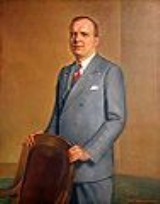
Harold Stassen

Harold Stassen

Overview
Harold Edward Stassen was the 25th Governor of Minnesota
Governor of Minnesota
The Governor of Minnesota is the chief executive of the U.S. state of Minnesota, leading the state's executive branch. Forty different people have been governors of the state, though historically there were also three governors of Minnesota Territory. Alexander Ramsey, the first territorial...

 from 1939 to 1943. After service in World War II, from 1948 to 1953 he was president of the University of Pennsylvania
University of Pennsylvania
The University of Pennsylvania is a private, Ivy League university located in Philadelphia, Pennsylvania, United States. Penn is the fourth-oldest institution of higher education in the United States,Penn is the fourth-oldest using the founding dates claimed by each institution...

. In popular culture his name has become most identified with his fame as a perennial candidate
Perennial candidate
A perennial candidate is one who frequently runs for public office with a record of success that is infrequent, if existent at all. Perennial candidates are often either members of minority political parties or have political opinions that are not mainstream. They may run without any serious hope...

 for other offices, most notably and frequently President of the United States.
Discussion
Ask a question about 'Harold Stassen'
Start a new discussion about 'Harold Stassen'
Answer questions from other users
Full Discussion Forum
 
Unanswered Questions
Encyclopedia
Harold Edward Stassen was the 25th Governor of Minnesota
Governor of Minnesota
The Governor of Minnesota is the chief executive of the U.S. state of Minnesota, leading the state's executive branch. Forty different people have been governors of the state, though historically there were also three governors of Minnesota Territory. Alexander Ramsey, the first territorial...

 from 1939 to 1943. After service in World War II, from 1948 to 1953 he was president of the University of Pennsylvania
University of Pennsylvania
The University of Pennsylvania is a private, Ivy League university located in Philadelphia, Pennsylvania, United States. Penn is the fourth-oldest institution of higher education in the United States,Penn is the fourth-oldest using the founding dates claimed by each institution...

. In popular culture his name has become most identified with his fame as a perennial candidate
Perennial candidate
A perennial candidate is one who frequently runs for public office with a record of success that is infrequent, if existent at all. Perennial candidates are often either members of minority political parties or have political opinions that are not mainstream. They may run without any serious hope...

 for other offices, most notably and frequently President of the United States.

Birth to 1940


Stassen, the fourth of five children, was born in West St. Paul, Minnesota
West St. Paul, Minnesota
As of the census of 2000, there were 19,405 people, 8,645 households, and 4,875 families residing in the city. The population density was 3,874.2 people per square mile . There were 8,779 housing units at an average density of 1,752.7 per square mile...

, to Elsie Emma (née Mueller) and William Andrew Stassen, a farmer and several times mayor of West St. Paul. He graduated from high school at age 14. At the University of Minnesota
University of Minnesota
The University of Minnesota, Twin Cities is a public research university located in Minneapolis and St. Paul, Minnesota, United States. It is the oldest and largest part of the University of Minnesota system and has the fourth-largest main campus student body in the United States, with 52,557...

 Stassen was an intercollegiate debater, captain of the champion university rifle team in 1927, and received bachelor's and law degrees in 1929. After opening a law office with Elmer J. Ryan in South St. Paul
South St. Paul, Minnesota
South St. Paul is a city in Dakota County, Minnesota, immediately south and southeast of the city of Saint Paul, Minnesota. It is also southeast of West St. Paul, Minnesota. The population was 20,160 at the 2010 census. It is notable as one of the historic major meat packing cities in the United...

 that year, he was elected District Attorney of Dakota County
Dakota County, Minnesota
Dakota County is the third most populous county in the U.S. state of Minnesota. The county is bordered by the Minnesota and Mississippi Rivers on the north, and the state of Wisconsin on the east. Dakota County comprises the southeast portion of seven-county Minneapolis-St. Paul, the thirteenth...

 in 1930 and 1934, then elected Governor of Minnesota in 1938. Stassen was seen as an "up and comer" after delivering the keynote
Keynote
A keynote in literature, music, or public speaking establishes the principal underlying theme. In corporate or commercial settings, greater importance is attached to the delivery of a keynote speech or keynote address...

 address at the 1940 Republican National Convention
1940 Republican National Convention
The 1940 Republican National Convention was held in Philadelphia, Pennsylvania, from June 24 to June 28, 1940. It nominated Wendell Willkie of Indiana for President and Senator Charles McNary of Oregon for Vice-President....

. There he worked to help Wendell Willkie
Wendell Willkie
Wendell Lewis Willkie was a corporate lawyer in the United States and a dark horse who became the Republican Party nominee for the president in 1940. A member of the liberal wing of the GOP, he crusaded against those domestic policies of the New Deal that he thought were inefficient and...

 win the Republican Party
Republican Party (United States)
The Republican Party is one of the two major contemporary political parties in the United States, along with the Democratic Party. Founded by anti-slavery expansion activists in 1854, it is often called the GOP . The party's platform generally reflects American conservatism in the U.S...

 (GOP) nomination for the presidency.

World War II


Stassen, who was reelected in 1940 and 1942, supported President Franklin D. Roosevelt
Franklin D. Roosevelt
Franklin Delano Roosevelt , also known by his initials, FDR, was the 32nd President of the United States and a central figure in world events during the mid-20th century, leading the United States during a time of worldwide economic crisis and world war...

's foreign policy and encouraged the state Republican Party to repudiate American isolationism before the attack on Pearl Harbor
Attack on Pearl Harbor
The attack on Pearl Harbor was a surprise military strike conducted by the Imperial Japanese Navy against the United States naval base at Pearl Harbor, Hawaii, on the morning of December 7, 1941...

. During the 1942 campaign he announced that, if reelected, he would resign to serve on active duty with the United States Naval Reserve, which Stassen had joined with the rank of Lieutenant Commander the previous year. After being promoted to Commander, he joined the staff of Admiral
Admiral
Admiral is the rank, or part of the name of the ranks, of the highest naval officers. It is usually considered a full admiral and above vice admiral and below admiral of the fleet . It is usually abbreviated to "Adm" or "ADM"...

 William F. Halsey, Commander of the South Pacific Force and served for two years. He left active duty at the rank of Captain in November, 1945.

After the war


Stassen lost some of his political base while overseas, whereas Republican candidates such as Thomas E. Dewey had a chance to increase theirs. Stassen was a delegate at the San Francisco Conference
United Nations Conference on International Organization
The United Nations Conference on International Organization was a convention of delegates from 50 Allied nations that took place from 25 April 1945 to 26 June 1945 in San Francisco, California. At this convention, the delegates reviewed and rewrote the Dumbarton Oaks agreements...

 that established the United Nations, and president of the University of Pennsylvania
University of Pennsylvania
The University of Pennsylvania is a private, Ivy League university located in Philadelphia, Pennsylvania, United States. Penn is the fourth-oldest institution of higher education in the United States,Penn is the fourth-oldest using the founding dates claimed by each institution...

 from 1948 to 1953. His attempt to increase the prominence of the university football team
Penn Quakers football
The Penn Quakers football team is the college football team at the University of Pennsylvania in Philadelphia, PA. The Penn Quakers have competed in the Ivy League since its inaugural season of 1956, and are currently a Division I Football Championship Subdivision member of the National...

 was unpopular and soon abandoned. From 1953 to 1955 he was the director of President Dwight D. Eisenhower
Dwight D. Eisenhower
Dwight David "Ike" Eisenhower was the 34th President of the United States, from 1953 until 1961. He was a five-star general in the United States Army...

's short-lived Foreign Operations Administration
United States Foreign Operations Administration
The Foreign Operations Administration was created in 1953 under the directorship of Harold Stassen. Its purpose was "was intended to centralize all governmental operations, as distinguished from policy formulation, that had as their purpose the cooperative development of economic and military...

.

Presidential candidate


Stassen was later best known for being a perennial candidate
Perennial candidate
A perennial candidate is one who frequently runs for public office with a record of success that is infrequent, if existent at all. Perennial candidates are often either members of minority political parties or have political opinions that are not mainstream. They may run without any serious hope...

 for the Republican Party nomination for President of the United States, seeking it 12 times between 1944 and 2000 (1944
United States presidential election, 1944
The United States presidential election of 1944 took place while the United States was preoccupied with fighting World War II. President Franklin D. Roosevelt had been in office longer than any other president, but remained popular. Unlike 1940, there was little doubt that Roosevelt would run for...

, 1948
United States presidential election, 1948
The United States presidential election of 1948 is considered by most historians as the greatest election upset in American history. Virtually every prediction indicated that incumbent President Harry S. Truman would be defeated by Republican Thomas E. Dewey. Truman won, overcoming a three-way...

 1952
United States presidential election, 1952
The United States presidential election of 1952 took place in an era when Cold War tension between the United States and the Soviet Union was escalating rapidly. In the United States Senate, Republican Senator Joseph McCarthy of Wisconsin had become a national figure after chairing congressional...

, 1964
United States presidential election, 1964
The United States presidential election of 1964 was held on November 3, 1964. Incumbent President Lyndon B. Johnson had come to office less than a year earlier following the assassination of his predecessor, John F. Kennedy. Johnson, who had successfully associated himself with Kennedy's...

, 1968
United States presidential election, 1968
The United States presidential election of 1968 was the 46th quadrennial United States presidential election. Coming four years after Democrat Lyndon B. Johnson won in a historic landslide, it saw Johnson forced out of the race and Republican Richard Nixon elected...

, 1976
United States presidential election, 1976
The United States presidential election of 1976 followed the resignation of President Richard Nixon in the wake of the Watergate scandal. It pitted incumbent President Gerald Ford, the Republican candidate, against the relatively unknown former governor of Georgia, Jimmy Carter, the Democratic...

, 1980
United States presidential election, 1980
The United States presidential election of 1980 featured a contest between incumbent Democrat Jimmy Carter and his Republican opponent, Ronald Reagan, as well as Republican Congressman John B. Anderson, who ran as an independent...

, 1984
United States presidential election, 1984
The United States presidential election of 1984 was a contest between the incumbent President Ronald Reagan, the Republican candidate, and former Vice President Walter Mondale, the Democratic candidate. Reagan was helped by a strong economic recovery from the deep recession of 1981–1982...

, 1988
United States presidential election, 1988
The United States presidential election of 1988 featured no incumbent president, as President Ronald Reagan was unable to seek re-election after serving the maximum two terms allowed by the Twenty-second Amendment. Reagan's Vice President, George H. W. Bush, won the Republican nomination, while the...

, 1992
United States presidential election, 1992
The United States presidential election of 1992 had three major candidates: Incumbent Republican President George Bush; Democratic Arkansas Governor Bill Clinton, and independent Texas businessman Ross Perot....

, 1996
United States presidential election, 1996
The United States presidential election of 1996 was a contest between the Democratic national ticket of President Bill Clinton of Arkansas and Vice President Al Gore of Tennessee and the Republican national ticket of former Senator Bob Dole of Kansas for President and former Housing Secretary Jack...

, and 2000
United States presidential election, 2000
The United States presidential election of 2000 was a contest between Republican candidate George W. Bush, then-governor of Texas and son of former president George H. W. Bush , and Democratic candidate Al Gore, then-Vice President....

), but never winning it or, after 1952, even coming close. He did receive votes at the Republican National Convention as late as 1968 when he won two votes for president (one from Minnesota and the other from his nephew, an Ohio
Ohio
Ohio is a Midwestern state in the United States. The 34th largest state by area in the U.S.,it is the 7th‑most populous with over 11.5 million residents, containing several major American cities and seven metropolitan areas with populations of 500,000 or more.The state's capital is Columbus...

 delegate). In 1992
Republican Party (United States) presidential primaries, 1992
The 1992 Republican presidential primaries were the selection process by which voters of the Republican Party chose its nominee for President of the United States in the 1992 U.S. presidential election. Incumbent President George H.W...

, the results of an experimental Presidential preference primary in Minnesota should have bound the state's Republican Party Convention to elect one delegate to the Republican National Convention who was pledged to vote for Stassen. Stassen's name was placed in nomination for a national delegate slot; however, he was defeated in the voting on the convention floor by Tim Holtz, a young pro-life
Pro-life
Opposition to the legalization of abortion is centered around the pro-life, or anti-abortion, movement, a social and political movement opposing elective abortion on moral grounds and supporting its legal prohibition or restriction...

 activist whose candidacy was pushed by Minnesota Citizens Concerned for Life
Minnesota Citizens Concerned for Life
Minnesota Citizens Concerned for Life is the oldest and largest right-to-life/pro-life organization in Minnesota and an affiliate of the National Right to Life Committee...

. Holtz went to the national convention and cast his vote for incumbent George H.W. Bush, thus denying Stassen the opportunity to represent himself as a delegate or even to receive the single vote to which he was entitled.

Stassen also ran for:
  • Dakota County District Attorney (he won in 1930 and 1934)
  • Governor of Minnesota on four occasions (he won on his first three attempts in 1938, 1940, and 1942, but was unsuccessful in 1982)
  • Governor of Pennsylvania
    Pennsylvania
    The Commonwealth of Pennsylvania is a U.S. state that is located in the Northeastern and Mid-Atlantic regions of the United States. The state borders Delaware and Maryland to the south, West Virginia to the southwest, Ohio to the west, New York and Ontario, Canada, to the north, and New Jersey to...

     twice
  • United States Senate
    United States Senate
    The United States Senate is the upper house of the bicameral legislature of the United States, and together with the United States House of Representatives comprises the United States Congress. The composition and powers of the Senate are established in Article One of the U.S. Constitution. Each...

     twice
  • Mayor of Philadelphia once
  • U.S. Representative (he was the Republican nominee against Bruce Vento
    Bruce Vento
    Bruce Frank Vento was an American politician, a Democratic-Farmer-Labor member of the United States House of Representatives from 1977 until his death in 2000...

     of Minnesota in 1986)


Stassen's strongest bid for the presidential nomination was in 1948, when he won a series of upset victories in early primaries
Primary election
A primary election is an election in which party members or voters select candidates for a subsequent election. Primary elections are one means by which a political party nominates candidates for the next general election....

. Polls showed that he would beat Harry S Truman if nominated. He lost the nomination to Thomas Dewey
Thomas Dewey
Thomas Edmund Dewey was the 47th Governor of New York . In 1944 and 1948, he was the Republican candidate for President, but lost both times. He led the liberal faction of the Republican Party, in which he fought conservative Ohio Senator Robert A. Taft...

, however, who went on to lose to Truman
United States presidential election, 1948
The United States presidential election of 1948 is considered by most historians as the greatest election upset in American history. Virtually every prediction indicated that incumbent President Harry S. Truman would be defeated by Republican Thomas E. Dewey. Truman won, overcoming a three-way...

.

Stassen played a key role in the 1952 Republican contest when he released his delegates to Dwight D. Eisenhower
Dwight D. Eisenhower
Dwight David "Ike" Eisenhower was the 34th President of the United States, from 1953 until 1961. He was a five-star general in the United States Army...

. This helped Eisenhower to defeat Robert Taft
Robert Taft
Robert Alphonso Taft , of the Taft political family of Cincinnati, was a Republican United States Senator and a prominent conservative statesman...

 on the first ballot. He served in the Eisenhower Administration, filling posts including director of the Mutual Security Administration (foreign aid) and Special Assistant to the President for Disarmament. During this period he held cabinet rank and led a quixotic effort (perhaps covertly encouraged by Eisenhower, who had serious reservations about Richard Nixon
Richard Nixon
Richard Milhous Nixon was the 37th President of the United States, serving from 1969 to 1974. The only president to resign the office, Nixon had previously served as a US representative and senator from California and as the 36th Vice President of the United States from 1953 to 1961 under...

's qualifications for the presidency) to "dump Nixon" at the 1956 Republican Convention. When he left the Eisenhower Administration in 1958, he became a candidate for the Republican nomination for governor of Pennsylvania. His defeat in this race – which was not close – generally was seen as marking the end of his importance as a political figure, although he became a candidate on many occasions in the ensuing years. Though he maintained a successful law practice in Philadelphia and was a major figure of the World War II and immediate post-war eras, he nonetheless became the subject of jokes, even wearing a toupee in an apparent effort to look younger and hence presumably more electable. The humor was collective, with the 'Stop Stassen' movement often attracting more attention than Stassen's bid for the nomination.He made his last attempt at the presidency in 1992.

Religious life


Stassen gained a reputation as a liberal, particularly when, as president of the American Baptist Convention in 1963, he joined Martin Luther King in his march on Washington, D.C. Much of Stassen's political thought came from his religious beliefs. He held important positions in his denomination and in local and national councils of churches. Baptists writing memorials remembered him as much as a church figure as a political candidate.

Death


On the death of Happy Chandler
Happy Chandler
Albert Benjamin "Happy" Chandler, Sr. was a politician from the US state of Kentucky. He represented the state in the U.S. Senate and served as its 44th and 49th governor. Aside from his political positions, he also served as the second Commissioner of Major League Baseball from 1945 to 1951 and...

, Stassen became the eldest governor of any U.S. state still living. When he died, the title was passed to Charles Poletti
Charles Poletti
Charles Poletti was an American lawyer and politician. He was the 46th Governor of New York in 1942, and was the first Italian-American governor in the United States.-Early life and education:...

, a former governor of New York State. Stassen died in 2001 in Bloomington, Minnesota
Bloomington, Minnesota
Bloomington is the fifth largest city in the U.S. state of Minnesota in Hennepin County. Located on the north bank of the Minnesota River above its confluence with the Mississippi River, Bloomington lies at the heart of the southern...

 at the age of 93 and is buried at the Acacia Park Cemetery
Acacia Park Cemetery, Mendota Heights
Acacia Park Cemetery is located in Mendota Heights, Minnesota at 2151 Pilot Knob Road. Established in 1925, Acacia Park consists of of land overlooking the confluence of the Minnesota and Mississippi Rivers. In addition, Dakota Indians had buried their dead on the same site prior to acquisition...

 in Mendota Heights, Minnesota
Mendota Heights, Minnesota
At the 2000 census, there were 11,434 people, 4,178 households and 3,237 families residing in the town. The population density was 1,222.2 per square mile . There were 4,252 housing units at an average density of 454.5 per square mile...

. The Minnesota Department of Revenue headquarters near the State Capitol
Minnesota State Capitol
The Minnesota State Capitol is located in Minnesota's capital city, Saint Paul, and houses the Minnesota Senate, Minnesota House of Representatives, the Office of the Attorney General and the Office of the Governor...

 is named for him.

Cultural references

  • In The Simpsons
    The Simpsons
    The Simpsons is an American animated sitcom created by Matt Groening for the Fox Broadcasting Company. The series is a satirical parody of a middle class American lifestyle epitomized by its family of the same name, which consists of Homer, Marge, Bart, Lisa and Maggie...

     episode, Kill Gil, Volumes I & II
    Kill Gil, Volumes I & II
    "Kill Gil, Volumes I & II" is the ninth episode of The Simpsons eighteenth season which originally aired on December 17, 2006. This episode won a Writers Guild of America Award for best animation. The title of this episode is a reference to Kill Bill Vol. 1 & 2. This episode aired exactly 17 years...

    , houseguest Gil Gunderson prepares breakfast for Bart and Lisa and asks, "Hey, who wants some eggs a la Harold Stassen? They're always running!"

  • In a 1988 essay entitled "Last Train from Camelot" written by Hunter S. Thompson
    Hunter S. Thompson
    Hunter Stockton Thompson was an American journalist and author who wrote The Rum Diary , Fear and Loathing in Las Vegas and Fear and Loathing on the Campaign Trail '72 .He is credited as the creator of Gonzo journalism, a style of reporting where reporters involve themselves in the action to...

    . "Others are not so lucky and are doomed, like Harold Stassen, to wallow for the rest of their lives in the backwaters of local politics, cheap crooks, and relentless humiliating failures."

  • In episode 818 of Mystery Science Theater 3000
    Mystery Science Theater 3000
    Mystery Science Theater 3000 is an American cult television comedy series created by Joel Hodgson and produced by Best Brains, Inc., that ran from 1988 to 1999....

    , Devil Doll, the Great Vorelli says to his dummy Hugo, "You'll never win. You'll always lose." Crow T. Robot
    Crow T. Robot
    Crow T. Robot is a fictional character from the American science fiction comedy television series Mystery Science Theater 3000 . Crow is a robot, who, along with others, quips and riffs upon poor-quality B movies.- Overview :...

     quips, "You're Harold Stassen."

  • In a Doonesbury
    Doonesbury
    Doonesbury is a comic strip by American cartoonist Garry Trudeau, that chronicles the adventures and lives of an array of characters of various ages, professions, and backgrounds, from the President of the United States to the title character, Michael Doonesbury, who has progressed from a college...

     comic strip of March 3, 1971, poker players compare their hands, one says his has the winning power of Richard Nixon
    Richard Nixon
    Richard Milhous Nixon was the 37th President of the United States, serving from 1969 to 1974. The only president to resign the office, Nixon had previously served as a US representative and senator from California and as the 36th Vice President of the United States from 1953 to 1961 under...

    , one says he has the challenging strength of Edmund Muskie
    Edmund Muskie
    Edmund Sixtus "Ed" Muskie was an American politician from Rumford, Maine. He served as Governor of Maine from 1955 to 1959, as a member of the United States Senate from 1959 to 1980, and as Secretary of State under Jimmy Carter from 1980 to 1981...

    , the last simply says Harold Stassen.

Electoral history


Records


In the Harold E. Stassen Papers at the Minnesota Historical Society, digital content is available for researcher use. Researchers will find content that includes, but is not limited to: speech files, handwritten notes, memoranda, annotated briefings, correspondence, war diaries, working papers, and draft charters for the United Nations.
The entire Harold E. Stassen collection includes campaign and political, naval service, United Nations, Eisenhower administration, and organizational membership files of the Minnesota Governor (1938–1943), Naval Officer (1943–1945), United Nations delegate (April–June 1945), Presidential contender (1948), and Eisenhower cabinet member and Director of the Mutual Security Agency (1953–1958), documenting most aspects of Stassen's six-decade career, including all of his public offices, campaigns, and Republican Party and other non-official activities.
Digital selections from this manuscript collection were made based on user and researcher interest, historic significance, and copyright status.

External links