


Grateful Dead

Encyclopedia
The Grateful Dead was an American rock band
formed in 1965 in the San Francisco Bay Area
. The band was known for its unique and eclectic style, which fused elements of rock
, folk
, bluegrass
, blues
, reggae
, country
, improvisational jazz
, psychedelia
, and space rock
, and for live performances of long musical improvisation
. "Their music," writes Lenny Kaye
, "touches on ground that most other groups don't even know exists." These various influences were distilled into a diverse and psychedelic
whole that made the Grateful Dead "the pioneering Godfathers of the jam band
world." They were ranked 57th in the issue The Greatest Artists of all Time by Rolling Stone
magazine.
The fans of the Grateful Dead, some of whom followed the band from concert to concert for years, are known as "Deadhead
s" and are known for their dedication to the band's music. Many referred to the band simply as "the Dead"; from 2003 to 2009 former members of the Grateful Dead, along with other musicians, toured as The Dead
.
(guitar
, vocals
), Bob Weir
(guitar, vocals), Ron "Pigpen" McKernan (keyboards
, harmonica
, vocals), Phil Lesh
(bass
, vocals), and Bill Kreutzmann
(drums
). Lesh was the last member to join the Warlocks before they became the Grateful Dead; he replaced Dana Morgan Jr., who had played bass for a few gigs. With the exception of McKernan, who died in 1973, the core of the band stayed together for its entire 30 year history.
Phil Lesh and Jerry Garcia were brought together by Gert Chiarito in 1964 to perform on The Midnight Special, her Saturday night radio program on KPFA
, Berkeley.
The Grateful Dead began their career as the Warlocks, a group formed in early 1965 from the remnants of a Palo Alto jug band
called Mother McCree's Uptown Jug Champions
. The band's first show was at Magoo's Pizza in suburban Menlo Park, California
on May 5, 1965. They were still known as the Warlocks although the Velvet Underground was also using that name on the east coast. The show was not recorded and not even the set list has been preserved. The band changed its name after finding out that another band of the same name had signed a recording contract (not the Velvet Underground who by then had also changed their name). The first show under the new name Grateful Dead was in San Jose, California
on December 4, 1965, at one of Ken Kesey
's Acid Tests
. Earlier demo tapes have survived, but the first of over 2,000 concerts known to have been recorded by the band's fans was a show at the Fillmore Auditorium
in San Francisco on January 8, 1966. Later on that month, the Grateful Dead played at the Trips Festival, an early psychedelic rock
show.
The name "Grateful Dead" was chosen from a dictionary. According to Phil Lesh, in his biography (pp. 62), "...[Jerry Garcia] picked up an old Britannica
World Language Dictionary...[and]...In that silvery elf-voice he said to me, 'Hey, man, how about the Grateful Dead?'" The definition there was "the soul of a dead person, or his angel, showing gratitude to someone who, as an act of charity, arranged their burial." According to Alan Trist, director of the Grateful Dead's music publisher company Ice Nine
, Garcia found the name in the Funk & Wagnalls Folklore Dictionary, when his finger landed on that phrase while playing a game of "dictionary
". In the Garcia biography, Captain Trips, author Sandy Troy states that the band was smoking the psychedelic DMT
at the time. The term "grateful dead
" appears in folktales of a variety of cultures. In the summer of '69, Phil Lesh told another version of the story to Carol Maw, a young Texan visiting with the band in Marin County who also ended up going on the road with them to the Fillmore East
and Woodstock
. In this version, Phil said, "Jerry found the name spontaneously when he picked up a dictionary and the pages fell open. The words 'grateful' and 'dead' appeared straight opposite each other across the crack between the pages in unrelated text."
Other supporting personnel who signed on early included Rock Scully
, who heard of the band from Kesey and signed on as manager after meeting them at the Big Beat Acid Test; Stewart Brand
, "with his side show of taped music and slides of Indian life, a multimedia presentation" at the Big Beat and then, expanded, at the Trips Festival; and Owsley Stanley
, the "Acid King" whose LSD supplied the tests and who, in early 1966, became the band's financial backer, renting them a house on the fringes of Watts and buying them sound equipment. "We were living solely off of Owsley's good graces at that time.... [His] trip was he wanted to design equipment for us, and we were going to have to be in sort of a lab situation for him to do it," said Garcia.
 One of the group's earliest major performances in 1967 was the Mantra-Rock Dance
—a musical event held on January 29, 1967 at the Avalon Ballroom by the San Francisco Hare Krishna temple. The Grateful Dead performed at the event along with the Hare Krishna founder Bhaktivedanta Swami, poet Allen Ginsberg
, bands Moby Grape
and Big Brother and the Holding Company
with Janis Joplin
, donating proceeds to the Krishna temple. The band's first LP, The Grateful Dead
, was released on Warner Brothers in 1967.
Classically trained trumpeter Phil Lesh
played bass guitar
. Bob Weir
, the youngest original member of the group, played rhythm guitar
. Ron "Pigpen" McKernan played keyboards
and harmonica
until shortly before his death in 1973 at the age of 27. Garcia, Weir and McKernan shared the lead vocal duties more or less equally; Lesh only sang a few leads but his tenor was a key part of the band's three-part vocal harmonies. Bill Kreutzmann
played drum
s, and in September 1967 was joined by a second drummer, New York native Mickey Hart
, who also played a wide variety of other percussion
instruments.
The year 1970 included tour dates in New Orleans, Louisiana
, where the band performed at The Warehouse
for two nights. On January 31, 1970, the local police raided their hotel on Bourbon Street
in the French Quarter
, and arrested and charged a total of 19 people with possession of various drugs. The second night's concert was performed as scheduled after bail was posted. Eventually the charges were dismissed, with the exception of those against sound engineer Owsley Stanley
, who was already facing charges in California for manufacturing LSD. This event was later memorialized in the lyrics of the song "Truckin'
", a single from American Beauty which reached number 64 on the charts.
Hart quit the Grateful Dead in February 1971, leaving Kreutzmann once again as the sole percussionist. Mickey Hart rejoined the Grateful Dead for good in October 1974. Tom "TC" Constanten
was added as a second keyboardist from 1968 to 1970, while Pigpen also played various percussion instruments and sang.
After Constanten's departure, Pigpen reclaimed his position as sole organist. Less than two years later, in late 1971, Pigpen was joined by another keyboardist, Keith Godchaux, who played grand piano alongside Pigpen's Hammond B-3 organ
. In early 1972, Keith's wife, Donna Jean Godchaux, joined the Grateful Dead as a backing vocalist.
Following the Grateful Dead's "Europe '72
" tour, Pigpen's health had deteriorated to the point that he could no longer tour with the band. His final concert appearance was June 17, 1972 at the Hollywood Bowl
, in Los Angeles
; he died in March, 1973 of complications from alcohol abuse.
The death of Pigpen did not slow the band down, and they continued on with their new members. They soon formed their own record group, Grateful Dead Records. Later that year, they released their next studio album, the jazz influenced Wake of the Flood
. It became their biggest commercial success thus far. While touring in late 1973 the band began to use cocaine
in order to reduce the exhausting effects of constantly being on the road. Meanwhile, capitalizing on Flood’s success, the band soon went back to the studio, and the next year released another album, Grateful Dead from the Mars Hotel
. Not long after that album’s release however, the Grateful Dead decided to take a hiatus from live touring so that its members could focus on their solo careers. This hiatus was short lived, though, as they resumed touring in 1976. That same year, they re-signed with Arista Records. Their new contract soon produced Terrapin Station
in 1977. Although things appeared to be going well for the band, problems were arising with their two newest members, Keith and Donna Jean Godchaux. Donna frequently had excessive vocal issues while performing live, and Keith was becoming dependent on hard drugs. Both of those issues were causing complications with the band’s touring, and they were asked to leave the band in February 1979.
Following the departure of the Godchauxs, Brent Mydland
joined as keyboardist and vocalist and was considered "the perfect fit". The Godchauxs then formed the Heart of Gold Band
before Keith Godchaux died in a car accident in 1980. Mydland was the keyboardist for the Grateful Dead for 11 years until his death by narcotics overdose in July 1990, becoming the third Dead keyboardist to pass away.
During the 80's the band transformed as the impeccable talents of Mydland helped power the group. Shortly after Mydland found his place in the early 1980s, Garcia's health began to descend. His drug habits caused him to lose his liveliness on stage. After kicking his drug habit in 1985, Garcia slipped into a diabetic coma for several days in July 1986. After a quick recovery, the band released "In the Dark" in 1987, which resulted as their best selling studio album release. Inspired by Garcia's improved health and a successful album, the band's energy and chemistry peaked in the late 1980s and 1990. Performances were vigorous and as a result, every show exceeded its maximum audience capacity. The band's "high time" came to a sudden halt when Mydland died after the summer tour in 1990. The band was affected greatly, and now had to rebuild.
Vince Welnick
, former keyboardist for The Tubes
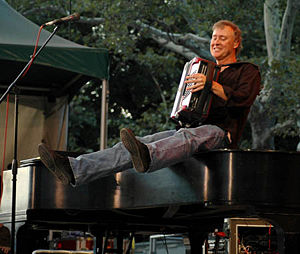
, joined on keyboards and vocals. Bruce Hornsby
joined the band as the pianist and vocals on September 15, 1990. Welnick stayed with the band until Garcia's death, but he was never a member of The Other Ones
or the Dead
. He did, however, play in early incarnations of Ratdog
with Bob Weir. Welnick died on June 2, 2006, reportedly a suicide. Hornsby was a member until March 24, 1992.
_2.jpg) Following Garcia's death in August 1995, the remaining members formally decided to disband. Since that time however, there have been a number of reunions by the surviving members
Following Garcia's death in August 1995, the remaining members formally decided to disband. Since that time however, there have been a number of reunions by the surviving members
involving various combinations of musicians.
In 1998, Bob Weir, Phil Lesh, and Mickey Hart, along with several other musicians, formed a band called The Other Ones
. The Other Ones performed a number of concerts that year, and released a live album, The Strange Remain
, the following year. In 2000, The Other Ones toured again, this time with Bill Kreutzmann but without Lesh. After taking another year off, the band was active again in 2002. With Lesh's return for this go-round, The Other Ones then included all four former Grateful Dead members who had been in the band for most or all of its history.
In 2003, The Other Ones changed their name to The Dead
. The Dead toured the country in 2003 and 2004. In 2008, members of The Dead played two concerts, called "Deadheads for Obama
" and "Change Rocks". In 2009 The Dead performed on a spring tour, and were at the Rothbury Music Festival on July 4, 2009.
Following the 2009 summer reunion tour bandmates Lesh and Weir formed the band Furthur
which debuted in September 2009. Joining Lesh and Weir in Furthur are Jeff Chimenti
(keyboard), John Kadlecik
(guitar), Joe Russo
(drums), Sunshine Becker
(vocalist), and Jeff Pehrson
(vocalist).
In 2010, Hart and Kreutzmann re-formed the Rhythm Devils
, and played a summer concert tour.
Since 1995, the former members of the Grateful Dead have also pursued solo musical careers. Bob Weir & RatDog have performed many concerts and released several albums, as have Phil Lesh and Friends
. Mickey Hart and Bill Kreutzmann have each led several different bands and have also released some albums. Recently Mickey Hart has been working with his Mickey Hart Band and Kreutzmann has been touring with BK3
, and with 7 Walkers
, a band he formed with Papa Mali
. Donna Godchaux has returned to the music scene, with the Donna Jean Godchaux Band
, and Tom Constanten
also continues to write and perform music. All of these groups continue to play Grateful Dead music.
Since 1995, there have also been a number of tribute bands, most of which tour regionally. The most notable tribute band is Dark Star Orchestra
(often referred to simply as DSO), which continues to tour nationally, despite having lost its co-founder, John Kadlecik, in 2009 when he was invited by Phil Lesh and Bob Weir to play guitar in their new project, Furthur. At some point after its founding in 1997, DSO began its attempt to recreate actual Grateful Dead shows with as much specificity as possible. This is possible thanks to the fan-created tapes available from many of the Grateful Dead shows.
, The Beach Boys
and The Rolling Stones
were dominating the airwaves. "The Beatles were why we turned from a jug band into a rock 'n' roll band," said Bob Weir. "What we saw them doing was impossibly attractive. Former folk-scene star Bob Dylan
had recently put out a couple of records featuring electric instrumentation. I couldn't think of anything else more worth doing" Grateful Dead members have said that it was after attending a concert by the touring New York City
band The Lovin' Spoonful
that they decided to "go electric" and look for a dirtier sound. Gradually, many of the East-Coast American folk musicians, formerly luminaries of the coffee-house scene, were moving in the electric direction. It was natural for Jerry Garcia
and Bob Weir
, each of whom had been immersed in the American folk music revival
of the late 1950s and early '60s, to be open-minded toward electric guitars. But the new Dead music was also naturally different from bands like Dylan's or the Spoonful, partly because their fellow musician Phil Lesh
came out of a schooled classical and electronic music
background, while Pigpen was a no-nonsense deep blues
lover and drummer Bill Kreutzmann had a jazz
and R&B
background. For comparison purposes, their first LP (The Grateful Dead
, Warner Brothers, 1967), was released in the same year that Pink Floyd
released The Piper at the Gates of Dawn
and The Beatles released Sgt. Pepper's Lonely Hearts Club Band
.
The Grateful Dead's early music (in the mid 1960s) was part of the process of establishing what "psychedelic music
" was, but theirs was essentially a "street party" form of it. They developed their "psychedelic" playing as a result of meeting Ken Kesey
in Palo Alto, CA and subsequently becoming the house band for the Acid Tests
he staged. After the Dead relocated to the Haight-Ashbury section of San Francisco, their "street party" form developed out of the many psychedelic dances, open-air park events, and closed-street Haight-Ashbury block parties at which they played. The Dead were not inclined to fit their music to an established category such as pop rock, blues, folk rock, or country/western. Individual tunes within their repertoire could be identified under one of these stylistic labels, but overall their music drew on all of these genres and more, frequently melding several of them. It was doubtless with this in mind that Bill Graham
said of the Grateful Dead, "They're not the best at what they do, they're the only ones that do what they do." Often (both in performance and on recording) the Dead left room for exploratory, spacey soundscapes.
Their live shows, fed by their improvisational approach to music, made the Grateful Dead different from most other touring bands. While most rock and roll bands rehearse a standard show for their tours that is replayed night after night, city after city, the Grateful Dead never did. As Garcia stated in an 1966 interview, "We don't make up our sets beforehand. We'd rather work off the tops of our heads than off a piece of paper." They maintained this operating ethic throughout their existence. For each performance, the band drew material from an active list of a hundred or so songs. Due to the band's varied song selection and the improvisational nature of their playing, no two Grateful Dead concerts were exactly the same.
The early records reflected the Dead's live repertoire—lengthy instrumental jams with group improvisation, best exemplified by "Dark Star
"—but, lacking the energy of the shows, did not sell well. The 1969 live album Live/Dead
did capture more of their essence, but commercial success did not come until Workingman's Dead
and American Beauty
, both released in 1970. These records largely featured the band's laid-back acoustic musicianship and more traditional song structures.
As the band and its sound matured over thirty years of touring, playing, and recording, each member's stylistic contribution became more defined, consistent, and identifiable. Lesh, who was originally a classically-trained trumpet player with an extensive background in music theory, did not tend to play traditional blues-based bass forms, but opted for more melodic, symphonic and complex lines, often sounding like a second lead guitar. Weir, too, was not a traditional rhythm guitarist, but tended to play jazz-influenced, unique inversions at the upper end of the Dead's sound. The two drummers, Mickey Hart
and Kreutzmann, developed a unique, complex interplay, balancing Kreutzmann's steady beat with Hart's interest in percussion styles outside the rock tradition. Hart incorporated an 11-count measure to his drumming, bringing a new dimension to the band's sound that became an important part of its emerging style. Garcia's lead lines were fluid, supple and spare, owing a great deal of their character to his training in fingerpicking
and banjo.
The band's primary lyricists, Robert Hunter
and John Perry Barlow
, commonly used themes involving love and loss, life and death, gambling and murder, beauty and horror, chaos and order, God and other religious themes, travelling and touring, etc. Less frequent ideas include the environment and issues from the world of politics.
was an entertainment industry attorney who specialized in representing musical groups. He spent 35 years as principal lawyer and general counsel for the Grateful Dead, a position in the group that was so strong that his business cards with the band identified his role as "Czar".
Kant brought the band millions of dollars in revenue through his management of the band's intellectual property
and merchandising rights. At Kant's recommendation, the group was one of the few rock 'n roll pioneers to retain ownership of their music masters and publishing rights
.
In 2006, the Grateful Dead signed a ten year licensing agreement with Rhino Entertainment
. Rhino is managing the Dead's business interests, including the release of musical recordings, merchandising, and marketing. In 2011 Rhino and Grateful Dead Productions began working with Curious Sense to develop an online and mobile social game built on the band's legacy. The band retains creative control and keeps ownership of the music catalog.
s, many of whom followed their tours for months or years on end. In their early career, the band also dedicated their time and talents to their community, the Haight-Ashbury area of San Francisco, making available free food, lodging, music and health care to all comers; they were the "first among equals in giving unselfishly of themselves to hippie culture, performing 'more free concerts than any band in the history of music'.
With the exception of 1975, when the band was on hiatus and played only four concerts together, the Grateful Dead performed many concerts every year, from their formation in April, 1965, until July 9, 1995. Initially all their shows were in California, principally in the San Francisco Bay Area
and in or near Los Angeles
. They also performed, in 1965 and 1966, with Ken Kesey and the Merry Pranksters
, as the house band for the Acid Tests
. They toured nationally starting in June 1967 (their first foray to New York), with a few detours to Canada
, Europe
and three nights at the Great Pyramid of Giza
in Egypt
in 1978. They appeared at the Monterey Pop Festival
in 1967, and at the Woodstock Festival
in 1969. Their first UK performance was at the Hollywood Music Festival
in 1970. Their largest concert audience came in 1973 when they played, along with The Allman Brothers Band
and The Band
, before an estimated 600,000 people at the Summer Jam at Watkins Glen
. Many of these concerts were preserved in the band's tape vault, and several dozen have since been released on CD and as downloads. The Dead were known for the tremendous variation in their setlists from night to night—the list of songs documented to have been played by the band exceeds 500.
Their numerous studio albums were generally collections of new songs that they had first played in concert. The band was also famous for its extended musical jams, which featured both individual improvisations as well as distinctive "group-mind" improvisations during which each of the band members improvised individually while simultaneously blending together as a cohesive musical unit. Musically, this may be illustrated in that the band not only improvised within the form of songs, but also with the form. The Grateful Dead have often been described as having never played the same song the same way twice. The cohesive listening abilities of each band member made for a transcendence of what might be called "free form" and improvisation. Their concert sets often blended songs, one into the next (a segue
).
was an enormous sound system designed specifically for the Grateful Dead. The band was never satisfied with the house system anywhere they played. After the Monterey Pop Festival, the band's crew, 'borrowed,' some of the other performers sound equipment and used it to host some free shows in San Francisco. So in their early days, soundman Owsley "Bear" Stanley
designed a public address
(PA) and monitor system for them. Bear was the Grateful Dead's soundman
for many years; he was also one of the largest suppliers of LSD. Stanley's sound systems were delicate and finicky, and frequently brought shows to a halt with technical breakdowns. After Stanley went to jail for manufacturing LSD in 1970, the group briefly used house PAs, but found them to be even less reliable than those built by their former soundman. In 1971, the band purchased their first solid-state
sound system from Alembic Inc
Studios. Because of this, Alembic would play an integral role in the research, development, and production of the Wall of Sound. The band also welcomed Dan Healy
into the fold on a permanent basis that year. Healy would mix the Grateful Dead's live sound until 1993.
set up their microphones wherever they could. The eventual forest of microphones became a problem for the official sound crew. Eventually this was solved by having a dedicated taping section located behind the soundboard, which required a special "tapers" ticket. The band allowed sharing of tapes of their shows, as long as no profits were made on the sale of their show tapes. Sometimes the sound crew would allow the tapers to connect directly to the soundboard, which created exceptional concert recordings. Recently, there have been some disputes over which recordings archive.org
could host on their site. Currently, all recordings are hosted, though soundboard recordings are not available for download, but rather in a streaming format. soundboard recordings from the Bill Graham Archive are available for free streaming and download at Grateful Dead. Of the approximately 2,350 shows the Grateful Dead played, almost 2,200 were taped, and most of these are available online. Concert set lists from a subset of 1,590 Grateful Dead shows were used to perform a comparative analysis between how songs were played in concert and how they are listened online by Last.fm
members. In their book Marketing Lessons from the Grateful Dead: What Every Business Can Learn From the Most Iconic Band in History, David Meerman Scott
and Brian Halligan
identify the taper section as a crucial idea in increasing the Grateful Dead's fan base.
s. While the origin of the term may be shrouded in haze, Dead Heads were made canon by the notice placed inside the Skull and Roses
album by manager Jon McIntire:
Many of the Dead Heads would go on tour with the band. As a group, the Dead Heads were considered very mellow. "I'd rather work nine Grateful Dead concerts than one Oregon football game," Police Det. Rick Raynor said. "They don't get belligerent like they do at the games".
, University of California, Santa Cruz
chancellor George Blumenthal
, and UC Santa Cruz librarian Virginia Steel, held a press conference announcing that UCSC's McHenry Library
would be the permanent home of the Grateful Dead's complete archival history from 1965 up to the present. The archive includes correspondence, photographs, fliers, posters, and several other forms of memorabilia and records of the band. Also included are unreleased videos of interviews and TV appearances that will be installed for visitors to view, as well as stage backdrops and other props from the band's concerts.
Blumenthal stated at the event, "The Grateful Dead Archive
represents one of the most significant popular cultural collections of the 20th century; UC Santa Cruz is honored to receive this invaluable gift. The Grateful Dead and UC Santa Cruz are both highly innovative institutions—born the same year—that continue to make a major, positive impact on the world." Guitarist Bob Weir stated, "We looked around, and UC Santa Cruz seems the best possible home. If you ever wrote the Grateful Dead a letter, you'll probably find it there!"
Professor of music Fredric Lieberman
was the key contact between the band and the university, who let the university know about the search for a home for the archive, and who had collaborated with Mickey Hart on three books in the past, Planet Drum (1990), Drumming at the Edge of Magic (1991), and Spirit into Sound (2006).
The first large-scale exhibition of materials from the Grateful Dead Archive was mounted at the New-York Historical Society
in 2010.
ist Jerry Garcia
was often seen both by the public and the media as the leader or primary spokesperson for the Grateful Dead, but was reluctant to be perceived that way, especially since he and the other group members saw themselves as equal participants
and contributors to their collective musical and creative output. Garcia, a native of San Francisco, grew up in the Excelsior District. One of his main influences was bluegrass music, and Garcia also performed—on banjo
, one of his other great instrumental loves, along with the pedal steel guitar
—in bluegrass bands, notably Old and in the Way
with mandolin
ist David Grisman
.
The singer-songwriter Bruce Hornsby
never officially joined the band, because of his other commitments, but he did play keyboards at most Dead shows between September 1990 and March 1992, and sat in with the band over one hundred times in all between 1988 and 1995.
Robert Hunter
and John Perry Barlow
were the band's primary lyricist
s. Twelve members of The Grateful Dead (the eleven official performing members plus Robert Hunter) were inducted into the Rock and Roll Hall of Fame
in 1994, and Bruce Hornsby
was their presenter.
On February 10, 2007, the Grateful Dead received a Grammy Lifetime Achievement Award
. The award was accepted on behalf of the band by Mickey Hart and Bill Kreutzmann.
Rock Band
Rock Band is a music video game developed by Harmonix Music Systems, published by MTV Games and Electronic Arts. It is the first title in the Rock Band series. The PlayStation 3 and Xbox 360 versions were released in the United States on November 20, 2007, while the PlayStation 2 version was...
formed in 1965 in the San Francisco Bay Area
San Francisco Bay Area
The San Francisco Bay Area, commonly known as the Bay Area, is a populated region that surrounds the San Francisco and San Pablo estuaries in Northern California. The region encompasses metropolitan areas of San Francisco, Oakland, and San Jose, along with smaller urban and rural areas...
. The band was known for its unique and eclectic style, which fused elements of rock
Rock music
Rock music is a genre of popular music that developed during and after the 1960s, particularly in the United Kingdom and the United States. It has its roots in 1940s and 1950s rock and roll, itself heavily influenced by rhythm and blues and country music...
, folk
Folk music
Folk music is an English term encompassing both traditional folk music and contemporary folk music. The term originated in the 19th century. Traditional folk music has been defined in several ways: as music transmitted by mouth, as music of the lower classes, and as music with unknown composers....
, bluegrass
Bluegrass music
Bluegrass music is a form of American roots music, and a sub-genre of country music. It has mixed roots in Scottish, English, Welsh and Irish traditional music...
, blues
Blues
Blues is the name given to both a musical form and a music genre that originated in African-American communities of primarily the "Deep South" of the United States at the end of the 19th century from spirituals, work songs, field hollers, shouts and chants, and rhymed simple narrative ballads...
, reggae
Reggae
Reggae is a music genre first developed in Jamaica in the late 1960s. While sometimes used in a broader sense to refer to most types of Jamaican music, the term reggae more properly denotes a particular music style that originated following on the development of ska and rocksteady.Reggae is based...
, country
Country music
Country music is a popular American musical style that began in the rural Southern United States in the 1920s. It takes its roots from Western cowboy and folk music...
, improvisational jazz
Jazz
Jazz is a musical style that originated at the beginning of the 20th century in African American communities in the Southern United States. It was born out of a mix of African and European music traditions. From its early development until the present, jazz has incorporated music from 19th and 20th...
, psychedelia
Psychedelic rock
Psychedelic rock is a style of rock music that is inspired or influenced by psychedelic culture and attempts to replicate and enhance the mind-altering experiences of psychedelic drugs. It emerged during the mid 1960s among folk rock and blues rock bands in United States and the United Kingdom...
, and space rock
Space rock
Space rock is a subgenre of rock music; the term originally referred to a group of early, mostly British, 1970s progressive and psychedelic rock bands such as Hawkwind and Pink Floyd, characterised by slow, lengthy instrumental passages dominated by electric organs, synthesizers, experimental...
, and for live performances of long musical improvisation
Musical improvisation
Musical improvisation is the creative activity of immediate musical composition, which combines performance with communication of emotions and instrumental technique as well as spontaneous response to other musicians...
. "Their music," writes Lenny Kaye
Lenny Kaye
Lenny Kaye is an American guitarist, composer and writer who is best known as a member of the Patti Smith Group.- Early life :...
, "touches on ground that most other groups don't even know exists." These various influences were distilled into a diverse and psychedelic
Psychedelic
The term psychedelic is derived from the Greek words ψυχή and δηλοῦν , translating to "soul-manifesting". A psychedelic experience is characterized by the striking perception of aspects of one's mind previously unknown, or by the creative exuberance of the mind liberated from its ostensibly...
whole that made the Grateful Dead "the pioneering Godfathers of the jam band
Jam band
-Ambiguity:By the late 1990s use of the term jam band also became ambiguous. An editorial at jamband.com suggested that any band of which a primary band such as Phish has done a cover of be included as jam band. The example was including New York post-punk band Talking Heads after Phish performed...
world." They were ranked 57th in the issue The Greatest Artists of all Time by Rolling Stone
Rolling Stone
Rolling Stone is a US-based magazine devoted to music, liberal politics, and popular culture that is published every two weeks. Rolling Stone was founded in San Francisco in 1967 by Jann Wenner and music critic Ralph J...
magazine.
The fans of the Grateful Dead, some of whom followed the band from concert to concert for years, are known as "Deadhead
Deadhead
Deadhead or Dead Head is a name given to fans of the American jam band, the Grateful Dead. In the 1970s, a number of fans began travelling to see the band in as many shows or festival venues as they could. With large numbers of people thus attending strings of shows, a community developed...
s" and are known for their dedication to the band's music. Many referred to the band simply as "the Dead"; from 2003 to 2009 former members of the Grateful Dead, along with other musicians, toured as The Dead
The Dead (band)
The Dead is an American rock band composed of some of the former members of the Grateful Dead.After the death of Jerry Garcia in 1995, Bob Weir, Phil Lesh, Mickey Hart, and Bill Kreutzmann formed a band called The Other Ones. They performed concert tours in 1998 , 2000 , and 2002, and released one...
.
Formation (1964–1966)
The founding members of the Grateful Dead were Jerry GarciaJerry Garcia
Jerome John "Jerry" Garcia was an American musician best known for his lead guitar work, singing and songwriting with the band the Grateful Dead...
(guitar
Electric guitar
An electric guitar is a guitar that uses the principle of direct electromagnetic induction to convert vibrations of its metal strings into electric audio signals. The signal generated by an electric guitar is too weak to drive a loudspeaker, so it is amplified before sending it to a loudspeaker...
, vocals
Singing
Singing is the act of producing musical sounds with the voice, and augments regular speech by the use of both tonality and rhythm. One who sings is called a singer or vocalist. Singers perform music known as songs that can be sung either with or without accompaniment by musical instruments...
), Bob Weir
Bob Weir
Bob Weir is an American singer, songwriter, and guitarist, most recognized as a founding member of the Grateful Dead. After the Grateful Dead disbanded in 1995, Weir performed with The Other Ones, later known as The Dead, together with other former members of the Grateful Dead...
(guitar, vocals), Ron "Pigpen" McKernan (keyboards
Keyboard instrument
A keyboard instrument is a musical instrument which is played using a musical keyboard. The most common of these is the piano. Other widely used keyboard instruments include organs of various types as well as other mechanical, electromechanical and electronic instruments...
, harmonica
Harmonica
The harmonica, also called harp, French harp, blues harp, and mouth organ, is a free reed wind instrument used primarily in blues and American folk music, jazz, country, and rock and roll. It is played by blowing air into it or drawing air out by placing lips over individual holes or multiple holes...
, vocals), Phil Lesh
Phil Lesh
Phillip Chapman Lesh is a musician and a founding member of the Grateful Dead, with whom he played bass guitar throughout their 30-year career....
(bass
Bass guitar
The bass guitar is a stringed instrument played primarily with the fingers or thumb , or by using a pick....
, vocals), and Bill Kreutzmann
Bill Kreutzmann
Bill Kreutzmann is an American drummer who played with the rock band the Grateful Dead for their entire thirty-year career...
(drums
Drum kit
A drum kit is a collection of drums, cymbals and often other percussion instruments, such as cowbells, wood blocks, triangles, chimes, or tambourines, arranged for convenient playing by a single person ....
). Lesh was the last member to join the Warlocks before they became the Grateful Dead; he replaced Dana Morgan Jr., who had played bass for a few gigs. With the exception of McKernan, who died in 1973, the core of the band stayed together for its entire 30 year history.
Phil Lesh and Jerry Garcia were brought together by Gert Chiarito in 1964 to perform on The Midnight Special, her Saturday night radio program on KPFA
KPFA
KPFA is a listener-funded progressive talk radio and music radio station located in Berkeley, California, broadcasting to the San Francisco Bay Area. KPFA airs public news, public affairs, talk, and music programming. The station signed on-the-air April 15 1949, as the first Pacifica Station...
, Berkeley.
The Grateful Dead began their career as the Warlocks, a group formed in early 1965 from the remnants of a Palo Alto jug band
Jug band
A Jug band is a band employing a jug player and a mix of traditional and home-made instruments. These home-made instruments are ordinary objects adapted to or modified for making of sound, like the washtub bass, washboard, spoons, stovepipe and comb & tissue paper...
called Mother McCree's Uptown Jug Champions
Mother McCree's Uptown Jug Champions (album)
Mother McCree's Uptown Jug Champions is an American folk music album. It was recorded live by the band of the same name at the Top of the Tangent coffee house in Palo Alto, California in July, 1964, and released in 1999....
. The band's first show was at Magoo's Pizza in suburban Menlo Park, California
Menlo Park, California
Menlo Park, California is a city at the eastern edge of San Mateo County, in the San Francisco Bay Area of California, in the United States. It is bordered by San Francisco Bay on the north and east; East Palo Alto, Palo Alto, and Stanford to the south; Atherton, North Fair Oaks, and Redwood City...
on May 5, 1965. They were still known as the Warlocks although the Velvet Underground was also using that name on the east coast. The show was not recorded and not even the set list has been preserved. The band changed its name after finding out that another band of the same name had signed a recording contract (not the Velvet Underground who by then had also changed their name). The first show under the new name Grateful Dead was in San Jose, California
San Jose, California
San Jose is the third-largest city in California, the tenth-largest in the U.S., and the county seat of Santa Clara County which is located at the southern end of San Francisco Bay...
on December 4, 1965, at one of Ken Kesey
Ken Kesey
Kenneth Elton "Ken" Kesey was an American author, best known for his novel One Flew Over the Cuckoo's Nest , and as a counter-cultural figure who considered himself a link between the Beat Generation of the 1950s and the hippies of the 1960s. "I was too young to be a beatnik, and too old to be a...
's Acid Tests
Acid Tests
The Acid Tests were a series of parties held by Ken Kesey in the San Francisco Bay Area during the mid 1960s, centered entirely around the use of, experimentation with, and advocacy of, the psychedelic drug LSD, also known as "acid."...
. Earlier demo tapes have survived, but the first of over 2,000 concerts known to have been recorded by the band's fans was a show at the Fillmore Auditorium
The Fillmore
The Fillmore Auditorium is a historic music venue in San Francisco, California, made famous by Bill Graham. Named for its original location at the intersection of Fillmore Street and Geary Boulevard, it lies on the boundary of the Western Addition and the Pacific Heights neighborhoods.In 1968,...
in San Francisco on January 8, 1966. Later on that month, the Grateful Dead played at the Trips Festival, an early psychedelic rock
Psychedelic rock
Psychedelic rock is a style of rock music that is inspired or influenced by psychedelic culture and attempts to replicate and enhance the mind-altering experiences of psychedelic drugs. It emerged during the mid 1960s among folk rock and blues rock bands in United States and the United Kingdom...
show.
The name "Grateful Dead" was chosen from a dictionary. According to Phil Lesh, in his biography (pp. 62), "...[Jerry Garcia] picked up an old Britannica
Encyclopædia Britannica
The Encyclopædia Britannica , published by Encyclopædia Britannica, Inc., is a general knowledge English-language encyclopaedia that is available in print, as a DVD, and on the Internet. It is written and continuously updated by about 100 full-time editors and more than 4,000 expert...
World Language Dictionary...[and]...In that silvery elf-voice he said to me, 'Hey, man, how about the Grateful Dead?'" The definition there was "the soul of a dead person, or his angel, showing gratitude to someone who, as an act of charity, arranged their burial." According to Alan Trist, director of the Grateful Dead's music publisher company Ice Nine
Ice Nine
Ice-nine is a fictional solid polymorph of water from Kurt Vonnegut's Cat's Cradle.Ice-nine may also refer to:*Ice-Nine, a Grammy-nominated musical composition by Steve Wiest, recorded by the One O'Clock Lab Band on Lab 2009...
, Garcia found the name in the Funk & Wagnalls Folklore Dictionary, when his finger landed on that phrase while playing a game of "dictionary
Fictionary
Fictionary, also known as the Dictionary Game or simply Dictionary, is a word game in which players guess the definition of an obscure word....
". In the Garcia biography, Captain Trips, author Sandy Troy states that the band was smoking the psychedelic DMT
Dimethyltryptamine
N,N-Dimethyltryptamine is a naturally occurring psychedelic compound of the tryptamine family. DMT is found in several plants, and also in trace amounts in humans and other mammals, where it is originally derived from the essential amino acid tryptophan, and ultimately produced by the enzyme INMT...
at the time. The term "grateful dead
Grateful dead (folklore)
Grateful dead is a folktale present in many cultures throughout the world. The most common story involves a traveler who encounters a corpse of someone who never received a proper burial, typically stemming from an unpaid debt. The traveler then either pays off the dead person's debt or pays for...
" appears in folktales of a variety of cultures. In the summer of '69, Phil Lesh told another version of the story to Carol Maw, a young Texan visiting with the band in Marin County who also ended up going on the road with them to the Fillmore East
Fillmore East
The Fillmore East was rock promoter Bill Graham's rock venue on Second Avenue near East 6th Street in the East Village neighborhood of the Manhattan borough of New York City. It was open from 1968 to 1971, and featured some of the biggest acts in rock music at the time...
and Woodstock
Woodstock Festival
Woodstock Music & Art Fair was a music festival, billed as "An Aquarian Exposition: 3 Days of Peace & Music". It was held at Max Yasgur's 600-acre dairy farm in the Catskills near the hamlet of White Lake in the town of Bethel, New York, from August 15 to August 18, 1969...
. In this version, Phil said, "Jerry found the name spontaneously when he picked up a dictionary and the pages fell open. The words 'grateful' and 'dead' appeared straight opposite each other across the crack between the pages in unrelated text."
Other supporting personnel who signed on early included Rock Scully
Rock Scully
Rock Scully was the manager of The Grateful Dead from 1965 to 1985. He is the co-author with David Dalton of the book .Living in The Haight before and during the Summer of Love, Scully first saw the band play at one of Ken Kesey's Acid Tests under the name "The Warlocks." He signed on as the...
, who heard of the band from Kesey and signed on as manager after meeting them at the Big Beat Acid Test; Stewart Brand
Stewart Brand
Stewart Brand is an American writer, best known as editor of the Whole Earth Catalog. He founded a number of organizations including The WELL, the Global Business Network, and the Long Now Foundation...
, "with his side show of taped music and slides of Indian life, a multimedia presentation" at the Big Beat and then, expanded, at the Trips Festival; and Owsley Stanley
Owsley Stanley
Owsley Stanley also known as Bear, was an essential and transitional personality in the development of the San Francisco Bay counter-culture. Spanning the Beat-era years of Ken Kesey's Merry Pranksters scenes, he was equally pivotal to the explosion of 1960's Psychedelia culture...
, the "Acid King" whose LSD supplied the tests and who, in early 1966, became the band's financial backer, renting them a house on the fringes of Watts and buying them sound equipment. "We were living solely off of Owsley's good graces at that time.... [His] trip was he wanted to design equipment for us, and we were going to have to be in sort of a lab situation for him to do it," said Garcia.
Main career (1967–1995)
Mantra-Rock Dance
Mantra-Rock Dance was a musical countercultural event held on , 1967, at the Avalon Ballroom in San Francisco. It was organized by followers of the International Society for Krishna Consciousness as an opportunity for its founder, Swami Prabhupada, to address a wider public, and as a promotional...
—a musical event held on January 29, 1967 at the Avalon Ballroom by the San Francisco Hare Krishna temple. The Grateful Dead performed at the event along with the Hare Krishna founder Bhaktivedanta Swami, poet Allen Ginsberg
Allen Ginsberg
Irwin Allen Ginsberg was an American poet and one of the leading figures of the Beat Generation in the 1950s. He vigorously opposed militarism, materialism and sexual repression...
, bands Moby Grape
Moby Grape
Moby Grape is an American rock group from the 1960s, known for having all five members contribute to singing and songwriting and that collectively merged elements of folk music, blues, country, and jazz together with rock and psychedelic music...
and Big Brother and the Holding Company
Big Brother and the Holding Company
Big Brother and the Holding Company is an American rock band that formed in San Francisco in 1965 as part of the same psychedelic music scene that produced the Grateful Dead, Quicksilver Messenger Service and Jefferson Airplane. They are best known as the band that featured Janis Joplin as their...
with Janis Joplin
Janis Joplin
Janis Lyn Joplin was an American singer, songwriter, painter, dancer and music arranger. She rose to prominence in the late 1960s as the lead singer of Big Brother and the Holding Company and later as a solo artist with her backing groups, The Kozmic Blues Band and The Full Tilt Boogie Band...
, donating proceeds to the Krishna temple. The band's first LP, The Grateful Dead
The Grateful Dead (album)
The Grateful Dead is the debut album of the Grateful Dead. It was recorded by Warner Bros. Records, and was released in March 1967. According to bassist Phil Lesh in his autobiography Searching for the Sound: My Life with the Grateful Dead, the album was released as San Francisco's Grateful...
, was released on Warner Brothers in 1967.
Classically trained trumpeter Phil Lesh
Phil Lesh
Phillip Chapman Lesh is a musician and a founding member of the Grateful Dead, with whom he played bass guitar throughout their 30-year career....
played bass guitar
Bass guitar
The bass guitar is a stringed instrument played primarily with the fingers or thumb , or by using a pick....
. Bob Weir
Bob Weir
Bob Weir is an American singer, songwriter, and guitarist, most recognized as a founding member of the Grateful Dead. After the Grateful Dead disbanded in 1995, Weir performed with The Other Ones, later known as The Dead, together with other former members of the Grateful Dead...
, the youngest original member of the group, played rhythm guitar
Rhythm guitar
Rhythm guitar is a technique and rôle that performs a combination of two functions: to provide all or part of the rhythmic pulse in conjunction with singers or other instruments; and to provide all or part of the harmony, ie. the chords, where a chord is a group of notes played together...
. Ron "Pigpen" McKernan played keyboards
Hammond organ
The Hammond organ is an electric organ invented by Laurens Hammond in 1934 and manufactured by the Hammond Organ Company. While the Hammond organ was originally sold to churches as a lower-cost alternative to the wind-driven pipe organ, in the 1960s and 1970s it became a standard keyboard...
and harmonica
Harmonica
The harmonica, also called harp, French harp, blues harp, and mouth organ, is a free reed wind instrument used primarily in blues and American folk music, jazz, country, and rock and roll. It is played by blowing air into it or drawing air out by placing lips over individual holes or multiple holes...
until shortly before his death in 1973 at the age of 27. Garcia, Weir and McKernan shared the lead vocal duties more or less equally; Lesh only sang a few leads but his tenor was a key part of the band's three-part vocal harmonies. Bill Kreutzmann
Bill Kreutzmann
Bill Kreutzmann is an American drummer who played with the rock band the Grateful Dead for their entire thirty-year career...
played drum
Drum
The drum is a member of the percussion group of musical instruments, which is technically classified as the membranophones. Drums consist of at least one membrane, called a drumhead or drum skin, that is stretched over a shell and struck, either directly with the player's hands, or with a...
s, and in September 1967 was joined by a second drummer, New York native Mickey Hart
Mickey Hart
Mickey Hart is an American percussionist and musicologist. He is best known as one of the two drummers of the rock band the Grateful Dead. He was a member of the Grateful Dead from September 1967 to February 1971, and from October 1974 to August 1995...
, who also played a wide variety of other percussion
Percussion instrument
A percussion instrument is any object which produces a sound when hit with an implement or when it is shaken, rubbed, scraped, or otherwise acted upon in a way that sets the object into vibration...
instruments.
The year 1970 included tour dates in New Orleans, Louisiana
New Orleans, Louisiana
New Orleans is a major United States port and the largest city and metropolitan area in the state of Louisiana. The New Orleans metropolitan area has a population of 1,235,650 as of 2009, the 46th largest in the USA. The New Orleans – Metairie – Bogalusa combined statistical area has a population...
, where the band performed at The Warehouse
The Warehouse (New Orleans)
The Warehouse, located at 1820 Tchoupitoulas Street, was the main venue for rock music, in New Orleans, in the 1970s. It opened on January 30, 1970, with Fleetwood Mac, followed the next night by The Grateful Dead. The Allman Brothers Band were regulars....
for two nights. On January 31, 1970, the local police raided their hotel on Bourbon Street
Bourbon Street
Bourbon Street is a famous and historic street that spans the length of the French Quarter in New Orleans, Louisiana. When founded in 1718, the city was originally centered around the French Quarter...
in the French Quarter
French Quarter
The French Quarter, also known as Vieux Carré, is the oldest neighborhood in the city of New Orleans. When New Orleans was founded in 1718 by Jean-Baptiste Le Moyne de Bienville, the city was originally centered on the French Quarter, or the Vieux Carré as it was known then...
, and arrested and charged a total of 19 people with possession of various drugs. The second night's concert was performed as scheduled after bail was posted. Eventually the charges were dismissed, with the exception of those against sound engineer Owsley Stanley
Owsley Stanley
Owsley Stanley also known as Bear, was an essential and transitional personality in the development of the San Francisco Bay counter-culture. Spanning the Beat-era years of Ken Kesey's Merry Pranksters scenes, he was equally pivotal to the explosion of 1960's Psychedelia culture...
, who was already facing charges in California for manufacturing LSD. This event was later memorialized in the lyrics of the song "Truckin'
Truckin'
"Truckin'" is a song by the Grateful Dead, which first appeared on their 1970 album American Beauty. It was recognized by the United States Library of Congress in 1997 as a national treasure....
", a single from American Beauty which reached number 64 on the charts.
Hart quit the Grateful Dead in February 1971, leaving Kreutzmann once again as the sole percussionist. Mickey Hart rejoined the Grateful Dead for good in October 1974. Tom "TC" Constanten
Tom Constanten
Tom Constanten is an American keyboardist, best known for playing with the Grateful Dead from 1968 to 1970.-Biography:...
was added as a second keyboardist from 1968 to 1970, while Pigpen also played various percussion instruments and sang.
After Constanten's departure, Pigpen reclaimed his position as sole organist. Less than two years later, in late 1971, Pigpen was joined by another keyboardist, Keith Godchaux, who played grand piano alongside Pigpen's Hammond B-3 organ
Hammond organ
The Hammond organ is an electric organ invented by Laurens Hammond in 1934 and manufactured by the Hammond Organ Company. While the Hammond organ was originally sold to churches as a lower-cost alternative to the wind-driven pipe organ, in the 1960s and 1970s it became a standard keyboard...
. In early 1972, Keith's wife, Donna Jean Godchaux, joined the Grateful Dead as a backing vocalist.
Following the Grateful Dead's "Europe '72
Europe '72
Europe '72 is a 1972 live triple album of performances by the Grateful Dead, recorded during their tour of Western Europe in early 1972.-History:...
" tour, Pigpen's health had deteriorated to the point that he could no longer tour with the band. His final concert appearance was June 17, 1972 at the Hollywood Bowl
Hollywood Bowl
The Hollywood Bowl is a modern amphitheater in the Hollywood area of Los Angeles, California, United States that is used primarily for music performances...
, in Los Angeles
Los Ángeles
Los Ángeles is the capital of the province of Biobío, in the commune of the same name, in Region VIII , in the center-south of Chile. It is located between the Laja and Biobío rivers. The population is 123,445 inhabitants...
; he died in March, 1973 of complications from alcohol abuse.
The death of Pigpen did not slow the band down, and they continued on with their new members. They soon formed their own record group, Grateful Dead Records. Later that year, they released their next studio album, the jazz influenced Wake of the Flood
Wake of the Flood
Wake of the Flood is the sixth studio album by the Grateful Dead. It was recorded between August 4 and September 1, 1973 and originally released on October 15, 1973. It was the first release under the band's own label, Grateful Dead Records, after fulfilling their contract with Warner Bros. Records...
. It became their biggest commercial success thus far. While touring in late 1973 the band began to use cocaine
Cocaine
Cocaine is a crystalline tropane alkaloid that is obtained from the leaves of the coca plant. The name comes from "coca" in addition to the alkaloid suffix -ine, forming cocaine. It is a stimulant of the central nervous system, an appetite suppressant, and a topical anesthetic...
in order to reduce the exhausting effects of constantly being on the road. Meanwhile, capitalizing on Flood’s success, the band soon went back to the studio, and the next year released another album, Grateful Dead from the Mars Hotel
Grateful Dead from the Mars Hotel
From the Mars Hotel is the seventh studio album by the Grateful Dead. It was mostly recorded in April 1974 and originally released on June 27, 1974. It was the second release under the band's own label, Grateful Dead Records, after fulfilling their contract with Warner Bros...
. Not long after that album’s release however, the Grateful Dead decided to take a hiatus from live touring so that its members could focus on their solo careers. This hiatus was short lived, though, as they resumed touring in 1976. That same year, they re-signed with Arista Records. Their new contract soon produced Terrapin Station
Terrapin Station
Terrapin Station is the ninth studio album by the Grateful Dead, and was originally released on July 27, 1977.This album was the first time since Anthem of the Sun that the Grateful Dead used an outside producer...
in 1977. Although things appeared to be going well for the band, problems were arising with their two newest members, Keith and Donna Jean Godchaux. Donna frequently had excessive vocal issues while performing live, and Keith was becoming dependent on hard drugs. Both of those issues were causing complications with the band’s touring, and they were asked to leave the band in February 1979.
Following the departure of the Godchauxs, Brent Mydland
Brent Mydland
Brent Mydland was the fourth keyboardist to play for the American rock band the Grateful Dead. He was with the band for eleven years, longer than any other keyboardist.- Early life :...
joined as keyboardist and vocalist and was considered "the perfect fit". The Godchauxs then formed the Heart of Gold Band
Heart of Gold Band
The Heart of Gold Band is an American rock band formed by Keith and Donna Jean Godchaux in 1980 following their departure from the Grateful Dead. The band took its name from a line in the Dead song "Scarlet Begonias."-Original Run:...
before Keith Godchaux died in a car accident in 1980. Mydland was the keyboardist for the Grateful Dead for 11 years until his death by narcotics overdose in July 1990, becoming the third Dead keyboardist to pass away.
During the 80's the band transformed as the impeccable talents of Mydland helped power the group. Shortly after Mydland found his place in the early 1980s, Garcia's health began to descend. His drug habits caused him to lose his liveliness on stage. After kicking his drug habit in 1985, Garcia slipped into a diabetic coma for several days in July 1986. After a quick recovery, the band released "In the Dark" in 1987, which resulted as their best selling studio album release. Inspired by Garcia's improved health and a successful album, the band's energy and chemistry peaked in the late 1980s and 1990. Performances were vigorous and as a result, every show exceeded its maximum audience capacity. The band's "high time" came to a sudden halt when Mydland died after the summer tour in 1990. The band was affected greatly, and now had to rebuild.
Vince Welnick
Vince Welnick
Vince Welnick was an American keyboardist, best known for playing with the band The Tubes during the 1970s and 1980s and with the Grateful Dead in the 1990s.-Music career:...
, former keyboardist for The Tubes
The Tubes
The Tubes are a San Francisco-based rock band, whose 1975 debut album included the hit single, "White Punks on Dope". During its first fifteen years or so, the band's live performances combined quasi-pornography with wild satires of media, consumerism, and politics...
, joined on keyboards and vocals. Bruce Hornsby
Bruce Hornsby
Bruce Randall Hornsby is an American singer, pianist, accordion player, and songwriter. Known for the spontaneity and creativity of his live performances, Hornsby draws frequently from classical, jazz, bluegrass, folk, Motown, rock, blues, and jam band musical traditions with his songwriting and...
joined the band as the pianist and vocals on September 15, 1990. Welnick stayed with the band until Garcia's death, but he was never a member of The Other Ones
The Other Ones
The Other Ones was an American rock band formed in 1998 by former Grateful Dead members Bob Weir, Phil Lesh, and Mickey Hart, along with part-time Grateful Dead collaborator Bruce Hornsby. In 2000, Bill Kreutzmann, another Grateful Dead alumnus, joined the group, while Phil Lesh dropped out. In...
or the Dead
The Dead (band)
The Dead is an American rock band composed of some of the former members of the Grateful Dead.After the death of Jerry Garcia in 1995, Bob Weir, Phil Lesh, Mickey Hart, and Bill Kreutzmann formed a band called The Other Ones. They performed concert tours in 1998 , 2000 , and 2002, and released one...
. He did, however, play in early incarnations of Ratdog
Ratdog
RatDog , is an American rock band. The group began as a side project for Grateful Dead rhythm guitarist Bob Weir and bassist Rob Wasserman. After the Grateful Dead disbanded in December 1995, following the death of Jerry Garcia on August 9, 1995, RatDog became Bob Weir's primary band...
with Bob Weir. Welnick died on June 2, 2006, reportedly a suicide. Hornsby was a member until March 24, 1992.
Aftermath (1995 to the present)
Reunions of the Grateful Dead
The Grateful Dead were an American rock band known for their lengthy, improvised, performances as well as a loyal fan base that often followed the band for several shows or entire tours. Following the 1995 death of bandleader Jerry Garcia the remaining members have reunited for several one-off...
involving various combinations of musicians.
In 1998, Bob Weir, Phil Lesh, and Mickey Hart, along with several other musicians, formed a band called The Other Ones
The Other Ones
The Other Ones was an American rock band formed in 1998 by former Grateful Dead members Bob Weir, Phil Lesh, and Mickey Hart, along with part-time Grateful Dead collaborator Bruce Hornsby. In 2000, Bill Kreutzmann, another Grateful Dead alumnus, joined the group, while Phil Lesh dropped out. In...
. The Other Ones performed a number of concerts that year, and released a live album, The Strange Remain
The Strange Remain
The Strange Remain is an album by the rock band The Other Ones. It was recorded live on the Furthur Festival tour in 1998 and released in 1999. The album reached number one on Billboard's Top Heatseekers chart and number 112 on the Billboard 200....
, the following year. In 2000, The Other Ones toured again, this time with Bill Kreutzmann but without Lesh. After taking another year off, the band was active again in 2002. With Lesh's return for this go-round, The Other Ones then included all four former Grateful Dead members who had been in the band for most or all of its history.
In 2003, The Other Ones changed their name to The Dead
The Dead (band)
The Dead is an American rock band composed of some of the former members of the Grateful Dead.After the death of Jerry Garcia in 1995, Bob Weir, Phil Lesh, Mickey Hart, and Bill Kreutzmann formed a band called The Other Ones. They performed concert tours in 1998 , 2000 , and 2002, and released one...
. The Dead toured the country in 2003 and 2004. In 2008, members of The Dead played two concerts, called "Deadheads for Obama
Deadheads for Obama
Deadheads for Obama is the name given to the February 4, 2008 reunion concert of three former members of the Grateful Dead at the Warfield in San Francisco...
" and "Change Rocks". In 2009 The Dead performed on a spring tour, and were at the Rothbury Music Festival on July 4, 2009.
Following the 2009 summer reunion tour bandmates Lesh and Weir formed the band Furthur
Furthur (band)
Furthur is a rock band founded in 2009 by former Grateful Dead members Bob Weir and Phil Lesh. The original lineup also included John Kadlecik of the Dark Star Orchestra on lead guitar, Jeff Chimenti of RatDog on keyboards, Jay Lane of RatDog on percussion, and Joe Russo of the Benevento/Russo Duo...
which debuted in September 2009. Joining Lesh and Weir in Furthur are Jeff Chimenti
Jeff Chimenti
Jeff Chimenti is an American keyboardist, best known for his ongoing work with RatDog. He is also a member of the post-Grateful Dead bands The Dead and Furthur....
(keyboard), John Kadlecik
John Kadlecik
John Kadlecik is an American guitarist best known for his ability to closely replicate the guitar and vocal parts of the late Jerry Garcia. He came to prominence as the lead guitarist for the Grateful Dead tribute band, Dark Star Orchestra, in 1997 and currently performs with original Dead members...
(guitar), Joe Russo
Joe Russo (musician)
Joe Russo is an American drummer and half of the Benevento/Russo Duo. He plays with a number of other bands, including A Big Yes and a Small No, Fat Mama, Robert Walter's 20th Congress, Danjaboots, Bustle In Your Hedgerow, Electron , Younger Brother, Shpongle, Tom Hamilton's American Babies, the...
(drums), Sunshine Becker
Sunshine Becker
Sunshine Becker is an American singer, who currently performs backing vocals for the band, Furthur. Despite her maiden name, Garcia, she is not related to Jerry Garcia, an incorrect assumption made by some because of her involvement with Furthur, a post-Garcia incarnation of the Grateful Dead...
(vocalist), and Jeff Pehrson
Jeff Pehrson
Jeff Pehrson is an American singer-songwriter who performs backing vocals for Furthur, a band that includes two former members of the Grateful Dead.-Musical career:...
(vocalist).
In 2010, Hart and Kreutzmann re-formed the Rhythm Devils
Rhythm Devils
The Rhythm Devils are a band led by founding Grateful Dead drummers Bill Kreutzmann and Mickey Hart.-Grateful Dead:The Rhythm Devils had their origins as an informal but frequent fixture in the Grateful Dead concert repertoire...
, and played a summer concert tour.
Since 1995, the former members of the Grateful Dead have also pursued solo musical careers. Bob Weir & RatDog have performed many concerts and released several albums, as have Phil Lesh and Friends
Phil Lesh and Friends
Phil Lesh and Friends is an American rock band formed and led by Phil Lesh, former bassist of the Grateful Dead.Phil & Friends is not a traditional group in that several different lineups of musicians have played under the name, including groups featuring members of Phish, Little Feat, and the Zen...
. Mickey Hart and Bill Kreutzmann have each led several different bands and have also released some albums. Recently Mickey Hart has been working with his Mickey Hart Band and Kreutzmann has been touring with BK3
BK3
BK3 is an American rock band led by Grateful Dead drummer Bill Kreutzmann. Kreutzmann formed the band in 2008 with Max Creek guitarist Scott Murawski and Allman Brothers Band bassist Oteil Burbridge.-Formation:...
, and with 7 Walkers
7 Walkers
7 Walkers are an American rock band featuring former Grateful Dead drummer Bill Kreutzmann and guitarist Papa Mali-History:The band formed in 2009 out of informal collaborations between Bill Kreutzmann and Papa Mali. Kreutzmann had been featured as a special guest at several of Mali's concerts...
, a band he formed with Papa Mali
Papa Mali
Malcolm "Papa Mali" Welbourne is an American slide guitarist, singer, and songwriter who grew up in Shreveport, Louisiana, United States, and is based in Austin, Texas....
. Donna Godchaux has returned to the music scene, with the Donna Jean Godchaux Band
Donna Jean Godchaux Band
The Donna Jean Godchaux Band is an American rock music group. Originally named Kettle Joe's Psychedelic Swamp Revue, and later Donna Jean and the Tricksters, the band was originally formed in 2007 and made up of Donna Jean Godchaux-MacKay and members of the Zen Tricksters...
, and Tom Constanten
Tom Constanten
Tom Constanten is an American keyboardist, best known for playing with the Grateful Dead from 1968 to 1970.-Biography:...
also continues to write and perform music. All of these groups continue to play Grateful Dead music.
Since 1995, there have also been a number of tribute bands, most of which tour regionally. The most notable tribute band is Dark Star Orchestra
Dark Star Orchestra
-References:* at the Internet Archive* - John Kadlecik's official website & personal pages**-External links:* , official website of Dark Star Orchestra* , official website of Dino English...
(often referred to simply as DSO), which continues to tour nationally, despite having lost its co-founder, John Kadlecik, in 2009 when he was invited by Phil Lesh and Bob Weir to play guitar in their new project, Furthur. At some point after its founding in 1997, DSO began its attempt to recreate actual Grateful Dead shows with as much specificity as possible. This is possible thanks to the fan-created tapes available from many of the Grateful Dead shows.
Musical style
The Grateful Dead formed during the era when bands such as The BeatlesThe Beatles
The Beatles were an English rock band, active throughout the 1960s and one of the most commercially successful and critically acclaimed acts in the history of popular music. Formed in Liverpool, by 1962 the group consisted of John Lennon , Paul McCartney , George Harrison and Ringo Starr...
, The Beach Boys
The Beach Boys
The Beach Boys are an American rock band, formed in 1961 in Hawthorne, California. The group was initially composed of brothers Brian, Dennis and Carl Wilson, their cousin Mike Love, and friend Al Jardine. Managed by the Wilsons' father Murry, The Beach Boys signed to Capitol Records in 1962...
and The Rolling Stones
The Rolling Stones
The Rolling Stones are an English rock band, formed in London in April 1962 by Brian Jones , Ian Stewart , Mick Jagger , and Keith Richards . Bassist Bill Wyman and drummer Charlie Watts completed the early line-up...
were dominating the airwaves. "The Beatles were why we turned from a jug band into a rock 'n' roll band," said Bob Weir. "What we saw them doing was impossibly attractive. Former folk-scene star Bob Dylan
Bob Dylan
Bob Dylan is an American singer-songwriter, musician, poet, film director and painter. He has been a major and profoundly influential figure in popular music and culture for five decades. Much of his most celebrated work dates from the 1960s when he was an informal chronicler and a seemingly...
had recently put out a couple of records featuring electric instrumentation. I couldn't think of anything else more worth doing" Grateful Dead members have said that it was after attending a concert by the touring New York City
New York City
New York is the most populous city in the United States and the center of the New York Metropolitan Area, one of the most populous metropolitan areas in the world. New York exerts a significant impact upon global commerce, finance, media, art, fashion, research, technology, education, and...
band The Lovin' Spoonful
The Lovin' Spoonful
The Lovin' Spoonful is an American pop rock band of the 1960s, named to the Rock and Roll Hall of Fame in 2000. When asked about his band, leader John Sebastian said it sounded like a combination of "Mississippi John Hurt and Chuck Berry," prompting his friend, Fritz Richmond, to suggest the name...
that they decided to "go electric" and look for a dirtier sound. Gradually, many of the East-Coast American folk musicians, formerly luminaries of the coffee-house scene, were moving in the electric direction. It was natural for Jerry Garcia
Jerry Garcia
Jerome John "Jerry" Garcia was an American musician best known for his lead guitar work, singing and songwriting with the band the Grateful Dead...
and Bob Weir
Bob Weir
Bob Weir is an American singer, songwriter, and guitarist, most recognized as a founding member of the Grateful Dead. After the Grateful Dead disbanded in 1995, Weir performed with The Other Ones, later known as The Dead, together with other former members of the Grateful Dead...
, each of whom had been immersed in the American folk music revival
American folk music revival
The American folk music revival was a phenomenon in the United States that began during the 1940s and peaked in popularity in the mid-1960s. Its roots went earlier, and performers like Josh White, Burl Ives, Woody Guthrie, Lead Belly, Richard Dyer-Bennett, Oscar Brand, Jean Ritchie, John Jacob...
of the late 1950s and early '60s, to be open-minded toward electric guitars. But the new Dead music was also naturally different from bands like Dylan's or the Spoonful, partly because their fellow musician Phil Lesh
Phil Lesh
Phillip Chapman Lesh is a musician and a founding member of the Grateful Dead, with whom he played bass guitar throughout their 30-year career....
came out of a schooled classical and electronic music
Electronic music
Electronic music is music that employs electronic musical instruments and electronic music technology in its production. In general a distinction can be made between sound produced using electromechanical means and that produced using electronic technology. Examples of electromechanical sound...
background, while Pigpen was a no-nonsense deep blues
Blues
Blues is the name given to both a musical form and a music genre that originated in African-American communities of primarily the "Deep South" of the United States at the end of the 19th century from spirituals, work songs, field hollers, shouts and chants, and rhymed simple narrative ballads...
lover and drummer Bill Kreutzmann had a jazz
Jazz
Jazz is a musical style that originated at the beginning of the 20th century in African American communities in the Southern United States. It was born out of a mix of African and European music traditions. From its early development until the present, jazz has incorporated music from 19th and 20th...
and R&B
Rhythm and blues
Rhythm and blues, often abbreviated to R&B, is a genre of popular African American music that originated in the 1940s. The term was originally used by record companies to describe recordings marketed predominantly to urban African Americans, at a time when "urbane, rocking, jazz based music with a...
background. For comparison purposes, their first LP (The Grateful Dead
The Grateful Dead (album)
The Grateful Dead is the debut album of the Grateful Dead. It was recorded by Warner Bros. Records, and was released in March 1967. According to bassist Phil Lesh in his autobiography Searching for the Sound: My Life with the Grateful Dead, the album was released as San Francisco's Grateful...
, Warner Brothers, 1967), was released in the same year that Pink Floyd
Pink Floyd
Pink Floyd were an English rock band that achieved worldwide success with their progressive and psychedelic rock music. Their work is marked by the use of philosophical lyrics, sonic experimentation, innovative album art, and elaborate live shows. Pink Floyd are one of the most commercially...
released The Piper at the Gates of Dawn
The Piper at the Gates of Dawn
The Piper at the Gates of Dawn is the debut album by the English rock group Pink Floyd, and the only one made under founding member Syd Barrett's leadership. The album contains whimsical lyrics about space, scarecrows, gnomes, bicycles and fairy tales, along with psychedelic instrumental songs...
and The Beatles released Sgt. Pepper's Lonely Hearts Club Band
Sgt. Pepper's Lonely Hearts Club Band
Sgt. Pepper's Lonely Hearts Club Band is the eighth studio album by the English rock band The Beatles, released on 1 June 1967 on the Parlophone label and produced by George Martin...
.
The Grateful Dead's early music (in the mid 1960s) was part of the process of establishing what "psychedelic music
Psychedelic music
Psychedelic music covers a range of popular music styles and genres, which are inspired by or influenced by psychedelic culture and which attempt to replicate and enhance the mind-altering experiences of psychedelic drugs. It emerged during the mid 1960s among folk rock and blues-rock bands in the...
" was, but theirs was essentially a "street party" form of it. They developed their "psychedelic" playing as a result of meeting Ken Kesey
Ken Kesey
Kenneth Elton "Ken" Kesey was an American author, best known for his novel One Flew Over the Cuckoo's Nest , and as a counter-cultural figure who considered himself a link between the Beat Generation of the 1950s and the hippies of the 1960s. "I was too young to be a beatnik, and too old to be a...
in Palo Alto, CA and subsequently becoming the house band for the Acid Tests
Acid Tests
The Acid Tests were a series of parties held by Ken Kesey in the San Francisco Bay Area during the mid 1960s, centered entirely around the use of, experimentation with, and advocacy of, the psychedelic drug LSD, also known as "acid."...
he staged. After the Dead relocated to the Haight-Ashbury section of San Francisco, their "street party" form developed out of the many psychedelic dances, open-air park events, and closed-street Haight-Ashbury block parties at which they played. The Dead were not inclined to fit their music to an established category such as pop rock, blues, folk rock, or country/western. Individual tunes within their repertoire could be identified under one of these stylistic labels, but overall their music drew on all of these genres and more, frequently melding several of them. It was doubtless with this in mind that Bill Graham
Bill Graham (promoter)
Bill Graham was an American impresario and rock concert promoter from the 1960s until his death.-Early life:...
said of the Grateful Dead, "They're not the best at what they do, they're the only ones that do what they do." Often (both in performance and on recording) the Dead left room for exploratory, spacey soundscapes.
Their live shows, fed by their improvisational approach to music, made the Grateful Dead different from most other touring bands. While most rock and roll bands rehearse a standard show for their tours that is replayed night after night, city after city, the Grateful Dead never did. As Garcia stated in an 1966 interview, "We don't make up our sets beforehand. We'd rather work off the tops of our heads than off a piece of paper." They maintained this operating ethic throughout their existence. For each performance, the band drew material from an active list of a hundred or so songs. Due to the band's varied song selection and the improvisational nature of their playing, no two Grateful Dead concerts were exactly the same.
The early records reflected the Dead's live repertoire—lengthy instrumental jams with group improvisation, best exemplified by "Dark Star
Dark Star (song)
"Dark Star" is a song released as a single by the Grateful Dead. It was written by lyricist Robert Hunter and composed by lead guitarist Jerry Garcia; however, compositional credit is sometimes extended to include Phil Lesh, Bill Kreutzmann, Mickey Hart, the late Ron "Pigpen" McKernan, and Bob Weir...
"—but, lacking the energy of the shows, did not sell well. The 1969 live album Live/Dead
Live/Dead
Live/Dead is the first official live album released by the San Francisco-based band Grateful Dead. It was recorded over a series of live concerts in early 1969 and released later in the year on November 10...
did capture more of their essence, but commercial success did not come until Workingman's Dead
Workingman's Dead
Workingman's Dead is the fourth studio album by the Grateful Dead. It was recorded in February 1970 and originally released on June 14, 1970....
and American Beauty
American Beauty (album)
American Beauty is the fifth album by the Grateful Dead. It was recorded between August and September 1970 and originally released in November 1970 by Warner Bros. Records...
, both released in 1970. These records largely featured the band's laid-back acoustic musicianship and more traditional song structures.
As the band and its sound matured over thirty years of touring, playing, and recording, each member's stylistic contribution became more defined, consistent, and identifiable. Lesh, who was originally a classically-trained trumpet player with an extensive background in music theory, did not tend to play traditional blues-based bass forms, but opted for more melodic, symphonic and complex lines, often sounding like a second lead guitar. Weir, too, was not a traditional rhythm guitarist, but tended to play jazz-influenced, unique inversions at the upper end of the Dead's sound. The two drummers, Mickey Hart
Mickey Hart
Mickey Hart is an American percussionist and musicologist. He is best known as one of the two drummers of the rock band the Grateful Dead. He was a member of the Grateful Dead from September 1967 to February 1971, and from October 1974 to August 1995...
and Kreutzmann, developed a unique, complex interplay, balancing Kreutzmann's steady beat with Hart's interest in percussion styles outside the rock tradition. Hart incorporated an 11-count measure to his drumming, bringing a new dimension to the band's sound that became an important part of its emerging style. Garcia's lead lines were fluid, supple and spare, owing a great deal of their character to his training in fingerpicking
Fingerstyle guitar
Fingerstyle guitar is the technique of playing the guitar by plucking the strings directly with the fingertips, fingernails, or picks attached to fingers, as opposed to flatpicking ....
and banjo.
The band's primary lyricists, Robert Hunter
Robert Hunter (lyricist)
Robert C. Hunter is an American lyricist, singer-songwriter, translator, and poet, best known for his association with Jerry Garcia and the Grateful Dead.-Biography:He was born Robert Burns in San Luis Obispo, California...
and John Perry Barlow
John Perry Barlow
John Perry Barlow is an American poet and essayist, a retired Wyoming cattle rancher, and a cyberlibertarian political activist who has been associated with both the Democratic and Republican parties. He is also a former lyricist for the Grateful Dead and a founding member of the Electronic...
, commonly used themes involving love and loss, life and death, gambling and murder, beauty and horror, chaos and order, God and other religious themes, travelling and touring, etc. Less frequent ideas include the environment and issues from the world of politics.
Merchandising and representation
Hal KantHal Kant
Harold Sanford "Hal" Kant was an entertainment industry attorney who specialized in representing musical groups...
was an entertainment industry attorney who specialized in representing musical groups. He spent 35 years as principal lawyer and general counsel for the Grateful Dead, a position in the group that was so strong that his business cards with the band identified his role as "Czar".
Kant brought the band millions of dollars in revenue through his management of the band's intellectual property
Intellectual property
Intellectual property is a term referring to a number of distinct types of creations of the mind for which a set of exclusive rights are recognized—and the corresponding fields of law...
and merchandising rights. At Kant's recommendation, the group was one of the few rock 'n roll pioneers to retain ownership of their music masters and publishing rights
Publishing rights
Literally, the right to publish a work.In the music industry, "publishing" is used as a catch-all shorthand for the administration of matters relating to the songwriter's and composer's share of income from a musical composition or recorded work....
.
In 2006, the Grateful Dead signed a ten year licensing agreement with Rhino Entertainment
Rhino Entertainment
Rhino Entertainment Company is an American specialty record label and production company. It is owned by Warner Music Group.-History:Rhino was originally a novelty song and reissue company during the 1970s and 1980s, releasing compilation albums of pop, rock & roll, and rhythm & blues successes...
. Rhino is managing the Dead's business interests, including the release of musical recordings, merchandising, and marketing. In 2011 Rhino and Grateful Dead Productions began working with Curious Sense to develop an online and mobile social game built on the band's legacy. The band retains creative control and keeps ownership of the music catalog.
Live performances
The Grateful Dead have constantly toured throughout their career, playing more than 2300 concerts. They promoted a sense of community among their fans, who became known as DeadheadDeadhead
Deadhead or Dead Head is a name given to fans of the American jam band, the Grateful Dead. In the 1970s, a number of fans began travelling to see the band in as many shows or festival venues as they could. With large numbers of people thus attending strings of shows, a community developed...
s, many of whom followed their tours for months or years on end. In their early career, the band also dedicated their time and talents to their community, the Haight-Ashbury area of San Francisco, making available free food, lodging, music and health care to all comers; they were the "first among equals in giving unselfishly of themselves to hippie culture, performing 'more free concerts than any band in the history of music'.
With the exception of 1975, when the band was on hiatus and played only four concerts together, the Grateful Dead performed many concerts every year, from their formation in April, 1965, until July 9, 1995. Initially all their shows were in California, principally in the San Francisco Bay Area
San Francisco Bay Area
The San Francisco Bay Area, commonly known as the Bay Area, is a populated region that surrounds the San Francisco and San Pablo estuaries in Northern California. The region encompasses metropolitan areas of San Francisco, Oakland, and San Jose, along with smaller urban and rural areas...
and in or near Los Angeles
Los Angeles, California
Los Angeles , with a population at the 2010 United States Census of 3,792,621, is the most populous city in California, USA and the second most populous in the United States, after New York City. It has an area of , and is located in Southern California...
. They also performed, in 1965 and 1966, with Ken Kesey and the Merry Pranksters
Merry Pranksters
The Merry Pranksters were a group of people who formed around American author Ken Kesey in 1964 and sometimes lived communally at his homes in California and Oregon...
, as the house band for the Acid Tests
Acid Tests
The Acid Tests were a series of parties held by Ken Kesey in the San Francisco Bay Area during the mid 1960s, centered entirely around the use of, experimentation with, and advocacy of, the psychedelic drug LSD, also known as "acid."...
. They toured nationally starting in June 1967 (their first foray to New York), with a few detours to Canada
Canada
Canada is a North American country consisting of ten provinces and three territories. Located in the northern part of the continent, it extends from the Atlantic Ocean in the east to the Pacific Ocean in the west, and northward into the Arctic Ocean...
, Europe
Europe
Europe is, by convention, one of the world's seven continents. Comprising the westernmost peninsula of Eurasia, Europe is generally 'divided' from Asia to its east by the watershed divides of the Ural and Caucasus Mountains, the Ural River, the Caspian and Black Seas, and the waterways connecting...
and three nights at the Great Pyramid of Giza
Great Pyramid of Giza
The Great Pyramid of Giza is the oldest and largest of the three pyramids in the Giza Necropolis bordering what is now El Giza, Egypt. It is the oldest of the Seven Wonders of the Ancient World, and the only one to remain largely intact...
in Egypt
Egypt
Egypt , officially the Arab Republic of Egypt, Arabic: , is a country mainly in North Africa, with the Sinai Peninsula forming a land bridge in Southwest Asia. Egypt is thus a transcontinental country, and a major power in Africa, the Mediterranean Basin, the Middle East and the Muslim world...
in 1978. They appeared at the Monterey Pop Festival
Monterey Pop Festival
The Monterey International Pop Music Festival was a three-day concert event held June 16 to June 18, 1967 at the Monterey County Fairgrounds in Monterey, California...
in 1967, and at the Woodstock Festival
Woodstock Festival
Woodstock Music & Art Fair was a music festival, billed as "An Aquarian Exposition: 3 Days of Peace & Music". It was held at Max Yasgur's 600-acre dairy farm in the Catskills near the hamlet of White Lake in the town of Bethel, New York, from August 15 to August 18, 1969...
in 1969. Their first UK performance was at the Hollywood Music Festival
Hollywood music festival
The Hollywood Music Festival was held at Leycett in the grounds of a farm near Newcastle-under-Lyme, UK, on 23rd and 24 May 1970. It was notable for the first performance of the Grateful Dead in the UK and also for the triumphant performance of the band Mungo Jerry and featured such notable...
in 1970. Their largest concert audience came in 1973 when they played, along with The Allman Brothers Band
The Allman Brothers Band
The Allman Brothers Band is an American rock/blues band once based in Macon, Georgia. The band was formed in Jacksonville, Florida, in 1969 by brothers Duane Allman and Gregg Allman , who were supported by Dickey Betts , Berry Oakley , Butch Trucks , and Jai Johanny "Jaimoe"...
and The Band
The Band
The Band was an acclaimed and influential roots rock group. The original group consisted of Rick Danko , Garth Hudson , Richard Manuel , and Robbie Robertson , and Levon Helm...
, before an estimated 600,000 people at the Summer Jam at Watkins Glen
Summer Jam at Watkins Glen
The Summer Jam at Watkins Glen was a 1973 rock festival which once received the Guinness Book of World Records entry for "Largest audience at a pop festival." An estimated 600,000 rock fans came to the Watkins Glen Grand Prix Raceway outside of Watkins Glen, New York on July 28, 1973, to see The...
. Many of these concerts were preserved in the band's tape vault, and several dozen have since been released on CD and as downloads. The Dead were known for the tremendous variation in their setlists from night to night—the list of songs documented to have been played by the band exceeds 500.
Their numerous studio albums were generally collections of new songs that they had first played in concert. The band was also famous for its extended musical jams, which featured both individual improvisations as well as distinctive "group-mind" improvisations during which each of the band members improvised individually while simultaneously blending together as a cohesive musical unit. Musically, this may be illustrated in that the band not only improvised within the form of songs, but also with the form. The Grateful Dead have often been described as having never played the same song the same way twice. The cohesive listening abilities of each band member made for a transcendence of what might be called "free form" and improvisation. Their concert sets often blended songs, one into the next (a segue
Segue
A segue is a smooth transition from one topic or section to the next.-In music:In music, segue is a direction to the performer. It means continue without a pause. It comes from the Italian "it follows". The term attacca is also used in classical music.For written music it implies a transition...
).
Concert sound systems
The Wall of SoundWall of Sound (Grateful Dead)
The Wall of Sound was an enormous public address system designed specifically for the Grateful Dead's live performances by audio engineer Owsley "Bear" Stanley. Used in 1974, the Wall of Sound fulfilled the band's desire for a distortion-free sound system that could also serve as its own monitoring...
was an enormous sound system designed specifically for the Grateful Dead. The band was never satisfied with the house system anywhere they played. After the Monterey Pop Festival, the band's crew, 'borrowed,' some of the other performers sound equipment and used it to host some free shows in San Francisco. So in their early days, soundman Owsley "Bear" Stanley
Owsley Stanley
Owsley Stanley also known as Bear, was an essential and transitional personality in the development of the San Francisco Bay counter-culture. Spanning the Beat-era years of Ken Kesey's Merry Pranksters scenes, he was equally pivotal to the explosion of 1960's Psychedelia culture...
designed a public address
Public address
A public address system is an electronic amplification system with a mixer, amplifier and loudspeakers, used to reinforce a sound source, e.g., a person giving a speech, a DJ playing prerecorded music, and distributing the sound throughout a venue or building.Simple PA systems are often used in...
(PA) and monitor system for them. Bear was the Grateful Dead's soundman
Audio engineering
An audio engineer, also called audio technician, audio technologist or sound technician, is a specialist in a skilled trade that deals with the use of machinery and equipment for the recording, mixing and reproduction of sounds. The field draws on many artistic and vocational areas, including...
for many years; he was also one of the largest suppliers of LSD. Stanley's sound systems were delicate and finicky, and frequently brought shows to a halt with technical breakdowns. After Stanley went to jail for manufacturing LSD in 1970, the group briefly used house PAs, but found them to be even less reliable than those built by their former soundman. In 1971, the band purchased their first solid-state
Solid state (electronics)
Solid-state electronics are those circuits or devices built entirely from solid materials and in which the electrons, or other charge carriers, are confined entirely within the solid material...
sound system from Alembic Inc
Alembic Inc
Alembic was founded in 1969 and is a manufacturer of high-end electric basses, guitars and preamps.-History:Ron and Susan Wickersham founded Alembic, Inc. in 1969...
Studios. Because of this, Alembic would play an integral role in the research, development, and production of the Wall of Sound. The band also welcomed Dan Healy
Dan Healy (soundman)
Dan Healy is an audio engineer most famous for his work with the American rock band the Grateful Dead. He succeeded Owsley "Bear" Stanley as the group's chief sound man...
into the fold on a permanent basis that year. Healy would mix the Grateful Dead's live sound until 1993.
Tapers
Like several other bands during this time, the Grateful Dead allowed their fans to record their shows. For many years the tapersTaper (concert)
A Taper is a person who records musical events often from standing microphones in the audience for the benefit of the musical group's fanbase. Such taping was popularized in the late 1960s and early 1970s by fans of the Grateful Dead. Audio recording was allowed at shows and fans would share their...
set up their microphones wherever they could. The eventual forest of microphones became a problem for the official sound crew. Eventually this was solved by having a dedicated taping section located behind the soundboard, which required a special "tapers" ticket. The band allowed sharing of tapes of their shows, as long as no profits were made on the sale of their show tapes. Sometimes the sound crew would allow the tapers to connect directly to the soundboard, which created exceptional concert recordings. Recently, there have been some disputes over which recordings archive.org
Internet Archive
The Internet Archive is a non-profit digital library with the stated mission of "universal access to all knowledge". It offers permanent storage and access to collections of digitized materials, including websites, music, moving images, and nearly 3 million public domain books. The Internet Archive...
could host on their site. Currently, all recordings are hosted, though soundboard recordings are not available for download, but rather in a streaming format. soundboard recordings from the Bill Graham Archive are available for free streaming and download at Grateful Dead. Of the approximately 2,350 shows the Grateful Dead played, almost 2,200 were taped, and most of these are available online. Concert set lists from a subset of 1,590 Grateful Dead shows were used to perform a comparative analysis between how songs were played in concert and how they are listened online by Last.fm
Last.fm
Last.fm is a music website, founded in the United Kingdom in 2002. It has claimed 30 million active users in March 2009. On 30 May 2007, CBS Interactive acquired Last.fm for UK£140m ....
members. In their book Marketing Lessons from the Grateful Dead: What Every Business Can Learn From the Most Iconic Band in History, David Meerman Scott
David Meerman Scott
David Meerman Scott is an American online marketing strategist, and author of several books on marketing. Based in Boston, he is a speaker at conferences and corporate events and he runs seminars about marketing around the world....
and Brian Halligan
Brian Halligan
Brian Halligan is an executive and author. He is CEO and co-founder of HubSpot, a Cambridge, MA-based inbound marketing company. Halligan is also an Entrepreneur-In-Residence at MIT. He has co-authored two books on marketing.-Academia:...
identify the taper section as a crucial idea in increasing the Grateful Dead's fan base.
Artwork
Over the years, a number of iconic images have come to be associated with the Grateful Dead. Many of these images originated as artwork for concert posters or album covers.- "Steal Your Face" or "Stealie" skull: Perhaps the best-known Grateful Dead art icon is a red, white, and blue skull with a lightning bolt through it. The lightning bolt skull can be found on the cover of the album Steal Your FaceSteal Your FaceSteal Your Face is a live double album by the Grateful Dead, released in June 1976. The album was recorded live in concert between October 16 and October 20, 1974 at San Francisco's Winterland Ballroom as part of the band's then-"farewell run"....
, and the image is sometimes known by that name. It was designed by Owsley StanleyOwsley StanleyOwsley Stanley also known as Bear, was an essential and transitional personality in the development of the San Francisco Bay counter-culture. Spanning the Beat-era years of Ken Kesey's Merry Pranksters scenes, he was equally pivotal to the explosion of 1960's Psychedelia culture...
and artist Bob Thomas, and was originally used as a logo to mark the band's equipment. - Dancing bears: A series of stylized dancing bears was drawn by Bob Thomas as part of the back cover for the album History of the Grateful Dead, Volume One (Bear's Choice)History of the Grateful Dead, Volume One (Bear's Choice)History of the Grateful Dead, Volume One is the ninth album and the fourth live album by the Grateful Dead, released in July 1973 on Warner Bros. Records, catalogue BS 2721...
. The bear is a reference to Owsley "Bear" Stanley, who recorded and produced the album. Bear himself wrote, "... the bears on the album cover are not really 'dancing'. I don't know why people think they are, their positions are quite obviously those of a high-stepping march." - Skull and roses: The skull and roses design was composed by Alton Kelley and Stanley MouseStanley MouseStanley George Miller , better known as Mouse and Stanley Mouse, is an American artist, notable for his 1960s psychedelic rock concert poster designs and Grateful Dead album cover art.-Early life:...
, who added lettering and color, respectively, to a black and white drawing by Edmund Joseph SullivanEdmund Joseph SullivanEdmund Joseph Sullivan , usually known as E. J. Sullivan, was a British book illustrator who worked in a style which merged the British tradition of illustration from the 1860s with aspects of Art Nouveau.Sullivan was the son of an artist...
. Sullivan's drawing was an illustration for a 1913 edition of the Rubaiyat of Omar KhayyamRubaiyat of Omar KhayyamThe Rubáiyát of Omar Khayyám is the title that Edward FitzGerald gave to his translation of a selection of poems, originally written in Persian and of which there are about a thousand, attributed to Omar Khayyám , a Persian poet, mathematician and astronomer...
. Earlier antecedents include the custom of exhibiting the relic skulls of Christian martyrs decorated with roses on their feast days. The rose is an attribute of Saint Valentine who according to one legend was martyred by decapitation. Accordingly, in Rome, at the church dedicated to him, the observance of his feast day included the display of his skull surrounded by roses. This was discontinued in the late 1960s when Valentine was removed from the Roman Catholic canon along with other legendary saints whose lives and deeds could not be confirmed. Kelley and Mouse's design originally appeared on a poster for the September 16 and 17, 1966 Dead shows at the Avalon Ballroom. Later it was used as the cover for the album Grateful DeadGrateful Dead (album)Grateful Dead is the seventh album by the Grateful Dead, released in October 1971 on Warner Bros. Records, catalogue 2WS-1935. It is their second live double album, and also known generally by the names Skull and Roses and Skull Fuck Grateful Dead is the seventh album by the Grateful Dead,...
. The album is sometimes referred to as Skull and Roses (or Bertha). - Dancing Terrapins: The two dancing terrapinTerrapinA terrapin is a turtle living in fresh or brackish water.Terrapin may also refer to:* Terrapin , a transport vehicle used for amphibious assault by the Allies during the Second World War...
s first appeared on the cover of the 1977 album Terrapin StationTerrapin StationTerrapin Station is the ninth studio album by the Grateful Dead, and was originally released on July 27, 1977.This album was the first time since Anthem of the Sun that the Grateful Dead used an outside producer...
, which was drawn by Kelley and Mouse. Since then these turtles have become one of the Grateful Dead's most recognizable logos. - Uncle Sam skeleton: The Uncle Sam skeleton was devised by Gary Gutierrez as part of the animation for The Grateful Dead MovieThe Grateful Dead MovieThe Grateful Dead Movie, released in 1977 and directed by Jerry Garcia, is a film that captures performances from the Grateful Dead's October 1974 five-night stand at the Winterland Ballroom in San Francisco. This end-of-tour run marked the beginning of an extended hiatus for the band, with no...
. The image combines the Grateful Dead skeleton motif with the character of Uncle SamUncle SamUncle Sam is a common national personification of the American government originally used during the War of 1812. He is depicted as a stern elderly man with white hair and a goatee beard...
, a reference to the then-recently written song "U.S. Blues", which the Dead are seen performing near the beginning of the film. - Jester: Another icon of the Dead is a skeleton dressed as a jester and holding a luteLuteLute can refer generally to any plucked string instrument with a neck and a deep round back, or more specifically to an instrument from the family of European lutes....
. This image was an airbrush painting done by Stanley Mouse in 1972. It was originally used for the cover of The Grateful Dead Songbook.
Deadheads
Fans and enthusiasts of the band are commonly referred to as Dead HeadDeadhead
Deadhead or Dead Head is a name given to fans of the American jam band, the Grateful Dead. In the 1970s, a number of fans began travelling to see the band in as many shows or festival venues as they could. With large numbers of people thus attending strings of shows, a community developed...
s. While the origin of the term may be shrouded in haze, Dead Heads were made canon by the notice placed inside the Skull and Roses
Grateful Dead (album)
Grateful Dead is the seventh album by the Grateful Dead, released in October 1971 on Warner Bros. Records, catalogue 2WS-1935. It is their second live double album, and also known generally by the names Skull and Roses and Skull Fuck Grateful Dead is the seventh album by the Grateful Dead,...
album by manager Jon McIntire:
Many of the Dead Heads would go on tour with the band. As a group, the Dead Heads were considered very mellow. "I'd rather work nine Grateful Dead concerts than one Oregon football game," Police Det. Rick Raynor said. "They don't get belligerent like they do at the games".
Donation of archives
On April 24, 2008, members Bob Weir and Mickey Hart, along with Nion McEvoy, CEO of Chronicle BooksChronicle Books
Chronicle Books is a San Francisco-based American publisher of books for adults and children.The company was established in 1968 by Phelps Dewey, an executive with Chronicle Publishing Company, then-publisher of the San Francisco Chronicle. In 1999 it was bought by Nion McEvoy, great-grandson of...
, University of California, Santa Cruz
University of California, Santa Cruz
The University of California, Santa Cruz, also known as UC Santa Cruz or UCSC, is a public, collegiate university; one of ten campuses in the University of California...
chancellor George Blumenthal
George Blumenthal
George R. Blumenthal is an American astrophysicist, astronomer, professor, and academic administrator. He is the tenth chancellor of the University of California, Santa Cruz.-Biography:...
, and UC Santa Cruz librarian Virginia Steel, held a press conference announcing that UCSC's McHenry Library
McHenry Library
The McHenry Library is the arts, humanities, and social sciences library of the University of California, Santa Cruz. It was named after the founding chancellor of the university, Dean E. McHenry...
would be the permanent home of the Grateful Dead's complete archival history from 1965 up to the present. The archive includes correspondence, photographs, fliers, posters, and several other forms of memorabilia and records of the band. Also included are unreleased videos of interviews and TV appearances that will be installed for visitors to view, as well as stage backdrops and other props from the band's concerts.
Blumenthal stated at the event, "The Grateful Dead Archive
Grateful Dead Archive
The Grateful Dead Archive is an archive of materials related to music from The Grateful Dead. The archive was officially donated in April, 2008, by band members Bob Weir and Mickey Hart....
represents one of the most significant popular cultural collections of the 20th century; UC Santa Cruz is honored to receive this invaluable gift. The Grateful Dead and UC Santa Cruz are both highly innovative institutions—born the same year—that continue to make a major, positive impact on the world." Guitarist Bob Weir stated, "We looked around, and UC Santa Cruz seems the best possible home. If you ever wrote the Grateful Dead a letter, you'll probably find it there!"
Professor of music Fredric Lieberman
Fredric Lieberman
Fredric Lieberman is an American ethnomusicologist, composer, music professor, and author. He is a music professor and scholar at the University of California at Santa Cruz, where he is involved in the University’s Ph.D. Music program, and where, notably, he teaches and studies the Grateful Dead...
was the key contact between the band and the university, who let the university know about the search for a home for the archive, and who had collaborated with Mickey Hart on three books in the past, Planet Drum (1990), Drumming at the Edge of Magic (1991), and Spirit into Sound (2006).
The first large-scale exhibition of materials from the Grateful Dead Archive was mounted at the New-York Historical Society
New-York Historical Society
The New-York Historical Society is an American history museum and library located in New York City at the corner of 77th Street and Central Park West in Manhattan. Founded in 1804 as New York's first museum, the New-York Historical Society presents exhibitions, public programs and research that...
in 2010.
Membership
Lead guitarLead guitar
Lead guitar is a guitar part which plays melody lines, instrumental fill passages, guitar solos, and occasionally, some riffs within a song structure...
ist Jerry Garcia
Jerry Garcia
Jerome John "Jerry" Garcia was an American musician best known for his lead guitar work, singing and songwriting with the band the Grateful Dead...
was often seen both by the public and the media as the leader or primary spokesperson for the Grateful Dead, but was reluctant to be perceived that way, especially since he and the other group members saw themselves as equal participants
Musical collective
Musical collective is a phrase used to describe a group of musicians in which membership is flexible and creative control is shared. Such entities have transitioned from the traditional hierarchical configuration that features either a frontman , or a plurality of band members in tension for...
and contributors to their collective musical and creative output. Garcia, a native of San Francisco, grew up in the Excelsior District. One of his main influences was bluegrass music, and Garcia also performed—on banjo
Banjo
In the 1830s Sweeney became the first white man to play the banjo on stage. His version of the instrument replaced the gourd with a drum-like sound box and included four full-length strings alongside a short fifth-string. There is no proof, however, that Sweeney invented either innovation. This new...
, one of his other great instrumental loves, along with the pedal steel guitar
Pedal steel guitar
The pedal steel guitar is a type of electric guitar that uses a metal bar to "fret" or shorten the length of the strings, rather than fingers on strings as with a conventional guitar. Unlike other types of steel guitar, it also uses pedals and knee levers to affect the pitch, hence the name "pedal"...
—in bluegrass bands, notably Old and in the Way
Old and in the Way
Old & in the Way was a bluegrass supergroup in the 1970s. The group performed traditional tunes such as "Pig in a Pen" as well as bluegrass-flavoured versions of The Rolling Stones' "Wild Horses" and Peter Rowan's "Panama Red"....
with mandolin
Mandolin
A mandolin is a musical instrument in the lute family . It descends from the mandore, a soprano member of the lute family. The mandolin soundboard comes in many shapes—but generally round or teardrop-shaped, sometimes with scrolls or other projections. A mandolin may have f-holes, or a single...
ist David Grisman
David Grisman
David Grisman is an American bluegrass/newgrass mandolinist and composer of acoustic music. In the early 1990s, he started the Acoustic Disc record label in an effort to preserve and spread acoustic or instrumental music.-Biography:Grisman grew up in Hackensack, New Jersey...
.
The singer-songwriter Bruce Hornsby
Bruce Hornsby
Bruce Randall Hornsby is an American singer, pianist, accordion player, and songwriter. Known for the spontaneity and creativity of his live performances, Hornsby draws frequently from classical, jazz, bluegrass, folk, Motown, rock, blues, and jam band musical traditions with his songwriting and...
never officially joined the band, because of his other commitments, but he did play keyboards at most Dead shows between September 1990 and March 1992, and sat in with the band over one hundred times in all between 1988 and 1995.
Robert Hunter
Robert Hunter (lyricist)
Robert C. Hunter is an American lyricist, singer-songwriter, translator, and poet, best known for his association with Jerry Garcia and the Grateful Dead.-Biography:He was born Robert Burns in San Luis Obispo, California...
and John Perry Barlow
John Perry Barlow
John Perry Barlow is an American poet and essayist, a retired Wyoming cattle rancher, and a cyberlibertarian political activist who has been associated with both the Democratic and Republican parties. He is also a former lyricist for the Grateful Dead and a founding member of the Electronic...
were the band's primary lyricist
Lyricist
A lyricist is a songwriter who specializes in lyrics. A singer who writes the lyrics to songs is a singer-lyricist. This differentiates from a singer-composer, who composes the song's melody.-Collaboration:...
s. Twelve members of The Grateful Dead (the eleven official performing members plus Robert Hunter) were inducted into the Rock and Roll Hall of Fame
Rock and Roll Hall of Fame
The Rock and Roll Hall of Fame and Museum is a museum located on the shore of Lake Erie in downtown Cleveland, Ohio, United States. It is dedicated to archiving the history of some of the best-known and most influential artists, producers, engineers and others who have, in some major way,...
in 1994, and Bruce Hornsby
Bruce Hornsby
Bruce Randall Hornsby is an American singer, pianist, accordion player, and songwriter. Known for the spontaneity and creativity of his live performances, Hornsby draws frequently from classical, jazz, bluegrass, folk, Motown, rock, blues, and jam band musical traditions with his songwriting and...
was their presenter.
Band lineups
| (June 1965 – September 1967) |
|
|---|---|
| (September 1967 – November 1968) |
Mickey Hart Mickey Hart is an American percussionist and musicologist. He is best known as one of the two drummers of the rock band the Grateful Dead. He was a member of the Grateful Dead from September 1967 to February 1971, and from October 1974 to August 1995... – drums |
| (November 1968 – January 1970) |
Tom Constanten Tom Constanten is an American keyboardist, best known for playing with the Grateful Dead from 1968 to 1970.-Biography:... – keyboards |
| (January 1970 – February 1971) |
|
| (February 1971 – October 1971) |
|
| (October 1971 – March 1972) |
Keith Godchaux Keith Richard Godchaux was a musician best known for his tenure in the rock group the Grateful Dead.-Biography:Keith Godchaux was born in Seattle, Washington and grew up in Concord, California... – keyboards |
| (March 1972 – June 1972) |
Donna Godchaux Donna Jean Godchaux-MacKay is an American singer best known for having been a member of the Grateful Dead rock group.-Biography:... – vocals |
| (June 1972 – October 1974) |
|
| (October 1974 – February 1979) |
|
| (April 1979 – July 1990) |
Brent Mydland Brent Mydland was the fourth keyboardist to play for the American rock band the Grateful Dead. He was with the band for eleven years, longer than any other keyboardist.- Early life :... – keyboards, vocals |
| (September 1990 – March 1992) |
Vince Welnick Vince Welnick was an American keyboardist, best known for playing with the band The Tubes during the 1970s and 1980s and with the Grateful Dead in the 1990s.-Music career:... – keyboards, vocals Bruce Hornsby Bruce Randall Hornsby is an American singer, pianist, accordion player, and songwriter. Known for the spontaneity and creativity of his live performances, Hornsby draws frequently from classical, jazz, bluegrass, folk, Motown, rock, blues, and jam band musical traditions with his songwriting and... – keyboards, vocals |
| (May 1992 – August 1995) |
|
Awards
In 2004, Rolling Stone ranked the Grateful Dead #57 on their list of the 100 Greatest Artists of All Time.On February 10, 2007, the Grateful Dead received a Grammy Lifetime Achievement Award
Grammy Lifetime Achievement Award
The Grammy Lifetime Achievement Award is awarded by the Recording Academy to "performers who, during their lifetimes, have made creative contributions of outstanding artistic significance to the field of recording."...
. The award was accepted on behalf of the band by Mickey Hart and Bill Kreutzmann.
Discography
Further reading
- The Grateful Dead in Concert: Essays on Live Improvisation (2010) - By James A. Tuedio, Stan Spector - McFarland. ISBN 9780786443574
- Gerould, G. H.Gordon Hall GerouldGordon Hall Gerould, B.A., B.Litt. was a philologist and folklorist of the United States.Born in Goffstown, New Hampshire, he joined the faculty of Bryn Mawr College and was a professor of English at Princeton University. In 1910 he married fellow writer Katharine Elizabeth Fullerton Gerould. He...
The Grateful Dead: The History of a Folk Story, Folk-Lore Society, 1908. D. Nutt, London. - A Long Strange Trip: The Inside History of the Grateful Dead (2002) - By Dennis McNally - Broadway Books/ ISBN 9780767911863
- Conversations with the Dead: the Grateful Dead interview book ( 2002) - By David Gans, Grateful Dead - Da Capo Press, 2002 ISBN 0306810999
- The Grateful Dead Reader (2001) - By David Dodd, Diana Spaulding - Oxford University Press. ISBN 0195147065
- Perspectives on the Grateful Dead: critical writings (1999) - By Robert G. Weiner - Greenwood Press. ISBN 0313305692