
| |
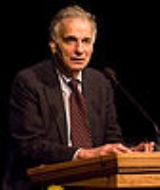
Ralph Nader (born February 27, 1934) is an American attorney, author, lecturer, political activist, and perennial candidate for presidency as an independent candidate for President of the United States in 2004 and 2008, and a Green Party candidate in 1996 and 2000. Areas of particular concern to Nader include consumer protection, humanitarianism, environmentalism, and democratic government. With grassroots democracy civic actions, green politics and left-wing politics, he is a reputed populist, harking to 19th century American populists and movements like Henry George's geoism, to which he referred in his 2004 presidential election platform.

Discussion
Ask a question about 'Ralph Nader'
Start a new discussion about 'Ralph Nader'
Answer questions from other users
|
Quotations
...the Democratic and Republican parties, two apparently distinct political entities feeding at the same corporate trough.
The shortcomings of America's political leaders do not stop at our borders.
Unlike members of Congress, Big Business knew what the WTO agreements contained. That's because corporate lobbyists helped draft them.
Up against the corporate government, voters find themselves asked to choose between look-alike candidates from two parties vying to see who takes the marching orders from their campaign paymasters and their future employers. The money of vested interest nullifies genuine voter choice and trust.
The democracy gap in our politics and elections spells a deep sense of powerlessness by people who drop out, do not vote, or listlessly vote for the least worst.
every four years and then wonder why after every cycle the “least worst” gets worse.
...organized labor...rushes to support the party without demanding a turn away from corporatism toward workers needs. This is the logic of the lesser of two evils. It tethers labor to a relentless slide deeper into the corporate power pits year after year.

Encyclopedia
Ralph Nader (born February 27, 1934) is an American attorney, author, lecturer, political activist, and perennial candidate for presidency as an independent candidate for President of the United States in 2004 and 2008, and a Green Party candidate in 1996 and 2000. Areas of particular concern to Nader include consumer protection, humanitarianism, environmentalism, and democratic government. With grassroots democracy civic actions, green politics and left-wing politics, he is a reputed populist, harking to 19th century American populists and movements like Henry George's geoism, to which he referred in his 2004 presidential election platform. He is also the first Arab American to run for president.
Background and early career
Nader was born in Winsted, Connecticut. His parents, Nathra and Rose Nader, were Eastern Orthodox Christian immigrants from Zahle, Lebanon. His family's native language is Arabic, and he has spoken it along with English since childhood. His sister, Laura Nader, is a notable anthropologist.
Nathra Nader was employed in a textile mill, and at one point owned a bakery and restaurant where he engaged customers in political discourse.
Nader graduated from Princeton University in 1955 and Harvard Law School in 1958. He served in the United States Army for six months in 1959, then began work as a lawyer in Hartford, Connecticut. Between 1961 and 1963, he was a Professor of History and Government at the University of Hartford. In 1964, Nader moved to Washington, D.C., where he worked for Assistant Secretary of Labor Daniel Patrick Moynihan. He also advised a United States Senate subcommittee on car safety. In the early 1980s, Nader spearheaded a powerful lobby against the Food and Drug Administration (FDA) approval of mass-scale experimentation of artificial lens implants. Nader has served as a faculty member at the American University Washington College of Law.
Automobile-safety activism
Nader's first consumer safety articles appeared in the Harvard Law Record, a student publication of Harvard Law School, but he first criticized the automobile industry in an article he wrote for The Nation in 1959 called "The Safe Car You Can't Buy." In 1965, Nader wrote Unsafe at Any Speed, a study that revealed that many American automobiles were unsafe, especially the Chevrolet Corvair manufactured by General Motors. The Corvair had been involved in numerous accidents involving spins and rollovers, and there were over 100 lawsuits pending against GM in connection to accidents involving the popular compact car. These lawsuits provided the initial material for Nader's investigations into the safety of the car. GM tried to discredit Nader, hiring private detectives to tap his phones and investigate his past, and hiring prostitutes to trap him in compromising situations. GM failed to uncover any wrongdoing, and never explained resorting to smear tactics instead of defending the car in the popular press, where the company had considerable corporate influence. GM's avoidance of technical journals makes more sense, as it was well known among auto engineers that the early (1960-64) Corvair's swing axle suspension handled miserably. Upon learning of GM's actions, Nader successfully sued the company for invasion of privacy, forced it to publicly apologize, and used much of his $284,000 net settlement to expand his consumer rights efforts. Nader's lawsuit against GM was ultimately decided by the New York Court of Appeals, whose opinion in the case expanded tort law to cover "overzealous surveillance."
Nader's advocacy of automobile safety and the publicity generated by the publication of Unsafe at Any Speed, along with concern over escalating nationwide traffic fatalities, led to the unanimous passage of the 1966 National Traffic and Motor Vehicle Safety Act. The act established the National Highway Traffic Safety Administration, and marked a historic shift in responsibility for automobile safety from the consumer to the manufacturer. The legislation mandated a series of safety features for automobiles, beginning with safety belts and stronger windshields.
A 1972 National Highway Traffic Safety Administration safety commission report conducted by Texas A&M University concluded that the 1960-1963 Corvair possessed no greater potential for loss of control than its contemporaries in extreme situations. A different account, however, was given in John DeLorean's "General Motors autobiography," On a Clear Day You Can See General Motors, 1979 (published under the name of his would-be ghostwriter, J. Patrick Wright), in which DeLorean asserts that Nader's criticisms were valid. The specific Corvair design flaws were corrected in the second half (1965-1969) of the Corvair's production, although by then the Corvair name was irredeemably compromised.
Activism
Hundreds of young activists, inspired by Nader's work, came to DC to help him with other projects. They came to be known as "Nader's Raiders" who, under Nader, investigated government corruption, publishing dozens of books with their results:
- Nader's Raiders (Federal Trade Commission)
- Vanishing Air (National Air Pollution Control Administration)
- The Chemical Feast (Food and Drug Administration)
- The Interstate Commerce Omission (Interstate Commerce Commission)
- Old Age (nursing homes)
- The Water Lords (water pollution)
- Who Runs Congress? (Congress)
- Whistle Blowing (punishment of whistle blowers)
- The Big Boys (corporate executives)
- Collision Course (Federal Aviation Administration)
- No Contest (corporate lawyers)
- Destroy the Forest (Destruction of ecosystems worldwide)
- Operation: Nuclear (Making of a nuclear missile)
In 1971, Nader founded the non-governmental organization (NGO) Public Citizen as an umbrella organization for these projects. Today, Public Citizen has over 140,000 members and investigates Congressional, health, environmental, economic and other issues. Nader wrote, "The consumer must be protected at times from his own indiscretion and vanity."
In the 1970s and 1980s Nader was a key leader in the anti-nuclear power movement. "By 1976, consumer advocate Ralph Nader, who later became allied with the environmental movement 'stood as the titular head of opposition to nuclear energy'" He advocates the complete elimination of nuclear energy in favor of solar, tidal, wind and geothermal, citing environmental, worker safety, migrant labor, national security, disaster preparedness, foreign policy, government accountability and democratic governance issues to bolster his position.
Non-profit organizations
In 1980, Nader resigned as director of Public Citizen to work on other projects, forcefully campaigning against what he believed to be the dangers of large multinational corporations. He went on to start a variety of non-profit organizations:
Presidential campaigns
Third-party votes controversy
In the 2000 presidential election in Florida, George W. Bush defeated Al Gore by 537 votes. Nader received 97,421 votes, which led to claims that he was responsible for Gore's defeat. Nader, both in his book Crashing the Party, and on his website, states: "In the year 2000, exit polls reported that 25% of my voters would have voted for Bush, 38% would have voted for Gore and the rest would not have voted at all." When asked about claims of being a spoiler, Nader typically points to the controversial Supreme Court ruling that halted a Florida recount, Gore's loss in his home state of Tennessee, and the "quarter million Democrats who voted for Bush in Florida." A study in 2002 by the Progressive Review found no correlation between votes for Nader and votes for Gore (i.e., more votes for Nader did not correlate to fewer votes for Gore and vice versa). An analysis conducted by Harvard Professor B.C. Burden in 2005 showed Nader did affect Gore's chances, but that
"Contrary to Democrats’ complaints, Nader was not intentionally trying to throw the election. A spoiler strategy would have caused him to focus disproportionately on the most competitive states and markets with the hopes of being a keyplayer in the outcome. There is no evidence that his appearances responded to closeness. He did, apparently, pursue voter support, however, in a quest to receive 5% of the popular vote."
When asked by MSNBC's Tim Russert about the possibility of preventing a Democratic victory in 2008, Nader responded, "Not a chance. If the Democrats can’t landslide the Republicans this year, they ought to just wrap up, close down, and emerge in a different form."
Presidential campaign history
1972
Ralph Nader's name appeared in the press as a potential candidate for president for the first time in 1971, when he was offered the opportunity to run as the presidential candidate for the New Party, a progressive split-off from the Democratic Party in 1972. Chief among his advocates was author Gore Vidal, who touted a 1972 Nader presidential campaign in a front-page article in Esquire magazine in 1971. Nader declined the offer to run that year; the New Party ultimately joined with the People's Party in running Benjamin Spock in the 1972 Presidential election. That year, Nader also received one vote in the Vice Presidential Nomination at the 1972 Democratic National Convention.
1990
Nader considered launching a third party around issues of citizen empowerment and consumer rights. He suggested a serious third party could address needs such as campaign-finance reform, worker and whistle-blower rights, government-sanctioned watchdog groups to oversee banks and insurance agencies, and class-action lawsuit reforms.
1992
Nader stood in as a write-in for "none of the above" in both the 1992 New Hampshire Democratic and Republican Primaries and received 3,054 of the 170,333 Democratic votes and 3,258 of the 177,970 Republican votes cast. He was also a candidate in the 1992 Massachusetts Democratic Primary, where he appeared at the top of the ballot.
(in some areas, he appeared on the ballot as an independent).
1996
Nader was drafted as a candidate for President of the United States on the Green Party ticket during the 1996 presidential election. He was not formally nominated by the Green Party USA, which was, at the time, the largest national Green group; instead he was nominated independently by various state Green parties (in some states, he appeared on the ballot as an independent). However, many activists in the Green Party USA worked actively to campaign for Nader that year. Nader qualified for ballot status in 22 states, garnering 685,297 votes 0.71% of the popular vote, although the effort did make significant organizational gains for the party. He refused to raise or spend more than $5,000 on his campaign, presumably to avoid meeting the threshold for Federal Elections Commission reporting requirements; the unofficial Draft Nader committee could (and did) spend more than that, but the committee was legally prevented from coordinating in any way with Nader himself.
Nader received some criticism from progressives and gay rights supporters for calling gay rights "gonad politics" and stating that he was not interested in dealing with such matters.
His running mates included: Anne Goeke (nine states), Deborah Howes (Oregon), Muriel Tillinghast (New York), Krista Paradise (Colorado), Madelyn Hoffman (New Jersey), Bill Boteler (Washington, D.C.), and Winona LaDuke (California and Texas).
2000
In the 2006 documentary An Unreasonable Man, Nader describes how, during the second Clinton Administration, he found that he was unable to get the views of his public interest groups heard in Washington, even by then President Clinton's administration. Nader cites this as one of the primary reasons that he decided again to actively run in the 2000 election as candidate of the Green Party, which had been formed in the wake of his 1996 campaign.
In October 2000, at the largest Super Rally of his campaign, held in New York City's Madison Square Garden, 15,000 people paid $20 each to hear Mr. Nader speak. Nader's campaign rejected both parties as institutions dominated by corporate interests, stating that Al Gore and George W. Bush were "Tweedledee and Tweedledum." The campaign also had some prominent union help: The California Nurses Association and the United Electrical Workers endorsed his candidacy and campaigned for him.
In 2000, Nader received 2,883,105 votes, for 2.74 percent of the popular vote, missing the 5 percent needed to qualify the Green Party for federally distributed public funding in the next election, yet qualifying the Greens for ballot status in many new states.
Nader's votes in New Hampshire and Florida vastly exceeded the difference in votes between Gore and Bush, as did the votes of all alternative candidates. Exit polls showed the state staying close, and within the margin of error without Nader as national exit polls showed Nader's supporters choose Gore over Bush by a large margin well outside the margin of error. Winning either state would have given Gore the presidency, and while critics claim this shows Nader tipped the election to Bush, Nader has called that claim "a mantra — an assumption without data." Michael Moore at first argued that Florida was so close that votes for any of seven other candidates could also have switched the results, but in 2004 joined the view that Nader had helped make Bush president. Other Nader supporters argued that Gore was primarily responsible for his own loss. But Eric Alterman, perhaps Nader's most persistent critic, has regarded such arguments as beside the point: "One person in the world could have prevented Bush's election with his own words on the Election Day 2000." Nation columnist Alexander Cockburn cited Gore's failure to win over progressive voters in Florida who chose Nader, and congratulated those voters: "Who would have thought the Sunshine State had that many progressives in it, with steel in their spine and the spunk to throw Eric Alterman's columns into the trash can?" Nader's actual influence on the 2000 election is the subject of considerable discussion, and there is no consensus on Nader's impact on the outcome. Still others argued that even if Nader's constituents could have made the swing difference between Gore and Bush, the votes Nader garnered were not from the Democrats, but from Democrats, Republicans, and discouraged voters who would not have voted otherwise.
2004
Nader announced on December 24, 2003 that he would not seek the Green Party's nomination for president in 2004; however, he did not rule out running as an independent candidate.
Meeting with John Kerry
Ralph Nader and Democratic candidate John Kerry held a widely publicized meeting early in the 2004 Presidential campaign, which Nader described in An Unreasonable Man. Nader said that John Kerry wanted to work to win Nader's support and the support of Nader's voters. Nader then provided more than 20 pages of issues that he felt were important and he "put them on the table" for John Kerry. According to Nader the issues covered topics ranging from environmental, labor, healthcare, tax reform, corporate crime, campaign finance reform and various consumer protection issues.
Nader reported that he asked John Kerry to choose any three of the issues and highlight them in his campaign and if Kerry would do this, he would refrain from the race. Several days passed and Kerry failed to adopt any of Nader's issues as benchmarks of his campaign, so on February 22, 2004, Nader announced on NBC that he would indeed run for president as an independent, saying, "There's too much power and wealth in too few hands."
The campaign
Nader's 2004 campaign ran on a platform consistent with the Green Party's positions on major issues, such as opposition to the war in Iraq. Due to concerns about a possible spoiler effect as in 2000, many Democrats urged Nader to abandon his 2004 candidacy. The Chairman of the Democratic National Committee, Terry McAuliffe, stated that Nader had a "distinguished career, fighting for working families," and that McAuliffe "would hate to see part of his legacy being that he got us eight years of George Bush." Nader received 463,653 votes, for 0.38% of the popular vote. Nader replied to this, in filmed interviews for An Unreasonable Man, by arguing that, "Voting for a candidate of one's choice is a Constitutional right, and the Democrats who are asking me not to run are, without question, seeking to deny the Constitutional rights of voters who are, by law, otherwise free to choose to vote for me."
In the 2004 campaign, Democrats such as Howard Dean and Terry McAuliffe asked that Nader return money donated to his campaign by Republicans who were well-known Bush supporters, such as billionaire Richard Egan. Nader's reaction to the request was to refuse to return any donations and he charged that the Democrats were attempting to smear him. Nader's vice-presidential running mate, Peter Camejo, supported the return of the money if it could be proved that "the aim of the wealthy GOP donors was to peel votes from Kerry." According to the San Francisco Chronicle, Nader defended his keeping of the donations by saying that wealthy contributors "are human beings too."
Nader received 463,655 votes, for 0.38 percent of the popular vote, placing him in third place overall.
2008
In February 2007, Nader criticized Democratic front-runner Hillary Clinton as "a panderer and a flatterer." Asked on CNN Late Edition news program if he would run in 2008, Nader replied, "It's really too early to say...." Asked during a radio appearance to describe the former First Lady, Nader said, "Flatters, panders, coasting, front-runner, looking for a coronation ... She has no political fortitude." Some Greens started a campaign to draft Nader as their party's 2008 presidential candidate.
After some consideration, Nader announced on February 24, 2008, that he would run for President as an independent. His vice-presidential candidate was Matt Gonzalez.
Nader received 738,475 votes, for 0.56 percent of the popular vote, placing him in third place overall .
Personal life
Nader has never married. Karen Croft, a writer who worked for Nader in the late 1970s at the Center for Study of Responsive Law, once asked him if he had ever considered getting married. "He said that at a certain point he had to decide whether to have a family or to have a career, that he couldn't have both," Croft recalled. "That's the kind of person he is. He couldn't have a wife -- he's up all night reading the Congressional Record."
Personal finances
According to the mandatory fiscal disclosure report that he filed with the Federal Election Commission in 2000, he then owned more than $3 million worth of stocks and mutual fund shares; his single largest holding was more than $1 million worth of stock in Cisco Systems, Inc. He also held more than $2 million in two money market funds. Nader owned no car or real estate in 2000, and said he lived on US$25,000 a year, giving most of his stock earnings to many of the over four dozen non-profit organizations he had founded.
Recognition
In 1999, an NYU panel of eminent journalists ranked Nader's book Unsafe At Any Speed 38th among the top 100 pieces of journalism of the 20th century. In 1990, Life Magazine named Nader one of the 100 most influential Americans of the 20th century.
Television appearances
In 1988, Ralph Nader appeared on Sesame Street as "a person in your neighborhood." The verse of the song began "A consumer advocate is a person in your neighborhood." This was somewhat tongue-in-cheek, as his profession as a consumer advocate was largely self-defined, and he was perhaps the only professional full-time consumer advocate at that time. This song compares him to a postman or a policeman, members of professions whom you may run into on a daily basis. Nader's appearance on Sesame Street was particularly memorable because it was the only time that the grammar of the last line of the song--"A person who you meet each day"--was questioned and corrected in the show. Ralph Nader refused to sing the grammatically incorrect line, and so a compromise was reached, resulting in Ralph Nader singing the last line as a solo with the modified words: "A person whom you meet each day." As a consumer advocate, Nader tests Bob's sweater (with permission) and destroys it, telling Bob "Your aunt . . . knitted you a lemon!"
He appeared on the Superman 50th anniversary special in 1988 warning the consumer on the different effects of green, gold, red kryptonite.
Ralph Nader also hosted an episode of NBC's Saturday Night Live in 1977.
During his 2008 presidential campaign, Nader appeared on CNBC with John Harwood, CNN with Rick Sanchez, PBS's The NewsHour with Jim Lehrer, and Fox News Channel with Shepard Smith. He also appeared on comedy programs, including Late Night with Conan O'Brien, interviewed by Triumph the Insult Comic Dog in 2008. Nader also appeared on Real Time with Bill Maher on September 26, 2008.
Nader is a member of the union American Federation of Television and Radio Artists and receives a union pension.
Works
See also
Further reading
- What Was Ralph Nader Thinking? by Jurgen Vsych, Wroughten Books, 2008. ISBN 978-0-9749879-2-7
- Citizen Nader by Charles McCarry Saturday Review Press, 1972 ISBN 0-8415-0163-7
- The Investigation of Ralph Nader by Thomas Whiteside 1972.
External links
- (not campaign-related)
- (site has been decommissioned, February 2009)
- (a 2008 presidential draft site)
- for Princeton Report on Knowledge about the spin of information. April 26, 2007
- July 14, 2007
- March 23, 2007
- May 5, 2008
-
Video and audio links
- , presentation at Benson High School in Portland, Oregon, May 13, 2008.
- May 10, 2008
- (February 13, 2007), presentation from Mr. Nader's 2007 book tour.
-
- — Provided by C-SPAN in
- video RealVideo format.
- Talk at UC Berkeley April 26, 2002
- CBC Broadcast three days into the invasion of Iraq.
- at Center for Ethics, Emory College
- from Aug. 1, 2008, Sacramento, CA
|