All Topics  
Nuclear Non-Proliferation Treaty

 
Nuclear Non Proliferation Treaty

   Email Print
   Bookmark   Link


Nuclear Non-Proliferation Treaty


The Treaty on the Non-Proliferation of Nuclear Weapons, also Nuclear Non-Proliferation Treaty (NPT or NNPT) is a treaty
Treaty

A Treaty is an agreement under international law entered into by actors in international law, namely states and international organizations. A Treaty may also be known as: agreement, protocol, covenant, convention, exchange of letters, etc....
 to limit the spread of nuclear weapon
Nuclear weapon

A nuclear weapon is an explosive device that derives its destructive force from nuclear reactions, either nuclear fission or a combination of fission and nuclear fusion....
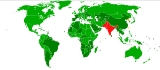
s, opened for signature on July 1, 1968. There are currently 189 countries party to the treaty, five of which have nuclear weapons: the United States
United States

The United States of America is a Federal government constitutional republic comprising U.S. state and a federal district. The country is situated mostly in central North America, where its Contiguous United States and Washington, D.C., the Capital districts and territories, lie between the Pacific Ocean and Atlantic Oceans, Borders of the U...
, the United Kingdom
United Kingdom

The United Kingdom of Great Britain and Northern Ireland, commonly known as the United Kingdom , the UK or Britain,is a sovereign state located off the northwestern coast of continental Europe....
, France
France

France , officially the French Republic , is a country whose Metropolitan France is located in Western Europe and that also comprises various Overseas departments and territories of France....
, Russia
Russia

Russia , or the Russian Federation , is a list of countries spanning more than one continent country extending over much of northern Eurasia....
, and the People's Republic of China
People's Republic of China

The People's Republic of China , commonly known as China, is the largest country in East Asia and the List of countries by population in the world with over 1.3 billion people, approximately a fifth of the world's population....
 (the permanent members of the UN Security Council).

Only four recognized sovereign states are not parties to the treaty: India
India

India, officially the Republic of India , is a country in South Asia. It is the List of countries and outlying territories by total area country by geographical area, the List of countries by population country, and the most populous liberal democracy in the world....
, Israel
Israel

Israel officially the State of Israel , is a country in the Middle East located on the eastern shore of the Mediterranean Sea. It borders Lebanon in the north, Syria in the northeast, Jordan in the east, and Egypt on the southwest, and contains geographically diverse features within its relatively small area....
, Pakistan
Pakistan

Pakistan , officially the Islamic Republic of Pakistan, is a country located in South Asia and borders Central Asia and the Middle East. It has a 1,046 kilometre coastline along the Arabian Sea and Gulf of Oman in the south, and is bordered by Afghanistan and Iran in the west, India in the east and People's Republic of China in th...
 and North Korea
North Korea

North Korea, officially the Democratic People's Republic of Korea , is a state in East Asia, occupying the northern half of the Korean Peninsula....
.


Discussion
Ask a question about 'Nuclear Non-Proliferation Treaty'
Start a new discussion about 'Nuclear Non-Proliferation Treaty'
Answer questions from other users
Full Discussion Forum


Encyclopedia


The Treaty on the Non-Proliferation of Nuclear Weapons, also Nuclear Non-Proliferation Treaty (NPT or NNPT) is a treaty
Treaty

A Treaty is an agreement under international law entered into by actors in international law, namely states and international organizations. A Treaty may also be known as: agreement, protocol, covenant, convention, exchange of letters, etc....
 to limit the spread of nuclear weapon
Nuclear weapon

A nuclear weapon is an explosive device that derives its destructive force from nuclear reactions, either nuclear fission or a combination of fission and nuclear fusion....
s, opened for signature on July 1, 1968. There are currently 189 countries party to the treaty, five of which have nuclear weapons: the United States
United States

The United States of America is a Federal government constitutional republic comprising U.S. state and a federal district. The country is situated mostly in central North America, where its Contiguous United States and Washington, D.C., the Capital districts and territories, lie between the Pacific Ocean and Atlantic Oceans, Borders of the U...
, the United Kingdom
United Kingdom

The United Kingdom of Great Britain and Northern Ireland, commonly known as the United Kingdom , the UK or Britain,is a sovereign state located off the northwestern coast of continental Europe....
, France
France

France , officially the French Republic , is a country whose Metropolitan France is located in Western Europe and that also comprises various Overseas departments and territories of France....
, Russia
Russia

Russia , or the Russian Federation , is a list of countries spanning more than one continent country extending over much of northern Eurasia....
, and the People's Republic of China
People's Republic of China

The People's Republic of China , commonly known as China, is the largest country in East Asia and the List of countries by population in the world with over 1.3 billion people, approximately a fifth of the world's population....
 (the permanent members of the UN Security Council).

Only four recognized sovereign states are not parties to the treaty: India
India

India, officially the Republic of India , is a country in South Asia. It is the List of countries and outlying territories by total area country by geographical area, the List of countries by population country, and the most populous liberal democracy in the world....
, Israel
Israel

Israel officially the State of Israel , is a country in the Middle East located on the eastern shore of the Mediterranean Sea. It borders Lebanon in the north, Syria in the northeast, Jordan in the east, and Egypt on the southwest, and contains geographically diverse features within its relatively small area....
, Pakistan
Pakistan

Pakistan , officially the Islamic Republic of Pakistan, is a country located in South Asia and borders Central Asia and the Middle East. It has a 1,046 kilometre coastline along the Arabian Sea and Gulf of Oman in the south, and is bordered by Afghanistan and Iran in the west, India in the east and People's Republic of China in th...
 and North Korea
North Korea

North Korea, officially the Democratic People's Republic of Korea , is a state in East Asia, occupying the northern half of the Korean Peninsula....
. India, Pakistan and North Korea have openly tested and possess nuclear weapons. Israel has had a policy of opacity
Policy of deliberate ambiguity

A policy of deliberate ambiguity is the practice by a country of being intentionally ambiguous on certain aspects of its foreign policy or whether it possesses certain Weapon of mass destruction....
 regarding its own nuclear weapons program
Nuclear weapons and Israel

Israel is widely believed to be the List of states with nuclear weapons in the world to develop nuclear weapons and to be one of four nuclear-armed countries not recognized as a nuclear weapons states by the Nuclear Non-Proliferation Treaty , the others being India, Pakistan and North Korea....
. North Korea
North Korea

North Korea, officially the Democratic People's Republic of Korea , is a state in East Asia, occupying the northern half of the Korean Peninsula....
 acceded to the treaty, violated it, and later withdrew.

The treaty was proposed by Ireland
Republic of Ireland

Ireland is an Island country in north-western Europe. The modern Sovereignty state occupies about five-sixths of the island of Ireland, which was partitioned by the British on 3 May 1921....
, and Finland
Finland

Finland , officially the Republic of Finland , is a Nordic countries situated in the Fennoscandian region of northern Europe. It borders Sweden on the west, Russia on the east, and Norway on the north, while Estonia lies to its south across the Gulf of Finland....
 was the first to sign. The signing parties decided by consensus to extend the treaty indefinitely and without conditions upon meeting in New York City
New York City

The City of New York is the List of United States cities by population in the United States, while the New York metropolitan area ranks among the List of urban areas by population....
 on May 11, 1995. The NPT consists of a preamble and eleven articles. Although the concept of "pillars" appears nowhere in the NPT, the treaty is nevertheless sometimes interpreted as having three pillars: non-proliferation, disarmament
Disarmament

Disarmament refers to the act of reducing, limiting, or abolishing weapons. Disarmament." The American Heritage The context of disarmament generally refers to a country's military or specific type of weaponry....
, and the right to peacefully use nuclear technology
Nuclear power

Nuclear power is any nuclear technology designed to extract usable energy from atomic nucleus via controlled nuclear reactions. The only method in use today is through nuclear fission, though other methods might one day include nuclear fusion and radioactive decay ....
.

Treaty "pillars"

The NPT is commonly described as having three main "pillars": non-proliferation, disarmament, and peaceful use. This "pillars" concept has been questioned by some who believe that the NPT is, as its name suggests, principally about nonproliferation, and who worry that "three pillars" language misleadingly implies that the three elements have equivalent importance.

First pillar: non-proliferation

Five states are recognized by the NPT as nuclear weapon states (NWS): France
France

France , officially the French Republic , is a country whose Metropolitan France is located in Western Europe and that also comprises various Overseas departments and territories of France....
 (signed 1992), the People's Republic of China
People's Republic of China

The People's Republic of China , commonly known as China, is the largest country in East Asia and the List of countries by population in the world with over 1.3 billion people, approximately a fifth of the world's population....
 (1992), the Soviet Union
Soviet Union

The Union of Soviet Socialist Republics was a Constitution of the Soviet Union socialist state that existed in Eurasia from 1922 to 1991.The name is a translation of the , romanization of Russian Soyuz Sovetskikh Sotsialisticheskikh Respublik, abbreviated ????, SSSR....
 (1968; obligations and rights now assumed by Russia
Russia

Russia , or the Russian Federation , is a list of countries spanning more than one continent country extending over much of northern Eurasia....
), the United Kingdom
United Kingdom

The United Kingdom of Great Britain and Northern Ireland, commonly known as the United Kingdom , the UK or Britain,is a sovereign state located off the northwestern coast of continental Europe....
 (1968), and the United States
United States

The United States of America is a Federal government constitutional republic comprising U.S. state and a federal district. The country is situated mostly in central North America, where its Contiguous United States and Washington, D.C., the Capital districts and territories, lie between the Pacific Ocean and Atlantic Oceans, Borders of the U...
 (1968) (The U.S., UK, and Soviet Union were the only states openly possessing such weapons among the original ratifiers
Ratification

Ratification is the act of approving and paying for supplies or services provided to and accepted by the government as a result of an unauthorized commitment....
 of the treaty, which entered into force in 1970). These five nations are also the five permanent members of the United Nations Security Council
United Nations Security Council

The United Nations Security Council is one of the principal organs charged with the maintenance of international security. Its powers, outlined in the United Nations Charter, include the establishment of peacekeeping operations, the establishment of international sanctions, and the authorization of war....
. These five NWS agree not to transfer "nuclear weapons or other nuclear explosive
Nuclear explosive

A nuclear explosive is an explosive device that derives its energy from nuclear reactions. Almost all nuclear explosive devices that have been designed and produced are nuclear weapons intended for warfare....
 devices" and "not in any way to assist, encourage, or induce" a non-nuclear weapon state (NNWS) to acquire nuclear weapons (Article I). NNWS parties to the NPT agree not to "receive," "manufacture" or "acquire" nuclear weapons or to "seek or receive any assistance in the manufacture of nuclear weapons" (Article II). NNWS parties also agree to accept safeguards by the International Atomic Energy Agency (IAEA) to verify that they are not diverting nuclear energy from peaceful uses to nuclear weapons or other nuclear explosive
Nuclear explosive

A nuclear explosive is an explosive device that derives its energy from nuclear reactions. Almost all nuclear explosive devices that have been designed and produced are nuclear weapons intended for warfare....
 devices (Article III).

The five NWS parties have made undertakings not to use their nuclear weapons against a non-NWS party except in response to a nuclear attack, or a conventional attack in alliance with a Nuclear Weapons State. However, these undertakings have not been incorporated formally into the treaty, and the exact details have varied over time. The U.S. also had nuclear warheads targeted at North Korea, a non-NWS state, from 1959 until 1991. The previous United Kingdom Secretary of State for Defence
Secretary of State for Defence

The Secretary of State for Defence is the senior United Kingdom government Political minister in charge of the Ministry of Defence . It is a Cabinet of the United Kingdom position....
, Geoff Hoon
Geoff Hoon

Geoffrey 'Geoff' William Hoon is a United Kingdom politician. He is Labour Party Member of Parliament for Ashfield , as well as former Labour Chief Whip and Parliamentary Secretary to the Treasury....
, has also explicitly invoked the possibility of the use of the country's nuclear weapons in response to a non-conventional attack by "rogue states". In January 2006, President Jacques Chirac
Jacques Chirac

Jacques Ren? Chirac served as the President of France from 17 May 1995 until 16 May 2007. As President he also served as an ex officio Co-Prince of Andorra and Grand Master of the French L?gion d'honneur....
 of France
France

France , officially the French Republic , is a country whose Metropolitan France is located in Western Europe and that also comprises various Overseas departments and territories of France....
 indicated that an incident of state-sponsored terrorism on France could trigger a small-scale nuclear retaliation aimed at destroying the "rogue state's" power centers.

Second pillar: disarmament

The NPT's preamble contains language affirming the desire of treaty signatories to ease international tension and strengthen international trust so as to create someday the conditions for a halt to the production of nuclear weapons, and treaty on general and complete disarmament that liquidates, in particular, nuclear weapons and their delivery vehicles from national arsenals.

The wording of the NPT's Article VI arguably imposes only a vague obligation on all NPT signatories to move in the general direction of nuclear and total disarmament, saying, "Each of the Parties to the Treaty undertakes to pursue negotiations in good faith on effective measures relating to cessation of the nuclear arms race at an early date and to nuclear disarmament, and on a treaty on general and complete disarmament." Under this interpretation, Article VI does not strictly require all signatories to actually conclude a disarmament treaty. Rather, it only requires them "to negotiate in good faith."

On the other hand, some governments, especially non-nuclear-weapon states belonging to the Non-Aligned Movement
Non-Aligned Movement

The Non-Aligned Movement is an international organization of states considering themselves not formally aligned with or against any major power bloc....
, have interpreted Article VI's language as being anything but vague. In their view, Article VI constitutes a formal and specific obligation on the NPT-recognized nuclear-weapon states to disarm themselves of nuclear weapons, and argue that these states have failed to meet their obligation. Some government delegations to the Conference on Disarmament have put forth proposals for a complete and universal disarmament, but no disarmament treaty has emerged from these proposals. Critics of the NPT-recognized nuclear-weapon states sometimes argue that what they view as the failure of the NPT-recognized nuclear weapon states to disarm themselves of nuclear weapons, especially in the post-Cold War
Cold War

The Cold War was the continuing state of conflict, tension and competition that existed between a number of world powers, including the United States, the Soviet Union, People's Republic of China, France, United Kingdom and those countries' respective allies from the mid-1940s to the early 1990s....
 era, has angered some non-nuclear-weapon NPT signatories of the NPT. Such failure, these critics add, provides justification for the non-nuclear-weapon signatories to quit the NPT and develop their own nuclear arsenals.

Other observers have suggested that the linkage between proliferation and disarmament may also work the other way, i.e., that the failure to resolve proliferation threats in Iran and North Korea, for instance, will cripple the prospects for disarmament. No current nuclear weapons state, the argument goes, would seriously consider eliminating its last nuclear weapons without high confidence that other countries would not acquire them. Some observers have even suggested that the very progress of disarmament by the superpowers—which has led to the elimination of thousands of weapons and delivery systems—could eventually make the possession of nuclear weapons more attractive by increasing the perceived strategic value of a small arsenal. As one U.S. official and NPT expert warned in 2007, "logic suggests that as the number of nuclear weapons decreases, the 'marginal utility' of a nuclear weapon as an instrument of military power increases. At the extreme, which it is precisely disarmament’s hope to create, the strategic utility of even one or two nuclear weapons would be huge."

Peter Pella (Gettysburg College), a former William Foster Fellow who worked with the Arms Control Disarmament Agency on the NPT, maintained that countries will pursue nuclear disarmament as a goal only if they feel it is in their national interests to do so, and that the permanence of NPT along with other measures will enhance security and speed up the disarmament process.

Third pillar: peaceful use of nuclear energy

The third pillar allows for and agrees upon the transfer of nuclear technology and materials to NPT signatory countries for the development of civilian nuclear energy programs in those countries, as long as they can demonstrate that their nuclear programs are not being used for the development of nuclear weapons.

Since very few of the nuclear weapons states and states using nuclear reactors for energy generation
Nuclear power

Nuclear power is any nuclear technology designed to extract usable energy from atomic nucleus via controlled nuclear reactions. The only method in use today is through nuclear fission, though other methods might one day include nuclear fusion and radioactive decay ....
 are willing to completely abandon possession of nuclear fuel, the third pillar of the NPT under Article IV provides other states with the possibility to do the same, but under conditions intended to make it difficult to develop nuclear weapons.

The treaty recognizes the inalienable right of sovereign states to use nuclear energy for peaceful purposes, but restricts this right for NPT parties to be exercised "in conformity with Articles I and II" (the basic nonproliferation obligations that constitute the "first pillar" of the Treaty). As the commercially popular light water reactor
Light water reactor

The light water reactor or LWR is a type of thermal reactor, a reactor that uses a neutron moderator to reduce the speed of neutrons to low velocity thermal neutrons....
 nuclear power station uses enriched uranium fuel, it follows that states must be able either to enrich uranium or purchase it on an international market. Mohamed ElBaradei
Mohamed ElBaradei

Dr. Mohamed Mostafa El-Baradei is the Director General of the International Atomic Energy Agency , an inter-governmental organization under the auspices of the United Nations....
, Director General of the International Atomic Energy Agency
International Atomic Energy Agency

The International Atomic Energy Agency is an international organization that seeks to promote the peaceful use of nuclear technology and to inhibit its use for nuclear weapon....
, has called the spread of enrichment and reprocessing capabilities the "Achilles' heel
Achilles' heel

An Achilles? heel is a fatal weakness in spite of overall strength, actually or potentially leading to downfall. While the mythological origin refers to a physical vulnerability, metaphorical references to other attributes or qualities that can lead to their downfall are common....
" of the nuclear nonproliferation regime. As of 2007 13 states have an enrichment capability. Because the availability of fissile material has long been considered the principal obstacle to, and "pacing element" for, a country's nuclear weapons development effort, it was declared a major emphasis of U.S. policy in 2004 to prevent the further spread of uranium enrichment and plutonium reprocessing (a.k.a. "ENR") technology. Countries possessing ENR capabilities, it is feared, have what is in effect the option of using this capability to produce fissile material for weapons use on demand, thus giving them what has been termed a "virtual" nuclear weapons program. The degree to which NPT members have a "right" to ENR technology notwithstanding its potentially grave proliferation implications, therefore, is at the cutting edge of policy and legal debates surrounding the meaning of Article IV and its relation to Articles I, II, and III of the Treaty.

Countries that have signed the treaty as Non-Nuclear Weapons States and maintained that status have an unbroken record of not building nuclear weapons. However, Iraq
Iraq

Iraq , officially the Republic of Iraq , is a country in Western Asia spanning most of the northwestern end of the Zagros Mountains, the eastern part of the Syrian Desert and the northern part of the Arabian Desert....
 was cited by the IAEA and sanctioned by the UN Security Council for violating its NPT safeguards obligations; North Korea
North Korea

North Korea, officially the Democratic People's Republic of Korea , is a state in East Asia, occupying the northern half of the Korean Peninsula....
 never came into compliance with its NPT safeguards agreement and was cited repeatedly for these violations, and later withdrew from the NPT and tested a nuclear device; Iran
Iran

Iran , officially the Islamic Republic of Iran and formerly known internationally as Persian Empire until 1935, is a country in Central Eurasia, located on the northeastern shore of the Persian Gulf and the southern shore of the Caspian Sea....
 was found in non-compliance with its NPT safeguards obligations in an unusual non-consensus decision because it "failed in a number of instances over an extended period of time" to report aspects of its enrichment program; and Libya
Libya

Libya , officially the Great Socialist People's Libyan Arab Jamahiriya , is a country located in North Africa. Bordering the Mediterranean Sea to the north, Libya lies between Egypt to the east, Sudan to the southeast, Chad and Niger to the south, and Algeria and Tunisia to the west....
 pursued a clandestine nuclear weapons program before abandoning it in December 2003. In 1991 Romania reported previously undeclared nuclear activities by the former regime and the IAEA reported this non-compliance to the Security Council for information only. In some regions, the fact that all neighbors are verifiably free of nuclear weapons reduces any pressure individual states might feel to build those weapons themselves, even if neighbors are known to have peaceful nuclear energy programs that might otherwise be suspicious. In this, the treaty works as designed.

Mohamed ElBaradei
Mohamed ElBaradei

Dr. Mohamed Mostafa El-Baradei is the Director General of the International Atomic Energy Agency , an inter-governmental organization under the auspices of the United Nations....
, Director General of the International Atomic Energy Agency
International Atomic Energy Agency

The International Atomic Energy Agency is an international organization that seeks to promote the peaceful use of nuclear technology and to inhibit its use for nuclear weapon....
 (IAEA), has said that by some estimates thirty-five to forty states could have the knowledge to acquire nuclear weapons.

Key articles

Article I: Each nuclear-weapons state (NWS) undertakes not to transfer, to any recipient, nuclear weapons, or other nuclear explosive devices, and not to assist any non-nuclear weapon state to manufacture or acquire such weapons or devices.

Article II: Each non-NWS party undertakes not to receive, from any source, nuclear weapons, or other nuclear explosive devices; not to manufacture or acquire such weapons or devices; and not to receive any assistance in their manufacture.

Article III: Each non-NWS party undertakes to conclude an agreement with the IAEA for the application of its safeguards to all nuclear material in all of the state's peaceful nuclear activities and to prevent diversion of such material to nuclear weapons or other nuclear explosive devices.

Article IV: 1. Nothing in this Treaty shall be interpreted as affecting the inalienable right of all the Parties to the Treaty to develop research, production and use of nuclear energy for peaceful purposes without discrimination and in conformity with Articles I and II of this Treaty.

2. All the Parties to the Treaty undertake to facilitate, and have the right to participate in, the fullest possible exchange of equipment, materials and scientific and technological information for the peaceful uses of nuclear energy. Parties to the Treaty in a position to do so shall also co-operate in contributing alone or together with other States or international organizations to the further development of the applications of nuclear energy for peaceful purposes, especially in the territories of non-nuclear-weapon States Party to the Treaty, with due consideration for the needs of the developing areas of the world.

Article VI. The states undertake to pursue "negotiations in good faith on effective measures relating to cessation of the nuclear arms race at an early date and to nuclear disarmament", and towards a "Treaty on general and complete disarmament under strict and effective international control".

Article X. Establishes the right to withdraw from the Treaty giving 3 months' notice. It also establishes the duration of the Treaty (25 years before 1995 Extension Initiative).

History

The impetus behind the NPT was concern for the safety of a world with many nuclear weapon states. It was recognized that the cold war
Cold War

The Cold War was the continuing state of conflict, tension and competition that existed between a number of world powers, including the United States, the Soviet Union, People's Republic of China, France, United Kingdom and those countries' respective allies from the mid-1940s to the early 1990s....
 deterrent relationship between just the United States
United States

The United States of America is a Federal government constitutional republic comprising U.S. state and a federal district. The country is situated mostly in central North America, where its Contiguous United States and Washington, D.C., the Capital districts and territories, lie between the Pacific Ocean and Atlantic Oceans, Borders of the U...
 and Soviet Union
Soviet Union

The Union of Soviet Socialist Republics was a Constitution of the Soviet Union socialist state that existed in Eurasia from 1922 to 1991.The name is a translation of the , romanization of Russian Soyuz Sovetskikh Sotsialisticheskikh Respublik, abbreviated ????, SSSR....
 was fragile. More nuclear players reduced security for all, multiplying the risks of miscalculation, accident or unauthorized use, or through the escalation of a small nuclear conflict.

The NPT process was launched by Frank Aiken
Frank Aiken

Frank Aiken was a senior Ireland politician. A founding-member of Fianna F?il, Aiken was first elected to D?il ?ireann in 1923 and at each subsequent election until 1973....
, Irish Minister for External Affairs, in 1958. It was opened for signature in 1968, with Finland the first State to sign. By 1992 all five then-declared nuclear powers had signed the treaty, and the treaty was renewed in 1995 (and followed by the Comprehensive Test Ban Treaty
Comprehensive Test Ban Treaty

The Comprehensive Nuclear-Test-Ban Treaty bans all nuclear weapon explosions in all environments, for military or civilian purposes....
 in 1996). Several NPT signatories have given up nuclear weapons or nuclear weapons programs. South Africa
South Africa

The Republic of South Africa, also known by Official names of South Africa, is a country located at the southern tip of the continent of Africa....
 undertook a nuclear weapons program, allegedly with the assistance of Israel in the 1970s, and may have conducted a nuclear test in the Atlantic ocean in 1979, but has since renounced its nuclear program and signed the treaty in 1991 after destroying its small nuclear arsenal
Arsenal

An arsenal is an establishment for the construction, repair, storage and issue of weapons and ammunition. The word arsenal appears in various forms in Romance languages , i.e....
. Several former Soviet Republics destroyed or transferred to Russia the nuclear weapons inherited from the Soviet Union.

United States-NATO nuclear weapons sharing

At the time the treaty was being negotiated, NATO
NATO

The North Atlantic Treaty Organization , also called the Atlantic Alliance, is a military alliance established by the signing of the North Atlantic Treaty on 4 April 1949....
 had in place secret nuclear weapons sharing
Nuclear sharing

Nuclear sharing is a concept in NATO's policy of nuclear Deterrence theory, which involves member countries without nuclear weapons of their own in the planning for the use of nuclear weapons by NATO, and in particular provides for the armed forces of these countries to be involved in delivering these weapons in the event of their use....
 agreements whereby the United States
United States

The United States of America is a Federal government constitutional republic comprising U.S. state and a federal district. The country is situated mostly in central North America, where its Contiguous United States and Washington, D.C., the Capital districts and territories, lie between the Pacific Ocean and Atlantic Oceans, Borders of the U...
 provided nuclear weapons to be deployed by, and stored in, other NATO states. Some argue this is an act of proliferation violating Articles I and II of the treaty. A counter-argument is that the U.S. controlled the weapons in storage within the NATO states, and that no transfer of the weapons or control over them was intended "unless and until a decision were made to go to war, at which the treaty would no longer be controlling", so there is no breach of the NPT. These agreements were disclosed to a few of the states, including the Soviet Union
Soviet Union

The Union of Soviet Socialist Republics was a Constitution of the Soviet Union socialist state that existed in Eurasia from 1922 to 1991.The name is a translation of the , romanization of Russian Soyuz Sovetskikh Sotsialisticheskikh Respublik, abbreviated ????, SSSR....
, negotiating the treaty, but most of the states that signed the NPT in 1968 would not have known about these agreements and interpretations at that time .

As of 2005, it is estimated that the United States
United States

The United States of America is a Federal government constitutional republic comprising U.S. state and a federal district. The country is situated mostly in central North America, where its Contiguous United States and Washington, D.C., the Capital districts and territories, lie between the Pacific Ocean and Atlantic Oceans, Borders of the U...
 still provides about 180 tactical B61 nuclear bomb
B61 nuclear bomb

The B61 nuclear bomb is the primary thermonuclear weapon in the United States Enduring Stockpile following the end of the Cold War....
s for use by Belgium
Belgium

* A small German-speaking Community of Belgium exists in eastern Wallonia. Belgium's linguistic diversity and related political and cultural conflicts are reflected in the history of Belgium and a complex Communities and regions of Belgium....
, Germany
Germany

Germany , officially the Federal Republic of Germany , is a country in Central Europe. It is bordered to the north by the North Sea, Denmark, and the Baltic Sea; to the east by Poland and the Czech Republic; to the south by Austria and Switzerland; and to the west by France, Luxembourg, Belgium, and the Netherlands....
, Italy
Italy

Italy , officially the Italian Republic , is a country located on the Italian Peninsula in Southern Europe and on the two largest islands in the Mediterranean Sea, Sicily and Sardinia....
, the Netherlands
Netherlands

The Netherlands is a country that is part of the Kingdom of the Netherlands. It is a parliamentary democratic constitutional monarchy. The Netherlands is located in North-West Europe, and bordered by the North Sea to the north and west, Belgium to the south, and Germany to the east....
 and Turkey
Turkey

Turkey , known officially as the Republic of Turkey , is a Eurasian country that stretches across the Anatolian peninsula in southwest Asia and Thrace in the Balkans region of Southern Europe....
 under these NATO agreements . Many states, and the Non-Aligned Movement
Non-Aligned Movement

The Non-Aligned Movement is an international organization of states considering themselves not formally aligned with or against any major power bloc....
, now argue this violates Articles I and II of the treaty, and are applying diplomatic pressure to terminate these agreements. They point out that the pilots and other staff of the "non-nuclear" NATO states practice handling and delivering the U.S. nuclear bombs, and non-U.S. warplanes have been adapted to deliver U.S. nuclear bombs which must have involved the transfer of some technical nuclear weapons information. NATO believes its "nuclear forces continue to play an essential role in war prevention, but their role is now more fundamentally political". NATO officials also point out that no nuclear weapons have ever been given over to non-U.S. control by the United States, so therefore there cannot have been a violation of Article I (which prohibits transferring "nuclear weapons or other nuclear explosive devices or control over such weapons or explosive devices") or Article II (which bars "receiv[ing] the transfer from any transferor whatsoever of nuclear weapons or other nuclear explosive devices or of control over such weapons or explosive devices").

It is also worth noting that U.S. nuclear sharing policies were originally designed to help prevent the proliferation of nuclear weapons -- not least by persuading the then West Germany not to develop an independent nuclear capability by assuring it that West Germany would be able, in the event of war with the Warsaw Pact, to wield (U.S.) nuclear weapons in self-defense. (Until that point of all-out war, however, the weapons themselves would remain "safely" in U.S. hands.) The point was to limit the spread of countries having their own nuclear weapons programs, helping ensure that NATO allies would not choose to go down the proliferation route. (West Germany was discussed in U.S. intelligence estimates for a number of years as being a country with the potential to develop nuclear weapons capabilities of its own if officials in Bonn were not convinced that their defense against the Soviet Union and its allies could otherwise be met. )

India, Israel and Pakistan

Three states—India
India

India, officially the Republic of India , is a country in South Asia. It is the List of countries and outlying territories by total area country by geographical area, the List of countries by population country, and the most populous liberal democracy in the world....
, Israel
Israel

Israel officially the State of Israel , is a country in the Middle East located on the eastern shore of the Mediterranean Sea. It borders Lebanon in the north, Syria in the northeast, Jordan in the east, and Egypt on the southwest, and contains geographically diverse features within its relatively small area....
, and Pakistan
Pakistan

Pakistan , officially the Islamic Republic of Pakistan, is a country located in South Asia and borders Central Asia and the Middle East. It has a 1,046 kilometre coastline along the Arabian Sea and Gulf of Oman in the south, and is bordered by Afghanistan and Iran in the west, India in the east and People's Republic of China in th...
—have declined to sign the treaty. India and Pakistan are confirmed nuclear powers, and Israel has a long-standing policy of deliberate ambiguity
Policy of deliberate ambiguity

A policy of deliberate ambiguity is the practice by a country of being intentionally ambiguous on certain aspects of its foreign policy or whether it possesses certain Weapon of mass destruction....
 (see List of countries with nuclear weapons
List of countries with nuclear weapons

Nations that are known or believed to possess nuclear weapons are sometimes referred to as the nuclear club. There are currently nine states that have successfully detonated nuclear weapons....
). These countries argue that the NPT creates a club of "nuclear haves" and a larger group of "nuclear have-nots" by restricting the legal possession of nuclear weapons to those states that tested them before 1967, but the treaty never explains on what ethical grounds such a distinction is valid.

India and Pakistan have publicly announced possession of nuclear weapons and have detonated nuclear devices in tests, India having first done so
Smiling Buddha

The Smiling Buddha was the first nuclear testing by India on May 18, 1974 at Pokhran. It was also the first confirmed nuclear test by a nation outside the permanent five members of the United Nations Security Council having been developed and executed with no foreign help or assistance....
 in 1974 and Pakistan following suit in 1998 in response to another Indian test
Pokhran-II

Pokharan-II refers to test explosions of five nuclear devices, three on 11 May and two on 13 May 1998, conducted by India at the Pokhran test range....
. India is estimated to have enough fissile material for more than 150 warheads. Pakistan reportedly has between 80 and 120 warheads according to the former head of its strategic arms division.India is one of the few countries to have a no first use
No first use

No first use refers to a pledge or a policy by a List of states with nuclear weapons to not use nuclear weapons as a mean of warfare unless first attacked by an adversary using nuclear weapons....
 policy, a pledge not to use nuclear weapons unless first attacked by an adversary using nuclear weapons. The main reason India cites for not signing the NPT and for possessing nuclear weapons is that China is one of the "nuclear haves." China and India have a longstanding border dispute, including a border war in 1962.

According to leaked intelligence, Israel has been developing nuclear weapons at its Dimona
Dimona

Dimona is an Israeli city in the Negev desert, to the south of Beersheba and west of the Dead Sea above the Arabah valley in the Southern District ....
 site in the Negev
Negev

The Negev is a desert and semidesert region of southern Israel. The indigenous Negev Bedouin inhabitants of the region refer to the desert as al-Naqab ....
 since 1958, and many nonproliferation analysts like David Albright estimate that Israel may have stockpiled between 100 to 200 warheads using the plutonium reprocessed from Dimona. The Israeli government refuses to confirm or deny possession of nuclear weapons, although this is now regarded as an open secret
Open secret

An open secret is a concept or idea that is "officially" secret or restricted in knowledge, but is actually widely known; or refers to something which is widely known to be true, but which none of the people most intimately concerned is willing to categorically acknowledge in public....
 after Israeli low level nuclear technician Mordechai Vanunu
Mordechai Vanunu

Mordechai Vanunu , born in Marrakech, Morocco on 14 October, 1954 is an Israeli former nuclear weapon technician who revealed details of Nuclear weapons and Israel to the History of British newspapers in 1986....
—later abducted and jailed by Israel—revealed the program to the British
United Kingdom

The United Kingdom of Great Britain and Northern Ireland, commonly known as the United Kingdom , the UK or Britain,is a sovereign state located off the northwestern coast of continental Europe....
 Sunday Times
The Sunday Times (UK)

The Sunday Times is a Sunday broadsheet newspaper distributed in the United Kingdom. There is also a Republic of Ireland edition; contrary to a popular misconception, the Irish edition of the Sunday Times is not linked to The Irish Times newspaper, which is published Monday to Saturday in Dublin....
 in 1986.

In early March 2006, India and the United States
United States

The United States of America is a Federal government constitutional republic comprising U.S. state and a federal district. The country is situated mostly in central North America, where its Contiguous United States and Washington, D.C., the Capital districts and territories, lie between the Pacific Ocean and Atlantic Oceans, Borders of the U...
 finalized a deal, having critics in both countries, to provide India with US civilian nuclear technology. Proponents of the deal note that India will now classify 14 of its 22 nuclear facilities as being for civilian use, and thus open to inspection. Mohamed ElBaradei
Mohamed ElBaradei

Dr. Mohamed Mostafa El-Baradei is the Director General of the International Atomic Energy Agency , an inter-governmental organization under the auspices of the United Nations....
, the director of the IAEA at the time, welcomed the deal by calling India "an important partner in the non-proliferation regime".

However, attempts by Pakistan to reach a similar agreement have been rebuffed by the U.S. as well as the international community. The argument put forth is that not only does Pakistan lack the same energy requirements but that the track record of Pakistan as a nuclear proliferator makes it impossible for it to have any sort of nuclear deal in the near future.

In December 2006, United States Congress
United States Congress

The United States Congress is the Bicameralism legislature of the Federal government of the United States of the United States of America, consisting of two houses, the United States Senate and the United States House of Representatives....
 approved the United States-India Peaceful Atomic Energy Cooperation Act that was cemented during President Bush's visit to India earlier in the year. The legislation allows for the transfer of civilian nuclear material to India. Despite its status outside the Nuclear Non-Proliferation Treaty, India was granted these transactions on the basis of its clean proliferation record, and India's unusually high need for energy fueled by its rapid industrialization and a billion-plus population.

The Nuclear Suppliers Group
Nuclear Suppliers Group

Nuclear Suppliers Group is a multinational body concerned with reducing nuclear proliferation by controlling the export and re-transfer of materials that may be applicable to nuclear weapon development and by improving safeguards and protection on existing materials....
 (NSG) Guidelines currently rule out nuclear exports by all major suppliers with very narrow exceptions for Pakistan, and Israel, since none of the two has full-scope IAEA
International Atomic Energy Agency

The International Atomic Energy Agency is an international organization that seeks to promote the peaceful use of nuclear technology and to inhibit its use for nuclear weapon....
 safeguards on all its nuclear activities.

On August 1, 2008, the IAEA approved the India Safeguards Agreement and on September 6, 2008, India was granted the waiver at the NSG meeting held in Vienna, Austria. The consensus was arrived after overcoming misgivings expressed by Austria, Ireland and New Zealand and is an unprecedented step in giving exemption to a country, which has not signed the NPT and the Comprehensive Test Ban Treaty (CTBT). While India can commence nuclear trade with other willing countries, the deal needs to be passed by the US Congress before nuclear trade between India and the United States can begin. The U.S. Congress approved this agreement and the President signed it on 8 October, 2008.

North Korea

North Korea
North Korea

North Korea, officially the Democratic People's Republic of Korea , is a state in East Asia, occupying the northern half of the Korean Peninsula....
 ratified the treaty on December 12, 1985, but gave notice of withdrawal from the treaty on January 10, 2003 following U.S. allegations that it had started an illegal enriched uranium
Enriched uranium

Enriched uranium is a kind of uranium in which the percent composition of uranium-235 has been increased through the process of isotope separation....
 weapons program, and the U.S. subsequently stopping fuel oil
Fuel oil

Fuel oil is a fractional distillation obtained from petroleum distillation, either as a distillate or a residue. Broadly speaking, fuel oil is any liquid petroleum product that is burned in a furnace or boiler for the generation of heat or used in an engine for the generation of power, except oils having a flash point of approximately and oi...
 shipments under the Agreed Framework which had resolved plutonium weapons issues in 1994 . The withdrawal became effective April 10, 2003 making North Korea the first state ever to withdraw from the treaty. North Korea had once before announced withdrawal, on March 12, 1993, but suspended that notice before it came into effect.

On February 10, 2005, North Korea publicly declared that it possessed nuclear weapons and pulled out of the six-party talks
Six-party talks

The six-party talks aim to find a peaceful resolution to the security concerns as a result of the North Korea and weapons of mass destruction.There has been a series of meetings with six participating states: the People's Republic of China; the South Korea ; the North Korea ; the United States of America; the Russian Federation; and Japan....
 hosted by China to find a diplomatic solution to the issue. "We had already taken the resolute action of pulling out of the Nuclear Non-Proliferation Treaty and have manufactured nuclear arms for self-defence to cope with the Bush administration's evermore undisguised policy to isolate and stifle the DPRK [Democratic People's Republic of Korea]," a North Korean Foreign Ministry statement said regarding the issue. Six-party talks resumed in July 2005.

On September 19, 2005, North Korea announced that it would agree to a preliminary accord. Under the accord, North Korea would scrap all of its existing nuclear weapons and nuclear production facilities, rejoin the NPT, and readmit IAEA inspectors. The difficult issue of the supply of light water reactor
Light water reactor

The light water reactor or LWR is a type of thermal reactor, a reactor that uses a neutron moderator to reduce the speed of neutrons to low velocity thermal neutrons....
s to replace North Korea's indigenous nuclear power plant program, as per the 1994 Agreed Framework, was left to be resolved in future discussions. On the next day North Korea reiterated its known view that until it is supplied with a light water reactor it will not dismantle its nuclear arsenal or rejoin the NPT .

On October 2, 2006, the North Korean foreign minister announced that his country was planning to conduct a nuclear test "in the future", although it did not state when. On Monday, October 9, 2006 at 01:35:27 (UTC) the United States Geological Survey
United States Geological Survey

The United States Geological Survey is a scientific agency of the United States government. The scientists of the USGS study the landscape of the United States, its natural resources, and the natural hazards that threaten it....
 detected a magnitude 4.2 seismic event
Seismology

Seismology is the scientific study of earthquakes and the propagation of Linear elasticity#Elastic waves through the Earth. The field also includes studies of earthquake effects, such as tsunamis as well as diverse seismic sources such as volcanic, tectonic, oceanic, atmospheric, and artificial processes ....
 70 km (45 miles) north of Kimchaek, North Korea indicating a nuclear test. The North Korean government announced shortly afterward that they had completed a successful underground test
2006 North Korean nuclear test

The 2006 North Korean nuclear test was the nuclear testing of a Nuclear weapon conducted on October 9, 2006 by North Korea.North Korea announced its intention to conduct a test on October 3, six days prior, and in doing so became the first nation to give warning of its first nuclear test....
 of a nuclear fission device.

In 2007, reports from Washington suggested that the 2002 CIA reports stating that North Korea was developing an enriched uranium weapons program, which led to North Korea leaving the NPT, had overstated or misread the intelligence. On the other hand, even apart from these press allegations -- which some critics worry could have been planted in order to justify the United States giving up trying to verify the dismantlement of Pyongyang's uranium program in the face of North Korean intransigence -- there remains some information in the public record indicating the existence of a uranium effort. Quite apart from the fact that North Korean First Vice Minister Kang Sok Ju at one point admitted the existence of a uranium enrichment program, Pakistan's then-President Musharraf revealed that the A.Q. Khan proliferation network had provided North Korea with a number of gas centrifuges designed for uranium enrichment. Additionally, press reports have cited U.S. officials to the effect that evidence obtained in dismantling Libya’s WMD programs points toward North Korea as the source for Libya's uranium hexa?uoride (UF6) -- which, if true, would mean that North Korea has a uranium conversion facility for producing feedstock for centrifuge enrichment.

Iran

Iran
Iran

Iran , officially the Islamic Republic of Iran and formerly known internationally as Persian Empire until 1935, is a country in Central Eurasia, located on the northeastern shore of the Persian Gulf and the southern shore of the Caspian Sea....
 is a signatory state of the NPT and has recently (as of 2006
2006 in Iran

Years: 2001 in Iran - 2002 in Iran - 2003 in Iran - 2004 in Iran - 2005 in Iran - 2006 - 2007 in Iran - 2008 in Iran - 2009 in Iran - 2010 in Iran...
) resumed development of a uranium enrichment
Enriched uranium

Enriched uranium is a kind of uranium in which the percent composition of uranium-235 has been increased through the process of isotope separation....
 program. The Iranian government states its enrichment program is part of its civilian nuclear energy program. This is allowed under Article IV of the NPT. In 2005, the IAEA Board of Governors found Iran in noncompliance with its NPT safeguards agreement in an unusual non-consensus decision, after which the Security Council passed a resolution demanding that Iran suspend its enrichment.

In November 2003 IAEA
International Atomic Energy Agency

The International Atomic Energy Agency is an international organization that seeks to promote the peaceful use of nuclear technology and to inhibit its use for nuclear weapon....
 Director General Mohamed ElBaradei
Mohamed ElBaradei

Dr. Mohamed Mostafa El-Baradei is the Director General of the International Atomic Energy Agency , an inter-governmental organization under the auspices of the United Nations....
 reported that Iran had repeatedly and over an extended period failed to meet its safeguards obligations, including by failing to declare its uranium enrichment program. After about two years of EU3-led diplomatic efforts and Iran temporarily suspending its enrichment program, the IAEA Board of Governors, acting under Article XII.C of the IAEA Statute, found in a rare non-consensus decision with 12 abstentions that these failures constituted non-compliance with the IAEA safeguards agreement. Iran resumed its enrichment program after being referred to the Security Council.The United States concluded on this basis that Iran violated its Article III NPT safeguards obligations, and further argued based on circumstantial evidence that Iran's enrichment program was for weapons purposes and therefore violated Iran's Article II nonproliferation obligations. The November 2007 US National Intelligence Estimate
National Intelligence Estimate

National Intelligence Estimates are Federal government of the United States documents that are the authoritative assessment of the Director of National Intelligence on Intelligence related to a particular national security issue....
 (NIE) later concluded that Iran had halted an active nuclear weapons program in the fall of 2003 and that it had remained halted as of mid-2007. The NIE's "Key Judgments," however, also made clear that what Iran had actually stopped in 2003 was only "nuclear weapon design and weaponization work and covert uranium conversion-related and uranium enrichment-related work" -- namely, those aspects of Iran's nuclear weapons effort that had not by that point already been leaked to the press and become the subject of IAEA investigations. Since Iran's uranium enrichment program at Natanz -- and its continuing work on a heavy water reactor at Arak that would be ideal for plutonium production -- began secretly years before in conjunction with the very weaponization work the NIE discussed and for the purpose of developing nuclear weapons, many observers find Iran's continued development of fissile material production capabilities distinctly worrying. Particularly because fissile material availability has long been understood to be the principal obstacle to nuclear weapons development and the primary "pacing element" for a weapons program, the fact that Iran has reportedly suspended weaponization work may not mean very much. As U.S. Director of National Intelligence Mike McConnell has put it, the aspects of its work that Iran allegedly suspended were thus "probably the least significant part of the program."

Iran states it has a legal right to enrich uranium for peaceful purposes under the NPT, and further says that it "has constantly complied with its obligations under the NPT and the Statute of the International Atomic Energy Agency".

The IAEA
International Atomic Energy Agency

The International Atomic Energy Agency is an international organization that seeks to promote the peaceful use of nuclear technology and to inhibit its use for nuclear weapon....
 has been able to verify the non-diversion of declared nuclear material in Iran, and is continuing its work on verifying the absence of undeclared activities. As recently as October 2007, IAEA Director General ElBaradei reported that IAEA inspections had not found any evidence that Iran was making nuclear weapons. Russia further said in November 2007 that it had not seen any evidence of Iran trying to build a nuclear weapon. In February 2008, the IAEA reported that all declared nuclear material remained accounted for. However, the IAEA also reported that it was working to address "alleged studies" of weaponization, based on documents provided by certain Member States, which those states claimed originated from Iran. Iran rejected the allegations as "baseless" and the documents as "fabrications." In May 2008, the IAEA reported that these alleged studies remained "a matter of serious concern" and requests for clarification from Iran remained outstanding. The IAEA further reported that it had "not detected the actual use of nuclear material in connection with the alleged studies" and that Iran had agreed to address the alleged studies.

The Non-Aligned Movement has welcomed the continuing cooperation of Iran with the IAEA and reaffirmed Iran's right to the peaceful uses of nuclear technology. UN Secretary General Ban Ki-moon
Ban Ki-moon

Ban Ki-moon is the current Secretary-General of the United Nations of the United Nations.Before becoming Secretary-General, Ban was a career diplomat in South Korea's Ministry of Foreign Affairs and Trade and in the United Nations....
 has welcomed the continued dialogue between Iran and the IAEA, and has called for a peaceful resolution to the issue.

South Africa

South Africa
South Africa

The Republic of South Africa, also known by Official names of South Africa, is a country located at the southern tip of the continent of Africa....
 also deserves a special mention as the only country that developed nuclear weapons by itself and later dismantled them - unlike the former Soviet states Ukraine, Belarus and Kazakhstan, which inherited nuclear weapons from the former USSR, and also acceded to the NPT as non-nuclear weapon states.

During the days of apartheid, the white South African government developed a deep fear of both a black uprising and the threat of communism. This led to the development of a secret nuclear weapons program as an ultimate deterrent. South Africa has a large supply of uranium
Uranium

Uranium is a silvery-gray metallic chemical element in the actinide series of the periodic table that has the chemical symbol U and atomic number 92....
, which is mined in the country's gold mines. The government built a nuclear research facility at Pelindaba near Pretoria where uranium was enriched to fuel grade for the nuclear power plant at Koeberg as well as weapon grade for bomb production.

In 1991, after international pressure and when a change of government was imminent, South African Ambassador to the United States Harry Schwarz
Harry Schwarz

Harry Heinz Schwarz is a former leading South African anti-apartheid politician, diplomat, and jurist.Harry Schwarz's political career started with sitting on the Johannesburg city council from 1951-1957....
 signed the Nuclear Non-Proliferation Treaty. In 1993, the then president Frederik Willem de Klerk
Frederik Willem de Klerk

Frederik Willem de Klerk was the last State President of History of South Africa in the apartheid era South Africa, serving from September 1989 to May 1994....
 openly admitted that the country had developed a limited nuclear weapon capability. These weapons were subsequently dismantled prior to accession to the NPT. South Africa then opened itself up to IAEA for inspection. In 1994 the IAEA completed its work and declared that the country had fully dismantled its nuclear weapons program.

Libya

Libya had signed and ratified the Nuclear Non-Proliferation Treaty and was subject to IAEA nuclear safeguards inspections, but undertook a secret nuclear weapons development program in violation of its NPT obligations, using material and technology provided by the A.Q. Khan proliferation network -- including actual nuclear weapons designed allegedly originating in China. Libya began secret negotiations with the United States and the United Kingdom in March 2003 over potentially eliminating its WMD programs. In October 2003, Libya was embarrassed by the interdiction of a shipment of Pakistani-designed centrifuge parts sent from Malaysia, also as part of A. Q. Khan's proliferation ring. In December 2003, Libya announced that it had agreed to eliminate all its WMD programs, and permitted U.S. and British teams (as well as IAEA inspectors) into the country to assist this process and verify its completion. The nuclear weapons designs, gas centrifuges for uranium enrichment, and other equipment -- including prototypes for improved SCUD ballistic missiles -- were removed from Libya by the United States. (Libyan chemical weapons stocks and chemical bombs were also destroyed on site with international verification, with Libya joining the Chemical Weapons Convention.) Libya's noncompliance with its IAEA safeguards was reported to the U.N. Security Council, but with no action taken, as Libya's return to compliance with safeguards and Article II of the NPT was welcomed.

Leaving the treaty

Article X allows a state to leave the treaty if "extraordinary events, related to the subject matter of this Treaty, have jeopardized the supreme interests of its country", giving three months' (ninety days') notice. The state is required to give reasons for leaving the NPT in this notice.

NATO
NATO

The North Atlantic Treaty Organization , also called the Atlantic Alliance, is a military alliance established by the signing of the North Atlantic Treaty on 4 April 1949....
 states argue that when there is a state of "general war" the treaty no longer applies, effectively allowing the states involved to leave the treaty with no notice. This is a necessary argument to support the NATO nuclear weapons sharing policy, but a troubling one for the logic of the treaty. NATO's argument is based on the phrase "the consequent need to make every effort to avert the danger of such a war" in the treaty preamble, inserted at the behest of U.S. diplomats, arguing that the treaty would at that point have failed to fulfill its function of prohibiting a general war and thus no longer be binding. Many states do not accept this argument. See United States-NATO nuclear weapons sharing
Nuclear Non-Proliferation Treaty

The Treaty on the Non-Proliferation of Nuclear Weapons, also Nuclear Non-Proliferation Treaty is a treaty to limit the spread of nuclear weapons, opened for signature on July 1, 1968....
 above.

North Korea has also caused an uproar by its use of this provision of the treaty. Article X.1 only requires a state to give three months' notice in total, and does not provide for other states to question a state's interpretation of "supreme interests of its country". In 1993, North Korea gave notice to withdraw from the NPT. However, after 89 days, North Korea reached agreement with the United States to freeze its nuclear program under the Agreed Framework and "suspended" its withdrawal notice. In October 2002, the United States accused North Korea of violating the Agreed Framework by pursuing a secret uranium enrichment program, and suspended shipments of heavy fuel oil under that agreement. In response, North Korea expelled IAEA inspectors, disabled IAEA equipment, and, on January 10, 2003, announced that it was ending the suspension of its previous NPT withdrawal notification. North Korea said that only one more day's notice was sufficient for withdrawal from the NPT, as it had given 89 days before. The IAEA Board of Governors rejected this interpretation.. Most countries held that a new three-months withdrawal notice was required, and some questioned whether North Korea's notification met the "extraordinary events" and "supreme interests" requirements of the Treaty. The Joint Statement of September 19, 2005 at the end of the Fourth Round of the Six-Party Talks
Six-party talks

The six-party talks aim to find a peaceful resolution to the security concerns as a result of the North Korea and weapons of mass destruction.There has been a series of meetings with six participating states: the People's Republic of China; the South Korea ; the North Korea ; the United States of America; the Russian Federation; and Japan....
 called for North Korea to "return" to the NPT, implicitly acknowledging that it had withdrawn.

Future

The inclusion of (civilian) nuclear power in the July 2005 Asia-Pacific Partnership for Clean Development and Climate is politically sensitive, as India, which tested its first atomic bomb in 1974, refuses to sign the NPT. Prior to the announcement of the Asia-Pacific Partnership, on 18 July 2005, US President George W. Bush had met Indian Prime Minister Manmohan Singh
Manmohan Singh

Manmohan Singh is the 17th and current Prime Minister of India of the Republic of India. He also serves as the Ministry of Finance , succeeding P....
 and declared that he would work to change US law and international rules to permit trade in US civilian nuclear technology with India. Some, such as British columnist George Monbiot, argue that the U.S.-India nuclear deal, in combination with US attempts to deny Iran
Iran

Iran , officially the Islamic Republic of Iran and formerly known internationally as Persian Empire until 1935, is a country in Central Eurasia, located on the northeastern shore of the Persian Gulf and the southern shore of the Caspian Sea....
 (an NPT signatory) civilian nuclear fuel-making technology, may destroy the NPT regime, while others contend that such a move will likely bring India, an NPT non-signatory, under closer international scrutiny.

Every five years, there is a Review Conference on the treaty. At the , there were stark differences between the United States
United States

The United States of America is a Federal government constitutional republic comprising U.S. state and a federal district. The country is situated mostly in central North America, where its Contiguous United States and Washington, D.C., the Capital districts and territories, lie between the Pacific Ocean and Atlantic Oceans, Borders of the U...
, which wanted the conference to focus on proliferation, especially on its allegations against Iran
Iran

Iran , officially the Islamic Republic of Iran and formerly known internationally as Persian Empire until 1935, is a country in Central Eurasia, located on the northeastern shore of the Persian Gulf and the southern shore of the Caspian Sea....
, and most other countries, who emphasized the lack of serious nuclear disarmament
Nuclear disarmament

Nuclear disarmament is the proposed dismantling of nuclear weapons.Proponents of nuclear disarmament say that it would lessen the probability of Nuclear warfare occurring, especially accidentally....
 by the nuclear powers. The non-aligned countries
Non-Aligned Movement

The Non-Aligned Movement is an international organization of states considering themselves not formally aligned with or against any major power bloc....
 reiterated their position that NATO
NATO

The North Atlantic Treaty Organization , also called the Atlantic Alliance, is a military alliance established by the signing of the North Atlantic Treaty on 4 April 1949....
's nuclear sharing
Nuclear sharing

Nuclear sharing is a concept in NATO's policy of nuclear Deterrence theory, which involves member countries without nuclear weapons of their own in the planning for the use of nuclear weapons by NATO, and in particular provides for the armed forces of these countries to be involved in delivering these weapons in the event of their use....
 arrangement violates the treaty.

Criticism and Responses

Gamal Abdel Nasser
Gamal Abdel Nasser

Gamal Abdel Nasser was the second President of Egypt from 1956 until his death in 1970. Along with Muhammad Naguib, he led the Egyptian Revolution of 1952, which removed Farouk of Egypt and heralded a new period of industrialization in Egypt, together with a profound advancement of Arab nationalism, including a short-lived United Arab Republ...
 once said "basically they did whatever they wanted to do before the introduction of NPT and then devised it to prevent others from doing what they had themselves been doing before". In addition, some argue that the NWS have not fully complied, in practice, with their commitments mentioned in NPT. Article VI of the treaty requires NPT parties to "pursue negotiations" on an end to the arms race, "nuclear disarmament, and on a treaty on general and complete disarmament." Yet thousands of nuclear weapons remain, some on high alert, long after the end of the cold war. In January 2002, a report by the Defense Department following the U.S. Nuclear Posture Review recommended the development of nuclear weapons designed to destroy hardened and deeply-buried targets, but the resulting Robust Nuclear Earth Penetrator
Nuclear bunker buster

Bunker-busting nuclear weapons, also known as earth-penetrating weapons , are a type of nuclear weapon designed to penetrate into soil, Rock , or concrete to deliver a nuclear warhead to a target....
 never gained full Congressional support and was canceled in 2005. The representative of Ghana, on behalf of the Non-Aligned Movement and the African Group said disarmament and non-proliferation were complementary and mutually reinforcing and that, "Without tangible progress in disarmament, the current emphasis on non-proliferation cannot be sustained."

The United States responds to criticism of its disarmament record by pointing out that since the end of the Cold War it has eliminated over 13,000 nuclear weapons and eliminated over 80% of its deployed strategic warheads and 90% of non-strategic warheads deployed to NATO, in the processing eliminating whole categories of warheads and delivery systems and reducing its reliance on nuclear weapons. U.S. officials have also pointed out the United States' ongoing -- and, throughout 2007, sharply accelerating -- work to dismantle nuclear warheads. When current accelerated dismantlement efforts ordered by President George W. Bush have been completed, the U.S. arsenal will be less than a quarter of its size at the end of the Cold War, and smaller than it has been at any point since the Eisenhower administration, well before the drafting of the NPT. The United States has also purchased many thousands of weapons' worth of uranium formerly in Soviet nuclear weapons for conversion into reactor fuel. (As a consequence of this latter effort, it has been estimated that the equivalent of one lightbulb in every ten in the United States is powered by nuclear fuel removed from warheads previously targeted at the United States and its allies during the Cold War.) The U.S. Special Representative for Nuclear Nonproliferation agreed that that nonproliferation and disarmament are linked, noting that they can be mutually reinforcing but also that growing proliferation risks create an environment that makes disarmament more difficult. The United Kingdom,, France and Russia likewise defend their nuclear disarmament records, and the five NPT NWS issued a joint statement in 2008 reaffirming their Article VI disarmament commitments. As discussed above, the precise nature of nuclear weapons state obligations, if any, under Article VI of the Treaty is sharply contested.

See also

  • Nuclear Free World Policy
    Nuclear Free World Policy

    The Nuclear Free World Policy is a commitment by the governments of Brazil, Egypt, Ireland, Mexico, New Zealand, Slovenia, South Africa, and Sweden to shape foreign policy around the goal of "the elimination of nuclear weapons and assurance that they will never be produced again." Of particular concern to the signatories are the states who ha...
  • 13 steps
    13 steps

    The 13 steps is a paragraph of the Final Document of the 2000 Review Conference of the Nuclear Non-Proliferation Treaty, providing a set of 'practical steps for the systematic and progressive efforts to implement Article VI of the Treaty on the Non-nuclear proliferation of nuclear weapon'....
     (an important section in the Final Document of the 2000 Review Conference of the Treaty)
  • Nuclear warfare
    Nuclear warfare

    Nuclear warfare, or atomic warfare refers to the strategy for fighting or deterring military conflicts and terrorism when nuclear weapons are present....
  • List of countries with nuclear weapons
    List of countries with nuclear weapons

    Nations that are known or believed to possess nuclear weapons are sometimes referred to as the nuclear club. There are currently nine states that have successfully detonated nuclear weapons....
  • Nuclear fission
    Nuclear fission

    In nuclear physics and nuclear chemistry, nuclear fission is a nuclear reaction in which the atomic nucleus of an atom splits into smaller parts, often producing free neutrons and lighter atomic nucleus, which may eventually produce photons ....
  • Nuclear fusion
    Nuclear fusion

    In nuclear physics and nuclear chemistry, nuclear fusion is the process by which multiple like-charged atomic nuclei join together to form a heavier nucleus....
  • Nuclear peace
    Nuclear peace

    Nuclear peace is a theory of International Relations which argues that under some circumstances nuclear weapons can induce stability and decrease the chances of crisis escalation....
  • Nuclear energy phase-out
  • Strategic Offensive Reductions Treaty (SORT)
    Sort

    selfref|For sortable tables in Wikipedia, see...
  • Missile Technology Control Regime
    Missile Technology Control Regime

    The Missile Technology Control Regime , drafted by Dr. Richard H. Speier, is an informal and voluntary partnership between 34 countries to prevent the nuclear proliferation of missile....


External links

  • at the Center for a World in Balance
  • at npt-webcast.info
  • Summary and text from the nuclear NPT
  • at the Center for a World in Balance
  • - A not-for-profit organization based in Washington, D.C., and founded in 1994 to promote a better understanding of strategic weapons proliferation issues among policymakers, scholars and the media.
  • .
  • George Perkovich, , Proliferation Papers, Paris, Ifri, Fall 2008.
  • U.S. Department of State, website compiling speeches and papers relevant to NPT Review Cycle, http://www.state.gov/t/isn/wmd/nnp/.