

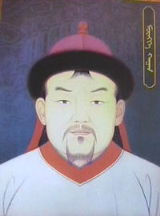
Möngke Khan

Encyclopedia
Möngke Khan born Möngke, (January 10, 1209 – August 11, 1259 ), was the fourth Great Khan of the Mongol Empire
from July 1, 1251 – August 11, 1259. He was the first Great Khan from the Toluid
line, and made significant reforms to improve the administration
of the Empire during his reign. Under Möngke, the Mongols conquered Iraq
and Syria
as well as the kingdom of Nanzhao and the area of present-day Vietnam
. He was given temple name
( by his successor Kublai Khan
, who founded the Yuan Dynasty
.
's teen-aged son Tolui
and Sorghaghtani. Teb Tengri Khokhcuu, the powerful shaman, saw in the stars a great future for the child and bestowed on him the name Mongke, "eternal" in the Mongolian language
. His uncle Ogedei's childless queen Angqui raised him at her ordo (nomadic palace). Ogedei instructed Persian scholar Idi-dan Muhammed to teach writing to Mongke.
On his way back home after the conquest
of Khwarizmian Empire, Genghis Khan performed the ceremony on his grandsons Mongke and Kublai after their first hunting in 1224 near the Ili River
. Mongke was eleven years old, and with his brother, Kublai, killed a rabbit
and an antelope
. Their grandfather smeared fat from killed animals onto their middle fingers following the Mongol tradition.
In 1230, Mongke went to war for the first time, following Ogedei Khan
and his father Tolui into battle against the Jurchen Jin Dynasty. Tolui died in 1232 and Ogedei appointed Sorghaghtani head of the Toluid appanage
. Following the Mongol custom, Mongke inherited at least one of his father's wives, Oghul-Khoimish of the Oirat
clan. Mongke deeply loved her and gave special favor to her elder daughter, Shirin.
 Ogedei dispatched him along with his relatives to attack the Kipchaks, Russians
and Bulgars
in the west in 1235. When the most formidable Kipchak chief, Bachman, fled to an island in the Volga delta. Mongke crossed the river and captured Bachman. When he ordered Bachman to bend on knees, Bachman refused, and, hence, he was executed by Mongke's brother Bujek. Mongke also engaged in hand to hand combat in the sieges of Russian cities. While his cousins, Shiban
and Büri
, went to Crimea
, Mongke and Khadan, a son of Ogedei, were ordered to reduce the tribes in Caucasus
. The Mongols captured the Alani capital Maghas
and massacred its inhabitants. Many chiefs of the Alans and Circassians surrendered to Mongke. After the conquest of Europe
, Mongke would bring them back
to Mongolia
. He also participated in the conquest of Kiev
in 1240. Mongke was apparently taken by the splendor of Kiev
and offered the city surrender, but his envoys were killed. After Batu
's army joined Mongke's soldiers, they sacked the city. And he also fought with Batu at the Battle of Mohi
. In the summer of 1241, before the premature end of the campaign, Möngke returned home after his uncle Ogedei recalled him in winter 1240-41. However, Ogedei died.
In 1246, Temuge Odchigen, Genghis Khan's sole remaining brother, unsuccessfully tried to seize the throne without confirmation by a kurultai
. The new Khagan Guyuk
entrusted the delicate task of trying Odchigin to Mongke and Orda Khan
, the eldest brother of Batu. Guyuk eventually died in route to west in 1248 and Batu and Mongke emerged as main contenders.
to meet Batu who was afflicted with the gout. Batu decided to support his election and called a kurultai at Ala Qamaq. The leader of the families of Genghis Khan's brothers, and several important generals, came to the kurultai. Guyuk's sons Naqu and Khoja attended briefly but then left. Despite vehement objections from Bala, Oghul Qaimish
's scribe, the kurultai approved Mongke. Given its limited attendance and location, this kurultai was of questionable validity. Batu sent Mongke under the protection of his brothers, Berke
and Tuqa-temur, and his son Sartaq to assemble a formal kurultai at Kodoe Aral in Mongolia
. When Sorghaghtani and Berke organized a second kurultai on the 1st of July, 1251, the assembled throng proclaimed Mongke the Great Khan of the Mongol Empire, and a few of the Ogedeid
and Chagatayid
princes, such as his cousin Kadan
and the deposed khan Khara Hulegu, acknowledged the decision.
Shortly thereafter, Oghul's son Khoja and Ogedei's favorite grandson Shiremun came to "pay homage" to Mongke as the new ruler, but they brought the entire army of the Ogedei faction with them. Mongke's the Kankali
falconer, Kheshig, discovered the preparations for the attack and told his lord. At the end of the investigation under his father's loyal servant Menggesar noyan
, he found his relatives guilty but at first wanted to give them mercy as written in the Great Yassa
. Mongke's officials opposed it and then he began to punish his relatives. The trials took place on all parts of the empire from Mongolia and China in the east to Afghanistan
and Iraq in the west. Mongke and Batu's brother Berke
therefore arranged to have Oghul accused of using black magic against Mongke. After she was arrested and questioned by Sorghaghtani, Oghul Qaimish was sewn up into a sack, and tossed into a river and drowned (which was the traditional Mongol punishment for using black magic). Estimates of the deaths of aristocrats, officials and Mongol commanders include Eljigidei
, Yesu Mongke
, Büri
and Shiremun and range from 77-300. Most of the princes of Genghisid blood involved in the plot, however, were given some form of exile. The anti-Mongke plot of an Uyghur
scribe
, Bala, and the Idiqut Salindi (the monarch of the Uyghurs) was discovered and they were publicly executed. Mongke also eliminated the Ogedeid and Chagataid families’ estates and shared the western part of the empire with his ally Batu Khan. After the bloody purge, Mongke ordered a general amnesty
for prisoners and captives. Soon, Mongke's mother Sorghaghtani died in 1252.
After his accession to the throne in 1251, Mongke announced that he would follow his ancestors but he do not imitate other countries' ways. To increase his legitimacy, in 1252 he retroactively awarded his father the title of Great Khan (Ikh Khagan). And Möngke's friendliness with Batu ensured the unity of the empire.
 Mongke drafted his own decrees and kept close watch on their revision. Mongke forbade practices of extravagant costs of the Borjigin
and non-Borjigid nobles. He also limited gifts to the princes, converting them into regular salaries
and made the merchant
s subject to tax
es. Mongke limited notorious abuses and sent imperial investigators to supervise the business of the merchants who were sponsored by the Mongols. He prohibited them from using the imperial relay stations, yam (route)
and paiza
s (tablet that gave the bearer authority to demand goods and services from civilian populations). With Guyuk dead, many local officials no longer wanted to pay off the paper drafts used by Guyuk. Mongke recognized that if he did not meet the financial obligation
s of Guyuk, it would make merchants reluctant to continue business with the Mongols. Mongke paid out all drafts drawn by high rank Mongol elites to these merchants. Ata Malik Juvaini stated, "And from what book of history has it been read or heard...that a king paid the debt of another king?" in his book. The generals and princes (including his son), who allowed their troops to plunder civilians without authorization, were repeatedly punished by Mongke Khan. He used North Chinese, Muslim
and Uyghur officials. The Khagan's chief judge
(jarughachi) was the Jait-Jalayir
official Menggeser while the chief sribe was the Kerait
Bulghai who was a Christian
. 9 of the 16 chief provincial officials of Mongke Khan were certainly Muslims. He reappointed Guyuk's three officials: Mahmud Yalavach in China, Masud Beg in Turkestan
, and Arghun Agha of the Oirat
in Persia. Mongke separated the position of the great judge at court from that of chief scribe.
In 1253, Mongke established the Department of Monetary affairs to control the issuance of paper money in order to eliminate the overissue of the currency by Mongol and non-Mongol nobles since the reign of Great Khan Ogedei. His authority established united measure based on sukhe or silver ingot, however, the Mongols allowed their foreign subjects to mint coins in the denominations and use weight they traditionally used. During the reigns of Ogedei, Guyuk and Mongke, Mongol coinage increased with gold and silver coinage in Central Asia and copper
and silver coins in Caucasus
, Iran and Bolghar
.
In 1252-1259, Möngke conducted a census
of the Mongol Empire including Iran
, Afghanistan
, Georgia
, Armenia
, Russia, Central Asia
and North China
. While that of China was completed in 1252, Novgorod in the far northwest was not counted until winter 1258-59. There was an uprising in Novgorod against Mongol rule in 1257, but Alexander Nevsky
forced the city to submit to Mongol census and taxation. The new census counted not only households but also the number of men aged 15–60 and the number of field
s, livestock
, vineyard
s, and orchard
s. Within the civilian register craftsmen were listed separately while in the military registers auxiliary
and regular households were distinguished. Clergy of the approved religions were separated and not counted. When the new register was completed, one copy was sent to Karakorum and one copy kept for the local administration. Mongke tried to create a fixed poll-tax collected by imperial agents, which could forward to the needy units. Initially, the maximum rate was fixed at 10-11 gold dinar
s in the Middle East and 6-7 taels of silver in China. But protests from the landlord
classes reduced this relatively low rate to 6-7 dinars and taels. Mongke's some officials raised the top rate on the wealthy of 500 dinars. Although, the reform of the taxation did not lighten the tax burden, it made the payments more predictable. Even so, the census and the regressive taxation it facilitated sparked popular riots and resistance in the western districts. In 1259, the Georgian King David Narin revolted, unsuccessfully, against the Mongols and, then, fled to Kutaisi
, from whence he reigned over western Georgia (Imereti
) as a de facto
separate ruler. In 1261, he gave shelter to David VII Ulu
, who in his turn had attempted to end the Mongol dominance. However, David Ulu made peace with the Mongols and returned to Tbilisi
in 1262. Mongke and Batu's official, Arghun, harshly punished the Georgian and Armenian nobles, plundering their cities and executing their prominent leaders. He divided the Georgians into 6 tumen
s. Meanwhile, Baiju
crushed the rebellion of the Seljuk
Sultan Kaykaus II
near Ankara
in 1256 and reestablished Mongol authority over Eastern Turkey
. By that time the Kashmiris had revolted, and Mongke appointed his generals, Sali and Takudar, to replace the court and a Buddhist master, Otochi, as darugachi to Kashmir
. However, the Kashmiri king killed Otochi at Srinagar
. Sali invaded again, killing the king, and put down the rebellion, after which the country remained subject to the Mongol Empire for many years.
in 1251. In 1253 Namo from Kashmir
was made chief of all the Buddhist monk
s in the Empire. During the conquest of Tibet in 1252-53, all Buddhist clergy were exempted from taxation. The Tibetan Karma Pakshi
received Mongke's patronage. Mongke had been so impressed by the aged Taoist monk Qiu Chuji
who met his grandfather Genghis Khan in Afghanistan
. Mongke made Li Zhichang chief of the Taoists. However, the Taoists had exploited their wealth and status by seizing Buddhist temples. Mongke demanded that the Taoists cease their denigration of Buddhism
. Mongke ordered Kublai to end the clerical strife between the Taoists and Buddhists in his territory. Kublai called a conference of Taoist and Buddhist leaders in early 1258. At the conference, the Taoist claim was officially declared refuted and Kublai forcibly converted their 237 temples to Buddhism and destroyed all copies of the fraudulent texts.
Despite his conquests of the Abbasid Caliphate and the Ismailis, Mongke favored Muslim perceptions. He and Hulegu made the Shiite community at Najaf
autonomous tax-exempt ecclesiastical polity. Like his predecessors, he exempted clerics, monks, churches, mosques, monasteries and doctor
s from taxation.
 During Mongke's reign, the French king Louis IX
sent William Rubruck as a diplomat seeking an alliance
with the Mongols against the Muslims. By that time Mongke's khatun Oghul-Khoimish was already dead. After making the French envoy wait for many months, Mongke officially received William Rubruck on May 24, 1254. Rubruck informed him that he had come to spread the word of Jesus Christ. Then he stayed to help the Christians in Karakorum and attended debates among rival religions organized by the Mongols. Mongke Khan summoned William Rubruck to send him back home in 1255. He told Rubruck:
"We Mongols believe in one God, by Whom we live and die". He then continued "Just as God gave different fingers to the hand so has He given different ways to men. To you God has given the Scriptures and you Christians do not observe them". He explained God had given the Mongols their shamans. Mongke offered Louis IX his cooperation but warned all Christians that "If, when you hear and understand the decree of the eternal God, you are unwilling to pay attention and believe it...and in this confidence you bring an army against us-we know what we can do".
Ambassadors from the Latin Empire
and the Empire of Nicaea
came to the Mongol court to negotiate terms with Mongke Khan as well. From 1252 on King Hethum I of Lesser Armenia
began his journey to Mongolia. He brought many sumptuous presents, and met with Mongke at Karakorum
. He had an audience with Mongke on September 13, 1254, advised the Khagan on Christian matters in Western Asia, and obtained from Mongke Khan documents guaranteeing the inviolability of his person and his kingdom. Hethum asked the Khagan and his officials to convert into Christianity
. In reply, Mongke explained that he really wished his subjects to truly worship Messiah
but he could not force the Mongols and other civilians to change their religion. Mongke also informed him that he was preparing to mount an attack on Baghdad
and that he would remit Jerusalem to the Christians if they collaborated with him.
Hethum strongly encouraged other Crusaders
to follow his example and submit to Mongol overlordship, but persuaded only his son-in-law Bohemond VI, ruler of the Principality of Antioch
and County of Tripoli
, who offered his own submission sometime in the 1250s. The armies of the Kingdom of Cilician Armenia and Bohemond VI would assist Mongke's army in the West soon.
The Mongol shamans
played an important role in the court and sometimes influenced the war preparation.
and the Middle east.
and Dali Kingdom in Yunnan
in 1252.
Mongke sent envoys to the Goryeo
, announcing his coronation in October 1251. He also demanded the King Gojong
to summon before him in person and move his headquarter from Ganghwa Island
to the mainland of Korea. But the Goryeo court refused to send the king because the old king was unable to go so far. Mongke dispatched his envoys with specific tasks again. The envoys were well-received by the Goryeo officials but they criticized the Goryeo officials that their king did not follow his overlord Mongke's orders. Mongke ordered the prince Yeku to command the army against Korea. However, a Korean in the court of Mongke convinced them to begin their campaign in July 1253. Yeku, along with Amuqan, demanded the Goryeo court to surrender. The court refused but did not resist the Mongols and gathered the peasentry into the mountain fortresses and islands. Working together with the Goryeo commanders who had joined the Mongols, Jalairtai Qorchi ravaged Korea. When one of Yeku's envoys arrived, Gojong personally met him at his new palace. The king Gojong sent his stepson as hostage to Mongolia. The Mongols agreed to cease fire in January 1254.
However, Mongke realized that the hostage was not the blood prince of the Goryeo Dynasty. So Mongke blamed the Goryeo court for deceiving him. Mongke's commander Jalairtai devastated much of the Goryeo and took 206,800 captives in 1254. Famine and despair forced peasants to surrender to the Mongols. They established a chiliarchy office at Yonghung with local officials. Ordering defectors to build ships, the Mongols began attacking the coastal islands from 1255 on. In the Liaodong Peninsula, the Mongols formed Korean defectors into a colony of eventually 5,000 households.
In 1258 the king and the Choe clan retainer Kim Jun staged a counter-coup, assassinated the head of the Choe family and sued for peace. When the Goryeo court sent the future king Wonjong of Goryeo
as hostage to the Mongol court and promised to return to Gaegyeong
, the Mongols withdrew from Korea.
through the conquest of Yunnan
in 1254 and an invasion of Indochina
, which allowed the Mongols to invade from north, west, and south.
Mongke Khan
dispatched Kublai to the Dali Kingdom in 1253. The ruling faimly, Gao, resisted and murdered Mongol envoy
s. The Mongols divided their forces into three. One wing rode eastward into the Sichuan
basin. The second column under Uryankhadai took a difficult way into the mountains of western Sichuan. Kublai himself headed south over the grasslands, meeting up with the first column. While Uryankhadai galloping in along the lakeside from the north, Kublai took the capital city of Dali and spared the residents despite the slaying of his ambassadors. The Mongols appointed King Duan Xingzhi as local ruler and stationed a pacification commissioner there. After Kublai's departure, unrest broke out among the Black jang. By 1256, Uryankhadai, the son of Subutai
had completely pacified Yunnan
.
After subjugating the Dali, Kublai sent one column under Uriyankhadai to south. Uriyankhadai sent envoys to ask the Vietnam
ese a route to attack Southern Song Dynasty. But the Tran Vietnamese imprisoned Mongol envoys. This action led Uriyankhadai and his son Aju
to invade Vietnam with 3,000 Mongols and 10,000 Yi tribesmen
. In 1257, a Mongol column under Uriyankhadai, the son of Subutai
, invaded Vietnam (then known as Đại Việt or Great Land of the Viet people), routing the Vietnamese militant
s and sacking the capital at Thanh Long (renamed Hanoi
in 1831). He executed its inhabitants for the murder of the envoys. After staying in Thang Long for a while, the Mongols fell ills due to unfamiliar climate. Realizing that it was time to drive the Mongols out, the Vietnamese launched a counter attack and won the decisive battle of Dong Bo Dau. In order to sooth the Mongol and prevent further war, the Tran accepted Mongol overlorship Uriyankhadai withdrew when the Tran Emperor accepted Mongol overlordship. The Vietnamese king Trần Thái Tông
paid tribute to Uriyankhadi who had quickly evacuated Vietnam to escape malaria
. The Trần Dynasty accepted terms of the vassalage and sent tributes to the administration of Mongke.
In order to strengthen his control over Tibet
, Mongke made Qoridai commander of the Mongol and Han troops in Tufan in 1251. In 1252-53 Qoridai invaded Tibet, reaching as far as Damxung. The Central Tibetian monasteries submitted to the Mongols and the Mongol princes divided between them as their appanages.
of the Tatar clan was sent to the Indian borderlands at the head of fresh troops, and was given authority over the Qaraunas. Sali himself was subordinate to Mongke's brother Hulegu. Due to the internal conflicts of the Delhi Sultanate
, the Mamluk Sultan Nasir ud din Mahmud
's brother, Jalal al-Din Masud, fled into Mongol territory in 1248. When Mongke was crowned as Khagan, Jalal al-Din Masud attended the ceremony and asked help from Mongke. Mongke ordered Sali to assist him to recover his ancestral realm. Sali made successive attacks on Multan
and Lahore
. Sham al-Din Muhammad Kart
, the client malik of Herat
, accompanied the Mongols. Jalal al-Din was installed as client ruler of Lahore, Kujah and Sodra
. In 1254 the Delhi official Kushlu Khan offered his submission to Mongke Khan and accepted a Mongol darugachi. When he failed to take Delhi, Kushlu turned to Hulegu. In the winter of 655/1257-8 Sali Noyan entered Sind
in strength and dismantled the fortifications of Multan; his forces may also have invested the island fortress of Bakhkar on the Indus.
 When Mongke called a kurultai to prepare the next conquest in 1252/1253, the Sultanate of Rum
and the Lu'lu'id dynasty of Mosul
were subject to the Mongol Empire. The Ayyubid ruler of Mayyafariqin, Malik Kamil, and his cousin in Aleppo
and the future Sultan, Malik Nasir Yusuf sent envoys to Mongke Khan, who imposed darugachis (overseers) and a census on the Diyarbakir
area.
After the defeat of the Ogedeid and Chagataid families, Mongke eliminated their territory, assigning acquiescent members of the family new territories either in Turkestan or in northwest China. In another move to consolidate his power, Mongke gave his brothers Kublai and Hulegu supervisory powers in North China and Iran. Rumors spread that his brother Kublai founded a de facto independent ulus (district) and perhaps took for himself some of the tax receipts that should by rights be coming to Karakorum. In 1257 the Emperor sent two tax inspector
s to audit Kublai's official. They found fault, listed 142 breaches of regulations, accused Chinese officials, even had some executed and Kublai's office was abolished. Mongke's authority took over the collection of all taxes in Kublai's estates. As his Confucian and Buddhist advisers pointed out, Kublai first sent his wives to the court of Khagan and then appealed to Mongke in person. They embraced in tears and Mongke forgave his brother.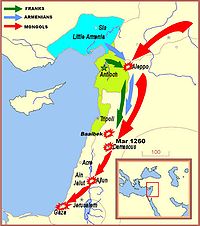 Some sources say the Ismaili-Hashashin's imam
Alaud-Din dispatched hundreds of assassin
s to kill Mongke in his palace. Shams-ud-Din, the chief judge of Qazvin
, had denounced the menace of the Ismailis. Hence, Mongke decided to exterminate the sect
. This is sometimes called the First War on Terror (as by John Man
in "Kublai Khan". Mongke ordered the Jochid and Chagataid families to join Hulegu's expedition to Iran and strengthened the army with 1,000 siege engineers from China. Möngke's armies, led by his brother Hulegu (c. 1217–65), launched an attack on the Ismailis in Iran, crushing the last major resistance there by the end of 1256. The Hashashin Imam Rukn ad-Din requested permission to travel to Karakorum to meet with the Great Khan Mongke himself. Hulegu sent him on the long journey to Mongolia, but once the Imam arrived there, Mongke criticized his action and dismissed him. Rukn ad-Din was killed in uncertain circumstances. For the Abbasids, envoys from Baghdad attended the coronation of Mongke in 1251 to come to terms with the Mongols. However, Mongke told Hulegu whether the Caliph
Al-Musta'sim
refused to meet him in person, then Hulegu was to destroy Baghdad
. Hulegu then advanced on Iraq
, taking the capital at Baghdad in 1258. Hulegu sent Mongke some of his war booty with the news of his conquest of Baghdad. Mongke dispatched a Chinese messenger to congratulate for his victory in reply. Outraged by the attack on the caliphate, Malik Kamil revolted, killing his Mongol overseer. Hulegu's son Yoshumut invested Mayyafariqin and executed Malik Kamil. From there they moved into Syria
in 1259, took Damascus
and Aleppo
, and reached the shores of the Mediterranean. Fearing of the Mongol advance, the Ayyubid Sultan Malik Nasir Yusuf refused to see Hulegu and fled. However, the Mongols captured him at Gaza
.
had sent an envoy to make peace proposals and discuss Zhao Yun of the Song
. The Song court arrested the envoy and imprisoned him in a fortress with his suite of seventy persons. The envoy died but his suite were detained until 1254. That year the Mongol army attacked to take Ho-chiu but failed. The Chinese freed the suite of the late envoy to show their desire for peace.
Mongke concentrated all his attention on the conquest of the Song Dynasty
. Taking personal command late in the decade, he captured many of the fortified cities along the northern front. In October 1257 Mongke set out for South China, leaving his administration to his brother, Ariq Böke
, in Karakorum with Alamdar as assistant, and fixed his camps near the Liu-pan mountains in May of the following year. He first attacked Song positions in Sichuan
and took Paoning in 1258. Mongke forbade his army to plunder civilians. When his son accidentally destroyed a crop
in the field of the Chinese peasents, Mongke punished him.
On February 18, 1259, Tsagaan Sar
, the Mongol New Year feast was given by Mongke near the mountain Chung-kwe. At this feast his relative, Togan, a chief of the Jalayir
tribe, declared that South China was dangerous through its climate, and that the Great Khagan should go northward for safety. Baritchi of the Erlat tribe called this advice cowardly and advised Mongke to remain with his army. These words pleased Mongke who wished to take the city nearby. The Song commander slew his envoy who had been sent to ask the city's submission.
Mongke's siege of Hochwan (Hechuan
) was prolonged. Meanwhile, Kublai was laying siege to Wuchang, and Uryankhadai attacked Kwangsi and then went on to Hunan
. During the second year of the campaign, the weather became extremely hot. Many of the Mongol soldiers suffered from bloody diarrhea
(plagues) and Mongke Khan became ill.
in modern-day Chongqing
, Möngke died perhaps of dysentery or cholera
near the site of the siege on August 11, 1259. His youngest wife, Chubei, died a month after Mongke at the Liupanshan Mountains. Mongke's son Asutai conducted the corpse to Burkhan Khaldun, Mongolia, where the late Khagan was buried, near the graves of Genghis and Tolui. Once again the worldwide campaigns of the Mongols came to a sudden halt.
As the only Great Khan to have ever died during the campaign, several different accounts have been published as to how he perished. Some reports indicated that he died of cholera
. Persian accounts assert that he died of dysentery
. Armenian
historian Hayton of Corycus
says that the Mongol war ship sank in the Chinese seas, with it Mongke, while the Mongols were besieging an island fortress. According to a Syrian chronicle, he is also reported to have been killed by an arrow
shot by a Chinese archer
during the siege. However, another Chinese account tells that he died of a wound caused by cannon fire or a projectile launched from a Song Chinese trebuchet
, while the Mongolians covered up the story by claiming that his death was due to illness to maintain their soldiers' morale. While Möngke left a will declaring that the town should be massacred once taken, its siege continued for another 17 years before the defenders of the town surrendered themselves to Kublai Khan, who promised to spare the lives of the town's residents.
Möngke's death led to the 4-year succession war between his two younger brothers: Kublai Khan
and Ariq Boke
. Though Kublai Khan eventually won the battle against Ariq Boke, the succession war essentially marked the end of the unified Mongol empire. It was not until 1304, when all Mongol khans submitted to Kublai's successor, the Khagan Temür Öljeytü, that the Mongol world again acknowledged a single paramount sovereign for the first time since 1259 - and even the late Khagans' authority rested on nothing like the same foundations as that of Genghis Khan and his first three successors.
When Kublai Khan established the Yuan Dynasty
in China in 1271, Möngke Khan was placed on the official record of the dynasty as Xianzong .
 In 1252–53, Flemish missionary and explorer William of Rubruck
saw Hungarians, Russians
, Germans
and a Parisian goldsmith
, Guillaume Boucher, in Karakorum
. He even heard of Saxon miners in Zungaria. Foreigners such as a woman from Lorraine
, mastered the making of the Mongol ger
s.
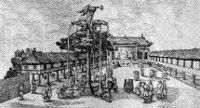
In 1253, Mongke deported 5,00 households from China to repair and maintain the imperial ordos. He decorated the capital city of Karakorum with Chinese, European and Persian architectures. One example of those constructions was a large silver tree, with pipes that discharge various drinks and a triumphant angel
at its top, made by Guillaume Boucher. Foreign merchants’ quarters, Buddhist monasteries, Mosque
s and Christian Churches were newly built. Markets were in the Muslim sector and outside the four gates. Chinese farmer
s grew vegetable
s and grain
s outside the wall of Karakorum.
Mongke married Oghul-Khoimish (Oghul Teimish) of the Oirats
. She bore two daughters.
Mongke's youngest wife was Chubei (d.1259).
There were the most favored two concubines among his many wives and concubines. Herein:
Mongol Empire
The Mongol Empire , initially named as Greater Mongol State was a great empire during the 13th and 14th centuries...
from July 1, 1251 – August 11, 1259. He was the first Great Khan from the Toluid
Toluid
The Toluid refers the family of Tolui, the youngest son of Genghis Khan by his principal queen Börte.Tolui's line ruled Outer and Inner Mongolia from 1251 to 1635, and Outer Mongolia only until 1691. The last of his descedant with the title Khan was murdered in 1923. in addition to their empire in...
line, and made significant reforms to improve the administration
Administration (government)
The term administration, as used in the context of government, differs according to jurisdiction.-United States:In United States usage, the term refers to the executive branch under a specific president , for example: the "Barack Obama administration." It can also mean an executive branch agency...
of the Empire during his reign. Under Möngke, the Mongols conquered Iraq
Iraq
Iraq ; officially the Republic of Iraq is a country in Western Asia spanning most of the northwestern end of the Zagros mountain range, the eastern part of the Syrian Desert and the northern part of the Arabian Desert....
and Syria
Syria
Syria , officially the Syrian Arab Republic , is a country in Western Asia, bordering Lebanon and the Mediterranean Sea to the West, Turkey to the north, Iraq to the east, Jordan to the south, and Israel to the southwest....
as well as the kingdom of Nanzhao and the area of present-day Vietnam
Vietnam
Vietnam – sometimes spelled Viet Nam , officially the Socialist Republic of Vietnam – is the easternmost country on the Indochina Peninsula in Southeast Asia. It is bordered by China to the north, Laos to the northwest, Cambodia to the southwest, and the South China Sea –...
. He was given temple name
Temple name
Temple names are commonly used when naming most Chinese, Korean , and Vietnamese royalty. They should not be confused with era names. Compared to posthumous names, the use of temple names is more exclusive...
( by his successor Kublai Khan
Kublai Khan
Kublai Khan , born Kublai and also known by the temple name Shizu , was the fifth Great Khan of the Mongol Empire from 1260 to 1294 and the founder of the Yuan Dynasty in China...
, who founded the Yuan Dynasty
Yuan Dynasty
The Yuan Dynasty , or Great Yuan Empire was a ruling dynasty founded by the Mongol leader Kublai Khan, who ruled most of present-day China, all of modern Mongolia and its surrounding areas, lasting officially from 1271 to 1368. It is considered both as a division of the Mongol Empire and as an...
.
Early life
Möngke was born on January 10, 1209 as the eldest son of Genghis KhanGenghis Khan
Genghis Khan , born Temujin and occasionally known by his temple name Taizu , was the founder and Great Khan of the Mongol Empire, which became the largest contiguous empire in history after his death....
's teen-aged son Tolui
Tolui
Tolui, was the youngest son of Genghis Khan by his chief khatun Börte...
and Sorghaghtani. Teb Tengri Khokhcuu, the powerful shaman, saw in the stars a great future for the child and bestowed on him the name Mongke, "eternal" in the Mongolian language
Mongolian language
The Mongolian language is the official language of Mongolia and the best-known member of the Mongolic language family. The number of speakers across all its dialects may be 5.2 million, including the vast majority of the residents of Mongolia and many of the Mongolian residents of the Inner...
. His uncle Ogedei's childless queen Angqui raised him at her ordo (nomadic palace). Ogedei instructed Persian scholar Idi-dan Muhammed to teach writing to Mongke.
On his way back home after the conquest
Mongol invasion of Khwarezmia
The Mongol invasion of Khwarezmia from 1219 to 1221 marked the beginning of the Mongol conquest of the Islamic states, in the Mongol expansion would ultimately culminate in the conquest of virtually all of Eurasia, save for Western Europe, Fennoscandia, the Byzantine Empire, Arabia, Indian...
of Khwarizmian Empire, Genghis Khan performed the ceremony on his grandsons Mongke and Kublai after their first hunting in 1224 near the Ili River
Ili River
thumb|right|300px|Map of the Lake Balkhash drainage basin showing the Ili River and its tributariesThe Ili River is a river in northwestern China and southeastern Kazakhstan .It is long, of which is in Kazakhstan...
. Mongke was eleven years old, and with his brother, Kublai, killed a rabbit
Rabbit
Rabbits are small mammals in the family Leporidae of the order Lagomorpha, found in several parts of the world...
and an antelope
Antelope
Antelope is a term referring to many even-toed ungulate species indigenous to various regions in Africa and Eurasia. Antelopes comprise a miscellaneous group within the family Bovidae, encompassing those old-world species that are neither cattle, sheep, buffalo, bison, nor goats...
. Their grandfather smeared fat from killed animals onto their middle fingers following the Mongol tradition.
In 1230, Mongke went to war for the first time, following Ogedei Khan
Ögedei Khan
Ögedei Khan, born Ögedei was the third son of Genghis Khan and second Great Khan of the Mongol Empire by succeeding his father...
and his father Tolui into battle against the Jurchen Jin Dynasty. Tolui died in 1232 and Ogedei appointed Sorghaghtani head of the Toluid appanage
Appanage
An apanage or appanage or is the grant of an estate, titles, offices, or other things of value to the younger male children of a sovereign, who would otherwise have no inheritance under the system of primogeniture...
. Following the Mongol custom, Mongke inherited at least one of his father's wives, Oghul-Khoimish of the Oirat
Oirats
Oirats are the westernmost group of the Mongols who unified several tribes origin whose ancestral home is in the Altai region of western Mongolia. Although the Oirats originated in the eastern parts of Central Asia, the most prominent group today is located in the Republic of Kalmykia, a federal...
clan. Mongke deeply loved her and gave special favor to her elder daughter, Shirin.
Russians
The Russian people are an East Slavic ethnic group native to Russia, speaking the Russian language and primarily living in Russia and neighboring countries....
and Bulgars
Bulgars
The Bulgars were a semi-nomadic who flourished in the Pontic Steppe and the Volga basin in the 7th century.The Bulgars emerge after the collapse of the Hunnic Empire in the 5th century....
in the west in 1235. When the most formidable Kipchak chief, Bachman, fled to an island in the Volga delta. Mongke crossed the river and captured Bachman. When he ordered Bachman to bend on knees, Bachman refused, and, hence, he was executed by Mongke's brother Bujek. Mongke also engaged in hand to hand combat in the sieges of Russian cities. While his cousins, Shiban
Shiban
Shiban or Shayban was one of the Left Wing princes. He was Jöchi's fifth son and a grandson of Genghis Khan. Because he was too young when his father died in 1227, he did not receive any lands at that time....
and Büri
Büri
Buri was a son of Mutugen and a grandson of Chagatai khan. His name - Buri - means Wolf. According to Rashid-al-Din Hamadani, Buri's mother was a wife of Chagatai khan's one official. She was a beauty, and Mutuken was attracted by her while she served in Khan's ger. Mutuken made her pregnant...
, went to Crimea
Crimea
Crimea , or the Autonomous Republic of Crimea , is a sub-national unit, an autonomous republic, of Ukraine. It is located on the northern coast of the Black Sea, occupying a peninsula of the same name...
, Mongke and Khadan, a son of Ogedei, were ordered to reduce the tribes in Caucasus
Caucasus
The Caucasus, also Caucas or Caucasia , is a geopolitical region at the border of Europe and Asia, and situated between the Black and the Caspian sea...
. The Mongols captured the Alani capital Maghas
Maghas
Known exclusively from Arabic sources, Maghas or Maas was the capital city of Alania, a medieval kingdom in the Greater Caucasus. Its location is uncertain, with some authors favouring North Ossetia and others pointing to Arkhyz in modern-day Karachay-Cherkessia, where three 10th-century churches...
and massacred its inhabitants. Many chiefs of the Alans and Circassians surrendered to Mongke. After the conquest of Europe
Mongol invasion of Europe
The resumption of the Mongol invasion of Europe, during which the Mongols attacked medieval Rus' principalities and the powers of Poland and Hungary, was marked by the Mongol invasion of Rus starting in 21 December 1237...
, Mongke would bring them back
Asud
Asud were a guard and military group of Alani origin. The Mongol clan Asud is the plural of As, the Arabic name for the Alans.After the Mongol invasion of Rus, many Alans submitted to the Mongol Empire. Some of them resisted the Golden Horde longer. Many warriors moved from Northern Caucasia to...
to Mongolia
Mongolia
Mongolia is a landlocked country in East and Central Asia. It is bordered by Russia to the north and China to the south, east and west. Although Mongolia does not share a border with Kazakhstan, its western-most point is only from Kazakhstan's eastern tip. Ulan Bator, the capital and largest...
. He also participated in the conquest of Kiev
Siege of Kiev (1240)
The Siege of Kiev by the Mongols took place between November 28th and December 6th, 1240, resulting in a Mongol victory. It was a heavy moral and military blow to Halych-Volhynia and allowed Batu Khan to proceed westward into Europe.- Background :...
in 1240. Mongke was apparently taken by the splendor of Kiev
Kiev
Kiev or Kyiv is the capital and the largest city of Ukraine, located in the north central part of the country on the Dnieper River. The population as of the 2001 census was 2,611,300. However, higher numbers have been cited in the press....
and offered the city surrender, but his envoys were killed. After Batu
Batu Khan
Batu Khan was a Mongol ruler and founder of the Ulus of Jochi , the sub-khanate of the Mongol Empire. Batu was a son of Jochi and grandson of Genghis Khan. His ulus was the chief state of the Golden Horde , which ruled Rus and the Caucasus for around 250 years, after also destroying the armies...
's army joined Mongke's soldiers, they sacked the city. And he also fought with Batu at the Battle of Mohi
Battle of Mohi
The Battle of Mohi , or Battle of the Sajó River, was the main battle between the Mongol Empire and the Kingdom of Hungary during the Mongol invasion of Europe. It took place at Muhi, Southwest of the Sajó River. After the invasion, Hungary lay in ruins. Nearly half of the inhabited places had...
. In the summer of 1241, before the premature end of the campaign, Möngke returned home after his uncle Ogedei recalled him in winter 1240-41. However, Ogedei died.
In 1246, Temuge Odchigen, Genghis Khan's sole remaining brother, unsuccessfully tried to seize the throne without confirmation by a kurultai
Kurultai
Kurultai is a political and military council of ancient Mongol and Turkic chiefs and khans. The root of the word "Khural" means political "meeting" or "assembly" in the Mongolian language, it is also a verb for "to be established"...
. The new Khagan Guyuk
Güyük Khan
Güyük was the third Great Khan of the Mongol Empire. As the eldest son of Ögedei Khan and a grandson of Genghis Khan, he reigned from 1246 to 1248...
entrusted the delicate task of trying Odchigin to Mongke and Orda Khan
Orda Khan
Orda Ichen was a Mongol Khan and military strategist who ruled eastern part of the Ulus of Jochi during the 13th century.-First Khan of the Blue Horde:...
, the eldest brother of Batu. Guyuk eventually died in route to west in 1248 and Batu and Mongke emerged as main contenders.
The Toluid revolution
Following his mother Sorghaghtani's advice, Mongke went to the Golden HordeGolden Horde
The Golden Horde was a Mongol and later Turkicized khanate that formed the north-western sector of the Mongol Empire...
to meet Batu who was afflicted with the gout. Batu decided to support his election and called a kurultai at Ala Qamaq. The leader of the families of Genghis Khan's brothers, and several important generals, came to the kurultai. Guyuk's sons Naqu and Khoja attended briefly but then left. Despite vehement objections from Bala, Oghul Qaimish
Oghul Qaimish
Oghul Qaimish was the principal wife of Güyük Khan and ruled as regent over the Mongol empire after the death of her husband in 1248. She was a descendant from the Mergid tribe. However, H.H.Howorth believed that she was an Oirat.- Life :...
's scribe, the kurultai approved Mongke. Given its limited attendance and location, this kurultai was of questionable validity. Batu sent Mongke under the protection of his brothers, Berke
Berke
Berke Khan was the ruler of the Golden Horde who effectively consolidated the power of the Blue Horde and White Hordes from 1257 to 1266. He succeeded his brother Batu Khan of the Blue Horde and was responsible for the first official establishment of Islam in a khanate of the Mongol Empire...
and Tuqa-temur, and his son Sartaq to assemble a formal kurultai at Kodoe Aral in Mongolia
Mongolia
Mongolia is a landlocked country in East and Central Asia. It is bordered by Russia to the north and China to the south, east and west. Although Mongolia does not share a border with Kazakhstan, its western-most point is only from Kazakhstan's eastern tip. Ulan Bator, the capital and largest...
. When Sorghaghtani and Berke organized a second kurultai on the 1st of July, 1251, the assembled throng proclaimed Mongke the Great Khan of the Mongol Empire, and a few of the Ogedeid
House of Ogedei
The House of Ogedei, sometimes called the Ogedeids were an influential family of Mongol Borjigin from the 12th to 14th centuries. They were descended from Ogedei Khan , a son of Genghis Khan who had become his father's successor, second Great Khan of the Mongol Empire. Ogedei continued the...
and Chagatayid
Chagatai Khanate
The Chagatai Khanate was a Turko-Mongol khanate that comprised the lands ruled by Chagatai Khan , second son of the Great Khan Genghis Khan, and his descendents and successors...
princes, such as his cousin Kadan
Kadan
Kadaň , is a city in the Ústí nad Labem Region of the Czech Republic.The city lies on the banks of the river Ohře. Although it is situated in an industrial part of the Czech Republic there is no major industry within the city and people usually work in offices or have to commute. There are two...
and the deposed khan Khara Hulegu, acknowledged the decision.
Shortly thereafter, Oghul's son Khoja and Ogedei's favorite grandson Shiremun came to "pay homage" to Mongke as the new ruler, but they brought the entire army of the Ogedei faction with them. Mongke's the Kankali
Kankali
The Kankali are a Muslim community found in the state of Uttar Pradesh in India. They are also known as Kankal and Mangta.- Origin :The word kankali is said to be derived from the Hidi word kangal, meaning a pauper. This is said to refer to the fact that the Kankali were once a community of...
falconer, Kheshig, discovered the preparations for the attack and told his lord. At the end of the investigation under his father's loyal servant Menggesar noyan
Noyan
Noyan, noyon was a title of authority in the Mongol Empire and later periods...
, he found his relatives guilty but at first wanted to give them mercy as written in the Great Yassa
Yassa
Yassa was a secret written code of law created by Genghis Khan. It was the principal law under the Mongol Empire even though no copies were made available...
. Mongke's officials opposed it and then he began to punish his relatives. The trials took place on all parts of the empire from Mongolia and China in the east to Afghanistan
Afghanistan
Afghanistan , officially the Islamic Republic of Afghanistan, is a landlocked country located in the centre of Asia, forming South Asia, Central Asia and the Middle East. With a population of about 29 million, it has an area of , making it the 42nd most populous and 41st largest nation in the world...
and Iraq in the west. Mongke and Batu's brother Berke
Berke
Berke Khan was the ruler of the Golden Horde who effectively consolidated the power of the Blue Horde and White Hordes from 1257 to 1266. He succeeded his brother Batu Khan of the Blue Horde and was responsible for the first official establishment of Islam in a khanate of the Mongol Empire...
therefore arranged to have Oghul accused of using black magic against Mongke. After she was arrested and questioned by Sorghaghtani, Oghul Qaimish was sewn up into a sack, and tossed into a river and drowned (which was the traditional Mongol punishment for using black magic). Estimates of the deaths of aristocrats, officials and Mongol commanders include Eljigidei
Eljigidei
Eljigidei was a Mongol commander in Persia, fl. He supposedly commanded a strong contingent when Chingis Khan invaded Khwarizm in 1219–1223. Ogedei was close to Eljihidey. That's why Eljigidei was given command over the Mongol forces in Persia, by the new khan Güyük in 1246, replacing Baiju...
, Yesu Mongke
Yesü Möngke
Yesü Möngke was head of the ulus of the Chagatai Khanate . He was the son of Chagatai Khan.In or around 1246, he was appointed as khan of the Chagatai Khanate by his cousin the Great Khan Güyük Khan, whom he was friends with, following the deposition of Qara Hülëgü...
, Büri
Büri
Buri was a son of Mutugen and a grandson of Chagatai khan. His name - Buri - means Wolf. According to Rashid-al-Din Hamadani, Buri's mother was a wife of Chagatai khan's one official. She was a beauty, and Mutuken was attracted by her while she served in Khan's ger. Mutuken made her pregnant...
and Shiremun and range from 77-300. Most of the princes of Genghisid blood involved in the plot, however, were given some form of exile. The anti-Mongke plot of an Uyghur
Uyghur people
The Uyghur are a Turkic ethnic group living in Eastern and Central Asia. Today, Uyghurs live primarily in the Xinjiang Uyghur Autonomous Region in the People's Republic of China...
scribe
Scribe
A scribe is a person who writes books or documents by hand as a profession and helps the city keep track of its records. The profession, previously found in all literate cultures in some form, lost most of its importance and status with the advent of printing...
, Bala, and the Idiqut Salindi (the monarch of the Uyghurs) was discovered and they were publicly executed. Mongke also eliminated the Ogedeid and Chagataid families’ estates and shared the western part of the empire with his ally Batu Khan. After the bloody purge, Mongke ordered a general amnesty
Amnesty
Amnesty is a legislative or executive act by which a state restores those who may have been guilty of an offense against it to the positions of innocent people, without changing the laws defining the offense. It includes more than pardon, in as much as it obliterates all legal remembrance of the...
for prisoners and captives. Soon, Mongke's mother Sorghaghtani died in 1252.
After his accession to the throne in 1251, Mongke announced that he would follow his ancestors but he do not imitate other countries' ways. To increase his legitimacy, in 1252 he retroactively awarded his father the title of Great Khan (Ikh Khagan). And Möngke's friendliness with Batu ensured the unity of the empire.
Mongol Imperialism
Borjigin
Borjigin , also known as the Altan urug , were the imperial clan of Genghis Khan and his successors....
and non-Borjigid nobles. He also limited gifts to the princes, converting them into regular salaries
Salary
A salary is a form of periodic payment from an employer to an employee, which may be specified in an employment contract. It is contrasted with piece wages, where each job, hour or other unit is paid separately, rather than on a periodic basis....
and made the merchant
Merchant
A merchant is a businessperson who trades in commodities that were produced by others, in order to earn a profit.Merchants can be one of two types:# A wholesale merchant operates in the chain between producer and retail merchant...
s subject to tax
Tax
To tax is to impose a financial charge or other levy upon a taxpayer by a state or the functional equivalent of a state such that failure to pay is punishable by law. Taxes are also imposed by many subnational entities...
es. Mongke limited notorious abuses and sent imperial investigators to supervise the business of the merchants who were sponsored by the Mongols. He prohibited them from using the imperial relay stations, yam (route)
Yam (route)
Yam is a supply point route messenger system employed and extensively used and expanded by Genghis Khan and used by subsequent Great Khans and Khans.Relay stations were used to give food, shelter and spare horses for Mongol armies messengers...
and paiza
Paiza
Paiza or Gerege is a tablet of authority for the Mongol officials and envoys...
s (tablet that gave the bearer authority to demand goods and services from civilian populations). With Guyuk dead, many local officials no longer wanted to pay off the paper drafts used by Guyuk. Mongke recognized that if he did not meet the financial obligation
Obligation
An obligation is a requirement to take some course of action, whether legal or moral. There are also obligations in other normative contexts, such as obligations of etiquette, social obligations, and possibly...
s of Guyuk, it would make merchants reluctant to continue business with the Mongols. Mongke paid out all drafts drawn by high rank Mongol elites to these merchants. Ata Malik Juvaini stated, "And from what book of history has it been read or heard...that a king paid the debt of another king?" in his book. The generals and princes (including his son), who allowed their troops to plunder civilians without authorization, were repeatedly punished by Mongke Khan. He used North Chinese, Muslim
Muslim
A Muslim, also spelled Moslem, is an adherent of Islam, a monotheistic, Abrahamic religion based on the Quran, which Muslims consider the verbatim word of God as revealed to prophet Muhammad. "Muslim" is the Arabic term for "submitter" .Muslims believe that God is one and incomparable...
and Uyghur officials. The Khagan's chief judge
Chief judge
Chief Judge is a title that can refer to the highest-ranking judge of a court that has more than one judge. The meaning and usage of the term vary from one court system to another...
(jarughachi) was the Jait-Jalayir
Jalayir
Jalayir is one of the Darliqin Mongol tribes according to Rashid-al-Din Hamadani's Jami' al-tawarikh. After the Mongol conquest in the 13th century many Jalayirs spread over Central Asia and the Middle East. Jalayirs are one of the founding tribes of Mongolia's largest ethnic group Khalkha....
official Menggeser while the chief sribe was the Kerait
Kerait
The Kereit tribe was one of the five major tribal confederations in Mongolian plateau in the 12th century, and dominant in the area and, as allies of Genghis Khan, influential in the rise of the Mongol Empire...
Bulghai who was a Christian
Christian
A Christian is a person who adheres to Christianity, an Abrahamic, monotheistic religion based on the life and teachings of Jesus of Nazareth as recorded in the Canonical gospels and the letters of the New Testament...
. 9 of the 16 chief provincial officials of Mongke Khan were certainly Muslims. He reappointed Guyuk's three officials: Mahmud Yalavach in China, Masud Beg in Turkestan
Turkestan
Turkestan, spelled also as Turkistan, literally means "Land of the Turks".The term Turkestan is of Persian origin and has never been in use to denote a single nation. It was first used by Persian geographers to describe the place of Turkish peoples...
, and Arghun Agha of the Oirat
Oirats
Oirats are the westernmost group of the Mongols who unified several tribes origin whose ancestral home is in the Altai region of western Mongolia. Although the Oirats originated in the eastern parts of Central Asia, the most prominent group today is located in the Republic of Kalmykia, a federal...
in Persia. Mongke separated the position of the great judge at court from that of chief scribe.
In 1253, Mongke established the Department of Monetary affairs to control the issuance of paper money in order to eliminate the overissue of the currency by Mongol and non-Mongol nobles since the reign of Great Khan Ogedei. His authority established united measure based on sukhe or silver ingot, however, the Mongols allowed their foreign subjects to mint coins in the denominations and use weight they traditionally used. During the reigns of Ogedei, Guyuk and Mongke, Mongol coinage increased with gold and silver coinage in Central Asia and copper
Copper
Copper is a chemical element with the symbol Cu and atomic number 29. It is a ductile metal with very high thermal and electrical conductivity. Pure copper is soft and malleable; an exposed surface has a reddish-orange tarnish...
and silver coins in Caucasus
Caucasus
The Caucasus, also Caucas or Caucasia , is a geopolitical region at the border of Europe and Asia, and situated between the Black and the Caspian sea...
, Iran and Bolghar
Bolghar
Bolghar was intermittently capital of Volga Bulgaria from the 8th to the 15th centuries, along with Bilyar and Nur-Suvar. It was situated on the bank of the Volga River, about 30 km downstream from its confluence with the Kama River and some 130 km from modern Kazan...
.
In 1252-1259, Möngke conducted a census
Census
A census is the procedure of systematically acquiring and recording information about the members of a given population. It is a regularly occurring and official count of a particular population. The term is used mostly in connection with national population and housing censuses; other common...
of the Mongol Empire including Iran
Iran
Iran , officially the Islamic Republic of Iran , is a country in Southern and Western Asia. The name "Iran" has been in use natively since the Sassanian era and came into use internationally in 1935, before which the country was known to the Western world as Persia...
, Afghanistan
Afghanistan
Afghanistan , officially the Islamic Republic of Afghanistan, is a landlocked country located in the centre of Asia, forming South Asia, Central Asia and the Middle East. With a population of about 29 million, it has an area of , making it the 42nd most populous and 41st largest nation in the world...
, Georgia
Georgia (country)
Georgia is a sovereign state in the Caucasus region of Eurasia. Located at the crossroads of Western Asia and Eastern Europe, it is bounded to the west by the Black Sea, to the north by Russia, to the southwest by Turkey, to the south by Armenia, and to the southeast by Azerbaijan. The capital of...
, Armenia
Armenia
Armenia , officially the Republic of Armenia , is a landlocked mountainous country in the Caucasus region of Eurasia...
, Russia, Central Asia
Central Asia
Central Asia is a core region of the Asian continent from the Caspian Sea in the west, China in the east, Afghanistan in the south, and Russia in the north...
and North China
North China
thumb|250px|Northern [[People's Republic of China]] region.Northern China or North China is a geographical region of China. The heartland of North China is the North China Plain....
. While that of China was completed in 1252, Novgorod in the far northwest was not counted until winter 1258-59. There was an uprising in Novgorod against Mongol rule in 1257, but Alexander Nevsky
Alexander Nevsky
Alexander Nevsky was the Prince of Novgorod and Grand Prince of Vladimir during some of the most trying times in the city's history. Commonly regarded as the key figure of medieval Rus, Alexander was the grandson of Vsevolod the Big Nest and rose to legendary status on account of his military...
forced the city to submit to Mongol census and taxation. The new census counted not only households but also the number of men aged 15–60 and the number of field
Field (agriculture)
In agriculture, the word field refers generally to an area of land enclosed or otherwise and used for agricultural purposes such as:* Cultivating crops* Usage as a paddock or, generally, an enclosure of livestock...
s, livestock
Livestock
Livestock refers to one or more domesticated animals raised in an agricultural setting to produce commodities such as food, fiber and labor. The term "livestock" as used in this article does not include poultry or farmed fish; however the inclusion of these, especially poultry, within the meaning...
, vineyard
Vineyard
A vineyard is a plantation of grape-bearing vines, grown mainly for winemaking, but also raisins, table grapes and non-alcoholic grape juice...
s, and orchard
Orchard
An orchard is an intentional planting of trees or shrubs that is maintained for food production. Orchards comprise fruit or nut-producing trees which are grown for commercial production. Orchards are also sometimes a feature of large gardens, where they serve an aesthetic as well as a productive...
s. Within the civilian register craftsmen were listed separately while in the military registers auxiliary
Auxiliary
Auxiliary may refer to:* A backup site or system* Auxiliary input jack, generally for audio* Auxiliary verb* International auxiliary language* Auxiliary police* Auxiliaries, troops supporting the main force of an army** Auxiliaries...
and regular households were distinguished. Clergy of the approved religions were separated and not counted. When the new register was completed, one copy was sent to Karakorum and one copy kept for the local administration. Mongke tried to create a fixed poll-tax collected by imperial agents, which could forward to the needy units. Initially, the maximum rate was fixed at 10-11 gold dinar
Dinar
The dinar is the official currency of several countries.The history of the dinar dates to the gold dinar, an early Islamic coin corresponding to the Byzantine denarius auri...
s in the Middle East and 6-7 taels of silver in China. But protests from the landlord
Landlord
A landlord is the owner of a house, apartment, condominium, or real estate which is rented or leased to an individual or business, who is called a tenant . When a juristic person is in this position, the term landlord is used. Other terms include lessor and owner...
classes reduced this relatively low rate to 6-7 dinars and taels. Mongke's some officials raised the top rate on the wealthy of 500 dinars. Although, the reform of the taxation did not lighten the tax burden, it made the payments more predictable. Even so, the census and the regressive taxation it facilitated sparked popular riots and resistance in the western districts. In 1259, the Georgian King David Narin revolted, unsuccessfully, against the Mongols and, then, fled to Kutaisi
Kutaisi
Kutaisi is Georgia's second largest city and the capital of the western region of Imereti. It is 221 km to the west of Tbilisi.-Geography:...
, from whence he reigned over western Georgia (Imereti
Imereti
Imereti is a province in Georgia situated along the middle and upper reaches of the Rioni river. It consists of the following Georgian administrative-territorial units:#Kutaisi #Baghdati region#Vani region#Zestafoni region...
) as a de facto
De facto
De facto is a Latin expression that means "concerning fact." In law, it often means "in practice but not necessarily ordained by law" or "in practice or actuality, but not officially established." It is commonly used in contrast to de jure when referring to matters of law, governance, or...
separate ruler. In 1261, he gave shelter to David VII Ulu
David VII Ulu
David VII Ulu , from the Bagrationi dynasty, was king of Georgia in 1247–1270. He reigned over the eastern part of the country from 1259 to 1270.-Life:David was an illegitimate son of King Giorgi IV Lasha by a non-noble woman...
, who in his turn had attempted to end the Mongol dominance. However, David Ulu made peace with the Mongols and returned to Tbilisi
Tbilisi
Tbilisi is the capital and the largest city of Georgia, lying on the banks of the Mt'k'vari River. The name is derived from an early Georgian form T'pilisi and it was officially known as Tiflis until 1936...
in 1262. Mongke and Batu's official, Arghun, harshly punished the Georgian and Armenian nobles, plundering their cities and executing their prominent leaders. He divided the Georgians into 6 tumen
Tumen
Tumen or Tümen was a part of the decimal system used by Turkic and Mongol peoples to organize their armies. Tumen is an army unit of 10,000 soldiers...
s. Meanwhile, Baiju
Baiju
Baiju was a Mongol commander in Persia appointed by Ögedei Khan to succeed Chormagan, and expand Mongol power further in that area....
crushed the rebellion of the Seljuk
Seljuq dynasty
The Seljuq ; were a Turco-Persian Sunni Muslim dynasty that ruled parts of Central Asia and the Middle East from the 11th to 14th centuries...
Sultan Kaykaus II
Kaykaus II
Kaykaus II or Kayka'us II was the eldest of three sons of Kaykhusraw II. He was a youth at the time of his father’s death in 1246 and could do little to prevent the Mongol subjugation of Anatolia. For most of his tenure as the Seljuq Sultan of Rûm, he shared the throne with one or both of his...
near Ankara
Ankara
Ankara is the capital of Turkey and the country's second largest city after Istanbul. The city has a mean elevation of , and as of 2010 the metropolitan area in the entire Ankara Province had a population of 4.4 million....
in 1256 and reestablished Mongol authority over Eastern Turkey
Turkey
Turkey , known officially as the Republic of Turkey , is a Eurasian country located in Western Asia and in East Thrace in Southeastern Europe...
. By that time the Kashmiris had revolted, and Mongke appointed his generals, Sali and Takudar, to replace the court and a Buddhist master, Otochi, as darugachi to Kashmir
Kashmir
Kashmir is the northwestern region of the Indian subcontinent. Until the mid-19th century, the term Kashmir geographically denoted only the valley between the Great Himalayas and the Pir Panjal mountain range...
. However, the Kashmiri king killed Otochi at Srinagar
Srinagar
Srinagar is the summer seasonal capital of Jammu and Kashmir. It is situated in Kashmir Valley and lies on the banks of the Jhelum River, a tributary of the Indus. It is one of the largest cities in India not to have a Hindu majority. The city is famous for its gardens, lakes and houseboats...
. Sali invaded again, killing the king, and put down the rebellion, after which the country remained subject to the Mongol Empire for many years.
Religious policy
Mongke confirmed Guyuk's appointment of Haiyun as chief of all the Buddhists in the Mongol EmpireMongol Empire
The Mongol Empire , initially named as Greater Mongol State was a great empire during the 13th and 14th centuries...
in 1251. In 1253 Namo from Kashmir
Kashmir
Kashmir is the northwestern region of the Indian subcontinent. Until the mid-19th century, the term Kashmir geographically denoted only the valley between the Great Himalayas and the Pir Panjal mountain range...
was made chief of all the Buddhist monk
Monk
A monk is a person who practices religious asceticism, living either alone or with any number of monks, while always maintaining some degree of physical separation from those not sharing the same purpose...
s in the Empire. During the conquest of Tibet in 1252-53, all Buddhist clergy were exempted from taxation. The Tibetan Karma Pakshi
Karma Pakshi
Karma Pakshi was the 2nd Gyalwa Karmapa. He was a child prodigy who had already acquired a broad understanding of Dharma philosophy and meditation by the age of ten. His teacher, Pomdrakpa, had received the full Kagyu transmission from Drogon Rechen, the first Karmapa's spiritual heir...
received Mongke's patronage. Mongke had been so impressed by the aged Taoist monk Qiu Chuji
Qiu Chuji
Qiu Chuji was a Daoist disciple of Wang Chongyang. He was the most famous among the Seven True Daoists of the North...
who met his grandfather Genghis Khan in Afghanistan
Afghanistan
Afghanistan , officially the Islamic Republic of Afghanistan, is a landlocked country located in the centre of Asia, forming South Asia, Central Asia and the Middle East. With a population of about 29 million, it has an area of , making it the 42nd most populous and 41st largest nation in the world...
. Mongke made Li Zhichang chief of the Taoists. However, the Taoists had exploited their wealth and status by seizing Buddhist temples. Mongke demanded that the Taoists cease their denigration of Buddhism
Buddhism
Buddhism is a religion and philosophy encompassing a variety of traditions, beliefs and practices, largely based on teachings attributed to Siddhartha Gautama, commonly known as the Buddha . The Buddha lived and taught in the northeastern Indian subcontinent some time between the 6th and 4th...
. Mongke ordered Kublai to end the clerical strife between the Taoists and Buddhists in his territory. Kublai called a conference of Taoist and Buddhist leaders in early 1258. At the conference, the Taoist claim was officially declared refuted and Kublai forcibly converted their 237 temples to Buddhism and destroyed all copies of the fraudulent texts.
Despite his conquests of the Abbasid Caliphate and the Ismailis, Mongke favored Muslim perceptions. He and Hulegu made the Shiite community at Najaf
Najaf
Najaf is a city in Iraq about 160 km south of Baghdad. Its estimated population in 2008 is 560,000 people. It is the capital of Najaf Governorate...
autonomous tax-exempt ecclesiastical polity. Like his predecessors, he exempted clerics, monks, churches, mosques, monasteries and doctor
Physician
A physician is a health care provider who practices the profession of medicine, which is concerned with promoting, maintaining or restoring human health through the study, diagnosis, and treatment of disease, injury and other physical and mental impairments...
s from taxation.
Louis IX
Louis IX may refer to:* Louis IX of France .* Louis IX, Duke of Bavaria "the Rich" * Louis IX, Landgrave of Hesse-Darmstadt ....
sent William Rubruck as a diplomat seeking an alliance
Franco-Mongol alliance
Franco-Mongol relations were established in the 13th century, as attempts were made towards forming a Franco-Mongol alliance between the Christian Crusaders and the Mongol Empire against various Muslim empires. Such an alliance would have seemed a logical choice: the Mongols were sympathetic to...
with the Mongols against the Muslims. By that time Mongke's khatun Oghul-Khoimish was already dead. After making the French envoy wait for many months, Mongke officially received William Rubruck on May 24, 1254. Rubruck informed him that he had come to spread the word of Jesus Christ. Then he stayed to help the Christians in Karakorum and attended debates among rival religions organized by the Mongols. Mongke Khan summoned William Rubruck to send him back home in 1255. He told Rubruck:
"We Mongols believe in one God, by Whom we live and die". He then continued "Just as God gave different fingers to the hand so has He given different ways to men. To you God has given the Scriptures and you Christians do not observe them". He explained God had given the Mongols their shamans. Mongke offered Louis IX his cooperation but warned all Christians that "If, when you hear and understand the decree of the eternal God, you are unwilling to pay attention and believe it...and in this confidence you bring an army against us-we know what we can do".
Ambassadors from the Latin Empire
Latin Empire
The Latin Empire or Latin Empire of Constantinople is the name given by historians to the feudal Crusader state founded by the leaders of the Fourth Crusade on lands captured from the Byzantine Empire. It was established after the capture of Constantinople in 1204 and lasted until 1261...
and the Empire of Nicaea
Empire of Nicaea
The Empire of Nicaea was the largest of the three Byzantine Greek successor states founded by the aristocracy of the Byzantine Empire that fled after Constantinople was occupied by Western European and Venetian forces during the Fourth Crusade...
came to the Mongol court to negotiate terms with Mongke Khan as well. From 1252 on King Hethum I of Lesser Armenia
Lesser Armenia
Lesser Armenia , also known as Armenia Minor and Armenia Inferior, refers to the Armenian populated regions, primarily to the West and North-West of the ancient Armenian Kingdom...
began his journey to Mongolia. He brought many sumptuous presents, and met with Mongke at Karakorum
Karakorum
Karakorum was the capital of the Mongol Empire in the 13th century, and of the Northern Yuan in the 14-15th century. Its ruins lie in the northwestern corner of the Övörkhangai Province of Mongolia, near today's town of Kharkhorin, and adjacent to the Erdene Zuu monastery...
. He had an audience with Mongke on September 13, 1254, advised the Khagan on Christian matters in Western Asia, and obtained from Mongke Khan documents guaranteeing the inviolability of his person and his kingdom. Hethum asked the Khagan and his officials to convert into Christianity
Christianity
Christianity is a monotheistic religion based on the life and teachings of Jesus as presented in canonical gospels and other New Testament writings...
. In reply, Mongke explained that he really wished his subjects to truly worship Messiah
Messiah
A messiah is a redeemer figure expected or foretold in one form or another by a religion. Slightly more widely, a messiah is any redeemer figure. Messianic beliefs or theories generally relate to eschatological improvement of the state of humanity or the world, in other words the World to...
but he could not force the Mongols and other civilians to change their religion. Mongke also informed him that he was preparing to mount an attack on Baghdad
Baghdad
Baghdad is the capital of Iraq, as well as the coterminous Baghdad Governorate. The population of Baghdad in 2011 is approximately 7,216,040...
and that he would remit Jerusalem to the Christians if they collaborated with him.
Hethum strongly encouraged other Crusaders
Crusaders
The Crusaders are a New Zealand professional rugby union team based in Christchurch that competes in the Super Rugby competition. They are the most successful team in Super Rugby history with seven titles...
to follow his example and submit to Mongol overlordship, but persuaded only his son-in-law Bohemond VI, ruler of the Principality of Antioch
Principality of Antioch
The Principality of Antioch, including parts of modern-day Turkey and Syria, was one of the crusader states created during the First Crusade.-Foundation:...
and County of Tripoli
County of Tripoli
The County of Tripoli was the last Crusader state founded in the Levant, located in what today are parts of western Syria and northern Lebanon, where exists the modern city of Tripoli. The Crusader state was captured and created by Christian forces in 1109, originally held by Bertrand of Toulouse...
, who offered his own submission sometime in the 1250s. The armies of the Kingdom of Cilician Armenia and Bohemond VI would assist Mongke's army in the West soon.
The Mongol shamans
Tengriism
Tengriism is a Central Asian religion that incorporates elements of shamanism, animism, totemism and ancestor worship. Despite still being active in some minorities, it was, in old times, the major belief of Turkic peoples , Bulgars, Hungarians and Mongols...
played an important role in the court and sometimes influenced the war preparation.
Period of conquests
As Khagan, Möngke seemed to take the legacy of world conquest he had inherited much more seriously than did Güyük. His conquests were all directed to East AsiaEast Asia
East Asia or Eastern Asia is a subregion of Asia that can be defined in either geographical or cultural terms...
and the Middle east.
Conquest of the Goryeo Dynasty
In his first plans of the Mongol conquests, Mongke chose KoreaKorea
Korea ) is an East Asian geographic region that is currently divided into two separate sovereign states — North Korea and South Korea. Located on the Korean Peninsula, Korea is bordered by the People's Republic of China to the northwest, Russia to the northeast, and is separated from Japan to the...
and Dali Kingdom in Yunnan
Yunnan
Yunnan is a province of the People's Republic of China, located in the far southwest of the country spanning approximately and with a population of 45.7 million . The capital of the province is Kunming. The province borders Burma, Laos, and Vietnam.Yunnan is situated in a mountainous area, with...
in 1252.
Mongke sent envoys to the Goryeo
Goryeo
The Goryeo Dynasty or Koryŏ was a Korean dynasty established in 918 by Emperor Taejo. Korea gets its name from this kingdom which came to be pronounced Korea. It united the Later Three Kingdoms in 936 and ruled most of the Korean peninsula until it was removed by the Joseon dynasty in 1392...
, announcing his coronation in October 1251. He also demanded the King Gojong
Gojong of Goryeo
Gojong of Goryeo was the twenty-third ruler of Goryeo in present-day Korea. Gojong's reign was marked by prolonged conflict with the Mongol Empire, which sought to conquer Goryeo, ending only when the kingdom was finally vassalized in 1259...
to summon before him in person and move his headquarter from Ganghwa Island
Ganghwa Island
Ganghwa Island is an island in the estuary of the Han River, on the west coast of South Korea. Ganghwa Island is separated from Gimpo, on the mainland, by a narrow channel, which is spanned by two bridges. The main channel of the Han River separates the island from Gaeseong in North Korea.About...
to the mainland of Korea. But the Goryeo court refused to send the king because the old king was unable to go so far. Mongke dispatched his envoys with specific tasks again. The envoys were well-received by the Goryeo officials but they criticized the Goryeo officials that their king did not follow his overlord Mongke's orders. Mongke ordered the prince Yeku to command the army against Korea. However, a Korean in the court of Mongke convinced them to begin their campaign in July 1253. Yeku, along with Amuqan, demanded the Goryeo court to surrender. The court refused but did not resist the Mongols and gathered the peasentry into the mountain fortresses and islands. Working together with the Goryeo commanders who had joined the Mongols, Jalairtai Qorchi ravaged Korea. When one of Yeku's envoys arrived, Gojong personally met him at his new palace. The king Gojong sent his stepson as hostage to Mongolia. The Mongols agreed to cease fire in January 1254.
However, Mongke realized that the hostage was not the blood prince of the Goryeo Dynasty. So Mongke blamed the Goryeo court for deceiving him. Mongke's commander Jalairtai devastated much of the Goryeo and took 206,800 captives in 1254. Famine and despair forced peasants to surrender to the Mongols. They established a chiliarchy office at Yonghung with local officials. Ordering defectors to build ships, the Mongols began attacking the coastal islands from 1255 on. In the Liaodong Peninsula, the Mongols formed Korean defectors into a colony of eventually 5,000 households.
In 1258 the king and the Choe clan retainer Kim Jun staged a counter-coup, assassinated the head of the Choe family and sued for peace. When the Goryeo court sent the future king Wonjong of Goryeo
Wonjong of Goryeo
Wonjong of Goryeo was the 24th ruler of the Goryeo dynasty of Korea. He ascended to the throne with the help of Kublai Khan...
as hostage to the Mongol court and promised to return to Gaegyeong
Kaesong
Kaesŏng is a city in North Hwanghae Province, southern North Korea , a former Directly Governed City, and the capital of Korea during the Koryo Dynasty. The city is near Kaesŏng Industrial Region and it contains the remains of the Manwoldae palace. It was formally named Songdo while it was the...
, the Mongols withdrew from Korea.
Yunnan, Vietnam and Tibet
Möngke concerned himself more with the war in China, outflanking the Song DynastySong Dynasty
The Song Dynasty was a ruling dynasty in China between 960 and 1279; it succeeded the Five Dynasties and Ten Kingdoms Period, and was followed by the Yuan Dynasty. It was the first government in world history to issue banknotes or paper money, and the first Chinese government to establish a...
through the conquest of Yunnan
Kingdom of Dali
Dali or Great Li was a Bai kingdom centred in what is now Yunnan Province of China. Established by Duan Siping in 937, it was ruled by a succession of 22 kings until the year 1253, when it was conquered by an invasion of the Mongol Empire. The capital city was at Dali.- History :The Kingdom of...
in 1254 and an invasion of Indochina
Indochina
The Indochinese peninsula, is a region in Southeast Asia. It lies roughly southwest of China, and east of India. The name has its origins in the French, Indochine, as a combination of the names of "China" and "India", and was adopted when French colonizers in Vietnam began expanding their territory...
, which allowed the Mongols to invade from north, west, and south.
Mongke Khan
Möngke Khan
Möngke Khan , born Möngke, , was the fourth Great Khan of the Mongol Empire from July 1, 1251 – August 11, 1259. He was the first Great Khan from the Toluid line, and made significant reforms to improve the administration of the Empire during his reign...
dispatched Kublai to the Dali Kingdom in 1253. The ruling faimly, Gao, resisted and murdered Mongol envoy
Diplomacy
Diplomacy is the art and practice of conducting negotiations between representatives of groups or states...
s. The Mongols divided their forces into three. One wing rode eastward into the Sichuan
Sichuan
' , known formerly in the West by its postal map spellings of Szechwan or Szechuan is a province in Southwest China with its capital in Chengdu...
basin. The second column under Uryankhadai took a difficult way into the mountains of western Sichuan. Kublai himself headed south over the grasslands, meeting up with the first column. While Uryankhadai galloping in along the lakeside from the north, Kublai took the capital city of Dali and spared the residents despite the slaying of his ambassadors. The Mongols appointed King Duan Xingzhi as local ruler and stationed a pacification commissioner there. After Kublai's departure, unrest broke out among the Black jang. By 1256, Uryankhadai, the son of Subutai
Subutai
Subutai was the primary military strategist and general of Genghis Khan and Ögedei Khan...
had completely pacified Yunnan
Yunnan
Yunnan is a province of the People's Republic of China, located in the far southwest of the country spanning approximately and with a population of 45.7 million . The capital of the province is Kunming. The province borders Burma, Laos, and Vietnam.Yunnan is situated in a mountainous area, with...
.
After subjugating the Dali, Kublai sent one column under Uriyankhadai to south. Uriyankhadai sent envoys to ask the Vietnam
Vietnam
Vietnam – sometimes spelled Viet Nam , officially the Socialist Republic of Vietnam – is the easternmost country on the Indochina Peninsula in Southeast Asia. It is bordered by China to the north, Laos to the northwest, Cambodia to the southwest, and the South China Sea –...
ese a route to attack Southern Song Dynasty. But the Tran Vietnamese imprisoned Mongol envoys. This action led Uriyankhadai and his son Aju
Aju
Aju was a general and chancellor of the Mongol Empire and the Yuan Dynasty. He was from the Jarchud clan of the Mongol Uriankhai....
to invade Vietnam with 3,000 Mongols and 10,000 Yi tribesmen
Yi people
The Yi or Lolo people are an ethnic group in China, Vietnam, and Thailand. Numbering 8 million, they are the seventh largest of the 55 ethnic minority groups officially recognized by the People's Republic of China...
. In 1257, a Mongol column under Uriyankhadai, the son of Subutai
Subutai
Subutai was the primary military strategist and general of Genghis Khan and Ögedei Khan...
, invaded Vietnam (then known as Đại Việt or Great Land of the Viet people), routing the Vietnamese militant
Militant
The word militant, which is both an adjective and a noun, usually is used to mean vigorously active, combative and aggressive, especially in support of a cause, as in 'militant reformers'. It comes from the 15th century Latin "militare" meaning "to serve as a soldier"...
s and sacking the capital at Thanh Long (renamed Hanoi
Hanoi
Hanoi , is the capital of Vietnam and the country's second largest city. Its population in 2009 was estimated at 2.6 million for urban districts, 6.5 million for the metropolitan jurisdiction. From 1010 until 1802, it was the most important political centre of Vietnam...
in 1831). He executed its inhabitants for the murder of the envoys. After staying in Thang Long for a while, the Mongols fell ills due to unfamiliar climate. Realizing that it was time to drive the Mongols out, the Vietnamese launched a counter attack and won the decisive battle of Dong Bo Dau. In order to sooth the Mongol and prevent further war, the Tran accepted Mongol overlorship Uriyankhadai withdrew when the Tran Emperor accepted Mongol overlordship. The Vietnamese king Trần Thái Tông
Trần Thái Tông
Trần Thái Tông, born name: Trần Cảnh , July 17, 1218-May 4, 1277) was the first emperor of the Trần Dynasty, seated on the throne for 33 years , being Grand Emperor for 19 years.-Biography:...
paid tribute to Uriyankhadi who had quickly evacuated Vietnam to escape malaria
Malaria
Malaria is a mosquito-borne infectious disease of humans and other animals caused by eukaryotic protists of the genus Plasmodium. The disease results from the multiplication of Plasmodium parasites within red blood cells, causing symptoms that typically include fever and headache, in severe cases...
. The Trần Dynasty accepted terms of the vassalage and sent tributes to the administration of Mongke.
In order to strengthen his control over Tibet
Tibet
Tibet is a plateau region in Asia, north-east of the Himalayas. It is the traditional homeland of the Tibetan people as well as some other ethnic groups such as Monpas, Qiang, and Lhobas, and is now also inhabited by considerable numbers of Han and Hui people...
, Mongke made Qoridai commander of the Mongol and Han troops in Tufan in 1251. In 1252-53 Qoridai invaded Tibet, reaching as far as Damxung. The Central Tibetian monasteries submitted to the Mongols and the Mongol princes divided between them as their appanages.
Conflicts with the Delhi Sultanate
In 1252-3 Sali NoyanNoyan
Noyan, noyon was a title of authority in the Mongol Empire and later periods...
of the Tatar clan was sent to the Indian borderlands at the head of fresh troops, and was given authority over the Qaraunas. Sali himself was subordinate to Mongke's brother Hulegu. Due to the internal conflicts of the Delhi Sultanate
Delhi Sultanate
The Delhi Sultanate is a term used to cover five short-lived, Delhi based kingdoms or sultanates, of Turkic origin in medieval India. The sultanates ruled from Delhi between 1206 and 1526, when the last was replaced by the Mughal dynasty...
, the Mamluk Sultan Nasir ud din Mahmud
Nasir ud din Mahmud
Nasir ud din Mahmud, Nasir ud din Firuz Shah was the eighth sultan of the Mamluk Sultanate . He was the youngest son of Shams ud din Iltutmish , and he succeeded Ala ud din Masud after the chiefs replaced Masud when they felt that he began to behave as a tyrant.As a ruler, Mahmud was known to be...
's brother, Jalal al-Din Masud, fled into Mongol territory in 1248. When Mongke was crowned as Khagan, Jalal al-Din Masud attended the ceremony and asked help from Mongke. Mongke ordered Sali to assist him to recover his ancestral realm. Sali made successive attacks on Multan
Multan
Multan , is a city in the Punjab Province of Pakistan and capital of Multan District. It is located in the southern part of the province on the east bank of the Chenab River, more or less in the geographic centre of the country and about from Islamabad, from Lahore and from Karachi...
and Lahore
Lahore
Lahore is the capital of the Pakistani province of Punjab and the second largest city in the country. With a rich and fabulous history dating back to over a thousand years ago, Lahore is no doubt Pakistan's cultural capital. One of the most densely populated cities in the world, Lahore remains a...
. Sham al-Din Muhammad Kart
Kartids
The Kartid Dynasty was a Persian dynasty that ruled over a large part of Khorassan during the 13th and 14th centuries...
, the client malik of Herat
Herat
Herāt is the capital of Herat province in Afghanistan. It is the third largest city of Afghanistan, with a population of about 397,456 as of 2006. It is situated in the valley of the Hari River, which flows from the mountains of central Afghanistan to the Karakum Desert in Turkmenistan...
, accompanied the Mongols. Jalal al-Din was installed as client ruler of Lahore, Kujah and Sodra
Södra
Södra Skogsägarna, trading as Södra, is a forestry cooperative based in Växjö, Sweden. It has 50,000 members in Southern Sweden and both operates in its members forests and owns processing plants. The cooperative has 3,700 employees. The company also produces electricity.In Norway, Södra operates...
. In 1254 the Delhi official Kushlu Khan offered his submission to Mongke Khan and accepted a Mongol darugachi. When he failed to take Delhi, Kushlu turned to Hulegu. In the winter of 655/1257-8 Sali Noyan entered Sind
History of Sindh
Sindh is one of the provinces of Pakistan. Sindh was home to one of the world's oldest civilizations, the Indus Valley civilization.-Paleolithic and Mesolithic era:...
in strength and dismantled the fortifications of Multan; his forces may also have invested the island fortress of Bakhkar on the Indus.
Conquest of the Middle East
Sultanate of Rûm
The Sultanate of Rum , also known as the Anatolian Seljuk State , was a Turkic state centered in in Anatolia, with capitals first at İznik and then at Konya. Since the court of the sultanate was highly mobile, cities like Kayseri and Sivas also functioned at times as capitals...
and the Lu'lu'id dynasty of Mosul
Mosul
Mosul , is a city in northern Iraq and the capital of the Ninawa Governorate, some northwest of Baghdad. The original city stands on the west bank of the Tigris River, opposite the ancient Assyrian city of Nineveh on the east bank, but the metropolitan area has now grown to encompass substantial...
were subject to the Mongol Empire. The Ayyubid ruler of Mayyafariqin, Malik Kamil, and his cousin in Aleppo
Aleppo
Aleppo is the largest city in Syria and the capital of Aleppo Governorate, the most populous Syrian governorate. With an official population of 2,301,570 , expanding to over 2.5 million in the metropolitan area, it is also one of the largest cities in the Levant...
and the future Sultan, Malik Nasir Yusuf sent envoys to Mongke Khan, who imposed darugachis (overseers) and a census on the Diyarbakir
Diyarbakir
Diyarbakır is one of the largest cities in southeastern Turkey...
area.
After the defeat of the Ogedeid and Chagataid families, Mongke eliminated their territory, assigning acquiescent members of the family new territories either in Turkestan or in northwest China. In another move to consolidate his power, Mongke gave his brothers Kublai and Hulegu supervisory powers in North China and Iran. Rumors spread that his brother Kublai founded a de facto independent ulus (district) and perhaps took for himself some of the tax receipts that should by rights be coming to Karakorum. In 1257 the Emperor sent two tax inspector
Inspector
Inspector is both a police rank and an administrative position, both used in a number of contexts. However, it is not an equivalent rank in each police force.- Australia :...
s to audit Kublai's official. They found fault, listed 142 breaches of regulations, accused Chinese officials, even had some executed and Kublai's office was abolished. Mongke's authority took over the collection of all taxes in Kublai's estates. As his Confucian and Buddhist advisers pointed out, Kublai first sent his wives to the court of Khagan and then appealed to Mongke in person. They embraced in tears and Mongke forgave his brother.
Imam
An imam is an Islamic leadership position, often the worship leader of a mosque and the Muslim community. Similar to spiritual leaders, the imam is the one who leads Islamic worship services. More often, the community turns to the mosque imam if they have a religious question...
Alaud-Din dispatched hundreds of assassin
Assassination
To carry out an assassination is "to murder by a sudden and/or secret attack, often for political reasons." Alternatively, assassination may be defined as "the act of deliberately killing someone, especially a public figure, usually for hire or for political reasons."An assassination may be...
s to kill Mongke in his palace. Shams-ud-Din, the chief judge of Qazvin
Qazvin
Qazvin is the largest city and capital of the Province of Qazvin in Iran. At the 2006 census, its population was 349,821, in 96,420 families....
, had denounced the menace of the Ismailis. Hence, Mongke decided to exterminate the sect
Sect
A sect is a group with distinctive religious, political or philosophical beliefs. Although in past it was mostly used to refer to religious groups, it has since expanded and in modern culture can refer to any organization that breaks away from a larger one to follow a different set of rules and...
. This is sometimes called the First War on Terror (as by John Man
John Man (author)
John Anthony Garnet Man is a British historian and travel writer. His special interests are China, Mongolia and the history of written communication...
in "Kublai Khan". Mongke ordered the Jochid and Chagataid families to join Hulegu's expedition to Iran and strengthened the army with 1,000 siege engineers from China. Möngke's armies, led by his brother Hulegu (c. 1217–65), launched an attack on the Ismailis in Iran, crushing the last major resistance there by the end of 1256. The Hashashin Imam Rukn ad-Din requested permission to travel to Karakorum to meet with the Great Khan Mongke himself. Hulegu sent him on the long journey to Mongolia, but once the Imam arrived there, Mongke criticized his action and dismissed him. Rukn ad-Din was killed in uncertain circumstances. For the Abbasids, envoys from Baghdad attended the coronation of Mongke in 1251 to come to terms with the Mongols. However, Mongke told Hulegu whether the Caliph
Caliph
The Caliph is the head of state in a Caliphate, and the title for the ruler of the Islamic Ummah, an Islamic community ruled by the Shari'ah. It is a transcribed version of the Arabic word which means "successor" or "representative"...
Al-Musta'sim
Al-Musta'sim
Al-Musta'sim Billah was the last Abbasid Caliph in Baghdad; he ruled from 1242 until his death.-Biography:...
refused to meet him in person, then Hulegu was to destroy Baghdad
Baghdad
Baghdad is the capital of Iraq, as well as the coterminous Baghdad Governorate. The population of Baghdad in 2011 is approximately 7,216,040...
. Hulegu then advanced on Iraq
Iraq
Iraq ; officially the Republic of Iraq is a country in Western Asia spanning most of the northwestern end of the Zagros mountain range, the eastern part of the Syrian Desert and the northern part of the Arabian Desert....
, taking the capital at Baghdad in 1258. Hulegu sent Mongke some of his war booty with the news of his conquest of Baghdad. Mongke dispatched a Chinese messenger to congratulate for his victory in reply. Outraged by the attack on the caliphate, Malik Kamil revolted, killing his Mongol overseer. Hulegu's son Yoshumut invested Mayyafariqin and executed Malik Kamil. From there they moved into Syria
Syria
Syria , officially the Syrian Arab Republic , is a country in Western Asia, bordering Lebanon and the Mediterranean Sea to the West, Turkey to the north, Iraq to the east, Jordan to the south, and Israel to the southwest....
in 1259, took Damascus
Damascus
Damascus , commonly known in Syria as Al Sham , and as the City of Jasmine , is the capital and the second largest city of Syria after Aleppo, both are part of the country's 14 governorates. In addition to being one of the oldest continuously inhabited cities in the world, Damascus is a major...
and Aleppo
Aleppo
Aleppo is the largest city in Syria and the capital of Aleppo Governorate, the most populous Syrian governorate. With an official population of 2,301,570 , expanding to over 2.5 million in the metropolitan area, it is also one of the largest cities in the Levant...
, and reached the shores of the Mediterranean. Fearing of the Mongol advance, the Ayyubid Sultan Malik Nasir Yusuf refused to see Hulegu and fled. However, the Mongols captured him at Gaza
Gaza
Gaza , also referred to as Gaza City, is a Palestinian city in the Gaza Strip, with a population of about 450,000, making it the largest city in the Palestinian territories.Inhabited since at least the 15th century BC,...
.
South China
In 1241 Töregene KhatunTöregene Khatun
Töregene Khatun was the Great Khatun and regent of the Mongol Empire from the death of her husband Ögedei Khan in 1241 until the election of her eldest son Güyük Khan in 1246.-Background:...
had sent an envoy to make peace proposals and discuss Zhao Yun of the Song
Emperor Lizong of Song
Emperor Lizong 理宗 was the 14th emperor of the Song Dynasty of China, and the fifth emperor of the Southern Song. His personal name was Zhao Yun . He reigned from 1224 to 1264. His temple name means "Reasonable Ancestor"...
. The Song court arrested the envoy and imprisoned him in a fortress with his suite of seventy persons. The envoy died but his suite were detained until 1254. That year the Mongol army attacked to take Ho-chiu but failed. The Chinese freed the suite of the late envoy to show their desire for peace.
Mongke concentrated all his attention on the conquest of the Song Dynasty
Song Dynasty
The Song Dynasty was a ruling dynasty in China between 960 and 1279; it succeeded the Five Dynasties and Ten Kingdoms Period, and was followed by the Yuan Dynasty. It was the first government in world history to issue banknotes or paper money, and the first Chinese government to establish a...
. Taking personal command late in the decade, he captured many of the fortified cities along the northern front. In October 1257 Mongke set out for South China, leaving his administration to his brother, Ariq Böke
Ariq Boke
Ariq Böke , the components of his name also spelled Arigh, Arik, Bukha, Buka , was the youngest son of Tolui , a son of Genghis Khan. After the death of his brother the Great Khan Mongke, Ariq Boke briefly took power while his brothers Kublai and Hulagu were absent...
, in Karakorum with Alamdar as assistant, and fixed his camps near the Liu-pan mountains in May of the following year. He first attacked Song positions in Sichuan
Sichuan
' , known formerly in the West by its postal map spellings of Szechwan or Szechuan is a province in Southwest China with its capital in Chengdu...
and took Paoning in 1258. Mongke forbade his army to plunder civilians. When his son accidentally destroyed a crop
Crop
Crop may refer to:* Crop, a plant grown and harvested for agricultural use* Crop , part of the alimentary tract of some animals* Crop , a modified whip used in horseback riding or disciplining humans...
in the field of the Chinese peasents, Mongke punished him.
On February 18, 1259, Tsagaan Sar
Tsagaan Sar
Tsagaan Sar , white moon or white month) is the lunisolar New Year festival of the Mongols. Today, Mongols are found in Mongolia, Inner Mongolia, Buryatia and Kalmykia. It is often celebrated around the same time as the Chinese New Year...
, the Mongol New Year feast was given by Mongke near the mountain Chung-kwe. At this feast his relative, Togan, a chief of the Jalayir
Jalayir
Jalayir is one of the Darliqin Mongol tribes according to Rashid-al-Din Hamadani's Jami' al-tawarikh. After the Mongol conquest in the 13th century many Jalayirs spread over Central Asia and the Middle East. Jalayirs are one of the founding tribes of Mongolia's largest ethnic group Khalkha....
tribe, declared that South China was dangerous through its climate, and that the Great Khagan should go northward for safety. Baritchi of the Erlat tribe called this advice cowardly and advised Mongke to remain with his army. These words pleased Mongke who wished to take the city nearby. The Song commander slew his envoy who had been sent to ask the city's submission.
Mongke's siege of Hochwan (Hechuan
Hechuan
Hechuan is a district in the northern part of Chongqing, China, located at the meeting point of the Jialing, Fu and Qu rivers, with a history of 1500 years...
) was prolonged. Meanwhile, Kublai was laying siege to Wuchang, and Uryankhadai attacked Kwangsi and then went on to Hunan
Hunan
' is a province of South-Central China, located to the south of the middle reaches of the Yangtze River and south of Lake Dongting...
. During the second year of the campaign, the weather became extremely hot. Many of the Mongol soldiers suffered from bloody diarrhea
Diarrhea
Diarrhea , also spelled diarrhoea, is the condition of having three or more loose or liquid bowel movements per day. It is a common cause of death in developing countries and the second most common cause of infant deaths worldwide. The loss of fluids through diarrhea can cause dehydration and...
(plagues) and Mongke Khan became ill.
Death
While conducting the war in China at Fishing TownFishing town
Fishing Town or Fishing City , is one of the three great ancient battlefields of China. It is famous for its resistance to the Mongol armies in the latter half of the Song Dynasty...
in modern-day Chongqing
Chongqing
Chongqing is a major city in Southwest China and one of the five national central cities of China. Administratively, it is one of the PRC's four direct-controlled municipalities , and the only such municipality in inland China.The municipality was created on 14 March 1997, succeeding the...
, Möngke died perhaps of dysentery or cholera
Cholera
Cholera is an infection of the small intestine that is caused by the bacterium Vibrio cholerae. The main symptoms are profuse watery diarrhea and vomiting. Transmission occurs primarily by drinking or eating water or food that has been contaminated by the diarrhea of an infected person or the feces...
near the site of the siege on August 11, 1259. His youngest wife, Chubei, died a month after Mongke at the Liupanshan Mountains. Mongke's son Asutai conducted the corpse to Burkhan Khaldun, Mongolia, where the late Khagan was buried, near the graves of Genghis and Tolui. Once again the worldwide campaigns of the Mongols came to a sudden halt.
As the only Great Khan to have ever died during the campaign, several different accounts have been published as to how he perished. Some reports indicated that he died of cholera
Cholera
Cholera is an infection of the small intestine that is caused by the bacterium Vibrio cholerae. The main symptoms are profuse watery diarrhea and vomiting. Transmission occurs primarily by drinking or eating water or food that has been contaminated by the diarrhea of an infected person or the feces...
. Persian accounts assert that he died of dysentery
Dysentery
Dysentery is an inflammatory disorder of the intestine, especially of the colon, that results in severe diarrhea containing mucus and/or blood in the faeces with fever and abdominal pain. If left untreated, dysentery can be fatal.There are differences between dysentery and normal bloody diarrhoea...
. Armenian
Armenians
Armenian people or Armenians are a nation and ethnic group native to the Armenian Highland.The largest concentration is in Armenia having a nearly-homogeneous population with 97.9% or 3,145,354 being ethnic Armenian....
historian Hayton of Corycus
Hayton of Corycus
Hayton of Corycus was a medieval Armenian monk and historian . He is the author of a History of the Tartars , written in France, for which he is also known as "Hayton the Historian"...
says that the Mongol war ship sank in the Chinese seas, with it Mongke, while the Mongols were besieging an island fortress. According to a Syrian chronicle, he is also reported to have been killed by an arrow
Arrow
An arrow is a shafted projectile that is shot with a bow. It predates recorded history and is common to most cultures.An arrow usually consists of a shaft with an arrowhead attached to the front end, with fletchings and a nock at the other.- History:...
shot by a Chinese archer
Archery
Archery is the art, practice, or skill of propelling arrows with the use of a bow, from Latin arcus. Archery has historically been used for hunting and combat; in modern times, however, its main use is that of a recreational activity...
during the siege. However, another Chinese account tells that he died of a wound caused by cannon fire or a projectile launched from a Song Chinese trebuchet
Trebuchet
A trebuchet is a siege engine that was employed in the Middle Ages. It is sometimes called a "counterweight trebuchet" or "counterpoise trebuchet" in order to distinguish it from an earlier weapon that has come to be called the "traction trebuchet", the original version with pulling men instead of...
, while the Mongolians covered up the story by claiming that his death was due to illness to maintain their soldiers' morale. While Möngke left a will declaring that the town should be massacred once taken, its siege continued for another 17 years before the defenders of the town surrendered themselves to Kublai Khan, who promised to spare the lives of the town's residents.
Möngke's death led to the 4-year succession war between his two younger brothers: Kublai Khan
Kublai Khan
Kublai Khan , born Kublai and also known by the temple name Shizu , was the fifth Great Khan of the Mongol Empire from 1260 to 1294 and the founder of the Yuan Dynasty in China...
and Ariq Boke
Ariq Boke
Ariq Böke , the components of his name also spelled Arigh, Arik, Bukha, Buka , was the youngest son of Tolui , a son of Genghis Khan. After the death of his brother the Great Khan Mongke, Ariq Boke briefly took power while his brothers Kublai and Hulagu were absent...
. Though Kublai Khan eventually won the battle against Ariq Boke, the succession war essentially marked the end of the unified Mongol empire. It was not until 1304, when all Mongol khans submitted to Kublai's successor, the Khagan Temür Öljeytü, that the Mongol world again acknowledged a single paramount sovereign for the first time since 1259 - and even the late Khagans' authority rested on nothing like the same foundations as that of Genghis Khan and his first three successors.
When Kublai Khan established the Yuan Dynasty
Yuan Dynasty
The Yuan Dynasty , or Great Yuan Empire was a ruling dynasty founded by the Mongol leader Kublai Khan, who ruled most of present-day China, all of modern Mongolia and its surrounding areas, lasting officially from 1271 to 1368. It is considered both as a division of the Mongol Empire and as an...
in China in 1271, Möngke Khan was placed on the official record of the dynasty as Xianzong .
Architecture
William of Rubruck
William of Rubruck was a Flemish Franciscan missionary and explorer. His account is one of the masterpieces of medieval geographical literature comparable to that of Marco Polo....
saw Hungarians, Russians
Russians
The Russian people are an East Slavic ethnic group native to Russia, speaking the Russian language and primarily living in Russia and neighboring countries....
, Germans
Germans
The Germans are a Germanic ethnic group native to Central Europe. The English term Germans has referred to the German-speaking population of the Holy Roman Empire since the Late Middle Ages....
and a Parisian goldsmith
Goldsmith
A goldsmith is a metalworker who specializes in working with gold and other precious metals. Since ancient times the techniques of a goldsmith have evolved very little in order to produce items of jewelry of quality standards. In modern times actual goldsmiths are rare...
, Guillaume Boucher, in Karakorum
Karakorum
Karakorum was the capital of the Mongol Empire in the 13th century, and of the Northern Yuan in the 14-15th century. Its ruins lie in the northwestern corner of the Övörkhangai Province of Mongolia, near today's town of Kharkhorin, and adjacent to the Erdene Zuu monastery...
. He even heard of Saxon miners in Zungaria. Foreigners such as a woman from Lorraine
Lorraine (province)
The Duchy of Upper Lorraine was an historical duchy roughly corresponding with the present-day northeastern Lorraine region of France, including parts of modern Luxembourg and Germany. The main cities were Metz, Verdun, and the historic capital Nancy....
, mastered the making of the Mongol ger
Yurt
A yurt is a portable, bent wood-framed dwelling structure traditionally used by Turkic nomads in the steppes of Central Asia. The structure comprises a crown or compression wheel usually steam bent, supported by roof ribs which are bent down at the end where they meet the lattice wall...
s.
In 1253, Mongke deported 5,00 households from China to repair and maintain the imperial ordos. He decorated the capital city of Karakorum with Chinese, European and Persian architectures. One example of those constructions was a large silver tree, with pipes that discharge various drinks and a triumphant angel
Angel
Angels are mythical beings often depicted as messengers of God in the Hebrew and Christian Bibles along with the Quran. The English word angel is derived from the Greek ἄγγελος, a translation of in the Hebrew Bible ; a similar term, ملائكة , is used in the Qur'an...
at its top, made by Guillaume Boucher. Foreign merchants’ quarters, Buddhist monasteries, Mosque
Mosque
A mosque is a place of worship for followers of Islam. The word is likely to have entered the English language through French , from Portuguese , from Spanish , and from Berber , ultimately originating in — . The Arabic word masjid literally means a place of prostration...
s and Christian Churches were newly built. Markets were in the Muslim sector and outside the four gates. Chinese farmer
Farmer
A farmer is a person engaged in agriculture, who raises living organisms for food or raw materials, generally including livestock husbandry and growing crops, such as produce and grain...
s grew vegetable
Vegetable
The noun vegetable usually means an edible plant or part of a plant other than a sweet fruit or seed. This typically means the leaf, stem, or root of a plant....
s and grain
GRAIN
GRAIN is a small international non-profit organisation that works to support small farmers and social movements in their struggles for community-controlled and biodiversity-based food systems. Our support takes the form of independent research and analysis, networking at local, regional and...
s outside the wall of Karakorum.
Marriage and children
Mongke married first Qutuqui of the Ikheres clan. Their children included 2 boys and 1 girl:- Baltu
- Urendash
- the princess Baylun
Mongke married Oghul-Khoimish (Oghul Teimish) of the Oirats
Oirats
Oirats are the westernmost group of the Mongols who unified several tribes origin whose ancestral home is in the Altai region of western Mongolia. Although the Oirats originated in the eastern parts of Central Asia, the most prominent group today is located in the Republic of Kalmykia, a federal...
. She bore two daughters.
- Shirin
- Bichike
Mongke's youngest wife was Chubei (d.1259).
There were the most favored two concubines among his many wives and concubines. Herein:
- Bayavchin of the BayidBayidThe Bayid is third largest subgroup of the Mongols in Mongolia and was a tribe in Four Oirats. Bayids were a prominent clan within the Mongol Empire. Bayids can be found in both Mongolic and Turkic peoples...
clan.- Shiregi
- Quitani of the Eljigin clan
- Asutai, the prince who supported the election of Arik Boke.