
All Topics  
Ganghwa Island


   Email Print
   Bookmark   Link


Ganghwa Island


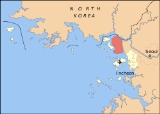
Ganghwa Island is an island in the estuary of the Han River
Han River (Korea)

The Han River is a major river in South Korea and is formed by the confluence of the Namhan River , which originates in Mount Daedeok, and the Bukhan River , which originates on the slopes of Kumgang-san in North Korea....
, on the west coast of South Korea
South Korea

South Korea, officially the Republic of Korea , ), often referred to as Korea and the "names of Korea#Revival of the names", is a Semi-presidential system republic in East Asia, located in the southern half of the Korean Peninsula....
. About 65,500 people live on the island. With an area of 302.4 km˛, it constitutes most of Ganghwa-gun
Ganghwa County

Ganghwa-gun is a county in Incheon Metropolitan City, South Korea, where Ganghwa Island, as well the minor islands around it, is located....
, a division of Incheon
Incheon

Incheon is a Special cities of Korea and a major seaport on the west coast of South Korea, near Seoul.Human settlement at the location goes back to the Neolithic....
 Municipality. About half of the island's population reside in Ganghwa-eup, or Ganghwa Town, in the northeastern part of the island. The island's highest point is Mani-san, 469 meters above sea level
Sea level

Mean sea level is the average height of the sea, with reference to a suitable reference surface. Defining the reference level , however, involves complex measurement, and accurately determining MSL can prove difficult....
. It is the 5th largest island in South Korea.

hwa Island is separated from Gimpo
Gimpo City

Gimpo is a Administrative divisions of South Korea in Gyeonggi-do Province, South Korea. It borders on Incheon, with which it shares the South Korean side of the Han River estuary, as well as Seoul and the lesser cities of Paju and Goyang....
, on the mainland, by a narrow channel, which is spanned by two bridges.


Discussion
Ask a question about 'Ganghwa Island'
Start a new discussion about 'Ganghwa Island'
Answer questions from other users
Full Discussion Forum


Encyclopedia


Ganghwa Island is an island in the estuary of the Han River
Han River (Korea)

The Han River is a major river in South Korea and is formed by the confluence of the Namhan River , which originates in Mount Daedeok, and the Bukhan River , which originates on the slopes of Kumgang-san in North Korea....
, on the west coast of South Korea
South Korea

South Korea, officially the Republic of Korea , ), often referred to as Korea and the "names of Korea#Revival of the names", is a Semi-presidential system republic in East Asia, located in the southern half of the Korean Peninsula....
. About 65,500 people live on the island. With an area of 302.4 km˛, it constitutes most of Ganghwa-gun
Ganghwa County

Ganghwa-gun is a county in Incheon Metropolitan City, South Korea, where Ganghwa Island, as well the minor islands around it, is located....
, a division of Incheon
Incheon

Incheon is a Special cities of Korea and a major seaport on the west coast of South Korea, near Seoul.Human settlement at the location goes back to the Neolithic....
 Municipality. About half of the island's population reside in Ganghwa-eup, or Ganghwa Town, in the northeastern part of the island. The island's highest point is Mani-san, 469 meters above sea level
Sea level

Mean sea level is the average height of the sea, with reference to a suitable reference surface. Defining the reference level , however, involves complex measurement, and accurately determining MSL can prove difficult....
. It is the 5th largest island in South Korea.

Location

Ganghwa Island is separated from Gimpo
Gimpo City

Gimpo is a Administrative divisions of South Korea in Gyeonggi-do Province, South Korea. It borders on Incheon, with which it shares the South Korean side of the Han River estuary, as well as Seoul and the lesser cities of Paju and Goyang....
, on the mainland, by a narrow channel, which is spanned by two bridges. The main channel of the Han River separates the island from Gaeseong
Kaesong

Kaesong is a city in North Hwanghae Province, southern North Korea , a former Special cities of Korea#North Korea, and the capital of Korea during the Goryeo....
 in North Korea
North Korea

North Korea, officially the Democratic People's Republic of Korea , is a state in East Asia, occupying the northern half of the Korean Peninsula....
.

Mythology

The legendary god-king Dangun
Dangun

Dangun Wanggeom was the legendary founder of Gojoseon, the first Korean kingdom, around present-day Liaoning, Manchuria, and the Korean Peninsula....
 is said to have made an altar on top of Mani-san and offered sacrifices to his ancestors.

Early History

Because of its strategic position in the mouth of the Han River, Ganghwa Island has often played a key role in historical events. In the ninth century, Unified Silla
Unified Silla

Unified Silla or Later Silla is the name often applied to the kingdom of Silla, one of the Three Kingdoms of Korea, when it conquered Baekje in 660 and Goguryeo in 668....
 established a garrison on the island to combat piracy. The commander Wang Geon
Taejo of Goryeo

Taejo of Goryeo , was the founder of the Goryeo Dynasty, which ruled Korea from the 10th to the 14th century....
 established his military reputation at the garrison, later going on to found the kingdom of Goryeo
Goryeo

The Goryeo Dynasty was a sovereign state established in 918 by Taejo of Goryeo. It united the Later Three Kingdoms in 936 and ruled most of the Korean peninsula until it was removed by the Joseon dynasty in 1392....
. In the thirteenth century, the court of Goryeo took refuge on the island as Mongol
Mongol Empire

The Mongol Empire was the List of largest empires#Contiguous Empires empire and the largest bar none. It emerged from the unification of Mongols and Turkic peoples tribes in modern day Mongolia, and grew through Mongol invasions, after Genghis Khan had been proclaimed ruler of all Mongols in 1206....
 forces invaded in 1232
Mongol invasions of Korea

The Mongol invasions of Korea consisted of a series of campaigns by the Mongol Empire against Korea, then known as Goryeo, from 1231 to 1270. There were six major campaigns at tremendous cost to civilian lives throughout the Korean peninsula, ultimately resulting in Korea becoming a vassal of the Mongol Yuan Dynasty for approximately 80 year...
. After Goryeo capitulated to the Mongols, the elite forces on the island rose up, beginning the Sambyeolcho Rebellion
Sambyeolcho Rebellion

The Sambyeolcho Rebellion was a Korean rebellion against the Goryeo Dynasty that happened at the last stage of the Mongol invasions of Korea....
. During the Manchu invasion of 1636, the Joseon
Joseon Dynasty

Joseon , was a sovereign state founded by Taejo Taejo of Joseon, and lasted for approximately five centuries. It was founded in the aftermath of the overthrow of the Goryeo Kingdom at what is today the city of Kaesong....
 court sought to follow the Goryeo example, but the royal refugees were captured by the invaders.

Encounters with Foreign Powers


French Invasion

In the nineteenth century, as outside powers sought to enter Korea by sea, Ganghwa became a point of contact rather than a refuge. In the early 19th century, Christianity (Catholicism) was introduced into Korea despite its official proscription by the Korean court. In 1866, reacting to greater numbers of Korean converts as well as the humiliations suffered by China at the hands of Westerners during the Opium Wars
Opium Wars

The Opium Wars , also known as the Anglo-Chinese Wars, lasted from 1839 to 1842 and 1856 to 1860, the climax of a trade dispute between China under the Qing Dynasty and the British Empire....
, the Korean court clamped down on the illicit French missionaries, massacring French Catholic missionaries and Koreans converts alike. That same year France launched a punitive expedition
Punitive expedition

A punitive expedition is a military journey undertaken to punish a state or any group of persons. It is usually undertaken in response to disobedient or morally wrong behavior, but may be also be a covered revenge....
 against Korea, invading and occupying portions of Ganghwa Island in the fall of 1866.

At the first battle, the Korean infantry division lost heavily, and General Yang Haun-Soo concluded that only a large cavalry division could stand up to French firepower. An ambush by Korean forces on a French party attempting to occupy the strategically located Cheondeung Temple ??? on the island‘s south coast resulted in French casualties. French realization that they were far outnumbered and outgunned forced them to abandon the island and their expedition. The entire incident later became known as the byeong-in yang-yo, or foreign disturbance of the byeong-in year (1866).

US Asiatic Squadron

Ganghwa 6
The US Asiatic Squadron visited the island in May 1871, with the primary excuse as the SS General Sherman incident in Pyongyang, although the main objective of the expedition was to establish trade and diplomatic relations with Korea. In case of SS General Sherman in 1866, Americans killed the Korean inhabitants, plundered the coastal area, and kidnapped a military officer. For this, the angered Korean population burnt down the ship. Misunderstanding between the both sides brought them into conflict. General Rodgers was the leader of the fleet, and was trying to find a direct waterway route to the Korean capital Hanyang (present-day Seoul). He happened to find the island, and made contacts with the Koreans. At the first meeting, the Americans warned the Koreans that the fleet would be investigating the area, and, therefore, not to worry. But, when the fleet passed the Korean territorial boundary, the fortress opened fire. For this aggression, General Rodgers requested for a negotiation, to which the Koreans replied, “We have been living 4,000 years without any treaty with you, and we can't see why we shouldn't continue to live as we do.” The fact that the Korean cannons could not aim properly due to some errors in the setup caused the bullets to go past the ships, and allowed the American fleet to bombard the fortresses and take them over with the infantry.

Japanese Imperial Navy

In 1875 a Japanese ship, Unyo, explored into the restricted areas in name of measuring the coastline, and fired a few shots at the fortress on the island. When a crew boat was sent to the island, Koreans fired a few shots back (Ganghwa Island incident
Ganghwa Island incident

The Ganghwa Island incident was an armed encounter between the Joseon Dynasty and Japan which occurred in the vicinity of Ganghwa Island on September, 20 1875....
). The Japanese argued that this was an aggression and demanded a treaty. Early in the following year, Japan sent a large force of the Imperial Japanese Navy
Imperial Japanese Navy

The origins of the Imperial Japanese Navy trace back to early interactions with nations on the Asia, beginning in the early history of Japan#Feudal Japan and reaching a peak of activity during the 16th and 17th centuries at a time of cultural diffusion with European power during the Age of Discovery....
, and the Treaty of Ganghwa
Treaty of Ganghwa

The Treaty of Ganghwa, also known in Japan as Korea-Japanese Treaty of Amity It ended Joseon's status as a protectorate of Qing China, at least in the eyes of Joseon and Japan, if not China, and opened three ports to Japanese trade....
 was concluded. That agreement, concluded on Ganghwa Island, officially opened Korea to Japanese trade for the first time during the 19th century (although trade did go on before Japan westernized and Korea became a hermit kingdom).

See also

  • Seoul National Capital Area
    Seoul National Capital Area

    The Seoul National Capital Area is a region located in the north-west of South Korea. It is generally referred to as Sudogwon in Korean, and contains three different administrative districts; Seoul, Incheon and Gyeonggi-do....
  • Geography of South Korea
    Geography of South Korea

    South Korea is located in East Asia, on the southern half of the Korean Peninsula jutting out from the far east of the Asian land mass.The only country with a land border to South Korea is North Korea, lying to the north with 238 km of border running along the Korean Demilitarized Zone....
  • Islands of South Korea
  • Ganghwa Island affair