


William of Rubruck

Encyclopedia
Franciscan
Most Franciscans are members of Roman Catholic religious orders founded by Saint Francis of Assisi. Besides Roman Catholic communities, there are also Old Catholic, Anglican, Lutheran, ecumenical and Non-denominational Franciscan communities....
missionary and explorer. His account is one of the masterpieces of medieval geographical literature comparable to that of Marco Polo
Marco Polo
Marco Polo was a Venetian merchant traveler from the Venetian Republic whose travels are recorded in Il Milione, a book which did much to introduce Europeans to Central Asia and China. He learned about trading whilst his father and uncle, Niccolò and Maffeo, travelled through Asia and apparently...
.
Born in Rubrouck
Rubrouck
-References:*...
, Flanders, he is known also as William of Rubruk, Willem van Ruysbroeck, Guillaume de Rubrouck or Willielmus de Rubruquis.
Mission
William accompanied King Louis IX of FranceLouis IX of France
Louis IX , commonly Saint Louis, was King of France from 1226 until his death. He was also styled Louis II, Count of Artois from 1226 to 1237. Born at Poissy, near Paris, he was an eighth-generation descendant of Hugh Capet, and thus a member of the House of Capet, and the son of Louis VIII and...
on the Seventh Crusade
Seventh Crusade
The Seventh Crusade was a crusade led by Louis IX of France from 1248 to 1254. Approximately 800,000 bezants were paid in ransom for King Louis who, along with thousands of his troops, was captured and defeated by the Egyptian army led by the Ayyubid Sultan Turanshah supported by the Bahariyya...
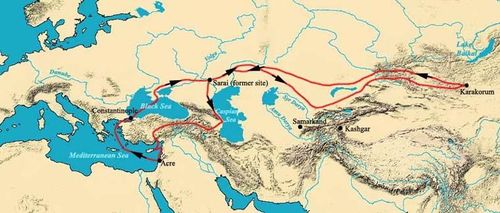
in 1248. On May 7, 1253, on Louis' orders, he set out from Constantinople
Constantinople
Constantinople was the capital of the Roman, Eastern Roman, Byzantine, Latin, and Ottoman Empires. Throughout most of the Middle Ages, Constantinople was Europe's largest and wealthiest city.-Names:...
on a missionary journey to convert the Tartars. He actually followed the route of the first journey of the Hungarian Friar Julian
Friar Julian
Friar Julian was one of a group of Hungarian Dominican friars who, in 1235, left Hungary in order to find those Magyars who — according to the chronicles — remained in the eastern homeland. After travelling a great distance, Friar Julian reached the capital of Volga Bulgaria, where he...
. With William's party were Bartolomeo da Cremona, an attendant called Gosset, and an interpreter named in William's report Homo Dei, meaning "man of God", literally translating the Arabic Abdullah.
Travels
After reaching the Crimean town of SudakSudak
Sudak or Sudaq is a small historic town located in Crimea, Ukraine situated to the west of Feodosiya and to the east of Simferopol, the capital of Crimea...
, William continued his trek with oxen and carts. Nine days after crossing the Don he met Sartaq Khan
Sartaq Khan
Sartaq Khan was the son of Batu Khan and Regent Dowager Khatun Boraqcin of Alchi Tatar. Sartaq succeeded Batu as khan of the Ulus of Jochi ....
, ruler of the Kipchak Khanate. The Khan sent William on to his father, Batu Khan
Batu Khan
Batu Khan was a Mongol ruler and founder of the Ulus of Jochi , the sub-khanate of the Mongol Empire. Batu was a son of Jochi and grandson of Genghis Khan. His ulus was the chief state of the Golden Horde , which ruled Rus and the Caucasus for around 250 years, after also destroying the armies...
, at Sarai
Sarai (city)
Sarai was the name of two cities, which were successively capital cities of the Golden Horde, the Mongol kingdom which ruled Russia and much of central Asia in the 13th and 14th centuries...
near the Volga. Five weeks later, after the departure from Sudak, he reached the encampment of Batu Khan
Batu Khan
Batu Khan was a Mongol ruler and founder of the Ulus of Jochi , the sub-khanate of the Mongol Empire. Batu was a son of Jochi and grandson of Genghis Khan. His ulus was the chief state of the Golden Horde , which ruled Rus and the Caucasus for around 250 years, after also destroying the armies...
, Mongol ruler of the Volga River
Volga River
The Volga is the largest river in Europe in terms of length, discharge, and watershed. It flows through central Russia, and is widely viewed as the national river of Russia. Out of the twenty largest cities of Russia, eleven, including the capital Moscow, are situated in the Volga's drainage...
region. Batu refused conversion but sent the ambassadors on to the great Mongol Möngke Khan
Möngke Khan
Möngke Khan , born Möngke, , was the fourth Great Khan of the Mongol Empire from July 1, 1251 – August 11, 1259. He was the first Great Khan from the Toluid line, and made significant reforms to improve the administration of the Empire during his reign...
. He and his travelling companions set off on horseback on September 16, 1253 on a 9,000 km journey to the court of the Great Khan at Karakorum
Karakorum
Karakorum was the capital of the Mongol Empire in the 13th century, and of the Northern Yuan in the 14-15th century. Its ruins lie in the northwestern corner of the Övörkhangai Province of Mongolia, near today's town of Kharkhorin, and adjacent to the Erdene Zuu monastery...
. Upon arrival they were received courteously, and he was given an audience on January 4, 1254. William's account provided an extensive description of the city's walls, markets and temples, and the separate quarters for Muslim and Chinese craftsmen among a surprisingly cosmopolitan population. Among Europeans he encountered were the nephew of an English bishop, a woman from Lorraine who cooked William's Easter dinner and a French silversmith, making ornaments for the Khan's women and altars for the Nestorian Christians. He stayed at the Khan's camp until July 10, 1254, when they began their long journey back home. William and his companions reached the Crusader State of Tripoli
Tripoli, Lebanon
Tripoli is the largest city in northern Lebanon and the second-largest city in Lebanon. Situated 85 km north of the capital Beirut, Tripoli is the capital of the North Governorate and the Tripoli District. Geographically located on the east of the Mediterranean, the city's history dates back...
on August 15, 1255. William of Rubruck's was the fourth European mission to the Mongols: previous ones were led by Giovanni da Pian del Carpine
Giovanni da Pian del Carpine
Giovanni da Pian del Carpine, or John of Plano Carpini or John of Pian de Carpine or Joannes de Plano was one of the first Europeans to enter the court of the Great Khan of the Mongol Empire. He is the author of the earliest important Western account of northern and central Asia, Rus, and other...
and Ascelin of Lombardia in 1245 and André de Longjumeau
Andrew of Longjumeau
André de Longjumeau was a 13th century Dominican missionary and diplomat and one of the most active Occidental diplomats in the East in the 13th century. He led two embassies to the Mongols: the first carried letters from Pope Innocent IV and the second bore gifts and letters from Louis IX of...
in 1249. The King was encouraged to send another mission by reports of the presence of Nestorian Christians at the Mongolian court.
Account
On his return, William presented to King Louis IX a very clear and precise report, entitled Itinerarium fratris Willielmi de Rubruquis de ordine fratrum Minorum, Galli, Anno gratia 1253 ad partes Orientales.In this report, he described the peculiarities of Mongolia
Mongolia
Mongolia is a landlocked country in East and Central Asia. It is bordered by Russia to the north and China to the south, east and west. Although Mongolia does not share a border with Kazakhstan, its western-most point is only from Kazakhstan's eastern tip. Ulan Bator, the capital and largest...
as well as many geographical observations, making it the first scientific description of central Asia. There were also anthropological observations, such as his surprise at the presence of Islam
Islam
Islam . The most common are and . : Arabic pronunciation varies regionally. The first vowel ranges from ~~. The second vowel ranges from ~~~...
in Inner Asia
Inner Asia
Inner Asia has a range of meanings among different researchers and in different countries. Denis Sinor defined Inner Asia broadly as the homelands of the Altaic peoples and the Uralic peoples .German makes a distinction between "Zentralasien", meaning Mongolia, Tibet, Xinjiang, and...
.
William also answered a long-standing question, demonstrating by his passage north of the Caspian
Caspian Sea
The Caspian Sea is the largest enclosed body of water on Earth by area, variously classed as the world's largest lake or a full-fledged sea. The sea has a surface area of and a volume of...
, that it was an inland sea and did not flow into the Arctic Ocean
Arctic Ocean
The Arctic Ocean, located in the Northern Hemisphere and mostly in the Arctic north polar region, is the smallest and shallowest of the world's five major oceanic divisions...
; although earlier Scandinavian explorers had doubtless already known this, he was the first to report it.
William's report is divided into 40 chapters. Chapters 1-10 relate general observations about the Mongols and their customs. Chapters from 11 to 40 give an account of the course and the events of William's voyage.
The report of William of Rubruck is one of the great masterpieces of medieval geographical literature, comparable to that of Marco Polo, although they are very different. William was a good observer, and an excellent writer. He asked many questions along the way and did not take folk tale and fable as truth.
In may 1254, during his stay among the Mongols, William entered into a famous competition at the Mongol court, as the khan encouraged a formal debate between the Christians, Buddhists, and Muslims, to determine which faith was correct, as determined by three judges, one from each faith.