

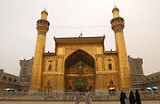
Najaf

Encyclopedia
Najaf is a city in Iraq
about 160 km south of Baghdad
. Its estimated population in 2008 is 560,000 people. It is the capital of Najaf Governorate. It is widely considered the third holiest city of Shi'a Islam
and the center of Shia political power in Iraq.
also known as "Imām Alī"the First Imam of Shia's , the cousin and son-in-law of the prophet Muhammad
whom the Shia consider to be the righteous caliph . The city is now a great center of pilgrimage
from throughout the Shi'a Islam
ic world. It is estimated that only Mecca
and Medina
receive more Muslim pilgrims. As the burial site of Shia Islam's second most important figure, the Imam Ali Mosque
is considered by Shias as the third holiest Islamic site.
The Imam Ali Mosque
is housed in a grand structure with a gold gilded dome and many precious objects in the walls. Nearby is the Wadi-us-Salaam
cemetery, reputed to be the largest in the world. It contains the tombs of several prophets and many of the devout from around the world aspire to be buried here, to be raised from the dead with Imām Alī on Judgement Day. Over the centuries, numerous hospices, schools, libraries and Sufi convents were built around the shrine to make the city the centre of Shīʻa learning and theology.
The Najaf seminary is one of the most important teaching centres in the Islamic world. Ayatollah Khomeini
lectured there from 1964-1978.
Many of the leading figures of the new Islamic movement that emerged in Iraq, Iran and Lebanon in the 1970s had studied at Najaf.
Much of Najaf's heritage was badly damaged during the rule of Saddam Hussein
, with a highway being driven through the middle of the Wādī'u s-Salām.
 The Najaf area is located 30 km south of the ancient city of Babylon
and 400 km north of the ancient Biblical city of Ur
. The city itself was reputedly founded in 791 by the Abbasid
Caliph
Harūn ar-Rashīd
, as a shrine to Ali ibn Abi Talib.
Ali ibn Abi Talib instructed that his burial place should remain a secret as he had many enemies and he feared that his body might be subjected to some indignity. According to legend the dead body of Ali was placed on a camel which was driven from Kufa
. The camel stopped a few miles west of the city and here the body was secretly buried. No tomb was raised and nobody knew of the burial place except for a few trusted people.
It is narrated that more than a hundred years later the Abbasid Caliph, Harun al-Rashid
, went deer hunting outside Kufa
and the deer sought sanctuary at a place where the hounds would not pursue it. On inquiry as to why the place was a sanctuary Harūn ar-Rashīd was told that it was the burial place of Ali. Harūn ar-Rashīd ordered a mausoleum to be built on the spot and in due course the town of Najaf grew around the mausoleum.
Under the rule of the Ottoman Empire
Najaf experienced severe difficulties as the result of repeated raids by Arab desert tribes and Persian army and acute water shortages caused by the lack of a reliable water supply. The number of inhabited houses in the city had plummeted from 3000 to just 30 by the start of the 16th century.
When the Portuguese traveller Pedro Texeira passed through Najaf in 1604, he found the city in ruins, inhabited by little more than 500 people.
The city was besieged by the Wahhabis in the late 18th century, which prompted the clergy of the city to arrange for the construction of a wall around the city and under-ground tunnels as a refuge for the women and children if the wall was over-run. These fortifications successfully repelled a Wahhabi siege later on. The water shortages were finally resolved in 1803 with the construction of the Hindiyya canal, following which the city's population rapidly doubled from 30,000 to 60,000.
The Ottomans were expelled in an uprising in 1915, following which the city fell under the rule of the British Empire
. The sheikhs of Najaf rebelled in 1918, killing the British governor of the city by Sayed Mahdi Al-Awadi and cutting off grain supplies to the Anaza, a tribe allied with the British. In retaliation the British besieged the city and cut off its water supply. The rebellion was put down and the rule of the sheikhs was forcibly ended. A great number of the Shia ulema
were expelled into Persia/Iran
where they set the foundations for the rise of the city of Qom
as the center of the Shia learning and authority in lieu of Najaf. Najaf lost its religious primacy to Qom
and was not to regain it until the 21st century and the establishment of a Shia-majority government in Iraq after 2003.
, which suppressed and restricted Shia religious activities. At the end of the Gulf War
in 1991, people revolted against the regime's suppression and the destruction that it led the country into. This was put down by the Iraqi military with severe brutality and damage to the city, damaging the golden dome, slaughtering several innocent people who took refuge in the shrine and causing several others to disappear. Much of the damage was not repaired after several years, which was considered to be a collective punishment.
In February 1999, One of Najaf's most senior clerics, Muħammad Sādiq as-Sadr, was assassinated along with his two sons on the way from Baghdad to Najaf - the third killing of Shiite clerics in less than a year. Although the Iraqi government claimed to have caught and executed the supposed killers, there was evidence that Saddam's regime carried out the assassination, especially since it occurred in a country with very tight security and surveillance. One of his surviving sons, Moqtada al-Sadr, has assumed a prominent political role, mostly after the 2003 Iraq war, despite his relative paucity of formal theological credentials.
, Najaf was a key target of the invading United States
forces. The city was encircled during heavy fighting on March 26, 2003 and was captured on April 3, 2003 by 1st, 2nd, 3rd Battalions, 327th Infantry Regiment
, units of the 101st Airborne Division
.
.jpg) The clerical authorities of the Shīa enclave of Sadr City
The clerical authorities of the Shīa enclave of Sadr City
in Baghdad
, which claimed autonomy in April 2003 after the fall of Baghdad
, claimed to be taking their orders from senior clerics in Najaf.
On April 10, 2003 Sayyid Abdul Majid al-Khoei
the son of Sayyid Abul-Qassim Al-Khoei was stabbed to death outside the Imam Ali Mosque by an angry mob.
On August 29, 2003 a car bomb exploded
during prayers outside the Imām Alī Mosque just as weekly prayers were ending. More than 80 people were killed, including the influential cleric
Ayatollah Sayyid Muħammad Bāqir al-Ħakīm
, the Shīia leader of the Supreme Council for the Islamic Revolution in Iraq
(SCIRI). Dozens of others were injured. Nobody claimed responsibility for the attack - Saddam himself, in hiding at the time, denied any involvement in a taped message.
On April 4, 2004, the Mahdi Army attacked the Spanish-Salvadoran-ALARNG base (Camp Golf, later renamed Camp Baker) in An Najaf, part of a coordinated uprising across central and southern Iraq in an apparent attempt to seize control of the country ahead of the June 30, 2004 handover of power to a new Iraqi government.
This uprising led to the 1st Armored Division's Task Force 2nd Battalion, 37th Armor (2-37 AR) attached to the 2 Armored Cavalry Regiment (2ACR) arriving in the city in the wake of the Spanish withdrawal. The situation aroused grave concerns among the Shia community of Iraq and Iran, as firefights took place within yards of the Kufa Mosque. Some mosques suffered superficial damage in the process, mostly due to Mahdi Army fighters mishandling explosives stored in the Kufa Mosque.
Firefights between the Mahdi Army and Badr Organization
took place in May as tensions rose over the Mahdi Army's occupation of the Imam Ali Shrine, looting of the mosques in their control, and controversial prisons and Sharia courts. The Najaf cemetery, the largest cemetery in the world, became a battle ground in May 2004 as M1A1 tanks from 2-37 AR fought Mahdi Army soldiers on the outskirts of the cemetery. The Mahdi Army stationed several three man rocket propelled grenade RPG
teams in the cemetery, who lived in large tombs to avoid detection from U.S. helicopters and UAVs
.
In August 2004, heavy fighting broke out again between American troops of the 11th Marine Expeditionary Unit
, the 1st Cavalry Division's 1st Battalion, 5th Cavalry Regiment and 2nd Battalion, 7th US Cavalry Regiment, 15th Forward Support Battalion and Al-Sadr's Mahdi Army. The battle, which was mostly centered around Wādī' as-Salām Cemetery and the southwestern portion of the city, lasted three weeks and ended when senior Iraqi cleric Grand Ayatollah Alī Al-Sīstānī negotiated an end to the fighting. During the aforementioned 3 week period Camp Golf, which occupied a very small fooprint at the site of the unfinished Kufah University, received over 165 mortar hits. Many US citizens working for contractor KBR admirably maintained the camp before, during, and after the 22 days of direct mortar hits. Also during that period several fire-fights occurred, some of which were friendly fire. One significant direct hit obliterated the fuel depot, which had contained a combined 90,000 gallons of JP-8, diesel, and gasoline fuels.
The evening before Al-Sistani arrived in the city, two F-16's, flying out of Balad
, dropped four two-thousand pound JDAMs (Joint Direct Attack Munitions) on two hotels in close proximity to the Imam Ali Shrine. The success of this airstrike dealt a devastating blow to the Mahdi Army soldiers holed up in one of the holiest shrines in the Islamic faith.
Iraq
Iraq ; officially the Republic of Iraq is a country in Western Asia spanning most of the northwestern end of the Zagros mountain range, the eastern part of the Syrian Desert and the northern part of the Arabian Desert....
about 160 km south of Baghdad
Baghdad
Baghdad is the capital of Iraq, as well as the coterminous Baghdad Governorate. The population of Baghdad in 2011 is approximately 7,216,040...
. Its estimated population in 2008 is 560,000 people. It is the capital of Najaf Governorate. It is widely considered the third holiest city of Shi'a Islam
Shi'a Islam
Shia Islam is the second largest denomination of Islam. The followers of Shia Islam are called Shi'ites or Shias. "Shia" is the short form of the historic phrase Shīʻatu ʻAlī , meaning "followers of Ali", "faction of Ali", or "party of Ali".Like other schools of thought in Islam, Shia Islam is...
and the center of Shia political power in Iraq.
Religious significance
Najaf is renowned as the site of the tomb of Alī ibn Abī TālibAli
' |Ramaḍān]], 40 AH; approximately October 23, 598 or 600 or March 17, 599 – January 27, 661).His father's name was Abu Talib. Ali was also the cousin and son-in-law of the Islamic prophet Muhammad, and ruled over the Islamic Caliphate from 656 to 661, and was the first male convert to Islam...
also known as "Imām Alī"the First Imam of Shia's , the cousin and son-in-law of the prophet Muhammad
Muhammad
Muhammad |ligature]] at U+FDF4 ;Arabic pronunciation varies regionally; the first vowel ranges from ~~; the second and the last vowel: ~~~. There are dialects which have no stress. In Egypt, it is pronounced not in religious contexts...
whom the Shia consider to be the righteous caliph . The city is now a great center of pilgrimage
Pilgrimage
A pilgrimage is a journey or search of great moral or spiritual significance. Typically, it is a journey to a shrine or other location of importance to a person's beliefs and faith...
from throughout the Shi'a Islam
Islam
Islam . The most common are and . : Arabic pronunciation varies regionally. The first vowel ranges from ~~. The second vowel ranges from ~~~...
ic world. It is estimated that only Mecca
Mecca
Mecca is a city in the Hijaz and the capital of Makkah province in Saudi Arabia. The city is located inland from Jeddah in a narrow valley at a height of above sea level...
and Medina
Medina
Medina , or ; also transliterated as Madinah, or madinat al-nabi "the city of the prophet") is a city in the Hejaz region of western Saudi Arabia, and serves as the capital of the Al Madinah Province. It is the second holiest city in Islam, and the burial place of the Islamic Prophet Muhammad, and...
receive more Muslim pilgrims. As the burial site of Shia Islam's second most important figure, the Imam Ali Mosque
Imam Ali Mosque
The Imām ‘Alī Holy Shrine , also known as Masjid Ali or the Mosque of ‘Alī, located in Najaf, Iraq, is the third holiest site for some of the estimated 200 million followers of the Shia branch of Islam. ‘Alī ibn Abī Tālib, the cousin of Muhammad, the fourth caliph , the first Imam is buried here...
is considered by Shias as the third holiest Islamic site.
The Imam Ali Mosque
Imam Ali Mosque
The Imām ‘Alī Holy Shrine , also known as Masjid Ali or the Mosque of ‘Alī, located in Najaf, Iraq, is the third holiest site for some of the estimated 200 million followers of the Shia branch of Islam. ‘Alī ibn Abī Tālib, the cousin of Muhammad, the fourth caliph , the first Imam is buried here...
is housed in a grand structure with a gold gilded dome and many precious objects in the walls. Nearby is the Wadi-us-Salaam
Wadi-us-Salaam
Wadi-us-Salaam is an Islamic cemetery, located in Shiite holy city of Najaf, Iraq. It is reputed to be the largest cemetery in the world. It is estimated more than half a million corpses are interred in the cemetery each year...
cemetery, reputed to be the largest in the world. It contains the tombs of several prophets and many of the devout from around the world aspire to be buried here, to be raised from the dead with Imām Alī on Judgement Day. Over the centuries, numerous hospices, schools, libraries and Sufi convents were built around the shrine to make the city the centre of Shīʻa learning and theology.
The Najaf seminary is one of the most important teaching centres in the Islamic world. Ayatollah Khomeini
Ruhollah Khomeini
Grand Ayatollah Sayyed Ruhollah Musavi Khomeini was an Iranian religious leader and politician, and leader of the 1979 Iranian Revolution which saw the overthrow of Mohammad Reza Pahlavi, the Shah of Iran...
lectured there from 1964-1978.
Many of the leading figures of the new Islamic movement that emerged in Iraq, Iran and Lebanon in the 1970s had studied at Najaf.
Much of Najaf's heritage was badly damaged during the rule of Saddam Hussein
Saddam Hussein
Saddam Hussein Abd al-Majid al-Tikriti was the fifth President of Iraq, serving in this capacity from 16 July 1979 until 9 April 2003...
, with a highway being driven through the middle of the Wādī'u s-Salām.
History
Babylon
Babylon was an Akkadian city-state of ancient Mesopotamia, the remains of which are found in present-day Al Hillah, Babil Province, Iraq, about 85 kilometers south of Baghdad...
and 400 km north of the ancient Biblical city of Ur
Ur
Ur was an important city-state in ancient Sumer located at the site of modern Tell el-Muqayyar in Iraq's Dhi Qar Governorate...
. The city itself was reputedly founded in 791 by the Abbasid
Abbasid
The Abbasid Caliphate or, more simply, the Abbasids , was the third of the Islamic caliphates. It was ruled by the Abbasid dynasty of caliphs, who built their capital in Baghdad after overthrowing the Umayyad caliphate from all but the al-Andalus region....
Caliph
Caliph
The Caliph is the head of state in a Caliphate, and the title for the ruler of the Islamic Ummah, an Islamic community ruled by the Shari'ah. It is a transcribed version of the Arabic word which means "successor" or "representative"...
Harūn ar-Rashīd
Harun al-Rashid
Hārūn al-Rashīd was the fifth Arab Abbasid Caliph in Iraq. He was born in Rey, Iran, close to modern Tehran. His birth date remains a point of discussion, though, as various sources give the dates from 763 to 766)....
, as a shrine to Ali ibn Abi Talib.
Ali ibn Abi Talib instructed that his burial place should remain a secret as he had many enemies and he feared that his body might be subjected to some indignity. According to legend the dead body of Ali was placed on a camel which was driven from Kufa
Kufa
Kufa is a city in Iraq, about south of Baghdad, and northeast of Najaf. It is located on the banks of the Euphrates River. The estimated population in 2003 was 110,000....
. The camel stopped a few miles west of the city and here the body was secretly buried. No tomb was raised and nobody knew of the burial place except for a few trusted people.
It is narrated that more than a hundred years later the Abbasid Caliph, Harun al-Rashid
Harun al-Rashid
Hārūn al-Rashīd was the fifth Arab Abbasid Caliph in Iraq. He was born in Rey, Iran, close to modern Tehran. His birth date remains a point of discussion, though, as various sources give the dates from 763 to 766)....
, went deer hunting outside Kufa
Kufa
Kufa is a city in Iraq, about south of Baghdad, and northeast of Najaf. It is located on the banks of the Euphrates River. The estimated population in 2003 was 110,000....
and the deer sought sanctuary at a place where the hounds would not pursue it. On inquiry as to why the place was a sanctuary Harūn ar-Rashīd was told that it was the burial place of Ali. Harūn ar-Rashīd ordered a mausoleum to be built on the spot and in due course the town of Najaf grew around the mausoleum.
Under the rule of the Ottoman Empire
Ottoman Empire
The Ottoman EmpireIt was usually referred to as the "Ottoman Empire", the "Turkish Empire", the "Ottoman Caliphate" or more commonly "Turkey" by its contemporaries...
Najaf experienced severe difficulties as the result of repeated raids by Arab desert tribes and Persian army and acute water shortages caused by the lack of a reliable water supply. The number of inhabited houses in the city had plummeted from 3000 to just 30 by the start of the 16th century.
When the Portuguese traveller Pedro Texeira passed through Najaf in 1604, he found the city in ruins, inhabited by little more than 500 people.
The city was besieged by the Wahhabis in the late 18th century, which prompted the clergy of the city to arrange for the construction of a wall around the city and under-ground tunnels as a refuge for the women and children if the wall was over-run. These fortifications successfully repelled a Wahhabi siege later on. The water shortages were finally resolved in 1803 with the construction of the Hindiyya canal, following which the city's population rapidly doubled from 30,000 to 60,000.
The Ottomans were expelled in an uprising in 1915, following which the city fell under the rule of the British Empire
British Empire
The British Empire comprised the dominions, colonies, protectorates, mandates and other territories ruled or administered by the United Kingdom. It originated with the overseas colonies and trading posts established by England in the late 16th and early 17th centuries. At its height, it was the...
. The sheikhs of Najaf rebelled in 1918, killing the British governor of the city by Sayed Mahdi Al-Awadi and cutting off grain supplies to the Anaza, a tribe allied with the British. In retaliation the British besieged the city and cut off its water supply. The rebellion was put down and the rule of the sheikhs was forcibly ended. A great number of the Shia ulema
Ulema
Ulama , also spelt ulema, refers to the educated class of Muslim legal scholars engaged in the several fields of Islamic studies. They are best known as the arbiters of shari‘a law...
were expelled into Persia/Iran
Iran
Iran , officially the Islamic Republic of Iran , is a country in Southern and Western Asia. The name "Iran" has been in use natively since the Sassanian era and came into use internationally in 1935, before which the country was known to the Western world as Persia...
where they set the foundations for the rise of the city of Qom
Qom
Qom is a city in Iran. It lies by road southwest of Tehran and is the capital of Qom Province. At the 2006 census, its population was 957,496, in 241,827 families. It is situated on the banks of the Qom River....
as the center of the Shia learning and authority in lieu of Najaf. Najaf lost its religious primacy to Qom
Qom
Qom is a city in Iran. It lies by road southwest of Tehran and is the capital of Qom Province. At the 2006 census, its population was 957,496, in 241,827 families. It is situated on the banks of the Qom River....
and was not to regain it until the 21st century and the establishment of a Shia-majority government in Iraq after 2003.
Saddam Hussein period
Najaf was regarded with suspicion by the Sunnī-dominated regime of Saddam HusseinSaddam Hussein
Saddam Hussein Abd al-Majid al-Tikriti was the fifth President of Iraq, serving in this capacity from 16 July 1979 until 9 April 2003...
, which suppressed and restricted Shia religious activities. At the end of the Gulf War
Gulf War
The Persian Gulf War , commonly referred to as simply the Gulf War, was a war waged by a U.N.-authorized coalition force from 34 nations led by the United States, against Iraq in response to Iraq's invasion and annexation of Kuwait.The war is also known under other names, such as the First Gulf...
in 1991, people revolted against the regime's suppression and the destruction that it led the country into. This was put down by the Iraqi military with severe brutality and damage to the city, damaging the golden dome, slaughtering several innocent people who took refuge in the shrine and causing several others to disappear. Much of the damage was not repaired after several years, which was considered to be a collective punishment.
In February 1999, One of Najaf's most senior clerics, Muħammad Sādiq as-Sadr, was assassinated along with his two sons on the way from Baghdad to Najaf - the third killing of Shiite clerics in less than a year. Although the Iraqi government claimed to have caught and executed the supposed killers, there was evidence that Saddam's regime carried out the assassination, especially since it occurred in a country with very tight security and surveillance. One of his surviving sons, Moqtada al-Sadr, has assumed a prominent political role, mostly after the 2003 Iraq war, despite his relative paucity of formal theological credentials.
Post-Saddam Hussein period
During the 2003 invasion of Iraq2003 invasion of Iraq
The 2003 invasion of Iraq , was the start of the conflict known as the Iraq War, or Operation Iraqi Freedom, in which a combined force of troops from the United States, the United Kingdom, Australia and Poland invaded Iraq and toppled the regime of Saddam Hussein in 21 days of major combat operations...
, Najaf was a key target of the invading United States
United States
The United States of America is a federal constitutional republic comprising fifty states and a federal district...
forces. The city was encircled during heavy fighting on March 26, 2003 and was captured on April 3, 2003 by 1st, 2nd, 3rd Battalions, 327th Infantry Regiment
327th Infantry Regiment
During World War II, the 327th Glider Infantry Regiment was a gliderborne regiment of the U.S. 101st Airborne Division. It fought during World War II as part of the U.S. 82nd Division...
, units of the 101st Airborne Division
101st Airborne Division
The 101st Airborne Division—the "Screaming Eagles"—is a U.S. Army modular light infantry division trained for air assault operations. During World War II, it was renowned for its role in Operation Overlord, the D-Day landings on 6 June 1944, in Normandy, France, Operation Market Garden, the...
.
Sadr City
Sadr City is a suburb district of the city of Baghdad, Iraq. It was built in 1959 by Prime Minister Abdul Karim Qassim and later unofficially renamed Sadr City after deceased Shia leader Mohammad Mohammad Sadeq al-Sadr....
in Baghdad
Baghdad
Baghdad is the capital of Iraq, as well as the coterminous Baghdad Governorate. The population of Baghdad in 2011 is approximately 7,216,040...
, which claimed autonomy in April 2003 after the fall of Baghdad
Fall of Baghdad
The Fall of Baghdad may refer to the following:*Siege of Baghdad , the Mongol Empire's capture of Baghdad, then the capital of the Abbasid Caliphate....
, claimed to be taking their orders from senior clerics in Najaf.
On April 10, 2003 Sayyid Abdul Majid al-Khoei
Abdul Majid al-Khoei
Sayyid Abdul Majid al-Khoei , 16 August 1962 – 10 April 2003) was a Twelver Shia cleric and the son of Ayatollah Al-Udhma Sayyid Abul Qasim al-Khoei. He was born in the holy city of Najaf.-Life:...
the son of Sayyid Abul-Qassim Al-Khoei was stabbed to death outside the Imam Ali Mosque by an angry mob.
On August 29, 2003 a car bomb exploded
Imam Ali Mosque bombing
The Imam Ali Mosque bombing was the detonation of two car bombs outside of the Shia Imam Ali Mosque in Najaf on August 29, 2003. The attack killed 83 people crowded around the mosque for Friday prayers, including Ayatollah Mohammed Baqir al-Hakim, spiritual leader of the Supreme Council of the...
during prayers outside the Imām Alī Mosque just as weekly prayers were ending. More than 80 people were killed, including the influential cleric
Clergy
Clergy is the generic term used to describe the formal religious leadership within a given religion. A clergyman, churchman or cleric is a member of the clergy, especially one who is a priest, preacher, pastor, or other religious professional....
Ayatollah Sayyid Muħammad Bāqir al-Ħakīm
Mohammed Baqir al-Hakim
Ayatollah Sayed Mohammad Baqir al-Hakim , also known as Shaheed al-Mehraab was one of the foremost Twelver Shi'a Muslim leaders in Iraq until his assassination in a bombing in Najaf...
, the Shīia leader of the Supreme Council for the Islamic Revolution in Iraq
Supreme Council for the Islamic Revolution in Iraq
The Islamic Supreme Council of Iraq is an Iraqi political party. Its political support comes from the country's Shi'a Muslim community. Prior to his assassination in August 2003, SCIRI was led by Ayatollah Mohammed Baqir al-Hakim; afterwards it was led by the ayatollah's brother, Abdul Aziz...
(SCIRI). Dozens of others were injured. Nobody claimed responsibility for the attack - Saddam himself, in hiding at the time, denied any involvement in a taped message.
On April 4, 2004, the Mahdi Army attacked the Spanish-Salvadoran-ALARNG base (Camp Golf, later renamed Camp Baker) in An Najaf, part of a coordinated uprising across central and southern Iraq in an apparent attempt to seize control of the country ahead of the June 30, 2004 handover of power to a new Iraqi government.
This uprising led to the 1st Armored Division's Task Force 2nd Battalion, 37th Armor (2-37 AR) attached to the 2 Armored Cavalry Regiment (2ACR) arriving in the city in the wake of the Spanish withdrawal. The situation aroused grave concerns among the Shia community of Iraq and Iran, as firefights took place within yards of the Kufa Mosque. Some mosques suffered superficial damage in the process, mostly due to Mahdi Army fighters mishandling explosives stored in the Kufa Mosque.
Firefights between the Mahdi Army and Badr Organization
Badr Organization
The Badr Organization previously known as the Badr Brigades or Badr Corps is an Iraqi political party headed by Hadi al-Amiri...
took place in May as tensions rose over the Mahdi Army's occupation of the Imam Ali Shrine, looting of the mosques in their control, and controversial prisons and Sharia courts. The Najaf cemetery, the largest cemetery in the world, became a battle ground in May 2004 as M1A1 tanks from 2-37 AR fought Mahdi Army soldiers on the outskirts of the cemetery. The Mahdi Army stationed several three man rocket propelled grenade RPG
Rocket propelled grenade
A rocket-propelled grenade is a shoulder-fired, anti-tank weapon system which fires rockets equipped with an explosive warhead. These warheads are affixed to a rocket motor and stabilized in flight with fins. Some types of RPG are reloadable while others are single-use. RPGs, with the exception of...
teams in the cemetery, who lived in large tombs to avoid detection from U.S. helicopters and UAVs
Unmanned aerial vehicle
An unmanned aerial vehicle , also known as a unmanned aircraft system , remotely piloted aircraft or unmanned aircraft, is a machine which functions either by the remote control of a navigator or pilot or autonomously, that is, as a self-directing entity...
.
In August 2004, heavy fighting broke out again between American troops of the 11th Marine Expeditionary Unit
11th Marine Expeditionary Unit
The 11th Marine Expeditionary Unit is one of seven Marine Expeditionary Units currently in existence in the United States Marine Corps. The Marine Expeditionary Unit is a Marine Air Ground Task Force with a strength of about 2,200 personnel. The MEU consists of a command element, a reinforced...
, the 1st Cavalry Division's 1st Battalion, 5th Cavalry Regiment and 2nd Battalion, 7th US Cavalry Regiment, 15th Forward Support Battalion and Al-Sadr's Mahdi Army. The battle, which was mostly centered around Wādī' as-Salām Cemetery and the southwestern portion of the city, lasted three weeks and ended when senior Iraqi cleric Grand Ayatollah Alī Al-Sīstānī negotiated an end to the fighting. During the aforementioned 3 week period Camp Golf, which occupied a very small fooprint at the site of the unfinished Kufah University, received over 165 mortar hits. Many US citizens working for contractor KBR admirably maintained the camp before, during, and after the 22 days of direct mortar hits. Also during that period several fire-fights occurred, some of which were friendly fire. One significant direct hit obliterated the fuel depot, which had contained a combined 90,000 gallons of JP-8, diesel, and gasoline fuels.
The evening before Al-Sistani arrived in the city, two F-16's, flying out of Balad
Balad
Al-Balad is the historical area of Jeddah, the second largest city of Saudi Arabia. Balad can literally be translated as "The City." Balad is the historic center of the City of Jeddah. Balad traces its history 2,500 years back as a fishing village when the Quda'a fishermen tribe settled...
, dropped four two-thousand pound JDAMs (Joint Direct Attack Munitions) on two hotels in close proximity to the Imam Ali Shrine. The success of this airstrike dealt a devastating blow to the Mahdi Army soldiers holed up in one of the holiest shrines in the Islamic faith.
See also
- Battle of Najaf (2003)Battle of Najaf (2003)The Battle of Najaf was a major battle in the 2003 invasion of Iraq. The first stage of the battle was fought when the US 3rd Infantry Division fought to surround the town. The second stage was fought when soldiers from the U.S...
- Battle of Najaf (2004)Battle of Najaf (2004)The Battle of Najaf was fought between United States and Iraqi forces on one side and the Islamist Mahdi Army of Muqtada al-Sadr on the other in the Iraqi city of Najaf in August 2004.-Background:...
- Battle of Najaf (2007)Battle of Najaf (2007)The Battle of Najaf took place on 28 January 2007 at Zarqa near Najaf, Iraq, betweenIraqi Security Forces The Battle of Najaf took place on 28 January 2007 at Zarqa (alt. Zarga) near Najaf, Iraq, betweenIraqi Security Forces The Battle of Najaf took place on 28 January 2007 at Zarqa (alt. Zarga)...
- Al Najaf International Airport
- List of places in Iraq
External links
- The Holy City of Najaf (Iraq)
- Interactive Guide: Najaf - The GuardianThe GuardianThe Guardian, formerly known as The Manchester Guardian , is a British national daily newspaper in the Berliner format...