

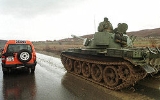
Kosovo War

Encyclopedia
The term Kosovo War or Kosovo conflict was two sequential, and at times parallel, armed conflicts in Kosovo
province, then part of FR Yugoslav Republic of Serbia; from early 1998 to 1999, there was an armed conflict initiated by the ethnic Albanian "Kosovo Liberation Army
" (KLA), who sought independence (classified by Serbia as terrorists), against the Serbian police
and Yugoslav Military
. From March 24, 1999 to June 11, 1999, NATO launched an air campaign on FR Yugoslavia, while the KLA continued battles with Yugoslav forces, amidst a massive population displacement estimated to be close to 1 million people.
The KLA, formed in 1991, began attacking police stations and government offices in February 1996, which resulted in an increase of security forces, and escalation of conflict, although it initially was viewed as an insurgency
. The KLA was regarded by the US as a terrorist group until 1998 when it was de-listed for classified reasons, and then the UK and the US lobbied France to do the same. The U.S. and NATO then cultivated diplomatic relationships with the KLA leaders, This happened despite the fact that General Klaus Naumann
(Chairman of NATO Military Committee) stated that "Ambassador Walker stated in the NAC (North Atlantic Council) that the majority of violations was caused by the KLA."
In 1999 the KLA was officially disbanded and their members joined the UCPMB
in the Preševo Valley
, and the NLA and ANA
in the armed ethnic conflict in Macedonia
. UNMIK instituted NGOs within Kosovo such as the Kosovo Protection Corps
(in accordance with UNSC resolution 1244 which required the establishment of a civilian emergency protection body to replace the former KLA) and the Kosovo Police (mainly of KLA veterans).
NATO countries promoted the war in Kosovo as the first humanitarian war based on short-term military reports and casualty reports that were later criticized as highly inaccurate. It was the center of news headlines for months, and gained a massive amount of coverage and attention from the international community and media. The NATO bombing and surrounding events have remained controversial.
, World War I
, and World War II
. The Socialist government of Josip Broz Tito
systematically repressed nationalist manifestations throughout Yugoslavia, seeking to ensure that no Yugoslav republic or nationality gained dominance over the others. In particular, the power of Serbia
—the largest and most populous republic—was diluted by the establishment of autonomous governments in the province of Vojvodina
in the north of Serbia and Kosovo in the south. Kosovo's borders did not precisely match the areas of ethnic Albanian settlement in Yugoslavia (significant numbers of Albanians were left in the Republic of Macedonia
, Montenegro
, and Serbia though the majority of its inhabitants were Albanian). Kosovo's formal autonomy, established under the 1945 Yugoslav constitution, initially meant relatively little in practice. Tito's secret police
cracked down hard on nationalists. In 1956, a number of Albanians
were put on trial in Kosovo on charges of espionage and subversion. The threat of separatism was in fact minimal, as the few underground groups aiming for union with Albania
were politically insignificant. Their long-term impact was substantial, though, as some—particularly the Revolutionary Movement for Albanian Unity, founded by Adem Demaci
—were to form the political core of the Kosovo Liberation Army
. Demaci himself was imprisoned in 1964 along with many of his followers. Yugoslavia underwent a period of economic and political crisis in 1969, as a massive government program of economic reform widened the gap between the rich north and poor south of the country.
Student demonstrations and riots in Belgrade
in June 1968 spread to Kosovo in November the same year, but were quelled by the Yugoslav security forces. However, some of the students' demands—in particular, representative powers for Albanians in both the Serbian and Yugoslav state bodies, and better recognition of the Albanian language
—were conceded by Tito. The University of Priština was established as an independent institution in 1970, ending a long period when the institution had been run as an outpost of Belgrade University. The Albanianisation of education in Kosovo was hampered by the lack of Albanian-language educational materials in Yugoslavia, so an agreement was struck with Albania itself to supply textbooks. In 1974, Kosovo's political status was improved further when a new Yugoslav constitution granted an expanded set of political rights. Along with Vojvodina, Kosovo was declared a province and gained many of the powers of a fully-fledged republic: a seat on the federal presidency and its own assembly, police force, and national bank.
Power was still exercised by the Communist Party, but it was now devolved mainly to ethnic Albanian communists. Tito's death on May 4, 1980 ushered in a long period of political instability, worsened by growing economic crisis and nationalist unrest. The first major outbreak occurred in Kosovo's main city, Pristina
, in March 1981, when Albanian students rioted over long queues in their university canteen. This seemingly trivial dispute rapidly spread throughout Kosovo and took on the character of a national revolt, with massive popular demonstrations in many Kosovo towns. The protesters demanded that Kosovo should become the seventh republic of Yugoslavia.
However, this was politically unacceptable to Serbia and the Socialist Republic of Macedonia
. Some Serbs (and possibly some Albanian nationalists as well) saw the demands as being a prelude to a "Greater Albania
" which could encompass parts of Montenegro
, the Republic of Macedonia
and Kosovo itself. The Communist Yugoslav presidency quelled the disturbances by sending in riot police and the army, and proclaiming a state of emergency, although it did not repeal the province's autonomy as some Serbian Communists demanded. The Yugoslav press reported that about 11 people had been killed (although others claimed a death toll as high as 1,000) and another 4,200 were imprisoned. Kosovo's Communist Party also suffered purges, with several key figures (including its president) expelled.
Hardliners instituted a fierce crackdown on nationalism of all kinds, Albanian and Serbian alike. Kosovo endured a heavy secret police presence throughout most of the 1980s that ruthlessly suppressed any unauthorized nationalist manifestations, both Albanian and Serbian. According to a report quoted by Mark Thompson
, as many as 580,000 inhabitants of Kosovo were arrested, interrogated, interned, or reprimanded. Thousands of these lost their jobs or were expelled from their educational establishments. During this time, tension between the Albanian and Serbian communities continued to escalate.
In 1969, the Serbian Orthodox Church had ordered its clergy to compile data on the ongoing problems of Serbs in Kosovo, seeking to pressure the government in Belgrade to do more to protect the Serbian faithful. In February 1982, a group of priests from Serbia proper petitioned their bishops to ask "why the Serbian Church is silent" and why it did not campaign against "the destruction, arson and sacrilege of the holy shrines of Kosovo". Such concerns did attract interest in Belgrade. Stories appeared from time to time in the Belgrade media claiming that Serbs and Montenegrins were being persecuted. There was a perception among Serbian nationalists that Serbs were being driven out of Kosovo.
In addition to all this, the worsening state of Kosovo's economy made the province a poor choice for Serbs seeking work. Albanians, as well as Serbs, tended to favor their compatriots when employing new recruits, but the number of jobs was too few for the population. To that end, it is believed that a large number of those declaring Albanian ethnicity are in fact from the Roma community who happen to be of Islamic faith. Kosovo was the poorest part of Yugoslavia: the average per capita income
was $795, compared with the national average of $2,635 (and $5,315 in Slovenia).
In 1987 David Binder wrote a report on The New York Times
about rising nationalism among Albanians in Kosovo. In his report he tells about Paracin massacre
, where an Albanian soldier killed 4 soldiers and wounded 5 in a JNA barracks.
The report quoting Federal Secretary for National Defense, Fleet Adm. Branko Mamula, shows that from 1981–1987, 216 illegal Albanian organizations with 1,435 members were discovered in the JNA. They had prepared the mass killings of officers and soldiers, poisoning food and water, sabotage, breaking in and stealing weapons and ammunition.
and separatism led to tensions between Serbs and Albanians. An increasingly poisonous atmosphere led to wild rumors being spread around and otherwise trivial incidents being blown out of proportion.
It was against this tense background that the Serbian Academy of Sciences and Arts
(SANU, from its Serbian initials, САНУ) conducted a survey of Serbs who had left Kosovo in 1985 and 1986. The report concluded that a considerable part of those who had left had been under pressure by Albanians to do so.
Sixteen prominent members of the SANU began work in June 1985 on a draft document that was leaked to the public in September 1986. The SANU Memorandum, as it has become known, was hugely controversial. It focused on the political difficulties facing Serbs in Yugoslavia, pointing to Tito's deliberate hobbling of Serbia's power and the difficulties faced by Serbs outside Serbia proper.
The Memorandum paid special attention to Kosovo, arguing that the province's Serbs were being subjected to "physical, political, legal and cultural genocide" in an "open and total war" that had been ongoing since the spring of 1981. It claimed that Kosovo's status in 1986 was a worse historical defeat for the Serbs than any event since liberation from the Ottomans in 1804, thus ranking it above such catastrophes as the Nazi occupation or the First World War occupation of Serbia by the Austro-Hungarians
. The Memorandum's authors claimed that 200,000 Serbs had moved out of the province over the previous twenty years and warned that there would soon be none left "unless things change radically." The remedy, according to the Memorandum, was for "genuine security and unambiguous equality for all peoples living in Kosovo and Metohija [to be] established" and "objective and permanent conditions for the return of the expelled [Serbian] nation [to be] created." It concluded that "Serbia must not be passive and wait and see what the others will say, as it has done so often in the past."
The SANU Memorandum met with many different reactions. The Albanians saw it as a call for Serbian supremacy at a local level. They claimed that all Serb emigrants had left Kosovo for economic reasons. Other Yugoslav nationalities, notably the Slovenes and Croats, saw a threat in the call for a more assertive Serbia. Serbs themselves were divided: many welcomed it, while the Communist old guard strongly attacked its message. One of those who denounced it was Serbian Communist Party official Slobodan Milošević
.
In November 1988, Kosovo's head of the provincial committee was arrested. In March 1989, Milošević announced an "anti-bureaucratic revolution
" in Kosovo and Vojvodina, curtailing their autonomy as well as imposing a curfew and a state of emergency in Kosovo due to violent demonstrations, resulting in 24 deaths (including two policemen). Milošević and his government claimed that the constitutional changes were necessary to protect Kosovo's remaining Serbs against harassment from the Albanian majority.
and Azem Vllasi
were forced to resign from the leadership of the League of Communists of Kosovo
(LCK). In early 1989 the Serbian Assembly proposed amendments to the Constitution of Serbia which would remove the word "Socialist" from the Serbian Republic's title, establish multi-party elections, remove the independence of institutions of the autonomous provinces such as Kosovo, and rename Kosovo as the Autonomous Province of Kosovo and Metohija. In February Kosovar Albanians demonstrated in large numbers against the proposal, emboldened by striking miners. Serbs in Belgrade protested against the Kosovo Albanian's separatism. On 3 March 1989 the Presidency of Yugoslavia imposed special measures assigning responsibility for public security to the federal government. On 23 March the Assembly of Kosovo voted to accept the proposed amendments although most Albanian delegates abstained. In early 1990 Kosovar Albanians held mass demonstrations against the special measures, which were lifted on 18 April 1990 and responsibility for public security was again assigned to Serbia.
On 8 May 1989 Milošević became President of the Presidency of Serbia, which was confirmed on 6 December. On 22 January 1990 the 14 congress of the League of Communists of Yugoslavia
(LCY) abolished the party's position as the only legal political party in Yugoslavia. In January 1990 the Yugoslav government announced it would press ahead with the creation of a multi-party system.
On 26 June 1990 Serbian authorities closed the Kosovo Assembly citing special circumstances. On 1 or 2 July 1990 Serbia approved the new amendments to the Constitution of Serbia in a referendum. Also on 2 July, 114 ethnic Albanian delegates of the 180 member Kosovo Assembly declared Kosovo an independent republic within Yugoslavia. On 5 July the Serbian Assembly dissolved the Kosovo Assembly. Serbia also dissolved the provincial executive council and assumed full and direct control of the province. Serbia took over management of Kosovo's principle Albanian-language media, halting Ablanian-language broadcasts. On 4 September 1990 Kosovar Albanians observed a 24-hour general strike, virtually shutting down the province.
On 16 or 17 July 1990, the League of Communists of Serbia
(LCS) combined with the Socialist Alliance of Working People of Serbia to become the Socialist Party of Serbia
(SPS), and Milošević became its first president. On 8 August 1990 several amendments to the federal Socialist Federal Republic of Yugoslavia
(SFRY) Constitution were adopted enabling the establishment of a multi-party election system.
On 7 September 1990 the Constitution of the Republic of Kosovo was promulgated by the disbanded Assembly of Kosovo. Milošević reposed by ordering the arrest of the deputies of the disbanded Assembly of Kosovo. The new controversial Serbian Constitution was promulgated on 28 September 1990. Multi-party elections were held in Serbia on 9 and 26 December 1990 after which Milošević became President of Serbia
. In September 1991 Kosovar Albanians held an unofficial referendum in which they voted overwhelmingly for independence. On 24 May 1992 Kosovar Albanians held unofficial elections for an assembly and president of the Republic of Kosovo.
On 5 August 1991 the Serbian Assembly suspended the Priština daily Rilindja, following the Law on Public Information of 29 March 1991 and establishment of the Panorama publishing house on 6 November which incorporated Rilindja, which was declared unconstitutional by the federal authorities. United Nations Special Rapporteur Tadeusz Mazowiecki
reported on 26 February 1993 that the police had intensified their repression of the Albanian population since 1990, including depriving them of their basic rights, destroying their educations system, and large numbers of political dismissals of civil servants.
Crucially, as both provinces had a vote in the eight member Yugoslav Presidency, this gave Milosevic an automatic four votes when combined with Serbia and Montenegro (which was closely allied to Serbia). Slovenia
, Croatia
, Bosnia
and Macedonia
thus had to maintain an uneasy alliance to prevent Milošević from driving through constitutional changes. Serbia's political changes were ratified in a July 5, 1990 referendum
across the entire republic of Serbia, including Kosovo. As a result of these measures more than 80,000 Kosovo Albanians were expelled from their state jobs in Kosovo. A new Serb curriculum was imposed in all higher education in Kosovo, a move which was rejected by Albanians who responded by creating their parallel education system.
The impact on Kosovo was drastic. The reduction of its autonomy was accompanied by the abolition of its political institutions (including the League of Communists of Kosovo
); its assembly and government were formally disbanded. As most of Kosovo's industry was state-owned, the changes brought a wholesale change of corporate cadres. Technically, few were sacked outright: their companies required them to sign loyalty pledges, which most Albanians would not sign, although a few did and remained employed in Serbian state companies right up to 1999.
Albanian cultural autonomy was also drastically reduced. TV and radio broadcasts in Albanian ceased. Albanian was no longer an official language of the province. The University of Pristina, seen as a hotbed of Albanian nationalism
, was purged: 800 lecturers at Pristina University were sacked and 22,500 of the 23,000 students expelled. Some 40,000 Yugoslav troops and police replaced the original Albanian-run security forces. A punitive regime was imposed that was harshly condemned as a "police state
". Poverty and unemployment reached catastrophic levels, with about 80% of Kosovo's population becoming unemployed. As many as a third of adult male Albanians chose to go abroad (particularly to Germany
and Switzerland
) to find work.
With Kosovo's Communist Party effectively broken up by Milošević's crackdown, the dominant Albanian political party position passed to the Democratic League of Kosovo
, led by the writer Ibrahim Rugova
. It responded to the abolition of Kosovo's autonomy by pursuing a policy of peaceful resistance. Rugova took the very practical line that armed resistance would be futile given Serbia's military strength and would lead only to a bloodbath in the province. He called on the Albanian populace to boycott the Yugoslav and Serbian states by not participating in any elections, by ignoring the military draft (compulsory in Yugoslavia), and most important, by not paying any taxes or duties to the State. He also called for the creation of parallel Albanian schools, clinics, and hospitals. In September 1991, the shadow Kosovo Assembly organized a referendum
on independence for Kosovo. Despite widespread harassment and violence by Serbian security forces, the referendum achieved a reported 90% turnout among the province's Albanians, and a 98% vote—nearly a million votes in all—which approved the creation of an independent "Republic of Kosovo". In May 1992, a second referendum elected Rugova as President of Kosovo. The Serbian government declared that both referendums were illegal, and their results null and void.
, and the wars in Croatia
and Bosnia
during the early 1990s. However, as evidenced by the emergence of the KLA, this came at the cost of increasing frustration among Kosovo's Albanian population. In the mid-1990s, Rugova pleaded for a United Nations
peacekeeping force for Kosovo. In 1997, Milošević was promoted to the presidency of the Federal Republic of Yugoslavia (comprising Serbia and Montenegro since its inception in April 1992).
Continuing Serbian repression had radicalized many Albanians, some of whom decided that only armed resistance would change the situation. On April 22, 1996, four attacks on Serbian security personnel were carried out almost simultaneously in several parts of Kosovo. A hitherto-unknown organization calling itself the "Kosovo Liberation Army
" (KLA) subsequently claimed responsibility. The nature of the KLA was at first highly mysterious.
It is widely believed that the KLA received financial and material support from the Kosovo Albanian diaspora. In early 1997, Albania
collapsed into chaos following the fall of President Sali Berisha
. Military stockpiles were looted with impunity by criminal gangs, with much of the hardware ending up in western Kosovo and boosting the growing KLA arsenal. Bujar Bukoshi
, shadow Prime Minister in exile (in Zürich
, Switzerland
), created a group called FARK (Armed Forces of the Republic of Kosova) which was reported to have been disbanded and absorbed by the KLA in 1998. The Yugoslav government considered the KLA "terrorists" and "insurgents", attacking police and civilians, while most Albanians saw the KLA as "freedom fighters
".
In 1998, the U.S. State Department listed the KLA as a terrorist organization, and in 1999 the Republican Policy Committee of the U.S. Senate expressed its troubles with the "effective alliance" of the Clinton administration with the KLA due to "numerous reports from reputable unofficial sources ".
In 2000, a BBC
article stated that Nato at War shows how the United States, which had described the KLA as "terrorist", now sought to form a relationship with it.
U.S. envoy Robert Gelbard referred to the KLA as terrorists. Responding to criticism, he later clarified to the House Committee on International Relations that "while it has committed 'terrorist acts,' it has 'not been classified legally by the U.S. Government as a terrorist organization.'" On June 1998, he held talks with two men who claimed they were political leaders.
Meanwhile, the U.S. held an "outer wall of sanctions" on Yugoslavia which had been tied to a series of issues, Kosovo being one of them. These were maintained despite the agreement at Dayton to end all sanctions. The Clinton administration claimed that Dayton bound Yugoslavia to hold discussions with Rugova over Kosovo.
The crisis escalated in December 1997 at the Peace Implementation Council meeting in Bonn, where the International Community (as defined in the Dayton Agreement
) agreed to give the High Representative in Bosnia sweeping powers, including the right to dismiss elected leaders. At the same time, Western diplomats insisted that Kosovo be discussed, and that Serbia and Yugoslavia be responsive to Albanian demands there. The delegation from Serbia stormed out of the meetings in protest.
This was followed by the return of the Contact Group that oversaw the last phases of the Bosnian conflict and declarations from European powers demanding that Serbia solve the problem in Kosovo.
KLA attacks suddenly intensified, centered on the Drenica
valley area, with the compound of one Adem Jashari
being a particular focal point. Days after Robert Gelbard described the KLA as a terrorist group, Serbian police responded to the KLA attacks in the Likosane area, and pursued some of the KLA to Cirez, resulting in the deaths of 30 Albanian civilians and four Serbian policemen. The first serious action of the war had begun.
Despite some accusations of summary executions and killings of civilians, condemnations from Western capitals were not as voluble as they would become later. Serb police began to pursue Jashari and his followers in the village of Donje Prekaz. A massive firefight at the Jashari compound led to the massacre of 60 Albanians, of which eighteen were women and ten were under the age of sixteen. This March 5 event provoked massive condemnation from the western capitals. Madeleine Albright
stated that "this crisis is not an internal affair of the FRY".
On March 24, Serbian forces surrounded the village of Glodjane, in the Dukagjin operational zone, and attacked a rebel compound there. Despite their superior firepower, the Serbian forces failed to destroy the KLA unit which had been their objective. Although there were deaths and severe injuries on the Albanian side, the insurgency in Glodjane was far from stamped out. It was in fact to become one of the strongest centers of resistance in the upcoming war.
Northern Albania served as another center of KLA activity, centered in the town of Tropojë
. Following the 1997 Albanian civil conflict, parts of Albania ended up beyond the reach of national authorities. Moreover, the Albanian army's armories were looted. Many of these looted weapons ended up in the hands of the KLA whilst the KLA took over the border area. This was a staging ground for attacks and for shipping weapons to the Drenica stronghold. The path between these areas crossed Đakovica, the plains of Metohija
, and to the Klina opstina, and were those areas hardest hit by KLA activity in the beginning.
The KLA's first goal was thus to merge its Drenica stronghold with their stronghold in Albania proper, and this would shape the first few months of the fighting.
The Serbs also continued their efforts at diplomacy, attempting to arrange talks with Ibrahim Rugova's staff (talks which Rugova and his staff refused to attend). After several failed meetings, Ratko Marković, chairman of the Serbian delegation to the meetings, invited representatives of Kosovo minority groups to attend while maintaining his invitation to the Albanians. Serbian President Milan Milutinović
attended one of the meetings, though Rugova did not. He and his staff insisted on talking to Yugoslav officials, not Serbian ones, and only to discuss the modalities of Kosovo independence.
A new Serbian government was also formed at this time, led by the Socialist Party of Serbia
and the Serbian Radical Party
. Ultra-nationalist Radical Party chairman Vojislav Šešelj
became a deputy prime minister. This increased the dissatisfaction with Serbia's position among Western diplomats and spokespersons.
In early April, Serbia arranged for a referendum on the issue of foreign interference in Kosovo. Serbian voters decisively rejected foreign interference in this crisis. Meanwhile, the KLA claimed much of the area in and around Dečani
and ran a territory based in the village of Glođane, encompassing its surroundings. So, on May 31, 1998, the Yugoslav army and the Serb Ministry of the Interior police began an operation to clear the border of the KLA. NATO's response to this offensive was mid-June's Operation Determined Falcon, an air show over the Yugoslav borders.
During this time, the Yugoslav President Milošević reached an arrangement with Boris Yeltsin of Russia to stop offensive operations and prepare for talks with the Albanians, who, through this whole crisis, refused to talk to the Serbian side, but not the Yugoslav. In fact, the only meeting between Milošević and Ibrahim Rugova took place on May 15 in Belgrade, two days after Richard Holbrooke
announced that it would take place. One month later, Holbrooke, after a trip to Belgrade where he threatened Milošević that if he did not obey, "what's left of your country will implode", he visited the border areas affected by the fighting in early June; there he was famously photographed with the KLA. The publication of these images sent a signal to the KLA, its supporters and sympathizers, and to observers in general, that the U.S. was decisively backing the KLA and the Albanian population in Kosovo.
The Yeltsin agreement included Milošević's allowing international representatives to set up a mission in Kosovo-Metohija to monitor the situation there. This was the Kosovo Diplomatic Observer Mission (KDOM) that began operations in early July. The American government welcomed this part of the agreement, but denounced the initiative's call for a mutual cease fire. Rather, the Americans demanded that the Serbian-Yugoslavian side should cease fire "without linkage...to a cessation in terrorist activities".
All through June and into mid-July, the KLA maintained its advance. KLA surrounded Peć
, Đakovica, and had set up an interim capital in the town of Mališevo
(north of Orahovac
). The KLA troops infiltrated Suva Reka, and the northwest of Priština. They moved on to the Belacevec coal pits and captured them in late June, threatening energy supplies in the region. Their tactics as usual focused mainly on guerrilla and mountain warfare, and harassing and ambushing Serb forces and police patrols.
The tide turned in mid-July when the KLA captured Orahovac. On July 17, 1998, two close-by villages to Orahovac, Retimlije and Opteruša, were also captured. Similar, even if less systematic events took place in the town of Orahovac and the larger Serb village of Velika hoċa. The Orthodox monastery of Zociste 3 miles (5 km) from Orehovac—famous for the relics of the Saints Kosmas and Damianos and revered also by local Albanians—was robbed, its monks deported to a KLA prison camp, and, while empty, the monastery church and all its buildings were leveled to the ground by mining. This led to a series of Serb and Yugoslav offensives which would continue into the beginning of August.
A new set of KLA attacks in mid-August triggered Yugoslavian operations in south-central Kosovo south of the Priština-Peć road. This wound down with the capture of Klecka on August 23 and the discovery of a KLA-run crematorium in which some of their victims were found. The KLA began an offensive on September 1 around Prizren
, causing Yugoslavian military activity there. In Metohija
, around Peć
, another offensive caused condemnation as international officials expressed fear that a large column of displaced people would be attacked.
In early mid-September, for the first time, some KLA activity was reported in northern Kosovo around Podujevo
. Finally, in late September, a determined effort was made to clear the KLA out of the northern and central parts of Kosovo and out of the Drenica valley itself. During this time many threats were made from Western capitals but these were tempered somewhat by the elections in Bosnia, as they did not want Serbian Democrats and Radicals to win. Following the elections, however, the threats intensified once again but a galvanizing event was needed. They got it on September 28, when the mutilated corpses of a family were discovered by KDOM outside the village of Gornje Obrinje; the bloody doll from there became the rallying image for the ensuing war.
the UN Security Council
adopted Resolution 1199
demanding that all parties in Kosovo and the Federal Republic of Yugoslavia (Serbia and Montenegro) cease hostilities and maintain a ceasefire. On 24 September the North Atlantic Council
(NAC) of NATO issued an "activation warning" (ACTWARN) taking NATO to an increased level of military preparedness for both a limited air option and a phased air campaign in Kosovo.
The other major issue for those who saw no option but to resort to the use of force was the estimated 250,000 displaced Albanians, 30,000 of whom were out in the woods, without warm clothing or shelter, with winter fast approaching.
Meanwhile, the U.S. Ambassador to the Republic of Macedonia
, Christopher Hill
, was leading shuttle diplomacy between an Albanian delegation, led by Rugova, and the Yugoslav and Serbian authorities. It was these meetings which were shaping what was to be the peace plan to be discussed during a period of planned NATO occupation of Kosovo.
During a period of two weeks, threats intensified, culminating in NATO's Activation Order being given. All was ready for the bombs to fly; Richard Holbrooke went to Belgrade in the hope of reaching an agreement with Milošević with regards to deploying a NATO presence in Kosovo. He was accompanied by General Michael Short, who threatened to destroy Belgrade.
Officially, the international community demanded an end to fighting. It specifically demanded that the Serbs end its offensives against the KLA whilst attempting to convince the KLA to drop its bid for independence. Moreover, attempts were made to persuade Milošević to permit NATO peacekeeping troops to enter Kosovo. This, they argued, would allow for the Christopher Hill peace process to proceed and yield a peace agreement.
On 13 October 1998 the North Atlantic Council
issued issue activation orders (ACTORDs) for the execution of both limited air strikes and a phased air campaign
in Yugoslavia which would begin in approximately 96 hours. On 15 October the NATO Kosovo Verification Mission (KVM) Agreement for a ceasefire was signed, and the deadline for withdrawal was extended to 27 October. The Serbian withdrawal commenced on or around 25 October 1998, and Operation Eagle Eye commenced on 30 October.
The KVM was a large contingent of unarmed OSCE peace monitors (officially known as verifiers) that moved into Kosovo. Their inadequacy was evident from the start. They were nicknamed the "clockwork oranges" in reference to their brightly coloured vehicles (in English, a "clockwork orange" signifies a useless object.) The ceasefire broke down within a matter of weeks and fighting resumed in December 1998 after the KLA occupied bunkers overlooking the strategic Priština-Podujevo highway, not long after the Panda Bar Massacre
, when the KLA shot up a cafe in Peć. The KLA also allegedly assassinated the mayor of Kosovo Polje
.
The January to March 1999 phase of the war brought increasing insecurity in urban areas, including bombings and murders. Such attacks took place during the Rambouillet talks in February and as the Kosovo Verification Agreement unraveled in March. Killings on the roads continued and increased. There were military confrontations in, among other places, the Vučitrn
area in February and the heretofore unaffected Kačanik
area in early March.
On 15 January 1999 the Račak massacre occurred when "45 Kosovan Albanian farmers were rounded up, led up a hill and massacred". The bodies had been discovered by OSCE
monitors, including Head of Mission William Walker
, and foreign news correspondents. Yugoslavia denied a massacre took place. The controversial Račak incident was the culmination of the KLA attacks and Serbian reprisals that had continued throughout the winter of 1998–1999. The incident was immediately (before the investigation) condemned as a massacre by the Western countries and the United Nations Security Council
, and later became the basis of one of the charges of war crimes leveled against Milošević and his top officials. The massacre was the turning point of the war. NATO decided that the conflict could only be settled by introducing a military peacekeeping force under the auspices of NATO, to forcibly restrain the two sides.
had agreed that "the NATO Secretary General may authorise air strikes against targets on FRY territory" to "[compel] compliance with the demands of the international community and [to achieve] a political settlement". While this was most obviously a threat to the Milošević government, it also included a coded threat to the Albanians: any decision would depend on the "position and actions of the Kosovo Albanian leadership and all Kosovo Albanian armed elements in and around Kosovo."
Also on 30 January 1999 the Contact Group issued a set of "non-negotiable principles" which made up a package known as "Status Quo Plus"—effectively the restoration of Kosovo's pre-1990 autonomy within Serbia, plus the introduction of democracy and supervision by international organizations. It also called for a peace conference to be held in February 1999 at the Château de Rambouillet
, outside Paris
.
The Rambouillet talks
began on February 6, 1999, with NATO Secretary General
Javier Solana
negotiating with both sides. They were intended to conclude by February 19. The Serbian delegation was led by then president of Serbia Milan Milutinović
, while Milošević himself remained in Belgrade. This was in contrast to the 1995 Dayton conference
that ended the war in Bosnia, where Milošević negotiated in person. The absence of Milošević was interpreted as a sign that the real decisions were being made back in Belgrade, a move that aroused criticism in Serbia as well as abroad; Kosovo's Serbian Orthodox bishop Artemije traveled all the way to Rambouillet to protest that the delegation was wholly unrepresentative. At this time speculation about an indictment of Milošević for war crimes was rife, so his absence may have been motivated by fear of arrest.
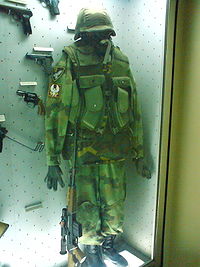 The first phase of negotiations was successful. In particular, a statement was issued by the Contact Group co-chairmen on February 23, 1999 that the negotiations "have led to a consensus on substantial autonomy for Kosovo, including on mechanisms for free and fair elections to democratic institutions, for the governance of Kosovo, for the protection of human rights and the rights of members of national communities; and for the establishment of a fair judicial system". They went on to say that "a political framework is now in place", leaving the further work of finalizing "the implementation Chapters of the Agreement, including the modalities of the invited international civilian and military presence in Kosovo". During the next month, however, NATO, under the influence of US diplomats Rubin and Albright, sought to impose a forced, as opposed to invited, military presence. The tilting of NATO towards the KLA organization is chronicled in the BBC Television "Moral Combat: NATO at War" program. This happened despite the fact, quoting General Klaus Naumann
(Chairman of NATO Military Committee), that "Ambassador Walker stated in the NAC (North Atlantic Council) that the majority of [ceasefire] violations was caused by the KLA".
In the end, on March 18, 1999, the Albanian, American, and British delegations signed what became known as the Rambouillet Accords
while the Serbian and Russian delegations refused. The accords called for NATO administration of Kosovo as an autonomous province within Yugoslavia, a force of 30,000 NATO troops to maintain order in Kosovo; an unhindered right of passage for NATO troops on Yugoslav territory, including Kosovo; and immunity for NATO and its agents to Yugoslav law. These latter provisions were much the same as had been applied to Bosnia for the SFOR
(Stabilization Force) mission there.
While the accords did not fully satisfy the Albanians, they were much too radical for the Serbs, who responded by substituting a drastically revised text that even the Russia
ns (traditional allies of the Serbs) found unacceptable. It sought to reopen the painstakingly negotiated political status of Kosovo and deleted all of the proposed implementation measures. Among many other changes in the proposed new version, it eliminated the entire chapter on humanitarian assistance and reconstruction, removed virtually all international oversight and dropped any mention of invoking "the will of the people [of Kosovo]" in determining the final status of the province.
Events proceeded rapidly after the failure at Rambouillet. The international monitors from the OSCE
withdrew on 22 March, for fear of the monitors' safety ahead of the anticipated NATO bombing campaign.
On March 23, the Serbian assembly accepted the principle of autonomy for Kosovo and non-military part of the agreement. But the Serbian side had objections to the military part of the Rambouillet agreement, particularly appendix B that foresees free access to all of Serbia for NATO troops, which it characterized as "NATO occupation". The full document was described as "fraudulent" because the military part of the agreement was offered only at the very end of the talks without much possibility for negotiation, and because the other side, condemned in harshest terms as a "separatist–terrorist delegation", completely refused to meet delegation of FRY and negotiate directly during the Rambouillet talks at all.
On 23 March 1999 at 21:30 UTC Richard Holbrooke
returned to Brussels and announced that peace talks had failed and formally handed the matter to NATO for military action. Hours before the announcement, Yugoslavia announced on national television it had declared a state of emergency citing an imminent threat of war and began a huge mobilization of troops and resources.
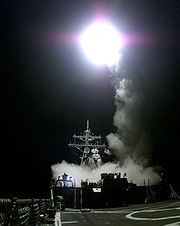
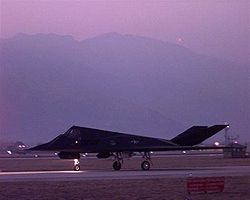
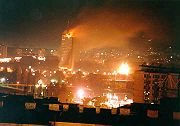
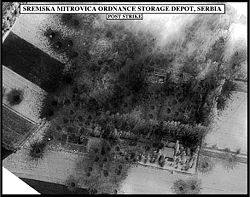 On 23 March 1999 at 22:17 UTC the Secretary General of NATO
, Javier Solana
, announced he had directed the Supreme Allied Commander Europe (SACEUR), US Army General Wesley Clark
, to "initiate air operations in the Federal Republic of Yugoslavia." On 24 March at 19:00 UTC NATO started its bombing campaign against Yugoslavia.
NATO's bombing campaign lasted from March 24 to June 11, 1999, involving up to 1,000 aircraft operating mainly from bases in Italy
and aircraft carriers stationed in the Adriatic. Tomahawk
cruise missile
s were also extensively used, fired from aircraft, ships, and submarines. All of the NATO members were involved to some degree—with the exception of Greece. Over the ten weeks of the conflict, NATO aircraft flew over 38,000 combat missions. For the German Air Force (Luftwaffe
), it was the second time it had participated in a conflict since World War II after the Bosnian War.
The proclaimed goal of the NATO operation was summed up by its spokesman as "Serbs
out, peacekeepers in, refugees back". That is, Yugoslav troops would have to leave Kosovo and be replaced by international peacekeepers to ensure that the Albanian refugees could return to their homes. The campaign was initially designed to destroy Yugoslav air defenses and high-value military targets. It did not go very well at first, with bad weather hindering many sorties early on. NATO had seriously underestimated Milošević's will to resist: few in Brussels thought that the campaign would last more than a few days, and although the initial bombardment was more than just a pin-prick, it was nowhere near the concentrated bombardments seen in Baghdad in 1991. On the ground, the ethnic cleansing campaign by the Serbians was stepped up and within a week of the war starting, over 300,000 Kosovo Albanians had fled into neighboring Albania and the Republic of Macedonia, with many thousands more displaced within Kosovo. By April, the United Nations was reporting that 850,000 people, mostly Albanians, had fled their homes. On 25 March Arkan appeared at the Hyatt
hotel in Belgrade where most of Western
journalists were staying and warned all of them to leave Serbia.
NATO military operations switched increasingly to attacking Yugoslav units on the ground, hitting targets as small as individual tanks and artillery pieces, as well as continuing with the strategic bombardment. This activity was, however, heavily constrained by politics, as each target needed to be approved by all nineteen member states. Montenegro
was bombed on several occasions but NATO eventually desisted to prop up the precarious position of its anti-Milošević leader, Đukanović. So-called "dual-use" targets, of use to both civilians and the military, were attacked, including bridges across the Danube
, factories, power stations, schools, houses, nurseries, hospitals, telecommunications facilities and, controversially, the headquarters of Yugoslavian Leftists, a political party led by Milošević's wife, and the Serbian state television broadcasting tower. Some saw these actions as violations of international law and the Geneva Conventions
in particular. NATO, however, argued that these facilities were potentially useful to the Yugoslav military and that their bombing was therefore justified.
At the start of May, a NATO aircraft attacked an Albanian refugee convoy
, believing it was a Yugoslav military convoy, killing around fifty people. NATO admitted its mistake five days later, but the Serbs accused NATO of deliberately attacking the refugees. On May 7, NATO bombs hit the Chinese Embassy in Belgrade
, killing three Chinese journalists and outraging Chinese public opinion. NATO claimed they were firing at Yugoslav positions. The United States and NATO later apologized for the bombing, saying that it occurred because of an outdated map provided by the CIA. This was challenged by a joint report from The Observer
(UK) and Politiken
(Denmark
) newspapers which claimed that NATO intentionally bombed the embassy because it was being used as a relay station for Yugoslav army radio signals. The bombing strained relations between China and NATO countries, and provoked angry demonstrations outside Western embassies in Beijing
.
In another major incident at the Dubrava
prison in Kosovo, the Yugoslav government attributed 85 civilian deaths to NATO bombing. Human Rights Watch
research in Kosovo determined that an estimated eighteen prisoners were killed by NATO bombs on May 21 (three prisoners and a guard were killed in an earlier attack on May 19).
By the start of April, the conflict seemed little closer to a resolution and NATO countries began to think seriously about a ground operation—an invasion of Kosovo. This would have to be organized very quickly, as there was little time before winter would set in and much work would have to be done to improve the roads from the Greek
and Albania
n ports to the envisaged invasion routes through Macedonia
and northeastern Albania. U.S. President Bill Clinton was, however, extremely reluctant to commit American forces for a ground offensive. Instead, Clinton authorized a CIA operation to look into methods to destabilize the Serbian government without training KLA troops. At the same time, Finnish
and Russia
n negotiators continued to try to persuade Milošević to back down. He finally recognised that NATO was serious in its resolve to end the conflict one way or another and that Russia would not intervene to defend Serbia despite Moscow's strong anti-NATO rhetoric. Faced with little alternative, Milošević accepted the conditions offered by a Finnish–Russian mediation team and agreed to a military presence within Kosovo headed by the UN, but incorporating NATO troops.
WP:WEASEL
The Norwegian special forces Hærens Jegerkommando
and Forsvarets Spesialkommando cooperated with the KLA in gathering intelligence information. Preparing for the invasion on June 12, the Norwegian
special forces sat together with the KLA on the Ramno mountain on the border between Macedonia and Kosovo and had an excellent scouting point for what was happening inside Kosovo. Together with British special forces, Norwegian special forces were the first to cross over the border into Kosovo. According to Keith Graves with the television network Sky News, the Norwegians were already inside Kosovo two days prior to the marching in of other forces and were among the first to enter into Pristina. The Hærens Jegerkommando's and Forsvarets Spesialkommando's job was to clear the way between the striding parties and to make local deals to implement the peace deal between the Serbians and the Kosovo Albanians.
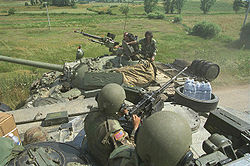 On June 3, 1999, Milošević accepted the terms of an international peace plan to end the fighting, with the Serbian parliament adopting the proposal amid contentious debate with delegates coming close to fistfights at some points. On 10 June, the North Atlantic Council
ratified the agreement and suspended of air operations.
On June 12, after Milošević accepted the conditions, the NATO-led peacekeeping
Kosovo Force (KFOR) began entering Kosovo. KFOR had been preparing to conduct combat operations, but in the end, its mission was only peacekeeping. It was based upon the Allied Rapid Reaction Corps
headquarters commanded by then Lieutenant General Mike Jackson
of the British Army
. It consisted of British forces (a brigade built from 4th Armored and 5th Airborne Brigades), a French Army
Brigade, a German Army
brigade, which entered from the west while all the other forces advanced from the south, and Italian Army
and United States Army
brigades. The U.S. contribution, known as the Initial Entry Force, was led by the 1st Armored Division which was spearheaded by a platoon from the 2nd Battalion, 505th Parachute Infantry Regiment attached to the British Forces. Subordinate units included TF 1-35 Armor from Baumholder, Germany, the 2nd Battalion, 505th Parachute Infantry Regiment from Fort Bragg, North Carolina, the 26th Marine Expeditionary Unit
from Camp Lejeune, North Carolina
, the 1st Battalion, 26th Infantry Regiment from Schweinfurt, Germany, and Echo Troop, 4th Cavalry Regiment, also from Schweinfurt, Germany. Also attached to the U.S. force was the Greek Army's 501st Mechanized Infantry Battalion. The initial U.S. forces established their area of operation around the towns of Uroševac, the future Camp Bondsteel
, and Gnjilane, at Camp Monteith
, and spent four months—the start of a stay which continues to date—establishing order in the southeast sector of Kosovo.
During the initial incursion, the U.S. soldiers were greeted by Albanians cheering and throwing flowers as U.S. soldiers and KFOR rolled through their villages. Although no resistance was met, three U.S. soldiers from the Initial Entry Force lost their lives in accidents.
Following the military campaign, the involvement of Russian peacekeepers proved to be tense and challenging to the NATO Kosovo force. The Russians expected to have an independent sector of Kosovo, only to be unhappily surprised with the prospect of operating under NATO command. Without prior communication or coordination with NATO, Russian peacekeeping forces entered Kosovo from Bosnia and seized the Pristina International Airport
.
In 2010 James Blunt
in an interview described how his unit was given the assignment of securing the Pristina in advance of the 30,000-strong peacekeeping force and the Russian army had moved in and taken control of the airport before his unit's arrival. As the first officer on the scene, Blunt shared a part in the difficult task of addressing the potentially violent international incident. According to Blunt's account, verified by General Sir Mike Jackson, there was a stand-off with the Russians, and the NATO Supreme Commander, US General Wesley Clark, gave orders to over-power them. Whilst these were questioned by Blunt, they were rejected by General Sir Mike Jackson with the now famous line, "I'm not having my soldiers responsible for starting World War III".
Furthermore, in June 2000, arms trading relations between Russia and Serbia were exposed which lead to the retaliation and bombings of Russian Checkpoints and area Police Stations. Outpost Gunner was established on a high point in the Preševo Valley by Echo Battery 1/161 Field Artillery in an attempt to monitor and assist with peacekeeping efforts in the Russian Sector. Operating under the support of 2/3 Field Artillery, 1st Armored Division, the Battery was able to successfully deploy and continuously operate a Firefinder Radar which allowed the NATO forces to keep a closer watch on activities in the Sector and the Preševo Valley. Eventually a deal was struck whereby Russian forces operated as a unit of KFOR but not under the NATO command structure.
in Kosovo has been the subject of much debate. One immediate cause of this criticism was the timing of the NATO intervention, coming as it did on the heels of the Monica Lewinsky scandal which led many critics to suspect that the intervention was an opportunistic attempt to distract the American public from the same (references to the film Wag the Dog
were a polite way to refer to this suspicion). Some support for this hypothesis may be found in the fact that coverage of the bombing directly replaced coverage of the Monica Lewinsky scandal in American news cycles. Still others point out that before the bombing, rather than there being an unusually bloody conflict, the KLA was not engaged in a widespread civil war against Yugoslav forces and the death toll among all concerned (including ethnic Albanians) skyrocketed after the NATO intervention. In addition, NATO did not have the backing of the United Nations Security Council
. NATO argued that their defiance of the Security Council was justified based on the claims of an "international humanitarian emergency". Criticism was also drawn by the fact that the NATO charter specifies that NATO is an organization created for defense of its members, but in this case it was used to attack a non-NATO country which was not directly threatening any NATO member. NATO claimed that instability in the Balkans
was a direct threat to the security interests of NATO members, and military action was therefore justified by the NATO charter; however, the only NATO member country to which the instability was a direct threat was Greece
, which opposed the bombing.
Many on the left of Western politics saw the NATO campaign as U.S. aggression and imperialism, while critics on the right considered it irrelevant to their countries' national security interests. Noam Chomsky
, Edward Said
and Tariq Ali
were prominent in opposing the campaign. However, in comparison with the anti-war protests against the 2003 invasion of Iraq
, the campaign against the war in Kosovo aroused much less public support.
The personalities were also very different—the NATO nations were mostly led by centre-left and moderately liberal leaders, most prominently U.S. President Bill Clinton
, British Prime Minister Tony Blair
, Canadian Prime Minister Jean Chrétien
, German Chancellor Gerhard Schröder
and the Italian Prime Minister Massimo D'Alema
. Anti-war protests were generally from the libertarian right, the left, far-left and Serbian émigrés, with many other left-wingers supporting the campaign on humanitarian grounds. The German participation in the operation was one of the reasons for Oskar Lafontaine
's resignation from the post of Federal Minister of Finance and the chairman of the SPD
.
There was, however, criticism from all parts of the political spectrum for the way that NATO conducted the campaign. NATO officials sought to portray it as a "clean war" using precision weapons
. The U.S. Department of Defense
claimed that, up to June 2, 99.6% of the 20,000 bombs and missiles used had hit their targets. However, the use of technologies such as depleted uranium ammunition and cluster bombs was highly controversial, as was the bombing of oil refineries and chemical plants, which led to accusations of "environmental warfare". The slow pace of progress during the war was also heavily criticised. Many believed that NATO should have mounted an all-out campaign from the start, rather than starting with a relatively small number of strikes and combat aircraft.
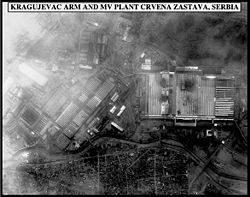 The choice of targets was highly controversial. The destruction of bridges over the Danube greatly disrupted shipping on the river for months afterwards, causing serious economic damage to countries along the length of the river. Industrial facilities were also attacked, damaging the economies of many towns. In fact, as the Serbian opposition later complained, the Yugoslav military was using civilian factories as weapons plants: the Sloboda vacuum cleaner factory in the town of Čačak
also housed a tank repair facility, while the Zastava
car plant was wrongly bombed, because the weapons factory of the same name exists in the same city, but in a completely different location. There were more similar mistakes that showed a lack of intelligence services.
Only state-owned factories were targeted, leading critics to suspect that the bombing campaign was partly designed to prepare the way for a free market-based reconstruction by wealthy foreign powers. No private or foreign-owned industrial sites were bombed. Perhaps the most controversial deliberate attack of the war was that made against the headquarters of Serbian television on April 23, which killed at least fourteen people. NATO justified the attack on the grounds that the Serbian television headquarters was part of the Milošević regime's "propaganda machine". Opponents of Milošević inside Serbia charged that the managers of the state TV station had been forewarned of the attack but ordered staff to remain inside the building despite an air raid alert.
Within Yugoslavia, opinion on the war was (unsurprisingly) split between highly critical among Serbs and highly supportive among Albanians, although not all Albanians felt that way; some appear to have blamed NATO for not acting quickly enough. Although Milošević was increasingly unpopular, the NATO campaign created a mood of national unity. Milošević did not leave matters entirely to chance, however. Many opposition supporters feared for their lives, particularly after the murder of the dissident journalist Slavko Curuvija
on April 11, an act widely blamed on Milošević's secret police. In Montenegro, President Milo Đukanović, who opposed both the NATO bombardment and Serbian actions in Kosovo, publicly expressed fear of a "creeping coup
" by Milošević supporters.
Opinion in Yugoslavia's neighbours was much more mixed. Macedonia
was the only Yugoslav republic apart from Montenegro not to have fought a war with Serbia and had tense relations between the Macedonian
majority and a large Albanian minority. Its government did not approve of Milošević's actions, but it was also not very sympathetic towards the Albanian refugees. Albania was wholly supportive of NATO's actions, as might be expected given the ethnic ties between Albanians on both sides of the border. Croatia, Romania, and Bulgaria granted fly-over rights to NATO aircraft. Hungary was a new member of NATO and supported the campaign. Across the Adriatic, Italian public and political opinion was against the war, but the Italian government nonetheless allowed NATO full use of Italian air bases. In Greece, popular opposition to the NATO bombing reached 96%.
. U.S. President Clinton and his administration were accused of inflating the number of Kosovo Albanians
killed by Serbians. Clinton's Secretary of Defense William Cohen
, giving a speech, said, "The appalling accounts of mass killing in Kosovo and the pictures of refugees fleeing Serb oppression for their lives makes it clear that this is a fight for justice over genocide." On CBS' Face the Nation Cohen claimed, "We've now seen about 100,000 military-aged men missing... they may have been murdered." Clinton, citing the same figure, spoke of "at least 100,000 (Kosovo Albanians) missing". Later, talking about Yugoslav elections, Clinton said, "they're going to have to come to grips with what Mr. Milošević ordered in Kosovo... they're going to have to decide whether they support his leadership or not; whether they think it's OK that all those tens of thousands of people were killed...". Clinton also claimed, in the same press conference, that "NATO stopped deliberate, systematic efforts at ethnic cleansing and genocide." Clinton compared the events of Kosovo to the Holocaust. CNN reported, "Accusing Serbia of 'ethnic cleansing' in Kosovo similar to the genocide of Jews in World War II, an impassioned President Clinton sought...to rally public support for his decision to send U.S. forces into combat against Yugoslavia, a prospect that seemed increasingly likely with the breakdown of a diplomatic peace effort." Clinton's State Department also claimed Yugoslav troops had committed genocide. The New York Times reported, "the Administration said evidence of 'genocide' by Yugoslav forces was growing to include 'abhorrent and criminal action' on a vast scale. The language was the State Department's strongest yet in denouncing Yugoslav President Slobodan Milošević." The State Department also gave the highest estimate of dead Albanians. The New York Times reported, "On April 19, the State Department said that up to 500,000 Kosovo Albanians were missing and feared dead" (the entire prewar Albanian population of Kosovo was estimated at 1,300,000 to 1,600,000).
After the bombing of the Chinese embassy in Belgrade, Chinese Premier Jiang Zemin said that the US was using its economic and military superiority to aggressively expand its influence and interfere in the internal affairs of other countries. Chinese leaders called the NATO campaign a dangerous precedent of naked aggression, a new form of colonialism, and an aggressive war groundless in morality or law. It was seen as part of a plot by the US to destroy Yugoslavia, expand eastward and control all of Europe.
The United Nations Charter does not allow military interventions in other sovereign countries with few exceptions which, in general, need to be decided upon by the United Nations Security Council. The issue was brought before the UN Security Council by Russia, in a draft resolution which, inter alia, would affirm "that such unilateral use of force constitutes a flagrant violation of the United Nations Charter". China, Namibia, and Russia voted for the resolution, the other members against, thus it failed to pass.
On April 29, 1999, Yugoslavia filed a complaint at the International Court of Justice (ICJ) at The Hague
against ten NATO member countries (Belgium, Germany, France, Great Britain, Italy, Canada, The Netherlands, Portugal, Spain, and the USA). The Court did not decide upon the case because Yugoslavia was not a member of the UN during the war.
In Western European countries, opposition to NATO's intervention was mainly from the libertarian right, and from the far left
. In Britain, the war was opposed by many prominent conservative figures including former UK Foreign Secretary Sir Malcolm Rifkind
, former Chancellor of the Exchequer
Norman Lamont, and journalists Peter Hitchens
and Simon Heffer
, whereas opposition on the left
was confined to The Morning Star
newspaper and left wing MPs like Tony Benn
and Alan Simpson. In the U.S. criticism was largely limited to the conservative Republican Party, many of whom voted to approve congressional funding for the war under the premise of "supporting the troops, not the policy" of Democratic President Bill Clinton. The war was opposed primarily by prominent conservative figures in the U.S., including (then Texas Governor) George W. Bush, House Majority Leader Dick Armey, House Majority Whip Tom Delay and Senate Majority Leader Trent Lott. The more liberal Democratic Party largely supported the policy of the Democratic president, with the exception of some elements of the far-left, led by liberal activists, like Ralph Nader.
The war inflicted many casualties. Already by March 1999, the combination of fighting and the targeting of civilians had left an estimated 1,500-2,000 civilians and combatants dead. Final estimates of the casualties are still unavailable for either side.
A study by researchers from the Center for Disease Control and Prevention in Atlanta
, Georgia published in 2000 in medical journal the Lancet
estimated that "12,000 deaths in the total population" could be attributed to war. This number was achieved by surveying 1,197 households from February 1998 through June 1999. 67 out of the 105 deaths reported in the sample population were attributed to war-related trauma
, which extrapolates to be 12,000 deaths if the same war-related mortality rate is applied to Kosovo's total population. The highest mortality rates were in men between 15 and 49 (5,421 victims of war) as well as for men over 50 (5,176 victims). For persons younger than 15, the estimates were 160 victims for males and 200 for females. For women between 15-49 the estimate is that there were 510 victims; older than 50 years the estimate is 541 victims. The authors stated that it is not "possible to differentiate completely between civilian and military casualties".
In the 2008 joint study by the Humanitarian Law Center (an NGO from Serbia and Kosovo), The International Commission on Missing Person, and the Missing Person Commission of Serbia made a name-by-name list of 13,472 war and post-war victims in Kosovo killed in the period from January 1998 to December 2000. The list contained the name, date of birth, military or civilian status of victim, type of injury/missing, time and place of death. There are 9,260 Albanians and 2,488 Serbs, as well as 1,254 victims that can not be identified by ethnic origin
as a reasonable estimate. This report counted between 488 and 527 civilian deaths (90 to 150 of them killed from cluster bomb use) in 90 separate incidents, the worst of which were the 87 lives lost at Korisa, where Serb forces made civilians occupy a known military target.
Attacks in Kosovo overall were more deadly due to the confused situation with many refugee movements— the one-third of the incidents there account for more than half of the deaths.
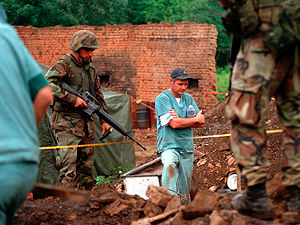 Various estimates of the number of killings attributed to Yugoslav ground forces have been announced through the years.
The estimate of 10,000 deaths is used by the U.S. State Department, which cited human rights abuses as its main justification for attacking Yugoslavia.
Statistical experts working on behalf of the ICTY prosecution estimate that the total number of dead is about 10,000. Eric Fruits, a professor at Portland State University, argued that the experts' analyses were based on fundamentally flawed data and that none of its conclusions are supported by any valid statistical analysis or tests.
In August 2000, the International Criminal Tribunal for the former Yugoslavia
(ICTY) announced that it had exhumed 2,788 bodies in Kosovo, but declined to say how many were thought to be victims of war crimes. Earlier however, KFOR sources told Agence France Presse that of the 2,150 bodies that had been discovered up until July 1999, about 850 were thought to be victims of war crimes.
Known mass graves:
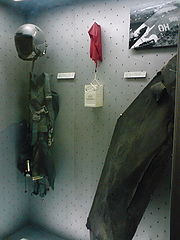 Military casualties on the NATO side were light. According to official reports, the alliance suffered no fatalities as a result of combat operations. However, in the early hours of May 5, an American military AH-64 Apache
helicopter crashed not far from the border between Serbia and Albania.
An American AH-64 helicopter crashed about 40 miles (64 km) northeast of Tirana
, Albania's capital, very close to the Albanian/Kosovo border. According to CNN
, the crash happened 45 miles (72 km) northeast of Tirana. The two American pilots of the helicopter, Army Chief Warrant Officer
s David Gibbs and Kevin L. Reichert, died in that crash. They were the only NATO casualties during the war, according to NATO official statements.
There were other casualties after the war, mostly due to land mines. After the war, the alliance reported the loss of the first U.S. stealth plane (an F-117
stealth fighter) ever shot down by enemy fire. Furthermore an F-16 fighter was lost near Šabac
and whose remains are on display in Museum of Aviation in Belgrade, 32 unmanned aerial vehicle
s (UAVs) from different nations were lost. The wreckages of downed UAVs were shown on Serbian television during the war. Some claim a second F-117A was also heavily damaged, and although it made it back to its base, it never flew again.
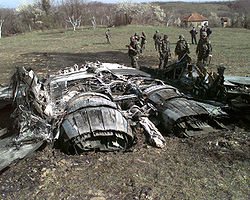
 NATO did not release any official casualty estimates. The Yugoslav authorities claimed 462 soldiers were killed and 299 wounded by NATO airstrikes. The names of Yugoslav casualties were recorded in a "book of remembrance".
Of military equipment, NATO destroyed around 50 Yugoslav aircraft including 6 MiG-29s destroyed in air-to-air combat. A number of G-4 Super Galebs which were destroyed in their hardened aircraft shelter by bunker-busting bombs which started a fire which spread because the shelter doors were not closed. At the end of war, NATO officially claimed they destroyed 93 Yugoslav tanks. Yugoslavia admitted a total of 13 destroyed tanks. The latter figure was verified by European inspectors when Yugoslavia rejoined the Dayton accords, by noting the difference between the number of tanks then and at the last inspection in 1995. The NATO officers claimed that Yugoslav army lost 94 tanks (M-84
's and T-55
's), 132 APCs, and 52 artillery pieces. Yugoslav officers claimed the real numbers were "14 tanks, not 120; 18 armored personnel carriers, not 220; 20 artillery pieces, not 450". Most of the targets hit in Kosovo were decoys, such as tanks made out of plastic sheets with telegraph poles for gun barrels, or old World War II–era tanks which were not functional. Anti-aircraft defences were preserved by the simple expedient of not turning them on, preventing NATO aircraft from detecting them, but forcing them to keep above a ceiling of 15,000 feet (5,000 m), making accurate bombing much more difficult. Towards the end of the war, it was claimed that carpet bombing by B-52
aircraft had caused huge casualties among Yugoslav troops stationed along the Kosovo–Albania border. Careful searching by NATO investigators found no evidence of any such large-scale casualties.
However, the most significant loss for the Yugoslav Army
was the damaged and destroyed infrastructure. Almost all military air bases and airfields (Batajnica, Lađevci, Slatina
, Golubovci, Kovin
, and Đakovica) and other military buildings and facilities were badly damaged or destroyed. Unlike the units and their equipment, military buildings couldn't be camouflaged. thus, defence industry and military technical overhaul facilities were also seriously damaged (Utva, Zastava Arms
factory, Moma Stanojlović air force overhaul center, technical overhaul centers in Čačak
and Kragujevac
). Moreover, in an effort to weaken the Yugoslav Army, NATO targeted several important civilian facilities (Pančevo
oil refinery, bridges, TV antennas, railroads, etc.).
During the war, 90,000 Serbs fled from Kosovo. The Yugoslav Red Cross had also registered 247,391 mostly Serbian refugees by November. The persistent anti-Serb attacks and riots, including against other non-Albanians, had remained in the anarchic stage until some form of order was established in 2001. This order disintegrated during the 2004 pogrom against non Albanians.
charged Milošević with crimes against humanity, violating the laws or customs of war, grave breaches of the Geneva Conventions
and genocide
for his role during the wars in Croatia
, Bosnia
, and Kosovo.
Before the end of the bombing, Yugoslav President Slobodan Milošević, along with Milan Milutinović
, Nikola Šainović
, Dragoljub Ojdanić
and Vlajko Stojiljković
were charged by the International Criminal Tribunal for the Former Yugoslavia
(ICTY) with crimes against humanity including murder, forcible transfer, deportation, and "persecution on political, racial or religious grounds".
Further indictments were leveled in October 2003 against former armed forces chief of staff Nebojša Pavković
, former army corps commander Vladimir Lazarević, former police official Vlastimir Đorđević, and the current head of Serbia's public security, Sreten Lukić
. All were indicted for crimes against humanity and violations of the laws or customs of war.
War crimes prosecutions have also been carried out in Yugoslavia. Yugoslav soldier Ivan Nikolić was found guilty in 2002 of war crimes in the deaths of two civilians in Kosovo. A significant number of Yugoslav soldiers were tried by Yugoslav military tribunals during the war.
, Haradin Bala
, Isak Musliu
, and Agim Murtezi for crimes against humanity. They were arrested on February 17 and 18, 2003. Charges were soon dropped against Agim Murtezi as a case of mistaken identity, whereas Fatmir Limaj was acquitted of all charges on November 30, 2005 and released. The charges were in relation to the prison camp run by the defendants at Lapusnik between May and July 1998.
In 2008, Carla Del Ponte
published a book in which she alleged that, after the end of the war in 1999, Kosovo Albanians were smuggling organs of between 100 and 300 Serbs and other minorities from the province to Albania. The ICTY and the Serbian War Crimes Tribunal are currently investigating these allegations, as numerous witnesses and new materials have recently emerged.
On March 2005, a U.N. tribunal indicted Kosovo Prime Minister Ramush Haradinaj
for war crimes against the Serbs. On March 8, he tendered his resignation. Haradinaj, an ethnic Albanian, was a former commander who led units of the Kosovo Liberation Army and was appointed Prime Minister after winning an election of 72 votes to three in the Kosovo's Parliament in December 2004. Haradinaj was acquitted on all counts. The Office of the Prosecutor has appealed his acquittal, and as of July 2008, the matter remains unresolved.
) claimed that NATO had carried out war crimes during the conflict, notably the bombing of the Serbian TV headquarters in Belgrade on April 23, 1999, where 16 people were killed and 16 more were injured. Sian Jones of Amnesty stated, "The bombing of the headquarters of Serbian state radio and television was a deliberate attack on a civilian object and as such constitutes a war crime". The ICTY
conducted an inquiry into these charges, but did not press charges, citing a lack of mandate.
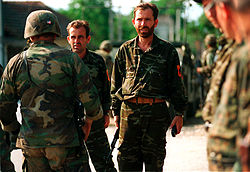 The Kosovo war had a number of important consequences in terms of the military and political outcome. The status of Kosovo remains unresolved; international negotiations began in 2006 to determine the level of autonomy Kosovo would have, as envisaged under UN Security Council Resolution 1244, but failed. The province is administered by the United Nations
despite its unilateral declaration of independence
on February 17, 2008.
 The UN-backed talks, led by UN Special Envoy Martti Ahtisaari
, had begun in February 2006. Whilst progress was made on technical matters, both parties remained diametrically opposed on the question of status itself. In February 2007, Ahtisaari delivered a draft status settlement proposal to leaders in Belgrade and Pristina, the basis for a draft UN Security Council Resolution which proposes "supervised independence" for the province, which is in contrary to UN Security Council Resolution 1244. By July 2007, the draft resolution, which was backed by the United States
, United Kingdom
, and other European members of the Security Council, had been rewritten four times to try to accommodate Russian concerns that such a resolution would undermine the principle of state sovereignty. Russia, which holds a veto in the Security Council as one of five permanent members, stated that it would not support any resolution which is not acceptable to both Belgrade and Priština.
The campaign exposed significant weaknesses in the U.S. arsenal, which were later addressed for the Afghanistan
and Iraq
campaigns. Apache attack helicopters
and AC-130 Spectre gunships were brought up to the front lines but were never actually used after two Apaches crashed during training in the Albanian mountains. Stocks of many precision missiles were run down to critically low levels; had the campaign lasted much longer, NATO would have had to revert back to using "dumb" bombs for lack of anything better. The situation was not any better with the combat aircraft; continuous operations meant skipped maintenance schedules and many aircraft were withdrawn from service awaiting spare parts and service. Also, many of the precision-guided weapons proved unable to cope with Balkan weather, as the clouds blocked the laser guidance beams. This was resolved by retrofitting bombs with Global Positioning System
satellite guidance devices that are immune to bad weather. Also, although pilotless surveillance aircraft
were extensively used, it often proved the case that attack aircraft could not be brought to the scene quickly enough to hit targets of opportunity. This led to the fitting of missiles to Predator drones in Afghanistan, reducing the "sensor to shooter" time to virtually nothing.
Kosovo also demonstrated that even a high-tech force such as NATO could be thwarted by simple tactics, according to Wesley Clark
and other NATO generals who analyzed these tactics a few years after the conflict. The Yugoslav army had long expected to need to resist a much stronger enemy, either Soviet
or NATO, during the Cold War
and had developed effective tactics of deception and concealment in response. These would have been unlikely to have resisted a full-scale invasion for long, but were probably effective in misleading overflying aircraft and satellites. Among the tactics used were:
for Kosovo Service, an international military decoration. Shortly thereafter, NATO created the Non-Article 5 Medal for Balkans service to combine both Yugoslavian and Kosovo operations into one service medal.
Due to the involvement of the United States armed forces
, a separate U.S. military decoration
, known as the Kosovo Campaign Medal
, was established by President Bill Clinton
in 2000.
FR Yugoslavia
The following weapons used by FR Yugoslavia are listed below. Most of them were Yugoslav Made weaponry, while almost all of the AA Units and some other weaponry were Soviet Made. The flags pinned next to the weaponry represents Country of Origin.
Kosovo Liberation Army
The following weapons used by the Kosovo Liberation Army are listed below. They mostly consist of Soviet Kalashnikov weaponry, also Chinese Derivatives of the AK-47 and some Western Weaponry. The flags pinned next to the weaponry represents Country of Origin.
NATO
The following aircraft used by NATO are listed below. The flags pinned next to the aircraft represents Country of Origin and which of the following countries used it (More flags to be pinned later).
and in novels
Kosovo
Kosovo is a region in southeastern Europe. Part of the Ottoman Empire for more than five centuries, later the Autonomous Province of Kosovo and Metohija within Serbia...
province, then part of FR Yugoslav Republic of Serbia; from early 1998 to 1999, there was an armed conflict initiated by the ethnic Albanian "Kosovo Liberation Army
Kosovo Liberation Army
The Kosovo Liberation Army or KLA was a Kosovar Albanian paramilitary organization which sought the separation of Kosovo from Federal Republic of Yugoslavia in the 1990s....
" (KLA), who sought independence (classified by Serbia as terrorists), against the Serbian police
Law enforcement in Serbia
Law enforcement in Serbia is the primary responsibility of the Serbian Police, which is subordinate to the Ministry of Internal Affairs. The ministry is responsible for all local and national law enforcement services in Serbia...
and Yugoslav Military
Military of Serbia and Montenegro
The Military of Serbia and Montenegro were the armed forces of the Serbia and Montenegro...
. From March 24, 1999 to June 11, 1999, NATO launched an air campaign on FR Yugoslavia, while the KLA continued battles with Yugoslav forces, amidst a massive population displacement estimated to be close to 1 million people.
The KLA, formed in 1991, began attacking police stations and government offices in February 1996, which resulted in an increase of security forces, and escalation of conflict, although it initially was viewed as an insurgency
Insurgency
An insurgency is an armed rebellion against a constituted authority when those taking part in the rebellion are not recognized as belligerents...
. The KLA was regarded by the US as a terrorist group until 1998 when it was de-listed for classified reasons, and then the UK and the US lobbied France to do the same. The U.S. and NATO then cultivated diplomatic relationships with the KLA leaders, This happened despite the fact that General Klaus Naumann
Klaus Naumann
Klaus Naumann is a retired German General, who served as Chief of Staff of the Bundeswehr, the German armed fources, from 1991 to 1996, and as Chairman of the NATO Military Committee from 1996 to 1999, succeeding the British general Richard Frederick Vincent, Baron Vincent of Coleshill...
(Chairman of NATO Military Committee) stated that "Ambassador Walker stated in the NAC (North Atlantic Council) that the majority of violations was caused by the KLA."
In 1999 the KLA was officially disbanded and their members joined the UCPMB
UCPMB
The Liberation Army of Preševo, Medveđa and Bujanovac was a separatist militant group fighting for independence from the Federal Republic of Yugoslavia for the three municipalities: Preševo, Bujanovac, and Medveđa, home to most of the ethnic Albanians of Central Serbia, adjacent to Kosovo.UCPMB's...
in the Preševo Valley
Preševo Valley
The Preševo Valley , is an Albanian political catchphrase used to describe the two south Serbian municipalities of Bujanovac and Preševo, which have a majority ethnic Albanian population. Medvedja municipality is sometimes also included under this term, although it has a majority Serbian population...
, and the NLA and ANA
Albanian National Army
The Albanian National Army , is an ethnic Albanian organization closely associated with the Kosovo Liberation Army — operating in the Republic of Macedonia and Kosovo...
in the armed ethnic conflict in Macedonia
Insurgency in the Republic of Macedonia
The insurgency in the Republic of Macedonia was an armed conflict which began when the ethnic Albanian National Liberation Army militant group attacked the security forces of the Republic of Macedonia at the beginning of January 2001...
. UNMIK instituted NGOs within Kosovo such as the Kosovo Protection Corps
Kosovo Protection Corps
The Kosovo Protection Corps was a civilian emergency services organisation in Kosovo active from 1999 to 2009.The KPC was created on September 21, 1999 through the promulgation of UNMIK Regulation 1999/8 and the agreement of a "Statement of Principles" on the KPC's permitted role in Kosovo...
(in accordance with UNSC resolution 1244 which required the establishment of a civilian emergency protection body to replace the former KLA) and the Kosovo Police (mainly of KLA veterans).
NATO countries promoted the war in Kosovo as the first humanitarian war based on short-term military reports and casualty reports that were later criticized as highly inaccurate. It was the center of news headlines for months, and gained a massive amount of coverage and attention from the international community and media. The NATO bombing and surrounding events have remained controversial.
Kosovo in Tito's Yugoslavia (1945–1986)
Tensions between the Serbian and Albanian communities in Kosovo simmered throughout the 20th century and occasionally erupted into major violence, particularly during the First Balkan WarFirst Balkan War
The First Balkan War, which lasted from October 1912 to May 1913, pitted the Balkan League against the Ottoman Empire. The combined armies of the Balkan states overcame the numerically inferior and strategically disadvantaged Ottoman armies and achieved rapid success...
, World War I
World War I
World War I , which was predominantly called the World War or the Great War from its occurrence until 1939, and the First World War or World War I thereafter, was a major war centred in Europe that began on 28 July 1914 and lasted until 11 November 1918...
, and World War II
World War II
World War II, or the Second World War , was a global conflict lasting from 1939 to 1945, involving most of the world's nations—including all of the great powers—eventually forming two opposing military alliances: the Allies and the Axis...
. The Socialist government of Josip Broz Tito
Josip Broz Tito
Marshal Josip Broz Tito – 4 May 1980) was a Yugoslav revolutionary and statesman. While his presidency has been criticized as authoritarian, Tito was a popular public figure both in Yugoslavia and abroad, viewed as a unifying symbol for the nations of the Yugoslav federation...
systematically repressed nationalist manifestations throughout Yugoslavia, seeking to ensure that no Yugoslav republic or nationality gained dominance over the others. In particular, the power of Serbia
Socialist Republic of Serbia
Socialist Republic of Serbia was a socialist state that was a constituent country of the Socialist Federal Republic of Yugoslavia. It is a predecessor of modern day Serbia, which served as the biggest republic in the Yugoslav federation and held the largest population of all the Yugoslav...
—the largest and most populous republic—was diluted by the establishment of autonomous governments in the province of Vojvodina
Vojvodina
Vojvodina, officially called Autonomous Province of Vojvodina is an autonomous province of Serbia. Its capital and largest city is Novi Sad...
in the north of Serbia and Kosovo in the south. Kosovo's borders did not precisely match the areas of ethnic Albanian settlement in Yugoslavia (significant numbers of Albanians were left in the Republic of Macedonia
Albanians in the Republic of Macedonia
Albanians are the largest ethnic minority in the Republic of Macedonia. Of the 2,022,547 citizens of Macedonia, 509,083, or 25%, are Albanian according to the latest national census in 2002. The Albanian minority lives mostly in the north-western part of the country...
, Montenegro
Albanians in Montenegro
Albanians in Montenegro constitute 4.91% of the county's total population. They mainly live in South-Eastern Montenegro, in the region commonly known as Malesija as well as in the municipality of Ulcinj .-Geography:...
, and Serbia though the majority of its inhabitants were Albanian). Kosovo's formal autonomy, established under the 1945 Yugoslav constitution, initially meant relatively little in practice. Tito's secret police
UDBA
The Department of State Security was the secret police organization of the Socialist Federal Republic of Yugoslavia.Although it operated with more restraint than other secret...
cracked down hard on nationalists. In 1956, a number of Albanians
Albanians
Albanians are a nation and ethnic group native to Albania and neighbouring countries. They speak the Albanian language. More than half of all Albanians live in Albania and Kosovo...
were put on trial in Kosovo on charges of espionage and subversion. The threat of separatism was in fact minimal, as the few underground groups aiming for union with Albania
Albania
Albania , officially known as the Republic of Albania , is a country in Southeastern Europe, in the Balkans region. It is bordered by Montenegro to the northwest, Kosovo to the northeast, the Republic of Macedonia to the east and Greece to the south and southeast. It has a coast on the Adriatic Sea...
were politically insignificant. Their long-term impact was substantial, though, as some—particularly the Revolutionary Movement for Albanian Unity, founded by Adem Demaci
Adem Demaçi
Adem Demaçi is a Kosovo Albanian writer and politician and a longtime political prisoner who spent a total of 28 years in prison for speaking out against the poor treatment of the Albanian minority in Yugoslavia as well as criticizing communism and the regime of Josip Broz Tito...
—were to form the political core of the Kosovo Liberation Army
Kosovo Liberation Army
The Kosovo Liberation Army or KLA was a Kosovar Albanian paramilitary organization which sought the separation of Kosovo from Federal Republic of Yugoslavia in the 1990s....
. Demaci himself was imprisoned in 1964 along with many of his followers. Yugoslavia underwent a period of economic and political crisis in 1969, as a massive government program of economic reform widened the gap between the rich north and poor south of the country.
Student demonstrations and riots in Belgrade
Belgrade
Belgrade is the capital and largest city of Serbia. It is located at the confluence of the Sava and Danube rivers, where the Pannonian Plain meets the Balkans. According to official results of Census 2011, the city has a population of 1,639,121. It is one of the 15 largest cities in Europe...
in June 1968 spread to Kosovo in November the same year, but were quelled by the Yugoslav security forces. However, some of the students' demands—in particular, representative powers for Albanians in both the Serbian and Yugoslav state bodies, and better recognition of the Albanian language
Albanian language
Albanian is an Indo-European language spoken by approximately 7.6 million people, primarily in Albania and Kosovo but also in other areas of the Balkans in which there is an Albanian population, including western Macedonia, southern Montenegro, southern Serbia and northwestern Greece...
—were conceded by Tito. The University of Priština was established as an independent institution in 1970, ending a long period when the institution had been run as an outpost of Belgrade University. The Albanianisation of education in Kosovo was hampered by the lack of Albanian-language educational materials in Yugoslavia, so an agreement was struck with Albania itself to supply textbooks. In 1974, Kosovo's political status was improved further when a new Yugoslav constitution granted an expanded set of political rights. Along with Vojvodina, Kosovo was declared a province and gained many of the powers of a fully-fledged republic: a seat on the federal presidency and its own assembly, police force, and national bank.
Power was still exercised by the Communist Party, but it was now devolved mainly to ethnic Albanian communists. Tito's death on May 4, 1980 ushered in a long period of political instability, worsened by growing economic crisis and nationalist unrest. The first major outbreak occurred in Kosovo's main city, Pristina
Pristina
Pristina, also spelled Prishtina and Priština is the capital and largest city of Kosovo. It is the administrative centre of the homonymous municipality and district....
, in March 1981, when Albanian students rioted over long queues in their university canteen. This seemingly trivial dispute rapidly spread throughout Kosovo and took on the character of a national revolt, with massive popular demonstrations in many Kosovo towns. The protesters demanded that Kosovo should become the seventh republic of Yugoslavia.
However, this was politically unacceptable to Serbia and the Socialist Republic of Macedonia
Socialist Republic of Macedonia
The Socialist Republic of Macedonia was a socialist state that was a constituent country of the former Socialist Federal Republic of Yugoslavia...
. Some Serbs (and possibly some Albanian nationalists as well) saw the demands as being a prelude to a "Greater Albania
Greater Albania
Greater Albania or Ethnic Albania is an irredentist concept of lands outside the borders of the Republic of Albania that are considered part of a greater national homeland by most Albanians, based on the present-day or historical presence of Albanian populations in those areas...
" which could encompass parts of Montenegro
Socialist Republic of Montenegro
Socialist Republic of Montenegro or SR Montenegro in shortened form, was a socialist state that was a constituent country in the former Socialist Federal Republic of Yugoslavia. It is a predecessor of the modern day Montenegro...
, the Republic of Macedonia
Republic of Macedonia
Macedonia , officially the Republic of Macedonia , is a country located in the central Balkan peninsula in Southeast Europe. It is one of the successor states of the former Yugoslavia, from which it declared independence in 1991...
and Kosovo itself. The Communist Yugoslav presidency quelled the disturbances by sending in riot police and the army, and proclaiming a state of emergency, although it did not repeal the province's autonomy as some Serbian Communists demanded. The Yugoslav press reported that about 11 people had been killed (although others claimed a death toll as high as 1,000) and another 4,200 were imprisoned. Kosovo's Communist Party also suffered purges, with several key figures (including its president) expelled.
Hardliners instituted a fierce crackdown on nationalism of all kinds, Albanian and Serbian alike. Kosovo endured a heavy secret police presence throughout most of the 1980s that ruthlessly suppressed any unauthorized nationalist manifestations, both Albanian and Serbian. According to a report quoted by Mark Thompson
Mark Thompson
Mark John Thompson is Director-General of the BBC, a post he has held since 2004, and a former chief executive of Channel 4...
, as many as 580,000 inhabitants of Kosovo were arrested, interrogated, interned, or reprimanded. Thousands of these lost their jobs or were expelled from their educational establishments. During this time, tension between the Albanian and Serbian communities continued to escalate.
In 1969, the Serbian Orthodox Church had ordered its clergy to compile data on the ongoing problems of Serbs in Kosovo, seeking to pressure the government in Belgrade to do more to protect the Serbian faithful. In February 1982, a group of priests from Serbia proper petitioned their bishops to ask "why the Serbian Church is silent" and why it did not campaign against "the destruction, arson and sacrilege of the holy shrines of Kosovo". Such concerns did attract interest in Belgrade. Stories appeared from time to time in the Belgrade media claiming that Serbs and Montenegrins were being persecuted. There was a perception among Serbian nationalists that Serbs were being driven out of Kosovo.
In addition to all this, the worsening state of Kosovo's economy made the province a poor choice for Serbs seeking work. Albanians, as well as Serbs, tended to favor their compatriots when employing new recruits, but the number of jobs was too few for the population. To that end, it is believed that a large number of those declaring Albanian ethnicity are in fact from the Roma community who happen to be of Islamic faith. Kosovo was the poorest part of Yugoslavia: the average per capita income
Per capita income
Per capita income or income per person is a measure of mean income within an economic aggregate, such as a country or city. It is calculated by taking a measure of all sources of income in the aggregate and dividing it by the total population...
was $795, compared with the national average of $2,635 (and $5,315 in Slovenia).
Riots
In 1981 it was reported that some 4,000 Serbs moved from Kosovo to Central Serbia after the Kosovo Albanian riots in March that resulted in several deaths of Serbs and desecration of Serbian Orthodox architecture and graveyards. In 1982 It was concluded that the Serbs were victims of major prejudice and harassment, several murders had been committed by ethnic Albanians, and forming of serious nationalist groups was reality. 33 nationalist formations were dismantled by the Yugoslav Police who sentenced some 280 people (800 fined, 100 under investigation) and seized arms caches and propaganda material.In 1987 David Binder wrote a report on The New York Times
The New York Times
The New York Times is an American daily newspaper founded and continuously published in New York City since 1851. The New York Times has won 106 Pulitzer Prizes, the most of any news organization...
about rising nationalism among Albanians in Kosovo. In his report he tells about Paracin massacre
Paracin massacre
The Paraćin massacre was the murder of 4 people and injury of 5, in the military barracks in Paraćin, Yugoslavia on September 3, 1987 by Aziz Kelmendi, a 19-year old Kosovo Albanian, who was a conscript in the Yugoslav People's Army. Kelmendi shot an AK-47 in two sleeping rooms, then fled and...
, where an Albanian soldier killed 4 soldiers and wounded 5 in a JNA barracks.
The report quoting Federal Secretary for National Defense, Fleet Adm. Branko Mamula, shows that from 1981–1987, 216 illegal Albanian organizations with 1,435 members were discovered in the JNA. They had prepared the mass killings of officers and soldiers, poisoning food and water, sabotage, breaking in and stealing weapons and ammunition.
Kosovo and the rise of Slobodan Milošević (1986–1990)
In Kosovo, growing Albanian nationalismAlbanian nationalism
Albanian nationalism is a general grouping of nationalist ideas and concepts among ethnic Albanians that were first formed in the beginning of 19th century in what was called the Albanian National Awakening...
and separatism led to tensions between Serbs and Albanians. An increasingly poisonous atmosphere led to wild rumors being spread around and otherwise trivial incidents being blown out of proportion.
It was against this tense background that the Serbian Academy of Sciences and Arts
Serbian Academy of Sciences and Arts
The Serbian Academy of Sciences and Arts is the most prominent academic institution in Serbia today...
(SANU, from its Serbian initials, САНУ) conducted a survey of Serbs who had left Kosovo in 1985 and 1986. The report concluded that a considerable part of those who had left had been under pressure by Albanians to do so.
Sixteen prominent members of the SANU began work in June 1985 on a draft document that was leaked to the public in September 1986. The SANU Memorandum, as it has become known, was hugely controversial. It focused on the political difficulties facing Serbs in Yugoslavia, pointing to Tito's deliberate hobbling of Serbia's power and the difficulties faced by Serbs outside Serbia proper.
The Memorandum paid special attention to Kosovo, arguing that the province's Serbs were being subjected to "physical, political, legal and cultural genocide" in an "open and total war" that had been ongoing since the spring of 1981. It claimed that Kosovo's status in 1986 was a worse historical defeat for the Serbs than any event since liberation from the Ottomans in 1804, thus ranking it above such catastrophes as the Nazi occupation or the First World War occupation of Serbia by the Austro-Hungarians
Austria-Hungary
Austria-Hungary , more formally known as the Kingdoms and Lands Represented in the Imperial Council and the Lands of the Holy Hungarian Crown of Saint Stephen, was a constitutional monarchic union between the crowns of the Austrian Empire and the Kingdom of Hungary in...
. The Memorandum's authors claimed that 200,000 Serbs had moved out of the province over the previous twenty years and warned that there would soon be none left "unless things change radically." The remedy, according to the Memorandum, was for "genuine security and unambiguous equality for all peoples living in Kosovo and Metohija [to be] established" and "objective and permanent conditions for the return of the expelled [Serbian] nation [to be] created." It concluded that "Serbia must not be passive and wait and see what the others will say, as it has done so often in the past."
The SANU Memorandum met with many different reactions. The Albanians saw it as a call for Serbian supremacy at a local level. They claimed that all Serb emigrants had left Kosovo for economic reasons. Other Yugoslav nationalities, notably the Slovenes and Croats, saw a threat in the call for a more assertive Serbia. Serbs themselves were divided: many welcomed it, while the Communist old guard strongly attacked its message. One of those who denounced it was Serbian Communist Party official Slobodan Milošević
Slobodan Milošević
Slobodan Milošević was President of Serbia and Yugoslavia. He served as the President of Socialist Republic of Serbia and Republic of Serbia from 1989 until 1997 in three terms and as President of the Federal Republic of Yugoslavia from 1997 to 2000...
.
In November 1988, Kosovo's head of the provincial committee was arrested. In March 1989, Milošević announced an "anti-bureaucratic revolution
Anti-bureaucratic revolution
Anti-bureaucratic revolution as a term, refers to a series of mass protests against governments of Yugoslavian republics and autonomous provinces during 1988 and 1989, which led to resignations of leaderships of Kosovo, Vojvodina and Montenegro, and the capture of power by politicians close to...
" in Kosovo and Vojvodina, curtailing their autonomy as well as imposing a curfew and a state of emergency in Kosovo due to violent demonstrations, resulting in 24 deaths (including two policemen). Milošević and his government claimed that the constitutional changes were necessary to protect Kosovo's remaining Serbs against harassment from the Albanian majority.
Constitutional change (1989–1996)
On 17 November 1988 Kaqusha JashariKaqusha Jashari
Kaqusha Jashari born 1946 in Prishtina, Kosovo. She is a Kosovo Albanian politician and engineer and a member of the Assembly of Kosovo on the Democratic Party of Kosovo list since 2007. She is of Montenegrin descent on her mother's side....
and Azem Vllasi
Azem Vllasi
- Early years :In his youth and student years, Vllasi chaired a number of youth organizations; the student league of Kosovo and of Yugoslavia, and from 1974, the League of Socialist Youth of Yugoslavia. As socialist youth chairman, he became popular and gained the support of President Tito, which...
were forced to resign from the leadership of the League of Communists of Kosovo
League of Communists of Kosovo
The League of Communists of Kosovo was the Kosovo branch of the League of Communists of Yugoslavia, the sole legal party of Yugoslavia from 1945 to 1990.-History and background:...
(LCK). In early 1989 the Serbian Assembly proposed amendments to the Constitution of Serbia which would remove the word "Socialist" from the Serbian Republic's title, establish multi-party elections, remove the independence of institutions of the autonomous provinces such as Kosovo, and rename Kosovo as the Autonomous Province of Kosovo and Metohija. In February Kosovar Albanians demonstrated in large numbers against the proposal, emboldened by striking miners. Serbs in Belgrade protested against the Kosovo Albanian's separatism. On 3 March 1989 the Presidency of Yugoslavia imposed special measures assigning responsibility for public security to the federal government. On 23 March the Assembly of Kosovo voted to accept the proposed amendments although most Albanian delegates abstained. In early 1990 Kosovar Albanians held mass demonstrations against the special measures, which were lifted on 18 April 1990 and responsibility for public security was again assigned to Serbia.
On 8 May 1989 Milošević became President of the Presidency of Serbia, which was confirmed on 6 December. On 22 January 1990 the 14 congress of the League of Communists of Yugoslavia
League of Communists of Yugoslavia
League of Communists of Yugoslavia , before 1952 the Communist Party of Yugoslavia League of Communists of Yugoslavia (Serbo-Croatian: Savez komunista Jugoslavije/Савез комуниста Југославије, Slovene: Zveza komunistov Jugoslavije, Macedonian: Сојуз на комунистите на Југославија, Sojuz na...
(LCY) abolished the party's position as the only legal political party in Yugoslavia. In January 1990 the Yugoslav government announced it would press ahead with the creation of a multi-party system.
On 26 June 1990 Serbian authorities closed the Kosovo Assembly citing special circumstances. On 1 or 2 July 1990 Serbia approved the new amendments to the Constitution of Serbia in a referendum. Also on 2 July, 114 ethnic Albanian delegates of the 180 member Kosovo Assembly declared Kosovo an independent republic within Yugoslavia. On 5 July the Serbian Assembly dissolved the Kosovo Assembly. Serbia also dissolved the provincial executive council and assumed full and direct control of the province. Serbia took over management of Kosovo's principle Albanian-language media, halting Ablanian-language broadcasts. On 4 September 1990 Kosovar Albanians observed a 24-hour general strike, virtually shutting down the province.
On 16 or 17 July 1990, the League of Communists of Serbia
League of Communists of Serbia
The League of Communists of Serbia was the Serbian branch of the League of Communists of Yugoslavia, the sole legal party of Yugoslavia from 1945 to 1990. Under a new constitution ratified in 1974, greater power was devolved to the various republic level branches. In the late 1980s, the party was...
(LCS) combined with the Socialist Alliance of Working People of Serbia to become the Socialist Party of Serbia
Socialist Party of Serbia
The Socialist Party of Serbia is officially a democratic socialist political party in Serbia. It is also widely recognized as a de facto Serbian nationalist party, though the party itself does not officially acknowledge this...
(SPS), and Milošević became its first president. On 8 August 1990 several amendments to the federal Socialist Federal Republic of Yugoslavia
Socialist Federal Republic of Yugoslavia
The Socialist Federal Republic of Yugoslavia was the Yugoslav state that existed from the abolition of the Yugoslav monarchy until it was dissolved in 1992 amid the Yugoslav Wars. It was a socialist state and a federation made up of six socialist republics: Bosnia and Herzegovina, Croatia,...
(SFRY) Constitution were adopted enabling the establishment of a multi-party election system.
On 7 September 1990 the Constitution of the Republic of Kosovo was promulgated by the disbanded Assembly of Kosovo. Milošević reposed by ordering the arrest of the deputies of the disbanded Assembly of Kosovo. The new controversial Serbian Constitution was promulgated on 28 September 1990. Multi-party elections were held in Serbia on 9 and 26 December 1990 after which Milošević became President of Serbia
President of Serbia
The President of Serbia is the head of state of Serbia. Presently serving as the head of state is Boris Tadić. He was elected with a narrow majority of 50.31% in the 2008 Serbian presidential elections.-Authority, legal and constitutional rights:...
. In September 1991 Kosovar Albanians held an unofficial referendum in which they voted overwhelmingly for independence. On 24 May 1992 Kosovar Albanians held unofficial elections for an assembly and president of the Republic of Kosovo.
On 5 August 1991 the Serbian Assembly suspended the Priština daily Rilindja, following the Law on Public Information of 29 March 1991 and establishment of the Panorama publishing house on 6 November which incorporated Rilindja, which was declared unconstitutional by the federal authorities. United Nations Special Rapporteur Tadeusz Mazowiecki
Tadeusz Mazowiecki
Tadeusz Mazowiecki is a Polish author, journalist, philanthropist and Christian-democratic politician, formerly one of the leaders of the Solidarity movement, and the first non-communist prime minister in Central and Eastern Europe after World War II.-Biography:Mazowiecki comes from a Polish...
reported on 26 February 1993 that the police had intensified their repression of the Albanian population since 1990, including depriving them of their basic rights, destroying their educations system, and large numbers of political dismissals of civil servants.
Crucially, as both provinces had a vote in the eight member Yugoslav Presidency, this gave Milosevic an automatic four votes when combined with Serbia and Montenegro (which was closely allied to Serbia). Slovenia
Socialist Republic of Slovenia
The Socialist Republic of Slovenia was a socialist state that was a constituent country of the Socialist Federal Republic of Yugoslavia from 1943 until 1990...
, Croatia
Socialist Republic of Croatia
Socialist Republic of Croatia was a sovereign constituent country of the second Yugoslavia. It came to existence during World War II, becoming a socialist state after the war, and was also renamed four times in its existence . It was the second largest republic in Yugoslavia by territory and...
, Bosnia
Socialist Republic of Bosnia and Herzegovina
Socialist Republic of Bosnia and Herzegovina , known until 1963 under the name of People's Republic of Bosnia and Herzegovina, was a socialist state that was a constituent country of the former Socialist Federal Republic of Yugoslavia...
and Macedonia
Socialist Republic of Macedonia
The Socialist Republic of Macedonia was a socialist state that was a constituent country of the former Socialist Federal Republic of Yugoslavia...
thus had to maintain an uneasy alliance to prevent Milošević from driving through constitutional changes. Serbia's political changes were ratified in a July 5, 1990 referendum
Referendum
A referendum is a direct vote in which an entire electorate is asked to either accept or reject a particular proposal. This may result in the adoption of a new constitution, a constitutional amendment, a law, the recall of an elected official or simply a specific government policy. It is a form of...
across the entire republic of Serbia, including Kosovo. As a result of these measures more than 80,000 Kosovo Albanians were expelled from their state jobs in Kosovo. A new Serb curriculum was imposed in all higher education in Kosovo, a move which was rejected by Albanians who responded by creating their parallel education system.
The impact on Kosovo was drastic. The reduction of its autonomy was accompanied by the abolition of its political institutions (including the League of Communists of Kosovo
League of Communists of Kosovo
The League of Communists of Kosovo was the Kosovo branch of the League of Communists of Yugoslavia, the sole legal party of Yugoslavia from 1945 to 1990.-History and background:...
); its assembly and government were formally disbanded. As most of Kosovo's industry was state-owned, the changes brought a wholesale change of corporate cadres. Technically, few were sacked outright: their companies required them to sign loyalty pledges, which most Albanians would not sign, although a few did and remained employed in Serbian state companies right up to 1999.
Albanian cultural autonomy was also drastically reduced. TV and radio broadcasts in Albanian ceased. Albanian was no longer an official language of the province. The University of Pristina, seen as a hotbed of Albanian nationalism
Albanian nationalism
Albanian nationalism is a general grouping of nationalist ideas and concepts among ethnic Albanians that were first formed in the beginning of 19th century in what was called the Albanian National Awakening...
, was purged: 800 lecturers at Pristina University were sacked and 22,500 of the 23,000 students expelled. Some 40,000 Yugoslav troops and police replaced the original Albanian-run security forces. A punitive regime was imposed that was harshly condemned as a "police state
Police state
A police state is one in which the government exercises rigid and repressive controls over the social, economic and political life of the population...
". Poverty and unemployment reached catastrophic levels, with about 80% of Kosovo's population becoming unemployed. As many as a third of adult male Albanians chose to go abroad (particularly to Germany
Germany
Germany , officially the Federal Republic of Germany , is a federal parliamentary republic in Europe. The country consists of 16 states while the capital and largest city is Berlin. Germany covers an area of 357,021 km2 and has a largely temperate seasonal climate...
and Switzerland
Switzerland
Switzerland name of one of the Swiss cantons. ; ; ; or ), in its full name the Swiss Confederation , is a federal republic consisting of 26 cantons, with Bern as the seat of the federal authorities. The country is situated in Western Europe,Or Central Europe depending on the definition....
) to find work.
With Kosovo's Communist Party effectively broken up by Milošević's crackdown, the dominant Albanian political party position passed to the Democratic League of Kosovo
Democratic League of Kosovo
The Democratic League of Kosovo is the second largest political party in Kosovo. It is a conservative and liberal conservative party; the main right-wing party in Kosovo....
, led by the writer Ibrahim Rugova
Ibrahim Rugova
Ibrahim Rugova was an Albanian politician who was the first President of Kosovo and of its leading political party, the Democratic League of Kosovo ....
. It responded to the abolition of Kosovo's autonomy by pursuing a policy of peaceful resistance. Rugova took the very practical line that armed resistance would be futile given Serbia's military strength and would lead only to a bloodbath in the province. He called on the Albanian populace to boycott the Yugoslav and Serbian states by not participating in any elections, by ignoring the military draft (compulsory in Yugoslavia), and most important, by not paying any taxes or duties to the State. He also called for the creation of parallel Albanian schools, clinics, and hospitals. In September 1991, the shadow Kosovo Assembly organized a referendum
Referendum
A referendum is a direct vote in which an entire electorate is asked to either accept or reject a particular proposal. This may result in the adoption of a new constitution, a constitutional amendment, a law, the recall of an elected official or simply a specific government policy. It is a form of...
on independence for Kosovo. Despite widespread harassment and violence by Serbian security forces, the referendum achieved a reported 90% turnout among the province's Albanians, and a 98% vote—nearly a million votes in all—which approved the creation of an independent "Republic of Kosovo". In May 1992, a second referendum elected Rugova as President of Kosovo. The Serbian government declared that both referendums were illegal, and their results null and void.
The slide to war (1996–1998)
Rugova's policy of passive resistance succeeded in keeping Kosovo quiet during the war with SloveniaSlovenia
Slovenia , officially the Republic of Slovenia , is a country in Central and Southeastern Europe touching the Alps and bordering the Mediterranean. Slovenia borders Italy to the west, Croatia to the south and east, Hungary to the northeast, and Austria to the north, and also has a small portion of...
, and the wars in Croatia
Croatia
Croatia , officially the Republic of Croatia , is a unitary democratic parliamentary republic in Europe at the crossroads of the Mitteleuropa, the Balkans, and the Mediterranean. Its capital and largest city is Zagreb. The country is divided into 20 counties and the city of Zagreb. Croatia covers ...
and Bosnia
Bosnia and Herzegovina
Bosnia and Herzegovina , sometimes called Bosnia-Herzegovina or simply Bosnia, is a country in Southern Europe, on the Balkan Peninsula. Bordered by Croatia to the north, west and south, Serbia to the east, and Montenegro to the southeast, Bosnia and Herzegovina is almost landlocked, except for the...
during the early 1990s. However, as evidenced by the emergence of the KLA, this came at the cost of increasing frustration among Kosovo's Albanian population. In the mid-1990s, Rugova pleaded for a United Nations
United Nations
The United Nations is an international organization whose stated aims are facilitating cooperation in international law, international security, economic development, social progress, human rights, and achievement of world peace...
peacekeeping force for Kosovo. In 1997, Milošević was promoted to the presidency of the Federal Republic of Yugoslavia (comprising Serbia and Montenegro since its inception in April 1992).
Continuing Serbian repression had radicalized many Albanians, some of whom decided that only armed resistance would change the situation. On April 22, 1996, four attacks on Serbian security personnel were carried out almost simultaneously in several parts of Kosovo. A hitherto-unknown organization calling itself the "Kosovo Liberation Army
Kosovo Liberation Army
The Kosovo Liberation Army or KLA was a Kosovar Albanian paramilitary organization which sought the separation of Kosovo from Federal Republic of Yugoslavia in the 1990s....
" (KLA) subsequently claimed responsibility. The nature of the KLA was at first highly mysterious.
It is widely believed that the KLA received financial and material support from the Kosovo Albanian diaspora. In early 1997, Albania
Albania
Albania , officially known as the Republic of Albania , is a country in Southeastern Europe, in the Balkans region. It is bordered by Montenegro to the northwest, Kosovo to the northeast, the Republic of Macedonia to the east and Greece to the south and southeast. It has a coast on the Adriatic Sea...
collapsed into chaos following the fall of President Sali Berisha
Sali Berisha
Sali Ram Berisha is an Albanian politician and cardiologist, currently the Prime Minister of Albania and the leader of Democratic Party of Albania ....
. Military stockpiles were looted with impunity by criminal gangs, with much of the hardware ending up in western Kosovo and boosting the growing KLA arsenal. Bujar Bukoshi
Bujar Bukoshi
Bujar Bukoshi was the Minister of Healthcare in Kosovo in the first government of Hashim Thaci. Previously, he served as Prime Minister of Kosovo within the self-proclaimed Republic of Kosova from 1991 to 2000. He graduated from the University of Belgrade's Medical School.-Notes:...
, shadow Prime Minister in exile (in Zürich
Zürich
Zurich is the largest city in Switzerland and the capital of the canton of Zurich. It is located in central Switzerland at the northwestern tip of Lake Zurich...
, Switzerland
Switzerland
Switzerland name of one of the Swiss cantons. ; ; ; or ), in its full name the Swiss Confederation , is a federal republic consisting of 26 cantons, with Bern as the seat of the federal authorities. The country is situated in Western Europe,Or Central Europe depending on the definition....
), created a group called FARK (Armed Forces of the Republic of Kosova) which was reported to have been disbanded and absorbed by the KLA in 1998. The Yugoslav government considered the KLA "terrorists" and "insurgents", attacking police and civilians, while most Albanians saw the KLA as "freedom fighters
Resistance movement
A resistance movement is a group or collection of individual groups, dedicated to opposing an invader in an occupied country or the government of a sovereign state. It may seek to achieve its objects through either the use of nonviolent resistance or the use of armed force...
".
In 1998, the U.S. State Department listed the KLA as a terrorist organization, and in 1999 the Republican Policy Committee of the U.S. Senate expressed its troubles with the "effective alliance" of the Clinton administration with the KLA due to "numerous reports from reputable unofficial sources ".
In 2000, a BBC
BBC
The British Broadcasting Corporation is a British public service broadcaster. Its headquarters is at Broadcasting House in the City of Westminster, London. It is the largest broadcaster in the world, with about 23,000 staff...
article stated that Nato at War shows how the United States, which had described the KLA as "terrorist", now sought to form a relationship with it.
U.S. envoy Robert Gelbard referred to the KLA as terrorists. Responding to criticism, he later clarified to the House Committee on International Relations that "while it has committed 'terrorist acts,' it has 'not been classified legally by the U.S. Government as a terrorist organization.'" On June 1998, he held talks with two men who claimed they were political leaders.
Meanwhile, the U.S. held an "outer wall of sanctions" on Yugoslavia which had been tied to a series of issues, Kosovo being one of them. These were maintained despite the agreement at Dayton to end all sanctions. The Clinton administration claimed that Dayton bound Yugoslavia to hold discussions with Rugova over Kosovo.
The crisis escalated in December 1997 at the Peace Implementation Council meeting in Bonn, where the International Community (as defined in the Dayton Agreement
Dayton Agreement
The General Framework Agreement for Peace in Bosnia and Herzegovina, also known as the Dayton Agreement, Dayton Accords, Paris Protocol or Dayton-Paris Agreement, is the peace agreement reached at Wright-Patterson Air Force Base near Dayton, Ohio in November 1995, and formally signed in Paris on...
) agreed to give the High Representative in Bosnia sweeping powers, including the right to dismiss elected leaders. At the same time, Western diplomats insisted that Kosovo be discussed, and that Serbia and Yugoslavia be responsive to Albanian demands there. The delegation from Serbia stormed out of the meetings in protest.
This was followed by the return of the Contact Group that oversaw the last phases of the Bosnian conflict and declarations from European powers demanding that Serbia solve the problem in Kosovo.
KLA attacks suddenly intensified, centered on the Drenica
Drenica
Drenica also known as the Drenica Valley, is a hilly region in central Kosovo, covering . Located west of the capital Prishtina, its population of 110,000 is largely ethnic-Albanian....
valley area, with the compound of one Adem Jashari
Adem Jashari
Adem Jashari was born in Prekaz, in the Drenica region of Kosovo, . He is considered to be one of the chief architects of the Kosovo Liberation Army, along with Zahir Pajaziti...
being a particular focal point. Days after Robert Gelbard described the KLA as a terrorist group, Serbian police responded to the KLA attacks in the Likosane area, and pursued some of the KLA to Cirez, resulting in the deaths of 30 Albanian civilians and four Serbian policemen. The first serious action of the war had begun.
Despite some accusations of summary executions and killings of civilians, condemnations from Western capitals were not as voluble as they would become later. Serb police began to pursue Jashari and his followers in the village of Donje Prekaz. A massive firefight at the Jashari compound led to the massacre of 60 Albanians, of which eighteen were women and ten were under the age of sixteen. This March 5 event provoked massive condemnation from the western capitals. Madeleine Albright
Madeleine Albright
Madeleine Korbelová Albright is the first woman to become a United States Secretary of State. She was appointed by U.S. President Bill Clinton on December 5, 1996, and was unanimously confirmed by a U.S. Senate vote of 99–0...
stated that "this crisis is not an internal affair of the FRY".
On March 24, Serbian forces surrounded the village of Glodjane, in the Dukagjin operational zone, and attacked a rebel compound there. Despite their superior firepower, the Serbian forces failed to destroy the KLA unit which had been their objective. Although there were deaths and severe injuries on the Albanian side, the insurgency in Glodjane was far from stamped out. It was in fact to become one of the strongest centers of resistance in the upcoming war.
Northern Albania served as another center of KLA activity, centered in the town of Tropojë
Tropojë
Tropojë is a municipality in the Tropojë District, Kukës County, northern Albania; near the border with Kosovo. It is home to the non-navigable Valbonë River.-Etymology:...
. Following the 1997 Albanian civil conflict, parts of Albania ended up beyond the reach of national authorities. Moreover, the Albanian army's armories were looted. Many of these looted weapons ended up in the hands of the KLA whilst the KLA took over the border area. This was a staging ground for attacks and for shipping weapons to the Drenica stronghold. The path between these areas crossed Đakovica, the plains of Metohija
Metohija
Metohija , is a large basin and the name of the region covering the southwestern part of Kosovo.It encompasses three of the seven districts of Kosovo, namely the historical :* District of Peć * District of Đakovica * District of Prizren...
, and to the Klina opstina, and were those areas hardest hit by KLA activity in the beginning.
The KLA's first goal was thus to merge its Drenica stronghold with their stronghold in Albania proper, and this would shape the first few months of the fighting.
The Serbs also continued their efforts at diplomacy, attempting to arrange talks with Ibrahim Rugova's staff (talks which Rugova and his staff refused to attend). After several failed meetings, Ratko Marković, chairman of the Serbian delegation to the meetings, invited representatives of Kosovo minority groups to attend while maintaining his invitation to the Albanians. Serbian President Milan Milutinović
Milan Milutinovic
Milan Milutinović is a former President of Serbia. He served as Director of the National Library of Serbia , Ambassador of the Federal Republic of Yugoslavia to Greece, Yugoslavia's Federal Minister of Foreign Affairs , and as President of Serbia from 1997 until 2002.After his presidential term...
attended one of the meetings, though Rugova did not. He and his staff insisted on talking to Yugoslav officials, not Serbian ones, and only to discuss the modalities of Kosovo independence.
A new Serbian government was also formed at this time, led by the Socialist Party of Serbia
Socialist Party of Serbia
The Socialist Party of Serbia is officially a democratic socialist political party in Serbia. It is also widely recognized as a de facto Serbian nationalist party, though the party itself does not officially acknowledge this...
and the Serbian Radical Party
Serbian Radical Party
The Serbian Radical Party is a far-right Serbian nationalist political party in Serbia, founded in 1991. Currently the second-largest party in the Serbian National Assembly, it has branches in three of the nations that currently border Serbia – all former federal republics of Yugoslavia...
. Ultra-nationalist Radical Party chairman Vojislav Šešelj
Vojislav Šešelj
Vojislav Šešelj, JD is a Serbian politician, writer and lawyer. He is the founder and president of the Serbian Radical Party and was vice-president of Serbia between 1998 and 2000...
became a deputy prime minister. This increased the dissatisfaction with Serbia's position among Western diplomats and spokespersons.
In early April, Serbia arranged for a referendum on the issue of foreign interference in Kosovo. Serbian voters decisively rejected foreign interference in this crisis. Meanwhile, the KLA claimed much of the area in and around Dečani
Decani
Decani is the side of a church choir occupied by the Dean. In English churches this is typically the choir stalls on the south side of the chancel, although there are some notable exceptions, such as Durham Cathedral and Southwell Minster...
and ran a territory based in the village of Glođane, encompassing its surroundings. So, on May 31, 1998, the Yugoslav army and the Serb Ministry of the Interior police began an operation to clear the border of the KLA. NATO's response to this offensive was mid-June's Operation Determined Falcon, an air show over the Yugoslav borders.
During this time, the Yugoslav President Milošević reached an arrangement with Boris Yeltsin of Russia to stop offensive operations and prepare for talks with the Albanians, who, through this whole crisis, refused to talk to the Serbian side, but not the Yugoslav. In fact, the only meeting between Milošević and Ibrahim Rugova took place on May 15 in Belgrade, two days after Richard Holbrooke
Richard Holbrooke
Richard Charles Albert Holbrooke was an American diplomat, magazine editor, author, professor, Peace Corps official, and investment banker....
announced that it would take place. One month later, Holbrooke, after a trip to Belgrade where he threatened Milošević that if he did not obey, "what's left of your country will implode", he visited the border areas affected by the fighting in early June; there he was famously photographed with the KLA. The publication of these images sent a signal to the KLA, its supporters and sympathizers, and to observers in general, that the U.S. was decisively backing the KLA and the Albanian population in Kosovo.
The Yeltsin agreement included Milošević's allowing international representatives to set up a mission in Kosovo-Metohija to monitor the situation there. This was the Kosovo Diplomatic Observer Mission (KDOM) that began operations in early July. The American government welcomed this part of the agreement, but denounced the initiative's call for a mutual cease fire. Rather, the Americans demanded that the Serbian-Yugoslavian side should cease fire "without linkage...to a cessation in terrorist activities".
All through June and into mid-July, the KLA maintained its advance. KLA surrounded Peć
Pec
Peć or Pejë is a city and municipality in north-western Kosovo and Metohija - Serbia, and the administrative centre of the homonymous district. Governor of city is Ali Berisha....
, Đakovica, and had set up an interim capital in the town of Mališevo
Mališevo
Mališevo is a town and municipality in the Prizren District of central Kosovo...
(north of Orahovac
Orahovac
Orahovac is a town and municipality in western Kosovo, in the District of Đakovica.-Name:Its Serbian name stems from the Serbian word orah , meaning "walnut"....
). The KLA troops infiltrated Suva Reka, and the northwest of Priština. They moved on to the Belacevec coal pits and captured them in late June, threatening energy supplies in the region. Their tactics as usual focused mainly on guerrilla and mountain warfare, and harassing and ambushing Serb forces and police patrols.
The tide turned in mid-July when the KLA captured Orahovac. On July 17, 1998, two close-by villages to Orahovac, Retimlije and Opteruša, were also captured. Similar, even if less systematic events took place in the town of Orahovac and the larger Serb village of Velika hoċa. The Orthodox monastery of Zociste 3 miles (5 km) from Orehovac—famous for the relics of the Saints Kosmas and Damianos and revered also by local Albanians—was robbed, its monks deported to a KLA prison camp, and, while empty, the monastery church and all its buildings were leveled to the ground by mining. This led to a series of Serb and Yugoslav offensives which would continue into the beginning of August.
A new set of KLA attacks in mid-August triggered Yugoslavian operations in south-central Kosovo south of the Priština-Peć road. This wound down with the capture of Klecka on August 23 and the discovery of a KLA-run crematorium in which some of their victims were found. The KLA began an offensive on September 1 around Prizren
Prizren
Prizren is a historical city located in southern Kosovo. It is the administrative center of the eponymous municipality and district.The city has a population of around 131,247 , mostly Albanians...
, causing Yugoslavian military activity there. In Metohija
Metohija
Metohija , is a large basin and the name of the region covering the southwestern part of Kosovo.It encompasses three of the seven districts of Kosovo, namely the historical :* District of Peć * District of Đakovica * District of Prizren...
, around Peć
Pec
Peć or Pejë is a city and municipality in north-western Kosovo and Metohija - Serbia, and the administrative centre of the homonymous district. Governor of city is Ali Berisha....
, another offensive caused condemnation as international officials expressed fear that a large column of displaced people would be attacked.
In early mid-September, for the first time, some KLA activity was reported in northern Kosovo around Podujevo
Podujevo
Podujevo or Podujeva is a town and municipality located in the district of Pristina of north-eastern Kosovo.Podujevo is situated in a strategic position due to a regional motorway and railroad passing through it which links surrounding regions. Pristina, the capital of Kosovo, is located some to...
. Finally, in late September, a determined effort was made to clear the KLA out of the northern and central parts of Kosovo and out of the Drenica valley itself. During this time many threats were made from Western capitals but these were tempered somewhat by the elections in Bosnia, as they did not want Serbian Democrats and Radicals to win. Following the elections, however, the threats intensified once again but a galvanizing event was needed. They got it on September 28, when the mutilated corpses of a family were discovered by KDOM outside the village of Gornje Obrinje; the bloody doll from there became the rallying image for the ensuing war.
UN, NATO, and OSCE (1998-1999)
On 23 September 1998 acting under Chapter VII of the United Nations CharterChapter VII of the United Nations Charter
Chapter VII of the United Nations Charter sets out the UN Security Council's powers to maintain peace. It allows the Council to "determine the existence of any threat to the peace, breach of the peace, or act of aggression" and to take military and nonmilitary action to "restore international peace...
the UN Security Council
United Nations Security Council
The United Nations Security Council is one of the principal organs of the United Nations and is charged with the maintenance of international peace and security. Its powers, outlined in the United Nations Charter, include the establishment of peacekeeping operations, the establishment of...
adopted Resolution 1199
United Nations Security Council Resolution 1199
United Nations Security Council Resolution 1199, adopted on September 23, 1998, after recalling Resolution 1160 , the Council demanded that the Albanian and Yugoslav parties in Kosovo end hostilities and observe a ceasefire....
demanding that all parties in Kosovo and the Federal Republic of Yugoslavia (Serbia and Montenegro) cease hostilities and maintain a ceasefire. On 24 September the North Atlantic Council
North Atlantic Council
North Atlantic Council is the most senior political governing body of NATO established by Article 9 of the North Atlantic Treaty. The NAC can be held at the Permanent Representative Level , or can be composed of member states' Ministers of State, Defense, or Heads of Government. The NAC has the...
(NAC) of NATO issued an "activation warning" (ACTWARN) taking NATO to an increased level of military preparedness for both a limited air option and a phased air campaign in Kosovo.
The other major issue for those who saw no option but to resort to the use of force was the estimated 250,000 displaced Albanians, 30,000 of whom were out in the woods, without warm clothing or shelter, with winter fast approaching.
Meanwhile, the U.S. Ambassador to the Republic of Macedonia
Republic of Macedonia
Macedonia , officially the Republic of Macedonia , is a country located in the central Balkan peninsula in Southeast Europe. It is one of the successor states of the former Yugoslavia, from which it declared independence in 1991...
, Christopher Hill
Christopher R. Hill
Christopher Robert Hill is an American diplomat who served as the U.S. Ambassador to Iraq.On July 1, 2010, Hill was chosen to be the dean of the Josef Korbel School of International Studies at the University of Denver...
, was leading shuttle diplomacy between an Albanian delegation, led by Rugova, and the Yugoslav and Serbian authorities. It was these meetings which were shaping what was to be the peace plan to be discussed during a period of planned NATO occupation of Kosovo.
During a period of two weeks, threats intensified, culminating in NATO's Activation Order being given. All was ready for the bombs to fly; Richard Holbrooke went to Belgrade in the hope of reaching an agreement with Milošević with regards to deploying a NATO presence in Kosovo. He was accompanied by General Michael Short, who threatened to destroy Belgrade.
Officially, the international community demanded an end to fighting. It specifically demanded that the Serbs end its offensives against the KLA whilst attempting to convince the KLA to drop its bid for independence. Moreover, attempts were made to persuade Milošević to permit NATO peacekeeping troops to enter Kosovo. This, they argued, would allow for the Christopher Hill peace process to proceed and yield a peace agreement.
On 13 October 1998 the North Atlantic Council
North Atlantic Council
North Atlantic Council is the most senior political governing body of NATO established by Article 9 of the North Atlantic Treaty. The NAC can be held at the Permanent Representative Level , or can be composed of member states' Ministers of State, Defense, or Heads of Government. The NAC has the...
issued issue activation orders (ACTORDs) for the execution of both limited air strikes and a phased air campaign
Aerial warfare
Aerial warfare is the use of military aircraft and other flying machines in warfare, including military airlift of cargo to further the national interests as was demonstrated in the Berlin Airlift...
in Yugoslavia which would begin in approximately 96 hours. On 15 October the NATO Kosovo Verification Mission (KVM) Agreement for a ceasefire was signed, and the deadline for withdrawal was extended to 27 October. The Serbian withdrawal commenced on or around 25 October 1998, and Operation Eagle Eye commenced on 30 October.
The KVM was a large contingent of unarmed OSCE peace monitors (officially known as verifiers) that moved into Kosovo. Their inadequacy was evident from the start. They were nicknamed the "clockwork oranges" in reference to their brightly coloured vehicles (in English, a "clockwork orange" signifies a useless object.) The ceasefire broke down within a matter of weeks and fighting resumed in December 1998 after the KLA occupied bunkers overlooking the strategic Priština-Podujevo highway, not long after the Panda Bar Massacre
Panda Bar Massacre
The Panda Bar incident was a terrorist attack against Kosovo Serb teenagers in the City of Peć in north-western Kosovo.On 14 December 1998, during the Kosovo war, unidentified gunmen attacked Panda Bar caffe in Peć...
, when the KLA shot up a cafe in Peć. The KLA also allegedly assassinated the mayor of Kosovo Polje
Kosovo Polje
Kosovo Polje or Fushë Kosova is a town and municipality in the Pristina district of central Kosovo, at 42.63° North, 21.12° East, or approximately eight kilometres south-west of the capital Pristina...
.
The January to March 1999 phase of the war brought increasing insecurity in urban areas, including bombings and murders. Such attacks took place during the Rambouillet talks in February and as the Kosovo Verification Agreement unraveled in March. Killings on the roads continued and increased. There were military confrontations in, among other places, the Vučitrn
Vucitrn
Vučitrn or Vushtrri is a city and municipality in north-eastern Kosovo. It is the seat of the Kosovska Mitrovica District. The name of the city means "wolf's thorn", the name of the spiny restharrow plant in Serbian....
area in February and the heretofore unaffected Kačanik
Kacanik
Kačanik or Kaçanik is a town and municipality in southern Kosovo, in the Uroševac district. The municipality covers an area of , including the town of Kačanik and 31 villages. It has a population of approximately 33,454...
area in early March.
On 15 January 1999 the Račak massacre occurred when "45 Kosovan Albanian farmers were rounded up, led up a hill and massacred". The bodies had been discovered by OSCE
Organization for Security and Co-operation in Europe
The Organization for Security and Co-operation in Europe is the world's largest security-oriented intergovernmental organization. Its mandate includes issues such as arms control, human rights, freedom of the press and fair elections...
monitors, including Head of Mission William Walker
William Walker (diplomat)
William Graham Walker is a veteran United States Foreign Service diplomat who served as the US ambassador to El Salvador and as the head of the Kosovo Verification Mission.-Political career:...
, and foreign news correspondents. Yugoslavia denied a massacre took place. The controversial Račak incident was the culmination of the KLA attacks and Serbian reprisals that had continued throughout the winter of 1998–1999. The incident was immediately (before the investigation) condemned as a massacre by the Western countries and the United Nations Security Council
United Nations Security Council
The United Nations Security Council is one of the principal organs of the United Nations and is charged with the maintenance of international peace and security. Its powers, outlined in the United Nations Charter, include the establishment of peacekeeping operations, the establishment of...
, and later became the basis of one of the charges of war crimes leveled against Milošević and his top officials. The massacre was the turning point of the war. NATO decided that the conflict could only be settled by introducing a military peacekeeping force under the auspices of NATO, to forcibly restrain the two sides.
The Rambouillet Conference (January–March 1999)
On 30 January 1999 NATO issued a statement announcing that the North Atlantic CouncilNorth Atlantic Council
North Atlantic Council is the most senior political governing body of NATO established by Article 9 of the North Atlantic Treaty. The NAC can be held at the Permanent Representative Level , or can be composed of member states' Ministers of State, Defense, or Heads of Government. The NAC has the...
had agreed that "the NATO Secretary General may authorise air strikes against targets on FRY territory" to "[compel] compliance with the demands of the international community and [to achieve] a political settlement". While this was most obviously a threat to the Milošević government, it also included a coded threat to the Albanians: any decision would depend on the "position and actions of the Kosovo Albanian leadership and all Kosovo Albanian armed elements in and around Kosovo."
Also on 30 January 1999 the Contact Group issued a set of "non-negotiable principles" which made up a package known as "Status Quo Plus"—effectively the restoration of Kosovo's pre-1990 autonomy within Serbia, plus the introduction of democracy and supervision by international organizations. It also called for a peace conference to be held in February 1999 at the Château de Rambouillet
Château de Rambouillet
The château de Rambouillet is a castle in the town of Rambouillet, Yvelines department, in the Île-de-France region in northern France, southwest of Paris...
, outside Paris
Paris
Paris is the capital and largest city in France, situated on the river Seine, in northern France, at the heart of the Île-de-France region...
.
The Rambouillet talks
Rambouillet Agreement
The Rambouillet Agreement is the name of a proposed peace agreement between then-Yugoslavia and a delegation representing the ethnic-Albanian majority population of Kosovo. It was drafted by the North Atlantic Treaty Organisation and named for Chateau Rambouillet, where it was initially proposed...
began on February 6, 1999, with NATO Secretary General
Secretary General of NATO
The Secretary General of the North Atlantic Treaty Organisation is the chairman of the North Atlantic Council, the supreme decision-making organisation of the defence alliance. The Secretary-General also serves as the leader of the organisation's staff and as its chief spokesman...
Javier Solana
Javier Solana
Francisco Javier Solana de Madariaga, KOGF is a Spanish physicist and Socialist politician. After serving in the Spanish government under Felipe González and Secretary General of NATO , he was appointed the European Union's High Representative for Common Foreign and Security Policy, Secretary...
negotiating with both sides. They were intended to conclude by February 19. The Serbian delegation was led by then president of Serbia Milan Milutinović
Milan Milutinovic
Milan Milutinović is a former President of Serbia. He served as Director of the National Library of Serbia , Ambassador of the Federal Republic of Yugoslavia to Greece, Yugoslavia's Federal Minister of Foreign Affairs , and as President of Serbia from 1997 until 2002.After his presidential term...
, while Milošević himself remained in Belgrade. This was in contrast to the 1995 Dayton conference
Dayton Agreement
The General Framework Agreement for Peace in Bosnia and Herzegovina, also known as the Dayton Agreement, Dayton Accords, Paris Protocol or Dayton-Paris Agreement, is the peace agreement reached at Wright-Patterson Air Force Base near Dayton, Ohio in November 1995, and formally signed in Paris on...
that ended the war in Bosnia, where Milošević negotiated in person. The absence of Milošević was interpreted as a sign that the real decisions were being made back in Belgrade, a move that aroused criticism in Serbia as well as abroad; Kosovo's Serbian Orthodox bishop Artemije traveled all the way to Rambouillet to protest that the delegation was wholly unrepresentative. At this time speculation about an indictment of Milošević for war crimes was rife, so his absence may have been motivated by fear of arrest.
Klaus Naumann
Klaus Naumann is a retired German General, who served as Chief of Staff of the Bundeswehr, the German armed fources, from 1991 to 1996, and as Chairman of the NATO Military Committee from 1996 to 1999, succeeding the British general Richard Frederick Vincent, Baron Vincent of Coleshill...
(Chairman of NATO Military Committee), that "Ambassador Walker stated in the NAC (North Atlantic Council) that the majority of [ceasefire] violations was caused by the KLA".
In the end, on March 18, 1999, the Albanian, American, and British delegations signed what became known as the Rambouillet Accords
Rambouillet Agreement
The Rambouillet Agreement is the name of a proposed peace agreement between then-Yugoslavia and a delegation representing the ethnic-Albanian majority population of Kosovo. It was drafted by the North Atlantic Treaty Organisation and named for Chateau Rambouillet, where it was initially proposed...
while the Serbian and Russian delegations refused. The accords called for NATO administration of Kosovo as an autonomous province within Yugoslavia, a force of 30,000 NATO troops to maintain order in Kosovo; an unhindered right of passage for NATO troops on Yugoslav territory, including Kosovo; and immunity for NATO and its agents to Yugoslav law. These latter provisions were much the same as had been applied to Bosnia for the SFOR
SFOR
The Stabilisation Force was a NATO-led multinational peacekeeping force in Bosnia and Herzegovina which was tasked with upholding the Dayton Agreement. It replaced the previous force IFOR...
(Stabilization Force) mission there.
While the accords did not fully satisfy the Albanians, they were much too radical for the Serbs, who responded by substituting a drastically revised text that even the Russia
Russia
Russia or , officially known as both Russia and the Russian Federation , is a country in northern Eurasia. It is a federal semi-presidential republic, comprising 83 federal subjects...
ns (traditional allies of the Serbs) found unacceptable. It sought to reopen the painstakingly negotiated political status of Kosovo and deleted all of the proposed implementation measures. Among many other changes in the proposed new version, it eliminated the entire chapter on humanitarian assistance and reconstruction, removed virtually all international oversight and dropped any mention of invoking "the will of the people [of Kosovo]" in determining the final status of the province.
Events proceeded rapidly after the failure at Rambouillet. The international monitors from the OSCE
Organization for Security and Co-operation in Europe
The Organization for Security and Co-operation in Europe is the world's largest security-oriented intergovernmental organization. Its mandate includes issues such as arms control, human rights, freedom of the press and fair elections...
withdrew on 22 March, for fear of the monitors' safety ahead of the anticipated NATO bombing campaign.
On March 23, the Serbian assembly accepted the principle of autonomy for Kosovo and non-military part of the agreement. But the Serbian side had objections to the military part of the Rambouillet agreement, particularly appendix B that foresees free access to all of Serbia for NATO troops, which it characterized as "NATO occupation". The full document was described as "fraudulent" because the military part of the agreement was offered only at the very end of the talks without much possibility for negotiation, and because the other side, condemned in harshest terms as a "separatist–terrorist delegation", completely refused to meet delegation of FRY and negotiate directly during the Rambouillet talks at all.
On 23 March 1999 at 21:30 UTC Richard Holbrooke
Richard Holbrooke
Richard Charles Albert Holbrooke was an American diplomat, magazine editor, author, professor, Peace Corps official, and investment banker....
returned to Brussels and announced that peace talks had failed and formally handed the matter to NATO for military action. Hours before the announcement, Yugoslavia announced on national television it had declared a state of emergency citing an imminent threat of war and began a huge mobilization of troops and resources.
The NATO bombing campaign
Secretary General of NATO
The Secretary General of the North Atlantic Treaty Organisation is the chairman of the North Atlantic Council, the supreme decision-making organisation of the defence alliance. The Secretary-General also serves as the leader of the organisation's staff and as its chief spokesman...
, Javier Solana
Javier Solana
Francisco Javier Solana de Madariaga, KOGF is a Spanish physicist and Socialist politician. After serving in the Spanish government under Felipe González and Secretary General of NATO , he was appointed the European Union's High Representative for Common Foreign and Security Policy, Secretary...
, announced he had directed the Supreme Allied Commander Europe (SACEUR), US Army General Wesley Clark
Wesley Clark
Wesley Kanne Clark, Sr., is a retired general of the United States Army. Graduating as valedictorian of the class of 1966 at West Point, he was awarded a Rhodes Scholarship to the University of Oxford where he obtained a degree in Philosophy, Politics and Economics, and later graduated from the...
, to "initiate air operations in the Federal Republic of Yugoslavia." On 24 March at 19:00 UTC NATO started its bombing campaign against Yugoslavia.
NATO's bombing campaign lasted from March 24 to June 11, 1999, involving up to 1,000 aircraft operating mainly from bases in Italy
Italy
Italy , officially the Italian Republic languages]] under the European Charter for Regional or Minority Languages. In each of these, Italy's official name is as follows:;;;;;;;;), is a unitary parliamentary republic in South-Central Europe. To the north it borders France, Switzerland, Austria and...
and aircraft carriers stationed in the Adriatic. Tomahawk
BGM-109 Tomahawk
The Tomahawk is a long-range, all-weather, subsonic cruise missile. Introduced by General Dynamics in the 1970s, it was designed as a medium- to long-range, low-altitude missile that could be launched from a surface platform. It has been improved several times and, by way of corporate divestitures...
cruise missile
Cruise missile
A cruise missile is a guided missile that carries an explosive payload and is propelled, usually by a jet engine, towards a land-based or sea-based target. Cruise missiles are designed to deliver a large warhead over long distances with high accuracy...
s were also extensively used, fired from aircraft, ships, and submarines. All of the NATO members were involved to some degree—with the exception of Greece. Over the ten weeks of the conflict, NATO aircraft flew over 38,000 combat missions. For the German Air Force (Luftwaffe
Luftwaffe
Luftwaffe is a generic German term for an air force. It is also the official name for two of the four historic German air forces, the Wehrmacht air arm founded in 1935 and disbanded in 1946; and the current Bundeswehr air arm founded in 1956....
), it was the second time it had participated in a conflict since World War II after the Bosnian War.
The proclaimed goal of the NATO operation was summed up by its spokesman as "Serbs
Serbs
The Serbs are a South Slavic ethnic group of the Balkans and southern Central Europe. Serbs are located mainly in Serbia, Montenegro and Bosnia and Herzegovina, and form a sizable minority in Croatia, the Republic of Macedonia and Slovenia. Likewise, Serbs are an officially recognized minority in...
out, peacekeepers in, refugees back". That is, Yugoslav troops would have to leave Kosovo and be replaced by international peacekeepers to ensure that the Albanian refugees could return to their homes. The campaign was initially designed to destroy Yugoslav air defenses and high-value military targets. It did not go very well at first, with bad weather hindering many sorties early on. NATO had seriously underestimated Milošević's will to resist: few in Brussels thought that the campaign would last more than a few days, and although the initial bombardment was more than just a pin-prick, it was nowhere near the concentrated bombardments seen in Baghdad in 1991. On the ground, the ethnic cleansing campaign by the Serbians was stepped up and within a week of the war starting, over 300,000 Kosovo Albanians had fled into neighboring Albania and the Republic of Macedonia, with many thousands more displaced within Kosovo. By April, the United Nations was reporting that 850,000 people, mostly Albanians, had fled their homes. On 25 March Arkan appeared at the Hyatt
Hyatt
Hyatt Hotels Corporation , is an international operator of hotels.Hyatt Center is the headquarters for Hyatt corporation...
hotel in Belgrade where most of Western
Western world
The Western world, also known as the West and the Occident , is a term referring to the countries of Western Europe , the countries of the Americas, as well all countries of Northern and Central Europe, Australia and New Zealand...
journalists were staying and warned all of them to leave Serbia.
NATO military operations switched increasingly to attacking Yugoslav units on the ground, hitting targets as small as individual tanks and artillery pieces, as well as continuing with the strategic bombardment. This activity was, however, heavily constrained by politics, as each target needed to be approved by all nineteen member states. Montenegro
Montenegro
Montenegro Montenegrin: Crna Gora Црна Гора , meaning "Black Mountain") is a country located in Southeastern Europe. It has a coast on the Adriatic Sea to the south-west and is bordered by Croatia to the west, Bosnia and Herzegovina to the northwest, Serbia to the northeast and Albania to the...
was bombed on several occasions but NATO eventually desisted to prop up the precarious position of its anti-Milošević leader, Đukanović. So-called "dual-use" targets, of use to both civilians and the military, were attacked, including bridges across the Danube
Danube
The Danube is a river in the Central Europe and the Europe's second longest river after the Volga. It is classified as an international waterway....
, factories, power stations, schools, houses, nurseries, hospitals, telecommunications facilities and, controversially, the headquarters of Yugoslavian Leftists, a political party led by Milošević's wife, and the Serbian state television broadcasting tower. Some saw these actions as violations of international law and the Geneva Conventions
Geneva Conventions
The Geneva Conventions comprise four treaties, and three additional protocols, that establish the standards of international law for the humanitarian treatment of the victims of war...
in particular. NATO, however, argued that these facilities were potentially useful to the Yugoslav military and that their bombing was therefore justified.
At the start of May, a NATO aircraft attacked an Albanian refugee convoy
Convoy
A convoy is a group of vehicles, typically motor vehicles or ships, traveling together for mutual support and protection. Often, a convoy is organized with armed defensive support, though it may also be used in a non-military sense, for example when driving through remote areas.-Age of Sail:Naval...
, believing it was a Yugoslav military convoy, killing around fifty people. NATO admitted its mistake five days later, but the Serbs accused NATO of deliberately attacking the refugees. On May 7, NATO bombs hit the Chinese Embassy in Belgrade
NATO Bombing of the Chinese embassy in Belgrade
On May 7, 1999, during the NATO bombing of Yugoslavia , five US JDAM bombs hit the People's Republic of China embassy in the Belgrade district of New Belgrade, killing three Chinese reporters and outraging the Chinese public. President Bill Clinton later apologized for the bombing, stating it was...
, killing three Chinese journalists and outraging Chinese public opinion. NATO claimed they were firing at Yugoslav positions. The United States and NATO later apologized for the bombing, saying that it occurred because of an outdated map provided by the CIA. This was challenged by a joint report from The Observer
The Observer
The Observer is a British newspaper, published on Sundays. In the same place on the political spectrum as its daily sister paper The Guardian, which acquired it in 1993, it takes a liberal or social democratic line on most issues. It is the world's oldest Sunday newspaper.-Origins:The first issue,...
(UK) and Politiken
Politiken
Politiken is a Danish daily broadsheet newspaper, published by JP/Politikens Hus.The newspaper comes third among Danish newspapers in terms of both number of readers and circulated copies ....
(Denmark
Denmark
Denmark is a Scandinavian country in Northern Europe. The countries of Denmark and Greenland, as well as the Faroe Islands, constitute the Kingdom of Denmark . It is the southernmost of the Nordic countries, southwest of Sweden and south of Norway, and bordered to the south by Germany. Denmark...
) newspapers which claimed that NATO intentionally bombed the embassy because it was being used as a relay station for Yugoslav army radio signals. The bombing strained relations between China and NATO countries, and provoked angry demonstrations outside Western embassies in Beijing
Beijing
Beijing , also known as Peking , is the capital of the People's Republic of China and one of the most populous cities in the world, with a population of 19,612,368 as of 2010. The city is the country's political, cultural, and educational center, and home to the headquarters for most of China's...
.
In another major incident at the Dubrava
Dubrava
Dubrava, Dúbrava, Dubrawa or Dabrava is a toponym common in Slavic regions. Terminology is derived from an old Slavic word dub and it generally means "oak forest", "woods of dub". Oak was an important tree in Slavic mythology...
prison in Kosovo, the Yugoslav government attributed 85 civilian deaths to NATO bombing. Human Rights Watch
Human Rights Watch
Human Rights Watch is an international non-governmental organization that conducts research and advocacy on human rights. Its headquarters are in New York City and it has offices in Berlin, Beirut, Brussels, Chicago, Geneva, Johannesburg, London, Los Angeles, Moscow, Paris, San Francisco, Tokyo,...
research in Kosovo determined that an estimated eighteen prisoners were killed by NATO bombs on May 21 (three prisoners and a guard were killed in an earlier attack on May 19).
By the start of April, the conflict seemed little closer to a resolution and NATO countries began to think seriously about a ground operation—an invasion of Kosovo. This would have to be organized very quickly, as there was little time before winter would set in and much work would have to be done to improve the roads from the Greek
Greece
Greece , officially the Hellenic Republic , and historically Hellas or the Republic of Greece in English, is a country in southeastern Europe....
and Albania
Albania
Albania , officially known as the Republic of Albania , is a country in Southeastern Europe, in the Balkans region. It is bordered by Montenegro to the northwest, Kosovo to the northeast, the Republic of Macedonia to the east and Greece to the south and southeast. It has a coast on the Adriatic Sea...
n ports to the envisaged invasion routes through Macedonia
Republic of Macedonia
Macedonia , officially the Republic of Macedonia , is a country located in the central Balkan peninsula in Southeast Europe. It is one of the successor states of the former Yugoslavia, from which it declared independence in 1991...
and northeastern Albania. U.S. President Bill Clinton was, however, extremely reluctant to commit American forces for a ground offensive. Instead, Clinton authorized a CIA operation to look into methods to destabilize the Serbian government without training KLA troops. At the same time, Finnish
Finland
Finland , officially the Republic of Finland, is a Nordic country situated in the Fennoscandian region of Northern Europe. It is bordered by Sweden in the west, Norway in the north and Russia in the east, while Estonia lies to its south across the Gulf of Finland.Around 5.4 million people reside...
and Russia
Russia
Russia or , officially known as both Russia and the Russian Federation , is a country in northern Eurasia. It is a federal semi-presidential republic, comprising 83 federal subjects...
n negotiators continued to try to persuade Milošević to back down. He finally recognised that NATO was serious in its resolve to end the conflict one way or another and that Russia would not intervene to defend Serbia despite Moscow's strong anti-NATO rhetoric. Faced with little alternative, Milošević accepted the conditions offered by a Finnish–Russian mediation team and agreed to a military presence within Kosovo headed by the UN, but incorporating NATO troops.
WP:WEASEL
The Norwegian special forces Hærens Jegerkommando
Hærens Jegerkommando
Hærens Jegerkommando is a special forces unit of the Norwegian military. It is the armed forces competence center for commando, airborne and counter terrorist duty in the Norwegian Army. Its headquarters are located 30 km...
and Forsvarets Spesialkommando cooperated with the KLA in gathering intelligence information. Preparing for the invasion on June 12, the Norwegian
Norway
Norway , officially the Kingdom of Norway, is a Nordic unitary constitutional monarchy whose territory comprises the western portion of the Scandinavian Peninsula, Jan Mayen, and the Arctic archipelago of Svalbard and Bouvet Island. Norway has a total area of and a population of about 4.9 million...
special forces sat together with the KLA on the Ramno mountain on the border between Macedonia and Kosovo and had an excellent scouting point for what was happening inside Kosovo. Together with British special forces, Norwegian special forces were the first to cross over the border into Kosovo. According to Keith Graves with the television network Sky News, the Norwegians were already inside Kosovo two days prior to the marching in of other forces and were among the first to enter into Pristina. The Hærens Jegerkommando's and Forsvarets Spesialkommando's job was to clear the way between the striding parties and to make local deals to implement the peace deal between the Serbians and the Kosovo Albanians.
Yugoslav withdrawal and entry of KFOR
North Atlantic Council
North Atlantic Council is the most senior political governing body of NATO established by Article 9 of the North Atlantic Treaty. The NAC can be held at the Permanent Representative Level , or can be composed of member states' Ministers of State, Defense, or Heads of Government. The NAC has the...
ratified the agreement and suspended of air operations.
On June 12, after Milošević accepted the conditions, the NATO-led peacekeeping
NATO peacekeeping
The North Atlantic Treaty Organization has been involved in active peacekeeping missions since 1994, and coordinates with UN Peacekeeping operations and directives.-The Former Yugoslavia:...
Kosovo Force (KFOR) began entering Kosovo. KFOR had been preparing to conduct combat operations, but in the end, its mission was only peacekeeping. It was based upon the Allied Rapid Reaction Corps
Headquarters Allied Command Europe Rapid Reaction Corps
The Headquarters Allied Rapid Reaction Corps, is a North Atlantic Treaty Organisation High Readiness Force Headquarters ready for deployment worldwide within five to thirty days.-History:...
headquarters commanded by then Lieutenant General Mike Jackson
Mike Jackson
General Sir Michael David "Mike" Jackson, is a retired British Army officer and one of its most high-profile generals since the Second World War. Originally commissioned into the Intelligence Corps in 1963, he transferred to the Parachute Regiment, with whom he served two of his three tours of...
of the British Army
British Army
The British Army is the land warfare branch of Her Majesty's Armed Forces in the United Kingdom. It came into being with the unification of the Kingdom of England and Scotland into the Kingdom of Great Britain in 1707. The new British Army incorporated Regiments that had already existed in England...
. It consisted of British forces (a brigade built from 4th Armored and 5th Airborne Brigades), a French Army
French Army
The French Army, officially the Armée de Terre , is the land-based and largest component of the French Armed Forces.As of 2010, the army employs 123,100 regulars, 18,350 part-time reservists and 7,700 Legionnaires. All soldiers are professionals, following the suspension of conscription, voted in...
Brigade, a German Army
German Army
The German Army is the land component of the armed forces of the Federal Republic of Germany. Following the disbanding of the Wehrmacht after World War II, it was re-established in 1955 as the Bundesheer, part of the newly formed West German Bundeswehr along with the Navy and the Air Force...
brigade, which entered from the west while all the other forces advanced from the south, and Italian Army
Italian Army
The Italian Army is the ground defence force of the Italian Armed Forces. It is all-volunteer force of active-duty personnel, numbering 108,355 in 2010. Its best-known combat vehicles are the Dardo infantry fighting vehicle, the Centauro tank destroyer and the Ariete tank, and among its aircraft...
and United States Army
United States Army
The United States Army is the main branch of the United States Armed Forces responsible for land-based military operations. It is the largest and oldest established branch of the U.S. military, and is one of seven U.S. uniformed services...
brigades. The U.S. contribution, known as the Initial Entry Force, was led by the 1st Armored Division which was spearheaded by a platoon from the 2nd Battalion, 505th Parachute Infantry Regiment attached to the British Forces. Subordinate units included TF 1-35 Armor from Baumholder, Germany, the 2nd Battalion, 505th Parachute Infantry Regiment from Fort Bragg, North Carolina, the 26th Marine Expeditionary Unit
26th Marine Expeditionary Unit
The 26th Marine Expeditionary Unit is one of seven Marine Expeditionary Units currently in existence in the United States Marine Corps. The Marine Expeditionary Unit is a Marine Air-Ground Task Force with a strength of about 2,200 personnel. The MEU consists of four major parts: a command element,...
from Camp Lejeune, North Carolina
North Carolina
North Carolina is a state located in the southeastern United States. The state borders South Carolina and Georgia to the south, Tennessee to the west and Virginia to the north. North Carolina contains 100 counties. Its capital is Raleigh, and its largest city is Charlotte...
, the 1st Battalion, 26th Infantry Regiment from Schweinfurt, Germany, and Echo Troop, 4th Cavalry Regiment, also from Schweinfurt, Germany. Also attached to the U.S. force was the Greek Army's 501st Mechanized Infantry Battalion. The initial U.S. forces established their area of operation around the towns of Uroševac, the future Camp Bondsteel
Camp Bondsteel
Camp Bondsteel is the main base of the United States Army under KFOR command in Kosovo. Located near Uroševac in the eastern part of Kosovo, the base serves as the NATO headquarters for KFOR's Multinational Brigade East . The base is named after Vietnam War Medal of Honor recipient United States...
, and Gnjilane, at Camp Monteith
Camp Monteith
Camp Monteith was a military base near Gnjilane, Kosovo and located about east of Camp Bondsteel. A former Serb artillery outpost and 79 parcels of private land, the area was taken over by U.S. Marines and used as a base of operation during the Kosovo War of 1999. The camp was named after Jimmie...
, and spent four months—the start of a stay which continues to date—establishing order in the southeast sector of Kosovo.
During the initial incursion, the U.S. soldiers were greeted by Albanians cheering and throwing flowers as U.S. soldiers and KFOR rolled through their villages. Although no resistance was met, three U.S. soldiers from the Initial Entry Force lost their lives in accidents.
Following the military campaign, the involvement of Russian peacekeepers proved to be tense and challenging to the NATO Kosovo force. The Russians expected to have an independent sector of Kosovo, only to be unhappily surprised with the prospect of operating under NATO command. Without prior communication or coordination with NATO, Russian peacekeeping forces entered Kosovo from Bosnia and seized the Pristina International Airport
Priština International Airport
Pristina International Airport Adem Jashari is an international airport located southwest of Pristina, Kosovo. It is an international airport that handles over a million passengers per year, co-located with Slatina Air Base. It is under the authority of the Government of Kosovo and is the only...
.
In 2010 James Blunt
James Blunt
James Hillier Blount , better known by his stage name James Blunt, is an English singer-songwriter and musician, and former army officer, whose debut album, Back to Bedlam and single releases, including "You're Beautiful" and "Goodbye My Lover", brought him to fame in 2005...
in an interview described how his unit was given the assignment of securing the Pristina in advance of the 30,000-strong peacekeeping force and the Russian army had moved in and taken control of the airport before his unit's arrival. As the first officer on the scene, Blunt shared a part in the difficult task of addressing the potentially violent international incident. According to Blunt's account, verified by General Sir Mike Jackson, there was a stand-off with the Russians, and the NATO Supreme Commander, US General Wesley Clark, gave orders to over-power them. Whilst these were questioned by Blunt, they were rejected by General Sir Mike Jackson with the now famous line, "I'm not having my soldiers responsible for starting World War III".
Furthermore, in June 2000, arms trading relations between Russia and Serbia were exposed which lead to the retaliation and bombings of Russian Checkpoints and area Police Stations. Outpost Gunner was established on a high point in the Preševo Valley by Echo Battery 1/161 Field Artillery in an attempt to monitor and assist with peacekeeping efforts in the Russian Sector. Operating under the support of 2/3 Field Artillery, 1st Armored Division, the Battery was able to successfully deploy and continuously operate a Firefinder Radar which allowed the NATO forces to keep a closer watch on activities in the Sector and the Preševo Valley. Eventually a deal was struck whereby Russian forces operated as a unit of KFOR but not under the NATO command structure.
Reaction to the war
The legitimacy of NATO's bombing campaignLegitimacy of NATO bombing of Yugoslavia
The legitimacy of the NATO bombing of the Federal Republic of Yugoslavia has been subject to question by many bodies and individuals from the time of the action continuing to this day. The key basis governing the legality of any act of war is international law...
in Kosovo has been the subject of much debate. One immediate cause of this criticism was the timing of the NATO intervention, coming as it did on the heels of the Monica Lewinsky scandal which led many critics to suspect that the intervention was an opportunistic attempt to distract the American public from the same (references to the film Wag the Dog
Wag the Dog
Wag the Dog is a 1997 black comedy film starring Dustin Hoffman and Robert De Niro, co-starring Anne Heche, Denis Leary and William H. Macy about a Washington spin doctor who, merely days before a presidential election, distracts the electorate from a sex scandal by hiring a Hollywood film producer...
were a polite way to refer to this suspicion). Some support for this hypothesis may be found in the fact that coverage of the bombing directly replaced coverage of the Monica Lewinsky scandal in American news cycles. Still others point out that before the bombing, rather than there being an unusually bloody conflict, the KLA was not engaged in a widespread civil war against Yugoslav forces and the death toll among all concerned (including ethnic Albanians) skyrocketed after the NATO intervention. In addition, NATO did not have the backing of the United Nations Security Council
United Nations Security Council
The United Nations Security Council is one of the principal organs of the United Nations and is charged with the maintenance of international peace and security. Its powers, outlined in the United Nations Charter, include the establishment of peacekeeping operations, the establishment of...
. NATO argued that their defiance of the Security Council was justified based on the claims of an "international humanitarian emergency". Criticism was also drawn by the fact that the NATO charter specifies that NATO is an organization created for defense of its members, but in this case it was used to attack a non-NATO country which was not directly threatening any NATO member. NATO claimed that instability in the Balkans
Balkans
The Balkans is a geopolitical and cultural region of southeastern Europe...
was a direct threat to the security interests of NATO members, and military action was therefore justified by the NATO charter; however, the only NATO member country to which the instability was a direct threat was Greece
Greece
Greece , officially the Hellenic Republic , and historically Hellas or the Republic of Greece in English, is a country in southeastern Europe....
, which opposed the bombing.
Many on the left of Western politics saw the NATO campaign as U.S. aggression and imperialism, while critics on the right considered it irrelevant to their countries' national security interests. Noam Chomsky
Noam Chomsky
Avram Noam Chomsky is an American linguist, philosopher, cognitive scientist, and activist. He is an Institute Professor and Professor in the Department of Linguistics & Philosophy at MIT, where he has worked for over 50 years. Chomsky has been described as the "father of modern linguistics" and...
, Edward Said
Edward Said
Edward Wadie Saïd was a Palestinian-American literary theorist and advocate for Palestinian rights. He was University Professor of English and Comparative Literature at Columbia University and a founding figure in postcolonialism...
and Tariq Ali
Tariq Ali
Tariq Ali , , is a British Pakistani military historian, novelist, journalist, filmmaker, public intellectual, political campaigner, activist, and commentator...
were prominent in opposing the campaign. However, in comparison with the anti-war protests against the 2003 invasion of Iraq
2003 invasion of Iraq
The 2003 invasion of Iraq , was the start of the conflict known as the Iraq War, or Operation Iraqi Freedom, in which a combined force of troops from the United States, the United Kingdom, Australia and Poland invaded Iraq and toppled the regime of Saddam Hussein in 21 days of major combat operations...
, the campaign against the war in Kosovo aroused much less public support.
The personalities were also very different—the NATO nations were mostly led by centre-left and moderately liberal leaders, most prominently U.S. President Bill Clinton
Bill Clinton
William Jefferson "Bill" Clinton is an American politician who served as the 42nd President of the United States from 1993 to 2001. Inaugurated at age 46, he was the third-youngest president. He took office at the end of the Cold War, and was the first president of the baby boomer generation...
, British Prime Minister Tony Blair
Tony Blair
Anthony Charles Lynton Blair is a former British Labour Party politician who served as the Prime Minister of the United Kingdom from 2 May 1997 to 27 June 2007. He was the Member of Parliament for Sedgefield from 1983 to 2007 and Leader of the Labour Party from 1994 to 2007...
, Canadian Prime Minister Jean Chrétien
Jean Chrétien
Joseph Jacques Jean Chrétien , known commonly as Jean Chrétien is a former Canadian politician who was the 20th Prime Minister of Canada. He served in the position for over ten years, from November 4, 1993 to December 12, 2003....
, German Chancellor Gerhard Schröder
Gerhard Schröder
Gerhard Fritz Kurt Schröder is a German politician, and was Chancellor of Germany from 1998 to 2005. A member of the Social Democratic Party of Germany , he led a coalition government of the SPD and the Greens. Before becoming a full-time politician, he was a lawyer, and before becoming Chancellor...
and the Italian Prime Minister Massimo D'Alema
Massimo D'Alema
Massimo D'Alema is an Italian politician. He is also a journalist and a former national secretary of the Democratic Party of the Left...
. Anti-war protests were generally from the libertarian right, the left, far-left and Serbian émigrés, with many other left-wingers supporting the campaign on humanitarian grounds. The German participation in the operation was one of the reasons for Oskar Lafontaine
Oskar Lafontaine
Oskar Lafontaine is a German politician, former German finance minister, former chairman of the Social Democratic Party and former Minister-President of the state of Saarland. Since 2007 he was co-chairman of The Left...
's resignation from the post of Federal Minister of Finance and the chairman of the SPD
Social Democratic Party of Germany
The Social Democratic Party of Germany is a social-democratic political party in Germany...
.
There was, however, criticism from all parts of the political spectrum for the way that NATO conducted the campaign. NATO officials sought to portray it as a "clean war" using precision weapons
Precision-guided munition
A precision-guided munition is a guided munition intended to precisely hit a specific target, and to minimize damage to things other than the target....
. The U.S. Department of Defense
United States Department of Defense
The United States Department of Defense is the U.S...
claimed that, up to June 2, 99.6% of the 20,000 bombs and missiles used had hit their targets. However, the use of technologies such as depleted uranium ammunition and cluster bombs was highly controversial, as was the bombing of oil refineries and chemical plants, which led to accusations of "environmental warfare". The slow pace of progress during the war was also heavily criticised. Many believed that NATO should have mounted an all-out campaign from the start, rather than starting with a relatively small number of strikes and combat aircraft.
Targets of the NATO bombing campaign
Cacak
Čačak is a city in central Serbia. It is the administrative center of the Moravica District of Serbia. Čačak is also the main industrial, cultural and sport center of the district...
also housed a tank repair facility, while the Zastava
Zastava
Zastava can refer to:*Zastava Arms*Zastava Automobiles*Zastava Trucks...
car plant was wrongly bombed, because the weapons factory of the same name exists in the same city, but in a completely different location. There were more similar mistakes that showed a lack of intelligence services.
Only state-owned factories were targeted, leading critics to suspect that the bombing campaign was partly designed to prepare the way for a free market-based reconstruction by wealthy foreign powers. No private or foreign-owned industrial sites were bombed. Perhaps the most controversial deliberate attack of the war was that made against the headquarters of Serbian television on April 23, which killed at least fourteen people. NATO justified the attack on the grounds that the Serbian television headquarters was part of the Milošević regime's "propaganda machine". Opponents of Milošević inside Serbia charged that the managers of the state TV station had been forewarned of the attack but ordered staff to remain inside the building despite an air raid alert.
Within Yugoslavia, opinion on the war was (unsurprisingly) split between highly critical among Serbs and highly supportive among Albanians, although not all Albanians felt that way; some appear to have blamed NATO for not acting quickly enough. Although Milošević was increasingly unpopular, the NATO campaign created a mood of national unity. Milošević did not leave matters entirely to chance, however. Many opposition supporters feared for their lives, particularly after the murder of the dissident journalist Slavko Curuvija
Slavko Curuvija
Slavko Ćuruvija was a Serbian journalist and newspaper publisher. His brutal murder on 11 April 1999 in Belgrade, Serbia provoked international outrage and wide condemnation...
on April 11, an act widely blamed on Milošević's secret police. In Montenegro, President Milo Đukanović, who opposed both the NATO bombardment and Serbian actions in Kosovo, publicly expressed fear of a "creeping coup
Coup d'état
A coup d'état state, literally: strike/blow of state)—also known as a coup, putsch, and overthrow—is the sudden, extrajudicial deposition of a government, usually by a small group of the existing state establishment—typically the military—to replace the deposed government with another body; either...
" by Milošević supporters.
Opinion in Yugoslavia's neighbours was much more mixed. Macedonia
Republic of Macedonia
Macedonia , officially the Republic of Macedonia , is a country located in the central Balkan peninsula in Southeast Europe. It is one of the successor states of the former Yugoslavia, from which it declared independence in 1991...
was the only Yugoslav republic apart from Montenegro not to have fought a war with Serbia and had tense relations between the Macedonian
Macedonians (ethnic group)
The Macedonians also referred to as Macedonian Slavs: "... the term Slavomacedonian was introduced and was accepted by the community itself, which at the time had a much more widespread non-Greek Macedonian ethnic consciousness...
majority and a large Albanian minority. Its government did not approve of Milošević's actions, but it was also not very sympathetic towards the Albanian refugees. Albania was wholly supportive of NATO's actions, as might be expected given the ethnic ties between Albanians on both sides of the border. Croatia, Romania, and Bulgaria granted fly-over rights to NATO aircraft. Hungary was a new member of NATO and supported the campaign. Across the Adriatic, Italian public and political opinion was against the war, but the Italian government nonetheless allowed NATO full use of Italian air bases. In Greece, popular opposition to the NATO bombing reached 96%.
Criticism of the case for war
A number of critics have emerged since the end of the war. They have accused the coalition of leading a war in Kosovo under the false pretense of genocideGenocide
Genocide is defined as "the deliberate and systematic destruction, in whole or in part, of an ethnic, racial, religious, or national group", though what constitutes enough of a "part" to qualify as genocide has been subject to much debate by legal scholars...
. U.S. President Clinton and his administration were accused of inflating the number of Kosovo Albanians
Kosovo
Kosovo is a region in southeastern Europe. Part of the Ottoman Empire for more than five centuries, later the Autonomous Province of Kosovo and Metohija within Serbia...
killed by Serbians. Clinton's Secretary of Defense William Cohen
William Cohen
William Sebastian Cohen is an author and American politician from the U.S. state of Maine. A Republican, Cohen served as Secretary of Defense under Democratic President Bill Clinton.-Early life and education:...
, giving a speech, said, "The appalling accounts of mass killing in Kosovo and the pictures of refugees fleeing Serb oppression for their lives makes it clear that this is a fight for justice over genocide." On CBS' Face the Nation Cohen claimed, "We've now seen about 100,000 military-aged men missing... they may have been murdered." Clinton, citing the same figure, spoke of "at least 100,000 (Kosovo Albanians) missing". Later, talking about Yugoslav elections, Clinton said, "they're going to have to come to grips with what Mr. Milošević ordered in Kosovo... they're going to have to decide whether they support his leadership or not; whether they think it's OK that all those tens of thousands of people were killed...". Clinton also claimed, in the same press conference, that "NATO stopped deliberate, systematic efforts at ethnic cleansing and genocide." Clinton compared the events of Kosovo to the Holocaust. CNN reported, "Accusing Serbia of 'ethnic cleansing' in Kosovo similar to the genocide of Jews in World War II, an impassioned President Clinton sought...to rally public support for his decision to send U.S. forces into combat against Yugoslavia, a prospect that seemed increasingly likely with the breakdown of a diplomatic peace effort." Clinton's State Department also claimed Yugoslav troops had committed genocide. The New York Times reported, "the Administration said evidence of 'genocide' by Yugoslav forces was growing to include 'abhorrent and criminal action' on a vast scale. The language was the State Department's strongest yet in denouncing Yugoslav President Slobodan Milošević." The State Department also gave the highest estimate of dead Albanians. The New York Times reported, "On April 19, the State Department said that up to 500,000 Kosovo Albanians were missing and feared dead" (the entire prewar Albanian population of Kosovo was estimated at 1,300,000 to 1,600,000).
After the bombing of the Chinese embassy in Belgrade, Chinese Premier Jiang Zemin said that the US was using its economic and military superiority to aggressively expand its influence and interfere in the internal affairs of other countries. Chinese leaders called the NATO campaign a dangerous precedent of naked aggression, a new form of colonialism, and an aggressive war groundless in morality or law. It was seen as part of a plot by the US to destroy Yugoslavia, expand eastward and control all of Europe.
The United Nations Charter does not allow military interventions in other sovereign countries with few exceptions which, in general, need to be decided upon by the United Nations Security Council. The issue was brought before the UN Security Council by Russia, in a draft resolution which, inter alia, would affirm "that such unilateral use of force constitutes a flagrant violation of the United Nations Charter". China, Namibia, and Russia voted for the resolution, the other members against, thus it failed to pass.
On April 29, 1999, Yugoslavia filed a complaint at the International Court of Justice (ICJ) at The Hague
The Hague
The Hague is the capital city of the province of South Holland in the Netherlands. With a population of 500,000 inhabitants , it is the third largest city of the Netherlands, after Amsterdam and Rotterdam...
against ten NATO member countries (Belgium, Germany, France, Great Britain, Italy, Canada, The Netherlands, Portugal, Spain, and the USA). The Court did not decide upon the case because Yugoslavia was not a member of the UN during the war.
In Western European countries, opposition to NATO's intervention was mainly from the libertarian right, and from the far left
Far left
Far left, also known as the revolutionary left, radical left and extreme left are terms which refer to the highest degree of leftist positions among left-wing politics...
. In Britain, the war was opposed by many prominent conservative figures including former UK Foreign Secretary Sir Malcolm Rifkind
Malcolm Rifkind
Sir Malcolm Leslie Rifkind KCMG QC MP is a British Conservative Party politician and Member of Parliament for Kensington. He served in various roles as a cabinet minister under Prime Ministers Margaret Thatcher and John Major, including Secretary of State for Scotland , Defence Secretary and...
, former Chancellor of the Exchequer
Chancellor of the Exchequer
The Chancellor of the Exchequer is the title held by the British Cabinet minister who is responsible for all economic and financial matters. Often simply called the Chancellor, the office-holder controls HM Treasury and plays a role akin to the posts of Minister of Finance or Secretary of the...
Norman Lamont, and journalists Peter Hitchens
Peter Hitchens
Peter Jonathan Hitchens is an award-winning British columnist and author, noted for his traditionalist conservative stance. He has published five books, including The Abolition of Britain, A Brief History of Crime, The Broken Compass and most recently The Rage Against God. Hitchens writes for...
and Simon Heffer
Simon Heffer
Simon James Heffer is a British journalist, columnist and writer.-Education:Heffer was educated at King Edward VI Grammar School in Chelmsford and Corpus Christi College, Cambridge.-Career:...
, whereas opposition on the left
Left-wing politics
In politics, Left, left-wing and leftist generally refer to support for social change to create a more egalitarian society...
was confined to The Morning Star
The Morning Star
The Morning Star is a left wing British daily tabloid newspaper with a focus on social and trade union issues. Articles and comment columns are contributed by writers from socialist, social democratic, green and religious perspectives....
newspaper and left wing MPs like Tony Benn
Tony Benn
Anthony Neil Wedgwood "Tony" Benn, PC is a British Labour Party politician and a former MP and Cabinet Minister.His successful campaign to renounce his hereditary peerage was instrumental in the creation of the Peerage Act 1963...
and Alan Simpson. In the U.S. criticism was largely limited to the conservative Republican Party, many of whom voted to approve congressional funding for the war under the premise of "supporting the troops, not the policy" of Democratic President Bill Clinton. The war was opposed primarily by prominent conservative figures in the U.S., including (then Texas Governor) George W. Bush, House Majority Leader Dick Armey, House Majority Whip Tom Delay and Senate Majority Leader Trent Lott. The more liberal Democratic Party largely supported the policy of the Democratic president, with the exception of some elements of the far-left, led by liberal activists, like Ralph Nader.
The war inflicted many casualties. Already by March 1999, the combination of fighting and the targeting of civilians had left an estimated 1,500-2,000 civilians and combatants dead. Final estimates of the casualties are still unavailable for either side.
Civilian losses
In June 2000, the Red Cross reported that 3,368 civilians (2,500 Albanians, 400 Serbs, and 100 Roma) were still missing, nearly one year after the conflict.A study by researchers from the Center for Disease Control and Prevention in Atlanta
Atlanta, Georgia
Atlanta is the capital and most populous city in the U.S. state of Georgia. According to the 2010 census, Atlanta's population is 420,003. Atlanta is the cultural and economic center of the Atlanta metropolitan area, which is home to 5,268,860 people and is the ninth largest metropolitan area in...
, Georgia published in 2000 in medical journal the Lancet
The Lancet
The Lancet is a weekly peer-reviewed general medical journal. It is one of the world's best known, oldest, and most respected general medical journals...
estimated that "12,000 deaths in the total population" could be attributed to war. This number was achieved by surveying 1,197 households from February 1998 through June 1999. 67 out of the 105 deaths reported in the sample population were attributed to war-related trauma
Physical trauma
Trauma refers to "a body wound or shock produced by sudden physical injury, as from violence or accident." It can also be described as "a physical wound or injury, such as a fracture or blow." Major trauma can result in secondary complications such as circulatory shock, respiratory failure and death...
, which extrapolates to be 12,000 deaths if the same war-related mortality rate is applied to Kosovo's total population. The highest mortality rates were in men between 15 and 49 (5,421 victims of war) as well as for men over 50 (5,176 victims). For persons younger than 15, the estimates were 160 victims for males and 200 for females. For women between 15-49 the estimate is that there were 510 victims; older than 50 years the estimate is 541 victims. The authors stated that it is not "possible to differentiate completely between civilian and military casualties".
In the 2008 joint study by the Humanitarian Law Center (an NGO from Serbia and Kosovo), The International Commission on Missing Person, and the Missing Person Commission of Serbia made a name-by-name list of 13,472 war and post-war victims in Kosovo killed in the period from January 1998 to December 2000. The list contained the name, date of birth, military or civilian status of victim, type of injury/missing, time and place of death. There are 9,260 Albanians and 2,488 Serbs, as well as 1,254 victims that can not be identified by ethnic origin
Civilians killed by NATO airstrikes
Yugoslavia claimed that NATO attacks caused between 1,200 and 5,700 civilian casualties. NATO's Secretary General, Lord Robertson, wrote after the war that "the actual toll in human lives will never be precisely known" but he then offered the figures found in a report by Human Rights WatchHuman Rights Watch
Human Rights Watch is an international non-governmental organization that conducts research and advocacy on human rights. Its headquarters are in New York City and it has offices in Berlin, Beirut, Brussels, Chicago, Geneva, Johannesburg, London, Los Angeles, Moscow, Paris, San Francisco, Tokyo,...
as a reasonable estimate. This report counted between 488 and 527 civilian deaths (90 to 150 of them killed from cluster bomb use) in 90 separate incidents, the worst of which were the 87 lives lost at Korisa, where Serb forces made civilians occupy a known military target.
Attacks in Kosovo overall were more deadly due to the confused situation with many refugee movements— the one-third of the incidents there account for more than half of the deaths.
Civilians killed by Yugoslav ground forces
The estimate of 10,000 deaths is used by the U.S. State Department, which cited human rights abuses as its main justification for attacking Yugoslavia.
Statistical experts working on behalf of the ICTY prosecution estimate that the total number of dead is about 10,000. Eric Fruits, a professor at Portland State University, argued that the experts' analyses were based on fundamentally flawed data and that none of its conclusions are supported by any valid statistical analysis or tests.
In August 2000, the International Criminal Tribunal for the former Yugoslavia
International Criminal Tribunal for the former Yugoslavia
The International Tribunal for the Prosecution of Persons Responsible for Serious Violations of International Humanitarian Law Committed in the Territory of the Former Yugoslavia since 1991, more commonly referred to as the International Criminal Tribunal for the former Yugoslavia or ICTY, is a...
(ICTY) announced that it had exhumed 2,788 bodies in Kosovo, but declined to say how many were thought to be victims of war crimes. Earlier however, KFOR sources told Agence France Presse that of the 2,150 bodies that had been discovered up until July 1999, about 850 were thought to be victims of war crimes.
Known mass graves:
- In 2001, the bodies of more than 800 Kosovo Albanians were found in pits on a police training ground as outside Belgrade and in eastern Serbia.
- 700 bodies were uncovered in a mass grave located in the Belgrade suburb of Batajnica.
- 77 bodies were found in the eastern Serbian town of Petrovo Selo.
- 50 bodies were uncovered nearby the western Serbian town of Peručac.
NATO losses
AH-64 Apache
The Boeing AH-64 Apache is a four-blade, twin-engine attack helicopter with a tailwheel-type landing gear arrangement, and a tandem cockpit for a two-man crew. The Apache was developed as Model 77 by Hughes Helicopters for the United States Army's Advanced Attack Helicopter program to replace the...
helicopter crashed not far from the border between Serbia and Albania.
An American AH-64 helicopter crashed about 40 miles (64 km) northeast of Tirana
Tirana
Tirana is the capital and the largest city of Albania. Modern Tirana was founded as an Ottoman town in 1614 by Sulejman Bargjini, a local ruler from Mullet, although the area has been continuously inhabited since antiquity. Tirana became Albania's capital city in 1920 and has a population of over...
, Albania's capital, very close to the Albanian/Kosovo border. According to CNN
CNN
Cable News Network is a U.S. cable news channel founded in 1980 by Ted Turner. Upon its launch, CNN was the first channel to provide 24-hour television news coverage, and the first all-news television channel in the United States...
, the crash happened 45 miles (72 km) northeast of Tirana. The two American pilots of the helicopter, Army Chief Warrant Officer
Chief Warrant Officer
Chief warrant officer is a military rank used by the Canadian Forces and the Israel Defence Forces.-Canada:In the Canadian Forces, a chief warrant officer or CWO is the most senior non-commissioned member rank in the Canadian Army and the Royal Canadian Air Force...
s David Gibbs and Kevin L. Reichert, died in that crash. They were the only NATO casualties during the war, according to NATO official statements.
There were other casualties after the war, mostly due to land mines. After the war, the alliance reported the loss of the first U.S. stealth plane (an F-117
F-117 Nighthawk
The Lockheed F-117 Nighthawk was a single-seat, twin-engine stealth ground-attack aircraft formerly operated by the United States Air Force . The F-117A's first flight was in 1981, and it achieved initial operating capability status in October 1983...
stealth fighter) ever shot down by enemy fire. Furthermore an F-16 fighter was lost near Šabac
Šabac
Šabac is a city and municipality in western Serbia, along the Sava river, in the historic region of Mačva. It is the administrative center of the Mačva District. The city has a population of 52,822 , while population of the municipality is 115,347...
and whose remains are on display in Museum of Aviation in Belgrade, 32 unmanned aerial vehicle
Unmanned aerial vehicle
An unmanned aerial vehicle , also known as a unmanned aircraft system , remotely piloted aircraft or unmanned aircraft, is a machine which functions either by the remote control of a navigator or pilot or autonomously, that is, as a self-directing entity...
s (UAVs) from different nations were lost. The wreckages of downed UAVs were shown on Serbian television during the war. Some claim a second F-117A was also heavily damaged, and although it made it back to its base, it never flew again.
Yugoslav military losses
Of military equipment, NATO destroyed around 50 Yugoslav aircraft including 6 MiG-29s destroyed in air-to-air combat. A number of G-4 Super Galebs which were destroyed in their hardened aircraft shelter by bunker-busting bombs which started a fire which spread because the shelter doors were not closed. At the end of war, NATO officially claimed they destroyed 93 Yugoslav tanks. Yugoslavia admitted a total of 13 destroyed tanks. The latter figure was verified by European inspectors when Yugoslavia rejoined the Dayton accords, by noting the difference between the number of tanks then and at the last inspection in 1995. The NATO officers claimed that Yugoslav army lost 94 tanks (M-84
M-84
The M-84 is a Yugoslav 2nd generation main battle tank. The M-84 is in service in Bosnia and Herzegovina, Croatia, Kuwait, Slovenia and Serbia.-Development and production:...
's and T-55
T-55
The T-54 and T-55 tanks were a series of main battle tanks designed in the Soviet Union. The first T-54 prototype appeared in March 1945, just before the end of the Second World War. The T-54 entered full production in 1947 and became the main tank for armored units of the Soviet Army, armies of...
's), 132 APCs, and 52 artillery pieces. Yugoslav officers claimed the real numbers were "14 tanks, not 120; 18 armored personnel carriers, not 220; 20 artillery pieces, not 450". Most of the targets hit in Kosovo were decoys, such as tanks made out of plastic sheets with telegraph poles for gun barrels, or old World War II–era tanks which were not functional. Anti-aircraft defences were preserved by the simple expedient of not turning them on, preventing NATO aircraft from detecting them, but forcing them to keep above a ceiling of 15,000 feet (5,000 m), making accurate bombing much more difficult. Towards the end of the war, it was claimed that carpet bombing by B-52
B-52 Stratofortress
The Boeing B-52 Stratofortress is a long-range, subsonic, jet-powered strategic bomber operated by the United States Air Force since the 1950s. The B-52 was designed and built by Boeing, who have continued to provide maintainence and upgrades to the aircraft in service...
aircraft had caused huge casualties among Yugoslav troops stationed along the Kosovo–Albania border. Careful searching by NATO investigators found no evidence of any such large-scale casualties.
However, the most significant loss for the Yugoslav Army
Yugoslav Army
Aside from the Yugoslav People's Army, the terms Yugoslav Army, Army of Yugoslavia, or Military of Yugoslavia may refer to:* Yugoslav Partisans , the Yugoslav resistance army during World War II...
was the damaged and destroyed infrastructure. Almost all military air bases and airfields (Batajnica, Lađevci, Slatina
Slatina Air Base
Slatina Air Base , located at Pristina International Airport, contained the second largest military underground hangar complex in former Yugoslavia. The largest one was at Željava Airport near Bihać...
, Golubovci, Kovin
Kovin Airport
Kovin Airport is an airport in the Kovin Municipality, Vojvodina, Serbia...
, and Đakovica) and other military buildings and facilities were badly damaged or destroyed. Unlike the units and their equipment, military buildings couldn't be camouflaged. thus, defence industry and military technical overhaul facilities were also seriously damaged (Utva, Zastava Arms
Zastava Arms
Zastava Arms is a Serbian manufacturer of firearms and artillery. It was founded in 1853 when it cast its first cannons. It is currently the leading producer of firearms in Serbia and is a large contributor to the local defence industry...
factory, Moma Stanojlović air force overhaul center, technical overhaul centers in Čačak
Cacak
Čačak is a city in central Serbia. It is the administrative center of the Moravica District of Serbia. Čačak is also the main industrial, cultural and sport center of the district...
and Kragujevac
Kragujevac
Kragujevac is the fourth largest city in Serbia, the main city of the Šumadija region and the administrative centre of Šumadija District. It is situated on the banks of the Lepenica River...
). Moreover, in an effort to weaken the Yugoslav Army, NATO targeted several important civilian facilities (Pančevo
Pancevo
Pančevo is a city and municipality located in the southern part of Serbian province of Vojvodina, 15 km northeast from Belgrade. In 2002, the city had a total population of 77,087, while municipality of Pančevo had 127,162 inhabitants. It is the administrative center of the South Banat...
oil refinery, bridges, TV antennas, railroads, etc.).
KLA losses
Kosovo Liberation Army losses are difficult to analyze. According to some reports there were around 1,000 casualties on KLA side. Difficulties arise in calculating an accurate figure. Things are complicated by the difficulty of determining who was a KLA member. For example, the Yugoslavs considered any armed Albanian to be a member of the KLA, regardless of whether he was officially a card-carrying member, so someone who is counted as a civilian by the Albanian side might be counted as a KLA combatant by the Serbs. Also, many members of the KLA were not wearing uniforms.Aftermath
Within three weeks, over 500,000 Albanian refugees had returned home. By November 1999, according to the UN High Commissioner for Refugees, 848,100 out of 1,108,913 had returned.During the war, 90,000 Serbs fled from Kosovo. The Yugoslav Red Cross had also registered 247,391 mostly Serbian refugees by November. The persistent anti-Serb attacks and riots, including against other non-Albanians, had remained in the anarchic stage until some form of order was established in 2001. This order disintegrated during the 2004 pogrom against non Albanians.
Serbian war crimes
The International Criminal Tribunal for the former YugoslaviaInternational Criminal Tribunal for the former Yugoslavia
The International Tribunal for the Prosecution of Persons Responsible for Serious Violations of International Humanitarian Law Committed in the Territory of the Former Yugoslavia since 1991, more commonly referred to as the International Criminal Tribunal for the former Yugoslavia or ICTY, is a...
charged Milošević with crimes against humanity, violating the laws or customs of war, grave breaches of the Geneva Conventions
Geneva Conventions
The Geneva Conventions comprise four treaties, and three additional protocols, that establish the standards of international law for the humanitarian treatment of the victims of war...
and genocide
Genocide
Genocide is defined as "the deliberate and systematic destruction, in whole or in part, of an ethnic, racial, religious, or national group", though what constitutes enough of a "part" to qualify as genocide has been subject to much debate by legal scholars...
for his role during the wars in Croatia
Croatia
Croatia , officially the Republic of Croatia , is a unitary democratic parliamentary republic in Europe at the crossroads of the Mitteleuropa, the Balkans, and the Mediterranean. Its capital and largest city is Zagreb. The country is divided into 20 counties and the city of Zagreb. Croatia covers ...
, Bosnia
Bosnia and Herzegovina
Bosnia and Herzegovina , sometimes called Bosnia-Herzegovina or simply Bosnia, is a country in Southern Europe, on the Balkan Peninsula. Bordered by Croatia to the north, west and south, Serbia to the east, and Montenegro to the southeast, Bosnia and Herzegovina is almost landlocked, except for the...
, and Kosovo.
Before the end of the bombing, Yugoslav President Slobodan Milošević, along with Milan Milutinović
Milan Milutinovic
Milan Milutinović is a former President of Serbia. He served as Director of the National Library of Serbia , Ambassador of the Federal Republic of Yugoslavia to Greece, Yugoslavia's Federal Minister of Foreign Affairs , and as President of Serbia from 1997 until 2002.After his presidential term...
, Nikola Šainović
Nikola Šainovic
Nikola Šainović , born 7 December 1948 in Bor, Serbia, Yugoslavia) is a former Prime Minister of Serbia of Montenegrin descent...
, Dragoljub Ojdanić
Dragoljub Ojdanic
Dragoljub Ojdanić was former Chief of the General Staff and Defence minister of Yugoslavia...
and Vlajko Stojiljković
Vlajko Stojiljkovic
Vlajko Stojiljkovic was Yugoslavia's Minister of Internal Affairs from 1997 until the deposal of Slobodan Milosevic....
were charged by the International Criminal Tribunal for the Former Yugoslavia
International Criminal Tribunal for the former Yugoslavia
The International Tribunal for the Prosecution of Persons Responsible for Serious Violations of International Humanitarian Law Committed in the Territory of the Former Yugoslavia since 1991, more commonly referred to as the International Criminal Tribunal for the former Yugoslavia or ICTY, is a...
(ICTY) with crimes against humanity including murder, forcible transfer, deportation, and "persecution on political, racial or religious grounds".
Further indictments were leveled in October 2003 against former armed forces chief of staff Nebojša Pavković
Nebojša Pavkovic
Nebojša Pavković was Chief of the General Staff of the Federal Republic of Yugoslavia....
, former army corps commander Vladimir Lazarević, former police official Vlastimir Đorđević, and the current head of Serbia's public security, Sreten Lukić
Sreten Lukić
Sreten Lukić, born on 28 March 1955 in Višegrad, Bosnia and Herzegovina, is the former head of the Serbian police in Kosovo during the 1998-99 Kosovo and subsequently Serbian deputy interior minister from 2001 to 2004...
. All were indicted for crimes against humanity and violations of the laws or customs of war.
War crimes prosecutions have also been carried out in Yugoslavia. Yugoslav soldier Ivan Nikolić was found guilty in 2002 of war crimes in the deaths of two civilians in Kosovo. A significant number of Yugoslav soldiers were tried by Yugoslav military tribunals during the war.
KLA war crimes
The ICTY also leveled indictments against KLA members Fatmir LimajFatmir Limaj
Fatmir Limaj is a politician from Kosovo. He is a member of the Democratic Party of Kosovo and is considered to be Hashim Thaçi's right hand and close political partner...
, Haradin Bala
Haradin Bala
Haradin Bala is an Albanian-Kosovar commander of the Kosovo Liberation Army , found guilty of crimes against humanity and violations of the customs of war by the International Criminal Tribunal for the former Yugoslavia...
, Isak Musliu
Isak Musliu
Isak Musliu was charged by the International Criminal Tribunal for the former Yugoslavia with a series of beatings and murders in a Kosovo Liberation Army prison camp in a family compound in Lapušnik to deal with Serbs and suspected Albanians opposed to the KLA between May and July 1998 during...
, and Agim Murtezi for crimes against humanity. They were arrested on February 17 and 18, 2003. Charges were soon dropped against Agim Murtezi as a case of mistaken identity, whereas Fatmir Limaj was acquitted of all charges on November 30, 2005 and released. The charges were in relation to the prison camp run by the defendants at Lapusnik between May and July 1998.
In 2008, Carla Del Ponte
Carla Del Ponte
Carla Del Ponte is a former Chief Prosecutor of two United Nations international criminal law tribunals. A former Swiss attorney general, she was appointed prosecutor for the International Criminal Tribunal for the former Yugoslavia and the International Criminal Tribunal for Rwanda in August...
published a book in which she alleged that, after the end of the war in 1999, Kosovo Albanians were smuggling organs of between 100 and 300 Serbs and other minorities from the province to Albania. The ICTY and the Serbian War Crimes Tribunal are currently investigating these allegations, as numerous witnesses and new materials have recently emerged.
On March 2005, a U.N. tribunal indicted Kosovo Prime Minister Ramush Haradinaj
Ramush Haradinaj
Ramush Haradinaj is a former leader of the Kosovo Liberation Army and former prime minister of Kosovo. He leads the Alliance for the Future of Kosovo and is among former KLA officers charged of war crimes during the 1999 Kosovo War by the International Criminal Tribunal for the former Yugoslavia...
for war crimes against the Serbs. On March 8, he tendered his resignation. Haradinaj, an ethnic Albanian, was a former commander who led units of the Kosovo Liberation Army and was appointed Prime Minister after winning an election of 72 votes to three in the Kosovo's Parliament in December 2004. Haradinaj was acquitted on all counts. The Office of the Prosecutor has appealed his acquittal, and as of July 2008, the matter remains unresolved.
NATO war crimes
The Serbian government and a number of international pressure groups (e.g. Amnesty InternationalAmnesty International
Amnesty International is an international non-governmental organisation whose stated mission is "to conduct research and generate action to prevent and end grave abuses of human rights, and to demand justice for those whose rights have been violated."Following a publication of Peter Benenson's...
) claimed that NATO had carried out war crimes during the conflict, notably the bombing of the Serbian TV headquarters in Belgrade on April 23, 1999, where 16 people were killed and 16 more were injured. Sian Jones of Amnesty stated, "The bombing of the headquarters of Serbian state radio and television was a deliberate attack on a civilian object and as such constitutes a war crime". The ICTY
International Criminal Tribunal for the former Yugoslavia
The International Tribunal for the Prosecution of Persons Responsible for Serious Violations of International Humanitarian Law Committed in the Territory of the Former Yugoslavia since 1991, more commonly referred to as the International Criminal Tribunal for the former Yugoslavia or ICTY, is a...
conducted an inquiry into these charges, but did not press charges, citing a lack of mandate.
Military and political consequences
United Nations
The United Nations is an international organization whose stated aims are facilitating cooperation in international law, international security, economic development, social progress, human rights, and achievement of world peace...
despite its unilateral declaration of independence
2008 Kosovo declaration of independence
The 2008 Kosovo declaration of independence was adopted on 17 February 2008 by individual members of the Assembly of Kosovo acting in personal capacity and not binding to the Assembly itself...
on February 17, 2008.
Martti Ahtisaari
Martti Oiva Kalevi Ahtisaari is a Finnish politician, the tenth President of Finland , Nobel Peace Prize laureate and United Nations diplomat and mediator, noted for his international peace work....
, had begun in February 2006. Whilst progress was made on technical matters, both parties remained diametrically opposed on the question of status itself. In February 2007, Ahtisaari delivered a draft status settlement proposal to leaders in Belgrade and Pristina, the basis for a draft UN Security Council Resolution which proposes "supervised independence" for the province, which is in contrary to UN Security Council Resolution 1244. By July 2007, the draft resolution, which was backed by the United States
United States
The United States of America is a federal constitutional republic comprising fifty states and a federal district...
, United Kingdom
United Kingdom
The United Kingdom of Great Britain and Northern IrelandIn the United Kingdom and Dependencies, other languages have been officially recognised as legitimate autochthonous languages under the European Charter for Regional or Minority Languages...
, and other European members of the Security Council, had been rewritten four times to try to accommodate Russian concerns that such a resolution would undermine the principle of state sovereignty. Russia, which holds a veto in the Security Council as one of five permanent members, stated that it would not support any resolution which is not acceptable to both Belgrade and Priština.
The campaign exposed significant weaknesses in the U.S. arsenal, which were later addressed for the Afghanistan
War in Afghanistan (2001–present)
The War in Afghanistan began on October 7, 2001, as the armed forces of the United States of America, the United Kingdom, Australia, and the Afghan United Front launched Operation Enduring Freedom...
and Iraq
2003 invasion of Iraq
The 2003 invasion of Iraq , was the start of the conflict known as the Iraq War, or Operation Iraqi Freedom, in which a combined force of troops from the United States, the United Kingdom, Australia and Poland invaded Iraq and toppled the regime of Saddam Hussein in 21 days of major combat operations...
campaigns. Apache attack helicopters
AH-64 Apache
The Boeing AH-64 Apache is a four-blade, twin-engine attack helicopter with a tailwheel-type landing gear arrangement, and a tandem cockpit for a two-man crew. The Apache was developed as Model 77 by Hughes Helicopters for the United States Army's Advanced Attack Helicopter program to replace the...
and AC-130 Spectre gunships were brought up to the front lines but were never actually used after two Apaches crashed during training in the Albanian mountains. Stocks of many precision missiles were run down to critically low levels; had the campaign lasted much longer, NATO would have had to revert back to using "dumb" bombs for lack of anything better. The situation was not any better with the combat aircraft; continuous operations meant skipped maintenance schedules and many aircraft were withdrawn from service awaiting spare parts and service. Also, many of the precision-guided weapons proved unable to cope with Balkan weather, as the clouds blocked the laser guidance beams. This was resolved by retrofitting bombs with Global Positioning System
Global Positioning System
The Global Positioning System is a space-based global navigation satellite system that provides location and time information in all weather, anywhere on or near the Earth, where there is an unobstructed line of sight to four or more GPS satellites...
satellite guidance devices that are immune to bad weather. Also, although pilotless surveillance aircraft
Unmanned aerial vehicle
An unmanned aerial vehicle , also known as a unmanned aircraft system , remotely piloted aircraft or unmanned aircraft, is a machine which functions either by the remote control of a navigator or pilot or autonomously, that is, as a self-directing entity...
were extensively used, it often proved the case that attack aircraft could not be brought to the scene quickly enough to hit targets of opportunity. This led to the fitting of missiles to Predator drones in Afghanistan, reducing the "sensor to shooter" time to virtually nothing.
Kosovo also demonstrated that even a high-tech force such as NATO could be thwarted by simple tactics, according to Wesley Clark
Wesley Clark
Wesley Kanne Clark, Sr., is a retired general of the United States Army. Graduating as valedictorian of the class of 1966 at West Point, he was awarded a Rhodes Scholarship to the University of Oxford where he obtained a degree in Philosophy, Politics and Economics, and later graduated from the...
and other NATO generals who analyzed these tactics a few years after the conflict. The Yugoslav army had long expected to need to resist a much stronger enemy, either Soviet
Red Army
The Workers' and Peasants' Red Army started out as the Soviet Union's revolutionary communist combat groups during the Russian Civil War of 1918-1922. It grew into the national army of the Soviet Union. By the 1930s the Red Army was among the largest armies in history.The "Red Army" name refers to...
or NATO, during the Cold War
Cold War
The Cold War was the continuing state from roughly 1946 to 1991 of political conflict, military tension, proxy wars, and economic competition between the Communist World—primarily the Soviet Union and its satellite states and allies—and the powers of the Western world, primarily the United States...
and had developed effective tactics of deception and concealment in response. These would have been unlikely to have resisted a full-scale invasion for long, but were probably effective in misleading overflying aircraft and satellites. Among the tactics used were:
- U.S. stealth aircraft were tracked with radars operating on long wavelengths. If stealth jets got wet or opened their bomb bay doors they would become visible on the radar screens. An F-117 NighthawkF-117 NighthawkThe Lockheed F-117 Nighthawk was a single-seat, twin-engine stealth ground-attack aircraft formerly operated by the United States Air Force . The F-117A's first flight was in 1981, and it achieved initial operating capability status in October 1983...
downed with a missile was possibly spotted in this way. - Precision-guided missiles were often confused and unable to pinpoint radars, because radar beams were reflected off heavy farm machinery like old tractors and plows.
- Many low-tech approaches were used to confuse heat-seeking missiles and infrared sensors. Decoys such as small gas furnaces were used to simulate nonexistent positions on mountainsides.
- Dummy targets were used very extensively. Fake bridges, airfields and decoy planes and tanks were used. Tanks were made using old tires, plastic sheeting and logs, and sand cans and fuel set alight to mimic heat emissions. They fooled NATO pilots into bombing hundreds of such decoys, though General Clark's survey found that in Operation: Allied Force, NATO airmen hit just 25 decoys—an insignificant percentage of the 974 validated hits. However, NATO sources claim that this was due to operating procedures, which oblige troops, in this case aircraft, to engage any and all targets, however unlikely they may be. The targets needed only to look real to be shot at, if detected, of course. NATO claimed that Yugoslav air force had been decimated. "Official data show that the Yugoslav army in Kosovo lost 26 percent of its tanks, 34 percent of its APCs, and 47 percent of the artillery to the air campaign."
- Old electronic jammers were used to block U.S. bombs equipped with satellite guidance.
- Hispano-SuizaHispano-SuizaHispano-Suiza was a Spanish automotive and engineering firm, best known for its luxury cars and aviation engines in the pre-World War II period of the twentieth century. In 1923, its French subsidiary became a semi-autonomous partnership with the parent company and is now part of the French SAFRAN...
anti-aircraft cannon from the World War IIWorld War IIWorld War II, or the Second World War , was a global conflict lasting from 1939 to 1945, involving most of the world's nations—including all of the great powers—eventually forming two opposing military alliances: the Allies and the Axis...
era was used once effectively against slow-flying drone aircraft.
Military decorations
As a result of the Kosovo War, the North Atlantic Treaty Organisation created a second NATO medal, the NATO MedalNATO Medal
The NATO Medal is an international military decoration which is awarded to various militaries of the world under the authority of the North Atlantic Treaty Organization . It is manufactured by Eekelers - Centini, International, of Hemiksem, Belgium...
for Kosovo Service, an international military decoration. Shortly thereafter, NATO created the Non-Article 5 Medal for Balkans service to combine both Yugoslavian and Kosovo operations into one service medal.
Due to the involvement of the United States armed forces
United States armed forces
The United States Armed Forces are the military forces of the United States. They consist of the Army, Navy, Marine Corps, Air Force, and Coast Guard.The United States has a strong tradition of civilian control of the military...
, a separate U.S. military decoration
Awards and decorations of the United States military
Awards and decorations of the United States Military are military decorations which recognize service and personal accomplishments while a member of the United States armed forces...
, known as the Kosovo Campaign Medal
Kosovo Campaign Medal
The Kosovo Campaign Medal is a military award of the United States armed forces established by Executive Order 13154 of President Bill Clinton on May 3, 2000...
, was established by President Bill Clinton
Bill Clinton
William Jefferson "Bill" Clinton is an American politician who served as the 42nd President of the United States from 1993 to 2001. Inaugurated at age 46, he was the third-youngest president. He took office at the end of the Cold War, and was the first president of the baby boomer generation...
in 2000.
Weaponry used on all sides
A variety of weapons were used by the Yugoslav Armed Forces and the Kosovo Liberation Army, who fought about 90 percent of the conflict. NATO used only aircraft and unknown naval units since its arrival on March 24, 1999.FR Yugoslavia
The following weapons used by FR Yugoslavia are listed below. Most of them were Yugoslav Made weaponry, while almost all of the AA Units and some other weaponry were Soviet Made. The flags pinned next to the weaponry represents Country of Origin.
- 152 mm field gun-howitzer M84 NORA-A
- 2K12 Kub

- 9K31 Strela-1
- 9K32 Strela-2
- 9K33 Osa9K33 OsaThe 9K33 OSA is a highly mobile, low-altitude, short-range tactical surface-to-air missile system. "9K33" is its GRAU designation. Its NATO reporting name is SA-8 Gecko.-Description:...
- 9K35 Strela-10
- AK-47AK-47The AK-47 is a selective-fire, gas-operated 7.62×39mm assault rifle, first developed in the Soviet Union by Mikhail Kalashnikov. It is officially known as Avtomat Kalashnikova . It is also known as a Kalashnikov, an "AK", or in Russian slang, Kalash.Design work on the AK-47 began in the last year...
- AKS-74U
- BOV (APC)BOV (APC)The BOV , literally "Combat Armored Vehicle", is an all-wheel drive armoured vehicle manufactured in the former Yugoslavia.-Description:The BOV has a capactiy of 10, including a driver, gunner and eight infantrymen...
- BVP M-80BVP M-80The BVP M-80, is a Yugoslavian infantry fighting vehicle, produced in the 1980s until the Yugoslav civil wars in the 1990s.-Development:Early research and development of the M-80 began in 1969, with testing of the first completed prototype in 1974. First examples of the, BVP M-80 rolled out in 1979...
- CZ-99CZ-99The CZ 99 is a Semi-automatic pistol, which is produced in Zastava Arms, Serbia, first model developed in 1989. Designed with the intent to replace the Zastava M57 TT pistol as the standard issue handgun for the Yugoslavian Military and Police. The frame design was influenced by the Walther P 88...
- G-4 Super GalebG-4 Super GalebThe Soko G-4 Super Galeb is a single engine, advanced jet trainer and light ground-attack aircraft.-Design and development:First flown on 17 July 1978, with serial production beginning in 1982, the G-4 was designed to replace the G-2 Galeb in the Yugoslav Air Force.-Operational history:The G-4 saw...
- J-22 Orao
- M53/59 PragaM53/59 PragaThe M53/59 Praga is a Czechoslovak self-propelled anti-aircraft gun developed in the late 1950s. It consists of a heavily modified Praga V3S 6 wheel drive truck chassis, armed with a twin 30 mm AA autocannon mounted on the rear for which the vehicle typically carries 900 rounds of ammunition, each...

- M-63 PlamenM-63 PlamenThe M-63 "Plamen" is a Yugoslav multiple rocket launcher. Developed in 1963 and immediately accepted into the Yugoslav Peoples Army.Professor Obrad Vucurovic, Mechanical Engineering time, Chief operating officer of the Artillery department of Military Technical Institute as project manager and...
- M-77 OganjM-77 OganjThe LVRS M-77 "Oganj" is an self-propelled multiple rocket launcher made in Yugoslavia. Development started in 1968. Professor Obrad Vucurevic, Mechanical Engineer at the time, and Chief operating officer of the Artillery department of Military Technical Institute, developed and managed...
- M-87 Orkan
- M-84 TankM-84The M-84 is a Yugoslav 2nd generation main battle tank. The M-84 is in service in Bosnia and Herzegovina, Croatia, Kuwait, Slovenia and Serbia.-Development and production:...
- MiG-21
- MiG-29
- Mil Mi-24 Hind
- S-125 Neva/Pechora
- SA.341 GAMAAérospatiale GazelleThe Aérospatiale Gazelle is a five-seat light helicopter, powered by a single turbine engine. It was designed and manufactured in France by Sud Aviation . It was also manufactured under licence by Westland Aircraft in the United Kingdom , by SOKO in Yugoslavia and ABHCO in Egypt...
/
- T-54/55
- UAZ-469UAZ-469The UAZ-469 is an all-terrain vehicle manufactured by UAZ. It was used by the Red Army and other Warsaw Pact forces, as well as paramilitary units in Eastern Bloc countries. In the Soviet Union, it also saw widespread service in all state organizations that needed a robust off-road vehicle.The...
- Zastava M70Zastava M70The Zastava M70 is a 7.62mm assault rifle developed in Yugoslavia by Zastava Arms. The M70 was designed on the basis of the AKM and became the standard issue assault rifle in the Yugoslav People's Army in 1970. The M70 is air-cooled, magazine-fed, selective fire rifle...
- Zastava M72Zastava M72The Zastava M72 is a 7.62mm light machine gun developed and manufactured by Zastava Arms of Serbia, . The M72 is based on the RPK rifle from the USSR.-Overview:...
- Zastava M76
- Zastava M77Zastava M77The Zastava M77 is a 7.62mm light machine gun developed and manufactured by Zastava Arms. The M77 is designed on the basis of the AK-47 rifles from the USSR.-Overview:The Zastava M77 rifle chambers and fires the 7.62x51mm NATO round...
- Zastava M77B1Zastava M77B1The Zastava M77B1 is a 7.62mm assault rifle developed and manufactured by Zastava Arms. The M77B1 is designed on the basis of the AK-47 rifle from the USSR.-Overview:The M77B1 rifle chambers and fires the 7.62x51mm NATO round...
- Zastava M80
- Zastava M84Zastava M84The Zastava M84 is a 7.62mm general-purpose machine gun manufactured by Zastava Arms. The M84 is based on the PK machine gun. The M84 chambers the 7.62×54mmR round. It is gas-operated, air-cooled, belt-fed and fully automatic.-M84:...
- Zastava M85/M90
- Zastava M87Zastava M87The Zastava M87 is a 12.7 mm heavy machine gun produced by the Zastava Arms works of Serbia. The M87 is a licenced copy of the Soviet NSV 12.7 mm heavy machine gun. It is intended for anti-aircraft duties, but it also used for action against ground and water targets at long...
- Zastava M88Zastava M88The Zastava M88 is a semi-automatic handgun produced by Zastava Arms, Serbia. Based on the design specs, the pistol is an improved version on the previous Tokarev-based M57 and M70A pistols, with the main difference being that it's chambered in 9x19mm Parabellum, making it more convenient for...
- Zastava M91Zastava M91The Zastava M91 is a modern military semi-automatic sniper rifle developed and manufactured by Zastava Arms, Serbia.-History:Zastava website claims that M91 rifle was designed after a long and careful study of combat tactics and experience of military and police special forces worldwide; and that...
- Zastava M92Zastava M92The Zastava M92 is a 7.62mm carbine developed and manufactured by Zastava Arms. The M92 was developed from the Zastava M85 carbine, a nearly identical weapon only chambered in the 5.56mm caliber.-Overview:...
- Zastava M93 Black ArrowZastava M93 Black ArrowThe M93 Black Arrow is a 12.7mm or .50 caliber anti-materiel rifle developed and manufactured by Zastava Arms.The M93 Black Arrow is designed on the basis of the Mauser system, which was, during its one hundred years long combat history, proven to be one of the most accurate and reliable...
Kosovo Liberation Army
The following weapons used by the Kosovo Liberation Army are listed below. They mostly consist of Soviet Kalashnikov weaponry, also Chinese Derivatives of the AK-47 and some Western Weaponry. The flags pinned next to the weaponry represents Country of Origin.
- AK-47AK-47The AK-47 is a selective-fire, gas-operated 7.62×39mm assault rifle, first developed in the Soviet Union by Mikhail Kalashnikov. It is officially known as Avtomat Kalashnikova . It is also known as a Kalashnikov, an "AK", or in Russian slang, Kalash.Design work on the AK-47 began in the last year...
- Armsel Striker

- D-1 Howitzer
- RPKRPKThe RPK is a 7.62x39mm light machine gun of Soviet design, developed by Mikhail Kalashnikov in the late 1950s, parallel with the AKM assault/battle rifle...
- Type 56 Assault RifleType 56 Assault RifleThe Type 56 assault rifle is a Chinese copy of the Kalashnikov AK-47 assault rifle, which has been manufactured since 1956. It was produced by State Factory 66 from 1956-73, then by Norinco from 1973 onwards.-Service history:...

- Zastava M76
- AKMAKMThe AKM is a 7.62mm assault rifle designed by Mikhail Kalashnikov. It is an upgraded version of the AK-47 rifle and was developed in the 1950s....
NATO
The following aircraft used by NATO are listed below. The flags pinned next to the aircraft represents Country of Origin and which of the following countries used it (More flags to be pinned later).
- A-10 Thunderbolt

- AC-130 Spooky
- AH-64 ApacheAH-64 ApacheThe Boeing AH-64 Apache is a four-blade, twin-engine attack helicopter with a tailwheel-type landing gear arrangement, and a tandem cockpit for a two-man crew. The Apache was developed as Model 77 by Hughes Helicopters for the United States Army's Advanced Attack Helicopter program to replace the...
- AV-8B Harrier
- B-1 LancerB-1 LancerThe Rockwell B-1 LancerThe name "Lancer" is only applied to the B-1B version, after the program was revived. is a four-engine variable-sweep wing strategic bomber used by the United States Air Force...
- B-2 SpiritB-2 SpiritThe Northrop Grumman B-2 Spirit is an American heavy bomber with low observable stealth technology designed to penetrate dense anti-aircraft defenses and deploy both conventional and nuclear weapons. The bomber has a crew of two and can drop up to eighty -class JDAM GPS-guided bombs, or sixteen ...
- B-52 StratofortressB-52 StratofortressThe Boeing B-52 Stratofortress is a long-range, subsonic, jet-powered strategic bomber operated by the United States Air Force since the 1950s. The B-52 was designed and built by Boeing, who have continued to provide maintainence and upgrades to the aircraft in service...
- Dassault Mirage 2000
- Dassault RafaleDassault RafaleThe Dassault Rafale is a French twin-engine delta-wing multi-role jet fighter aircraft designed and built by Dassault Aviation. Introduced in 2000, the Rafale is being produced both for land-based use with the French Air Force and for carrier-based operations with the French Navy...
- Boeing E-3 Sentry

- F-104 StarfighterF-104 StarfighterThe Lockheed F-104 Starfighter is a single-engine, high-performance, supersonic interceptor aircraft originally developed for the United States Air Force by Lockheed. One of the Century Series of aircraft, it served with the USAF from 1958 until 1969, and continued with Air National Guard units...
- F-117 NighthawkF-117 NighthawkThe Lockheed F-117 Nighthawk was a single-seat, twin-engine stealth ground-attack aircraft formerly operated by the United States Air Force . The F-117A's first flight was in 1981, and it achieved initial operating capability status in October 1983...
- F/A-18 HornetF/A-18 HornetThe McDonnell Douglas F/A-18 Hornet is a supersonic, all-weather carrier-capable multirole fighter jet, designed to dogfight and attack ground targets . Designed by McDonnell Douglas and Northrop, the F/A-18 was derived from the latter's YF-17 in the 1970s for use by the United States Navy and...
- F-14 TomcatF-14 TomcatThe Grumman F-14 Tomcat is a supersonic, twin-engine, two-seat, variable-sweep wing fighter aircraft. The Tomcat was developed for the United States Navy's Naval Fighter Experimental program following the collapse of the F-111B project...
- F-15 EagleF-15 EagleThe McDonnell Douglas F-15 Eagle is a twin-engine, all-weather tactical fighter designed by McDonnell Douglas to gain and maintain air superiority in aerial combat. It is considered among the most successful modern fighters with over 100 aerial combat victories with no losses in dogfights...
- F-15 Strike Eagle
- F-16 Fighting FalconF-16 Fighting FalconThe General Dynamics F-16 Fighting Falcon is a multirole jet fighter aircraft originally developed by General Dynamics for the United States Air Force . Designed as an air superiority day fighter, it evolved into a successful all-weather multirole aircraft. Over 4,400 aircraft have been built since...
- F-4 Phantom
- Harrier Jump JetHarrier Jump JetThe Harrier, informally referred to as the Jump Jet, is a family of British-designed military jet aircraft capable of vertical/short takeoff and landing operations...

- MQ-1 Predator
- Panavia TornadoPanavia TornadoThe Panavia Tornado is a family of twin-engine, variable-sweep wing combat aircraft, which was jointly developed and manufactured by the United Kingdom, West Germany and Italy...
- Panavia Tornado ADVPanavia Tornado ADVThe Panavia Tornado Air Defence Variant is a long-range, twin-engine interceptor version of the swing-wing Panavia Tornado. The aircraft's first flight was on 27 October 1979, and it entered service in 1986. It was retired on 22 March 2011 by the Royal Air Forceand is now only in service with the...
- SEPECAT JaguarSEPECAT JaguarThe SEPECAT Jaguar is an Anglo-French jet ground attack aircraft, originally used by the British Royal Air Force and the French Armée de l'Air in the close air support and nuclear strike role, and still in service with several export customers, notably the Indian Air Force and the Royal Air Force...
Literature
Kosovo, due to its strategical and historical place in the Balkans, has many sources of literature. Some of it is in Albanian due to its predominant ethnic Albanian population and the rest in other languages. There are many books which cover the 1998-1999 Kosovo conflict written by international authors. A few books worthy of mention are:- The Dollar and the Gun: theme connected, documentary-based short stories, about or inspired by, the Kosovo war, written by novelist and thinker Shlomo KaloShlomo KaloShlomo Kalo is an Israeli prolific author and thinker, poet, composer and medical microbiologist who published 80 books, fiction and nonfiction. Some of his works are translated and published in 17 countries.- Biography :...
. Published in Serbia, England, Israel, Greece, Italy, India. - Elegy for Kosovo: Stories by Ismail Kadare
- From Kosovo to Kabul and Beyond: Human Rights and International Intervention by David Chandler
- Waging Modern War: Bosnia, Kosovo, and the Future of Combat by Wesley K. Clark
- Love Thy Neighbor: A Story of War by Peter Maass
- The Tenth Circle of Hell (although about Bosnia parallels the situation in Kosovo) by Rezak Hukanovic
- The Balkans: Nationalism, War & the Great Powers, 1804-1999 by Misha Glenny
- Beyond the Mountains of the Damned: The War inside Kosovo By McAllester, Matthew
- Madness Visible A Memoir of War By Di Giovanni, Janine
and in novels
- From Bosnia with Love by Javed Mohammed, S: A novel about the Balkans by Slavenka Drakulic.
See also
- War crimes in the Kosovo WarWar crimes in the Kosovo WarThe War crimes in the Kosovo War were a series of war crimes committed during the Kosovo War . Yugoslav security forces invaded Kosovo and killed many Albanian civilians; there were also attacks on on Yugoslav security forces and moderate Albanians by the Kosovo Liberation Army...
- Organ theft in Kosovo
- Operation Eagle Eye (Kosovo)Operation Eagle Eye (Kosovo)Operation Eagle Eye was an operation before the 1999 Kosovo War to monitor Kosovo's compliance with the United Nations Security Council Resolution 1199 - which in part "Demands that all parties, groups and individuals immediately cease hostilities and maintain a ceasefire in Kosovo, Federal...
- Operation HorseshoeOperation HorseshoeOperation Horseshoe is a name attributed to a large-scale antiterrorism campaign which during the NATO bombing escalated to ethnic cleansing of Kosovo Albanians carried out by Serbian Police and Yugoslav Army during the Kosovo War....
- Strategic Bombardment in the Kosovo War
- Milan MilutinovicMilan MilutinovicMilan Milutinović is a former President of Serbia. He served as Director of the National Library of Serbia , Ambassador of the Federal Republic of Yugoslavia to Greece, Yugoslavia's Federal Minister of Foreign Affairs , and as President of Serbia from 1997 until 2002.After his presidential term...
- Federal Yugoslavia Special ForcesFederal Yugoslavia Special ForcesSpecial forces of Federal Yugoslav, also known as Yugoslav Paramilitaries were part of the Department for Protection of the People , a police security agency aimed at protecting Yugoslavia from internal threats...
- History of KosovoHistory of KosovoIn antiquity, the Kosovo region in the Balkans was known as Dardania and from the 1st century AD it formed part of the Roman province of Moesia. From c. 700 to 1455, the Kosovo region became part of the Bulgarian Empire, the Byzantine Empire and then the Serbian medieval states, notably Raška...
- Guerrilla WarfareGuerrilla warfareGuerrilla warfare is a form of irregular warfare and refers to conflicts in which a small group of combatants including, but not limited to, armed civilians use military tactics, such as ambushes, sabotage, raids, the element of surprise, and extraordinary mobility to harass a larger and...
- Mountain WarfareMountain warfareMountain warfare refers to warfare in the mountains or similarly rough terrain. This type of warfare is also called Alpine warfare, named after the Alps mountains...
- Serbian-Albanian conflict
- Insurgency in the Preševo ValleyInsurgency in the Preševo ValleyThe insurgency in the Preševo Valley was a struggle between the Federal Republic of Yugoslavia and the local Albanian rebel organization, the Liberation Army of Preševo, Medveđa and Bujanovac .- See also :...
- Insurgency in the Republic of MacedoniaInsurgency in the Republic of MacedoniaThe insurgency in the Republic of Macedonia was an armed conflict which began when the ethnic Albanian National Liberation Army militant group attacked the security forces of the Republic of Macedonia at the beginning of January 2001...
- 2004 unrest in Kosovo2004 unrest in KosovoViolent unrest in Kosovo, which at the time was under United Nations administration, broke out on 17 March 2004. Kosovo Albanians, numbering over 50,000, took part in widescale attacks on the Serbian people, compared by the then Serbian Prime Minister Vojislav Koštunica to ethnic cleansing but not...
- 2008 Kosovo declaration of independence2008 Kosovo declaration of independenceThe 2008 Kosovo declaration of independence was adopted on 17 February 2008 by individual members of the Assembly of Kosovo acting in personal capacity and not binding to the Assembly itself...
- The Weight of ChainsThe Weight of ChainsThe Weight of Chains is a 2010 Canadian documentary film directed by Boris Malagurski which analyzes the role that the United States, NATO and the EU played in the breakup of Yugoslavia. It was released on December 17, 2010.-Production:...
- A Canadian documentary about the break up of Yugoslavia with an emphasis on the Kosovo War
External links
- Indictment of Milosevic United NationsUnited NationsThe United Nations is an international organization whose stated aims are facilitating cooperation in international law, international security, economic development, social progress, human rights, and achievement of world peace...
- Text of Rambouillet Treaty – "Interim Agreement for Peace and Self-Government In Kosovo, Rambouillet, France – February 23, 1999," including Appendix B University of Pittsburgh Jurist
- Beginning of discussion (May 14, 1999 to June 8, 1999, specifically) of Appendix B of the Rambouillet Treaty on H-Diplo, the diplomatic history forum H-NetH-NetH-Net is an interdisciplinary online discussion forum for scholars in the humanities and social sciences that consists of over 180 topic- or discipline-specific listservs. Many of the lists deal with various areas of historical study...
- Through My Eyes website Imperial War Museum — Online Exhibition (Including images, videos and interviews with refugees from the War in Kosovo)
- Civilian Deaths in Airstrikes Erode NATO Credibility , Los Angeles TimesLos Angeles TimesThe Los Angeles Times is a daily newspaper published in Los Angeles, California, since 1881. It was the second-largest metropolitan newspaper in circulation in the United States in 2008 and the fourth most widely distributed newspaper in the country....
Reports
- Police in Kosovo charge 5, including ex-official, with international organ trafficking
- UNDER ORDERS: War Crimes in Kosovo Human Rights WatchHuman Rights WatchHuman Rights Watch is an international non-governmental organization that conducts research and advocacy on human rights. Its headquarters are in New York City and it has offices in Berlin, Beirut, Brussels, Chicago, Geneva, Johannesburg, London, Los Angeles, Moscow, Paris, San Francisco, Tokyo,...
- OSCE Kosovo Verification Mission OSCE (Internet Archive)
- Operation Allied Force NATO
- HUMANITARIAN LAW VIOLATIONS IN KOSOVO HRW (1998)
- ABUSES AGAINST SERBS AND ROMA IN THE NEW KOSOVO HRW (1999)
- The Ethnic Cleansing of Kosovo U.S. State Department
- Ethnic Cleansing in Kosovo: An Accounting U.S. State Department
- War and mortality in Kosovo, 1998 99: an epidemiological testimony The LancetThe LancetThe Lancet is a weekly peer-reviewed general medical journal. It is one of the world's best known, oldest, and most respected general medical journals...
(PDF) - Trebinje danas.com K. Mitrovica: Više od 100 povrijeđenih Srba, UNMIK policajaca i Kfora
Media
- War in Europe PBS Frontline
- Kosovo fact files BBC NewsBBC NewsBBC News is the department of the British Broadcasting Corporation responsible for the gathering and broadcasting of news and current affairs. The department is the world's largest broadcast news organisation and generates about 120 hours of radio and television output each day, as well as online...
- Focus on Kosovo CNNCNNCable News Network is a U.S. cable news channel founded in 1980 by Ted Turner. Upon its launch, CNN was the first channel to provide 24-hour television news coverage, and the first all-news television channel in the United States...
- How the (2008) Nobel Peace Prize was Won, by Gregory Elich, Counterpunch, published at Global Research. Diplomatic intervention of Finnish president Martti AhtisaariMartti AhtisaariMartti Oiva Kalevi Ahtisaari is a Finnish politician, the tenth President of Finland , Nobel Peace Prize laureate and United Nations diplomat and mediator, noted for his international peace work....
on the conflict.