

Diplomatic rank

Encyclopedia
Diplomatic rank is the system of professional
and social rank used in the world of diplomacy
and international relations. Over time it has been formalized on an international basis.
an nation had its own system of diplomatic rank. The relative ranks of diplomats from different nations had been a source of considerable dispute, made more so by the insistence of major nations to have their diplomats ranked higher than those of minor nations, to be reflected in such things as table seatings.
In an attempt to resolve the problem, the Congress of Vienna
of 1815 formally established an international system of diplomatic ranks.
The four ranks within the system are:
As it turned out, this system of diplomatic rank created its own set of problems regarding the nations' precedence. The appropriate diplomatic ranks used would be determined by the precedence among the nations; thus the exchanges of ambassadors (the highest diplomatic rank) would be reserved among major nations, or close allies and related monarchies. In contrast, a major nation would probably send just an envoy to a minor nation, who in return would send an envoy to the major nation. As a result, the United States
did not use the rank of ambassador until their emergence as a major world power
at the end of the 19th century. Indeed, until the mid-20th century, the majority of diplomats in the world were of the rank of envoy.
After World War II
, it was no longer considered acceptable to treat some nations as inferior to others given the United Nations
doctrine of equality of sovereign states; therefore most legations were upgraded to embassies, and the use of the rank of Minister for diplomatic missions' highest-ranking officials gradually ceased. The last U.S. Legations, in Sofia
, Bulgaria
, and in Budapest, Hungary, were upgraded to an Embassy on November 28, 1966. Where those ranks still exist, their incumbents usually act as embassy section chiefs or Deputy Chief of mission.
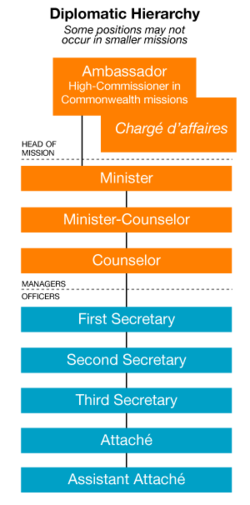 In modern diplomatic practice there are a number of diplomatic ranks below Ambassador. Since most missions are now headed by an Ambassador, these ranks now rarely indicate a mission's (or its host nation's) relative importance, but rather reflect the diplomat's individual seniority within their own nation's diplomatic career path and in the diplomatic corps in the host nation:
[p] and "chargé d'affaires, ad interim" (or simply a.i.) are separate titles used when an Ambassador (or other head of mission
) is not present, has not been appointed, or is otherwise not able to discharge duties in a specific location. Generally, the ad interim (temporary) "chargé" (as they are often known) is another staff member (usually the second-most senior officer) accredited in the host country for the head of mission's temporary absences. In such cases, the diplomatic mission advises the local government (usually the foreign ministry) by means of a diplomatic note that a specific individual has been appointed chargé for a specific or indefinite period of time. In contrast to an Ambassador, the specific agreement of the host government is not required.
s, but the diplomatic title may be used for any specific individual or position as required. Since administrative and technical staff benefit from only limited diplomatic immunity
, some countries may routinely appoint support staff as attachés. Attaché does not, therefore, denote any rank or position (except in Soviet and post-Soviet diplomatic services, where attaché is the lowest diplomatic rank of a career diplomat). Note that many traditional functionary roles, such as press attaché or cultural attaché
, are not formal titles in diplomatic practice, although they may be used as a matter of custom.
s and the United Nations. A few examples are provided below:
,the personnel system under which most U.S. diplomatic personnel are assigned, a system of personal ranks is applied which roughly corresponds to these diplomatic ranks. Personal ranks are differentiated as "Senior Foreign Service
" (SFS) or "Member of the Foreign Service".
The SFS
ranks, in descending order, are:
In U.S. terms, these correspond to four-, three-, two- and one-star general
and flag officer
s in the military, respectively. Officers at these ranks may serve as ambassadors and occupy the most senior positions in diplomatic missions.
Members of the Foreign Service consist of two groups, Foreign Service Officer
s and Foreign Service Specialist
s. Ranks descend from the highest, FS-1, equivalent to a full Colonel
in the military, to FS-9, the lowest rank in the U.S. Foreign Service personnel system. (Most entry-level Foreign Service members begin at the FS-5 or FS-6 level.) Personal rank is distinct from and should not be confused with the diplomatic or consular rank assigned at the time of appointment to a particular diplomatic or consular mission.
In a large mission, several Senior Foreign Service Officers may serve under the Ambassador as Minister-Counselors, Counselors, and First Secretaries; in a small mission, an FS-2 may serve as the lone Counselor of Embassy.
differentiates between officers in the "Senior Management Structure" (SMS; equivalent to the Senior Civil Service grades of the Home Civil Service) and those in the "delegated grades". SMS officers are classified into three pay-bands, and will serve in the Foreign and Commonwealth Office
in London as (in descending order of seniority) Permanent Under-Secretary, Directors-General, Directors, or Heads of Department; overseas they will be Ambassadors (High Commissioners in Commonwealth countries), or Consuls-General, Deputy Heads of Mission or Counsellors for larger posts. (Deputy Heads of Mission at the historically most significant Embassies, for example those in Washington and Paris, are known as Ministers.)
In the "delegated grades", officers are graded by number from 1 to 7; the grades are grouped into bands lettered A–D (grades 1 and 2 are in Band A; 3 in B; 4 and 5 in C; and 6 and 7 in D). Overseas, A2 grade officers hold the title of Attache, B3-grade officers are Third Secretaries; C4s are Second Secretaries; and C5s and D6s are First Secretaries. D7 officers are usually Deputy Heads of Mission in medium-sized posts or Heads of Mission in small posts.
In the British Civil Service grades rank from 7 up to 1, with grade 1 being Permanent Secretary. Grade 7 was formerly known as Principal Officer, grade 6 as Senior Principal Officer. Equally pay band A is the most senior, with B, C and D following. The 1 to 7 grading system in the UK is the reverse to that of the US where higher numbers denote higher seniority.
If Head of Mission and Deputy Head of Mission is senior to First Secretary followed by Second and Third Secretary then these ranks should logically follow the seniority of grades in the Home Civil Service.
(DFAT) are graded into four broadbands (BB1 to BB4), with the Senior Executive Service (SES Band 1 to SES Band 3) following above.
Ambassadors, High Commissioners and Consuls-General usually come from the Senior Executive Service, although in smaller posts the head of mission may be a BB4 officer. Generally speaking (and there are variation in ranking and nomenclature between posts and positions), Counsellors are represented by BB4 officers; Consuls and First and Second Secretaries are BB3 officers and Third Secretaries and Vice Consuls are BB2 officers. DFAT only posts a limited number of low level BB1 staff abroad. In large missions an SES officer who is not the head of mission could be posted with the rank of Minister.
(ranking in descending order: Consul-General, Consul, Vice-Consul, Consular Agent; equivalents with consular immunity limited to offcial acts only include Honorary Consul-General, Honorary Consul, and Honorary Vice-Consul) forms a separate hierarchy. Many countries do not internally have a separate consular path or stream, and the meaning of "consular" responsibilities and functions will differ from country to country. Other titles, including "Vice Consul-General", have existed in the past. Consular titles may be used concurrently with diplomatic titles if the individual is assigned to an embassy. Diplomatic immunity is more limited for consular officials without other diplomatic accreditation, and broadly limited to immunity with respect to their official duties.
At a separate consular post, the official will have only a consular title. Officials at consular posts may therefore have consular titles, but not be involved in traditional consular activities, and actually be responsible for trade, cultural, or other matters.
Consular officers, being nominally more distant from the politically sensitive aspects of diplomacy, can more easily render a wide range of services to private citizens, enterprises, et cetera. They may be more numerous since diplomatic missions are posted only in a nation's capital, while consular officials are stationed in various other cities as well. However, it is not uncommon for individuals to be transferred from one hierarchy to the other, and for consular officials to serve in a capital carrying out strictly consular duties within the 'consular section' of a diplomatic post, e.g. within an embassy. Some countries routinely provide their Embassy officials with consular commissions, including those without formal consular responsibilities, since a consular commission allows the individual to legalize documents, sign certain documents, and undertake certain other necessary functions.
Depending on the practice of the individual country, "consular services" may be limited to services provided for citizens or residents of the sending country, or extended to include, for example, visa services for nationals of the host country.
Sending nations may also designate incumbents of certain positions as holding consulary authority by virtue of their office, while lacking individual accreditation, immunity and inviolability. For example, 10 U.S.C. §§ 936 and 1044a identify various U.S. military officers (and authorize the service secretaries to identify others) who hold general authority as a notary and consul of the United States for, respectively, purposes of military administration and those entitled to military legal assistance. A nation may also declare that its senior merchant sea captain in a given foreign port—or its merchant sea captains generally—has consulary authority for merchant seamen.
Professional
A professional is a person who is paid to undertake a specialised set of tasks and to complete them for a fee. The traditional professions were doctors, lawyers, clergymen, and commissioned military officers. Today, the term is applied to estate agents, surveyors , environmental scientists,...
and social rank used in the world of diplomacy
Diplomacy
Diplomacy is the art and practice of conducting negotiations between representatives of groups or states...
and international relations. Over time it has been formalized on an international basis.
Ranks
Until the early 19th century, each EuropeEurope
Europe is, by convention, one of the world's seven continents. Comprising the westernmost peninsula of Eurasia, Europe is generally 'divided' from Asia to its east by the watershed divides of the Ural and Caucasus Mountains, the Ural River, the Caspian and Black Seas, and the waterways connecting...
an nation had its own system of diplomatic rank. The relative ranks of diplomats from different nations had been a source of considerable dispute, made more so by the insistence of major nations to have their diplomats ranked higher than those of minor nations, to be reflected in such things as table seatings.
In an attempt to resolve the problem, the Congress of Vienna
Congress of Vienna
The Congress of Vienna was a conference of ambassadors of European states chaired by Klemens Wenzel von Metternich, and held in Vienna from September, 1814 to June, 1815. The objective of the Congress was to settle the many issues arising from the French Revolutionary Wars, the Napoleonic Wars,...
of 1815 formally established an international system of diplomatic ranks.
The four ranks within the system are:
- Ambassador Extraordinary and PlenipotentiaryAmbassadorAn ambassador is the highest ranking diplomat who represents a nation and is usually accredited to a foreign sovereign or government, or to an international organization....
. An Ambassador is a diplomatic representative with plenipotentiaryPlenipotentiaryThe word plenipotentiary has two meanings. As a noun, it refers to a person who has "full powers." In particular, the term commonly refers to a diplomat fully authorized to represent his government as a prerogative...
powers (i.e. full authority to represent the head of state). An Ambassador representing the Holy SeeHoly SeeThe Holy See is the episcopal jurisdiction of the Catholic Church in Rome, in which its Bishop is commonly known as the Pope. It is the preeminent episcopal see of the Catholic Church, forming the central government of the Church. As such, diplomatically, and in other spheres the Holy See acts and...
is known as the papal nuncio. As they formally represent the head of state, they are entitled to use the title "His/Her ExcellencyExcellencyExcellency is an honorific style given to certain members of an organization or state.Usually, people styled "Excellency" are heads of state, heads of government, governors, ambassadors, certain ecclesiastics, royalty, aristocracy, and military, and others holding equivalent rank .It is...
".- Among CommonwealthCommonwealth of NationsThe Commonwealth of Nations, normally referred to as the Commonwealth and formerly known as the British Commonwealth, is an intergovernmental organisation of fifty-four independent member states...
countries, the equivalent title that is normally used is High CommissionerHigh CommissionerHigh Commissioner is the title of various high-ranking, special executive positions held by a commission of appointment.The English term is also used to render various equivalent titles in other languages.-Bilateral diplomacy:...
, who represents the government rather than the head of state.
- Among Commonwealth
- Envoy Extraordinary and Minister PlenipotentiaryEnvoy (title)In diplomacy, an Envoy Extraordinary and Minister Plenipotentiary is, under the terms of the Congress of Vienna of 1815, a diplomat of the second class, ranking between an Ambassador and a Minister Resident....
. Usually just referred to as a Minister, an Envoy is a diplomatic representative with plenipotentiaryPlenipotentiaryThe word plenipotentiary has two meanings. As a noun, it refers to a person who has "full powers." In particular, the term commonly refers to a diplomat fully authorized to represent his government as a prerogative...
powers (i.e. full authority to represent the head of state), but ranking below an Ambassador. As they formally represent the head of state, Envoys are also entitled to use the title "His/Her ExcellencyExcellencyExcellency is an honorific style given to certain members of an organization or state.Usually, people styled "Excellency" are heads of state, heads of government, governors, ambassadors, certain ecclesiastics, royalty, aristocracy, and military, and others holding equivalent rank .It is...
". - Minister Resident or Resident Minister (or simply "Minister"). Introduced by the Congress of Aix-la-Chapelle (1818)Congress of Aix-la-Chapelle (1818)The Congress or Conference of Aix-la-Chapelle , held in the autumn of 1818, was primarily a meeting of the four allied powers Britain, Austria, Prussia and Russia to decide the question of the withdrawal of the army of occupation from France and the nature of the modifications to be introduced in...
, this is the lowest rank of full chief of mission, above only chargé d'affairesChargé d'affairesIn diplomacy, chargé d’affaires , often shortened to simply chargé, is the title of two classes of diplomatic agents who head a diplomatic mission, either on a temporary basis or when no more senior diplomat has been accredited.-Chargés d’affaires:Chargés d’affaires , who were...
(who are considered as substitutes or acting chiefs of mission).- Note that both the Envoy (Minister Plenipotentiary) and the Minister Resident are diplomatic ministers, which are not the same thing as government ministersMinister (government)A minister is a politician who holds significant public office in a national or regional government. Senior ministers are members of the cabinet....
or religious ministers. A diplomatic mission headed by either type of Minister would be called a Legation. Both ranks of Ministers have become effectively obsolete after World War II.
- Note that both the Envoy (Minister Plenipotentiary) and the Minister Resident are diplomatic ministers, which are not the same thing as government ministers
- Chargé d'affairesChargé d'affairesIn diplomacy, chargé d’affaires , often shortened to simply chargé, is the title of two classes of diplomatic agents who head a diplomatic mission, either on a temporary basis or when no more senior diplomat has been accredited.-Chargés d’affaires:Chargés d’affaires , who were...
("chargé")[p]. As the title (meaning "charged with affairs" in FrenchFrench languageFrench is a Romance language spoken as a first language in France, the Romandy region in Switzerland, Wallonia and Brussels in Belgium, Monaco, the regions of Quebec and Acadia in Canada, and by various communities elsewhere. Second-language speakers of French are distributed throughout many parts...
) suggests, a chargé d'affaires is in charge of the affairs of a diplomatic mission in the usually temporary absence of a more senior diplomat. A chargé d'affaires ad interim or simply "a.i." is generally serving as chief of mission during the temporary absence of the head of missionHead of MissionIn diplomatic usage, Head of Mission or Chief of Mission from the French "Chef de Mission Diplomatique" is the generic term used to refer to the head of a diplomatic representation, such as an Ambassador, High Commissioner, Nuncio, Chargé d'affaires, Permanent Representative, and sometimes to a...
, while the chargé d'affaires e.p. or en pied maintains the same functions and duties as an ambassador, and is accredited not to the head of state but to the foreign minister of the receiving state.
As it turned out, this system of diplomatic rank created its own set of problems regarding the nations' precedence. The appropriate diplomatic ranks used would be determined by the precedence among the nations; thus the exchanges of ambassadors (the highest diplomatic rank) would be reserved among major nations, or close allies and related monarchies. In contrast, a major nation would probably send just an envoy to a minor nation, who in return would send an envoy to the major nation. As a result, the United States
United States
The United States of America is a federal constitutional republic comprising fifty states and a federal district...
did not use the rank of ambassador until their emergence as a major world power
Great power
A great power is a nation or state that has the ability to exert its influence on a global scale. Great powers characteristically possess military and economic strength and diplomatic and cultural influence which may cause small powers to consider the opinions of great powers before taking actions...
at the end of the 19th century. Indeed, until the mid-20th century, the majority of diplomats in the world were of the rank of envoy.
After World War II
World War II
World War II, or the Second World War , was a global conflict lasting from 1939 to 1945, involving most of the world's nations—including all of the great powers—eventually forming two opposing military alliances: the Allies and the Axis...
, it was no longer considered acceptable to treat some nations as inferior to others given the United Nations
United Nations
The United Nations is an international organization whose stated aims are facilitating cooperation in international law, international security, economic development, social progress, human rights, and achievement of world peace...
doctrine of equality of sovereign states; therefore most legations were upgraded to embassies, and the use of the rank of Minister for diplomatic missions' highest-ranking officials gradually ceased. The last U.S. Legations, in Sofia
Sofia
Sofia is the capital and largest city of Bulgaria and the 12th largest city in the European Union with a population of 1.27 million people. It is located in western Bulgaria, at the foot of Mount Vitosha and approximately at the centre of the Balkan Peninsula.Prehistoric settlements were excavated...
, Bulgaria
Bulgaria
Bulgaria , officially the Republic of Bulgaria , is a parliamentary democracy within a unitary constitutional republic in Southeast Europe. The country borders Romania to the north, Serbia and Macedonia to the west, Greece and Turkey to the south, as well as the Black Sea to the east...
, and in Budapest, Hungary, were upgraded to an Embassy on November 28, 1966. Where those ranks still exist, their incumbents usually act as embassy section chiefs or Deputy Chief of mission.
Bilateral diplomacy
- Ambassador (High Commissioner in CommonwealthCommonwealth of NationsThe Commonwealth of Nations, normally referred to as the Commonwealth and formerly known as the British Commonwealth, is an intergovernmental organisation of fifty-four independent member states...
missions); Ambassador at large - Minister
- Minister-Counselor
- Counselor
- First Secretary
- Second Secretary
- Third Secretary
- Attaché
- Assistant Attaché
Chargé d'affaires
Chargé d'affairesChargé d'affaires
In diplomacy, chargé d’affaires , often shortened to simply chargé, is the title of two classes of diplomatic agents who head a diplomatic mission, either on a temporary basis or when no more senior diplomat has been accredited.-Chargés d’affaires:Chargés d’affaires , who were...
[p] and "chargé d'affaires, ad interim" (or simply a.i.) are separate titles used when an Ambassador (or other head of mission
Head of Mission
In diplomatic usage, Head of Mission or Chief of Mission from the French "Chef de Mission Diplomatique" is the generic term used to refer to the head of a diplomatic representation, such as an Ambassador, High Commissioner, Nuncio, Chargé d'affaires, Permanent Representative, and sometimes to a...
) is not present, has not been appointed, or is otherwise not able to discharge duties in a specific location. Generally, the ad interim (temporary) "chargé" (as they are often known) is another staff member (usually the second-most senior officer) accredited in the host country for the head of mission's temporary absences. In such cases, the diplomatic mission advises the local government (usually the foreign ministry) by means of a diplomatic note that a specific individual has been appointed chargé for a specific or indefinite period of time. In contrast to an Ambassador, the specific agreement of the host government is not required.
Attaché
The term "attaché"[p2] is used for any diplomatic agent who does not fit in the standard diplomatic ranks, often because they are not (or were not traditionally) members of the sending country's diplomatic service or foreign ministry, and were therefore only "attached" to the diplomatic mission. The most frequent use is for military attachéMilitary attaché
A military attaché is a military expert who is attached to a diplomatic mission . This post is normally filled by a high-ranking military officer who retains the commission while serving in an embassy...
s, but the diplomatic title may be used for any specific individual or position as required. Since administrative and technical staff benefit from only limited diplomatic immunity
Diplomatic immunity
Diplomatic immunity is a form of legal immunity and a policy held between governments that ensures that diplomats are given safe passage and are considered not susceptible to lawsuit or prosecution under the host country's laws...
, some countries may routinely appoint support staff as attachés. Attaché does not, therefore, denote any rank or position (except in Soviet and post-Soviet diplomatic services, where attaché is the lowest diplomatic rank of a career diplomat). Note that many traditional functionary roles, such as press attaché or cultural attaché
Cultural attaché
A cultural attaché is a diplomat with special responsibility for promoting the culture of his or her homeland. The position has been used as an official cover for intelligence agents. Historically, the post has often been filled by writers and artists, giving them a steady income, allowing them to...
, are not formal titles in diplomatic practice, although they may be used as a matter of custom.
Multilateral diplomacy
Furthermore, outside this traditional pattern of bilateral diplomacy, as a rule on a permanent residency basis (though sometimes doubling elsewhere), certain ranks and positions were created specifically for multilateral diplomacy:- An Ambassador at Large is equivalent of an Ambassador and assigned specific tasks or region in which he is assigned various assignments aimed at multi track diplomacy.
- A permanent representativePermanent RepresentativeA Permanent Representative is the head of a diplomatic mission to one of various international organisations. The best known of the organisations to which states send Permanent Representatives is the United Nations; of these, the most high-profile ones are those assigned to headquarters in New...
is the equivalent of an ambassador, normally of that rank, but accredited to an international body (mainly by member—and possibly observer states), not to a head of state. - A resident representativeResident (title)A Resident, or in full Resident Minister, is a government official required to take up permanent residence in another country. A representative of his government, he officially has diplomatic functions which are often seen as a form of indirect rule....
(or sometimes simply representative) is also a member of the diplomatic corps, but is below the rank of ambassador. A representative is accredited by an international organization (generally a United Nations agency, or a Bretton WoodsBretton Woods systemThe Bretton Woods system of monetary management established the rules for commercial and financial relations among the world's major industrial states in the mid 20th century...
institution) to a country's government. The resident representative typically heads the country office of that international organization within that country. - A special ambassador is a government's specialist diplomat in a particular field, not posted in residence, but often traveling around the globe.
- The U.S. Trade RepresentativeOffice of the United States Trade RepresentativeThe Office of the United States Trade Representative is the United States government agency responsible for developing and recommending United States trade policy to the president of the United States, conducting trade negotiations at bilateral and multilateral levels, and coordinating trade...
(USTR) is an ambassador of cabinet rank, in charge of U.S. delegations in multilateral trade negotiations (since 1962). The USTR's Special Agricultural Negotiator also typically holds an ambassadorial appointment.
Special envoys
Special Envoys have been created ad hoc by individual countries, regional powerRegional power
In international relations, a regional power is a state that has power within a geographic region. States which wield unrivaled power and influence within a region of the world possess regional hegemony.-Characteristics:...
s and the United Nations. A few examples are provided below:
- Belgium: In 2005, former cabinet member, Pierre Chevalier served as Special Envoy of the OSCE presidency to mediate in the GazpromGazpromOpen Joint Stock Company Gazprom is the largest extractor of natural gas in the world and the largest Russian company. Its headquarters are in Cheryomushki District, South-Western Administrative Okrug, Moscow...
natural gas-pipeline crisis involving Russia, Ukraine and the EU. - IndiaIndiaIndia , officially the Republic of India , is a country in South Asia. It is the seventh-largest country by geographical area, the second-most populous country with over 1.2 billion people, and the most populous democracy in the world...
: During the 2006 democracy movement in Nepal2006 democracy movement in NepalThe 2006 Democracy Movement is a name given to the political agitations against the direct and undemocratic rule of King Gyanendra of Nepal. The movement is also sometimes referred to as Jana Andolan-II , implying it being a continuation of the 1990 Jana Andolan.-Reinstitution of Parliament:In a...
, IndiaIndiaIndia , officially the Republic of India , is a country in South Asia. It is the seventh-largest country by geographical area, the second-most populous country with over 1.2 billion people, and the most populous democracy in the world...
sent on April 18 Karan SinghKaran SinghKaran Singh is an MP in the Rajya Sabha, a senior member of the ruling Indian National Congress Party serving as Chairman of the Foreign Affairs Department, President of the Indian Council for Cultural Relations , India's Ambassador to UNESCO, Chairman of the Auroville Foundation and of the Temple...
, who is related to royalty in both predominantly Hindu countries, as Special Envoy to neighbouring NepalNepalNepal , officially the Federal Democratic Republic of Nepal, is a landlocked sovereign state located in South Asia. It is located in the Himalayas and bordered to the north by the People's Republic of China, and to the south, east, and west by the Republic of India...
where increasingly violent opposition started its successful challenge of the king's autocratic rule - The UK has appointed special envoys from time to time.
- The EU has appointed various Special Representatives (some regional, some thematic); e.g. in 2005—as a response to events in KyrgyzstanKyrgyzstanKyrgyzstan , officially the Kyrgyz Republic is one of the world's six independent Turkic states . Located in Central Asia, landlocked and mountainous, Kyrgyzstan is bordered by Kazakhstan to the north, Uzbekistan to the west, Tajikistan to the southwest and China to the east...
and UzbekistanUzbekistanUzbekistan , officially the Republic of Uzbekistan is a doubly landlocked country in Central Asia and one of the six independent Turkic states. It shares borders with Kazakhstan to the west and to the north, Kyrgyzstan and Tajikistan to the east, and Afghanistan and Turkmenistan to the south....
—the Council of the EU appointed Jan KubisJan KubisJan Kubis may refer to:* Jan Kubiš , Czech soldier* Ján Kubiš , Slovak diplomat...
as its "Special Representative for Central Asia".
- The United States has appointed numerous special envoys including a Special Envoy for Northern IrelandUnited States Special Envoy for Northern IrelandThe United States Special Envoy for Northern Ireland or more formally, the Special Envoy of the President and the Secretary of State for Northern Ireland is the top U.S. diplomat supporting the Northern Ireland peace process.-Origins:Traditionally U.S...
with the diplomatic rank of Ambassador to help with the Northern Ireland peace processNorthern Ireland peace processThe peace process, when discussing the history of Northern Ireland, is often considered to cover the events leading up to the 1994 Provisional Irish Republican Army ceasefire, the end of most of the violence of the Troubles, the Belfast Agreement, and subsequent political developments.-Towards a...
. As of 2008, the position was occupied by Paula DobrianskyPaula DobrianskyPaula Jon Dobriansky is an American foreign policy expert who has served in key roles as a diplomat and policy maker in the administrations of five U.S. presidents, both Democrat and Republican. She is a specialist in the areas of Eastern Europe and the former Soviet Union as well as...
. Special Envoys have been appointed for SudanSudanSudan , officially the Republic of the Sudan , is a country in North Africa, sometimes considered part of the Middle East politically. It is bordered by Egypt to the north, the Red Sea to the northeast, Eritrea and Ethiopia to the east, South Sudan to the south, the Central African Republic to the...
, Middle East Peace, Eurasian Energy, Climate Change, and Human Rights in North Korea. Other posts include Special Representative, Special Advisor, and Special Coordinator.
- The Secretary-General of the United Nations personally mandates Special Envoys for a particular field. Examples include:
- United Nations Special Envoy for HIV/AIDS in AfricaUnited Nations Special Envoy for HIV/AIDS in AfricaThe United Nations Special Envoy for HIV/AIDS in Africa is a diplomatic position that deals with the deadly disease on the continent where the issue is most pressing.-External links:* , United Nations, 21 May 2007...
(who deals with HIV/AIDS in AfricaHIV/AIDS in AfricaHIV/AIDS is a major public health concern and cause of death in Africa. Although Africa is home to about 14.5% of the world's population, it is estimated to be home to 67% of all people living with HIV and to 72% of all AIDS deaths in 2009.-Overview:...
) - United Nations Special Envoy on Climate Change (who deals with climate changeClimate changeClimate change is a significant and lasting change in the statistical distribution of weather patterns over periods ranging from decades to millions of years. It may be a change in average weather conditions or the distribution of events around that average...
) - United Nations Special Envoy for Kosovo (Special Envoy for the Future Status Process for Kosovo)
- United Nations Special Envoy for Darfur
- United Nations Special Envoy for HIV/AIDS in Africa
- The Director-General of UNESCO appoints special envoys who can use their talents and renown to further the Organization’s ideals and action. Envoys include:
- Special Envoy for Basic and Higher Education: HH Sheikha Mozah Bint Nasser Al Missned
- Special Envoy for Haiti: The Right Honourable Michaëlle JeanMichaëlle JeanMichaëlle Jean is a Canadian journalist and stateswoman who served as Governor General of Canada, the 27th since Canadian Confederation, from 2005 to 2010....
, former Governor General of CanadaGovernor General of CanadaThe Governor General of Canada is the federal viceregal representative of the Canadian monarch, Queen Elizabeth II... - Special Envoy for Water: HRH Prince Talal Bin Abdul AzizTalal ibn Abd al-AzizPrince Talal bin Abdul-Aziz , also called The Red Prince, is a senior member of the Saudi royal family, and has led the Arab Gulf Program For the United Nations Development since 1986. He is a former ambassador to France. He served as Minister of Communications till 1955 before the Ministry was...
- Special Envoy on Literacy for Development: HRH Princess Laurentien of the NetherlandsPrincess Laurentien of the NetherlandsPrincess Laurentien of the Netherlands is the wife of Prince Constantijn of the Netherlands, the third son of Queen Beatrix and Prince Claus of the Netherlands, Jonkheer van Amsberg.-Early life:Petra Laurentien Brinkhorst was born in Leiden on 25 May 1966, the daughter of the former Dutch minister...
- A case sui generisSui generisSui generis is a Latin expression, literally meaning of its own kind/genus or unique in its characteristics. The expression is often used in analytic philosophy to indicate an idea, an entity, or a reality which cannot be included in a wider concept....
is the High Representative for Bosnia and HerzegovinaHigh Representative for Bosnia and HerzegovinaThe High Representative for Bosnia and Herzegovina, with the Office of the High Representative in Bosnia and Herzegovina, was created in 1995 immediately after the Dayton Peace Agreement to oversee the civilian implementation of this agreement. The High Representative and the OHR represent the...
.
Usage worldwide
Most countries worldwide have some form of internal rank, roughly parallel to the diplomatic ranks, which are used in their foreign service or civil service in general. The correspondence is not exact, however, for various reasons, including the fact that according to diplomatic usage, all Ambassadors are of equal rank, but clearly Ambassadors of more senior rank are sent to more important postings. Some countries may make specific links or comparisons to military ranks.In the United States Foreign Service
In the United States Foreign ServiceUnited States Foreign Service
The United States Foreign Service is a component of the United States federal government under the aegis of the United States Department of State. It consists of approximately 11,500 professionals carrying out the foreign policy of the United States and aiding U.S...
,the personnel system under which most U.S. diplomatic personnel are assigned, a system of personal ranks is applied which roughly corresponds to these diplomatic ranks. Personal ranks are differentiated as "Senior Foreign Service
Senior Foreign Service
The Senior Foreign Service comprises the top four ranks of the United States Foreign Service. These ranks were created by the Foreign Service Act of 1980 and Executive Order 12293 in order to provide the Foreign Service with senior grades equivalent to general- and flag ranks in the military and...
" (SFS) or "Member of the Foreign Service".
The SFS
Senior Foreign Service
The Senior Foreign Service comprises the top four ranks of the United States Foreign Service. These ranks were created by the Foreign Service Act of 1980 and Executive Order 12293 in order to provide the Foreign Service with senior grades equivalent to general- and flag ranks in the military and...
ranks, in descending order, are:
- Career Ambassador, awarded to career diplomats with extensive and distinguished service;
- Career Minister, the highest regular senior rank;
- Minister-Counselor; and
- Counselor.
In U.S. terms, these correspond to four-, three-, two- and one-star general
General
A general officer is an officer of high military rank, usually in the army, and in some nations, the air force. The term is widely used by many nations of the world, and when a country uses a different term, there is an equivalent title given....
and flag officer
Flag Officer
A flag officer is a commissioned officer in a nation's armed forces senior enough to be entitled to fly a flag to mark where the officer exercises command. The term usually refers to the senior officers in an English-speaking nation's navy, specifically those who hold any of the admiral ranks; in...
s in the military, respectively. Officers at these ranks may serve as ambassadors and occupy the most senior positions in diplomatic missions.
Members of the Foreign Service consist of two groups, Foreign Service Officer
Foreign Service Officer
A Foreign Service Officer is a commissioned member of the United States Foreign Service. As diplomats, Foreign Service Officers formulate and implement the foreign policy of the United States. FSOs spend most of their careers overseas as members of U.S. embassies, consulates, and other diplomatic...
s and Foreign Service Specialist
Foreign Service Specialist
Foreign Service Specialists are employees of the United States Department of State and other foreign affairs agencies. They are members of the Foreign Service system who provide technical, administrative, or security support and services at embassies and consulates worldwide, in Washington, D.C...
s. Ranks descend from the highest, FS-1, equivalent to a full Colonel
Colonel
Colonel , abbreviated Col or COL, is a military rank of a senior commissioned officer. It or a corresponding rank exists in most armies and in many air forces; the naval equivalent rank is generally "Captain". It is also used in some police forces and other paramilitary rank structures...
in the military, to FS-9, the lowest rank in the U.S. Foreign Service personnel system. (Most entry-level Foreign Service members begin at the FS-5 or FS-6 level.) Personal rank is distinct from and should not be confused with the diplomatic or consular rank assigned at the time of appointment to a particular diplomatic or consular mission.
In a large mission, several Senior Foreign Service Officers may serve under the Ambassador as Minister-Counselors, Counselors, and First Secretaries; in a small mission, an FS-2 may serve as the lone Counselor of Embassy.
British Diplomatic Service
As in the U.S. Foreign Service, Her Majesty's Diplomatic ServiceHer Majesty's Diplomatic Service
Her Majesty's Diplomatic Service is the diplomatic service of the United Kingdom, dealing with foreign affairs, as opposed to the Home Civil Service, which deals with domestic affairs...
differentiates between officers in the "Senior Management Structure" (SMS; equivalent to the Senior Civil Service grades of the Home Civil Service) and those in the "delegated grades". SMS officers are classified into three pay-bands, and will serve in the Foreign and Commonwealth Office
Foreign and Commonwealth Office
The Foreign and Commonwealth Office, commonly called the Foreign Office or the FCO is a British government department responsible for promoting the interests of the United Kingdom overseas, created in 1968 by merging the Foreign Office and the Commonwealth Office.The head of the FCO is the...
in London as (in descending order of seniority) Permanent Under-Secretary, Directors-General, Directors, or Heads of Department; overseas they will be Ambassadors (High Commissioners in Commonwealth countries), or Consuls-General, Deputy Heads of Mission or Counsellors for larger posts. (Deputy Heads of Mission at the historically most significant Embassies, for example those in Washington and Paris, are known as Ministers.)
In the "delegated grades", officers are graded by number from 1 to 7; the grades are grouped into bands lettered A–D (grades 1 and 2 are in Band A; 3 in B; 4 and 5 in C; and 6 and 7 in D). Overseas, A2 grade officers hold the title of Attache, B3-grade officers are Third Secretaries; C4s are Second Secretaries; and C5s and D6s are First Secretaries. D7 officers are usually Deputy Heads of Mission in medium-sized posts or Heads of Mission in small posts.
In the British Civil Service grades rank from 7 up to 1, with grade 1 being Permanent Secretary. Grade 7 was formerly known as Principal Officer, grade 6 as Senior Principal Officer. Equally pay band A is the most senior, with B, C and D following. The 1 to 7 grading system in the UK is the reverse to that of the US where higher numbers denote higher seniority.
If Head of Mission and Deputy Head of Mission is senior to First Secretary followed by Second and Third Secretary then these ranks should logically follow the seniority of grades in the Home Civil Service.
In the Australian Department of Foreign Affairs and Trade
Officers from the Department of Foreign Affairs and TradeDepartment of Foreign Affairs and Trade (Australia)
The Department of Foreign Affairs and Trade is a department of the government of Australia charged with advancing the interests of Australia and its citizens internationally...
(DFAT) are graded into four broadbands (BB1 to BB4), with the Senior Executive Service (SES Band 1 to SES Band 3) following above.
Ambassadors, High Commissioners and Consuls-General usually come from the Senior Executive Service, although in smaller posts the head of mission may be a BB4 officer. Generally speaking (and there are variation in ranking and nomenclature between posts and positions), Counsellors are represented by BB4 officers; Consuls and First and Second Secretaries are BB3 officers and Third Secretaries and Vice Consuls are BB2 officers. DFAT only posts a limited number of low level BB1 staff abroad. In large missions an SES officer who is not the head of mission could be posted with the rank of Minister.
Consular counterpart
Formally the consular careerConsul (representative)
The political title Consul is used for the official representatives of the government of one state in the territory of another, normally acting to assist and protect the citizens of the consul's own country, and to facilitate trade and friendship between the peoples of the two countries...
(ranking in descending order: Consul-General, Consul, Vice-Consul, Consular Agent; equivalents with consular immunity limited to offcial acts only include Honorary Consul-General, Honorary Consul, and Honorary Vice-Consul) forms a separate hierarchy. Many countries do not internally have a separate consular path or stream, and the meaning of "consular" responsibilities and functions will differ from country to country. Other titles, including "Vice Consul-General", have existed in the past. Consular titles may be used concurrently with diplomatic titles if the individual is assigned to an embassy. Diplomatic immunity is more limited for consular officials without other diplomatic accreditation, and broadly limited to immunity with respect to their official duties.
At a separate consular post, the official will have only a consular title. Officials at consular posts may therefore have consular titles, but not be involved in traditional consular activities, and actually be responsible for trade, cultural, or other matters.
Consular officers, being nominally more distant from the politically sensitive aspects of diplomacy, can more easily render a wide range of services to private citizens, enterprises, et cetera. They may be more numerous since diplomatic missions are posted only in a nation's capital, while consular officials are stationed in various other cities as well. However, it is not uncommon for individuals to be transferred from one hierarchy to the other, and for consular officials to serve in a capital carrying out strictly consular duties within the 'consular section' of a diplomatic post, e.g. within an embassy. Some countries routinely provide their Embassy officials with consular commissions, including those without formal consular responsibilities, since a consular commission allows the individual to legalize documents, sign certain documents, and undertake certain other necessary functions.
Depending on the practice of the individual country, "consular services" may be limited to services provided for citizens or residents of the sending country, or extended to include, for example, visa services for nationals of the host country.
Sending nations may also designate incumbents of certain positions as holding consulary authority by virtue of their office, while lacking individual accreditation, immunity and inviolability. For example, 10 U.S.C. §§ 936 and 1044a identify various U.S. military officers (and authorize the service secretaries to identify others) who hold general authority as a notary and consul of the United States for, respectively, purposes of military administration and those entitled to military legal assistance. A nation may also declare that its senior merchant sea captain in a given foreign port—or its merchant sea captains generally—has consulary authority for merchant seamen.
See also
- Apocrisiary
- ConsulConsul (representative)The political title Consul is used for the official representatives of the government of one state in the territory of another, normally acting to assist and protect the citizens of the consul's own country, and to facilitate trade and friendship between the peoples of the two countries...
- DiplomacyDiplomacyDiplomacy is the art and practice of conducting negotiations between representatives of groups or states...
- Internuncio, NuncioNuncioNuncio is an ecclesiastical diplomatic title, derived from the ancient Latin word, Nuntius, meaning "envoy." This article addresses this title as well as derived similar titles, all within the structure of the Roman Catholic Church...
- LegatePapal legateA papal legate – from the Latin, authentic Roman title Legatus – is a personal representative of the pope to foreign nations, or to some part of the Catholic Church. He is empowered on matters of Catholic Faith and for the settlement of ecclesiastical matters....