

Chardonnay

Encyclopedia
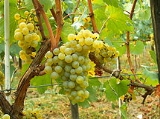
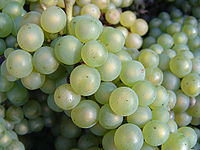
Chardonnay is a green-skinned grape
variety
used to make white wine
. It is originated from the Burgundy wine
region of eastern France
but is now grown wherever wine is produced, from England to New Zealand
. For new and developing wine regions, growing Chardonnay is seen as a "rite of passage
" and an easy segue into the international wine market.
The Chardonnay grape itself is very neutral, with many of the flavors commonly associated with the grape being derived from such influences as terroir
and oak. It is vinified in many different styles, from the lean, crisply mineral wines of Chablis, France to New World wine
s with tropical fruit flavors and lots of oak.
Chardonnay is an important component of many sparkling wine
s around the world, including Champagne. A peak in popularity in the late 1980s gave way to a backlash among those wine drinkers who saw the grape as a leading negative component of the globalization of wine
. Nonetheless, it remains one of the most widely-planted grape varieties, with over 160000 hectares (395,368.3 acre) worldwide, second only to Airén
among white wine grapes and planted in more wine regions than any other grape – including Cabernet Sauvignon
.
 For much of its history, a connection was assumed between Chardonnay and Pinot noir
or Pinot blanc
. In addition to being found in the same region of France for centuries, ampelographers noted that the leaves of each plant have near-identical shape and structure. Pierre Galet
disagreed with this assessment, believing that Chardonnay was not related to any other major grape variety. Viticulturalists
Maynard Amerine
& Harold Olmo
proposed a descendency from a wild Vitis vinifera
vine that was a step removed from white Muscat. Chardonnay's true origins were further obscured by vineyard owners in Lebanon
and Syria
, who claimed that the grape's ancestry could be traced to the Middle East, from where it was introduced to Europe by returning Crusaders
, though there is little external evidence to support that theory. Another theory stated that it originated from an ancient indigenous
vine found in Cyprus
.
Modern DNA fingerprinting research at University of California, Davis
, now suggests that Chardonnay is the result of a cross between the Pinot
and Gouais Blanc
(Heunisch) grape varieties. It is believed that the Romans
brought Gouais Blanc from the Balkans
, and it was widely cultivated by peasants in Eastern France
. The Pinot of the French aristocracy
grew in close proximity to the Gouais Blanc, giving both grapes ample opportunity to interbreed. Since the two parents were genetically distant, many of the crosses showed hybrid vigour and were selected for further propagation. These "successful" crosses included Chardonnay and siblings such as Aligoté
, Aubin Vert
, Auxerrois
, Bachet noir
, Beaunoir
, Franc Noir de la-Haute-Saône, Gamay Blanc Gloriod
, Gamay noir, Melon, Knipperlé
, Peurion
, Roublot
, Sacy
and Dameron
.
in Dijon
. The so-called "Dijon clones" are bred for their adaptive attributes, with vineyard owners planting the clonal variety best suited to their terroir
and which will produce the type of characteristics that they are seeking in the wine. Examples include the lower-yielding
clones Dijon-76, 95 & 96 that produce more flavor-concentrated clusters. Dijon-77 & 809 produce more aromatic wines with a "grapey" perfume, while Dijon-75, 78, 121, 124, 125 & 277 are more vigorous and higher yielding clones. New World varieties include the Mendoza clone, which produced some of the early Californian Chardonnays. The Mendoza clone is prone to developed millerandage
, also known as "hens and chicks", where the berries develop unevenly. In places such as Oregon
, the use of newer Dijon clones has had some success in those regions of the Willamette Valley
with climates similar to that of Burgundy.
Chardonnay has served as parent to several French-American hybrid grapes, as well as crossings with other Vitis vinifera varieties. Examples include the hybrid Chardonel
which was a Chardonnay and Seyval blanc
cross produced in 1953 at the New York State Agricultural Experiment Station
. Mutation
s of the Chardonnay grape include the rare pink-berried "Chardonnay Rose"; also "Chardonnay Blanc Musqué", which produces an intensely aromatic wine. Chardonnay Blanc Musqué is mostly found around the Mâconnais
village of Clessé
and sometimes confused with the Dijon-166 clone planted in South Africa
, which yields Muscat-like aromas.
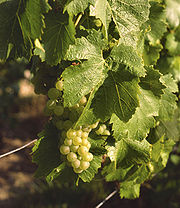 Chardonnay has a wide-ranging reputation for relative ease of cultivation and ability to adapt to different conditions. The grape is very "malleable", in that it reflects and takes on the impression of its terroir and winemaker
. It is a highly vigorous vine, with extensive leaf cover which can inhibit the energy and nutrient uptake of its grape clusters. Vineyard managers counteract this with aggressive pruning and canopy management. When Chardonnay vines are planted densely, they are forced to compete for resources and funnel energy into their grape clusters. In certain conditions the vines can be very high-yielding, but the wine produced from such vines will suffer a drop in quality if yields go much beyond 4.5 ton
s per acre (80 hl/ha). Producers of premium Chardonnay limit yields to less than half this amount. Sparkling wine producers tend not to focus as much on limiting yields, since concentrated flavors are not as important as the wine's finesse.
Harvest
ing time is crucial to winemaking, with the grape rapidly losing acidity as soon as it ripens. Some viticultural hazards include the risk of damage from springtime frost
, as Chardonnay is an early-budding vine – usually a week after Pinot noir
. To combat the threat of frost, a method developed in Burgundy involves aggressive pruning just prior to flowering. This "shocks" the vine and delays flowering for up to two weeks, which is often long enough for warmer weather to arrive. Millerandage
and coulure
can also pose problems, along with powdery mildew
attacking the thin skin of the grapes. Because of Chardonnay's early ripening, it can thrive in wine regions with a short growing season and, in regions like Burgundy, will be harvested before autumn rain sets in and brings the threat of rot.
While Chardonnay can adapt to almost all vineyard soils, the three it seems to like most are chalk
, clay
and limestone
, all very prevalent throughout Chardonnay's traditional "homeland". The Grand crus of Chablis are planted on hillsides composed of Kimmeridgian
marl
, limestone and chalk. The outlying regions, falling under the more basic "Petit Chablis" appellation
, are planted on portlandian limestone
which produces wines with less finesse. Chalk beds are found throughout the Champagne region, and the Côte-d'Or
has many areas composed of limestone and clay. In Burgundy, the amount of limestone to which the Chardonnay are vines exposed also seems to have some effect on the resulting wine. In the Meursault
region, the premier cru vineyards planted at Meursault-Charmes have topsoil
almost 78 inches (2 m) above limestone and the resulting wines are very rich and rounded. In the nearby Les Perrieres vineyard, the topsoil is only around 12 inches (30 centimeters) above the limestone and the wine from that region is much more powerful, mineral
ly and tight, needing longer in the bottle to develop fully. In other areas, soil type
can compensate for lack of ideal climate conditions. In South Africa
for example, regions with stonier, shale
y soils and high clay levels tend to produce lower-yielding and more Burgundian-style wine, despite having a discernibly warmer climate than France. In contrast, South African Chardonnay produced from more sandstone-based vineyards tend to be richer and more weighty.
 Due to some ampelographical similarities, Pinot Blanc
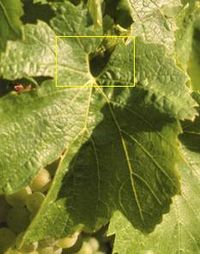
and Chardonnay were often mistaken for each other and even today share many of the same synonyms. The grape vines, leaves and clusters look identical at first glance but there are some subtle differences. The most visible of these can be observed as the grapes are ripening, with Chardonnay grapes taking on a more golden-green color than Pinot Blanc grapes. On closer inspection, the grapevine will show slight differences in the texture and length of the hairs on the vine's shoot
, and the veins of a Chardonnay leaf are "naked" near the petiolar sinus – the open area where the leaf connects to the stem is delineated by veins at the edge. Cabernet Sauvignon is one of the few other Vitis vinifera grape vines to share this characteristic. This confusion between Pinot blanc and Chardonnay was very pervasive throughout northern Italy, where the two vines grew interspersed in the vineyard and were blended in winemaking. Not until 1978 did the Italian government dispatch researchers to try to distinguish the two vines. A similar situation occurred in France, with the two vines being commonly confused until the mid 19th century, when ampelographers began combing through the vineyards of Chablis and Burgundy, identifying the true Chardonnay and weeding out the Pinot Blanc.
and Sauvignon blanc
. The grape first rose to prominence in the Chablis
and Burgundy regions. In Champagne, it is most often blended with Pinot noir
and Pinot meunier
but is also used to produce single varietal
blanc de blancs styles of sparkling wine
. Chardonnay can be found in Appellation d'origine contrôlée
(AOC) wines of the Loire Valley and Jura wine
region as well as the Vin de pays
wines of the Languedoc
.
 Chardonnay is one of the dominant grapes in Burgundy though Pinot noir vines outnumber it by nearly a 3 to 1 ratio. In addition to Chablis, it is found in the Côte d'Or
(largely in the Côte de Beaune
) as well as the Côte Chalonnaise
and Mâconnais
. It is grown in 8 Grand cru vineyards; The "Montrachets"-Montrachet
, Criots-Bâtard-Montrachet
, Bâtard-Montrachet
, Chevalier-Montrachet
, Bienvenues-Bâtard-Montrachet
as well as Charlemagne
, Corton-Charlemagne
& Le Musigny
. In addition to being the most expensive, the Burgundy examples of Chardonnay were long considered the benchmark standard of expressing terroir
through Chardonnay. The Montrachets are noted for their high alcohol
levels, often above 13%, as well as deep concentration of flavors. The vineyards around Chassagne-Montrachet
tend to have a characteristic hazelnut
aroma to them while those of Puligny-Montrachet
have more steely flavors. Both grand cru and premier cru examples from Corton-Charlemagne have been known to demonstrate marzipan
while Meursault wines tend to be the most round and buttery examples.
South of the Côte d'Or is the Côte Chalonnaise and Mâconnais wine regions. The villages of Mercurey
, Montagny-lès-Buxy
and Rully
are the largest producers of Chardonnay in the Côte Chalonnaise with the best made examples rivaling those of the Côte de Beaune. In the Mâconnais, white wine production is centered around the town of Mâcon
and the Pouilly-Fuissé
region. The full bodied wines of the Pouilly-Fuissé have long held cult wine status with prices that can rival the Grand cru white burgundies. Further south, in the region of Beaujolais
, Chardonnay has started to replace Aligote
as the main white wine grape and is even replacing Gamay
in some areas around Saint-Véran. With the exception of Pouilly-Fuissé, the wines of the Mâconnais are the closest Burgundy example to "New World" Chardonnay though it is not identical. Typically Mâcon blanc, basic Bourgogne, Beaujolais blanc and Saint-Véran are meant to be consumed within 2 to 3 years of release. However, many of the well made examples of white Burgundy from the Côte d'Or will need at least three years in the bottle to develop enough to express the aromas and character of the wine. Hazelnut, licorice and spice
are some of the flavors that can develop as these wines age.
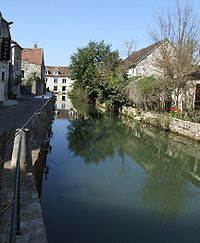 Chardonnay is the only permitted AOC grape variety in the Chablis region with the wines here developing such worldwide recognition that the name "chablis" has taken on semi-generic
connotations to mean any dry white wine, even those not made from Chardonnay. The name is protected in the European Union
and for wine sold in the EU, "Chablis" refers only to the Chardonnay wine produced in this region of the Yonne
. The region sits on the outer edges of the Paris Basin
. On the other side of the basin is the village of Kimmeridge
in England which gives it name to the Kimmeridgean soil that is located throughout Chablis. The French describe this soil as "argilo-calcaire" and is a composition of clay
, limestone and fossilized oyster shells. The most expensive examples of Chardonnay from Chablis comes from the seven Grand Cru vineyards that account for around 247 acres (100 ha) on the southwest side of one slope along the Serein
river near the town of Chablis—Blanchots, Bougros, Les Clos, Grenouilles, Preuses, Valmur and Vaudésir. The wines from these crus most often capture the goût de pierre à fusil or "gunflint" quality that is characterized of Chablis wine.
Chardonnay was believed to be first planted in Chablis by the Cistercians at Pontigny Abbey
in the 12th century. Today, the Chardonnay made in the Chablis region is one of the "purest" expression of the varietal character of the grape due to the simplistic style of winemaking favored in this region. Chablis winemakers want to emphasis the terroir of the calcareous
soil and cooler climate that help maintain high acidity. The wines rarely will go through malolactic fermentation
or be exposed to oak (though its use is increasing). The biting, green apple-like acidity is a trademark of Chablis and can be noticeable in the bouquet. The acidity can mellow with age and Chablis are some of the longest living examples of Chardonnay. Some examples of Chablis can have an earthy "wet stone" flavor that can get mustier as it ages before mellowing into delicate honey
ed notes. The use of oak is controversial in the Chablis community with some winemakers dismissing it as counter to the "Chablis style" or terroir while other embrace its use though not to the length that would characterized a "New World" Chardonnay. The winemakers that do use oak tend to favor more neutral oak that doesn't impart the vanilla
characteristic associated with American oak. The amount of "char" in the barrel is often very light which limits the amount of "toastiness" that is perceived in the wine. The advocates of oak in Chablis point to the positive benefits of allowing limited oxygenation
with the wine through the permeable oak barrels. This can have the effect of softening the wine and make the generally austere and acidic Chablis more approachable at a younger age.
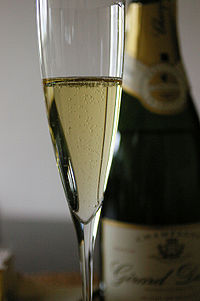 In the Champagne, Chardonnay is one of three major grape varieties planted in the region. It is most commonly found in the Aube
and Marne
départments which, combined with Chablis, accounted for more than half of all plantings of Chardonnay in France during the 20th century. In the Côte des Blancs (white slope) district of the Marne, Chardonnay thrives on the chalk
soil. The three main villages around the Côte grow Chardonnay that emphasizes certain characteristics that the Champagne producers seek depending on their house style. The village of Avize
grows grapes that produce the lightest wines, Cramant
makes the most aromatic and Mesnil produces wines with the most acidity. The Côte des Blancs is the only district in the Champagne region that is predominately planted with Chardonnay. In the four other main districts-Aube, Côte de Sézanne, Montagne de Reims, and Vallée de la Marne-Chardonnay lags behind Pinot noir in planting. In the outlying region of Aisne
, only Pinot Meunier has a significant presence. Despite being less planted, the Blanc de Blancs style of Champagne (made from only Chardonnay grapes) is far more commonly produced than Blanc de Noirs. This is partly because Pinot noir and Pinot Meunier produce very coarse and heavy wines that lack the finesse and balance that Chardonnay brings to the mix. Non-sparkling
still wine Chardonnay is produced under the Coteaux Champenois AOC
. The wine is much more acidic than that of Chablis and is normally made bone-dry.
Despite receiving the same amount of sunshine as the Chablis region, Chardonnay grapes in Champagne rarely attain full ripeness. This is due to the mean
average temperature of the region being around 51 °F (10.6 °C), barely above the minimum average temperature needed to ripen grapes. Therefore the Chardonnay grapes do not fully develop its fruit flavors and the still version of Champagne can taste very "un-Chardonnay"-like because of this. However, it does lessen the premium on needing to keep yields low that other wine regions much battle with since not much flavor is going to develop in the grapes anyway. Rather the element in Chardonnay that Champagne wine-makers look for is the finesse and balance of acidity that it brings to the blend. Some flavors that can emerge from, particularly with extended time on its lees
, include creamy and nuttiness with some floral notes.
where it was first planted around the town of Limoux
and up to 30% can be blended with Mauzac
in the sparkling Blanquette de Limoux
. By the year 2000, there was more than 9000 hectares (22,239.5 acre) planted with many being used for wines under the Vin de Pays d'Oc. These wines were unique in that they were some of the first examples of Chardonnay to be varietally labeled
as "Chardonnay". Other French wine regions with Chardonnay plantings include Alsace, Ardèche
, Jura
, Savoie
and the Loire Valley
. In Jura, Chardonnay is sometimes treated to the same type of flor
yeast
found in Sherry
(though the wine is rarely, if ever, fortified
) and it is used to create vin de paille dessert wine
s. Here the grape is known as Melon d'Arbois or Gamay blanc and is sometimes blended with Savagnin
. It is most widely found in Arbois
, Côtes du Jura and L'Étoile AOCs. In the Loire, up to 20% of Chardonnay can be included in the Chenin blanc
based wines of Anjou blanc and more producers are using the grape to soften some of the edges of Chenin blanc. It can also be used in the sparkling wines of Saumur
and some Muscadet
producers have begun experimenting with oak aged Chardonnay.
, Chardonnay found another region where it could thrive and produce a style of wine that was noticeably different than that of France. It is the dominant white wine variety of the area, overtaking Riesling
in 1990. In the United States
it is found most notably in California, Oregon
, Texas
, Virginia
and Washington
but also in Alabama
, Arizona
, Arkansas
, Colorado
, Connecticut
, Georgia, Idaho
, Illinois
, Indiana
, Iowa
, Maryland
, Massachusetts
, Michigan
, Minnesota
, Missouri
, New Hampshire
, New Jersey
, New Mexico
, New York
, North Carolina
, Ohio
, Oklahoma
, South Carolina
, Tennessee
and Vermont wine
. In Canada
, Chardonnay is found in British Columbia
, Nova Scotia
, Ontario
and Quebec
.
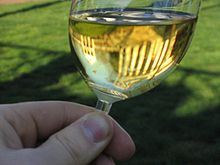 The first successful commercial production of California Chardonnay was from plantings in the Livermore Valley AVA. Wente Vineyards
developed a Chardonnay clone that was used to introduce the grape variety in several Californian vineyards throughout the 1940s. In the 1950s James David Zellerbach
, one time US Ambassador to Rome, started Hanzell Vineyards
winery and dedicated it to making Burgundian style Chardonnay. His success would encourage other Californian winemakers to follow suit and culminated in Chateau Montelena
's victory over Burgundy Chardonnay in the 1976 blind tasting event conducted by French judges known as the Judgment of Paris. In response, the demand for Californian Chardonnay increased and Californian winemakers rushed to increase plantings. In the 1980s, the popularity of Californian Chardonnay would explode so much that the number of vines planted in the state eclipsed that of France by 1988. By 2005 there was nearly 100000 acres (40,468.6 ha) accounting for almost 25% of the world's total Chardonnay plantings. The early trend was to imitate the great Burgundy wines but soon gave way to more rich buttery and oaked styles. Starting with the 1970s, the focus was on harvesting the grapes at more advance degrees of ripeness and at higher Brix
levels. New oak barrels were used to produce wines that were big in body and mouthfeel
. Frank J. Prial
of The New York Times
was an early critic of this style, particularly because of the lack of "food friendliness"
that was common with these massive wines. Another criticism of California Chardonnays, and one that has been levied against other Californian wines, is the very high alcohol levels which can make a wine seem out of balance. In recent years, Californian winemakers have been using process such as reverse osmosis
and spinning cone
s to bring the alcohol levels down to between 12 and 14%.
The Californian wine regions that seem to favor producing premium quality Chardonnay are the ones that are most influenced, climatically, by coastal fog
s that can slow the ripening of the grape and give it more time to develop its flavors. The regions of Alexander Valley, Los Carneros
, Santa Maria Valley
, Russian River Valley
and other parts of Sonoma county
have shown success in producing wines that reflect more Burgundian styles. Other regions often associated with Chardonnay include Napa Valley
, Monterey County
and Santa Barbara County
. The California Central Valley is home to many mass produced Chardonnay brands as well as box
and jug wine
production. While the exact style of the wine will vary from producer, some of the terroir characteristics associated with California Chardonnay include "flinty" notes with the Russian River Valley and mango & guava
from Monterey. A large portion of the Californian sparkling wine industry uses Chardonnay grapes from Carneros, Alexander and Russian River valleys with these areas attracting the attention of Champagne producers like Bollinger
, Louis Roederer
, Moët et Chandon
and the Taittinger family
who have opened up wineries in last few decades.
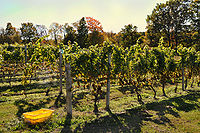 Chardonnay was one of the first European grape varietals to have been grown commercially east of the Rocky Mountains. After three centuries of failure with vinifera this achievement was realized in the Finger Lakes
region of upstate New York. Frenchman, Charles Fournier and Russian, Konstantin Frank
experimented with Chardonnay and other varietals in hopes of producing sparkling wines based on Old World grapes for the Gold Seal wine company. In the late 1950s they succeeded in harvesting the first commercial quantities of European grapes in eastern North America. Frank went on to found the Konstantin Frank Vinifera Wine Cellars which helped demonstrate that a winery in the eastern United States could produce European style wines as a basis for a winery business. Chardonnay became an important part of that strategy.
New York, like Burgundy and Washington State, is a cool climate viticultural region. Being cold tolerant, the Chardonnay grape is well suited for New York State. Not only can it endure New York's cold winters but the varietal buds late reducing the risk of spring frosts. New York's comparatively cooler growing season causes slower ripening requiring a longer time on the vine which may allow the grapes to develop greater complexity and character at more reasonable sugar levels than warmer Chardonnay producing regions. New York has subsequently developed significant plantings of the varietal since Fournier and Frank's early experiments.
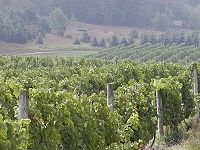 Washington Chardonnays can be very similar to Californian Chardonnays but there tends to be more emphasis on fruit than creaminess. In 2000, it was the most widely planted premium wine grape in the state. Rather than using Dijon clones, Washington vineyards are planted with clones developed at the University of California-Davis that are designed to take longer to ripen in the warmer weather of the state's wine regions. This allows winemakers to maintain the acidity levels that balances the fruity and flint
earthiness that have characterized Washington Chardonnay. Apple
notes are common and depending on producer and appellation
can range from flavors of Golden Delicious
and Fuji
to Gala
and Jonathan
. In Oregon, the introduction of Dijon clones from Burgundy has helped to adapt the grape to the Oregon climate and soils.
and lighter styles produced in Quebec and British Columbia. In fact, in 2009, Le Clos Jordanne winery, of Jordan Village on the Niagara Peninsula, Ontario received critical acclaim for its 2005 Claystone Terrace Chardonnay, which won the top spot for Chardonnay in the "Judgement of Montreal" experts’ tasting. This recognition, which caught the attention of the wine community, resulted from a blind tasting held in Quebec for Cellier magazine. Thirty-three years after the "Judgment of Paris" Cellier magazine organized a blind tasting in Montreal based on the Judgment of Paris. In the "Judgement of Montreal" 10 judges at the Cellier tasting assessed 16 red and 14 white wines, primarily from France and California. The Chardonay from Le Clos Jordanne placed first out of the 14 white wines, some of which were notable international wines, including: Chateau Montelena, Mer Soleil, Kumeu River, an aged reserve wine from Rosemount Estates, and a number of Burgundian entrants from producers such as Drouhin, Lamy, Boisset, Jadot and others. Other great examples of Ontario chardonnay include Closson Chase and Norman Hardie from the Prince Edward County region, and Tawse Winery, Hidden Bench Vineyards, and Southbrook Vineyards from the Niagara region.
The Chardonnay vintages of the early 1990s from British Columbia helped generate international attention to the quality of Canadian wines apart from ice wine
varietals. In British Columbia, Chardonnay from the Okanagan are characterized by delicate citrus fruits. They are typically light bodied but producers who use barrel fermentation and oak aging can produce fuller bodied wines.
in the collection of James Busby
in 1832, but it only really took off in the 1950s. It is most significant in South Australia
, New South Wales
— especially the Hunter Valley
- and Victoria
. One of the first commercially successful Chardonnays was produced by Murray Tyrrell
in the Hunter Valley in 1971. Tyrell's vineyard was planted with Chardonnay cuttings that he "borrowed
" from Penfolds
' experimental plantings by hopping over their barb-wire fence one night and pruning their vines. The export
driven Australian wine industry was well situated for the Chardonnay boom of the 1980s and 1990s and Australia responded with a unique style of wine that was characterized by big fruit flavors and easy approachability. To compensate for the very warm climate, richness was enhanced by the use of oak chips and acid was added during fermentation
. During this period the number of Chardonnay plants increased fivefold and by 1990 it was the most widely planted white wine grape in Australia and third most planted overall behind Shiraz and Cabernet Sauvignon. Early in the 21st century, demand outpaced supply and there was a shortage of Chardonnay grapes which prompted Australian winemakers to introduce new blending partners like Sémillon (known as "SemChard") and Colombard.
Being a rather neutral grape, Australian winemakers first approached Chardonnay in the same manner they were making wine from the similarly neutral Sultana
grape. Aromatic yeast
were added and maceration
was extended to get more flavors from skin contact. While the style of Australian Chardonnay is mostly characterized by the mass produced products of the hot Riverland
region, the cooler climates of Victoria and Tasmania
has been creating more crisp, less oaked wines with lime notes. In the Cowra
region, Chardonnay's citrus
notes are emphasized while Hunter Valley examples have more richness and smoky notes. The Yarra Valley
produces the most Burgundian style while Mount Barker
in the Great Southern, Western Australia
produces Chardonnay that more closely resembles those of Chablis. A rare, isolated clone exist in the Mudgee region that local believe traces its ancestry back to some of the first vines brought to Australia in the 19th century. While the wine made from this clone is not particularly distinguished, it can still be of very good quality. Overall, there has been a shift in style since the 1980s from deep golden, oily wines with melon
and butterscotch
flavors to lighter, paler Chardonnays with more structure and notes of white peach
es and nectarines. Sparkling wines from Chardonnay are produced in the cool regions of Geelong, Macedon Ranges and Tasmania
.
Despite being more famous for its Sauvignon blanc production, Chardonnay was New Zealand's most widely planted grape variety from 1990 till 2002 when Sauvignon blanc finally surpassed it. The east coast of the North Island
, in places like Hawke's Bay
and Wairarapa
, have seen the most success with Chardonnay wine that has noticeable acidity and leanness. As better clonal varieties are discovered and planted, the overall quality of New Zealand Chardonnay have increased, particularly from places like Canterbury
, Marlborough
and Nelson
. Some producers in the Gisborne
region have recently developed a cult following for their Chardonnay among New Zealand wine drinkers. While many New Zealand winemakers are still developing a characteristic style, the Chardonnay produced so far have emphasized the grape's affinity for oak.
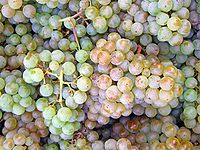 Chardonnay has a long history in Italy
but for a large part of it, the grape was commonly confused with Pinot blanc—often with both varieties inter planted in the same vineyard and blended together. This happened despite the fact that Chardonnay grapes get more golden yellow in color close to harvest time and can be visually distinguished from Pinot blanc. In the Trentino-Alto Adige/Südtirol region this confusion appeared in the synonyms for each grape with Pinot blanc being known as "Weissburgunder" (White Burgundy) and Chardonnay was known as "Gelber Weissburgunder" (Golden White Burgundy). By the late 20th century, more concentrated efforts were put into identifying Chardonnay and making pure varietal versions of the wine. In 1984, it was granted its first Denominazione di origine controllata
(DOC) in the province of South Tyrol
. By 2000, it was Italy's fourth most widely planted white wine grape.
Though many varietal form of Chardonnay are produced, and the numbers are increasing, for most of its history in Italian winemaking Chardonnay was a blending grape. Besides Pinot bianco, Chardonnay can be found in blends with Albana
, Catarratto
, Cortese
, Erbaluce
, Favorita
, Garganega
, Grecanico, Incrocio Manzoni
, Nuragus, Procanico, Ribolla Gialla
, Verdeca, Vermentino
and Viognier
. It even blended into a dry White Zinfandel
-style Nebbiolo wine that is made from the white juice of the red Nebbiolo grape prior to being dyed with skin contact. Most Chardonnay plantings are located in the northern wine regions, though plantings can be found throughout Italy as far south as Sicily
and Apulia
. In Piedmont
and Tuscany, the grape is being planted in sites that are less favorable to Dolcetto
and Sangiovese
respectively. In Lombardy
, the grape is often used for spumante and in the Veneto it is often blended with Garganega to give more weight and structure to the wine. Chardonnay is also found in the Valle d'Aosta DOC
and Friuli-Venezia Giulia wine
region.
in the 1970s and 1980s and many times were misidentified as to what grape variety it really was. A large portion of the Chardonnay plantings from this period turned out to be Auxerrois Blanc
. (A similar event happened in the German wine region of Baden during the 1980s.) By the late 1990s, efforts to promote "authentic" Chardonnay helped to increase plantings and by 2004 it was the 3rd most widely planted white wine grape behind Chenin blanc and Colombard
. Winemakers in the Western Cape
have experimented blending Chardonnay with Riesling and Sauvignon blanc.
, Israel
and Lebanon
as well as Austria
, Bulgaria
, Croatia
, England, Georgia
, Germany
, Slovakia, Hungary, Macedonia
, Moldova
, Portugal
, Romania
, Slovenia
, Spain
, Serbia
and Switzerland
. In Austria, the grape varieties known as Feinburgunder in Burgenland
& Vienna
and Morillon in Styria was not identified as Chardonnay till the late 1980s. Today, Austrian Chardonnays range from the rich, oaked aged varieties to leaner, more aromatic styles based on Austrian Rieslings to sweet
late harvest
styles. In nearby Germany, this distinctly French wine grape was slow to gain a footing being only officially sanctioned since 1991. Today it is most commonly found in the Baden
, Palatinate
and Rheinhessen
regions. In Switzerland, Chardonnay is found mostly around Bündner Herrschaft, Geneva
and Valais
. In Spain, Chardonnay has been increasingly used in the sparkling wine
Cava. It is also permitted in the Denominación de Origen
(DO) wines of Costers del Segre
, Navarra
and Somontano
. In the wine regions of the former Soviet Union, Chardonnay has lagged behind in white wine grapes plantings in favor Rkatsiteli
, Aligote and Riesling. The Portuguese experimentation with Chardonnay has been mostly influenced by flying winemakers from Australia and the examples produced so far are very New World in style.
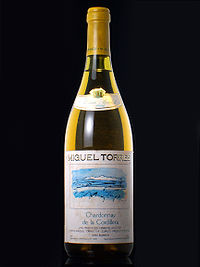
's Uco Valley
and Chile
's Casablanca
, Chardonnay has started to develop a presence. In the 1990s, Chardonnay became the second most widely planted white grape variety in Argentina-second only Torrontés
. In Chile, it has surpassed Sauvignon blanc and Sauvignon vert
to be the most widely planted white wine grape. India and Uruguay
have been steadily increasing their plantings.
and the degree of oak influence used for the wine. With malolactic fermentation (or MLF), the harder malic acid
gets converted into the softer lactic acid
which creates the "butter
y-ness" that is associated with some styles of Chardonnay. The wines that do not go though MLF will have more green apple like flavors. Oak can be introduced during fermentation
or after in the form of the barrel aging. Depending on the amount of charring that the oak was treated with, this can introduce a "toastiness" and flavors that many wine drinkers mistake as a characteristic
of the grape itself. These flavors can include caramel, cream
, smoke
, spice
, coconut
, cinnamon
, cloves and vanilla
.
 Other winemaking decisions that can have a significant effect include the temperature of fermentation and what time, if any, that the wine allowed to spend aging on the lees
. Burgundian winemaking tends to favor extended contact on the lees and even "stirring up" the lees within the wine while it is aging in the barrel in a process known as bâttonage. Colder fermentation temperatures produces more "tropical" fruit flavors like mango
and pineapple
. The "Old World" style of winemaking favors the use of wild, or ambient yeast
, though some will also use specially cultivated yeast that can impart aromatic qualities to the wine. A particular style of yeast used in Champagne is the Prise de Mousse that is cultivated for use world wide in sparkling Chardonnay wines. A potential drawback of using wild yeast is that the fermentation process can go very slow with the results of the yeasts being very unpredictable and producing potentially a very different wine each year. One Burgundian winemaker that favors the use of only wild yeast is Domaine des Comtes Lafon which had the fermentation of its 1963 Chardonnay batch take 5 years to complete when the fermentation process normally only takes a matter of weeks.
The time of harvesting is a crucial decision because the grape quickly begins to lose acidity as it ripens. For sparkling wine production
, the grapes will be harvested early and slightly unripe to maintain the acid levels. Sparkling Chardonnay based wines tend to exhibit more floral and steely flavors in their youth. As the wine ages, particularly if it spends significant time on lees, the wines will develop "toasty" notes. Chardonnay grapes usually have little trouble developing sugar content, even in cooler climates, which translates into high potential alcohol levels and limits the need for chaptalization
. On the flip side, low acid levels can be a concern which make the wine taste "flabby" and dull. Winemakers can counteract this by adding tartaric acid
in a process known as "acidification". In cooler climates, the extract and acidity of Chardonnay is magnified which has the potential of producing very concentrated wines that can develop through bottle aging. Chardonnay can blend well with other grapes and still maintain some of its unique character. The grapes most often blended with Chardonnay include Chenin blanc, Colombard and Sémillon.
, a sense of "smokiness" is one clue that could be picked up in a blind tasting of Chardonnay but there are many styles that do not have any "smokey" notes. Compared to other white wine grapes like Sauvignon blanc, Gewürztraminer
and Viognier-Chardonnay has a more subtle and muted nose with no overwhelming aromatics that jump out of the wine glass. The identifying styles of Chardonnay are regionally based. For example, pineapple notes are more commonly associated with Chardonnay from Napa Valley while Chablis will have more notes of green apples. While many examples of Chardonnay can benefit from a few years of bottle aging, especially if they have high acidity, most Chardonnays are meant to be consumed in their youth. A notable exception to this is the most premium examples of Chablis and white Burgundies.
and other white meat
s such as turkey. Heavily oak influenced Chardonnays do not pair well with more delicate fish
and seafood
dish. Instead, those wines tend to go better with smoked fish
, spicy southeast Asian cuisine
, garlic
and guacamole
dips. The regional influences of Chardonnay can help it pair with different food styles. Chardonnays from Washington, which is characterized by maintaining more acidity, tend to pair well with tomato-based
dishes and items featuring sweet onion
s. Older, more mellow Chardonnays are often paired with more "earthy" dishes like mushroom
soup and aged cheese
.
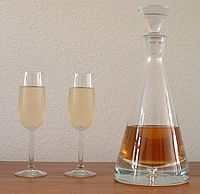 Chardonnay long had a reputation as one of France's great white wines, but due to the dominance of geographical labeling
, the fact that Chardonnay was the grape behind white Burgundy was not widely known by the wine-drinking public. The success of California and new world Chardonnays, partly encouraged by the Californian showing at the Judgment of Paris wine tasting, brought varietal wine labeling to more prominence and the easy to pronounce Chardonnay grape was one of the largest beneficiaries. In the late 1980s, a sort of "Chardonnay-mania" developed as wine regions (particularly new and developing ones) dramatically increased their planting of the grape to meet the world wide demand. Chardonnay became very fashionable in the 1990s, as the stereotypical drink of young urban women of the Bridget Jones
generation.
But as more vineyards responded with massive new plantings of the variety, they found that fashions were changing again. The market was drinking more red wine, and there was a backlash against heavy, oaky, New World Chardonnays in favor of lighter wines such as Pinot Grigio. There was a new fashion, "ABC" - Anything But Chardonnay, identified by Frank Prial in 1995. Another reason for the backlash was that Chardonnay was seen as a symbol of the globalization of wine, in which local grape varieties were grubbed up in favor of the big names demanded by international markets. Oz Clarke
described a view of Chardonnay as "...the ruthless coloniser and destroyer of the world's vineyards and the world's palates." The criticism was centered on the habits of winemakers to pull out or give up on local varieties in order to plant more Chardonnay which offered potentially more income but lack the uniqueness and character of local varieties. Examples of this occurred in south Italy and Spain when ancient Negroamaro
, Primitivo, Grenache
and Mataro vineyards were ripped up in favor of new Chardonnay plantings. Despite the backlash, Chardonnay remains very popular. In 2004 Chardonnay was estimated to be the world's 6th most grown grape variety, covering 179300 hectares (443,059.6 acre).
Chardonnay. Ostensibly to protect vines from Pierce's Disease, the idea has run into widespread opposition. Trials are underway in the US and South Africa.
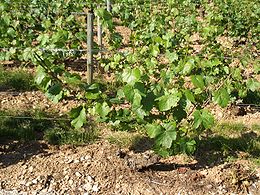 Due to the worldwide recognition of the name of "Chardonnay", many of these synonyms have fallen out of favor as winemakers use the more marketable Chardonnay:
Arboisier, Arnaison Blanc, Arnoison, Aubain, Aubaine, Auvergnat Blanc, Auvernas, Auvernas Blanc, Auvernat Blanc, Auxeras, Auxerras Blanc, Auxerrois Blanc, Auxois, Auxois Blanc, Bargeois Blanc, Beaunois, Biela Klevanjika, Blanc de Champagne, Blanc de Cramant, Breisgauer Suessling, Breisgauer Sussling, Burgundi Feher, Chablis, Chardenai, Chardenay, Chardenet, Chardennet, Chardonay, Chardonnet, Chatenait, Chatey Petit, Chatte, Chaudenay, Chaudenet, Chaudent, Clävner, Clevner Weiss, Cravner, Epinette, Epinette Blanc, Epinette Blanche, Epinette de Champagne, Ericey Blanc, Feher Chardonnay, Feherburgundi, Feinburgunder, Gamay Blanc, Gelber Weissburgunder, Gentil Blanc, Grosse Bourgogne, Klawner, Klevanjka Biela, Klevner, Lisant, Luisant, Luizannais, Luizant, Luzannois, Maconnais, Maurillon Blanc, Melon Blanc, Melon D'Arbois, Meroué, Moreau Blanc, Morillon Blanc, Moulon, Noirien Blanc, Obaideh, Petit Chatey, Petit Sainte-Marie, Petite Sainte Marie, Pineau Blanc, Pino Sardone, Pino Shardone, Pinot Blanc à Cramant, Pinot Blanc Chardonnay, Pinot Chardonnay, Pinot de Bourgogne, Pinot Giallo, Pinot Planc, Plant de Tonnerre, Romere, Romeret, Rouci Bile, Rousseau, Roussot, Ruländer Weiß, Sainte Marie Petite, Sardone, Shardone, Shardonne, Später Weiß Burgunder, Weiß Burgunder (normally refers to Pinot Blanc), Weiß Clevner, Weiß Edler, Weiß Elder, Weiß Klewner, Weiß Silber, Weißedler, Weißer Clevner, Weißer Rulander.
Grape
A grape is a non-climacteric fruit, specifically a berry, that grows on the perennial and deciduous woody vines of the genus Vitis. Grapes can be eaten raw or they can be used for making jam, juice, jelly, vinegar, wine, grape seed extracts, raisins, molasses and grape seed oil. Grapes are also...
variety
Variety (biology)
In botanical nomenclature, variety is a taxonomic rank below that of species: as such, it gets a three-part infraspecific name....
used to make white wine
Wine
Wine is an alcoholic beverage, made of fermented fruit juice, usually from grapes. The natural chemical balance of grapes lets them ferment without the addition of sugars, acids, enzymes, or other nutrients. Grape wine is produced by fermenting crushed grapes using various types of yeast. Yeast...
. It is originated from the Burgundy wine
Burgundy wine
Burgundy wine is wine made in the Burgundy region in eastern France, in the valleys and slopes west of the Saône River, a tributary of the Rhône. The most famous wines produced here - those commonly referred to as "Burgundies" - are red wines made from Pinot Noir grapes or white wines made from...
region of eastern France
French wine
French wine is produced in several regions throughout France, in quantities between 50 and 60 million hectolitres per year, or 7–8 billion bottles. France has the world's second-largest total vineyard area, behind Spain, and is in the position of being the world's largest wine producer...
but is now grown wherever wine is produced, from England to New Zealand
New Zealand wine
New Zealand wine is largely produced in ten major wine growing regions spanning latitudes 36° to 45° South and extending . They are, from north to south Northland, Auckland, Waikato/Bay of Plenty, Gisborne, Hawke's Bay, Wellington, Nelson, Marlborough, Canterbury/Waipara and Central...
. For new and developing wine regions, growing Chardonnay is seen as a "rite of passage
Rite of passage
A rite of passage is a ritual event that marks a person's progress from one status to another. It is a universal phenomenon which can show anthropologists what social hierarchies, values and beliefs are important in specific cultures....
" and an easy segue into the international wine market.
The Chardonnay grape itself is very neutral, with many of the flavors commonly associated with the grape being derived from such influences as terroir
Terroir
Terroir comes from the word terre "land". It was originally a French term in wine, coffee and tea used to denote the special characteristics that the geography, geology and climate of a certain place bestowed upon particular varieties...
and oak. It is vinified in many different styles, from the lean, crisply mineral wines of Chablis, France to New World wine
New World wine
New World wines are those wines produced outside the traditional wine-growing areas of Europe, in particular from Argentina, Australia, Canada, Chile, New Zealand, South Africa and the United States.-Early wines in the Americas:...
s with tropical fruit flavors and lots of oak.
Chardonnay is an important component of many sparkling wine
Sparkling wine
Sparkling wine is a wine with significant levels of carbon dioxide in it making it fizzy. The carbon dioxide may result from natural fermentation, either in a bottle, as with the méthode champenoise, in a large tank designed to withstand the pressures involved , or as a result of carbon dioxide...
s around the world, including Champagne. A peak in popularity in the late 1980s gave way to a backlash among those wine drinkers who saw the grape as a leading negative component of the globalization of wine
Globalization of wine
"Globalization is the expansion of brands across nations and into other continents. In food and wine it refers to the whole problem of making the product global. The primary issue is scaling production while reducing the costs of goods with processes. In marketing it refers to wearing the mantle of...
. Nonetheless, it remains one of the most widely-planted grape varieties, with over 160000 hectares (395,368.3 acre) worldwide, second only to Airén
Airén
Airén is a variety of Vitis vinifera, a white grape commonly used in winemaking. This grape is native to Spain where it represents about 30% of all grapes grown. As of 2004, Airén was estimated to be the world's most grown grape variety in terms of planted surface, at , although it is almost...
among white wine grapes and planted in more wine regions than any other grape – including Cabernet Sauvignon
Cabernet Sauvignon
Cabernet Sauvignon is one of the world's most widely recognized red wine grape varieties. It is grown in nearly every major wine producing country among a diverse spectrum of climates from Canada's Okanagan Valley to Lebanon's Beqaa Valley...
.
History
Pinot Noir
Pinot noir is a black wine grape variety of the species Vitis vinifera. The name may also refer to wines created predominantly from Pinot noir grapes...
or Pinot blanc
Pinot Blanc
Pinot blanc is a white wine grape. It is a point genetic mutation of Pinot noir. Pinot noir is genetically unstable and will occasionally experience a point mutation in which a vine bears all black fruit except for one cane which produced white fruit....
. In addition to being found in the same region of France for centuries, ampelographers noted that the leaves of each plant have near-identical shape and structure. Pierre Galet
Pierre Galet
Pierre Galet is a French ampelographer and author who was an influential figure within ampelography in the 20th century and before DNA typing was widely introduced...
disagreed with this assessment, believing that Chardonnay was not related to any other major grape variety. Viticulturalists
Viticulture
Viticulture is the science, production and study of grapes which deals with the series of events that occur in the vineyard. When the grapes are used for winemaking, it is also known as viniculture...
Maynard Amerine
Maynard Amerine
Maynard Amerine was a pioneering researcher in the cultivation, fermentation, and sensory evaluation of wine. His academic work at the University of California at Davis is recognized internationally...
& Harold Olmo
Harold Olmo
Dr. Harold Olmo was a pioneering viticulturalist and professor at the University of California, Davis where he created many new grape varieties known today as Olmo grapes. In the 1950s, he helped to establish California's first quarantine facility on the UC-Davis campus to permit California...
proposed a descendency from a wild Vitis vinifera
Vitis vinifera
Vitis vinifera is a species of Vitis, native to the Mediterranean region, central Europe, and southwestern Asia, from Morocco and Portugal north to southern Germany and east to northern Iran....
vine that was a step removed from white Muscat. Chardonnay's true origins were further obscured by vineyard owners in Lebanon
Lebanon
Lebanon , officially the Republic of LebanonRepublic of Lebanon is the most common term used by Lebanese government agencies. The term Lebanese Republic, a literal translation of the official Arabic and French names that is not used in today's world. Arabic is the most common language spoken among...
and Syria
Syria
Syria , officially the Syrian Arab Republic , is a country in Western Asia, bordering Lebanon and the Mediterranean Sea to the West, Turkey to the north, Iraq to the east, Jordan to the south, and Israel to the southwest....
, who claimed that the grape's ancestry could be traced to the Middle East, from where it was introduced to Europe by returning Crusaders
Crusades
The Crusades were a series of religious wars, blessed by the Pope and the Catholic Church with the main goal of restoring Christian access to the holy places in and near Jerusalem...
, though there is little external evidence to support that theory. Another theory stated that it originated from an ancient indigenous
Indigenous (ecology)
In biogeography, a species is defined as native to a given region or ecosystem if its presence in that region is the result of only natural processes, with no human intervention. Every natural organism has its own natural range of distribution in which it is regarded as native...
vine found in Cyprus
Cyprus
Cyprus , officially the Republic of Cyprus , is a Eurasian island country, member of the European Union, in the Eastern Mediterranean, east of Greece, south of Turkey, west of Syria and north of Egypt. It is the third largest island in the Mediterranean Sea.The earliest known human activity on the...
.
Modern DNA fingerprinting research at University of California, Davis
University of California, Davis
The University of California, Davis is a public teaching and research university established in 1905 and located in Davis, California, USA. Spanning over , the campus is the largest within the University of California system and third largest by enrollment...
, now suggests that Chardonnay is the result of a cross between the Pinot
Pinot Noir
Pinot noir is a black wine grape variety of the species Vitis vinifera. The name may also refer to wines created predominantly from Pinot noir grapes...
and Gouais Blanc
Gouais Blanc
Gouais Blanc or Weißer Heunisch is a white grape variety that is seldom grown today but is important as the ancestor of many traditional French and German grape varieties. The name Gouais derives from the old French adjective ‘gou’, a term of derision befitting its traditional status as the grape...
(Heunisch) grape varieties. It is believed that the Romans
Roman Empire
The Roman Empire was the post-Republican period of the ancient Roman civilization, characterised by an autocratic form of government and large territorial holdings in Europe and around the Mediterranean....
brought Gouais Blanc from the Balkans
Balkans
The Balkans is a geopolitical and cultural region of southeastern Europe...
, and it was widely cultivated by peasants in Eastern France
Roman Gaul
Roman Gaul consisted of an area of provincial rule in the Roman Empire, in modern day France, Belgium, Luxembourg, and western Germany. Roman control of the area lasted for less than 500 years....
. The Pinot of the French aristocracy
Aristocracy
Aristocracy , is a form of government in which a few elite citizens rule. The term derives from the Greek aristokratia, meaning "rule of the best". In origin in Ancient Greece, it was conceived of as rule by the best qualified citizens, and contrasted with monarchy...
grew in close proximity to the Gouais Blanc, giving both grapes ample opportunity to interbreed. Since the two parents were genetically distant, many of the crosses showed hybrid vigour and were selected for further propagation. These "successful" crosses included Chardonnay and siblings such as Aligoté
Aligoté
Aligoté is a white grape used to make dry white wines in the Burgundy region of France, and which also has significant plantings in much of Eastern Europe including Romania, Russia, Ukraine, Moldova and Bulgaria. With , it was the 22nd most planted vine variety in the world in 2004...
, Aubin Vert
Aubin Vert
Aubin Vert is a white wine grape cultivar grown in the Lorraine region of France. Small vineyards are found in Bulligny, Bruley, Pagney and Rozérieulles. Within the last century, it has also been grown in Thiaucourt-Regniéville, d'Euvezin and Magny...
, Auxerrois
Auxerrois Blanc
Auxerrois Blanc or Auxerrois Blanc de Laquenexy is a white wine grape that is important in Alsace, and is also grown in Germany and Luxembourg. It is a full sibling of Chardonnay that is often blended with the similar Pinot Blanc.-History:...
, Bachet noir
Bachet noir
Bachet Noir is a traditional French variety of red wine grape that is a sibling of Chardonnay. A little is still grown in the Aube, where it is used to add colour and body to Gamay wines.-History:...
, Beaunoir
Beaunoir
Beaunoir is a traditional French variety of red wine grape that is a sibling of Chardonnay. The 'beautiful black' grape produces a thin wine and not much is grown these days.-History:...
, Franc Noir de la-Haute-Saône, Gamay Blanc Gloriod
Gamay Blanc Gloriod
Gamay Blanc Gloriod is an obscure French variety of white wine grape. Very little of it is grown commercially.It is named after Émile Gloriod, who discovered it as a seedling; it was originally thought to be a white version of the Gamay grape. "Gamay Blanc" was already used as an alternative name...
, Gamay noir, Melon, Knipperlé
Knipperlé
Knipperlé is a traditional French variety of white wine grape from Alsace. It's not listed for use in AOC wine, but is a minor component of blends for local drinking, in some ways an Alsatian equivalent of its sibling Aligoté in Burgundy.-History:...
, Peurion
Peurion
Peurion is a traditional French variety of white wine grape that is a sibling of Chardonnay. Once quite popular, not much is still grown in France these days.-History:...
, Roublot
Roublot
Roublot is a traditional French variety of white wine grape that is a sibling of Chardonnay. It was once quite widely grown near Auxerre.-History:In the early 19th century, Roublot made up a third of the area in Saint-Bris-le-Vineux in the west of Chablis...
, Sacy
Sacy (grape)
Sacy is a white wine grape grown primarily in the central and northeastern France within the Yonne and Allier départments.Sacy ripens early, and produces light-coloured wines low in acid and alcohol.-Parentage:...
and Dameron
Dameron
Dameron is a traditional French variety of red wine grape that is a sibling of Gamay. Its wines are somewhat weightier than Gamay, but it is disappearing from its traditional areas in northern France...
.
Clones, crossing and mutations
As of 2006, 34 clonal varieties of Chardonnay could be found in vineyards throughout France, most of which were developed at the University of BurgundyUniversity of Burgundy
The University of Burgundy is a university located in Dijon, France.The University of Burgundy is situated on a large campus called Campus Montmuzard, 15 minutes by bus from the City Centre...
in Dijon
Dijon
Dijon is a city in eastern France, the capital of the Côte-d'Or département and of the Burgundy region.Dijon is the historical capital of the region of Burgundy. Population : 151,576 within the city limits; 250,516 for the greater Dijon area....
. The so-called "Dijon clones" are bred for their adaptive attributes, with vineyard owners planting the clonal variety best suited to their terroir
Terroir
Terroir comes from the word terre "land". It was originally a French term in wine, coffee and tea used to denote the special characteristics that the geography, geology and climate of a certain place bestowed upon particular varieties...
and which will produce the type of characteristics that they are seeking in the wine. Examples include the lower-yielding
Yield (wine)
In viticulture, the yield is a measure of the amount of grapes or wine that is produced per unit surface of vineyard, and is therefore a type of crop yield...
clones Dijon-76, 95 & 96 that produce more flavor-concentrated clusters. Dijon-77 & 809 produce more aromatic wines with a "grapey" perfume, while Dijon-75, 78, 121, 124, 125 & 277 are more vigorous and higher yielding clones. New World varieties include the Mendoza clone, which produced some of the early Californian Chardonnays. The Mendoza clone is prone to developed millerandage
Millerandage
Millerandage or shot berries is a French term referring to an viticultural problem in which grape bunches contain berries of greatly different size and, most important, different levels of maturity. Its most common cause is too cold or otherwise bad weather during the flowering stage of the vines....
, also known as "hens and chicks", where the berries develop unevenly. In places such as Oregon
Oregon wine
The state of Oregon in the United States has established an international reputation for its production of wine. Oregon has several different growing regions within the state's borders which are well-suited to the cultivation of grapes; additional regions straddle the border between Oregon and the...
, the use of newer Dijon clones has had some success in those regions of the Willamette Valley
Willamette Valley
The Willamette Valley is the most populated region in the state of Oregon of the United States. Located in the state's northwest, the region is surrounded by tall mountain ranges to the east, west and south and the valley's floor is broad, flat and fertile because of Ice Age conditions...
with climates similar to that of Burgundy.
Chardonnay has served as parent to several French-American hybrid grapes, as well as crossings with other Vitis vinifera varieties. Examples include the hybrid Chardonel
Chardonel
Chardonel is a late ripening white wine hybrid grape which can produce a high quality wine with varietal character. It is a result of a cross made by the New York State Agricultural Experiment Station of the popular French American hybrid Seyval and the classic vitis vinifera Chardonnay...
which was a Chardonnay and Seyval blanc
Seyval Blanc
Seyval Blanc is a hybrid wine grape variety used to make white wines. Its vines ripen early, are productive and are suited to fairly cool climates.Seyval Blanc is grown mainly in England, and the Finger Lakes region of upstate New York, as well as to a lesser extent in Canada...
cross produced in 1953 at the New York State Agricultural Experiment Station
New York State Agricultural Experiment Station
The New York State Agricultural Experiment Station at Geneva, Ontario County, New York State, is an integral part of the New York State College of Agriculture and Life Sciences at Cornell University. It is a mission-oriented experiment station with a strong emphasis on applied research...
. Mutation
Mutation
In molecular biology and genetics, mutations are changes in a genomic sequence: the DNA sequence of a cell's genome or the DNA or RNA sequence of a virus. They can be defined as sudden and spontaneous changes in the cell. Mutations are caused by radiation, viruses, transposons and mutagenic...
s of the Chardonnay grape include the rare pink-berried "Chardonnay Rose"; also "Chardonnay Blanc Musqué", which produces an intensely aromatic wine. Chardonnay Blanc Musqué is mostly found around the Mâconnais
Mâconnais
The Mâconnais district lies in the south of the Burgundy wine region in France, west of the River Saône. It takes its name from the town of Mâcon. It is best known as a source of good value white wines made from the Chardonnay grape; the wines from Pouilly-Fuissé are particularly sought-after....
village of Clessé
Clessé, Saône-et-Loire
Clessé is a commune in the Saône-et-Loire department in the region of Bourgogne in eastern France.-Wine:Vineyards of Clessé are part of the appellation d'origine contrôlée Viré-Clessé, which is used for white wines from Chardonnay grapes. Before 1999, the wines used to be called...
and sometimes confused with the Dijon-166 clone planted in South Africa
South Africa
The Republic of South Africa is a country in southern Africa. Located at the southern tip of Africa, it is divided into nine provinces, with of coastline on the Atlantic and Indian oceans...
, which yields Muscat-like aromas.
Viticulture
Winemaker
A winemaker or vintner is a person engaged in winemaking. They are generally employed by wineries or wine companies, where their work includes:*Cooperating with viticulturists...
. It is a highly vigorous vine, with extensive leaf cover which can inhibit the energy and nutrient uptake of its grape clusters. Vineyard managers counteract this with aggressive pruning and canopy management. When Chardonnay vines are planted densely, they are forced to compete for resources and funnel energy into their grape clusters. In certain conditions the vines can be very high-yielding, but the wine produced from such vines will suffer a drop in quality if yields go much beyond 4.5 ton
Ton
The ton is a unit of measure. It has a long history and has acquired a number of meanings and uses over the years. It is used principally as a unit of weight, and as a unit of volume. It can also be used as a measure of energy, for truck classification, or as a colloquial term.It is derived from...
s per acre (80 hl/ha). Producers of premium Chardonnay limit yields to less than half this amount. Sparkling wine producers tend not to focus as much on limiting yields, since concentrated flavors are not as important as the wine's finesse.
Harvest
Harvest (wine)
The harvesting of wine grapes is one of the most crucial steps in the process of winemaking. The time of harvest is determined primarily by the ripeness of the grape as measured by sugar, acid and tannin levels with winemakers basing their decision to pick based on the style of wine they wish to...
ing time is crucial to winemaking, with the grape rapidly losing acidity as soon as it ripens. Some viticultural hazards include the risk of damage from springtime frost
Frost
Frost is the solid deposition of water vapor from saturated air. It is formed when solid surfaces are cooled to below the dew point of the adjacent air as well as below the freezing point of water. Frost crystals' size differ depending on time and water vapour available. Frost is also usually...
, as Chardonnay is an early-budding vine – usually a week after Pinot noir
Pinot Noir
Pinot noir is a black wine grape variety of the species Vitis vinifera. The name may also refer to wines created predominantly from Pinot noir grapes...
. To combat the threat of frost, a method developed in Burgundy involves aggressive pruning just prior to flowering. This "shocks" the vine and delays flowering for up to two weeks, which is often long enough for warmer weather to arrive. Millerandage
Millerandage
Millerandage or shot berries is a French term referring to an viticultural problem in which grape bunches contain berries of greatly different size and, most important, different levels of maturity. Its most common cause is too cold or otherwise bad weather during the flowering stage of the vines....
and coulure
Coulure
Coulure is a potential viticultural hazard that is the result of metabolic reactions to weather conditions that causes a failure of grapes to develop after flowering. In English the word shatter is sometimes used. Coulure is triggered by periods of cold, cloudy, rainy weather or very high...
can also pose problems, along with powdery mildew
Powdery mildew
Powdery mildew is a fungal disease that affects a wide range of plants. Powdery mildew diseases are caused by many different species of fungi in the order Erysiphales. It is one of the easier diseases to spot, as its symptoms are quite distinctive. Infected plants display white powdery spots on the...
attacking the thin skin of the grapes. Because of Chardonnay's early ripening, it can thrive in wine regions with a short growing season and, in regions like Burgundy, will be harvested before autumn rain sets in and brings the threat of rot.
While Chardonnay can adapt to almost all vineyard soils, the three it seems to like most are chalk
Chalk
Chalk is a soft, white, porous sedimentary rock, a form of limestone composed of the mineral calcite. Calcite is calcium carbonate or CaCO3. It forms under reasonably deep marine conditions from the gradual accumulation of minute calcite plates shed from micro-organisms called coccolithophores....
, clay
Clay
Clay is a general term including many combinations of one or more clay minerals with traces of metal oxides and organic matter. Geologic clay deposits are mostly composed of phyllosilicate minerals containing variable amounts of water trapped in the mineral structure.- Formation :Clay minerals...
and limestone
Limestone
Limestone is a sedimentary rock composed largely of the minerals calcite and aragonite, which are different crystal forms of calcium carbonate . Many limestones are composed from skeletal fragments of marine organisms such as coral or foraminifera....
, all very prevalent throughout Chardonnay's traditional "homeland". The Grand crus of Chablis are planted on hillsides composed of Kimmeridgian
Kimmeridgian
In the geologic timescale, the Kimmeridgian is an age or stage in the Late or Upper Jurassic epoch or series. It spans the time between 155.7 ± 4 Ma and 150.8 ± 4 Ma . The Kimmeridgian follows the Oxfordian and precedes the Tithonian....
marl
Marl
Marl or marlstone is a calcium carbonate or lime-rich mud or mudstone which contains variable amounts of clays and aragonite. Marl was originally an old term loosely applied to a variety of materials, most of which occur as loose, earthy deposits consisting chiefly of an intimate mixture of clay...
, limestone and chalk. The outlying regions, falling under the more basic "Petit Chablis" appellation
Appellation
An appellation is a legally defined and protected geographical indication used to identify where the grapes for a wine were grown; other types of food often have appellations as well...
, are planted on portlandian limestone
Portland stone
Portland stone is a limestone from the Tithonian stage of the Jurassic period quarried on the Isle of Portland, Dorset. The quarries consist of beds of white-grey limestone separated by chert beds. It has been used extensively as a building stone throughout the British Isles, notably in major...
which produces wines with less finesse. Chalk beds are found throughout the Champagne region, and the Côte-d'Or
Côte-d'Or
Côte-d'Or is a department in the eastern part of France.- History :Côte-d'Or is one of the original 83 departments created during the French Revolution on 4 March 1790. It was formed from part of the former province of Burgundy.- Geography :...
has many areas composed of limestone and clay. In Burgundy, the amount of limestone to which the Chardonnay are vines exposed also seems to have some effect on the resulting wine. In the Meursault
Meursault
-See also:* Communes of the Côte-d'Or département* Route des Grands Crus* French wine-External links:* * In French.* * In French....
region, the premier cru vineyards planted at Meursault-Charmes have topsoil
Topsoil
Topsoil is the upper, outermost layer of soil, usually the top to . It has the highest concentration of organic matter and microorganisms and is where most of the Earth's biological soil activity occurs.-Importance:...
almost 78 inches (2 m) above limestone and the resulting wines are very rich and rounded. In the nearby Les Perrieres vineyard, the topsoil is only around 12 inches (30 centimeters) above the limestone and the wine from that region is much more powerful, mineral
Mineral
A mineral is a naturally occurring solid chemical substance formed through biogeochemical processes, having characteristic chemical composition, highly ordered atomic structure, and specific physical properties. By comparison, a rock is an aggregate of minerals and/or mineraloids and does not...
ly and tight, needing longer in the bottle to develop fully. In other areas, soil type
Soil type
In terms of soil texture, soil type usually refers to the different sizes of mineral particles in a particular sample. Soil is made up in part of finely ground rock particles, grouped according to size as sand, silt and clay...
can compensate for lack of ideal climate conditions. In South Africa
South African wine
South African wine has a history dating back to 1659, and at one time Constantia was considered one of the greatest wines in the world. Access to international markets has unleashed a burst of new energy and new investment. Production is concentrated around Cape Town, with major vineyard and...
for example, regions with stonier, shale
Shale
Shale is a fine-grained, clastic sedimentary rock composed of mud that is a mix of flakes of clay minerals and tiny fragments of other minerals, especially quartz and calcite. The ratio of clay to other minerals is variable. Shale is characterized by breaks along thin laminae or parallel layering...
y soils and high clay levels tend to produce lower-yielding and more Burgundian-style wine, despite having a discernibly warmer climate than France. In contrast, South African Chardonnay produced from more sandstone-based vineyards tend to be richer and more weighty.
Confusion with Pinot blanc
Pinot Blanc
Pinot blanc is a white wine grape. It is a point genetic mutation of Pinot noir. Pinot noir is genetically unstable and will occasionally experience a point mutation in which a vine bears all black fruit except for one cane which produced white fruit....
and Chardonnay were often mistaken for each other and even today share many of the same synonyms. The grape vines, leaves and clusters look identical at first glance but there are some subtle differences. The most visible of these can be observed as the grapes are ripening, with Chardonnay grapes taking on a more golden-green color than Pinot Blanc grapes. On closer inspection, the grapevine will show slight differences in the texture and length of the hairs on the vine's shoot
Shoot
Shoots are new plant growth, they can include stems, flowering stems with flower buds, and leaves. The new growth from seed germination that grows upward is a shoot where leaves will develop...
, and the veins of a Chardonnay leaf are "naked" near the petiolar sinus – the open area where the leaf connects to the stem is delineated by veins at the edge. Cabernet Sauvignon is one of the few other Vitis vinifera grape vines to share this characteristic. This confusion between Pinot blanc and Chardonnay was very pervasive throughout northern Italy, where the two vines grew interspersed in the vineyard and were blended in winemaking. Not until 1978 did the Italian government dispatch researchers to try to distinguish the two vines. A similar situation occurred in France, with the two vines being commonly confused until the mid 19th century, when ampelographers began combing through the vineyards of Chablis and Burgundy, identifying the true Chardonnay and weeding out the Pinot Blanc.
France
In France, Chardonnay is the second most widely planted white grape variety just behind Ugni blanc and ahead of SémillonSémillon
Sémillon is a golden-skinned grape used to make dry and sweet white wines, most notably in France and Australia.-History:The origin of the Sémillon grape is hard to determine. It is known that it first arrived in Australia in the early 19th century and by the 1820s the grape covered over 90 percent...
and Sauvignon blanc
Sauvignon blanc
Sauvignon Blanc is a green-skinned grape variety which originates from the Bordeaux region of France. The grape most likely gets its name from the French word sauvage and blanc due to its early origins as an indigenous grape in South West France., a possible descendant of savagnin...
. The grape first rose to prominence in the Chablis
Chablis
Chablis is a town and commune in the Yonne department in Burgundy in north-central France.It lies in the valley of the River Serein.-Wine:The village of Chablis gives its name to one of the most famous French white wines...
and Burgundy regions. In Champagne, it is most often blended with Pinot noir
Pinot Noir
Pinot noir is a black wine grape variety of the species Vitis vinifera. The name may also refer to wines created predominantly from Pinot noir grapes...
and Pinot meunier
Pinot meunier
Pinot Meunier, , also known as Meunier or Black Riesling, is a variety of black wine grape most noted for being one of the three main grapes used in the production of champagne...
but is also used to produce single varietal
Varietal
"Varietal" describes wines made primarily from a single named grape variety, and which typically displays the name of that variety on the wine label. Examples of grape varieties commonly used in varietal wines are Cabernet Sauvignon, Chardonnay and Merlot...
blanc de blancs styles of sparkling wine
Sparkling wine
Sparkling wine is a wine with significant levels of carbon dioxide in it making it fizzy. The carbon dioxide may result from natural fermentation, either in a bottle, as with the méthode champenoise, in a large tank designed to withstand the pressures involved , or as a result of carbon dioxide...
. Chardonnay can be found in Appellation d'origine contrôlée
Appellation d'Origine Contrôlée
Appellation d’origine contrôlée , which translates as "controlled designation of origin", is the French certification granted to certain French geographical indications for wines, cheeses, butters, and other agricultural products, all under the auspices of the government bureau Institut National...
(AOC) wines of the Loire Valley and Jura wine
Jura wine
Jura wine, is French wine produced in the Jura département. Located between Burgundy and Switzerland, this cool climate wine region produces wines with some similarity to Burgundy and Swiss wine. Jura wines are distinctive and unusual wines, the most famous being vin jaune, which is made by a...
region as well as the Vin de pays
Vin de pays
Vin de pays is a French term meaning "country wine". Vins de pays are a step in the French wine classification which is above the table wine classification, but below the VDQS and Appellation d'origine contrôlée classifications...
wines of the Languedoc
Languedoc wine
Languedoc - Roussillon wine, including the vin de pays labeled Vin de Pays d'Oc, is produced in southern France. While "Languedoc" can refer to a specific historic region of France and Northern Catalonia, usage since the 20th century has primarily referred to the northern part of the...
.
Burgundy
Côte d'Or (escarpment)
The Côte d'Or is a limestone escarpment in Burgundy, France that lends its name to the department which was formed around it...
(largely in the Côte de Beaune
Côte de Beaune
The Côte de Beaune area is the southern part of the Côte d'Or, the limestone ridge that is home to the great names of Burgundy wine. The Côte de Beaune starts between Nuits-Saint-Georges and Beaune, and extends southwards for about 25 km to the River Dheune...
) as well as the Côte Chalonnaise
Côte Chalonnaise
Côte Chalonnaise is a subregion of the Burgundy wine region of France. Côte Chalonnaise lies to the south of the Côte d'Or continuing the same geology southward. It is still in the main area of Burgundy wine production but it includes no Grand cru vineyards...
and Mâconnais
Mâconnais
The Mâconnais district lies in the south of the Burgundy wine region in France, west of the River Saône. It takes its name from the town of Mâcon. It is best known as a source of good value white wines made from the Chardonnay grape; the wines from Pouilly-Fuissé are particularly sought-after....
. It is grown in 8 Grand cru vineyards; The "Montrachets"-Montrachet
Montrachet
Montrachet is an Appellation d'origine contrôlée and Grand Cru vineyard for white wine from Chardonnay in the Côte de Beaune subregion of Burgundy. It is situated across the border between the two communes of Chassagne-Montrachet and Puligny-Montrachet and produces what many consider to be the...
, Criots-Bâtard-Montrachet
Criots-Bâtard-Montrachet
Criots-Bâtard-Montrachet is an Appellation d'origine contrôlée and Grand Cru vineyard for white wine from Chardonnay in the Côte de Beaune subregion of Burgundy. It is located within the commune of Chassagne-Montrachet...
, Bâtard-Montrachet
Bâtard-Montrachet
Bâtard-Montrachet is an Appellation d'origine contrôlée and Grand Cru vineyard for white wine from Chardonnay in the Côte de Beaune subregion of Burgundy. It is located within the communes of Puligny-Montrachet and Chassagne-Montrachet...
, Chevalier-Montrachet
Chevalier-Montrachet
Chevalier-Montrachet is an Appellation d'origine contrôlée and Grand Cru vineyard for white wine from Chardonnay in the Côte de Beaune subregion of Burgundy. It is located within the commune of Puligny-Montrachet. Bâtard-Montrachet borders on the Grand Cru vineyard Montrachet and on the...
, Bienvenues-Bâtard-Montrachet
Bienvenues-Bâtard-Montrachet
Bienvenues-Bâtard-Montrachet is an Appellation d'origine contrôlée and Grand Cru vineyard for white wine from Chardonnay in the Côte de Beaune subregion of Burgundy. It is located within the commune of Puligny-Montrachet...
as well as Charlemagne
Charlemagne (wine)
Charlemagne is a little used Appellation d'origine contrôlée at Grand Cru level for white wine in Côte de Beaune subregion of Burgundy. The vineyards that can use this AOC are located within the communes of Aloxe-Corton and Pernand-Vergelesses...
, Corton-Charlemagne
Corton-Charlemagne
Corton-Charlemagne is an Appellation d'origine contrôlée and Grand Cru vineyard for white wine in Côte de Beaune subregion of Burgundy. It is located in the communes of Aloxe-Corton, Pernand-Vergelesses and Ladoix-Serrigny; and Chardonnay is the only allowed grape variety. Around 300,000 bottles...
& Le Musigny
Le Musigny
Musigny, sometimes referred to as Le Musigny, is an Appellation d'origine contrôlée and Grand Cru vineyard for red and white wine in Côte de Nuits of Burgundy. It is located within the commune of Chambolle-Musigny, to the south of the village itself...
. In addition to being the most expensive, the Burgundy examples of Chardonnay were long considered the benchmark standard of expressing terroir
Terroir
Terroir comes from the word terre "land". It was originally a French term in wine, coffee and tea used to denote the special characteristics that the geography, geology and climate of a certain place bestowed upon particular varieties...
through Chardonnay. The Montrachets are noted for their high alcohol
Alcohol
In chemistry, an alcohol is an organic compound in which the hydroxy functional group is bound to a carbon atom. In particular, this carbon center should be saturated, having single bonds to three other atoms....
levels, often above 13%, as well as deep concentration of flavors. The vineyards around Chassagne-Montrachet
Chassagne-Montrachet
Chassagne-Montrachet is a commune in the Côte-d'Or department in eastern France.It used to be known under the name Chassagne-le-Haut, but the name was changed to Chassagne-Montrachet by a decrete on November 27, 1879...
tend to have a characteristic hazelnut
Hazelnut
A hazelnut is the nut of the hazel and is also known as a cob nut or filbert nut according to species. A cob is roughly spherical to oval, about 15–25 mm long and 10–15 mm in diameter, with an outer fibrous husk surrounding a smooth shell. A filbert is more elongated, being about twice...
aroma to them while those of Puligny-Montrachet
Puligny-Montrachet
Puligny-Montrachet is a commune in the Côte-d'Or department in eastern France.In the middle of the Côte de Beaune, it is a well-known appellation of Burgundy wine, containing one of the most famous vineyards in the world, Montrachet.-Population:-Wine:...
have more steely flavors. Both grand cru and premier cru examples from Corton-Charlemagne have been known to demonstrate marzipan
Marzipan
Marzipan is a confection consisting primarily of sugar and almond meal. Persipan is a similar, yet less expensive product, in which the almonds are replaced by apricot or peach kernels...
while Meursault wines tend to be the most round and buttery examples.
South of the Côte d'Or is the Côte Chalonnaise and Mâconnais wine regions. The villages of Mercurey
Mercurey
Mercurey dates from pre-historic times, and is the most widely recognized and important wine village of the Côte Chalonnaise, producing more wines than all other village appellations combined....
, Montagny-lès-Buxy
Montagny-lès-Buxy
Montagny-lès-Buxy is a commune in the Saône-et-Loire department in the region of Bourgogne in eastern France.-References:*...
and Rully
Rully, Saône-et-Loire
Rully is a commune in the Saône-et-Loire department in the region of Bourgogne in eastern France.It is known for its red and white Rully wines made from Pinot Noir and Chardonnay respectively...
are the largest producers of Chardonnay in the Côte Chalonnaise with the best made examples rivaling those of the Côte de Beaune. In the Mâconnais, white wine production is centered around the town of Mâcon
Mâcon
Mâcon is a small city in central France. It is prefecture of the Saône-et-Loire department, in the region of Bourgogne, and the capital of the Mâconnais district. Mâcon is home to over 35,000 residents, called Mâconnais.-Geography:...
and the Pouilly-Fuissé
Pouilly-Fuissé
Pouilly-Fuissé is an appellation for white wine in the Mâconnais subregion Burgundy in central France, located in the communes of Fuissé, Solutré-Pouilly, Vergisson and Chaintré...
region. The full bodied wines of the Pouilly-Fuissé have long held cult wine status with prices that can rival the Grand cru white burgundies. Further south, in the region of Beaujolais
Beaujolais
Beaujolais is a French Appellation d'Origine Contrôlée wine generally made of the Gamay grape which has a thin skin and is low in tannins. Like most AOC wines they are not labeled varietally. Whites from the region, which make up only 1% of its production, are made mostly with Chardonnay grapes...
, Chardonnay has started to replace Aligote
Aligoté
Aligoté is a white grape used to make dry white wines in the Burgundy region of France, and which also has significant plantings in much of Eastern Europe including Romania, Russia, Ukraine, Moldova and Bulgaria. With , it was the 22nd most planted vine variety in the world in 2004...
as the main white wine grape and is even replacing Gamay
Gamay
Gamay is a purple-colored grape variety used to make red wines, most notably grown in Beaujolais and in the Loire Valley around Tours. Its full name is Gamay Noir à Jus Blanc. It is a very old cultivar, mentioned as long ago as the 15th century...
in some areas around Saint-Véran. With the exception of Pouilly-Fuissé, the wines of the Mâconnais are the closest Burgundy example to "New World" Chardonnay though it is not identical. Typically Mâcon blanc, basic Bourgogne, Beaujolais blanc and Saint-Véran are meant to be consumed within 2 to 3 years of release. However, many of the well made examples of white Burgundy from the Côte d'Or will need at least three years in the bottle to develop enough to express the aromas and character of the wine. Hazelnut, licorice and spice
Spice
A spice is a dried seed, fruit, root, bark, or vegetative substance used in nutritionally insignificant quantities as a food additive for flavor, color, or as a preservative that kills harmful bacteria or prevents their growth. It may be used to flavour a dish or to hide other flavours...
are some of the flavors that can develop as these wines age.
Chablis
Semi-generic
Semi-generic is a legal term used in by the United States Alcohol and Tobacco Tax and Trade Bureau to refer to a specific type of wine designation. The majority of these were originally based on the names of well-known European wine-producing regions...
connotations to mean any dry white wine, even those not made from Chardonnay. The name is protected in the European Union
European Union
The European Union is an economic and political union of 27 independent member states which are located primarily in Europe. The EU traces its origins from the European Coal and Steel Community and the European Economic Community , formed by six countries in 1958...
and for wine sold in the EU, "Chablis" refers only to the Chardonnay wine produced in this region of the Yonne
Yonne
Yonne is a French department named after the Yonne River. It is one of the four constituent departments of Burgundy in eastern France and its prefecture is Auxerre. Its official number is 89....
. The region sits on the outer edges of the Paris Basin
Paris Basin (geology)
The Paris Basin is one of the major geological regions of France having developed since the Triassic on a basement formed by the Variscan orogeny.-Extent:...
. On the other side of the basin is the village of Kimmeridge
Kimmeridge
Kimmeridge is a small village in the Purbeck district of Dorset, England, situated on the English Channel coast. Kimmeridge is about south of Wareham and about west of Swanage and is on the Isle of Purbeck...
in England which gives it name to the Kimmeridgean soil that is located throughout Chablis. The French describe this soil as "argilo-calcaire" and is a composition of clay
Kimmeridge Clay
The Kimmeridge Clay Formation is a sedimentary deposit of fossiliferous marine clay which is of Jurassic age. It occurs in Europe.Kimmeridge Clay is arguably the most economically important unit of rocks in the whole of Europe, being the major source rock for oil fields in the North Sea hydrocarbon...
, limestone and fossilized oyster shells. The most expensive examples of Chardonnay from Chablis comes from the seven Grand Cru vineyards that account for around 247 acres (100 ha) on the southwest side of one slope along the Serein
Serein
The Serein is a river of eastern France. It is the main waterway of the Chablis wine district in Burgundy.-Origin of the name:Serein is the French word for "serene". This may reflect the placid nature of its course, or the strong monastic tradition in the area.-Geography:The Serein rises in the...
river near the town of Chablis—Blanchots, Bougros, Les Clos, Grenouilles, Preuses, Valmur and Vaudésir. The wines from these crus most often capture the goût de pierre à fusil or "gunflint" quality that is characterized of Chablis wine.
Chardonnay was believed to be first planted in Chablis by the Cistercians at Pontigny Abbey
Pontigny Abbey
Pontigny Abbey, founded in 1114 as the second of the four great daughter houses of Cîteaux Abbey, was a Cistercian monastery situated in the commune of Pontigny, on the River Serein, in the present diocese of Sens and department of Yonne, in Burgundy, France.-History:Hildebert , a canon of...
in the 12th century. Today, the Chardonnay made in the Chablis region is one of the "purest" expression of the varietal character of the grape due to the simplistic style of winemaking favored in this region. Chablis winemakers want to emphasis the terroir of the calcareous
Calcareous
Calcareous is an adjective meaning mostly or partly composed of calcium carbonate, in other words, containing lime or being chalky. The term is used in a wide variety of scientific disciplines.-In zoology:...
soil and cooler climate that help maintain high acidity. The wines rarely will go through malolactic fermentation
Malolactic fermentation
Malolactic fermentation is a process in winemaking where tart-tasting malic acid, naturally present in grape must, is converted to softer-tasting lactic acid. Malolactic fermentation tends to create a rounder, fuller mouthfeel. It has been said that malic acid tastes of green apples...
or be exposed to oak (though its use is increasing). The biting, green apple-like acidity is a trademark of Chablis and can be noticeable in the bouquet. The acidity can mellow with age and Chablis are some of the longest living examples of Chardonnay. Some examples of Chablis can have an earthy "wet stone" flavor that can get mustier as it ages before mellowing into delicate honey
Honey
Honey is a sweet food made by bees using nectar from flowers. The variety produced by honey bees is the one most commonly referred to and is the type of honey collected by beekeepers and consumed by humans...
ed notes. The use of oak is controversial in the Chablis community with some winemakers dismissing it as counter to the "Chablis style" or terroir while other embrace its use though not to the length that would characterized a "New World" Chardonnay. The winemakers that do use oak tend to favor more neutral oak that doesn't impart the vanilla
Vanilla
Vanilla is a flavoring derived from orchids of the genus Vanilla, primarily from the Mexican species, Flat-leaved Vanilla . The word vanilla derives from the Spanish word "", little pod...
characteristic associated with American oak. The amount of "char" in the barrel is often very light which limits the amount of "toastiness" that is perceived in the wine. The advocates of oak in Chablis point to the positive benefits of allowing limited oxygenation
Oxygenation (environmental)
Environmental oxygenation can be important to the sustainability of a particular ecosystem. Insufficient oxygen may occur in bodies of water such as ponds and rivers, tending to suppress the presence of aerobic organisms such as fish...
with the wine through the permeable oak barrels. This can have the effect of softening the wine and make the generally austere and acidic Chablis more approachable at a younger age.
Champagne
Aube
Aube is a department in the northeastern part of France named after the Aube River. In 1995, its population was 293,100 inhabitants.- History :Aube is one of the original 83 departments created during the French Revolution on 4 March 1790...
and Marne
Marne
Marne is a department in north-eastern France named after the river Marne which flows through the department. The prefecture of Marne is Châlons-en-Champagne...
départments which, combined with Chablis, accounted for more than half of all plantings of Chardonnay in France during the 20th century. In the Côte des Blancs (white slope) district of the Marne, Chardonnay thrives on the chalk
Chalk
Chalk is a soft, white, porous sedimentary rock, a form of limestone composed of the mineral calcite. Calcite is calcium carbonate or CaCO3. It forms under reasonably deep marine conditions from the gradual accumulation of minute calcite plates shed from micro-organisms called coccolithophores....
soil. The three main villages around the Côte grow Chardonnay that emphasizes certain characteristics that the Champagne producers seek depending on their house style. The village of Avize
Avize
Avize is a commune in the Marne department in north-eastern France.-Champagne:The village's vineyards are located in the Côte de Blancs subregion of Champagne, and are classified as Grand Cru in the Champagne vineyard classification.-See also:...
grows grapes that produce the lightest wines, Cramant
Cramant
Cramant is a commune in the Marne department in north-eastern France.-Champagne:The village's vineyards are located in the Côte de Blancs subregion of Champagne, and are classified as Grand Cru in the Champagne vineyard classification.-See also:...
makes the most aromatic and Mesnil produces wines with the most acidity. The Côte des Blancs is the only district in the Champagne region that is predominately planted with Chardonnay. In the four other main districts-Aube, Côte de Sézanne, Montagne de Reims, and Vallée de la Marne-Chardonnay lags behind Pinot noir in planting. In the outlying region of Aisne
Aisne
Aisne is a department in the northern part of France named after the Aisne River.- History :Aisne is one of the original 83 departments created during the French Revolution on 4 March 1790. It was created from parts of the former provinces of Île-de-France, Picardie, and Champagne.Most of the old...
, only Pinot Meunier has a significant presence. Despite being less planted, the Blanc de Blancs style of Champagne (made from only Chardonnay grapes) is far more commonly produced than Blanc de Noirs. This is partly because Pinot noir and Pinot Meunier produce very coarse and heavy wines that lack the finesse and balance that Chardonnay brings to the mix. Non-sparkling
Sparkling wine
Sparkling wine is a wine with significant levels of carbon dioxide in it making it fizzy. The carbon dioxide may result from natural fermentation, either in a bottle, as with the méthode champenoise, in a large tank designed to withstand the pressures involved , or as a result of carbon dioxide...
still wine Chardonnay is produced under the Coteaux Champenois AOC
Coteaux Champenois AOC
Coteaux Champenois is a wine Appellation d'Origine Contrôlée in the Champagne province of France. It covers the same area as sparkling Champagne production, but covers only still wines. The grapes are the same as those allowed for sparkling Champagne: Pinot Noir and Pinot Meunier for red wines,...
. The wine is much more acidic than that of Chablis and is normally made bone-dry.
Despite receiving the same amount of sunshine as the Chablis region, Chardonnay grapes in Champagne rarely attain full ripeness. This is due to the mean
Mean
In statistics, mean has two related meanings:* the arithmetic mean .* the expected value of a random variable, which is also called the population mean....
average temperature of the region being around 51 °F (10.6 °C), barely above the minimum average temperature needed to ripen grapes. Therefore the Chardonnay grapes do not fully develop its fruit flavors and the still version of Champagne can taste very "un-Chardonnay"-like because of this. However, it does lessen the premium on needing to keep yields low that other wine regions much battle with since not much flavor is going to develop in the grapes anyway. Rather the element in Chardonnay that Champagne wine-makers look for is the finesse and balance of acidity that it brings to the blend. Some flavors that can emerge from, particularly with extended time on its lees
Lees (fermentation)
Lees refers to deposits of dead yeast or residual yeast and other particles that precipitate, or are carried by the action of "fining", to the bottom of a vat of wine after fermentation and ageing. The yeast deposits in beer brewing are known as trub...
, include creamy and nuttiness with some floral notes.
Other French regions
Champagne, Chablis and Burgundy account for more than three-fifths of all Chardonnay plantings in France. The next largest concentration is found in the LanguedocLanguedoc
Languedoc is a former province of France, now continued in the modern-day régions of Languedoc-Roussillon and Midi-Pyrénées in the south of France, and whose capital city was Toulouse, now in Midi-Pyrénées. It had an area of approximately 42,700 km² .-Geographical Extent:The traditional...
where it was first planted around the town of Limoux
Limoux
Limoux is a commune and subprefecture in the Aude department, a part of the ancient Languedoc province and the present-day Languedoc-Roussillon region in southern France...
and up to 30% can be blended with Mauzac
Mauzac (grape)
Mauzac or Mauzac Blanc a white variety of grape used for wine, of the species Vitis vinifera. It is mainly grown in the Gaillac and Limoux regions in the southwest of France. Total French plantations of Mauzac stood at in the year 2000....
in the sparkling Blanquette de Limoux
Limoux wine
Limoux wine is produced around the city of Limoux in Languedoc in southwestern France. Limoux wine is produced under four Appellation d'origine contrôlée designations: Blanquette de Limoux, Blanquette méthode ancestrale, Crémant de Limoux and Limoux, the first three of which are sparkling wines...
. By the year 2000, there was more than 9000 hectares (22,239.5 acre) planted with many being used for wines under the Vin de Pays d'Oc. These wines were unique in that they were some of the first examples of Chardonnay to be varietally labeled
Varietal
"Varietal" describes wines made primarily from a single named grape variety, and which typically displays the name of that variety on the wine label. Examples of grape varieties commonly used in varietal wines are Cabernet Sauvignon, Chardonnay and Merlot...
as "Chardonnay". Other French wine regions with Chardonnay plantings include Alsace, Ardèche
Ardèche
Ardèche is a department in south-central France named after the Ardèche River.- History :The area has been inhabited by humans at least since the Upper Paleolithic, as attested by the famous cave paintings at Chauvet Pont d'Arc. The plateau of the Ardeche River has extensive standing stones ,...
, Jura
Jura wine
Jura wine, is French wine produced in the Jura département. Located between Burgundy and Switzerland, this cool climate wine region produces wines with some similarity to Burgundy and Swiss wine. Jura wines are distinctive and unusual wines, the most famous being vin jaune, which is made by a...
, Savoie
Savoie
Savoie is a French department located in the Rhône-Alpes region in the French Alps.Together with the Haute-Savoie, Savoie is one of the two departments of the historic region of Savoy that was annexed by France on June 14, 1860, following the signature of the Treaty of Turin on March 24, 1860...
and the Loire Valley
Loire Valley
The Loire Valley , spanning , is located in the middle stretch of the Loire River in central France. Its area comprises approximately . It is referred to as the Cradle of the French Language, and the Garden of France due to the abundance of vineyards, fruit orchards, and artichoke, asparagus, and...
. In Jura, Chardonnay is sometimes treated to the same type of flor
Flor
Flor is a winemaking term referring to a film of yeast on the surface of wine and which is important in the manufacture of certain styles of sherry. The flor is formed naturally under certain winemaking conditions, from indigenous yeasts found in the region of Andalucía in southern Spain...
yeast
Yeast
Yeasts are eukaryotic micro-organisms classified in the kingdom Fungi, with 1,500 species currently described estimated to be only 1% of all fungal species. Most reproduce asexually by mitosis, and many do so by an asymmetric division process called budding...
found in Sherry
Sherry
Sherry is a fortified wine made from white grapes that are grown near the town of Jerez , Spain. In Spanish, it is called vino de Jerez....
(though the wine is rarely, if ever, fortified
Fortified wine
Fortified wine is wine to which a distilled beverage has been added. Fortified wine is distinguished from spirits made from wine in that spirits are produced by means of distillation, while fortified wine is simply wine that has had a spirit added to it...
) and it is used to create vin de paille dessert wine
Dessert wine
Dessert wines are sweet wines typically served with dessert.There is no simple definition of a dessert wine. In the UK, a dessert wine is considered to be any sweet wine drunk with a meal, as opposed to the white fortified wines drunk before the meal, and the red fortified wines drunk after it...
s. Here the grape is known as Melon d'Arbois or Gamay blanc and is sometimes blended with Savagnin
Savagnin
Savagnin or Savagnin Blanc is a variety of white wine grape with green-skinned berries. It is mostly grown in the Jura region of France, where it is made into the famous vin jaune and vin de paille.-History:...
. It is most widely found in Arbois
Arbois
Arbois is a commune in the Jura department in Franche-Comté in eastern France. The Cuisance River passes through the town, which has some pretty streets lined with ancient houses...
, Côtes du Jura and L'Étoile AOCs. In the Loire, up to 20% of Chardonnay can be included in the Chenin blanc
Chenin Blanc
Chenin blanc , is a white wine grape variety from the Loire valley of France. Its high acidity means it can be used to make everything from sparkling wines to well-balanced dessert wines, although it can produce very bland, neutral wines if the vine's natural vigor is not controlled...
based wines of Anjou blanc and more producers are using the grape to soften some of the edges of Chenin blanc. It can also be used in the sparkling wines of Saumur
Saumur (wine)
Saumur is a French wine region located in the Loire Valley. The region is noted for sparkling wines produced by the traditional method, and for red wines made primarily from Cabernet Franc...
and some Muscadet
Muscadet
Muscadet is a white French wine. It is made at the western end of the Loire Valley, near the city of Nantes in the Pays de la Loire region neighboring the Brittany Region. More Muscadet is produced than any other Loire wine. It is made from the Melon de Bourgogne grape, often referred to simply as...
producers have begun experimenting with oak aged Chardonnay.
North America
In North America, particularly CaliforniaCalifornia wine
California wine has a long and continuing history, and in the late twentieth century became recognized as producing some of the world's finest wine. While wine is made in all fifty U.S. states, up to 90% of American wine is produced in the state...
, Chardonnay found another region where it could thrive and produce a style of wine that was noticeably different than that of France. It is the dominant white wine variety of the area, overtaking Riesling
Riesling
Riesling is a white grape variety which originated in the Rhine region of Germany. Riesling is an aromatic grape variety displaying flowery, almost perfumed, aromas as well as high acidity. It is used to make dry, semi-sweet, sweet and sparkling white wines. Riesling wines are usually varietally...
in 1990. In the United States
American wine
American wine has been produced for over 300 years. Today, wine production is undertaken in all fifty states, with California producing 89 percent of all US wine...
it is found most notably in California, Oregon
Oregon wine
The state of Oregon in the United States has established an international reputation for its production of wine. Oregon has several different growing regions within the state's borders which are well-suited to the cultivation of grapes; additional regions straddle the border between Oregon and the...
, Texas
Texas wine
Texas has a long history of wine production. The sunny and dry climate of the major wine making regions in the state have drawn comparison to Portuguese wines. Some of the earliest recorded Texas wines were produced by Spanish missionaries in the 1650s near El Paso...
, Virginia
Virginia wine
Virginia wine refers to wine made from grapes grown in the U.S. state of Virginia. Wine has been produced in the area since the early days of European colonization in the 17th century. Virginia has hot humid summers that can be challenging to viticulture. Since 2000, Chardonnay has been the most...
and Washington
Washington Wine
Washington wine is wine produced from grape varieties grown in the U.S. state of Washington. Washington ranks second in the United States in the production of wine, behind only California. By 2006, the state had over of vineyards, a harvest of of grapes, and exports going to over 40 countries...
but also in Alabama
Alabama wine
Alabama wine refers to wine made from grapes grown in the U.S. state of Alabama. The wine industry in Alabama received a significant boost in 2002 when agricultural reforms lifted restrictions on wineries. Most wineries in the state focus on French hybrid grape varieties and the Muscadine grape,...
, Arizona
Arizona wine
Arizona wine refers to wine made from grapes grown in the U.S. state of Arizona.Viticulture in Arizona has a history that begins in the 16th century when missionary Spanish Jesuit priests began to plant grapevines and make wine for use in Christian religious ceremonies...
, Arkansas
Arkansas wine
Arkansas wine refers to wine made from grapes grown in the U.S. state of Arkansas. Many of these wines are grown from traditional European wine grapes of the vitis vinifera group such as Cabernet Sauvignon, Chardonnay, Pinot Noir,and Riesling but Arkansas boasts a few wine from its native grapes,...
, Colorado
Colorado wine
Colorado wine refers to wine made from grapes grown in the U.S. state of Colorado. Most the Colorado's vineyards are located on the western slope of the Rocky Mountains, though an increasing number of wineries are located along the Front Range....
, Connecticut
Connecticut wine
Connecticut wine refers to wine made from grapes and other fruit grown in the U.S. state of Connecticut. The modern wine industry in Connecticut began with the passage of the Connecticut Winery Act in 1978. The wineries in Connecticut are located throughout the state, including in the two...
, Georgia, Idaho
Idaho wine
Idaho wine refers to wine made from the U.S. state of Idaho. Idaho has a long history of wine production with the first vineyards in the Pacific Northwest being planted here in the 1860s...
, Illinois
Illinois wine
Illinois wine refers to any wine that is made from grapes grown in the U.S. state of Illinois. In 2006, Shawnee Hills, in southern Illinois, was named the state's first American Viticultural Area. As of 2008, there were 79 wineries in Illinois, utilizing approximately of vines.-History:Grapes...
, Indiana
Indiana wine
Indiana wine refers to wine made from grapes grown in the U.S. state of Indiana. Wine has been produced in the area since the early days of European colonization in the 18th century. In the mid-19th century, Indiana was the tenth-largest winegrape producing state in the country.There is one...
, Iowa
Iowa wine
Iowa wine refers to wine made from grapes grown in the U.S. state of Iowa. Iowa presents many challenges to viticulture including very warm summer days that can promote fungal vine diseases, and extremely cold winter nights that can kill many varieties of grapevines...
, Maryland
Maryland wine
Maryland wine is wine made in the U.S. state of Maryland. The industry has grown rapidly since the first winery in Maryland, Boordy Vineyards, opened in 1945. It is estimated that the industry contributes $50 million annually to the Maryland economy....
, Massachusetts
Massachusetts wine
Massachusetts wine refers to wine made from grapes grown in the U.S. state of Massachusetts. Most of the wine grape vineyards and wineries in Massachusetts are located in the southern half of the state, within the boundaries of the Southeastern New England AVA...
, Michigan
Michigan wine
Michigan wine refers to any wine that is made in the U.S. state of Michigan. As of 2007, there were under wine-grape cultivation and 64 commercial wineries in Michigan, producing 425,000 cases of wine . According to another count there were 112 operating wineries in Michigan in 2007.Wine and...
, Minnesota
Minnesota wine
Minnesota wine refers to wine made from grapes grown in the U.S. state of Minnesota. Minnesota is a very cold climate for viticulture and many grape varieties require protection from the winter weather by being buried under soil for the season. Minnesota is home to extensive research on...
, Missouri
Missouri wine
Missouri Wine refers to wine made from grapes grown in the U.S. state of Missouri. German immigrants in the early-to-mid-19th century, founded the wine industry in Missouri, resulting in its wine corridor being called the Missouri "Rhineland". Later Italian immigrants also entered wine production....
, New Hampshire
New Hampshire wine
New Hampshire wine refers to wine made from grapes grown in the U.S. state of New Hampshire. The wine industry in New Hampshire began in 1994 when two wineries, Jewell Towne Vineyards and Flag Hill Winery, each produced their first vintages from locally-grown grapes. In 1997, Candia Vineyards...
, New Jersey
New Jersey wine
Wine production in the U.S. state of New Jersey dates back to the region's colonial era when, in the mid-18th century, wines were made by local vintners on a small scale. The state's first commercial operation, Renault Winery, was opened in 1864 in southern Atlantic County and remains one of the...
, New Mexico
New Mexico wine
New Mexico has the longest history of wine production in the United States. In 1629, Franciscan friar García de Zúñiga and a Capuchín monk named Antonio de Arteaga planted the first wine grapes in the Río Grande valley of southern New Mexico. Viticulture took hold in the valley, and by the year...
, New York
New York wine
New York wine refers to wine made from grapes grown in the U.S. state of New York. New York ranks third in grape production by volume after California and Washington. Eighty-three percent of New York's grape area is Vitis labrusca varieties...
, North Carolina
North Carolina wine
North Carolina wine refers to wine made from grapes grown in the U.S. state of North Carolina. Wine has been produced in the area since the early days of European colonization in the 17th century. wine growers in North Carolina were the first to cultivate a native American grape variety, the...
, Ohio
Ohio wine
Ohio wine refers to wine made from grapes grown in the U.S. state of Ohio. Historically, this has been wine grown from native American species of grapes, not European wine grapes, although hybrid and vinifera grapes are now common in Ohio...
, Oklahoma
Oklahoma wine
Oklahoma wine refers to wine made from grapes grown in the U.S. state of Oklahoma.Wine production was a significant component of the Oklahoma agricultural economy in the 1920s. The industry was destroyed by the Dust Bowl of the 1930s and the introduction of Prohibition in the United States. ...
, South Carolina
South Carolina wine
South Carolina wine refers to wine made from grapes grown in the U.S. state of South Carolina. The climate of South Carolina is challenging for the production of wine grapes. Hot and humid summers require viticulturalists to adapt their canopy management to minimize direct sunlight on the grapes,...
, Tennessee
Tennessee wine
Tennessee wine refers to wine made from grapes grown in the U.S. state of Tennessee. The state was home to a wine industry in the 19th century that was crushed when Prohibition was introduced in the early 20th century. The modern Tennessee wine industry focuses on French hybrid grapes, which are...
and Vermont wine
Vermont wine
Vermont wine refers to wine made from grapes grown in the U.S. state of Vermont. The first commercial winery in Vermont, Snow Farm Winery, opened in 1997. Vermont is a very cold climate for viticulture. Vermont wineries have focused on using cold-hardy French hybrid grapes, but have been...
. In Canada
Canadian wine
Canadian wine is produced in mainly southern British Columbia and southern Ontario. There is also a growing number of small scale producers of grapes and wine in southern Quebec and Nova Scotia. The two largest wine-producing regions in Canada are the Okanagan Valley of British Columbia and the...
, Chardonnay is found in British Columbia
British Columbia
British Columbia is the westernmost of Canada's provinces and is known for its natural beauty, as reflected in its Latin motto, Splendor sine occasu . Its name was chosen by Queen Victoria in 1858...
, Nova Scotia
Nova Scotia
Nova Scotia is one of Canada's three Maritime provinces and is the most populous province in Atlantic Canada. The name of the province is Latin for "New Scotland," but "Nova Scotia" is the recognized, English-language name of the province. The provincial capital is Halifax. Nova Scotia is the...
, Ontario
Ontario wine
Ontario wine is Canadian wine produced in the province of Ontario. Wines made from 100% Ontario grapes can qualify for classification under Ontario's appellation system, the Vintners Quality Alliance , depending on the varietal, the wine-making techniques employed, and other restrictions...
and Quebec
Quebec
Quebec or is a province in east-central Canada. It is the only Canadian province with a predominantly French-speaking population and the only one whose sole official language is French at the provincial level....
.
California
Wente Vineyards
Wente Vineyards is a winery in Livermore, California and holds the distinction of being "the oldest continuously operating, family-owned winery in California." The Wente Estate is registered as California Historical Landmark #957.-History:...
developed a Chardonnay clone that was used to introduce the grape variety in several Californian vineyards throughout the 1940s. In the 1950s James David Zellerbach
James David Zellerbach
James David Zellerbach was an American businessman and ambassador.Zellerbach was sworn in as United States Ambassador to Italy in 1957. He held the post until 1960. He was a member on the board of Wells Fargo Bank Council on Foreign Relations.He died on August 3, 1963 of a brain tumor.-External...
, one time US Ambassador to Rome, started Hanzell Vineyards
Hanzell Vineyards
Hanzell Vineyards is a California wine producer located just outside the town of Sonoma. The winery was founded by James David Zellerbach who acquired 200 acres in the Mayacamas Mountains in 1943 and began planting Pinot Noir and Chardonnay in 1953...
winery and dedicated it to making Burgundian style Chardonnay. His success would encourage other Californian winemakers to follow suit and culminated in Chateau Montelena
Chateau Montelena
Chateau Montelena is a Napa Valley winery most famous for winning the white wine section of the historic "Judgement of Paris" wine competition. Chateau Montelena's Chardonnay was in competition with nine other wines from France and California under blind tasting...
's victory over Burgundy Chardonnay in the 1976 blind tasting event conducted by French judges known as the Judgment of Paris. In response, the demand for Californian Chardonnay increased and Californian winemakers rushed to increase plantings. In the 1980s, the popularity of Californian Chardonnay would explode so much that the number of vines planted in the state eclipsed that of France by 1988. By 2005 there was nearly 100000 acres (40,468.6 ha) accounting for almost 25% of the world's total Chardonnay plantings. The early trend was to imitate the great Burgundy wines but soon gave way to more rich buttery and oaked styles. Starting with the 1970s, the focus was on harvesting the grapes at more advance degrees of ripeness and at higher Brix
Brix
Degrees Brix is the sugar content of an aqueous solution.One degree Brix is 1 gram of sucrose in 100 grams of solution and represents the strength of the solution as percentage by weight . If the solution contains dissolved solids other than pure sucrose, then the °Bx is only approximate the...
levels. New oak barrels were used to produce wines that were big in body and mouthfeel
Mouthfeel
Mouthfeel is a product's physical and chemical interaction in the mouth, an aspect of food rheology. It is a concept used in many areas related to the testing and evaluating of foodstuffs, such as wine-tasting and rheology. It is evaluated from initial perception on the palate, to first bite,...
. Frank J. Prial
Frank J. Prial
Frank J. Prial, who graduated from Georgetown University in 1951, was the wine columnist for The New York Times for 25 years, writing the weekly "Wine Talk" column since 1972 until his retirement in 2005....
of The New York Times
The New York Times
The New York Times is an American daily newspaper founded and continuously published in New York City since 1851. The New York Times has won 106 Pulitzer Prizes, the most of any news organization...
was an early critic of this style, particularly because of the lack of "food friendliness"
Wine and food matching
Wine and food matching is the process of pairing food dishes with wine to enhance the dining experience. In many cultures, wine has had a long history of being a staple at the dinner table and in some ways both the winemaking and culinary traditions of a region will have evolved together over the...
that was common with these massive wines. Another criticism of California Chardonnays, and one that has been levied against other Californian wines, is the very high alcohol levels which can make a wine seem out of balance. In recent years, Californian winemakers have been using process such as reverse osmosis
Reverse osmosis
Reverse osmosis is a membrane technical filtration method that removes many types of large molecules and ions from solutions by applying pressure to the solution when it is on one side of a selective membrane. The result is that the solute is retained on the pressurized side of the membrane and...
and spinning cone
Spinning cone
Spinning cone columns are used in a form of steam distillation to gently extract volatile chemicals from liquid foodstuffs while minimising the effect on the taste of the product...
s to bring the alcohol levels down to between 12 and 14%.
The Californian wine regions that seem to favor producing premium quality Chardonnay are the ones that are most influenced, climatically, by coastal fog
Fog
Fog is a collection of water droplets or ice crystals suspended in the air at or near the Earth's surface. While fog is a type of stratus cloud, the term "fog" is typically distinguished from the more generic term "cloud" in that fog is low-lying, and the moisture in the fog is often generated...
s that can slow the ripening of the grape and give it more time to develop its flavors. The regions of Alexander Valley, Los Carneros
Los Carneros AVA
Los Carneros AVA is an American Viticultural Area which includes parts of both Sonoma and Napa counties in California, U.S.A.. It is located north of San Pablo Bay. The proximity to the cool fog and breezes from the bay makes the climate in Los Carneros cooler and more moderate than the wine...
, Santa Maria Valley
Santa Maria Valley AVA
Santa Maria Valley is an American Viticultural Area located in Northern Santa Barbara County and San Luis Obispo County, California USA.- History :...
, Russian River Valley
Russian River Valley AVA
The Russian River Valley AVA is an American Viticultural Area in Sonoma County, California. Centered around the Russian River, the Russian River Valley AVA accounts for about one-sixth of the total planted vineyard acreage in Sonoma County. The appellation was granted AVA status in 1983 and...
and other parts of Sonoma county
Sonoma County wine
Sonoma County wine is wine made in Sonoma County, California, USA. County names in the United States automatically qualify as legal appellations of origin for wine produced from grapes grown in that county and do not require registration with the United States Department of the Treasury, Alcohol...
have shown success in producing wines that reflect more Burgundian styles. Other regions often associated with Chardonnay include Napa Valley
Napa Valley AVA
Napa Valley AVA is an American Viticultural Area located in Napa County, California, United States. Napa Valley is considered one of the top wine regions in the United States...
, Monterey County
Monterey County, California
Monterey County is a county located on the Pacific coast of the U.S. state of California, its northwestern section forming the southern half of Monterey Bay. The northern half of the bay is in Santa Cruz County. As of 2010, the population was 415,057. The county seat and largest city is Salinas...
and Santa Barbara County
Santa Barbara County, California
Santa Barbara County is a county located in the southern portion of the U.S. state of California, on the Pacific coast. As of 2010 the county had a population of 423,895. The county seat is Santa Barbara and the largest city is Santa Maria.-History:...
. The California Central Valley is home to many mass produced Chardonnay brands as well as box
Box wine
A box wine is a wine packaged as a Bag-In-Box. Such packages contain a plastic bladder protected by a box, usually made of corrugated fiberboard.- History :...
and jug wine
Jug wine
Jug wine is a term in the United States for inexpensive table wine typically bottled in a glass jug.Historically, jug wines were labeled semi-generically, often sold to third parties to be relabeled, or sold directly from the winery's tasting room to customers who would often bring their own bottles...
production. While the exact style of the wine will vary from producer, some of the terroir characteristics associated with California Chardonnay include "flinty" notes with the Russian River Valley and mango & guava
Guava
Guavas are plants in the myrtle family genus Psidium , which contains about 100 species of tropical shrubs and small trees. They are native to Mexico, Central America, and northern South America...
from Monterey. A large portion of the Californian sparkling wine industry uses Chardonnay grapes from Carneros, Alexander and Russian River valleys with these areas attracting the attention of Champagne producers like Bollinger
Bollinger
Bollinger is a Champagne house, a producer of sparkling wines from the Champagne region of France. They produce several labels of Champagne under the Bollinger name, including the vintage Vieille Vignes Françaises, Grand Année and R.D. as well as the non-vintage Special Cuvée...
, Louis Roederer
Louis Roederer
Louis Roederer is a producer of champagne based in Reims, France. Founded in 1776, it was inherited and renamed by Louis Roederer in 1833, and is noted as the producer of the luxury champagne Cristal.-History:...
, Moët et Chandon
Moët et Chandon
Moët & Chandon , or Moët, is a French winery and co-owner of the luxury goods company Moët-Hennessy • Louis Vuitton. Moët et Chandon is one of the world's largest champagne producers and a prominent champagne house. The company holds a Royal Warrant to supply champagne to Elizabeth II...
and the Taittinger family
Taittinger family
Taittinger is a French wine family who are famous producers of Champagne. The estate is headed by Claude Taittinger , a member of the consultative committee of the Banque de France...
who have opened up wineries in last few decades.
New York
Finger Lakes AVA
The Finger Lakes AVA is an American Viticultural Area located in Upstate New York, south of Lake Ontario. The Finger Lakes encompass eleven glacial lakes, but the area around Canandaigua, Keuka, Seneca, and Cayuga Lakes contain the vast majority of vineyard plantings in the AVA...
region of upstate New York. Frenchman, Charles Fournier and Russian, Konstantin Frank
Konstantin Frank
Dr. Konstantin Frank was a viticulturist and winemaker in the Finger Lakes region of New York. He was born in Odessa, Russian Empire and received his PhD in viticulture from the University of Odessa, his thesis being on techniques for growing Vitis vinifera in a cold climate...
experimented with Chardonnay and other varietals in hopes of producing sparkling wines based on Old World grapes for the Gold Seal wine company. In the late 1950s they succeeded in harvesting the first commercial quantities of European grapes in eastern North America. Frank went on to found the Konstantin Frank Vinifera Wine Cellars which helped demonstrate that a winery in the eastern United States could produce European style wines as a basis for a winery business. Chardonnay became an important part of that strategy.
New York, like Burgundy and Washington State, is a cool climate viticultural region. Being cold tolerant, the Chardonnay grape is well suited for New York State. Not only can it endure New York's cold winters but the varietal buds late reducing the risk of spring frosts. New York's comparatively cooler growing season causes slower ripening requiring a longer time on the vine which may allow the grapes to develop greater complexity and character at more reasonable sugar levels than warmer Chardonnay producing regions. New York has subsequently developed significant plantings of the varietal since Fournier and Frank's early experiments.
Other states
Flint
Flint is a hard, sedimentary cryptocrystalline form of the mineral quartz, categorized as a variety of chert. It occurs chiefly as nodules and masses in sedimentary rocks, such as chalks and limestones. Inside the nodule, flint is usually dark grey, black, green, white, or brown in colour, and...
earthiness that have characterized Washington Chardonnay. Apple
Apple
The apple is the pomaceous fruit of the apple tree, species Malus domestica in the rose family . It is one of the most widely cultivated tree fruits, and the most widely known of the many members of genus Malus that are used by humans. Apple grow on small, deciduous trees that blossom in the spring...
notes are common and depending on producer and appellation
Appellation
An appellation is a legally defined and protected geographical indication used to identify where the grapes for a wine were grown; other types of food often have appellations as well...
can range from flavors of Golden Delicious
Golden Delicious
The Golden Delicious is a cultivar of apple with a yellow color. It is not closely related to the Red Delicious apple.- Appearance and flavor :...
and Fuji
Fuji (apple)
The Fuji apple is an apple clone developed by growers at the Tohoku Research Station in Fujisaki, Aomori, Japan, in the late 1930s, and brought to market in 1962...
to Gala
Gala (apple)
Gala is a clonally propagated apple with a mild and sweet flavor. Gala apples ranked at number 2 in 2006 on the US Apple Association's list of most popular apples, after Red Delicious and before Golden Delicious, Granny Smith, and Fuji ....
and Jonathan
Jonathan (apple)
The Jonathan apple is a medium-sized sweet apple, with a strong touch of acid and a tough but smooth skin. It is closely related to the Esopus Spitzenburg apple.-History:There are two alternative theories about the origin of the Jonathan apple....
. In Oregon, the introduction of Dijon clones from Burgundy has helped to adapt the grape to the Oregon climate and soils.
Canada
In Canada, Chardonnay has seen some success with rich, oaky styles produced in OntarioOntario
Ontario is a province of Canada, located in east-central Canada. It is Canada's most populous province and second largest in total area. It is home to the nation's most populous city, Toronto, and the nation's capital, Ottawa....
and lighter styles produced in Quebec and British Columbia. In fact, in 2009, Le Clos Jordanne winery, of Jordan Village on the Niagara Peninsula, Ontario received critical acclaim for its 2005 Claystone Terrace Chardonnay, which won the top spot for Chardonnay in the "Judgement of Montreal" experts’ tasting. This recognition, which caught the attention of the wine community, resulted from a blind tasting held in Quebec for Cellier magazine. Thirty-three years after the "Judgment of Paris" Cellier magazine organized a blind tasting in Montreal based on the Judgment of Paris. In the "Judgement of Montreal" 10 judges at the Cellier tasting assessed 16 red and 14 white wines, primarily from France and California. The Chardonay from Le Clos Jordanne placed first out of the 14 white wines, some of which were notable international wines, including: Chateau Montelena, Mer Soleil, Kumeu River, an aged reserve wine from Rosemount Estates, and a number of Burgundian entrants from producers such as Drouhin, Lamy, Boisset, Jadot and others. Other great examples of Ontario chardonnay include Closson Chase and Norman Hardie from the Prince Edward County region, and Tawse Winery, Hidden Bench Vineyards, and Southbrook Vineyards from the Niagara region.
The Chardonnay vintages of the early 1990s from British Columbia helped generate international attention to the quality of Canadian wines apart from ice wine
Ice wine
Ice wine is a type of dessert wine produced from grapes that have been frozen while still on the vine. The sugars and other dissolved solids do not freeze, but the water does, allowing a more concentrated grape must to be pressed from the frozen grapes, resulting in a smaller amount of more...
varietals. In British Columbia, Chardonnay from the Okanagan are characterized by delicate citrus fruits. They are typically light bodied but producers who use barrel fermentation and oak aging can produce fuller bodied wines.
Australia and New Zealand
Like many grape varieties, Chardonnay first came to AustraliaAustralian wine
The Australian Wine Industry is the fourth largest exporter of wine around the world, with 760 million litres a year to a large international export market and contributes $5.5 billion per annum to the nation's economy...
in the collection of James Busby
James Busby
James Busby is widely regarded as the "father" of the Australian wine industry, as he took the first collection of vine stock from Spain and France to Australia. Later he become a British Resident who traveled to New Zealand, involved in the drafting of the Declaration of the Independence of New...
in 1832, but it only really took off in the 1950s. It is most significant in South Australia
South Australian wine
The South Australian wine industry is responsible for more than half the production of all Australian wine. The state of South Australia has a vast diversity in geography and climate which allows the state to be able to successfully produce a wide range of grape varieties-from the cool climate...
, New South Wales
New South Wales
New South Wales is a state of :Australia, located in the east of the country. It is bordered by Queensland, Victoria and South Australia to the north, south and west respectively. To the east, the state is bordered by the Tasman Sea, which forms part of the Pacific Ocean. New South Wales...
— especially the Hunter Valley
Hunter Valley
The Hunter Region, more commonly known as the Hunter Valley, is a region of New South Wales, Australia, extending from approximately to north of Sydney with an approximate population of 645,395 people. Most of the population of the Hunter Region lives within of the coast, with 55% of the entire...
- and Victoria
Victorian wine
Victorian wine is wine made in the Australian state of Victoria. With over 600 wineries, Victoria has more wine producers than any other Australian wine-producing state but ranks third in overall wine production due to the lack of a mass bulk wine-producing area like South Australia's Riverland and...
. One of the first commercially successful Chardonnays was produced by Murray Tyrrell
Murray Tyrrell (winemaker)
Murray David Tyrrell AM was a prominent Australian winemaker.He was prominent in the development of the wine industry in the Hunter Valley of New South Wales, and for many years was regarded as the leading promoter and spokesperson for the wine industry there.In the 1986 Australia Day Honours, he...
in the Hunter Valley in 1971. Tyrell's vineyard was planted with Chardonnay cuttings that he "borrowed
Theft
In common usage, theft is the illegal taking of another person's property without that person's permission or consent. The word is also used as an informal shorthand term for some crimes against property, such as burglary, embezzlement, larceny, looting, robbery, shoplifting and fraud...
" from Penfolds
Penfolds
Penfolds is an Australian wine producer, founded in 1844 by Christopher Rawson Penfold, an English physician who emigrated to Australia, and his wife, Mary Penfold...
' experimental plantings by hopping over their barb-wire fence one night and pruning their vines. The export
Export
The term export is derived from the conceptual meaning as to ship the goods and services out of the port of a country. The seller of such goods and services is referred to as an "exporter" who is based in the country of export whereas the overseas based buyer is referred to as an "importer"...
driven Australian wine industry was well situated for the Chardonnay boom of the 1980s and 1990s and Australia responded with a unique style of wine that was characterized by big fruit flavors and easy approachability. To compensate for the very warm climate, richness was enhanced by the use of oak chips and acid was added during fermentation
Fermentation (wine)
The process of fermentation in wine turns grape juice into an alcoholic beverage. During fermentation, yeast interact with sugars in the juice to create ethanol, commonly known as ethyl alcohol, and carbon dioxide...
. During this period the number of Chardonnay plants increased fivefold and by 1990 it was the most widely planted white wine grape in Australia and third most planted overall behind Shiraz and Cabernet Sauvignon. Early in the 21st century, demand outpaced supply and there was a shortage of Chardonnay grapes which prompted Australian winemakers to introduce new blending partners like Sémillon (known as "SemChard") and Colombard.
Being a rather neutral grape, Australian winemakers first approached Chardonnay in the same manner they were making wine from the similarly neutral Sultana
Sultana (grape)
The sultana is a type of white, seedless grape assumed to originate from the Turkish, Greek, or Iranian area...
grape. Aromatic yeast
Yeast
Yeasts are eukaryotic micro-organisms classified in the kingdom Fungi, with 1,500 species currently described estimated to be only 1% of all fungal species. Most reproduce asexually by mitosis, and many do so by an asymmetric division process called budding...
were added and maceration
Maceration (wine)
Maceration is the winemaking process where the phenolic materials of the grape— tannins, coloring agents and flavor compounds— are leached from the grape skins, seeds and stems into the must. Maceration is the process by which the red wine receives its red color, since 99% of all grape juice is...
was extended to get more flavors from skin contact. While the style of Australian Chardonnay is mostly characterized by the mass produced products of the hot Riverland
Riverland
The Riverland, is a region of South Australia. It covers the area near the Murray River from where it flows into South Australia downstream to Blanchetown.The major town centres are Renmark, Berri, Loxton, Waikerie and Barmera...
region, the cooler climates of Victoria and Tasmania
Tasmanian wine
Tasmanian wine is produced in the Australian state of Tasmania. Located at a more southerly latitude than the rest of Australia's wine regions, Tasmania has a cooler climate and the potential to make distinctly different wines than in the rest of the country. The area grows primarily Pinot noir,...
has been creating more crisp, less oaked wines with lime notes. In the Cowra
Cowra, New South Wales
Cowra is a town in the Central West region of New South Wales, Australia in the Cowra Shire. It is located on the Mid-Western Highway, 317 kilometres west of Sydney on the banks of the Lachlan River at an altitude of 310 metres above sea level. At the 2006 census Cowra had a population of 8,430...
region, Chardonnay's citrus
Citrus
Citrus is a common term and genus of flowering plants in the rue family, Rutaceae. Citrus is believed to have originated in the part of Southeast Asia bordered by Northeastern India, Myanmar and the Yunnan province of China...
notes are emphasized while Hunter Valley examples have more richness and smoky notes. The Yarra Valley
Yarra Valley
The Yarra Valley is the name given to the region surrounding the Yarra River in Victoria, Australia. The river originates approximately 90 kilometres east of the City of Melbourne and flows towards it and out into Port Phillip Bay...
produces the most Burgundian style while Mount Barker
Mount Barker, Western Australia
Mount Barker is a town on the Albany Highway and is the administrative centre of the Shire of Plantagenet in the Great Southern region of Western Australia...
in the Great Southern, Western Australia
Western Australia
Western Australia is a state of Australia, occupying the entire western third of the Australian continent. It is bounded by the Indian Ocean to the north and west, the Great Australian Bight and Indian Ocean to the south, the Northern Territory to the north-east and South Australia to the south-east...
produces Chardonnay that more closely resembles those of Chablis. A rare, isolated clone exist in the Mudgee region that local believe traces its ancestry back to some of the first vines brought to Australia in the 19th century. While the wine made from this clone is not particularly distinguished, it can still be of very good quality. Overall, there has been a shift in style since the 1980s from deep golden, oily wines with melon
Melon
thumb|200px|Various types of melonsThis list of melons includes members of the plant family Cucurbitaceae with edible, fleshy fruit e.g. gourds or cucurbits. The word "melon" can refer to either the plant or specifically to the fruit...
and butterscotch
Butterscotch
Butterscotch is a type of confectionery whose primary ingredients are brown sugar and butter, although other ingredients such as corn syrup, cream, vanilla, and salt are part of some recipes...
flavors to lighter, paler Chardonnays with more structure and notes of white peach
Peach
The peach tree is a deciduous tree growing to tall and 6 in. in diameter, belonging to the subfamily Prunoideae of the family Rosaceae. It bears an edible juicy fruit called a peach...
es and nectarines. Sparkling wines from Chardonnay are produced in the cool regions of Geelong, Macedon Ranges and Tasmania
Tasmania
Tasmania is an Australian island and state. It is south of the continent, separated by Bass Strait. The state includes the island of Tasmania—the 26th largest island in the world—and the surrounding islands. The state has a population of 507,626 , of whom almost half reside in the greater Hobart...
.
Despite being more famous for its Sauvignon blanc production, Chardonnay was New Zealand's most widely planted grape variety from 1990 till 2002 when Sauvignon blanc finally surpassed it. The east coast of the North Island
North Island
The North Island is one of the two main islands of New Zealand, separated from the much less populous South Island by Cook Strait. The island is in area, making it the world's 14th-largest island...
, in places like Hawke's Bay
Hawke's Bay
Hawke's Bay is a region of New Zealand. Hawke's Bay is recognised on the world stage for its award-winning wines. The regional council sits in both the cities of Napier and Hastings.-Geography:...
and Wairarapa
Wairarapa
Wairarapa is a geographical region of New Zealand. It occupies the south-eastern corner of the North Island, east of metropolitan Wellington and south-west of the Hawke's Bay region. It is lightly populated, having several rural service towns, with Masterton being the largest...
, have seen the most success with Chardonnay wine that has noticeable acidity and leanness. As better clonal varieties are discovered and planted, the overall quality of New Zealand Chardonnay have increased, particularly from places like Canterbury
Canterbury, New Zealand
The New Zealand region of Canterbury is mainly composed of the Canterbury Plains and the surrounding mountains. Its main city, Christchurch, hosts the main office of the Christchurch City Council, the Canterbury Regional Council - called Environment Canterbury - and the University of Canterbury.-...
, Marlborough
Marlborough, New Zealand
Marlborough is one of the regions of New Zealand, located in the northeast of the South Island. Marlborough is a unitary authority, both a region and a district, and its council is located at Blenheim. Marlborough is known for its dry climate, the picturesque Marlborough Sounds, and sauvignon blanc...
and Nelson
Nelson, New Zealand
Nelson is a city on the eastern shores of Tasman Bay, and is the economic and cultural centre of the Nelson-Tasman region. Established in 1841, it is the second oldest settled city in New Zealand and the oldest in the South Island....
. Some producers in the Gisborne
Gisborne, New Zealand
-Economy:The harbour was host to many ships in the past and had developed as a river port to provide a more secure location for shipping compared with the open roadstead of Poverty Bay which can be exposed to southerly swells. A meat works was sited beside the harbour and meat and wool was shipped...
region have recently developed a cult following for their Chardonnay among New Zealand wine drinkers. While many New Zealand winemakers are still developing a characteristic style, the Chardonnay produced so far have emphasized the grape's affinity for oak.
Italy
Italian wine
Italian wine is wine produced in Italy, a country which is home to some of the oldest wine-producing regions in the world. Italy is the world's largest wine producer, responsible for approximately one-fifth of world wine production in 2005. Italian wine is exported largely around the world and has...
but for a large part of it, the grape was commonly confused with Pinot blanc—often with both varieties inter planted in the same vineyard and blended together. This happened despite the fact that Chardonnay grapes get more golden yellow in color close to harvest time and can be visually distinguished from Pinot blanc. In the Trentino-Alto Adige/Südtirol region this confusion appeared in the synonyms for each grape with Pinot blanc being known as "Weissburgunder" (White Burgundy) and Chardonnay was known as "Gelber Weissburgunder" (Golden White Burgundy). By the late 20th century, more concentrated efforts were put into identifying Chardonnay and making pure varietal versions of the wine. In 1984, it was granted its first Denominazione di origine controllata
Denominazione di Origine Controllata
Denominazione di origine controllata is a quality assurance label for food products, especially wines and various formaggi . It is modelled after the French AOC...
(DOC) in the province of South Tyrol
South Tyrol
South Tyrol , also known by its Italian name Alto Adige, is an autonomous province in northern Italy. It is one of the two autonomous provinces that make up the autonomous region of Trentino-Alto Adige/Südtirol. The province has an area of and a total population of more than 500,000 inhabitants...
. By 2000, it was Italy's fourth most widely planted white wine grape.
Though many varietal form of Chardonnay are produced, and the numbers are increasing, for most of its history in Italian winemaking Chardonnay was a blending grape. Besides Pinot bianco, Chardonnay can be found in blends with Albana
Albana (grape)
Albana is a white Italian wine grape planted primarily in the Emilia-Romagna region.The wine made from the grape, Albana di Romagna, was first awarded DOCG status in 1987...
, Catarratto
Catarratto
Catarratto is a white Italian wine grape planted primarily in Sicily where it is the most widely planted grape. Overproduction in recent years has led to this grape being a substantial contributor to the European wine lake problem...
, Cortese
Cortese
Cortese is a white Italian wine grape variety predominantly grown in the southeastern regions of Piedmont in the provinces of Alessandria and Asti. It is the primary grape of the Denominazione di origine controllata wines of Cortese dell'Alto Monferrato and Colli Tortonesi as well as the...
, Erbaluce
Erbaluce
Erbaluce or Erbaluce Bianca is a white Italian wine grape grown primarily in the Piedmont region around Caluso. In addition to dry table wines, it is used to make sweet wines passito with deep golden coloring...
, Favorita
Favorita (grape)
Favorita is a white Italian wine grape grown primarily in the Piedmont region. It is most widely planted on the left bank of the Tanaro river in the Roero district near Alba, though some plantings exist on the right bank of the Tanaro in the Langhe hills...
, Garganega
Garganega
Garganega is a variety of white Italian wine grape widely grown in the Veneto region of North East Italy, particularly in the provinces of Verona and Vicenza. It is Italy's 6th most widely planted white grape...
, Grecanico, Incrocio Manzoni
Incrocio Manzoni
Incrocio Manzoni is a family of grape varieties named after Professor Luigi Manzoni of Italy's oldest school of oenology located in Conegliano, in the Veneto region...
, Nuragus, Procanico, Ribolla Gialla
Ribolla Gialla
Ribolla Gialla is a white Italian wine grape grown most prominently in the Friuli-Venezia Giulia region of northeast Italy. The grape is also found in Slovenia, where it is known as Rebula, and on the Greek island of Kefalonia where it is known as Robola. In Friuli, the grape thrives in the region...
, Verdeca, Vermentino
Vermentino
Vermentino is a late-ripening white grape variety, primarily found in Italian wine. It is widely planted in Sardinia, in Liguria primarily under the name Pigato, to some extent in Corsica, in Piedmont under the name Favorita, and in increasing amounts in Languedoc-Roussillon. The leaves are dark...
and Viognier
Viognier
Viognier is a white wine grape. It is the only permitted grape for the French wine Condrieu in the Rhone valley.-History:The origin of the Viognier grape is unknown. Viognier is presumed to be an ancient grape, possibly originating in Dalmatia and then brought to Rhône by the Romans. One legend...
. It even blended into a dry White Zinfandel
White Zinfandel
White Zinfandel, often abbreviated as White Zin, is an off-dry to sweet, pink-colored blush wine. White Zinfandel is made from the Zinfandel wine grape, which would otherwise produce a bold and spicy red wine. As such, it is not a grape variety but a method of processing Zinfandel grapes...
-style Nebbiolo wine that is made from the white juice of the red Nebbiolo grape prior to being dyed with skin contact. Most Chardonnay plantings are located in the northern wine regions, though plantings can be found throughout Italy as far south as Sicily
Sicily
Sicily is a region of Italy, and is the largest island in the Mediterranean Sea. Along with the surrounding minor islands, it constitutes an autonomous region of Italy, the Regione Autonoma Siciliana Sicily has a rich and unique culture, especially with regard to the arts, music, literature,...
and Apulia
Apulia
Apulia is a region in Southern Italy bordering the Adriatic Sea in the east, the Ionian Sea to the southeast, and the Strait of Òtranto and Gulf of Taranto in the south. Its most southern portion, known as Salento peninsula, forms a high heel on the "boot" of Italy. The region comprises , and...
. In Piedmont
Piemonte (wine)
Piemonte wine is the range of Italian wines made in the province of Piedmont in the northwestern corner of Italy.The best-known wines from the region include Barolo and Barbaresco. They are made from the Nebbiolo grape...
and Tuscany, the grape is being planted in sites that are less favorable to Dolcetto
Dolcetto
Dolcetto is a black wine grape variety widely grown in the Piedmont region of northwest Italy. The Italian word dolcetto means "little sweet one", but it is not certain that the name originally carried any reference to the grape’s sugar levels: it is possible that it derives from the name of the...
and Sangiovese
Sangiovese
Sangiovese is a red Italian wine grape variety whose name derives from the Latin sanguis Jovis, "the blood of Jove"...
respectively. In Lombardy
Lombardia (wine)
Lombardia wine is the Italian wine produced in the Lombardy region of north central Italy. The region is known particularly for its sparkling wines made in the Franciacorta and Oltrepò Pavese areas...
, the grape is often used for spumante and in the Veneto it is often blended with Garganega to give more weight and structure to the wine. Chardonnay is also found in the Valle d'Aosta DOC
Valle d'Aosta DOC
The Valle d'Aosta DOC is an Italian denominazione di origine controllata located in the Aosta Valley of northwest Italy. Surrounded by the Alps, the Valle d'Aosta is home to the highest elevated vineyards in all of Europe...
and Friuli-Venezia Giulia wine
Friuli-Venezia Giulia wine
Friuli-Venezia Giulia wine is wine made in the northeastern Italian region of Friuli-Venezia Giulia. Once part of the Venetian Republic and with sections under the influence of the Austro-Hungarian Empire for some time, The wines of the region have noticeable Slavic and Germanic influences...
region.
South Africa
Due to quarantine restrictions, plant cuttings were often smuggled into South AfricaSouth African wine
South African wine has a history dating back to 1659, and at one time Constantia was considered one of the greatest wines in the world. Access to international markets has unleashed a burst of new energy and new investment. Production is concentrated around Cape Town, with major vineyard and...
in the 1970s and 1980s and many times were misidentified as to what grape variety it really was. A large portion of the Chardonnay plantings from this period turned out to be Auxerrois Blanc
Auxerrois Blanc
Auxerrois Blanc or Auxerrois Blanc de Laquenexy is a white wine grape that is important in Alsace, and is also grown in Germany and Luxembourg. It is a full sibling of Chardonnay that is often blended with the similar Pinot Blanc.-History:...
. (A similar event happened in the German wine region of Baden during the 1980s.) By the late 1990s, efforts to promote "authentic" Chardonnay helped to increase plantings and by 2004 it was the 3rd most widely planted white wine grape behind Chenin blanc and Colombard
Colombard
Colombard is an early fruiting white variety of wine grape, better known as French Colombard in North America. It is possibly the offspring of Gouais Blanc and Chenin Blanc....
. Winemakers in the Western Cape
Western Cape
The Western Cape is a province in the south west of South Africa. The capital is Cape Town. Prior to 1994, the region that now forms the Western Cape was part of the much larger Cape Province...
have experimented blending Chardonnay with Riesling and Sauvignon blanc.
Other wine regions
Outside of the regions discussed above, Chardonnay can be found in cooler climate sites in GreeceGreek wine
Greece is one of the oldest wine-producing regions in the world. The earliest evidence of Greek wine has been dated to 6,500 years ago where wine was produced on a household or communal basis. In ancient times, as trade in wine became extensive, it was transported from end to end of the...
, Israel
Israeli wine
Israeli wine is produced by hundreds of wineries, ranging in size from small boutique enterprises to large companies producing over ten million bottles per year. Wine has been produced in the Land of Israel since biblical times. In 2009, Israeli wine exports totaled over $22 million...
and Lebanon
Lebanese wine
Lebanon is among the oldest sites of wine production in the world. The Israelite prophet Hosea is said to have urged his followers to return to Yahweh so that "they will blossom as the vine, [and] their fragrance will be like the wine of Lebanon"...
as well as Austria
Austrian wine
Austrian wines are mostly dry white wines with some luscious dessert wines made around the Neusiedler See. About 30% of the wines are red, made from Blaufränkisch , Pinot Noir and locally bred varieties such as Zweigelt...
, Bulgaria
Bulgarian wine
Grape growing and wine production have a long history in Bulgaria, dating back to the times of the Thracians. Wine is, together with beer and grape rakia, among the most popular alcoholic beverages in the country.-Viticultural regions:...
, Croatia
Croatian wine
Croatian wine has a history dating back to the Ancient Greek settlers, and their wine production on the southern Dalmatian islands of Vis, Hvar and Korčula some 2,500 years ago. Like other old world wine producers, many traditional grape varieties still survive in Croatia, perfectly suited to...
, England, Georgia
Georgian wine
Georgia is one of the oldest wine producing regions of the world. The fertile valleys of the South Caucasus, which Georgia straddles, are believed by many archaeologists to be the source of the world's first cultivated grapevines and neolithic wine production, over 8,000 years ago...
, Germany
German wine
German wine is primarily produced in the west of Germany, along the river Rhine and its tributaries, with the oldest plantations going back to the Roman era. Approximately 60 percent of the German wine production is situated in the federal state of Rhineland-Palatinate, where 6 of the 13 regions ...
, Slovakia, Hungary, Macedonia
Macedonian wine
The Republic of Macedonia produces wine on some of vineyards, and the production was 108,100 tonnes in 2008. There are also some additional of vineyards dedicated to table grapes....
, Moldova
Moldovan wine
With a production of 124,200 tons of wine , Moldova has a well established wine industry. It has a vineyard area of of which are used for commercial production. The remaining are vineyards planted in villages around the houses used to make home-made wine, or "vin de casa"...
, Portugal
Portuguese wine
Portuguese wine is the result of traditions introduced to the region by ancient civilizations, such as the Phoenicians, Carthaginians, Greeks, and mostly the Romans. Portugal started to export its wines to Rome during the Roman Empire. Modern exports developed with trade to England after the...
, Romania
Romanian wine
Romania is one of the world's largest wine producers, producing around 610,000 tons of wine. In recent years, Romania has attracted many European business people and wine buyers, due to the affordable prices of both vineyards and wines compared to other wine producing nations such as France,...
, Slovenia
Slovenian wine
Slovenian wine is wine from the Central European country of Slovenia. Viticulture and winemaking has existed in this region since the time of the Celts and Illyrians tribes, long before the Romans would introduce winemaking to the lands of France, Spain and Germany...
, Spain
Spanish wine
Spanish wines are wines produced in the southwestern European country of Spain. Located on the Iberian Peninsula, Spain has over 2.9 million acres planted—making it the most widely planted wine producing nation but it is the third largest producer of wine in the world, the largest...
, Serbia
Serbian wine
There are nearly 70,000 hectares of vineyards in Serbia, producing about 425,000 tons of grapes annually. The majority of production is dedicated to local wineries....
and Switzerland
Swiss wine
Swiss wine is produced from nearly 15 000 hectares of vineyards, and the wines are mainly produced in the west and in the south of Switzerland, in the cantons of Geneva, Neuchâtel, Ticino, Valais and Vaud...
. In Austria, the grape varieties known as Feinburgunder in Burgenland
Burgenland
Burgenland is the easternmost and least populous state or Land of Austria. It consists of two Statutarstädte and seven districts with in total 171 municipalities. It is 166 km long from north to south but much narrower from west to east...
& Vienna
Vienna
Vienna is the capital and largest city of the Republic of Austria and one of the nine states of Austria. Vienna is Austria's primary city, with a population of about 1.723 million , and is by far the largest city in Austria, as well as its cultural, economic, and political centre...
and Morillon in Styria was not identified as Chardonnay till the late 1980s. Today, Austrian Chardonnays range from the rich, oaked aged varieties to leaner, more aromatic styles based on Austrian Rieslings to sweet
Sweetness of wine
The subjective sweetness of a wine is determined by the interaction of several factors, including the amount of sugar in the wine to be sure, but also the relative levels of alcohol, acids, and tannins. Briefly: sugars and alcohol enhance a wine's sweetness; acids and bitter tannins counteract it...
late harvest
Late harvest wine
Late harvest is a term applied to wines made from grapes left on the vine longer than usual. Late harvest is usually an indication of a sweet dessert wine, such as late harvest Riesling. Late harvest grapes are often more similar to raisins, but have been naturally dehydrated while on the vine...
styles. In nearby Germany, this distinctly French wine grape was slow to gain a footing being only officially sanctioned since 1991. Today it is most commonly found in the Baden
Baden (wine region)
Baden is a region for quality wine in Germany, and is located in the historical region of Baden in southwestern Germany, which today forms part of the federal state of Baden-Württemberg...
, Palatinate
Palatinate (wine region)
Palatinate is a German wine-growing region in the area of Bad Dürkheim, Neustadt an der Weinstraße, and Landau in Rhineland-Palatinate. Before 1993, it was known as Rhine Palatinate . With under cultivation in 2008, the region is the second largest wine region in Germany after Rheinhessen...
and Rheinhessen
Rheinhessen (wine region)
Rheinhessen is the largest of 13 German wine regions for quality wines with under cultivation in 2008. Named for the traditional region of Rhenish Hesse, it lies on the left bank of the River Rhine between Worms and Bingen in the federal state of Rhineland-Palatinate...
regions. In Switzerland, Chardonnay is found mostly around Bündner Herrschaft, Geneva
Geneva
Geneva In the national languages of Switzerland the city is known as Genf , Ginevra and Genevra is the second-most-populous city in Switzerland and is the most populous city of Romandie, the French-speaking part of Switzerland...
and Valais
Valais
The Valais is one of the 26 cantons of Switzerland in the southwestern part of the country, around the valley of the Rhône from its headwaters to Lake Geneva, separating the Pennine Alps from the Bernese Alps. The canton is one of the drier parts of Switzerland in its central Rhône valley...
. In Spain, Chardonnay has been increasingly used in the sparkling wine
Sparkling wine
Sparkling wine is a wine with significant levels of carbon dioxide in it making it fizzy. The carbon dioxide may result from natural fermentation, either in a bottle, as with the méthode champenoise, in a large tank designed to withstand the pressures involved , or as a result of carbon dioxide...
Cava. It is also permitted in the Denominación de Origen
Denominación de Origen
Denominación de Origen is part of a regulatory classification system primarily for Spanish wines but also for other foodstuffs like honey, meats and condiments. In wines it parallels the hierarchical system of France and Italy although Rioja and Sherry preceded the full system...
(DO) wines of Costers del Segre
Costers del Segre
Costers del Segre is a Spanish Denominación de Origen for wines located in the province of Lleida and is divided into several separate sub-zones. The four original subzones created in 1988 are Artesa, to the northeast of Lleida, Valls de Riucorb to the east, Garrigues and Raïmat...
, Navarra
Navarra (DO)
Navarra is a Spanish Denominación de Origen for wines that extends over practically the entire southern half of the autonomous community of Navarre...
and Somontano
Somontano
Somontano is a Spanish Denominación de Origen for wines, created in 1984, and located in the county of the same name, in the province of Huesca, . It borders the regions of Sobrarbe and Ribagorza in the North, Hoya de Huesca in the West, the Monegros in the South, and the region of Litera in the...
. In the wine regions of the former Soviet Union, Chardonnay has lagged behind in white wine grapes plantings in favor Rkatsiteli
Rkatsiteli
Rkatsiteli is a kind of grape used to produce white wine.-History:This ancient vinifera originates in Georgia and is one of the oldest grape varieties...
, Aligote and Riesling. The Portuguese experimentation with Chardonnay has been mostly influenced by flying winemakers from Australia and the examples produced so far are very New World in style.
New World wine regions
In the cool-climate South American wine regions of ArgentinaArgentine wine
The Argentine wine industry is the fifth largest producer of wine in the world. Argentine wine, as with some aspects of Argentine cuisine, has its roots in Spain...
's Uco Valley
Uco Valley
Valley de Uco is a viticultural region southwest of Mendoza City in Argentina. It is widely considered one of the top wine regions in Mendoza, and all of Argentina. The average temperature is 14ºC and altitudes range from 900 meters to 1,200 meters above sea level...
and Chile
Chilean wine
Chilean wine is wine made in the South American country of Chile. The region has a long viticultural history for a New World wine region dating to the 16th century when the Spanish conquistadors brought Vitis vinifera vines with them as they colonized the region. In the mid-19th century, French...
's Casablanca
Casablanca, Chile
Casablanca, meaning "white house", is a Chilean city and commune located in Valparaíso Province, Valparaíso Region.- Geography :The city of Casablanca is located on Route 68 between Santiago and the city of Valparaíso, at about 30 minutes southeast of Valparaíso and 50 minutes northwest of Santiago...
, Chardonnay has started to develop a presence. In the 1990s, Chardonnay became the second most widely planted white grape variety in Argentina-second only Torrontés
Torrontes
Torrontés is a white Argentine wine grape variety, producing fresh, aromatic wines with moderate acidity, smooth texture and mouthfeel as well as distinctive peach and apricot aromas on the nose. Three Torrontés varieties exist in Argentina: Torrontés Riojano, the most common, Torrontés Sanjuanino,...
. In Chile, it has surpassed Sauvignon blanc and Sauvignon vert
Sauvignon vert
Sauvignon vert is a white wine grape of the species Vitis vinifera. It is widely planted in Chile where it was historically mistaken for Sauvignon blanc...
to be the most widely planted white wine grape. India and Uruguay
Uruguay
Uruguay ,officially the Oriental Republic of Uruguay,sometimes the Eastern Republic of Uruguay; ) is a country in the southeastern part of South America. It is home to some 3.5 million people, of whom 1.8 million live in the capital Montevideo and its metropolitan area...
have been steadily increasing their plantings.
Winemaking
Chardonnay lends itself to most any style of wine making from dry still wines, to sparkling wines to sweet late harvest and even botrytized wines (though its susceptibility to other less favorable rot makes these wines more rare). The two winemaking decisions that most widely affect the end result of a Chardonnay wine is whether or not to use malolactic fermentationMalolactic fermentation
Malolactic fermentation is a process in winemaking where tart-tasting malic acid, naturally present in grape must, is converted to softer-tasting lactic acid. Malolactic fermentation tends to create a rounder, fuller mouthfeel. It has been said that malic acid tastes of green apples...
and the degree of oak influence used for the wine. With malolactic fermentation (or MLF), the harder malic acid
Malic acid
Malic acid is an organic compound with the formula HO2CCH2CHOHCO2H. It is a dicarboxylic acid which is made by all living organisms, contributes to the pleasantly sour taste of fruits, and is used as a food additive. Malic acid has two stereoisomeric forms , though only the L-isomer exists...
gets converted into the softer lactic acid
Lactic acid
Lactic acid, also known as milk acid, is a chemical compound that plays a role in various biochemical processes and was first isolated in 1780 by the Swedish chemist Carl Wilhelm Scheele. Lactic acid is a carboxylic acid with the chemical formula C3H6O3...
which creates the "butter
Butter
Butter is a dairy product made by churning fresh or fermented cream or milk. It is generally used as a spread and a condiment, as well as in cooking applications, such as baking, sauce making, and pan frying...
y-ness" that is associated with some styles of Chardonnay. The wines that do not go though MLF will have more green apple like flavors. Oak can be introduced during fermentation
Fermentation (wine)
The process of fermentation in wine turns grape juice into an alcoholic beverage. During fermentation, yeast interact with sugars in the juice to create ethanol, commonly known as ethyl alcohol, and carbon dioxide...
or after in the form of the barrel aging. Depending on the amount of charring that the oak was treated with, this can introduce a "toastiness" and flavors that many wine drinkers mistake as a characteristic
Typicity
Typicity is a term in wine tasting used to describe the degree to which a wine reflects its varietal origins, and thus demonstrate the signature characteristics of the grape from which it was produced, i.e., how much a Merlot wine “tastes like a Merlot”...
of the grape itself. These flavors can include caramel, cream
Cream
Cream is a dairy product that is composed of the higher-butterfat layer skimmed from the top of milk before homogenization. In un-homogenized milk, over time, the lighter fat rises to the top. In the industrial production of cream this process is accelerated by using centrifuges called "separators"...
, smoke
Smoke
Smoke is a collection of airborne solid and liquid particulates and gases emitted when a material undergoes combustion or pyrolysis, together with the quantity of air that is entrained or otherwise mixed into the mass. It is commonly an unwanted by-product of fires , but may also be used for pest...
, spice
Spice
A spice is a dried seed, fruit, root, bark, or vegetative substance used in nutritionally insignificant quantities as a food additive for flavor, color, or as a preservative that kills harmful bacteria or prevents their growth. It may be used to flavour a dish or to hide other flavours...
, coconut
Coconut
The coconut palm, Cocos nucifera, is a member of the family Arecaceae . It is the only accepted species in the genus Cocos. The term coconut can refer to the entire coconut palm, the seed, or the fruit, which is not a botanical nut. The spelling cocoanut is an old-fashioned form of the word...
, cinnamon
Cinnamon
Cinnamon is a spice obtained from the inner bark of several trees from the genus Cinnamomum that is used in both sweet and savoury foods...
, cloves and vanilla
Vanilla
Vanilla is a flavoring derived from orchids of the genus Vanilla, primarily from the Mexican species, Flat-leaved Vanilla . The word vanilla derives from the Spanish word "", little pod...
.
Lees (fermentation)
Lees refers to deposits of dead yeast or residual yeast and other particles that precipitate, or are carried by the action of "fining", to the bottom of a vat of wine after fermentation and ageing. The yeast deposits in beer brewing are known as trub...
. Burgundian winemaking tends to favor extended contact on the lees and even "stirring up" the lees within the wine while it is aging in the barrel in a process known as bâttonage. Colder fermentation temperatures produces more "tropical" fruit flavors like mango
Mango
The mango is a fleshy stone fruit belonging to the genus Mangifera, consisting of numerous tropical fruiting trees in the flowering plant family Anacardiaceae. The mango is native to India from where it spread all over the world. It is also the most cultivated fruit of the tropical world. While...
and pineapple
Pineapple
Pineapple is the common name for a tropical plant and its edible fruit, which is actually a multiple fruit consisting of coalesced berries. It was given the name pineapple due to its resemblance to a pine cone. The pineapple is by far the most economically important plant in the Bromeliaceae...
. The "Old World" style of winemaking favors the use of wild, or ambient yeast
Yeast
Yeasts are eukaryotic micro-organisms classified in the kingdom Fungi, with 1,500 species currently described estimated to be only 1% of all fungal species. Most reproduce asexually by mitosis, and many do so by an asymmetric division process called budding...
, though some will also use specially cultivated yeast that can impart aromatic qualities to the wine. A particular style of yeast used in Champagne is the Prise de Mousse that is cultivated for use world wide in sparkling Chardonnay wines. A potential drawback of using wild yeast is that the fermentation process can go very slow with the results of the yeasts being very unpredictable and producing potentially a very different wine each year. One Burgundian winemaker that favors the use of only wild yeast is Domaine des Comtes Lafon which had the fermentation of its 1963 Chardonnay batch take 5 years to complete when the fermentation process normally only takes a matter of weeks.
The time of harvesting is a crucial decision because the grape quickly begins to lose acidity as it ripens. For sparkling wine production
Sparkling wine production
There are four main methods of sparkling wine production. The first is simple injection of carbon dioxide , the process used in soft drinks, but this produces big bubbles that dissipate quickly in the glass. The second is the Metodo Italiano – Charmat process, in which the wine undergoes a...
, the grapes will be harvested early and slightly unripe to maintain the acid levels. Sparkling Chardonnay based wines tend to exhibit more floral and steely flavors in their youth. As the wine ages, particularly if it spends significant time on lees, the wines will develop "toasty" notes. Chardonnay grapes usually have little trouble developing sugar content, even in cooler climates, which translates into high potential alcohol levels and limits the need for chaptalization
Chaptalization
Chaptalization is the process of adding sugar to unfermented grape must in order to increase the alcohol content after fermentation. The technique is named after its developer, the French chemist Jean-Antoine-Claude Chaptal...
. On the flip side, low acid levels can be a concern which make the wine taste "flabby" and dull. Winemakers can counteract this by adding tartaric acid
Tartaric acid
Tartaric acid is a white crystalline diprotic organic acid. It occurs naturally in many plants, particularly grapes, bananas, and tamarinds; is commonly combined with baking soda to function as a leavening agent in recipes, and is one of the main acids found in wine. It is added to other foods to...
in a process known as "acidification". In cooler climates, the extract and acidity of Chardonnay is magnified which has the potential of producing very concentrated wines that can develop through bottle aging. Chardonnay can blend well with other grapes and still maintain some of its unique character. The grapes most often blended with Chardonnay include Chenin blanc, Colombard and Sémillon.
Wine style
Due to the "malleability" of Chardonnay in winemaking and its ability to reflect its terroir, there is not one distinct universal "style" or set of constants that could be applied to Chardonnay made across the globe. According to Jancis RobinsonJancis Robinson
Jancis Mary Robinson OBE, MW is a British wine critic, journalist and editor of wine literature. She currently writes a weekly column for the Financial Times, and writes for her website jancisrobinson.com...
, a sense of "smokiness" is one clue that could be picked up in a blind tasting of Chardonnay but there are many styles that do not have any "smokey" notes. Compared to other white wine grapes like Sauvignon blanc, Gewürztraminer
Gewürztraminer
Gewürztraminer is an aromatic wine grape variety that performs best in cooler climates. It is sometimes referred to colloquially as Gewürz, and in French it is written '...
and Viognier-Chardonnay has a more subtle and muted nose with no overwhelming aromatics that jump out of the wine glass. The identifying styles of Chardonnay are regionally based. For example, pineapple notes are more commonly associated with Chardonnay from Napa Valley while Chablis will have more notes of green apples. While many examples of Chardonnay can benefit from a few years of bottle aging, especially if they have high acidity, most Chardonnays are meant to be consumed in their youth. A notable exception to this is the most premium examples of Chablis and white Burgundies.
With food
Due to the wide range of styles, Chardonnay has the potential to be paired with a diverse spectrum of food types. It is most commonly paired with roast chickenChicken (food)
Chicken is the most common type of poultry in the world, and is prepared as food in a wide variety of ways, varying by region and culture.- History :...
and other white meat
White meat
White meat or light meat refers to the lighter-colored meat of poultry as contrasted with dark meat. In a more general sense, white meat may also refer to any lighter-colored meat, as contrasted with red meats like beef and some types of game....
s such as turkey. Heavily oak influenced Chardonnays do not pair well with more delicate fish
Fish (food)
Fish is a food consumed by many species, including humans. The word "fish" refers to both the animal and to the food prepared from it. Fish has been an important source of protein for humans throughout recorded history.-Terminology:...
and seafood
Seafood
Seafood is any form of marine life regarded as food by humans. Seafoods include fish, molluscs , crustaceans , echinoderms . Edible sea plants, such as some seaweeds and microalgae, are also seafood, and are widely eaten around the world, especially in Asia...
dish. Instead, those wines tend to go better with smoked fish
Smoked fish
Smoked fish are fish that have been cured by smoking.Foods have been smoked by humans throughout history. Originally this was done as a preservative...
, spicy southeast Asian cuisine
Asian cuisine
Asian cuisine styles can be broken down into several tiny regional styles that have roots in the peoples and cultures of those regions. The major types can be roughly defined as East Asian with its origins in Imperial China and now encompassing modern Japan and the Korean peninsula; Southeast Asian...
, garlic
Garlic
Allium sativum, commonly known as garlic, is a species in the onion genus, Allium. Its close relatives include the onion, shallot, leek, chive, and rakkyo. Dating back over 6,000 years, garlic is native to central Asia, and has long been a staple in the Mediterranean region, as well as a frequent...
and guacamole
Guacamole
Guacamole , is an avocado-based dip that originated in Mexico. It is traditionally made by mashing ripe avocados with a molcajete with sea salt. Some recipes call for limited tomato, spicy Asian spices such as white onion, lime juice, and/or additional seasonings.-History:Guacamole was made by...
dips. The regional influences of Chardonnay can help it pair with different food styles. Chardonnays from Washington, which is characterized by maintaining more acidity, tend to pair well with tomato-based
Tomato sauce
A tomato sauce is any of a very large number of sauces made primarily from tomatoes, usually to be served as part of a dish...
dishes and items featuring sweet onion
Sweet onion
A sweet onion is a variety of onion that is not pungent. Their mildness is attributable to their low sulfur content and high water content when compared to other onion varieties.-Origins in the United States:...
s. Older, more mellow Chardonnays are often paired with more "earthy" dishes like mushroom
Edible mushroom
Edible mushrooms are the fleshy and edible fruiting bodies of several species of fungi. Mushrooms belong to the macrofungi, because their fruiting structures are large enough to be seen with the naked eye. They can appear either below ground or above ground where they may be picked by hand...
soup and aged cheese
Cheese
Cheese is a generic term for a diverse group of milk-based food products. Cheese is produced throughout the world in wide-ranging flavors, textures, and forms....
.
Popularity and backlash
Wine label
Wine labels are important sources of information for consumers since they tell the type and origin of the wine. The label is often the only resource a buyer has for evaluating the wine before purchasing it...
, the fact that Chardonnay was the grape behind white Burgundy was not widely known by the wine-drinking public. The success of California and new world Chardonnays, partly encouraged by the Californian showing at the Judgment of Paris wine tasting, brought varietal wine labeling to more prominence and the easy to pronounce Chardonnay grape was one of the largest beneficiaries. In the late 1980s, a sort of "Chardonnay-mania" developed as wine regions (particularly new and developing ones) dramatically increased their planting of the grape to meet the world wide demand. Chardonnay became very fashionable in the 1990s, as the stereotypical drink of young urban women of the Bridget Jones
Bridget Jones
Bridget Jones is a franchise based on the fictional character with the same name. English writer Helen Fielding started her Bridget Jones's Diary column in The Independent in 1995, chronicling the life of Bridget Jones as a thirtysomething single woman in London as she tries to make sense of life...
generation.
But as more vineyards responded with massive new plantings of the variety, they found that fashions were changing again. The market was drinking more red wine, and there was a backlash against heavy, oaky, New World Chardonnays in favor of lighter wines such as Pinot Grigio. There was a new fashion, "ABC" - Anything But Chardonnay, identified by Frank Prial in 1995. Another reason for the backlash was that Chardonnay was seen as a symbol of the globalization of wine, in which local grape varieties were grubbed up in favor of the big names demanded by international markets. Oz Clarke
Oz Clarke
Robert "Oz" Clarke is a British wine writer, television presenter and broadcaster.-Biography:Clarke’s parents were a chest physician and a nursing sister. He was brought up near Canterbury with a brother and a sister. Clarke became a chorister at Canterbury Cathedral and subsequently won a choral...
described a view of Chardonnay as "...the ruthless coloniser and destroyer of the world's vineyards and the world's palates." The criticism was centered on the habits of winemakers to pull out or give up on local varieties in order to plant more Chardonnay which offered potentially more income but lack the uniqueness and character of local varieties. Examples of this occurred in south Italy and Spain when ancient Negroamaro
Negroamaro
Negroamaro, also Negro amaro, is a red wine grape variety native to southern Italy. It is grown almost exclusively in Puglia and particularly in Salento, the peninsula which can be visualised as the “heel” of Italy. The grape can produce wines very deep in color. Wines made from Negroamaro tend to...
, Primitivo, Grenache
Grenache
Grenache is one of the most widely planted red wine grape varieties in the world. It ripens late, so it needs hot, dry conditions such as those found in Spain, the south of France, and California's San Joaquin Valley. It is generally spicy, berry-flavored and soft on the palate with a relatively...
and Mataro vineyards were ripped up in favor of new Chardonnay plantings. Despite the backlash, Chardonnay remains very popular. In 2004 Chardonnay was estimated to be the world's 6th most grown grape variety, covering 179300 hectares (443,059.6 acre).
Genetic modification
Currently trials are being run on genetically-modifiedGenetic engineering
Genetic engineering, also called genetic modification, is the direct human manipulation of an organism's genome using modern DNA technology. It involves the introduction of foreign DNA or synthetic genes into the organism of interest...
Chardonnay. Ostensibly to protect vines from Pierce's Disease, the idea has run into widespread opposition. Trials are underway in the US and South Africa.
Synonyms
Arboisier, Arnaison Blanc, Arnoison, Aubain, Aubaine, Auvergnat Blanc, Auvernas, Auvernas Blanc, Auvernat Blanc, Auxeras, Auxerras Blanc, Auxerrois Blanc, Auxois, Auxois Blanc, Bargeois Blanc, Beaunois, Biela Klevanjika, Blanc de Champagne, Blanc de Cramant, Breisgauer Suessling, Breisgauer Sussling, Burgundi Feher, Chablis, Chardenai, Chardenay, Chardenet, Chardennet, Chardonay, Chardonnet, Chatenait, Chatey Petit, Chatte, Chaudenay, Chaudenet, Chaudent, Clävner, Clevner Weiss, Cravner, Epinette, Epinette Blanc, Epinette Blanche, Epinette de Champagne, Ericey Blanc, Feher Chardonnay, Feherburgundi, Feinburgunder, Gamay Blanc, Gelber Weissburgunder, Gentil Blanc, Grosse Bourgogne, Klawner, Klevanjka Biela, Klevner, Lisant, Luisant, Luizannais, Luizant, Luzannois, Maconnais, Maurillon Blanc, Melon Blanc, Melon D'Arbois, Meroué, Moreau Blanc, Morillon Blanc, Moulon, Noirien Blanc, Obaideh, Petit Chatey, Petit Sainte-Marie, Petite Sainte Marie, Pineau Blanc, Pino Sardone, Pino Shardone, Pinot Blanc à Cramant, Pinot Blanc Chardonnay, Pinot Chardonnay, Pinot de Bourgogne, Pinot Giallo, Pinot Planc, Plant de Tonnerre, Romere, Romeret, Rouci Bile, Rousseau, Roussot, Ruländer Weiß, Sainte Marie Petite, Sardone, Shardone, Shardonne, Später Weiß Burgunder, Weiß Burgunder (normally refers to Pinot Blanc), Weiß Clevner, Weiß Edler, Weiß Elder, Weiß Klewner, Weiß Silber, Weißedler, Weißer Clevner, Weißer Rulander.