
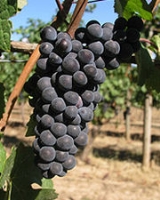
Pinot noir is a red
wineWine is an alcoholic beverage typically made of fermented grape juice. The natural chemical balance of grapes is such that they can ferment without the addition of sugars, acids, enzymes or other nutrients. Wine is produced by fermenting crushed grapes using various types of yeast. Yeast consumes...
grapeA grape is the non-climacteric fruit, botanically a true berry, that grows on the perennial and deciduous woody vines of the genus Vitis. Grapes can be eaten raw or used for making jam, juice, jelly, vinegar, wine, grape seed extracts, raisins, and grape seed oil...
variety of the species
Vitis viniferaFor the town in Australia, see Vinifera, VictoriaVitis vinifera is a species of Vitis, native to the Mediterranean region, central Europe, and southwestern Asia, from Morocco and Spain north to southern Germany and east to northern Iran.It is a liana growing to 35 m tall, with flaky bark...
. The name may also refer to wines produced predominantly from Pinot noir grapes. The name is derived from the
FrenchFrench is a Romance language globally spoken by about 65 million people as a first language , by 50 million as a second language, and by about another 200 million people as an acquired foreign language, with significant speakers in 57 countries. Most native speakers of the language live in France,...
words for "pine" and "black" alluding to the varietals' tightly clustered dark purple pine cone-shaped bunches of fruit.
Pinot noir grapes are grown around the world, mostly in the cooler regions, but the grape is chiefly associated with the Burgundy region of
FranceFrance , officially the French Republic , is a country located in Western Europe, with several overseas islands and territories located on other continents. Metropolitan France extends from the Mediterranean Sea to the English Channel and the North Sea, and from the Rhine to the Atlantic Ocean...
. It is widely considered to produce some of the finest wines in the world, but is a difficult variety to cultivate and transform into wine.
Description
Pinot noir thrives in France's Burgundy region, particularly on the
Côte-d'OrCôte-d'Or is a department in the eastern part of France.- History :Côte-d'Or is one of the original 83 departments created during the French Revolution on March 4, 1790. It was formed from part of the former province of Burgundy.- Geography :...
which has produced some of the world's most celebrated wines for centuries. It is also planted in
AustriaAustria , officially the Republic of Austria , is a landlocked country of roughly 8.3 million people in Central Europe. It borders both Germany and the Czech Republic to the north, Slovakia and Hungary to the east, Slovenia and Italy to the south, and Switzerland and Liechtenstein to the west...
,
ArgentinaArgentina, officially the Argentine Republic , is the second largest country in South America, constituted as a federation of 23 provinces and an autonomous city, Buenos Aires. It is the eighth largest country in the world by land area and the largest among Spanish-speaking nations, though Mexico,...
,
AustraliaAustralia , officially the Commonwealth of Australia, is a country in the Southern Hemisphere comprising the continental mainland , the island of Tasmania, and numerous smaller islands in the Indian and Pacific Oceans...
,
CanadaCanada is a country occupying most of northern North America, extending from the Atlantic Ocean in the east to the Pacific Ocean in the west and northward into the Arctic Ocean...
,
ChileChile, officially the Republic of Chile , is a country in South America occupying a long, narrow coastal strip between the Andes mountains to the east and the Pacific Ocean to the west. It borders Peru to the north, Bolivia to the northeast, Argentina to the east, and the Drake Passage in the far...
, the Republic of Georgia,
GermanyGermany , officially the Federal Republic of Germany , is a country in Central Europe. It is bordered to the north by the North Sea, Denmark, and the Baltic Sea; to the east by Poland and the Czech Republic; to the south by Austria and Switzerland; and to the west by France, Luxembourg, Belgium,...
,
ItalyItaly , officially the Italian Republic , is a country located on the Italian Peninsula in Southern Europe and on the two largest islands in the Mediterranean Sea, Sicily and Sardinia. Italy shares its northern, Alpine boundary with France, Switzerland, Austria and Slovenia...
,
HungaryHungary , in English officially the Republic of Hungary , is a landlocked country in the Carpathian Basin of Central Europe, bordered by Austria, Slovakia, Ukraine, Romania, Serbia, Croatia, and Slovenia. Its capital is Budapest. Hungary is a member of OECD, NATO, EU, V4 and is a Schengen state...
, the
Republic of MacedoniaMacedonia , officially the Republic of Macedonia , is a country in the central Balkan peninsula in southeastern Europe. It is one of the successor states of the former Yugoslavia, from which it declared independence in 1991...
,
MoldovaMoldova , officially the Republic of Moldova is a landlocked country in Eastern Europe, located between Romania to the west and Ukraine to the north, east and south....
,
New ZealandNew Zealand is an island country in the south-western Pacific Ocean comprising two main landmasses , and numerous smaller islands, most notably Stewart Island/Rakiura and the Chatham Islands. The indigenous Māori named New Zealand Aotearoa, commonly translated as The Land of the Long White Cloud...
,
South AfricaThe Republic of South Africa is a country located at the southern tip of Africa, with a coastline on the Atlantic and Indian Oceans. To the north lie Namibia, Botswana and Zimbabwe, to the east are Mozambique and Swaziland, while Lesotho is an independent country surrounded by South Africa.Modern...
,
SerbiaSerbia , officially the Republic of Serbia , is a country located in both Central and Southeastern Europe. Its territory covers the southern part of the Pannonian Plain and central part of the Balkans...
,
SwitzerlandSwitzerland , officially the Swiss Confederation , is a federal republic consisting of 26 states named cantons, with Bern as the seat of the federal authorities...
and
BulgariaBulgaria , officially the Republic of Bulgaria , is a country in the Balkans in south-eastern Europe. Bulgaria borders five other countries: Romania to the north , Serbia and the Republic of Macedonia to the west, and Greece and Turkey to the south...
. The United States has increasingly become a major Pinot noir producer, with some of the best regarded coming from the
Willamette ValleyThe Willamette Valley is the region in northwest Oregon in the United States that surrounds the Willamette River as it proceeds northward from its emergence from mountains near Eugene to its confluence with the Columbia River at Portland. A small part of the Willamette Valley ecoregion is in...
in
OregonOregon is a state in the Pacific Northwest region of the United States. It is located on the Pacific coast, with Washington to the north, California to the south, Nevada on the southeast and Idaho to the east. The Columbia and Snake rivers delineate much of Oregon's northern and eastern...
;
CaliforniaCalifornia is the most populous state in the United States, and the third largest by area. California is the second most populous sub-national entity in the Americas, behind only São Paulo, Brazil...
's Sonoma County with its Russian River Valley and Sonoma Coast appellations, as well as the Central Coast's Santa Lucia Highlands appellation and the
Sta. Rita Hills American Viticultural Area in Santa Barbara County. In New Zealand, it is grown in
MartinboroughMartinborough is a town in South Wairarapa, a district in the Wellington region on the North Island of New Zealand. It is 65 kilometres east of Wellington and 35 kilometres south-west of Masterton...
,
WaiparaWaipara is a small town in north Canterbury, New Zealand, on the banks of the Waipara River.It is at the junction of State Highways 1 and 7 60 kilometres north of Christchurch...
, and
Central OtagoAt latitude 45° south, the Central Otago Wine Region is the most southerly wine producing region in the world. The vineyards are also the highest in New Zealand at 200 to 400 metres above sea level where they cling precariously to the steep slopes of lakesides and the edges of deep river gorges,...
.
The leaves of Pinot noir are generally smaller than those of
Cabernet SauvignonCabernet Sauvignon is one of the world's most widely recognized red wine grape varieties. It is grown in nearly every major wine producing country among a diverse spectrum of climates from Canada's Okanagan Valley to Lebanon's Beqaa Valley...
, but larger than those of Syrah. The grape cluster is small and cylindrical, vaguely shaped like a pine cone. Some viticultural historians believe this shape may have given rise to the name.
Pinot noir tends to produce narrow trunks and branches. In the vineyard it is sensitive to light exposure, cropping levels (it must be low yielding), soil types and pruning techniques. In the winery it is sensitive to fermentation methods, yeast strains and is highly reflective of its
terroirTerroir was originally a French term in wine, coffee and tea used to denote the special characteristics that geography bestowed upon particular varieties. Agricultural sites in the same region share similar soil, weather conditions, and farming techniques, which all contribute to the unique...
with different regions producing very different wines. Its thin skin makes it highly susceptible to
bunch rotBotrytis may refer to:*Botrytis, the anamorphs of fungi of the genus Botryotinia**Botrytis cinerea, a mold important in wine making*Botrytis, the cauliflower cultivar group of Brassica oleracea...
and other fungal diseases. The vines themselves are prone to
downy mildewDowny mildew refers to any of several types of oomycete microbes that are obligate parasites of plants. Downy mildews exclusively belong to Peronosporaceae...
, leaf roll, and
fanleafGrapevine fanleaf virus is a plant pathogenic virus of the family Comoviridae.-External links:**...
. These complications have given the grape the reputation of being difficult to grow:
Jancis RobinsonJancis Mary Robinson OBE, MW is a British wine critic, journalist and editor of wine literature. She currently writes a weekly column for the Financial Times, and writes for her website jancisrobinson.com...
calls Pinot a "minx of a vine" and
André TchelistcheffAndré Tchelistcheff was America's most influential post-Prohibition winemaker. Tchelistcheff is most notable for his contributions toward defining the style of California's best wines, especially Cabernet Sauvignon...
declared that "God made Cabernet Sauvignon whereas the devil made Pinot noir."
However, Pinot wines are among the most popular in the world. Joel Fleischman of
Vanity FairVanity Fair is an American Hollywood magazine of pop culture, fashion, and politics published by Condé Nast Publications. The present Vanity Fair has been published since 1981 and there have been editions for four European countries as well as the U.S. edition...
describes Pinot noir as "the most romantic of wines, with so voluptuous a perfume, so sweet an edge, and so powerful a punch that, like falling in love, they make the blood run hot and the soul wax embarrassingly poetic." Master Sommelier Madeline Triffon calls pinot "sex in a glass". Peter Richardsson of OenoStyle christened it "a seductive yet fickle mistress!"
The tremendously broad range of
bouquetsThe use of wine tasting descriptors allow the taster an opportunity to put into words the aromas and flavors that they experience and can be used in assessing the overall quality of wine...
, flavors, textures and impressions that Pinot noir can produce sometimes confuses tasters. In the broadest terms, the wine tends to be of light to medium body with an aroma reminiscent of black
cherryThe cherry is the fruit of many plants of the genus Prunus. It is a fleshy fruit that contains a single stony seed. The cherry fruits of commerce are usually obtained from a limited number of species, including especially cultivars of the wild cherry, Prunus avium.The name 'cherry', often as the...
,
raspberryThe raspberry is the edible fruit of a multitude of plant species in the subgenus Idaeobatus of the genus Rubus; the name also applies to these plants themselves...
or
currantThe Blackcurrant is a species of Ribes berry native to central and northern Europe and northern Asia. It is also known as French "cassis"....
. Traditional red Burgundy is famous for its fleshy, 'farmyard' aromas, but changing fashions and new easier-to-grow clones have favoured a lighter, fruitier style. The grape's color when young, often compared to that of
garnetThe garnet group includes a group of minerals that have been used since the Bronze Age as gemstones and abrasives. The name "garnet" may come from either the Middle English word gernet meaning 'dark red', or the Latin granatus , possibly a reference to the Punica granatum , a plant with red seeds...
, is often much lighter than that of other red wines. However, an emerging style from California and New Zealand highlights a more powerful, fruit forward and darker wine that can approach syrah in depth.
It is also used in the production of Champagne (usually along with
ChardonnayChardonnay is a green-skinned grape variety used to make white wine. It is believed to have originated in the Burgundy wine region of eastern France but is now grown wherever wine is produced, from England to New Zealand...
and
Pinot meunierPinot Meunier, also known as Meunier, is a variety of black wine grape most noted for being one of the three main grapes used in the production of champagne...
) and is planted in most of the world's wine growing regions for use in both still and sparkling wines. Pinot noir grown for dry table wines is generally low-
yieldingIn agriculture, crop yield is not only a measure of the yield of cereal per unit area of land under cultivation, it is also the seed generation of the plant itself, i.e. one grain of wheat produces a stalk yielding three grain, or 1:3...
and often difficult to grow well. Pinot noir grown for use in sparkling wines (e.g. Champagne) is generally higher yielding.
In addition to being used for the production of sparkling and still red wine, Pinot noir is also sometimes used for
roséA rosé wine has some of the color typical of a red wine, but only enough to turn it pink. The pink color can range from a pale orange to a vivid near-purple, depending on the grapes and wine making techniques.-Skin contact:...
still wines, and even
vin grisVin gris is white wine made from red grapes, in particular pinot noir. Pinot noir is a black grape, but can also be used to make rosé or white wine. When the grapes are brought to the winery and crushed, the juice is run off and removed from contact with the skin, leaving the colour and flavour...
white wines.
History, mutants and clones
Pinot noir is an ancient variety that may be only one or two generations removed from wild vines. The origins of the variety are unclear: In
De re rustica,
ColumellaLucius Iunius Moderatus Columella was a Roman writer. After a career in the army , he took up farming...
describes a grape variety similar to Pinot noir in Burgundy during the 1st century AD, however, vines have grown wild as far north as Belgium in the days before
phylloxeraGrape phylloxera , commonly just called Phylloxera , is a pest of commercial grapevines worldwide, originally native to eastern North America...
, and it is possible that Pinot represents an independent domestication of
Vitis vinifera. The vines of southern France may represent Caucasian stock transported by the ancient Greeks.
Ferdinand Regner has proposed that Pinot noir is a cross between
Pinot meunierPinot Meunier, also known as Meunier, is a variety of black wine grape most noted for being one of the three main grapes used in the production of champagne...
(Schwarzriesling) and Traminer, but this work has not been replicated. In fact
Pinot meunier appears to be a Pinot noir with a mutation in the epidermal cells which makes the shoot tips hairy and the vine a little smaller. This means that Pinot meunier is a
chimeraChimeras in botany are usually single organisms composed of two genetically different types of tissue. They occur in plants, on the same general basis as with animal chimeras...
with two tissue layers of different genetic makeup, one of which is identical to Pinot noir. As such, Pinot meunier cannot be the parent of Pinot noir.
Pinot grisPinot gris is a white wine grape variety of the species Vitis vinifera. Thought to be a mutant clone of the Pinot noir grape, it normally has a grayish-blue fruit, accounting for its name but the grape can have a brownish pink to black and even white appearance...
is a bud sport of Pinot noir, presumably representing a somatic mutation in either the VvMYBA1 or VvMYBA2 genes that control grape colour.
Pinot blancPinot blanc is a white wine grape. It is a point genetic mutation of Pinot noir. Pinot noir is genetically unstable and will occasionally experience a point mutation in which a vine bears all black fruit except for one cane which produced white fruit....
may represent a further mutation of
Pinot grisPinot gris is a white wine grape variety of the species Vitis vinifera. Thought to be a mutant clone of the Pinot noir grape, it normally has a grayish-blue fruit, accounting for its name but the grape can have a brownish pink to black and even white appearance...
. The DNA profiles of both Pinot gris and blanc are identical to Pinot noir; the other two major Pinots,
Pinot moure and
Pinot teinturier, are also genetically very similar.
A more recent white grape sport was propagated in 1936 by Henri Gouges of Burgundy, and there is now 2.5ha planted of this grape which Clive Coates calls
Pinot Gouges, and others call
Pinot Musigny.
Pinot Liébault is a mutant which has higher, more consistent yields than Pinot noir, but retains its oenological qualities. As such it is explicitly mentioned in some Burgundy appellations.
The
Wrotham (pronounced "ruttum")
Pinot is an English variety with white hairs on the upper surface of the leaves, and is particularly resistant to disease. Edward Hyams of Oxted Viticultural Research Station was alerted to a strange vine growing against a cottage wall in
WrothamWrotham is a village situated on the Pilgrims' Way in Kent, at the foot of the North Downs. It is located one mile north of Borough Green and approximately five miles east of Sevenoaks. It is within the junction of the M20 and M26 motorways....
in
KentKent , originally Cantia, is a county in southeast England, and is one of the home counties. It borders East Sussex, Surrey and Greater London and has a defined boundary with Essex in the middle of the River Thames estuary. The ceremonial county boundaries of Kent include the shire county of Kent...
, which local lore said was descended from vines brought over by the Romans. An experimental Blanc de Noir was made at Oxted, and in 1980 Richard Peterson took cuttings to California, where he now makes a pink sparkling Wrotham Pinot. Wrotham Pinot is sometimes regarded as a synonym of Pinot meunier, but it has a higher natural sugar content and ripens two weeks earlier.
Pinot noir appears to be particularly prone to mutation (suggesting it has active
transposable elementsTransposons are sequences of DNA that can move around to different positions within the genome of a single cell, a process called transposition. In the process, they can cause mutations and change the amount of DNA in the genome. Transposons were also once called "jumping genes", and are examples...
?), and has a long history in cultivation, so there are hundreds of different
clonesCloning in biology is the process of producing populations of genetically-identical individuals that occurs in nature when organisms such as bacteria, insects or plants reproduce asexually. Cloning in biotechnology refers to processes used to create copies of DNA fragments , cells , or organisms...
such as Pinot Fin and Pinot Tordu. More than 50 are officially recognized in France compared to only 25 of the much more widely planted
cabernet sauvignonCabernet Sauvignon is one of the world's most widely recognized red wine grape varieties. It is grown in nearly every major wine producing country among a diverse spectrum of climates from Canada's Okanagan Valley to Lebanon's Beqaa Valley...
. The French Etablissement National Technique pour l’Amelioration de la Viticulture (ENTAV) has set up a programme to select the best clones of Pinot. This program has succeeded admirably in increasing the number of quality clones available to growers. Nonetheless, in the new world, particularly in Oregon, wines of extraordinary quality continue to be made from the earlier Pommard and Wadensvil clones.
Gamay BeaujolaisGamay Beaujolais is a varietal designation for a Californian grape variety that is an early ripening clone of Pinot noir.- History :In the late 1930's an early pioneer of the American viticulture, Paul Masson, brought with him several Burgundian grapes for his winery in California...
is an early-ripening clone of Pinot noir. It is used mostly in California but is also seen in New Zealand. It was brought to California by Paul Masson.
Frühburgunder (Pinot Noir Précoce) is an early-ripening grape that is thought to be a clone of Pinot noir - it's possible that the two are the same mutant.
In August 2007, French researchers announced the sequencing of the genome of Pinot noir. It is the first fruit crop to be sequenced, and only the fourth flowering plant.
Crosses
In the Middle Ages, the nobility of northeast France grew some form of Pinot on the slopes above the peasants'
Gouais blancGouais blanc is a white grape variety that is seldom grown but is important as the ancestor of many French and German wine varieties. It is believed to originate in Croatia; in Central Europe it is known as Weißer Heunisch. The name Gouais derives from the old French adjective ‘gou’, a term of...
, a Croatian grape that may have been brought to
GaulGaul is a historical name used in the context of the Roman Empire in references to the region of Western Europe approximating present day France and Belgium, but also sometimes including the Po Valley, western Switzerland, and the parts of the Netherlands and Germany on the west bank of the River...
by the Romans. Much cross-pollination usually resulted from such close proximity, and the genetic distance between the two parents imparted
hybrid vigourHeterosis is a term used in genetics and selective breeding. The term heterosis, also known as hybrid vigor or outbreeding enhancement, describes the increased strength of different characteristics in hybrids; the possibility to obtain a genetically superior individual by combining the virtues of...
leading to many desirable offspring. These include
ChardonnayChardonnay is a green-skinned grape variety used to make white wine. It is believed to have originated in the Burgundy wine region of eastern France but is now grown wherever wine is produced, from England to New Zealand...
,
AligotéAligoté is a white grape used to make dry white wines in the Burgundy region of France, and which also has significant plantings in much of Eastern Europe including Romania, Russia, Ukraine, Moldova and Bulgaria. With , it was the 22nd most planted vine variety in the world in 2004...
,
AuxerroisAuxerrois is a historical province of France. Named after the city of Auxerre in Burgundy, it gives its name to several grape varieties:* Auxerrois Blanc is a white wine grape that is widely grown in Alsace, and also in Lorraine, Germany and Luxembourg...
,
GamayGamay is a purple-colored grape variety used to make red wines, most notably grown in Beaujolais and in the Loire Valley around Tours. Its full name is Gamay Noir à Jus Blanc. It is a very old cultivar, mentioned as long ago as the 1400s...
, Melon and eleven others.
In 1925 Pinot noir was crossed in
South AfricaSouth African wine has a history dating back to 1659, and at one time Constantia was considered one of the greatest wines in the world. Access to international markets has unleashed a burst of new energy and new investment. Production is concentrated around Cape Town, with major vineyard and...
with the
CinsautCinsaut or Cinsault is a red wine grape, whose heat tolerance and productivity make it important in Languedoc-Roussillon and the former French colonies of Algeria and Morocco...
grape (known locally as Hermitage) to create a unique variety called
PinotagePinotage, is a red wine grape that is South Africa's signature variety. It was bred there in 1925 as a cross between Pinot noir and Cinsaut. It typically produces deep red varietal wines with smoky, bramble and earthy flavors, sometimes with notes of bananas and tropical fruit, but has been...
.
Australia
Pinot noir is produced in several wine growing areas of
AustraliaAustralia , officially the Commonwealth of Australia, is a country in the Southern Hemisphere comprising the continental mainland , the island of Tasmania, and numerous smaller islands in the Indian and Pacific Oceans...
, notably in the
Yarra ValleyThe Yarra Valley is the name given to the region surrounding the Yarra River in Victoria, Australia. The river originates in the Yarra Ranges approximately 80 kilometres east of Melbourne and flows towards and into the city of Melbourne and out into Port Phillip...
,
GeelongGeelong is the second largest city in the state of Victoria, Australia and is the largest regional centre in the state. It is a port city with an urban population of 160,991 people, and one of the largest provincial cities in Australia...
, the
Bellarine PeninsulaThe Bellarine Peninsula is a peninsula located south-west of Melbourne in Victoria, Australia, surrounded by Port Phillip, Corio Bay and Bass Strait. The peninsula, together with the Mornington Peninsula separates Port Phillip from Bass Strait...
,
BeechworthBeechworth is a well-preserved historical town located in the north-east of Victoria, Australia, famous for its major growth during the gold rush days of the mid-1850s...
, South
GippslandGippsland is a large rural region in Victoria, Australia. It begins immediately east of the suburbs of Melbourne and stretches to the New South Wales border, lying between the Great Dividing Range to the north and Bass Strait to the south...
,
SunburyPlaces called Sunbury include:Australia*Sunbury, Victoria**Sunbury Downs College**Sunbury Pop Festival Canada*Sunbury County, New BrunswickUnited Kingdom*Sunbury-on-Thames, Surrey, EnglandUnited States*Sunbury, Georgia*Sunbury, Ohio...
and
Mornington PeninsulaThe Mornington Peninsula is a peninsula located south-east of Melbourne in Central Victoria, Australia. It is surrounded by Port Phillip to the west, Western Port to the east and Bass Strait to the south, and is connected to the mainland in the north. Geographically, the peninsula begins its...
in Victoria,
Adelaide HillsThe Adelaide Hills are part of the Mount Lofty Ranges, east of the city of Adelaide in the state of South Australia. It is unofficially centred on the largest town in the area, Mount Barker, which has a population of around 9,000 people and which is also one of Australia's fastest growing towns.-...
in
South AustraliaSouth Australia is a state of Australia in the southern central part of the country. It covers some of the most arid parts of the continent; with a total land area of , it is the fourth largest of Australia's six states and two territories....
, Great Southern Wine Region in
Western AustraliaWestern Australia is a state of Australia, occupying the entire western third of the Australian continent. Australia's largest state and the second largest subnational entity in the world, it has 2.2 million inhabitants , 85% of whom live in the south-west corner of the state.The state's capital...
and
TasmaniaTasmania is an Australian island and state. It is located south of the eastern side of the continent, from which it is separated by Bass Strait. The state includes the island of Tasmania – the 26th largest island in the world – and the surrounding islands. The state has a population of 500,000 ,...
.
Austria
In Austria, Pinot noir is sometimes called
Blauburgunder (literally Blue Burgundy) and produced in
BurgenlandBurgenland is the easternmost and least populous state or Land of Austria. It consists of two Statutarstädte and seven districts with in total 171 municipalities...
and
Lower AustriaLower Austria is the northeast state of the nine states or Bundesländer in Austria. The capital of Lower Austria since 1986 is Sankt Pölten , but formerly, the capital of Lower Austria was Vienna, even though Vienna is not properly part of Lower Austria...
. Austrian Pinot noir wines are dry red wines similar in character to the red wines of Burgundy, mostly aged in French barriques. Some of the best Austrian Pinots come from Neusiedlersee and Blaufraenkischland, (Burgenland) and Thermenregion (Lower Austria).
Canada
Quality Pinot noir has been grown in Ontario for some time in the
Niagara PeninsulaThe Niagara Peninsula is the portion of Southern Ontario, Canada lying between the south shore of Lake Ontario and the north shore of Lake Erie. It stretches from the Niagara River in the east to Hamilton, Ontario in the west. The population of the peninsula is roughly 1,000,000 people...
and especially the
Short Hills BenchThe Short Hills Bench sub-appellation of the Niagara Peninsula .-Flora and fauna:A Carolinian Climatic Zone, the Short Hills Bench has been acknowledged for its unique soils, topography and climate by the governing body of wine production, the Vintners Quality AllianceOntario and by the United...
wine region, as well as on the north shore of
Lake ErieLake Erie is the fourth largest lake of the five Great Lakes in North America, and the thirteenth largest globally. It is the southernmost, shallowest, and smallest by volume of the Great Lakes and therefore also has the shortest average water residence time. It is bounded on the north by the...
. It has also been grown recently in the Okanagan,
Lower MainlandThe Lower Mainland is a name commonly applied to the region surrounding Vancouver, British Columbia, Canada. In 2007, 2,524,113 people live in the region; sixteen of the province's thirty most populous municipalities are located there....
, and
Vancouver IslandVancouver Island is a large island in British Columbia, Canada, one of several North American regions named after George Vancouver, the British Royal Navy officer who explored the Pacific coast of North America between 1791 and 1794....
wine regions of
British ColumbiaBritish Columbia is the westernmost of Canada's provinces and is famed for its natural beauty, as reflected in its Latin motto, Splendor sine occasu . In 1871, it became the sixth province of Canada.The capital of British Columbia is Victoria, the 15th largest metropolitan region in Canada...
and the
Annapolis ValleyThe Annapolis Valley is a valley in the Canadian province of Nova Scotia. It is located in the western part of the Nova Scotia peninsula, formed by a trough between two parallel mountain ranges along the shore of the Bay of Fundy.-Geography:...
region of
Nova ScotiaNova Scotia is a Canadian province located on Canada's southeastern coast. It is the most populous province in Atlantic Canada. Its capital, Halifax, is a major economic centre of the region. Nova Scotia is the second-smallest province in Canada with an area of...
.
UK
Pinot noir is increasingly being planted in the U.K., mostly for use in sparkling wine blends such as Nyetimber. It is sometimes made into a fairly light still red or rose wine, in the style of Alsace, Chapel Down are particular keen on it. The U.K. can claim an indigenous Pinot variety in the Wrotham Pinot (see above).
France
Pinot noir has made France's
BurgundyBurgundy wine is wine made in the Burgundy region in eastern France. The most famous wines produced here - those commonly referred to as Burgundies - are red wines made from Pinot Noir grapes or white wines made from Chardonnay grapes. Red and white wines are also made from other grape varieties,...
appellationAn appellation is a geographical indication used to identify where the grapes for a wine were grown. Restrictions other than geographical boundaries, such as what grapes may be grown, maximum grape yields, alcohol level, and other quality factors, may also apply before an appellation name may...
famous, and vice-versa. Many wine historians, including John Winthrop Haeger and Roger Dion, believe that the association between pinot and Burgundy was the explicit strategy of Burgundy's
ValoisValois is a district, in the city of Pointe-Claire, Quebec, Canada. It was once a separate village, many years ago, but was then merged with Pointe-Claire....
dukes. Roger Dion, in his thesis regarding
Philip the BoldPhilip the Bold can refer to:* Philip the Bold, also known as Philip II Duke of Burgundy * Philip III of France...
's role in promoting the spread of Pinot noir, holds that the reputation of
BeauneBeaune is a commune in eastern France, a sub-prefecture of the Côte-d'Or department in the Bourgogne region.-Wine:The area around Beaune, the Côte de Beaune, is known for its Burgundy wines, with Beaune as the hub of the local wine business...
wines as "the finest in the world" was a propaganda triumph of Burgundy's Valois dukes. In any event, the worldwide archetype for Pinot noir is that grown in
BurgundyBurgundy wine is wine made in the Burgundy region in eastern France. The most famous wines produced here - those commonly referred to as Burgundies - are red wines made from Pinot Noir grapes or white wines made from Chardonnay grapes. Red and white wines are also made from other grape varieties,...
where it has been cultivated since AD100.
Burgundy's Pinot noir produces great wines which can age very well in good years, developing floral flavours as they age, often reaching peak 15 or 20 years after the vintage. Many of the wines are produced in very small quantities and can be very expensive.
Today, the celebrated Côte d’Or area of Burgundy has about 4,500 hectares (11,000 acres) of Pinot noir. Most of the region's finest wines are produced from this area. The Côte Chalonnaise and Mâconnais regions in southern Burgundy have another 4,000 hectares (10,000 acres).
In
Jura départementJura is a department in the east of France named after the Jura mountains.- History :Historically, Jura belonged to the Free County of Burgundy, known in French as the Franche-Comté. Dole was the capital until the region was conquered by Louis XIV and it was moved to Besançon...
, across the river valley from Burgundy, the wines made from Pinot noir are lighter.
In Champagne it used in blending with
ChardonnayChardonnay is a green-skinned grape variety used to make white wine. It is believed to have originated in the Burgundy wine region of eastern France but is now grown wherever wine is produced, from England to New Zealand...
and
Pinot meunierPinot Meunier, also known as Meunier, is a variety of black wine grape most noted for being one of the three main grapes used in the production of champagne...
. It can also appear unblended, in which case it may be labeled
blanc de noirs. The Champagne appellation has more Pinot planted than any other area of France.
In
SancerreSancerre is a medieval hilltop town , commune and canton in the Cher department of central France overlooking the Loire River. It is noted for its wine.-History:...
it is used to make red and
roséA rosé wine has some of the color typical of a red wine, but only enough to turn it pink. The pink color can range from a pale orange to a vivid near-purple, depending on the grapes and wine making techniques.-Skin contact:...
wines, much lighter in style that those of Burgundy, refreshing served chilled, especially in warmer years when they are less thin.
In
AlsaceAlsace wine or Alsatian wine is produced in the Alsace region in France and is primarily white. These wines, which for historical reasons have a strong Germanic influence, are produced under three different Appellation d'Origine Contrôlées : Alsace AOC for white, rosé and red wines, Alsace Grand...
it is generally used to make
roséA rosé wine has some of the color typical of a red wine, but only enough to turn it pink. The pink color can range from a pale orange to a vivid near-purple, depending on the grapes and wine making techniques.-Skin contact:...
wines. However, it is also used to make genuine red wines usually called Pinot noir rouge, which are similar in character to red Burgundy and Beaujolais wines but are consumed chilled. Prominent examples are Rouge de Barr and Rouge d'Ottrott. Pinot noir rouge is the only red wine produced in Alsace.
Germany
In
GermanyGerman wine is primarily produced in the southwest of Germany, along river Rhine and its tributaries, with the oldest plantations going back to the Roman era. Approximately 60 per cent of the German wine production is situated in the federal state of Rhineland-Palatinate, where 6 of the 13 regions ...
it is called
Spätburgunder, and is now the most widely planted red grape. Historically much German wine produced from Pinot noir was pale, often
roséA rosé wine has some of the color typical of a red wine, but only enough to turn it pink. The pink color can range from a pale orange to a vivid near-purple, depending on the grapes and wine making techniques.-Skin contact:...
like the red wines of
AlsaceAlsace is the fourth-smallest of the 26 regions of France in land area , and the smallest in metropolitan France. It is also the sixth-most densely populated region in France , with 222 inhabitants per km²...
. However recently, despite the northerly climate, darker, richer reds have been produced, often barrel (barrique) aged, in regions such as
BadenBaden is a historical state on the east bank of the Rhine River in the southwest of Germany, now the western part of the Baden-Württemberg of Germany....
,
PalatinatePalatinate is a German wine-growing region in the area of Bad Dürkheim, Neustadt an der Weinstraße, and Landau in Rhineland-Palatinate. Before 1993, it was known as Rhine Palatinate . With under cultivation in 2006, the region is the second largest wine region in Germany after Rheinhessen...
(Pfalz) and
AhrThe Ahr is a river in Germany, a left tributary of the Rhine. Its source is at a height of approximately 470 meters above sea level in Blankenheim in the Eifel, in the cellar of a half-timbered house near the castle of Blankenheim...
. These are rarely exported and are often very expensive in Germany for the better examples. As "Rhenish", German Pinot noir is mentioned several times in Shakesperean plays as a highly prized wine.
There is also a smaller-berried, early ripening, lower yield variety called Frühburgunder (Pinot noir précoce) which is grown in
RheinhessenRhenish Hesse refers to the part of the former Grand Duchy of Hesse-Darmstadt located west of the Rhine river and now part of Rhineland-Palatinate. It is a hilly countryside largely devoted to vineyards, therefore it is also called the "land of the thousand hills." Its larger towns include:...
and
AhrThe Ahr is a river in Germany, a left tributary of the Rhine. Its source is at a height of approximately 470 meters above sea level in Blankenheim in the Eifel, in the cellar of a half-timbered house near the castle of Blankenheim...
area and can produce very good wines.
Italy
In Italy, where Pinot noir is known as
Pinot nero, it has traditionally been cultivated in the Alto Adige, Collio Goriziano, Oltrepò Pavese and Trentino regions to produce Burgundy-style red wines. Cultivation of Pinot noir in other regions of Italy, mostly since the 1980s, has been challenging due to climate and soil conditions.
In
Alto Adige (called also
Südtirol or historically Tirol) the variety is first noted 1838 as "Bourgoigne noir" in an grape wine buy list of the "k.u.k. Landwirtschafts-Gesellschaft von Tirol und Vorarlberg, Niederlassung Bozen" and later called "Blauburgunder" like in Austria. The first analytical descriptions are from Edmund Mach (founder of
Ist. Agr. San Michele a.A.) in the year 1894: Friedrich Boscarolli - Rametz/Meran - Rametzer Burgunder 1890, Chorherrenstift Neustift - Blauburgunder 1890, R.v.Bressendorf - Vernaun/Meran - Burgunder 1890, C.Frank - Rebhof Gries Bozen - Burgunder 1889, Fr. Tschurtschenthaler - Bozen - Burgunder 1890 & 1891, Fr. Tschurtschenthaler - Bozen - Kreuzbichler 1889 & 1891 & 1887. Today very small quantities from certain micro-zones (Mazon/Neumarkt, Buchholz, Eppan Berg, Vinschgau) are regularly on the top of Italian Pinot nero degustations. See for example the
Pinot nero days
Moldova
Large amounts of Pinot were planted in central
MoldovaMoldova has a well established wine industry. It has a vineyard area of ., of which are used for commercial production. Most of the country's wine production is for export...
during the 19th century, but much was lost to the ravages of
phylloxeraGrape phylloxera , commonly just called Phylloxera , is a pest of commercial grapevines worldwide, originally native to eastern North America...
; Soviet control of Moldova from 1940 to 1991 also reduced the productivity of vineyards. Quality is somewhat variable; Moldovan Pinot can be overoaked and rather rough.
New Zealand
Pinot noir is a grape variety whose importance in New Zealand is greater than the weight of planting. Early in the modern wine industry (late 1970s early 1980s), the comparatively low annual sunshine hours to be found in NZ discouraged the planting of red varieties. But even at this time great hopes were had for Pinot noir (see
Romeo BragatoRomeo Alessandro Bragato played a significant role in the early development of the wine industry in New Zealand.-Early Life and Career:...
). Initial results were not promising for several reasons, including the mistaken planting of Gamay , and the limited number of Pinot noir clones available for planting. However in recent years Pinot noir from Martinborough and Central Otago has won numerous international awards and accolations making it one of New Zealand's most sought-after varieties.
Historically, one notable exception was the St Helena 1984 Pinot noir from the
CanterburyThe New Zealand region of Canterbury is mainly composed of the Canterbury Plains and the surrounding mountains. Its main city, Christchurch, hosts the main office of the Christchurch City Council, the Canterbury Regional Council and the University of Canterbury.- Geography :Canterbury is New...
region. This led to the belief for a time that Canterbury might become the natural home for Pinot noir in New Zealand. While the early excitement passed, the Canterbury region has witnessed the development of Pinot noir as the dominant red variety. The next region to excel with Pinot noir was
MartinboroughMartinborough is a town in South Wairarapa, a district in the Wellington region on the North Island of New Zealand. It is 65 kilometres east of Wellington and 35 kilometres south-west of Masterton...
on the southern end of the North Island. The moderate climate and long growing season gives wines of great intensity and complexity. In the 2000s, other sub-regions in the
WairarapaThe Wairarapa is a geographical region of New Zealand. It occupies the south-eastern corner of the North Island, east of metropolitan Wellington and south-west of the Hawke's Bay region. It is lightly populated, having several rural service towns, with Masterton being the largest...
have been developed to the north of
MartinboroughMartinborough is a town in South Wairarapa, a district in the Wellington region on the North Island of New Zealand. It is 65 kilometres east of Wellington and 35 kilometres south-west of Masterton...
.
At around this time the first plantings of Pinot noir in
Central OtagoAt latitude 45° south, the Central Otago Wine Region is the most southerly wine producing region in the world. The vineyards are also the highest in New Zealand at 200 to 400 metres above sea level where they cling precariously to the steep slopes of lakesides and the edges of deep river gorges,...
occurred in the Kawarau Gorge. Central Otago had a long (for New Zealand) history as a producer of quality stone fruit and particularly cherries. Significantly further south than all other wine regions in New Zealand, it had been overlooked despite a long history of grape growing. However, it benefited from being surrounded by mountain ranges which increased its temperature variations both between seasons and between night and day making the climate unusual in the typically maritime conditions in New Zealand.
The first vines were planted using holes blasted out of the north facing schist slopes of the region, creating difficult, highly marginal conditions. The first results coming in the mid to late 1990s excited the interest of British wine commentators, including Jancis Robinson and Oz Clarke. The latest sub-region appears to be Waitaki, on the border between Otago and Canterbury.
A recent blind tasting of New Zealand Pinot noir featured in Cuisine magazine (issue 119), Michael Cooper reported that of the top ten wines, five came from Central Otago, four from Marlborough and one from Waipara. This compares with all top ten wines coming from Marlborough in an equivalent blind tasting from last year. Cooper suggests that this has to do with more Central Otago production becoming available in commercial quantities, than the relative qualities of the regions' Pinot noir. In addition, as the industry has matured, many of the country's top producers have made the decision to no longer submit their wines to reviews or shows.
As is the case for other New Zealand wine, New Zealand Pinot noir is fruit-driven, forward and early maturing in the bottle. It tends to be quite full bodied (for the variety), very approachable and oak maturation tends to be restrained. High quality examples of New Zealand Pinot noir, particularly from the Martinborough region, are distinguished by savoury, earthy flavours with a greater complexity.
Spain
Pinot noir has recently been produced in small amounts in
Lleida provinceLleida is a province of north-eastern Spain, in the western part of the autonomous community of Catalonia. It is bordered by the provinces of Girona, Barcelona, Tarragona, Zaragoza and Huesca and the countries of France and Andorra....
,
CataloniaCatalonia is an Autonomous Community in northeast Spain. The capital city is Barcelona.Catalonia covers an area of 32,114 km² and has an official population of 7,364,078. It borders France and Andorra to the north, Aragon to the west, the Valencian Community to the south, and the...
, under the
appellationAn appellation is a geographical indication used to identify where the grapes for a wine were grown. Restrictions other than geographical boundaries, such as what grapes may be grown, maximum grape yields, alcohol level, and other quality factors, may also apply before an appellation name may...
"
Costers del SegreCosters del Segre is a Spanish Denominación de Origen for wines located in the province of Lleida and is divided into several separate sub-zones. The four original subzones created in 1988 are Artesa, to the northeast of Lleida, Valls de Riucorb to the east, Garrigues and Raimat...
"
DODenominación de Origen is part of a regulatory classification system primarily for Spanish wines but also for other foodstuffs like honey, meats and condiments. In wines it parallels the hierarchical system of France and Italy although Rioja and Sherry preceded the full system...
.
Switzerland
Pinot noir is a popular grape variety all over Switzerland. In German speaking regions of Switzerland it is often called Blauburgunder. Pinot noir wines are produced in Neuchâtel, Schaffhausen, St. Gallen and Bündner Herrschaft. Neuchâtel, across the border from Burgundy, is renowned for its Pinot noir, a full bodied dry red wine. In Valais, Pinot noir is blended with Gamay to produce the well known Dôle.
United States
By volume most Pinot noir in America is grown in California with Oregon coming in second. Other regions are Washington State, Michigan and New York. New York state red wines,
http://www.news.cornell.edu/chronicle/98/2.5.98/resveratrol.html,
have higher levels of
resveratrolResveratrol is a phytoalexin produced naturally by several plants when under attack by pathogens such as bacteria or fungi. Resveratrol has also been produced by chemical synthesis and is sold as a nutritional supplement derived primarily from Japanese knotweed...
—a naturally occurring substance in grapes that is believed to reduce the chance of heart disease and cancer—than comparable wines from other regions of the world, according to Leroy Creasy, professor of fruit and vegetable science.
California wine regions known for producing Pinot noir are:
- Sonoma Coast
- Russian River Valley
The Russian River is a southward-flowing river in the Northern California counties of Mendocino and Sonoma.-Course:The Russian River springs from the Laughlin Range about east of Willits in Mendocino County. It flows generally southward to Redwood Valley, then parallels U.S...
- Central Coast
- Sta. Rita Hills
- Monterey County / Santa Lucia Highlands
The Santa Lucia Mountains or Santa Lucia Range is a mountain range in coastal California, running from Monterey southeast for 105 miles to San Luis Obispo. The highest summit is Junipero Serra Peak, in Monterey County...
- Santa Cruz Mountains http://www.scmwa.com
- Carneros District of Napa
Napa Valley AVA is an American Viticultural Area located in Napa County, California, USA. Napa Valley is considered one of the top wine regions in the United States and the world, with a history dating back to the nineteenth century. The combination of Mediterranean climate, geography and...
and SonomaSonoma Valley is the birthplace of the California wine industry and often called The Valley of the Moon. Sonoma Valley is home to some of the earliest vineyards and wineries in the state, some of which survived the phylloxera epidemic of the 1870s and the impact of Prohibition...
- Anderson Valley
Anderson Valley is a sparsely populated region in western Mendocino County in Northern California. Located approximately 100 miles north of San Francisco, the name "Anderson Valley" applies broadly to several rural, unincorporated communities in or near the alluvial terraces along Anderson Creek...
- Livermore Valley
The Livermore Valley AVA is an American Viticultural Area in Alameda County, California, surrounding the city of Livermore in the Tri-Valley region. Both the AVA and the city are named after Robert Livermore, a landowner whose holdings encompassed the valley. The groundwater basin underlying the...
- San Luis Obispo County/Arroyo Grande Valley, Edna Valley http://www.slowine.com/cm/Home.html
Oregon wine regions known for producing Pinot noir:
Oregon Pinot noir pioneer
David LettDavid Lett was the founder and winemaker for The Eyrie Vineyards in the U.S. state of Oregon. He was a pioneer in the Oregon wine industry.Lett grew up in Utah and studied dentistry in California...
of
Eyrie VineyardsThe Eyrie Vineyards is an American winery in Oregon that consists of in several different vineyards in the Willamette Valley. The vineyards and winery were established by owner and winemaker David Lett, who produced the first Pinot gris in the United States...
first planted Pinot noir in Oregon in 1965, and several other growers followed suit throughout the 1970s. In 1979, Lett took his wines to a competition in Paris, known in English as the
Wine OlympicsA Wine Olympics was organized by the French food and wine magazine GaultMillau in 1979; a total of 330 wines from 33 countries were evaluated by 62 experts from ten nationalities. The 1976 Trefethen Vineyards Chardonnay from the Napa Valley won the Chardonnay tasting and was judged best in the...
, and they placed third among pinots. In a 1980 rematch arranged by French wine magnate Robert Drouhin, the Eyrie vintage improved to second place. The competition instantly put Oregon on the map as a world class Pinot noir producing region.
The
Willamette ValleyThe Willamette Valley AVA , is an American Viticultural Area which lies in the Willamette Valley of Oregon. The AVA is the wine growing region which encompasses the drainage basin of the Willamette River...
of Oregon is at the same latitude as the Burgundy region of France, and has a similar climate in which the finicky Pinot noir grapes thrive. In 1987, Drouhin purchased land in the Willamette Valley, and in 1989 built Domaine Drouhin Oregon, a state-of-the-art, gravity-fed winery. Throughout the 1980s, the
Oregon wine industryThe state of Oregon in the United States has established an international reputation for its production of wine. Oregon has several different growing regions within the state's borders which are well-suited to the cultivation of grapes; additional regions straddle the border between Oregon and the...
blossomed.
In general, "New York's relatively humid climate explains the higher concentrations of resveratrol in the wines," Creasy said. "Resveratrol is a natural fungicide, and the more humid the climate, the more is produced to combat mildew. During the long contact between the grape skins and the juice in producing red wines, the resveratrol is transferred into the wine.
http://www.news.cornell.edu/chronicle/98/2.5.98/resveratrol.html In recent times, wineries in New York State have come to be known for their Pinot noir, in particular the
Niagara Escarpment AVAThe Niagara Escarpment AVA is an American Viticultural Area in the New York state portion of the Niagara Escarpment. The area was officially recognized as an AVA on October 11th, 2005, by ruling of the United States Department of the Treasury Alcohol and Tobacco Tax and Trade Bureau...
and Warm Lake
Estate. The latter, in
Lockport, New YorkLockport, New York can refer to either:*Lockport , New York, in Niagara County, NY.*Lockport , New York, which surrounds the city....
, is recognized in the
The Oxford Companion to WineThe Oxford Companion to Wine is a book in the series of Oxford Companions published by Oxford University Press. The book provides an alphabetically arranged reference to wine, compiled and edited by Jancis Robinson, with contributions by several wine writers including Hugh Johnson, Michael...
and
has been awarded the highest ratings in New York State
of any Pinot noir with its of Pinot noir being the largest continuous
planting east of the
Rocky MountainsThe Rocky Mountains are a major mountain range in western North America. The Rocky Mountains stretch more than from the northernmost part of British Columbia, in Canada, to New Mexico, in the United States. The range's highest peak is Mount Elbert in Colorado at above sea level...
.
Recent popularity
During 2004 and the beginning of 2005, Pinot noir became considerably more popular amongst consumers in the
United States of AmericaThe United States of America is a federal constitutional republic comprising fifty states and a federal district...
,
AustraliaAustralia , officially the Commonwealth of Australia, is a country in the Southern Hemisphere comprising the continental mainland , the island of Tasmania, and numerous smaller islands in the Indian and Pacific Oceans...
,
New ZealandNew Zealand is an island country in the south-western Pacific Ocean comprising two main landmasses , and numerous smaller islands, most notably Stewart Island/Rakiura and the Chatham Islands. The indigenous Māori named New Zealand Aotearoa, commonly translated as The Land of the Long White Cloud...
and
AsiaAsia is the world's largest and most populous continent, located in the eastern and northern hemispheres. It covers 8.6% of the earth's total surface area and with approximately 4 billion people, it hosts 60% of the world's current human population.Asia is traditionally defined as part of the...
possibly because of the movie
SidewaysSideways is a 2004 American comedy-drama film written by Jim Taylor and Alexander Payne and directed by Payne. Adapted from Rex Pickett's 2004 novel, Sideways follows two forty-something men, portrayed by Paul Giamatti and Thomas Haden Church, who take a week-long road trip to the wine country of...
. Being lighter in style, it has benefited from a trend toward more restrained, less alcoholic wines being at or around 12% alcohol by volume.
Robert ParkerRobert M. Parker, Jr. is a leading U.S. wine critic with an international influence. His wine ratings on a 100-point scale and his florid tasting notes, published in his newsletter The Wine Advocate, define modern American wine criticism and are a major factor in setting the prices for...
has described Pinot noir in
Parker's Wine Buying Guide:
- "When it's great, Pinot noir produces the most complex, hedonistic, and remarkably thrilling red wine in the world..."
See also
- Burgundy wine
Burgundy wine is wine made in the Burgundy region in eastern France. The most famous wines produced here - those commonly referred to as Burgundies - are red wines made from Pinot Noir grapes or white wines made from Chardonnay grapes. Red and white wines are also made from other grape varieties,...
- Russian River Valley AVA
The Russian River Valley AVA is an American Viticultural Area in Sonoma County, California. Centered around the Russian River, the Russian River Valley AVA accounts for about one-sixth of the total planted vineyard acreage in Sonoma County. The appellation was granted AVA status in 1983 and...
- Willamette Valley AVA
The Willamette Valley AVA , is an American Viticultural Area which lies in the Willamette Valley of Oregon. The AVA is the wine growing region which encompasses the drainage basin of the Willamette River...
- International variety
An International variety is a grape variety that is widely planted in most of the major wine producing regions and has widespread appeal and consumer recognition. These are grapes that are highly likely to appear on wine labels as varietal wines and are often considered benchmarks for emerging wine...
External links