
The
United Nations Security Council "power of veto" refers to the
vetoA veto, Latin for "I forbid", is the power of an officer of the state to unilaterally stop an official action, especially enactment of a piece of legislation...
power wielded solely by the five permanent members of the
United NationsThe United Nations is an international organization whose stated aims are facilitating cooperation in international law, international security, economic development, social progress, human rights, and achievement of world peace...
Security CouncilThe United Nations Security Council is one of the principal organs of the United Nations and is charged with the maintenance of international peace and security. Its powers, outlined in the United Nations Charter, include the establishment of peacekeeping operations, the establishment of...
(
ChinaChina , officially the People's Republic of China , is the most populous country in the world, with over 1.3 billion citizens. Located in East Asia, the country covers approximately 9.6 million square kilometres...
,
FranceThe French Republic , The French Republic , The French Republic , (commonly known as France , is a unitary semi-presidential republic in Western Europe with several overseas territories and islands located on other continents and in the Indian, Pacific, and Atlantic oceans. Metropolitan France...
,
RussiaRussia or , officially known as both Russia and the Russian Federation , is a country in northern Eurasia. It is a federal semi-presidential republic, comprising 83 federal subjects...
,
United KingdomThe United Kingdom of Great Britain and Northern IrelandIn the United Kingdom and Dependencies, other languages have been officially recognised as legitimate autochthonous languages under the European Charter for Regional or Minority Languages...
, and
United StatesThe United States of America is a federal constitutional republic comprising fifty states and a federal district...
), enabling them to prevent the adoption of any "substantive" draft Council resolution, regardless of the level of international support for the draft. The veto does not apply to procedural votes, which is significant in that the Security Council's permanent membership can vote against a "procedural" draft resolution, without necessarily blocking its adoption by the Council.
The veto is exercised when any permanent member—the so-called "P5"—casts a "negative" vote on a "substantive" draft resolution. Abstention or absence from the vote by a permanent member does
not prevent a draft resolution from being adopted.
Origins of the veto provision
The idea of states having a veto over the actions of international organizations was not new in 1945. From the foundation of the
League of NationsThe League of Nations was an intergovernmental organization founded as a result of the Paris Peace Conference that ended the First World War. It was the first permanent international organization whose principal mission was to maintain world peace...
in 1920, each member of the League Council, whether permanent or non-permanent, had a veto on any non-procedural issue. From 1920 there were 4 permanent and 4 non-permanent members, but by 1936 the number of non-permanent members had increased to 11. Thus there were in effect 15 vetoes. This was one of several defects of the League that made action on many issues impossible.
The UN Charter provision for unanimity among the Permanent Members of the Security Council (the veto) was the result of extensive discussion, including at Dumbarton Oaks (August–October 1944) and Yalta (February 1945). The evidence is that the UK, US, USSR, and France all favoured the principle of unanimity, and that they were motivated in this not only by a belief in the desirability of the major powers acting together, but also by a hard-headed concern to protect their own sovereign rights and national interest. Truman, who became President of the US in April 1945, went so far as to write in his memoirs: "All our experts, civil and military, favored it, and without such a veto no arrangement would have passed the Senate."
The UNSC veto system was established in order to prohibit the UN from taking any future action directly against its principal founding members. One of the lessons of the
League of NationsThe League of Nations was an intergovernmental organization founded as a result of the Paris Peace Conference that ended the First World War. It was the first permanent international organization whose principal mission was to maintain world peace...
(1919–46) had been that an international organization cannot work if all the major powers are not members. The expulsion of the
Soviet UnionThe Soviet Union , officially the Union of Soviet Socialist Republics , was a constitutionally socialist state that existed in Eurasia between 1922 and 1991....
from the
League of NationsThe League of Nations was an intergovernmental organization founded as a result of the Paris Peace Conference that ended the First World War. It was the first permanent international organization whose principal mission was to maintain world peace...
in December 1939, following its November 1939 attack on Finland soon after the outbreak of
World War IIWorld War II, or the Second World War , was a global conflict lasting from 1939 to 1945, involving most of the world's nations—including all of the great powers—eventually forming two opposing military alliances: the Allies and the Axis...
, was just one of many events in the League's long history of incomplete membership.
It had already been decided at the UN's founding conference in 1944, that
BritainThe United Kingdom of Great Britain and Northern IrelandIn the United Kingdom and Dependencies, other languages have been officially recognised as legitimate autochthonous languages under the European Charter for Regional or Minority Languages...
,
ChinaThe Republic of China , commonly known as Taiwan , is a unitary sovereign state located in East Asia. Originally based in mainland China, the Republic of China currently governs the island of Taiwan , which forms over 99% of its current territory, as well as Penghu, Kinmen, Matsu and other minor...
, the
Soviet UnionThe Soviet Union , officially the Union of Soviet Socialist Republics , was a constitutionally socialist state that existed in Eurasia between 1922 and 1991....
, the
United StatesThe United States of America is a federal constitutional republic comprising fifty states and a federal district...
and, "in due course"
FranceThe French Republic , The French Republic , The French Republic , (commonly known as France , is a unitary semi-presidential republic in Western Europe with several overseas territories and islands located on other continents and in the Indian, Pacific, and Atlantic oceans. Metropolitan France...
, should be the permanent members of any newly formed Council. France had been defeated and occupied by
GermanyNazi Germany , also known as the Third Reich , but officially called German Reich from 1933 to 1943 and Greater German Reich from 26 June 1943 onward, is the name commonly used to refer to the state of Germany from 1933 to 1945, when it was a totalitarian dictatorship ruled by...
(1940–44), but its role as a permanent member of the
League of NationsThe League of Nations was an intergovernmental organization founded as a result of the Paris Peace Conference that ended the First World War. It was the first permanent international organization whose principal mission was to maintain world peace...
, its status as a colonial power and the activities of the
Free French forcesThe Free French Forces were French partisans in World War II who decided to continue fighting against the forces of the Axis powers after the surrender of France and subsequent German occupation and, in the case of Vichy France, collaboration with the Germans.-Definition:In many sources, Free...
on the allied side allowed it a place at the table with the other four.
Article 27
Article 27 of the
United Nations CharterThe Charter of the United Nations is the foundational treaty of the international organization called the United Nations. It was signed at the San Francisco War Memorial and Performing Arts Center in San Francisco, United States, on 26 June 1945, by 50 of the 51 original member countries...
states:
- Each member of the Security Council shall have one vote.
- Decisions of the Security Council on procedural matters shall be made by an affirmative vote of nine members.
- Decisions of the Security Council on all other matters shall be made by an affirmative vote of nine members including the concurring votes of the permanent members; provided that, in decisions under Chapter VI, and under paragraph 3 of Article 52, a party to a dispute shall abstain from voting.
Although the "power of veto" is not explicitly mentioned in the UN Charter, the fact that "substantive" decisions by the UNSC require "the concurring votes of the permanent members", means that any of those permanent members can prevent the adoption, by the Council, of any draft resolutions on "substantive" matters. For this reason, the "power of veto" is also referred to as the principle of "
great PowerA great power is a nation or state that has the ability to exert its influence on a global scale. Great powers characteristically possess military and economic strength and diplomatic and cultural influence which may cause small powers to consider the opinions of great powers before taking actions...
unanimity".
The experience of the veto power
The actual use of the veto, and the constant possibility of its use, have been central features of the functioning of the Security Council throughout the UN's history. In the period from 1945 to the end of 2009, 215 resolutions on substantive issues were vetoed, sometimes by more than one of the Permanent Five. The average number of vetoes cast each year to 1989 was over five: since then the average annual number has been just above one.
The figures reflect the fact that a Permanent Member of the Security Council can avoid casting a veto if the proposal in question does not in any event obtain the requisite majority. In the first two decades of the UN, the Western states were frequently able to defeat resolutions without actually using the veto; and the Soviet Union was in this position in the 1970s and 1980s. Use of the veto has reflected a degree of diplomatic isolation of the vetoing state(s) on the particular issue. Because of the use or threat of the veto, the Security Council could at best have a limited role in certain wars and interventions in which its Permanent Members were involved – for example in Algeria (1954–62); Suez (1956), Hungary (1956), Vietnam (1946–75), the Sino-Vietnamese war (1979), Afghanistan (1979–88), Panama (1989), Iraq (2003), and Georgia (2008).
Not all cases of UN inaction in crises have been due to actual use of the veto. For example, re the Iran–Iraq war of 1980–88 there was no use of the veto, but the UN role was minimal except in its concluding phase. Likewise the limited involvement of the UN in the crisis in the Darfur region of Sudan from 2003 onwards was not due to any actual use of the veto. A general lack of willingness to act was the main problem.
Since 1990 the veto has been used sparingly. The period from 31 May 1990 to 11 May 1993 was the longest without use of the veto in the history of the UN. Up till the end of 1989 the number of resolutions passed by the Security Council had been 646 – an average of about 15 per annum. The figures for the years since then show a peak of Security Council activism in 1993, followed by a modest degree of retrenchment.
In 1950 the Soviet Union missed one important opportunity to exercise its veto power. The Soviet government had adopted an "empty chair" policy at the Security Council from January 1950, owing to its discontent over the UN's refusal to recognize the People's Republic of China's representatives as the legitimate representatives of China, and with the hope of preventing any future decisions by the Council on substantive matters. Despite the wording of the Charter (which makes no provisions for passing resolutions with the abstention or absence of a veto-bearing member), this was treated as a non-blocking abstention. This had in fact already become Council practice by that time, the Council having already adopted numerous draft resolutions despite the lack of an affirmative vote by each of its permanent members. The result of the Soviet Union's absence from the Security Council was that it was not in a position to veto the UN Security Council resolutions 83 (27 June 1950) and 84 (7 July 1950) authorising the US-led military coalition in Korea which assisted South Korea in repelling the North Korean attack.
Most common users
Almost half the vetoes in the history of the Security Council were cast by the
Soviet UnionThe Soviet Union , officially the Union of Soviet Socialist Republics , was a constitutionally socialist state that existed in Eurasia between 1922 and 1991....
, with the vast majority of those being before 1965. Since using its first veto in 1946, Russia has been the most frequent user of the veto.
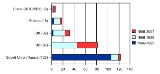
From 1946 to 2008, vetoes were issued on 261 occasions. For that period, usage breaks down as follows:
- United States has used the veto on 82 occasions between 1946 and 2007.
- Russia
Russia or , officially known as both Russia and the Russian Federation , is a country in northern Eurasia. It is a federal semi-presidential republic, comprising 83 federal subjects...
/the Soviet Union has used the veto on 124 occasions, more than any two others of the five permanent members of the Security Council combined.
Most recent vetoes
While China, Russia and the United States have exercised their veto power in the twenty-first century, neither France nor the United Kingdom have. The following list contains the most recent event any of the five permanent members of the United Nations Security Council exercised their veto power:
- October 4, 2011: China and Russia vetoed a draft resolution condemning the crackdown of protests in Syria
The 2011 Syrian uprising is an ongoing internal conflict occurring in Syria. Protests started on 26 January 2011, and escalated into an uprising by 15 March 2011...
.
- February 18, 2011: The United States vetoed a draft resolution condemning Israeli settlements in the West Bank
The West Bank ) of the Jordan River is the landlocked geographical eastern part of the Palestinian territories located in Western Asia. To the west, north, and south, the West Bank shares borders with the state of Israel. To the east, across the Jordan River, lies the Hashemite Kingdom of Jordan...
.
- December 23, 1989: France, the United Kingdom and the United States vetoed a draft resolution condemning the United States invasion of Panama
The United States Invasion of Panama, code-named Operation Just Cause, was the invasion of Panama by the United States in December 1989. It occurred during the administration of U.S. President George H. W...
.
Russia/Soviet Union
In the early days of the United Nations, the Soviet Union commissar and later minister for foreign affairs,
Vyacheslav MolotovVyacheslav Mikhailovich Molotov was a Soviet politician and diplomat, an Old Bolshevik and a leading figure in the Soviet government from the 1920s, when he rose to power as a protégé of Joseph Stalin, to 1957, when he was dismissed from the Presidium of the Central Committee by Nikita Khrushchev...
, said no so many times that he was known as "Mr. Veto". In fact, the Soviet Union was responsible for nearly half of all vetoes ever cast—79 vetoes were used in the first 10 years. Molotov regularly rejected bids for new membership because of the US's refusal to admit the Soviet republics. Since the dissolution of the Soviet Union, Russia has used its veto power sparingly.
United States
Ambassador Charles W. Yost cast the first U.S. veto in 1970, regarding a crisis in
RhodesiaRhodesia , officially the Republic of Rhodesia from 1970, was an unrecognised state located in southern Africa that existed between 1965 and 1979 following its Unilateral Declaration of Independence from the United Kingdom on 11 November 1965...
, and the U.S. cast a lone veto in 1972, to prevent a resolution relating to Israel. Since that time, it has become by far the most frequent user of the veto, mainly on resolutions criticising Israel; since 2002 the
Negroponte doctrineOn July 26, 2002, John Negroponte, the United States Ambassador to the United Nations, stated that the United States will oppose Security Council resolutions concerning the Israeli–Palestinian conflict that condemn Israel without also condemning terrorist groups...
has been applied for the use of a veto on resolutions relating to the ongoing Israel-Palestinian conflict. This has been a constant cause of friction between the
General AssemblyFor two articles dealing with membership in the General Assembly, see:* General Assembly members* General Assembly observersThe United Nations General Assembly is one of the five principal organs of the United Nations and the only one in which all member nations have equal representation...
and the Security Council. On 18 February 2011, the Obama administration vetoed resolutions condemning Israeli settlements.
United Kingdom
The United Kingdom used its Security Council veto power, along with France, to veto a draft resolution aimed at resolving the
Suez Canal crisisThe Suez Crisis, also referred to as the Tripartite Aggression, Suez War was an offensive war fought by France, the United Kingdom, and Israel against Egypt beginning on 29 October 1956. Less than a day after Israel invaded Egypt, Britain and France issued a joint ultimatum to Egypt and Israel,...
in 1956. They eventually withdrew after the U.S. instigated an "emergency special session" of the General Assembly, under the terms of the
"Uniting for Peace" resolutionUnited Nations General Assembly resolution 377 A, the "Uniting for Peace" resolution, states that in any cases where the Security Council, because of a lack of unanimity amongst its five permanent members, fails to act as required to maintain international peace and security, the General Assembly...
, which led to the establishment of the
United Nations Emergency ForceThe first United Nations Emergency Force was established by United Nations General Assembly to secure an end to the 1956 Suez Crisis with resolution 1001 on November 7, 1956. The force was developed in large measure as a result of efforts by UN Secretary-General Dag Hammarskjöld and a proposal...
I (UNEF I), by the adoption of Assembly resolution 1001. The UK also used the veto unilaterally seven times because of
RhodesiaRhodesia , officially the Republic of Rhodesia from 1970, was an unrecognised state located in southern Africa that existed between 1965 and 1979 following its Unilateral Declaration of Independence from the United Kingdom on 11 November 1965...
.
France
France uses its veto power sparingly. It vetoed a 1976 Resolution on the question of the
ComorosThe Comoros , officially the Union of the Comoros is an archipelago island nation in the Indian Ocean, located off the eastern coast of Africa, on the northern end of the Mozambique Channel, between northeastern Mozambique and northwestern Madagascar...
independence, when the island of
MayotteMayotte is an overseas department and region of France consisting of a main island, Grande-Terre , a smaller island, Petite-Terre , and several islets around these two. The archipelago is located in the northern Mozambique Channel in the Indian Ocean, namely between northwestern Madagascar and...
was kept in French territory due to the vote of the local population. The threat of a French veto of resolution on the impending
2003 invasion of IraqThe 2003 invasion of Iraq , was the start of the conflict known as the Iraq War, or Operation Iraqi Freedom, in which a combined force of troops from the United States, the United Kingdom, Australia and Poland invaded Iraq and toppled the regime of Saddam Hussein in 21 days of major combat operations...
caused friction between France and the United States. France subsequently used the threat of a veto to support
MoroccoMorocco , officially the Kingdom of Morocco , is a country located in North Africa. It has a population of more than 32 million and an area of 710,850 km², and also primarily administers the disputed region of the Western Sahara...
's position in the
Western SaharaWestern Sahara is a disputed territory in North Africa, bordered by Morocco to the north, Algeria to the northeast, Mauritania to the east and south, and the Atlantic Ocean to the west. Its surface area amounts to . It is one of the most sparsely populated territories in the world, mainly...
conflict
.
China (ROC/PRC)
Between 1946 and 1971, the Chinese seat on the Security Council was the government of the
Republic of ChinaThe Republic of China , commonly known as Taiwan , is a unitary sovereign state located in East Asia. Originally based in mainland China, the Republic of China currently governs the island of Taiwan , which forms over 99% of its current territory, as well as Penghu, Kinmen, Matsu and other minor...
(from 1949 on Taiwan) during which its representative used the veto only once (to block the Mongolian People's Republic's application for membership in 1955 because the ROC considered
MongoliaMongolia is a landlocked country in East and Central Asia. It is bordered by Russia to the north and China to the south, east and west. Although Mongolia does not share a border with Kazakhstan, its western-most point is only from Kazakhstan's eastern tip. Ulan Bator, the capital and largest...
to be a part of China). This postponed the admission of Mongolia until 1960, when the Soviet Union announced that unless Mongolia was admitted, it would block the admission of all of the newly independent African states. Faced with this pressure, the ROC relented under protest.
After the Republic of China's expulsion from the United Nations in 1971, the first veto cast by the present occupant, the
People's Republic of ChinaChina , officially the People's Republic of China , is the most populous country in the world, with over 1.3 billion citizens. Located in East Asia, the country covers approximately 9.6 million square kilometres...
, was issued in 25 August 1972 over
BangladeshBangladesh , officially the People's Republic of Bangladesh is a sovereign state located in South Asia. It is bordered by India on all sides except for a small border with Burma to the far southeast and by the Bay of Bengal to the south...
's admission to the United Nations. As of December 2008, the People's Republic of China has used its veto six times; observers have noted a preference for China to abstain rather than veto on resolutions not directly related to Chinese interests.
Veto power reform
Various discussions have taken place in recent years over the suitability of the Security Council veto power in today's world. Key arguments include that the five permanent members no longer represent the most stable and responsible member states in the United Nations, and that their veto power slows down and even prevents important decisions being made on matters of international peace and security. Due to the global changes that have taken place politically and economically since the formation of the UN in 1945, widespread debate has been apparent over whether the five permanent members of the UN Security Council remain the best member states to hold veto power. While the permanent members are still typically regarded as great powers, there is debate over their suitability to retain exclusive veto power.
A second argument against retaining the UNSC veto power is that it is detrimental to balanced political decisions, as any draft text needs to be approved of by each permanent member before any draft resolution can possibly be adopted. Indeed, several proposed draft resolutions are never formally presented to the Council for a vote owing to the knowledge that a permanent member would vote against their adoption (the so-called "pocket veto"). Debate also exists over the potential use of the veto power to provide "diplomatic cover" to a permanent member's allies . The United States has used its veto power more than any other permanent member since 1972, particularly on what it sees as unbalanced draft resolutions condemning the actions or policies of the State of Israel.
Advocates of the veto power believe that it is just as necessary in the current geo-political landscape, and that without the veto power, the Security Council would be open to making democratic "majority rules" decisions on matters that have implications at a global level—decisions that may well go directly against the interests of a permanent member.
Discussions on improving the UN's effectiveness and responsiveness to international security threats often include reform of the UNSC veto. Proposals include: limiting the use of the veto to vital national security issues; requiring agreement from multiple states before exercising the veto; and abolishing the veto entirely. However, any reform of the veto will be very difficult, if not impossible. In fact, Articles 108 and 109 of the
United Nations CharterThe Charter of the United Nations is the foundational treaty of the international organization called the United Nations. It was signed at the San Francisco War Memorial and Performing Arts Center in San Francisco, United States, on 26 June 1945, by 50 of the 51 original member countries...
grant the P5 veto over any amendments to the Charter, requiring them to approve of any modifications to the UNSC veto power that they themselves hold: it is highly unlikely that any of the P5 would accept a reform of the UN Charter that would be detrimental to their own national interests.
Nonetheless, it has been argued that with the adoption of the "Uniting for Peace" resolution by the General Assembly, and given the interpretations of the Assembly's powers that became
customary international lawCustomary international law are those aspects of international law that derive from custom. Along with general principles of law and treaties, custom is considered by the International Court of Justice, jurists, the United Nations, and its member states to be among the primary sources of...
as a result, that the Security Council "power of veto" was rendered, fundamentally, irrelevant. By adopting A/RES/377 A, on 3 November 1950, over two-thirds of UN Member states declared that, according to the UN Charter, the permanent members of the UNSC cannot and should not prevent the UNGA from taking any and all action necessary to restore international peace and security, in cases where the UNSC has failed to exercise its "primary responsibility" for maintaining peace. Such an interpretation sees the UNGA as being awarded "final responsibility"—rather than "secondary responsibility"—for matters of international peace and security, by the UN Charter. Various official and semi-official UN reports make explicit reference to the Uniting for Peace resolution as providing a mechanism for the UNGA to overrule any UNSC vetoes; thus rendering them little more than delays in UN action, should two-thirds of the Assembly subsequently agree that action is necessary.
The threat of the use of the veto by the P5 has led the UN Security Council to adopt what some commentators have described as unlawful resolutions that violated the UN Charter. For example, UNSC resolution 1422 of 2002, renewed once through resolution 1487 of 2003, aimed at exempting peace-keepers and other military personnel conducting operations authorized by the Security Council from the jurisdiction of the International Criminal Court (ICC) for a period of 12 months. Resolution 1422 was adopted as a consequence to the US veto on 30 June 2002 to the renewal of the Peace-keeping operation in Bosnia and Herzegovina, a State Party to the Rome Statute of the ICC.
There has been discussion of increasing the number of permanent members. The countries who have made the strongest demands for permanent seats are Brazil, Germany, India, and Japan. Indeed, Japan and Germany are the UN's second and third largest funders respectively, while Brazil, the largest Latin American nation, and India, the world's largest democracy and second most populous country, are two of the largest contributors of troops to UN-mandated peace-keeping missions. This proposal has found opposition in a group of countries called Uniting for Consensus. On 21 September 2004, the G4 nations issued a joint statement mutually backing each other's claim to permanent status, together with two African countries. Any such proposal would involve amendment of the UN Charter, and as such would need to be accepted by two-thirds of the General Assembly (128 votes), and also by all the permanent members of the Security Council.
Further reading
ISBN 978-0-19-953343-5 (hardback); ISBN 978-0-19-958330-0 (paperback).
US edition.
On Google.
- David Malone (ed), The UN Security Council: From the Cold War to the 21st Century, Lynne Rienner, Boulder, Colorado, 2004. ISBN 1-58826-240-5 (paperback).
External links