


Second city of the United Kingdom

Encyclopedia
The identity of the second city of the United Kingdom
is a subject of some disagreement. A country
's second city is the city that is thought to be the second most important, usually after the capital or first city (London
, in this case), according to criteria such as population
size, economic and commercial
importance, political importance or some cultural criteria. There is no official mechanism by which second city status is conferred on a city, and citizens and civic leaders of rival cities often argue over their conflicting claims.
Birmingham
has generally been regarded as the traditional second city of the United Kingdom
since around the time of World War I
, though some polls and media references, have quoted Manchester
as the second city particularly after the 1996 Manchester bombing
when Manchester underwent heavy redevelopment. Other cities in both England and Scotland have at times been considered the second city. For example, Glasgow
, in Scotland, was in the past called The Second City of the Empire. During the 19th and early 20th century, the whole of Ireland
was part of the United Kingdom. During some of this time Dublin was considered to be the second city.
It is perhaps even more difficult to make a distinction based on cultural factors, as all major UK cities play an important role in the cultural make-up of the country: in addition to Birmingham
and Manchester
, Edinburgh
, Glasgow
(European Capital of Culture
for 1990), Liverpool
(joint European Capital of Culture
for 2008), Leeds
, Sheffield
, Cardiff
, Newcastle upon Tyne
, Kingston Upon Hull
, Bradford
and others all boast internationally recognised sporting, music and performing arts scenes.
, several places have been described as the "second city". Dublin was the second most populous city at the time of the formation of the United Kingdom of Great Britain and Ireland
in 1801, though it lost that position later in the 19th century as other cities grew through industrialisation. As such, it was often described as the second city of the UK. Dublin, and the rest of the Republic of Ireland
, became independent of the UK in the 1920s.
By the early 19th century, Glasgow
was frequently referred to as the second city; and during much of the 20th century it had a population of over one million, larger than that of Birmingham
until the 1951 census. For example, the Official Census
population for Glasgow was 0.784 million in April 1911; 1.034 million in April 1921; 1.088 million in April 1931 and 1.090 million in April 1951. However, slum clearances in the 1960s led to displacement of residents from the city centre to new communities located outside the city boundaries. This, together with local government reorganisation, resulted in the official population of Glasgow falling sharply. The Glasgow City Council area currently has a population of 600,000 although the surrounding conurbation of Greater Glasgow
has a population of 1,199,629. In contrast, the population of the city of Birmingham has remained steady around the one million mark; its central population fell like Glasgow's, but the city boundaries were extended several times in the early 20th century. Occasional claims were made for Liverpool
, Birmingham
and Manchester
.
The title Second City of Empire or Second City of the British Empire
was claimed by a number of cities in the 18th, 19th and early 20th centuries. These include Dublin, Glasgow (which continues to use the title as a marketing slogan), Liverpool; and (outside the UK) Kolkata
(known as Calcutta during the British Empire) and Philadelphia.
Prior to the union with Scotland
in 1707, from the English Civil War
until the 18th century, Norwich
was the second-largest city of England, being a major trading
centre, Britain's richest provincial city and county town of Norfolk
, at that time the most populous county of England. Bristol
was the second wealthiest city in England in the 16th century; and by the 18th century, Bristol
was often described as the second city of England. During the 19th century, claims were made for Manchester
, Liverpool
and York
. York had also been named as the second city in earlier centuries.
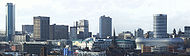 Since World War I
, Birmingham
has historically been considered the second city of the United Kingdom, but recent polls and media references have indicated that Manchester
is regarded as the second city.
In a 2007 survey commissioned by the BBC
investigating the subject of the "'Second city' of England" (as opposed to the UK as a whole), 48% of 1,000 people said that Manchester
deserves the distinction, with 40% choosing Birmingham. The BBC further reported that Manchester is close to being the second city of the UK in 2005. In a similar survey conducted by Ipsos MORI, commissioned by "Visit Manchester" (Manchester's tourism department), Manchester received the highest response for the category of second city at 34%, compared to Birmingham at 29%; and in the same poll, Manchester had the highest response for the category of third city with 27% of the vote, 6% more than the 21% for Birmingham. Only 85% of respondents put London as first City.
Based on population within actual city boundaries the City of Birmingham
, the most populous local government district in Europe, is substantially larger than the City of Manchester
, which is the fifth largest in the UK (2006 estimates, see List of English districts by population). However, most sources do not use formal city boundaries as the sole criterion for population comparison: for instance, the City of London
, with a population of only 7,185 (2001 census), is very small, though London
as a whole is the most populous city within city limits
in the European Union
with an official population of 7.6 million (as of 2006) and has a metropolitan area
population of between 12 and 14 million people.
The surrounding conurbations and the areas that can be considered informally part of each city are hard to define. However after the 1974 reorganisation of local government and the creation of metropolitan counties
, the City of Birmingham was included with the City of Coventry
and five other metropolitan borough
s (one, Wolverhampton
gained city status in 2000) in a new West Midlands
county. The City of Manchester joined with the neighbouring City of Salford
and eight other Metropolitan boroughs within the County of Greater Manchester
.
The City of Birmingham
has a population of 1,006,500 (2006 estimate). It forms part of the larger West Midlands conurbation
, which has a population of 2,284,093 (2001 census) and also includes the city of Wolverhampton
, the towns of the Black Country
, and other towns such as Solihull
. The City of Manchester
has a population of 452,000 (2006 estimate), while the Greater Manchester Urban Area
is home to 2,240,230 people (2001 census) and also includes the City of Salford
, and towns like Bolton
, Bury
, Oldham
, Rochdale
, Stockport
and Wigan
. The populations of Metropolitan counties such as the West Midlands and Greater Manchester also differ slightly from those of the urban areas. Birmingham City Council
(BCC) is the largest local authority in Europe and is notable for having the largest wards, by population, in the whole of the UK (each ward has approximately 18,000 voters). BCC is also the UK's largest landlord, with its Housing Department managing just under (?) council homes.
While the 'second city' status of any country is decided upon a variety of economic or cultural indices, both Birmingham and Manchester have shown an edge in each over the years (see also discussion of this article). For example in 2010, Manchester City Centre became second to London for new office building take-up with almost a million square foot (86,399km2) occupied in the year, whilst praise for Birmingham's striking modern architecture was sited as confirmation of its claim to second city status.
There have been a variety of Ministerial opinions on the subject for some time: these include:
is often thought of as being just behind Birmingham and Manchester when considering the second city title.Edinburgh
, Belfast
and Cardiff
also have a claim on the title of "second city" by virtue of their status as the respective capital cities of Scotland
, Northern Ireland
and Wales
. Liverpool
and Leeds
make up the other major contenders.
has become the most important city after London in governmental terms, housing the Scottish Parliament
. It is a growing financial centre and houses, amongst other financial and insurance companies, Royal Bank of Scotland
and HBOS
, two of the UK's big five banks. Edinburgh is also home to the world's largest arts festival every August; is the only British city to have hosted the Commonwealth Games
twice (1970 and 1986); and has since the 1990s been one of the main alternatives in the UK to London for hosting major political summits, having hosted meetings of the European Council
(1992), G8
(2005, nearby at Auchterarder
- see 31st G8 summit
), and the Commonwealth Heads of Government in 1997
.
and third most populous in the United Kingdom
. The city is situated on the River Clyde
in the country's west central lowlands
. A person from Glasgow is known as a Glaswegian.
Glasgow grew from the medieval Bishopric of Glasgow
and the later establishment of the University of Glasgow
in the 15th century, which subsequently became a major centre of the Scottish Enlightenment
in the 18th century. From the 18th century the city also grew as one of Britain's main hubs of transatlantic trade
with British North America
and the British West Indies
. With the Industrial Revolution
, the city and surrounding region shifted to become one of the world's pre-eminent centres of heavy engineering
, most notably in the shipbuilding
and marine engineering
industry, which produced many innovative and famous vessels. Glasgow was known as the "Second City of the British Empire
" for much of the Victorian era
and Edwardian period. Today it is one of Europe's top twenty financial centres and is home to many of Scotland's leading businesses. Glasgow is also ranked as the 57th most liveable city in the world.
In the late 19th and early 20th centuries Glasgow grew to a population of over one million, and was the fourth-largest city in Europe, after London
, Paris
and Berlin
. In the 1960s, large-scale relocation to new town
s and peripheral suburb
s, followed by successive boundary changes, have reduced the current population of the City of Glasgow unitary authority area to 580,690, with 1,199,629 people living in the Greater Glasgow
urban area
. The entire region surrounding the conurbation
covers approximately 2.3 million people, 41% of Scotland's population.
, largest city and most populous county of Wales
. The city is Wales' chief commercial centre, the base for most national cultural and sporting institutions, the Welsh national media, and the seat of the National Assembly for Wales
. According to recent estimates, the population of the unitary authority area is 324,800, while the wider metropolitan area has a population of nearly 1.1 million, more than a third of the total Welsh population. Cardiff is a significant tourism centre and the most popular visitor destination in Wales with 14.6 million visitors in 2009.
The city of Cardiff is the county town
of the historic county of Glamorgan
(and later South Glamorgan
). Cardiff is part of the Eurocities
network of the largest European cities. The Cardiff Urban Area
covers a slightly larger area outside of the county boundary, and includes the towns of Dinas Powys
, Penarth
and Radyr
. A small town until the early 19th century, its prominence as a major port
for the transport of coal following the arrival of industry in the region contributed to its rise as a major city.
Cardiff was made a city
in 1905, and proclaimed capital of Wales
in 1955. Since the 1990s Cardiff has seen significant development with a new waterfront area at Cardiff Bay
which contains the Senedd
building, home to the Welsh Assembly
and the Wales Millennium Centre
arts complex.
Sporting venues in the city include the Millennium Stadium
(the national stadium for the Wales national rugby union team
and the Wales national football team
), SWALEC Stadium (the home of Glamorgan County Cricket Club
), Cardiff City Stadium (the home of Cardiff City football team
and Cardiff Blues rugby union team
), Cardiff International Sports Stadium (the home of Cardiff Amateur Athletic Club
) and Cardiff Arms Park
(the home of Cardiff Rugby Club
). The city was awarded with the European City Of Sport in 2009 due to its role in hosting major international sporting events.
") is the capital of and the largest city in Northern Ireland
and the second largest city in Ireland
. It is the seat of devolved government
and legislative Northern Ireland Assembly
. The city forms part of the largest urban area
in Northern Ireland, and the main settlement in the province of Ulster
. The city of Belfast has a population of 267,500 and lies at the heart of the Belfast urban area
, which has a population of 483,418. The Larger Urban Zone, as defined by the European Union
, has a total population 641,638. Belfast was granted city status
in 1888.
Historically, Belfast has been a centre for the Irish linen industry (earning the nickname "Linenopolis
"), tobacco production, rope-making and shipbuilding: the city's main shipbuilders, Harland and Wolff
, which built the ill-fated RMS Titanic, propelled Belfast on to the global stage in the early 20th century as the largest and most productive shipyard in the world. Belfast played a key role in the Industrial Revolution
, establishing its place as a global industrial centre until the latter half of the 20th century.
Industrialisation and the inward migration it brought made Belfast, if briefly, the largest city in Ireland at the turn of the 20th century and the city's industrial and economic success was cited by Ulster unionist
opponents of Home Rule as a reason why Ireland should shun devolution and later why Ulster in particular would fight to resist it.
Today, Belfast remains a centre for industry
, as well as the arts
, higher education
and business
, a legal centre, and is the economic engine of Northern Ireland. The city suffered greatly during the period of disruption, conflict, and destruction called the Troubles
, but latterly has undergone a sustained period of calm, free from the intense political violence of former years, and substantial economic and commercial growth. Belfast city centre
has undergone considerable expansion and regeneration in recent years, notably around Victoria Square.
Belfast is served by two airports: George Best Belfast City Airport
in the city, and Belfast International Airport
15 miles (24 km) west of the city. Belfast is also a major seaport, with commercial and industrial docks dominating the Belfast Lough shoreline, including the famous Harland and Wolff shipyard. Belfast is a constituent city of the Dublin-Belfast corridor
, which has a population of 3 million, or half the total population of the island of Ireland.
Historically a part of Lancashire, the urbanisation and expansion of Liverpool were both largely brought about by the city's status as a major port. By the 18th century, trade from the West Indies, Ireland and mainland Europe coupled with close links with the Atlantic Slave Trade furthered the economic expansion of Liverpool. By the early 19th century, 40% of the world's trade passed through Liverpool's docks, contributing to Liverpool's rise as a major city.
Liverpool's status as a port city has contributed to its diverse population, which, historically, were drawn from a wide range of peoples, cultures, and religions, particularly those from Ireland. The city is also home to the oldest Black African community in the country and the oldest Chinese community in Europe.
The popularity of The Beatles and the other groups from the Merseybeat era contributes to Liverpool's status as a tourist destination; tourism forms a significant part of the city's modern economy. The city celebrated its 800th anniversary in 2007, and it held the European Capital of Culture title together with Stavanger, Norway, in 2008. Several areas of the city centre were granted World Heritage Site status by UNESCO in 2004. Referred to as the Liverpool Maritime Mercantile City, the site comprises six separate locations in the city including the Pier Head, Albert Dock and William Brown Street and includes many of the city's most famous landmarks.
, a city and metropolitan borough in West Yorkshire
, England. In 2001 Leeds's main urban subdivision had a population of 443,247, while the entire city had a population of 770,800 (2008 est.) making it the third largest in the country. Leeds is the cultural, financial and commercial heart of the West Yorkshire Urban Area, which at the 2001 census had a population of 1.5 million, and the Leeds city region, an economic area with Leeds at its core, had a population of 2.9 million. Leeds is the UK's largest centre for business, legal, and financial services outside London.
The contemporary economy of Leeds has been shaped by Leeds City Council having the vision of building a '24-hour European city' and a 'capital of the north'. It has developed from the decay of the post-industrial era to become a telephone banking centre, connected to the electronic infrastructure of the modern global economy.There has been growth in the corporate and legal sectors and increased local affluence has led to an expanding retail sector, including the luxury goods market. Leeds was voted 'Britain's Best City for Business' by Omis Research in 2003 but dropped to 3rd place behind Manchester and Glasgow in 2005 ("Relative under-performance over the past two years in transport improvements and cost competitiveness were the major contributing factors"). It is also regarded by some as one of the fastest growing cities in the UK.
Over 124,000 people work in financial and business services in Leeds, the largest number of any UK city outside London. The strength of the economy is also indicated by the low unemployment rate. Although Leeds's economy has boomed in recent years, the prosperity has not spread to all parts of the city.
Leeds has an extensive and diverse range of shops and department stores, and has been described by the Lonely Planet guides as the 'Knightsbridge of the North'. The diverse range of shopping facilities, from individual one-off boutiques to large department stores such as Harvey Nichols
and Louis Vuitton
outlets, has greatly expanded the Leeds retail base.
United Kingdom
The United Kingdom of Great Britain and Northern IrelandIn the United Kingdom and Dependencies, other languages have been officially recognised as legitimate autochthonous languages under the European Charter for Regional or Minority Languages...
is a subject of some disagreement. A country
Country
A country is a region legally identified as a distinct entity in political geography. A country may be an independent sovereign state or one that is occupied by another state, as a non-sovereign or formerly sovereign political division, or a geographic region associated with a previously...
's second city is the city that is thought to be the second most important, usually after the capital or first city (London
London
London is the capital city of :England and the :United Kingdom, the largest metropolitan area in the United Kingdom, and the largest urban zone in the European Union by most measures. Located on the River Thames, London has been a major settlement for two millennia, its history going back to its...
, in this case), according to criteria such as population
Population
A population is all the organisms that both belong to the same group or species and live in the same geographical area. The area that is used to define a sexual population is such that inter-breeding is possible between any pair within the area and more probable than cross-breeding with individuals...
size, economic and commercial
Commerce
While business refers to the value-creating activities of an organization for profit, commerce means the whole system of an economy that constitutes an environment for business. The system includes legal, economic, political, social, cultural, and technological systems that are in operation in any...
importance, political importance or some cultural criteria. There is no official mechanism by which second city status is conferred on a city, and citizens and civic leaders of rival cities often argue over their conflicting claims.
Birmingham
Birmingham
Birmingham is a city and metropolitan borough in the West Midlands of England. It is the most populous British city outside the capital London, with a population of 1,036,900 , and lies at the heart of the West Midlands conurbation, the second most populous urban area in the United Kingdom with a...
has generally been regarded as the traditional second city of the United Kingdom
United Kingdom
The United Kingdom of Great Britain and Northern IrelandIn the United Kingdom and Dependencies, other languages have been officially recognised as legitimate autochthonous languages under the European Charter for Regional or Minority Languages...
since around the time of World War I
World War I
World War I , which was predominantly called the World War or the Great War from its occurrence until 1939, and the First World War or World War I thereafter, was a major war centred in Europe that began on 28 July 1914 and lasted until 11 November 1918...
, though some polls and media references, have quoted Manchester
Manchester
Manchester is a city and metropolitan borough in Greater Manchester, England. According to the Office for National Statistics, the 2010 mid-year population estimate for Manchester was 498,800. Manchester lies within one of the UK's largest metropolitan areas, the metropolitan county of Greater...
as the second city particularly after the 1996 Manchester bombing
1996 Manchester bombing
The 1996 Manchester bombing was an attack carried out by the Provisional Irish Republican Army on 15 June 1996 in Manchester, England. The bomb, placed in a van on Corporation Street in city centre, targeted the city's infrastructure and economy and caused widespread damage, estimated by...
when Manchester underwent heavy redevelopment. Other cities in both England and Scotland have at times been considered the second city. For example, Glasgow
Glasgow
Glasgow is the largest city in Scotland and third most populous in the United Kingdom. The city is situated on the River Clyde in the country's west central lowlands...
, in Scotland, was in the past called The Second City of the Empire. During the 19th and early 20th century, the whole of Ireland
Ireland
Ireland is an island to the northwest of continental Europe. It is the third-largest island in Europe and the twentieth-largest island on Earth...
was part of the United Kingdom. During some of this time Dublin was considered to be the second city.
It is perhaps even more difficult to make a distinction based on cultural factors, as all major UK cities play an important role in the cultural make-up of the country: in addition to Birmingham
Birmingham
Birmingham is a city and metropolitan borough in the West Midlands of England. It is the most populous British city outside the capital London, with a population of 1,036,900 , and lies at the heart of the West Midlands conurbation, the second most populous urban area in the United Kingdom with a...
and Manchester
Manchester
Manchester is a city and metropolitan borough in Greater Manchester, England. According to the Office for National Statistics, the 2010 mid-year population estimate for Manchester was 498,800. Manchester lies within one of the UK's largest metropolitan areas, the metropolitan county of Greater...
, Edinburgh
Edinburgh
Edinburgh is the capital city of Scotland, the second largest city in Scotland, and the eighth most populous in the United Kingdom. The City of Edinburgh Council governs one of Scotland's 32 local government council areas. The council area includes urban Edinburgh and a rural area...
, Glasgow
Glasgow
Glasgow is the largest city in Scotland and third most populous in the United Kingdom. The city is situated on the River Clyde in the country's west central lowlands...
(European Capital of Culture
European Capital of Culture
The European Capital of Culture is a city designated by theEuropean Union for a period of one calendar year during which it organises a series of cultural events with a strong European dimension....
for 1990), Liverpool
Liverpool
Liverpool is a city and metropolitan borough of Merseyside, England, along the eastern side of the Mersey Estuary. It was founded as a borough in 1207 and was granted city status in 1880...
(joint European Capital of Culture
European Capital of Culture
The European Capital of Culture is a city designated by theEuropean Union for a period of one calendar year during which it organises a series of cultural events with a strong European dimension....
for 2008), Leeds
Leeds
Leeds is a city and metropolitan borough in West Yorkshire, England. In 2001 Leeds' main urban subdivision had a population of 443,247, while the entire city has a population of 798,800 , making it the 30th-most populous city in the European Union.Leeds is the cultural, financial and commercial...
, Sheffield
Sheffield
Sheffield is a city and metropolitan borough of South Yorkshire, England. Its name derives from the River Sheaf, which runs through the city. Historically a part of the West Riding of Yorkshire, and with some of its southern suburbs annexed from Derbyshire, the city has grown from its largely...
, Cardiff
Cardiff
Cardiff is the capital, largest city and most populous county of Wales and the 10th largest city in the United Kingdom. The city is Wales' chief commercial centre, the base for most national cultural and sporting institutions, the Welsh national media, and the seat of the National Assembly for...
, Newcastle upon Tyne
Newcastle upon Tyne
Newcastle upon Tyne is a city and metropolitan borough of Tyne and Wear, in North East England. Historically a part of Northumberland, it is situated on the north bank of the River Tyne...
, Kingston Upon Hull
Kingston upon Hull
Kingston upon Hull , usually referred to as Hull, is a city and unitary authority area in the ceremonial county of the East Riding of Yorkshire, England. It stands on the River Hull at its junction with the Humber estuary, 25 miles inland from the North Sea. Hull has a resident population of...
, Bradford
Bradford
Bradford lies at the heart of the City of Bradford, a metropolitan borough of West Yorkshire, in Northern England. It is situated in the foothills of the Pennines, west of Leeds, and northwest of Wakefield. Bradford became a municipal borough in 1847, and received its charter as a city in 1897...
and others all boast internationally recognised sporting, music and performing arts scenes.
History
Since the formation of the United KingdomUnited Kingdom
The United Kingdom of Great Britain and Northern IrelandIn the United Kingdom and Dependencies, other languages have been officially recognised as legitimate autochthonous languages under the European Charter for Regional or Minority Languages...
, several places have been described as the "second city". Dublin was the second most populous city at the time of the formation of the United Kingdom of Great Britain and Ireland
United Kingdom of Great Britain and Ireland
The United Kingdom of Great Britain and Ireland was the formal name of the United Kingdom during the period when what is now the Republic of Ireland formed a part of it....
in 1801, though it lost that position later in the 19th century as other cities grew through industrialisation. As such, it was often described as the second city of the UK. Dublin, and the rest of the Republic of Ireland
Republic of Ireland
Ireland , described as the Republic of Ireland , is a sovereign state in Europe occupying approximately five-sixths of the island of the same name. Its capital is Dublin. Ireland, which had a population of 4.58 million in 2011, is a constitutional republic governed as a parliamentary democracy,...
, became independent of the UK in the 1920s.
By the early 19th century, Glasgow
Glasgow
Glasgow is the largest city in Scotland and third most populous in the United Kingdom. The city is situated on the River Clyde in the country's west central lowlands...
was frequently referred to as the second city; and during much of the 20th century it had a population of over one million, larger than that of Birmingham
Birmingham
Birmingham is a city and metropolitan borough in the West Midlands of England. It is the most populous British city outside the capital London, with a population of 1,036,900 , and lies at the heart of the West Midlands conurbation, the second most populous urban area in the United Kingdom with a...
until the 1951 census. For example, the Official Census
Census
A census is the procedure of systematically acquiring and recording information about the members of a given population. It is a regularly occurring and official count of a particular population. The term is used mostly in connection with national population and housing censuses; other common...
population for Glasgow was 0.784 million in April 1911; 1.034 million in April 1921; 1.088 million in April 1931 and 1.090 million in April 1951. However, slum clearances in the 1960s led to displacement of residents from the city centre to new communities located outside the city boundaries. This, together with local government reorganisation, resulted in the official population of Glasgow falling sharply. The Glasgow City Council area currently has a population of 600,000 although the surrounding conurbation of Greater Glasgow
Greater Glasgow
Greater Glasgow is an urban settlement in Scotland consisting of all localities which are physically attached to the city of Glasgow, forming with it a single contiguous urban area...
has a population of 1,199,629. In contrast, the population of the city of Birmingham has remained steady around the one million mark; its central population fell like Glasgow's, but the city boundaries were extended several times in the early 20th century. Occasional claims were made for Liverpool
Liverpool
Liverpool is a city and metropolitan borough of Merseyside, England, along the eastern side of the Mersey Estuary. It was founded as a borough in 1207 and was granted city status in 1880...
, Birmingham
Birmingham
Birmingham is a city and metropolitan borough in the West Midlands of England. It is the most populous British city outside the capital London, with a population of 1,036,900 , and lies at the heart of the West Midlands conurbation, the second most populous urban area in the United Kingdom with a...
and Manchester
Manchester
Manchester is a city and metropolitan borough in Greater Manchester, England. According to the Office for National Statistics, the 2010 mid-year population estimate for Manchester was 498,800. Manchester lies within one of the UK's largest metropolitan areas, the metropolitan county of Greater...
.
The title Second City of Empire or Second City of the British Empire
British Empire
The British Empire comprised the dominions, colonies, protectorates, mandates and other territories ruled or administered by the United Kingdom. It originated with the overseas colonies and trading posts established by England in the late 16th and early 17th centuries. At its height, it was the...
was claimed by a number of cities in the 18th, 19th and early 20th centuries. These include Dublin, Glasgow (which continues to use the title as a marketing slogan), Liverpool; and (outside the UK) Kolkata
Kolkata
Kolkata , formerly known as Calcutta, is the capital of the Indian state of West Bengal. Located on the east bank of the Hooghly River, it was the commercial capital of East India...
(known as Calcutta during the British Empire) and Philadelphia.
Prior to the union with Scotland
Acts of Union 1707
The Acts of Union were two Parliamentary Acts - the Union with Scotland Act passed in 1706 by the Parliament of England, and the Union with England Act passed in 1707 by the Parliament of Scotland - which put into effect the terms of the Treaty of Union that had been agreed on 22 July 1706,...
in 1707, from the English Civil War
English Civil War
The English Civil War was a series of armed conflicts and political machinations between Parliamentarians and Royalists...
until the 18th century, Norwich
Norwich
Norwich is a city in England. It is the regional administrative centre and county town of Norfolk. During the 11th century, Norwich was the largest city in England after London, and one of the most important places in the kingdom...
was the second-largest city of England, being a major trading
Trade
Trade is the transfer of ownership of goods and services from one person or entity to another. Trade is sometimes loosely called commerce or financial transaction or barter. A network that allows trade is called a market. The original form of trade was barter, the direct exchange of goods and...
centre, Britain's richest provincial city and county town of Norfolk
Norfolk
Norfolk is a low-lying county in the East of England. It has borders with Lincolnshire to the west, Cambridgeshire to the west and southwest and Suffolk to the south. Its northern and eastern boundaries are the North Sea coast and to the north-west the county is bordered by The Wash. The county...
, at that time the most populous county of England. Bristol
Bristol
Bristol is a city, unitary authority area and ceremonial county in South West England, with an estimated population of 433,100 for the unitary authority in 2009, and a surrounding Larger Urban Zone with an estimated 1,070,000 residents in 2007...
was the second wealthiest city in England in the 16th century; and by the 18th century, Bristol
Bristol
Bristol is a city, unitary authority area and ceremonial county in South West England, with an estimated population of 433,100 for the unitary authority in 2009, and a surrounding Larger Urban Zone with an estimated 1,070,000 residents in 2007...
was often described as the second city of England. During the 19th century, claims were made for Manchester
Manchester
Manchester is a city and metropolitan borough in Greater Manchester, England. According to the Office for National Statistics, the 2010 mid-year population estimate for Manchester was 498,800. Manchester lies within one of the UK's largest metropolitan areas, the metropolitan county of Greater...
, Liverpool
Liverpool
Liverpool is a city and metropolitan borough of Merseyside, England, along the eastern side of the Mersey Estuary. It was founded as a borough in 1207 and was granted city status in 1880...
and York
York
York is a walled city, situated at the confluence of the Rivers Ouse and Foss in North Yorkshire, England. The city has a rich heritage and has provided the backdrop to major political events throughout much of its two millennia of existence...
. York had also been named as the second city in earlier centuries.
Birmingham or Manchester
World War I
World War I , which was predominantly called the World War or the Great War from its occurrence until 1939, and the First World War or World War I thereafter, was a major war centred in Europe that began on 28 July 1914 and lasted until 11 November 1918...
, Birmingham
Birmingham
Birmingham is a city and metropolitan borough in the West Midlands of England. It is the most populous British city outside the capital London, with a population of 1,036,900 , and lies at the heart of the West Midlands conurbation, the second most populous urban area in the United Kingdom with a...
has historically been considered the second city of the United Kingdom, but recent polls and media references have indicated that Manchester
Manchester
Manchester is a city and metropolitan borough in Greater Manchester, England. According to the Office for National Statistics, the 2010 mid-year population estimate for Manchester was 498,800. Manchester lies within one of the UK's largest metropolitan areas, the metropolitan county of Greater...
is regarded as the second city.
In a 2007 survey commissioned by the BBC
BBC
The British Broadcasting Corporation is a British public service broadcaster. Its headquarters is at Broadcasting House in the City of Westminster, London. It is the largest broadcaster in the world, with about 23,000 staff...
investigating the subject of the "'Second city' of England" (as opposed to the UK as a whole), 48% of 1,000 people said that Manchester
Manchester
Manchester is a city and metropolitan borough in Greater Manchester, England. According to the Office for National Statistics, the 2010 mid-year population estimate for Manchester was 498,800. Manchester lies within one of the UK's largest metropolitan areas, the metropolitan county of Greater...
deserves the distinction, with 40% choosing Birmingham. The BBC further reported that Manchester is close to being the second city of the UK in 2005. In a similar survey conducted by Ipsos MORI, commissioned by "Visit Manchester" (Manchester's tourism department), Manchester received the highest response for the category of second city at 34%, compared to Birmingham at 29%; and in the same poll, Manchester had the highest response for the category of third city with 27% of the vote, 6% more than the 21% for Birmingham. Only 85% of respondents put London as first City.
Based on population within actual city boundaries the City of Birmingham
Birmingham
Birmingham is a city and metropolitan borough in the West Midlands of England. It is the most populous British city outside the capital London, with a population of 1,036,900 , and lies at the heart of the West Midlands conurbation, the second most populous urban area in the United Kingdom with a...
, the most populous local government district in Europe, is substantially larger than the City of Manchester
Manchester
Manchester is a city and metropolitan borough in Greater Manchester, England. According to the Office for National Statistics, the 2010 mid-year population estimate for Manchester was 498,800. Manchester lies within one of the UK's largest metropolitan areas, the metropolitan county of Greater...
, which is the fifth largest in the UK (2006 estimates, see List of English districts by population). However, most sources do not use formal city boundaries as the sole criterion for population comparison: for instance, the City of London
City of London
The City of London is a small area within Greater London, England. It is the historic core of London around which the modern conurbation grew and has held city status since time immemorial. The City’s boundaries have remained almost unchanged since the Middle Ages, and it is now only a tiny part of...
, with a population of only 7,185 (2001 census), is very small, though London
London
London is the capital city of :England and the :United Kingdom, the largest metropolitan area in the United Kingdom, and the largest urban zone in the European Union by most measures. Located on the River Thames, London has been a major settlement for two millennia, its history going back to its...
as a whole is the most populous city within city limits
Largest cities of the European Union by population within city limits
This is a list of the largest cities in the European Union by population within city limits which have more than 300,000 inhabitants. It deals exclusively with the areas within city administrative boundaries as opposed to urban areas or metropolitan areas, which are generally larger in terms of...
in the European Union
European Union
The European Union is an economic and political union of 27 independent member states which are located primarily in Europe. The EU traces its origins from the European Coal and Steel Community and the European Economic Community , formed by six countries in 1958...
with an official population of 7.6 million (as of 2006) and has a metropolitan area
Metropolitan area
The term metropolitan area refers to a region consisting of a densely populated urban core and its less-populated surrounding territories, sharing industry, infrastructure, and housing. A metropolitan area usually encompasses multiple jurisdictions and municipalities: neighborhoods, townships,...
population of between 12 and 14 million people.
The surrounding conurbations and the areas that can be considered informally part of each city are hard to define. However after the 1974 reorganisation of local government and the creation of metropolitan counties
Metropolitan county
The metropolitan counties are a type of county-level administrative division of England. There are six metropolitan counties, which each cover large urban areas, typically with populations of 1.2 to 2.8 million...
, the City of Birmingham was included with the City of Coventry
Coventry
Coventry is a city and metropolitan borough in the county of West Midlands in England. Coventry is the 9th largest city in England and the 11th largest in the United Kingdom. It is also the second largest city in the English Midlands, after Birmingham, with a population of 300,848, although...
and five other metropolitan borough
Metropolitan borough
A metropolitan borough is a type of local government district in England, and is a subdivision of a metropolitan county. Created in 1974 by the Local Government Act 1972, metropolitan boroughs are defined in English law as metropolitan districts, however all of them have been granted or regranted...
s (one, Wolverhampton
Wolverhampton
Wolverhampton is a city and metropolitan borough in the West Midlands, England. For Eurostat purposes Walsall and Wolverhampton is a NUTS 3 region and is one of five boroughs or unitary districts that comprise the "West Midlands" NUTS 2 region...
gained city status in 2000) in a new West Midlands
West Midlands (county)
The West Midlands is a metropolitan county in western central England with a 2009 estimated population of 2,638,700. It came into existence as a metropolitan county in 1974 after the passage of the Local Government Act 1972, formed from parts of Staffordshire, Worcestershire and Warwickshire. The...
county. The City of Manchester joined with the neighbouring City of Salford
City of Salford
The City of Salford is a city and metropolitan borough of Greater Manchester, England. It is named after its largest settlement, Salford, but covers a far larger area which includes the towns of Eccles, Swinton-Pendlebury, Walkden and Irlam which apart from Irlam each have a population of over...
and eight other Metropolitan boroughs within the County of Greater Manchester
Greater Manchester
Greater Manchester is a metropolitan county in North West England, with a population of 2.6 million. It encompasses one of the largest metropolitan areas in the United Kingdom and comprises ten metropolitan boroughs: Bolton, Bury, Oldham, Rochdale, Stockport, Tameside, Trafford, Wigan, and the...
.
The City of Birmingham
Birmingham
Birmingham is a city and metropolitan borough in the West Midlands of England. It is the most populous British city outside the capital London, with a population of 1,036,900 , and lies at the heart of the West Midlands conurbation, the second most populous urban area in the United Kingdom with a...
has a population of 1,006,500 (2006 estimate). It forms part of the larger West Midlands conurbation
West Midlands conurbation
The West Midlands conurbation is the name given to the large conurbation that includes the cities of Birmingham and Wolverhampton and the large towns of Dudley, Walsall, West Bromwich, Solihull, Stourbridge, Halesowen in the English West Midlands....
, which has a population of 2,284,093 (2001 census) and also includes the city of Wolverhampton
Wolverhampton
Wolverhampton is a city and metropolitan borough in the West Midlands, England. For Eurostat purposes Walsall and Wolverhampton is a NUTS 3 region and is one of five boroughs or unitary districts that comprise the "West Midlands" NUTS 2 region...
, the towns of the Black Country
Black Country
The Black Country is a loosely defined area of the English West Midlands conurbation, to the north and west of Birmingham, and to the south and east of Wolverhampton. During the industrial revolution in the 19th century this area had become one of the most intensely industrialised in the nation...
, and other towns such as Solihull
Solihull
Solihull is a town in the West Midlands of England with a population of 94,753. It is a part of the West Midlands conurbation and is located 9 miles southeast of Birmingham city centre...
. The City of Manchester
Manchester
Manchester is a city and metropolitan borough in Greater Manchester, England. According to the Office for National Statistics, the 2010 mid-year population estimate for Manchester was 498,800. Manchester lies within one of the UK's largest metropolitan areas, the metropolitan county of Greater...
has a population of 452,000 (2006 estimate), while the Greater Manchester Urban Area
Greater Manchester Urban Area
The Greater Manchester Urban Area is an area of land defined by the Office for National Statistics consisting of the large conurbation that encompasses the city of Manchester and the continuous metropolitan area that spreads outwards from it, forming much of Greater Manchester in North West England...
is home to 2,240,230 people (2001 census) and also includes the City of Salford
City of Salford
The City of Salford is a city and metropolitan borough of Greater Manchester, England. It is named after its largest settlement, Salford, but covers a far larger area which includes the towns of Eccles, Swinton-Pendlebury, Walkden and Irlam which apart from Irlam each have a population of over...
, and towns like Bolton
Bolton
Bolton is a town in Greater Manchester, in the North West of England. Close to the West Pennine Moors, it is north west of the city of Manchester. Bolton is surrounded by several smaller towns and villages which together form the Metropolitan Borough of Bolton, of which Bolton is the...
, Bury
Bury
Bury is a town in Greater Manchester, England. It lies on the River Irwell, east of Bolton, west-southwest of Rochdale, and north-northwest of the city of Manchester...
, Oldham
Oldham
Oldham is a large town in Greater Manchester, England. It lies amid the Pennines on elevated ground between the rivers Irk and Medlock, south-southeast of Rochdale, and northeast of the city of Manchester...
, Rochdale
Rochdale
Rochdale is a large market town in Greater Manchester, England. It lies amongst the foothills of the Pennines on the River Roch, north-northwest of Oldham, and north-northeast of the city of Manchester. Rochdale is surrounded by several smaller settlements which together form the Metropolitan...
, Stockport
Stockport
Stockport is a town in Greater Manchester, England. It lies on elevated ground southeast of Manchester city centre, at the point where the rivers Goyt and Tame join and create the River Mersey. Stockport is the largest settlement in the metropolitan borough of the same name...
and Wigan
Wigan
Wigan is a town in Greater Manchester, England. It stands on the River Douglas, south-west of Bolton, north of Warrington and west-northwest of Manchester. Wigan is the largest settlement in the Metropolitan Borough of Wigan and is its administrative centre. The town of Wigan had a total...
. The populations of Metropolitan counties such as the West Midlands and Greater Manchester also differ slightly from those of the urban areas. Birmingham City Council
Birmingham City Council
The Birmingham City Council is the body responsible for the governance of the City of Birmingham in England, which has been a metropolitan district since 1974. It is the most populated local authority in the United Kingdom with, following a reorganisation of boundaries in June 2004, 120 Birmingham...
(BCC) is the largest local authority in Europe and is notable for having the largest wards, by population, in the whole of the UK (each ward has approximately 18,000 voters). BCC is also the UK's largest landlord, with its Housing Department managing just under (?) council homes.
While the 'second city' status of any country is decided upon a variety of economic or cultural indices, both Birmingham and Manchester have shown an edge in each over the years (see also discussion of this article). For example in 2010, Manchester City Centre became second to London for new office building take-up with almost a million square foot (86,399km2) occupied in the year, whilst praise for Birmingham's striking modern architecture was sited as confirmation of its claim to second city status.
There have been a variety of Ministerial opinions on the subject for some time: these include:
- David MilibandDavid MilibandDavid Wright Miliband is a British Labour Party politician who has been the Member of Parliament for South Shields since 2001, and was the Secretary of State for Foreign and Commonwealth Affairs from 2007 to 2010. He is the elder son of the late Marxist theorist Ralph Miliband...
, the former Secretary of State for Foreign and Commonwealth AffairsSecretary of State for Foreign and Commonwealth AffairsThe Secretary of State for Foreign and Commonwealth Affairs, commonly referred to as the Foreign Secretary, is a senior member of Her Majesty's Government heading the Foreign and Commonwealth Office and regarded as one of the Great Offices of State...
, current Shadow Foreign SecretaryShadow Foreign SecretaryIn British politics, the shadow foreign secretary is a position within the opposition's shadow cabinet that deals mainly with issues surrounding the Foreign Office; such things are relations with other nations, if elected, the designated person may be slated to become the new Foreign...
and Member of ParliamentMember of ParliamentA Member of Parliament is a representative of the voters to a :parliament. In many countries with bicameral parliaments, the term applies specifically to members of the lower house, as upper houses often have a different title, such as senate, and thus also have different titles for its members,...
for the constituency of South ShieldsSouth Shields (UK Parliament constituency)South Shields is a borough constituency represented in the House of Commons of the Parliament of the United Kingdom. It elects one Member of Parliament by the first past the post system of election.-Boundaries:...
, Tyne and WearTyne and WearTyne and Wear is a metropolitan county in north east England around the mouths of the Rivers Tyne and Wear. It came into existence as a metropolitan county in 1974 after the passage of the Local Government Act 1972...
"However, if you look at Birmingham, I think a lot of people would say that it's a city, Britain's second city..."
- Digby Jones, Baron Jones of Birmingham (born and raised in Birmingham), former Minister of StateMinister of StateMinister of State is a title borne by politicians or officials in certain countries governed under a parliamentary system. In some countries a "minister of state" is a junior minister, who is assigned to assist a specific cabinet minister...
at the Department for Business, Enterprise and Regulatory ReformDepartment for Business, Enterprise and Regulatory ReformThe Department for Business, Enterprise and Regulatory Reform was a United Kingdom government department. The department was created on 28 June 2007 on the disbanding of the Department of Trade and Industry , and was itself disbanded on 6 June 2009 on the creation of the Department for Business,...
and the Foreign Office (former Director-General of the Confederation of British IndustryConfederation of British IndustryThe Confederation of British Industry is a British not for profit organisation incorporated by Royal charter which promotes the interests of its members, some 200,000 British businesses, a figure which includes some 80% of FTSE 100 companies and around 50% of FTSE 350 companies.-Role:The CBI works...
(CBI) said "Birmingham is naturally the second most important city in Britain after London because of where she is and how important she is as part of that crossroads,". Jones later said "As a Brummie it's not easy to say, but I can find no better place than the north west in terms of having a diverse manufacturing base, whether it's engineering manufacturing at Rolls-Royce, automotive manufacturing at Bentley or pharmaceuticals manufacturing at AstraZeneca." which contradicts what he said about Birmingham being the most important base outside London. He also praised "Manchester's 'first-class global' university, knowledge and transport infrastructure were the two key factors that determined the success of a city or region." In 2011, Jones stated that Birmingham is now in danger of losing its unofficial title to Manchester
- John PrescottJohn PrescottJohn Leslie Prescott, Baron Prescott is a British politician who was Deputy Prime Minister of the United Kingdom from 1997 to 2007. Born in Prestatyn, Wales, he represented Hull East as the Labour Member of Parliament from 1970 to 2010...
(born in Wales and raised in MerseysideMerseysideMerseyside is a metropolitan county in North West England, with a population of 1,365,900. It encompasses the metropolitan area centred on both banks of the lower reaches of the Mersey Estuary, and comprises five metropolitan boroughs: Knowsley, St Helens, Sefton, Wirral, and the city of Liverpool...
), former Deputy Prime MinisterDeputy Prime MinisterA deputy prime minister or vice prime minister is, in some counties, a government minister who can take the position of acting prime minister when the prime minister is temporarily absent. The position is often likened to that of a vice president, but is significantly different, though both...
and Member of Parliament for the constituency of Hull EastKingston upon Hull East (UK Parliament constituency)Kingston upon Hull East is a borough constituency represented in the House of Commons of the Parliament of the United Kingdom. It elects one Member of Parliament by the first past the post system of election.- Boundaries :...
, was also quoted as saying "Manchester - our second city", but this was later played down by his department, claiming they were made in a "light-hearted context".
- Graham StringerGraham StringerGraham Eric Stringer is a British Labour Party politician who is the current Member of Parliament for Blackley and Broughton having previously represented Manchester Blackley from 1997 to 2010.-Early life:...
(born and raised in and currently representing Manchester), MP for Blackley and BroughtonBlackley and Broughton (UK Parliament constituency)Blackley and Broughton is a parliamentary constituency represented in the House of Commons of the Parliament of the United Kingdom. It elects one Member of Parliament by the first past the post system of election.-Boundaries:...
, responded with "Manchester has always been the second city after the capital, in many ways it is the first. Birmingham has never really been in the competition."
- Sandra WhiteSandra WhiteSandra White is a Scottish politician, the Scottish National Party MSP for the Glasgow Kelvin constituency. She was previously a list MSP for the Glasgow electoral region from 1999....
(born and raised in and representing Glasgow), a Scottish National Party MSP for GlasgowGlasgow (Scottish Parliament electoral region)Glasgow is one of the eight electoral regions of the Scottish Parliament , which were created in 1999. Nine of the parliament's 73 first past the post constituencies are sub-divisions of the region and it elects seven of the 56 additional-member Members of the Scottish Parliament...
, claimed "Glasgow was always seen as the second city in the Empire, and Glasgow is still the second British city. Manchester is probably the second city in England after London."
- Phil WoolasPhil WoolasPhilip James Woolas was a British Labour Party politician who was the Member of Parliament for Oldham East and Saddleworth from his election in 1997 to 2010. He was the Minister of State for Borders and Immigration in the Home Office, as well as being the Minister of State for the Treasury...
(born in ScunthorpeScunthorpeScunthorpe is a town within North Lincolnshire, England. It is the administrative centre of the North Lincolnshire unitary authority, and had an estimated total resident population of 72,514 in 2010. A predominantly industrial town, Scunthorpe, the United Kingdom's largest steel processing centre,...
, LincolnshireLincolnshireLincolnshire is a county in the east of England. It borders Norfolk to the south east, Cambridgeshire to the south, Rutland to the south west, Leicestershire and Nottinghamshire to the west, South Yorkshire to the north west, and the East Riding of Yorkshire to the north. It also borders...
, living in Lees, Greater ManchesterLees, Greater ManchesterThe village consists of a small cluster of shops and businesses on either side of the A669 Lees Road, surrounded by some terraced houses and some small estates...
and representing the constituency of Oldham East and Saddleworth), Former Minister of State for the Environment - "And, of course, I, and colleagues in Manchester, am pleased to see its very sensible plans to relocate to Manchester - Britain's third city."
Other candidates for the title
GlasgowGlasgow
Glasgow is the largest city in Scotland and third most populous in the United Kingdom. The city is situated on the River Clyde in the country's west central lowlands...
is often thought of as being just behind Birmingham and Manchester when considering the second city title.Edinburgh
Edinburgh
Edinburgh is the capital city of Scotland, the second largest city in Scotland, and the eighth most populous in the United Kingdom. The City of Edinburgh Council governs one of Scotland's 32 local government council areas. The council area includes urban Edinburgh and a rural area...
, Belfast
Belfast
Belfast is the capital of and largest city in Northern Ireland. By population, it is the 14th biggest city in the United Kingdom and second biggest on the island of Ireland . It is the seat of the devolved government and legislative Northern Ireland Assembly...
and Cardiff
Cardiff
Cardiff is the capital, largest city and most populous county of Wales and the 10th largest city in the United Kingdom. The city is Wales' chief commercial centre, the base for most national cultural and sporting institutions, the Welsh national media, and the seat of the National Assembly for...
also have a claim on the title of "second city" by virtue of their status as the respective capital cities of Scotland
Scotland
Scotland is a country that is part of the United Kingdom. Occupying the northern third of the island of Great Britain, it shares a border with England to the south and is bounded by the North Sea to the east, the Atlantic Ocean to the north and west, and the North Channel and Irish Sea to the...
, Northern Ireland
Northern Ireland
Northern Ireland is one of the four countries of the United Kingdom. Situated in the north-east of the island of Ireland, it shares a border with the Republic of Ireland to the south and west...
and Wales
Wales
Wales is a country that is part of the United Kingdom and the island of Great Britain, bordered by England to its east and the Atlantic Ocean and Irish Sea to its west. It has a population of three million, and a total area of 20,779 km²...
. Liverpool
Liverpool
Liverpool is a city and metropolitan borough of Merseyside, England, along the eastern side of the Mersey Estuary. It was founded as a borough in 1207 and was granted city status in 1880...
and Leeds
Leeds
Leeds is a city and metropolitan borough in West Yorkshire, England. In 2001 Leeds' main urban subdivision had a population of 443,247, while the entire city has a population of 798,800 , making it the 30th-most populous city in the European Union.Leeds is the cultural, financial and commercial...
make up the other major contenders.
Edinburgh
In addition to being the capital of Scotland, Edinburgh is the second busiest tourist destination after London, and since devolutionScotland Act 1998
The Scotland Act 1998 is an Act of the Parliament of the United Kingdom. It is the Act which established the devolved Scottish Parliament.The Act will be amended by the Scotland Bill 2011, if and when it receives royal assent.-History:...
has become the most important city after London in governmental terms, housing the Scottish Parliament
Scottish Parliament
The Scottish Parliament is the devolved national, unicameral legislature of Scotland, located in the Holyrood area of the capital, Edinburgh. The Parliament, informally referred to as "Holyrood", is a democratically elected body comprising 129 members known as Members of the Scottish Parliament...
. It is a growing financial centre and houses, amongst other financial and insurance companies, Royal Bank of Scotland
Royal Bank of Scotland
The Royal Bank of Scotland Group is a British banking and insurance holding company in which the UK Government holds an 84% stake. This stake is held and managed through UK Financial Investments Limited, whose voting rights are limited to 75% in order for the bank to retain its listing on the...
and HBOS
HBOS
HBOS plc is a banking and insurance company in the United Kingdom, a wholly owned subsidiary of the Lloyds Banking Group having been taken over in January 2009...
, two of the UK's big five banks. Edinburgh is also home to the world's largest arts festival every August; is the only British city to have hosted the Commonwealth Games
Commonwealth Games
The Commonwealth Games is an international, multi-sport event involving athletes from the Commonwealth of Nations. The event was first held in 1930 and takes place every four years....
twice (1970 and 1986); and has since the 1990s been one of the main alternatives in the UK to London for hosting major political summits, having hosted meetings of the European Council
European Council
The European Council is an institution of the European Union. It comprises the heads of state or government of the EU member states, along with the President of the European Commission and the President of the European Council, currently Herman Van Rompuy...
(1992), G8
G8
The Group of Eight is a forum, created by France in 1975, for the governments of seven major economies: Canada, France, Germany, Italy, Japan, the United Kingdom, and the United States. In 1997, the group added Russia, thus becoming the G8...
(2005, nearby at Auchterarder
Auchterarder
Auchterarder is a small town located north of the Ochil Hills in Perth and Kinross, Scotland, and home to the famous Gleneagles Hotel. The 1.5 mile long High Street of Auchterarder gave the town its popular name of "Lang Toon"....
- see 31st G8 summit
31st G8 summit
The 31st G8 summit was held from July 6 to July 8, 2005 at the Gleneagles Hotel in Auchterarder, Scotland, United Kingdom and hosted by British Prime Minister Tony Blair...
), and the Commonwealth Heads of Government in 1997
Commonwealth Heads of Government Meeting 1997
The Commonwealth Heads of Government Meeting 1997 was the fifteenth Meeting of the Heads of Government of the Commonwealth of Nations. It was held in Edinburgh, the United Kingdom, between 24 October and 27 October 1997, and hosted by Prime Minister Tony Blair.It was the largest summit in modern...
.
Glasgow
Glasgow ( ; ; , pronounced ˈkɫ̪as̪xu) is the largest city in ScotlandScotland
Scotland is a country that is part of the United Kingdom. Occupying the northern third of the island of Great Britain, it shares a border with England to the south and is bounded by the North Sea to the east, the Atlantic Ocean to the north and west, and the North Channel and Irish Sea to the...
and third most populous in the United Kingdom
United Kingdom
The United Kingdom of Great Britain and Northern IrelandIn the United Kingdom and Dependencies, other languages have been officially recognised as legitimate autochthonous languages under the European Charter for Regional or Minority Languages...
. The city is situated on the River Clyde
River Clyde
The River Clyde is a major river in Scotland. It is the ninth longest river in the United Kingdom, and the third longest in Scotland. Flowing through the major city of Glasgow, it was an important river for shipbuilding and trade in the British Empire....
in the country's west central lowlands
Scottish Lowlands
The Scottish Lowlands is a name given to the Southern half of Scotland.The area is called a' Ghalldachd in Scottish Gaelic, and the Lawlands ....
. A person from Glasgow is known as a Glaswegian.
Glasgow grew from the medieval Bishopric of Glasgow
Archbishop of Glasgow
The Bishop of Glasgow, from 1492 Archbishop of Glasgow, was the ecclesiastical head of the Diocese of Glasgow and then, as Archbishop of Glasgow, the Archdiocese of Glasgow...
and the later establishment of the University of Glasgow
University of Glasgow
The University of Glasgow is the fourth-oldest university in the English-speaking world and one of Scotland's four ancient universities. Located in Glasgow, the university was founded in 1451 and is presently one of seventeen British higher education institutions ranked amongst the top 100 of the...
in the 15th century, which subsequently became a major centre of the Scottish Enlightenment
Scottish Enlightenment
The Scottish Enlightenment was the period in 18th century Scotland characterised by an outpouring of intellectual and scientific accomplishments. By 1750, Scots were among the most literate citizens of Europe, with an estimated 75% level of literacy...
in the 18th century. From the 18th century the city also grew as one of Britain's main hubs of transatlantic trade
Trade
Trade is the transfer of ownership of goods and services from one person or entity to another. Trade is sometimes loosely called commerce or financial transaction or barter. A network that allows trade is called a market. The original form of trade was barter, the direct exchange of goods and...
with British North America
British America
For American people of British descent, see British American.British America is the anachronistic term used to refer to the territories under the control of the Crown or Parliament in present day North America , Central America, the Caribbean, and Guyana...
and the British West Indies
British West Indies
The British West Indies was a term used to describe the islands in and around the Caribbean that were part of the British Empire The term was sometimes used to include British Honduras and British Guiana, even though these territories are not geographically part of the Caribbean...
. With the Industrial Revolution
Industrial Revolution
The Industrial Revolution was a period from the 18th to the 19th century where major changes in agriculture, manufacturing, mining, transportation, and technology had a profound effect on the social, economic and cultural conditions of the times...
, the city and surrounding region shifted to become one of the world's pre-eminent centres of heavy engineering
Engineering
Engineering is the discipline, art, skill and profession of acquiring and applying scientific, mathematical, economic, social, and practical knowledge, in order to design and build structures, machines, devices, systems, materials and processes that safely realize improvements to the lives of...
, most notably in the shipbuilding
Shipbuilding
Shipbuilding is the construction of ships and floating vessels. It normally takes place in a specialized facility known as a shipyard. Shipbuilders, also called shipwrights, follow a specialized occupation that traces its roots to before recorded history.Shipbuilding and ship repairs, both...
and marine engineering
Marine propulsion
Marine propulsion is the mechanism or system used to generate thrust to move a ship or boat across water. While paddles and sails are still used on some smaller boats, most modern ships are propelled by mechanical systems consisting a motor or engine turning a propeller, or less frequently, in jet...
industry, which produced many innovative and famous vessels. Glasgow was known as the "Second City of the British Empire
British Empire
The British Empire comprised the dominions, colonies, protectorates, mandates and other territories ruled or administered by the United Kingdom. It originated with the overseas colonies and trading posts established by England in the late 16th and early 17th centuries. At its height, it was the...
" for much of the Victorian era
Victorian era
The Victorian era of British history was the period of Queen Victoria's reign from 20 June 1837 until her death on 22 January 1901. It was a long period of peace, prosperity, refined sensibilities and national self-confidence...
and Edwardian period. Today it is one of Europe's top twenty financial centres and is home to many of Scotland's leading businesses. Glasgow is also ranked as the 57th most liveable city in the world.
In the late 19th and early 20th centuries Glasgow grew to a population of over one million, and was the fourth-largest city in Europe, after London
London
London is the capital city of :England and the :United Kingdom, the largest metropolitan area in the United Kingdom, and the largest urban zone in the European Union by most measures. Located on the River Thames, London has been a major settlement for two millennia, its history going back to its...
, Paris
Paris
Paris is the capital and largest city in France, situated on the river Seine, in northern France, at the heart of the Île-de-France region...
and Berlin
Berlin
Berlin is the capital city of Germany and is one of the 16 states of Germany. With a population of 3.45 million people, Berlin is Germany's largest city. It is the second most populous city proper and the seventh most populous urban area in the European Union...
. In the 1960s, large-scale relocation to new town
New town
A new town is a specific type of a planned community, or planned city, that was carefully planned from its inception and is typically constructed in a previously undeveloped area. This contrasts with settlements that evolve in a more ad hoc fashion. Land use conflicts are uncommon in new...
s and peripheral suburb
Suburb
The word suburb mostly refers to a residential area, either existing as part of a city or as a separate residential community within commuting distance of a city . Some suburbs have a degree of administrative autonomy, and most have lower population density than inner city neighborhoods...
s, followed by successive boundary changes, have reduced the current population of the City of Glasgow unitary authority area to 580,690, with 1,199,629 people living in the Greater Glasgow
Greater Glasgow
Greater Glasgow is an urban settlement in Scotland consisting of all localities which are physically attached to the city of Glasgow, forming with it a single contiguous urban area...
urban area
Urban area
An urban area is characterized by higher population density and vast human features in comparison to areas surrounding it. Urban areas may be cities, towns or conurbations, but the term is not commonly extended to rural settlements such as villages and hamlets.Urban areas are created and further...
. The entire region surrounding the conurbation
Conurbation
A conurbation is a region comprising a number of cities, large towns, and other urban areas that, through population growth and physical expansion, have merged to form one continuous urban and industrially developed area...
covers approximately 2.3 million people, 41% of Scotland's population.
Cardiff
Cardiff is the capitalCapital City
Capital City was a television show produced by Euston Films which focused on the lives of investment bankers in London living and working on the corporate trading floor for the fictional international bank Shane-Longman....
, largest city and most populous county of Wales
Wales
Wales is a country that is part of the United Kingdom and the island of Great Britain, bordered by England to its east and the Atlantic Ocean and Irish Sea to its west. It has a population of three million, and a total area of 20,779 km²...
. The city is Wales' chief commercial centre, the base for most national cultural and sporting institutions, the Welsh national media, and the seat of the National Assembly for Wales
National Assembly for Wales
The National Assembly for Wales is a devolved assembly with power to make legislation in Wales. The Assembly comprises 60 members, who are known as Assembly Members, or AMs...
. According to recent estimates, the population of the unitary authority area is 324,800, while the wider metropolitan area has a population of nearly 1.1 million, more than a third of the total Welsh population. Cardiff is a significant tourism centre and the most popular visitor destination in Wales with 14.6 million visitors in 2009.
The city of Cardiff is the county town
County town
A county town is a county's administrative centre in the United Kingdom or Ireland. County towns are usually the location of administrative or judicial functions, or established over time as the de facto main town of a county. The concept of a county town eventually became detached from its...
of the historic county of Glamorgan
Glamorgan
Glamorgan or Glamorganshire is one of the thirteen historic counties and a former administrative county of Wales. It was originally an early medieval kingdom of varying boundaries known as Glywysing until taken over by the Normans as a lordship. Glamorgan is latterly represented by the three...
(and later South Glamorgan
South Glamorgan
South Glamorgan is a preserved county of Wales.It was originally formed in 1974 under the Local Government Act 1972, as a county council area...
). Cardiff is part of the Eurocities
Eurocities
EUROCITIES is the network of major European cities.The EUROCITIES network was founded in 1986 by mayors from six large European cities:* Barcelona, Spain* Birmingham, United Kingdom* Frankfurt, Germany* Lyon, France* Milan, Italy* Rotterdam, Netherlands...
network of the largest European cities. The Cardiff Urban Area
Cardiff Urban Area
The Cardiff Urban Area is the name given to the urban area around Cardiff. The vast bulk of the population and area are contributed by Cardiff which had a population of 292,150 as recorded at the 2001 census. The rest was made up by the towns of Penarth and Dinas Powys connected to the south-east...
covers a slightly larger area outside of the county boundary, and includes the towns of Dinas Powys
Dinas Powys
Dinas Powys is a large village and a community in the Vale of Glamorgan in South Wales which takes its name from the Dinas Powys hillfort that dates from the Iron Age...
, Penarth
Penarth
Penarth is a town and seaside resort in the Vale of Glamorgan , Wales, 5.2 miles south west from the city centre of the Welsh capital city of Cardiff and lying on the north shore of the Severn Estuary at the southern end of Cardiff Bay...
and Radyr
Radyr
Radyr is an outer suburb of Cardiff, the capital of Wales. The suburb is situated in the west of the city, although it was originally a separate village, and is located around 5 miles north west of Cardiff city centre. According to 2009 estimates, the suburb has a population of 6,000...
. A small town until the early 19th century, its prominence as a major port
Port
A port is a location on a coast or shore containing one or more harbors where ships can dock and transfer people or cargo to or from land....
for the transport of coal following the arrival of industry in the region contributed to its rise as a major city.
Cardiff was made a city
City status in the United Kingdom
City status in the United Kingdom is granted by the British monarch to a select group of communities. The holding of city status gives a settlement no special rights other than that of calling itself a "city". Nonetheless, this appellation carries its own prestige and, consequently, competitions...
in 1905, and proclaimed capital of Wales
Capital of Wales
The Capital of Wales is a de facto designation usually applied to Cardiff since 1955. In that year, the Minister for Welsh Affairs Gwilym Lloyd-George commented in a Parliamentary written answer that "no formal measures are necessary to give effect to this decision".Cardiff is also the current seat...
in 1955. Since the 1990s Cardiff has seen significant development with a new waterfront area at Cardiff Bay
Cardiff Bay
Cardiff Bay is the area created by the Cardiff Barrage in South Cardiff, the capital of Wales. The regeneration of Cardiff Bay is now widely regarded as one of the most successful regeneration projects in the United Kingdom. The Bay is supplied by two rivers to form a freshwater lake round the...
which contains the Senedd
Senedd
The Senedd , also known as the National Assembly building, houses the debating chamber and three committee rooms for the National Assembly for Wales in Cardiff. The Senedd building was opened by Queen Elizabeth II on 1 March 2006 and the total cost was £69.6 million, which included £49.7M in...
building, home to the Welsh Assembly
National Assembly for Wales
The National Assembly for Wales is a devolved assembly with power to make legislation in Wales. The Assembly comprises 60 members, who are known as Assembly Members, or AMs...
and the Wales Millennium Centre
Wales Millennium Centre
Wales Millennium Centre is an arts centre located in the Cardiff Bay area of Cardiff, Wales. The site covers a total area of . Phase 1 of the building was opened during the weekend of the 26–28 November 2004 and phase 2 opened on 22 January 2009 with an inaugural concert...
arts complex.
Sporting venues in the city include the Millennium Stadium
Millennium Stadium
The Millennium Stadium is the national stadium of Wales, located in the capital, Cardiff. It is the home of the Wales national rugby union team and also frequently stages games of the Wales national football team, but is also host to many other large scale events, such as the Super Special Stage...
(the national stadium for the Wales national rugby union team
Wales national rugby union team
The Wales national rugby union team represent Wales in international rugby union tournaments. They compete annually in the Six Nations Championship with England, France, Ireland, Italy and Scotland. Wales have won the Six Nations and its predecessors 24 times outright, second only to England with...
and the Wales national football team
Wales national football team
The Wales national football team represents Wales in international football. It is controlled by the Football Association of Wales , the governing body for football in Wales, and the third oldest national football association in the world. The team have only qualified for a major international...
), SWALEC Stadium (the home of Glamorgan County Cricket Club
Glamorgan County Cricket Club
Glamorgan County Cricket Club is one of the 18 major county clubs which make up the English and Welsh national cricket structure, representing the historic county of Glamorgan aka Glamorganshire . Glamorgan CCC is the only Welsh first-class cricket club. Glamorgan CCC have won the English County...
), Cardiff City Stadium (the home of Cardiff City football team
Cardiff City F.C.
Cardiff City Football Club are a Welsh professional football club based in Cardiff, Wales. The club competes in the English football pyramid and is currently playing in the Football League Championship. Cardiff City is the best supported football club in Wales, averaging approximately 22,500 for...
and Cardiff Blues rugby union team
Cardiff Blues
Cardiff Blues are one of the four professional Welsh regional rugby union teams. Based in Cardiff, the capital of Wales, the team have played at Cardiff City Stadium since the start of the 2009/2010 season and are owned by Cardiff Rugby Football Club....
), Cardiff International Sports Stadium (the home of Cardiff Amateur Athletic Club
Cardiff Amateur Athletic Club
Cardiff Amateur Athletic Club is an athletics club based at the Cardiff International Sports Stadium, Cardiff. The club began as a cross country club, the first athletics only club in Wales. Roath Harriers runners became champions of the first Welsh Cross Country Championships, held on 7th March...
) and Cardiff Arms Park
Cardiff Arms Park
Cardiff Arms Park , also known as The Arms Park, is primarily known as a rugby union stadium, but it also has a bowling green, and is situated in the centre of Cardiff, Wales. The Arms Park was host to the British Empire and Commonwealth Games in 1958, and hosted four games in the 1991 Rugby World...
(the home of Cardiff Rugby Club
Cardiff RFC
Cardiff Rugby Football Club is a rugby union football club based in Cardiff, the capital city of Wales. The club was founded in 1876 and played their first few matches at Sophia Gardens, but soon relocated to Cardiff Arms Park where they have been based ever since...
). The city was awarded with the European City Of Sport in 2009 due to its role in hosting major international sporting events.
Belfast
Belfast ' onMouseout='HidePop("36919")' href="/topics/Shoal">sandbarsShoal
Shoal, shoals or shoaling may mean:* Shoal, a sandbank or reef creating shallow water, especially where it forms a hazard to shipping* Shoal draught , of a boat with shallow draught which can pass over some shoals: see Draft...
") is the capital of and the largest city in Northern Ireland
Northern Ireland
Northern Ireland is one of the four countries of the United Kingdom. Situated in the north-east of the island of Ireland, it shares a border with the Republic of Ireland to the south and west...
and the second largest city in Ireland
Ireland
Ireland is an island to the northwest of continental Europe. It is the third-largest island in Europe and the twentieth-largest island on Earth...
. It is the seat of devolved government
Northern Ireland Executive
The Northern Ireland Executive is the executive arm of the Northern Ireland Assembly, the devolved legislature for Northern Ireland. It is answerable to the Assembly and was established according to the terms of the Northern Ireland Act 1998, which followed the Good Friday Agreement...
and legislative Northern Ireland Assembly
Northern Ireland Assembly
The Northern Ireland Assembly is the devolved legislature of Northern Ireland. It has power to legislate in a wide range of areas that are not explicitly reserved to the Parliament of the United Kingdom, and to appoint the Northern Ireland Executive...
. The city forms part of the largest urban area
Urban area
An urban area is characterized by higher population density and vast human features in comparison to areas surrounding it. Urban areas may be cities, towns or conurbations, but the term is not commonly extended to rural settlements such as villages and hamlets.Urban areas are created and further...
in Northern Ireland, and the main settlement in the province of Ulster
Ulster
Ulster is one of the four provinces of Ireland, located in the north of the island. In ancient Ireland, it was one of the fifths ruled by a "king of over-kings" . Following the Norman invasion of Ireland, the ancient kingdoms were shired into a number of counties for administrative and judicial...
. The city of Belfast has a population of 267,500 and lies at the heart of the Belfast urban area
Greater Belfast
Greater Belfast is an area surrounding and including Belfast in Northern Ireland.It includes Belfast and parts of the North Down, Lisburn, Castlereagh and Newtownabbey district council areas. Greater Belfast is the largest urban area in Northern Ireland, and second largest in Ireland...
, which has a population of 483,418. The Larger Urban Zone, as defined by the European Union
European Union
The European Union is an economic and political union of 27 independent member states which are located primarily in Europe. The EU traces its origins from the European Coal and Steel Community and the European Economic Community , formed by six countries in 1958...
, has a total population 641,638. Belfast was granted city status
City status in the United Kingdom
City status in the United Kingdom is granted by the British monarch to a select group of communities. The holding of city status gives a settlement no special rights other than that of calling itself a "city". Nonetheless, this appellation carries its own prestige and, consequently, competitions...
in 1888.
Historically, Belfast has been a centre for the Irish linen industry (earning the nickname "Linenopolis
Linenopolis
Linenopolis was a nickname applied to Belfast, Northern Ireland in the 19th century.During the American Civil War there were disruptions to the supply of cotton reaching Europe, and during this period Irish linen experienced somewhat of a revival. There was a shortage of cotton goods on the world...
"), tobacco production, rope-making and shipbuilding: the city's main shipbuilders, Harland and Wolff
Harland and Wolff
Harland and Wolff Heavy Industries is a Northern Irish heavy industrial company, specialising in shipbuilding and offshore construction, located in Belfast, Northern Ireland....
, which built the ill-fated RMS Titanic, propelled Belfast on to the global stage in the early 20th century as the largest and most productive shipyard in the world. Belfast played a key role in the Industrial Revolution
Industrial Revolution
The Industrial Revolution was a period from the 18th to the 19th century where major changes in agriculture, manufacturing, mining, transportation, and technology had a profound effect on the social, economic and cultural conditions of the times...
, establishing its place as a global industrial centre until the latter half of the 20th century.
Industrialisation and the inward migration it brought made Belfast, if briefly, the largest city in Ireland at the turn of the 20th century and the city's industrial and economic success was cited by Ulster unionist
Unionism in Ireland
Unionism in Ireland is an ideology that favours the continuation of some form of political union between the islands of Ireland and Great Britain...
opponents of Home Rule as a reason why Ireland should shun devolution and later why Ulster in particular would fight to resist it.
Today, Belfast remains a centre for industry
Industry
Industry refers to the production of an economic good or service within an economy.-Industrial sectors:There are four key industrial economic sectors: the primary sector, largely raw material extraction industries such as mining and farming; the secondary sector, involving refining, construction,...
, as well as the arts
ARts
aRts, which stands for analog Real time synthesizer, is an audio framework that is no longer under development. It is best known for previously being used in KDE to simulate an analog synthesizer....
, higher education
Higher education
Higher, post-secondary, tertiary, or third level education refers to the stage of learning that occurs at universities, academies, colleges, seminaries, and institutes of technology...
and business
Business
A business is an organization engaged in the trade of goods, services, or both to consumers. Businesses are predominant in capitalist economies, where most of them are privately owned and administered to earn profit to increase the wealth of their owners. Businesses may also be not-for-profit...
, a legal centre, and is the economic engine of Northern Ireland. The city suffered greatly during the period of disruption, conflict, and destruction called the Troubles
The Troubles
The Troubles was a period of ethno-political conflict in Northern Ireland which spilled over at various times into England, the Republic of Ireland, and mainland Europe. The duration of the Troubles is conventionally dated from the late 1960s and considered by many to have ended with the Belfast...
, but latterly has undergone a sustained period of calm, free from the intense political violence of former years, and substantial economic and commercial growth. Belfast city centre
Belfast City Centre
Belfast city centre is the central business district of Belfast, Northern Ireland.The city centre was originally centred around the Donegall Street area. Donegall Street is now mainly a business area, but with expanding residential and entertainment development as part of the Cathedral Quarter...
has undergone considerable expansion and regeneration in recent years, notably around Victoria Square.
Belfast is served by two airports: George Best Belfast City Airport
George Best Belfast City Airport
George Best Belfast City Airport is a single-runway airport in Belfast, County Antrim, Northern Ireland. Situated adjacent to the Port of Belfast it is from Belfast City Centre. It shares the site with the Short Brothers/Bombardier aircraft manufacturing facility...
in the city, and Belfast International Airport
Belfast International Airport
Belfast International Airport is a major airport located northwest of Belfast in Northern Ireland. It was formerly known and is still referred to as Aldergrove Airport, after the village of the same name lying immediately to the west of the airport. Belfast International shares its runways with...
15 miles (24 km) west of the city. Belfast is also a major seaport, with commercial and industrial docks dominating the Belfast Lough shoreline, including the famous Harland and Wolff shipyard. Belfast is a constituent city of the Dublin-Belfast corridor
Dublin-Belfast corridor
The Dublin-Belfast corridor is a term used to loosely describe a geographical area that encompasses the cities of Dublin and Belfast and the area between...
, which has a population of 3 million, or half the total population of the island of Ireland.
Liverpool
Liverpool is a city and metropolitan borough of Merseyside, England, along the eastern side of the Mersey Estuary. It was founded as a borough in 1207 and was granted city status in 1880. Liverpool has a population of 435,500, and lies at the centre of the wider Liverpool Urban Area, which has a population of 816,216.Historically a part of Lancashire, the urbanisation and expansion of Liverpool were both largely brought about by the city's status as a major port. By the 18th century, trade from the West Indies, Ireland and mainland Europe coupled with close links with the Atlantic Slave Trade furthered the economic expansion of Liverpool. By the early 19th century, 40% of the world's trade passed through Liverpool's docks, contributing to Liverpool's rise as a major city.
Liverpool's status as a port city has contributed to its diverse population, which, historically, were drawn from a wide range of peoples, cultures, and religions, particularly those from Ireland. The city is also home to the oldest Black African community in the country and the oldest Chinese community in Europe.
The popularity of The Beatles and the other groups from the Merseybeat era contributes to Liverpool's status as a tourist destination; tourism forms a significant part of the city's modern economy. The city celebrated its 800th anniversary in 2007, and it held the European Capital of Culture title together with Stavanger, Norway, in 2008. Several areas of the city centre were granted World Heritage Site status by UNESCO in 2004. Referred to as the Liverpool Maritime Mercantile City, the site comprises six separate locations in the city including the Pier Head, Albert Dock and William Brown Street and includes many of the city's most famous landmarks.
Leeds
LeedsLeeds
Leeds is a city and metropolitan borough in West Yorkshire, England. In 2001 Leeds' main urban subdivision had a population of 443,247, while the entire city has a population of 798,800 , making it the 30th-most populous city in the European Union.Leeds is the cultural, financial and commercial...
, a city and metropolitan borough in West Yorkshire
West Yorkshire
West Yorkshire is a metropolitan county within the Yorkshire and the Humber region of England with a population of 2.2 million. West Yorkshire came into existence as a metropolitan county in 1974 after the passage of the Local Government Act 1972....
, England. In 2001 Leeds's main urban subdivision had a population of 443,247, while the entire city had a population of 770,800 (2008 est.) making it the third largest in the country. Leeds is the cultural, financial and commercial heart of the West Yorkshire Urban Area, which at the 2001 census had a population of 1.5 million, and the Leeds city region, an economic area with Leeds at its core, had a population of 2.9 million. Leeds is the UK's largest centre for business, legal, and financial services outside London.
The contemporary economy of Leeds has been shaped by Leeds City Council having the vision of building a '24-hour European city' and a 'capital of the north'. It has developed from the decay of the post-industrial era to become a telephone banking centre, connected to the electronic infrastructure of the modern global economy.There has been growth in the corporate and legal sectors and increased local affluence has led to an expanding retail sector, including the luxury goods market. Leeds was voted 'Britain's Best City for Business' by Omis Research in 2003 but dropped to 3rd place behind Manchester and Glasgow in 2005 ("Relative under-performance over the past two years in transport improvements and cost competitiveness were the major contributing factors"). It is also regarded by some as one of the fastest growing cities in the UK.
Over 124,000 people work in financial and business services in Leeds, the largest number of any UK city outside London. The strength of the economy is also indicated by the low unemployment rate. Although Leeds's economy has boomed in recent years, the prosperity has not spread to all parts of the city.
Leeds has an extensive and diverse range of shops and department stores, and has been described by the Lonely Planet guides as the 'Knightsbridge of the North'. The diverse range of shopping facilities, from individual one-off boutiques to large department stores such as Harvey Nichols
Harvey Nichols
Harvey Nichols, founded in 1813, is an upmarket department store chain. Its original store is in London. Founded in 1813 as a linen shop, it sells many international brands of clothing for women and men, fashion accessories, beauty products, wine and food...
and Louis Vuitton
Louis Vuitton
Louis Vuitton Malletier – commonly referred to as Louis Vuitton , or shortened to LV – is a French fashion house founded in 1854 by Louis Vuitton. The label is well known for its LV monogram, which is featured on most products, ranging from luxury trunks and leather goods to ready-to-wear, shoes,...
outlets, has greatly expanded the Leeds retail base.