

Greater London Council

Encyclopedia
The Greater London Council (GLC) was the top-tier local government
administrative body for Greater London
from 1965 to 1986. It replaced the earlier London County Council
(LCC) which had covered a much smaller area. The GLC was dissolved in 1986 by the Local Government Act 1985
and its powers were devolved to the London boroughs and other entities.
, which sought to create a new body covering all of London rather than just the inner part of the conurbation, additionally including and empowering newly-created London boroughs within the overall administrative structure.
A Royal Commission
was set up under Sir Edwin Herbert in 1957 and reported in 1960, recommending the creation of 52 new London borough
s as the basis for local government. It further recommended that the LCC be replaced by a weaker strategic authority, with responsibility for public transport, road schemes, housing development and regeneration.
The recommendations were accepted in most part, but the number of new boroughs reduced instead to 32. Greater London
covered the counties of London and most of Middlesex
, plus parts of Essex, Kent
and Surrey, a small part of Hertfordshire
and the County Borough
s of Croydon
(Surrey), East Ham
and West Ham
(both Essex) which had been independent of county control.
Some areas on the boundary of the area fought successfully to be excluded from it, notably the Sunbury-on-Thames Urban District
, Staines Urban District
and Potters Bar Urban District
of Middlesex, fearing increased local taxation. Other areas in the Report that were not eventually made part of Greater London included Epsom and Ewell
, Caterham
and Warlingham
, Esher
, and Weybridge
.
GLC councillors elected for the LCC area became ex officio members of the Inner London Education Authority
, which took over the LCC responsibility for education; in outer London, the London boroughs each operated as a local education authority.
s for providing road
s, housing, city planning and leisure services. It had a very limited role in direct service provision with most functions the responsibility of the London boroughs. The GLC did not take control of public transport from the London Transport Board
until 1970 and lost control to London Regional Transport
in 1984.
Under the 1963 Act, the GLC was required to produce a Greater London Development Plan. The plan included in its wide ranging remit: population changes, employment, housing, pollution
, transport
, roads, the central area
, growth and development areas, urban open spaces
and the urban landscape, public services and utilities and planning standards. The plan included the comprehensive redevelopment of Covent Garden
and creating a central London motorway loop. The plan was subject to an Inquiry which lasted from July 1970 until May 1972. The campaign to save Covent Garden
along with various opposition on other matters largely derailed the plan.
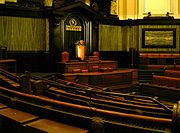 Each of the six GLC elections was won by the leading national opposition party, with the party in government nationally coming second in the GLC elections.
The first GLC election was on 9 April 1964. Each of the new boroughs elected a number of representatives under the bloc vote
system. Despite Conservative hopes, the first GLC consisted of 64 Labour and 36 Conservative councillors and Labour Group leader Bill Fiske
became the first Leader of the Council.
At the next election in 1967 the unpopularity of the national Labour government produced a massive Conservative victory with 82 seats, to Labour's 18. Desmond Plummer
became the first Conservative leader of London-wide government in 33 years. The Conservatives retained control in 1970 with a reduced majority.
In 1972 the electoral system was reformed to introduce single-member constituencies for the election after the 1973 contest, and extend the term of office to four years. Labour fought the 1973 election on a strongly socialist platform and won with 57 seats to 33 for the Conservatives. The Liberals
won two seats.
The GLC's hopes under the Labour administration of Reg Goodwin
were badly affected by the oil crisis of 1974. Massive inflation which when combined with the GLC's £1.6 billion debt led to heavy rate increases (200% in total before the next election in 1977) and unpopular budget cuts. Some months before the 1977 elections the Labour Group began to split. A left group, including Ken Livingstone
, denounced the election manifesto of the party.
The Conservatives regained control in May 1977, winning 64 seats under their new Thatcherite
leader Horace Cutler
against a Labour total of just 28. Cutler headed a resolutely right-wing administration, cutting spending, selling council housing and deprioritising London Transport. In opposition the Labour party continued to fractionalise: Goodwin resigned suddenly in 1980 and in the following leadership contest the little-regarded left-winger Ken Livingstone
was only just beaten in an intensely tactical campaign by the moderate Andrew McIntosh
. However the Labour left were strong at constituency level and as the 1981 election approached they worked to ensure that their members were selected to stand and that their ideologies shaped the manifesto
. The eventual manifesto topped out at over 50,000 words.
The May 1981 election was presented as a clash of ideologies by the Conservatives - Thatcherism against a 'tax high, spend high' Marxist Labour group, claiming that Andrew McIntosh would be deposed by Ken Livingstone
after the election. McIntosh and Labour Party leader Michael Foot
insisted this was untrue, and Labour won a very narrow victory with a majority of six. At a pre-arranged meeting of the new Councillors the day after the election, the Left faction won a complete victory over the less-organised Labour right. McIntosh lost with 20 votes to 30 for Ken Livingstone. Livingstone, dubbed 'Red Ken' by some newspapers, managed to gain the guarded support of the Labour deputy leader Illtyd Harrington and the party Chief Whip and set about his new administration.
Livingstone was able to push through the majority of his policies. The increased spending of the council led the national government to reduce and eventually end the GLC's central government grant as punishment.
's Conservative
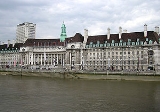
government. Livingstone soon became a thorn in the side of the sitting Conservative government. He deliberately antagonised Thatcher through a series of actions (including posting a billboard of London's rising unemployment figures on the side of County Hall
, directly opposite Parliament
); a Fares Fair policy of reducing Tube
and bus fares using government subsidies; meeting Sinn Féin
MP
Gerry Adams
at a time when Adams was banned from entering Britain
due to his links with the Provisional IRA
; and endorsing a statue of Nelson Mandela
while Thatcher regarded the future South African president as a terrorist. After what was regarded as a punitive funding cut by the Thatcher government, which had the effect of cutting school lunch subsidies for London schoolchildren, the GLC hung a banner with the words "Maggie Thatcher, Milk Snatcher" from the County Hall.
By 1983, the government argued for the abolition of the GLC, claiming that it was inefficient and unnecessary, and that its functions could be carried out more efficiently by the boroughs. The arguments for this case which were detailed in the White Paper
Streamlining the cities
. Critics of this position argued that the GLC's abolition (as with that of the Metropolitan County Councils) was politically motivated, claiming that it had become a powerful vehicle for opposition to Margaret Thatcher's government. Ken Livingstone
and 3 other Labour councilors resigned in protest, and won back their seats easily in the September 1984 by-elections because the Conservatives refused to stand.
The Local Government Act 1985
, which abolished the GLC, faced considerable opposition from many quarters but was narrowly passed in Parliament, setting the end of the council for 31 March 1986. It also cancelled the scheduled May 1985 elections. GLC assets were assigned to the quango
London Residuary Body
for disposal, including County Hall, which was sold to a Japanese entertainment company and now houses the London Aquarium
and the London Film Museum
, amongst other things.
The Inner London Education Authority
(ILEA) continued in existence for a few years, and direct elections to it were held, but ILEA was finally also disbanded in 1990, with the Inner London Boroughs assuming control over education as the Outer boroughs had done on their creation in 1965.
for an example. In total, around 100 organisations were responsible for service delivery in Greater London.
Tony Blair
's Labour
government was elected in 1997
, and was committed to bringing back London-wide government. In 1999 a referendum was held on the establishment of a new London authority and elected mayor, which was approved by a two to one margin.
The new Greater London Authority
(GLA) was established in 2000. The GLA has a very different structure to the GLC, consisting of a directly elected Mayor of London
and a London Assembly
. The Mayor of London elections were won by the same Ken Livingstone, who began his victory speech with the words: "As I was saying before I was so rudely interrupted 14 years ago ...".
The archives of the Greater London Council are held at London Metropolitan Archives
.
Local government
Local government refers collectively to administrative authorities over areas that are smaller than a state.The term is used to contrast with offices at nation-state level, which are referred to as the central government, national government, or federal government...
administrative body for Greater London
Greater London
Greater London is the top-level administrative division of England covering London. It was created in 1965 and spans the City of London, including Middle Temple and Inner Temple, and the 32 London boroughs. This territory is coterminate with the London Government Office Region and the London...
from 1965 to 1986. It replaced the earlier London County Council
London County Council
London County Council was the principal local government body for the County of London, throughout its 1889–1965 existence, and the first London-wide general municipal authority to be directly elected. It covered the area today known as Inner London and was replaced by the Greater London Council...
(LCC) which had covered a much smaller area. The GLC was dissolved in 1986 by the Local Government Act 1985
Local Government Act 1985
The Local Government Act 1985 is an Act of Parliament in the United Kingdom. Its main effect was to abolish the county councils of the metropolitan counties that had been set up in 1974 by the Local Government Act 1972, along with the Greater London Council that had been established in 1965.The...
and its powers were devolved to the London boroughs and other entities.
Creation
The GLC was established by the London Government Act 1963London Government Act 1963
The London Government Act 1963 is an Act of the Parliament of the United Kingdom, which recognised officially the conurbation known as Greater London and created a new local government structure for the capital. The Act significantly reduced the number of local government districts in the area,...
, which sought to create a new body covering all of London rather than just the inner part of the conurbation, additionally including and empowering newly-created London boroughs within the overall administrative structure.
A Royal Commission
Royal Commission
In Commonwealth realms and other monarchies a Royal Commission is a major ad-hoc formal public inquiry into a defined issue. They have been held in various countries such as the United Kingdom, Australia, Canada, New Zealand, and Saudi Arabia...
was set up under Sir Edwin Herbert in 1957 and reported in 1960, recommending the creation of 52 new London borough
London borough
The administrative area of Greater London contains thirty-two London boroughs. Inner London comprises twelve of these boroughs plus the City of London. Outer London comprises the twenty remaining boroughs of Greater London.-Functions:...
s as the basis for local government. It further recommended that the LCC be replaced by a weaker strategic authority, with responsibility for public transport, road schemes, housing development and regeneration.
The recommendations were accepted in most part, but the number of new boroughs reduced instead to 32. Greater London
Greater London
Greater London is the top-level administrative division of England covering London. It was created in 1965 and spans the City of London, including Middle Temple and Inner Temple, and the 32 London boroughs. This territory is coterminate with the London Government Office Region and the London...
covered the counties of London and most of Middlesex
Middlesex
Middlesex is one of the historic counties of England and the second smallest by area. The low-lying county contained the wealthy and politically independent City of London on its southern boundary and was dominated by it from a very early time...
, plus parts of Essex, Kent
Kent
Kent is a county in southeast England, and is one of the home counties. It borders East Sussex, Surrey and Greater London and has a defined boundary with Essex in the middle of the Thames Estuary. The ceremonial county boundaries of Kent include the shire county of Kent and the unitary borough of...
and Surrey, a small part of Hertfordshire
Hertfordshire
Hertfordshire is a ceremonial and non-metropolitan county in the East region of England. The county town is Hertford.The county is one of the Home Counties and lies inland, bordered by Greater London , Buckinghamshire , Bedfordshire , Cambridgeshire and...
and the County Borough
County borough
County borough is a term introduced in 1889 in the United Kingdom of Great Britain and Ireland , to refer to a borough or a city independent of county council control. They were abolished by the Local Government Act 1972 in England and Wales, but continue in use for lieutenancy and shrievalty in...
s of Croydon
County Borough of Croydon
Croydon was a local government district in north east Surrey, England from 1849 to 1965.-History:A local board of health was formed for the parish of Croydon St John the Baptist in 1849. On March 9, 1883 the town received a charter of incorporation to become a municipal borough...
(Surrey), East Ham
County Borough of East Ham
East Ham was a local government district in the far south west of Essex from 1878 to 1965. It extended from Wanstead Flats in the north to the River Thames in the south and from Green Street in the west to Barking Creek in the east...
and West Ham
County Borough of West Ham
West Ham was a local government district in the extreme south west of Essex from 1886 to 1965, forming part of the built-up area of London, although outside the County of London...
(both Essex) which had been independent of county control.
Some areas on the boundary of the area fought successfully to be excluded from it, notably the Sunbury-on-Thames Urban District
Sunbury-on-Thames Urban District
Sunbury on Thames - also known as Sunbury - was a local government district from 1894 to 1974 around the town of Sunbury-on-Thames, also covering Littleton and Shepperton....
, Staines Urban District
Staines Urban District
Staines was a local government district from 1894 to 1974 around the town of Staines. Apart from Staines itself, it also covered Ashford, Laleham and Stanwell....
and Potters Bar Urban District
Potters Bar Urban District
South Mimms Rural District and Potters Bar Urban District were local government districts occupying the area around the town of Potters Bar, England....
of Middlesex, fearing increased local taxation. Other areas in the Report that were not eventually made part of Greater London included Epsom and Ewell
Epsom and Ewell
Epsom and Ewell is a local government district with borough status in Surrey, England, covering the town of Epsom and the village of Ewell. The borough was formed as an urban district in 1894, and was known as Epsom until 1934. It was made a municipal borough in 1937...
, Caterham
Caterham
Caterham is a town in the Tandridge District of Surrey, England. The town is geographically divided into two sections: Caterham on the Hill and Caterham Valley - the main town centre. The town lies close to the A22, a few miles south of Croydon, in a valley cut into the dip slope of the North Downs...
and Warlingham
Warlingham
Warlingham is a large village on the south-eastern boundary of London, England, just across the border in Tandridge district, east Surrey. Neighbouring villages include Sanderstead, Hamsey Green, Whyteleafe, Farleigh, Fickleshole, Tatsfield and Woldingham...
, Esher
Esher
Esher is a town in the Surrey borough of Elmbridge in South East England near the River Mole. It is a very prosperous part of the Greater London Urban Area, largely suburban in character, and is situated 14.1 miles south west of Charing Cross....
, and Weybridge
Weybridge
Weybridge is a town in the Elmbridge district of Surrey in South East England. It is bounded to the north by the River Thames at the mouth of the River Wey, from which it gets its name...
.
GLC councillors elected for the LCC area became ex officio members of the Inner London Education Authority
Inner London Education Authority
The Inner London Education Authority was the education authority for the 12 inner London boroughs from 1965 until its abolition in 1990.-History:...
, which took over the LCC responsibility for education; in outer London, the London boroughs each operated as a local education authority.
Powers
The GLC was responsible for running strategic services such as the fire service, emergency planning, waste disposal and flood prevention. The GLC shared responsibility with the London boroughLondon borough
The administrative area of Greater London contains thirty-two London boroughs. Inner London comprises twelve of these boroughs plus the City of London. Outer London comprises the twenty remaining boroughs of Greater London.-Functions:...
s for providing road
Road
A road is a thoroughfare, route, or way on land between two places, which typically has been paved or otherwise improved to allow travel by some conveyance, including a horse, cart, or motor vehicle. Roads consist of one, or sometimes two, roadways each with one or more lanes and also any...
s, housing, city planning and leisure services. It had a very limited role in direct service provision with most functions the responsibility of the London boroughs. The GLC did not take control of public transport from the London Transport Board
London Transport Board
The London Transport Board was the organisation responsible for public transport in London, UK, and its environs from 1963-1969. In common with all London transport authorities from 1933 to 2000, the public name and operational brand of the organisation was London Transport.-History:The...
until 1970 and lost control to London Regional Transport
London Regional Transport
London Regional Transport was the organisation responsible for the public transport network in Greater London, UK from 1984-2000. In common with all London transport authorities from 1933 to 2000, the public name and operational brand of the organisation was London Transport.The organisation was...
in 1984.
Under the 1963 Act, the GLC was required to produce a Greater London Development Plan. The plan included in its wide ranging remit: population changes, employment, housing, pollution
Pollution
Pollution is the introduction of contaminants into a natural environment that causes instability, disorder, harm or discomfort to the ecosystem i.e. physical systems or living organisms. Pollution can take the form of chemical substances or energy, such as noise, heat or light...
, transport
Transport in London
London's transport forms the hub of the road, rail and air networks in the United Kingdom. It has its own dense and extensive internal private and public transport networks, as well as providing a focal point for the national road and railway networks...
, roads, the central area
Central London
Central London is the innermost part of London, England. There is no official or commonly accepted definition of its area, but its characteristics are understood to include a high density built environment, high land values, an elevated daytime population and a concentration of regionally,...
, growth and development areas, urban open spaces
Parks and open spaces in London
There are many parks and open spaces in London, England. Green space in central London consists of five Royal Parks, supplemented by a number of small garden squares scattered throughout the city centre...
and the urban landscape, public services and utilities and planning standards. The plan included the comprehensive redevelopment of Covent Garden
Covent Garden
Covent Garden is a district in London on the eastern fringes of the West End, between St. Martin's Lane and Drury Lane. It is associated with the former fruit and vegetable market in the central square, now a popular shopping and tourist site, and the Royal Opera House, which is also known as...
and creating a central London motorway loop. The plan was subject to an Inquiry which lasted from July 1970 until May 1972. The campaign to save Covent Garden
Covent Garden
Covent Garden is a district in London on the eastern fringes of the West End, between St. Martin's Lane and Drury Lane. It is associated with the former fruit and vegetable market in the central square, now a popular shopping and tourist site, and the Royal Opera House, which is also known as...
along with various opposition on other matters largely derailed the plan.
Composition and political control
The first GLC election was on 9 April 1964. Each of the new boroughs elected a number of representatives under the bloc vote
Plurality-at-large voting
Plurality-at-large voting is a non-proportional voting system for electing several representatives from a single multimember electoral district using a series of check boxes and tallying votes similar to a plurality election...
system. Despite Conservative hopes, the first GLC consisted of 64 Labour and 36 Conservative councillors and Labour Group leader Bill Fiske
Bill Fiske
William Geoffrey Fiske, Baron Fiske OBE , commonly known as Bill Fiske, was the first Leader of the Greater London Council and oversaw the decimalisation of the Pound Sterling as Chairman of the Decimal Currency Board....
became the first Leader of the Council.
At the next election in 1967 the unpopularity of the national Labour government produced a massive Conservative victory with 82 seats, to Labour's 18. Desmond Plummer
Desmond Plummer
Arthur Desmond Herne Plummer, Baron Plummer of St Marylebone was a Conservative Party politician in London and the longest serving Leader of the Greater London Council....
became the first Conservative leader of London-wide government in 33 years. The Conservatives retained control in 1970 with a reduced majority.
In 1972 the electoral system was reformed to introduce single-member constituencies for the election after the 1973 contest, and extend the term of office to four years. Labour fought the 1973 election on a strongly socialist platform and won with 57 seats to 33 for the Conservatives. The Liberals
Liberal Party (UK)
The Liberal Party was one of the two major political parties of the United Kingdom during the 19th and early 20th centuries. It was a third party of negligible importance throughout the latter half of the 20th Century, before merging with the Social Democratic Party in 1988 to form the present day...
won two seats.
The GLC's hopes under the Labour administration of Reg Goodwin
Reg Goodwin
Sir Reginald Eustace Goodwin was a British politician. He was Leader of the Greater London Council from 1973-77. On the moderate wing of the Labour Party, he nonetheless favoured public control of utilities.-Family background:Goodwin was from a middle-class family of five and was born in Streatham...
were badly affected by the oil crisis of 1974. Massive inflation which when combined with the GLC's £1.6 billion debt led to heavy rate increases (200% in total before the next election in 1977) and unpopular budget cuts. Some months before the 1977 elections the Labour Group began to split. A left group, including Ken Livingstone
Ken Livingstone
Kenneth Robert "Ken" Livingstone is an English politician who is currently a member of the centrist to centre-left Labour Party...
, denounced the election manifesto of the party.
The Conservatives regained control in May 1977, winning 64 seats under their new Thatcherite
Margaret Thatcher
Margaret Hilda Thatcher, Baroness Thatcher, was Prime Minister of the United Kingdom from 1979 to 1990...
leader Horace Cutler
Horace Cutler
Sir Horace Walter Cutler OBE was a British politician and Leader of the Greater London Council from 1977 to 1981. He was noted for his showmanship and flair for publicity, although sceptical of the merits of the authority he was in charge of.-Origin:Cutler was born in Stoke Newington, London into...
against a Labour total of just 28. Cutler headed a resolutely right-wing administration, cutting spending, selling council housing and deprioritising London Transport. In opposition the Labour party continued to fractionalise: Goodwin resigned suddenly in 1980 and in the following leadership contest the little-regarded left-winger Ken Livingstone
Ken Livingstone
Kenneth Robert "Ken" Livingstone is an English politician who is currently a member of the centrist to centre-left Labour Party...
was only just beaten in an intensely tactical campaign by the moderate Andrew McIntosh
Andrew McIntosh, Baron McIntosh of Haringey
Andrew Robert McIntosh, Baron McIntosh of Haringey PC was a British Labour politician and last elected Principal of the Working Men's College....
. However the Labour left were strong at constituency level and as the 1981 election approached they worked to ensure that their members were selected to stand and that their ideologies shaped the manifesto
Manifesto
A manifesto is a public declaration of principles and intentions, often political in nature. Manifestos relating to religious belief are generally referred to as creeds. Manifestos may also be life stance-related.-Etymology:...
. The eventual manifesto topped out at over 50,000 words.
The May 1981 election was presented as a clash of ideologies by the Conservatives - Thatcherism against a 'tax high, spend high' Marxist Labour group, claiming that Andrew McIntosh would be deposed by Ken Livingstone
Ken Livingstone
Kenneth Robert "Ken" Livingstone is an English politician who is currently a member of the centrist to centre-left Labour Party...
after the election. McIntosh and Labour Party leader Michael Foot
Michael Foot
Michael Mackintosh Foot, FRSL, PC was a British Labour Party politician, journalist and author, who was a Member of Parliament from 1945 to 1955 and from 1960 until 1992...
insisted this was untrue, and Labour won a very narrow victory with a majority of six. At a pre-arranged meeting of the new Councillors the day after the election, the Left faction won a complete victory over the less-organised Labour right. McIntosh lost with 20 votes to 30 for Ken Livingstone. Livingstone, dubbed 'Red Ken' by some newspapers, managed to gain the guarded support of the Labour deputy leader Illtyd Harrington and the party Chief Whip and set about his new administration.
Livingstone was able to push through the majority of his policies. The increased spending of the council led the national government to reduce and eventually end the GLC's central government grant as punishment.
Elections to the GLC
| Overall control | Conservative Conservative Party (UK) The Conservative Party, formally the Conservative and Unionist Party, is a centre-right political party in the United Kingdom that adheres to the philosophies of conservatism and British unionism. It is the largest political party in the UK, and is currently the largest single party in the House... |
Labour Labour Party (UK) The Labour Party is a centre-left democratic socialist party in the United Kingdom. It surpassed the Liberal Party in general elections during the early 1920s, forming minority governments under Ramsay MacDonald in 1924 and 1929-1931. The party was in a wartime coalition from 1940 to 1945, after... |
Liberal Liberal Party (UK) The Liberal Party was one of the two major political parties of the United Kingdom during the 19th and early 20th centuries. It was a third party of negligible importance throughout the latter half of the 20th Century, before merging with the Social Democratic Party in 1988 to form the present day... |
|
| 1981 Greater London Council election, 1981 Turnout: 2,250,118 people voted. All parties shown.This was the last election to the GLC. The Conservative government of Margaret Thatcher took the decision to abolish the council in the mid-1980s. For more information on this see the article, Greater London Council. Following the abolition of... |
Labour | 41 | 50 | 1 |
| 1977 Greater London Council election, 1977 Turnout: 2,242,064 people voted-References:*... |
Conservative | 64 | 28 | - |
| 1973 Greater London Council election, 1973 The fourth election to the Greater London Council was held on April 12, 1973. Labour, benefiting both from the unpopularity of the Conservative GLC's transport policy and from the difficulties of the national Conservative government, won a very large majority of 58 seats to 32 for the... |
Labour | 32 | 58 | 2 |
| 1970 Greater London Council election, 1970 The third election to the Greater London Council was held on 9 April 1970 and saw a Conservative victory with a reduced majority. In addition to the 100 councillors, there were sixteen Aldermen who divided 11 Conservative and 5 Labour, so that the Conservatives actually had 76 seats to 40 for... |
Conservative | 65 | 35 | - |
| 1967 Greater London Council election, 1967 The second election to the Greater London Council was held on 13 April 1967, and saw the first Conservative victory for a London-wide authority since 1931... |
Conservative | 82 | 18 | - |
| 1964 Greater London Council election, 1964 The first election to the Greater London Council was held on 9 April 1964. The election happened at a time of very high political tension, with a general election due in a few months... |
Labour | 36 | 64 | - |
Abolition
Livingstone's high-spend socialist policies put the GLC into direct conflict with Margaret ThatcherMargaret Thatcher
Margaret Hilda Thatcher, Baroness Thatcher, was Prime Minister of the United Kingdom from 1979 to 1990...
's Conservative
Conservative Party (UK)
The Conservative Party, formally the Conservative and Unionist Party, is a centre-right political party in the United Kingdom that adheres to the philosophies of conservatism and British unionism. It is the largest political party in the UK, and is currently the largest single party in the House...
government. Livingstone soon became a thorn in the side of the sitting Conservative government. He deliberately antagonised Thatcher through a series of actions (including posting a billboard of London's rising unemployment figures on the side of County Hall
County Hall, London
County Hall is a building in Lambeth, London, which was the headquarters of London County Council and later the Greater London Council . The building is on the bank of the River Thames, just north of Westminster Bridge, facing west toward the City of Westminster, and close to the Palace of...
, directly opposite Parliament
Palace of Westminster
The Palace of Westminster, also known as the Houses of Parliament or Westminster Palace, is the meeting place of the two houses of the Parliament of the United Kingdom—the House of Lords and the House of Commons...
); a Fares Fair policy of reducing Tube
London Underground
The London Underground is a rapid transit system serving a large part of Greater London and some parts of Buckinghamshire, Hertfordshire and Essex in England...
and bus fares using government subsidies; meeting Sinn Féin
Sinn Féin
Sinn Féin is a left wing, Irish republican political party in Ireland. The name is Irish for "ourselves" or "we ourselves", although it is frequently mistranslated as "ourselves alone". Originating in the Sinn Féin organisation founded in 1905 by Arthur Griffith, it took its current form in 1970...
MP
Member of Parliament
A Member of Parliament is a representative of the voters to a :parliament. In many countries with bicameral parliaments, the term applies specifically to members of the lower house, as upper houses often have a different title, such as senate, and thus also have different titles for its members,...
Gerry Adams
Gerry Adams
Gerry Adams is an Irish republican politician and Teachta Dála for the constituency of Louth. From 1983 to 1992 and from 1997 to 2011, he was an abstentionist Westminster Member of Parliament for Belfast West. He is the president of Sinn Féin, the second largest political party in Northern...
at a time when Adams was banned from entering Britain
Great Britain
Great Britain or Britain is an island situated to the northwest of Continental Europe. It is the ninth largest island in the world, and the largest European island, as well as the largest of the British Isles...
due to his links with the Provisional IRA
Provisional Irish Republican Army
The Provisional Irish Republican Army is an Irish republican paramilitary organisation whose aim was to remove Northern Ireland from the United Kingdom and bring about a socialist republic within a united Ireland by force of arms and political persuasion...
; and endorsing a statue of Nelson Mandela
Nelson Mandela
Nelson Rolihlahla Mandela served as President of South Africa from 1994 to 1999, and was the first South African president to be elected in a fully representative democratic election. Before his presidency, Mandela was an anti-apartheid activist, and the leader of Umkhonto we Sizwe, the armed wing...
while Thatcher regarded the future South African president as a terrorist. After what was regarded as a punitive funding cut by the Thatcher government, which had the effect of cutting school lunch subsidies for London schoolchildren, the GLC hung a banner with the words "Maggie Thatcher, Milk Snatcher" from the County Hall.
By 1983, the government argued for the abolition of the GLC, claiming that it was inefficient and unnecessary, and that its functions could be carried out more efficiently by the boroughs. The arguments for this case which were detailed in the White Paper
White paper
A white paper is an authoritative report or guide that helps solve a problem. White papers are used to educate readers and help people make decisions, and are often requested and used in politics, policy, business, and technical fields. In commercial use, the term has also come to refer to...
Streamlining the cities
Streamlining the cities
Streamlining the cities: Government proposals for reorganising local government in Greater London and the Metropolitan counties was a government white paper issued in 1983, by the Conservative government of Margaret Thatcher which led to the abolition of the Greater London Council and the...
. Critics of this position argued that the GLC's abolition (as with that of the Metropolitan County Councils) was politically motivated, claiming that it had become a powerful vehicle for opposition to Margaret Thatcher's government. Ken Livingstone
Ken Livingstone
Kenneth Robert "Ken" Livingstone is an English politician who is currently a member of the centrist to centre-left Labour Party...
and 3 other Labour councilors resigned in protest, and won back their seats easily in the September 1984 by-elections because the Conservatives refused to stand.
The Local Government Act 1985
Local Government Act 1985
The Local Government Act 1985 is an Act of Parliament in the United Kingdom. Its main effect was to abolish the county councils of the metropolitan counties that had been set up in 1974 by the Local Government Act 1972, along with the Greater London Council that had been established in 1965.The...
, which abolished the GLC, faced considerable opposition from many quarters but was narrowly passed in Parliament, setting the end of the council for 31 March 1986. It also cancelled the scheduled May 1985 elections. GLC assets were assigned to the quango
Quango
Quango or qango is an acronym used notably in the United Kingdom, Ireland and elsewhere to label an organisation to which government has devolved power...
London Residuary Body
London Residuary Body
The London Residuary Body was a body set up in 1985 to dispose of the assets of the Greater London Council after the council's abolition in 1986. Similar residuary bodies were set up for the metropolitan counties. After the abolition of the Inner London Education Authority, the LRB took control of...
for disposal, including County Hall, which was sold to a Japanese entertainment company and now houses the London Aquarium
London Aquarium
The Sea Life London Aquarium is located on the ground floor of County Hall on the South Bank of the River Thames in central London, near the EDF Energy London Eye...
and the London Film Museum
London Film Museum
The London Film Museum, founded and created by Jonathan Sands in February 2008, is a museum dedicated to the British film industry.It is located in County Hall on the South Bank in London, and features original props, costumes and sets from feature films. There is also a section on how films are...
, amongst other things.
The Inner London Education Authority
Inner London Education Authority
The Inner London Education Authority was the education authority for the 12 inner London boroughs from 1965 until its abolition in 1990.-History:...
(ILEA) continued in existence for a few years, and direct elections to it were held, but ILEA was finally also disbanded in 1990, with the Inner London Boroughs assuming control over education as the Outer boroughs had done on their creation in 1965.
Replacement
Most of the powers of the GLC were devolved to the London boroughs. Some powers, such as the fire service, were taken over by joint boards made up of councillors appointed by the boroughs - see waste authorities in Greater LondonWaste authorities in Greater London
Greater London has a number of waste disposal authorities, responsible for waste collection and disposal. Prior to the abolition of the Greater London Council in 1986, it was the waste authority for Greater London.-Joint authorities:...
for an example. In total, around 100 organisations were responsible for service delivery in Greater London.
Tony Blair
Tony Blair
Anthony Charles Lynton Blair is a former British Labour Party politician who served as the Prime Minister of the United Kingdom from 2 May 1997 to 27 June 2007. He was the Member of Parliament for Sedgefield from 1983 to 2007 and Leader of the Labour Party from 1994 to 2007...
's Labour
Labour Party (UK)
The Labour Party is a centre-left democratic socialist party in the United Kingdom. It surpassed the Liberal Party in general elections during the early 1920s, forming minority governments under Ramsay MacDonald in 1924 and 1929-1931. The party was in a wartime coalition from 1940 to 1945, after...
government was elected in 1997
United Kingdom general election, 1997
The United Kingdom general election, 1997 was held on 1 May 1997, more than five years after the previous election on 9 April 1992, to elect 659 members to the British House of Commons. The Labour Party ended its 18 years in opposition under the leadership of Tony Blair, and won the general...
, and was committed to bringing back London-wide government. In 1999 a referendum was held on the establishment of a new London authority and elected mayor, which was approved by a two to one margin.
The new Greater London Authority
Greater London Authority
The Greater London Authority is the top-tier administrative body for Greater London, England. It consists of a directly elected executive Mayor of London, currently Boris Johnson, and an elected 25-member London Assembly with scrutiny powers...
(GLA) was established in 2000. The GLA has a very different structure to the GLC, consisting of a directly elected Mayor of London
Mayor of London
The Mayor of London is an elected politician who, along with the London Assembly of 25 members, is accountable for the strategic government of Greater London. Conservative Boris Johnson has held the position since 4 May 2008...
and a London Assembly
London Assembly
The London Assembly is an elected body, part of the Greater London Authority, that scrutinises the activities of the Mayor of London and has the power, with a two-thirds majority, to amend the mayor's annual budget. The assembly was established in 2000 and is headquartered at City Hall on the south...
. The Mayor of London elections were won by the same Ken Livingstone, who began his victory speech with the words: "As I was saying before I was so rudely interrupted 14 years ago ...".
The archives of the Greater London Council are held at London Metropolitan Archives
London Metropolitan Archives
The London Metropolitan Archives are the main archives for the Greater London area. Established in 1997, having previously been known as the Greater London Record Office, they are financed by the City of London Corporation....
.
Leaders of the GLC
- Bill FiskeBill FiskeWilliam Geoffrey Fiske, Baron Fiske OBE , commonly known as Bill Fiske, was the first Leader of the Greater London Council and oversaw the decimalisation of the Pound Sterling as Chairman of the Decimal Currency Board....
1964-67 - Desmond PlummerDesmond PlummerArthur Desmond Herne Plummer, Baron Plummer of St Marylebone was a Conservative Party politician in London and the longest serving Leader of the Greater London Council....
1967-73 - Sir Reg GoodwinReg GoodwinSir Reginald Eustace Goodwin was a British politician. He was Leader of the Greater London Council from 1973-77. On the moderate wing of the Labour Party, he nonetheless favoured public control of utilities.-Family background:Goodwin was from a middle-class family of five and was born in Streatham...
1973-77 - Sir Horace CutlerHorace CutlerSir Horace Walter Cutler OBE was a British politician and Leader of the Greater London Council from 1977 to 1981. He was noted for his showmanship and flair for publicity, although sceptical of the merits of the authority he was in charge of.-Origin:Cutler was born in Stoke Newington, London into...
1977-81 - Ken LivingstoneKen LivingstoneKenneth Robert "Ken" Livingstone is an English politician who is currently a member of the centrist to centre-left Labour Party...
1981-84 - John Wilson 1984
- Ken LivingstoneKen LivingstoneKenneth Robert "Ken" Livingstone is an English politician who is currently a member of the centrist to centre-left Labour Party...
1984-86
See also
- List of Greater London Council committee chairs
- Members of the Greater London CouncilMembers of the Greater London CouncilThe following people served as Members of the Greater London Council, either as councillors or Aldermen. The polling days were:* April 9, 1964 * April 13, 1967...
- OXO TowerOXO TowerThe OXO Tower is a building with a prominent tower on the south bank of the River Thames in London. The building currently has a set of bijou arts and crafts shops on the ground and first floors. A well-known restaurant is located on the 8th floor, which is the roof top level of the main building...
– controversially sold by the GLC for £Pound sterlingThe pound sterling , commonly called the pound, is the official currency of the United Kingdom, its Crown Dependencies and the British Overseas Territories of South Georgia and the South Sandwich Islands, British Antarctic Territory and Tristan da Cunha. It is subdivided into 100 pence...
750,000 in 1984. - GLC: The Carnage Continues...GLC: The Carnage Continues..."GLC: The Carnage Continues" is an episode of the British television comedy series The Comic Strip Presents... broadcast on BBC Two in 1990...
– satire of the GLC politics by The Comic StripThe Comic StripThe Comic Strip is a group of British comedians, known for their television series The Comic Strip Presents.... The core members are Adrian Edmondson, Dawn French, Rik Mayall, Nigel Planer, Peter Richardson and Jennifer Saunders, with frequent appearances by Keith Allen, Robbie Coltrane and... - Gay Rights Working PartyGay Rights Working PartyGay Rights Working Party was a working party of the Greater London Council , between 1981 and 1986 ....
- part of the Greater London Council