
Encyclopedia
Birmingham is a
city and metropolitan borough in the
West Midlands. Birmingham is the largest of England's core cities, and is generally considered to be the UK's
second city. The city's reputation was forged as the powerhouse of the
Industrial Revolution in Britain, a fact which led to Birmingham being known as "the workshop of the world" or the "city of a thousand trades".
The City of Birmingham has a
population of 1,001,200
. It forms part of the larger West Midlands conurbation, which has a population of 2,284,093 and includes several neighbouring towns and cities, such as
Solihull,
Wolverhampton and the towns of the Black Country.
The people of Birmingham are known as 'Brummies', a term derived from the city's nickname of
Brum. This comes in turn from the city's dialect name, Brummagem. There is a distinctive Brummie dialect and accent.
Birmingham is an ethnically and culturally diverse city. At the time of the 2001 census, 70.4% of the population was White , 19.5%
British Asian 6.1%
Black or
Black British, 0.5%
Chinese, and 3.5% of
mixed race or other ethnic heritage.
History
Birmingham has a recorded history going back 1,000 years. In this time, it has grown from a tiny
Anglo-Saxon farming village into a major industrial and commercial city.
The Birmingham area was occupied in
Roman times, with several military roads and a large
fort. Birmingham started life as a small Anglo-Saxon hamlet in the
Early Middle Ages. It was first recorded in written documents by the
Domesday Book of 1086 as a small
village, worth only 20
shillings.
In the 12th century, Birmingham was granted a charter to hold a market, which in time became known as the
Bull Ring. As a convenient location for trade, Birmingham soon developed into a small but thriving market town.
By the 16th century, Birmingham's access to supplies of
iron ore and
coal meant that
metalworking industries became established. In the 17th century Birmingham became an important manufacturing town with a reputation for producing
small arms. Birmingham manufacturers supplied
Oliver Cromwell's forces with much of their
weaponry during the
English Civil War. Arms manufacture in Birmingham became a staple trade and was concentrated in the area known as the Gun Quarter.
During the
Industrial Revolution , Birmingham grew rapidly into a major industrial centre. Unlike many other English industrial cities such as
Manchester, industry in Birmingham was based upon small workshops rather than large
factories or mills.
Historical population of Birmingham
| Year | Population figure |
|---|
| 1538 | 1,300 |
| 1650 | 5,472 |
| 1700 | 15,032 |
| 1731 | 23,286 |
| 1778 | 42,250 |
| 1785 | 52,250 |
| 1801 | 73,670 |
| 1811 | 85,753 |
| 1821 | 106,722 |
| 1831 | 146,986 |
| 1841 | 182,922 |
| 1851 | 232,638 |
| 1861 | 296,076 |
| 1871 | 343,787 |
| 1881 | 400,774 |
| 1891 | 478,113 |
| 1901 | 522,204 |
| 1911 | 840,202 |
| 1912-1967 | Records destroyed |
| 1968 | 900,000 |
From the 1760s onwards, a large network of
canals were built across Birmingham and the Black Country, to transport raw materials and finished goods. By the 1820s an extensive canal system had been constructed; Birmingham is often described as having more miles of canals than
Venice.
Railways arrived in Birmingham in 1837, with the opening of the Grand Junction Railway and later the
London and Birmingham Railway the railways soon linked Birmingham to every corner of Britain.
New Street Station was opened as a joint station in 1854. And this was soon followed by the
Great Western Railway's
Snow Hill station.
In the early 20th century Birmingham Corporation Tramways operated a tramway network which was the largest in the country to be constructed to the narrow gauge of 3'6" rather than the more usual 4'8½". Over 800 tramcars served this network until its abandonment in 1953. It was linked with the tramways in
Walsall,
Wolverhampton and the Black Country.
During the
Victorian era, the population of Birmingham grew rapidly to well over half a million and Birmingham became the second largest population centre in England and the third in Britain after
Glasgow and then
London. Birmingham's importance led to it being granted
city status in 1889 by
Queen Victoria.
The city built its own university in 1900, The
University of Birmingham, which became the first of Britain's
Redbrick universities.
Birmingham was originally part of
Warwickshire, however the city expanded in the late 19th and early 20th century, absorbing parts of
Worcestershire to the south and
Staffordshire to the west. The city absorbed
Sutton Coldfield in 1974, and at the same time became part of the new
West Midlands county.
Birmingham suffered heavy
bomb damage during
World War II during the Birmingham Blitz, and partly as a result of this the city centre was extensively re-developed during the 1950s and 1960s, with many
concrete office buildings, ring-roads, and now much-derided pedestrian subways. As a result, Birmingham gained a reputation for ugliness and was frequently described as a "concrete jungle".
In recent years however, Birmingham has been transformed, the city centre has been extensively renovated and restored with the construction of new squares, the restoration of old streets, buildings and canals, the removal of the pedestrian subways, and the demolition and subsequent redevelopment of the
Bull Ring shopping centre, which now includes the architecturally unique
Selfridges building.
In the decades following World War II, the face of Birmingham changed dramatically, with large scale immigration from the
Commonwealth of Nations and beyond.
Birmingham's transition from an industrial centre to a tourism and services economy is best illustrated by the hosting of the first official summit of the
G8 at the
International Convention Centre .
Geography
The city of Birmingham is situated just to the west of the geographical centre of
England, across an area of relatively high ground, ranging around 150-200 metres above sea level. The main north-south
watershed of Britain actually passes through Birmingham. The Birmingham area has recently seen several tornadoes, the most recent of which were witnessed in 2005. The watershed of the
River Severn and River Trent can clearly be seen along the
Perry Barr area of Birmingham and areas near
Erdington where the level and gradient of the land changes significantly.
To the south and west of the city lie the
Lickey Hills,
Clent Hills and Walton Hill, which reach 315 metres and have good views over the city.
Part of the city centre is located on a
sandstone ridge which makes some buildings appear taller than other buildings which are actually taller than them. One of the highest points is located on
Broad Street.
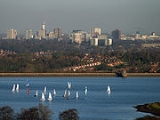
Birmingham, United Kingdom
Climate
These are the average and record temperatures as provided by BBC
Weather.
Celsius
| Average | Record |
|---|
| Month | Min | Max | Min | Max |
| January | 2 | 5 | -12 | 13 |
| February | 2 | 6 | -9 | 16 |
| March | 3 | 9 | -7 | 21 |
| April | 5 | 12 | -2 | 24 |
| May | 7 | 16 | -1 | 29 |
| June | 10 | 19 | 3 | 31 |
| July | 12 | 20 | 6 | 32 |
| August | 12 | 20 | 6 | 33 |
| September | 10 | 17 | 3 | 27 |
| October | 7 | 13 | -2 | 25 |
| November | 5 | 9 | -4 | 19 |
| December | 3 | 6 | -6 | 14 |
The weather in Birmingham is quite temperate with average maximum temperatures in summer being around 20C ; and in winter is around 4.5C . The weather is hardly extreme but there have been a few tornadoes in the area- the most recent being in July 2005 in the South of the city tearing homes and businesses in the area.
Occasional summer heatwaves, such as the one experienced in July 2006 have become more common in recent years, and winters have become milder since the 1990's with snow becoming much less frequent.
Economy
Birmingham is an important manufacturing and engineering centre, employing over 100,000 people in industry and contributing billions of
pounds to the national economy. During 2005, the
West Midlands region as a whole created UK exports worth £15.2 billion, around 7.1% of the national total .
Birmingham's industrial heritage predates the
Industrial Revolution, and up until the 20th century the city maintained a tradition of individual craftsmen, sometimes working independently in their own back yards or on piecework rates in rented workshops, alongside larger factories. During the Industrial Revolution many factories, foundries and businesses prospered in the city, including the areas known as the Gun Quarter and
Jewellery Quarter. Pen manufacture in Birmingham helped revolutionise writing across the world with many companies based in and around the Jewellery Quarter. The
Jewellery Quarter is still the largest concentration of dedicated jewellers in Europe, and one third of the jewellery manufactured in the UK is made within one mile of Birmingham city centre. Until 2003,
coins for circulation were manufactured in the Jewellery Quarter at the Birmingham Mint, the oldest independent mint in the world, which continues to produce commemorative coins and
medals.
James Watt improved the
steam engine while working in the city, and historically the largest manufacturers in the city have been associated with the
steam,
electric and
petrol transport and power industries. The city's workers designed and constructed
railway carriages,
steam engines,
motorcycles,
bicycles,
automobiles and even – unusually for somewhere so far from the sea – ships, which were made as pre-fabricated sections, then assembled at the coast. Birmingham was home to two major car factories: MG Rover in
Longbridge and
Jaguar in Castle Bromwich. The MG Rover car works went into administration in 2005, resulting in the plant being mothballed and the loss of 6,000 jobs at the site, plus more in the supply chain. Things are looking more positive in 2006 with the
Nanjing Automobile Group hoping to restart production of MG cars at Longbridge by 2007. Another small sports car manufacturer has set up business in the Longbridge premises.
The city's products include motor vehicles, vehicle components and accessories,
weapons, electrical equipment,
plastics, machine tools,
chemicals, food,
jewellery and
glass. Scientific research is expanding in the city. Other famous brands from the city include Ariel Motorcycles,
Bakelite,
Bird's Custard,
Brylcreem,
BSA,
Cadbury's chocolate, Chad Valley toys,
Halfords,
HP Sauce ,
Norton Motorcycles,
Triumph Motorcycles,
Typhoo Tea, Velocette Motorcycles and Valor, the list is extensive.
Birmingham has over 500 law firms, and has a number of insurance companies. The city attracts over 42% of the UK's total
conference trade. Two of Britain's "big four" banks were founded there. Lloyds Bank began in 1765 and the Midland Bank opened in Union Street in August 1836.
In recent years Birmingham's economy has diversified into
service industries,
retailing,
tourism and
conference hosting, which are now the main employers in the city. Millions of people visit Birmingham every year, and in 2004 the city was named the second best place to shop in England after the
West End of London . Attractions for visitors include
Birmingham Museum & Art Gallery,
Millennium Point,
Bull Ring,
Selfridges Building,
Cadbury World,
Tolkien Trail ,
Birmingham Royal Ballet, and the National Sea Life Centre.
Architecture
Although Birmingham has existed as a settlement for over a thousand years, today's city is overwhelmingly a product of the 18th, 19th, and 20th centuries, as the real growth of the city began with the
Industrial Revolution. Consequently, relatively few buildings survive from its earlier history.
Traces of
medieval Birmingham can be seen in the oldest churches, notably the original
parish church,
St Martin in the Bull Ring, where a church has stood since at least the 12th century. The current church was extensively re-built in the 1870s, retaining some original walls and foundations. A few other buildings from the medieval and
Tudor periods survive, among them
The Lad In The Lane public house in
Erdington,also
The Old Crown public house in Digbeth, the 15th century
Saracen's Head public house and Old Grammar School in
Kings Norton and Blakesley Hall in
Yardley.
The city grew rapidly from
Georgian times and a number of buildings survive from this period. Among them are
St Philip's Cathedral, originally built as a parish church, St Paul's Church in the largely
Georgian St Paul's Square,
Soho House in Handsworth, the home of
Matthew Boulton,
Perrott's Folly in
Ladywood , and the
Town Hall.
The
Victorian era saw extensive building across the city. Major public buildings such as the Law Courts, the
Council House and the
Museum & Art Gallery were constructed, many under the auspices of
Joseph Chamberlain's reforming mayoralty.
Saint Chad's Cathedral, built in 1839 by Augustus Pugin, was the first
Roman Catholic Cathedral to be built in the UK since the
Reformation. The characteristic materials of Victorian Birmingham are
red brick and terracotta, and many fine Victorian buildings have been retained on
New Street and Corporation Street in the city centre. Across the city, the need to house the industrial workers gave rise to miles of redbrick streets and terraces, many of back-to-back houses, some of which were later to become inner-city
slums.
Continued population growth in the
interwar period, saw vast estates of
semi-detached houses being built on greenfield land in outlying parts of the city such as Kingstanding and Weoley Castle, but the coming of
World War II and
the Blitz claimed many lives and many beautiful buildings too. However, the destruction that took place in post-war Birmingham was also extensive: dozens of fine Victorian buildings like the intricate glass-roofed
Birmingham New Street Station, and the old Central Library, were razed in the 1950s and 1960s and replaced with
modernist concrete buildings. In inner-city areas too, much Victorian housing was
redeveloped and existing communities were relocated to
tower block estates like Castle Vale.
The planning decisions of the post-war years were to have a profound effect on the image of Birmingham in subsequent decades, with the mix of ring roads,
shopping malls and tower blocks often referred to as a 'concrete jungle'. In more recent years, Birmingham has learnt from what many see as the mistakes of the 1960s and instituted the largest tower block demolition and renovation programmes anywhere in
Europe. There has been a lot of new building in the city centre in recent years, including the award-winning
Future Systems'
Selfridges building, an irregularly-shaped structure covered in thousands of reflective discs , the
Brindleyplace