


Football League Cup

Encyclopedia
The Football League Cup, commonly known as the League Cup or, from current sponsorship, the Carling Cup, is an English association football
competition. Like the FA Cup
, it is played on a knockout (single elimination) basis. Unlike the FA Cup, where 762 teams entered in 2008–09, only 92 clubs can enter the League Cup – the 20 Premier League clubs, and the 72 clubs of The Football League
, which organises the competition. Also unlike the FA Cup, the semi-finals are played over two legs. The winners qualify for the UEFA Europa League, if they have not qualified for European competition through the Premier League or by winning the FA Cup
. If this occurs, then the Europa League berth goes to the highest-placed team from the Premier League not already qualified for Europe. Birmingham City are the current holders.
Although the League Cup is one of the three major domestic trophies attainable by English league teams, it is perceived by some larger clubs as a lower priority than the league championship and the FA Cup. Some clubs have made a point of fielding a weaker side in the competition, making the opportunity for giant-killing of the larger clubs more likely. Many of the top English sides, Arsenal
and Manchester United
in particular, have used the competition to give young players valuable big-game experience. However, in response to Arsène Wenger's
claim that a League Cup win would not end his trophy drought, Alex Ferguson
described the trophy as "a pot worth winning". Since that nadir, the League Cup has recovered somewhat, embracing the 'youth' football ethic, and maintaining its niche as an early season trophy.
The women's game
has its own League Cup, which is open to the 36 women's clubs in the three divisions of the FA Women's Premier League
, although the women's competition is governed by The FA
and not The Football League
.
s. This opened up the opportunity to exploit weekday evenings throughout the winter. The League Cup was introduced in the 1960–61 season specifically as a mid-week floodlit tournament. In the early years of the competition, many of the top teams declined to take part. It was only when automatic entry to the UEFA Cup
was promised to the winners that the full League membership took part.
In the last 10 years, following restructuring of European football, and the introduction of the restructured format of the UEFA Champions League
, the League Cup was threatened with losing its UEFA Cup
berth for its winners. It has retained it thus far however, and along with France is the only nation to offer a UEFA cup berth to its second cup competition winners. Therefore it retains enough importance and popularity, especially with fans of clubs for whom the League Cup offers a realistic chance of qualifying for Europe.
Aston Villa
were the inaugural winners in 1960–61 defeating Rotherham United
3–2 in the final over two legs. Liverpool
have won the cup on the most occasions with seven victories including four successive trophies in the early 1980s. They completed two trebles of trophy wins, in 1984 and 2001. The present holders are Birmingham City
, who beat Arsenal 2–1 in the 2011 Final
.
Giant killings are less well remembered in the League Cup than the FA Cup
due to the absence of non-league sides and the fact that many big clubs have fielded very under-strength sides when knocked out. However, there have been some notable upsets, such as Fourth Division side Chester
knocking league champions Leeds United
out 3–0 en route to the semi-finals in 1974–75. In 1995–96, Manchester United
were beaten 3–0 at home by York City
in the second round, first leg, United could only win 3–1 and went out 4–3 on aggregate. United have also been knocked out by Southend United
and Coventry City
in 2006–07 and 2007–08 respectively: in the match against Southend they fielded a strong side, bucking a trend they had themselves started. In 2001–02, holders Liverpool
were defeated 2–1 at home by Grimsby Town
, then humbled again by Northampton Town in September 2010. Grimsby recorded another giant killing in 2005 by knocking out Tottenham Hotspur
.
last season (normally clubs promoted from Conference National
). This has been used twice to date, in 2002–03 and 2011–12
.
The ties are single matches, with extra time and a penalty shootout if necessary, with the winners progressing to the next round.
, Football League One
and Football League Two
), unless they are competing in the UEFA Europa League, enter at this stage and join any Preliminary Round winners. Sometimes (depending on the number of clubs competing in Europe, whether or not they play in The Football League and whether a preliminary round would be an easier way to even up the numbers) it is necessary to give one or more clubs a bye to the second round. The clubs would be those eligible to compete in the First Round who finished highest in the English football league system last season (normally clubs relegated from the Premier League).
For this round, the clubs are divided in northern and southern sections (though not always equally, so there could be more clubs in one section than another and, strangely, some of the clubs in the northern section are actually located further south than some of the southern section clubs). Half of the clubs from each section are seeded and half are not. First a draw is made to determine whether the seeded club is to play at home or away, and then the club is drawn against an unseeded club from their section.
The ties are single matches, with extra time and a penalty shootout if necessary, with the winners progressing to the next round.
or Europa League, as well as any clubs that may have been given a bye to this round, enter at this stage and join the First Round winners, although Manchester City
were not exempt in 2008–09, having qualified for the UEFA Cup through the Fair Play league.
The ties are single matches, with extra time and a penalty shootout if necessary, with the winners progressing to the next round.
The ties are single matches, with extra time and a penalty shootout if necessary, with the winners progressing to the next round.
The tie is a single match played at a neutral stadium (which was the Millennium Stadium
between the seasons 2000–01 and 2006–07 but returned to Wembley Stadium
from 2008 onwards), with extra time and a penalty shootout if necessary. The final is usually staged between late February and early March, in the final third of the domestic football season.
Since 1990, the best player in the League Cup final – as chosen by the Sky Sports
television panel – has been presented with the Alan Hardaker
trophy, named after the former secretary of The Football League
who devised the Football League Cup. The current holder of the trophy is Birmingham City
's Ben Foster
, the only player to win the award multiple times (in 2009 and 2011).
, giving it the following names:
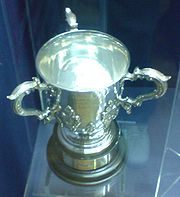 Three different trophies have been presented to the winners of the League Cup since its inauguration:
and Sky Sports
are host broadcasters. From 2009–10, the BBC will show one leg of each semi-final and the final live, with Sky showing at least one match from every round live, including the final. Highlights are shown on BBC One
and the BBC Sport website.
In its early years, coverage of the competition was split between the BBC and ITV
, though the final was usually on ITV (and was only shown as highlights until 1984). From 1988–89 to 2008–09, ITV were the only terrestrial broadcaster covering the competition. They showed it exclusively until 1996–97 when Sky began covering it, and gained the exclusive live rights to the final.
In Australia, two matches from each round, the semi-finals and final are shown live on Fox Sports. In the U.S. and Canada, games are broadcast by Fox Soccer Channel
and Setanta Sports (Canada)
, respectively. In Africa, Super Sport telecast the matches while Ten Sports
and TEN Action+ cover the event in India and Pakistan. In Scandinavia, games are broadcast by Canal+.
In Arab countries, most matches from each round, the semi-finals and final are shown live on Al Jazeera Sports
channels.
In Asia, games are broadcasted by Goal TV except Japan and Korea.
Football in England
Association football is a national sport in England, where the first modern set of rules for the code were established in 1863, which were a major influence on the development of the modern Laws of the Game...
competition. Like the FA Cup
FA Cup
The Football Association Challenge Cup, commonly known as the FA Cup, is a knockout cup competition in English football and is the oldest association football competition in the world. The "FA Cup" is run by and named after The Football Association and usually refers to the English men's...
, it is played on a knockout (single elimination) basis. Unlike the FA Cup, where 762 teams entered in 2008–09, only 92 clubs can enter the League Cup – the 20 Premier League clubs, and the 72 clubs of The Football League
The Football League
The Football League, also known as the npower Football League for sponsorship reasons, is a league competition featuring professional association football clubs from England and Wales. Founded in 1888, it is the oldest such competition in world football...
, which organises the competition. Also unlike the FA Cup, the semi-finals are played over two legs. The winners qualify for the UEFA Europa League, if they have not qualified for European competition through the Premier League or by winning the FA Cup
FA Cup
The Football Association Challenge Cup, commonly known as the FA Cup, is a knockout cup competition in English football and is the oldest association football competition in the world. The "FA Cup" is run by and named after The Football Association and usually refers to the English men's...
. If this occurs, then the Europa League berth goes to the highest-placed team from the Premier League not already qualified for Europe. Birmingham City are the current holders.
Although the League Cup is one of the three major domestic trophies attainable by English league teams, it is perceived by some larger clubs as a lower priority than the league championship and the FA Cup. Some clubs have made a point of fielding a weaker side in the competition, making the opportunity for giant-killing of the larger clubs more likely. Many of the top English sides, Arsenal
Arsenal F.C.
Arsenal Football Club is a professional English Premier League football club based in North London. One of the most successful clubs in English football, it has won 13 First Division and Premier League titles and 10 FA Cups...
and Manchester United
Manchester United F.C.
Manchester United Football Club is an English professional football club, based in Old Trafford, Greater Manchester, that plays in the Premier League. Founded as Newton Heath LYR Football Club in 1878, the club changed its name to Manchester United in 1902 and moved to Old Trafford in 1910.The 1958...
in particular, have used the competition to give young players valuable big-game experience. However, in response to Arsène Wenger's
Arsène Wenger
Arsène Wenger, OBE is a French association football manager and former player, who has managed English Premier League side Arsenal since 1996...
claim that a League Cup win would not end his trophy drought, Alex Ferguson
Alex Ferguson
Sir Alexander Chapman "Alex" Ferguson, CBE is a Scottish association football manager and former player, currently managing Manchester United, where he has been in charge since 1986...
described the trophy as "a pot worth winning". Since that nadir, the League Cup has recovered somewhat, embracing the 'youth' football ethic, and maintaining its niche as an early season trophy.
The women's game
Women's football in England
While women's football has been played in England for over a century, it has only been in the 1990s that the game has seen a large increase in female players, as well as in female spectators, culminating in England hosting the Women's European Championships in 2005....
has its own League Cup, which is open to the 36 women's clubs in the three divisions of the FA Women's Premier League
FA Women's Premier League
The FA Women's Premier League is the second tier of women's football in England. It previously formed the top tier prior to the creation of the FA Women's Super League in 2011. The Women's Premier League has been run by The Football Association since the 1992–93 season...
, although the women's competition is governed by The FA
The Football Association
The Football Association, also known as simply The FA, is the governing body of football in England, and the Crown Dependencies of Jersey, Guernsey and the Isle of Man. It was formed in 1863, and is the oldest national football association...
and not The Football League
The Football League
The Football League, also known as the npower Football League for sponsorship reasons, is a league competition featuring professional association football clubs from England and Wales. Founded in 1888, it is the oldest such competition in world football...
.
History
During the late 1950s, the majority of senior English clubs equipped their grounds with floodlightFloodlights (sport)
Floodlights are broad-beamed, high-intensity artificial lights often used to illuminate outdoor playing fields while an outdoor sports event is being held during low-light conditions....
s. This opened up the opportunity to exploit weekday evenings throughout the winter. The League Cup was introduced in the 1960–61 season specifically as a mid-week floodlit tournament. In the early years of the competition, many of the top teams declined to take part. It was only when automatic entry to the UEFA Cup
UEFA Cup
The UEFA Europa League is an annual association football cup competition organised by UEFA since 1971 for eligible European football clubs. It is the second most prestigious European club football contest after the UEFA Champions League...
was promised to the winners that the full League membership took part.
In the last 10 years, following restructuring of European football, and the introduction of the restructured format of the UEFA Champions League
UEFA Champions League
The UEFA Champions League, known simply the Champions League and originally known as the European Champion Clubs' Cup or European Cup, is an annual international club football competition organised by the Union of European Football Associations since 1955 for the top football clubs in Europe. It...
, the League Cup was threatened with losing its UEFA Cup
UEFA Cup
The UEFA Europa League is an annual association football cup competition organised by UEFA since 1971 for eligible European football clubs. It is the second most prestigious European club football contest after the UEFA Champions League...
berth for its winners. It has retained it thus far however, and along with France is the only nation to offer a UEFA cup berth to its second cup competition winners. Therefore it retains enough importance and popularity, especially with fans of clubs for whom the League Cup offers a realistic chance of qualifying for Europe.
Aston Villa
Aston Villa F.C.
Aston Villa Football Club is an English professional association football club based in Witton, Birmingham. The club was founded in 1874 and have played at their current home ground, Villa Park, since 1897. Aston Villa were founder members of The Football League in 1888. They were also founder...
were the inaugural winners in 1960–61 defeating Rotherham United
Rotherham United F.C.
Rotherham United Football Club are an English professional football club based in Rotherham, South Yorkshire, who compete in League Two, the fourth tier of English football. The club's colours have traditionally been red and white, although these have evolved through history...
3–2 in the final over two legs. Liverpool
Liverpool F.C.
Liverpool Football Club is an English Premier League football club based in Liverpool, Merseyside. Liverpool has won eighteen League titles, second most in English football, seven FA Cups and a record seven League Cups...
have won the cup on the most occasions with seven victories including four successive trophies in the early 1980s. They completed two trebles of trophy wins, in 1984 and 2001. The present holders are Birmingham City
Birmingham City F.C.
Birmingham City Football Club is a professional association football club based in the city of Birmingham, England. Formed in 1875 as Small Heath Alliance, they became Small Heath in 1888, then Birmingham in 1905, finally becoming Birmingham City in 1943.They were relegated at the end of the...
, who beat Arsenal 2–1 in the 2011 Final
2010–11 Football League Cup
The 2010–11 Football League Cup, known as the Carling Cup due to the competition's sponsorship by lager brand Carling, was the 51st season of the Football League Cup, a knock-out competition for England's top 92 football clubs....
.
Giant killings are less well remembered in the League Cup than the FA Cup
FA Cup
The Football Association Challenge Cup, commonly known as the FA Cup, is a knockout cup competition in English football and is the oldest association football competition in the world. The "FA Cup" is run by and named after The Football Association and usually refers to the English men's...
due to the absence of non-league sides and the fact that many big clubs have fielded very under-strength sides when knocked out. However, there have been some notable upsets, such as Fourth Division side Chester
Chester City F.C.
Chester City Football Club was an English football team from Chester. The club was founded as Chester F.C., and joined the Football League in 1931, spending most of their time in the lower divisions. They changed their name to Chester City in 1983. Chester won their first league title in 2004, the...
knocking league champions Leeds United
Leeds United A.F.C.
Leeds United Association Football Club are an English professional association football club based in Beeston, Leeds, West Yorkshire, who play in the Football League Championship, the second tier of the English football league system...
out 3–0 en route to the semi-finals in 1974–75. In 1995–96, Manchester United
Manchester United F.C.
Manchester United Football Club is an English professional football club, based in Old Trafford, Greater Manchester, that plays in the Premier League. Founded as Newton Heath LYR Football Club in 1878, the club changed its name to Manchester United in 1902 and moved to Old Trafford in 1910.The 1958...
were beaten 3–0 at home by York City
York City F.C.
York City Football Club is an English football club based in York, North Yorkshire. The club participates in the Conference National, the fifth tier of English football. Founded in 1922, they joined the Football League in 1929, and have spent most of their history in the lower divisions...
in the second round, first leg, United could only win 3–1 and went out 4–3 on aggregate. United have also been knocked out by Southend United
Southend United F.C.
Southend United Football Club is an English football club based at Roots Hall Stadium, Prittlewell, Southend-on-Sea, Essex, who play in Football League Two. Their home ground is Roots Hall, and the club plan to move into a new 22,000-seater stadium located at Fossetts Farm.-Stadium:The club has had...
and Coventry City
Coventry City F.C.
Coventry City Football Club, otherwise known as the Sky Blues owing to the traditional colour of their strip, are a professional English Football league club based in Coventry...
in 2006–07 and 2007–08 respectively: in the match against Southend they fielded a strong side, bucking a trend they had themselves started. In 2001–02, holders Liverpool
Liverpool F.C.
Liverpool Football Club is an English Premier League football club based in Liverpool, Merseyside. Liverpool has won eighteen League titles, second most in English football, seven FA Cups and a record seven League Cups...
were defeated 2–1 at home by Grimsby Town
Grimsby Town F.C.
Grimsby Town Football Club is an English football club based in the seaside town of Cleethorpes, in North East Lincolnshire, England, who compete in the Conference National. They were formed in 1878 as Grimsby Pelham and later became Grimsby Town...
, then humbled again by Northampton Town in September 2010. Grimsby recorded another giant killing in 2005 by knocking out Tottenham Hotspur
Tottenham Hotspur F.C.
Tottenham Hotspur Football Club , commonly referred to as Spurs, is an English Premier League football club based in Tottenham, north London. The club's home stadium is White Hart Lane....
.
Preliminary round
This is only used when the number of teams in European competition affects the number of byes to the third round and it would not be easier to give a club a bye to the second round. Matches involve the eligible clubs who finished lowest in the English football league systemEnglish football league system
The English football league system, also known as the football pyramid, is a series of interconnected leagues for association football clubs in England, with six teams from Wales also competing...
last season (normally clubs promoted from Conference National
Conference National
Conference National is the top division of the Football Conference in England. It is the highest level of the National League System and fifth highest of the overall English football league system...
). This has been used twice to date, in 2002–03 and 2011–12
2011–12 Football League Cup
The 2011–12 Football League Cup, known as the Carling Cup due to the competition's sponsorship by lager brand Carling, is the 52nd season of the Football League Cup, a knock-out competition for England's top 92 football clubs...
.
The ties are single matches, with extra time and a penalty shootout if necessary, with the winners progressing to the next round.
First round
All clubs playing in The Football League (the Football League ChampionshipFootball League Championship
The Football League Championship is the highest division of The Football League and second-highest division overall in the English football league system after the Premier League...
, Football League One
Football League One
Football League One is the second-highest division of The Football League and third-highest division overall in the English football league system....
and Football League Two
Football League Two
Football League Two is the third-highest division of The Football League and fourth-highest division overall in the English football league system....
), unless they are competing in the UEFA Europa League, enter at this stage and join any Preliminary Round winners. Sometimes (depending on the number of clubs competing in Europe, whether or not they play in The Football League and whether a preliminary round would be an easier way to even up the numbers) it is necessary to give one or more clubs a bye to the second round. The clubs would be those eligible to compete in the First Round who finished highest in the English football league system last season (normally clubs relegated from the Premier League).
For this round, the clubs are divided in northern and southern sections (though not always equally, so there could be more clubs in one section than another and, strangely, some of the clubs in the northern section are actually located further south than some of the southern section clubs). Half of the clubs from each section are seeded and half are not. First a draw is made to determine whether the seeded club is to play at home or away, and then the club is drawn against an unseeded club from their section.
The ties are single matches, with extra time and a penalty shootout if necessary, with the winners progressing to the next round.
Second round
All clubs playing in the Premier League, unless they are competing in the Champions LeagueUEFA Champions League
The UEFA Champions League, known simply the Champions League and originally known as the European Champion Clubs' Cup or European Cup, is an annual international club football competition organised by the Union of European Football Associations since 1955 for the top football clubs in Europe. It...
or Europa League, as well as any clubs that may have been given a bye to this round, enter at this stage and join the First Round winners, although Manchester City
Manchester City F.C.
Manchester City Football Club is an English Premier League football club based in Manchester. Founded in 1880 as St. Mark's , they became Ardwick Association Football Club in 1887 and Manchester City in 1894...
were not exempt in 2008–09, having qualified for the UEFA Cup through the Fair Play league.
The ties are single matches, with extra time and a penalty shootout if necessary, with the winners progressing to the next round.
Third round
All clubs competing in the Champions League or Europa League enter at this stage and join the Second Round winners (making for a total of 32 clubs).The ties are single matches, with extra time and a penalty shootout if necessary, with the winners progressing to the next round.
Fourth round
The winners of ties in the previous round play single matches, with extra time and a penalty shootout if necessary.Quarter-finals
The winners of the fourth round ties play each other in single matches in the quarter-finals, with extra time and a penalty shootout if necessary. This stage of the competition is also known as the fifth round.Semi-finals
The four fifth round winners compete in this round. The ties are played over home and away legs, with the aggregate scores being used to determine the winners. If the aggregate scores are level at the end of the 90 minutes, then extra time takes place to determine the winner. If after extra time the aggregate tie still prevails, the away goals rule determines the winner. However if there is no separation here, a penalty shootout takes place until there is a winner.Final
The two semi-final winners compete to win the cup.The tie is a single match played at a neutral stadium (which was the Millennium Stadium
Millennium Stadium
The Millennium Stadium is the national stadium of Wales, located in the capital, Cardiff. It is the home of the Wales national rugby union team and also frequently stages games of the Wales national football team, but is also host to many other large scale events, such as the Super Special Stage...
between the seasons 2000–01 and 2006–07 but returned to Wembley Stadium
Wembley Stadium
The original Wembley Stadium, officially known as the Empire Stadium, was a football stadium in Wembley, a suburb of north-west London, standing on the site now occupied by the new Wembley Stadium that opened in 2007...
from 2008 onwards), with extra time and a penalty shootout if necessary. The final is usually staged between late February and early March, in the final third of the domestic football season.
Since 1990, the best player in the League Cup final – as chosen by the Sky Sports
Sky Sports
Sky Sports is the brand name for a group of sports-oriented television channels operated by the UK and Ireland's main satellite pay-TV company, British Sky Broadcasting. Sky Sports is the dominant subscription television sports brand in the United Kingdom and Ireland...
television panel – has been presented with the Alan Hardaker
Alan Hardaker
Alan Hardaker was an English football administrator for the Football League, a wartime Royal Navy officer, and previously an amateur footballer...
trophy, named after the former secretary of The Football League
The Football League
The Football League, also known as the npower Football League for sponsorship reasons, is a league competition featuring professional association football clubs from England and Wales. Founded in 1888, it is the oldest such competition in world football...
who devised the Football League Cup. The current holder of the trophy is Birmingham City
Birmingham City F.C.
Birmingham City Football Club is a professional association football club based in the city of Birmingham, England. Formed in 1875 as Small Heath Alliance, they became Small Heath in 1888, then Birmingham in 1905, finally becoming Birmingham City in 1943.They were relegated at the end of the...
's Ben Foster
Ben Foster (footballer)
Benjamin Anthony "Ben" Foster is an English professional footballer who plays as a goalkeeper for West Bromwich Albion, on loan from Birmingham City, and internationally for the England national team.-Stoke City:...
, the only player to win the award multiple times (in 2009 and 2011).
Sponsorship
Since 1982, the League Cup has been named after its sponsorEnglish football sponsorship
Corporate sponsorship of major English football competitions dates back to the early 1980s, although minor competitions such as the Watney Cup and Texaco Cup were sponsored during the early 1970s....
, giving it the following names:
| Period | Sponsor | Name |
|---|---|---|
| 1960-1982 | No main sponsor | Football League Cup |
| 1982-1986 | Dairy Crest Dairy Crest Dairy Crest Group plc is a major dairy products company in the United Kingdom. Its brands include Cathedral City Cheddar cheese, Utterly Butterly, Vitalite, Clover, St Ivel and Frijj. The company delivers milk to around 1.1 million households via their milkmen... |
Milk Cup |
| 1986-1990 | Littlewoods (former retailer) Littlewoods Littlewoods is the name of a former retail and gambling company founded in Liverpool, Merseyside, England by John Moores in 1923.It started as a shopping catalogue company, processing orders by post in the early 1970s. In 1981, it expanded to a call centre, processing orders via telephone. At its... |
Littlewoods Challenge Cup |
| 1990-1992 | Rumbelows (former retailer) Rumbelows Rumbelows was an electrical and electronics retailer in the United Kingdom which once rivalled Currys, Dixons and Comet.-History:Fred Dawes established the company as a chain of television and radio rental shops in the 1950s, naming it Fred Dawes... |
Rumbelows Cup |
| 1992-1998 | Coca-Cola (soft drink) Coca-Cola Coca-Cola is a carbonated soft drink sold in stores, restaurants, and vending machines in more than 200 countries. It is produced by The Coca-Cola Company of Atlanta, Georgia, and is often referred to simply as Coke... |
Coca-Cola Cup |
| 1998-2003 | Worthington's (Brewery) | Worthington Cup |
| 2003-2012 | Molson Coors (Brewery) Molson Coors Brewing Company Molson Coors Brewing Company is a company that was created by the merger of two of North America's largest breweries: Molson of Canada, and Coors of the United States, on February 9, 2005... |
Carling Cup |
| 2012 | No main sponsor | Football League Cup |
Trophy
- The original trophy which is currently given to the winners
- The trophy presented from the first season of the Milk Marketing Board sponsoring the competition, 1981–82 to 1985–86;
- The trophy presented from 1986–87 until 1989–90 during Littlewoods' sponsorship of the competition.
Records
- Most tournament wins (team): 7 wins, LiverpoolLiverpool F.C.Liverpool Football Club is an English Premier League football club based in Liverpool, Merseyside. Liverpool has won eighteen League titles, second most in English football, seven FA Cups and a record seven League Cups...
. - Most final appearances (team): 10, Liverpool.
- Most tournament wins (individual): 5, Ian RushIan RushIan James Rush, MBE, is a retired football player from Flint, Wales. He is best remembered as a player for Liverpool, where he was among the top strikers in the English game in the 1980s and 1990s. He also had spells playing at Chester City, Juventus, Leeds United, Newcastle United, Sheffield...
for Liverpool. - Most final appearances: (individual): 6, Ian RushIan RushIan James Rush, MBE, is a retired football player from Flint, Wales. He is best remembered as a player for Liverpool, where he was among the top strikers in the English game in the 1980s and 1990s. He also had spells playing at Chester City, Juventus, Leeds United, Newcastle United, Sheffield...
for Liverpool (1981–1984, 1987, 1995) and Emile HeskeyEmile HeskeyEmile William Ivanhoe Heskey is an English footballer who plays for Aston Villa as a striker.Born in Leicester, Heskey started his career with hometown club Leicester City after progressing through their youth system, making his first team debut in 1995...
for Leicester City (1997, 1999, 2000), Liverpool (2001, 2003) and Aston Villa (2010). - Highest goalscorer (career): Geoff HurstGeoff HurstSir Geoffrey Charles Hurst MBE is a retired England footballer best remembered for his years with West Ham. He made his mark in World Cup history as the only player to have scored a hat-trick in a World Cup final. His three goals came in the 1966 final for England in their 4–2 win over West...
, Ian RushIan RushIan James Rush, MBE, is a retired football player from Flint, Wales. He is best remembered as a player for Liverpool, where he was among the top strikers in the English game in the 1980s and 1990s. He also had spells playing at Chester City, Juventus, Leeds United, Newcastle United, Sheffield...
49 goals. - Highest goalscorer (season): Clive AllenClive AllenClive Darren Allen is a retired English footballer, a prolific scorer for a number of clubs.Allen is the son of ex-Tottenham Hotspur forward Les Allen, who was a member of the legendary team which won the First Division title and FA Cup "double" in 1961...
, for Tottenham Hotspur, 12 goals in 1986–87. - Most goals scored in a match (individual): 6 goals, by Frankie BunnFrankie BunnFrank Stephen Bunn Bunn was a striker who began his career at Luton Town, and later played for Hull City and Oldham Athletic...
for Oldham AthleticOldham Athletic A.F.C.Oldham Athletic Association Football Club is an English association football club based at Boundary Park, on Sheepfoot Lane in Oldham, Greater Manchester. The club currently competes in the Football League One, the third tier of the English league...
vs ScarboroughScarborough F.C.Scarborough Football Club was an English football club based in the seaside resort of Scarborough, North Yorkshire. They were one of the oldest football clubs in England, formed in 1879, before they were wound up on 20 June 2007, with debts of £2.5 million.In the 2006–07 season...
, 25 October 1989. - Biggest win: West Ham UnitedWest Ham United F.C.West Ham United Football Club is an English professional football club based in Upton Park, Newham, East London. They play in The Football League Championship. The club was founded in 1895 as Thames Ironworks FC and reformed in 1900 as West Ham United. In 1904 the club relocated to their current...
10–0 BuryBury F.C.Bury Football Club is an association football team based in Bury, Greater Manchester. The team currently play in League One. The club's nickname is The Shakers which was bestowed upon them by club chairman JT Ingham, an industrialist and ironmonger of the late 1890s.-Formation of the club and the...
, second round second leg, 25 October 1983 and LiverpoolLiverpool F.C.Liverpool Football Club is an English Premier League football club based in Liverpool, Merseyside. Liverpool has won eighteen League titles, second most in English football, seven FA Cups and a record seven League Cups...
10–0 FulhamFulham F.C.Fulham Football Club is a professional English Premier League club based in southwest London Fulham, in the London Borough of Hammersmith and Fulham. Founded in 1879, they play in the Premier League, their 11th current season...
, second round first leg, 23 September 1983. - Youngest player: Ashley ChambersAshley ChambersAshley Renaldo Chambers is an English footballer who plays for York City as a striker.Chambers started his career with Leicester City, making his first team debut in 2005 at the age of 15 in a League Cup game against Blackpool, which made him the youngest player in the club's history. In 2009 he...
, 15 years 203 days, for Leicester CityLeicester City F.C.Leicester City Football Club , also known as The Foxes, is an English professional football club based at the King Power Stadium in Leicester...
vs BlackpoolBlackpool F.C.Blackpool Football Club are an English football club founded in 1887 from the Lancashire seaside town of Blackpool. They are competing in the 2011–12 season of the The Championship, the second tier of professional football in England, having been relegated from the Premier League at the end of the...
, 2005. - Youngest goalscorer in the final: Norman WhitesideNorman WhitesideNorman Whiteside is a former Northern Ireland international footballer who played in two World Cups.He appeared for Manchester United and Everton, before his career was ended by injury at the age of 26. He won the FA Cup twice during his time playing for Manchester United, in 1983 and 1985...
, 17 years 324 days, for Manchester UnitedManchester United F.C.Manchester United Football Club is an English professional football club, based in Old Trafford, Greater Manchester, that plays in the Premier League. Founded as Newton Heath LYR Football Club in 1878, the club changed its name to Manchester United in 1902 and moved to Old Trafford in 1910.The 1958...
vs LiverpoolLiverpool F.C.Liverpool Football Club is an English Premier League football club based in Liverpool, Merseyside. Liverpool has won eighteen League titles, second most in English football, seven FA Cups and a record seven League Cups...
, 19831983 Football League Cup FinalThe 1983 Milk Cup Final was a football match held on 26 March 1983 between League Cup holders Liverpool and Manchester United, who would go on to win the FA Cup later that year. Liverpool won the match 2-1; Norman Whiteside scored the opener for Manchester United, before Alan Kennedy equalised with...
. - Youngest captain in the final: Barry VenisonBarry VenisonBarry Venison is a retired English footballer who enjoyed a successful playing career from 1981 to 1997. He later worked as an television pundit.-Sunderland:...
, 20 years, 7 months 8 days, for SunderlandSunderland A.F.C.Sunderland Association Football Club is an English association football club based in Sunderland, Tyne and Wear who currently play in the Premier League...
vs Norwich CityNorwich City F.C.Norwich City Football Club is an English professional football club based in Norwich, Norfolk. As of the 2011–12 season, Norwich City are again playing in the Premier League after a six-year absence, having finished as runner up in the Championship in 2010–11 and winning automatic promotion.The...
, 19851985 Football League Cup FinalThe 1985 Milk Cup Final was won by Norwich City. The Canaries defeated Sunderland 1–0 at Wembley Stadium on 24 March 1985 with an own goal scored by Gordon Chisholm, who deflected Asa Hartford's shot past goalkeeper Chris Turner...
.
Television coverage
The BBCBBC
The British Broadcasting Corporation is a British public service broadcaster. Its headquarters is at Broadcasting House in the City of Westminster, London. It is the largest broadcaster in the world, with about 23,000 staff...
and Sky Sports
Sky Sports
Sky Sports is the brand name for a group of sports-oriented television channels operated by the UK and Ireland's main satellite pay-TV company, British Sky Broadcasting. Sky Sports is the dominant subscription television sports brand in the United Kingdom and Ireland...
are host broadcasters. From 2009–10, the BBC will show one leg of each semi-final and the final live, with Sky showing at least one match from every round live, including the final. Highlights are shown on BBC One
BBC One
BBC One is the flagship television channel of the British Broadcasting Corporation in the United Kingdom. It was launched on 2 November 1936 as the BBC Television Service, and was the world's first regular television service with a high level of image resolution...
and the BBC Sport website.
In its early years, coverage of the competition was split between the BBC and ITV
ITV
ITV is the major commercial public service TV network in the United Kingdom. Launched in 1955 under the auspices of the Independent Television Authority to provide competition to the BBC, it is also the oldest commercial network in the UK...
, though the final was usually on ITV (and was only shown as highlights until 1984). From 1988–89 to 2008–09, ITV were the only terrestrial broadcaster covering the competition. They showed it exclusively until 1996–97 when Sky began covering it, and gained the exclusive live rights to the final.
In Australia, two matches from each round, the semi-finals and final are shown live on Fox Sports. In the U.S. and Canada, games are broadcast by Fox Soccer Channel
Fox Soccer Channel
Fox Soccer is an American television specialty channel, owned by News Corporation's Fox Entertainment Group, that specializes in soccer. It formerly broadcast rugby and Australian rules football, but is now dedicated strictly to soccer...
and Setanta Sports (Canada)
Setanta Sports (Canada)
Sportsnet World is a Canadian English language Category B specialty channel owned by Rogers Media. Sportsnet World primarily airs top level association football , featuring exclusive coverage of the Barclays Premier League along with content from other leagues in Europe...
, respectively. In Africa, Super Sport telecast the matches while Ten Sports
TEN Sports
TEN SPORTS is a sports channel, widely broadcast in Asia. Its key programming includes Cricket, Football and sports-entertainment shows viz. WWE. Ten Sports was launched on April 1, 2002, and became the world's premier sports channel for South Asians, reaching over 55 million homes across the Arab...
and TEN Action+ cover the event in India and Pakistan. In Scandinavia, games are broadcast by Canal+.
In Arab countries, most matches from each round, the semi-finals and final are shown live on Al Jazeera Sports
Al Jazeera Sports
Al Jazeera Sports is a popular Arabic-language sports channel launched in November 2003 by the well-known Al Jazeera network.Al Jazeera Sports also owns the exclusive broadcasting rights in the Middle East for major football leagues, such as the Spanish La Liga, the French Ligue 1 and the Italian...
channels.
In Asia, games are broadcasted by Goal TV except Japan and Korea.
External links
- Carling Cup official site
- Full results, 1960–1992
- BBC News and RSSSF for attendance data