
All Topics  
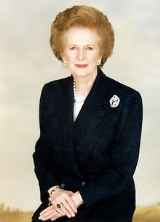
Margaret Thatcher

 
Margaret Thatcher

   Email Print
   Bookmark   Link


Margaret Thatcher


Margaret Hilda Thatcher, Baroness Thatcher LG
Order of the Garter

The Most Noble Order of the Garter is an order of chivalry, or knighthood, originating in medieval England, and presently bestowed on recipients in the United Kingdom and other Commonwealth realms; it is the pinnacle of the Orders, decorations, and medals of the United Kingdom....
, OM
Order of Merit

The Order of Merit is a United Kingdom and Commonwealth of Nations Order bestowed by the Elizabeth II of the United Kingdom. It was established in 1902 by King Edward VII of the United Kingdom as a reward for distinguished service in the armed forces, science, art, literature, or for the promotion of culture....
, PC, FRS (born 13 October 1925) was Prime Minister of the United Kingdom
Prime Minister of the United Kingdom

The Prime Minister of the United Kingdom of Great Britain and Northern Ireland is the political leader of the United Kingdom and the head of government Her Majesty's Government....
 from 1979 to 1990 and Leader of the Conservative Party
Conservative Party (UK)

The Conservative and Unionist Party, more commonly known as the Conservative Party, is a conservative political party in the United Kingdom....
 from 1975 to 1990. She is the only woman to have held either post.

Born in Grantham
Grantham

Grantham is a market town within the South Kesteven district of Lincolnshire, England. It stands athwart the East Coast Main Line railway , the historic A1 main north-south road, and the River Witham, 24 miles south-southwest of the city of Lincoln, Lincolnshire....
 in Lincolnshire
Lincolnshire

Lincolnshire is a Counties of England in the east of England. It borders Norfolk, Cambridgeshire, Rutland, Leicestershire, Nottinghamshire, South Yorkshire, and the East Riding of Yorkshire....
, England
England

native_name =|conventional_long_name = England|common_name = England|image_flag = Flag of England.svg|image_coat = England COA.svg|symbol_type = Royal Coat of Arms...
, she went on to read chemistry
Chemistry

Chemistry is the science concerned with the composition, structure, and properties of matter, as well as the changes it undergoes during chemical reactions....
 at Somerville College, Oxford
Somerville College, Oxford

Somerville College is one of the Colleges of the University of Oxford of the University of Oxford in England, and was one of the first women's colleges to be founded there....
 and train as a barrister
Barrister

A barrister is a lawyer found in many common law jurisdictions that employ a split profession in relation to legal representation. In split professions, the other type of lawyer is the solicitor....
. She won a seat
United Kingdom general election, 1959

This United Kingdom general election was held on 8 October 1959. It marked a third successive victory for the ruling Conservative Party , led by Harold Macmillan....
 as an MP from Finchley
Finchley (UK Parliament constituency)

Finchley was a constituency represented in the British House of Commons of the Parliament of the United Kingdom. It elected one Member of Parliament by the first past the post system of election; its best-known MP was Margaret Thatcher, Prime Minister of the United Kingdom from 1979 to 1990....
 in 1959, as a Conservative. When Edward Heath
Edward Heath

Sir Edward Richard George Heath, Order of the Garter, Order of the British Empire , often known as Ted Heath, was Prime Minister of the United Kingdom from 1970 to 1974 and leader of the Conservative Party from 1965 to 1975....
 formed a government in 1970, he appointed Thatcher as Secretary of State for Education and Science
Secretary of State for Education and Skills

The Secretary of State for Education and Skills was the chief Political minister of the Department for Education and Skills in the United Kingdom government....
.


Discussion
Ask a question about 'Margaret Thatcher'
Start a new discussion about 'Margaret Thatcher'
Answer questions from other users
Full Discussion Forum


Quotations


Constitutions have to be written on hearts, not just paper.

pg. 256

I can't bear Britain in decline. I just can't.

Interviewed by Michael Cockerell for BBC TV's Campaign '79 (27 April, 1979).

My job is to stop Britain going red.

Statement (3 November 1977)

Never believe that technology alone will allow America to prevail as a superpower.

pg. 47

The fightback begins now!

In a telephone call to Michael Portillo the morning after the 1997 General Election

Gentlemen, there is nothing sweeter than success, and you boys have got it!

Her comment to the SAS group, at 9.45 p.m. soon after Operation Nimrod (5 May, 1980)


Encyclopedia


Margaret Hilda Thatcher, Baroness Thatcher LG
Order of the Garter

The Most Noble Order of the Garter is an order of chivalry, or knighthood, originating in medieval England, and presently bestowed on recipients in the United Kingdom and other Commonwealth realms; it is the pinnacle of the Orders, decorations, and medals of the United Kingdom....
, OM
Order of Merit

The Order of Merit is a United Kingdom and Commonwealth of Nations Order bestowed by the Elizabeth II of the United Kingdom. It was established in 1902 by King Edward VII of the United Kingdom as a reward for distinguished service in the armed forces, science, art, literature, or for the promotion of culture....
, PC, FRS (born 13 October 1925) was Prime Minister of the United Kingdom
Prime Minister of the United Kingdom

The Prime Minister of the United Kingdom of Great Britain and Northern Ireland is the political leader of the United Kingdom and the head of government Her Majesty's Government....
 from 1979 to 1990 and Leader of the Conservative Party
Conservative Party (UK)

The Conservative and Unionist Party, more commonly known as the Conservative Party, is a conservative political party in the United Kingdom....
 from 1975 to 1990. She is the only woman to have held either post.

Born in Grantham
Grantham

Grantham is a market town within the South Kesteven district of Lincolnshire, England. It stands athwart the East Coast Main Line railway , the historic A1 main north-south road, and the River Witham, 24 miles south-southwest of the city of Lincoln, Lincolnshire....
 in Lincolnshire
Lincolnshire

Lincolnshire is a Counties of England in the east of England. It borders Norfolk, Cambridgeshire, Rutland, Leicestershire, Nottinghamshire, South Yorkshire, and the East Riding of Yorkshire....
, England
England

native_name =|conventional_long_name = England|common_name = England|image_flag = Flag of England.svg|image_coat = England COA.svg|symbol_type = Royal Coat of Arms...
, she went on to read chemistry
Chemistry

Chemistry is the science concerned with the composition, structure, and properties of matter, as well as the changes it undergoes during chemical reactions....
 at Somerville College, Oxford
Somerville College, Oxford

Somerville College is one of the Colleges of the University of Oxford of the University of Oxford in England, and was one of the first women's colleges to be founded there....
 and train as a barrister
Barrister

A barrister is a lawyer found in many common law jurisdictions that employ a split profession in relation to legal representation. In split professions, the other type of lawyer is the solicitor....
. She won a seat
United Kingdom general election, 1959

This United Kingdom general election was held on 8 October 1959. It marked a third successive victory for the ruling Conservative Party , led by Harold Macmillan....
 as an MP from Finchley
Finchley (UK Parliament constituency)

Finchley was a constituency represented in the British House of Commons of the Parliament of the United Kingdom. It elected one Member of Parliament by the first past the post system of election; its best-known MP was Margaret Thatcher, Prime Minister of the United Kingdom from 1979 to 1990....
 in 1959, as a Conservative. When Edward Heath
Edward Heath

Sir Edward Richard George Heath, Order of the Garter, Order of the British Empire , often known as Ted Heath, was Prime Minister of the United Kingdom from 1970 to 1974 and leader of the Conservative Party from 1965 to 1975....
 formed a government in 1970, he appointed Thatcher as Secretary of State for Education and Science
Secretary of State for Education and Skills

The Secretary of State for Education and Skills was the chief Political minister of the Department for Education and Skills in the United Kingdom government....
. Four years later, she backed Keith Joseph
Keith Joseph

Keith Sinjohn Joseph, Baron Joseph, Order of the Companions of Honour, Her Majesty's Most Honourable Privy Council was a United Kingdom barrister, politician, and Conservative Party cabinet of the United Kingdom under three different Ministries....
 in his bid to become Conservative party leader, but he was forced to drop out of the election
Conservative Party (UK) leadership election, 1975

Edward Heath, leader of the Conservative Party and Prime Minister of the United Kingdom had called and unexpectedly lost the United Kingdom general election, February 1974....
; Thatcher felt that Heath's government had lost direction, so she entered the contest herself and became leader of the Conservative party in 1975. As the Conservative party maintained leads in most polls, Thatcher went on to become Britain's Prime Minister in the 1979 general election
United Kingdom general election, 1979

The United Kingdom general election of 1979 was held on 3 May 1979 and is regarded as a pivotal point in 20th century British politics. The Conservative Party under Margaret Thatcher defeated James Callaghan's incumbent Labour Party government in what would prove to be the first of four consecutive general election victories for the Conserv...
.

Thatcher entered 10 Downing Street with a mandate to reverse the UK's economic decline. Her political philosophy and economic policies emphasised reduced state intervention, free market
Free market

A free market is a market that is free of government intervention and regulation, besides the minimal function of maintaining the legal system and protecting property rights, and is also free of private force and fraud....
s, and entrepreneur
Entrepreneur

An entrepreneur is a person who has possession of an organization, or venture, and assumes significant accountability for the inherent risks and the outcome....
ialism. She gained much support after the 1982 Falklands War
Falklands War

The Falklands War , also called the Falklands Conflict/Crisis, was fought in 1982 between Argentina and the United Kingdom over the disputed Falkland Islands and South Georgia and the South Sandwich Islands....
 and was re-elected the following year. Thatcher took a hard line against trade union
Trade union

A trade union or labor union is an organization run by and for workers who have banded together to achieve common goals in key areas such as wages, hours, and working conditions....
s, survived an assassination attempt
Brighton hotel bombing

The Brighton hotel bombing was the attack by the Provisional Irish Republican Army on the Grand Hotel in the England resort town of Brighton in the early morning of 12 October 1984....
, and opposed the Soviet Union
Soviet Union

The Union of Soviet Socialist Republics was a Constitution of the Soviet Union socialist state that existed in Eurasia from 1922 to 1991.The name is a translation of the , romanization of Russian Soyuz Sovetskikh Sotsialisticheskikh Respublik, abbreviated ????, SSSR....
 (her tough-talking rhetoric gained her the nickname the "Iron Lady
Iron Lady

Iron Lady is a nickname that has frequently been used to describe female heads of government around the world. The term describes a "strong willed" woman....
"); she was re-elected for an unprecedented third term in 1987. The following years would prove difficult, as her Community Charge
Community Charge

The Community Charge, popularly known as the "poll tax", was a system of taxation introduced in replacement of the Rates_ to part fund local government in Scotland from 1989, and Local government in England and Local government in Wales from 1990....
 plan was unpopular with many, and her views regarding the European Community
European Union

The European Union is an economic and political union of 27 European Union member state, located primarily in Europe. It was established by the Treaty of Maastricht on 1 November 1993 upon the foundations of the pre-existing European Economic Community....
 were not shared by others in her Cabinet. She resigned as Prime Minister in November 1990.

Thatcher's tenure as Prime Minister was the longest since that of Lord Salisbury
Robert Gascoyne-Cecil, 3rd Marquess of Salisbury

Robert Arthur Talbot Gascoyne-Cecil, 3rd Marquess of Salisbury, Order of the Garter, Royal Victorian Order, Privy Council of the United Kingdom , known as Lord Robert Cecil before 1865 and as Viscount Cranborne from 1865 until 1868, was a United Kingdom statesman and thrice Prime Minister of the United Kingdom, serving for a total...
 and the longest continuous period in office since Lord Liverpool
Robert Jenkinson, 2nd Earl of Liverpool

Robert Banks Jenkinson, 2nd Earl of Liverpool was a United Kingdom politics and the longest-serving Prime Minister of the United Kingdom since the Act of Union 1800 in 1801....
 in the early 19th century. She was the first woman to lead a major political party in the UK
United Kingdom

The United Kingdom of Great Britain and Northern Ireland, commonly known as the United Kingdom , the UK or Britain,is a sovereign state located off the northwestern coast of continental Europe....
, and the first of only three women to hold any of the four great offices of state
Great Offices of State

The Great Offices of State in the United Kingdom are the four most senior and prestigious posts in the British parliamentary system of government....
. She holds a life peerage as Baroness Thatcher, of Kesteven
Kesteven

The Parts of Kesteven are a traditional subdivision of Lincolnshire, England. This subdivision had long had a separate county administration , along with the other two parts Lindsey and Holland, Lincolnshire)....
 in the County of Lincolnshire, which entitles her to sit in the House of Lords
House of Lords

The House of Lords is the second house of the Parliament of the United Kingdom and is also commonly referred to as "the Lords". The Parliament comprises the British monarchy, the British House of Commons , and the Lords....
.

Early life and education

Margaret Hilda Roberts was born on 13 October 1925 to Alfred Roberts
Alfred Roberts

Alfred Roberts was a grocer, a Laity, an alderman and a Mayor of Grantham. He was the father of Margaret Thatcher, former Prime Minister of the United Kingdom....
, originally from Northamptonshire
Northamptonshire

Northamptonshire is a landlocked Counties of England in the England East Midlands, with a population of 629,676 as at the United Kingdom Census 2001....
, and Beatrice Roberts née Stephenson from Lincolnshire
Lincolnshire

Lincolnshire is a Counties of England in the east of England. It borders Norfolk, Cambridgeshire, Rutland, Leicestershire, Nottinghamshire, South Yorkshire, and the East Riding of Yorkshire....
. Thatcher spent her childhood in the town of Grantham
Grantham

Grantham is a market town within the South Kesteven district of Lincolnshire, England. It stands athwart the East Coast Main Line railway , the historic A1 main north-south road, and the River Witham, 24 miles south-southwest of the city of Lincoln, Lincolnshire....
 in Lincolnshire, where her father owned two grocery shops
Grocery store

A grocery store is a store established primarily for the retailing of food. A grocer, the owner of a grocery store, stocks different kinds of foods from assorted places and cultures, and sells them to customers....
. She and her older sister Muriel (born 1921, Grantham; died December 2004; married name Cullen) were raised in the flat above the larger of the two located near the railway line. Her father was active in local politics and religion, serving as an Alderman
Alderman

An alderman is a member of a Municipal government assembly or council in many jurisdictions. Historically the term could also refer to local municipal judges in small legal proceedings ....
 and Methodist lay preacher. He came from a Liberal
Liberal Party (UK)

The Liberal Party was one of the two major British political parties from the early 19th century until the rise of the Labour Party in the 1920s, and a third party of varying strength and importance up to 1988, when it merged with the Social Democratic Party to form a new party which would become known as the Liberal Democrats....
 family but stood—as was then customary in local government—as an Independent
Independent (politician)

In politics, an independent is a politician who is not affiliated with any political party. Independents may hold a Centrism viewpoint between those of major political parties, or they may have a viewpoint based on issues that they do not feel that any major party addresses....
. He lost his post as Alderman in 1952 after the Labour Party
Labour Party (UK)

The Labour Party is a political party in the United Kingdom. Founded at the start of the 20th century, it has been since the 1920s the principal party of the Left-wing politics in England, Scotland and Wales, but not Northern Ireland, where it has only recently organised again....
 won its first majority on Grantham Council in 1950.

Thatcher was brought up a devout Methodist and has remained a Christian throughout her life. After attending Huntingtower Road Primary School, she won a scholarship to Kesteven and Grantham Girls' School
Kesteven and Grantham Girls' School

Kesteven and Grantham Girls' School is a grammar school for girls in Grantham, Lincolnshire, established in 1910. It has over 1000 pupils ranging from ages 11-18, with its own sixth form based on site in the Harrowby House building....
. Her school reports show hard work and commitment, but not brilliance. Outside the classroom she played hockey
Field hockey

Field hockey is a team sport in which a team of players attempt to score Goal by hitting, pushing or flicking the ball with hockey sticks into the opposing team's goal....
 and also enjoyed swimming
Swimming

Swimming is the movement by humans or animals through water, usually without artificial assistance. Swimming is an activity that can be both useful and recreational....
 and walking. Finishing school during the Second World War, she applied for a scholarship to attend Somerville College, Oxford
Somerville College, Oxford

Somerville College is one of the Colleges of the University of Oxford of the University of Oxford in England, and was one of the first women's colleges to be founded there....
, but was only successful when the winning candidate dropped out. She went to Oxford in 1943 and studied Natural Sciences, specialising in Chemistry
Chemistry

Chemistry is the science concerned with the composition, structure, and properties of matter, as well as the changes it undergoes during chemical reactions....
. She became President of the Oxford University Conservative Association
Oxford University Conservative Association

The Oxford University Conservative Association is a student political organisation founded in 1924 whose members are drawn from the University of Oxford....
 in 1946, the third woman to hold the post. In 1946 Thatcher took the Final Honour School examination, graduating with a Second Class
British undergraduate degree classification

The British undergraduate degree classification system is a grade scheme for undergraduate degrees in the United Kingdom. The system has been applied in other countries, such as India, the Republic of Ireland, Kenya, South Africa, Singapore, Malaysia, Hong Kong, Australia, New Zealand, Nigeria, Malta and Canada....
 Bachelor of Arts
Bachelor of Arts

Bachelor of Arts , from the Latin language Artium Baccalaureus, is an Undergraduate education bachelor's degree awarded for either a course or a program in either the liberal arts, the sciences or both....
 degree. She subsequently studied crystallography
Crystallography

Crystallography is the experimental science of determining the arrangement of atoms in solids. In older usage, it is the scientific study of crystals....
 and received a postgraduate BSc
Bachelor of Science

A Bachelor of Science is an bachelor's degree academic degree awarded for completed courses that generally last three to five years ....
 degree in 1947. Three years later, in 1950, she achieved a Master of Arts advanced degree, according to her entitlement as an Oxford
University of Oxford

The University of Oxford , located in the city of Oxford, Oxfordshire, England, is the List of oldest universities in continuous operation in the English-speaking world....
 BA
Bachelor of Arts

Bachelor of Arts , from the Latin language Artium Baccalaureus, is an Undergraduate education bachelor's degree awarded for either a course or a program in either the liberal arts, the sciences or both....
 of seven years' standing since matriculation
Matriculation

Matriculation, in the broadest sense, means to be registered or added to a list, from the Latin matricula - little list. In Scottish heraldry, for instance, a matriculation is a registration of armorial bearings....
.

Following graduation, Margaret Roberts moved to Colchester
Colchester

Colchester is a town, and the largest settlement within the Colchester , in Essex, England.It has a population of List of English cities by population....
 in Essex
Essex

Essex is a counties of England in the East of England England. The county town is Chelmsford, and the highest point of the county is Chrishall Common near the village of Langley, Essex, close to the Hertfordshire border, which reaches ....
, to work as a research chemist for BX Plastics
BX Plastics

BX Plastics was a former Plastics engineering and production company. The company was acquired by Xylonite in the 1980s. The company had a plant in Manningtree....
. During this time she joined the local Conservative Association
Conservative Party (UK)

The Conservative and Unionist Party, more commonly known as the Conservative Party, is a conservative political party in the United Kingdom....
 and attended the party conference at Llandudno
Llandudno

Llandudno is a seaside resort and town in Conwy , Wales. In the 2001 UK census it had a population of 20,090 including that of Penrhyn Bay and Penrhynside, which are within the Llandudno Community ....
 in 1948, as a representative of the University Graduate Conservative Association. She was also a member of the Association of Scientific Workers
Association of Scientific Workers

The Association of Scientific Workers was a trade union in the United Kingdom. It was founded as the National Union of Scientific Workers in 1918, changing its name to the Association of Scientific Workers in 1927....
. In January 1949, a friend from Oxford, who was working for the Dartford
Dartford

Dartford is the principal town in the Dartford . It is situated in the northwest corner of Kent, England, 16 miles east south-east of central London....
 Conservative Association, told her that they were looking for candidates. After a brief period, she was selected as the Conservative candidate, and she subsequently moved to Dartford, in Kent
Kent

Kent is a Counties of England in southeast England, and is one of the home counties. It borders East Sussex, Surrey and Greater London and has a defined boundary with Essex in the middle of the River Thames estuary....
, to stand for election as a Member of Parliament
Parliament of the United Kingdom

The Parliament of the United Kingdom of Great Britain and Northern Ireland is the supreme legislature in the United Kingdom and British overseas territories....
. To support herself during this period, she went to work for J. Lyons and Co.
J. Lyons and Co.

Joseph Lyons and Co. was a United Kingdom company which controlled the largest food empire in the 1930s. It had a large central Checking Department at its headquarters in Cadby Hall, Hammersmith, London with hundreds of clerks and mechanical Burroughs Corporation adding machines to run this empire....
, where she helped develop methods for preserving ice cream
Ice cream

Ice cream or ice-cream is a frozen dessert usually made from dairy products, such as milk and cream, combined with fruits or other ingredients....
 and was paid Ł500 per year.

Political career between 1950 and 1970

At the 1950
United Kingdom general election, 1950

The 1950 United Kingdom general election was the first general election ever after a full term of a Labour party government. Despite polling over one and a half million votes more than the Conservative party , the election, held on 23 February 1950 resulted in Labour receiving a slim majority of just five seats over all other parties, and th...
 and 1951
United Kingdom general election, 1951

The 1951 United Kingdom general election was held eighteen months after the United Kingdom general election, 1950, which the Labour Party won, but with a very slim majority of just five seats....
 elections, she fought the safe
Safe seat

A safe seat is a seat in a legislature which is regarded as fully secured, either by a certain political party, the incumbent representative personally or a combination of both....
 Labour seat of Dartford
Dartford (UK Parliament constituency)

Dartford is a constituency represented in the British House of Commons of the Parliament of the United Kingdom. It elects one Member of Parliament by the first past the post system of election....
. Although she was unsuccessful in winning the seat losing out to Norman Dodds
Norman Dodds

Norman Noel Dodds was a United Kingdom Labour Co-operative politician.He was Member of Parliament for Dartford from 1945 to 1955, and then for Erith and Crayford from 1955 until his death in 1965, aged 61....
, she reduced the Labour majority in the constituency by 6,000. She was, at the time, the youngest ever female Conservative candidate and her campaign attracted a higher than normal amount of media attention for a first time candidate. While active in the Conservative Party in Kent, she met Denis Thatcher
Denis Thatcher

Major Sir Denis Thatcher, 1st Baronet, Order of the British Empire, Territorial Decoration was an England businessman, and the husband of the former Prime Minister of the United Kingdom, Margaret Thatcher....
, whom she married in 1951. Denis was a wealthy divorced businessman who ran his family's firm; he later became an executive in the oil industry. Denis funded his wife's studies for the Bar
Barrister

A barrister is a lawyer found in many common law jurisdictions that employ a split profession in relation to legal representation. In split professions, the other type of lawyer is the solicitor....
. She qualified as a barrister in 1953 and specialised in taxation. In the same year her twin children Carol
Carol Thatcher

Carol Thatcher is a British journalist and the daughter of Margaret Thatcher, the former Prime Minister of the United Kingdom, and the late Denis Thatcher....
 and Mark
Mark Thatcher

The Honourable Sir Mark Thatcher, 2nd Baronet is the only son of Denis Thatcher and The Rt Hon. The Margaret Thatcher, the former Prime Minister of the United Kingdom, and twin brother of Carol Thatcher....
 were born.

Thatcher began to look for a safe Conservative seat in the mid-1950s and was narrowly rejected as candidate for the Orpington by-election
Orpington by-election, 1955

The Orpington by-election, 1955 was a by-election held on 20 January 1955 for the British House of Commons United Kingdom constituencies of Orpington in Kent, England....
 in 1955, and was not selected as a candidate in the 1955 election
United Kingdom general election, 1955

The 1955 United Kingdom general election was held on 26 May 1955, four years after the United Kingdom general election, 1951. It resulted in a substantially increased majority of 60 for the Conservative Party government under Anthony Eden against the Labour Party under Clement Attlee....
. She had several further rejections before being selected for Finchley
Finchley (UK Parliament constituency)

Finchley was a constituency represented in the British House of Commons of the Parliament of the United Kingdom. It elected one Member of Parliament by the first past the post system of election; its best-known MP was Margaret Thatcher, Prime Minister of the United Kingdom from 1979 to 1990....
 in April 1958. She won the seat after hard campaigning during the 1959 election
United Kingdom general election, 1959

This United Kingdom general election was held on 8 October 1959. It marked a third successive victory for the ruling Conservative Party , led by Harold Macmillan....
 and was elected as a member of Parliament
British House of Commons

The House of Commons is the lower house of the Parliament of the United Kingdom, which also comprises the British monarchy and the House of Lords ....
. Her maiden speech
Maiden speech

A maiden speech is the first speech given by a newly-Election members of a legislature or parliament.Traditions surrounding maiden speeches vary from country to country....
 was in support of her Private Member's Bill
Private Member's Bill

A private member's bill is a proposed law introduced by a backbencher, a so-called private member of parliament, who can be a member of a party represented in the government or in the opposition....
 (Public Bodies (Admission to Meetings) Act 1960
Public Bodies (Admission to Meetings) Act 1960

The Public Bodies Act was an act of the Parliament of the United Kingdom in 1960 which allowed members of the public and press to attend meetings of certain public bodies....
) requiring local councils to hold meetings in public, which was successful. In 1961 she went against the Conservative Party's official position by voting for the restoration of birching
Birching

Birching is a corporal punishment with a birch rod, typically applied to the recipient's bare buttocks, although occasionally to the back and/or shoulders....
.

Within two years, in October 1961, she was given a promotion to the front bench as Parliamentary Undersecretary at the Ministry of Pensions and National Insurance
Parliamentary Secretary to the Minister for Pensions

The Parliamentary Secretary to the Minister for Pensions was a junior Ministerial office at Parliamentary Secretary rank in the United Kingdom Government, supporting the Secretary of State for Work and Pensions....
. She held this post throughout the administration of Harold Macmillan
Harold Macmillan

Harold Macmillan, 1st Earl of Stockton, Order of Merit, Her Majesty's Most Honourable Privy Council was a British Conservative Party politician and Prime Minister of the United Kingdom from 10 January 1957 to 18 October 1963....
, until the Conservatives were removed from office in the 1964 election
United Kingdom general election, 1964

The United Kingdom general election of 1964 was held on 15 October 1964, more than five years after its predecessor, and thirteen years after the Conservative Party had first taken power....
. When Sir Alec Douglas-Home
Alec Douglas-Home

Alexander Frederick Douglas-Home, Baron Home of the Hirsel, Order of the Thistle, Imperial Privy Council , 14th Earl of Home from 1951 to 1963, was a British Conservative Party politician, and served as Prime Minister of the United Kingdom for a year from October 1963 to October 1964 ....
 stepped down, Thatcher voted for Edward Heath
Edward Heath

Sir Edward Richard George Heath, Order of the Garter, Order of the British Empire , often known as Ted Heath, was Prime Minister of the United Kingdom from 1970 to 1974 and leader of the Conservative Party from 1965 to 1975....
 in the leadership election of 1965
Conservative Party (UK) leadership election, 1965

The Conservative Party leadership election of July 1965 was held to find a successor to Sir Alec Douglas-Home.It was the first time that a formal election by the parliamentary party had taken place, previous leaders having emerged through a consultation process....
 over Reginald Maudling
Reginald Maudling

Reginald Maudling was a United Kingdom politician known for his intellectual brilliance, political pragmatism, and easygoing nature but slightly dogged by a reputation for laziness....
. She was promoted to the position of Conservative spokesman on Housing and Land; in this position, she advocated the Conservative policy of allowing tenants to buy their council house
Council house

The council house is a form of public housing in the United Kingdom. Council houses were built and operated by local Municipality to supply uncrowded, well built homes on secure tenancies at affordable rents to the local population....
s. The policy would prove to be popular. She moved to the Shadow Treasury
HM Treasury

HM Treasury, in full Her Majesty's Treasury, informally The Treasury, is the United Kingdom government department responsible for developing and executing the British government's public finance policy and economic policy....
 team in 1966. As Treasury spokesman, she opposed Labour's mandatory price and income controls, which she argued would produce contrary effects to those intended and distort the economy.

Thatcher established herself as a potent conference speaker at the Conservative Party Conference of 1966, with a strong attack on the high-tax policies of the Labour Government as being steps "not only towards Socialism
Socialism

Socialism refers to a broad set of economic theories of social organization advocating public or state ownership and administration of the means of production and distribution of goods, and a society characterized by equality for all individuals, with a fair or Egalitarianism method of compensation....
, but towards Communism
Communism

Communism is a socioeconomic structure and political ideology that promotes the establishment of an egalitarianism, classlessness, stateless society based on common ownership and control of the means of production and property in general....
". She argued that lower taxes served as an incentive to hard work. Thatcher was one of few Conservative MPs to support Leo Abse
Leo Abse

Leopold Abse was a Wales lawyer, politician and gay rights campaigner. He was a Wales Labour Party Member of Parliament for nearly 30 years, and was noted for promoting private member's bills to decriminalise male homosexuality and liberalise the divorce laws....
's Bill to decriminalise male homosexuality
Homosexuality

Homosexuality refers to human sexual behavior or same-sex attraction between people of the same sex or to homosexual orientation. As a sexual orientation, homosexuality refers to "having sexual and romantic attraction primarily or exclusively to members of one?s own sex"; "it also refers to an individual?s sense of personal and social identi...
 and voted in favour of David Steel
David Steel

honorific-prefix = The Right Honourable| name = David Steel| honorific-suffix = Baron Steel of Aikwood, Order of the Thistle, Order of the British Empire, Her Majesty's Most Honourable Privy Council...
's Bill to legalise abortion
Abortion

An abortion is the termination of a pregnancy by the removal or expulsion of an embryo or fetus from the uterus, resulting in or caused by its death....
, as well as a ban on hare coursing
Hare coursing

Hare coursing is the pursuit of hares with Greyhounds and other sighthounds, which chase the hare by sight and not by scent. It is a competitive sport, in which dogs are tested on their ability to run, overtake and turn a hare, rather than a form of hunting aiming at the capture of game....
. She supported the retention of capital punishment
Capital punishment

Capital punishment, the death penalty or execution, is the killing of a person by procedural law for Punishment#Retribution and Punishment#Incapacitation....
 and voted against the relaxation of divorce
Divorce

Divorce or dissolution of marriage is a legal process in which a judge or other authority dissolves the bonds of matrimony existing between two persons, thus restoring them to the marital status of being single....
 laws.

In 1967 she was selected by the Embassy of the United States in London
Embassy of the United States in London

The Embassy of the United States of America to the Court of St James's is situated at the American Embassy London Chancery Building in Grosvenor Square, Westminster, City of Westminster, London....
 to participate in the International Visitor Leadership Program
International Visitor Leadership Program

The International Visitor Leadership Program is a professional exchange program funded by the U.S. Department of State Office of International Visitors in the Bureau of Educational and Cultural Affairs....
 (then called the Foreign Leader Program), a professional exchange program in which she spent about six weeks visiting various U.S. cities, political figures, and institutions such as the International Monetary Fund
International Monetary Fund

The International Monetary Fund is an international organization that oversees the global financial system by following the macroeconomic policies of its member countries, in particular those with an impact on exchange rates and the balance of payments....
. Later that year, Thatcher joined the Shadow Cabinet as Shadow Fuel spokesman. Shortly preceding the 1970 general election
United Kingdom general election, 1970

The United Kingdom general election of 1970 was held on 18 June 1970, and resulted in a surprise victory for the Conservative Party under leader Edward Heath, who defeated the Labour Party under Harold Wilson....
, she was promoted to Shadow Transport and, finally, Education.

Education Secretary (1970–1974)

When the Conservative party under Edward Heath
Edward Heath

Sir Edward Richard George Heath, Order of the Garter, Order of the British Empire , often known as Ted Heath, was Prime Minister of the United Kingdom from 1970 to 1974 and leader of the Conservative Party from 1965 to 1975....
 won the 1970 general election, Thatcher became Secretary of State for Education and Science
Secretary of State for Education and Skills

The Secretary of State for Education and Skills was the chief Political minister of the Department for Education and Skills in the United Kingdom government....
. In her first months in office, Thatcher came to public attention as a result of the administration of Edward Heath's decision to cut spending. She gave priority to academic needs in schools, and imposed public expenditure cuts on the state education system, resulting in, against her private protests, the abolition of free milk for school-children aged seven to eleven. She believed that few children would suffer if schools were charged for milk, however she agreed to give younger children a third of a pint, daily, for nutritional purposes. This provoked a storm of protest from the Labour party and the press, and led to the unflattering moniker "Margaret Thatcher, Milk Snatcher". Of the experience, Thatcher later wrote in her autobiography, "I learned a valuable lesson. I had incurred the maximum of political odium for the minimum of political benefit."

She successfully resisted the introduction of library book charges. She did not volunteer spending cuts in her department, contrary to her later beliefs. Her term was marked by support for several proposals for more local education authorities to close grammar schools and to adopt comprehensive secondary education
Comprehensive school

A comprehensive school is a secondary school and State school for children from the age of 11 to at least 16 that does not select children on the basis of academic achievement or aptitude....
. Thatcher was determined to preserve grammar schools, which prepared more students for admission to universities. She abolished Labour's commitment to comprehensive schooling, and instead left the matter to local education authorities.

Leader of the Opposition (1975–1979)

Thatcher Loc
The Heath government experienced many difficulties between 1970 and 1974. The government executed a series of reversals in its economic policies, dubbed "U-turns". The Conservatives were defeated in the February 1974 general election, and Thatcher's portfolio was changed to Shadow Environment Secretary. In this position she promised to abolish the rating system
Poll tax

A poll tax, head tax, or capitation tax is a tax of a portioned, fixed amount per individual in accordance with the census . When a corv?e is commuted for cash payment, in effect it becomes a poll tax ....
 that paid for local government services, which was a favoured policy proposal within the Conservative Party for many years.

Thatcher agreed that the Heath Government had lost control of monetary policy
Monetary policy

Monetary policy is the process by which the government, central bank, or monetary authority of a country controls the supply of money, availability of money, and cost of money or rate of interest, in order to attain a set of objectives oriented towards the growth and stability of the economy....
—and had lost direction. After her party lost the second election of 1974 in October, Thatcher, determined to change the direction of the Conservative party, challenged Heath for the Conservative party leadership. She promised a fresh start, and her main support came from the Conservative 1922 Committee. Unexpectedly, she defeated Heath
Conservative Party (UK) leadership election, 1975

Edward Heath, leader of the Conservative Party and Prime Minister of the United Kingdom had called and unexpectedly lost the United Kingdom general election, February 1974....
 on the first ballot, and he resigned the leadership. On the second ballot, she defeated Heath's preferred successor, William Whitelaw, and became Conservative Party leader on 11 February 1975. She appointed Whitelaw as her deputy. Heath remained disenchanted with Thatcher to the end of his life for what he, and many of his supporters, perceived as her disloyalty in standing against him.

Thatcher appointed many of Heath's supporters to the Shadow Cabinet, for she had won the leadership as an outsider and then had little power base of her own within the party. Thatcher had to act cautiously to convert the Conservative Party to her monetarist beliefs. She reversed Heath's support for devolved government for Scotland
Scotland

conventional_long_name = ScotlandAlba|common_name= Scotland|image_flag = Flag of Scotland.svg|flag_width = 130px...
.

On 19 January 1976, she made a speech in Kensington
Kensington

Kensington is a district of West London, England within the Royal Borough of Kensington and Chelsea, located west of Charing Cross. An affluent and densely-populated area, its commercial heart is Kensington High Street and it contains the well-known museum district of South Kensington....
 Town Hall in which she made a scathing attack on the Soviet Union
Soviet Union

The Union of Soviet Socialist Republics was a Constitution of the Soviet Union socialist state that existed in Eurasia from 1922 to 1991.The name is a translation of the , romanization of Russian Soyuz Sovetskikh Sotsialisticheskikh Respublik, abbreviated ????, SSSR....
. The most famous part of her speech ran:
The Russians are bent on world dominance, and they are rapidly acquiring the means to become the most powerful imperial nation the world has seen. The men in the Soviet Politburo do not have to worry about the ebb and flow of public opinion. They put guns before butter, while we put just about everything before guns.


In response, the Soviet Defence Ministry newspaper Krasnaya Zvezda
Krasnaya Zvezda

Krasnaya Zvezda is a Soviet Union and later Russian military newspaper. It was founded on January 1 1924. Today its official designation is "Central Organ of the Russian Ministry of Defence."...
 (Red Star) gave her the nickname "Iron Lady
Iron Lady

Iron Lady is a nickname that has frequently been used to describe female heads of government around the world. The term describes a "strong willed" woman....
". She took delight in the name and it soon became associated with her image as having an unwavering and steadfast character. She was later nicknamed "Attila the Hen" as well.

The Labour Government was running into difficulties with industrial disputes and rising unemployment, and eventually collapsing public services during the winter of 1978–79, popularly dubbed the "Winter of Discontent
Winter of Discontent

The "Winter of Discontent" is a term used to describe the British winter of 1978–1979, during which there were widespread strike actions by trade unions demanding larger pay raises for their members, and the government of James Callaghan struggled to cope....
". The Conservatives attacked the government's unemployment record, and used advertising hoardings
Billboard

Billboard is a weekly United States magazine devoted to the music industry. It maintains several internationally recognized Record chart that track the most popular songs and albums in various categories on a weekly basis....
 with the slogan "Labour Isn't Working" to assist them. In an interview in January 1978, Thatcher remarked, "people are really rather afraid that this country might be rather swamped by people with a different culture". Critics regarded the comment as a veiled reference to people of colour, thus pandering to xenophobia and reactionary sentiment. She received 10,000 letters thanking her for raising the subject and the Conservatives gained a lead against Labour in the opinion polls; both parties were at 43% before Thatcher's interview, but the Conservatives took a 48% to 39% lead over Labour immediately after.

In the run up to the 1979 General Election
United Kingdom general election, 1979

The United Kingdom general election of 1979 was held on 3 May 1979 and is regarded as a pivotal point in 20th century British politics. The Conservative Party under Margaret Thatcher defeated James Callaghan's incumbent Labour Party government in what would prove to be the first of four consecutive general election victories for the Conserv...
, most opinion polls showed that voters preferred James Callaghan
James Callaghan

Leonard James Callaghan, Baron Callaghan of Cardiff, Order of the Garter, Her Majesty's Most Honourable Privy Council , was Prime Minister of the United Kingdom from 1976 to 1979 and leader of the Labour Party from 1976 to 1980....
 of the Labour party as Prime Minister, even as the Conservative Party maintained a lead in the polls. After a successful motion of no confidence
Motion of no confidence

A motion of no confidence is a parliamentary motion traditionally put before a parliament by the parliamentary opposition in the hope of defeating or weakening a Executive , or, rarely by an erstwhile supporter who has lost confidence in the government....
 in spring 1979, Callaghan's Labour government fell. The Conservatives would go on to win a 44-seat majority in the House of Commons and Margaret Thatcher became the United Kingdom's first female Prime Minister.

Prime Minister (1979–1990)

Thatcher became Prime Minister on 4 May 1979, with a mandate to reverse the UK's economic decline and to reduce the role of the state in the economy. Arriving at 10 Downing Street
10 Downing Street

Number 10 Downing Street is the residence and office of the First Lord of the Treasury and Prime Minister of the United Kingdom. The headquarters of Her Majesty's Government, it is situated on Downing Street in the City of Westminster in London, England....
, she said, in a paraphrase of St. Francis of Assisi
Francis of Assisi

Francis of Assisi was a friar and the founder of the Order of Friars Minor, more commonly known as the Franciscans.He is known as the patron saint of animals, the Natural environment and Italy, and it is customary for Catholic Church es to hold ceremonies honoring animals around his feast day of 4 October....
:

Thatcher was incensed by one contemporary view within the Civil Service
British Civil Service

Her Majesty's Civil Service, also known as the Home Civil Service, is the permanent bureaucracy of Crown employees that supports Government of the United Kingdom and the devolved administrations in Welsh Assembly Government and Scottish Government....
, that its job was to manage the UK's decline from the days of Empire
British Empire

The British Empire comprised the dominions, Crown colony, protectorates, League of Nations mandate, and other Dependent territory ruled or administered by the United Kingdom , that had originated with the overseas colonies and trading posts established by England in the late 16th and early 17th centuries....
, and she wanted the country to assert a higher level of influence and leadership in international affairs
International relations

International relations represents the study of foreign affairs and global issues among states within the international system, including the roles of states, international organization , non-governmental organizations , and multinational corporations ....
. She represented the newly energetic right wing of the Conservative Party and advocated greater independence of the individual from the state and less government intervention. She became a very close ally, philosophically
Philosophy

Philosophy is the study of general problems concerning matters such as existence, knowledge, truth, beauty, justice, validity, mind, and language....
 and politically, with President
President of the United States

The President of the United States is the head of state and head of government of the United States and is the highest political official in the United States by influence and recognition....
 Ronald Reagan
Ronald Reagan

Ronald Wilson Reagan was the List of Presidents of the United States President of the United States and the 33rd Governor of California . Born in Illinois, Reagan moved to Los Angeles, California in the 1930s, where he was an actor, president of the Screen Actors Guild , and a spokesman for General Electric ....
, elected in 1980 in the United States
United States

The United States of America is a Federal government constitutional republic comprising U.S. state and a federal district. The country is situated mostly in central North America, where its Contiguous United States and Washington, D.C., the Capital districts and territories, lie between the Pacific Ocean and Atlantic Oceans, Borders of the U...
. During her tenure as Prime Minister she was said to need just four hours sleep a night.

1979–1983


New economic initiatives
Thatcher's political and economic philosophy emphasised reduced state intervention, free market
Free market

A free market is a market that is free of government intervention and regulation, besides the minimal function of maintaining the legal system and protecting property rights, and is also free of private force and fraud....
s, and entrepreneur
Entrepreneur

An entrepreneur is a person who has possession of an organization, or venture, and assumes significant accountability for the inherent risks and the outcome....
ialism. She vowed to end what she felt was excessive government interference in the economy, and did this through privatizing nationally-owned enterprises selling public housing to tenants. After the James Callaghan
James Callaghan

Leonard James Callaghan, Baron Callaghan of Cardiff, Order of the Garter, Her Majesty's Most Honourable Privy Council , was Prime Minister of the United Kingdom from 1976 to 1979 and leader of the Labour Party from 1976 to 1980....
 Government had concluded that the Keynesian approach to demand-side management failed, Thatcher felt that the economy was not self-righting and that new fiscal judgements had to be made to concentrate on inflation. She began her economic reforms by increasing interest rates to slow the growth of the money supply and thus lower inflation. In accordance with her less-government intervention views, she introduced budget cuts and reduced expenditures on social services such as health care, education, and housing. She also placed limits on the printing of money and legal restrictions on trade unions.

At the time, some Conservatives expressed doubt over Thatcher's policies. Civil unrest in Britain resulted in the British media discussing the need for a policy u-turn. At the 1980 Conservative Party conference, Thatcher addressed the issue directly, saying, "You turn if you want to. The lady’s not for turning!"

Thatcher lowered direct taxes on income amid a recession in 1981, but, despite concerns expressed in a letter from 364 leading economists, indirect taxes were increased. In January 1982, the inflation rate had dropped to 8.6% from earlier highs of 18%, and interest rates fell. By 1983, overall economic growth was stronger and inflation and mortgage rates were at their lowest levels since 1970, though manufacturing output had dropped 30% from 1978 and unemployment reached a figure of 3.6 million. The term "Thatcherism
Thatcherism

Thatcherism is the "distinctive ideology, political style and programme of polices of the British Conservative Party after Margaret Thatcher was elected leader in 1975"....
" came to refer to her policies as well as aspects of her ethical outlook and personal style, including moral absolutism, nationalism, interest in the individual, and an uncompromising approach to achieving political goals.

Irish hunger strike
In 1981, a number of Provisional IRA and Irish National Liberation Army
Irish National Liberation Army

The Irish National Liberation Army is an Irish republican, left-wing paramilitary organisation which was formed on 8 December, 1974.Sharing a common Marxist ideology with the Irish Republican Socialist Movement, it enjoyed its peak of influence in the late 1970s and early 1980s and is now one of a number of small armed republican groups in...
 prisoners in Northern Ireland
Northern Ireland

conventional_long_name = Northern Ireland|native_name= Tuaisceart ?ireannNorlin Airlann|motto =|image_map = Europe location N-IRL2.png...
's Maze Prison
Maze (HM Prison)

Her Majesty's Prison Maze was a prison used to house paramilitary prisoners during the Northern Ireland The Troubles from mid-1971 to mid-2000....
 went on hunger strike
1981 Irish hunger strike

The 1981 Irish hunger strike was the culmination of a five-year protest during The Troubles by Irish republicanism prisoners in Northern Ireland....
 to regain the status of political prisoners, which had been revoked five years earlier under the preceding Labour government. Bobby Sands
Bobby Sands

Robert Gerard Sands , commonly known as Bobby Sands, , was an Irish people Provisional Irish Republican Army volunteer and member of the Parliament of the United Kingdom who died on hunger strike whilst in Maze ....
 began the strike, saying that he would fast until death unless prison inmates won concessions over their living conditions. Thatcher refused to countenance a return to political status for the prisoners, famously declaring "Crime is crime is crime; it is not political" and felt that Britain should not negotiate with terrorists.

Nevertheless, after nine more men had starved to death and the strike had ended, some rights relating to political status were restored to paramilitary prisoners. Later that year, Thatcher and Irish Taoiseach
Taoiseach

The Taoiseach The Taoiseach is appointed by the President of Ireland upon the nomination of D?il ?ireann , and must, while he remains in office, retain the support of a majority in the D?il....
 Garret FitzGerald
Garret FitzGerald

Garret FitzGerald was the seventh Taoiseach of Republic of Ireland, serving two terms in office . FitzGerald was elected to Seanad ?ireann in 1965 and was subsequently elected to D?il ?ireann as a Fine Gael Teachta D?la in 1969....
 established the Anglo-Irish Inter-Governmental Council, which would act as a forum for meetings between the two governments. On 15 November 1985, Thatcher and FitzGerald signed the Hillsborough Anglo-Irish Agreement
Anglo-Irish Agreement

The Anglo-Irish Agreement was an agreement between the United Kingdom and Republic of Ireland which aimed to bring an end to the Troubles in Northern Ireland....
; the first time a British government gave the Republic of Ireland an advisory role in the governance of Northern Ireland.

The Falklands
On 2 April 1982, a ruling military junta in Argentina
Argentina

Argentina, officially the Argentine Republic , is a country in South America, constituted as a federation of 23 provinces and an autonomous city....
 invaded the Falkland Islands
Falkland Islands

The Falkland Islands are an archipelago in the South Atlantic Ocean, located from the coast of Argentina, west of the Shag Rocks , and north of the British Antarctic Territory ....
 and South Georgia, a British overseas territory that Argentina had claimed
Sovereignty of the Falkland Islands

The sovereignty of the Falkland Islands has been the subject of dispute between the United Kingdom, Spain, France and Argentina , lasting more than two centuries....
 since an 1810s dispute on the British settlement. The following day, Thatcher sent a naval task force
Task force

A task force is a temporary Military organization established to work on a single defined task or activity. Originally introduced by the United States Navy, the term has now caught on for general usage and is a standard part of NATO terminology....
 to recapture the islands and deport the salvagers back to Argentina. The conflict escalated from there, evolving into an amphibious and ground combat operation by the British. Argentina surrendered on 14 June and the operation was deemed a success for the British, despite 258 British casualties. The effect of the war resulted in a wave of patriotic enthusiasm and support for the Thatcher government.

1983 Election
The lasting effect of the Falklands War, along with an economic recovery in early 1983, bolstered Thatcher's popularity. The Labour party at this time was experiencing troubles as the party was split; Labour had lost many of its best political leaders to the Social Democratic Party
Social Democratic Party (UK)

The Social Democratic Party was a political party of the United Kingdom that existed nationwide between 1981 and 1988. It was founded by four senior Labour Party 'moderates', dubbed the "Gang of Four": Roy Jenkins, David Owen, Bill Rodgers and Shirley Williams....
 and the Liberal Party
Liberal Party (UK)

The Liberal Party was one of the two major British political parties from the early 19th century until the rise of the Labour Party in the 1920s, and a third party of varying strength and importance up to 1988, when it merged with the Social Democratic Party to form a new party which would become known as the Liberal Democrats....
, which presented a new challenge. Labour leader Michael Foot
Michael Foot

Michael Mackintosh Foot is an England politician and writer. He was leader of the Labour Party from 1980 to 1983....
 was generally regarded as unelectable, while Conservatives viewed Margaret Thatcher as "their greatest electoral asset." In the June 1983 general election, the Conservatives won 42.4% of the vote, the Labour party 27.6% and the Alliance 25.4% of the vote. Although the Conservatives' share of the vote had fallen slightly (1.5%) since 1979, Labour's vote had fallen by far more (9.3%) and in Britain's first past the post system, the Conservatives won a landslide victory
Landslide victory

In politics, a landslide victory is the victory of a candidate or political party by an overwhelming margin in an election....
 with a massive majority. This resulted in the Conservative Party having an overall majority of 144 MPs.

1983–1987


Economic developments
After the 1983 election, the Conservative majority expanded, Thatcher continued to enact her economic policies. The UK government sold most of the large national utilities to private companies. The policy of privatisation
Privatization

Privatization is the incidence or process of transferring ownership of business from the public sector to the private sector . In a broader sense, privatization refers to transfer of any government function to the private sector including governmental functions like revenue collection and law enforcement....
, while anathema to many on the Left, was a main component of Thatcherism.

Many people took advantage of share
STOCK

Software for fixed assets management and stock control developed in 2004. Stocktaking process is carried using a hand-held mobile terminal equipped with barcode reader or RFID technology....
 offers, although many sold their shares immediately for a quick profit and therefore the proportion of shares held by individuals rather than institutions did not increase. By the mid 1980s, the number of individual stockholders had tripled, and the UK government had sold 1.5 million publicly owned housing units to their tenants. In 1985, as a deliberate snub, the University of Oxford
University of Oxford

The University of Oxford , located in the city of Oxford, Oxfordshire, England, is the List of oldest universities in continuous operation in the English-speaking world....
 voted to refuse Thatcher an honorary degree in protest against her cuts in funding for higher education.

Trade unions
Thatcher was committed to reducing the power of the trades unions. Several unions launched strikes
Strike action

Strike action, often simply called a strike, is a work stoppage caused by the mass refusal of employees to perform labour . A strike usually takes place in response to employee grievances....
 in response to legislation introduced to curb their power, but these actions eventually collapsed, and gradually Thatcher's reforms reduced the power and influence of the unions. According to the BBC, Thatcher "managed to destroy the power of the trade unions for almost a generation."

In 1984 the National Union of Mineworkers
National Union of Mineworkers

The National Union of Mineworkers is a trade union for coal miners in the United Kingdom. It was formed in 1945 as a reorganisation of the Miners' Federation of Great Britain ....
 ordered a strike, without a national ballot, in opposition to proposals to close a large number of mines and cut thousands of jobs. Thatcher refused to meet the demands of the unions and famously referred to the strike, saying, "We had to fight the enemy without in the Falklands. We always have to be aware of the enemy within, which is much more difficult to fight and more dangerous to liberty." Violence was common during the year-long miners' strike
UK miners' strike (1984–1985)

The miners' strike of 1984/1985 was major industrial action affecting the United Kingdom Coal mining. It was a defining moment in British industrial relations, and its defeat significantly weakened the British trade union movement....
; controversial police tactics were used on strikers. Two miners, Dean Hancock and Russell Shankland, were convicted of the murder of a taxi driver and were sentenced to life imprisonment. After a year of striking, in 1985, the NUM leadership conceded without a deal. The Conservative government proceeded to close 25 pits in 1985; by 1992, a total of 97 pits had been closed with the remaining being sold off and privatised in 1994. These actions had great effect on the industrial and political complexion of Great Britain. The closing of the mines resulted in a loss of jobs and thus an increase in unemployment.

In another display of her views of less-government control, Thatcher broke up the state-owned British shipbuilders and privatised the companies. Only few British shipyards survive today.

Brighton bombing
On the early morning of 12 October 1984, the day before her 59th birthday, Thatcher narrowly escaped injury at the Brighton hotel when her hotel was bombed
Brighton hotel bombing

The Brighton hotel bombing was the attack by the Provisional Irish Republican Army on the Grand Hotel in the England resort town of Brighton in the early morning of 12 October 1984....
 by the Provisional Irish Republican Army
Provisional Irish Republican Army

The Provisional Irish Republican Army , is an Irish republican paramilitary organisation that considers itself a direct continuation of the Irish Republican Army that fought in the Irish War of Independence....
. Five people were killed in the attack, including the wife of Cabinet Minister John Wakeham
John Wakeham

John Wakeham, Baron Wakeham, Privy Council of the United Kingdom, Deputy Lieutenant , is a businessman and United Kingdom Conservative Party politician....
; a prominent member of the Cabinet, Norman Tebbit
Norman Tebbit

Norman Beresford Tebbit, Baron Tebbit Order of the Companions of Honour, Her Majesty's Most Honourable Privy Council is a United Kingdom Conservative Party politician and former Member of Parliament for Chingford, who was born in Southgate, London in London Borough of Enfield....
, was injured, and his wife Margaret was left paralysed. Thatcher was staying at the hotel to attend the Conservative Party Conference, and insisted that the conference open on time the next day. She delivered her speech as planned in defiance of the bombers, a gesture which won widespread approval across the political spectrum, and measurably enhanced her personal popularity with the public.

Cold War
Thatcher took office during the later period of what was known as the Cold War
Cold War

The Cold War was the continuing state of conflict, tension and competition that existed between a number of world powers, including the United States, the Soviet Union, People's Republic of China, France, United Kingdom and those countries' respective allies from the mid-1940s to the early 1990s....
, a period of frosty relations primarily between the capitalist United States and the communist Soviet Union. During her first year as prime minister, Mrs Thatcher supported NATO's decision to deploy US cruise and Pershing missile
Pershing missile

Pershing was a family of solid-fueled two-stage medium-range ballistic missiles designed and built by Martin Marietta to replace the PGM-11 Redstone missile as the United States Army's primary theater-level weapon....
s in Western Europe. She became very closely aligned with the policies of US President Ronald Reagan
Ronald Reagan

Ronald Wilson Reagan was the List of Presidents of the United States President of the United States and the 33rd Governor of California . Born in Illinois, Reagan moved to Los Angeles, California in the 1930s, where he was an actor, president of the Screen Actors Guild , and a spokesman for General Electric ....
 (1981–1989), and their closeness produced transatlantic cooperation. His policy of deterrence
Deterrence theory

Deterrence theory is a military strategy developed during the Cold War. It is especially relevant with regard to the use of nuclear weapons, and figures prominently in current United States foreign policy regarding the development of nuclear technology in North Korea and Iran....
 against the Soviets contrasted with the policy of détente
Détente

D?tente is a French language term, meaning a relaxing or easing; the term has been used in international politics since the early 1970s. Generally, it may be applied to any international situation where previously hostile nations not involved in an open war de-escalate tensions through diplomacy and confidence-building measures....
 which the West had pursued during the 1970s, and caused friction with allies who still adhered to the idea of détente. Thatcher permitted US forces to station more than 160 nuclear cruise missiles at Greenham Common, arousing mass protests by the Campaign for Nuclear Disarmament
Campaign for Nuclear Disarmament

The Campaign for Nuclear Disarmament is an organisation that advocates unilateral nuclear disarmament by Britain. It also campaigns for international nuclear disarmament and tighter international arms regulation through agreements such as the Nuclear Non-Proliferation Treaty....
; Thatcher took a hard line against the protestors. She modernized the British naval fleet with Trident II nuclear submarines.

On 19 December 1984, Thatcher and Deng Xiaoping
Deng Xiaoping

Deng Xiaoping was a prominent Chinese revolutionary, politician, pragmatist and reformer, as well as the late leader of the Communist Party of China ....
 of the People's Republic of China
People's Republic of China

The People's Republic of China , commonly known as China, is the largest country in East Asia and the List of countries by population in the world with over 1.3 billion people, approximately a fifth of the world's population....
 signed the Sino-British Joint Declaration
Sino-British Joint Declaration

The Sino-British Joint Declaration, formally known as the Joint Declaration of the Government of the United Kingdom of Great Britain and Northern Ireland and the Government of the People's Republic of China on the Question of Hong Kong, was signed by the Prime Ministers of the People's Republic of China and the United Kingdom governme...
, which committed Hong Kong
Hong Kong

Hong Kong , officially the Hong Kong Special Administrative Region, is a territory located in Southern China in East Asia, bordering the province of Guangdong to the north and facing the South China Sea to the east, west and south....
 to the status of a Special Administrative Region. Britain agreed to leave the region in 1997. In April 1986, Thatcher permitted US military forces to utilize British Royal Air Force bases amid the US bombing of Libya. In July 1986, Thatcher expressed her belief that economic sanctions against South Africa would be immoral because they would make thousands of black workers unemployed.

Thatcher was among the first of Western leaders to respond warmly to reformist Soviet leader Mikhail Gorbachev
Mikhail Gorbachev

Mikhail Sergeyevich Gorbachev is a Russian politician. He was the last General Secretary of the Communist Party of the Soviet Union, serving from 1985 until 1991, and also the last head of state of the USSR, serving from 1988 until its collapse in 1991....
. They met in London in 1984, three months before he became General Secretary. Thatcher declared that she liked him, and told Ronald Reagan, saying, "we can do business together." Following the Reagan-Gorbachev summit meetings from 1985 to 1988, as well as multiple reforms enacted by Gorbachev in the USSR, Thatcher declared in November 1988, "We're not in a Cold War now" but rather in a "new relationship much wider than the Cold War ever was." She continued, "I expect Mr Gorbachev to do everything he can to continue his reforms. We will support it." Thatcher was initially opposed to German reunification
German reunification

German reunification took place twice after 1945: first in 1957, the Saarland was permitted to join the Federal Republic of Germany, and again on 3 October 1990, when the five re-established states of the German Democratic Republic joined the Germany , and Berlin was united into a single city-state....
, as she worried that a united Germany would align itself closer with the Soviet Union and move away from NATO.

Her liking for defence ties with the United States was demonstrated in the Westland affair
Westland affair

The Westland affair was a British political scandals for the Conservative Party government of Margaret Thatcher in 1986. The argument was a result of differences of opinion within the government as to the future of the United Kingdom helicopter industry....
 when she acted with colleagues to allow the helicopter manufacturer Westland
Westland Aircraft

Westland Aircraft was a United Kingdom aircraft manufacturer located in Yeovil in Somerset. Formed as a separate company by separation from Petters Ltd just before the start of the World War II, Westland had been building aircraft since 1915....
, a vital defence contractor, to refuse to link with the Italian firm Agusta
Agusta

Agusta is an Italy helicopter manufacturer. It is based in the Varese province of Italy, with its main manufacturing plant being at Cascina Costa....
 in order for it to link with the management's preferred option, Sikorsky Aircraft Corporation of the United States. Defence Secretary
Secretary of State for Defence

The Secretary of State for Defence is the senior United Kingdom government Political minister in charge of the Ministry of Defence . It is a Cabinet of the United Kingdom position....
 Michael Heseltine
Michael Heseltine

Michael Ray Dibdin Heseltine, Baron Heseltine, Order of the Companions of Honour, Privy Council of the United Kingdom is a British people businessman, Conservative Party politician and patron of the Tory Reform Group....
, who had pushed the Agusta deal, resigned in protest after this, and remained an influential critic and potential leadership challenger. Thatcher's premiership outlasted the Cold War, which ended in 1989, and those who share her views on it credit her with a part in the West's victory, by both the deterrence and détente postures.

Other domestic issues
In 1986, in a controversial move, the Thatcher government abolished the Greater London Council
Greater London Council

The Greater London Council was the top-tier local government administrative body for Greater London from 1965 to 1986. It replaced the earlier London County Council which had covered a much smaller area....
, then led by the left-wing Ken Livingstone
Ken Livingstone

Kenneth Robert Livingstone, is a United Kingdom politician. He has twice held the List of heads of London government in London local government: firstly as leader of the Greater London Council from 1981 until the council was abolished in 1986 by the government of Margaret Thatcher, and secondly as the first Mayor of London, a post he held fr...
, as well as six Labour controlled metropolitan county councils
Metropolitan county

The metropolitan counties are a type of county-level administrative division of England. There are six metropolitan counties, which each cover large urban areas, typically with populations of 1.2 to 2.8 million....
. The government stated that they ordered this to decrease bureaucracy and increase efficiency, and encouraged transferring power to local councils for increased electoral accountability. Thatcher's opponents, however, held that the move was politically motivated, as the GLC had become a powerful centre of opposition to her government, and the county councils were in favour of higher local government taxes and public spending.

As Prime Minister, Thatcher met weekly with Queen Elizabeth II
Elizabeth II of the United Kingdom

Elizabeth II is the queen regnant of sixteen independent states known as the Commonwealth realms: Monarchy of the United Kingdom, Monarchy of Canada, Monarchy of Australia, Monarchy of New Zealand, Monarchy of Jamaica, Monarchy of Barbados, the Bahamas, Grenada, Papua New Guinea, the Monarchy of the Solomon Islands, Tuvalu, Saint Lucia, Sain...
 to discuss government business. She was just six months older than the Queen, and their relationship was one of much scrutiny; though there was never any personal animosity between the two, the consensus was that they did not get along overly well. While they displayed public images that largely contrasted, Tim Bell, a former Thatcher advisor, recalled, "Margaret has the deepest respect for the Queen and all her family". She was said to greet the Queen with a curtsey every time they met.

1987 Election
At the time of the 1987 general election
United Kingdom general election, 1987

The United Kingdom general election of 1987 was held on 11 June 1987 and was the third consecutive victory for the Conservative Party under the leadership of Margaret Thatcher....
, Labour leader Neil Kinnock
Neil Kinnock

Neil Gordon Kinnock, Baron Kinnock Privy Council of the United Kingdom is a British politician. He was a Member of Parliament from 1970 to 1995, and was Leader of the Opposition and Labour Party leader from 1983 to 1992, when he resigned after the United Kingdom general election, 1992 defeat....
 presided over a party deeply divided on policy agendas. Margaret Thatcher, in turn, led her party to victory, winning an unprecedented third term with a 102 seat majority, and became the longest continuously serving Prime Minister of the United Kingdom since Lord Liverpool (1812 to 1827), as well as the only Prime Minister of the 20th century to serve three terms. She was elected riding on an economic boom against a weak Labour opposition. The Conservatives won 42.2% of the popular vote, while the Labour party won 30.8% and Alliance won 22.6 %.

1987–1990


Environmental issues

Thatcher, the former chemist, became publicly concerned with environmental issues in the late 1980s. In 1988, she made a major speech communicating the problems of global warming
Global warming

Global warming is the increase in the Instrumental temperature record of the Earth's near-surface air and the oceans since the mid-twentieth century and its projected continuation....
, ozone depletion
Ozone depletion

Ozone depletion describes two distinct, but related observations: a slow, steady decline of about 4 percent per decade in the total volume of ozone in Earth stratosphere since the late 1970s, and a much larger, but seasonal, decrease in stratospheric ozone over Earth's polar regions during the same period....
 and acid rain
Acid rain

Acid rain is rain or any other form of Precipitation that is unusually acidic. It has harmful effects on plants, aquatic animals, and infrastructure....
.

Continuation of economic changes
Thatcher introduced a new system for the government to raise revenue; she replaced local government taxes with a Community Charge or 'Poll tax'
Community Charge

The Community Charge, popularly known as the "poll tax", was a system of taxation introduced in replacement of the Rates_ to part fund local government in Scotland from 1989, and Local government in England and Local government in Wales from 1990....
, in which property tax rates were made uniform, in that the same amount was charged to every individual resident, and the residential property tax was replaced with a head tax whose rate would be established by local governments. Thatcher's revolutionary system was introduced in Scotland in 1989 and in England and Wales the following year.

A sceptical British public was disenchanted with Thatcher's system and it was to be among the most unpopular policies of her premiership. What the Thatcher government did not anticipate was that local councils would raise their total shares from the taxes. As a result, the central Government capped rates that seemed out of line, resulting in charges of partisanship and the alienation of small-government Conservatives. The Prime Minister's popularity declined in 1989 as she continued to refuse to compromise on the tax. Unrest mounted and culminated in a number of riots
Poll Tax Riots

The Poll Tax Riots were mass disturbances, or riot, in UK cities during protests against the Community Charge , introduced by the Conservative Party government led by Prime Minister of the United Kingdom Margaret Thatcher....
, the most serious of which occurred at Trafalgar Square
Trafalgar Square

Trafalgar Square is a square in central London, England. With its position in the heart of London, it is a tourist attraction; its trademark is Nelson's Column which stands in the centre and the four lion statues that guard the column....
, London, on 31 March 1990; more than 100,000 protesters attended and more than 400 people were arrested.

European Community
At Bruges, Belgium, in 1988, Thatcher made a speech in which she outlined her opposition to proposals from the European Community
European Union

The European Union is an economic and political union of 27 European Union member state, located primarily in Europe. It was established by the Treaty of Maastricht on 1 November 1993 upon the foundations of the pre-existing European Economic Community....
, a forerunner to the European Union, for a federal structure and increasing centralisation of decision-making. Though she had supported British membership in the EC, Thatcher believed that the role of the organisation should be limited to ensuring free trade and effective competition, and feared that the EC approach to governing was at odds with her views of smaller government and deregulatory trends; in 1988, she remarked, "We have not successfully rolled back the frontiers of the state in Britain, only to see them re-imposed at a European level, with a European super-state exercising a new dominance from Brussels". A split was emerging over European policy inside the British Government and her Conservative Party.

At a meeting before the Madrid
Madrid

Madrid is the Capital and largest city of Spain. It is the Largest cities of the European Union by population within city limits in the European Union after Greater London and Berlin, and its Madrid metropolitan area is the Largest urban areas of the European Union in the European Union after Paris aire urbaine, Greater London Urban Area, a...
 European Community summit in June 1989, Chancellor of the Exchequer Nigel Lawson
Nigel Lawson

Nigel Lawson, Baron Lawson of Blaby, Privy Council of the United Kingdom , is a British Conservative Party politician and journalist who was Chancellor of the Exchequer between June 1983 and October 1989....
 and Foreign Secretary Geoffrey Howe
Geoffrey Howe

Richard Edward Geoffrey Howe, Baron Howe of Aberavon Order of the Companions of Honour Queen's Counsel Her Majesty's Most Honourable Privy Council , previously known as Sir Geoffrey Howe, is a United Kingdom Conservative Party politician....
 sought to persuade Thatcher to agree to circumstances under which Great Britain would join the Exchange Rate Mechanism, a preparation for monetary union, and abolish the pound sterling
Pound sterling

----The pound sterling , subdivided into 100 pence , is the currency of the United Kingdom, its Crown dependency and the British Overseas Territories of South Georgia and the South Sandwich Islands and British Antarctic Territory....
 as British currency. At the meeting, they both said they would resign if their demands were not met. Thatcher, as well as her economic advisor Alan Walters
Alan Walters

Professor Sir Alan Arthur Walters was a British economist, best known as the former Chief Economic Adviser to Prime Minister Margaret Thatcher from 1981 to 1983 and again in 1989 after he had returned from America....
, was opposed to this notion and felt that the pound sterling should be able to float freely, and that membership would constrain the UK economy. Both Lawson and Howe eventually resigned and Thatcher remained firmly opposed to British membership in the European Monetary System.

1989 Leadership election
Thatcher was challenged for the leadership of the Conservative Party by virtually unknown backbench
Backbencher

A backbencher in the Westminster system is a Member of Parliament or a legislator who does not hold Minister and is not a frontbencher spokesperson in the Opposition....
 MP Sir Anthony Meyer
Anthony Meyer

Sir Anthony John Charles Meyer, 3rd Baronet was a United Kingdom soldier, diplomat, and Conservative Party politician, best known for standing against Margaret Thatcher for the party leadership in 1989....
 in the 1989 leadership election
Conservative Party (UK) leadership election, 1989

The 1989 Conservative Party leadership election took place on 5 December 1989. The incumbent Margaret Thatcher was opposed by the little known MP Sir Anthony Meyer, Bt....
. Of the 374 Conservative MPs eligible to vote, 314 voted for Thatcher while 33 voted for Meyer; there were 27 abstentions. Thatcher noted, "I would like to say how very pleased I am with this result and how very pleased I am to have had the overwhelming support of my colleagues in the House and the people from the party in the country", while Meyer said he was delighted as well: "The total result I think is rather better than I had expected." Her supporters in the Party viewed the results as a success, and rejected suggestions that there was discontent within the Party.

Gulf War
Thatcher was visiting the United States when she received word that Iraqi leader Saddam Hussein
Saddam Hussein

Saddam Hussein Abd al-Majid al-Tikriti was the President of Iraq of Iraq from 16 July 1979 until 9 April 2003.A leading member of the revolutionary Ba'ath Party, which espoused secular pan-Arabism, economic modernization, and Arab socialism, Saddam played a key role in the 1968 coup that brought the party to long-term power....
 had invaded neighbouring Kuwait. She met with US President George H. W. Bush
George H. W. Bush

George Herbert Walker Bush served as the List of Presidents of the United States President of the United States from 1989 to 1993. Bush held a variety of political positions prior to his presidency, including Vice President of the United States in the administration of Ronald Reagan and Director of Central Intelligence under Gerald R....
, who had succeeded Ronald Reagan in 1989, during which Bush asked her, "Margaret, what is your view?" She recalled in an interview that she felt "that aggressors must be stopped, not only stopped, but they must be thrown out. An aggressor cannot gain from his aggression. He must be thrown out and really, by that time in my mind, I thought we ought to throw him out so decisively that he could never think of doing it again." She put pressure on Bush to deploy troops to the Middle East
Middle East

File:GreaterMiddleEast1.pngThe Middle East is a region that spans southwestern Asia, western Asia, and northeastern Africa. It has no clear boundaries, often used as a synonym to Near East, in opposition to Far East....
 to drive the Iraqi army out of Kuwait. Bush was somewhat apprehensive about the plan, so Thatcher remarked to him during a telephone conversation, "This was no time to go wobbly!" Thatcher's government provided military forces to the international coalition in the Gulf War
Gulf War

"Persian Gulf War" and "First Gulf War" redirect here. For other uses, see Persian Gulf War .The Persian Gulf War was a United Nations-authorized military conflict between Iraq and a Coalition of Gulf War from 34 nations commissioned with expelling Iraqi forces from Kuwait after Iraq's Invasion of Kuwait of Kuwait in August 1990....
 to pursue the ouster of Iraq from Kuwait.

Fall from power
By 1990, opposition to Thatcher's policies on local government taxation (the poll tax), and the divisions opening in the Conservative Party over European integration
European integration

European integration is the process of political, legal, economic integration of European states, including some states that are partly in Europe....
 made her seem increasingly politically vulnerable and her party increasingly divided.

Her combative personality and willingness to override colleagues' opinions contributed to the discontent. On 1 November 1990, Geoffrey Howe, once one of Thatcher's staunchest supporters, resigned from his position as Deputy Prime Minister in protest of Thatcher's European policy. His resignation speech in the House of Commons on 13 November led to the beginning of Mrs Thatcher's fall from power.

Thatcher's former cabinet colleague Michael Heseltine
Michael Heseltine

Michael Ray Dibdin Heseltine, Baron Heseltine, Order of the Companions of Honour, Privy Council of the United Kingdom is a British people businessman, Conservative Party politician and patron of the Tory Reform Group....
 subsequently challenged her for the leadership of the party, and attracted sufficient support in the first round of voting to prolong the contest to a second ballot. Though she initially stated that she intended to contest the second ballot, she consulted with her Cabinet and decided to withdraw from the contest. Thatcher said that pressure from her colleagues helped her to conclude that the unity of the Conservative Party and the prospect of victory in the next general election would be more likely if she resigned. On 22 November, at 09.34, the 65 year old Prime Minister announced to the Cabinet that she would not be a candidate in the second ballot. A statement was soon released from 10 Downing Street:

"The Prime Minister, the Rt. Hon. Margaret Thatcher, F.R.S., has informed the Queen that she does not intend to contest the second ballot of the election for leadership of the Conservative Party and intends to resign as Prime Minister as soon as a new leader of the Conservative Party has been elected... Having consulted widely among my colleagues, I have concluded that the unity of the Party and the prospects of victory in a General Election would be better served if I stood down to enable Cabinet colleagues to enter the ballot for the leadership. I should like to thank all those in Cabinet and outside who have given me such dedicated support."


The British public was stunned. Thatcher went to Buckingham Palace to inform the Queen of her decision. She later arrived at the House of Commons to a debate; Neil Kinnock
Neil Kinnock

Neil Gordon Kinnock, Baron Kinnock Privy Council of the United Kingdom is a British politician. He was a Member of Parliament from 1970 to 1995, and was Leader of the Opposition and Labour Party leader from 1983 to 1992, when he resigned after the United Kingdom general election, 1992 defeat....
, Leader of the Opposition, proposed a motion of no confidence in the government, and Thatcher displayed her combativeness. She said:

"Eleven years ago we rescued Britain from the parlous state to which socialism had brought it. Once again Britain stands tall in the councils of Europe and of the world. Over the last decade, we have given power back to the people on an unprecedented scale. We have given back control to people over their own lives and over their livelihoods, over the decisions that matter most to them and their families. We have done it by curbing the monopoly power of trade unions to control, even victimize the individual worker."


Later career

Mrs Thatcher retained her parliamentary seat in the House of Commons as MP for Finchley for two years despite returning to the backbenches after leaving the premiership. She supported John Major
John Major

Sir John Major, Order of the Garter, Order of the Companions of Honour, Chartered Institute of Bankers , was Prime Minister of the United Kingdom of the United Kingdom and Leaders of the Conservative and Unionist Party of the Conservative Party during 1990 to 1997....
 as her successor and he duly won the leadership contest, although in the years to come her approval of Major would fall away. She occasionally spoke in the House of Commons after she was Prime Minister, commenting and campaigning on issues regarding her beliefs and concerns. In 1991, she was given a five minute, unprecedented standing ovation at the party's annual conference. She retired from the House at the 1992 election
United Kingdom general election, 1992

The United Kingdom general election of 1992 was held on 9 April 1992, and was the fourth consecutive victory for the Conservative Party .John Major had won the Conservative Party leadership election, 1990 in November 1990 succeeding the outgoing PM Margaret Thatcher....
, at the age of 66 years; she said that leaving the Commons would allow her more freedom to speak her mind.

After Parliament

Margaret Thatcher became a peer in House of Lords
House of Lords

The House of Lords is the second house of the Parliament of the United Kingdom and is also commonly referred to as "the Lords". The Parliament comprises the British monarchy, the British House of Commons , and the Lords....
 in 1992 by the bestowal of a life peerage as Baroness Thatcher, of Kesteven
Kesteven

The Parts of Kesteven are a traditional subdivision of Lincolnshire, England. This subdivision had long had a separate county administration , along with the other two parts Lindsey and Holland, Lincolnshire)....
 in the County of Lincolnshire. Thatcher had already been honoured by the Queen in 1990, shortly after her resignation as Prime Minister, when awarded the Order of Merit
Order of Merit

The Order of Merit is a United Kingdom and Commonwealth of Nations Order bestowed by the Elizabeth II of the United Kingdom. It was established in 1902 by King Edward VII of the United Kingdom as a reward for distinguished service in the armed forces, science, art, literature, or for the promotion of culture....
, one of the UK's highest distinctions and in the personal conferment of the sovereign. At the same time it was announced that her husband, Denis, would be given a baronet
Baronet

A baronet or the rare female equivalent, a baronetess , is the holder of a hereditary title awarded by the British Crown known as a baronetcy....
cy, which was confirmed in 1991 (ensuring that their son, Mark
Mark Thatcher

The Honourable Sir Mark Thatcher, 2nd Baronet is the only son of Denis Thatcher and The Rt Hon. The Margaret Thatcher, the former Prime Minister of the United Kingdom, and twin brother of Carol Thatcher....
, would inherit a title). In 1995, Baroness Thatcher was appointed a Lady Companion of the Order of the Garter
Order of the Garter

The Most Noble Order of the Garter is an order of chivalry, or knighthood, originating in medieval England, and presently bestowed on recipients in the United Kingdom and other Commonwealth realms; it is the pinnacle of the Orders, decorations, and medals of the United Kingdom....
, the United Kingdom's highest order of Chivalry
Chivalry

Chivalry is a term relating to the medieval institution of knighthood. It is usually associated with ideals of knightly virtues, honor and courtly love....
.

After leaving the House of Commons, Thatcher remained active in politics. She authored her memoir
Memoir

As a literature genre, a memoir , or a reminiscence, forms a subclass of autobiography ? although the terms 'memoir' and 'autobiography' are today almost interchangeable....
s in two volumes: The Path to Power and The Downing Street Years, the former released in 1995 and the latter two years prior. She later published a third book, Statecraft: Strategies for a Changing World, detailing her thoughts on international relations
International relations

International relations represents the study of foreign affairs and global issues among states within the international system, including the roles of states, international organization , non-governmental organizations , and multinational corporations ....
 since her resignation in 1990. The chapters on the European Union were particularly controversial; she called for a fundamental renegotiation of Britain's membership to preserve the UK's sovereignty and, if that failed, for Britain to leave and join NAFTA
North American Free Trade Agreement

The North American Free Trade Agreement is a trilateral trade bloc in North America created by the governments of the United States, Canada, and Mexico....
.

In August 1992 Thatcher called for NATO
NATO

The North Atlantic Treaty Organization , also called the Atlantic Alliance, is a military alliance established by the signing of the North Atlantic Treaty on 4 April 1949....
 to stop the Serbian assault on Goražde
Goražde

Gora?de is a city and municipality in eastern Bosnia and Herzegovina on the Drina river. It is located between Foca, Sokolac and Vi?egrad, and is administratively part of the Federation of Bosnia and Herzegovina and the center of the Bosnian Podrinje Canton....
 and Sarajevo
Sarajevo

Sarajevo is the Capital and largest urban center of Bosnia and Herzegovina, with a population of 304,065 people in the four municipalities that make up the city proper, and an estimated urban area population of 419,030 people in the Sarajevo Canton ....
 in order to end ethnic cleansing
Ethnic cleansing

Ethnic cleansing is a euphemism referring to the persecution through imprisonment, expulsion, or killing of members of an ethnic minority by a majority to achieve ethnic homogeneity in majority-controlled territory....
 and to preserve the Bosnian
Bosnia and Herzegovina

Bosnia and Herzegovina is a country on the Balkans peninsula of South Eastern Europe with an area of 51,129 square kilometres . Bordered by Croatia to the north, west and south, Serbia to the east, and Montenegro to the south, Bosnia and Herzegovina is Landlocked#Nearly landlocked, except for 26 kilometres of the Adriatic Sea coas...
 state. She described the situation in Bosnia as "reminiscent of the worst excesses of the Nazis," warning that there could be a "holocaust" in Bosnia and described the conflict as a "killing field the like of which I thought we would never see in Europe again." She made a series of speeches in the Lords criticising the Maastricht Treaty
Maastricht Treaty

The Maastricht Treaty was signed on 7 February 1992 in Maastricht, the Netherlands after final negotiations on December 9, 1991 between the members of the European Community and entered into force on 1 November 1993 during the Delors Commission....
, describing it as "a treaty too far" and stated "I could never have signed this treaty". She cited A. V. Dicey
A. V. Dicey

Albert Venn Dicey was a United Kingdom jurist and constitutional lawal theorist who wrote An Introduction to the Study of the Law of the Constitution ....
, to the effect that, since all three main parties were in favour of revisiting the treaty, the people should have their say.

Mulroney Thatcher and Gorbachev At Reagan's Funeral
From 1993 to 2000, Lady Thatcher served as Chancellor of the College of William and Mary
College of William and Mary

The College of William & Mary in Virginia is a public university research university located in Williamsburg, Virginia, Virginia, United States....
 in Virginia, which, established by Royal Charter
Royal Charter

A royal charter is a charter granted by a Monarch to create institutions or other forms of incorporated bodies . In the United Kingdom legal tradition a royal charter is in the form of letters patent....
 in 1693, is the sole royal foundation in the contiguous United States. She was also Chancellor of the University of Buckingham
University of Buckingham

The University of Buckingham is the only degree awarding private university in the United Kingdom.Its two campuses are both located in Buckingham....
, the UK's only private university.

After Tony Blair
Tony Blair

Anthony Charles Lynton "Tony" Blair is a British politician, who served as Prime Minister of the United Kingdom from 2 May 1997 to 27 June 2007....
's election as Labour Party leader
Labour Party (UK) leadership election, 1994

A leadership election was held on July 21, 1994 for the Labour Party in the United Kingdom, after the death of incumbent leader John Smith . With the unpopularity of John Major's Conservative Party following Black Wednesday and a number of sleaze scandals the 1994 election would ultimately decide not only Labour's new leader but also likely the n...
 in 1994, Thatcher gave an interview in May 1995 in which she praised Blair as "probably the most formidable Labour leader since Hugh Gaitskell
Hugh Gaitskell

Hugh Todd Naylor Gaitskell was a British politician, leader of the Labour Party from 1955 until his death in 1963....
. I see a lot of socialism behind their front bench, but not in Mr Blair. I think he genuinely has moved."

Lady Thatcher visited former Chile
Chile

Chile, officially the Republic of Chile , is a country in South America occupying a long and narrow coastal strip wedged between the Andes mountains and the Pacific Ocean....
an president Augusto Pinochet, once a key British ally during the 1982 Falklands War, while he was under house arrest in Surrey
Surrey

Surrey is a counties of England in the South East England of England and is one of the Home Counties. The county borders Greater London, Kent, East Sussex, West Sussex, Hampshire, and Berkshire....
 in 1998. Pinochet was fighting extradition to Spain for alleged human rights
Human rights

Human rights refer to the "basic rights and freedom to which all humans are entitled." Examples of rights and freedoms which have come to be commonly thought of as human rights include civil and political rights, such as the right to life and liberty, freedom of speech, and equality before the law; and social, cultural and economic rights, i...
 abuses committed during his tenure. Thatcher expressed her support and friendship for Pinochet, thanking him for his support in 1982 and for "bringing democracy to Chile."

In 1999, during Thatcher's first speech to a Conservative Party conference in nine years, she contended that Britain's problems came from continental Europe. Her comments aroused some criticism from Sir Malcolm Rifkind
Malcolm Rifkind

Sir Malcolm Leslie Rifkind Order of St Michael and St George Queen's Counsel is a United Kingdom Conservative Party politician and Member of Parliament for the constituency of Kensington and Chelsea ....
, a former Foreign Secretary under Sir John Major
John Major

Sir John Major, Order of the Garter, Order of the Companions of Honour, Chartered Institute of Bankers , was Prime Minister of the United Kingdom of the United Kingdom and Leaders of the Conservative and Unionist Party of the Conservative Party during 1990 to 1997....
, who said that Lady Thatcher's comments could give the impression that Britain is prejudiced against Europe.

In the 2001 general election
United Kingdom general election, 2001

The UK general election, 2001 was held on 7 June 2001 and was dubbed "the quiet landslide" by the media. There was little change at all - outside Northern Ireland - with 620 out of 641 seats remaining unchanged....
, Lady Thatcher supported the Conservative general election campaign but this time did not endorse Iain Duncan Smith in public as she had done previously for John Major and William Hague. In the Conservative leadership election
Conservative Party (UK) leadership election, 2001

The 2001 Conservative leadership election was held after the United Kingdom Conservative Party failed to make inroads into the Labour government's lead in the United Kingdom general election, 2001....
 shortly after, she supported Iain Duncan Smith
Iain Duncan Smith

George Iain Duncan Smith Privy Council of the United Kingdom is a British politician. He is the Member of Parliament for the constituency of Chingford and Woodford Green ....
 because she believed he would "make infinitely the better leader" than Kenneth Clarke.

Activities since 2003


Thatcher was widow
Widow

A widow is a woman whose husband has died. A man whose wife has died is a widower. The state of having lost one's spouse to death is termed widowhood or viduity....
ed upon the death of Sir Denis Thatcher on 26 June 2003. A funeral service was held honouring him at the Royal Hospital in Chelsea on 3 July with Thatcher present, as well as her children Mark and Carol. Thatcher paid tribute to him by saying, "Being Prime Minister is a lonely job. In a sense, it ought to be—you cannot lead from a crowd. But with Denis there I was never alone. What a man. What a husband. What a friend".

The following year, on 11 June, Thatcher travelled to the United States to attend the state funeral
Death and state funeral of Ronald Reagan

The 40th President of the United States, Ronald Reagan, died on June 5, 2004, after suffering from Alzheimer's disease for nearly a decade. A seven-day state funeral followed, spanning June 5 to 11th....
 service for former US President Ronald Reagan
Ronald Reagan

Ronald Wilson Reagan was the List of Presidents of the United States President of the United States and the 33rd Governor of California . Born in Illinois, Reagan moved to Los Angeles, California in the 1930s, where he was an actor, president of the Screen Actors Guild , and a spokesman for General Electric ....
 and one of her closest friends at the National Cathedral in Washington, D.C.
Washington, D.C.

Washington, D.C. , formally the District of Columbia and commonly referred to as Washington, the District, or simply D.C., is the Capital of the United States, founded on July 16, 1790....
 Thatcher delivered a eulogy
Eulogy

A eulogy is a Speech or writing in praise of a person or thing, especially one recently deceased or retired. The word is derived from the Greek word e?????a , meaning praise ....
 via videotape to Reagan; in view of her failing mental faculties following several small strokes, the message had been pre-recorded several months earlier. Thatcher then flew to California
California

California is a U.S. state on the West Coast of the United States of the United States, along the Pacific Ocean. It is bordered by Oregon to the north, Nevada to the east, Arizona to the southeast, and to the south the Mexico state of Baja California....
 with the Reagan entourage, and attended the memorial service and interment ceremony for President Reagan at the Ronald Reagan Presidential Library
Ronald Reagan Presidential Library

The Ronald Reagan Presidential Library and Center for Public Affairs is the presidential library of Ronald Reagan, the 40th President of the United States....
.

Thatcher marked her 80th birthday with a celebration at the Mandarin Oriental Hotel in Hyde Park
Hyde Park, London

Hyde Park is one of the largest parks in central London, England and one of the Royal Parks of London, famous for its Speakers' Corner.The park is divided in two by the Serpentine ....
 on 13 October 2005, where the guests included the Queen
Elizabeth II of the United Kingdom

Elizabeth II is the queen regnant of sixteen independent states known as the Commonwealth realms: Monarchy of the United Kingdom, Monarchy of Canada, Monarchy of Australia, Monarchy of New Zealand, Monarchy of Jamaica, Monarchy of Barbados, the Bahamas, Grenada, Papua New Guinea, the Monarchy of the Solomon Islands, Tuvalu, Saint Lucia, Sain...
, The Duke of Edinburgh
Prince Philip, Duke of Edinburgh

The Prince Philip, Duke of Edinburgh is the husband of Elizabeth II of the United Kingdom since 20 November 1947, and her prince consort since 6 February 1952....
, Princess Alexandra
Princess Alexandra, The Honourable Lady Ogilvy

Princess Alexandra, The Honourable Lady Ogilvy , is a member of the British Royal Family, the youngest granddaughter of George V of the United Kingdom and Mary of Teck....
 and Tony Blair. There, Geoffrey Howe, now Lord Howe of Aberavon, said of his former boss, "Her real triumph was to have transformed not just one party but two, so that when Labour did eventually return, the great bulk of Thatcherism was accepted as irreversible."

In 2006, Thatcher attended the official Washington, D.C.
Washington, D.C.

Washington, D.C. , formally the District of Columbia and commonly referred to as Washington, the District, or simply D.C., is the Capital of the United States, founded on July 16, 1790....
 memorial service to commemorate the fifth anniversary of the 11 September 2001 attacks on the United States. She attended as a guest of the US Vice President, Dick Cheney
Dick Cheney

Richard Bruce "Dick" Cheney served as the List of Vice Presidents of the United States Vice President of the United States from 2001 to 2009 in the George W....
, and met with US Secretary of State Condoleezza Rice
Condoleezza Rice

Condoleezza Rice was the 66th United States Secretary of State, and the second in the administration of President of the United States George W....
 during her visit. On 12 November, she appeared at the Remembrance Day
Remembrance Day

Remembrance Day – also known as Poppy Day, Armistice Day or Veterans Day – is a day to commemorate the sacrifices of members of the armed forces and of civilians in times of war, specifically since the World War I....
 parade at the Cenotaph
Cenotaph

A cenotaph is a tomb or a monument erected in honor of a person or group of persons whose remains are elsewhere. It can also be the initial tomb for a person who has since been interred elsewhere....
 in London, leaning heavily on the arm of Sir John Major. On 10 December she announced she was "deeply saddened" by the death of Augusto Pinochet.

In February 2007, she became the first Prime Minister of the United Kingdom to be honoured with a statue in the Houses of Parliament while still living. The statue is made of bronze and stands opposite her political hero and predecessor, Sir Winston Churchill
Winston Churchill

Sir Winston Leonard Spencer-Churchill, Order of the Garter, Order of Merit, Order of the Companions of Honour, Territorial Decoration, Fellow of the Royal Society, Her Majesty's Most Honourable Privy Council, Queen's Privy Council for Canada was a Politics of the United Kingdom known chiefly for his leadership of the United King...
. The statue was unveiled on 21 February 2007 with Lady Thatcher in attendance; she made a rare and brief speech in the members' lobby of the House of Commons, reposting, "I might have preferred iron — but bronze will do... It won't rust." The statue shows her as if she were addressing the House of Commons, with her right arm outstretched. Thatcher said she was thrilled with it.

On 13 September 2007, Thatcher was invited to 10 Downing Street
10 Downing Street

Number 10 Downing Street is the residence and office of the First Lord of the Treasury and Prime Minister of the United Kingdom. The headquarters of Her Majesty's Government, it is situated on Downing Street in the City of Westminster in London, England....
 to have tea with Prime Minister Gordon Brown
Gordon Brown

James Gordon Brown UK Member of Parliament is a United Kingdom Labour Party politician and the Prime Minister of the United Kingdom. Brown assumed office in June 2007, after the resignation of Tony Blair and three days after becoming leader of the governing Labour Party....
 and his wife, Sarah
Sarah Brown (spouse)

Sarah Brown is the wife of Gordon Brown, the current Prime Minister of the United Kingdom. She was also a founding partner of Hobsbawm Macaulay Communications, a public relations company....
. Brown referred to Lady Thatcher as a "conviction politician" and said of himself, "I'm a conviction politician just like her." William Hague
William Hague

William Jefferson Hague is a United Kingdom politician. He is the Conservative Party Member of Parliament for Richmond , Shadow Foreign Secretary and Senior Member of the Shadow Cabinet ....
 attacked this decision, saying to Brown, "You may fawn now at the feet of our greatest prime minister but you are no Margaret Thatcher. Margaret Thatcher would never have devastated the pension funds of this nation, nor kicked its small businesses in the teeth. We, Gordon, backed her when she rescued our country in the face of every denunciation and insult from the likes of you. Brown's spokesman insisted that the meeting was "not unusual", that it was customary for Prime Ministers to invite their predecessors to tea and that Mr Brown would be "happy" to meet any former Prime Minister.

On 30 January 2008, Thatcher met incumbent Tory Leader David Cameron
David Cameron

David William Donald Cameron is the current leader of the Conservative Party and Leader of the Opposition in the United Kingdom. He has occupied both positions since December of 2005....
 at an awards ceremony at London's Guildhall
Guildhall, London

The Guildhall is a building in the City of London, off Cheapside and Basinghall Street, in the wards of Bassishaw and Cheap . It has been used as a town hall for several hundred years, and is still the ceremonial and administrative centre of the City of London and its City of London Corporation....
 where she was presented with a 'Lifetime Achievement Award'.

Health concerns

Thatcher suffered several small stroke
Stroke

A stroke is the rapidly developing loss of brain function due to a disturbance in the blood supply to the brain. According to the National Stroke Association, a "stroke" occurs when a blood clot blocks and artery or a blood vessel breaks, interrupting blood flow to an area of the brain....
s in 2002 and she was advised by her doctors not to engage in any more public speaking. As a result of the strokes, her short term memory began to falter. Her former press spokesman Sir Bernard Ingham
Bernard Ingham

Sir Bernard Ingham is a journalist best known as Margaret Thatcher's Chief Press Secretary whilst she was Prime Minister of the United Kingdom 1979-1990....
 said in early 2007, "She's now got no short-term memory left, which is absolutely tragic."

Thatcher was admitted to St Thomas' Hospital, Central London on 7 March 2008, for tests after collapsing at a House of Lords dinner. She was taken by ambulance to the hospital, where she spent one night. The incident was probably caused by her low blood pressure and stuffy conditions within the dining hall.

On 24 August 2008 it was publicly disclosed that Thatcher has been suffering from dementia
Dementia

Dementia is the progressive decline in cognition due to damage or disease in the body beyond what might be expected from normal aging. Although dementia is far more common in the geriatric population, it may occur in any stage of adulthood....
. Her daughter Carol described in her 2008 memoir, A Swim-on Part in the Goldfish Bowl, first observing in 2000 that Thatcher was becoming forgetful. The condition later became more noticeable; at times, Thatcher thought that her husband Denis, who died in 2003, was still living. Carol Thatcher recalls that her mother's memories of the time she spent as Prime Minister from 1979 to 1990 remain among her sharpest.

Legacy

Thatcher is well remembered for her famed remarks to the reporter Douglas Keay, for Woman's Own
Woman's Own

Woman's Own is a United Kingdom lifestyle magazine aimed at women.Woman's Own was first published in 1932. It is one of the UK's most famous women's magazines and is published by IPC Media....
 magazine, 23 September 1987:
I think we have gone through a period when too many children and people have been given to understand "I have a problem, it is the Government's job to cope with it!" or "I have a problem, I will go and get a grant to cope with it!" "I am homeless, the Government must house me!" and so they are casting their problems on society and who is society? There is no such thing! There are individual men and women and there are families and no government can do anything except through people and people look to themselves first. It is our duty to look after ourselves and then also to help look after our neighbour and life is a reciprocal business and people have got the entitlements too much in mind without the obligations...


To her supporters, Margaret Thatcher remains a revolutionary figure who revitalized Britain's economy, impacted the trade unions, and re-established the nation as a world power. She contributed greatly to the end of the Cold War and the fall of communism. But Thatcher was also a controversial figure, in that her premiership was also marked by high unemployment and social unrest. Many critics fault her economic policies for the unemployment level.

The Labour Party has incorporated much of the economic, social and political tenets of Thatcherism. Thatcher's program of privatising
Privatization

Privatization is the incidence or process of transferring ownership of business from the public sector to the private sector . In a broader sense, privatization refers to transfer of any government function to the private sector including governmental functions like revenue collection and law enforcement....
 state-owned enterprises has not been reversed. Indeed, successive Tory and Labour governments have further curtailed the involvement of the state in the economy and have further dismantled public ownership.

After her resignation in 1990, a MORI
MORI

Ipsos MORI is the second largest survey research organisation in the UK, formed by two of the UK's leading companies in October 2005. MORI , was originally founded in 1969 by Robert Worcester, and was the largest independent research organisation in the United Kingdom....
 poll found that 52% of Britons agreed that "On balance she had been good for the country", while 48% disagreed, thinking she had not. In April 2008, the London Daily Telegraph commissioned a poll asking who Britons regard as the greatest post-World War II prime minister; Thatcher came in first, receiving 34% of the vote, while Winston Churchill ranked second with 15%. Thatcher has been the subject
Cultural depictions of Margaret Thatcher

This page is a list of depictions of Margaret Thatcher onstage, in film and in other forms of fiction....
 of a number of television programs, documentaries, films and plays; among the most notable depictions of her are Patricia Hodge
Patricia Hodge

Patricia Ann Hodge is an England actor....
 in The Falklands Play
The Falklands Play

The Falklands Play is a dramatic account of the political events leading up to, and including, the 1982 Falklands War. The play was written by Ian Curteis, an experienced writer who had started his television career in drama, but had increasingly come to specialise in dramatic reconstructions of history....
 (1986) and Lindsay Duncan
Lindsay Duncan

Lindsay Vere Duncan is a United Kingdom Tony Award-winning actor. She is a noted stage actress, winning the Tony Award for Private Lives....
 in Margaret
Margaret (2009 film)

Margaret is a 2009 television film produced by Great Meadow Productions for the BBC. It is a fictionalisation of the life of Margaret Thatcher and her fall from the Prime Minister of the United Kingdom in the Conservative Party leadership election, 1990....
 (2009). She was also the inspiration for a number of protest song
Protest song

A protest song is a song which is associated with a movement for social change and hence part of the broader category of topical songs . It may be folk, classical, or commercial in genre....
s.

Honours

In addition to her conventional appointment as a Member of Her Majesty's Most Honourable Privy Council (PC) upon becoming Secretary of State for Education and Science in 1970 she has received numerous honours as a result of her career, including being named a Lady of the Most Noble Order of the Garter
Order of the Garter

The Most Noble Order of the Garter is an order of chivalry, or knighthood, originating in medieval England, and presently bestowed on recipients in the United Kingdom and other Commonwealth realms; it is the pinnacle of the Orders, decorations, and medals of the United Kingdom....
 (LG). She is a Member of the Order of Merit
Order of Merit

The Order of Merit is a United Kingdom and Commonwealth of Nations Order bestowed by the Elizabeth II of the United Kingdom. It was established in 1902 by King Edward VII of the United Kingdom as a reward for distinguished service in the armed forces, science, art, literature, or for the promotion of culture....
 (OM) as well as a Fellow of the Royal Society (FRS) and the first woman entitled to full membership rights as an honorary member of the Carlton Club
Carlton Club

The Carlton Club is a gentlemen's club in London....
, a gentlemen's club.

In 1999 Thatcher was among 18 included in Gallup's List of Widely Admired People of the 20th century
Gallup's List of Widely Admired People

Gallup's List of Widely Admired People, a poll of United States citizens to volunteer the names of the individuals whom they most admire, is a list compiled annually by The Gallup Organization....
, from a poll conducted of Americans. In a 2006 list compiled by New Statesman
New Statesman

The New Statesman is a United Kingdom left-wing politics magazine published weekly in London. The current editor is Jason Cowley, whose appointment was announced on 16 May 2008....
, she was voted 5th in the list of "Heroes of our time". She was also named a "Hero of Freedom" by the libertarian magazine Reason
Reason (magazine)

Reason is a libertarianism monthly magazine from the Reason Foundation.Reason was founded in 1968 by Lanny Friedlander as a more-or-less monthly Mimeograph machine publication....
.

In the Falkland Islands, Margaret Thatcher Day is celebrated as a public holiday every 10 January, commemorating her visit on this date in 1983, seven months after the military victory; the decision was taken by the Falklands Islands legislature in 1992. Thatcher Drive in Stanley
Stanley, Falkland Islands

Stanley is the Capital and only true cityin the Falkland Islands. It is located on the isle of East Falkland, on a north-facing slope, south of Stanley Harbour, in one of the wettest parts of the islands....
, the site of government, is also named for her. In South Georgia, Thatcher Peninsula
Thatcher Peninsula

Thatcher Peninsula is a mountainous cove in north-central South Georgia terminating to the north in Mai Point, rising between Cumberland West Bay to the west, and Cumberland East Bay and Moraine Fjord to the east; bounded to the southwest and south by Lyell Glacier, South Georgia and Hamberg Glacier....
, where the Task Force troops first set foot on Falklands soil, also bears her name.

Upon her death, it has been suggested that Lady Thatcher be granted the rare honour of a state funeral. However, this has proved controversial, and the government has stated that they are undecided on the issue.

Thatcher has also been awarded numerous honours from foreign countries. In 1990, she was awarded the Presidential Medal of Freedom
Presidential Medal of Freedom

The Presidential Medal of Freedom is a decoration bestowed by the President of the United States and is, along with theequivalent Congressional Gold Medal bestowed by an act of United States Congress, the highest Civilian decorations of the United States in the United States....
, the highest civilian honour awarded by the United States. She was also given the Republican Senatorial Medal of Freedom
Republican Senatorial Medal of Freedom

The United States Republican Senatorial Medal of Freedom, is the highest and most prestigious award that United States Republican Party United States Senate can bestow on an individual....
, Ronald Reagan Freedom Award
Ronald Reagan Freedom Award

The Ronald Reagan Freedom Award is the highest civilian honor bestowed by the private Ronald Reagan Presidential Library. The award is given to "those who have made monumental and lasting contributions to the cause of freedom worldwide."...
, and named a patron of the Heritage Foundation
Heritage Foundation

The Heritage Foundation is an American American conservatism-leaning think tank based in Washington, D.C.The foundation took a leading role in the conservative movement during the presidency of Ronald Reagan, whose policies drew significantly from Heritage's policy study Mandate for Leadership....
. She was also awarded the Grand Order of King Dmitar Zvonimir
Grand Order of King Dmitar Zvonimir

The Grand Order of King Dmitar Zvonimir , or more fully the Grand Order of King Dmitar Zvonimir with sash and Morning Star , is an Orders, decorations, and medals of Croatia....
, the highest state order of the Republic of Croatia.

Titles


Styles
Style (manner of address)

A style of office, or honorific, is a legal, official, or recognized title, in other words a term which by tradition or law precedes a reference to a person who holds a post, or which is used to refer to the political office itself....
 and titles Baroness Thatcher has held from birth, in chronological order:
  • Miss Margaret Roberts (13 October 1925 – 13 December 1951)
  • Mrs Denis Thatcher (13 December 1951 – 8 October 1959)
  • Mrs Denis Thatcher, MP (8 October 1959 – 22 June 1970)
  • The Rt Hon.
    The Right Honourable

    The Right Honourable is an honorific prefix that is traditionally applied to certain people in the United Kingdom, Canada, Australia, New Zealand, the Anglophone Caribbean and other Commonwealth Realms, and occasionally elsewhere....
     Margaret Thatcher, MP, PC (22 June 1970 – 7 December 1990)
  • The Rt Hon. Margaret Thatcher, OM, MP, PC (7 December 1990 – 4 February 1991)
  • The Rt Hon. Lady Thatcher, OM, MP, PC (4 February 1991 – 16 March 1992)
  • The Rt Hon. Lady Thatcher, OM, PC (16 March 1992 – 26 June 1992)
  • The Rt Hon. The Baroness Thatcher, OM, PC (26 June 1992 – 22 April 1995)
  • The Rt Hon. The Baroness Thatcher, LG, OM, PC (since 22 April 1995)


External links

  • , held at the Churchill Archives Centre
    Churchill Archives Centre

    The Churchill Archives Centre is one of the largest repositories in the United Kingdom for the preservation and study of modern personal papers....
     in Cambridge.
  • —A public policy center dedicated to advancing the ideas of Margaret Thatcher
  • on the Downing Street website.
  • .
  • about Margaret Thatcher on Royal Historical Society Bibliography.
  • - Profile of Thatcher's post-Premiership from Vanity Fair
    Vanity Fair (magazine)

    Vanity Fair is an American magazine of culture, fashion, and politics published by Cond? Nast Publications....
    , June 1991