
Encyclopedia
Yorkshire is the largest
historic county of
England and
Great Britain, covering just under 6,000 sq. miles with a population of five million. The highest point in Yorkshire is
Mickle Fell at 788
m . It is bordered by
County Durham ,
Lincolnshire ,
Nottinghamshire,
Derbyshire,
Lancashire ,
Westmorland and the
North Sea and is traditionally divided into
West,
North and
East Ridings . Each of the ridings was then further subdivided into smaller units called Wapentakes, which were administered by an early experiment with democratic representation termed a "Thing". The county town,
York, is not part of any riding.
In modern terms, a large part of Yorkshire together with a small part of Lincolnshire forms the
English Region of
Yorkshire and the Humber, and is itself divided into several administrative counties. The bulk of historic Yorkshire is part of the ceremonial counties of
North Yorkshire,
West Yorkshire,
South Yorkshire and
East Riding, with small parts in the Teesdale district of County Durham, the
South Lakeland district of
Cumbria, the
Ribble Valley and
Pendle districts of
Lancashire, and the boroughs of
Oldham and
Tameside in
Greater Manchester.
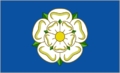
The emblem of Yorkshire is the
White Rose of the
House of York. An annual Yorkshire Day celebration has been held every 1 August since 1975. Amongst the celebrations there is a Civic gathering of Lord Mayors, Mayors and other Civic Heads from across the county and convened by the Yorkshire Society, in 2004 it was held in Leeds and in 2005 it was held in Bradford. The people of
Penistone will be hosting the Civic gathering in 2006. There is also an "anthem" for the county in the form of the
folk song "On Ilkla Moor Baht'at" .
The county is known - by residents and expatriates alike - as "God's Own Country".
Flags
Yorkshire is usually represented by the White Rose of York
...
on a blue field.
This new flag for Yorkshire was designed by Michael Faul, Director of the Flag Institute.
History
- Main article History of Yorkshire
In early Anglo-Saxon times, Elmet, a British kingdom around modern Leeds/Sheffield, held out against the invading English for long enough to ensure that the kingdoms of
Mercia and
Northumbria on either side developed separately.
Note the use of the word "Angles". "Saxon" is often used as though it is simply an abbreviation for "Anglo Saxon" - but the Saxons settled in southern England, not the Midlands or North. In Yorkshire the local Anglo Saxons were Angles.Elmet eventually succumbed, and all of what is now modern Yorkshire became the Anglian kingdom of Deira. Later, Deira merged with
Bernicia to form the English
Kingdom of Northumbria. At its greatest extent,
Northumbria stretched from the
Irish Sea to the
North Sea and from
Edinburgh down to Hallamshire .
In
Viking times, the Danes occupied the southern half of Northumbria to create the Danish city and kingdom of
Jorvik from which stem the names of York and Yorkshire .
After around 100 years of Yorkshire independence, the English crown nominally regained sovereignty, and Yorkshire became again part of Northumbria - which was now an almost-independent
earldom, rather than a separate kingdom. Even as late as the centralising
Tudors the monarch ruled the former Northumbria at arms length - via the Council of the North based in
York.
Various small boundary changes happened over the years, but a shakeup in 1974 was more fundamental. Yorkshire councils lost administrative control of most of their territory west of the Pennines , some chunks in the northeast and the southeast . Internally: the North Riding became North Yorkshire, swallowing the East Riding; and the West Riding lost a chunk to North Yorkshire, and was split into West Yorkshire and South Yorkshire. Within twenty years, many of these changes had been reversed: in particular, the East Riding emerged again, and Cleveland and Humberside disappeared. Also several towns and cities became "Unitary Authorities".
Today, the southern boundary of Yorkshire is not much different from the ancient one formed by the River Don and the
River Sheaf. However, Sheffield has expanded southwards, crossing these rivers and absorbing several Derbyshire villages. The Yorkshire boundary still marks the start of the North of England, with strong traces of the old Anglian/Danish amalgam of character and dialect which once made it so different from southern England - though it is related to the areas of Anglian
Mercia in the modern
East Midlands which were also ruled by Danes, though for a shorter time.
When, in 2005, the people of the
North East England region voted to reject the proposition that their regional assembly become an elected body, plans for a similar referendum in the
Yorkshire and the Humber region were shelved, and the regional assembly remains an unelected body.
Divisions of Yorkshire
Yorkshire is traditionally divided into three ridings, which were divided further into
wapentakes when used as the basis for administration. In about 1823 the wapentakes were:
North Riding- Allertonshire
- Birdforth
- Bulmer
- Gilling East and West
- Halikeld
- Hang East and West
- Langbaurgh East and West
- Pickering Lythe
- Ryedale
...
East Riding- Buckrose
- Dickering
- Harthill — Bainton beacon, Holme beacon, Hunsley beacon and Wilton beacon
- Holderness South Middle and North
- Howdenshire
- Hullshire
- Hunsley Beacon
- Ouse and Derwent
West Riding- Agbrigg and Morley
- Barkston Ash
- Ewcross
- Claro Lower and Upper
- Morley
- Osgoldcross
- Skyrack Lower and Upper
- Staincliffe East and West
- Staincross
- Strafforth and Tickhill Lower and Upper
Apart from these there were the Ainsty wapentake surrounding the
City of York . Lesser boroughs were Yorkshire isolates;
Richmondshire and Allertonshire in the North Riding, Hallamshire in the West Riding and Hullshire in the East Riding.
The Ridings were used as the basis of
administrative counties upon the introduction of local government, in 1888, although many boroughs within the area were made
county boroughs in their own right.
In 1974 the local government system was reformed, with the bulk of the area being split between:
South and West Yorkshire are termed
metropolitan counties, as they cover mostly built-up areas. Additionally, small portions were ceded to the control of
Cumbria ,
Lancashire ,
County Durham and
Greater Manchester .
In 1986 the county councils of West and South Yorkshire were abolished, and in 1996 Cleveland and Humberside were broken up into districts, which became independent administrative counties in their own right, as did an expanded
City of York. The bulk of the Yorkshire part of Humberside became known as the
East Riding of Yorkshire, with
Kingston upon Hull being independent.
For ceremonial purposes the districts previously covered by Cleveland now fall in the
ceremonial counties of North Yorkshire and County Durham, and the districts previously covered by Humberside now fall in the ceremonial counties of East Riding of Yorkshire and Lincolnshire.
Much of Yorkshire is now represented by the
region of
Yorkshire and the Humber.
Villages, towns and cities in Yorkshire
See the list of places in Yorkshire.Local government areas in ceremonial Yorkshire
Much of Yorkshire remains in the following four ceremonial counties with a
Lord Lieutenant appointed to each:
...
...
...
, Harrogate,
Richmondshire,
Ryedale,
Scarborough, Selby
...
External links
...
,
Leeds,
WakefieldTraditions and Stereotypes
Yorshiremen are immensely proud of both their county
Yorkshiremen are often stereotyped as being warm and friendly but "bloody minded" and argumentative.
The social stereotype of a Yorkshireman has a tendency to include such accessories as a
flat cap and a
whippet, although these fashions were started in London, and were brought to Yorkshire by the engineers and workmen who came when the railways were being built out from London in the early 19th century .
Journalist and broadcaster Sir Bernard Ingham recently wrote a book
Yorkshire Greats: The County's Fifty Finest, in which he proposed a list of the greatest ever Yorkshiremen and women. The list included the likes of
James Cook,
William Wilberforce and
George Cayley.
"Tyke" is now a colloquialism for the Yorkshire dialect as well as the term some Yorkshiremen affectionately use to describe themselves, especially in the West Riding. "Tyke" was originally a term of abuse given by Yorkshire people to Londoners, because they thought their speech made them sound like yapping mongrel dogs . Londoners turned this around and used the term to describe Yorkshire folk .
Among Yorkshire's unique traditions is the
Long Sword dance, a traditional dance not found elsewhere in England.
In recent times Yorkshire has produced a number of popular bands,such as Kaiser Chiefs and Arctic Monkeys . Yorkshire has been home to its own genre of techno music, Yorkshire Bleeps and Bass.
See also
External links
-
-
-
- — a gallery of drawings depicting Yorkshire as it was in the 1800s.
References