

Great Depression in the United Kingdom

Encyclopedia
The Great Depression in the United Kingdom, also known as the Great Slump, was a period of national economic downturn
in the 1930s, which had its origins in the global Great Depression
. It was the largest and most profound economic depression
of the 20th century for the United Kingdom
.
was still far from having recovered from the effects of the First World War
. Economist
Lee Ohanain showed that economic output fell by 25% between 1918 and 1921 and did not recover until the end of the Great Depression, arguing that the United Kingdom suffered a twenty-year great depression beginning in 1918. Relative to the rest of the world, economic output declined mildly in the UK between 1929 and 1934.
A major cause of financial instability, which preceded and accompanied the Great Depression
, was the debt that many European countries had accumulated to pay for their involvement in the First World War. This debt destabilised many European economies as they tried to rebuild during the 1920s.
Britain had largely avoided this trap by financing their war effort largely through sales of foreign assets. Britain had a net loss of £300 million of foreign investments, less than two years' investment on a pre-1914 average. The largest material loss during the war was in the British Merchant Navy, which lost 40 percent of its merchant fleet to the U-boat
attacks (but this was replaced soon after the war). Along with loss of assets through enemy action, such divestiture reduced British investments abroad by around 20% by 1918.
The resulting loss of foreign exchange earnings left the British economy more dependent upon export
s, and more vulnerable to any downturn in world markets. But the war had permanently eroded Britain's trading position in world markets through disruptions to trade and losses of shipping. Overseas customers for British produce had been lost, especially for traditional exports such as textiles, steel
and coal
.
The 1920s saw the development of new industries such as the motor industry and the electrical goods industry, but British products in these fields were not usually sufficiently advanced to compete in world markets against foreign competitors possessing more up-to-date plants, and so British products largely served the domestic market.
Heavy industries which formed the bedrock of Britain's export trade (such as coalmining
, shipbuilding
and steel) were heavily concentrated in certain areas of Britain, such as northern England
, South Wales
and central Scotland
, while the newer industries were heavily concentrated in southern and central England.
British industrial output during the 1920s ran at about 80-100%, and exports at about 80% of their pre-war levels, so there was little chance of Britain being able to amass enough capital to restore her overseas investment position.
Chancellor
, Winston Churchill
, on advice from the Bank of England
, restored the Pound Sterling
to the gold standard
at its prewar exchange rate
of 4.86 US dollars. This made the pound convertible to its value in gold
, but at a level that made British exports more expensive on world markets. The economic recovery was immediately slowed. To offset the effects of the high exchange rate
, the export industries tried to cut costs by lowering workers' wages, provoking the General Strike of May 1926.
The industrial areas spent the rest of the 1920s in recession
, and these industries received little investment or modernisation. Throughout the 1920s, unemployment
stayed at a steady one million.
 In May 1929, a minority Labour government headed by Ramsay MacDonald
came to office with Liberal support. This was only the second time a Labour government had been in office (they had briefly been in office in 1924), and few of the government's members had any deep knowledge of economics
or experience of running the economy. MacDonald's Labour Party was not radical
in economic thinking, and was wedded to the orthodoxy of Victorian
classical economics
with its emphasis on maintaining a balanced budget
at any cost.
In October 1929, the Stock Market Crash in New York heralded the Great Depression
. The ensuing American economic collapse shook the world: World trade contracted, prices fell and governments faced financial crisis as the supply of American credit dried up. Many countries adopted an emergency response to the crisis by erecting trade barriers and tariff
s, which worsened the crisis by further hindering global trade.
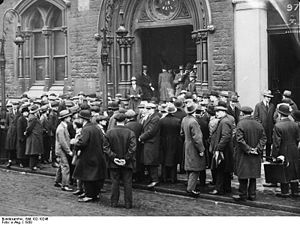
The effects on the industrial areas of Britain were immediate and devastating, as demand for British products collapsed. By the end of 1930, unemployment
had more than doubled from 1 million to 2.5 million (20% of the insured workforce), and exports had fallen in value by 50%. Government revenues contracted as national income fell, while the cost of assisting the jobless rose. The industrial areas were hardest hit, along with the coal mining
districts. London and the south-east of England were hurt less. In 1933, 30% of Glaswegians
were unemployed due to the severe decline in heavy industry.
Under pressure from its Liberal allies as well as the Conservative opposition, the Labour government appointed a committee to review the state of public finances. The May Report
of July 1931 urged public sector
wage
cuts and large cuts in public spending (notably in benefit payments to the unemployed) to avoid incurring a budget deficit. This proposal proved deeply unpopular within the Labour Party and among its main supporters, the trade union
s, which along with several government ministers refused to support any such measures. The Chancellor of the Exchequer
, Philip Snowden, insisted that the Report's recommendations be adopted to avoid incurring a budget deficit. In a memorandum
in January 1930, one junior government minister, Oswald Mosley
, proposed that the government should take control of banking and exports, as well as increase pension
s to boost purchasing power. When his ideas were turned down, he resigned. He soon left Labour to form the New Party
, and later the British Union of Fascists
.
and gold
further de-stabilised the economy. In response, MacDonald, on the urging of King George V
, decided to form a "National Government
" with the Conservatives
and the Liberals. On 24 August, MacDonald submitted the resignation of his ministers and led his senior colleagues in forming the new National Government. MacDonald and his supporters were expelled from the Labour Party and adopted the label "National Labour". The Labour Party and some Liberals, led by David Lloyd George
, went into opposition. The Labour Party denounced MacDonald as a "traitor" and a "rat" for what they saw as his betrayal.
Soon after this, a General Election
was called. The election
resulted in a Conservative landslide victory, with the now leaderless Labour Party winning only 46 seats in Parliament. After the 1931 election the national government became Conservative-dominated, although MacDonald continued as Prime Minister
until 1935.
, which immediately instituted a round of cuts in public spending and wages. Public sector wages and unemployment pay were cut by 10%, and income tax
was raised from 4s 6d to 5s in the pound (from 22.5% to 25%). The pay cuts did not go down well however and resulted in a Mutiny
in the Royal Navy
.
These measures were deflationary and merely reduced purchasing power in the economy, worsening the situation, and by the end of 1931 unemployment had reached nearly 3 million. The measures were also unsuccessful at defending the gold standard, which the National Government had ostensibly been created to defend.
Because of the gold standard
there was nothing to stop a flight of gold. At first the government tried to stop the flight by introducing punitive interest rates. However panic among international investors following the Mutiny, put renewed pressure on the pound, and on 21 September 1931 the government was finally forced to abandon the gold standard, and immediately the exchange rate of the pound
fell by 25%, from $4.86 to $3.40. This eased the pressure on exporters, and laid the ground for a gradual economic recovery.
Also, in 1932 following the Ottawa Agreement Neville Chamberlain
who had become Chancellor after the 1931 election, introduced tariff
s on imports at a rate of 10% on all imports except those from the countries of the British Empire
. The introduction of tariffs caused a split in the Liberal Party, some of whom, along with Phillip Snowden withdrew support for the National Government.
, experienced mass unemployment and poverty, while some areas in the Home Counties
did not.
and the south east of England
unemployment was initially as high as 13.5%, the later 1930s were a prosperous time in these areas, as a suburban house-building boom was fuelled by the low interest rates which followed the abolition of the gold standard, and as London's growing population buoyed the economy of the Home Counties
.
The south was also the home of new developing industries such as the electrical industry, which prospered from the large-scale electrification of housing and industry. Mass production
methods brought new products such as electrical cookers, washing machine
s and radio
s into the reach of the middle class
es, and the industries which produced these prospered. Nearly half of all new factories that opened in Britain between 1932 and 1937 were in the Greater London
area.
Another industry that prospered during the 1930s was the British motor industry. For cities that had a developed motor industry such as Birmingham
, Coventry
and Oxford
, the 1930s were also a boom time. Manufacturers such as Austin
, Morris
and Ford
dominated the motor industry during the 1930s, and the number of cars on British roads doubled within the decade. British Agriculture
also flourished in the 1930s.
however was a quite different matter. The north was the home to most of Britain's traditional heavy industries such as coal mining
in Yorkshire
and Nottinghamshire
, shipbuilding
on Tyneside
, steel
in Sheffield
and textile
s in Lancashire
which were heavily export
orientated. The north bore the brunt of the depression, and the '30s were the most difficult time in living memory for people in these areas. The north was hit so hard in the Great Depression because of the structural decline in British industry. Staple industries such as coal, steel and shipbuilding were smaller, less modern and efficient and over-staffed compared to continental rivals.
In the north east
(including Sunderland, Middlesbrough
and Newcastle-upon-Tyne) this was especially so. The north east was a major centre of the shipbuilding industry. The Depression caused a collapse in demand for ships. Between 1929 and 1932 ship production declined by 90%, and this in turn affected all the supply industries such as steel and coal. In some towns and cities in the north east, unemployment reached as high as 70%. Among the worst affected towns was Jarrow
, where unemployment led to the famous Jarrow March
, in which unemployed workers marched 300 mi (482.8 km) to London to protest against unemployment.
The north west
, a centre of the textile industries, was also hard hit, with places such as Manchester
and Lancashire
suffering a slump. The South Wales Valleys
, a centre of the coalmining and steel industries, was also devastated by the depression where towns such as Merthyr Tydfil
and Swansea
had unemployment rates reaching above 25% at certain times. The industrial belt of central Scotland, also a major shipbuilding centre in Glasgow
, was also hard hit by the slump.
In these areas, millions of unemployed and their families were left destitute, and queueing at soup kitchen
s became a way of life. A government report in the mid-1930s estimated that around 25% of the UK's population existed on a subsistence diet, often with signs of child malnutrition
such as scurvy
, rickets
and tuberculosis
. In his book The Road to Wigan Pier
, George Orwell
described life for the unemployed in northern England during the depression: "Several hundred men risk their lives and several hundred women scrabble in the mud for hours... searching eagerly for tiny chips of coal
in slagheaps so they could heat their own homes. For them, this arduously-gained 'free' coal was more important almost than food."
government of Herbert Henry Asquith
(see Liberal reforms
). This scheme had been funded through contributions from the government, the employers and the workers. At first, the scheme only applied to certain trades but, in 1920, it was expanded to include most manual workers.
However, the scheme only paid out according to the level of contributions made rather than according to need, and was only payable for 15 weeks. Anyone unemployed for longer than that had to rely on poor law
relief paid by their local authority. In effect, millions of workers who had been too poorly paid to make contributions, or who had been unemployed long term, were left destitute by the scheme. With the mass unemployment of the 1930s, contributions to the insurance scheme dried up, resulting in a funding crisis.
In August 1931, the 1911 scheme was replaced by a fully government-funded unemployment benefit
system. This system, for the first time, paid out according to need rather than the level of contributions. This unemployment benefit was subject to a strict means test
, and anyone applying for unemployment pay had to have an inspection by a government official to make sure that they had no hidden earnings or savings, undisclosed source(s) of income or other means of support. For many poor people, this was a humiliating experience and was much resented.
Unemployment began a modest fall in 1934 and fell further in 1935 and 1936, but the rise in employment levels occurred mostly in the south, where lower interest rates had spurred the house building boom, which in turn spurred a recovery in domestic industry. The North and Wales remained severely depressed for most of the decade. In severely depressed parts of the country, the government enacted a number of policies to stimulate growth and reduce unemployment, including road building, loans to shipyards, and tariffs on steel imports. These policies helped but were not, however, on a sufficiently large scale to make a huge impact on the unemployment levels.
. By 1937 unemployment had fallen to 1.5 million, but rose again to 1,810,000 by January 1938 suggesting that the recovery was to be short lived.
and returning servicemen and women, did not want a return to pre-war Conservative economic policies, which they blamed for the hardship of the 1930s, and there was a mood for widespread social change. At the 1945 general election
, to the surprise of many observers, Winston Churchill
was defeated by the Labour Party headed by Clement Attlee
.
The Labour government built up from pre-war foundations what was to become a comprehensive 'cradle-to-grave' welfare state
, and established a tax funded National Health Service
, which gave treatment according to need rather than ability to pay as the previous tax funded system had been. The Labour government also enacted Keynesian economic policies, to create artificial economic demand leading to full employment
. These policies became known as the "post-war consensus
", and were accepted by all major political parties at different times. There were noted disagreements about the involvement of the state with the steel industry. With one government, it was state owned, to then be sold off with the following conservative administration only to be then re-nationalised by the following labour government. For the most part, the post-war consensus lasted until the late 1970s. Throughout the 1970s, it was becoming clear from all sides that radical change was needed as a result of such economic crises as the 1973 oil shock, high inflation, industrial unrest and sterling devaluation, but 1970s governments lacked in totality the political will and leadership, the House of Commons majority, and the intellectual basis from which to change the system until the Conservatives led by Margaret Thatcher
won the 1979 general election.
In the decades immediately following the Second World War, most historical opinion was critical of the governments of the period. Certain historians, such as Robert Skidelsky in his Politicians and the Slump, compared the orthodox policies of the Labour and National governments unfavourably with the more radical proto-Keynesian measures advocated by David Lloyd George
and Oswald Mosley
, and the more interventionist
and Keynesian responses in other economies: Franklin Roosevelt's New Deal
in the United States, the Labour government
in New Zealand, and the Social Democratic government
in Sweden. Since the 1970s opinion has become less uniformly hostile. In the preface to the 1994 edition, Skidelsky argues that recent experience of currency crises and capital flight make it hard to be so critical of the politicians who wanted to achieve stability by cutting labour costs and defending the value of the currency.
Recession
In economics, a recession is a business cycle contraction, a general slowdown in economic activity. During recessions, many macroeconomic indicators vary in a similar way...
in the 1930s, which had its origins in the global Great Depression
Great Depression
The Great Depression was a severe worldwide economic depression in the decade preceding World War II. The timing of the Great Depression varied across nations, but in most countries it started in about 1929 and lasted until the late 1930s or early 1940s...
. It was the largest and most profound economic depression
Depression (economics)
In economics, a depression is a sustained, long-term downturn in economic activity in one or more economies. It is a more severe downturn than a recession, which is seen by some economists as part of the modern business cycle....
of the 20th century for the United Kingdom
United Kingdom
The United Kingdom of Great Britain and Northern IrelandIn the United Kingdom and Dependencies, other languages have been officially recognised as legitimate autochthonous languages under the European Charter for Regional or Minority Languages...
.
Background
The Great Depression of 1929-32 broke out at a time when the United KingdomUnited Kingdom
The United Kingdom of Great Britain and Northern IrelandIn the United Kingdom and Dependencies, other languages have been officially recognised as legitimate autochthonous languages under the European Charter for Regional or Minority Languages...
was still far from having recovered from the effects of the First World War
World War I
World War I , which was predominantly called the World War or the Great War from its occurrence until 1939, and the First World War or World War I thereafter, was a major war centred in Europe that began on 28 July 1914 and lasted until 11 November 1918...
. Economist
Economist
An economist is a professional in the social science discipline of economics. The individual may also study, develop, and apply theories and concepts from economics and write about economic policy...
Lee Ohanain showed that economic output fell by 25% between 1918 and 1921 and did not recover until the end of the Great Depression, arguing that the United Kingdom suffered a twenty-year great depression beginning in 1918. Relative to the rest of the world, economic output declined mildly in the UK between 1929 and 1934.
A major cause of financial instability, which preceded and accompanied the Great Depression
Great Depression
The Great Depression was a severe worldwide economic depression in the decade preceding World War II. The timing of the Great Depression varied across nations, but in most countries it started in about 1929 and lasted until the late 1930s or early 1940s...
, was the debt that many European countries had accumulated to pay for their involvement in the First World War. This debt destabilised many European economies as they tried to rebuild during the 1920s.
Britain had largely avoided this trap by financing their war effort largely through sales of foreign assets. Britain had a net loss of £300 million of foreign investments, less than two years' investment on a pre-1914 average. The largest material loss during the war was in the British Merchant Navy, which lost 40 percent of its merchant fleet to the U-boat
U-boat
U-boat is the anglicized version of the German word U-Boot , itself an abbreviation of Unterseeboot , and refers to military submarines operated by Germany, particularly in World War I and World War II...
attacks (but this was replaced soon after the war). Along with loss of assets through enemy action, such divestiture reduced British investments abroad by around 20% by 1918.
The resulting loss of foreign exchange earnings left the British economy more dependent upon export
Export
The term export is derived from the conceptual meaning as to ship the goods and services out of the port of a country. The seller of such goods and services is referred to as an "exporter" who is based in the country of export whereas the overseas based buyer is referred to as an "importer"...
s, and more vulnerable to any downturn in world markets. But the war had permanently eroded Britain's trading position in world markets through disruptions to trade and losses of shipping. Overseas customers for British produce had been lost, especially for traditional exports such as textiles, steel
Steel
Steel is an alloy that consists mostly of iron and has a carbon content between 0.2% and 2.1% by weight, depending on the grade. Carbon is the most common alloying material for iron, but various other alloying elements are used, such as manganese, chromium, vanadium, and tungsten...
and coal
Coal
Coal is a combustible black or brownish-black sedimentary rock usually occurring in rock strata in layers or veins called coal beds or coal seams. The harder forms, such as anthracite coal, can be regarded as metamorphic rock because of later exposure to elevated temperature and pressure...
.
The 1920s saw the development of new industries such as the motor industry and the electrical goods industry, but British products in these fields were not usually sufficiently advanced to compete in world markets against foreign competitors possessing more up-to-date plants, and so British products largely served the domestic market.
Heavy industries which formed the bedrock of Britain's export trade (such as coalmining
History of coal mining
Due to its abundance, coal has been mined in various parts of the world throughout history and continues to be an important economic activity today. Compared to wood fuels, coal yields a higher amount of energy per mass and could be obtained in areas where wood is not readily available...
, shipbuilding
Shipbuilding
Shipbuilding is the construction of ships and floating vessels. It normally takes place in a specialized facility known as a shipyard. Shipbuilders, also called shipwrights, follow a specialized occupation that traces its roots to before recorded history.Shipbuilding and ship repairs, both...
and steel) were heavily concentrated in certain areas of Britain, such as northern England
Northern England
Northern England, also known as the North of England, the North or the North Country, is a cultural region of England. It is not an official government region, but rather an informal amalgamation of counties. The southern extent of the region is roughly the River Trent, while the North is bordered...
, South Wales
South Wales
South Wales is an area of Wales bordered by England and the Bristol Channel to the east and south, and Mid Wales and West Wales to the north and west. The most densely populated region in the south-west of the United Kingdom, it is home to around 2.1 million people and includes the capital city of...
and central Scotland
Central Belt
The Central Belt of Scotland is a common term used to describe the area of highest population density within Scotland. Despite the name, it is not geographically central but is nevertheless situated at the 'waist' of Scotland on a conventional map and the term 'central' is used in many local...
, while the newer industries were heavily concentrated in southern and central England.
British industrial output during the 1920s ran at about 80-100%, and exports at about 80% of their pre-war levels, so there was little chance of Britain being able to amass enough capital to restore her overseas investment position.
Gold Standard and the General Strike
From about 1921, Britain had started a slow economic recovery from the war and the subsequent slump. But in April 1925, the ConservativeConservative Party (UK)
The Conservative Party, formally the Conservative and Unionist Party, is a centre-right political party in the United Kingdom that adheres to the philosophies of conservatism and British unionism. It is the largest political party in the UK, and is currently the largest single party in the House...
Chancellor
Chancellor of the Exchequer
The Chancellor of the Exchequer is the title held by the British Cabinet minister who is responsible for all economic and financial matters. Often simply called the Chancellor, the office-holder controls HM Treasury and plays a role akin to the posts of Minister of Finance or Secretary of the...
, Winston Churchill
Winston Churchill
Sir Winston Leonard Spencer-Churchill, was a predominantly Conservative British politician and statesman known for his leadership of the United Kingdom during the Second World War. He is widely regarded as one of the greatest wartime leaders of the century and served as Prime Minister twice...
, on advice from the Bank of England
Bank of England
The Bank of England is the central bank of the United Kingdom and the model on which most modern central banks have been based. Established in 1694, it is the second oldest central bank in the world...
, restored the Pound Sterling
Pound sterling
The pound sterling , commonly called the pound, is the official currency of the United Kingdom, its Crown Dependencies and the British Overseas Territories of South Georgia and the South Sandwich Islands, British Antarctic Territory and Tristan da Cunha. It is subdivided into 100 pence...
to the gold standard
Gold standard
The gold standard is a monetary system in which the standard economic unit of account is a fixed mass of gold. There are distinct kinds of gold standard...
at its prewar exchange rate
Exchange rate
In finance, an exchange rate between two currencies is the rate at which one currency will be exchanged for another. It is also regarded as the value of one country’s currency in terms of another currency...
of 4.86 US dollars. This made the pound convertible to its value in gold
Gold
Gold is a chemical element with the symbol Au and an atomic number of 79. Gold is a dense, soft, shiny, malleable and ductile metal. Pure gold has a bright yellow color and luster traditionally considered attractive, which it maintains without oxidizing in air or water. Chemically, gold is a...
, but at a level that made British exports more expensive on world markets. The economic recovery was immediately slowed. To offset the effects of the high exchange rate
Exchange rate
In finance, an exchange rate between two currencies is the rate at which one currency will be exchanged for another. It is also regarded as the value of one country’s currency in terms of another currency...
, the export industries tried to cut costs by lowering workers' wages, provoking the General Strike of May 1926.
The industrial areas spent the rest of the 1920s in recession
Recession
In economics, a recession is a business cycle contraction, a general slowdown in economic activity. During recessions, many macroeconomic indicators vary in a similar way...
, and these industries received little investment or modernisation. Throughout the 1920s, unemployment
Unemployment
Unemployment , as defined by the International Labour Organization, occurs when people are without jobs and they have actively sought work within the past four weeks...
stayed at a steady one million.
Economic Crisis and the Labour government 1929-1931
Ramsay MacDonald
James Ramsay MacDonald, PC, FRS was a British politician who was the first ever Labour Prime Minister, leading a minority government for two terms....
came to office with Liberal support. This was only the second time a Labour government had been in office (they had briefly been in office in 1924), and few of the government's members had any deep knowledge of economics
Economics
Economics is the social science that analyzes the production, distribution, and consumption of goods and services. The term economics comes from the Ancient Greek from + , hence "rules of the house"...
or experience of running the economy. MacDonald's Labour Party was not radical
Political radicalism
The term political radicalism denotes political principles focused on altering social structures through revolutionary means and changing value systems in fundamental ways...
in economic thinking, and was wedded to the orthodoxy of Victorian
Victorian era
The Victorian era of British history was the period of Queen Victoria's reign from 20 June 1837 until her death on 22 January 1901. It was a long period of peace, prosperity, refined sensibilities and national self-confidence...
classical economics
Classical economics
Classical economics is widely regarded as the first modern school of economic thought. Its major developers include Adam Smith, Jean-Baptiste Say, David Ricardo, Thomas Malthus and John Stuart Mill....
with its emphasis on maintaining a balanced budget
Balanced budget
A balanced budget is when there is neither a budget deficit or a budget surplus – when revenues equal expenditure – particularly by a government. More generally, it refers to when there is no deficit, but possibly a surplus...
at any cost.
In October 1929, the Stock Market Crash in New York heralded the Great Depression
Great Depression
The Great Depression was a severe worldwide economic depression in the decade preceding World War II. The timing of the Great Depression varied across nations, but in most countries it started in about 1929 and lasted until the late 1930s or early 1940s...
. The ensuing American economic collapse shook the world: World trade contracted, prices fell and governments faced financial crisis as the supply of American credit dried up. Many countries adopted an emergency response to the crisis by erecting trade barriers and tariff
Tariff
A tariff may be either tax on imports or exports , or a list or schedule of prices for such things as rail service, bus routes, and electrical usage ....
s, which worsened the crisis by further hindering global trade.
The effects on the industrial areas of Britain were immediate and devastating, as demand for British products collapsed. By the end of 1930, unemployment
Unemployment
Unemployment , as defined by the International Labour Organization, occurs when people are without jobs and they have actively sought work within the past four weeks...
had more than doubled from 1 million to 2.5 million (20% of the insured workforce), and exports had fallen in value by 50%. Government revenues contracted as national income fell, while the cost of assisting the jobless rose. The industrial areas were hardest hit, along with the coal mining
Coal mining
The goal of coal mining is to obtain coal from the ground. Coal is valued for its energy content, and since the 1880s has been widely used to generate electricity. Steel and cement industries use coal as a fuel for extraction of iron from iron ore and for cement production. In the United States,...
districts. London and the south-east of England were hurt less. In 1933, 30% of Glaswegians
Glasgow
Glasgow is the largest city in Scotland and third most populous in the United Kingdom. The city is situated on the River Clyde in the country's west central lowlands...
were unemployed due to the severe decline in heavy industry.
Under pressure from its Liberal allies as well as the Conservative opposition, the Labour government appointed a committee to review the state of public finances. The May Report
May Report
The May Report was the publication on 31 July 1931 of the views of the Committee on National Expenditure chaired by Sir George May.-Background:...
of July 1931 urged public sector
Public sector
The public sector, sometimes referred to as the state sector, is a part of the state that deals with either the production, delivery and allocation of goods and services by and for the government or its citizens, whether national, regional or local/municipal.Examples of public sector activity range...
wage
Wage
A wage is a compensation, usually financial, received by workers in exchange for their labor.Compensation in terms of wages is given to workers and compensation in terms of salary is given to employees...
cuts and large cuts in public spending (notably in benefit payments to the unemployed) to avoid incurring a budget deficit. This proposal proved deeply unpopular within the Labour Party and among its main supporters, the trade union
Trade union
A trade union, trades union or labor union is an organization of workers that have banded together to achieve common goals such as better working conditions. The trade union, through its leadership, bargains with the employer on behalf of union members and negotiates labour contracts with...
s, which along with several government ministers refused to support any such measures. The Chancellor of the Exchequer
Chancellor of the Exchequer
The Chancellor of the Exchequer is the title held by the British Cabinet minister who is responsible for all economic and financial matters. Often simply called the Chancellor, the office-holder controls HM Treasury and plays a role akin to the posts of Minister of Finance or Secretary of the...
, Philip Snowden, insisted that the Report's recommendations be adopted to avoid incurring a budget deficit. In a memorandum
Memorandum
A memorandum is from the Latin verbal phrase memorandum est, the gerundive form of the verb memoro, "to mention, call to mind, recount, relate", which means "It must be remembered ..."...
in January 1930, one junior government minister, Oswald Mosley
Oswald Mosley
Sir Oswald Ernald Mosley, 6th Baronet, of Ancoats, was an English politician, known principally as the founder of the British Union of Fascists...
, proposed that the government should take control of banking and exports, as well as increase pension
Pension
In general, a pension is an arrangement to provide people with an income when they are no longer earning a regular income from employment. Pensions should not be confused with severance pay; the former is paid in regular installments, while the latter is paid in one lump sum.The terms retirement...
s to boost purchasing power. When his ideas were turned down, he resigned. He soon left Labour to form the New Party
New Party (Oswald Mosley)
The New Party was a political party briefly active in the United Kingdom in the early 1930s. It was formed by Sir Oswald Mosley, an MP who had belonged to both the Conservative and Labour parties, quitting Labour after its 1930 conference narrowly rejected his "Mosley Memorandum", a document he...
, and later the British Union of Fascists
British Union of Fascists
The British Union was a political party in the United Kingdom formed in 1932 by Sir Oswald Mosley as the British Union of Fascists, in 1936 it changed its name to the British Union of Fascists and National Socialists and then in 1937 to simply the British Union...
.
National Government
The dispute over spending and wage cuts split the Labour government: as it turned out, beyond recovery. The resulting political deadlock caused investors to take fright, and a flight of capitalCapital (economics)
In economics, capital, capital goods, or real capital refers to already-produced durable goods used in production of goods or services. The capital goods are not significantly consumed, though they may depreciate in the production process...
and gold
Gold
Gold is a chemical element with the symbol Au and an atomic number of 79. Gold is a dense, soft, shiny, malleable and ductile metal. Pure gold has a bright yellow color and luster traditionally considered attractive, which it maintains without oxidizing in air or water. Chemically, gold is a...
further de-stabilised the economy. In response, MacDonald, on the urging of King George V
George V of the United Kingdom
George V was King of the United Kingdom and the British Dominions, and Emperor of India, from 6 May 1910 through the First World War until his death in 1936....
, decided to form a "National Government
UK National Government
In the United Kingdom the term National Government is an abstract concept referring to a coalition of some or all major political parties. In a historical sense it usually refers primarily to the governments of Ramsay MacDonald, Stanley Baldwin and Neville Chamberlain which held office from 1931...
" with the Conservatives
Conservative Party (UK)
The Conservative Party, formally the Conservative and Unionist Party, is a centre-right political party in the United Kingdom that adheres to the philosophies of conservatism and British unionism. It is the largest political party in the UK, and is currently the largest single party in the House...
and the Liberals. On 24 August, MacDonald submitted the resignation of his ministers and led his senior colleagues in forming the new National Government. MacDonald and his supporters were expelled from the Labour Party and adopted the label "National Labour". The Labour Party and some Liberals, led by David Lloyd George
David Lloyd George
David Lloyd George, 1st Earl Lloyd-George of Dwyfor OM, PC was a British Liberal politician and statesman...
, went into opposition. The Labour Party denounced MacDonald as a "traitor" and a "rat" for what they saw as his betrayal.
Soon after this, a General Election
General election
In a parliamentary political system, a general election is an election in which all or most members of a given political body are chosen. The term is usually used to refer to elections held for a nation's primary legislative body, as distinguished from by-elections and local elections.The term...
was called. The election
United Kingdom general election, 1931
The United Kingdom general election on Tuesday 27 October 1931 was the last in the United Kingdom not held on a Thursday. It was also the last election, and the only one under universal suffrage, where one party received an absolute majority of the votes cast.The 1931 general election was the...
resulted in a Conservative landslide victory, with the now leaderless Labour Party winning only 46 seats in Parliament. After the 1931 election the national government became Conservative-dominated, although MacDonald continued as Prime Minister
Prime minister
A prime minister is the most senior minister of cabinet in the executive branch of government in a parliamentary system. In many systems, the prime minister selects and may dismiss other members of the cabinet, and allocates posts to members within the government. In most systems, the prime...
until 1935.
Emergency measures
In an effort to balance the budget and restore confidence in the pound, on the 10 September 1931 with Phillip Snowden still as Chancellor, the new national government issued an emergency budgetBudget
A budget is a financial plan and a list of all planned expenses and revenues. It is a plan for saving, borrowing and spending. A budget is an important concept in microeconomics, which uses a budget line to illustrate the trade-offs between two or more goods...
, which immediately instituted a round of cuts in public spending and wages. Public sector wages and unemployment pay were cut by 10%, and income tax
Income tax
An income tax is a tax levied on the income of individuals or businesses . Various income tax systems exist, with varying degrees of tax incidence. Income taxation can be progressive, proportional, or regressive. When the tax is levied on the income of companies, it is often called a corporate...
was raised from 4s 6d to 5s in the pound (from 22.5% to 25%). The pay cuts did not go down well however and resulted in a Mutiny
Invergordon Mutiny
The Invergordon Mutiny was an industrial action by around 1,000 sailors in the British Atlantic Fleet, that took place on 15–16 September 1931...
in the Royal Navy
Royal Navy
The Royal Navy is the naval warfare service branch of the British Armed Forces. Founded in the 16th century, it is the oldest service branch and is known as the Senior Service...
.
These measures were deflationary and merely reduced purchasing power in the economy, worsening the situation, and by the end of 1931 unemployment had reached nearly 3 million. The measures were also unsuccessful at defending the gold standard, which the National Government had ostensibly been created to defend.
Because of the gold standard
Gold standard
The gold standard is a monetary system in which the standard economic unit of account is a fixed mass of gold. There are distinct kinds of gold standard...
there was nothing to stop a flight of gold. At first the government tried to stop the flight by introducing punitive interest rates. However panic among international investors following the Mutiny, put renewed pressure on the pound, and on 21 September 1931 the government was finally forced to abandon the gold standard, and immediately the exchange rate of the pound
Pound sterling
The pound sterling , commonly called the pound, is the official currency of the United Kingdom, its Crown Dependencies and the British Overseas Territories of South Georgia and the South Sandwich Islands, British Antarctic Territory and Tristan da Cunha. It is subdivided into 100 pence...
fell by 25%, from $4.86 to $3.40. This eased the pressure on exporters, and laid the ground for a gradual economic recovery.
Also, in 1932 following the Ottawa Agreement Neville Chamberlain
Neville Chamberlain
Arthur Neville Chamberlain FRS was a British Conservative politician who served as Prime Minister of the United Kingdom from May 1937 to May 1940. Chamberlain is best known for his appeasement foreign policy, and in particular for his signing of the Munich Agreement in 1938, conceding the...
who had become Chancellor after the 1931 election, introduced tariff
Tariff
A tariff may be either tax on imports or exports , or a list or schedule of prices for such things as rail service, bus routes, and electrical usage ....
s on imports at a rate of 10% on all imports except those from the countries of the British Empire
British Empire
The British Empire comprised the dominions, colonies, protectorates, mandates and other territories ruled or administered by the United Kingdom. It originated with the overseas colonies and trading posts established by England in the late 16th and early 17th centuries. At its height, it was the...
. The introduction of tariffs caused a split in the Liberal Party, some of whom, along with Phillip Snowden withdrew support for the National Government.
During the recession
Although the overall picture for the British economy in the 1930s was bleak, the effects of the depression were uneven. Some parts of the country, and some industries, fared better than others. Some parts of the country such as the South Wales ValleysSouth Wales Valleys
The South Wales Valleys are a number of industrialised valleys in South Wales, stretching from eastern Carmarthenshire in the west to western Monmouthshire in the east and from the Heads of the Valleys in the north to the lower-lying, pastoral country of the Vale of Glamorgan and the coastal plain...
, experienced mass unemployment and poverty, while some areas in the Home Counties
Home Counties
The home counties is a term which refers to the counties of South East England and the East of England which border London, but do not include the capital city itself...
did not.
The South and the Midlands
Although in LondonLondon
London is the capital city of :England and the :United Kingdom, the largest metropolitan area in the United Kingdom, and the largest urban zone in the European Union by most measures. Located on the River Thames, London has been a major settlement for two millennia, its history going back to its...
and the south east of England
South East England
South East England is one of the nine official regions of England, designated in 1994 and adopted for statistical purposes in 1999. It consists of Berkshire, Buckinghamshire, East Sussex, Hampshire, Isle of Wight, Kent, Oxfordshire, Surrey and West Sussex...
unemployment was initially as high as 13.5%, the later 1930s were a prosperous time in these areas, as a suburban house-building boom was fuelled by the low interest rates which followed the abolition of the gold standard, and as London's growing population buoyed the economy of the Home Counties
Home Counties
The home counties is a term which refers to the counties of South East England and the East of England which border London, but do not include the capital city itself...
.
The south was also the home of new developing industries such as the electrical industry, which prospered from the large-scale electrification of housing and industry. Mass production
Mass production
Mass production is the production of large amounts of standardized products, including and especially on assembly lines...
methods brought new products such as electrical cookers, washing machine
Washing machine
A washing machine is a machine designed to wash laundry, such as clothing, towels and sheets...
s and radio
Radio
Radio is the transmission of signals through free space by modulation of electromagnetic waves with frequencies below those of visible light. Electromagnetic radiation travels by means of oscillating electromagnetic fields that pass through the air and the vacuum of space...
s into the reach of the middle class
Middle class
The middle class is any class of people in the middle of a societal hierarchy. In Weberian socio-economic terms, the middle class is the broad group of people in contemporary society who fall socio-economically between the working class and upper class....
es, and the industries which produced these prospered. Nearly half of all new factories that opened in Britain between 1932 and 1937 were in the Greater London
Greater London
Greater London is the top-level administrative division of England covering London. It was created in 1965 and spans the City of London, including Middle Temple and Inner Temple, and the 32 London boroughs. This territory is coterminate with the London Government Office Region and the London...
area.
Another industry that prospered during the 1930s was the British motor industry. For cities that had a developed motor industry such as Birmingham
Birmingham
Birmingham is a city and metropolitan borough in the West Midlands of England. It is the most populous British city outside the capital London, with a population of 1,036,900 , and lies at the heart of the West Midlands conurbation, the second most populous urban area in the United Kingdom with a...
, Coventry
Coventry
Coventry is a city and metropolitan borough in the county of West Midlands in England. Coventry is the 9th largest city in England and the 11th largest in the United Kingdom. It is also the second largest city in the English Midlands, after Birmingham, with a population of 300,848, although...
and Oxford
Oxford
The city of Oxford is the county town of Oxfordshire, England. The city, made prominent by its medieval university, has a population of just under 165,000, with 153,900 living within the district boundary. It lies about 50 miles north-west of London. The rivers Cherwell and Thames run through...
, the 1930s were also a boom time. Manufacturers such as Austin
Austin Motor Company
The Austin Motor Company was a British manufacturer of automobiles. The company was founded in 1905 and merged in 1952 into the British Motor Corporation Ltd. The marque Austin was used until 1987...
, Morris
Morris Motor Company
The Morris Motor Company was a British car manufacturing company. After the incorporation of the company into larger corporations, the Morris name remained in use as a marque until 1984 when British Leyland's Austin Rover Group decided to concentrate on the more popular Austin marque...
and Ford
Ford Motor Company
Ford Motor Company is an American multinational automaker based in Dearborn, Michigan, a suburb of Detroit. The automaker was founded by Henry Ford and incorporated on June 16, 1903. In addition to the Ford and Lincoln brands, Ford also owns a small stake in Mazda in Japan and Aston Martin in the UK...
dominated the motor industry during the 1930s, and the number of cars on British roads doubled within the decade. British Agriculture
Agriculture
Agriculture is the cultivation of animals, plants, fungi and other life forms for food, fiber, and other products used to sustain life. Agriculture was the key implement in the rise of sedentary human civilization, whereby farming of domesticated species created food surpluses that nurtured the...
also flourished in the 1930s.
In the north and industrial heartlands
Northern EnglandNorthern England
Northern England, also known as the North of England, the North or the North Country, is a cultural region of England. It is not an official government region, but rather an informal amalgamation of counties. The southern extent of the region is roughly the River Trent, while the North is bordered...
however was a quite different matter. The north was the home to most of Britain's traditional heavy industries such as coal mining
Coal mining
The goal of coal mining is to obtain coal from the ground. Coal is valued for its energy content, and since the 1880s has been widely used to generate electricity. Steel and cement industries use coal as a fuel for extraction of iron from iron ore and for cement production. In the United States,...
in Yorkshire
Yorkshire
Yorkshire is a historic county of northern England and the largest in the United Kingdom. Because of its great size in comparison to other English counties, functions have been increasingly undertaken over time by its subdivisions, which have also been subject to periodic reform...
and Nottinghamshire
Nottinghamshire
Nottinghamshire is a county in the East Midlands of England, bordering South Yorkshire to the north-west, Lincolnshire to the east, Leicestershire to the south, and Derbyshire to the west...
, shipbuilding
Shipbuilding
Shipbuilding is the construction of ships and floating vessels. It normally takes place in a specialized facility known as a shipyard. Shipbuilders, also called shipwrights, follow a specialized occupation that traces its roots to before recorded history.Shipbuilding and ship repairs, both...
on Tyneside
Tyneside
Tyneside is a conurbation in North East England, defined by the Office of National Statistics, which is home to over 80% of the population of Tyne and Wear. It includes the city of Newcastle upon Tyne and the Metropolitan Boroughs of Gateshead, North Tyneside and South Tyneside — all settlements on...
, steel
Steel
Steel is an alloy that consists mostly of iron and has a carbon content between 0.2% and 2.1% by weight, depending on the grade. Carbon is the most common alloying material for iron, but various other alloying elements are used, such as manganese, chromium, vanadium, and tungsten...
in Sheffield
Sheffield
Sheffield is a city and metropolitan borough of South Yorkshire, England. Its name derives from the River Sheaf, which runs through the city. Historically a part of the West Riding of Yorkshire, and with some of its southern suburbs annexed from Derbyshire, the city has grown from its largely...
and textile
Textile
A textile or cloth is a flexible woven material consisting of a network of natural or artificial fibres often referred to as thread or yarn. Yarn is produced by spinning raw fibres of wool, flax, cotton, or other material to produce long strands...
s in Lancashire
Lancashire
Lancashire is a non-metropolitan county of historic origin in the North West of England. It takes its name from the city of Lancaster, and is sometimes known as the County of Lancaster. Although Lancaster is still considered to be the county town, Lancashire County Council is based in Preston...
which were heavily export
Export
The term export is derived from the conceptual meaning as to ship the goods and services out of the port of a country. The seller of such goods and services is referred to as an "exporter" who is based in the country of export whereas the overseas based buyer is referred to as an "importer"...
orientated. The north bore the brunt of the depression, and the '30s were the most difficult time in living memory for people in these areas. The north was hit so hard in the Great Depression because of the structural decline in British industry. Staple industries such as coal, steel and shipbuilding were smaller, less modern and efficient and over-staffed compared to continental rivals.
In the north east
North East England
North East England is one of the nine official regions of England. It covers Northumberland, County Durham, Tyne and Wear, and Teesside . The only cities in the region are Durham, Newcastle upon Tyne and Sunderland...
(including Sunderland, Middlesbrough
Middlesbrough
Middlesbrough is a large town situated on the south bank of the River Tees in north east England, that sits within the ceremonial county of North Yorkshire...
and Newcastle-upon-Tyne) this was especially so. The north east was a major centre of the shipbuilding industry. The Depression caused a collapse in demand for ships. Between 1929 and 1932 ship production declined by 90%, and this in turn affected all the supply industries such as steel and coal. In some towns and cities in the north east, unemployment reached as high as 70%. Among the worst affected towns was Jarrow
Jarrow
Jarrow is a town in Tyne and Wear, England, located on the River Tyne, with a population of 27,526. From the middle of the 19th century until 1935, Jarrow was a centre for shipbuilding, and was the starting point of the Jarrow March against unemployment in 1936.-Foundation:The Angles re-occupied...
, where unemployment led to the famous Jarrow March
Jarrow March
The Jarrow March , was an October 1936 protest march against unemployment and extreme poverty suffered in North East England. The 207 marchers travelled from the town of Jarrow to the Palace of Westminster in London, a distance of almost , to lobby Parliament...
, in which unemployed workers marched 300 mi (482.8 km) to London to protest against unemployment.
The north west
North West England
North West England, informally known as The North West, is one of the nine official regions of England.North West England had a 2006 estimated population of 6,853,201 the third most populated region after London and the South East...
, a centre of the textile industries, was also hard hit, with places such as Manchester
Manchester
Manchester is a city and metropolitan borough in Greater Manchester, England. According to the Office for National Statistics, the 2010 mid-year population estimate for Manchester was 498,800. Manchester lies within one of the UK's largest metropolitan areas, the metropolitan county of Greater...
and Lancashire
Lancashire
Lancashire is a non-metropolitan county of historic origin in the North West of England. It takes its name from the city of Lancaster, and is sometimes known as the County of Lancaster. Although Lancaster is still considered to be the county town, Lancashire County Council is based in Preston...
suffering a slump. The South Wales Valleys
South Wales Valleys
The South Wales Valleys are a number of industrialised valleys in South Wales, stretching from eastern Carmarthenshire in the west to western Monmouthshire in the east and from the Heads of the Valleys in the north to the lower-lying, pastoral country of the Vale of Glamorgan and the coastal plain...
, a centre of the coalmining and steel industries, was also devastated by the depression where towns such as Merthyr Tydfil
Merthyr Tydfil
Merthyr Tydfil is a town in Wales, with a population of about 30,000. Although once the largest town in Wales, it is now ranked as the 15th largest urban area in Wales. It also gives its name to a county borough, which has a population of around 55,000. It is located in the historic county of...
and Swansea
Swansea
Swansea is a coastal city and county in Wales. Swansea is in the historic county boundaries of Glamorgan. Situated on the sandy South West Wales coast, the county area includes the Gower Peninsula and the Lliw uplands...
had unemployment rates reaching above 25% at certain times. The industrial belt of central Scotland, also a major shipbuilding centre in Glasgow
Glasgow
Glasgow is the largest city in Scotland and third most populous in the United Kingdom. The city is situated on the River Clyde in the country's west central lowlands...
, was also hard hit by the slump.
In these areas, millions of unemployed and their families were left destitute, and queueing at soup kitchen
Soup kitchen
A soup kitchen, a bread line, or a meal center is a place where food is offered to the hungry for free or at a reasonably low price. Frequently located in lower-income neighborhoods, they are often staffed by volunteer organizations, such as church groups or community groups...
s became a way of life. A government report in the mid-1930s estimated that around 25% of the UK's population existed on a subsistence diet, often with signs of child malnutrition
Malnutrition
Malnutrition is the condition that results from taking an unbalanced diet in which certain nutrients are lacking, in excess , or in the wrong proportions....
such as scurvy
Scurvy
Scurvy is a disease resulting from a deficiency of vitamin C, which is required for the synthesis of collagen in humans. The chemical name for vitamin C, ascorbic acid, is derived from the Latin name of scurvy, scorbutus, which also provides the adjective scorbutic...
, rickets
Rickets
Rickets is a softening of bones in children due to deficiency or impaired metabolism of vitamin D, magnesium , phosphorus or calcium, potentially leading to fractures and deformity. Rickets is among the most frequent childhood diseases in many developing countries...
and tuberculosis
Tuberculosis
Tuberculosis, MTB, or TB is a common, and in many cases lethal, infectious disease caused by various strains of mycobacteria, usually Mycobacterium tuberculosis. Tuberculosis usually attacks the lungs but can also affect other parts of the body...
. In his book The Road to Wigan Pier
The Road to Wigan Pier
The Road to Wigan Pier is a book by the British writer George Orwell, first published in 1937. The first half of this work documents his sociological investigations of the bleak living conditions amongst the working class in Lancashire and Yorkshire in the industrial north of England before World...
, George Orwell
George Orwell
Eric Arthur Blair , better known by his pen name George Orwell, was an English author and journalist...
described life for the unemployed in northern England during the depression: "Several hundred men risk their lives and several hundred women scrabble in the mud for hours... searching eagerly for tiny chips of coal
Coal
Coal is a combustible black or brownish-black sedimentary rock usually occurring in rock strata in layers or veins called coal beds or coal seams. The harder forms, such as anthracite coal, can be regarded as metamorphic rock because of later exposure to elevated temperature and pressure...
in slagheaps so they could heat their own homes. For them, this arduously-gained 'free' coal was more important almost than food."
Welfare state during the 1930s
In the 1920s and 1930s, Britain had a relatively advanced welfare system compared to many of the industrialised countries. In 1911, a compulsory national unemployment and health insurance scheme had been put in place by the LiberalLiberal Party (UK)
The Liberal Party was one of the two major political parties of the United Kingdom during the 19th and early 20th centuries. It was a third party of negligible importance throughout the latter half of the 20th Century, before merging with the Social Democratic Party in 1988 to form the present day...
government of Herbert Henry Asquith
H. H. Asquith
Herbert Henry Asquith, 1st Earl of Oxford and Asquith, KG, PC, KC served as the Liberal Prime Minister of the United Kingdom from 1908 to 1916...
(see Liberal reforms
Liberal reforms
The Liberal welfare reforms were acts of social legislation passed by the British Liberal Party after the 1906 General Election. It has been argued that this legislation shows the emergence of the modern welfare state in the UK. They shifted their outlook from a laissez-faire system to a more...
). This scheme had been funded through contributions from the government, the employers and the workers. At first, the scheme only applied to certain trades but, in 1920, it was expanded to include most manual workers.
However, the scheme only paid out according to the level of contributions made rather than according to need, and was only payable for 15 weeks. Anyone unemployed for longer than that had to rely on poor law
Poor Law
The English Poor Laws were a system of poor relief which existed in England and Wales that developed out of late-medieval and Tudor-era laws before being codified in 1587–98...
relief paid by their local authority. In effect, millions of workers who had been too poorly paid to make contributions, or who had been unemployed long term, were left destitute by the scheme. With the mass unemployment of the 1930s, contributions to the insurance scheme dried up, resulting in a funding crisis.
In August 1931, the 1911 scheme was replaced by a fully government-funded unemployment benefit
Unemployment benefit
Unemployment benefits are payments made by the state or other authorized bodies to unemployed people. Benefits may be based on a compulsory para-governmental insurance system...
system. This system, for the first time, paid out according to need rather than the level of contributions. This unemployment benefit was subject to a strict means test
Means test
A means test is a determination of whether an individual or family is eligible for help from the government.- Canada :In Canada means tests are used for student finance , and "welfare" . They are not generally used for primary education and secondary education which are tax-funded...
, and anyone applying for unemployment pay had to have an inspection by a government official to make sure that they had no hidden earnings or savings, undisclosed source(s) of income or other means of support. For many poor people, this was a humiliating experience and was much resented.
Slow recovery
Following Britain's withdrawal from the gold standard and the devaluation of the pound, interest rates were reduced from 6% to 1%. As a result, British exports became more competitive on world markets than those of countries that remained on the gold standard. This led to a modest economic recovery, and a fall in unemployment from 1933 onwards. Although exports were still a fraction of their pre-depression levels, they recovered slightly.Unemployment began a modest fall in 1934 and fell further in 1935 and 1936, but the rise in employment levels occurred mostly in the south, where lower interest rates had spurred the house building boom, which in turn spurred a recovery in domestic industry. The North and Wales remained severely depressed for most of the decade. In severely depressed parts of the country, the government enacted a number of policies to stimulate growth and reduce unemployment, including road building, loans to shipyards, and tariffs on steel imports. These policies helped but were not, however, on a sufficiently large scale to make a huge impact on the unemployment levels.
Rearmament and recovery
From 1936 onwards, the National Government followed a policy of mass rearmament in the face of the rise of Nazi GermanyNazi Germany
Nazi Germany , also known as the Third Reich , but officially called German Reich from 1933 to 1943 and Greater German Reich from 26 June 1943 onward, is the name commonly used to refer to the state of Germany from 1933 to 1945, when it was a totalitarian dictatorship ruled by...
. By 1937 unemployment had fallen to 1.5 million, but rose again to 1,810,000 by January 1938 suggesting that the recovery was to be short lived.
Consequences of the Great Depression
Following the end of the Second World War, the majority of the British people, and particularly the working classWorking class
Working class is a term used in the social sciences and in ordinary conversation to describe those employed in lower tier jobs , often extending to those in unemployment or otherwise possessing below-average incomes...
and returning servicemen and women, did not want a return to pre-war Conservative economic policies, which they blamed for the hardship of the 1930s, and there was a mood for widespread social change. At the 1945 general election
United Kingdom general election, 1945
The United Kingdom general election of 1945 was a general election held on 5 July 1945, with polls in some constituencies delayed until 12 July and in Nelson and Colne until 19 July, due to local wakes weeks. The results were counted and declared on 26 July, due in part to the time it took to...
, to the surprise of many observers, Winston Churchill
Winston Churchill
Sir Winston Leonard Spencer-Churchill, was a predominantly Conservative British politician and statesman known for his leadership of the United Kingdom during the Second World War. He is widely regarded as one of the greatest wartime leaders of the century and served as Prime Minister twice...
was defeated by the Labour Party headed by Clement Attlee
Clement Attlee
Clement Richard Attlee, 1st Earl Attlee, KG, OM, CH, PC, FRS was a British Labour politician who served as the Prime Minister of the United Kingdom from 1945 to 1951, and as the Leader of the Labour Party from 1935 to 1955...
.
The Labour government built up from pre-war foundations what was to become a comprehensive 'cradle-to-grave' welfare state
Welfare state
A welfare state is a "concept of government in which the state plays a key role in the protection and promotion of the economic and social well-being of its citizens. It is based on the principles of equality of opportunity, equitable distribution of wealth, and public responsibility for those...
, and established a tax funded National Health Service
National Health Service
The National Health Service is the shared name of three of the four publicly funded healthcare systems in the United Kingdom. They provide a comprehensive range of health services, the vast majority of which are free at the point of use to residents of the United Kingdom...
, which gave treatment according to need rather than ability to pay as the previous tax funded system had been. The Labour government also enacted Keynesian economic policies, to create artificial economic demand leading to full employment
Full employment
In macroeconomics, full employment is a condition of the national economy, where all or nearly all persons willing and able to work at the prevailing wages and working conditions are able to do so....
. These policies became known as the "post-war consensus
Post-war consensus
The post-war consensus is a name given by historians to an era in British political history which lasted from the end of World War II in 1945 to the election of Margaret Thatcher as Prime Minister of the United Kingdom in 1979....
", and were accepted by all major political parties at different times. There were noted disagreements about the involvement of the state with the steel industry. With one government, it was state owned, to then be sold off with the following conservative administration only to be then re-nationalised by the following labour government. For the most part, the post-war consensus lasted until the late 1970s. Throughout the 1970s, it was becoming clear from all sides that radical change was needed as a result of such economic crises as the 1973 oil shock, high inflation, industrial unrest and sterling devaluation, but 1970s governments lacked in totality the political will and leadership, the House of Commons majority, and the intellectual basis from which to change the system until the Conservatives led by Margaret Thatcher
Margaret Thatcher
Margaret Hilda Thatcher, Baroness Thatcher, was Prime Minister of the United Kingdom from 1979 to 1990...
won the 1979 general election.
Historic evaluation
The events of the 1930s, and the response of the Labour and National governments to the depression, have generated much historical controversy.In the decades immediately following the Second World War, most historical opinion was critical of the governments of the period. Certain historians, such as Robert Skidelsky in his Politicians and the Slump, compared the orthodox policies of the Labour and National governments unfavourably with the more radical proto-Keynesian measures advocated by David Lloyd George
David Lloyd George
David Lloyd George, 1st Earl Lloyd-George of Dwyfor OM, PC was a British Liberal politician and statesman...
and Oswald Mosley
Oswald Mosley
Sir Oswald Ernald Mosley, 6th Baronet, of Ancoats, was an English politician, known principally as the founder of the British Union of Fascists...
, and the more interventionist
Economic interventionism
Economic interventionism is an action taken by a government in a market economy or market-oriented mixed economy, beyond the basic regulation of fraud and enforcement of contracts, in an effort to affect its own economy...
and Keynesian responses in other economies: Franklin Roosevelt's New Deal
New Deal
The New Deal was a series of economic programs implemented in the United States between 1933 and 1936. They were passed by the U.S. Congress during the first term of President Franklin D. Roosevelt. The programs were Roosevelt's responses to the Great Depression, and focused on what historians call...
in the United States, the Labour government
First Labour Government of New Zealand
The First Labour Government of New Zealand was the government of New Zealand from 1935 to 1949. It set the tone of New Zealand's economic and welfare policies until the 1980s, establishing a welfare state, a system of Keynesian economic management, and high levels of state intervention...
in New Zealand, and the Social Democratic government
Swedish Social Democratic Party
The Swedish Social Democratic Workers' Party, , contesting elections as 'the Workers' Party – the Social Democrats' , or sometimes referred to just as 'the Social Democrats' and most commonly as Sossarna ; is the oldest and largest political party in Sweden. The party was founded in 1889...
in Sweden. Since the 1970s opinion has become less uniformly hostile. In the preface to the 1994 edition, Skidelsky argues that recent experience of currency crises and capital flight make it hard to be so critical of the politicians who wanted to achieve stability by cutting labour costs and defending the value of the currency.