
The Great Britain Historical GIS (or GBHGIS), is a
spatially-enabled databaseA spatial database is a database that is optimized to store and query data that is related to objects in space, including points, lines and polygons. While typical databases can understand various numeric and character types of data, additional functionality needs to be added for databases to...
that documents and visualises the changing
human geographyHuman geography is one of the two major sub-fields of the discipline of geography. Human geography is the study of the world, its people, communities, and cultures. Human geography differs from physical geography mainly in that it has a greater focus on studying human activities and is more...
of the
British IslesThe British Isles are a group of islands off the northwest coast of continental Europe that include the islands of Great Britain and Ireland and over six thousand smaller isles. There are two sovereign states located on the islands: the United Kingdom of Great Britain and Northern Ireland and...
, although is primarily focussed on the
subdivisions of the United KingdomThe administrative geography of the United Kingdom is complex, multi-layered and non-uniform. The United Kingdom, a sovereign state to the northwest of continental Europe, consists of England, Northern Ireland, Scotland and Wales...
mainly over the 200 years since the first
census in 1801The Census Act 1800 also known as the Population Act 1800 was an Act of the Parliament of Great Britain which enabled the first Census of England, Scotland and Wales to be undertaken. The census was carried out in 1801 and every ten years thereafter...
. The project is currently based at the
University of PortsmouthThe University of Portsmouth is a university in Portsmouth, Hampshire, England. The University was ranked 60th out of 122 in The Sunday Times University Guide...
, and is the provider of the website
A Vision of Britain through Time.
Original GB Historical GIS (1994-99)
The first version of the GB Historical GIS was developed at
Queen Mary, University of LondonQueen Mary, University of London is a public research university located in London, United Kingdom and a constituent college of the federal University of London...
between 1994 and 1999, although it was originally conceived simply as a mapping extension to the existing Labour Markets Database (LMDB). The system included digital boundaries for
Registration DistrictsA registration district in the United Kingdom is a type of administrative region which exists for the purpose of civil registration of births, marriages, and deaths and civil partnerships...
and Poor Law Unions (c.1840 to 1911),
Local Government Districts (1911 to 1974), and Parishes (1870s to 1974). These boundaries were held not as polygons but as line segments (arcs), using
ArcGISArcGIS is a suite consisting of a group of geographic information system software products produced by Esri.ArcGIS is a system for working with maps and geographic information...
software. Dates of creation and abolition were held for each line segment (or "arc") and custom software was developed to assemble line segments into polygons, creating conventional boundary maps for particular dates. Meanwhile, the Labour Markets Database evolved into the
Great Britain Historical Database (GBHDB), which stored a large collection of historical statistics from the census, vital registration and records of poverty and economic distress. These were held in thousands of columns within hundreds of separate tables, within an
Oracle databaseThe Oracle Database is an object-relational database management system produced and marketed by Oracle Corporation....
. This system is described in detail in Gregory and Southall (1998), and in Gregory and Southall (2002).
New GB Historical GIS (2000-)
The second version of the GB Historical GIS was developed at the
University of PortsmouthThe University of Portsmouth is a university in Portsmouth, Hampshire, England. The University was ranked 60th out of 122 in The Sunday Times University Guide...
from 2000 onwards. The work was mainly funded by the UK
National LotteryThe National Lottery is the state-franchised national lottery in the United Kingdom and the Isle of Man.It is operated by Camelot Group, to whom the licence was granted in 1994, 2001 and again in 2007. The lottery is regulated by the National Lottery Commission, and was established by the then...
, so the results had to be useful to a far wider audience than most historical GIS projects.
New architecture
This is a true
spatial databaseA spatial database is a database that is optimized to store and query data that is related to objects in space, including points, lines and polygons. While typical databases can understand various numeric and character types of data, additional functionality needs to be added for databases to...
in which all content is held in Oracle, although GIS software is used to edit content. It is designed to overcome limitations of the original system:
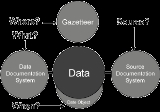
- The statistical content is now the core of the system, all data values being held in a single column of a single table, with other columns indicating what the number measures, when and where it is for, and the source it was taken from (Southall, 2007).
- Where is recorded not directly as a location but via a reference to a large catalogue of administrative units. This catalogue is organised as an ontology
In computer science and information science, an ontology formally represents knowledge as a set of concepts within a domain, and the relationships between those concepts. It can be used to reason about the entities within that domain and may be used to describe the domain.In theory, an ontology is...
, each unit having any number of names and at least one IsPartOf relationship with a higher-level unit; the obvious exception is the root unit, which represents the British Isles and to which all other units ultimately belong.
- Almost all the original digital boundaries are included in the new system, but they are held as polygons rather than line segments. Many units, especially those lacking associated statistical data, do not have boundary polygons. Most of these have approximate centroids, inferred from their relationships with units that do have polygons.
- The meaning of the statistical content -- the what in the central data table -- is recorded via a data documentation subsystem which is another ontology
In computer science and information science, an ontology formally represents knowledge as a set of concepts within a domain, and the relationships between those concepts. It can be used to reason about the entities within that domain and may be used to describe the domain.In theory, an ontology is...
. It was designed as a relational implementation of the aggregate data extension developed by the Data Documentation InitiativeThe Data Documentation Initiative is an international project to create a standard for information describing statistical and social science data. Begun in 1995, the effort brings together data professionals from around the world to develop the standard. The DDI specification, written in XML,...
. This sub-system does not simply provide text defining variables, it directly drives the graphical presentation of data. Each data value is located within an nCube or HypercubeIn geometry, a hypercube is an n-dimensional analogue of a square and a cube . It is a closed, compact, convex figure whose 1-skeleton consists of groups of opposite parallel line segments aligned in each of the space's dimensions, perpendicular to each other and of the same length.An...
. For more details, see Southall (2008).
Expanded content
This new version of the GB Historical GIS also included several other kinds of content:
- Descriptive Gazetteers: Over 90,000 entries from three late nineteenth century gazetteers: John Marius Wilson's Imperial Gazetteer of England and Wales
The Imperial Gazetteer of England and Wales is a substantial topographical dictionary first published between 1870 and 1872, edited by the Reverend John Marius Wilson. It contains a detailed description of England and Wales...
(1872); Frances Groome's The Ordnance Gazetteer of Scotland (1885); and John Bartholomew's Gazetteer of the British Isles (1887).
- Travel Writing: The text of most of the best known historical British travel writers, including James Boswell
James Boswell, 9th Laird of Auchinleck was a lawyer, diarist, and author born in Edinburgh, Scotland; he is best known for the biography he wrote of one of his contemporaries, the English literary figure Samuel Johnson....
, William CamdenWilliam Camden was an English antiquarian, historian, topographer, and officer of arms. He wrote the first chorographical survey of the islands of Great Britain and Ireland and the first detailed historical account of the reign of Elizabeth I of England.- Early years :Camden was born in London...
, William CobbettWilliam Cobbett was an English pamphleteer, farmer and journalist, who was born in Farnham, Surrey. He believed that reforming Parliament and abolishing the rotten boroughs would help to end the poverty of farm labourers, and he attacked the borough-mongers, sinecurists and "tax-eaters" relentlessly...
, Daniel DefoeDaniel Defoe , born Daniel Foe, was an English trader, writer, journalist, and pamphleteer, who gained fame for his novel Robinson Crusoe. Defoe is notable for being one of the earliest proponents of the novel, as he helped to popularise the form in Britain and along with others such as Richardson,...
, Celia FiennesCelia Fiennes was an English traveller. Born in Wiltshire, she was the daughter of an English Civil War Parliamentarian Colonel, who was in turn the second son of the William Fiennes, 1st Viscount Saye and Sele. Celia Fiennes died in Hackney in 1741.-Pioneering Female Traveller:Fiennes never married...
, Charles WesleyCharles Wesley was an English leader of the Methodist movement, son of Anglican clergyman and poet Samuel Wesley, the younger brother of Anglican clergyman John Wesley and Anglican clergyman Samuel Wesley , and father of musician Samuel Wesley, and grandfather of musician Samuel Sebastian Wesley...
and Arthur Young. The earliest source included in the GB Historical GIS is a survey of Wales written by Giraldus CambrensisGerald of Wales , also known as Gerallt Gymro in Welsh or Giraldus Cambrensis in Latin, archdeacon of Brecon, was a medieval clergyman and chronicler of his times...
in 1188. Place-names are identified within these texts using XML tags defined by the Text Encoding InitiativeThe Text Encoding Initiative is a text-centric community of practice in the academic field of digital humanities. The community runs a mailing list, meetings and conference series, and maintains a technical standard, a wiki and a toolset....
. This is believed to be the largest collection of British historical travel literatureTravel literature is travel writing of literary value. Travel literature typically records the experiences of an author touring a place for the pleasure of travel. An individual work is sometimes called a travelogue or itinerary. Travel literature may be cross-cultural or transnational in focus, or...
on the web, and is unique in that it is fully geo-referenced.
- Census Reports: The sub-system recording sources of statistical information holds a complete list of all the tables published in British census reports up to 1961, enabling the system to reconstruct selected tables. The system also holds the introductory text from selected reports, and the Guide to Census Reports: Great Britain 1801-1966.
- Geographical name authority: the administrative unit ontology described above was created from quite separate sources from the original GIS, including Frederick Youngs' Guide to the Local Administrative Units of England, Melville Richards' Welsh Administrative and Territorial Units and a new gazetteer of Scottish counties, parishes and burghs created by the Scottish Archives Network. It also holds additional variant names found in census reports, and is designed to be used for name authority control
Authority control is the practice of creating and maintaining index terms for bibliographic material in a catalog in library and information science. Authority control fulfills two important functions. First, it enables catalogers to disambiguate items with similar or identical headings...
.
All of this new content is held in the same Oracle database and linked to the polygons and statistics inherited from the original GBHGIS.
Historical maps
A GIS consisting entirely of administrative boundaries can create maps but these are hard to relate to the real world. The project has therefore constructed a second GIS consisting entirely of scanned images of historical maps, supporting an on-line
map library.
Three complete sets of one inch to one mile maps of Great Britain have been scanned and geo-referenced, each accompanied by less detailed maps from the same period:
- The Ordnance Survey
Ordnance Survey , an executive agency and non-ministerial government department of the Government of the United Kingdom, is the national mapping agency for Great Britain, producing maps of Great Britain , and one of the world's largest producers of maps.The name reflects its creation together with...
New Popular Edition, from the late 1940s. These are the most recent detailed maps of Britain to be free from OS copyright. The smallest scale twentieth century map is New Map of the British Isles. Produced under the direction of A. Gross, (London: Geographia, 1921; British Library shelfmark Maps 1080.(70.)). The intermediate mapping is the Ordnance Survey of Great Britain. Scale of ten statute miles to one inch. 1:633 600 maps from 1904 (British Library shelfmark Maps 1125.(14.)).
- The Ordnance Survey
Ordnance Survey , an executive agency and non-ministerial government department of the Government of the United Kingdom, is the national mapping agency for Great Britain, producing maps of Great Britain , and one of the world's largest producers of maps.The name reflects its creation together with...
First Series. These were created over several decades during the mid-19th century, and the GB Historical GIS uses the earliest state for each sheet held by the British LibraryThe British Library is the national library of the United Kingdom, and is the world's largest library in terms of total number of items. The library is a major research library, holding over 150 million items from every country in the world, in virtually all known languages and in many formats,...
. The least detailed nineteenth century map is from 1812 and is by Robert Wilkinson, at a scale of 1:1,625,000 (British Library shelfmark Maps 177.d.2.(15.)). The intermediate scale map is Smith's New Map of the United Kingdom of Great Britain and Ireland: on which the Turnpike, and Principal Cross Roads, are carefully described. Particularly distinguishing the Route of the mail Coaches, the course of the Rivers, and Navigable canals; ..., published in 1806 at a scale of 1:633,600 (British Library shelfmark Maps 177.d.2.(14.)).
- The Land Utilisation Survey of Great Britain, created by L.Dudley Stamp
Sir Dudley Stamp, CBE, DSc, D. Litt, LLD, Ekon D, DSc Nat , was professor of geography at Rangoon and London, and one of the internationally best known British geographers of the 20th century....
of the London School of EconomicsThe London School of Economics and Political Science is a public research university specialised in the social sciences located in London, United Kingdom, and a constituent college of the federal University of London...
. These maps include all the published one inch sheets, plus the 56 maps covering upland Scotland, hand painted in water colour to show land use, that Stamp deposited with the Royal Geographical SocietyThe Royal Geographical Society is a British learned society founded in 1830 for the advancement of geographical sciences...
(RGS Control No. 568206). The ten mile to the inch summary sheets published by the LUSGB are also included.
This collection of historical maps is not held in the main Oracle system. They are instead managed using open source
MapServerMapServer is an open source development environment for building spatially-enabled internet applications. It can run as a CGI program or via MapScript which supports several programming languages . MapServer was developed by the University of Minnesota — so, it is often and more specifically...
software. However, they are mainly accessed via MapServer's implementation of the
Open Geospatial ConsortiumThe Open Geospatial Consortium , an international voluntary consensus standards organization, originated in 1994. In the OGC, more than 400 commercial, governmental, nonprofit and research organizations worldwide collaborate in a consensus process encouraging development and implementation of open...
's
Web Map ServiceA Web Map Service is a standard protocol for serving georeferenced map images over the Internet that are generated by a map server using data from a GIS database...
standard. This is how they are used by the GB Historical GIS project's Vision of Britain system, but they are also available for use as base maps by other web sites.
Re-districting statistics to constant units
Britain has had an unusually large number of changes to its local government geography, and the current districts date back only to 1996, to 1974 or, in London, to 1965. As census reporting has always been based on local government units, it is hard to study how any particular area has changed in the long term. One of the main reasons for building the GB Historical GIS was to enable demographic and social statistics to be re-districted from various historical units to modern districts. This is done using a vector overlay methodology, using parish-level counts of total population to weight the reallocation of district-level data.
This methodology has been used to replicate the most important statistics from the Key Statistics release from the 2001 census for many earlier dates, including total population from 1801, occupational structure for selected censuses from 1841 onwards, and age and gender structure for every census from 1851 onwards.
A Vision of Britain through Time
Components of the GB Historical GIS are available for download by academic researchers from the
UK Data ArchiveThe UK Data Archive is a national centre of expertise in data archiving in the United Kingdom . It houses the largest collection of digital data in the social sciences and humanities in the UK....
and from
EDINAEDINA is a UK-based data centre , which provides data applications delivered over the Internet and aimed primarily at Higher Education staff and students in the United Kingdom....
's
UKBORDERS system. However, the main way most people can access the system is via the
Vision of Britain web site, developed by the GB Historical GIS project with their lottery funding.
The site is designed mainly as a resource for studying local history but also includes extensive mapping facilities. It includes home pages both for "places", i.e. towns and villages, and for the individual administrative units based on places. Administrative unit pages provide access to census statistics for the unit, to boundary maps and to formal information on official names and status, relationships with other units and boundary changes. All these web pages are generated by software from the data held in the underlying GB Historical GIS. Many Wikipedia pages refer to Vision of Britain.
Vision of Britain is an unusual web site as it is database-driven, but uses the ontologies in the underlying system to create clickable links between pages: most pages the site can create can be reached without filling out a search form, or clicking on an image map, and this makes the site's content generally accessible to search engines. One result is that Google searches for historical information for particular places in Britain are very likely to return links to Vision of Britain. For the most reliable results, search in Google for "place county history"; for example, "Portsmouth Hampshire History".
For a detailed guide to using the Vision of Britain system for research into local history, see Southall (2006).
Is it a GISA geographic information system, geographical information science, or geospatial information studies is a system designed to capture, store, manipulate, analyze, manage, and present all types of geographically referenced data...
at all?
The post-2000 GB Historical GIS makes no use of commercial GIS software, except for editing parts of the content, and implements a data model which could not be implemented using packages such as ArcGIS or MapInfo, so is it a GIS at all? It is certainly not a conventional GIS, but one answer is that any system that can create an image like the one shown below is some kind of GIS. This image from A Vision of Britain through Time combines the boundaries of local government districts, data on unemployment from the 1931 census, and a scanned image of an Ordnance Survey ten mile-to-one inch map from the early 20th century.
Extended Historical GIS (2007 onwards)
A new system is being developed, partly with funding from the European Union under the
QVIZ project, which will no longer be limited to Great Britain:
- The root unit represents the world rather than the British Isles, although more detailed decisions about map projections mean that the system is in practice limited to Europe.
- All coordinates are held using latitude
In geography, the latitude of a location on the Earth is the angular distance of that location south or north of the Equator. The latitude is an angle, and is usually measured in degrees . The equator has a latitude of 0°, the North pole has a latitude of 90° north , and the South pole has a...
and longitudeLongitude is a geographic coordinate that specifies the east-west position of a point on the Earth's surface. It is an angular measurement, usually expressed in degrees, minutes and seconds, and denoted by the Greek letter lambda ....
, not the Ordnance Survey National GridThe Ordnance Survey National Grid reference system is a system of geographic grid references used in Great Britain, different from using latitude and longitude....
.
- All geographical names and some other text are held using Unicode
Unicode is a computing industry standard for the consistent encoding, representation and handling of text expressed in most of the world's writing systems...
(UTF-8).
- Multiple languages are supported, especially when recording geographical names, using Ethnologue codes to identify modern languages and Linguist codes for historical ones.
An enhanced web site based on this extended system will be launched in 2009.
Further reading
- Ian Gregory: A place in History A short introduction to HGIS by the lead developer of the original GBHGIS ISSN 1463-5194
External links