


Historic counties of England

Encyclopedia
The historic counties of England are subdivisions of England
established for administration by the Normans
and in most cases based on earlier Anglo-Saxon
kingdoms and shire
s. They were used for various functions for several hundred years, initially for the administration of justice, collection of taxes and organisation of the military, and later for local government and electing parliamentary representation. They continue to form, albeit with considerably altered boundaries, the basis of modern local government. They are alternatively known as ancient counties, or sometimes traditional counties.
. Former kingdoms, which became earl
doms in the united England
did not feature this formulation; so for Kent, the former kingdom of the Jutes
, "Kentshire" was not used. Counties ending in the suffix "-sex" are also in this category and are former Saxon kingdoms. Many of these names are formed from compass directions. The third category includes counties such as Cornwall
and Devon
where the name corresponds to the tribes who inhabited the area. County Durham
is anomalous in terms of naming and origin, not falling into any of the three categories. Instead it was a diocese
that was turned into the County Palatine of Durham
, ruled by the Bishop of Durham. The expected form would otherwise be "Durhamshire", but it has never been used.
There are customary abbreviations for many of the counties. In most cases these consist of simple truncation, usually with an "s" at the end signifying "shire", such as "Berks" for Berkshire
or "Bucks" for Buckinghamshire
. Some abbreviations are not obvious, such as "Salop" for Shropshire
, "Oxon" for Oxfordshire
, "Hants" for Hampshire
and "Northants" for Northamptonshire
. Counties were often prefixed with "County of" in official contexts, such as "County of Kent". Those counties named after central towns lost the -"shire" suffix, for example Yorkshire would be known as "County of York". This usage was sometimes followed even where there was no town by that name, such as the "County of Berks". The "-shire" suffix was also appended for some counties, such as "Devonshire", "Dorsetshire" and "Somersetshire", despite their origin. There is still a Duke of Devonshire
, who is not properly called the Duke of Devon, and an Earl of Devon
.
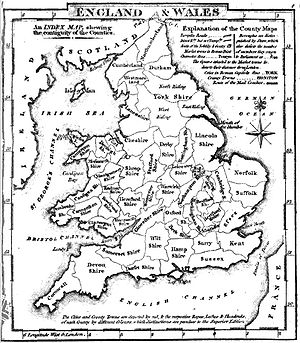 Great Britain
was first divided into administrative areas by the Romans, most likely following major geographical features such as rivers. Before their arrival there were distinct tribal areas, but they were in a constant state of flux as territory was gained and lost. After the demise of Roman Britain
around 410 these first divisions of land were generally abandoned, although traditional divisions taking the form of petty kingdoms such as Powys, Dumnonia
and Elmet
, remained in those areas which remained British
, such as south west England
. The areas that would later form the English counties started to take shape soon afterwards, with the Kingdom of Kent
founded by settlers around 445. In southern England more widely, shires emerged from earlier sub-kingdoms as part of the administrative structure of Wessex
, which then imposed its system of shires, boroughs (or burh
s) and ealdormen on Mercia
after it came under West Saxon control during the 9th century. Once the Kingdom of England
was united as a whole in 927 it became necessary to subdivide it for administrative convenience and to this end, earl
doms were created out of the earlier kingdoms. The whole kingdom was divided into shires by the time of the Norman conquest. Robert of Gloucester
accounts for thirty-five shires and William of Malmesbury
thirty-two, Henry of Huntingdon, thirty-seven In most cases the counties or shires in medieval times were administered by a sheriff
(originally "shire-reeve
") on behalf of the monarch. At the Norman conquest the sheriff was replaced and the shires became counties, or "areas under the control of a count".
Although all of England was divided into shires by the time of the Norman conquest, some counties were formed considerably later, up to the 16th century. Because of their differing origins the counties varied considerably in size. The county boundaries were fairly static between the 16th century Laws in Wales acts
and the Local Government Act 1888
. Each shire was responsible for gathering taxes for the central government; for local defence; and for justice, through assize courts.
, and in many areas represented annexed, previously independent, kingdoms or other tribal territories. Kent
derives from the Kingdom of Kent
, and Essex
, Sussex
and Middlesex
come from the East Saxons
, South Saxons
and Middle Saxons
. Norfolk and Suffolk were subdivisions representing the "North Folk" and "South Folk" of the Kingdom of East Anglia. Only one county on the south coast of England now usually takes the suffix "-shire", Hampshire
, which is named after the former town of "Hamwic" (sic), the site of which is now a part of the city of Southampton
. A "lost" Saxon county was Winchcombeshire
which lasted from 1007 to 1017 before being incorporated into Gloucestershire
.
Dorset
and Somerset
derive their names from the saete or inhabitants of the areas around the towns of Dorchester and Somerton
respectively; the names were first used by the Saxons in the 9th century. Devon
and Cornwall
were based on the pre-Saxon Celtic kingdoms known in Latin as Dumnonia
and Cornubia
.
The City of London
was recognised as a county of itself separate from Middlesex by Henry I
's charter of c.1131. A number of other boroughs in southern England were constituted counties by royal charter
. Bristol
developed as a major port in the medieval period, straddling both sides of the River Avon
which formed the ancient boundary between Gloucestershire
and Somerset
. In 1373, Edward III
decreed
(1404), Southampton
(1447), Canterbury
(1471), Gloucester
(1483), Exeter
(1537), and Poole
(1571). These counties became known as counties corporate.
in the 9th and 10th centuries, it subdivided the area into various shires of roughly equal size and tax-raising potential or hidage
. These generally took the name of the main town (the county town
) of the county, along with "-shire". Examples of these include Northamptonshire
and Warwickshire
. In some cases the original names have been worn down — for example, Cheshire
was originally "Chestershire".
In the east Midlands, it is thought that county boundaries may represent a 9th century division of the Danelaw
between units of the Danish army. Rutland was an anomalous territory or soke
, associated with Nottinghamshire
, but it eventually became considered the smallest county. Lincolnshire
was the successor to the Kingdom of Lindsey
, and took on the territories of Kesteven
and Holland
when Stamford
became the only Danelaw
borough to fail to become a county town
.
Charters were granted constituting the boroughs or cities of Lincoln
(1409), Nottingham
(1448), Lichfield
(1556) and Worcester
(1622) as counties. The County of the City of Coventry
was separated from Warwickshire in 1451, and included an extensive area of countryside surrounding the city.
The border with Wales was not set until the Laws in Wales Act 1535
— this remains the modern border. At the time of the Domesday Book
, some parts of what later became Wales were accounted as parts of English counties; Monmouth
, for example, was included in Herefordshire
, and the ancient town of Ludlow
, now in Shropshire
, was also included in Herefordshire. Parts of the March of Wales
which after the Norman conquest had been administered by Marcher Lords largely independently of the English monarch, were incorporated into the English counties of Shropshire, Herefordshire and Gloucestershire in 1535.
and Cravenshire. The Normans did not use these divisions, and so they are not generally regarded as ancient counties. The huge county of Yorkshire was a successor to the Viking Kingdom of York, and at the time of the Domesday Book in 1086 it was considered to include what was to become northern Lancashire
, as well as parts of Cumberland
, and Westmorland
. Most of the later Cumberland and Westmorland were under Scottish
rule until 1092. After the Norman Conquest in 1066 and the harrying of the North
, much of the North of England was left depopulated and was included in the returns for Cheshire
and Yorkshire
in the Domesday Book. However, there is some disagreement about the status of some of this land. The area in between the River Ribble
and the River Mersey
, referred to as in the Domesday Book, was included in the returns for Cheshire. Whether this meant that this land was actually part of Cheshire is however not clear. Additionally, the Domesday book included as part of Cheshire, areas that later became part of Wales, including the two hundreds of Atiscross and Exestan
, and the southern part of Duddestan Hundred (as it was known as the time), which later became known as Maelor Saesneg, and (later still) "Flintshire
Detached" (see Flintshire (historic)
), The Northeast, or Northumbria
, land that later became County Durham
and Northumberland
, was left unrecorded.
Cumberland, Westmorland, Lancashire, County Durham and Northumberland were established as counties in the 12th century. Lancashire can be firmly dated to 1182. Part of the domain of the Bishops of Durham, Hexhamshire
was split off and was considered an independent county until 1572, when it became part of Northumberland.
Charters granting separate county status to the cities and boroughs of Chester
(1238/9), York
(1396), Newcastle upon Tyne
(1400) and Kingston-upon-Hull (with the surrounding area of Hullshire
) (1440). In 1551 Berwick upon Tweed, on the border with Scotland
, was created a county corporate.
. It was created out of ‘the said Country or Dominion of Wales’ by the Laws in Wales Act of 1535 and later added to the Oxford circuit of the English Assizes. Laws since 1536 relating to Wales alone applied to "Wales and Monmouthshire" and for most purposes it was regarded as part of Wales. It was considered to be a county of England for parliamentary purposes until 1950 and for local government until 1974, with the Local Government Act 1972
unambiguously including the area as part of Wales.
originating in Norman times as Knights of the Peace, were appointed in each county. At the head of the legal hierarchy were the High Sheriff
and the Custos rotulorum
(keeper of the rolls) for each county.
The justices had responsibility for maintaining county gaols and houses of correction
. During the 19th century penal reformers
campaigned against the often primitive conditions in gaols, and under the Prison Act 1877
they came under Home Office
control.
Until the 19th century law enforcement was mostly carried out at the parish
level. With an increasingly mobile population, however, the system became outdated. Following the successful establishment of the Metropolitan Police
in London, the County Police Act 1839
empowered justices of the peace to form county constabularies outside boroughs. The formation of county police forces was made compulsory by the County and Borough Police Act 1856
.
was instituted. The lieutenants had a military role, previously exercised by the sheriffs, and were made responsible for raising and organising the militia
in each county. The lieutenancies were subsequently given responsibility for the Volunteer Force
. In 1871 the lieutenants lost their positions as heads of the militia, and their office became largely ceremonial. The Cardwell
and Childers Reforms
of the British Army
linked the recruiting areas of infantry regiments to the counties.
to the House of Commons
(in addition to the burgesses sent by boroughs). Yorkshire gained two members in 1821 when Grampound
was disenfranchised. The Great Reform Act
of 1832 reapportioned members throughout the counties, many of which were also split into parliamentary divisions. Constituencies based on the ancient county boundaries remained in use until 1918.
as the justices of the peace took on various administrative functions known as "county business". This was transacted at the quarter sessions
, summoned four times a year by the lord lieutenant. By the 19th century the county magistrates were exercising powers over the licensing of alehouses, the construction of bridges, prisons and asylums, the superintendence of main roads, public buildings and charitable institutions, and the regulation of weights and measures. The justices were empowered to levy local taxes to support these activities, and in 1739 these were unified as a single "county rate", under the control of a county treasurer. In order to build and maintain roads and bridges, a salaried county surveyor was to be appointed.
By the 1880s it was being suggested that it would be more efficient if a wider variety of functions were provided on a county-wide basis.
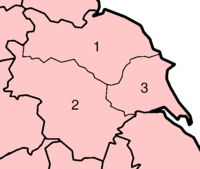 Some of the counties had major subdivisions. Of these, the most significant were the divisions of Yorkshire: the East Riding
, West Riding
, North Riding
and the ainsty
of York. Since Yorkshire is so big, its ridings became established as geographical terms quite apart from their original role as administrative divisions. The second largest county, Lincolnshire
, was divided into three historic "parts
": Lindsey
, Holland
and Kesteven
. Other divisions include those of Sussex
into East Sussex
and West Sussex
and Suffolk
into East Suffolk
and West Suffolk
, and, more informally and hence more vaguely, of Kent into East Kent
and West Kent
.
Several counties had liberties
or Soke
s within them that were administered separately. Cambridgeshire
had the Isle of Ely
, and Northamptonshire
had the Soke of Peterborough
. Such divisions were used by such entities as the Quarter Sessions
courts and were inherited by the later administrative county
areas under the control of county council
s.
Most English counties were subdivided into smaller subdivisions called hundreds. Nottinghamshire, Yorkshire and Lincolnshire were divided into wapentakes (a unit of Danish origin), while Durham, Northumberland, Cumberland and Westmorland were divided into wards
, areas originally organised for military purposes, each centred on a castle. Kent and Sussex had an intermediate level between their major subdivisions and their hundreds, known as lathes in Kent and rapes in Sussex. Hundreds or their equivalents were divided into tithings and parish
es (the only class of these divisions still used administratively), which in turn were divided into township
s and manor
s. In the 17th century the Ossulstone
hundred of Middlesex was further divided into four divisions, which replaced the functions of the hundred. The borough and parish were the principal providers of local services throughout England until the creation of ad-hoc boards and, later, local government districts.
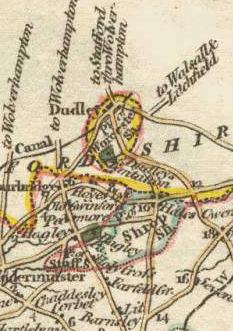 The ancient counties had many anomalies, and many small exclaves, where a parcel of land was politically part of one county despite not being physically connected to the rest of the county. The Counties (Detached Parts) Act 1844
modified the counties by abolishing the many enclaves of counties within others, which had already been done for Parliamentary purposes by the Great Reform Act.
Large exclaves affected by the 1844 Act included the County Durham exclaves of Islandshire
, Bedlingtonshire
and Norhamshire
, which were incorporated into Northumberland
; and the Halesowen
exclave of Shropshire, which was incorporated into Worcestershire.
Exclaves that the 1844 Act did not touch include the part of Derbyshire
around Donisthorpe
, locally in Leicestershire
; and most of the larger exclaves of Worcestershire
, including the town of Dudley
, which remained surrounded by Staffordshire
. Additionally, the Furness
portion of Lancashire
remained separated from the rest of Lancashire by a narrow strip of Westmorland — though it was accessible by way of the Morecambe Bay
tidal flats
.
. Several historic subdivisions with separate county administrations were also created administrative counties, particularly the separate ridings of Yorkshire
, the separate parts of Lincolnshire, and East and West Sussex. The Local Government Act 1888
also contained wording to create both a new "administrative county" and "county" of London
, and to ensure that the county borough
s which were created at the same time continued for non-administrative purposes to be part of the county which they had previously formed part of. These counties were to be used "for all purposes, whether sheriff, lieutenant, custos rotulorum, justices, militia, coroner, or other". The effect was that new county boroughs which were counties corporate retained their status as separate counties. In retrospect, these "statutory" counties can be identified as the predecessors of the ceremonial counties of England. The censuses of 1891, 1901 and 1911 provided figures for the "ancient counties".
Several towns were historically divided between counties, including Banbury
, Burton upon Trent
, Newmarket, Peterborough
, Royston
, Stamford, Tamworth
, Todmorden
and Warrington
. In Newmarket and Tamworth the county boundary ran right up the middle of the high street. The 1888 Act ensured that every urban sanitary district would be considered to be part of a single county. This principle was maintained in the 20th century: when county boroughs such as Birmingham
, Manchester
, Reading
, Sheffield
and Stockport
expanded into neighbouring counties, the area added became associated with another county.
 On 1 April 1965 a number of changes came into effect. The new administrative area of Greater London
was created, resulting in the abolition of the counties of London and Middlesex, at the same time taking in areas from surrounding counties. On the same date the new counties of Cambridgeshire and Isle of Ely
and of Huntingdon and Peterborough
were formed by the merger of pairs of administrative counties. The new areas were also adopted for lieutenancy and shrievalty purposes.
In 1974 a major local government reform took place under the Local Government Act 1972
. The Act abolished administrative counties and county boroughs, and divided England (except Greater London and the Isles of Scilly) into counties. These were of two types: "metropolitan" and "non-metropolitan" counties. Apart from local government, the new counties were "substituted for counties of any other description" for judicial, shrievalty, lieutenancy and other purposes. Several counties, such as Cumberland
, Herefordshire
, Rutland
, Westmorland
and Worcestershire
, vanished from the administrative map, while new entities such as Avon
, Cleveland
, Cumbria
and Humberside
appeared, in addition to the six new metropolitan counties
.
The built-up areas of conurbations tend to cross historic county boundaries freely. Examples here include Bournemouth
–Poole
–Christchurch (Dorset
and Hampshire
) Greater Manchester
(Cheshire
, Lancashire
and Yorkshire
), Merseyside
(Cheshire and Lancashire), Teesside
(Yorkshire and County Durham), South Yorkshire
(Yorkshire, Nottinghamshire
and Derbyshire
), Tyneside
(County Durham and Northumberland
) and West Midlands
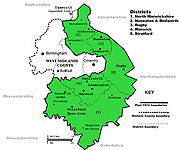
(Shropshire, Staffordshire
, Warwickshire
and Worcestershire
). Greater London
itself straddles five ancient counties — Essex
, Hertfordshire
, Kent, Middlesex
, Surrey
— and the London urban area sprawls into Buckinghamshire and Berkshire. The Local Government Act 1972 sought generally to unite conurbations within a single county, while retaining the historic county boundaries as far as was practicable.
was able to alter many of its postal counties
in accordance with the 1965 and 1974 reforms, but not all. The two major exceptions were Greater London
and Greater Manchester
. Greater London was not adopted in 1965, since, according to the Post Office at the time, it would have been too expensive to do so, while it gave as its reason for not adopting Greater Manchester the ambiguity of the name with the Manchester post town
. Perhaps as a result of this, the ancient counties appear not to have fallen completely out of use for locating places in Greater Manchester, along with areas of Greater London that are not part of the London
post town. It is common for people to speak of "Uxbridge
, Middlesex", or "Bromley
, Kent" (which are outside of the London postal district), but much less so to speak of "Brixton
, Surrey", "Greenwich
, Kent", or "West Ham
, Essex" (which are inside it).
In 1996, following further local government reform and the modernisation of its sorting equipment, the Royal Mail ceased to use counties at all in the direction of mail. Instead it now uses the outward code (first half) of the postcode. The former postal counties were removed in 2000 from its Postcode Address File
database and included in an "alias file", which is used to cross-references details that may be added by users but are no longer required, such as former street names or historic, administrative and former postal counties.
During a public consultation in 2009 Postcomm found that many respondents objected to the use of counties in the alias file. In May 2010 Postcomm announced that it was encouraging Royal Mail to discontinue the use of counties in its alias file at the earliest opportunity. However because some existing software included the use of counties, Royal Mail was advised not to implement the change before 2013.
led to the restoration of the East Riding of Yorkshire
, Herefordshire
, Rutland
and Worcestershire
as administrative areas in the 1990s; the abolition of Avon, Cleveland and Humberside within 25 years of their creation; and the restoration of the traditional borders between Somerset and Gloucestershire, Durham and Yorkshire (towards the mouth of the River Tees; not in Teesdale), and Yorkshire and Lincolnshire for ceremonial purposes in these areas. The case of Huntingdonshire was considered twice, but the Commission found that "there was no exceptional county allegiance to Huntingdonshire, as had been perceived in Rutland and Herefordshire".
The Association of British Counties
, and its regional affiliates, such as the Friends of Real Lancashire
and the Yorkshire Ridings Society
, are pressure groups that assert that, on the basis that they were not formally abolished, the counties continue to exist with their ancient boundaries. These groups seek to promote greater public awareness of what they term "traditional counties" and broadly wish to see counties realigned to the historic boundaries.
A direct action
group, CountyWatch
, was formed in 2004 to remove what its members consider to be wrongly placed county boundary signs that do not mark the historic or traditional county boundaries of England and Wales. They have removed, resorted or erected a number of what they claim to be "wrongly sited" county boundary signs in various parts of England. For instance, in Lancashire 30 signs were removed. CountyWatch has been criticised for such actions by the councils that erected the signs: Lancashire County Council
pointed out that the taxpayers would have to pay for the signs to be re-erected.
The only political party with a manifesto commitment to restore the boundaries and political functions of all ancient counties, including Middlesex
and Monmouthshire
, is the English Democrats Party
.
, the ancient counties continue to form, with considerably altered boundaries, many of the ceremonial
and non-metropolitan counties in England. Although some have been abandoned as counties, they are used as the basis for activities such as county cricket teams
. Some ancient counties have their names preserved in multiple contemporary counties, such as Yorkshire in North Yorkshire
and West Yorkshire
or now correspond to another type of subdivision, such as the Huntingdonshire
district. In some areas ancient counties have been abandoned for local government use and then later revived. The ancient counties as existed in the 19th century were as follows:
The vice counties
, used for biological recording since 1852, are largely based on historic county boundaries. They ignore all exclaves and are modified by subdividing large counties and merging smaller areas into neighbouring counties; such as Rutland with Leicestershire and Furness with Westmorland. The static boundaries make Longitudinal study
of biodiversity easier. They also cover the rest of Great Britain and Ireland.
England
England is a country that is part of the United Kingdom. It shares land borders with Scotland to the north and Wales to the west; the Irish Sea is to the north west, the Celtic Sea to the south west, with the North Sea to the east and the English Channel to the south separating it from continental...
established for administration by the Normans
Normans
The Normans were the people who gave their name to Normandy, a region in northern France. They were descended from Norse Viking conquerors of the territory and the native population of Frankish and Gallo-Roman stock...
and in most cases based on earlier Anglo-Saxon
Anglo-Saxons
Anglo-Saxon is a term used by historians to designate the Germanic tribes who invaded and settled the south and east of Great Britain beginning in the early 5th century AD, and the period from their creation of the English nation to the Norman conquest. The Anglo-Saxon Era denotes the period of...
kingdoms and shire
Shire
A shire is a traditional term for a division of land, found in the United Kingdom and in Australia. In parts of Australia, a shire is an administrative unit, but it is not synonymous with "county" there, which is a land registration unit. Individually, or as a suffix in Scotland and in the far...
s. They were used for various functions for several hundred years, initially for the administration of justice, collection of taxes and organisation of the military, and later for local government and electing parliamentary representation. They continue to form, albeit with considerably altered boundaries, the basis of modern local government. They are alternatively known as ancient counties, or sometimes traditional counties.
Nomenclature
The name of a county often gives a clue to how it was formed, either as a division that took its name from a centre of administration, an ancient kingdom, or an area occupied by an ethnic group. The majority of English counties are in the first category, with the name formed by combining the central town with the suffix "-shire", for example YorkshireYorkshire
Yorkshire is a historic county of northern England and the largest in the United Kingdom. Because of its great size in comparison to other English counties, functions have been increasingly undertaken over time by its subdivisions, which have also been subject to periodic reform...
. Former kingdoms, which became earl
Earl
An earl is a member of the nobility. The title is Anglo-Saxon, akin to the Scandinavian form jarl, and meant "chieftain", particularly a chieftain set to rule a territory in a king's stead. In Scandinavia, it became obsolete in the Middle Ages and was replaced with duke...
doms in the united England
Kingdom of England
The Kingdom of England was, from 927 to 1707, a sovereign state to the northwest of continental Europe. At its height, the Kingdom of England spanned the southern two-thirds of the island of Great Britain and several smaller outlying islands; what today comprises the legal jurisdiction of England...
did not feature this formulation; so for Kent, the former kingdom of the Jutes
Jutes
The Jutes, Iuti, or Iutæ were a Germanic people who, according to Bede, were one of the three most powerful Germanic peoples of their time, the other two being the Saxons and the Angles...
, "Kentshire" was not used. Counties ending in the suffix "-sex" are also in this category and are former Saxon kingdoms. Many of these names are formed from compass directions. The third category includes counties such as Cornwall
Cornwall
Cornwall is a unitary authority and ceremonial county of England, within the United Kingdom. It is bordered to the north and west by the Celtic Sea, to the south by the English Channel, and to the east by the county of Devon, over the River Tamar. Cornwall has a population of , and covers an area of...
and Devon
Devon
Devon is a large county in southwestern England. The county is sometimes referred to as Devonshire, although the term is rarely used inside the county itself as the county has never been officially "shired", it often indicates a traditional or historical context.The county shares borders with...
where the name corresponds to the tribes who inhabited the area. County Durham
County Durham
County Durham is a ceremonial county and unitary district in north east England. The county town is Durham. The largest settlement in the ceremonial county is the town of Darlington...
is anomalous in terms of naming and origin, not falling into any of the three categories. Instead it was a diocese
Diocese
A diocese is the district or see under the supervision of a bishop. It is divided into parishes.An archdiocese is more significant than a diocese. An archdiocese is presided over by an archbishop whose see may have or had importance due to size or historical significance...
that was turned into the County Palatine of Durham
County Palatine of Durham
The County Palatine of Durham was an area in the North of England that was controlled by the Bishop of Durham.-Liberty of Durham:The territory was originally the Liberty of Durham under the control of the Bishop of Durham. The liberty was also known variously as the "Liberty of St Cuthbert's...
, ruled by the Bishop of Durham. The expected form would otherwise be "Durhamshire", but it has never been used.
There are customary abbreviations for many of the counties. In most cases these consist of simple truncation, usually with an "s" at the end signifying "shire", such as "Berks" for Berkshire
Berkshire
Berkshire is a historic county in the South of England. It is also often referred to as the Royal County of Berkshire because of the presence of the royal residence of Windsor Castle in the county; this usage, which dates to the 19th century at least, was recognised by the Queen in 1957, and...
or "Bucks" for Buckinghamshire
Buckinghamshire
Buckinghamshire is a ceremonial and non-metropolitan home county in South East England. The county town is Aylesbury, the largest town in the ceremonial county is Milton Keynes and largest town in the non-metropolitan county is High Wycombe....
. Some abbreviations are not obvious, such as "Salop" for Shropshire
Shropshire
Shropshire is a county in the West Midlands region of England. For Eurostat purposes, the county is a NUTS 3 region and is one of four counties or unitary districts that comprise the "Shropshire and Staffordshire" NUTS 2 region. It borders Wales to the west...
, "Oxon" for Oxfordshire
Oxfordshire
Oxfordshire is a county in the South East region of England, bordering on Warwickshire and Northamptonshire , Buckinghamshire , Berkshire , Wiltshire and Gloucestershire ....
, "Hants" for Hampshire
Hampshire
Hampshire is a county on the southern coast of England in the United Kingdom. The county town of Hampshire is Winchester, a historic cathedral city that was once the capital of England. Hampshire is notable for housing the original birthplaces of the Royal Navy, British Army, and Royal Air Force...
and "Northants" for Northamptonshire
Northamptonshire
Northamptonshire is a landlocked county in the English East Midlands, with a population of 629,676 as at the 2001 census. It has boundaries with the ceremonial counties of Warwickshire to the west, Leicestershire and Rutland to the north, Cambridgeshire to the east, Bedfordshire to the south-east,...
. Counties were often prefixed with "County of" in official contexts, such as "County of Kent". Those counties named after central towns lost the -"shire" suffix, for example Yorkshire would be known as "County of York". This usage was sometimes followed even where there was no town by that name, such as the "County of Berks". The "-shire" suffix was also appended for some counties, such as "Devonshire", "Dorsetshire" and "Somersetshire", despite their origin. There is still a Duke of Devonshire
Duke of Devonshire
Duke of Devonshire is a title in the peerage of England held by members of the Cavendish family. This branch of the Cavendish family has been one of the richest and most influential aristocratic families in England since the 16th century, and have been rivalled in political influence perhaps only...
, who is not properly called the Duke of Devon, and an Earl of Devon
Earl of Devon
The title of Earl of Devon was created several times in the Peerage of England, and was possessed first by the de Redvers family, and later by the Courtenays...
.
History
Great Britain
Great Britain or Britain is an island situated to the northwest of Continental Europe. It is the ninth largest island in the world, and the largest European island, as well as the largest of the British Isles...
was first divided into administrative areas by the Romans, most likely following major geographical features such as rivers. Before their arrival there were distinct tribal areas, but they were in a constant state of flux as territory was gained and lost. After the demise of Roman Britain
Roman Britain
Roman Britain was the part of the island of Great Britain controlled by the Roman Empire from AD 43 until ca. AD 410.The Romans referred to the imperial province as Britannia, which eventually comprised all of the island of Great Britain south of the fluid frontier with Caledonia...
around 410 these first divisions of land were generally abandoned, although traditional divisions taking the form of petty kingdoms such as Powys, Dumnonia
Dumnonia
Dumnonia is the Latinised name for the Brythonic kingdom in sub-Roman Britain between the late 4th and late 8th centuries, located in the farther parts of the south-west peninsula of Great Britain...
and Elmet
Elmet
Elmet was an independent Brythonic kingdom covering a broad area of what later became the West Riding of Yorkshire during the Early Middle Ages, between approximately the 5th century and early 7th century. Although its precise boundaries are unclear, it appears to have been bordered by the River...
, remained in those areas which remained British
Britons (historical)
The Britons were the Celtic people culturally dominating Great Britain from the Iron Age through the Early Middle Ages. They spoke the Insular Celtic language known as British or Brythonic...
, such as south west England
South West England
South West England is one of the regions of England defined by the Government of the United Kingdom for statistical and other purposes. It is the largest such region in area, covering and comprising Bristol, Gloucestershire, Somerset, Dorset, Wiltshire, Devon, Cornwall and the Isles of Scilly. ...
. The areas that would later form the English counties started to take shape soon afterwards, with the Kingdom of Kent
Kingdom of Kent
The Kingdom of Kent was a Jutish colony and later independent kingdom in what is now south east England. It was founded at an unknown date in the 5th century by Jutes, members of a Germanic people from continental Europe, some of whom settled in Britain after the withdrawal of the Romans...
founded by settlers around 445. In southern England more widely, shires emerged from earlier sub-kingdoms as part of the administrative structure of Wessex
Wessex
The Kingdom of Wessex or Kingdom of the West Saxons was an Anglo-Saxon kingdom of the West Saxons, in South West England, from the 6th century, until the emergence of a united English state in the 10th century, under the Wessex dynasty. It was to be an earldom after Canute the Great's conquest...
, which then imposed its system of shires, boroughs (or burh
Burh
A Burh is an Old English name for a fortified town or other defended site, sometimes centred upon a hill fort though always intended as a place of permanent settlement, its origin was in military defence; "it represented only a stage, though a vitally important one, in the evolution of the...
s) and ealdormen on Mercia
Mercia
Mercia was one of the kingdoms of the Anglo-Saxon Heptarchy. It was centred on the valley of the River Trent and its tributaries in the region now known as the English Midlands...
after it came under West Saxon control during the 9th century. Once the Kingdom of England
Kingdom of England
The Kingdom of England was, from 927 to 1707, a sovereign state to the northwest of continental Europe. At its height, the Kingdom of England spanned the southern two-thirds of the island of Great Britain and several smaller outlying islands; what today comprises the legal jurisdiction of England...
was united as a whole in 927 it became necessary to subdivide it for administrative convenience and to this end, earl
Earl
An earl is a member of the nobility. The title is Anglo-Saxon, akin to the Scandinavian form jarl, and meant "chieftain", particularly a chieftain set to rule a territory in a king's stead. In Scandinavia, it became obsolete in the Middle Ages and was replaced with duke...
doms were created out of the earlier kingdoms. The whole kingdom was divided into shires by the time of the Norman conquest. Robert of Gloucester
Robert of Gloucester (historian)
Robert of Gloucester wrote a chronicle of British, English, and Norman history sometime in the mid- or late-thirteenth century. The Chronicle survives in some 16 manuscripts, ranging in date from the early fourteenth to mid-fifteenth centuries, and was of considerable interest to contemporaries...
accounts for thirty-five shires and William of Malmesbury
William of Malmesbury
William of Malmesbury was the foremost English historian of the 12th century. C. Warren Hollister so ranks him among the most talented generation of writers of history since Bede, "a gifted historical scholar and an omnivorous reader, impressively well versed in the literature of classical,...
thirty-two, Henry of Huntingdon, thirty-seven In most cases the counties or shires in medieval times were administered by a sheriff
Sheriff
A sheriff is in principle a legal official with responsibility for a county. In practice, the specific combination of legal, political, and ceremonial duties of a sheriff varies greatly from country to country....
(originally "shire-reeve
Reeve (England)
Originally in Anglo-Saxon England the reeve was a senior official with local responsibilities under the Crown e.g. as the chief magistrate of a town or district...
") on behalf of the monarch. At the Norman conquest the sheriff was replaced and the shires became counties, or "areas under the control of a count".
Although all of England was divided into shires by the time of the Norman conquest, some counties were formed considerably later, up to the 16th century. Because of their differing origins the counties varied considerably in size. The county boundaries were fairly static between the 16th century Laws in Wales acts
Laws in Wales Acts 1535-1542
The Laws in Wales Acts 1535 and 1542 were parliamentary measures by which the legal system of Wales was annexed to England and the norms of English administration introduced. The intention was to create a single state and a single legal jurisdiction; frequently referred to as England and Wales...
and the Local Government Act 1888
Local Government Act 1888
The Local Government Act 1888 was an Act of the Parliament of the United Kingdom, which established county councils and county borough councils in England and Wales...
. Each shire was responsible for gathering taxes for the central government; for local defence; and for justice, through assize courts.
Southern England
In southern England the counties were mostly subdivisions of the Kingdom of WessexWessex
The Kingdom of Wessex or Kingdom of the West Saxons was an Anglo-Saxon kingdom of the West Saxons, in South West England, from the 6th century, until the emergence of a united English state in the 10th century, under the Wessex dynasty. It was to be an earldom after Canute the Great's conquest...
, and in many areas represented annexed, previously independent, kingdoms or other tribal territories. Kent
Kent
Kent is a county in southeast England, and is one of the home counties. It borders East Sussex, Surrey and Greater London and has a defined boundary with Essex in the middle of the Thames Estuary. The ceremonial county boundaries of Kent include the shire county of Kent and the unitary borough of...
derives from the Kingdom of Kent
Kingdom of Kent
The Kingdom of Kent was a Jutish colony and later independent kingdom in what is now south east England. It was founded at an unknown date in the 5th century by Jutes, members of a Germanic people from continental Europe, some of whom settled in Britain after the withdrawal of the Romans...
, and Essex
Essex
Essex is a ceremonial and non-metropolitan county in the East region of England, and one of the home counties. It is located to the northeast of Greater London. It borders with Cambridgeshire and Suffolk to the north, Hertfordshire to the west, Kent to the South and London to the south west...
, Sussex
Sussex
Sussex , from the Old English Sūþsēaxe , is an historic county in South East England corresponding roughly in area to the ancient Kingdom of Sussex. It is bounded on the north by Surrey, east by Kent, south by the English Channel, and west by Hampshire, and is divided for local government into West...
and Middlesex
Middlesex
Middlesex is one of the historic counties of England and the second smallest by area. The low-lying county contained the wealthy and politically independent City of London on its southern boundary and was dominated by it from a very early time...
come from the East Saxons
Kingdom of Essex
The Kingdom of Essex or Kingdom of the East Saxons was one of the seven traditional kingdoms of the so-called Anglo-Saxon Heptarchy. It was founded in the 6th century and covered the territory later occupied by the counties of Essex, Hertfordshire, Middlesex and Kent. Kings of Essex were...
, South Saxons
Kingdom of Sussex
The Kingdom of Sussex or Kingdom of the South Saxons was a Saxon colony and later independent kingdom of the Saxons, on the south coast of England. Its boundaries coincided in general with those of the earlier kingdom of the Regnenses and the later county of Sussex. A large part of its territory...
and Middle Saxons
Middle Saxons
The Middle Saxons or Middel Seaxe were a people and their territory which later became, with somewhat contracted boundaries, the county of Middlesex, England. It included the early London settlement. The area was part of the Kingdom of Essex, but was ceded to Mercia in the 8th century....
. Norfolk and Suffolk were subdivisions representing the "North Folk" and "South Folk" of the Kingdom of East Anglia. Only one county on the south coast of England now usually takes the suffix "-shire", Hampshire
Hampshire
Hampshire is a county on the southern coast of England in the United Kingdom. The county town of Hampshire is Winchester, a historic cathedral city that was once the capital of England. Hampshire is notable for housing the original birthplaces of the Royal Navy, British Army, and Royal Air Force...
, which is named after the former town of "Hamwic" (sic), the site of which is now a part of the city of Southampton
Southampton
Southampton is the largest city in the county of Hampshire on the south coast of England, and is situated south-west of London and north-west of Portsmouth. Southampton is a major port and the closest city to the New Forest...
. A "lost" Saxon county was Winchcombeshire
Winchcombeshire
Winchcombeshire, an ancient county in the South West of England, in the 10th and 11th centuries, developed around its county town, Winchcombe....
which lasted from 1007 to 1017 before being incorporated into Gloucestershire
Gloucestershire
Gloucestershire is a county in South West England. The county comprises part of the Cotswold Hills, part of the flat fertile valley of the River Severn, and the entire Forest of Dean....
.
Dorset
Dorset
Dorset , is a county in South West England on the English Channel coast. The county town is Dorchester which is situated in the south. The Hampshire towns of Bournemouth and Christchurch joined the county with the reorganisation of local government in 1974...
and Somerset
Somerset
The ceremonial and non-metropolitan county of Somerset in South West England borders Bristol and Gloucestershire to the north, Wiltshire to the east, Dorset to the south-east, and Devon to the south-west. It is partly bounded to the north and west by the Bristol Channel and the estuary of the...
derive their names from the saete or inhabitants of the areas around the towns of Dorchester and Somerton
Somerton
Somerton is a small town and civil parish in the South Somerset district of the English county of Somerset. It gave its name to the county of Somerset, was briefly, around the start of the 14th century, the county town, and around 900 AD was possibly the capital of Wessex...
respectively; the names were first used by the Saxons in the 9th century. Devon
Devon
Devon is a large county in southwestern England. The county is sometimes referred to as Devonshire, although the term is rarely used inside the county itself as the county has never been officially "shired", it often indicates a traditional or historical context.The county shares borders with...
and Cornwall
Cornwall
Cornwall is a unitary authority and ceremonial county of England, within the United Kingdom. It is bordered to the north and west by the Celtic Sea, to the south by the English Channel, and to the east by the county of Devon, over the River Tamar. Cornwall has a population of , and covers an area of...
were based on the pre-Saxon Celtic kingdoms known in Latin as Dumnonia
Dumnonia
Dumnonia is the Latinised name for the Brythonic kingdom in sub-Roman Britain between the late 4th and late 8th centuries, located in the farther parts of the south-west peninsula of Great Britain...
and Cornubia
Kingdom of Cornwall
The Kingdom of Cornwall was an independent polity in southwest Britain during the Early Middle Ages, roughly coterminous with the modern English county of Cornwall. During the sub-Roman and early medieval periods Cornwall was evidently part of the kingdom of Dumnonia, which included most of the...
.
| Compare to 2010 |
The City of London
City of London
The City of London is a small area within Greater London, England. It is the historic core of London around which the modern conurbation grew and has held city status since time immemorial. The City’s boundaries have remained almost unchanged since the Middle Ages, and it is now only a tiny part of...
was recognised as a county of itself separate from Middlesex by Henry I
Henry I of England
Henry I was the fourth son of William I of England. He succeeded his elder brother William II as King of England in 1100 and defeated his eldest brother, Robert Curthose, to become Duke of Normandy in 1106...
's charter of c.1131. A number of other boroughs in southern England were constituted counties by royal charter
Royal Charter
A royal charter is a formal document issued by a monarch as letters patent, granting a right or power to an individual or a body corporate. They were, and are still, used to establish significant organizations such as cities or universities. Charters should be distinguished from warrants and...
. Bristol
Bristol
Bristol is a city, unitary authority area and ceremonial county in South West England, with an estimated population of 433,100 for the unitary authority in 2009, and a surrounding Larger Urban Zone with an estimated 1,070,000 residents in 2007...
developed as a major port in the medieval period, straddling both sides of the River Avon
River Avon, Bristol
The River Avon is an English river in the south west of the country. To distinguish it from a number of other River Avons in Britain, this river is often also known as the Lower Avon or Bristol Avon...
which formed the ancient boundary between Gloucestershire
Gloucestershire
Gloucestershire is a county in South West England. The county comprises part of the Cotswold Hills, part of the flat fertile valley of the River Severn, and the entire Forest of Dean....
and Somerset
Somerset
The ceremonial and non-metropolitan county of Somerset in South West England borders Bristol and Gloucestershire to the north, Wiltshire to the east, Dorset to the south-east, and Devon to the south-west. It is partly bounded to the north and west by the Bristol Channel and the estuary of the...
. In 1373, Edward III
Edward III of England
Edward III was King of England from 1327 until his death and is noted for his military success. Restoring royal authority after the disastrous reign of his father, Edward II, Edward III went on to transform the Kingdom of England into one of the most formidable military powers in Europe...
decreed
…that the said town of Bristol with its suburbs and their precinct, as the boundaries now exist, henceforward shall be separated and exempt in every way from the said counties of Gloucester and Somerset, on land and by water; that it shall be a county in itself and be called the county of Bristol for ever…Similar arrangements were later applied to Norwich
Norwich
Norwich is a city in England. It is the regional administrative centre and county town of Norfolk. During the 11th century, Norwich was the largest city in England after London, and one of the most important places in the kingdom...
(1404), Southampton
Southampton
Southampton is the largest city in the county of Hampshire on the south coast of England, and is situated south-west of London and north-west of Portsmouth. Southampton is a major port and the closest city to the New Forest...
(1447), Canterbury
Canterbury
Canterbury is a historic English cathedral city, which lies at the heart of the City of Canterbury, a district of Kent in South East England. It lies on the River Stour....
(1471), Gloucester
Gloucester
Gloucester is a city, district and county town of Gloucestershire in the South West region of England. Gloucester lies close to the Welsh border, and on the River Severn, approximately north-east of Bristol, and south-southwest of Birmingham....
(1483), Exeter
Exeter
Exeter is a historic city in Devon, England. It lies within the ceremonial county of Devon, of which it is the county town as well as the home of Devon County Council. Currently the administrative area has the status of a non-metropolitan district, and is therefore under the administration of the...
(1537), and Poole
Poole
Poole is a large coastal town and seaport in the county of Dorset, on the south coast of England. The town is east of Dorchester, and Bournemouth adjoins Poole to the east. The Borough of Poole was made a unitary authority in 1997, gaining administrative independence from Dorset County Council...
(1571). These counties became known as counties corporate.
Midlands
When Wessex conquered MerciaMercia
Mercia was one of the kingdoms of the Anglo-Saxon Heptarchy. It was centred on the valley of the River Trent and its tributaries in the region now known as the English Midlands...
in the 9th and 10th centuries, it subdivided the area into various shires of roughly equal size and tax-raising potential or hidage
Hide (unit)
The hide was originally an amount of land sufficient to support a household, but later in Anglo-Saxon England became a unit used in assessing land for liability to "geld", or land tax. The geld would be collected at a stated rate per hide...
. These generally took the name of the main town (the county town
County town
A county town is a county's administrative centre in the United Kingdom or Ireland. County towns are usually the location of administrative or judicial functions, or established over time as the de facto main town of a county. The concept of a county town eventually became detached from its...
) of the county, along with "-shire". Examples of these include Northamptonshire
Northamptonshire
Northamptonshire is a landlocked county in the English East Midlands, with a population of 629,676 as at the 2001 census. It has boundaries with the ceremonial counties of Warwickshire to the west, Leicestershire and Rutland to the north, Cambridgeshire to the east, Bedfordshire to the south-east,...
and Warwickshire
Warwickshire
Warwickshire is a landlocked non-metropolitan county in the West Midlands region of England. The county town is Warwick, although the largest town is Nuneaton. The county is famous for being the birthplace of William Shakespeare...
. In some cases the original names have been worn down — for example, Cheshire
Cheshire
Cheshire is a ceremonial county in North West England. Cheshire's county town is the city of Chester, although its largest town is Warrington. Other major towns include Widnes, Congleton, Crewe, Ellesmere Port, Runcorn, Macclesfield, Winsford, Northwich, and Wilmslow...
was originally "Chestershire".
In the east Midlands, it is thought that county boundaries may represent a 9th century division of the Danelaw
Danelaw
The Danelaw, as recorded in the Anglo-Saxon Chronicle , is a historical name given to the part of England in which the laws of the "Danes" held sway and dominated those of the Anglo-Saxons. It is contrasted with "West Saxon law" and "Mercian law". The term has been extended by modern historians to...
between units of the Danish army. Rutland was an anomalous territory or soke
Soke (legal)
The term soke ), at the time of the Norman Conquest of England generally denoted "jurisdiction", but due to vague usage probably lacks a single precise definition....
, associated with Nottinghamshire
Nottinghamshire
Nottinghamshire is a county in the East Midlands of England, bordering South Yorkshire to the north-west, Lincolnshire to the east, Leicestershire to the south, and Derbyshire to the west...
, but it eventually became considered the smallest county. Lincolnshire
Lincolnshire
Lincolnshire is a county in the east of England. It borders Norfolk to the south east, Cambridgeshire to the south, Rutland to the south west, Leicestershire and Nottinghamshire to the west, South Yorkshire to the north west, and the East Riding of Yorkshire to the north. It also borders...
was the successor to the Kingdom of Lindsey
Kingdom of Lindsey
Lindsey or Linnuis is the name of a petty Anglo-Saxon kingdom, absorbed into Northumbria in the 7th century.It lay between the Humber and the Wash, forming its inland boundaries from the course of the Witham and Trent rivers , and the Foss Dyke between...
, and took on the territories of Kesteven
Kesteven
The Parts of Kesteven are a traditional subdivision of Lincolnshire, England. This subdivision had long had a separate county administration , along with the other two parts, Lindsey and Holland.-Etymology:...
and Holland
Holland, Lincolnshire
Holland is an area of south-east Lincolnshire, England. The name is still recognised locally and survives in the district of South Holland.-Administration:...
when Stamford
Stamford, Lincolnshire
Stamford is a town and civil parish within the South Kesteven district of the county of Lincolnshire, England. It is approximately to the north of London, on the east side of the A1 road to York and Edinburgh and on the River Welland...
became the only Danelaw
Danelaw
The Danelaw, as recorded in the Anglo-Saxon Chronicle , is a historical name given to the part of England in which the laws of the "Danes" held sway and dominated those of the Anglo-Saxons. It is contrasted with "West Saxon law" and "Mercian law". The term has been extended by modern historians to...
borough to fail to become a county town
County town
A county town is a county's administrative centre in the United Kingdom or Ireland. County towns are usually the location of administrative or judicial functions, or established over time as the de facto main town of a county. The concept of a county town eventually became detached from its...
.
Charters were granted constituting the boroughs or cities of Lincoln
Lincoln, Lincolnshire
Lincoln is a cathedral city and county town of Lincolnshire, England.The non-metropolitan district of Lincoln has a population of 85,595; the 2001 census gave the entire area of Lincoln a population of 120,779....
(1409), Nottingham
Nottingham
Nottingham is a city and unitary authority in the East Midlands of England. It is located in the ceremonial county of Nottinghamshire and represents one of eight members of the English Core Cities Group...
(1448), Lichfield
Lichfield
Lichfield is a cathedral city, civil parish and district in Staffordshire, England. One of eight civil parishes with city status in England, Lichfield is situated roughly north of Birmingham...
(1556) and Worcester
Worcester
The City of Worcester, commonly known as Worcester, , is a city and county town of Worcestershire in the West Midlands of England. Worcester is situated some southwest of Birmingham and north of Gloucester, and has an approximate population of 94,000 people. The River Severn runs through the...
(1622) as counties. The County of the City of Coventry
County of the City of Coventry
The County of the City of Coventry was a former English county, which existed between 1451 and 1842.The county covered an area of around and contained the city of Coventry and the surrounding villages of Ansty, Asthull, Biggin, Binley, Caludon, Exhall, Foleshill, Harnell, Horwell, Radford, Stoke,...
was separated from Warwickshire in 1451, and included an extensive area of countryside surrounding the city.
The border with Wales was not set until the Laws in Wales Act 1535
Laws in Wales Acts 1535-1542
The Laws in Wales Acts 1535 and 1542 were parliamentary measures by which the legal system of Wales was annexed to England and the norms of English administration introduced. The intention was to create a single state and a single legal jurisdiction; frequently referred to as England and Wales...
— this remains the modern border. At the time of the Domesday Book
Domesday Book
Domesday Book , now held at The National Archives, Kew, Richmond upon Thames in South West London, is the record of the great survey of much of England and parts of Wales completed in 1086...
, some parts of what later became Wales were accounted as parts of English counties; Monmouth
Monmouth
Monmouth is a town in southeast Wales and traditional county town of the historic county of Monmouthshire. It is situated close to the border with England, where the River Monnow meets the River Wye with bridges over both....
, for example, was included in Herefordshire
Herefordshire
Herefordshire is a historic and ceremonial county in the West Midlands region of England. For Eurostat purposes it is a NUTS 3 region and is one of three counties that comprise the "Herefordshire, Worcestershire and Gloucestershire" NUTS 2 region. It also forms a unitary district known as the...
, and the ancient town of Ludlow
Ludlow
Ludlow is a market town in Shropshire, England close to the Welsh border and in the Welsh Marches. It lies within a bend of the River Teme, on its eastern bank, forming an area of and centred on a small hill. Atop this hill is the site of Ludlow Castle and the market place...
, now in Shropshire
Shropshire
Shropshire is a county in the West Midlands region of England. For Eurostat purposes, the county is a NUTS 3 region and is one of four counties or unitary districts that comprise the "Shropshire and Staffordshire" NUTS 2 region. It borders Wales to the west...
, was also included in Herefordshire. Parts of the March of Wales
Welsh Marches
The Welsh Marches is a term which, in modern usage, denotes an imprecisely defined area along and around the border between England and Wales in the United Kingdom. The precise meaning of the term has varied at different periods...
which after the Norman conquest had been administered by Marcher Lords largely independently of the English monarch, were incorporated into the English counties of Shropshire, Herefordshire and Gloucestershire in 1535.
Northern England
Much of Northumbria was also shired, the best known of these counties being HallamshireHallamshire
Hallamshire is the historical name for an area of South Yorkshire, England, in the current city of Sheffield.The origin of the name is uncertain. The English Place-Name Society describe "Hallam" originating from a formation meaning "on the rocks"...
and Cravenshire. The Normans did not use these divisions, and so they are not generally regarded as ancient counties. The huge county of Yorkshire was a successor to the Viking Kingdom of York, and at the time of the Domesday Book in 1086 it was considered to include what was to become northern Lancashire
Lancashire
Lancashire is a non-metropolitan county of historic origin in the North West of England. It takes its name from the city of Lancaster, and is sometimes known as the County of Lancaster. Although Lancaster is still considered to be the county town, Lancashire County Council is based in Preston...
, as well as parts of Cumberland
Cumberland
Cumberland is a historic county of North West England, on the border with Scotland, from the 12th century until 1974. It formed an administrative county from 1889 to 1974 and now forms part of Cumbria....
, and Westmorland
Westmorland
Westmorland is an area of North West England and one of the 39 historic counties of England. It formed an administrative county from 1889 to 1974, after which the entirety of the county was absorbed into the new county of Cumbria.-Early history:...
. Most of the later Cumberland and Westmorland were under Scottish
Scotland
Scotland is a country that is part of the United Kingdom. Occupying the northern third of the island of Great Britain, it shares a border with England to the south and is bounded by the North Sea to the east, the Atlantic Ocean to the north and west, and the North Channel and Irish Sea to the...
rule until 1092. After the Norman Conquest in 1066 and the harrying of the North
Harrying of the North
The Harrying of the North was a series of campaigns waged by William the Conqueror in the winter of 1069–1070 to subjugate Northern England, and is part of the Norman conquest of England...
, much of the North of England was left depopulated and was included in the returns for Cheshire
Cheshire
Cheshire is a ceremonial county in North West England. Cheshire's county town is the city of Chester, although its largest town is Warrington. Other major towns include Widnes, Congleton, Crewe, Ellesmere Port, Runcorn, Macclesfield, Winsford, Northwich, and Wilmslow...
and Yorkshire
Yorkshire
Yorkshire is a historic county of northern England and the largest in the United Kingdom. Because of its great size in comparison to other English counties, functions have been increasingly undertaken over time by its subdivisions, which have also been subject to periodic reform...
in the Domesday Book. However, there is some disagreement about the status of some of this land. The area in between the River Ribble
River Ribble
The River Ribble is a river that runs through North Yorkshire and Lancashire, in northern England. The river's drainage basin also includes parts of Greater Manchester around Wigan.-Geography:...
and the River Mersey
Mersey
Mersey may refer to:* River Mersey, in northwest England* Mersea Island, off the coast of Essex in England * Mersey River in the Australian state* Electoral division of Mersey in the state of Tasmania, Australian...
, referred to as in the Domesday Book, was included in the returns for Cheshire. Whether this meant that this land was actually part of Cheshire is however not clear. Additionally, the Domesday book included as part of Cheshire, areas that later became part of Wales, including the two hundreds of Atiscross and Exestan
Hundreds of Cheshire
The Hundreds of Cheshire, as with other Hundreds in England were the geographic divisions of Cheshire for administrative, military and judicial purposes. They were introduced in Cheshire some time before the Norman conquest...
, and the southern part of Duddestan Hundred (as it was known as the time), which later became known as Maelor Saesneg, and (later still) "Flintshire
Flintshire
Flintshire is a county in north-east Wales. It borders Denbighshire, Wrexham and the English county of Cheshire. It is named after the historic county of Flintshire, which had notably different borders...
Detached" (see Flintshire (historic)
Flintshire (historic)
Flintshire , also known as the County of Flint, is one of thirteen historic counties, a vice-county and a former administrative county, which mostly lies on the north east coast of Wales....
), The Northeast, or Northumbria
Northumbria
Northumbria was a medieval kingdom of the Angles, in what is now Northern England and South-East Scotland, becoming subsequently an earldom in a united Anglo-Saxon kingdom of England. The name reflects the approximate southern limit to the kingdom's territory, the Humber Estuary.Northumbria was...
, land that later became County Durham
County Durham
County Durham is a ceremonial county and unitary district in north east England. The county town is Durham. The largest settlement in the ceremonial county is the town of Darlington...
and Northumberland
Northumberland
Northumberland is the northernmost ceremonial county and a unitary district in North East England. For Eurostat purposes Northumberland is a NUTS 3 region and is one of three boroughs or unitary districts that comprise the "Northumberland and Tyne and Wear" NUTS 2 region...
, was left unrecorded.
Cumberland, Westmorland, Lancashire, County Durham and Northumberland were established as counties in the 12th century. Lancashire can be firmly dated to 1182. Part of the domain of the Bishops of Durham, Hexhamshire
Hexhamshire
Hexhamshire was a county of northern England. It existed for several hundred years until it was incorporated into Northumberland in 1572.-County:...
was split off and was considered an independent county until 1572, when it became part of Northumberland.
Charters granting separate county status to the cities and boroughs of Chester
Chester
Chester is a city in Cheshire, England. Lying on the River Dee, close to the border with Wales, it is home to 77,040 inhabitants, and is the largest and most populous settlement of the wider unitary authority area of Cheshire West and Chester, which had a population of 328,100 according to the...
(1238/9), York
York
York is a walled city, situated at the confluence of the Rivers Ouse and Foss in North Yorkshire, England. The city has a rich heritage and has provided the backdrop to major political events throughout much of its two millennia of existence...
(1396), Newcastle upon Tyne
Newcastle upon Tyne
Newcastle upon Tyne is a city and metropolitan borough of Tyne and Wear, in North East England. Historically a part of Northumberland, it is situated on the north bank of the River Tyne...
(1400) and Kingston-upon-Hull (with the surrounding area of Hullshire
Hullshire
Hullshire was a former district of England. The large county corporate was created in 1440 by Henry VI of England. It took its name from the River Hull, which formed its eastern boundary. At times it included the East Riding of Yorkshire's other two boroughs, Beverley and Hedon...
) (1440). In 1551 Berwick upon Tweed, on the border with Scotland
Scotland
Scotland is a country that is part of the United Kingdom. Occupying the northern third of the island of Great Britain, it shares a border with England to the south and is bounded by the North Sea to the east, the Atlantic Ocean to the north and west, and the North Channel and Irish Sea to the...
, was created a county corporate.
Monmouthshire
There was historic ambiguity as to the status of the county of MonmouthshireMonmouthshire (historic)
Monmouthshire , also known as the County of Monmouth , is one of thirteen ancient counties of Wales and a former administrative county....
. It was created out of ‘the said Country or Dominion of Wales’ by the Laws in Wales Act of 1535 and later added to the Oxford circuit of the English Assizes. Laws since 1536 relating to Wales alone applied to "Wales and Monmouthshire" and for most purposes it was regarded as part of Wales. It was considered to be a county of England for parliamentary purposes until 1950 and for local government until 1974, with the Local Government Act 1972
Local Government Act 1972
The Local Government Act 1972 is an Act of Parliament in the United Kingdom that reformed local government in England and Wales on 1 April 1974....
unambiguously including the area as part of Wales.
Functions
By the late Middle Ages the county was being used as the basis of a number of functions.Administration of justice and law enforcement
The Assize Courts used counties, or their major divisions, as a basis for their organisation. Justices of the peaceJustice of the Peace
A justice of the peace is a puisne judicial officer elected or appointed by means of a commission to keep the peace. Depending on the jurisdiction, they might dispense summary justice or merely deal with local administrative applications in common law jurisdictions...
originating in Norman times as Knights of the Peace, were appointed in each county. At the head of the legal hierarchy were the High Sheriff
High Sheriff
A high sheriff is, or was, a law enforcement officer in the United Kingdom, Canada and the United States.In England and Wales, the office is unpaid and partly ceremonial, appointed by the Crown through a warrant from the Privy Council. In Cornwall, the High Sheriff is appointed by the Duke of...
and the Custos rotulorum
Custos rotulorum
Custos rotulorum is the keeper of an English county's records and, by virtue of that office, the highest civil officer in the county...
(keeper of the rolls) for each county.
The justices had responsibility for maintaining county gaols and houses of correction
House of Correction
The house of correction was a type of establishment built after the passing of the Elizabethan Poor Law , places where those who were "unwilling to work", including vagrants and beggars, were set to work. The building of houses of correction came after the passing of an amendment to the Elizabethan...
. During the 19th century penal reformers
Prison reform
Prison reform is the attempt to improve conditions inside prisons, aiming at a more effective penal system.-History:Prisons have only been used as the primary punishment for criminal acts in the last couple of centuries...
campaigned against the often primitive conditions in gaols, and under the Prison Act 1877
Prison Act 1877
The Prison Act of 1877 was an Act of the Parliament of the United Kingdom of Great Britain and Ireland that aimed to alter the way in which British prisons were operated.-Detail:...
they came under Home Office
Home Office
The Home Office is the United Kingdom government department responsible for immigration control, security, and order. As such it is responsible for the police, UK Border Agency, and the Security Service . It is also in charge of government policy on security-related issues such as drugs,...
control.
Until the 19th century law enforcement was mostly carried out at the parish
Parish
A parish is a territorial unit historically under the pastoral care and clerical jurisdiction of one parish priest, who might be assisted in his pastoral duties by a curate or curates - also priests but not the parish priest - from a more or less central parish church with its associated organization...
level. With an increasingly mobile population, however, the system became outdated. Following the successful establishment of the Metropolitan Police
Metropolitan police
Metropolitan Police is a generic title for the municipal police force for a major metropolitan area, and it may be part of the official title of the force...
in London, the County Police Act 1839
County Police Act 1839
The County Police Act 1839 was an Act of Parliament passed by the Parliament of the United Kingdom. The act enabled Justices of the Peace in England and Wales to establish police forces in their counties...
empowered justices of the peace to form county constabularies outside boroughs. The formation of county police forces was made compulsory by the County and Borough Police Act 1856
County and Borough Police Act 1856
The County and Borough Police Act 1856 was an Act of Parliament passed by the Parliament of the United Kingdom. The Act made it compulsory for a police force to be established in any county which had not previously formed a constabulary....
.
Defence
In the 1540s the office of Lord LieutenantLord Lieutenant
The title Lord Lieutenant is given to the British monarch's personal representatives in the United Kingdom, usually in a county or similar circumscription, with varying tasks throughout history. Usually a retired local notable, senior military officer, peer or business person is given the post...
was instituted. The lieutenants had a military role, previously exercised by the sheriffs, and were made responsible for raising and organising the militia
Militia
The term militia is commonly used today to refer to a military force composed of ordinary citizens to provide defense, emergency law enforcement, or paramilitary service, in times of emergency without being paid a regular salary or committed to a fixed term of service. It is a polyseme with...
in each county. The lieutenancies were subsequently given responsibility for the Volunteer Force
Volunteer Force (Great Britain)
The Volunteer Force was a citizen army of part-time rifle, artillery and engineer corps, created as a popular movement in 1859. Originally highly autonomous, the units of volunteers became increasingly integrated with the British Army after the Childers Reforms in 1881, before forming part of the...
. In 1871 the lieutenants lost their positions as heads of the militia, and their office became largely ceremonial. The Cardwell
Cardwell Reforms
The Cardwell Reforms refer to a series of reforms of the British Army undertaken by Secretary of State for War Edward Cardwell between 1868 and 1874.-Background:...
and Childers Reforms
Childers Reforms
The Childers Reforms restructured the infantry regiments of the British army. The reforms were undertaken by Secretary of State for War Hugh Childers in 1881, and were a continuation of the earlier Cardwell reforms....
of the British Army
British Army
The British Army is the land warfare branch of Her Majesty's Armed Forces in the United Kingdom. It came into being with the unification of the Kingdom of England and Scotland into the Kingdom of Great Britain in 1707. The new British Army incorporated Regiments that had already existed in England...
linked the recruiting areas of infantry regiments to the counties.
Parliamentary representation
Each county sent two Knights of the ShireKnights of the Shire
From the creation of the Parliament of England in mediaeval times until 1826 each county of England and Wales sent two Knights of the Shire as members of Parliament to represent the interests of the county, when the number of knights from Yorkshire was increased to four...
to the House of Commons
British House of Commons
The House of Commons is the lower house of the Parliament of the United Kingdom, which also comprises the Sovereign and the House of Lords . Both Commons and Lords meet in the Palace of Westminster. The Commons is a democratically elected body, consisting of 650 members , who are known as Members...
(in addition to the burgesses sent by boroughs). Yorkshire gained two members in 1821 when Grampound
Grampound (UK Parliament constituency)
Grampound in Cornwall, was a borough constituency of the House of Commons of the Parliament of England, then of the Parliament of Great Britain from 1707 to 1800 and of the Parliament of the United Kingdom from 1801 to 1821. It was represented by two Members of Parliament.-History:Grampound's...
was disenfranchised. The Great Reform Act
Reform Act 1832
The Representation of the People Act 1832 was an Act of Parliament that introduced wide-ranging changes to the electoral system of England and Wales...
of 1832 reapportioned members throughout the counties, many of which were also split into parliamentary divisions. Constituencies based on the ancient county boundaries remained in use until 1918.
Local government
From the 16th century onwards the county was increasingly used as a unit of local governmentLocal government
Local government refers collectively to administrative authorities over areas that are smaller than a state.The term is used to contrast with offices at nation-state level, which are referred to as the central government, national government, or federal government...
as the justices of the peace took on various administrative functions known as "county business". This was transacted at the quarter sessions
Quarter Sessions
The Courts of Quarter Sessions or Quarter Sessions were local courts traditionally held at four set times each year in the United Kingdom and other countries in the former British Empire...
, summoned four times a year by the lord lieutenant. By the 19th century the county magistrates were exercising powers over the licensing of alehouses, the construction of bridges, prisons and asylums, the superintendence of main roads, public buildings and charitable institutions, and the regulation of weights and measures. The justices were empowered to levy local taxes to support these activities, and in 1739 these were unified as a single "county rate", under the control of a county treasurer. In order to build and maintain roads and bridges, a salaried county surveyor was to be appointed.
By the 1880s it was being suggested that it would be more efficient if a wider variety of functions were provided on a county-wide basis.
Subdivisions
East Riding of Yorkshire
The East Riding of Yorkshire, or simply East Yorkshire, is a local government district with unitary authority status, and a ceremonial county of England. For ceremonial purposes the county also includes the city of Kingston upon Hull, which is a separate unitary authority...
, West Riding
West Riding of Yorkshire
The West Riding of Yorkshire is one of the three historic subdivisions of Yorkshire, England. From 1889 to 1974 the administrative county, County of York, West Riding , was based closely on the historic boundaries...
, North Riding
North Riding of Yorkshire
The North Riding of Yorkshire was one of the three historic subdivisions of the English county of Yorkshire, alongside the East and West Ridings. From the Restoration it was used as a Lieutenancy area. The three ridings were treated as three counties for many purposes, such as having separate...
and the ainsty
Ainsty
The Ainsty or the Ainsty of York was a historic district of Yorkshire, England adjacent to the City of York. Originally a wapentake or subdivision of the West Riding of Yorkshire it later had a unique status as a rural area controlled by the corporation of the city.-Geography:The Ainsty covered a...
of York. Since Yorkshire is so big, its ridings became established as geographical terms quite apart from their original role as administrative divisions. The second largest county, Lincolnshire
Lincolnshire
Lincolnshire is a county in the east of England. It borders Norfolk to the south east, Cambridgeshire to the south, Rutland to the south west, Leicestershire and Nottinghamshire to the west, South Yorkshire to the north west, and the East Riding of Yorkshire to the north. It also borders...
, was divided into three historic "parts
Parts of Lincolnshire
The three Parts of the English county of Lincolnshire are or were divisions of the second-largest county in England. They existed as units of local government until it was reviewed in the 1970s...
": Lindsey
Lindsey
Lindsey was a unit of local government until 1974 in Lincolnshire, England, covering the northern part of the county. The Isle of Axholme, which is on the west side of the River Trent, has normally formed part of it...
, Holland
Holland, Lincolnshire
Holland is an area of south-east Lincolnshire, England. The name is still recognised locally and survives in the district of South Holland.-Administration:...
and Kesteven
Kesteven
The Parts of Kesteven are a traditional subdivision of Lincolnshire, England. This subdivision had long had a separate county administration , along with the other two parts, Lindsey and Holland.-Etymology:...
. Other divisions include those of Sussex
Sussex
Sussex , from the Old English Sūþsēaxe , is an historic county in South East England corresponding roughly in area to the ancient Kingdom of Sussex. It is bounded on the north by Surrey, east by Kent, south by the English Channel, and west by Hampshire, and is divided for local government into West...
into East Sussex
East Sussex
East Sussex is a county in South East England. It is bordered by the counties of Kent, Surrey and West Sussex, and to the south by the English Channel.-History:...
and West Sussex
West Sussex
West Sussex is a county in the south of England, bordering onto East Sussex , Hampshire and Surrey. The county of Sussex has been divided into East and West since the 12th century, and obtained separate county councils in 1888, but it remained a single ceremonial county until 1974 and the coming...
and Suffolk
Suffolk
Suffolk is a non-metropolitan county of historic origin in East Anglia, England. It has borders with Norfolk to the north, Cambridgeshire to the west and Essex to the south. The North Sea lies to the east...
into East Suffolk
East Suffolk
East Suffolk, along with West Suffolk, was created in 1888 as an administrative county of England. The administrative county was based on the eastern quarter sessions division of Suffolk...
and West Suffolk
West Suffolk
West Suffolk was an administrative county of England created in 1889 from part of the county of Suffolk. It survived until 1974 when it was rejoined with East Suffolk. Its county town was Bury St Edmunds....
, and, more informally and hence more vaguely, of Kent into East Kent
East Kent
East Kent and West Kent are one-time traditional subdivisions of the English county of Kent, kept alive by the Association of the Men of Kent and Kentish Men: an organisation formed in 1913...
and West Kent
West Kent
West Kent and East Kent are one-time traditional subdivisions of the English county of Kent, kept alive by the Association of the Men of Kent and Kentish Men: an organisation formed in 1913....
.
Several counties had liberties
Liberty (division)
Originating in the Middle Ages, a liberty was traditionally defined as an area in which regalian rights were revoked and where land was held by a mesne lord...
or Soke
Soke (legal)
The term soke ), at the time of the Norman Conquest of England generally denoted "jurisdiction", but due to vague usage probably lacks a single precise definition....
s within them that were administered separately. Cambridgeshire
Cambridgeshire
Cambridgeshire is a county in England, bordering Lincolnshire to the north, Norfolk to the northeast, Suffolk to the east, Essex and Hertfordshire to the south, and Bedfordshire and Northamptonshire to the west...
had the Isle of Ely
Isle of Ely
The Isle of Ely is a historic region around the city of Ely now in Cambridgeshire, England but previously a county in its own right.-Etymology:...
, and Northamptonshire
Northamptonshire
Northamptonshire is a landlocked county in the English East Midlands, with a population of 629,676 as at the 2001 census. It has boundaries with the ceremonial counties of Warwickshire to the west, Leicestershire and Rutland to the north, Cambridgeshire to the east, Bedfordshire to the south-east,...
had the Soke of Peterborough
Soke of Peterborough
The Soke of Peterborough is an historic area of England that is traditionally associated with the City and Diocese of Peterborough, but considered part of Northamptonshire...
. Such divisions were used by such entities as the Quarter Sessions
Quarter Sessions
The Courts of Quarter Sessions or Quarter Sessions were local courts traditionally held at four set times each year in the United Kingdom and other countries in the former British Empire...
courts and were inherited by the later administrative county
Administrative county
An administrative county was an administrative division in England and Wales and Ireland used for the purposes of local government. They are now abolished, although in Northern Ireland their former areas are used as the basis for lieutenancy....
areas under the control of county council
County council
A county council is the elected administrative body governing an area known as a county. This term has slightly different meanings in different countries.-United Kingdom:...
s.
Most English counties were subdivided into smaller subdivisions called hundreds. Nottinghamshire, Yorkshire and Lincolnshire were divided into wapentakes (a unit of Danish origin), while Durham, Northumberland, Cumberland and Westmorland were divided into wards
Wards of the United Kingdom
A ward in the United Kingdom is an electoral district at sub-national level represented by one or more councillors. It is the primary unit of British administrative and electoral geography .-England:...
, areas originally organised for military purposes, each centred on a castle. Kent and Sussex had an intermediate level between their major subdivisions and their hundreds, known as lathes in Kent and rapes in Sussex. Hundreds or their equivalents were divided into tithings and parish
Parish
A parish is a territorial unit historically under the pastoral care and clerical jurisdiction of one parish priest, who might be assisted in his pastoral duties by a curate or curates - also priests but not the parish priest - from a more or less central parish church with its associated organization...
es (the only class of these divisions still used administratively), which in turn were divided into township
Township (England)
In England, a township is a local division or district of a large parish containing a village or small town usually having its own church...
s and manor
Manorialism
Manorialism, an essential element of feudal society, was the organizing principle of rural economy that originated in the villa system of the Late Roman Empire, was widely practiced in medieval western and parts of central Europe, and was slowly replaced by the advent of a money-based market...
s. In the 17th century the Ossulstone
Ossulstone
Ossulstone was an ancient hundred in the south east of the county of Middlesex, England. Its area has been entirely absorbed by the growth of London; and now corresponds to the part of Inner London that is north of the River Thames and, from Outer London, parts of the London boroughs of Barnet,...
hundred of Middlesex was further divided into four divisions, which replaced the functions of the hundred. The borough and parish were the principal providers of local services throughout England until the creation of ad-hoc boards and, later, local government districts.
Detached parts
Counties (Detached Parts) Act 1844
The Counties Act 1844 , which came into effect on 20 October 1844, was an Act of Parliament of the United Kingdom which eliminated many outliers or exclaves of counties in England and Wales for civil purposes....
modified the counties by abolishing the many enclaves of counties within others, which had already been done for Parliamentary purposes by the Great Reform Act.
Large exclaves affected by the 1844 Act included the County Durham exclaves of Islandshire
Islandshire
Islandshire was an area of Northumberland, England, comprising Lindisfarne or Holy Island, plus five parishes on the mainland.It is historically associated with the Bishop of Durham, and was administratively an exclave of County Palatinate of Durham...
, Bedlingtonshire
Bedlingtonshire
Bedlingtonshire is an area in north east England, consisting solely of the parish of Bedlington. It was an urban district in the county of Northumberland from 1894...
and Norhamshire
Norhamshire
Norhamshire was an exclave of County Durham in England. It was first mentioned in 995, when it formed part of the lands of the priory at Lindisfarne...
, which were incorporated into Northumberland
Northumberland
Northumberland is the northernmost ceremonial county and a unitary district in North East England. For Eurostat purposes Northumberland is a NUTS 3 region and is one of three boroughs or unitary districts that comprise the "Northumberland and Tyne and Wear" NUTS 2 region...
; and the Halesowen
Halesowen (ancient parish)
Halesowen was a medieval parish in the West Midlands of England.The townships of Halesowen, Cakemore, Hasbury, Hawne, Hill, Hunnington, Illey, Lapal, Oldbury, Ridgacre, Romsley and Warley Salop formed a detached part of Shropshire; the rest of the parish, consisting of the chapelries of Cradley...
exclave of Shropshire, which was incorporated into Worcestershire.
Exclaves that the 1844 Act did not touch include the part of Derbyshire
Derbyshire
Derbyshire is a county in the East Midlands of England. A substantial portion of the Peak District National Park lies within Derbyshire. The northern part of Derbyshire overlaps with the Pennines, a famous chain of hills and mountains. The county contains within its boundary of approx...
around Donisthorpe
Donisthorpe
Donisthorpe is a village in the East Midlands of England, administered as part of the Leicestershire district of North West Leicestershire.The historic county boundary between Leicestershire and Derbyshire is the River Mease, which runs through the village, with the village centre being on the...
, locally in Leicestershire
Leicestershire
Leicestershire is a landlocked county in the English Midlands. It takes its name from the heavily populated City of Leicester, traditionally its administrative centre, although the City of Leicester unitary authority is today administered separately from the rest of Leicestershire...
; and most of the larger exclaves of Worcestershire
Worcestershire
Worcestershire is a non-metropolitan county, established in antiquity, located in the West Midlands region of England. For Eurostat purposes it is a NUTS 3 region and is one of three counties that comprise the "Herefordshire, Worcestershire and Warwickshire" NUTS 2 region...
, including the town of Dudley
Dudley
Dudley is a large town in the West Midlands county of England. At the 2001 census , the Dudley Urban Sub Area had a population of 194,919, making it the 26th largest settlement in England, the second largest town in the United Kingdom behind Reading, and the largest settlement in the UK without...
, which remained surrounded by Staffordshire
Staffordshire
Staffordshire is a landlocked county in the West Midlands region of England. For Eurostat purposes, the county is a NUTS 3 region and is one of four counties or unitary districts that comprise the "Shropshire and Staffordshire" NUTS 2 region. Part of the National Forest lies within its borders...
. Additionally, the Furness
Furness
Furness is a peninsula in south Cumbria, England. At its widest extent, it is considered to cover the whole of North Lonsdale, that part of the Lonsdale hundred that is an exclave of the historic county of Lancashire, lying to the north of Morecambe Bay....
portion of Lancashire
Lancashire
Lancashire is a non-metropolitan county of historic origin in the North West of England. It takes its name from the city of Lancaster, and is sometimes known as the County of Lancaster. Although Lancaster is still considered to be the county town, Lancashire County Council is based in Preston...
remained separated from the rest of Lancashire by a narrow strip of Westmorland — though it was accessible by way of the Morecambe Bay
Morecambe Bay
Morecambe Bay is a large bay in northwest England, nearly due east of the Isle of Man and just to the south of the Lake District National Park. It is the largest expanse of intertidal mudflats and sand in the United Kingdom, covering a total area of 310 km².-Natural features:The rivers Leven,...
tidal flats
Mudflat
Mudflats or mud flats, also known as tidal flats, are coastal wetlands that form when mud is deposited by tides or rivers. They are found in sheltered areas such as bays, bayous, lagoons, and estuaries. Mudflats may be viewed geologically as exposed layers of bay mud, resulting from deposition of...
.
1889
When the first county councils were set up in 1889, they covered newly created entities known as administrative countiesAdministrative counties of England
Administrative counties were a level of subnational division of England used for the purposes of local government from 1889 to 1974. They were created by the Local Government Act 1888 as the areas for which county councils were elected. Some large counties were divided into several administrative...
. Several historic subdivisions with separate county administrations were also created administrative counties, particularly the separate ridings of Yorkshire
Yorkshire
Yorkshire is a historic county of northern England and the largest in the United Kingdom. Because of its great size in comparison to other English counties, functions have been increasingly undertaken over time by its subdivisions, which have also been subject to periodic reform...
, the separate parts of Lincolnshire, and East and West Sussex. The Local Government Act 1888
Local Government Act 1888
The Local Government Act 1888 was an Act of the Parliament of the United Kingdom, which established county councils and county borough councils in England and Wales...
also contained wording to create both a new "administrative county" and "county" of London
County of London
The County of London was a county of England from 1889 to 1965, corresponding to the area known today as Inner London. It was created as part of the general introduction of elected county government in England, by way of the Local Government Act 1888. The Act created an administrative County of...
, and to ensure that the county borough
County borough
County borough is a term introduced in 1889 in the United Kingdom of Great Britain and Ireland , to refer to a borough or a city independent of county council control. They were abolished by the Local Government Act 1972 in England and Wales, but continue in use for lieutenancy and shrievalty in...
s which were created at the same time continued for non-administrative purposes to be part of the county which they had previously formed part of. These counties were to be used "for all purposes, whether sheriff, lieutenant, custos rotulorum, justices, militia, coroner, or other". The effect was that new county boroughs which were counties corporate retained their status as separate counties. In retrospect, these "statutory" counties can be identified as the predecessors of the ceremonial counties of England. The censuses of 1891, 1901 and 1911 provided figures for the "ancient counties".
Several towns were historically divided between counties, including Banbury
Banbury
Banbury is a market town and civil parish on the River Cherwell in the Cherwell District of Oxfordshire. It is northwest of London, southeast of Birmingham, south of Coventry and north northwest of the county town of Oxford...
, Burton upon Trent
Burton upon Trent
Burton upon Trent, also known as Burton-on-Trent or simply Burton, is a town straddling the River Trent in the east of Staffordshire, England. Its associated adjective is "Burtonian"....
, Newmarket, Peterborough
Peterborough
Peterborough is a cathedral city and unitary authority area in the East of England, with an estimated population of in June 2007. For ceremonial purposes it is in the county of Cambridgeshire. Situated north of London, the city stands on the River Nene which flows into the North Sea...
, Royston
Royston, Hertfordshire
Royston is a town and civil parish in the District of North Hertfordshire and county of Hertfordshire in England.It is situated on the Greenwich Meridian, which brushes the towns western boundary, and at the northernmost apex of the county on the same latitude of towns such as Milton Keynes and...
, Stamford, Tamworth
Tamworth
Tamworth is a town and local government district in Staffordshire, England, located north-east of Birmingham city centre and north-west of London. The town takes its name from the River Tame, which flows through the town, as does the River Anker...
, Todmorden
Todmorden
Todmorden is a market town and civil parish, located 17 miles from Manchester, within the Metropolitan Borough of Calderdale, in West Yorkshire, England. It forms part of the Upper Calder Valley and has a total population of 14,941....
and Warrington
Warrington
Warrington is a town, borough and unitary authority area of Cheshire, England. It stands on the banks of the River Mersey, which is tidal to the west of the weir at Howley. It lies 16 miles east of Liverpool, 19 miles west of Manchester and 8 miles south of St Helens...
. In Newmarket and Tamworth the county boundary ran right up the middle of the high street. The 1888 Act ensured that every urban sanitary district would be considered to be part of a single county. This principle was maintained in the 20th century: when county boroughs such as Birmingham
Birmingham
Birmingham is a city and metropolitan borough in the West Midlands of England. It is the most populous British city outside the capital London, with a population of 1,036,900 , and lies at the heart of the West Midlands conurbation, the second most populous urban area in the United Kingdom with a...
, Manchester
Manchester
Manchester is a city and metropolitan borough in Greater Manchester, England. According to the Office for National Statistics, the 2010 mid-year population estimate for Manchester was 498,800. Manchester lies within one of the UK's largest metropolitan areas, the metropolitan county of Greater...
, Reading
Reading, Berkshire
Reading is a large town and unitary authority area in England. It is located in the Thames Valley at the confluence of the River Thames and River Kennet, and on both the Great Western Main Line railway and the M4 motorway, some west of London....
, Sheffield
Sheffield
Sheffield is a city and metropolitan borough of South Yorkshire, England. Its name derives from the River Sheaf, which runs through the city. Historically a part of the West Riding of Yorkshire, and with some of its southern suburbs annexed from Derbyshire, the city has grown from its largely...
and Stockport
Stockport
Stockport is a town in Greater Manchester, England. It lies on elevated ground southeast of Manchester city centre, at the point where the rivers Goyt and Tame join and create the River Mersey. Stockport is the largest settlement in the metropolitan borough of the same name...
expanded into neighbouring counties, the area added became associated with another county.
1965 and 1974
Greater London
Greater London is the top-level administrative division of England covering London. It was created in 1965 and spans the City of London, including Middle Temple and Inner Temple, and the 32 London boroughs. This territory is coterminate with the London Government Office Region and the London...
was created, resulting in the abolition of the counties of London and Middlesex, at the same time taking in areas from surrounding counties. On the same date the new counties of Cambridgeshire and Isle of Ely
Cambridgeshire and Isle of Ely
Cambridgeshire and Isle of Ely was, from 1965 to 1974, an administrative county of England. In 1974 it became part of an enlarged Cambridgeshire.-Formation:...
and of Huntingdon and Peterborough
Huntingdon and Peterborough
Huntingdon and Peterborough was a short-lived administrative county in East Anglia in the United Kingdom. It existed from 1965 to 1974, when it became part of Cambridgeshire.-Formation:...
were formed by the merger of pairs of administrative counties. The new areas were also adopted for lieutenancy and shrievalty purposes.
In 1974 a major local government reform took place under the Local Government Act 1972
Local Government Act 1972
The Local Government Act 1972 is an Act of Parliament in the United Kingdom that reformed local government in England and Wales on 1 April 1974....
. The Act abolished administrative counties and county boroughs, and divided England (except Greater London and the Isles of Scilly) into counties. These were of two types: "metropolitan" and "non-metropolitan" counties. Apart from local government, the new counties were "substituted for counties of any other description" for judicial, shrievalty, lieutenancy and other purposes. Several counties, such as Cumberland
Cumberland
Cumberland is a historic county of North West England, on the border with Scotland, from the 12th century until 1974. It formed an administrative county from 1889 to 1974 and now forms part of Cumbria....
, Herefordshire
Herefordshire
Herefordshire is a historic and ceremonial county in the West Midlands region of England. For Eurostat purposes it is a NUTS 3 region and is one of three counties that comprise the "Herefordshire, Worcestershire and Gloucestershire" NUTS 2 region. It also forms a unitary district known as the...
, Rutland
Rutland
Rutland is a landlocked county in central England, bounded on the west and north by Leicestershire, northeast by Lincolnshire and southeast by Peterborough and Northamptonshire....
, Westmorland
Westmorland
Westmorland is an area of North West England and one of the 39 historic counties of England. It formed an administrative county from 1889 to 1974, after which the entirety of the county was absorbed into the new county of Cumbria.-Early history:...
and Worcestershire
Worcestershire
Worcestershire is a non-metropolitan county, established in antiquity, located in the West Midlands region of England. For Eurostat purposes it is a NUTS 3 region and is one of three counties that comprise the "Herefordshire, Worcestershire and Warwickshire" NUTS 2 region...
, vanished from the administrative map, while new entities such as Avon
Avon (county)
Avon was, from 1974 to 1996, a non-metropolitan and ceremonial county in the west of England.The county was named after the River Avon, which runs through the area. It was formed from parts of the historic counties of Gloucestershire and Somerset, together with the City of Bristol...
, Cleveland
Cleveland, England
Cleveland is an area in the north east of England. Its name means literally "cliff-land", referring to its hilly southern areas, which rise to nearly...
, Cumbria
Cumbria
Cumbria , is a non-metropolitan county in North West England. The county and Cumbria County Council, its local authority, came into existence in 1974 after the passage of the Local Government Act 1972. Cumbria's largest settlement and county town is Carlisle. It consists of six districts, and in...
and Humberside
Humberside
Humberside was a non-metropolitan and ceremonial county in Northern England from 1 April 1974 until 1 April 1996. It was composed of land from either side of the Humber Estuary, created from portions of the East and West ridings of Yorkshire and parts of Lindsey, Lincolnshire...
appeared, in addition to the six new metropolitan counties
Metropolitan county
The metropolitan counties are a type of county-level administrative division of England. There are six metropolitan counties, which each cover large urban areas, typically with populations of 1.2 to 2.8 million...
.
The built-up areas of conurbations tend to cross historic county boundaries freely. Examples here include Bournemouth
Bournemouth
Bournemouth is a large coastal resort town in the ceremonial county of Dorset, England. According to the 2001 Census the town has a population of 163,444, making it the largest settlement in Dorset. It is also the largest settlement between Southampton and Plymouth...
–Poole
Poole
Poole is a large coastal town and seaport in the county of Dorset, on the south coast of England. The town is east of Dorchester, and Bournemouth adjoins Poole to the east. The Borough of Poole was made a unitary authority in 1997, gaining administrative independence from Dorset County Council...
–Christchurch (Dorset
Dorset
Dorset , is a county in South West England on the English Channel coast. The county town is Dorchester which is situated in the south. The Hampshire towns of Bournemouth and Christchurch joined the county with the reorganisation of local government in 1974...
and Hampshire
Hampshire
Hampshire is a county on the southern coast of England in the United Kingdom. The county town of Hampshire is Winchester, a historic cathedral city that was once the capital of England. Hampshire is notable for housing the original birthplaces of the Royal Navy, British Army, and Royal Air Force...
) Greater Manchester
Greater Manchester
Greater Manchester is a metropolitan county in North West England, with a population of 2.6 million. It encompasses one of the largest metropolitan areas in the United Kingdom and comprises ten metropolitan boroughs: Bolton, Bury, Oldham, Rochdale, Stockport, Tameside, Trafford, Wigan, and the...
(Cheshire
Cheshire
Cheshire is a ceremonial county in North West England. Cheshire's county town is the city of Chester, although its largest town is Warrington. Other major towns include Widnes, Congleton, Crewe, Ellesmere Port, Runcorn, Macclesfield, Winsford, Northwich, and Wilmslow...
, Lancashire
Lancashire
Lancashire is a non-metropolitan county of historic origin in the North West of England. It takes its name from the city of Lancaster, and is sometimes known as the County of Lancaster. Although Lancaster is still considered to be the county town, Lancashire County Council is based in Preston...
and Yorkshire
Yorkshire
Yorkshire is a historic county of northern England and the largest in the United Kingdom. Because of its great size in comparison to other English counties, functions have been increasingly undertaken over time by its subdivisions, which have also been subject to periodic reform...
), Merseyside
Merseyside
Merseyside is a metropolitan county in North West England, with a population of 1,365,900. It encompasses the metropolitan area centred on both banks of the lower reaches of the Mersey Estuary, and comprises five metropolitan boroughs: Knowsley, St Helens, Sefton, Wirral, and the city of Liverpool...
(Cheshire and Lancashire), Teesside
Teesside
Teesside is the name given to the conurbation in the north east of England made up of the towns of Middlesbrough, Stockton-on-Tees, Redcar, Billingham and surrounding settlements near the River Tees. It was also the name of a local government district between 1968 and 1974—the County Borough of...
(Yorkshire and County Durham), South Yorkshire
South Yorkshire
South Yorkshire is a metropolitan county in the Yorkshire and the Humber region of England. It has a population of 1.29 million. It consists of four metropolitan boroughs: Barnsley, Doncaster, Rotherham, and City of Sheffield...
(Yorkshire, Nottinghamshire
Nottinghamshire
Nottinghamshire is a county in the East Midlands of England, bordering South Yorkshire to the north-west, Lincolnshire to the east, Leicestershire to the south, and Derbyshire to the west...
and Derbyshire
Derbyshire
Derbyshire is a county in the East Midlands of England. A substantial portion of the Peak District National Park lies within Derbyshire. The northern part of Derbyshire overlaps with the Pennines, a famous chain of hills and mountains. The county contains within its boundary of approx...
), Tyneside
Tyneside
Tyneside is a conurbation in North East England, defined by the Office of National Statistics, which is home to over 80% of the population of Tyne and Wear. It includes the city of Newcastle upon Tyne and the Metropolitan Boroughs of Gateshead, North Tyneside and South Tyneside — all settlements on...
(County Durham and Northumberland
Northumberland
Northumberland is the northernmost ceremonial county and a unitary district in North East England. For Eurostat purposes Northumberland is a NUTS 3 region and is one of three boroughs or unitary districts that comprise the "Northumberland and Tyne and Wear" NUTS 2 region...
) and West Midlands
West Midlands (county)
The West Midlands is a metropolitan county in western central England with a 2009 estimated population of 2,638,700. It came into existence as a metropolitan county in 1974 after the passage of the Local Government Act 1972, formed from parts of Staffordshire, Worcestershire and Warwickshire. The...
(Shropshire, Staffordshire
Staffordshire
Staffordshire is a landlocked county in the West Midlands region of England. For Eurostat purposes, the county is a NUTS 3 region and is one of four counties or unitary districts that comprise the "Shropshire and Staffordshire" NUTS 2 region. Part of the National Forest lies within its borders...
, Warwickshire
Warwickshire
Warwickshire is a landlocked non-metropolitan county in the West Midlands region of England. The county town is Warwick, although the largest town is Nuneaton. The county is famous for being the birthplace of William Shakespeare...
and Worcestershire
Worcestershire
Worcestershire is a non-metropolitan county, established in antiquity, located in the West Midlands region of England. For Eurostat purposes it is a NUTS 3 region and is one of three counties that comprise the "Herefordshire, Worcestershire and Warwickshire" NUTS 2 region...
). Greater London
Greater London
Greater London is the top-level administrative division of England covering London. It was created in 1965 and spans the City of London, including Middle Temple and Inner Temple, and the 32 London boroughs. This territory is coterminate with the London Government Office Region and the London...
itself straddles five ancient counties — Essex
Essex
Essex is a ceremonial and non-metropolitan county in the East region of England, and one of the home counties. It is located to the northeast of Greater London. It borders with Cambridgeshire and Suffolk to the north, Hertfordshire to the west, Kent to the South and London to the south west...
, Hertfordshire
Hertfordshire
Hertfordshire is a ceremonial and non-metropolitan county in the East region of England. The county town is Hertford.The county is one of the Home Counties and lies inland, bordered by Greater London , Buckinghamshire , Bedfordshire , Cambridgeshire and...
, Kent, Middlesex
Middlesex
Middlesex is one of the historic counties of England and the second smallest by area. The low-lying county contained the wealthy and politically independent City of London on its southern boundary and was dominated by it from a very early time...
, Surrey
Surrey
Surrey is a county in the South East of England and is one of the Home Counties. The county borders Greater London, Kent, East Sussex, West Sussex, Hampshire and Berkshire. The historic county town is Guildford. Surrey County Council sits at Kingston upon Thames, although this has been part of...
— and the London urban area sprawls into Buckinghamshire and Berkshire. The Local Government Act 1972 sought generally to unite conurbations within a single county, while retaining the historic county boundaries as far as was practicable.
Postal counties
In a period of financial crisis, the Post OfficeRoyal Mail
Royal Mail is the government-owned postal service in the United Kingdom. Royal Mail Holdings plc owns Royal Mail Group Limited, which in turn operates the brands Royal Mail and Parcelforce Worldwide...
was able to alter many of its postal counties
Postal counties of the United Kingdom
The postal counties of the United Kingdom, now known officially as the former postal counties, were postal subdivisions in routine use by the Royal Mail until 1996. The raison d'être of the postal county – as opposed to any other kind of county – was to aid the sorting of mail by...
in accordance with the 1965 and 1974 reforms, but not all. The two major exceptions were Greater London
Greater London
Greater London is the top-level administrative division of England covering London. It was created in 1965 and spans the City of London, including Middle Temple and Inner Temple, and the 32 London boroughs. This territory is coterminate with the London Government Office Region and the London...
and Greater Manchester
Greater Manchester
Greater Manchester is a metropolitan county in North West England, with a population of 2.6 million. It encompasses one of the largest metropolitan areas in the United Kingdom and comprises ten metropolitan boroughs: Bolton, Bury, Oldham, Rochdale, Stockport, Tameside, Trafford, Wigan, and the...
. Greater London was not adopted in 1965, since, according to the Post Office at the time, it would have been too expensive to do so, while it gave as its reason for not adopting Greater Manchester the ambiguity of the name with the Manchester post town
M postal area
The M postcode area, also known as the Manchester postcode area, is a group of several postcode districts in Greater Manchester, England.The area is divided into three post towns: Manchester, Salford, and Sale...
. Perhaps as a result of this, the ancient counties appear not to have fallen completely out of use for locating places in Greater Manchester, along with areas of Greater London that are not part of the London
London postal district
The London postal district is the area in England, currently of , to which mail addressed to the LONDON post town is delivered. The area was initially devised in 1856 and throughout its history has been subject to periodic reorganisation, contraction and division into increasingly smaller postal...
post town. It is common for people to speak of "Uxbridge
Uxbridge
Uxbridge is a large town located in north west London, England and is the administrative headquarters of the London Borough of Hillingdon. It forms part of the ceremonial county of Greater London. It is located west-northwest of Charing Cross and is one of the major metropolitan centres...
, Middlesex", or "Bromley
Bromley
Bromley is a large suburban town in south east London, England and the administrative headquarters of the London Borough of Bromley. It was historically a market town, and prior to 1963 was in the county of Kent and formed the administrative centre of the Municipal Borough of Bromley...
, Kent" (which are outside of the London postal district), but much less so to speak of "Brixton
Brixton
Brixton is a district in the London Borough of Lambeth in south London, England. It is south south-east of Charing Cross. The area is identified in the London Plan as one of 35 major centres in Greater London....
, Surrey", "Greenwich
Greenwich
Greenwich is a district of south London, England, located in the London Borough of Greenwich.Greenwich is best known for its maritime history and for giving its name to the Greenwich Meridian and Greenwich Mean Time...
, Kent", or "West Ham
West Ham
West Ham is in the London Borough of Newham in London, England. In the west it is a post-industrial neighbourhood abutting the site of the London Olympic Park and in the east it is mostly residential, consisting of Victorian terraced housing interspersed with higher density post-War social housing...
, Essex" (which are inside it).
In 1996, following further local government reform and the modernisation of its sorting equipment, the Royal Mail ceased to use counties at all in the direction of mail. Instead it now uses the outward code (first half) of the postcode. The former postal counties were removed in 2000 from its Postcode Address File
Postcode Address File
The Postcode Address File is a database which contains all known "Delivery Points" and postcodes in the United Kingdom. Buildings which contain several flats or businesses but only one external front door, will only have the external front door listed; the full addresses which include flat...
database and included in an "alias file", which is used to cross-references details that may be added by users but are no longer required, such as former street names or historic, administrative and former postal counties.
During a public consultation in 2009 Postcomm found that many respondents objected to the use of counties in the alias file. In May 2010 Postcomm announced that it was encouraging Royal Mail to discontinue the use of counties in its alias file at the earliest opportunity. However because some existing software included the use of counties, Royal Mail was advised not to implement the change before 2013.
Restoration of historic county boundaries
A review of the structure of local government in England by the Local Government Commission for EnglandLocal Government Commission for England (1992)
The Local Government Commission for England was the body responsible for reviewing the structure of local government in England from 1992 to 2002. It was established under the Local Government Act 1992, replacing the Local Government Boundary Commission for England...
led to the restoration of the East Riding of Yorkshire
East Riding of Yorkshire
The East Riding of Yorkshire, or simply East Yorkshire, is a local government district with unitary authority status, and a ceremonial county of England. For ceremonial purposes the county also includes the city of Kingston upon Hull, which is a separate unitary authority...
, Herefordshire
Herefordshire
Herefordshire is a historic and ceremonial county in the West Midlands region of England. For Eurostat purposes it is a NUTS 3 region and is one of three counties that comprise the "Herefordshire, Worcestershire and Gloucestershire" NUTS 2 region. It also forms a unitary district known as the...
, Rutland
Rutland
Rutland is a landlocked county in central England, bounded on the west and north by Leicestershire, northeast by Lincolnshire and southeast by Peterborough and Northamptonshire....
and Worcestershire
Worcestershire
Worcestershire is a non-metropolitan county, established in antiquity, located in the West Midlands region of England. For Eurostat purposes it is a NUTS 3 region and is one of three counties that comprise the "Herefordshire, Worcestershire and Warwickshire" NUTS 2 region...
as administrative areas in the 1990s; the abolition of Avon, Cleveland and Humberside within 25 years of their creation; and the restoration of the traditional borders between Somerset and Gloucestershire, Durham and Yorkshire (towards the mouth of the River Tees; not in Teesdale), and Yorkshire and Lincolnshire for ceremonial purposes in these areas. The case of Huntingdonshire was considered twice, but the Commission found that "there was no exceptional county allegiance to Huntingdonshire, as had been perceived in Rutland and Herefordshire".
The Association of British Counties
Association of British Counties
The Association of British Counties is a non-party-political outsider pressure group formed in 1989 that promotes the traditional counties of the United Kingdom. It claims that the traditional counties are an important part of Britain's cultural heritage and as such should be preserved and promoted...
, and its regional affiliates, such as the Friends of Real Lancashire
Friends of Real Lancashire
The Friends of Real Lancashire are an outsider pressure group affiliated to the Association of British Counties calling for the wider recognition of the historic boundaries of Lancashire...
and the Yorkshire Ridings Society
Yorkshire Ridings Society
The Yorkshire Ridings Society is a group affiliated to the Association of British Counties calling for the wider recognition of the historic borders of Yorkshire, and its traditional subdivisions, the North, East and West Ridings.-History:...
, are pressure groups that assert that, on the basis that they were not formally abolished, the counties continue to exist with their ancient boundaries. These groups seek to promote greater public awareness of what they term "traditional counties" and broadly wish to see counties realigned to the historic boundaries.
A direct action
Direct action
Direct action is activity undertaken by individuals, groups, or governments to achieve political, economic, or social goals outside of normal social/political channels. This can include nonviolent and violent activities which target persons, groups, or property deemed offensive to the direct action...
group, CountyWatch
CountyWatch
CountyWatch is a direct action group in the United Kingdom that was set up in 2004 to remove what they consider to be wrongly-placed county boundary signs that do not mark the historic or ancient county boundaries of England and Wales. Since 2005, Count Nikolai Tolstoy has been Patron of CountyWatch...
, was formed in 2004 to remove what its members consider to be wrongly placed county boundary signs that do not mark the historic or traditional county boundaries of England and Wales. They have removed, resorted or erected a number of what they claim to be "wrongly sited" county boundary signs in various parts of England. For instance, in Lancashire 30 signs were removed. CountyWatch has been criticised for such actions by the councils that erected the signs: Lancashire County Council
Lancashire County Council
Lancashire County Council is the upper-tier local authority for the non-metropolitan county of Lancashire, England. It currently consists of 84 councillors, and is controlled by the Conservative Party, who won control of the council in the local council elections in June 2009, ending 28 years of...
pointed out that the taxpayers would have to pay for the signs to be re-erected.
The only political party with a manifesto commitment to restore the boundaries and political functions of all ancient counties, including Middlesex
Middlesex
Middlesex is one of the historic counties of England and the second smallest by area. The low-lying county contained the wealthy and politically independent City of London on its southern boundary and was dominated by it from a very early time...
and Monmouthshire
Monmouthshire (historic)
Monmouthshire , also known as the County of Monmouth , is one of thirteen ancient counties of Wales and a former administrative county....
, is the English Democrats Party
English Democrats Party
The English Democrats are an English federalist political party, committed to the formation of a devolved English Parliament with at least the same powers as those granted to the Scottish Parliament. Whilst not supporting English Independence, the English Democrats consider themselves the English...
.
List of counties
At the time of the 2009 structural changes to local government in England2009 structural changes to local government in England
Structural changes to local government in England were effected on 1 April 2009, whereby a number of new unitary authorities were created in parts of the country which previously operated a 'two-tier' system of counties and districts...
, the ancient counties continue to form, with considerably altered boundaries, many of the ceremonial
Ceremonial counties of England
The ceremonial counties are areas of England to which are appointed a Lord Lieutenant, and are defined by the government as counties and areas for the purposes of the Lieutenancies Act 1997 with reference to the metropolitan and non-metropolitan counties of England and Lieutenancies Act 1997...
and non-metropolitan counties in England. Although some have been abandoned as counties, they are used as the basis for activities such as county cricket teams
County cricket
County cricket is the highest level of domestic cricket in England and Wales. For the 2010 season, see 2010 English cricket season.-First-class counties:...
. Some ancient counties have their names preserved in multiple contemporary counties, such as Yorkshire in North Yorkshire
North Yorkshire
North Yorkshire is a non-metropolitan or shire county located in the Yorkshire and the Humber region of England, and a ceremonial county primarily in that region but partly in North East England. Created in 1974 by the Local Government Act 1972 it covers an area of , making it the largest...
and West Yorkshire
West Yorkshire
West Yorkshire is a metropolitan county within the Yorkshire and the Humber region of England with a population of 2.2 million. West Yorkshire came into existence as a metropolitan county in 1974 after the passage of the Local Government Act 1972....
or now correspond to another type of subdivision, such as the Huntingdonshire
Huntingdonshire
Huntingdonshire is a local government district of Cambridgeshire, covering the area around Huntingdon. Traditionally it is a county in its own right...
district. In some areas ancient counties have been abandoned for local government use and then later revived. The ancient counties as existed in the 19th century were as follows:
| County | Alternative names | Abbreviation | Additional status | Current status (2010) | |
|---|---|---|---|---|---|
| Bedfordshire Bedfordshire Bedfordshire is a ceremonial county of historic origin in England that forms part of the East of England region.It borders Cambridgeshire to the north-east, Northamptonshire to the north, Buckinghamshire to the west and Hertfordshire to the south-east.... |
County of Bedford | Beds | 36 | extant | |
| Berkshire Berkshire Berkshire is a historic county in the South of England. It is also often referred to as the Royal County of Berkshire because of the presence of the royal residence of Windsor Castle in the county; this usage, which dates to the 19th century at least, was recognised by the Queen in 1957, and... |
County of Berks | Berks | royal county | 34 | extant |
| Buckinghamshire Buckinghamshire Buckinghamshire is a ceremonial and non-metropolitan home county in South East England. The county town is Aylesbury, the largest town in the ceremonial county is Milton Keynes and largest town in the non-metropolitan county is High Wycombe.... |
County of Buckingham | Bucks | 33 | extant | |
| Cambridgeshire Cambridgeshire Cambridgeshire is a county in England, bordering Lincolnshire to the north, Norfolk to the northeast, Suffolk to the east, Essex and Hertfordshire to the south, and Bedfordshire and Northamptonshire to the west... |
County of Cambridge | Cambs | 25 | extant | |
| Cheshire Cheshire Cheshire is a ceremonial county in North West England. Cheshire's county town is the city of Chester, although its largest town is Warrington. Other major towns include Widnes, Congleton, Crewe, Ellesmere Port, Runcorn, Macclesfield, Winsford, Northwich, and Wilmslow... |
County of Chester | Ches | county palatine | 20 | extant |
| Cornwall Cornwall Cornwall is a unitary authority and ceremonial county of England, within the United Kingdom. It is bordered to the north and west by the Celtic Sea, to the south by the English Channel, and to the east by the county of Devon, over the River Tamar. Cornwall has a population of , and covers an area of... |
Corn | Duchy of Cornwall enjoyed some palatine powers | 15 | extant | |
| Cumberland Cumberland Cumberland is a historic county of North West England, on the border with Scotland, from the 12th century until 1974. It formed an administrative county from 1889 to 1974 and now forms part of Cumbria.... |
Cumb | 11 | disestablished 1974 | ||
| Derbyshire Derbyshire Derbyshire is a county in the East Midlands of England. A substantial portion of the Peak District National Park lies within Derbyshire. The northern part of Derbyshire overlaps with the Pennines, a famous chain of hills and mountains. The county contains within its boundary of approx... |
County of Derby | Derbys | 19 | extant | |
| Devon Devon Devon is a large county in southwestern England. The county is sometimes referred to as Devonshire, although the term is rarely used inside the county itself as the county has never been officially "shired", it often indicates a traditional or historical context.The county shares borders with... |
Devonshire | 3 | extant | ||
| Dorset Dorset Dorset , is a county in South West England on the English Channel coast. The county town is Dorchester which is situated in the south. The Hampshire towns of Bournemouth and Christchurch joined the county with the reorganisation of local government in 1974... |
Dorsetshire | Dor | 23 | extant | |
| Durham County Durham County Durham is a ceremonial county and unitary district in north east England. The county town is Durham. The largest settlement in the ceremonial county is the town of Darlington... |
County of Durham, County Durham | Co. Durham, Co Dur | county palatine | 21 | extant |
| Essex Essex Essex is a ceremonial and non-metropolitan county in the East region of England, and one of the home counties. It is located to the northeast of Greater London. It borders with Cambridgeshire and Suffolk to the north, Hertfordshire to the west, Kent to the South and London to the south west... |
10 | extant | |||
| Gloucestershire Gloucestershire Gloucestershire is a county in South West England. The county comprises part of the Cotswold Hills, part of the flat fertile valley of the River Severn, and the entire Forest of Dean.... |
County of Gloucester | Glos | 17 | extant | |
| Hampshire Hampshire Hampshire is a county on the southern coast of England in the United Kingdom. The county town of Hampshire is Winchester, a historic cathedral city that was once the capital of England. Hampshire is notable for housing the original birthplaces of the Royal Navy, British Army, and Royal Air Force... |
County of Southampton, Southamptonshire | Hants | 8 | extant | |
| Herefordshire Herefordshire Herefordshire is a historic and ceremonial county in the West Midlands region of England. For Eurostat purposes it is a NUTS 3 region and is one of three counties that comprise the "Herefordshire, Worcestershire and Gloucestershire" NUTS 2 region. It also forms a unitary district known as the... |
County of Hereford | Here | 27 | disestablished 1974, revived 1998 | |
| Hertfordshire Hertfordshire Hertfordshire is a ceremonial and non-metropolitan county in the East region of England. The county town is Hertford.The county is one of the Home Counties and lies inland, bordered by Greater London , Buckinghamshire , Bedfordshire , Cambridgeshire and... |
County of Hertford | Herts | 35 | extant | |
| Huntingdonshire Huntingdonshire Huntingdonshire is a local government district of Cambridgeshire, covering the area around Huntingdon. Traditionally it is a county in its own right... |
County of Huntingdon | Hunts | 37 | disestablished 1965 | |
| Kent Kent Kent is a county in southeast England, and is one of the home counties. It borders East Sussex, Surrey and Greater London and has a defined boundary with Essex in the middle of the Thames Estuary. The ceremonial county boundaries of Kent include the shire county of Kent and the unitary borough of... |
9 | extant | |||
| Lancashire Lancashire Lancashire is a non-metropolitan county of historic origin in the North West of England. It takes its name from the city of Lancaster, and is sometimes known as the County of Lancaster. Although Lancaster is still considered to be the county town, Lancashire County Council is based in Preston... |
County of Lancaster | Lancs | county palatine | 6 | extant |
| Leicestershire Leicestershire Leicestershire is a landlocked county in the English Midlands. It takes its name from the heavily populated City of Leicester, traditionally its administrative centre, although the City of Leicester unitary authority is today administered separately from the rest of Leicestershire... |
County of Leicester | Leics | 28 | extant | |
| Lincolnshire Lincolnshire Lincolnshire is a county in the east of England. It borders Norfolk to the south east, Cambridgeshire to the south, Rutland to the south west, Leicestershire and Nottinghamshire to the west, South Yorkshire to the north west, and the East Riding of Yorkshire to the north. It also borders... |
County of Lincoln | Lincs | 2 | extant | |
| Middlesex Middlesex Middlesex is one of the historic counties of England and the second smallest by area. The low-lying county contained the wealthy and politically independent City of London on its southern boundary and was dominated by it from a very early time... |
Mx, Middx, Mddx | 38 | disestablished 1965 | ||
| Norfolk Norfolk Norfolk is a low-lying county in the East of England. It has borders with Lincolnshire to the west, Cambridgeshire to the west and southwest and Suffolk to the south. Its northern and eastern boundaries are the North Sea coast and to the north-west the county is bordered by The Wash. The county... |
Norf | 4 | extant | ||
| Northamptonshire Northamptonshire Northamptonshire is a landlocked county in the English East Midlands, with a population of 629,676 as at the 2001 census. It has boundaries with the ceremonial counties of Warwickshire to the west, Leicestershire and Rutland to the north, Cambridgeshire to the east, Bedfordshire to the south-east,... |
County of Northampton | Northants | 22 | extant | |
| Northumberland Northumberland Northumberland is the northernmost ceremonial county and a unitary district in North East England. For Eurostat purposes Northumberland is a NUTS 3 region and is one of three boroughs or unitary districts that comprise the "Northumberland and Tyne and Wear" NUTS 2 region... |
Northumb, Northd | 5 | extant | ||
| Nottinghamshire Nottinghamshire Nottinghamshire is a county in the East Midlands of England, bordering South Yorkshire to the north-west, Lincolnshire to the east, Leicestershire to the south, and Derbyshire to the west... |
County of Nottingham | Notts | 26 | extant | |
| Oxfordshire Oxfordshire Oxfordshire is a county in the South East region of England, bordering on Warwickshire and Northamptonshire , Buckinghamshire , Berkshire , Wiltshire and Gloucestershire .... |
County of Oxford | Oxon | 31 | extant | |
| Rutland Rutland Rutland is a landlocked county in central England, bounded on the west and north by Leicestershire, northeast by Lincolnshire and southeast by Peterborough and Northamptonshire.... |
Rutlandshire | Rut | 39 | disestablished 1974, revived 1997 | |
| Shropshire Shropshire Shropshire is a county in the West Midlands region of England. For Eurostat purposes, the county is a NUTS 3 region and is one of four counties or unitary districts that comprise the "Shropshire and Staffordshire" NUTS 2 region. It borders Wales to the west... |
County of Salop | Shrops, Salop | 16 | extant | |
| Somerset Somerset The ceremonial and non-metropolitan county of Somerset in South West England borders Bristol and Gloucestershire to the north, Wiltshire to the east, Dorset to the south-east, and Devon to the south-west. It is partly bounded to the north and west by the Bristol Channel and the estuary of the... |
Somersetshire | Som | 7 | extant | |
| Staffordshire Staffordshire Staffordshire is a landlocked county in the West Midlands region of England. For Eurostat purposes, the county is a NUTS 3 region and is one of four counties or unitary districts that comprise the "Shropshire and Staffordshire" NUTS 2 region. Part of the National Forest lies within its borders... |
County of Stafford | Staffs Staf | 18 | extant | |
| Suffolk Suffolk Suffolk is a non-metropolitan county of historic origin in East Anglia, England. It has borders with Norfolk to the north, Cambridgeshire to the west and Essex to the south. The North Sea lies to the east... |
Suff | 12 | extant | ||
| Surrey Surrey Surrey is a county in the South East of England and is one of the Home Counties. The county borders Greater London, Kent, East Sussex, West Sussex, Hampshire and Berkshire. The historic county town is Guildford. Surrey County Council sits at Kingston upon Thames, although this has been part of... |
Sy | 30 | extant | ||
| Sussex Sussex Sussex , from the Old English Sūþsēaxe , is an historic county in South East England corresponding roughly in area to the ancient Kingdom of Sussex. It is bounded on the north by Surrey, east by Kent, south by the English Channel, and west by Hampshire, and is divided for local government into West... |
Sx, Ssx | 13 | disestablished 1974 | ||
| Warwickshire Warwickshire Warwickshire is a landlocked non-metropolitan county in the West Midlands region of England. The county town is Warwick, although the largest town is Nuneaton. The county is famous for being the birthplace of William Shakespeare... |
County of Warwick | Warks, War, Warw | 24 | extant | |
| Westmorland Westmorland Westmorland is an area of North West England and one of the 39 historic counties of England. It formed an administrative county from 1889 to 1974, after which the entirety of the county was absorbed into the new county of Cumbria.-Early history:... |
Westm | 29 | disestablished 1974 | ||
| Wiltshire Wiltshire Wiltshire is a ceremonial county in South West England. It is landlocked and borders the counties of Dorset, Somerset, Hampshire, Gloucestershire, Oxfordshire and Berkshire. It contains the unitary authority of Swindon and covers... |
County of Wilts | Wilts | 14 | extant | |
| Worcestershire Worcestershire Worcestershire is a non-metropolitan county, established in antiquity, located in the West Midlands region of England. For Eurostat purposes it is a NUTS 3 region and is one of three counties that comprise the "Herefordshire, Worcestershire and Warwickshire" NUTS 2 region... |
County of Worcester | Worcs | 32 | disestablished 1974, revived 1998 | |
| Yorkshire Yorkshire Yorkshire is a historic county of northern England and the largest in the United Kingdom. Because of its great size in comparison to other English counties, functions have been increasingly undertaken over time by its subdivisions, which have also been subject to periodic reform... |
County of York | Yorks | 1 | disestablished 1974 |
The vice counties
Watsonian vice-counties
Vice-counties or biological vice-counties are geographical divisions of the British Isles used for the purposes of biological recording and other scientific data-gathering...
, used for biological recording since 1852, are largely based on historic county boundaries. They ignore all exclaves and are modified by subdividing large counties and merging smaller areas into neighbouring counties; such as Rutland with Leicestershire and Furness with Westmorland. The static boundaries make Longitudinal study
Longitudinal study
A longitudinal study is a correlational research study that involves repeated observations of the same variables over long periods of time — often many decades. It is a type of observational study. Longitudinal studies are often used in psychology to study developmental trends across the...
of biodiversity easier. They also cover the rest of Great Britain and Ireland.
See also
- Historic counties of Wales
- Historic counties of Scotland
- English county historiesEnglish county historiesEnglish county histories, in other words historical and topographical works concerned with individual ancient counties of England before their reorganisation, were produced by antiquarians from the late 16th century onwards...
Footnotes
- Note : 1889 areas recorded in 1891 census. Accurate measurements were not available until the 19th century, as a by-product of the Ordnance SurveyOrdnance SurveyOrdnance Survey , an executive agency and non-ministerial government department of the Government of the United Kingdom, is the national mapping agency for Great Britain, producing maps of Great Britain , and one of the world's largest producers of maps.The name reflects its creation together with...
's boundary survey. The officially recorded areas were adjusted to match the new data at the time of the 1861 CensusCensusA census is the procedure of systematically acquiring and recording information about the members of a given population. It is a regularly occurring and official count of a particular population. The term is used mostly in connection with national population and housing censuses; other common...
, replacing the less reliable figures previously used by the Registrar GeneralRegistrar GeneralGeneral Register Office, in England and Wales, Scotland, Ireland, and many Commonwealth nations, is the government agency responsible for civil registration - the recording of vital records such as births, deaths, and marriages...
.