


Great American Interchange

Encyclopedia
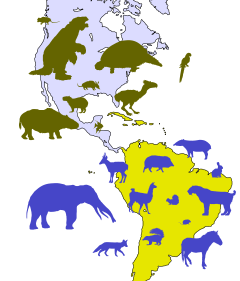
Zoogeography
Zoogeography is the branch of the science of biogeography that is concerned with the geographic distribution of animal species.-External links:*: A course outline and collection of Web resources by Dr. Taylor, UBC...
event in which land and freshwater fauna migrated from North America via Central America to South America and vice versa, as the volcanic Isthmus of Panama
Isthmus of Panama
The Isthmus of Panama, also historically known as the Isthmus of Darien, is the narrow strip of land that lies between the Caribbean Sea and the Pacific Ocean, linking North and South America. It contains the country of Panama and the Panama Canal...
rose up from the sea floor and bridged the formerly separated continent
Continent
A continent is one of several very large landmasses on Earth. They are generally identified by convention rather than any strict criteria, with seven regions commonly regarded as continents—they are : Asia, Africa, North America, South America, Antarctica, Europe, and Australia.Plate tectonics is...
s. The migration peaked dramatically around three million years (Ma) ago (during the Piacenzian
Piacenzian
The Piacenzian is in the international geologic timescale the upper stage or latest age of the Pliocene. It spans the time between 3.6 ± 0.005 Ma and 2.588 ± 0.005 Ma...
, the upper of the Pliocene
Pliocene
The Pliocene Epoch is the period in the geologic timescale that extends from 5.332 million to 2.588 million years before present. It is the second and youngest epoch of the Neogene Period in the Cenozoic Era. The Pliocene follows the Miocene Epoch and is followed by the Pleistocene Epoch...
).
It resulted in the joining of the Neotropic (roughly South America) and Nearctic (roughly North America) ecozones definitively to form the Americas
Americas
The Americas, or America , are lands in the Western hemisphere, also known as the New World. In English, the plural form the Americas is often used to refer to the landmasses of North America and South America with their associated islands and regions, while the singular form America is primarily...
. The interchange is visible from observation of both stratigraphy
Stratigraphy
Stratigraphy, a branch of geology, studies rock layers and layering . It is primarily used in the study of sedimentary and layered volcanic rocks....
and nature (neontology
Neontology
Neontology is the part of biology which – in contrast to paleontology – deals with now living organisms. The term neontologist is usually used only by paleontologists to refer to non-paleontologists...
). Its most dramatic effect is on the zoogeography
Zoogeography
Zoogeography is the branch of the science of biogeography that is concerned with the geographic distribution of animal species.-External links:*: A course outline and collection of Web resources by Dr. Taylor, UBC...
of mammal
Mammal
Mammals are members of a class of air-breathing vertebrate animals characterised by the possession of endothermy, hair, three middle ear bones, and mammary glands functional in mothers with young...
s but it also gave an opportunity for weak-flying or flightless birds, reptile
Reptile
Reptiles are members of a class of air-breathing, ectothermic vertebrates which are characterized by laying shelled eggs , and having skin covered in scales and/or scutes. They are tetrapods, either having four limbs or being descended from four-limbed ancestors...
s, amphibian
Amphibian
Amphibians , are a class of vertebrate animals including animals such as toads, frogs, caecilians, and salamanders. They are characterized as non-amniote ectothermic tetrapods...
s, arthropod
Arthropod
An arthropod is an invertebrate animal having an exoskeleton , a segmented body, and jointed appendages. Arthropods are members of the phylum Arthropoda , and include the insects, arachnids, crustaceans, and others...
s and even freshwater fish
Freshwater fish
Freshwater fish are fish that spend some or all of their lives in freshwater, such as rivers and lakes, with a salinity of less than 0.05%. These environments differ from marine conditions in many ways, the most obvious being the difference in levels of salinity...
to migrate.
The occurrence of the interchange was first discussed in 1876 by the "father of biogeography
Biogeography
Biogeography is the study of the distribution of species , organisms, and ecosystems in space and through geological time. Organisms and biological communities vary in a highly regular fashion along geographic gradients of latitude, elevation, isolation and habitat area...
", Alfred Russel Wallace
Alfred Russel Wallace
Alfred Russel Wallace, OM, FRS was a British naturalist, explorer, geographer, anthropologist and biologist...
.The entirety of volume 1 and volume 2 of Wallace's book The Geographical Distribution of Animals is also available online from Google Books. (Wallace had spent 1848-1852 exploring and collecting specimens in the Amazon Basin
Amazon Basin
The Amazon Basin is the part of South America drained by the Amazon River and its tributaries that drains an area of about , or roughly 40 percent of South America. The basin is located in the countries of Bolivia, Brazil, Colombia, Ecuador, Guyana, Peru, and Venezuela...
.) Others who made significant contributions to understanding the event in the century that followed include Florentino Ameghino
Florentino Ameghino
Florentino Ameghino was an Argentine naturalist, paleontologist, anthropologist and zoologist.Born in Luján, son of Italian immigrants, Ameghino was a self-taught naturalist, and focused his study on the lands of the southern Pampas...
, W. D. Matthew
William Diller Matthew
William Diller Matthew FRS was a vertebrate paleontologist who worked primarily on mammal fossils....
, W. B. Scott
William Berryman Scott
William Berryman Scott was an American vertebrate paleontologist, authority on mammals, and principal author of the White River Oligocene monographs. He was a professor of geology and paleontology at Princeton University....
, Bryan Patterson, George Gaylord Simpson
George Gaylord Simpson
George Gaylord Simpson was an American paleontologist. Simpson was perhaps the most influential paleontologist of the twentieth century, and a major participant in the modern evolutionary synthesis, contributing Tempo and mode in evolution , The meaning of evolution and The major features of...
and S. David Webb.
Analogous interchanges occurred earlier in the Cenozoic
Cenozoic
The Cenozoic era is the current and most recent of the three Phanerozoic geological eras and covers the period from 65.5 mya to the present. The era began in the wake of the Cretaceous–Tertiary extinction event at the end of the Cretaceous that saw the demise of the last non-avian dinosaurs and...
, when the formerly isolated land masses of India
Indian subcontinent
The Indian subcontinent, also Indian Subcontinent, Indo-Pak Subcontinent or South Asian Subcontinent is a region of the Asian continent on the Indian tectonic plate from the Hindu Kush or Hindu Koh, Himalayas and including the Kuen Lun and Karakoram ranges, forming a land mass which extends...
and Africa made contact
Plate tectonics
Plate tectonics is a scientific theory that describes the large scale motions of Earth's lithosphere...
with Eurasia
Eurasia
Eurasia is a continent or supercontinent comprising the traditional continents of Europe and Asia ; covering about 52,990,000 km2 or about 10.6% of the Earth's surface located primarily in the eastern and northern hemispheres...
c. 50 and 30 Ma ago, respectively.
South America's endemic fauna
Mesozoic
The Mesozoic era is an interval of geological time from about 250 million years ago to about 65 million years ago. It is often referred to as the age of reptiles because reptiles, namely dinosaurs, were the dominant terrestrial and marine vertebrates of the time...
breakup of Gondwana
Gondwana
In paleogeography, Gondwana , originally Gondwanaland, was the southernmost of two supercontinents that later became parts of the Pangaea supercontinent. It existed from approximately 510 to 180 million years ago . Gondwana is believed to have sutured between ca. 570 and 510 Mya,...
, South America spent most of the Cenozoic
Cenozoic
The Cenozoic era is the current and most recent of the three Phanerozoic geological eras and covers the period from 65.5 mya to the present. The era began in the wake of the Cretaceous–Tertiary extinction event at the end of the Cretaceous that saw the demise of the last non-avian dinosaurs and...
era as an island continent whose "splendid isolation" allowed its fauna to evolve into many forms found nowhere else on earth, most of which are now extinct
Extinction
In biology and ecology, extinction is the end of an organism or of a group of organisms , normally a species. The moment of extinction is generally considered to be the death of the last individual of the species, although the capacity to breed and recover may have been lost before this point...
. Its endemic
Endemic (ecology)
Endemism is the ecological state of being unique to a defined geographic location, such as an island, nation or other defined zone, or habitat type; organisms that are indigenous to a place are not endemic to it if they are also found elsewhere. For example, all species of lemur are endemic to the...
mammals initially consisted of metatheria
Metatheria
Metatheria is a grouping within the animal class Mammalia. First proposed by Thomas Henry Huxley in 1880, it is nearly synonymous with the earlier taxon Marsupialia though it is slightly wider since it also contains the nearest fossil relatives of marsupial mammals.The earliest known...
ns (marsupial
Marsupial
Marsupials are an infraclass of mammals, characterized by giving birth to relatively undeveloped young. Close to 70% of the 334 extant species occur in Australia, New Guinea, and nearby islands, with the remaining 100 found in the Americas, primarily in South America, but with thirteen in Central...
s and sparassodonts
Sparassodonta
Sparassodonta is an extinct order of carnivorous metatherian mammals native to South America. They were once considered to be true marsupials, but are now thought to be a sister taxon to them. A number of these mammalian predators closely resemble placental predators that evolved separately on...
), xenarthra
Xenarthra
The superorder Xenarthra is a group of placental mammals , existent today only in the Americas and represented by anteaters, tree sloths, and armadillos. The origins of the order can be traced back as far as the Paleogene in South America...
ns, and a diverse group of native ungulates
Meridiungulata
Meridiungulata is an extinct clade with the rank of cohort or super-order, containing the South-American ungulates: Pyrotheria , Astrapotheria, Notoungulata and Litopterna...
: notoungulate
Notoungulata
Notoungulata is an extinct order of hoofed, sometimes heavy bodied mammalian ungulates which inhabited South America during the Paleocene to Pleistocene, living from approximately 57 Ma to 11,000 years ago.-Taxonomy:...
s (the "southern ungulate
Ungulate
Ungulates are several groups of mammals, most of which use the tips of their toes, usually hoofed, to sustain their whole body weight while moving. They make up several orders of mammals, of which six to eight survive...
s"), litoptern
Litopterna
Litopterna is an extinct order of fossil hoofed mammals from the Tertiary period that displays toe reduction. Three-toed, and even a one-toed horselike form developed....
s, astrapotheres
Astrapotheria
Astrapotheria is an extinct order of South American hoofed animals. The history of this order is enigmatic, but it may taxonomically belong to Meridiungulata . In turn, Meridungulata is believed to belong to the extant superorder Laurasiatheria...
(e.g. Trigonostylops
Trigonostylops
Trigonostylops is an extinct genus of South American ungulate, from the late Paleocene to early Eocene of Argentina.A complete skull of the type species, T. wortmani, has been found, and it has been classified as an astrapothere based on its large lower tusks...
, Astrapotherium
Astrapotherium magnum
Astrapotherium magnum is an extinct South American mammal which vaguely resembled a cross between a small elephant, and a very large tapir. It may have fed on marsh plants...
), and pyrotheres
Pyrotheria
Pyrotheria is an order of extinct meridiungulate mammals. These mastodon-like ungulates include the genera Baguatherium, Carolozittelia, Colombitherium, Gryphodon, Propyrotherium, Proticia, and Pyrotherium....
(e.g. Pyrotherium
Pyrotherium
Pyrotherium is an extinct genus of South American ungulate, of the order Pyrotheria, that lived in what is now Argentina, during the Early Oligocene...
). (Monotreme
Monotreme
Monotremes are mammals that lay eggs instead of giving birth to live young like marsupials and placental mammals...
s, gondwanatheres and possibly multituberculates were also present in the Paleocene
Paleocene
The Paleocene or Palaeocene, the "early recent", is a geologic epoch that lasted from about . It is the first epoch of the Palaeogene Period in the modern Cenozoic Era...
, but didn't survive very long.)
Marsupials appear to have traveled (via Gondwana
Gondwana
In paleogeography, Gondwana , originally Gondwanaland, was the southernmost of two supercontinents that later became parts of the Pangaea supercontinent. It existed from approximately 510 to 180 million years ago . Gondwana is believed to have sutured between ca. 570 and 510 Mya,...
n land connections) from South America through Antarctica to Australia
Australia (continent)
Australia is the world's smallest continent, comprising the mainland of Australia and proximate islands including Tasmania, New Guinea, the Aru Islands and Raja Ampat Islands...
in the late Cretaceous
Cretaceous
The Cretaceous , derived from the Latin "creta" , usually abbreviated K for its German translation Kreide , is a geologic period and system from circa to million years ago. In the geologic timescale, the Cretaceous follows the Jurassic period and is followed by the Paleogene period of the...
or early Tertiary
Tertiary
The Tertiary is a deprecated term for a geologic period 65 million to 2.6 million years ago. The Tertiary covered the time span between the superseded Secondary period and the Quaternary...
. One living South American marsupial, the Monito del Monte
Monito del Monte
The Monito del Monte The Monito del Monte The Monito del Monte (Spanish for "little mountain monkey", Dromiciops gliroides, is a diminutive marsupial native only to southwestern South America (Chile and Argentina). It is the only extant species in the ancient order Microbiotheria, and the sole New...
, has been shown to be more closely related to Australian marsupials
Australidelphia
Australidelphia is the superorder that contains roughly three-quarters of all marsupials, including all those native to Australasia and a single species from South America...
than to other South American marsupials
Ameridelphia
Ameridelphia is traditionally a superorder that includes all marsupials living in the Americas except for the Monito del Monte...
; however, it is the most basal
Basal (phylogenetics)
In phylogenetics, a basal clade is the earliest clade to branch in a larger clade; it appears at the base of a cladogram.A basal group forms an outgroup to the rest of the clade, such as in the following example:...
australidelphian, meaning that this superorder arose in South America and then colonized
Biological dispersal
Biological dispersal refers to species movement away from an existing population or away from the parent organism. Through simply moving from one habitat patch to another, the dispersal of an individual has consequences not only for individual fitness, but also for population dynamics, population...
Australia after the Monito del Monte split off. A 61-Ma-old platypus-like monotreme fossil from Patagonia
Patagonia
Patagonia is a region located in Argentina and Chile, integrating the southernmost section of the Andes mountains to the southwest towards the Pacific ocean and from the east of the cordillera to the valleys it follows south through Colorado River towards Carmen de Patagones in the Atlantic Ocean...
may represent an Australian immigrant. It appears that ratite
Ratite
A ratite is any of a diverse group of large, flightless birds of Gondwanan origin, most of them now extinct. Unlike other flightless birds, the ratites have no keel on their sternum—hence the name from the Latin ratis...
s (relatives of South American tinamou
Tinamou
The tinamous are a family comprising 47 species of birds found in Central and South America. One of the most ancient living groups of bird, they are related to the ratites. Generally ground dwelling, they are found in a range of habitats....
s) migrated by this route around the same time, more likely in the direction from South America towards Australia/New Zealand
Zealandia (continent)
Zealandia , also known as Tasmantis or the New Zealand continent, is a nearly submerged continental fragment that sank after breaking away from Australia 60–85 million years ago, having separated from Antarctica between 85 and 130 million years ago...
. Other taxa that may have dispersed by the same route (if not by flying or floating across the ocean
Rafting event
Oceanic dispersal is a type of biological dispersal that occurs when organisms transfer from one land mass to another by way of a sea crossing on large clumps of floating vegetation. Such matted clumps of vegetation are often seen floating down major rivers in the tropics and washing out to sea,...
) are parrot
Parrot
Parrots, also known as psittacines , are birds of the roughly 372 species in 86 genera that make up the order Psittaciformes, found in most tropical and subtropical regions. The order is subdivided into three families: the Psittacidae , the Cacatuidae and the Strigopidae...
s, chelid
Chelidae
The Chelidae are one of the three living families of the turtle suborder Pleurodira and are commonly called the Austro-South American Side Neck turtles. The Family is distributed in Australia, New Guinea, parts of Indonesia and throughout most of South America. It is a large family of turtles with...
turtles and (extinct) meiolaniid
Meiolaniidae
Meiolaniidae is an extinct family of large, possibly herbivorous turtles with heavily armored heads and tails. They are best known from the last surviving genus, Meiolania, which lived in the rainforests of Australia from the Oligocene until the Pleistocene, and relict populations that lived on...
turtles.
Shrew opossum
The order Paucituberculata contains the six surviving species of shrew opossum: small, shrew-like marsupials which are confined to the Andes mountains of South America. It is thought that the order diverged from the ancestral marsupial line very early. As recently as 20 million years ago, there...
groups
Microbiotheria
The Monito del Monte is the only extant member of its family and the only surviving member of an ancient order, the Microbiotheria. The oldest microbiothere currently recognised is Khasia cordillerensis, based on fossil teeth from Early Palaeocene deposits at Tiupampa, Bolivia...
; larger predatory relatives of these also existed, like the borhyaenids and the sabertooth
Saber-toothed cat
Saber-toothed cat or Sabre-toothed cat refers to the extinct subfamilies of Machairodontinae , Barbourofelidae , and Nimravidae as well as two families related to marsupials that were found worldwide from the Eocene Epoch to the end of the Pleistocene Epoch ,...
Thylacosmilus
Thylacosmilus
Thylacosmilus was a genus of sabre-toothed metatherian predators that first appeared during the Miocene. Remains of the animal have been found in parts of South America, primarily Argentina...
(sparassodont
Sparassodonta
Sparassodonta is an extinct order of carnivorous metatherian mammals native to South America. They were once considered to be true marsupials, but are now thought to be a sister taxon to them. A number of these mammalian predators closely resemble placental predators that evolved separately on...
metatheria
Metatheria
Metatheria is a grouping within the animal class Mammalia. First proposed by Thomas Henry Huxley in 1880, it is nearly synonymous with the earlier taxon Marsupialia though it is slightly wider since it also contains the nearest fossil relatives of marsupial mammals.The earliest known...
ns which are no longer considered to be marsupials).
Metatherians were the only South American mammals to specialize as carnivore
Carnivore
A carnivore meaning 'meat eater' is an organism that derives its energy and nutrient requirements from a diet consisting mainly or exclusively of animal tissue, whether through predation or scavenging...
s; their relative inefficiency created openings for nonmammalian predators to play more prominent roles than usual (similar to the situation in Australia). Sparassodonts shared the ecological niche
Ecological niche
In ecology, a niche is a term describing the relational position of a species or population in its ecosystem to each other; e.g. a dolphin could potentially be in another ecological niche from one that travels in a different pod if the members of these pods utilize significantly different food...
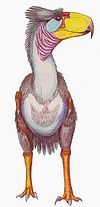
s for large predators with fearsome flightless "terror birds" (phorusrhacids
Phorusrhacidae
Phorusrhacids , colloquially known as "terror birds" as the larger species were apex predators during the Miocene, were a clade of large carnivorous flightless birds that were the dominant predators in South America during the Cenozoic, 62–2 million years ago. They were roughly 1–3 meters tall...
), whose closest extant relatives are the seriema
Seriema
The seriemas are the sole extant members of the small and ancient family Cariamidae, which is also the sole surviving family of the Cariamae. Once believed to be related to cranes, they have been placed by one recent study near the falcons, parrots and passerines, as well as the extinct terror birds...
s. Terrestrial ziphodont
Quinkana
Quinkana is an extinct genus of mekosuchine crocodile that lived in Australia from ~24 million years ago to ~40,000 years ago. By the Pleistocene Quinkana had become one of the top terrestrial predators of Australia, possessing long legs and ziphodont teeth .Ziphodont teeth tend to arise in...
Ziphodont (lateromedially compressed, recurved and serrated) teeth tend to arise in terrestrial crocodilians because, unlike their aquatic cousins, they are unable to dispatch their prey by simply holding them underwater and drowning them; they thus need cutting teeth with which to slice open their victims. sebecid
Sebecidae
Sebecidae is an extinct family of prehistoric crocodylomorphs. They lived mostly in Argentina.This group included many medium and large - sized genera, from Sebecus to a giant indeterminate unnamed species from the Miocene.-Phylogeny:...
crocodilians
Crocodylomorpha
The Crocodylomorpha are an important group of archosaurs that include the crocodilians and their extinct relatives.During Mesozoic and early Tertiary times the Crocodylomorpha were far more diverse than they are now. Triassic forms were small, lightly built, active terrestrial animals. These were...
were also present at least through the middle Miocene
Miocene
The Miocene is a geological epoch of the Neogene Period and extends from about . The Miocene was named by Sir Charles Lyell. Its name comes from the Greek words and and means "less recent" because it has 18% fewer modern sea invertebrates than the Pliocene. The Miocene follows the Oligocene...
. Some of South America's aquatic crocodilians, such as Gryposuchus
Gryposuchus
Gryposuchus is an extinct genus of gavialoid crocodilian. It is the type genus of the subfamily Gryposuchinae. Fossils have been found from Argentina, Colombia, Venezuela, Brazil and the Peruvian Amazon. The genus existed during the early and middle Miocene epoch. One recently described species, G...
, Mourasuchus
Mourasuchus
Mourasuchus is an extinct genus of giant crocodilian from the Miocene of South America. It was similar in length and weight to Rhamphosuchus...
and Purussaurus
Purussaurus
Purussaurus is an extinct genus of giant caiman that lived in South America during the Miocene epoch, 8 million years ago. It is known from skull material found in the Brazilian, Colombian and Peruvian Amazonia, and northern Venezuela. The estimated skull length for one large individual of the type...
, reached monstrous sizes, with lengths up to 12 m (comparable to the largest Mesozoic crocodyliforms
Crocodyliformes
Crocodyliformes is a clade of crurotarsan archosaurs, the group often traditionally referred to as "crocodilians."In 1988, Michael J. Benton and James M. Clark argued that all traditional names for well-known groups of animals should be restricted to their crown clades, that is, used only for...
). Through the skies over late Miocene South America (6 Ma ago) soared the largest flying bird known, the teratorn
Teratornithidae
Teratorns were very large birds of prey that lived in North and South America from Miocene to Pleistocene. They include some of the largest known flying birds. So far, at least four species have been identified:*Teratornis merriami . This is by far the best-known species...
Argentavis, with a wing span of 6 m or more, which may have subsisted in part on the leftovers of Thylacosmilus kills.
Xenarthra
Xenarthra
The superorder Xenarthra is a group of placental mammals , existent today only in the Americas and represented by anteaters, tree sloths, and armadillos. The origins of the order can be traced back as far as the Paleogene in South America...
ns are a curious group of mammals that developed morphological adaptations for specialized diets very early in their history. In addition to those extant today (armadillo
Armadillo
Armadillos are New World placental mammals, known for having a leathery armor shell. Dasypodidae is the only surviving family in the order Cingulata, part of the superorder Xenarthra along with the anteaters and sloths. The word armadillo is Spanish for "little armored one"...
s, anteater
Anteater
Anteaters, also known as antbear, are the four mammal species of the suborder Vermilingua commonly known for eating ants and termites. Together with the sloths, they compose the order Pilosa...
s and tree sloth
Sloth
Sloths are the six species of medium-sized mammals belonging to the families Megalonychidae and Bradypodidae , part of the order Pilosa and therefore related to armadillos and anteaters, which sport a similar set of specialized claws.They are arboreal residents of the jungles of Central and South...
s), a great diversity of larger types were present, including pampatheres
Pampatheriidae
Pampatheridae is an ancient family, now extinct, of large armadillo-like plantigrade armored xenarthrans. They are related to Glyptodontidae, an extinct family of much larger and more heavily armored xenarthrans, as well as to smaller extant armadillos...
, the ankylosaur
Ankylosauridae
An ankylosaurid is a member of the Ankylosauridae family of armored dinosaurs that evolved 125 million years ago and became extinct 65 million years ago during the Cretaceous-Tertiary extinction event...
-like glyptodontids
Glyptodontidae
Glyptodonts were large, more heavily armored relatives of extinct pampatheres and modern armadillos.They first evolved during the Miocene in South America, which remained their center of species diversity...
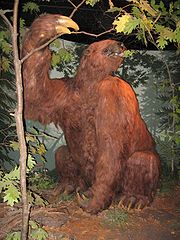
, various ground sloth
Ground sloth
Ground sloths are a diverse group of extinct sloths, in the mammalian superorder Xenarthra. Their most recent survivors lived in the Antilles, where it has been proposed they may have survived until 1550 CE; however, the youngest AMS radiocarbon date reported is 4190 BP, calibrated to c. 4700 BP...
s, some of which reached the size of elephants (e.g. Megatherium
Megatherium
Megatherium was a genus of elephant-sized ground sloths endemic to Central America and South America that lived from the Pliocene through Pleistocene existing approximately...
), and even semiaquatic marine sloths
Thalassocnus
Thalassocnus is an extinct genus of semi-aquatic or aquatic marine sloth from the Miocene and Pliocene of South America. Fossils found to date have been from the coast of Peru. They were apparently grazers of sea grass and seaweed. Over time, they apparently shifted from a preference for feeding...
.
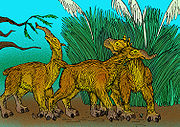
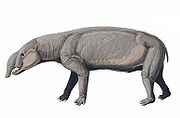
The notoungulates and litopterns had many strange forms, like Macrauchenia
Macrauchenia
Macrauchenia was a long-necked and long-limbed, three-toed South American ungulate mammal, typifying the order Litopterna. The oldest fossils date back to around 7 million years ago, and M...
, a camel-like litoptern with a small proboscis
Proboscis
A proboscis is an elongated appendage from the head of an animal, either a vertebrate or an invertebrate. In simpler terms, a proboscis is the straw-like mouth found in several varieties of species.-Etymology:...
. They also produced a number of familiar-looking body types that represent examples of parallel
Parallel evolution
Parallel evolution is the development of a similar trait in related, but distinct, species descending from the same ancestor, but from different clades.-Parallel vs...
or convergent evolution
Convergent evolution
Convergent evolution describes the acquisition of the same biological trait in unrelated lineages.The wing is a classic example of convergent evolution in action. Although their last common ancestor did not have wings, both birds and bats do, and are capable of powered flight. The wings are...
: one-toed Thoatherium
Thoatherium
Thoatherium is an extinct genus of litoptern mammal.With a length of , the gazelle-like Thoatherium was the smallest representative of the order Litopterna. Judging from its long legs, it was a fast runner. Thoatherium had remarkably reduced toes; only one horse-like hoof remained...
had legs like those of a horse, Pachyrukhos
Pachyrukhos
Pachyrukhos is an extinct genus of mammal from the Oligocene and Miocene of South America.It was about 30 cm long and closely resembled a rabbit, possessing a short tail and long hind feet. Pachyrukhos was probably also able to hop, and it had a rabbit-like skull with teeth adapted for eating nuts...
resembled a rabbit, Homalodotherium
Homalodotherium
Homalodotherium is an extinct genus of the order Notoungulata, an extinct group of hoofed mammals native to South America.Homalodotherium was about in body length, and had long forelimbs with claws instead of hooves...
was a semi-bipedal clawed browser like a chalicothere
Chalicothere
Chalicotheres were a group of herbivorous, odd-toed ungulate mammals spread throughout North America, Europe, Asia, and Africa during the Early Eocene to Early Pleistocene subepochs living from 55.8 mya—781,000 years ago, existing for approximately .They evolved around 40 million years ago from...
, and horned Trigodon
Trigodon
Trigodon gaudryi is an extinct species of the family Toxodontidae, a large bodied notoungulate which inhabited South America during the Miocene living from 11.61—7.25 Ma and existed for approximately ....
looked like a rhino
Rhinoceros
Rhinoceros , also known as rhino, is a group of five extant species of odd-toed ungulates in the family Rhinocerotidae. Two of these species are native to Africa and three to southern Asia....
. Both groups started evolving in the Lower Paleocene, possibly from condylarth
Condylarth
Condylarthra is an order of extinct placental mammals known primarily from the Paleocene and Eocene epochs. Condylarths are among the most characteristic Paleocene mammals and they illustrate the evolutionary level of the Paleocene mammal fauna....
stock, diversified, dwindled before the great interchange, and went extinct
Extinction
In biology and ecology, extinction is the end of an organism or of a group of organisms , normally a species. The moment of extinction is generally considered to be the death of the last individual of the species, although the capacity to breed and recover may have been lost before this point...
at the end of the Pleistocene
Pleistocene
The Pleistocene is the epoch from 2,588,000 to 11,700 years BP that spans the world's recent period of repeated glaciations. The name pleistocene is derived from the Greek and ....
. The pyrotheres and astrapotheres were also strange but were less diverse and disappeared earlier, well before the interchange.
The North American fauna was a pretty typical boreoeutheria
Boreoeutheria
Boreoeutheria is a clade of placental mammals that is composed of the sister taxa Laurasiatheria and Euarchontoglires...
n one (supplemented with Afrotheria
Afrotheria
Afrotheria is a clade of mammals, the living members of which belong to groups from Africa or of African origin: golden moles, sengis , tenrecs, aardvarks, hyraxes, elephants and sea cows. The common ancestry of these animals was not recognized until the late 1990s...
n proboscids
Proboscidea
Proboscidea is a taxonomic order containing one living family, Elephantidae, and several extinct families. This order was first described by J. Illiger in 1881 and encompasses the trunked mammals...
).
Island-hopping ‘waif dispersers’

Eocene
The Eocene Epoch, lasting from about 56 to 34 million years ago , is a major division of the geologic timescale and the second epoch of the Paleogene Period in the Cenozoic Era. The Eocene spans the time from the end of the Palaeocene Epoch to the beginning of the Oligocene Epoch. The start of the...
), when caviomorph rodent
Caviomorpha
Caviomorpha is the rodent infraorder or parvorder that unites all South American hystricognaths. It is supported by both fossil and molecular evidence.-Origin:...
s arrived in South America. Their subsequent vigorous diversification
Adaptive radiation
In evolutionary biology, adaptive radiation is the evolution of ecological and phenotypic diversity within a rapidly multiplying lineage. Starting with a recent single ancestor, this process results in the speciation and phenotypic adaptation of an array of species exhibiting different...
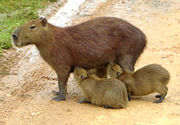
displaced some of South America's small marsupials and gave rise to – among others – capybara
Capybara
The capybara , also known as capivara in Portuguese, and capibara, chigüire in Venezuela, Colombia, and Ecuador ronsoco in Peru, chigüiro, and carpincho in Spanish, is the largest living rodent in the world. Its closest relatives are agouti, chinchillas, coyphillas, and guinea pigs...
s, chinchilla
Chinchilla
Chinchillas are crepuscular rodents, slightly larger and more robust than ground squirrels, and are native to the Andes mountains in South America. Along with their relatives, viscachas, they make up the family Chinchillidae....
s, viscacha
Viscacha
Viscachas or vizcachas are rodents of two genera in the family Chinchillidae. They are closely related to chinchillas, and look similar to rabbits...
s, and New World porcupine
New World porcupine
The New World porcupines, or Erethizontidae, are large arboreal rodents, distinguished by the spiny covering from which they take their name. They inhabit forests and wooded regions across North America, and into northern South America...
s. (The independent development of spines
Spine (zoology)
A spine is a hard, thorny or needle-like structure which occurs on various animals. Animals such as porcupines and sea urchins grow spines as a self-defense mechanism. Spines are often formed of keratin...
by New and Old World porcupine
Old World porcupine
The Old World porcupines, or Hystricidae, are large terrestrial rodents, distinguished by the spiny covering from which they take their name. They range over the south of Europe, most of Africa, India, and the Maritime Southeast Asia as far east as Borneo...
s is another example of parallel evolution.) This invasion most likely came from Africa. The crossing from West Africa to the northeast corner of Brazil was much shorter then, due to continental drift
Continental drift
Continental drift is the movement of the Earth's continents relative to each other. The hypothesis that continents 'drift' was first put forward by Abraham Ortelius in 1596 and was fully developed by Alfred Wegener in 1912...
, and may have been aided by island-hopping (e.g. via St. Paul's Rocks, if they were an inhabitable island at the time) and westward oceanic currents. Crossings of the ocean were accomplished when at least one fertilised female (more commonly a group of animals) accidentally floated over
Rafting event
Oceanic dispersal is a type of biological dispersal that occurs when organisms transfer from one land mass to another by way of a sea crossing on large clumps of floating vegetation. Such matted clumps of vegetation are often seen floating down major rivers in the tropics and washing out to sea,...
on driftwood
Driftwood
Driftwood is wood that has been washed onto a shore or beach of a sea or river by the action of winds, tides, waves or man. It is a form of marine debris or tidewrack....
or mangrove
Mangrove
Mangroves are various kinds of trees up to medium height and shrubs that grow in saline coastal sediment habitats in the tropics and subtropics – mainly between latitudes N and S...
rafts. (Island-hopping
Hutia
Hutias are moderately large cavy-like rodents of the family Capromyidae that inhabit the Caribbean Islands. They range in size from , and can weigh up to . Twenty species of hutia have been identified, and half may be extinct. They resemble the nutria in some respects...
caviomorphs
Giant hutia
The giant hutias are an extinct group of large rodents known from fossil and subfossil material in the West Indies. One species, Amblyrhiza inundata, is estimated to have weighed between , big specimens being as large as an American Black Bear...
would subsequently colonize the West Indies
Caribbean
The Caribbean is a crescent-shaped group of islands more than 2,000 miles long separating the Gulf of Mexico and the Caribbean Sea, to the west and south, from the Atlantic Ocean, to the east and north...
as far as the Bahamas). Over time, some caviomorph rodents evolved into larger forms that competed with some of the native South American ungulates, which may have contributed to the gradual loss of diversity suffered by the latter after the early Oligocene.
Later (probably over 30 Ma ago) primate
Primate
A primate is a mammal of the order Primates , which contains prosimians and simians. Primates arose from ancestors that lived in the trees of tropical forests; many primate characteristics represent adaptations to life in this challenging three-dimensional environment...
s followed, again from Africa in a fashion similar to that of the rodents. Primates capable of migrating had to be small. However, although they would have had little effective competition, all extant New World monkey
New World monkey
New World monkeys are the five families of primates that are found in Central and South America: Callitrichidae, Cebidae, Aotidae, Pitheciidae, and Atelidae. The five families are ranked together as the Platyrrhini parvorder and the Ceboidea superfamily, which are essentially synonymous since...
s appear to derive from a radiation that occurred long afterwards, in the Early Miocene
Early Miocene
The Early Miocene is a sub-epoch of the Miocene Epoch made up of two stages: the Aquitanian and Burdigalian stages....
about 18 Ma ago. Subsequent to this, monkeys apparently most closely related to titi
Titi
The titis, or titi monkeys, are the New World monkeys of the genus Callicebus. They are the only extant members of the Callicebinae subfamily, which also contains the extinct genera Xenothrix, Antillothrix, Paralouatta, Carlocebus, Homunculus, Lagonimico and possibly also Tremacebus.Titis live in...
s island-hopped to Cuba
Cuban Monkey
Paralouatta is a platyrrhine genus that currently contains two extinct species of small primates that lived on the island of Cuba.The Cuban fossil primate, Paralouatta varonai was described from a nearly complete cranium from the late Quaternary in 1991. This cranium and a number of isolated teeth...
, Hispaniola
Hispaniola Monkey
The Hispaniola Monkey is an extinct primate found on the island of Hispaniola. The species is thought to have gone extinct around the 16th century...
and Jamaica
Jamaican Monkey
The Jamaican Monkey is an extinct species of monkey first uncovered at Long Mile Cave in Jamaica by Harold Anthony in 1919...
. South American caviomorph rodents and monkeys are both believed to be clade
Clade
A clade is a group consisting of a species and all its descendants. In the terms of biological systematics, a clade is a single "branch" on the "tree of life". The idea that such a "natural group" of organisms should be grouped together and given a taxonomic name is central to biological...
s (i.e., monophyletic
Monophyly
In common cladistic usage, a monophyletic group is a taxon which forms a clade, meaning that it contains all the descendants of the possibly hypothetical closest common ancestor of the members of the group. The term is synonymous with the uncommon term holophyly...
).
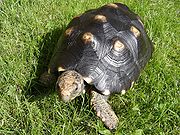
Chelonoidis
Chelonoidis is a genus of turtles in the tortoise family. They are found in South America and the Galápagos Islands. They were formerly assigned to Geochelone, but a recent comparative genetic analysis has indicated that they are actually most closely related to African hingeback tortoises. Their...
(formerly part of Geochelone
Geochelone
Geochelone is a genus of tortoises.Geochelone tortoises, which are also known as typical tortoises or terrestrial turtles, can be found in Africa and Asia. They primarily eat plants.The genus consists of three extant species:...
) is actually most closely related to African hingeback tortoises
Kinixys
Kinixys is a genus of turtles in the family Testudinidae. They are native to Africa, and commonly known as hinged tortoises. Some of these species are herbivores , although some also feed on worms and insects.-Species:* Forest hinge-back tortoise * Home's hinge-back tortoise * Natal...
.North American gopher tortoises
Gopherus
Gopherus is a genus of tortoises commonly referred to as gopher tortoises. The gopher tortoise is grouped with land tortoises that originated 60 million years ago, in North America...
are most closely related to the Asian genus Manouria
Manouria
Manouria is a genus of tortoise in the Testudinidae family.It contains the following species:* Impressed Tortoise * Manouria emys* Manouria sondaari - an extinct giant land tortoise from Luzon Island, Philippines....
. Tortoises are aided in oceanic dispersal by their ability to float with their heads up, and to survive up to six months without food or water. South American tortoises then went on to colonize the West Indies and Galápagos Islands
Galápagos Islands
The Galápagos Islands are an archipelago of volcanic islands distributed around the equator in the Pacific Ocean, west of continental Ecuador, of which they are a part.The Galápagos Islands and its surrounding waters form an Ecuadorian province, a national park, and a...
. Skinks of the related genera Mabuya
Mabuya
Mabuya is a genus of long-tailed skinks nowadays restricted to species from the Americas. The American mabuyas are primarily carnivorous, though many are omnivorous. Formerly, many Old World species were placed here, as Mabuya was a kind of "wastebasket taxon"...
and Trachylepis
Trachylepis
Trachylepis is a skink genus in the subfamily Lygosominae found mainly in Africa. Its members were formerly included in the "wastebin taxon" Mabuya, and for some time in Euprepis. As defined today, Trachylepis contains the clade of Afro-Malagasy mabuyas. The genus also contains a species from the...
apparently floated across the Atlantic from Africa to South America and Fernando de Noronha
Fernando de Noronha
Fernando de Noronha is an archipelago of 21 islands and islets in the Atlantic Ocean, offshore from the Brazilian coast. The main island has an area of and had a population of 3,012 in the year 2010...
, respectively, during the last 9 Ma.
The earliest mammalian arrival from North America was a procyonid
Procyonidae
Procyonidae is a New World family of the order Carnivora. It includes the raccoons, coatis, kinkajous, olingos, ringtails and cacomistles. Procyonids inhabit a wide range of environments, and are generally omnivorous.-Characteristics:...
that island-hopped from Central America before a land bridge
Land bridge
A land bridge, in biogeography, is an isthmus or wider land connection between otherwise separate areas, over which animals and plants are able to cross and colonise new lands...
formed, around 7 Ma ago. This was South America's first eutheria
Eutheria
Eutheria is a group of mammals consisting of placental mammals plus all extinct mammals that are more closely related to living placentals than to living marsupials . They are distinguished from noneutherians by various features of the feet, ankles, jaws and teeth...
n carnivore. South American procyonids then diversified into forms now extinct (e.g. the "dog-coati" Cyonasua
Cyonasua
Cyonasua is an extinct procyonid genus from the late Miocene of South America . Its name in Greek means dog-coati because its features resemble those of a dog and a coati. It's ancestors arrived from Central America by island hopping, as perhaps the earliest southward mammalian migrants of the...
, which evolved into the bear
Bear
Bears are mammals of the family Ursidae. Bears are classified as caniforms, or doglike carnivorans, with the pinnipeds being their closest living relatives. Although there are only eight living species of bear, they are widespread, appearing in a wide variety of habitats throughout the Northern...
-like Chapalmalania
Chapalmalania
Chapalmalania is an extinct procyonid genus from the Pliocene of South America, that lived from 5.3 to 1.8 million years ago.Though related to raccoons and coatis, Chapalmalania was a large creature reaching in body length, with a short tail. It probably resembled the giant panda. Due to its size,...
). However, all extant procyonid genera appear to have originated in North America. It has been suggested that the first South American procyonids may have contributed to the extinction of sebecid crocodilians by eating their eggs, but this view has not been universally viewed as plausible. The procyonids were followed to South America by island-hopping sigmodontine rodents
Sigmodontinae
The subfamily Sigmodontinae is one of the most diverse groups of mammals. It includes New World rats and mice, with at least 376 species. Many authorities include the Neotominae and Tylomyinae as part of a larger definition of Sigmodontinae. When those genera are included, the species count...
, peccaries
Peccary
A peccary is a medium-sized mammal of the family Tayassuidae, or New World Pigs. Peccaries are members of the artiodactyl suborder Suina, as are the pig family and possibly the hippopotamus family...
and hog-nosed
Hog-nosed skunk
The hog-nosed skunks belong to the genus Conepatus and are members of the family Mephitidae . They are native to the Americas. They have white backs and tails and black underparts...
skunk
Skunk
Skunks are mammals best known for their ability to secrete a liquid with a strong, foul odor. General appearance varies from species to species, from black-and-white to brown or cream colored. Skunks belong to the family Mephitidae and to the order Carnivora...
s. The oryzomyine
Oryzomyini
Oryzomyini is a tribe of rodents in the subfamily Sigmodontinae of family Cricetidae. It includes about 120 species in about thirty genera, distributed from the eastern United States to the southernmost parts of South America, including many offshore islands...
tribe of sigmodontine rodents then went on to colonize the Lesser Antilles
Lesser Antilles
The Lesser Antilles are a long, partly volcanic island arc in the Western Hemisphere. Most of its islands form the eastern boundary of the Caribbean Sea with the Atlantic Ocean, with the remainder located in the southern Caribbean just north of South America...
up to Anguilla
Anguilla
Anguilla is a British overseas territory and overseas territory of the European Union in the Caribbean. It is one of the most northerly of the Leeward Islands in the Lesser Antilles, lying east of Puerto Rico and the Virgin Islands and directly north of Saint Martin...
.
Similarly, megalonychid and mylodontid ground sloth
Ground sloth
Ground sloths are a diverse group of extinct sloths, in the mammalian superorder Xenarthra. Their most recent survivors lived in the Antilles, where it has been proposed they may have survived until 1550 CE; however, the youngest AMS radiocarbon date reported is 4190 BP, calibrated to c. 4700 BP...
s island-hopped to North America by 9 Ma ago. Megalonychids
Pilosans of the Caribbean
The mammalian order Pilosa, which includes the sloths and anteaters, includes various species from the Caribbean region. Many species of sloths are known from the Greater Antilles, all of which went extinct over the last millennia, but some sloths and anteaters survive on islands closer to the...
had colonized the Antilles
Antilles
The Antilles islands form the greater part of the West Indies in the Caribbean Sea. The Antilles are divided into two major groups: the "Greater Antilles" to the north and west, including the larger islands of Cuba, Jamaica, Hispaniola , and Puerto Rico; and the smaller "Lesser Antilles" on the...
previously, by the early Miocene
Miocene
The Miocene is a geological epoch of the Neogene Period and extends from about . The Miocene was named by Sir Charles Lyell. Its name comes from the Greek words and and means "less recent" because it has 18% fewer modern sea invertebrates than the Pliocene. The Miocene follows the Oligocene...
. (Megatheriid ground sloths had to wait for the formation of the isthmus, but then sent several lineages north.) Terror birds
Phorusrhacidae
Phorusrhacids , colloquially known as "terror birds" as the larger species were apex predators during the Miocene, were a clade of large carnivorous flightless birds that were the dominant predators in South America during the Cenozoic, 62–2 million years ago. They were roughly 1–3 meters tall...
may have also island-hopped to North America as early as 5 Ma ago.
The Caribbean islands were populated primarily by species from South America. This was due to the prevailing direction of oceanic currents, rather than to a competition between North and South American forms. (Except in the case of Jamaica
Jamaica
Jamaica is an island nation of the Greater Antilles, in length, up to in width and 10,990 square kilometres in area. It is situated in the Caribbean Sea, about south of Cuba, and west of Hispaniola, the island harbouring the nation-states Haiti and the Dominican Republic...
, oryzomyine rodents of North American origin were able to enter the region only after invading South America.)
The Great American Biotic Interchange
Camelid
Camelids are members of the biological family Camelidae, the only living family in the suborder Tylopoda. Dromedaries, Bactrian Camels, llamas, alpacas, vicuñas, and guanacos are in this group....
s, tapir
Tapir
A Tapir is a large browsing mammal, similar in shape to a pig, with a short, prehensile snout. Tapirs inhabit jungle and forest regions of South America, Central America, and Southeast Asia. There are four species of Tapirs: the Brazilian Tapir, the Malayan Tapir, Baird's Tapir and the Mountain...
s, deer
Deer
Deer are the ruminant mammals forming the family Cervidae. Species in the Cervidae family include white-tailed deer, elk, moose, red deer, reindeer, fallow deer, roe deer and chital. Male deer of all species and female reindeer grow and shed new antlers each year...
and horse
Horse
The horse is one of two extant subspecies of Equus ferus, or the wild horse. It is a single-hooved mammal belonging to the taxonomic family Equidae. The horse has evolved over the past 45 to 55 million years from a small multi-toed creature into the large, single-toed animal of today...
s), proboscids
Proboscidea
Proboscidea is a taxonomic order containing one living family, Elephantidae, and several extinct families. This order was first described by J. Illiger in 1881 and encompasses the trunked mammals...
(gomphothere
Gomphothere
Gomphotheriidae is a diverse taxonomic family of extinct elephant-like animals , called gomphotheres. They were widespread in North America during the Miocene and Pliocene epochs, 12-1.6 million years ago. Some lived in parts of Eurasia, Beringia and, following the Great American Interchange,...
s), carnivora
Carnivora
The diverse order Carnivora |Latin]] carō "flesh", + vorāre "to devour") includes over 260 species of placental mammals. Its members are formally referred to as carnivorans, while the word "carnivore" can refer to any meat-eating animal...
ns (including felid
Felidae
Felidae is the biological family of the cats; a member of this family is called a felid. Felids are the strictest carnivores of the thirteen terrestrial families in the order Carnivora, although the three families of marine mammals comprising the superfamily pinnipedia are as carnivorous as the...
s like cougars and saber-toothed cats
Machairodontinae
Machairodontinae is an extinct carnivoran mammal subfamily of Felidae endemic to Asia, Africa, North America, South America, and Europe from the Miocene to Pleistocene living from c. 23 Ma until c...
, canid
Canidae
Canidae is the biological family of carnivorous and omnivorous mammals that includes wolves, foxes, jackals, coyotes, and domestic dogs. A member of this family is called a canid . The Canidae family is divided into two tribes: Canini and Vulpini...
s, mustelids
Mustelidae
Mustelidae , commonly referred to as the weasel family, are a family of carnivorous mammals. Mustelids are diverse and the largest family in the order Carnivora, at least partly because in the past it has been a catch-all category for many early or poorly differentiated taxa...
, procyonids
Procyonidae
Procyonidae is a New World family of the order Carnivora. It includes the raccoons, coatis, kinkajous, olingos, ringtails and cacomistles. Procyonids inhabit a wide range of environments, and are generally omnivorous.-Characteristics:...
and bear
Bear
Bears are mammals of the family Ursidae. Bears are classified as caniforms, or doglike carnivorans, with the pinnipeds being their closest living relatives. Although there are only eight living species of bear, they are widespread, appearing in a wide variety of habitats throughout the Northern...
s) and a number of types of rodent
Rodent
Rodentia is an order of mammals also known as rodents, characterised by two continuously growing incisors in the upper and lower jaws which must be kept short by gnawing....
sOf the 6 families of North American rodents that did not originate in South America, only beaver
Beaver
The beaver is a primarily nocturnal, large, semi-aquatic rodent. Castor includes two extant species, North American Beaver and Eurasian Beaver . Beavers are known for building dams, canals, and lodges . They are the second-largest rodent in the world...
s and mountain beaver
Mountain Beaver
The Mountain Beaver is the most primitive extant rodent. Not to be confused with the North American beaver Castor canadensis, or its relative the Eurasian beaver, Castor fiber, it has several common names including Aplodontia, Boomer, Ground Bear, and Giant Mole...
s failed to migrate to South America. (However, introduced beavers have become serious pests in Tierra del Fuego
Tierra del Fuego
Tierra del Fuego is an archipelago off the southernmost tip of the South American mainland, across the Strait of Magellan. The archipelago consists of a main island Isla Grande de Tierra del Fuego divided between Chile and Argentina with an area of , and a group of smaller islands including Cape...
.) into South America. The larger members of the reverse migration, besides ground sloths and terror birds, were glyptodontids
Glyptodontidae
Glyptodonts were large, more heavily armored relatives of extinct pampatheres and modern armadillos.They first evolved during the Miocene in South America, which remained their center of species diversity...
, pampathere
Pampatheriidae
Pampatheridae is an ancient family, now extinct, of large armadillo-like plantigrade armored xenarthrans. They are related to Glyptodontidae, an extinct family of much larger and more heavily armored xenarthrans, as well as to smaller extant armadillos...
s, capybaras
Neochoerus pinckneyi
Neochoerus pinckneyi was a North American species of capybara. While capybaras originated in South America, formation of the Isthmus of Panama three million years ago allowed some of them to migrate north as part of the Great American Interchange...
and the notoungulate Mixotoxodon
Mixotoxodon
Mixotoxodon is an extinct genus of notoungulate of the family Toxodontidae which inhabited South America during the Pleistocene living from 1.8—0.30 Ma and existed for approximately ....
(the only South American ungulate known to have invaded Central America).
In general, the initial net migration was symmetrical. Later on, however, the Neotropic species proved far less successful than the Nearctic. This misfortune happened both ways. Northwardly migrating animals often were not able to compete for resources as well as the North American species already occupying the same ecological niches; those that succeeded in becoming established were not able to diversify much. Southwardly migrating Nearctic species established themselves in larger numbers and diversified considerably more, and are thought to have caused the extinction
Extinction
In biology and ecology, extinction is the end of an organism or of a group of organisms , normally a species. The moment of extinction is generally considered to be the death of the last individual of the species, although the capacity to breed and recover may have been lost before this point...
of a large proportion of the South American fauna. (There were no extinctions in North America obviously attributable to South American immigrants.) Although terror birds were initially able to invade North America, this success was temporary; all of the large Neotropic avian and metatherian predators ultimately disappeared. South America's native ungulates
Meridiungulata
Meridiungulata is an extinct clade with the rank of cohort or super-order, containing the South-American ungulates: Pyrotheria , Astrapotheria, Notoungulata and Litopterna...
also fared very poorly, with only several of the largest forms, Macrauchenia
Macrauchenia
Macrauchenia was a long-necked and long-limbed, three-toed South American ungulate mammal, typifying the order Litopterna. The oldest fossils date back to around 7 million years ago, and M...
and a few toxodontids
Toxodontidae
Toxodontidae is an extinct family of notoungulate mammals known from the Oligocene through the Pleistocene of South America, with one genus, Mixotoxodon, also known from the Pleistocene of Central America. They somewhat resembled rhinoceroses, and had teeth with high crowns and open roots,...
, withstanding the northern onslaught. (Among the notoungulates, the mesotheriids
Mesotheriidae
Mesotheriidae is an extinct family of notoungulate mammals known from the Eocene through the Pleistocene of South America. Mesotheriids were small to medium-sized herbivorous mammals adapted for digging.-Characteristics:...
and hegetotheriids
Hegetotheriidae
Hegetotheriidae is an extinct family of notoungulate mammals known from the Eocene through the Pleistocene of South America...
did manage to survive into the Pleistocene
Pleistocene
The Pleistocene is the epoch from 2,588,000 to 11,700 years BP that spans the world's recent period of repeated glaciations. The name pleistocene is derived from the Greek and ....
.) Its small marsupials
Ameridelphia
Ameridelphia is traditionally a superorder that includes all marsupials living in the Americas except for the Monito del Monte...
fared better, while the primitive
Primitive (biology)
Primitive in the sense most relevant to phylogenetics means resembling the first living things and in particular resembling them in the simple nature of their anatomy and behaviour...
-looking xenarthra
Xenarthra
The superorder Xenarthra is a group of placental mammals , existent today only in the Americas and represented by anteaters, tree sloths, and armadillos. The origins of the order can be traced back as far as the Paleogene in South America...
ns proved to be surprisingly competitive. The African immigrants, the caviomorph rodents and platyrrhine monkeys, generally held their own during the interchange, although the largest rodents (e.g. the dinomyids
Dinomyidae
Dinomyidae was once a very speciose group of South American hystricognath rodent, but now contains only a single living species, the Pacarana. The Dinomyidae included among its ranks the largest rodents known to date, the bison-sized Josephoartigasia monesi and the smaller Josephoartigasia magna...
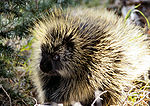
) disappeared. With the exception of the North American porcupine
North American Porcupine
The North American Porcupine , also known as Canadian Porcupine or Common Porcupine, is a large rodent in the New World porcupine family. The Beaver is the only rodent larger than the North American Porcupine found in North America...
and several extinct porcupines and capybaras, however, they did not migrate past Central America.Of the 11 extant families of South American caviomorph rodents, 5 are present in Central America; only 2 of these, Erethizontidae
New World porcupine
The New World porcupines, or Erethizontidae, are large arboreal rodents, distinguished by the spiny covering from which they take their name. They inhabit forests and wooded regions across North America, and into northern South America...
and Caviidae
Caviidae
The cavy family is a family of rodents native to South America, and including the domestic guinea pig, wild cavies, and the capybara, among other animals...
, ever reached North America. (The nutria/coypu
Coypu
The coypu , , also known as the river rat, and nutria, is a large, herbivorous, semiaquatic rodent and the only member of the family Myocastoridae. Originally native to subtropical and temperate South America, it has since been introduced to North America, Europe, Asia, and Africa, primarily by...
has been introduced to a number of North American locales.)
The initial wave of invading Nearctic carnivorans rapidly occupied the South American predatory niches, displacing phorusrhacids and sparassodonts, as well as eliminating Chapalmalania. The paucity of early competition and plentiful prey seems to have allowed short-faced bears to rapidly evolve into the largest known bear or terrestrial mammalian carnivore species; Arctotherium
Arctotherium
Arctotherium is an extinct genus of South American short-faced bears within Ursidae of the late Pliocene through the end of the Pleistocene. Their ancestors migrated from North America to South America during the Great American Interchange, following the formation of the Isthmus of Panama. They...
angustidens is estimated to have weighed around 1600 kg. Later species of Arctotherium exhibited a trend towards smaller size and a more omnivorous diet, probably due to increasing competition from later-arriving or evolving carnivores. In contrast, Smilodon
Smilodon
Smilodon , often called a saber-toothed cat or saber-toothed tiger, is an extinct genus of machairodonts. This saber-toothed cat was endemic to North America and South America, living from near the beginning through the very end of the Pleistocene epoch .-Etymology:The nickname "saber-tooth" refers...
showed a trend toward increasing body size that culminated in the appearance of S. populator, at up to nearly 500 kg the most massive felid known.
Due in large part to the success of the xenarthrans, one area of South American ecospace the Nearctic invaders were unable to dominate was the niches for megaherbivores. Before 12,000 years ago, South America was home to about 25 species of herbivores weighing more than 1000 kg, consisting of Neotropic ground sloths, glyptodontids and toxodontids, as well as gomphotheres and camelids of Nearctic origin. Native South American forms made up about 75% of these species. However, none of these megaherbivores have survived.
The presence of armadillos, opossums and porcupines in North America today is explained by the Great American Interchange. Opossums and porcupines were among most successful northward migrants, reaching as far as Canada and Alaska
Alaska
Alaska is the largest state in the United States by area. It is situated in the northwest extremity of the North American continent, with Canada to the east, the Arctic Ocean to the north, and the Pacific Ocean to the west and south, with Russia further west across the Bering Strait...
, respectively. Most major groups of xenarthrans were present in North America up until the end-Pleistocene
Pleistocene
The Pleistocene is the epoch from 2,588,000 to 11,700 years BP that spans the world's recent period of repeated glaciations. The name pleistocene is derived from the Greek and ....
Quaternary extinction event
Quaternary extinction event
The Quaternary period saw the extinctions of numerous predominantly larger, especially megafaunal, species, many of which occurred during the transition from the Pleistocene to the Holocene epoch. However, the extinction wave did not stop at the end of the Pleistocene, but continued especially on...
(as a result of at least seven successful invasions of temperate North America, and at least six more invasions of Central America only). Among the megafauna
Megafauna
In terrestrial zoology, megafauna are "giant", "very large" or "large" animals. The most common thresholds used are or...
, ground sloths were notably successful emigrants; Megalonyx
Megalonyx
Megalonyx is an extinct genus of giant ground sloths of the family Megalonychidae endemic to North America from the Hemphillian of the Late Miocene through to the Rancholabrean of the Pleistocene, living from ~10.3 Mya—11,000 years ago, existing for approximately .-Taxonomy:The generic name...
spread as far north as the Yukon
Yukon
Yukon is the westernmost and smallest of Canada's three federal territories. It was named after the Yukon River. The word Yukon means "Great River" in Gwich’in....
and Alaska, and might well have eventually reached Eurasia if the extinction event had not intervened.
Generally speaking, however, the dispersal and subsequent explosive adaptive radiation
Adaptive radiation
In evolutionary biology, adaptive radiation is the evolution of ecological and phenotypic diversity within a rapidly multiplying lineage. Starting with a recent single ancestor, this process results in the speciation and phenotypic adaptation of an array of species exhibiting different...
of sigmodontine rodents
Sigmodontinae
The subfamily Sigmodontinae is one of the most diverse groups of mammals. It includes New World rats and mice, with at least 376 species. Many authorities include the Neotominae and Tylomyinae as part of a larger definition of Sigmodontinae. When those genera are included, the species count...
throughout South America (leading to over 80 currently recognized genera) was vastly more successful (both spatially and by number of species) than any northward migration of South American mammals. Other examples of North American mammal groups that diversified conspicuously in South America include canids and cervids, both of which currently have 4 genera in North America, 2 or 3 in Central America, and 6 in South America. Although Canis
Canis
Canis is a genus containing 7 to 10 extant species, including dogs, wolves, coyotes, and jackals, and many extinct species.-Wolves, dogs and dingos:Wolves, dogs and dingos are subspecies of Canis lupus...
currently ranges only as far south as Panama, South America still has more extant canid genera than any other continent.
The effect of formation of the isthmus on the marine biota of the area was the inverse of its effect on terrestrial organisms, a development that has been termed the "Great American Schism". The connections between the east Pacific Ocean and the Caribbean were severed, setting now-separated populations on divergent evolutionary paths. Caribbean species also had to adapt to an environment of lower productivity after the inflow of nutrient-rich water of deep Pacific origin
Upwelling
Upwelling is an oceanographic phenomenon that involves wind-driven motion of dense, cooler, and usually nutrient-rich water towards the ocean surface, replacing the warmer, usually nutrient-depleted surface water. The increased availability in upwelling regions results in high levels of primary...
was blocked.
Reasons for success or failure
The eventual triumph of the Nearctic migrants was ultimately based on geographyGeography
Geography is the science that studies the lands, features, inhabitants, and phenomena of Earth. A literal translation would be "to describe or write about the Earth". The first person to use the word "geography" was Eratosthenes...
, which played into the hands of the northern invaders in two crucial respects. The first was a matter of climate
Climate
Climate encompasses the statistics of temperature, humidity, atmospheric pressure, wind, rainfall, atmospheric particle count and other meteorological elemental measurements in a given region over long periods...
. Obviously, any species that reached Panama
Panama
Panama , officially the Republic of Panama , is the southernmost country of Central America. Situated on the isthmus connecting North and South America, it is bordered by Costa Rica to the northwest, Colombia to the southeast, the Caribbean Sea to the north and the Pacific Ocean to the south. The...
from either direction had to be able to tolerate moist tropical conditions. Those migrating southward would then be able to occupy much of South America without encountering climates that were markedly different. However, northward migrants would have encountered drier and/or cooler conditions by the time they reached the vicinity of the Trans-Mexican Volcanic Belt
Trans-Mexican volcanic belt
The Trans-Mexican Volcanic Belt also known as the Transvolcanic Belt and locally as the Sierra Nevada , is a volcanic belt that extends 900 km from west to east across central-southern Mexico...
. The challenge this climatic asymmetry (see map on right) presented was particularly acute for Neotropic species specialized for tropical rainforest
Tropical rainforest
A tropical rainforest is an ecosystem type that occurs roughly within the latitudes 28 degrees north or south of the equator . This ecosystem experiences high average temperatures and a significant amount of rainfall...
environments, who had little prospect of penetrating beyond Central America (Central America currently has about 40 mammal species of Neotropical origin, compared to 3 for temperate North America).
The second and more important advantage geography gave to the northerners is related to the land area available for their ancestors to evolve in. During the Cenozoic, North America was periodically connected to Eurasia via Beringia, allowing multiple migrations back and forth to unite the faunas of the two continents. Eurasia was connected in turn to Africa
Afro-Eurasia
Afro-Eurasia or less commonly Afrasia or Eurafrasia is the term used to describe the largest landmass on earth. It may be defined as a supercontinent, consisting of Africa and Eurasia...
, which contributed further to the species that made their way to North America. South America, on the other hand, was connected to Antarctica and Australia, two much smaller continents, only in the earliest part of the Cenozoic, and this land connection does not seem to have carried much traffic (apparently no mammals other than marsupials and perhaps a few monotremes ever migrated by this route). Effectively, this means that northern hemisphere species arose over a land area roughly six times larger than was available to South American species. This calculation may not be entirely fair, in that migrations between continents would have been more difficult and less frequent than migrations within South America. Nevertheless, it is clear that North American species were products of a larger and more competitive arena, where evolution
Evolution
Evolution is any change across successive generations in the heritable characteristics of biological populations. Evolutionary processes give rise to diversity at every level of biological organisation, including species, individual organisms and molecules such as DNA and proteins.Life on Earth...
would have proceeded more rapidly. They tended to be more efficient and brain
Brain
The brain is the center of the nervous system in all vertebrate and most invertebrate animals—only a few primitive invertebrates such as sponges, jellyfish, sea squirts and starfishes do not have one. It is located in the head, usually close to primary sensory apparatus such as vision, hearing,...
ier, generally able to outrun and outwit their South American counterparts. These advantages can be clearly seen in the cases of ungulates and their predators, where South American forms were replaced wholesale by the invaders.
Against this backdrop, the ability of South America's xenarthra
Xenarthra
The superorder Xenarthra is a group of placental mammals , existent today only in the Americas and represented by anteaters, tree sloths, and armadillos. The origins of the order can be traced back as far as the Paleogene in South America...
ns to compete effectively against the northerners represents a special case. The explanation for the xenarthrans' success lies in part in their idiosyncratic approach to defending against predation
Predation
In ecology, predation describes a biological interaction where a predator feeds on its prey . Predators may or may not kill their prey prior to feeding on them, but the act of predation always results in the death of its prey and the eventual absorption of the prey's tissue through consumption...
, based on possession of body armor and/or formidable claw
Claw
A claw is a curved, pointed appendage, found at the end of a toe or finger in most mammals, birds, and some reptiles. However, the word "claw" is also often used in reference to an invertebrate. Somewhat similar fine hooked structures are found in arthropods such as beetles and spiders, at the end...
s. The xenarthrans did not need to be fleet-footed or quick-witted to survive. Such a strategy may have been forced on them by their low metabolic rate
Basal metabolic rate
Basal Metabolic Rate , and the closely related resting metabolic rate , is the amount of daily energy expended by humans and other animals at rest. Rest is defined as existing in a neutrally temperate environment while in the post-absorptive state...
(the lowest among the theria
Theria
Theria is a subclass of mammals that give birth to live young without using a shelled egg, including both eutherians and metatherians . The only omitted extant mammal group is the egg-laying monotremes....
ns). Their low metabolic rate may in turn have been advantageous in allowing them to subsist on less abundant and/or less nutritious food sources. Unfortunately, the defensive adaptations of the large xenarthrans would have been useless against humans armed with spears and other projectiles.
Late Pleistocene extinctions
Pleistocene
The Pleistocene is the epoch from 2,588,000 to 11,700 years BP that spans the world's recent period of repeated glaciations. The name pleistocene is derived from the Greek and ....
, about 12,000 years ago, three dramatic developments occurred in the Americas at roughly the same time (geologically speaking). Paleoindians
Indigenous peoples of the Americas
The indigenous peoples of the Americas are the pre-Columbian inhabitants of North and South America, their descendants and other ethnic groups who are identified with those peoples. Indigenous peoples are known in Canada as Aboriginal peoples, and in the United States as Native Americans...
invaded and occupied the New World
New World
The New World is one of the names used for the Western Hemisphere, specifically America and sometimes Oceania . The term originated in the late 15th century, when America had been recently discovered by European explorers, expanding the geographical horizon of the people of the European middle...
, the last glacial period came to an end, and a large fraction of the megafauna
Megafauna
In terrestrial zoology, megafauna are "giant", "very large" or "large" animals. The most common thresholds used are or...
of both North and South America went extinct. This wave of extinctions
Quaternary extinction event
The Quaternary period saw the extinctions of numerous predominantly larger, especially megafaunal, species, many of which occurred during the transition from the Pleistocene to the Holocene epoch. However, the extinction wave did not stop at the end of the Pleistocene, but continued especially on...
swept off the face of the Earth many of the successful participants of the Great American Interchange, as well as other species that had not migrated. All the pampatheres, glyptodontids, ground sloths, equids, proboscids, dire wolves, lions and Smilodon
Smilodon
Smilodon , often called a saber-toothed cat or saber-toothed tiger, is an extinct genus of machairodonts. This saber-toothed cat was endemic to North America and South America, living from near the beginning through the very end of the Pleistocene epoch .-Etymology:The nickname "saber-tooth" refers...
species of both continents disappeared. The last of the South and Central American notoungulates and litopterns died out, as well as North America's giant beavers
Giant Beaver
Castoroides ohioensis was a species of giant beaver, huge members of the family Castoridae , endemic to North America during the Pleistocene epoch .-Morphology:...
, dhole
Dhole
The dhole is a species of canid native to South and Southeast Asia. It is the only extant member of the genus Cuon, which differs from Canis by the reduced number of molars and greater number of teats...
s, native cheetahs, scimitar cats
Homotherium
Homotherium is an extinct genus of machairodontine saber-toothed cats, often termed scimitar cats, endemic to North America, South America, Europe, Asia, and Africa during the Pliocene and Pleistocene epochs , existing for approximately .It first became extinct in Africa some 1.5 million years ago...
, and many of its antilocaprid
Capromeryx minor
Capromeryx minor is a very small, extinct species of pronghorn-like antilocaprid ungulate discovered in the La Brea Tar Pits of California and elsewhere. It has been found at least as far east as the coast of Texas. It stood about 60 centimetres tall at the shoulders and weighed about 10...
, bovid
Shrub-ox
The shrub-ox is an extinct genus and species of Bovidae native to North America. It is a close relative of the musk-ox....
, cervid
Stag-moose
The stag-moose or stag moose was a large, moose-like deer of North America of the Pleistocene epoch. It was slightly larger than the moose, with an elk-like head, long legs, and complex, palmate antlers...
, tapir
Tapir
A Tapir is a large browsing mammal, similar in shape to a pig, with a short, prehensile snout. Tapirs inhabit jungle and forest regions of South America, Central America, and Southeast Asia. There are four species of Tapirs: the Brazilian Tapir, the Malayan Tapir, Baird's Tapir and the Mountain...
id and tayassuid
Platygonus
Platygonus is an extinct genus of herbivorous peccary of the family Tayassuidae, endemic to North America from the Miocene through Pleistocene epochs , existing for approximately ....
ungulates. Some groups disappeared over most or all of their original range but survived in their adopted homes, e.g. South American tapirs, camelids and tremarctine bears (cougars and jaguars may have been temporarily reduced to South American ranges also). Others, such as capybaras, survived in their original range but died out in areas they had migrated to. Notably, this extinction pulse eliminated all Neotropic migrants to North America larger than about 15 kg (the size of a big porcupine
North American Porcupine
The North American Porcupine , also known as Canadian Porcupine or Common Porcupine, is a large rodent in the New World porcupine family. The Beaver is the only rodent larger than the North American Porcupine found in North America...
), and all native South American mammals larger than about 65 kg (the size of a big capybara or giant anteater
Giant Anteater
The Giant Anteater, Myrmecophaga tridactyla, is the largest species of anteater. It is the only species in the genus Myrmecophaga. It is found in Central and South America from Honduras to northern Argentina...
). In contrast, the largest surviving native North American mammal, the wood bison
Wood Bison
The Wood Bison, Bison bison athabascae, also called Mountain Bison, Wood Buffalo or Mountain Buffalo, is a distinct northern subspecies or ecotype of the American Bison...
, can exceed 900 kg, and the largest surviving Nearctic migrant to South America, Baird's tapir
Baird's Tapir
Baird’s Tapir is a species of tapir that is native to Central America and northern South America. It is one of three Latin American species of tapir.-Names:...
, can reach 400 kg.
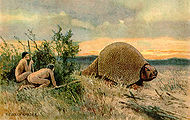
Models of migration to the New World
There have been several models for the human settlement of the Americas proposed by various academic communities. The question of how, when and why humans first entered the Americas is of intense interest to archaeologists and anthropologists, and has been a subject of heated debate for centuries...
has led to proposals that both climate change and human hunting played a role. Although the subject is contentious, a number of considerations suggest that human activities were pivotal. The extinctions did not occur selectively in the climatic zones that would have been most affected by the warming trend, and there is no plausible general climate-based megafauna-killing mechanism that could explain the continent-wide extinctions. The climate change took place worldwide, but had little effect on the megafauna in areas like Africa and southern Asia, where megafaunal species had coevolved with humans
Homo (genus)
Homo is the genus that includes modern humans and species closely related to them. The genus is estimated to be about 2.3 to 2.4 million years old, evolving from australopithecine ancestors with the appearance of Homo habilis....
. Numerous very similar glacial retreats had occurred previously within the ice age
Ice age
An ice age or, more precisely, glacial age, is a generic geological period of long-term reduction in the temperature of the Earth's surface and atmosphere, resulting in the presence or expansion of continental ice sheets, polar ice sheets and alpine glaciers...
of the last several Ma without ever producing comparable waves of extinction in the Americas or anywhere else. Similar megafaunal extinctions have occurred on other recently populated land masses (e.g. Australia
Australian megafauna
Australian megafauna are a number of large animal species in Australia, often defined as species with body mass estimates of greater than 30 kilograms, or equal to or greater than 30% greater body mass than their closest living relatives...
, Japan, Madagascar, New Zealand, and many smaller islands around the world, such as Cyprus, Crete, Tilos and New Caledonia) at different times that correspond closely to the first arrival of humans at each location. These extinction pulses invariably swept rapidly over the full extent of a contiguous land mass, regardless of whether it was an island or a hemisphere-spanning set of connected continents. This was true despite the fact that all the larger land masses involved (as well as many of the smaller ones) contained multiple climatic zones that would have been affected differently by any climate changes ongoing at the time. However, on sizable islands far enough offshore from newly occupied territory to escape immediate human colonization, megafaunal species sometimes survived for many thousands of years after they or related species became extinct on the mainland; examples include giant kangaroos
Protemnodon
Protemnodon is a genus of megafaunal macropods that existed in Australia, Tasmania and Papua New Guinea in the Pleistocene. Based on fossil evidence it is thought that Protemnodon was physically similar to wallabies but far larger; Protemnodon hopei was the smallest in the genus weighing about 45...
in Tasmania, giant
Giant tortoise
Giant tortoises are characteristic reptiles of certain tropical islands. Often reaching enormous size—they can weigh as much as 300 kg and can grow to be 1.3 m long—they live, or lived , in the Seychelles, the Mascarenes and the Galapagos...
Chelonoidis
Chelonoidis
Chelonoidis is a genus of turtles in the tortoise family. They are found in South America and the Galápagos Islands. They were formerly assigned to Geochelone, but a recent comparative genetic analysis has indicated that they are actually most closely related to African hingeback tortoises. Their...
tortoises of the Galápagos Islands
Galápagos Islands
The Galápagos Islands are an archipelago of volcanic islands distributed around the equator in the Pacific Ocean, west of continental Ecuador, of which they are a part.The Galápagos Islands and its surrounding waters form an Ecuadorian province, a national park, and a...
(formerly also of South America), giant Dipsochelys
Dipsochelys
Dipsochelys is a genus of giant tortoise restricted to Madagascar and the Seychelles islands, containing six species:* †Dipsochelys abrupta Grandidier 1868 - Madagascar,...
tortoises of the Seychelles
Seychelles
Seychelles , officially the Republic of Seychelles , is an island country spanning an archipelago of 115 islands in the Indian Ocean, some east of mainland Africa, northeast of the island of Madagascar....
(formerly also of Madagascar
Madagascar
The Republic of Madagascar is an island country located in the Indian Ocean off the southeastern coast of Africa...
), giant meiolaniid turtles
Meiolania
Meiolania is an extinct genus of cryptodire turtle from the Oligocene to Holocene, with the last relict populations at New Caledonia which survived until 2,000 years ago....
on Lord Howe Island
Lord Howe Island
Lord Howe Island is an irregularly crescent-shaped volcanic remnant in the Tasman Sea between Australia and New Zealand, directly east of mainland Port Macquarie, and about from Norfolk Island. The island is about 11 km long and between 2.8 km and 0.6 km wide with an area of...
, New Caledonia
Biodiversity of New Caledonia
The Biodiversity of New Caledonia is considered to be one of the most important in the world. New Caledonia, a large south Pacific island group about 1,200 km east of Australia, supports high levels of endemism, with many unique plants, insects, reptiles and birds...
and Vanuatu
Vanuatu
Vanuatu , officially the Republic of Vanuatu , is an island nation located in the South Pacific Ocean. The archipelago, which is of volcanic origin, is some east of northern Australia, northeast of New Caledonia, west of Fiji, and southeast of the Solomon Islands, near New Guinea.Vanuatu was...
,The giant tortoises of Asia died out much earlier in the Quaternary
Quaternary
The Quaternary Period is the most recent of the three periods of the Cenozoic Era in the geologic time scale of the ICS. It follows the Neogene Period, spanning 2.588 ± 0.005 million years ago to the present...
than those of South America, Madagascar and Australia. ground sloths
Megalocnus
The ground sloths of the extinct genus Megalocnus were among the largest of the Caribbean ground sloths, with individuals estimated to have weighed up to when alive. Two species are known, M. rodens of Cuba, and M. zile of Hispaniola. Subfossils of M...
on the Antilles
Antilles
The Antilles islands form the greater part of the West Indies in the Caribbean Sea. The Antilles are divided into two major groups: the "Greater Antilles" to the north and west, including the larger islands of Cuba, Jamaica, Hispaniola , and Puerto Rico; and the smaller "Lesser Antilles" on the...
, Steller's sea cows
Steller's Sea Cow
Steller's sea cow was a large herbivorous marine mammal. In historical times, it was the largest member of the order Sirenia, which includes its closest living relative, the dugong , and the manatees...
off the Commander Islands and woolly mammoth
Woolly mammoth
The woolly mammoth , also called the tundra mammoth, is a species of mammoth. This animal is known from bones and frozen carcasses from northern North America and northern Eurasia with the best preserved carcasses in Siberia...
s on Wrangel Island
Wrangel Island
Wrangel Island is an island in the Arctic Ocean, between the Chukchi Sea and East Siberian Sea. Wrangel Island lies astride the 180° meridian. The International Date Line is displaced eastwards at this latitude to avoid the island as well as the Chukchi Peninsula on the Russian mainland...
and Saint Paul Island. The glacial retreat may have played a primarily indirect role in the extinctions in the Americas
Americas
The Americas, or America , are lands in the Western hemisphere, also known as the New World. In English, the plural form the Americas is often used to refer to the landmasses of North America and South America with their associated islands and regions, while the singular form America is primarily...
by simply facilitating the movement of humans southeastward from Beringia down to North America. The reason that a number of groups went extinct in North America but lived on in South America (while there are no examples of the opposite pattern) appears to be that the dense rainforest of the Amazon basin
Amazon Basin
The Amazon Basin is the part of South America drained by the Amazon River and its tributaries that drains an area of about , or roughly 40 percent of South America. The basin is located in the countries of Bolivia, Brazil, Colombia, Ecuador, Guyana, Peru, and Venezuela...
and the high peaks of the Andes
Andes
The Andes is the world's longest continental mountain range. It is a continual range of highlands along the western coast of South America. This range is about long, about to wide , and of an average height of about .Along its length, the Andes is split into several ranges, which are separated...
provided environments that afforded a degree of protection from human predation.A number of recently extinct North American (and in some cases also South American) taxa such as tapirs, equids, camelids, saiga antelope
Saiga Antelope
The saiga is a Critically Endangered antelope which originally inhabited a vast area of the Eurasian steppe zone from the foothills of the Carpathians and Caucasus into Dzungaria and Mongolia. They also lived in North America during the Pleistocene...
, proboscids, dholes and lions survived in the Old World, probably mostly for different reasons – tapirs being a likely exception, since their Old World representative
Malayan Tapir
The Malayan Tapir , also called the Asian Tapir, is the largest of the four species of tapir and the only one native to Asia. The scientific name refers to the East Indies, the species' natural habitat...
survived only in the rainforests of Southeast Asia
Southeast Asia
Southeast Asia, South-East Asia, South East Asia or Southeastern Asia is a subregion of Asia, consisting of the countries that are geographically south of China, east of India, west of New Guinea and north of Australia. The region lies on the intersection of geological plates, with heavy seismic...
. (Cheetahs in the broadest sense could be added to this list, although the New and Old World
Cheetah
The cheetah is a large-sized feline inhabiting most of Africa and parts of the Middle East. The cheetah is the only extant member of the genus Acinonyx, most notable for modifications in the species' paws...
forms are in different genera.) Old World herbivores may in many cases have been able to learn to be vigilant about the presence of humans during a more gradual appearance (by development or migration) of advanced human hunters in their ranges. In the cases of predators, the Old World representatives in at least some locations would thus have suffered less from extinctions of their prey species. In contrast, the musk ox represents a rare example of a megafaunal taxon that recently went extinct in Asia but survived in remote areas of arctic
Arctic
The Arctic is a region located at the northern-most part of the Earth. The Arctic consists of the Arctic Ocean and parts of Canada, Russia, Greenland, the United States, Norway, Sweden, Finland, and Iceland. The Arctic region consists of a vast, ice-covered ocean, surrounded by treeless permafrost...
North America (its more southerly-distributed relatives such as Harlan's musk ox and the shrub ox
Shrub-ox
The shrub-ox is an extinct genus and species of Bovidae native to North America. It is a close relative of the musk-ox....
were less fortunate).
South American invasions of North America exclusive of Central America
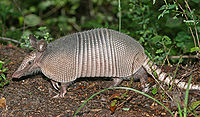
Extinction
In biology and ecology, extinction is the end of an organism or of a group of organisms , normally a species. The moment of extinction is generally considered to be the death of the last individual of the species, although the capacity to breed and recover may have been lost before this point...
(†) North American taxa
Taxon
|thumb|270px|[[African elephants]] form a widely-accepted taxon, the [[genus]] LoxodontaA taxon is a group of organisms, which a taxonomist adjudges to be a unit. Usually a taxon is given a name and a rank, although neither is a requirement...
whose ancestors migrated out of South America:This listing currently has fairly complete coverage of nonflying mammals, but only spotty coverage of other groups. Crossings by nonflying mammals and birds occurred during the last 10 Ma. Crossings by fish, arthropods, waif-dispersing amphibians and reptiles, and flying bats and birds were made before 10 Ma ago in many cases. Taxa listed as invasive did not necessarily cross the isthmus themselves; they may have evolved in the adopted land mass from ancestral taxa that made the crossing.
- Cichlids (Cichlidae: e.g. Herichthys cyanoguttatusTexas cichlidThe Texas cichlid is a freshwater fish of the cichlid family. Also known as Rio Grande cichlid, this species is originated from the lower Rio Grande drainage in Texas and Northeastern Mexico, particular on the sandy bottom of deep rivers...
) – freshwater fishFreshwater fishFreshwater fish are fish that spend some or all of their lives in freshwater, such as rivers and lakes, with a salinity of less than 0.05%. These environments differ from marine conditions in many ways, the most obvious being the difference in levels of salinity...
that often tolerate brackishBrackish waterBrackish water is water that has more salinity than fresh water, but not as much as seawater. It may result from mixing of seawater with fresh water, as in estuaries, or it may occur in brackish fossil aquifers. The word comes from the Middle Dutch root "brak," meaning "salty"...
conditions - Bufonid Toads (BufoBufoBufo is a large genus of about 150 species of true toads in the amphibian family Bufonidae. Bufo is a Latin word for toad.- Description :...
) - Hylid Frogs
- Leptodactylid FrogsLeptodactylidaeLeptodactylidae is a diverse family of frogs that probably diverged from other hyloids during the Cenozoic era, or possibly at the end of the Mesozoic. There are roughly 50 genera, one of which is Eleutherodactylus, the largest vertebrate genus, with over 700 species...
– as far north as TexasTexasTexas is the second largest U.S. state by both area and population, and the largest state by area in the contiguous United States.The name, based on the Caddo word "Tejas" meaning "friends" or "allies", was applied by the Spanish to the Caddo themselves and to the region of their settlement in... - Microhylid FrogsMicrohylidaeMicrohylidae is a geographically widespread family of frogs. There are 413 species in 69 genera and nine subfamilies, which is the largest number of genera of any frog family.-Description:...
- Virginia OpossumVirginia OpossumThe Virginia opossum , commonly known as the North American opossum or tlacuache in Mexico, is the only marsupial found in North America north of Mexico. A solitary and nocturnal animal about the size of a domestic cat, and thus the largest opossum, it is a successful opportunist...
(Didelphis virginiana) - ArmadilloArmadilloArmadillos are New World placental mammals, known for having a leathery armor shell. Dasypodidae is the only surviving family in the order Cingulata, part of the superorder Xenarthra along with the anteaters and sloths. The word armadillo is Spanish for "little armored one"...
s (Dasypus novemcinctusNine-banded ArmadilloThe nine-banded armadillo , or the nine-banded, long-nosed armadillo, is a species of armadillo found in North, Central, and South America, making it the most widespread of the armadillos...
, †D. bellus) - †PachyarmatheriumPachyarmatheriumPachyarmatherium is an extinct large armadillo-like cingulate genus of North and South America from the Pliocene and Pleistocene epochs, related to the extant armadillos and the extinct pampatheres and glyptodonts. It was present from 4.9 Mya—300,000 years ago, existing for approximately...
leiseyi, an enigmatic armored armadillo relative - †PampatheresPampatheriidaePampatheridae is an ancient family, now extinct, of large armadillo-like plantigrade armored xenarthrans. They are related to Glyptodontidae, an extinct family of much larger and more heavily armored xenarthrans, as well as to smaller extant armadillos...
(Plaina, HolmesinaHolmesinaHolmesina is a genus of pampathere, an extinct group of armadillo-like creatures that were distantly related to extant armadillos. Like armadillos, and unlike the other extinct branch of Cingulata, the glyptodonts, the shell was made up of flexible plates which allowed the animal to move more easily...
) – large armadillo-like animals - †GlyptodontidGlyptodontidaeGlyptodonts were large, more heavily armored relatives of extinct pampatheres and modern armadillos.They first evolved during the Miocene in South America, which remained their center of species diversity...
s (Glyptotherium) - †Megalonychid Ground SlothsWhile all megalonychid ground sloths are extinct, extant two-toed tree slothsTwo-toed slothCholoepus is a genus of mammals of Central and South America, within the family Megalonychidae consisting of two-toed sloths. There are only two species of Choloepus : Linnaeus's Two-toed Sloth and Hoffmann's Two-toed Sloth...
are from the same family. Three-toed tree slothsThree-toed slothThe three-toed sloths are tree-living mammals from South and Central America. They are the only members of the genus Bradypus and the family Bradypodidae. There are four living species of three-toed sloths...
, in contrast, are not closely related to any of the groups of extinct ground sloths. (PliometanastesPliometanastesPliometanastes is an extinct genus of giant ground sloths of the family Megalonychidae endemic to North America during the Miocene epoch through very early Pliocene epoch. Its fossils have been found across the southern U. S. from California to Florida....
, MegalonyxMegalonyxMegalonyx is an extinct genus of giant ground sloths of the family Megalonychidae endemic to North America from the Hemphillian of the Late Miocene through to the Rancholabrean of the Pleistocene, living from ~10.3 Mya—11,000 years ago, existing for approximately .-Taxonomy:The generic name...
) - †Mylodontid Ground Sloths (ThinobadistesThinobadistesThinobadistes is an extinct genus of actively mobile ground sloth of the family Mylodontidae, endemic to North America during the Miocene-Pleistocene epochs. It lived from 13.6—5.3 mya, existing for approximately ....
, GlossotheriumGlossotheriumGlossotherium was a genus of ground sloth. It was a heavily built animal with a length of about snout to tail-tip, and could potentially assume a slight bipedal stance.Fossils of this animal have been found in South America...
, ParamylodonParamylodonParamylodon is an extinct genus of ground sloth of the family Mylodontidae endemic to North America during the Pliocene through Pleistocene epochs, living from around ~4.9 Mya—11,000 years ago .-Overview:...
) - †Megatheriid Ground Sloths (EremotheriumEremotheriumEremotherium is an extinct genus of actively mobile ground sloth of the family Megatheriidae, endemic to North America and South America during the Pleistocene epoch...
, NothrotheriopsNothrotheriopsNothrotheriops is a genus of Pleistocene ground sloth found in North and South America. This genus of bear-sized xenarthran was related to the much larger, and far more famous Megatherium, although it has recently been placed in a different family, Nothrotheriidae.-Discovery and species:Fossils of...
) - New World porcupineNew World porcupineThe New World porcupines, or Erethizontidae, are large arboreal rodents, distinguished by the spiny covering from which they take their name. They inhabit forests and wooded regions across North America, and into northern South America...
s (Erethizon dorsatumNorth American PorcupineThe North American Porcupine , also known as Canadian Porcupine or Common Porcupine, is a large rodent in the New World porcupine family. The Beaver is the only rodent larger than the North American Porcupine found in North America...
, †Erethizon poyeri, †E. kleini) - CapybaraCapybaraThe capybara , also known as capivara in Portuguese, and capibara, chigüire in Venezuela, Colombia, and Ecuador ronsoco in Peru, chigüiro, and carpincho in Spanish, is the largest living rodent in the world. Its closest relatives are agouti, chinchillas, coyphillas, and guinea pigs...
s (†Neochoerus pinckneyiNeochoerus pinckneyiNeochoerus pinckneyi was a North American species of capybara. While capybaras originated in South America, formation of the Isthmus of Panama three million years ago allowed some of them to migrate north as part of the Great American Interchange...
, †N. aesopi) - Vampire BatVampire batVampire bats are bats whose food source is blood, a dietary trait called hematophagy. There are three bat species that feed solely on blood: the Common Vampire Bat , the Hairy-legged Vampire Bat , and the White-winged Vampire Bat .All three species are native to the Americas, ranging from Mexico to...
s (†Desmodus stocki, †D. archaeodaptes) - Cougar (Puma concolor) – returning from a South American refugium after North American cougars were extirpatedLocal extinctionLocal extinction, also known as extirpation, is the condition of a species which ceases to exist in the chosen geographic area of study, though it still exists elsewhere...
in the Pleistocene extinctionsQuaternary extinction eventThe Quaternary period saw the extinctions of numerous predominantly larger, especially megafaunal, species, many of which occurred during the transition from the Pleistocene to the Holocene epoch. However, the extinction wave did not stop at the end of the Pleistocene, but continued especially on... - †Terror BirdsPhorusrhacidaePhorusrhacids , colloquially known as "terror birds" as the larger species were apex predators during the Miocene, were a clade of large carnivorous flightless birds that were the dominant predators in South America during the Cenozoic, 62–2 million years ago. They were roughly 1–3 meters tall...
(Phorusrhacidae: Titanis walleri) - HummingbirdHummingbirdHummingbirds are birds that comprise the family Trochilidae. They are among the smallest of birds, most species measuring in the 7.5–13 cm range. Indeed, the smallest extant bird species is a hummingbird, the 5-cm Bee Hummingbird. They can hover in mid-air by rapidly flapping their wings...
s (Trochilidae) - TanagerTanagerThe tanagers comprise the bird family Thraupidae, in the order Passeriformes. The family has an American distribution.There were traditionally about 240 species of tanagers, but the taxonomic treatment of this family's members is currently in a state of flux...
s (Thraupidae) – descended from earlier (perhaps MioceneMioceneThe Miocene is a geological epoch of the Neogene Period and extends from about . The Miocene was named by Sir Charles Lyell. Its name comes from the Greek words and and means "less recent" because it has 18% fewer modern sea invertebrates than the Pliocene. The Miocene follows the Oligocene...
) North American migrants - Tyrant FlycatcherTyrant flycatcherThe tyrant flycatchers are a family of passerine birds which occur throughout North and South America. They are considered the largest family of birds on Earth, with more than 400 species. They are the most diverse avian family in every country in the Americas, except for the United States and...
s (Tyrannidae) - ParrotParrotParrots, also known as psittacines , are birds of the roughly 372 species in 86 genera that make up the order Psittaciformes, found in most tropical and subtropical regions. The order is subdivided into three families: the Psittacidae , the Cacatuidae and the Strigopidae...
s (AriniNeotropical parrotThe Neotropical parrots belong to the family of the true parrots Psittacidae. Several species and one of the 32 modern genera have become extinct in recent centuries. Though fairly few fossils of modern parrots are known, most of these are from Arini...
: Rhynchopsitta pachyrhynchaThick-billed ParrotThe Thick-billed Parrot, Rhynchopsitta pachyrhyncha is an endangered, medium-sized, up to 38 cm long, bright green parrot with a large black bill and a red forecrown, shoulder and thighs...
, †Conuropsis carolinensisCarolina ParakeetThe Carolina Parakeet was the only parrot species native to the eastern United States. It was found from the Ohio Valley to the Gulf of Mexico, and lived in old forests along rivers. It was the only species at the time classified in the genus Conuropsis...
)
South American invasions that failed to penetrate beyond Central America
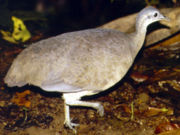
Physical geography
Physical geography is one of the two major subfields of geography. Physical geography is that branch of natural science which deals with the study of processes and patterns in the natural environment like the atmosphere, biosphere and geosphere, as opposed to the cultural or built environment, the...
as ending at the Isthmus of Tehuantepec
Isthmus of Tehuantepec
The Isthmus of Tehuantepec is an isthmus in Mexico. It represents the shortest distance between the Gulf of Mexico and the Pacific Ocean, and prior to the opening of the Panama Canal was a major shipping route known simply as the Tehuantepec Route...
, or less commonly, at the Trans-Mexican Volcanic Belt
Trans-Mexican volcanic belt
The Trans-Mexican Volcanic Belt also known as the Transvolcanic Belt and locally as the Sierra Nevada , is a volcanic belt that extends 900 km from west to east across central-southern Mexico...
, most of the taxa that proceeded further but failed to reach the present Mexican border are or were confined to tropical or subtropical ecozones similar to those of Central America. Examples include the giant anteater, the grayish mouse opossum, the lowland paca, Geoffroy's spider monkey and Mixotoxodon
Mixotoxodon
Mixotoxodon is an extinct genus of notoungulate of the family Toxodontidae which inhabited South America during the Pleistocene living from 1.8—0.30 Ma and existed for approximately ....
. whose ancestors migrated out of South America:
- Gonyleptid HarvestmenOpilionesOpiliones are an order of arachnids commonly known as harvestmen. , over 6,400 species of harvestmen have been discovered worldwide, although the real number of extant species may exceed 10,000. The order Opiliones can be divided into four suborders: Cyphophthalmi, Eupnoi, Dyspnoi and Laniatores...
(Opiliones: GonyleptidaeGonyleptidaeGonyleptidae is a Neotropical family of harvestmen with more than 800 species, the largest in the Suborder Laniatores and the second largest of the Opiiones as a whole...
) - Electric KnifefishesGymnotiformesThe Gymnotiformes are a group of teleost bony fishes commonly known as the Neotropical or South American knifefishes. They have long bodies and swim using undulations of their elongated anal fin...
(Gymnotiformes) - CaeciliidCaeciliidaeCaeciliidae is the family of common caecilians. They are found in central and south America, equatorial Africa and India. Like other caecilians, they superficially resemble worms or snakes....
CaecilianCaecilianThe caecilians are an order of amphibians that superficially resemble earthworms or snakes. They mostly live hidden in the ground, making them the least familiar order of amphibians. All extant caecilians and their closest fossil relatives are grouped as the clade Apoda. They are mostly...
s (CaeciliaCaeciliaCaecilia is a genus of amphibians in the family Caeciliidae.- Species :...
, DermophisDermophisDermophis is a genus of amphibian in the Caeciliidae family, native mainly to southern Mexico to northwestern Colombia.- Species :...
, GymnopisGymnopisGymnopis is a genus of amphibian in the Caeciliidae family.- Species :...
, OscaeciliaOscaeciliaOscaecilia is a genus of amphibian in the Caeciliidae family.- Species :...
) – snake-like amphibians - Poison Dart FrogsPoison dart frogPoison dart frog is the common name of a group of frogs in the family Dendrobatidae which are native to Central and South America. These species are diurnal and often have brightly-colored bodies...
(Dendrobatidae) - Boine Boas (Boidae: BoinaeBoinaeThe Boinae are a subfamily of boas found in Central and South America, Africa and Southeast Asia. Five genera comprising 28 species are currently recognized.-Geographic range:...
) - Spectacled CaimanSpectacled CaimanThe spectacled caiman , also known as the white caiman or common caiman, is a crocodilian reptile found in much of Central and South America. It lives in a range of lowland wetland and riverine habitat types and can tolerate salt water as well as fresh; due in part to this adaptability it is the...
(Caiman crocodilus) - other Opossums (Didelphidae) – 11 additional extant species, listed on discussion page
- Northern Naked-tailed ArmadilloNorthern Naked-tailed ArmadilloThe Northern Naked-tailed Armadillo is a species of armadillo. It is found from Chiapas in southern Mexico to western Colombia, northwestern Ecuador and northwestern Venezuela, at altitudes from sea level to 3000 m...
(Cabassous centralis) - Hoffmann'sHoffmann's Two-toed SlothHoffmann's two-toed sloth is a species of sloth from Central and South America. It is a solitary nocturnal and arboreal animal, found in mature and secondary rainforests and deciduous forests...
Two-toed SlothTwo-toed slothCholoepus is a genus of mammals of Central and South America, within the family Megalonychidae consisting of two-toed sloths. There are only two species of Choloepus : Linnaeus's Two-toed Sloth and Hoffmann's Two-toed Sloth...
(Megalonychidae: Choloepus hoffmanni) - Three-toed SlothsThree-toed slothThe three-toed sloths are tree-living mammals from South and Central America. They are the only members of the genus Bradypus and the family Bradypodidae. There are four living species of three-toed sloths...
(Bradypodidae: Bradypus variegatusBrown-throated Three-toed SlothThe brown-throated sloth is a species of three-toed sloth. It is the most common of the four species of three-toed sloth, and is found in the forests of South and Central America.-Description:...
, B. pygmaeusPygmy Three-toed SlothThe Pygmy Three-toed Sloth is a three-toed sloth. It is endemic to Isla Escudo de Veraguas, an island off the coast of Panama, which separated from the mainland nearly 8900 years ago. The species is thought to have originated from isolation of individuals from the mainland population of Bradypus...
) - Silky AnteaterSilky AnteaterThe Silky Anteater or Pygmy Anteater is a species of anteater from Central and South America, ranging from extreme southern Mexico south to Brazil Delta Amacuro Venezuela and possibly Paraguay...
(Cyclopedidae: Cyclopes didactylus) - other AnteatersMyrmecophagidaeMyrmecophagidae is a family of anteaters, the name being derived from the Ancient Greek words for 'ant' and 'eat' . Myrmecophagids are native to Central and South America, from southern Mexico to northern Argentina. There are 2 genera and 3 species in the family, consisting of the Giant Anteater,...
(Myrmecophagidae: Myrmecophaga tridactylaGiant AnteaterThe Giant Anteater, Myrmecophaga tridactyla, is the largest species of anteater. It is the only species in the genus Myrmecophaga. It is found in Central and South America from Honduras to northern Argentina...
, Tamandua mexicanaTamanduaTamandua is a genus of anteaters. It has two members: the Southern Tamandua and the Northern Tamandua . They live in forests and grasslands, are semi-arboreal, and possess partially prehensile tails. They mainly eat ants and termites, but they occasionally eat bees, beetles, and insect larvae...
) - Rothschild'sRothschild's PorcupineRothschild's Porcupine, Coendou rothschildi, is a species of rodent in the family Erethizontidae.It is usually considered endemic to Panama. A population in western Ecuador belongs either to this species or to Coendou bicolor....
and Mexican Hairy DwarfMexican Hairy Dwarf PorcupineThe Mexican Hairy Dwarf Porcupine or Mexican Tree Porcupine is a species of rodent in the family Erethizontidae. It is found in Costa Rica, El Salvador, Guatemala, Honduras, Mexico, Panama, possibly Belize, and possibly Nicaragua.-References:...
PorcupinesNew World porcupineThe New World porcupines, or Erethizontidae, are large arboreal rodents, distinguished by the spiny covering from which they take their name. They inhabit forests and wooded regions across North America, and into northern South America...
(Coendou rothschildi, Sphiggurus mexicanus) - other Caviomorph RodentsCaviomorphaCaviomorpha is the rodent infraorder or parvorder that unites all South American hystricognaths. It is supported by both fossil and molecular evidence.-Origin:...
(Caviomorpha) – 9 additional extant species, listed on discussion page - Platyrrhine MonkeysNew World monkeyNew World monkeys are the five families of primates that are found in Central and South America: Callitrichidae, Cebidae, Aotidae, Pitheciidae, and Atelidae. The five families are ranked together as the Platyrrhini parvorder and the Ceboidea superfamily, which are essentially synonymous since...
(Platyrrhini) – at least 8 extant species, listed on discussion page - †MixotoxodonMixotoxodonMixotoxodon is an extinct genus of notoungulate of the family Toxodontidae which inhabited South America during the Pleistocene living from 1.8—0.30 Ma and existed for approximately ....
larensis – a rhino-sized toxodontidToxodontidaeToxodontidae is an extinct family of notoungulate mammals known from the Oligocene through the Pleistocene of South America, with one genus, Mixotoxodon, also known from the Pleistocene of Central America. They somewhat resembled rhinoceroses, and had teeth with high crowns and open roots,...
notoungulateNotoungulataNotoungulata is an extinct order of hoofed, sometimes heavy bodied mammalian ungulates which inhabited South America during the Paleocene to Pleistocene, living from approximately 57 Ma to 11,000 years ago.-Taxonomy:... - other Vampire BatVampire batVampire bats are bats whose food source is blood, a dietary trait called hematophagy. There are three bat species that feed solely on blood: the Common Vampire Bat , the Hairy-legged Vampire Bat , and the White-winged Vampire Bat .All three species are native to the Americas, ranging from Mexico to...
s (Desmodontinae) – all 3 extant species - ToucanToucanToucans are members of the family Ramphastidae of near passerine birds from the Neotropics. The family is most closely related to the American barbets. They are brightly marked and have large, often colorful bills. The family includes five genera and about forty different species...
s (Ramphastidae) - TinamouTinamouThe tinamous are a family comprising 47 species of birds found in Central and South America. One of the most ancient living groups of bird, they are related to the ratites. Generally ground dwelling, they are found in a range of habitats....
s (Tinamidae) - Great CurassowGreat CurassowThe Great Curassow is a large, pheasant-like bird from the Neotropics. At in length and in weight, this is a very large cracid. No other cracid match its maximum weight, but its length is matched by a few other cracids....
(Crax rubra)
North American invasions of South America

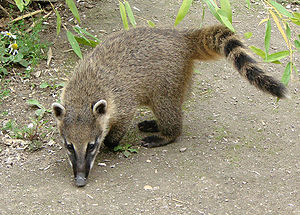
- Lungless SalamandersLungless salamanderThe Plethodontidae, or Lungless salamanders, are a family of salamanders. Most species are native to the western hemisphere, from British Columbia to Brazil, although a few species are found in Sardinia, Europe south of the Alps, and South Korea...
(BolitoglossaBolitoglossaBolitoglossa also called Tropical climbing salamanders or Web-footed Salamanders is a genus of salamanders in the Plethodontidae family. Their range is Central and South America: Mexico, Colombia, Venezuela, Ecuador, Peru, northeastern Brazil, and central Bolivia...
, OedipinaOedipinaOedipina or worm salamanders is a genus in the Plethodontidae family of salamanders, which is characterized by their absence of lungs; they instead achieve respiration through their skin and the tissues lining their mouth. They are endemic to Mexico, Colombia and Ecuador...
) – only present in northern South America - Ranid Frogs – only present in northern South America
- EmydidEmydidaeEmydidae, commonly called the pond turtles or marsh turtles, is a family of turtles. Previously, several species of Asian box turtle were classified in the family. However, revised taxonomy has separated them to a different family. Now, Emydidae, with the exception of two species of pond turtle,...
Turtles (TrachemysTrachemysTrachemys is a genus of turtles belonging to the family Emydidae.-Species:*Trachemys adiutrix - Maranhão slider*Trachemys callirostris - Colombian slider*Trachemys callirostris callirostris - Colombian slider...
) – only present in northern South America - GeoemydidGeoemydidaeGeoemydidae is the largest and most diverse family in the order Testudines with about 70 species. It includes the Eurasian pond and river turtles and Neotropical wood turtles.-Characteristics:...
Turtles (RhinoclemmysRhinoclemmysRhinoclemmys is a turtle genus in the family Geoemydidae . They are commonly known as the Neotropical wood turtles and are the only geoemydids known from the Americas...
) – only present in northern South America - Coral SnakesCoral snakeThe coral snakes are a large group of elapid snakes that can be subdivided into two distinct groups, Old World coral snakes and New World coral snakes...
(Leptomicrurus, Micrurus) - South American RattlesnakeRattlesnakeRattlesnakes are a group of venomous snakes of the genera Crotalus and Sistrurus of the subfamily Crotalinae . There are 32 known species of rattlesnake, with between 65-70 subspecies, all native to the Americas, ranging from southern Alberta and southern British Columbia in Canada to Central...
(Crotalus durissusCrotalus durissusCrotalus durissus is a venomous pitviper species found in South America. The most widely distributed member of its genus, this species poses a serious medical problem in many parts of its range...
) - Lanceheads (BothropsBothropsBothrops is a genus of venomous pitvipers found in Central and South America. The generic name is derived from the Greek words bothros and ops that mean "pit" and "eye" or "face"; an allusion to the heat-sensitive loreal pit organs. Members of this genus are responsible for more human deaths in the...
) - Bushmasters (LachesisLachesis (genus)Lachesis is a genus of venomous pitvipers found in remote forested areas of Central and South America. The generic name refers to one of the Three Fates in Greek mythology who determined the length of the thread of life...
) - other Pit VipersCrotalinaeThe Crotalinae, commonly known as "pit vipers" or crotaline snakes, are a subfamily of venomous vipers found in Asia and the Americas. They are distinguished by the presence of a heat-sensing pit organ located between the eye and the nostril on either side of the head...
(Bothriechis schlegeliiBothriechis schlegeliiThe Eyelash Viper is a venomous pitviper species found in Central and South America. Small and arboreal, these snakes are characterized by their wide array of color variations, as well as the superciliary scales over the eyes. Often present in zoological exhibits. Named after the German...
, BothriopsisBothriopsisBothriopsis is a genus of venomous pitvipers found in eastern Panama and most of northern South America. The name is derived from the Greek words bothros for "pit", and -opsis for "face" or "appearance"; obviously an allusion to the heat-sensitive loreal pit organs...
, PorthidiumPorthidiumPorthidium is a genus of venomous pitvipers found in Mexico and southward to northern South America. The name is derived from the Greek words portheo and the suffix -idus, which means "destroy" and "having the nature of"; apparently a reference to the venom...
) - Small-eared ShrewsSmall-eared shrewThe genus Cryptotis is a group of relatively small shrews with short ears, which are usually not visible, and short tails, commonly called small-eared shrews. They have 30 teeth and are members of the red-toothed shrew subfamily. Since 1992, Neal Woodman at the United States National Museum has...
(Cryptotis) – only present in NW South America: ColombiaColombiaColombia, officially the Republic of Colombia , is a unitary constitutional republic comprising thirty-two departments. The country is located in northwestern South America, bordered to the east by Venezuela and Brazil; to the south by Ecuador and Peru; to the north by the Caribbean Sea; to the...
, VenezuelaVenezuelaVenezuela , officially called the Bolivarian Republic of Venezuela , is a tropical country on the northern coast of South America. It borders Colombia to the west, Guyana to the east, and Brazil to the south...
, EcuadorEcuadorEcuador , officially the Republic of Ecuador is a representative democratic republic in South America, bordered by Colombia on the north, Peru on the east and south, and by the Pacific Ocean to the west. It is one of only two countries in South America, along with Chile, that do not have a border...
, PeruPeruPeru , officially the Republic of Peru , is a country in western South America. It is bordered on the north by Ecuador and Colombia, on the east by Brazil, on the southeast by Bolivia, on the south by Chile, and on the west by the Pacific Ocean.... - Geomyid Pocket GophersPocket gopherThe pocket gophers are burrowing rodents of the family Geomyidae. These are the "true" gophers, though several ground squirrels of the family Sciuridae are often called gophers as well...
(Orthogeomys thaeleriThaeler's Pocket GopherThe Thaeler's Pocket Gopher is a species of rodent in the Geomyidae family. It is endemic to Colombia....
) – one species, in ColombiaColombiaColombia, officially the Republic of Colombia , is a unitary constitutional republic comprising thirty-two departments. The country is located in northwestern South America, bordered to the east by Venezuela and Brazil; to the south by Ecuador and Peru; to the north by the Caribbean Sea; to the... - Heteromyid MiceHeteromyidaeThe family of rodents that include kangaroo rats, kangaroo mice and rock pocket mice is the Heteromyidae family. Most heteromyids live in complex burrows within the deserts and grasslands of western North America, though species within the Heteromys and Liomys genera are also found in forests and...
(HeteromysHeteromysHeteromys is a genus of rodent in the family Heteromyidae.It contains the following species:* Trinidad Spiny Pocket Mouse * Southern Spiny Pocket Mouse...
) – only present in NW South America: ColombiaColombiaColombia, officially the Republic of Colombia , is a unitary constitutional republic comprising thirty-two departments. The country is located in northwestern South America, bordered to the east by Venezuela and Brazil; to the south by Ecuador and Peru; to the north by the Caribbean Sea; to the...
, VenezuelaVenezuelaVenezuela , officially called the Bolivarian Republic of Venezuela , is a tropical country on the northern coast of South America. It borders Colombia to the west, Guyana to the east, and Brazil to the south...
, EcuadorEcuadorEcuador , officially the Republic of Ecuador is a representative democratic republic in South America, bordered by Colombia on the north, Peru on the east and south, and by the Pacific Ocean to the west. It is one of only two countries in South America, along with Chile, that do not have a border... - CricetidNew World rats and miceThe New World rats and mice are a group of related rodents found in North and South America. They are extremely diverse in appearance and ecology, ranging in from the tiny Baiomys to the large Kunsia...
– primarily SigmodontineSigmodontinaeThe subfamily Sigmodontinae is one of the most diverse groups of mammals. It includes New World rats and mice, with at least 376 species. Many authorities include the Neotominae and Tylomyinae as part of a larger definition of Sigmodontinae. When those genera are included, the species count...
– Rats and Mice (Cricetidae: Sigmodontinae) - Tree Squirrels (SciurusSciurusThe genus Sciurus contains most of the common, bushy-tailed squirrels in North America, Europe, temperate Asia, Central America and South America.-Species:There are 30 species.Genus Sciurus - Tree squirrels*Subgenus Sciurus...
, MicrosciurusMicrosciurusMicrosciurus or dwarf squirrels is a genus of squirrels from the tropical regions of Central and South America.There are four recognized species, however, recent DNA analysis has shown that there is some confusion regarding the traditional classification of the Microsciurus species:Genus...
, SciurillusNeotropical Pygmy SquirrelThe Neotropical pygmy squirrel is a very small tree squirrel, being the only living species in the genus Sciurillus and the subfamily Sciurillinae...
) - CottontailCottontail rabbitThe cottontail rabbits are among the 16 lagomorph species in the genus Sylvilagus, found in the Americas.In appearance, most cottontail rabbits closely resemble the wild European Rabbit...
RabbitRabbitRabbits are small mammals in the family Leporidae of the order Lagomorpha, found in several parts of the world...
s (Sylvilagus brasiliensisTapetiThe Tapeti , also known as the Brazilian Rabbit or Forest Rabbit, is a cottontail rabbit species found in Central and South America....
, S. floridanusEastern CottontailThe eastern cottontail is a New World cottontail rabbit, a member of the family Leporidae. It is one of the most common rabbit species in North America.-Distribution:...
, S. varynaensisVenezuelan lowland rabbitThe Venezuelan lowland rabbit , also known as the Barinas wild rabbit, is a cottontail rabbit species found in western Venezuela. Its diet consists in large measure of plants of the genus Sida. It is found in lowland savannas close to dry forests within the Llanos ecoregion. It is the largest of...
) – present in northern and central South America - TapirTapirA Tapir is a large browsing mammal, similar in shape to a pig, with a short, prehensile snout. Tapirs inhabit jungle and forest regions of South America, Central America, and Southeast Asia. There are four species of Tapirs: the Brazilian Tapir, the Malayan Tapir, Baird's Tapir and the Mountain...
s (Tapirus bairdiiBaird's TapirBaird’s Tapir is a species of tapir that is native to Central America and northern South America. It is one of three Latin American species of tapir.-Names:...
, T. pinchaqueMountain TapirThe Mountain Tapir or Woolly Tapir is the smallest of the four species of tapir and is the only one to live outside of tropical rainforests in the wild...
, T. terrestrisBrazilian TapirThe South American Tapir , or Brazilian Tapir or Lowland Tapir or Anta, is one of four species in the tapir family, along with the Mountain Tapir, the Malayan Tapir, and Baird's Tapir...
) - EquidEquidaeEquidae is the taxonomic family of horses and related animals, including the extant horses, donkeys, and zebras, and many other species known only from fossils. All extant species are in the genus Equus...
s (Equus ferus, †HippidionHippidionHippidion was a Welsh pony-sized horse that lived in South America during the Pleistocene epoch, between two million and 10,000 years ago....
) - PeccariesPeccaryA peccary is a medium-sized mammal of the family Tayassuidae, or New World Pigs. Peccaries are members of the artiodactyl suborder Suina, as are the pig family and possibly the hippopotamus family...
(Tayassu pecariWhite-lipped PeccaryThe White-lipped Peccary, Tayassu pecari, is a peccary species found in Central and South America, living in rainforest, dry forest and chaco scrub. It is monotypic within the genus Tayassu....
, Catagonus wagneriChacoan peccaryThe Chacoan peccary or Tagua is a species of peccary found in the Gran Chaco of Paraguay, Bolivia and Argentina. About 3000 exist in the world...
, Pecari tajacuCollared PeccaryThe collared peccary is a species of mammal in the family Tayassuidae that is found in North, Central, and South America. They are commonly referred to as javelina, saíno or báquiro, although these terms are also used to describe other species in the family...
, P. maximus) - DeerDeerDeer are the ruminant mammals forming the family Cervidae. Species in the Cervidae family include white-tailed deer, elk, moose, red deer, reindeer, fallow deer, roe deer and chital. Male deer of all species and female reindeer grow and shed new antlers each year...
(†AntiferAntiferAntifer is an extinct genus of small herbivorous deer of ths family Cervidae endemic to South America during the Late Pliocene to Late Pleistocene, living from 3.6 Ma-11,000 years ago and existing for approximately...
, OdocoileusWhite-tailed DeerThe white-tailed deer , also known as the Virginia deer or simply as the whitetail, is a medium-sized deer native to the United States , Canada, Mexico, Central America, and South America as far south as Peru...
, BlastocerusMarsh DeerThe Marsh Deer, Blastocerus dichotomus , is the largest deer species from South America reaching a length of and a height of at the rump. It is found in Argentina, Bolivia, Brazil, Uruguay and Paraguay...
, OzotocerosPampas DeerPampas deer, Ozotoceros bezoarticus, live in the grasslands of South America at low elevations. They are also known as Venado or Gama. Their habitat includes water and hills, often with winter drought, and grass that is high enough to cover a standing deer...
, MazamaBrocket DeerBrocket deer are the species of deer in the genus Mazama. They are medium to small in size, and are found in the Yucatán Peninsula, Central and South America, and the island of Trinidad. Most species are primarily found in forests. They are superficially similar to the African duikers and the Asian...
, PuduPudúThe pudús are two species of South American deer from the genus Pudu; the world's smallest deer. The name is a loanword from Mapudungun the language of the indigenous Mapuche people of southern Chile...
, Hippocamelus) - CamelidCamelidCamelids are members of the biological family Camelidae, the only living family in the suborder Tylopoda. Dromedaries, Bactrian Camels, llamas, alpacas, vicuñas, and guanacos are in this group....
s (Lama guanicoe, Vicugna vicugnaVicuñaThe vicuña or vicugna is one of two wild South American camelids, along with the guanaco, which live in the high alpine areas of the Andes. It is a relative of the llama, and is now believed to share a wild ancestor with domesticated alpacas, which are raised for their fibre...
, †EulamaopsEulamaopsEulamaops is an extinct genus of terrestrial herbivore in the family Camelidae, endemic to South America during the Pleistocene 800,000—11,000 years ago, existing for approximately .-Taxonomy:...
, †HemiaucheniaHemiaucheniaHemiauchenia is a genus of lamine camelids that evolved in North America in the Miocene period approximately 10 million years ago. This genus diversified and moved to South America in the early Pleistocene as part of the Great American Interchange, giving rise to modern lamines...
, †PalaeolamaPalaeolamaPalaeolama is an extinct North and South American genus of lamine camelid.Palaeolama mirifica, the "stout-legged llama", is known from southern California and the southeastern U. S...
) - †GomphothereGomphothereGomphotheriidae is a diverse taxonomic family of extinct elephant-like animals , called gomphotheres. They were widespread in North America during the Miocene and Pliocene epochs, 12-1.6 million years ago. Some lived in parts of Eurasia, Beringia and, following the Great American Interchange,...
s (CuvieroniusCuvieroniusCuvieronius is an extinct New World genus of gomphothere. It is named after the French naturalist Georges Cuvier, stood 2.7 m tall and looked like a modern elephant except for its spiral-shaped tusks.-Origin:...
hyodon, StegomastodonStegomastodonStegomastodon is an extinct genus of gomphothere, a family of proboscideans. It is not to be confused with the genus Mammut from a different proboscidean family, whose members are commonly called "mastodons", nor with the genus Stegodon, from yet another proboscidean sub-family, whose members are...
waringi, S. platensis)Sometimes classified as elephantidsElephantidaeElephantidae is a taxonomic family, collectively elephants and mammoths. These are terrestrial large mammals with a trunk and tusks. Most genera and species in the family are extinct...
rather than as gomphotheres. – elephantElephantElephants are large land mammals in two extant genera of the family Elephantidae: Elephas and Loxodonta, with the third genus Mammuthus extinct...
relatives - OtterOtterThe Otters are twelve species of semi-aquatic mammals which feed on fish and shellfish, and also other invertebrates, amphibians, birds and small mammals....
s (LontraLontraLontra is a genus of otters from the American continent.The genus comprises four species:*North American River Otter *Southern River Otter *Neotropical Otter...
, PteronuraGiant OtterThe giant otter is a South American carnivorous mammal. It is the longest member of the Mustelidae, or weasel family, a globally successful group of predators. Unusually for a mustelid, the giant otter is a social species, with family groups typically supporting three to eight members...
) - other MustelidsMustelidaeMustelidae , commonly referred to as the weasel family, are a family of carnivorous mammals. Mustelids are diverse and the largest family in the order Carnivora, at least partly because in the past it has been a catch-all category for many early or poorly differentiated taxa...
(MustelinaeMustelinaeMustelinae is a polyphyletic subfamily of family Mustelidae and includes wolverines, weasels, ferrets, martens, minks, and similar carnivorous mammals of Order Carnivora.- Extant species of Mustelinae :Subfamily Mustelinae*Genus Arctonyx...
: EiraTayraThe tayra , also known as the Tolomuco or Perico ligero in Central America, and San Hol or viejo de monte in the Yucatan Peninsula is an omnivorous animal from the weasel family Mustelidae. It is the only species in the genus Eira...
, GalictisGalictisThe grison, also known as the South American glutton, is a neotropical mustelid of South America. Comprising the genus Galictis, it is divided into two species: the greater grison , which is found widely in South America, through Central America to southern Mexico; and the lesser grison , which is...
, LyncodonPatagonian WeaselThe Patagonian Weasel is a small mustelid that is the only member of the genus Lyncodon. Its geographic range is the Pampas of western Argentina and sections of Chile...
, MustelaWeaselWeasels are mammals forming the genus Mustela of the Mustelidae family. They are small, active predators, long and slender with short legs....
) - Hog-NosedHog-nosed skunkThe hog-nosed skunks belong to the genus Conepatus and are members of the family Mephitidae . They are native to the Americas. They have white backs and tails and black underparts...
SkunkSkunkSkunks are mammals best known for their ability to secrete a liquid with a strong, foul odor. General appearance varies from species to species, from black-and-white to brown or cream colored. Skunks belong to the family Mephitidae and to the order Carnivora...
s (Conepatus chingaMolina's Hog-nosed SkunkMolina's hog-nosed skunk, also called the Andes Skunk , is a skunk species from South America. It is found in Argentina, Bolivia, Brazil, Chile, Peru and Uruguay in heights up to 5000m.-References:**The Andes: A Trekking Guide...
, C. humboldtiiHumboldt's Hog-nosed SkunkHumboldt's hog-nosed skunk, also known as the Patagonian hog-nosed skunk is a type of hog-nosed skunk indigenous to the open grassy areas in the Patagonian regions of Argentina and Chile.- Appearance :...
, C. semistriatusStriped Hog-nosed SkunkThe striped hog-nosed skunk, Conepatus semistriatus, is a skunk species from Central and South America. It lives in a wide range of habitats including dry forest scrub and occasionally, in rainforest....
) - ProcyonidProcyonidaeProcyonidae is a New World family of the order Carnivora. It includes the raccoons, coatis, kinkajous, olingos, ringtails and cacomistles. Procyonids inhabit a wide range of environments, and are generally omnivorous.-Characteristics:...
s (ProcyonProcyon (genus)Procyon is a genus of nocturnal mammals, comprising three species commonly known as raccoons, in the family Procyonidae. The most familiar species, the common raccoon , is often known simply as "the" raccoon, as the two other raccoon species in the genus are native only to the tropics and are...
, NasuaCoatiCoatis, genera Nasua and Nasuella, also known as the Brazilian aardvark, Mexican tejón, hog-nosed coon, pizotes, crackoons and snookum bears, are members of the raccoon family . They are diurnal mammals native to South America, Central America, and south-western North America...
, Nasuella, PotosKinkajouThe kinkajou , also known as the honey bear , is a rainforest mammal of the family Procyonidae related to olingos, coatis, raccoons, and the ringtail and cacomistle. It is the only member of the genus Potos. Kinkajous may be mistaken for ferrets or monkeys, but are not closely related...
, BassaricyonOlingoOlingos are small procyonids that comprise the genus Bassaricyon, native to the rainforests of Central and South America from Nicaragua to Peru. They are arboreal and nocturnal, and live at elevations from sea level to 2,000 m...
, †CyonasuaCyonasuaCyonasua is an extinct procyonid genus from the late Miocene of South America . Its name in Greek means dog-coati because its features resemble those of a dog and a coati. It's ancestors arrived from Central America by island hopping, as perhaps the earliest southward mammalian migrants of the...
, †ChapalmalaniaChapalmalaniaChapalmalania is an extinct procyonid genus from the Pliocene of South America, that lived from 5.3 to 1.8 million years ago.Though related to raccoons and coatis, Chapalmalania was a large creature reaching in body length, with a short tail. It probably resembled the giant panda. Due to its size,...
) - Short-Faced BearArctodusArctodus — known as the short-faced bear or bulldog bear — is an extinct genus of bear endemic to North America during the Pleistocene ~3.0 Ma.—11,000 years ago, existing for approximately three million years. Arctodus simus may have once been Earth's largest mammalian, terrestrial carnivore...
s (Tremarctinae: Tremarctos ornatusSpectacled BearThe spectacled bear , also known as the Andean bear and locally as ukuko, jukumari or ucumari, is the last remaining short-faced bear and the closest living relative to the Florida spectacled bear and short-faced bears of the Middle Pleistocene to Late Pleistocene age.The spectacled bear is a...
, †ArctotheriumArctotheriumArctotherium is an extinct genus of South American short-faced bears within Ursidae of the late Pliocene through the end of the Pleistocene. Their ancestors migrated from North America to South America during the Great American Interchange, following the formation of the Isthmus of Panama. They...
) - Wolves (†Canis gezi, †C. nehringiCanis nehringiCanis nehringi is an extinct species of canid. Canis gezi, a poorly known small wolf from the Ensenadan of South America, appears to have given rise to Canis nehringi, a Lujanian species from Argentina. Betra’s analysis places Canis dirus and Canis nehringi as sister taxa and are the most derived...
, †C. ambrusteri, †C. dirusDire WolfThe Dire Wolf, Canis dirus, is an extinct carnivorous mammal of the genus Canis, and was most common in North America and South America from the Irvingtonian stage to the Rancholabrean stage of the Pleistocene epoch living 1.80 Ma – 10,000 years ago, existing for approximately .- Relationships...
) - Gray FoxGray FoxThe gray fox is a mammal of the order Carnivora ranging throughout most of the southern half of North America from southern Canada to the northern part of South America...
Not to be confused with the South American gray fox. (Urocyon cinereoargenteus) – only present in NW South America: ColombiaColombiaColombia, officially the Republic of Colombia , is a unitary constitutional republic comprising thirty-two departments. The country is located in northwestern South America, bordered to the east by Venezuela and Brazil; to the south by Ecuador and Peru; to the north by the Caribbean Sea; to the...
, VenezuelaVenezuelaVenezuela , officially called the Bolivarian Republic of Venezuela , is a tropical country on the northern coast of South America. It borders Colombia to the west, Guyana to the east, and Brazil to the south... - other Canids (†Duciyon, †TheriodictisTheriodictisTheriodictis is an extinct genus of small hypercarnivorous fox-like canid endemic to South America during the Pleistocene, living from 1.2 Ma-11,000 years ago and existing for approximately ....
, AtelocynusShort-eared DogThe short-eared dog , also known as the short-eared fox or the short-eared zorro, is a unique and elusive canid species endemic to the Amazonian basin...
, CerdocyonCrab-eating FoxThe crab-eating fox , also known as the forest fox, wood fox, and the common fox, is an extant species of medium-sized canid endemic to the central part of South America and which appeared during the Pliocene epoch...
, Lycalopex, ChrysocyonManed WolfThe maned wolf is the largest canid of South America, resembling a large fox with reddish fur.This mammal is found in open and semi-open habitats, especially grasslands with scattered bushes and trees, in south, central-west and south-eastern Brazil The maned wolf (Chrysocyon brachyurus) is the...
, SpeothosBush DogThe bush dog is a canid found in Central and South America, including Panama, Colombia, Venezuela, Bolivia, Peru , Ecuador, the Guianas, Paraguay, northeast Argentina and Brazil...
) - small FelidFelidaeFelidae is the biological family of the cats; a member of this family is called a felid. Felids are the strictest carnivores of the thirteen terrestrial families in the order Carnivora, although the three families of marine mammals comprising the superfamily pinnipedia are as carnivorous as the...
s (LeopardusLeopardusLeopardus is a genus consisting of small spotted cats mostly native to Middle and South America. Very few range into the southern United States. The genus is considered the oldest branch of the part of the cat family to cross into the Americas, followed by the genera Lynx and Puma...
) – all 9 extant species (e.g. L. pardalisOcelotThe ocelot , pronounced /ˈɒsəˌlɒt/, also known as the dwarf leopard or McKenney's wildcat is a wild cat distributed over South and Central America and Mexico, but has been reported as far north as Texas and in Trinidad, in the Caribbean...
, L. wiediiMargayThe Margay is a spotted cat native to Middle and South America. Named for Prince Maximilian of Wied-Neuwied, it is a solitary and nocturnal animal that prefers remote sections of the rainforest. Although it was once believed to be vulnerable to extinction, the IUCN now lists it as "Near Threatened"...
) - Cougar (Puma concolor) and JaguarundiJaguarundiThe jaguarundi is a small-sized wild cat native to Central and South America. In 2002, the IUCN classified the jaguarundi as Least Concern as it is likely that no conservation units, with the probable exception of the mega-reserves of the Amazon basin could sustain long-term viable populations. It...
(P. yagouaroundi) - JaguarJaguarThe jaguar is a big cat, a feline in the Panthera genus, and is the only Panthera species found in the Americas. The jaguar is the third-largest feline after the tiger and the lion, and the largest in the Western Hemisphere. The jaguar's present range extends from Southern United States and Mexico...
(Panthera onca) - †American LionAmerican lionThe American lion — also known as the North American lion, Naegele’s giant jaguar or American cave lion — is an extinct lion of the family Felidae, endemic to North America during the Pleistocene epoch , existing for approximately...
(Panthera leo atrox) - †Scimitar Cats (HomotheriumHomotheriumHomotherium is an extinct genus of machairodontine saber-toothed cats, often termed scimitar cats, endemic to North America, South America, Europe, Asia, and Africa during the Pliocene and Pleistocene epochs , existing for approximately .It first became extinct in Africa some 1.5 million years ago...
) – known so far only from VenezuelaVenezuelaVenezuela , officially called the Bolivarian Republic of Venezuela , is a tropical country on the northern coast of South America. It borders Colombia to the west, Guyana to the east, and Brazil to the south... - †Saber-Toothed CatsSmilodonSmilodon , often called a saber-toothed cat or saber-toothed tiger, is an extinct genus of machairodonts. This saber-toothed cat was endemic to North America and South America, living from near the beginning through the very end of the Pleistocene epoch .-Etymology:The nickname "saber-tooth" refers...
(Smilodon gracilis, S. fatalis, S. populator) - CondorCondorCondor is the name for two species of New World vultures, each in a monotypic genus. They are the largest flying land birds in the Western Hemisphere.They are:* The Andean Condor which inhabits the Andean mountains....
s (Vultur gryphusAndean CondorThe Andean Condor is a species of South American bird in the New World vulture family Cathartidae and is the only member of the genus Vultur...
, †Dryornis, †Geronogyps, †Wingegyps, †Perugyps) - TrogonTrogonThe trogons and quetzals are birds in the order Trogoniformes which contains only one family, the Trogonidae. The family contains 39 species in eight genera. The fossil record of the trogons dates back 49 million years to the mid-Eocene. They might constitute a member of the basal radiation of...
s (TrogonTrogon (genus)Trogon is a genus of near passerine birds in the trogon family. Its members occur in forests and woodlands of the Americas, ranging from southeastern Arizona to northern Argentina....
)
See also
- Columbian ExchangeColumbian ExchangeThe Columbian Exchange was a dramatically widespread exchange of animals, plants, culture, human populations , communicable disease, and ideas between the Eastern and Western hemispheres . It was one of the most significant events concerning ecology, agriculture, and culture in all of human history...
- List of North American mammals
- Mammals of the CaribbeanMammals of the CaribbeanA unique and diverse albeit phylogenetically restricted mammal fauna is known from the Caribbean region. The region—specifically, all islands in the Caribbean Sea and the Bahamas, Turks and Caicos Islands, and Barbados, which are not in the Caribbean Sea but biogeographically belong to the same...
- List of Central American mammals
- List of South American mammals
- Lists of birds by region
- Lists of reptiles by region
- Lists of amphibians by region
- List of prehistoric mammals
- Lists of extinct animals by continent