
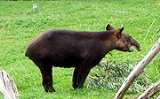
The
Mountain Tapir (
Tapirus pinchaque) is the smallest of the four
speciesIn biology, a species is:* a taxonomic rank or* a unit at that rank ....
of
tapirA tapir is a large browsing mammal, roughly pig-like in shape, with a short, prehensile snout. Tapirs inhabit jungle and forest regions of South America, Central America, and Southeast Asia. There are four species of Tapirs, being the Brazilian tapir, the Malayan tapir, Baird's tapir and the...
and is the only one to live outside of tropical
rainforestRainforests are forests characterized by high rainfall, with definitions setting minimum normal annual rainfall between 1750–2000 mm . The monsoon trough, alternately known as the intertropical convergence zone, plays a significant role in creating Earth's tropical rain forests.From 40 to 75%...
s in the wild.
The Mountain Tapir is referred to as
Sacha Huagra by
QuechuaQuechua is a Native American language family spoken primarily in the Andes of South America, derived from an original common ancestor language, Proto-Quechua. It is the most widely spoken language family of the indigenous peoples of the Americas, with a total of probably some 6 to 8 million speakers...
speakers,
dantaDanta is a village in Rajasthan, India. Danta Fort is a historical site near the village....
cordillerana (cordilleran tapir) and
danta lanuda (woolly tapir) by Spanish-speakers in
ColombiaColombia , officially the Republic of Colombia , is a constitutional republic in northwestern South America. Colombia is bordered to the east by Venezuela and Brazil; to the south by Ecuador and Peru; to the north by the Caribbean Sea; to the northwest by Panama; and to the west by the Pacific Ocean...
,
danta negra (black tapir) by Spanish-speaking
EcuadorEcuador , officially the Republic of Ecuador , literally, "Republic of the equator") is a representative democratic republic in South America, bordered by Colombia on the north, Peru on the east and south, and by the Pacific Ocean to the west. It is one of only two countries in South America that...
ians, and
tapir de altura (tapir of the heights) or
gran bestia (large beast) by Spanish-speaking
PeruPeru , officially the Republic of Peru , is a country in western South America. It is bordered on the north by Ecuador and Colombia, on the east by Brazil, on the southeast by Bolivia, on the south by Chile, and on the west by the Pacific Ocean.Peruvian territory was home to the Norte Chico...
vians.
The species name comes from the term
"La Pinchaque", an imaginary beast said to inhabit the same regions as the Mountain Tapir.
The Mountain Tapir is most easily recognized by its wooly coat (it is sometimes referred to as the
wooly tapir) and its white lower lip.
Mountain Tapirs may have greyish-black or brown coats, often depending on where they live, and often the hair around their cheeks is lighter.
Adults are usually around 1.8 meters (6 feet) in length and 0.75 to 1 meter (2.5 to 3 feet) in height.
The
Mountain Tapir (
Tapirus pinchaque) is the smallest of the four
speciesIn biology, a species is:* a taxonomic rank or* a unit at that rank ....
of
tapirA tapir is a large browsing mammal, roughly pig-like in shape, with a short, prehensile snout. Tapirs inhabit jungle and forest regions of South America, Central America, and Southeast Asia. There are four species of Tapirs, being the Brazilian tapir, the Malayan tapir, Baird's tapir and the...
and is the only one to live outside of tropical
rainforestRainforests are forests characterized by high rainfall, with definitions setting minimum normal annual rainfall between 1750–2000 mm . The monsoon trough, alternately known as the intertropical convergence zone, plays a significant role in creating Earth's tropical rain forests.From 40 to 75%...
s in the wild.
The Mountain Tapir is referred to as
Sacha Huagra by
QuechuaQuechua is a Native American language family spoken primarily in the Andes of South America, derived from an original common ancestor language, Proto-Quechua. It is the most widely spoken language family of the indigenous peoples of the Americas, with a total of probably some 6 to 8 million speakers...
speakers,
dantaDanta is a village in Rajasthan, India. Danta Fort is a historical site near the village....
cordillerana (cordilleran tapir) and
danta lanuda (woolly tapir) by Spanish-speakers in
ColombiaColombia , officially the Republic of Colombia , is a constitutional republic in northwestern South America. Colombia is bordered to the east by Venezuela and Brazil; to the south by Ecuador and Peru; to the north by the Caribbean Sea; to the northwest by Panama; and to the west by the Pacific Ocean...
,
danta negra (black tapir) by Spanish-speaking
EcuadorEcuador , officially the Republic of Ecuador , literally, "Republic of the equator") is a representative democratic republic in South America, bordered by Colombia on the north, Peru on the east and south, and by the Pacific Ocean to the west. It is one of only two countries in South America that...
ians, and
tapir de altura (tapir of the heights) or
gran bestia (large beast) by Spanish-speaking
PeruPeru , officially the Republic of Peru , is a country in western South America. It is bordered on the north by Ecuador and Colombia, on the east by Brazil, on the southeast by Bolivia, on the south by Chile, and on the west by the Pacific Ocean.Peruvian territory was home to the Norte Chico...
vians.
The species name comes from the term
"La Pinchaque", an imaginary beast said to inhabit the same regions as the Mountain Tapir.
General Appearance and Characteristics
The Mountain Tapir is most easily recognized by its wooly coat (it is sometimes referred to as the
wooly tapir) and its white lower lip.
Mountain Tapirs may have greyish-black or brown coats, often depending on where they live, and often the hair around their cheeks is lighter.
Adults are usually around 1.8 meters (6 feet) in length and 0.75 to 1 meter (2.5 to 3 feet) in height. They typically weigh between 150 and 225 kilograms (325 to 500 pounds). The females are more
often larger than the males, but usually the sexes are indistinguishable by size. Like the other types of tapir, they have small stubby tails and long, flexible
proboscisIn general, a proboscis is an elongated appendage from the head of an animal, either a vertebrate or an invertebrate..-Etymology:...
es. They have four toes on each front foot and three toes on each back foot.
Life Cycle
The
gestationGestation is the carrying of an embryo or fetus inside a female viviparous animal. Mammals duringpregnancy can have one or more gestations at the same time ....
period of the Mountain Tapir is approximately 400 days, after which a single offspring is born. It is very rare for more than one young to be born at once. The newborn young weighs about 7 kilograms (15 pounds) and, like all species of tapir, has a reddish-brown coat with white spots and stripes. However, like the adults of their species, baby Mountain Tapirs have wooly fur to help keep them warm. The immature coloration fades after about a year, around the time when the young animal is weaned. Mountain Tapirs reach
sexual maturitySexual maturity is the age or stage when an organism can reproduce. It is sometimes considered synonymous with adulthood, though the two are distinct...
at age three and can live up to 30 years.
Behavior
When around other members of their species, Mountain Tapirs communicate through high-pitched whistles, and the males occasionally fight over estrous females by trying to bite each other’s rear legs. But for the most part, Mountain Tapirs are shy and lead solitary lives, spending their waking hours foraging for food on their own along well-worn tapir paths. Despite their bulk, they travel easily through dense foliage, up the steep slopes of their hilly habitat, and in water, where they often wallow and swim. The Mountain Tapir is primarily active from sundown to sunup when it forages for tender plants to eat, and it sleeps for much of the day. When trying to access high plants, it will sometimes rear up on its hind legs to reach and then grab with its prehensile snout. It also seeks out natural
salt lickA salt lick is a salt deposit that animals regularly lick. In an ecosystem, salt/mineral licks often occur naturally, providing the sodium, calcium, iron, phosphorus and zinc required in the springtime for bone, muscle and other growth in deer and other wildlife, such as moose, elephants, cattle,...
s to satisfy its need for essential
mineralA mineral is a naturally occurring solid formed through geological processes that has a characteristic chemical composition, a highly ordered atomic structure, and specific physical properties. A rock, by comparison, is an aggregate of minerals and/or mineraloids, and need not have a specific...
s. Though its eyesight is lacking, it gets by with its keen senses of smell and taste, as well as the sensitive bristles on its proboscis.
Male Mountain Tapirs will frequently mark their territory with
dungDung may refer to:* Dung, animal feces* Dung, Doubs, a commune in the Doubs department in France* Mundungus "Dung" Fletcher, a character in Harry Potter* Dung beetle...
piles,
urineUrine is a liquid waste product of the body secreted by the kidneys by a process of filtration from blood called urination and excreted through the urethra. Cellular metabolism generates numerous waste compounds, many rich in nitrogen, that require elimination from the bloodstream...
, and rubbings on trees, and females will sometimes engage in these behaviors as well. The territories of individuals usually overlap, with each animal claiming over 8 square kilometers (3 square miles).
Habitat
The Mountain Tapir is found in the
cloud forestA cloud forest, also called a fog forest, is a generally tropical or subtropical evergreen montane moist forest characterized by a high incidence of low-level cloud cover, usually at the canopy level. Cloud forests often exhibit an abundance of mosses covering the ground and vegetation, in which...
s and
páramoPáramo is a neotropical ecosystem. It is located in the high elevations, between the upper forest line and the permanent snow line . The ecosystem consists of accidented, mostly glacier formed valleys and plains with a large variety of lakes, peat bogs and wet grasslands intermingled with...
of the
AndesThe Andes are the world's longest exposed mountain range. They lie as a continuous chain of highland along the western coast of South America...
in Colombia, Ecuador and north of Peru. In Peru is protected in the National Sanctuary Tabaconas Namballe. The species needs continuous stretches of cloud forest and paramo, rather than isolated patches, to successfully breed and maintain a healthy population, and this obstacle is a major concern for
conservationistConservationists are proponents or advocates of the ethic of conservation and may be part of the conservation movement.Conservationists advocate for the protection of all the species in an ecosystem with a strong focus on the natural environment...
s trying to protect the endangered animal. The Mountain Tapir lives at elevations of 1,950 to 4,400 meters (approximately 6,400 to 14,400 feet), and since at this altitude temperatures routinely fall below freezing, the animal’s wooly coat is essential.
During the
wet seasonThe wet season, or rainy season, is the time of year, covering one or more months, when most of the average annual rainfall in a region falls. The term green season is also sometimes used as a euphemism by tourist authorities. Areas with wet seasons are dispersed across portions of the tropics...
, Mountain Tapirs tend to inhabit the forests of the Andes, while during the drier months, they move to the
páramoPáramo is a neotropical ecosystem. It is located in the high elevations, between the upper forest line and the permanent snow line . The ecosystem consists of accidented, mostly glacier formed valleys and plains with a large variety of lakes, peat bogs and wet grasslands intermingled with...
where there are fewer biting
insectInsects are arthropods, having a hard exoskeleton, a three-part body , three pairs of jointed legs, compound eyes, and two antennae. They are the most diverse group of animals on the planet and include more than a million species that are already described. Insects represent more than half of all...
s to pester them.
Vulnerability
The Mountain Tapir is the most threatened of the four tapir species, classified as "Endangered" by the IUCN in 1996. Some scientists predict that the species could be extinct as early as 2014. There may be only 2,500 individuals left in the wild today, making it all the more difficult for scientists to study them. There are also very few individuals found in zoos. Only a handful of breeding pairs of this species exists in captivity in the world — at the Los Angeles Zoo, the Cheyenne Mountain Zoo in Colorado Springs, and, as of 2006, the San Francisco Zoo. None are in captivity in the home range countries. The total of 9 individuals in captivity are descendants of just 2 founder animals. This represents a distinct lack of genetic diversity and may not bode well for their continued existence in captivity. The three zoos that house this species are working to ensure that the remaining wild populations of mountain tapirs are protected. In the wild, this tapir is hunted by the
JaguarThe Jaguar, Panthera onca, is a big cat, a feline in the Panthera genus. It is the only Panthera species found in the Americas. The jaguar is the third-largest feline after the tiger and the lion, and the largest and most powerful feline in the Western Hemisphere...
and the Cougar, but
deforestationDeforestation is the clearance of naturally occurring forests by the processes of logging and/or burning of trees in a forested area. There are several reasons deforestation occurs: trees or derived charcoal can be sold as a commodity and used by humans, while cleared land is used as pasture,...
for agricultural purposes and
poachingPoaching is the illegal hunting, fishing, trapping, or eating of wild plants or animals contrary to local and international conservation and wildlife management laws...
are the main threats to the species.
Video/Multimedia
External links