
All Topics  
Caecilian

 
Caecilian

   Email Print
   Bookmark   Link


Caecilian


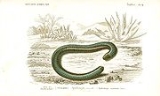
The caecilians are an order (Gymnophiona or Apoda) of amphibians that superficially resemble earthworm
Earthworm

Earthworm is the common name for the largest members of Oligochaeta in the phylum Annelida. The earthworm is the most known worm in America, and other countries....
s or snake
Snake

Snakes are elongate legless carnivore reptiles of the suborder Serpentes that can be distinguished from legless lizards by their lack of eyelids and external ears....
s. They mostly live hidden in the ground, which makes them the least explored order of amphibians, and widely unknown.

ilians completely lack limbs
Tetrapod

Tetrapods are vertebrate animals having four feet, legs or leglike appendages. Amphibians, reptiles, dinosaurs/birds, and mammals are all tetrapods, and even the limbless snakes are tetrapods by descent....
, making the smaller species resemble worms, while the larger species with lengths up to resemble snakes. The tail
Tail

The tail is the section at the rear end of an animal's body; in general, the term refers to a distinct, flexible appendage to the torso. It is the part of the body that corresponds roughly to the sacrum and coccyx in mammals and birds....
 is short or absent, and the cloaca
Cloaca

In zoological anatomy, a cloaca is the posterior opening that serves as the only such opening for the alimentary tract and urinary tract of certain animal species....
 is near the end of the body.

Their skin
Skin

The skin is the outer covering of the body, also known as the epidermis. It is the largest organ of the integumentary system made up of multiple layers of epithelial biological tissue, and guards the underlying muscles, bones, ligaments and organ s....
 is smooth and usually dark-matte, but some species have colorful skins.


Discussion
Ask a question about 'Caecilian'
Start a new discussion about 'Caecilian'
Answer questions from other users
Full Discussion Forum


Recent Posts


Encyclopedia


The caecilians are an order (Gymnophiona or Apoda) of amphibians that superficially resemble earthworm
Earthworm

Earthworm is the common name for the largest members of Oligochaeta in the phylum Annelida. The earthworm is the most known worm in America, and other countries....
s or snake
Snake

Snakes are elongate legless carnivore reptiles of the suborder Serpentes that can be distinguished from legless lizards by their lack of eyelids and external ears....
s. They mostly live hidden in the ground, which makes them the least explored order of amphibians, and widely unknown.

Anatomy

Caecilians completely lack limbs
Tetrapod

Tetrapods are vertebrate animals having four feet, legs or leglike appendages. Amphibians, reptiles, dinosaurs/birds, and mammals are all tetrapods, and even the limbless snakes are tetrapods by descent....
, making the smaller species resemble worms, while the larger species with lengths up to resemble snakes. The tail
Tail

The tail is the section at the rear end of an animal's body; in general, the term refers to a distinct, flexible appendage to the torso. It is the part of the body that corresponds roughly to the sacrum and coccyx in mammals and birds....
 is short or absent, and the cloaca
Cloaca

In zoological anatomy, a cloaca is the posterior opening that serves as the only such opening for the alimentary tract and urinary tract of certain animal species....
 is near the end of the body.

Their skin
Skin

The skin is the outer covering of the body, also known as the epidermis. It is the largest organ of the integumentary system made up of multiple layers of epithelial biological tissue, and guards the underlying muscles, bones, ligaments and organ s....
 is smooth and usually dark-matte, but some species have colorful skins. Inside the skin are calcite
Calcite

Calcite is a Carbonate minerals and the most stable Polymorphism of calcium carbonate . The other polymorphs are the minerals aragonite and vaterite....
 scales
Scale (zoology)

In most biology nomenclature, a scale is a small rigid plate that grows out of an animal's skin to provide protection. In lepidopteran species, scales are plates on the surface of the insect wing, and provide coloration....
. Because of these scales, the caecilians were once thought to be related to the fossil Stegocephalia
Stegocephalia

Stegocephalia is an old term for early amphibians, comprising all pre-Jurassic and some later extinct large amphibians of more or less salamander-like build....
, but they are now believed to be a secondary development, and the two groups are most likely unrelated.

The skin also has numerous ring-shaped folds, or annuli, that partially encircle the body, giving them a segmented appearance. Like other living amphibians, the skin contains glands that secrete a toxin to discourage predators. The skin secretions of Siphonops paulensis have been shown to have hemolytic properties.

Caecilian anatomy is highly adapted for a burrowing lifestyle. They have a strong skull, with a pointed snout used to force their way through soil or mud. In most species, the number of bones in the skull are reduced and fused together, and the mouth is recessed under the head. Their muscles are adapted to pushing their way through the ground, with the skeleton and deep muscles acting as a piston inside the skin and outer muscles. This allows the animal to anchor its hind end in position, and force the head forwards, and then pull the rest of the body up to reach it in waves. In water or very loose mud, caecilians instead swim in an eel-like fashion. Caecilians in the family Typhlonectidae
Typhlonectidae

Typhlonectidae, also known as Aquatic caecilians or Rubber eels, is a group of Gymnophiona amphibians found in South America.They are viviparous animals, giving birth to young that possess external gills....
 are aquatic as well as being the largest of their kind. The representatives of this family have a fleshy fin running along the rear section of their body, which enhanced propulsion in water.

All but the most primitive caecilians have two sets of muscles for closing the jaw, compared with the single pair found in all other vertebrates. These are more highly developed in the most efficient burrowers among the caecilians, and appear to help keep the skull and jaw rigid.

Owing to their underground life, the eye
Eye

Eyes are Organ that detect light, and send signals along the optic nerve to the visual system and other areas of the brain. Complex optical systems with resolving power have come in ten fundamentally different forms, and 96% of animal species possess a complex optical system....
s are small and covered by skin for protection, which has led to the misconception that they are blind. This is not strictly true, although their sight is limited to simple dark-light perception. All caecilians possess a pair of tentacles, located between their eyes and nostrils. These are probably used for a second olfactory capability
Olfaction

Olfaction refers to the sense of smell. This sense is mediated by specialized sensory cells of the nasal cavity of vertebrates, and, by analogy, sensory cells of the antennae of invertebrates....
, in addition to the normal sense of smell based in the nose.

Except for one lungless species — Atretochoana eiselti
Atretochoana eiselti

Atretochoana eiselti is a species of amphibian in the Caeciliidae family. It is notable for having no lungs and is the only lungless caecilian....
, only known from two specimens collected in South America — all caecilians have lung
Lung

The lung is the essential respiration organ in air-breathing animals, including most tetrapods, a few fish and a few snails. In mammals and the more complex life forms, the two lungs are located in the chest on either side of the heart....
s, but also use the skin or the mouth for oxygen
Oxygen

Oxygen no O2 produced; 2) O2 produced, but absorbed in oceans & seabed rock; 3) O2 starts to gas out of the oceans, but is absorbed by land surfaces and formation of ozone layer; 4-5) O2 sinks filled and the gas accumulates]]...
 absorption. Often the left lung is much smaller than the right one, an adaptation to body shape that is also found in snakes.

Distribution

Caecilians are found in most of the tropical regions of South-East Asia, Africa, the Seychelles
Seychelles

Seychelles , officially the Republic of Seychelles , is an archipelago Country of 115 islands in the Indian Ocean, some east of mainland Africa, northeast of the island of Madagascar....
 islands and South America, except the dry areas and high mountains. In South America their distribution extends well into the temperate zone in the north of Argentina. They can be seen as far south as Buenos Aires
Buenos Aires

Buenos Aires is the Capital and largest city of Argentina. It is located on the southern shore of the R?o de la Plata, on the southeastern coast of the South American continent....
, when they are carried by the flood waters of the Parana river
Paraná River

This article is about the second-longest river in South America: For the shorter river in Goi?s, central Brazil, see Paran? RiverThe Paran? River is a river in south central South America, running through Brazil, Paraguay and Argentina over a course of some 2,570 kilometers ....
 coming from farther north. No studies have been made in central Africa, but it is likely that caecilians are found in the tropical rainforests there. The northernmost distribution is of the species Ichthyophis sikkimensis of Northern India. In Africa caecilians are found from Guinea Bissau (Geotrypetes) to Northern Zambia (Scolecomorphus). In South-East Asia, they do not cross the Wallace-Line, and they are not found in Australia or the islands in between. Ichthyophis
Ichthyophis

Ichthyophis or Asian Caecilians is a genus of Caecilians localized in Southeastern Asia, southern Philippines, and western Indo-Australian Archipelago....
 is also found in South China and North Vietnam. They are also found in New Zealand.

Reproduction

Caecilians are the only order of amphibians which only use internal insemination. The male caecilians have a penis
Penis

The penis is an external sex organ of certain biologically male organisms, in both vertebrates and invertebrates.The penis is a reproductive organ, technically an intromittent organ, and for Eutheria, additionally serves as the external organ of urination....
-like organ, the phallodeum, which is inserted into the cloaca of the female for 2 to 3 hours. About 25% of the species are oviparous (egg-laying); the eggs are guarded by the female. For some species the young caecilians are already metamorphosed when they hatch; others hatch as larvae. The larvae are not fully aquatic, but spend the daytime in the soil near the water.

75% of the species are viviparous, meaning that they give birth to already developed offspring. The fetus is fed inside the female with cells of the oviduct
Oviduct

In oviparous animals , the passage from the ovary to the outside of the body is known as the oviduct. The eggs travel along the oviduct. These eggs will either be fertilized by sperm to become a zygote, or will degenerate in the body....
, which they eat with special scraping teeth.

The egg laying species Boulengerula taitanus feeds its young by developing an outer layer of skin, high in fat and other nutrients, which the young peel off with similar teeth. This allows them to grow by up to ten times their own weight in a week. The skin is consumed every three days, the time it takes for a new layer to grow, and the young have only been observed to eat it at night. It was previously thought that the juveniles subsisted on a liquid secretion from their mother.

Some larvae, such as those of Typhlonectes
Typhlonectes

Typhlonectes is a genus of amphibian in the Caeciliidae family.It contains the following species:* Typhlonectes compressicauda*
Typhlonectes cunhai...
, are born with enormous external gills which are shed almost immediately. Ichthyophis is oviparous and known to show maternal care, with the mother guarding the eggs until they hatch.

Etymology

The name caecilian derives from the Latin word caecus = blind
Blindness

Blindness is the condition of lacking visual perception due to physiological or neurological factors.Various scales have been developed to describe the extent of vision loss and define "blindness." Total blindness is the complete lack of form and visual light perception and is clinically recorded as "NLP," an abbreviation for "no ligh...
, referring to the small or sometimes non-existing eyes. The name dates back to the taxonomic name of the first species described by Carolus Linnaeus
Carolus Linnaeus

Carl Linnaeus was a Sweden botanist, physician, and zoologist, who laid the foundations for the modern scheme of binomial nomenclature. He is known as the father of modern alpha taxonomy, and is also considered one of the fathers of modern ecology....
, which he gave the name Caecilia tentaculata. The taxonomic name of the order derives from the Greek words ??µ??? (gymnos, naked) and ?f?? (ophis, snake), as the caecilians were originally thought to be related to snakes.

Taxonomy

Caecilian
Taxonomically the caecilians are divided into 6 families. The species numbers are approximate and many of these species are identified on the basis of only one specimen. It is almost certain that not all species have been described yet, and that some of the species described below as different may be combined into one species in future reclassifications.
  • Beaked Caecilians (Rhinatrematidae
    Rhinatrematidae

    Rhinatrematidae is the family of neotropical tailed caecilians or beaked caecilians. Members of the family are found in the equatorial countries of South America....
    ) - 2 genera, 9 species
  • Fish Caecilians (Ichthyophiidae
    Ichthyophiidae

    Ichthyophiidae is the family of Asiatic tailed caecilians or fish caecilians. They are found in south-east Asia.They are primitive caecilians, lacking many of the derived characters found in the other families....
    ) - 2 genera, 39 species
  • Indian Caecilians (Uraeotyphlidae
    Uraeotyphlidae

    Uraeotyphlidae is the family of Indian caecilians. There are six species of caecilians in the single genus Uraeotyphlus, found in the Western Ghats in Kerala State, peninsular India....
    ) - 1 genus, 5 species
  • Tropical Caecilians (Scolecomorphidae
    Scolecomorphidae

    Scolecomorphidae is the Family of tropical caecilians or African caecilians . They are found in Cameroon in west Africa, and Malawi and Tanzania in east Africa....
    ) - 2 genera, 6 species
  • Aquatic Caecilians (Typhlonectidae
    Typhlonectidae

    Typhlonectidae, also known as Aquatic caecilians or Rubber eels, is a group of Gymnophiona amphibians found in South America.They are viviparous animals, giving birth to young that possess external gills....
    ) - 5 genera, 13 species
  • Common Caecilians (Caeciliidae
    Caeciliidae

    Caeciliidae is the Family of common caecilians. They are found in central and south America, equatorial Africa and India. Like other caecilians, they superficially resemble worms or snakes....
    ) - 26 genera, 99 species


Evolution


Little is known of the evolutionary history of the caecilians, which have left almost no fossil record. What few fossils exist suggest that they have changed little in millions of years. The earliest fossil known comes the Jurassic
Jurassic

The Jurassic is a geologic period that extends from about annum to  Ma, that is, from the end of the Triassic to the beginning of the Cretaceous....
 period. This primitive genus, Eocaecilia
Eocaecilia

Eocaecilia micropodia is an extinct species of caecilian . It shared some characteristics with salamanders and the now extinct Microsauria....
, had small legs and well-developed eyes.

External links