
All Topics  
Coati

 
Coati

   Email Print
   Bookmark   Link


Coati


The coati, genera Nasua and Nasuella, also known as the hog-nosed coon, snookum bear, and the Brazilian Aardvark, is a member of the raccoon
Raccoon

Procyon is a genus of nocturnal mammals, comprising three species commonly known as raccoons, in the family Procyonidae. The most widespread species, the Raccoon , is often known simply as "the" raccoon, as the two other raccoon species in the genus are native only to the tropics and are considerably lesser-known....
 family (Procyonidae
Procyonidae

Procyonidae is a New World family of the order Carnivora. It includes the Procyon s, coatis, kinkajous, olingos, Ring-tailed_Cats and cacomistles....
); a diurnal mammal native to South
South America

South America is the southern continent of the Americas, situated entirely in the Western Hemisphere and mostly in the Southern Hemisphere, with a relatively small portion in the Northern Hemisphere....
, Central
Central America

Central America is a central geography region of the Americas. It is the southernmost, isthmus portion of the North American continent, which connects with South America on the southeast....
, and south-western North America
North America

North America is the northern continent of the Americas, situated in the Earth's northern hemisphere and almost totally in the western hemisphere....
. The word "coatimundi" is a commonly used misnomer applied to solitary adult male N. nasua. The term is reported to be derived from the Tupi language
Tupian languages

The Tupi or Tupian language family comprises some 70 languages spoken in South America, of which the best known are Old Tupi and Guarani language....
 (Brazil). Reports that this term is from the Guaraní language
Guaraní language

Guaran? is an indigenous language of South America that belongs to the Tup?-Guaran? subfamily of the Tupian languages. It is one of the official languages of Paraguay , where it is spoken by 94% of the population....
 are likely untrue.

Physical characteristics
Adult coatis measure 33 to 69 cm (13 to 27 inches) from head to the base of the tail, which can be as long as their bodies.


Discussion
Ask a question about 'Coati'
Start a new discussion about 'Coati'
Answer questions from other users
Full Discussion Forum


Encyclopedia


The coati, genera Nasua and Nasuella, also known as the hog-nosed coon, snookum bear, and the Brazilian Aardvark, is a member of the raccoon
Raccoon

Procyon is a genus of nocturnal mammals, comprising three species commonly known as raccoons, in the family Procyonidae. The most widespread species, the Raccoon , is often known simply as "the" raccoon, as the two other raccoon species in the genus are native only to the tropics and are considerably lesser-known....
 family (Procyonidae
Procyonidae

Procyonidae is a New World family of the order Carnivora. It includes the Procyon s, coatis, kinkajous, olingos, Ring-tailed_Cats and cacomistles....
); a diurnal mammal native to South
South America

South America is the southern continent of the Americas, situated entirely in the Western Hemisphere and mostly in the Southern Hemisphere, with a relatively small portion in the Northern Hemisphere....
, Central
Central America

Central America is a central geography region of the Americas. It is the southernmost, isthmus portion of the North American continent, which connects with South America on the southeast....
, and south-western North America
North America

North America is the northern continent of the Americas, situated in the Earth's northern hemisphere and almost totally in the western hemisphere....
. The word "coatimundi" is a commonly used misnomer applied to solitary adult male N. nasua. The term is reported to be derived from the Tupi language
Tupian languages

The Tupi or Tupian language family comprises some 70 languages spoken in South America, of which the best known are Old Tupi and Guarani language....
 (Brazil). Reports that this term is from the Guaraní language
Guaraní language

Guaran? is an indigenous language of South America that belongs to the Tup?-Guaran? subfamily of the Tupian languages. It is one of the official languages of Paraguay , where it is spoken by 94% of the population....
 are likely untrue.

Physical characteristics


Adult coatis measure 33 to 69 cm (13 to 27 inches) from head to the base of the tail, which can be as long as their bodies. Coatis are about 30 cm (12 inches) tall at the shoulder, and weigh between 3 and 8 kg (between 6 and 18 pounds), about the size of a large housecat
Cat

The cat , also known as the Domestication cat or house cat to distinguish it from other Felinae and Felidae, is a small predationy carnivore species of crepuscular mammal that is valued by humans for its companionship and its ability to hunt vermin, snakes, scorpions, and other unwanted household pests....
. Males can become almost twice as large as females and have large, sharp canine teeth.

All coatis share a slender head with an elongated, flexible, slightly upward-turned nose, small ears, dark feet, and a long, non-prehensile
Prehensility

Prehensility is the quality of an appendage or organ that has Adaptation for grasping or holding. The word is derived from the Latin term prehendere, meaning "to grasp."...
 tail used for balance and signaling.

Ring-tailed coatis have either a light brown or black coat, with a lighter under-part and a white-ringed tail in most cases. Coatis have a long brown tail with rings on it which are anywhere from starkly defined like a raccoon's to very faint. Like the raccoons and unlike ringtails and cacomistles, the rings go completely around the tail. Coatis often hold the tail erect, and it used as such to keep troops of coatis together in tall vegetation. The tip of the tail can be moved a bit on its own, as is the case with cats, but it is not prehensile as is that of the kinkajou
Kinkajou

The kinkajou , also known as the honey bear, is a rainforest mammal of the family Procyonidae related to the olingo, Ring-tailed Cat, cacomistle, raccoon, and coati....
, another procyonid. Coatis are known for dipping their nose into substances with certain smells like soap, perfume, et cetera and then rubbing it into their tail. It is not known if this is more or less common in the wild. The tail position may also signal mood and willingness to be approached by other coatis.

The coati has bear- and raccoon-like paws, and coatis, raccoons, and bears walk plantigrade
Plantigrade

In mammals, plantigrade locomotion means walking with the podials and metatarsals flat on the ground.Primates are examples of plantigrade species; in humans, the podials and metatarsals constitute the sole of the foot....
 (on the soles of the feet, as do people). Coatis have non-retractable claws. Coatis also have in common with raccoons and other procyonids (and others in the order Carnivora and rare cases amongst other mammals) double-jointed and ankles rotatable beyond 180° and therefore the ability to descend trees head-first. Other animals living in forests have acquired some or all of these properties through convergent evolution
Convergent evolution

Convergent evolution describes the acquisition of the same biological trait in unrelated lineages.The wing is a classic example of convergent evolution in action....
, including members of the mongoose
Mongoose

A mongoose is a member of the family Herpestidae , a family of small, cat-like Carnivoras.The word mongoose is derived from the Marathi language name mangus "mongoose", perhaps ultimately from Dravidian languages ....
, civet
Civet

The family Viverridae is made up of 35 species, including all of the genet , the Binturong, most of the civets, and the four linsangs.Viverrids are native to most of the Old World tropics, nearly all of Africa , Madagascar, and the Iberian Peninsula....
, ferret-skunk, cat, and bear families. Some of these animals walk on the toes of the front paws and soles of the back paws.

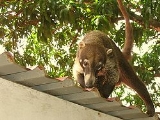
The coati snout is long and somewhat pig-like and extremely flexible and can be rotated up to 60 degrees in any direction, the former being part of the reason for its nickname the hog-nosed raccoon. The nose is utilized to push objects and rub parts of their body.

The facial markings include white markings around the eyes and on the ears and snout.

Coatis have strong limbs to climb and dig, and have a reputation for intelligence, like their fellow procyonid
Procyonidae

Procyonidae is a New World family of the order Carnivora. It includes the Procyon s, coatis, kinkajous, olingos, Ring-tailed_Cats and cacomistles....
 the raccoon.

They prefer to sleep or rest in elevated places and niches, like the rainforest
Rainforest

Rainforests are forests characterized by high rainfall, with definitions setting minimum normal annual rainfall between 1750?2000 mm . The monsoon trough, alternately known as the intertropical convergence zone, plays a significant role in creating Earth's tropical rain forests....
 canopy
Canopy (forest)

Canopy refers to the aboveground portion of a plant community or crop, formed by Crown_.Canopy is also the term for the upper layer or zone of a forest, formed by Crown_ and including other biological organisms ....
, in crudely-built sleeping nests.

Habitat and range


The coati is a widespread species living in habitats ranging from hot and arid areas to humid Amazonian rainforests or even cold Andean mountain slopes, including grasslands and bushy areas. Their geographical range extends from southern Arizona
Arizona

The State of Arizona is a U.S. state located in the Southwestern United States of the United States. The capital and largest city is Phoenix, Arizona....
 in the USA
United States

The United States of America is a Federal government constitutional republic comprising U.S. state and a federal district. The country is situated mostly in central North America, where its Contiguous United States and Washington, D.C., the Capital districts and territories, lie between the Pacific Ocean and Atlantic Oceans, Borders of the U...
 through northern Argentina
Argentina

Argentina, officially the Argentine Republic , is a country in South America, constituted as a federation of 23 provinces and an autonomous city....
, and they are often seen in Costa Rica
Costa Rica

Costa Rica, officially the Republic of Costa Rica is a country in Central America, bordered by Nicaragua to the north, Panama to the east and south, the Pacific Ocean to the west and south and the Caribbean Sea to the east....
 and Mexico
Mexico

The United Mexican States , commonly known as Mexico , is a federalism constitutionalism republic in North America. It is bordered on the north by the United States; on the south and west by the Pacific Ocean; on the southeast by Guatemala, Belize, and the Caribbean Sea; and on the east by the Gulf of Mexico....
. The following species have been scientifically described:

  • South American Coati Nasua nasua
    South American Coati

    The South American Coati, or Ring-tailed Coati , is a species of coati from South America. It is native to Argentina, Bolivia, Brazil, Colombia, Ecuador, Guyana, Paraguay, Peru, Surinam, Uruguay and Venezuela....


  • Brown- or White-nosed Coati Nasua narica


  • Nelson's Coati Nasua nelsoni
    Cozumel Island Coati

    The Cozumel Island Coati is a coati from the Mexico island of Cozumel. It is in the family Procyonidae, which also includes raccoons, olingos, and Kinkajous....


  • Wedel's Coati Nasua wedeli


  • Mountain or Andean Coati Nasuella olivacea
    Mountain Coati

    The Mountain Coati or Dwarf coati is a small Procyonidae, the only member of the genus Nasuella, found in Colombia, Ecuador and Venezuela. It is not a true coati, but a considerably smaller and rarer animal....


The coati species cited above have different geographical occurrences and can be told apart by their size, build, voice, and their hide colour.

Genetic studies have shown that the closest relatives of the coatis are the olingo
Olingo

Olingos are small procyonidae that comprise the genus Bassaricyon, native to the rainforests of Central America and South America from Nicaragua to Peru....
s.

Lifespan


In the wild, coatis live for about 7 to 8 years, while in captivity they can live for up to 15 years.

Feeding habits


The coati is an omnivore
Omnivore

Omnivores are species that eating both plants and animals as their primary food source. They are opportunistic, general feeders not specifically adapted to eat and digest either meat or plant material exclusively....
; its diet consists mainly of ground litter invertebrate
Invertebrate

An invertebrate is an animal lacking a vertebral column. The group includes 98% of all animal species ? all animals except those in the Chordate subphylum vertebrate ....
s and fruit (Alves-Costa et al. 2004, 2007, Hirsch 2007). They also eat small vertebrate prey, such as lizard
Lizard

Lizards are a large and widespread group of squamate reptiles, with nearly 5,000 species, ranging across all continents except Antarctica as well as most oceanic island chains....
s, rodent
Rodent

Rodentia is an Order of mammals also known as rodents, characterised by two continuously growing Incisors#The_Rodent_incisor in the upper and lower jaws which must be kept short by gnawing....
s, small bird
Bird

Birds are wing, Bipedalismal, endothermic , vertebrate animals that lay egg . There are around 10,000 living species, making them the most numerous tetrapod vertebrates....
s, and bird's eggs. The snout, with a formidable sense of smell, assists the skilled paws in a hog-like manner to unearth invertebrates.

Behaviour


Unlike most members of the raccoon
Raccoon

Procyon is a genus of nocturnal mammals, comprising three species commonly known as raccoons, in the family Procyonidae. The most widespread species, the Raccoon , is often known simply as "the" raccoon, as the two other raccoon species in the genus are native only to the tropics and are considerably lesser-known....
 family (Procyonidae
Procyonidae

Procyonidae is a New World family of the order Carnivora. It includes the Procyon s, coatis, kinkajous, olingos, Ring-tailed_Cats and cacomistles....
), coatis are primarily diurnal. Coati females and young males up to 2 years of age are gregarious and travel through their territories in noisy, loosely-organized bands made up of 4 to 25 individuals, foraging with their offspring on the ground or in the forest's canopy. Males over 2 years become solitary due to behavioural disposition and collective aggression from the females, and will join the female groups only during the breeding season.

When provoked, or for defense, coatis can be fierce fighters: their strong jaws, sharp canine teeth, and fast scratching paws, along with a tough hide sturdily attached to the underlying muscles, make it very difficult for predators (e.g. dogs, jaguars) to seize the small mammal.

The coati communicates its intentions or moods with chirping, snorting, or grunting sounds. Different chirping sounds are used to express joy during social grooming, appeasement after fights, or to convey irritation or anger. Snorting while digging, along with an erect tail, states territorial or food claims during foraging.

Coatis additionally use special postures or moves to convey simple messages; for example, hiding the nose between the front paws as a sign for submission; lowering the head, baring teeth, and jumping at an enemy signal an aggressive disposition.

Individuals recognize other coatis by their looks, voices, and smells, the individual smell is intensified by special musk
Musk

Musk is the name originally given to a substance with a penetrating odor obtained from a gland of the male musk deer, which is situated between its stomach and genitals....
-glands on their necks and bellies.

Coatis from Panama
Panama

Panama, officially the Republic of Panama , is the southernmost country of Central America and, in turn, North America. Situated on an isthmus connecting North and South America, some categorize it as a transcontinental nation....
 are known to rub their own fur and that of other troop members with resin from Trattinnickia aspera trees. The purpose of this fur rubbing is unclear. Some possibilities that have been proposed are that it serves as an insect repellent, a fungicide, or as a form of scent-marking.

Reproduction


The coati's breeding season mainly corresponds with the start of the rainy season to coincide with maximum availability of food, especially fruits: between January and March in some areas, and between October and February in others. During the breeding season, an adult male is accepted into the band of females and juveniles near the beginning of the breeding season, leading to a polygynous mating system.

The pregnant females separate from the group, build a nest on a tree or in a rocky niche and, after a gestation period of about 11 weeks, give birth to litters
Litter (animal)

A litter is the offspring at one birth of animals from the same mother and usually from one set of parents. The word is most often used for the offspring of mammals, but can be used for any animal that gives birth to multiple young....
 of 3 to 7 young. About six weeks after birth, the females and their young will rejoin the band. Females become sexually mature at 2 years of age, while males will acquire sexual maturity at 3 years of age. Members of the coati band will follow the pregnant female and eat the young that are born.

Natural enemies


Natural enemies include jaguarundi
Jaguarundi

The jaguarundi is a medium-sized wild felidae that ranges from southern Texas in the United States south to South America. The average length is 65 cm with 45 cm of tail and a weight of about 6 kg ....
s, fox
Fox

A fox is an animal belonging to any one of about 27 species of small to medium-sized Canidae, characterized by possessing a long, narrow snout, and a bushy tail, or brush....
es, tayra
Tayra

The tayra , also known as the Tolomuco or Perico ligero in Central America, is an omnivore animal from the weasel family Mustelidae....
s, ocelot
Ocelot

The Ocelot , also known as the Painted Leopard, McKenney's Wildcat, Jaguatirica or Manigordo is a wild Felidae distributed over South America and Central America and Mexico, but has been reported as far north as Texas and in Trinidad, in the Caribbean....
s, jaguar
Jaguar

The jaguar, Panthera onca, is a New World Felidae and one of four "big cats" in the Panthera genus, along with the tiger, lion, and leopard of the Old World....
s, hawk
Hawk

The term hawk can be used in several ways:* In strict usage in Europe and Asia, to mean any of the species in the subfamily Accipitrinae, which comprises the genus Accipiter, Micronisus, Melierax, Urotriorchis and Megatriorchis....
s, eagle
Eagle

Eagles are large bird of prey which are members of the bird family Accipitridae, and belong to several Genus which are not necessarily closely related to each other....
s, and human
Human

A human being, also human or man, is a member of a species of bipedalism primates in the family Hominidae . Mitochondrial DNA evidence indicates that modern humans originated in east Africa about 200,000 years ago....
s .

Status


The coati faces unregulated hunting and the serious threat of environmental destruction in Central and South America. The absence of scientifically sound population studies of Nasua or Nasuella in the wild is probably leading to a severe underestimation of the ecological problems and decline in numbers affecting the species in Central and South America.

Successful adaptation to life in human proximity (e.g. similar to raccoons living in metropolitan areas in the U.S.) is very unlikely; the species is thus threatened by habitat destruction.

Coatis in captivity

Coatis are one of the four species of procyonids commonly kept as pets in various parts of North, Central, and South America, the others being the raccoon
Raccoon

Procyon is a genus of nocturnal mammals, comprising three species commonly known as raccoons, in the family Procyonidae. The most widespread species, the Raccoon , is often known simply as "the" raccoon, as the two other raccoon species in the genus are native only to the tropics and are considerably lesser-known....
 (Common and Crab-Eating), the kinkajou
Kinkajou

The kinkajou , also known as the honey bear, is a rainforest mammal of the family Procyonidae related to the olingo, Ring-tailed Cat, cacomistle, raccoon, and coati....
, and ringtail
Ringtail

The ringtail is a mammal of the Procyonidae, native to arid regions of Nearctic. It is also known as the ringtail cat, ring-tailed cat or miner's cat, and is also sometimes mistakenly called a "civet" ....
 or cacomistle
Cacomistle

The Cacomistle is a nocturnal, arboreal and omnivore member of the carnivoran family procyonidae. Its preferred habitats are wet, tropical evergreen woodlands and mountain forests, though seasonally it will range into drier deciduous forests....
 (also known as the miner's cat and ring-tailed cat).

The coati is a small creature that can be wild, somewhat difficult to control or train in some cases, and generally behaves in a manner radically different from that of a pet dog. Optimally they should have a spacious outdoor enclosure and a coati-proofed room in the house and/or other climate-controlled place as well. They can be given the run of the house but need careful watching, more careful in some cases than others.

It is possible to litter or toilet-train coatis; if one cannot be trained as such it is still possible to lessen problems in that they tend to designate a latrine area which can have a litter pan place in/under it as is done with many ferret
Ferret

The ferret is a Domestication mammal of the type Mustela putorius furo. Ferrets are sexually Sexual dimorphism predators with males being substantially larger than females....
s, pet skunk
Pet skunk

A pet skunk is a skunk kept by humans for companionship and enjoyment. Although capable of living indoors with humans similarly to dogs or cats, pet skunks are relatively rare, partly due to restrictive laws and the complexity of their care....
s, rabbit
Rabbit

Rabbits are small mammals in the family Leporidae of the order Lagomorpha, found in several parts of the world. There are seven different genus in the family taxonomy as rabbits, including the European rabbit , Cottontail rabbit , and the Amami rabbit ....
s, and rodents.

Coatis generally need both dog and cat vaccines for distemper and many other diseases and a killed rabies vaccine. They can be spayed or neutered for the same reason as cats and dogs and other pets.

Gallery