

Reptile

Encyclopedia
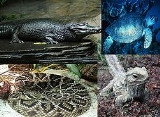
Reptiles are members of a class
of air-breathing, ectotherm
ic (cold-blooded) vertebrates which are characterized by laying shelled eggs (except for some vipers and constrictor snakes that give live birth), and having skin covered in scales
and/or scutes. They are tetrapod
s, either having four limbs or being descended from four-limbed ancestors. Modern reptiles inhabit every continent
with the exception of Antarctica, and four living orders
are currently recognized:
Reptiles originated around 320-310 million years ago during the Carboniferous
period, having evolved from advanced reptile-like amphibians
that became increasingly adapted to life on dry land. Unlike amphibians, reptiles do not have an aquatic larval stage. As a rule, reptiles are oviparous
(egg-laying), although certain species of squamates are capable of giving live birth. This is achieved by either ovoviviparity
(egg retention) or viviparity
(birth of offspring without the development of calcified eggs). Many of the viviparous species feed their fetus
es through various forms of placenta
analogous to those of mammal
s, with some providing initial care for their hatchlings. Extant reptiles range in size from a tiny gecko, Sphaerodactylus ariasae
, which can grow up to 1.7 cm (0.6 in) to the saltwater crocodile
, Crocodylus porosus, which may reach 6 m in length and weigh over 1,000 kg.
The study of reptiles and amphibians is called herpetology
.
s. Linnaeus, working from species-poor Sweden
, where the common adder and grass snake
are often found hunting in water, included all reptiles and amphibians in class
"III – Amphibia
" in his Systema Naturæ.
The terms "reptile" and "amphibian" were largely interchangeable, "reptile" (from Latin repere, "to creep") being preferred by the French.
Josephus Nicolaus Laurenti
was the first to formally use the term "Reptilia" for an expanded selection of reptiles and amphibians basically similar to that of Linnaeus. Today, it is still common to treat the two groups under the same heading as herptiles
.
 Not until the beginning of the 19th century did it become clear that reptiles and amphibians are in fact quite different animals, and Pierre André Latreille
erected the class Batracia (1825) for the latter, dividing the tetrapod
s into the four familiar classes of reptiles, amphibians, birds and mammals.
The British anatomist Thomas Henry Huxley made Latreille's definition popular, and together with Richard Owen
expanded Reptilia to include the various fossil “antediluvian
monsters”, including dinosaur
s and the mammal-like (synapsid
) Dicynodon
he helped describe. This was not the only possible classification scheme: In the Hunterian lectures delivered at the Royal College of Surgeons
in 1863, Huxley grouped the vertebrates into mammal
s, sauroids, and ichthyoids (the latter containing the fishes and amphibians). He subsequently proposed the names of Sauropsida
and Ichthyopsida for the two.
The terms "Sauropsida" ("lizard faces") and "Theropsida
" ("beast faces") were used again in 1916 by E.S. Goodrich
to distinguish between lizards, birds, and their relatives on the one hand (Sauropsida) and mammal
s and their extinct relatives (Theropsida) on the other. Goodrich supported this division by the nature of the hearts and blood vessels in each group, and other features such as the structure of the forebrain. According to Goodrich, both lineages evolved from an earlier stem group, Protosauria ("first lizards") which included some Paleozoic
amphibian
s as well as early reptiles.
In 1956 D.M.S. Watson observed that the first two groups diverged very early in reptilian history, and so he divided Goodrich's Protosauria between them. He also reinterpreted Sauropsida and Theropsida to exclude birds and mammals, respectively. Thus his Sauropsida included Procolophonia
, Eosuchia
, Millerosauria
, Chelonia
(turtles), Squamata
(lizards and snakes), Rhynchocephalia
, Crocodilia
, "thecodont
s" (paraphyletic
basal
Archosaur
ia), non-avian dinosaur
s, pterosaur
s, ichthyosaur
s, and sauropterygia
ns.
In 1866, Haeckel demonstrated that vertebrates could be divided based on their reproductive strategies, and that reptiles, birds and mammals were united by the amniotic egg. By the end of the 19th century, the class Reptilia had come to include all the amniote
s except bird
s and mammal
s. Thus reptiles were defined as the set of animal
s that includes the extant crocodile
s, alligator
s, tuatara
, lizard
s, snake
s, amphisbaenia
ns, and turtle
s, as well as fossil groups like dinosaurs, synapsid
s and the primitive pareiasaur
s. This is still the common definition of the term.
and elaborated and made popular by Romer
's classic Vertebrate Paleontology
. Those four subclasses were:
The composition of Euryapsida was uncertain. Ichthyosaurs were at times considered to have arisen independently of the other euryapsids, and given the older name Parapsida. Parapsida was later discarded as a group for the most part (ichthyosaurs being classified as incertae sedis
or with Euryapsida). However, the scheme with four (or three if Euryapsida is sunk into Diapsida) subclasses remained more or less universal for non-specialist work throughout the 20th century, and has only been challenged with the rising popularity of phylogenetic nomenclature
.
; that is, groups include all descendants of a particular ancestor. The reptiles as historically defined would be paraphyletic
, since they exclude both birds and mammals, although these also evolved from the original reptiles. Colin Tudge wrote:
Despite the early proposals for replacing the paraphyletic Reptilia for a monophyletic Sauropsida
, that term was never adopted widely or, when it was, applied consistently. When Sauropsida was used, it often had the same content or even the same definition as Reptilia. In 1988 Jacques Gauthier
proposed a cladistic
definition of Reptilia as a monophyletic node-based crown group
containing turtles, lizards and snakes, crocodilians, and birds, their common ancestor and all its descendants. Because the actual relationship of turtles to other reptiles was not yet well understood at this time, Gauthier's definition came to be considered inadequate. A variety of other definitions were proposed by other scientists in the years following Gauthier's paper. The first such new definition, which attempted to adhere to the standards of the PhyloCode
, was published by Modesto and Anderson in 2004. Modesto and Anderson reviewed the many previous definitions, and proposed a modified definition which they intended to retain most traditional content of the group while keeping it stable and monophyletic. They defined Reptilia as all amniotes closer to Lacerta agilis and Crocodylus niloticus than to Homo sapiens. This stem-based definition is equivalent to that of Sauropsida, which Modesto and Anderson synonymized with Reptilia, since the latter is more well known and more frequently used. Unlike most previous definitions of Reptilia, however, Modesto and Anderson's definition includes birds.
, with information on the relationships of the most primitive reptiles after Muller and Reisz (2006).

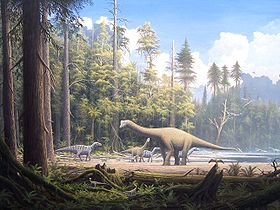
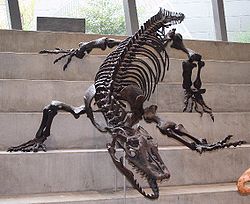 The origin of the reptiles lies about 320–310 million years ago, in the steaming swamps of the late Carboniferous
period, when the first reptiles evolved from advanced reptiliomorph
labyrinthodonts
.
The oldest known animal that may have been an amniote
, i.e. a primitive reptile rather than an advanced amphibian
is Casineria
.
A series of footprints from the fossil strata of Nova Scotia
, dated to 315 million years show typical reptilian toes and imprints of scales.
The tracks are attributed to Hylonomus
, the oldest unquestionable reptile known.
It was a small, lizard-like animal, about 20 to 30 cm (8–12 in) long, with numerous sharp teeth indicating an insectivorous diet. Other examples include Westlothiana
(for the moment considered a reptiliomorph amphibian
rather than a true amniote
) and Paleothyris
, both of similar build and presumably similar habit.
amphibians such as Cochleosaurus
, and remained a small, inconspicuous part of the fauna until the Carboniferous Rainforest Collapse
. This sudden collapse affected several large groups. Amphibians were particularly devastated, while reptiles fared better, being ecologically adapted to the drier conditions that followed. Amphibians must return to water to lay eggs; in contrast, reptiles - whose eggs have a hard shell and can therefore be laid on land - were better adapted to the new conditions. Reptiles acquired new niches at a faster rate than before the collapse and at a much faster rate than amphibians. They acquired new feeding strategies including herbivory and carnivory, previously only having been insectivores and piscivores. From this point forward, reptiles dominated communities and had a greater diversity than amphibians, setting the stage for the Mesozoic (known as the Age of Reptiles). One of the best known early reptiles is Mesosaurus
, a genus from the early Permian
that had returned to water, feeding on fish.
 The first reptiles were anapsid
s, having a solid skull with holes for only nose, eyes, spinal cord, etc. Very soon after the first reptiles appeared, they split into two branches. One branch, Synapsida (including both "mammal-like reptiles" and modern, extant mammals such as humans), had one opening in the skull roof
behind each eye; the other branch, Diapsid
a, possessed a hole in their skulls behind each eye, along with a second hole located higher on the skull. The function of the holes in both groups was to lighten the skull and give room for the jaw muscles to move, allowing for a more powerful bite. Diapsids and later anapsids are classed as the "true reptiles", Sauropsida
.
Turtles have been traditionally believed to be surviving anapsids, on the basis of their skull structure. The rationale for this classification has been disputed, with some arguing that turtles are diapsids that reverted to this primitive state in order to improve their armor (see Parareptilia
). Later morphological phylogenetic
studies with this in mind placed turtles firmly within Diapsida. All molecular studies have strongly upheld the placement of turtles within diapsids, most commonly as a sister group to extant archosaur
s.
, reptiles became the dominant tetrapod fauna. While the terrestrial reptiliomorph
labyrinthodonts still existed, the synapsids evolved the first truly terrestrial megafauna
(giant animals) in the form of pelycosaurs such as Edaphosaurus
and the carnivorous Dimetrodon
. In the mid-Permian period the climate turned dryer, resulting in a change of fauna: The pelycosaurs were replaced by the therapsids.
The anapsid reptiles, whose massive skull roof
s had no postorbital holes, continued and flourished throughout the Permian. The pareiasaur
s reached giant proportions in the late Permian, eventually disappearing at the close of the period (the turtles being possible survivors).
Early in the period, the diapsid reptiles split into two main lineages, the archosaurs (forefathers of crocodiles and dinosaurs) and the lepidosaurs
(predecessors of modern snakes, lizards, and tuatara
s). Both groups remained lizard-like and relatively small and inconspicuous during the Permian.
diapsids. The archosaurs were characterized by elongated hind legs and an erect pose, the early forms looking somewhat like long-legged crocodiles. The archosaurs became the dominant group during the Triassic
period, though it took 30 million years before their diversity was as great as the animals that lived in the Permian. Archosaurs developed into the well-known dinosaurs and pterosaurs, as well as crocodiles and phytosaur
s. Some of the dinosaurs developed into the largest land animals ever to have lived, making the Mesozoic era popularly known as the "Age of Reptiles". The dinosaurs also developed smaller forms, including the feather-bearing smaller theropods
. In the mid-Jurassic
period, these gave rise to the first birds.
The lepidosauromorph
diapsids may have been ancestral to the sea reptiles.
These reptiles developed into the sauropterygia
ns in the early Triassic and the ichthyosaur
s during the Middle Triassic. The mosasaurs also evolved in the Mesozoic era, emerging during the Cretaceous
period.
The therapsids came under increasing pressure from the dinosaurs in the early Mesozoic and developed into increasingly smaller and more nocturnal forms, the first mammals being the only survivors of the line by the late Jurassic
.
period saw the demise of the Mesozoic era reptilian megafauna (see the Cretaceous–Tertiary extinction event). Of the large marine reptiles, only sea turtle
s are left, and of the non-marine large reptiles, only the semi-aquatic crocodile
s and broadly similar Champsosaurus
survived the extinction, with the latter only going extinct in the Miocene
. Of the great host of dinosaurs dominating the Mesozoic, only the small feathered theropods
survived in the form of birds. This dramatic extinction pattern at the end of the “Age of Reptiles” led into the “Age of Mammals”. Mammals and birds filled the empty niches left behind by reptiles, and while reptile diversification slowed, bird and mammal diversification took an exponential turn.
After the extinction of most of the archosaurs at the end of the Cretaceous, reptile diversification continued throughout the Cenozoic, with squamates
undergoing a greater radiation than they did in the Mesozoic. Today squamates make up the majority of extant reptiles today (over 90%), most species being snakes. There are approximately 8,700 extant species of reptiles, compared with 5,400 species of mammals.
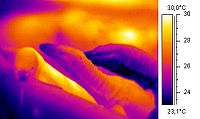 Most reptiles have a three-chambered heart
consisting of two atria, one variably partitioned ventricle
, and two aortas that lead to the systemic circulation
. The degree of mixing of oxygen
ated and deoxygenated blood in the three-chambered heart varies depending on the species and physiological state. Under different conditions, deoxygenated blood can be shunted back to the body or oxygenated blood can be shunted back to the lungs. This variation in blood flow has been hypothesized to allow more effective thermoregulation and longer diving times for aquatic species, but has not been shown to be a fitness
advantage.
There are some exceptions to the general physiology. For instance, crocodilia
ns have an anatomically four-chambered heart, but also have two systemic aortas and are therefore capable of bypassing only their pulmonary circulation
. Also, some snake and lizard species (e.g., pythons and monitor lizards) have three-chambered hearts that become functionally four-chambered hearts during contraction. This is made possible by a muscular ridge that subdivides the ventricle during ventricular diastole
and completely divides it during ventricular systole
. Because of this ridge, some of these squamates
are capable of producing ventricular pressure differentials that are equivalent to those seen in mammalian and avian hearts.
(i.e. some mix of poikilotherm
y, ectotherm
y, and bradymetabolism
). This means that most reptiles have limited physiological means of keeping the body temperature constant, and often rely on external sources of heat. Due to a less stable core temperature than bird
s and mammal
s, reptilian biochemistry requires enzymes capable of maintaining efficiency over a greater range of temperatures than warm-blooded
animals. The optimum body temperature range varies with species, but is typically below that of warm-blooded animals, in the 24°–35°C range for many lizards, while extreme heat adapted species like the American desert iguana
Dipsosaurus dorsalis can have optimal physiological temperatures in the mammalian range, between 35 and 40°C. While the optimum temperature is often encountered when the animal is active, the low basal metabolism makes body temperature drop rapidly when the animal is inactive.
Like in all animals, reptilian muscle action produces heat. In large reptiles, like leatherback turtles, the low surface to volume ratio allows this metabolically produced heat to keep the animals warmer than their environment, despite not having a warm-blooded
metabolism. This form of homeothermy is called gigantothermy
, and has been suggested as having been common in large dinosaurs and other extinct large-bodied reptiles.
The benefit of a low resting metabolism is that it requires far less fuel to sustain bodily functions. By using temperature variations in their surroundings or by remaining cold when they do not need to move, reptiles can save considerable amounts of energy compared to endotherm animals of the same size. A crocodile need from a fifth to a tenth of the food necessary for a lion
of the same weight, and can live half a year without eating. Lower food requirements and adaptive metabolisms allow reptiles to dominate the animal life in regions where net calorie
production is too low to sustain large-bodied mammals and birds.
It is generally assumed that reptiles are unable to produce the sustained high energy output necessary for long distance chases or flying. Higher energetic capacity might have been responsible for the evolution of warm-blooded
ness in birds and mammals. However, investigation of correlations between active capacity and thermophysiology
show a weak relationship. Most extant reptiles are carnivores with a sit-and-wait feeding strategy, and whether reptiles are cold blooded due to their ecology, or if their metabolism is a result of their ecology is not clear. Energetic studies on some reptiles have shown active capacities equal to, or greater than similar sized warm-blooded animals.
s. Aquatic turtle
s have developed more permeable skin, and some species have modified their cloaca
to increase the area for gas exchange
. Even with these adaptations, breathing is never fully accomplished without lung
s. Lung ventilation is accomplished differently in each main reptile group. In squamates
, the lungs are ventilated almost exclusively by the axial musculature. This is also the same musculature that is used during locomotion. Because of this constraint, most squamates are forced to hold their breath during intense runs. Some, however, have found a way around it. Varanids, and a few other lizard species, employ buccal pumping
as a complement to their normal "axial breathing." This allows the animals to completely fill their lungs during intense locomotion, and thus remain aerobically active for a long time. Tegu lizards are known to possess a proto-diaphragm
, which separates the pulmonary cavity from the visceral cavity. While not actually capable of movement, it does allow for greater lung inflation, by taking the weight of the viscera off the lungs. Crocodilia
ns actually have a muscular diaphragm that is analogous to the mammalian diaphragm. The difference is that the muscles for the crocodilian diaphragm pull the pubis (part of the pelvis, which is movable in crocodilians) back, which brings the liver down, thus freeing space for the lungs to expand. This type of diaphragmatic setup has been referred to as the "hepatic piston."
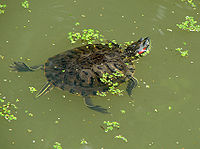 How turtles and tortoises
breathe has been the subject of much study. To date, only a few species have been studied thoroughly enough to get an idea of how turtles do it. The results indicate that turtles and tortoises have found a variety of solutions to this problem.
The difficulty is that most turtle shells are rigid and do not allow for the type of expansion and contraction that other amniotes use to ventilate their lungs. Some turtles such as the Indian flapshell (Lissemys punctata) have a sheet of muscle that envelops the lungs. When it contracts, the turtle can exhale. When at rest, the turtle can retract the limbs into the body cavity and force air out of the lungs. When the turtle protracts its limbs, the pressure inside the lungs is reduced, and the turtle can suck air in. Turtle lungs are attached to the inside of the top of the shell (carapace), with the bottom of the lungs attached (via connective tissue) to the rest of the viscera. By using a series of special muscles (roughly equivalent to a diaphragm
), turtles are capable of pushing their viscera up and down, resulting in effective respiration, since many of these muscles have attachment points in conjunction with their forelimbs (indeed, many of the muscles expand into the limb pockets during contraction).
Breathing during locomotion has been studied in three species, and they show different patterns. Adult female green sea turtles do not breathe as they crutch along their nesting beaches. They hold their breath during terrestrial locomotion and breathe in bouts as they rest. North American box turtles breathe continuously during locomotion, and the ventilation cycle is not coordinated with the limb movements. This is because they use their abdominal muscles to breathe during locomotion. The last species to have been studied is the red-eared slider, which also breathes during locomotion, but takes smaller breaths during locomotion than during small pauses between locomotor bouts, indicating that there may be mechanical interference between the limb movements and the breathing apparatus. Box turtles have also been observed to breathe while completely sealed up inside their shells.
, meaning that they must hold their breath while swallowing. Crocodilians have evolved a bony secondary palate that allows them to continue breathing while remaining submerged (and protect their brains against damage by struggling prey). Skinks (family Scincidae) also have evolved a bony secondary palate, to varying degrees. Snakes took a different approach and extended their trachea instead. Their tracheal extension sticks out like a fleshy straw, and allows these animals to swallow large prey without suffering from asphyxiation.
, making it watertight and enabling reptiles to live on dry land, in contrast to amphibians. Compared to mammalian skin, that of reptiles is rather thin and lacks the thick dermal
layer that produces leather
in mammals.
Exposed parts of reptiles are protected by scales
or scutes, sometimes with a bony base, forming armor
. In lepidosauria
ns such as lizards and snakes, the whole skin is covered in overlapping epidermal
scales. Such scales were once thought to be typical of the class Reptilia as a whole, but are now known to occur only in lepidosaurians. The scales found in turtles and crocodiles are of dermal
, rather than epidermal, origin and are properly termed scutes. In turtles, the body is hidden inside a hard shell composed of fused scutes.
Lacking a thick dermis, reptilian leather is not as strong as mammalian leather. It is used in leather-wares for decorative purposes for shoes, belts and handbags, particularly crocodile skin. Due to reptiles lacking feathers or fur, reptiles are used as pets by people with allergies.
is performed mainly by two small kidney
s. In diapsids, uric acid
is the main nitrogen
ous waste product; turtles, like mammal
s, excrete mainly urea
. Unlike the kidneys of mammals and birds, reptile kidneys are unable to produce liquid urine more concentrated than their body fluid. This is because they lack a specialized structure called a loop of Henle
, which is present in the nephron
s of birds and mammals,. Because of this, many reptiles use the colon
to aid in the reabsorption
of water. Some are also able to take up water stored in the bladder
. Excess salts are also excreted by nasal and lingual salt gland
s in some reptiles.
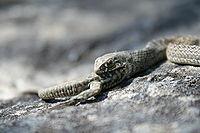 Most reptiles are carnivorous and have rather simple and comparatively short digestive tracts, meat being fairly simple to break down and digest. Digestion
is slower than in mammals, reflecting their lower resting metabolism
and their inability to divide and masticate their food. Their poikilotherm
metabolism has very low energy requirements, allowing large reptiles like crocodiles and the large constrictors to live from a single large meal for months, digesting it slowly.
While modern reptiles are predominately carnivorous, during the early history of reptiles several groups produced some herbivorous megafauna
: in the Paleozoic
the pareiasaur
s and the synapsid
dicynodont
s, and in the Mesozoic
several lines of dinosaurs. Today the turtles are the only predominantly herbivorous reptile group, but several lines of agamas
and iguanas
have evolved to live wholly or partly on plants.
Herbivorous reptiles face the same problems of mastication as herbivorous mammals but, lacking the complex teeth of mammals, many species swallow rocks and pebbles (so called gastrolith
s) to aid in digestion: The rocks are washed around in the stomach, helping to grind up plant matter. Fossil gastroliths have been found associated with sauropods. Sea turtles, crocodiles, and marine iguanas also use gastroliths as ballast
, helping them to dive.
brain, but the reptile cerebrum and cerebellum
are slightly larger. Most typical sense organs are well developed with certain exceptions, most notably the snake
's lack of external ears (middle and inner ears are present). There are twelve pairs of cranial nerves
. Due to their short cochlea, reptiles use electrical tuning
to expand their range of audible frequencies.
Reptiles are generally considered less intelligent than mammals and birds.
The size of their brain relative to their body is much less than that of mammals, the encephalization quotient
being about one tenth of that of mammals,
though larger reptiles show more complex brain development. Larger lizards like the monitors
are known to exhibit complex behavior, including cooperation. Crocodiles have relatively larger brains and show a fairly complex social structure. The Komodo dragon
is even known to engage in play.
Some snakes have extra sets of visual organs (in the loosest sense of the word) in the form of pits sensitive to infrared
radiation (heat). Such heat-sensitive pits are particularly well developed in the pit vipers, but are also found in boas and pythons. These pits allow the snakes to sense the body heat of birds and mammals, enabling pit vipers to hunt rodents in the dark.
 Reptiles generally reproduce sexually, though some are capable of asexual reproduction
. All reproductive activity occurs through the cloaca
, the single exit/entrance at the base of the tail where waste is also eliminated. Most reptiles have copulatory organs, which are usually retracted or inverted and stored inside the body. In turtles and crocodilians, the male has a single median penis
, while squamates, including snakes and lizards, possess a pair of hemipenes
. Tuataras, however, lack copulatory organs, and so the male and female simply press their cloacas together as the male excretes sperm.
Most reptiles lay amniotic eggs covered with leathery or calcareous shells. An amnion
, chorion
, and allantois
are present during embryo
nic life. There are no larva
l stages of development. Viviparity
and ovoviviparity
have evolved only in squamates, and many species, including all boas and most vipers, utilize this mode of reproduction. The degree of viviparity varies: some species simply retain the eggs until just before hatching, others provide maternal nourishment to supplement the yolk, and yet others lack any yolk and provide all nutrients via a structure similar to the mammalian placenta
.
Asexual reproduction has been identified in squamates
in six families of lizards and one snake. In some species of squamates, a population of females is able to produce a unisexual diploid clone of the mother. This form of asexual reproduction, called parthenogenesis
, occurs in several species of gecko
, and is particularly widespread in the teiids
(especially Aspidocelis) and lacertids
(Lacerta
). In captivity, Komodo dragon
s (Varanidae) have reproduced by parthenogenesis
.
Parthenogenetic species are suspected to occur among chameleon
s, agamids
, xantusiids
, and typhlopids
.
Some reptiles exhibit temperature-dependent sex determination
(TDSD), in which the incubation temperature determines whether a particular egg hatches as male or female. TDSD is most common in turtles and crocodiles, but also occurs in lizards and tuataras. To date, there has been no confirmation of whether TDSD occurs in snakes.
is the most common form of defense in reptiles. At the first sign of danger, most snakes and lizards crawl away into the undergrowth, and turtles and crocodiles will plunge into water and sink out of sight.
Reptiles may also avoid confrontation through camouflage. Using a variety of grays, greens, and browns, these animals can blend remarkably well into the background of their natural environment.
If the danger arises so suddenly that flight may be harmful, then crocodiles, turtles, some lizards, and some snakes hiss loudly when confronted by an enemy. Rattlesnakes rapidly vibrate the tip of the tail, which is composed of a series of nested, hollow beads.
If all this does not deter an enemy, different species will adopt different defensive tactics.
Snake
s use a complicated set of behaviors when attacked. Some will first elevate their head and spread out the skin of their neck in an effort to look bigger and more threatening. Failure of this may lead to other measures practiced particularly by cobras, vipers, and closely related species, who use venom
to attack. The venom is modified saliva, delivered through fangs from a venom gland. Some non-venomous snakes, such as the corn snake, play dead when in danger.
When a crocodile
is concerned about its safety, it will gape to expose the teeth and yellow tongue. If this doesn't work, the crocodile gets a little more agitated and typically begins to make hissing sounds. After this, the crocodile will start to change its posture dramatically to make itself look more intimidating. The body is inflated to increase apparent size. If absolutely necessary it may decide to attack an enemy.
Some species try to bite immediately. Some will use their heads as sledgehammers and literally smash an opponent, some will rush or swim toward the threat from a distance, even chasing them onto land or galloping after them.
Geckos
, skinks, and other lizards that are captured by the tail will shed part of the tail structure through a process called autotomy
and thus be able to flee. The detached tail will continue to wiggle, creating a deceptive sense of continued struggle and distracting the predator's attention from the fleeing prey animal. The animal can partially regenerate
its tail over a period of weeks. The new section will contain cartilage rather than bone, and the skin may be distinctly discolored compared to the rest of the body. The tails are often a separate and dramatically more vivid color then the rest of the body, as to attract potential predators to strike for the tail first.
Class (biology)
In biological classification, class is* a taxonomic rank. Other well-known ranks are life, domain, kingdom, phylum, order, family, genus, and species, with class fitting between phylum and order...
of air-breathing, ectotherm
Ectotherm
An ectotherm, from the Greek εκτός "outside" and θερμός "hot", refers to organisms that control body temperature through external means. As a result, organisms are dependent on environmental heat sources and have relatively low metabolic rates. For example, many reptiles regulate their body...
ic (cold-blooded) vertebrates which are characterized by laying shelled eggs (except for some vipers and constrictor snakes that give live birth), and having skin covered in scales
Scale (zoology)
In most biological nomenclature, a scale is a small rigid plate that grows out of an animal's skin to provide protection. In lepidopteran species, scales are plates on the surface of the insect wing, and provide coloration...
and/or scutes. They are tetrapod
Tetrapod
Tetrapods are vertebrate animals having four limbs. Amphibians, reptiles, birds and mammals are all tetrapods; even snakes and other limbless reptiles and amphibians are tetrapods by descent. The earliest tetrapods evolved from the lobe-finned fishes in the Devonian...
s, either having four limbs or being descended from four-limbed ancestors. Modern reptiles inhabit every continent
Continent
A continent is one of several very large landmasses on Earth. They are generally identified by convention rather than any strict criteria, with seven regions commonly regarded as continents—they are : Asia, Africa, North America, South America, Antarctica, Europe, and Australia.Plate tectonics is...
with the exception of Antarctica, and four living orders
Order (biology)
In scientific classification used in biology, the order is# a taxonomic rank used in the classification of organisms. Other well-known ranks are life, domain, kingdom, phylum, class, family, genus, and species, with order fitting in between class and family...
are currently recognized:
- CrocodiliaCrocodiliaCrocodilia is an order of large reptiles that appeared about 84 million years ago in the late Cretaceous Period . They are the closest living relatives of birds, as the two groups are the only known survivors of the Archosauria...
(crocodileCrocodileA crocodile is any species belonging to the family Crocodylidae . The term can also be used more loosely to include all extant members of the order Crocodilia: i.e...
s, gavialsGharialThe gharial , , also called Indian gavial or gavial, is the only surviving member of the once well-represented family Gavialidae, a long-established group of crocodilians with long, slender snouts...
, caimans, and alligatorAlligatorAn alligator is a crocodilian in the genus Alligator of the family Alligatoridae. There are two extant alligator species: the American alligator and the Chinese alligator ....
s): 23 species - SphenodontiaSphenodontiaSphenodontia is an order of lizard-like reptiles that includes only one living genus, the tuatara , and only two living species...
(tuataraTuataraThe tuatara is a reptile endemic to New Zealand which, though it resembles most lizards, is actually part of a distinct lineage, order Sphenodontia. The two species of tuatara are the only surviving members of its order, which flourished around 200 million years ago. Their most recent common...
s from New ZealandNew ZealandNew Zealand is an island country in the south-western Pacific Ocean comprising two main landmasses and numerous smaller islands. The country is situated some east of Australia across the Tasman Sea, and roughly south of the Pacific island nations of New Caledonia, Fiji, and Tonga...
): 2 species - SquamataSquamataSquamata, or the scaled reptiles, is the largest recent order of reptiles, including lizards and snakes. Members of the order are distinguished by their skins, which bear horny scales or shields. They also possess movable quadrate bones, making it possible to move the upper jaw relative to the...
(lizardLizardLizards are a widespread group of squamate reptiles, with nearly 3800 species, ranging across all continents except Antarctica as well as most oceanic island chains...
s, snakeSnakeSnakes are elongate, legless, carnivorous reptiles of the suborder Serpentes that can be distinguished from legless lizards by their lack of eyelids and external ears. Like all squamates, snakes are ectothermic, amniote vertebrates covered in overlapping scales...
s, and worm lizardsAmphisbaeniaThe Amphisbaenia are a usually legless suborder of squamates closely related to lizards and snakes. As many species possess a pink body coloration and scales arranged in rings, they have a superficial resemblance to earthworms. They are very poorly understood, due to their burrowing lifestyle...
): approximately 7,900 species - Testudines (turtleTurtleTurtles are reptiles of the order Testudines , characterised by a special bony or cartilaginous shell developed from their ribs that acts as a shield...
s, terrapinTerrapinA terrapin is a turtle living in fresh or brackish water.Terrapin may also refer to:* Terrapin , a transport vehicle used for amphibious assault by the Allies during the Second World War...
s and tortoiseTortoiseTortoises are a family of land-dwelling reptiles of the order of turtles . Like their marine cousins, the sea turtles, tortoises are shielded from predators by a shell. The top part of the shell is the carapace, the underside is the plastron, and the two are connected by the bridge. The tortoise...
s): approximately 300 species
Reptiles originated around 320-310 million years ago during the Carboniferous
Carboniferous
The Carboniferous is a geologic period and system that extends from the end of the Devonian Period, about 359.2 ± 2.5 Mya , to the beginning of the Permian Period, about 299.0 ± 0.8 Mya . The name is derived from the Latin word for coal, carbo. Carboniferous means "coal-bearing"...
period, having evolved from advanced reptile-like amphibians
Reptiliomorpha
Reptiliomorpha refers to an order or subclass of reptile-like amphibians, which gave rise to the amniotes in the Carboniferous. Under phylogenetic nomenclature, the Reptiliomorpha includes their amniote descendants though, even in phylogenetic nomenclature, the name is mostly used when referring to...
that became increasingly adapted to life on dry land. Unlike amphibians, reptiles do not have an aquatic larval stage. As a rule, reptiles are oviparous
Egg (biology)
An egg is an organic vessel in which an embryo first begins to develop. In most birds, reptiles, insects, molluscs, fish, and monotremes, an egg is the zygote, resulting from fertilization of the ovum, which is expelled from the body and permitted to develop outside the body until the developing...
(egg-laying), although certain species of squamates are capable of giving live birth. This is achieved by either ovoviviparity
Ovoviviparity
Ovoviviparity, ovovivipary, or ovivipary, is a mode of reproduction in animals in which embryos develop inside eggs that are retained within the mother's body until they are ready to hatch...
(egg retention) or viviparity
Vivipary
Vivipary has two different meanings. In animals, it means development of the embryo inside the body of the mother, eventually leading to live birth, as opposed to laying eggs...
(birth of offspring without the development of calcified eggs). Many of the viviparous species feed their fetus
Fetus
A fetus is a developing mammal or other viviparous vertebrate after the embryonic stage and before birth.In humans, the fetal stage of prenatal development starts at the beginning of the 11th week in gestational age, which is the 9th week after fertilization.-Etymology and spelling variations:The...
es through various forms of placenta
Placenta
The placenta is an organ that connects the developing fetus to the uterine wall to allow nutrient uptake, waste elimination, and gas exchange via the mother's blood supply. "True" placentas are a defining characteristic of eutherian or "placental" mammals, but are also found in some snakes and...
analogous to those of mammal
Mammal
Mammals are members of a class of air-breathing vertebrate animals characterised by the possession of endothermy, hair, three middle ear bones, and mammary glands functional in mothers with young...
s, with some providing initial care for their hatchlings. Extant reptiles range in size from a tiny gecko, Sphaerodactylus ariasae
Jaragua Sphaero
Sphaerodactylus ariasae, the Jaragua Sphaero or dwarf gecko, is a very small Gekkonidae species in the Sphaerodactylus genus. It is one of the world's two smallest known reptiles...
, which can grow up to 1.7 cm (0.6 in) to the saltwater crocodile
Saltwater Crocodile
The saltwater crocodile, also known as estuarine or Indo-Pacific crocodile, is the largest of all living reptiles...
, Crocodylus porosus, which may reach 6 m in length and weigh over 1,000 kg.
The study of reptiles and amphibians is called herpetology
Herpetology
Herpetology is the branch of zoology concerned with the study of amphibians and reptiles...
.
History of classification
Linnaeus and the 18th century
The reptiles were from the outset of classification grouped with the amphibianAmphibian
Amphibians , are a class of vertebrate animals including animals such as toads, frogs, caecilians, and salamanders. They are characterized as non-amniote ectothermic tetrapods...
s. Linnaeus, working from species-poor Sweden
Sweden
Sweden , officially the Kingdom of Sweden , is a Nordic country on the Scandinavian Peninsula in Northern Europe. Sweden borders with Norway and Finland and is connected to Denmark by a bridge-tunnel across the Öresund....
, where the common adder and grass snake
Grass Snake
The grass snake , sometimes called the ringed snake or water snake is a European non-venomous snake. It is often found near water and feeds almost exclusively on amphibians.-Etymology:...
are often found hunting in water, included all reptiles and amphibians in class
Class (biology)
In biological classification, class is* a taxonomic rank. Other well-known ranks are life, domain, kingdom, phylum, order, family, genus, and species, with class fitting between phylum and order...
"III – Amphibia
Amphibia in the 10th edition of Systema Naturae
In the 10th edition of Systema Naturae, Carl Linnaeus described the Amphibia as:Animals that are distinguished by a body cold and generally naked; stern and expressive countenance; harsh voice; mostly lurid color; filthy odor; a few are furnished with a horrid poison; all have cartilaginous bones,...
" in his Systema Naturæ.
The terms "reptile" and "amphibian" were largely interchangeable, "reptile" (from Latin repere, "to creep") being preferred by the French.
Josephus Nicolaus Laurenti
Josephus Nicolaus Laurenti
Josephus Nicolaus Laurenti was an Austrian naturalist of Italian origin.Laurenti is considered the auctor of the class Reptilia through his authorship of on the poisonous function of reptiles and amphibians...
was the first to formally use the term "Reptilia" for an expanded selection of reptiles and amphibians basically similar to that of Linnaeus. Today, it is still common to treat the two groups under the same heading as herptiles
Herpetology
Herpetology is the branch of zoology concerned with the study of amphibians and reptiles...
.
"Antediluvian monsters"
Pierre André Latreille
Pierre André Latreille was a French zoologist, specialising in arthropods. Having trained as a Roman Catholic priest before the French Revolution, Latreille was imprisoned, and only regained his freedom after recognising a rare species he found in the prison, Necrobia ruficollis...
erected the class Batracia (1825) for the latter, dividing the tetrapod
Tetrapod
Tetrapods are vertebrate animals having four limbs. Amphibians, reptiles, birds and mammals are all tetrapods; even snakes and other limbless reptiles and amphibians are tetrapods by descent. The earliest tetrapods evolved from the lobe-finned fishes in the Devonian...
s into the four familiar classes of reptiles, amphibians, birds and mammals.
The British anatomist Thomas Henry Huxley made Latreille's definition popular, and together with Richard Owen
Richard Owen
Sir Richard Owen, FRS KCB was an English biologist, comparative anatomist and palaeontologist.Owen is probably best remembered today for coining the word Dinosauria and for his outspoken opposition to Charles Darwin's theory of evolution by natural selection...
expanded Reptilia to include the various fossil “antediluvian
Antediluvian
The antediluvian period meaning "before the deluge" is the period referred to in the Bible between the Creation of the Earth and the Deluge . The narrative takes up chapters 1-6 of Genesis...
monsters”, including dinosaur
Dinosaur
Dinosaurs are a diverse group of animals of the clade and superorder Dinosauria. They were the dominant terrestrial vertebrates for over 160 million years, from the late Triassic period until the end of the Cretaceous , when the Cretaceous–Paleogene extinction event led to the extinction of...
s and the mammal-like (synapsid
Synapsid
Synapsids are a group of animals that includes mammals and everything more closely related to mammals than to other living amniotes. They are easily separated from other amniotes by having an opening low in the skull roof behind each eye, leaving a bony arch beneath each, accounting for their name...
) Dicynodon
Dicynodon
Dicynodon is a type of dicynodont therapsid that flourished during the Permian period between 251 and 299 million years ago. Like all dicynodonts, it was herbivorous. This animal was toothless, except for prominent tusks, hence the name...
he helped describe. This was not the only possible classification scheme: In the Hunterian lectures delivered at the Royal College of Surgeons
Royal College of Surgeons of England
The Royal College of Surgeons of England is an independent professional body and registered charity committed to promoting and advancing the highest standards of surgical care for patients, regulating surgery, including dentistry, in England and Wales...
in 1863, Huxley grouped the vertebrates into mammal
Mammal
Mammals are members of a class of air-breathing vertebrate animals characterised by the possession of endothermy, hair, three middle ear bones, and mammary glands functional in mothers with young...
s, sauroids, and ichthyoids (the latter containing the fishes and amphibians). He subsequently proposed the names of Sauropsida
Sauropsida
Sauropsida is a group of amniotes that includes all existing reptiles and birds and their fossil ancestors, including the dinosaurs, the immediate ancestors of birds...
and Ichthyopsida for the two.
The terms "Sauropsida" ("lizard faces") and "Theropsida
Synapsid
Synapsids are a group of animals that includes mammals and everything more closely related to mammals than to other living amniotes. They are easily separated from other amniotes by having an opening low in the skull roof behind each eye, leaving a bony arch beneath each, accounting for their name...
" ("beast faces") were used again in 1916 by E.S. Goodrich
Edwin Stephen Goodrich
Edwin Stephen Goodrich , was an English zoologist, specialising in comparative anatomy, embryology, paleontology, and evolution. He held the Linacre Chair of Zoology in the University of Oxford from 1921 to 1946...
to distinguish between lizards, birds, and their relatives on the one hand (Sauropsida) and mammal
Mammal
Mammals are members of a class of air-breathing vertebrate animals characterised by the possession of endothermy, hair, three middle ear bones, and mammary glands functional in mothers with young...
s and their extinct relatives (Theropsida) on the other. Goodrich supported this division by the nature of the hearts and blood vessels in each group, and other features such as the structure of the forebrain. According to Goodrich, both lineages evolved from an earlier stem group, Protosauria ("first lizards") which included some Paleozoic
Paleozoic
The Paleozoic era is the earliest of three geologic eras of the Phanerozoic eon, spanning from roughly...
amphibian
Amphibian
Amphibians , are a class of vertebrate animals including animals such as toads, frogs, caecilians, and salamanders. They are characterized as non-amniote ectothermic tetrapods...
s as well as early reptiles.
In 1956 D.M.S. Watson observed that the first two groups diverged very early in reptilian history, and so he divided Goodrich's Protosauria between them. He also reinterpreted Sauropsida and Theropsida to exclude birds and mammals, respectively. Thus his Sauropsida included Procolophonia
Procolophonia
The Procolophonia are a suborder of herbivorous reptiles that lived from the Middle Permian till the end of the Triassic period. They were originally included as a suborder of the Cotylosauria but are now considered a clade of Parareptilia...
, Eosuchia
Eosuchia
Eosuchians are an extinct order of diapsid reptiles. Depending on which taxa are included the order may have ranged from the late Carboniferous to the Eocene but the consensus is that eosuchians are confined to the Permian and Triassic....
, Millerosauria
Millerettid
The millerettids are an extinct group of anapsids that lived in South Africa during the Upper Permian. They were small insectivores and probably resembled modern lizards in appearance and lifestyle.-External links:*...
, Chelonia
Turtle
Turtles are reptiles of the order Testudines , characterised by a special bony or cartilaginous shell developed from their ribs that acts as a shield...
(turtles), Squamata
Squamata
Squamata, or the scaled reptiles, is the largest recent order of reptiles, including lizards and snakes. Members of the order are distinguished by their skins, which bear horny scales or shields. They also possess movable quadrate bones, making it possible to move the upper jaw relative to the...
(lizards and snakes), Rhynchocephalia
Sphenodontia
Sphenodontia is an order of lizard-like reptiles that includes only one living genus, the tuatara , and only two living species...
, Crocodilia
Crocodilia
Crocodilia is an order of large reptiles that appeared about 84 million years ago in the late Cretaceous Period . They are the closest living relatives of birds, as the two groups are the only known survivors of the Archosauria...
, "thecodont
Thecodont
Thecodont , now considered an obsolete term, was formerly used to describe a diverse range of early archosaurs that first appeared in the Latest Permian and flourished until the end of the Triassic period...
s" (paraphyletic
Paraphyly
A group of taxa is said to be paraphyletic if the group consists of all the descendants of a hypothetical closest common ancestor minus one or more monophyletic groups of descendants...
basal
Basal (phylogenetics)
In phylogenetics, a basal clade is the earliest clade to branch in a larger clade; it appears at the base of a cladogram.A basal group forms an outgroup to the rest of the clade, such as in the following example:...
Archosaur
Archosaur
Archosaurs are a group of diapsid amniotes whose living representatives consist of modern birds and crocodilians. This group also includes all extinct non-avian dinosaurs, many extinct crocodilian relatives, and pterosaurs. Archosauria, the archosaur clade, is a crown group that includes the most...
ia), non-avian dinosaur
Dinosaur
Dinosaurs are a diverse group of animals of the clade and superorder Dinosauria. They were the dominant terrestrial vertebrates for over 160 million years, from the late Triassic period until the end of the Cretaceous , when the Cretaceous–Paleogene extinction event led to the extinction of...
s, pterosaur
Pterosaur
Pterosaurs were flying reptiles of the clade or order Pterosauria. They existed from the late Triassic to the end of the Cretaceous Period . Pterosaurs are the earliest vertebrates known to have evolved powered flight...
s, ichthyosaur
Ichthyosaur
Ichthyosaurs were giant marine reptiles that resembled fish and dolphins...
s, and sauropterygia
Sauropterygia
Sauropterygia were a group of very successful aquatic reptiles that flourished during the Mesozoic before they became extinct at the end of the era. They were united by a radical adaptation of their shoulder, designed to support powerful flipper strokes...
ns.
In 1866, Haeckel demonstrated that vertebrates could be divided based on their reproductive strategies, and that reptiles, birds and mammals were united by the amniotic egg. By the end of the 19th century, the class Reptilia had come to include all the amniote
Amniote
The amniotes are a group of tetrapods that have a terrestrially adapted egg. They include synapsids and sauropsids , as well as their fossil ancestors. Amniote embryos, whether laid as eggs or carried by the female, are protected and aided by several extensive membranes...
s except bird
Bird
Birds are feathered, winged, bipedal, endothermic , egg-laying, vertebrate animals. Around 10,000 living species and 188 families makes them the most speciose class of tetrapod vertebrates. They inhabit ecosystems across the globe, from the Arctic to the Antarctic. Extant birds range in size from...
s and mammal
Mammal
Mammals are members of a class of air-breathing vertebrate animals characterised by the possession of endothermy, hair, three middle ear bones, and mammary glands functional in mothers with young...
s. Thus reptiles were defined as the set of animal
Animal
Animals are a major group of multicellular, eukaryotic organisms of the kingdom Animalia or Metazoa. Their body plan eventually becomes fixed as they develop, although some undergo a process of metamorphosis later on in their life. Most animals are motile, meaning they can move spontaneously and...
s that includes the extant crocodile
Crocodile
A crocodile is any species belonging to the family Crocodylidae . The term can also be used more loosely to include all extant members of the order Crocodilia: i.e...
s, alligator
Alligator
An alligator is a crocodilian in the genus Alligator of the family Alligatoridae. There are two extant alligator species: the American alligator and the Chinese alligator ....
s, tuatara
Tuatara
The tuatara is a reptile endemic to New Zealand which, though it resembles most lizards, is actually part of a distinct lineage, order Sphenodontia. The two species of tuatara are the only surviving members of its order, which flourished around 200 million years ago. Their most recent common...
, lizard
Lizard
Lizards are a widespread group of squamate reptiles, with nearly 3800 species, ranging across all continents except Antarctica as well as most oceanic island chains...
s, snake
Snake
Snakes are elongate, legless, carnivorous reptiles of the suborder Serpentes that can be distinguished from legless lizards by their lack of eyelids and external ears. Like all squamates, snakes are ectothermic, amniote vertebrates covered in overlapping scales...
s, amphisbaenia
Amphisbaenia
The Amphisbaenia are a usually legless suborder of squamates closely related to lizards and snakes. As many species possess a pink body coloration and scales arranged in rings, they have a superficial resemblance to earthworms. They are very poorly understood, due to their burrowing lifestyle...
ns, and turtle
Turtle
Turtles are reptiles of the order Testudines , characterised by a special bony or cartilaginous shell developed from their ribs that acts as a shield...
s, as well as fossil groups like dinosaurs, synapsid
Synapsid
Synapsids are a group of animals that includes mammals and everything more closely related to mammals than to other living amniotes. They are easily separated from other amniotes by having an opening low in the skull roof behind each eye, leaving a bony arch beneath each, accounting for their name...
s and the primitive pareiasaur
Pareiasaur
The Pareiasaurs - Family Pareiasauridae - are a clade of medium-sized to large herbivorous anapsid reptiles that flourished during the Permian period....
s. This is still the common definition of the term.
Skull openings in 20th century classification
The synapsid/sauropsid division supplemented, but was never as popular during the 20th century as a Linneaean approach splitting the reptiles into four subclasses based on the number and position of temporal fenestrae, openings in the sides of the skull behind the eyes. This classification was initiated by Henry Fairfield OsbornHenry Fairfield Osborn
Henry Fairfield Osborn, Sr. ForMemRS was an American geologist, paleontologist, and eugenicist.-Early life and career:...
and elaborated and made popular by Romer
Alfred Romer
Alfred Sherwood Romer was an American paleontologist and comparative anatomist and a specialist in vertebrate evolution.-Biography:...
's classic Vertebrate Paleontology
Vertebrate Paleontology (Romer)
Vertebrate Paleontology is an advanced textbook on vertebrate paleontology by Alfred Sherwood Romer, published by the University of Chicago Press. It went through three editions and for many years constituted a very authoritative work and the definitive coverage of the subject. A condensed...
. Those four subclasses were:
- AnapsidAnapsidAn anapsid is an amniote whose skull does not have openings near the temples.While "anapsid reptiles" or "anapsida" are traditionally spoken of as if they were a monophyletic group, it has been suggested that several groups of reptiles that had anapsid skulls may be only distantly related...
a – no fenestrae - cotylosaurs and Chelonia (turtleTurtleTurtles are reptiles of the order Testudines , characterised by a special bony or cartilaginous shell developed from their ribs that acts as a shield...
s and relatives) - SynapsidSynapsidSynapsids are a group of animals that includes mammals and everything more closely related to mammals than to other living amniotes. They are easily separated from other amniotes by having an opening low in the skull roof behind each eye, leaving a bony arch beneath each, accounting for their name...
a – one low fenestra - pelycosaurPelycosaurThe pelycosaurs are an informal grouping composed of basal or primitive Late Paleozoic synapsid amniotes. Some species were quite large and could grow up to 3 meters or more, although most species were much smaller...
s and therapsids (the 'mammal-like reptiles') - EuryapsidaEuryapsidaEuryapsida is a polyphyletic group of reptiles that are distinguished by a single temporal fenestra, an opening behind the orbit, under which the post-orbital and squamosal bones articulate. They are different from Synapsida, which also have a single opening behind the orbit, by the placement of...
– one high fenestra (above the postorbital and squamosal) - protorosaurs (small, early lizard-like reptiles) and the marine sauropterygiaSauropterygiaSauropterygia were a group of very successful aquatic reptiles that flourished during the Mesozoic before they became extinct at the end of the era. They were united by a radical adaptation of their shoulder, designed to support powerful flipper strokes...
ns and ichthyosaurs, the latter called Parapsida in Osborn's work. - DiapsidDiapsidDiapsids are a group of reptiles that developed two holes in each side of their skulls, about 300 million years ago during the late Carboniferous period. Living diapsids are extremely diverse, and include all crocodiles, lizards, snakes, and tuatara...
a – two fenestrae - most reptiles, including lizardLizardLizards are a widespread group of squamate reptiles, with nearly 3800 species, ranging across all continents except Antarctica as well as most oceanic island chains...
s, snakeSnakeSnakes are elongate, legless, carnivorous reptiles of the suborder Serpentes that can be distinguished from legless lizards by their lack of eyelids and external ears. Like all squamates, snakes are ectothermic, amniote vertebrates covered in overlapping scales...
s, crocodilians, dinosaurDinosaurDinosaurs are a diverse group of animals of the clade and superorder Dinosauria. They were the dominant terrestrial vertebrates for over 160 million years, from the late Triassic period until the end of the Cretaceous , when the Cretaceous–Paleogene extinction event led to the extinction of...
s and pterosaurPterosaurPterosaurs were flying reptiles of the clade or order Pterosauria. They existed from the late Triassic to the end of the Cretaceous Period . Pterosaurs are the earliest vertebrates known to have evolved powered flight...
s
The composition of Euryapsida was uncertain. Ichthyosaurs were at times considered to have arisen independently of the other euryapsids, and given the older name Parapsida. Parapsida was later discarded as a group for the most part (ichthyosaurs being classified as incertae sedis
Incertae sedis
, is a term used to define a taxonomic group where its broader relationships are unknown or undefined. Uncertainty at specific taxonomic levels is attributed by , , and similar terms.-Examples:*The fossil plant Paradinandra suecica could not be assigned to any...
or with Euryapsida). However, the scheme with four (or three if Euryapsida is sunk into Diapsida) subclasses remained more or less universal for non-specialist work throughout the 20th century, and has only been challenged with the rising popularity of phylogenetic nomenclature
Phylogenetic nomenclature
Phylogenetic nomenclature or phylogenetic taxonomy is an alternative to rank-based nomenclature, applying definitions from cladistics . Its two defining features are the use of phylogenetic definitions of biological taxon names, and the lack of obligatory ranks...
.
Phylogenetics and modern definition
By the 21st century, most vertebrate paleontologists had adopted phylogenetic taxonomy, in which all groups are defined in such a way as to be monophyleticClade
A clade is a group consisting of a species and all its descendants. In the terms of biological systematics, a clade is a single "branch" on the "tree of life". The idea that such a "natural group" of organisms should be grouped together and given a taxonomic name is central to biological...
; that is, groups include all descendants of a particular ancestor. The reptiles as historically defined would be paraphyletic
Paraphyly
A group of taxa is said to be paraphyletic if the group consists of all the descendants of a hypothetical closest common ancestor minus one or more monophyletic groups of descendants...
, since they exclude both birds and mammals, although these also evolved from the original reptiles. Colin Tudge wrote:
Mammals are a cladeCladisticsCladistics is a method of classifying species of organisms into groups called clades, which consist of an ancestor organism and all its descendants . For example, birds, dinosaurs, crocodiles, and all descendants of their most recent common ancestor form a clade...
, and therefore the cladistsPhylogenetic nomenclaturePhylogenetic nomenclature or phylogenetic taxonomy is an alternative to rank-based nomenclature, applying definitions from cladistics . Its two defining features are the use of phylogenetic definitions of biological taxon names, and the lack of obligatory ranks...
are happy to acknowledge the traditional taxon MammalMammalMammals are members of a class of air-breathing vertebrate animals characterised by the possession of endothermy, hair, three middle ear bones, and mammary glands functional in mothers with young...
ia; and birds, too, are a clade, universally ascribed to the formal taxon AvesBirdBirds are feathered, winged, bipedal, endothermic , egg-laying, vertebrate animals. Around 10,000 living species and 188 families makes them the most speciose class of tetrapod vertebrates. They inhabit ecosystems across the globe, from the Arctic to the Antarctic. Extant birds range in size from...
. Mammalia and Aves are, in fact, subclades within the grand clade of the Amniota. But the traditional class Reptilia is not a clade. It is just a section of the clade Amniota: the section that is left after the Mammalia and Aves have been hived off. It cannot be defined by synapomorphiesSynapomorphyIn cladistics, a synapomorphy or synapomorphic character is a trait that is shared by two or more taxa and their most recent common ancestor, whose ancestor in turn does not possess the trait. A synapomorphy is thus an apomorphy visible in multiple taxa, where the trait in question originates in...
, as is the proper way. It is instead defined by a combination of the features it has and the features it lacks: reptiles are the amniotes that lack fur or feathers. At best, the cladists suggest, we could say that the traditional Reptilia are 'non-avian, non-mammalian amniotes'.
Despite the early proposals for replacing the paraphyletic Reptilia for a monophyletic Sauropsida
Sauropsida
Sauropsida is a group of amniotes that includes all existing reptiles and birds and their fossil ancestors, including the dinosaurs, the immediate ancestors of birds...
, that term was never adopted widely or, when it was, applied consistently. When Sauropsida was used, it often had the same content or even the same definition as Reptilia. In 1988 Jacques Gauthier
Jacques Gauthier
Jacques Armand Gauthier is a vertebrate paleontologist, comparative morphologist, and systematist, and one of the founders of the use of cladistics in biology....
proposed a cladistic
Cladistics
Cladistics is a method of classifying species of organisms into groups called clades, which consist of an ancestor organism and all its descendants . For example, birds, dinosaurs, crocodiles, and all descendants of their most recent common ancestor form a clade...
definition of Reptilia as a monophyletic node-based crown group
Crown group
A crown group is a group consisting of living representatives, their ancestors back to the most recent common ancestor of that group, and all of that ancestor's descendants. The name was given by Willi Hennig, the formulator of phylogenetic systematics, as a way of classifying living organisms...
containing turtles, lizards and snakes, crocodilians, and birds, their common ancestor and all its descendants. Because the actual relationship of turtles to other reptiles was not yet well understood at this time, Gauthier's definition came to be considered inadequate. A variety of other definitions were proposed by other scientists in the years following Gauthier's paper. The first such new definition, which attempted to adhere to the standards of the PhyloCode
PhyloCode
The International Code of Phylogenetic Nomenclature, known as the PhyloCode for short, is a developing draft for a formal set of rules governing phylogenetic nomenclature...
, was published by Modesto and Anderson in 2004. Modesto and Anderson reviewed the many previous definitions, and proposed a modified definition which they intended to retain most traditional content of the group while keeping it stable and monophyletic. They defined Reptilia as all amniotes closer to Lacerta agilis and Crocodylus niloticus than to Homo sapiens. This stem-based definition is equivalent to that of Sauropsida, which Modesto and Anderson synonymized with Reptilia, since the latter is more well known and more frequently used. Unlike most previous definitions of Reptilia, however, Modesto and Anderson's definition includes birds.
Taxonomy
Classification to order level, after Benton, 2005.The above taxonomy and phylogeny do not reflect modern molecular evidence that places turtles within Diapsida.- Series AmniotaAmnioteThe amniotes are a group of tetrapods that have a terrestrially adapted egg. They include synapsids and sauropsids , as well as their fossil ancestors. Amniote embryos, whether laid as eggs or carried by the female, are protected and aided by several extensive membranes...
- Class SynapsidSynapsidSynapsids are a group of animals that includes mammals and everything more closely related to mammals than to other living amniotes. They are easily separated from other amniotes by having an opening low in the skull roof behind each eye, leaving a bony arch beneath each, accounting for their name...
a- Order PelycosaurPelycosaurThe pelycosaurs are an informal grouping composed of basal or primitive Late Paleozoic synapsid amniotes. Some species were quite large and could grow up to 3 meters or more, although most species were much smaller...
ia*ParaphylyA group of taxa is said to be paraphyletic if the group consists of all the descendants of a hypothetical closest common ancestor minus one or more monophyletic groups of descendants... - Order TherapsidaTherapsidaTherapsida is a group of the most advanced synapsids, and include the ancestors of mammals. Many of the traits today seen as unique to mammals had their origin within early therapsids, including hair, lactation, and an erect posture. The earliest fossil attributed to Therapsida is believed to be...
- Class MammalMammalMammals are members of a class of air-breathing vertebrate animals characterised by the possession of endothermy, hair, three middle ear bones, and mammary glands functional in mothers with young...
ia
- Class Mammal
- Order Pelycosaur
- Class SauropsidaSauropsidaSauropsida is a group of amniotes that includes all existing reptiles and birds and their fossil ancestors, including the dinosaurs, the immediate ancestors of birds...
- Subclass AnapsidAnapsidAn anapsid is an amniote whose skull does not have openings near the temples.While "anapsid reptiles" or "anapsida" are traditionally spoken of as if they were a monophyletic group, it has been suggested that several groups of reptiles that had anapsid skulls may be only distantly related...
a- Order Testudines (turtles)
- A series of unassigned anapsid families, corresponding to CaptorhinidaCaptorhinidaCaptorhinida is a doubly paraphyletic grouping of early reptiles. Robert L. Carroll ranked it as an order in the subclass Anapsida, composed of the following suborders:...
, MesosaurMesosaurMesosaurs were a group of small aquatic reptiles that lived during the early Permian period, roughly 299 to 270 million years ago. Mesosaurs were the first aquatic reptiles, having apparently returned to an aquatic lifestyle from more terrestrial ancestors...
ia and ProcolophonomorphaProcolophonomorphaProcolophonomorpha is an order or clade of early reptiles that appeared during the Middle Permian. It constitutes a diverse assemblage that includes a number of lizard-like forms, as well as more diverse types like the pareiasaurs. The most important subclade, Procolophonia, is traditionally...
- Subclass DiapsidDiapsidDiapsids are a group of reptiles that developed two holes in each side of their skulls, about 300 million years ago during the late Carboniferous period. Living diapsids are extremely diverse, and include all crocodiles, lizards, snakes, and tuatara...
a- Order AraeoscelidiaAraeoscelidiaAraeoscelidia or Araeoscelida is a clade of extinct diapsid reptiles superficially resembling lizards, extending from the Late Carboniferous to the Early Permian....
- Order YounginiformesYounginiformesYounginiformes is a replacement name for the taxon Eosuchia, proposed by Alfred Romer in 1947.The Eosuchia having become rather a dustbin for many probably distantly-related primitive diapsid reptiles ranging from the late Carboniferous to the Eocene, Romer proposed that this be replaced by...
- Infraclass IchthyosaurIchthyosaurIchthyosaurs were giant marine reptiles that resembled fish and dolphins...
ia - Infraclass LepidosauromorphaLepidosauromorphaLepidosauromorpha is a group of reptiles comprising all diapsids closer to lizards than to archosaurs . The only living sub-group is the Lepidosauria: extant lizards, snakes, and tuatara...
- Superorder SauropterygiaSauropterygiaSauropterygia were a group of very successful aquatic reptiles that flourished during the Mesozoic before they became extinct at the end of the era. They were united by a radical adaptation of their shoulder, designed to support powerful flipper strokes...
- Order PlacodontPlacodontPlacodonts were a group of marine reptiles that lived during the Triassic period, becoming extinct at the end of the period. It is believed that they were part of Sauropterygia, the group that includes Plesiosaurs...
ia - Order NothosaurNothosaurNothosaurs were Triassic marine sauropterygian reptiles that may have lived like seals of today, catching food in water but coming ashore on rocks and beaches. They averaged about in length, with a long body and tail. The feet were paddle-like, and are known to have been webbed in life, to help...
oidea - Order PlesiosaurPlesiosaurPlesiosauroidea is an extinct clade of carnivorous plesiosaur marine reptiles. Plesiosauroids, are known from the Jurassic and Cretaceous Periods...
ia
- Order Placodont
- Superorder LepidosauriaLepidosauriaThe Lepidosauria are reptiles with overlapping scales. This subclass includes Squamata and Sphenodontidae. It is a monophyletic group and therefore contains all descendents of a common ancestor. The squamata includes snakes, lizards, tuataras, and amphisbaenia. Lepidosauria is the sister taxon...
- Order SphenodontiaSphenodontiaSphenodontia is an order of lizard-like reptiles that includes only one living genus, the tuatara , and only two living species...
(tuatara) - Order SquamataSquamataSquamata, or the scaled reptiles, is the largest recent order of reptiles, including lizards and snakes. Members of the order are distinguished by their skins, which bear horny scales or shields. They also possess movable quadrate bones, making it possible to move the upper jaw relative to the...
(lizards & snakes)
- Order Sphenodontia
- Superorder Sauropterygia
- Infraclass ArchosauromorphaArchosauromorphaArchosauromorpha is an infraclass of diapsid reptiles that first appeared during the late Permian and became more common during the Triassic. Included in this infraclass are the groups Rhynchosauria, Trilophosauridae, Prolacertiformes, Archosauriformes, and, tentatively, Choristodera...
- Order ProlacertiformesProlacertiformesProlacertiformes were an order of archosauromorph reptiles that lived during the Permian and Triassic Periods...
- Division ArchosaurArchosaurArchosaurs are a group of diapsid amniotes whose living representatives consist of modern birds and crocodilians. This group also includes all extinct non-avian dinosaurs, many extinct crocodilian relatives, and pterosaurs. Archosauria, the archosaur clade, is a crown group that includes the most...
ia- Subdivision CrurotarsiCrurotarsiThe Crurotarsi are a group of archosauriformes, represented today by the crocodiles,...
- Superorder CrocodylomorphaCrocodylomorphaThe Crocodylomorpha are an important group of archosaurs that include the crocodilians and their extinct relatives.During Mesozoic and early Tertiary times the Crocodylomorpha were far more diverse than they are now. Triassic forms were small, lightly built, active terrestrial animals. These were...
- Order CrocodiliaCrocodiliaCrocodilia is an order of large reptiles that appeared about 84 million years ago in the late Cretaceous Period . They are the closest living relatives of birds, as the two groups are the only known survivors of the Archosauria...
- Order PhytosaurPhytosaurPhytosaurs are an extinct group of large semi-aquatic Late Triassic archosaurs. Phytosaurs belong to the family Phytosauridae and the order Phytosauria. They were long-snouted and heavily armoured, bearing a remarkable resemblance to modern crocodiles in size, appearance, and lifestyle, an example...
ia - Order RauisuchiaRauisuchiaRauisuchia is a group of predatory and mostly large Triassic archosaurs. As a clade, Rauisuchia includes these Triassic forms and all crocodylomorphs, which are descendants of Triassic rauisuchians. The group in its traditional sense is paraphyletic, because it does not include crocodylomorph...
- Order Rhynchosauria
- Order Crocodilia
- Superorder Crocodylomorpha
- Subdivision AvemetatarsaliaAvemetatarsaliaAvemetatarsalia is a clade name established by British palaeontologist Michael Benton in 1999 for all crown group archosaurs that are closer to birds than to crocodiles. It includes a similarly defined subgroup, Ornithodira...
- Infradivision Ornithodira
- Order PterosaurPterosaurPterosaurs were flying reptiles of the clade or order Pterosauria. They existed from the late Triassic to the end of the Cretaceous Period . Pterosaurs are the earliest vertebrates known to have evolved powered flight...
ia - Superorder DinosaurDinosaurDinosaurs are a diverse group of animals of the clade and superorder Dinosauria. They were the dominant terrestrial vertebrates for over 160 million years, from the late Triassic period until the end of the Cretaceous , when the Cretaceous–Paleogene extinction event led to the extinction of...
ia- Order SaurischiaSaurischiaSaurischia meaning 'lizard' and ischion meaning 'hip joint') is one of the two orders, or basic divisions, of dinosaurs. In 1888, Harry Seeley classified dinosaurs into two orders, based on their hip structure...
- Class AvesBirdBirds are feathered, winged, bipedal, endothermic , egg-laying, vertebrate animals. Around 10,000 living species and 188 families makes them the most speciose class of tetrapod vertebrates. They inhabit ecosystems across the globe, from the Arctic to the Antarctic. Extant birds range in size from...
- Class Aves
- Order OrnithischiaOrnithischiaOrnithischia or Predentata is an extinct order of beaked, herbivorous dinosaurs. The name ornithischia is derived from the Greek ornitheos meaning 'of a bird' and ischion meaning 'hip joint'...
- Order Saurischia
- Order Pterosaur
- Infradivision Ornithodira
- Subdivision Crurotarsi
- Order Prolacertiformes
- Order Araeoscelidia
- Subclass Anapsid
- Class Synapsid
Phylogeny
The cladogram presented here illustrates the "family tree" of reptiles, and follows a simplified version of the relationships found by Laurin and Gauthier (1996), presented as part of the Tree of Life Web ProjectTree of Life Web Project
The Tree of Life Web Project is an ongoing Internet project providing information about the diversity and phylogeny of life on Earth. This collaborative peer reviewed project began in 1995, and is written by biologists from around the world....
, with information on the relationships of the most primitive reptiles after Muller and Reisz (2006).
Origin of the reptiles
Carboniferous
The Carboniferous is a geologic period and system that extends from the end of the Devonian Period, about 359.2 ± 2.5 Mya , to the beginning of the Permian Period, about 299.0 ± 0.8 Mya . The name is derived from the Latin word for coal, carbo. Carboniferous means "coal-bearing"...
period, when the first reptiles evolved from advanced reptiliomorph
Reptiliomorpha
Reptiliomorpha refers to an order or subclass of reptile-like amphibians, which gave rise to the amniotes in the Carboniferous. Under phylogenetic nomenclature, the Reptiliomorpha includes their amniote descendants though, even in phylogenetic nomenclature, the name is mostly used when referring to...
labyrinthodonts
Labyrinthodontia
Labyrinthodontia is an older term for any member of the extinct subclass of amphibians, which constituted some of the dominant animals of Late Paleozoic and Early Mesozoic times . The group is ancestral to all extant landliving vertebrates, and as such constitutes an evolutionary grade rather...
.
The oldest known animal that may have been an amniote
Amniote
The amniotes are a group of tetrapods that have a terrestrially adapted egg. They include synapsids and sauropsids , as well as their fossil ancestors. Amniote embryos, whether laid as eggs or carried by the female, are protected and aided by several extensive membranes...
, i.e. a primitive reptile rather than an advanced amphibian
Amphibian
Amphibians , are a class of vertebrate animals including animals such as toads, frogs, caecilians, and salamanders. They are characterized as non-amniote ectothermic tetrapods...
is Casineria
Casineria
Casineria was a tetrapod which lived 340 million years ago in the Mississippian epoch. Casineria was a small animal with a total length estimated to have been 15 centimeters. It lived in what was then a fairly dry environment in Scotland. It is noted for its mix of primitive and advanced ...
.
A series of footprints from the fossil strata of Nova Scotia
Nova Scotia
Nova Scotia is one of Canada's three Maritime provinces and is the most populous province in Atlantic Canada. The name of the province is Latin for "New Scotland," but "Nova Scotia" is the recognized, English-language name of the province. The provincial capital is Halifax. Nova Scotia is the...
, dated to 315 million years show typical reptilian toes and imprints of scales.
The tracks are attributed to Hylonomus
Hylonomus
Hylonomus was a very early reptile. It lived 312 million years ago during the Late Carboniferous period.It is the earliest unquestionable reptile ....
, the oldest unquestionable reptile known.
It was a small, lizard-like animal, about 20 to 30 cm (8–12 in) long, with numerous sharp teeth indicating an insectivorous diet. Other examples include Westlothiana
Westlothiana
Westlothiana lizziae was a reptile-like amphibian or possibly early reptile that bore a superficial resemblance to modern-day lizards. It lived during the Carboniferous period, about 350 million years ago. The type specimen was discovered in East Kirkton Quarry, Bathgate, Scotland, in 1984, and was...
(for the moment considered a reptiliomorph amphibian
Reptiliomorpha
Reptiliomorpha refers to an order or subclass of reptile-like amphibians, which gave rise to the amniotes in the Carboniferous. Under phylogenetic nomenclature, the Reptiliomorpha includes their amniote descendants though, even in phylogenetic nomenclature, the name is mostly used when referring to...
rather than a true amniote
Amniote
The amniotes are a group of tetrapods that have a terrestrially adapted egg. They include synapsids and sauropsids , as well as their fossil ancestors. Amniote embryos, whether laid as eggs or carried by the female, are protected and aided by several extensive membranes...
) and Paleothyris
Paleothyris
Paleothyris was a small, agile, anapsid reptile which lived in the Middle Pennsylvanian epoch in Nova Scotia . Paleothyris had sharp teeth and large eyes, meaning that it was a nocturnal hunter. It was about a foot long. It probably fed on insects and other smaller animals found on the floor of its...
, both of similar build and presumably similar habit.
Rise of the reptiles
Earliest reptiles were largely overshadowed by bigger labyrinthodontLabyrinthodontia
Labyrinthodontia is an older term for any member of the extinct subclass of amphibians, which constituted some of the dominant animals of Late Paleozoic and Early Mesozoic times . The group is ancestral to all extant landliving vertebrates, and as such constitutes an evolutionary grade rather...
amphibians such as Cochleosaurus
Cochleosaurus
Cochleosaurus is a name of a tetrapod belonging to Temnospondyli, which lived during the late Carboniferous period . The great abundance of its remains was found in Czech Republic, near Nýřany. It was a creature of medium size, measuring 120-160 centimeters...
, and remained a small, inconspicuous part of the fauna until the Carboniferous Rainforest Collapse
Carboniferous Rainforest Collapse
The Carboniferous Rainforest Collapse was an extinction event that occurred around 305 million years ago in the Carboniferous period). Vast coal forests covered the equatorial region of Euramerica...
. This sudden collapse affected several large groups. Amphibians were particularly devastated, while reptiles fared better, being ecologically adapted to the drier conditions that followed. Amphibians must return to water to lay eggs; in contrast, reptiles - whose eggs have a hard shell and can therefore be laid on land - were better adapted to the new conditions. Reptiles acquired new niches at a faster rate than before the collapse and at a much faster rate than amphibians. They acquired new feeding strategies including herbivory and carnivory, previously only having been insectivores and piscivores. From this point forward, reptiles dominated communities and had a greater diversity than amphibians, setting the stage for the Mesozoic (known as the Age of Reptiles). One of the best known early reptiles is Mesosaurus
Mesosaurus
Mesosaurus is an extinct genus of reptile from the Early Permian of southern Africa and South America. Along with the genus Stereosternum, it is a member of the family Mesosauridae and the order Mesosauria. Mesosaurus was one of the first marine reptiles, and had many adaptations to a fully...
, a genus from the early Permian
Permian
The PermianThe term "Permian" was introduced into geology in 1841 by Sir Sir R. I. Murchison, president of the Geological Society of London, who identified typical strata in extensive Russian explorations undertaken with Edouard de Verneuil; Murchison asserted in 1841 that he named his "Permian...
that had returned to water, feeding on fish.
Anapsids, synapsids, diapsids and sauropsids
Anapsid
An anapsid is an amniote whose skull does not have openings near the temples.While "anapsid reptiles" or "anapsida" are traditionally spoken of as if they were a monophyletic group, it has been suggested that several groups of reptiles that had anapsid skulls may be only distantly related...
s, having a solid skull with holes for only nose, eyes, spinal cord, etc. Very soon after the first reptiles appeared, they split into two branches. One branch, Synapsida (including both "mammal-like reptiles" and modern, extant mammals such as humans), had one opening in the skull roof
Skull roof
The skull roof , or the roofing bones of the skull are a set of bones covering the brain, eyes and nostrils in bony fishes and all land living vertebrates. The bones are derived from dermal bone, hence the alternative name dermatocranium...
behind each eye; the other branch, Diapsid
Diapsid
Diapsids are a group of reptiles that developed two holes in each side of their skulls, about 300 million years ago during the late Carboniferous period. Living diapsids are extremely diverse, and include all crocodiles, lizards, snakes, and tuatara...
a, possessed a hole in their skulls behind each eye, along with a second hole located higher on the skull. The function of the holes in both groups was to lighten the skull and give room for the jaw muscles to move, allowing for a more powerful bite. Diapsids and later anapsids are classed as the "true reptiles", Sauropsida
Sauropsida
Sauropsida is a group of amniotes that includes all existing reptiles and birds and their fossil ancestors, including the dinosaurs, the immediate ancestors of birds...
.
Turtles have been traditionally believed to be surviving anapsids, on the basis of their skull structure. The rationale for this classification has been disputed, with some arguing that turtles are diapsids that reverted to this primitive state in order to improve their armor (see Parareptilia
Parareptilia
Parareptilia is a subclass or clade of reptiles which is variously defined as an extinct group of primitive anapsids, or a more cladistically correct alternative to Anapsida...
). Later morphological phylogenetic
Phylogenetics
In biology, phylogenetics is the study of evolutionary relatedness among groups of organisms , which is discovered through molecular sequencing data and morphological data matrices...
studies with this in mind placed turtles firmly within Diapsida. All molecular studies have strongly upheld the placement of turtles within diapsids, most commonly as a sister group to extant archosaur
Archosaur
Archosaurs are a group of diapsid amniotes whose living representatives consist of modern birds and crocodilians. This group also includes all extinct non-avian dinosaurs, many extinct crocodilian relatives, and pterosaurs. Archosauria, the archosaur clade, is a crown group that includes the most...
s.
Permian reptiles
With the close of the CarboniferousCarboniferous
The Carboniferous is a geologic period and system that extends from the end of the Devonian Period, about 359.2 ± 2.5 Mya , to the beginning of the Permian Period, about 299.0 ± 0.8 Mya . The name is derived from the Latin word for coal, carbo. Carboniferous means "coal-bearing"...
, reptiles became the dominant tetrapod fauna. While the terrestrial reptiliomorph
Reptiliomorpha
Reptiliomorpha refers to an order or subclass of reptile-like amphibians, which gave rise to the amniotes in the Carboniferous. Under phylogenetic nomenclature, the Reptiliomorpha includes their amniote descendants though, even in phylogenetic nomenclature, the name is mostly used when referring to...
labyrinthodonts still existed, the synapsids evolved the first truly terrestrial megafauna
Megafauna
In terrestrial zoology, megafauna are "giant", "very large" or "large" animals. The most common thresholds used are or...
(giant animals) in the form of pelycosaurs such as Edaphosaurus
Edaphosaurus
Edaphosaurus is a genus of prehistoric synapsid which lived around 303 to 265 million years ago, during the late Carboniferous to early Permian periods. The name Edaphosaurus means "ground lizard" and is derived from the Greek edaphos/εδαφος and σαυρος/sauros...
and the carnivorous Dimetrodon
Dimetrodon
Dimetrodon was a predatory synapsid genus that flourished during the Permian period, living between 280–265 million years ago ....
. In the mid-Permian period the climate turned dryer, resulting in a change of fauna: The pelycosaurs were replaced by the therapsids.
The anapsid reptiles, whose massive skull roof
Skull roof
The skull roof , or the roofing bones of the skull are a set of bones covering the brain, eyes and nostrils in bony fishes and all land living vertebrates. The bones are derived from dermal bone, hence the alternative name dermatocranium...
s had no postorbital holes, continued and flourished throughout the Permian. The pareiasaur
Pareiasaur
The Pareiasaurs - Family Pareiasauridae - are a clade of medium-sized to large herbivorous anapsid reptiles that flourished during the Permian period....
s reached giant proportions in the late Permian, eventually disappearing at the close of the period (the turtles being possible survivors).
Early in the period, the diapsid reptiles split into two main lineages, the archosaurs (forefathers of crocodiles and dinosaurs) and the lepidosaurs
Lepidosauria
The Lepidosauria are reptiles with overlapping scales. This subclass includes Squamata and Sphenodontidae. It is a monophyletic group and therefore contains all descendents of a common ancestor. The squamata includes snakes, lizards, tuataras, and amphisbaenia. Lepidosauria is the sister taxon...
(predecessors of modern snakes, lizards, and tuatara
Tuatara
The tuatara is a reptile endemic to New Zealand which, though it resembles most lizards, is actually part of a distinct lineage, order Sphenodontia. The two species of tuatara are the only surviving members of its order, which flourished around 200 million years ago. Their most recent common...
s). Both groups remained lizard-like and relatively small and inconspicuous during the Permian.
The Mesozoic era, the "Age of Reptiles"
The close of the Permian saw the greatest mass extinction known (see the Permian–Triassic extinction event), a prolonged event due to the accumalation of at lest two distinct extinction pulses. Most of the earlier anapsid/synapsid megafauna disappeared, being replaced by the archosauromorphArchosauromorpha
Archosauromorpha is an infraclass of diapsid reptiles that first appeared during the late Permian and became more common during the Triassic. Included in this infraclass are the groups Rhynchosauria, Trilophosauridae, Prolacertiformes, Archosauriformes, and, tentatively, Choristodera...
diapsids. The archosaurs were characterized by elongated hind legs and an erect pose, the early forms looking somewhat like long-legged crocodiles. The archosaurs became the dominant group during the Triassic
Triassic
The Triassic is a geologic period and system that extends from about 250 to 200 Mya . As the first period of the Mesozoic Era, the Triassic follows the Permian and is followed by the Jurassic. Both the start and end of the Triassic are marked by major extinction events...
period, though it took 30 million years before their diversity was as great as the animals that lived in the Permian. Archosaurs developed into the well-known dinosaurs and pterosaurs, as well as crocodiles and phytosaur
Phytosaur
Phytosaurs are an extinct group of large semi-aquatic Late Triassic archosaurs. Phytosaurs belong to the family Phytosauridae and the order Phytosauria. They were long-snouted and heavily armoured, bearing a remarkable resemblance to modern crocodiles in size, appearance, and lifestyle, an example...
s. Some of the dinosaurs developed into the largest land animals ever to have lived, making the Mesozoic era popularly known as the "Age of Reptiles". The dinosaurs also developed smaller forms, including the feather-bearing smaller theropods
Theropoda
Theropoda is both a suborder of bipedal saurischian dinosaurs, and a clade consisting of that suborder and its descendants . Dinosaurs belonging to the suborder theropoda were primarily carnivorous, although a number of theropod groups evolved herbivory, omnivory, and insectivory...
. In the mid-Jurassic
Jurassic
The Jurassic is a geologic period and system that extends from about Mya to Mya, that is, from the end of the Triassic to the beginning of the Cretaceous. The Jurassic constitutes the middle period of the Mesozoic era, also known as the age of reptiles. The start of the period is marked by...
period, these gave rise to the first birds.
The lepidosauromorph
Lepidosauromorpha
Lepidosauromorpha is a group of reptiles comprising all diapsids closer to lizards than to archosaurs . The only living sub-group is the Lepidosauria: extant lizards, snakes, and tuatara...
diapsids may have been ancestral to the sea reptiles.
These reptiles developed into the sauropterygia
Sauropterygia
Sauropterygia were a group of very successful aquatic reptiles that flourished during the Mesozoic before they became extinct at the end of the era. They were united by a radical adaptation of their shoulder, designed to support powerful flipper strokes...
ns in the early Triassic and the ichthyosaur
Ichthyosaur
Ichthyosaurs were giant marine reptiles that resembled fish and dolphins...
s during the Middle Triassic. The mosasaurs also evolved in the Mesozoic era, emerging during the Cretaceous
Cretaceous
The Cretaceous , derived from the Latin "creta" , usually abbreviated K for its German translation Kreide , is a geologic period and system from circa to million years ago. In the geologic timescale, the Cretaceous follows the Jurassic period and is followed by the Paleogene period of the...
period.
The therapsids came under increasing pressure from the dinosaurs in the early Mesozoic and developed into increasingly smaller and more nocturnal forms, the first mammals being the only survivors of the line by the late Jurassic
Jurassic
The Jurassic is a geologic period and system that extends from about Mya to Mya, that is, from the end of the Triassic to the beginning of the Cretaceous. The Jurassic constitutes the middle period of the Mesozoic era, also known as the age of reptiles. The start of the period is marked by...
.
Demise of the dinosaurs
The close of the CretaceousCretaceous
The Cretaceous , derived from the Latin "creta" , usually abbreviated K for its German translation Kreide , is a geologic period and system from circa to million years ago. In the geologic timescale, the Cretaceous follows the Jurassic period and is followed by the Paleogene period of the...
period saw the demise of the Mesozoic era reptilian megafauna (see the Cretaceous–Tertiary extinction event). Of the large marine reptiles, only sea turtle
Sea turtle
Sea turtles are marine reptiles that inhabit all of the world's oceans except the Arctic.-Distribution:...
s are left, and of the non-marine large reptiles, only the semi-aquatic crocodile
Crocodile
A crocodile is any species belonging to the family Crocodylidae . The term can also be used more loosely to include all extant members of the order Crocodilia: i.e...
s and broadly similar Champsosaurus
Champsosaurus
Champsosaurus is an extinct genus of diapsid reptile belonging to the order Choristodera. It grew to about 1.50 m long....
survived the extinction, with the latter only going extinct in the Miocene
Miocene
The Miocene is a geological epoch of the Neogene Period and extends from about . The Miocene was named by Sir Charles Lyell. Its name comes from the Greek words and and means "less recent" because it has 18% fewer modern sea invertebrates than the Pliocene. The Miocene follows the Oligocene...
. Of the great host of dinosaurs dominating the Mesozoic, only the small feathered theropods
Theropoda
Theropoda is both a suborder of bipedal saurischian dinosaurs, and a clade consisting of that suborder and its descendants . Dinosaurs belonging to the suborder theropoda were primarily carnivorous, although a number of theropod groups evolved herbivory, omnivory, and insectivory...
survived in the form of birds. This dramatic extinction pattern at the end of the “Age of Reptiles” led into the “Age of Mammals”. Mammals and birds filled the empty niches left behind by reptiles, and while reptile diversification slowed, bird and mammal diversification took an exponential turn.
After the extinction of most of the archosaurs at the end of the Cretaceous, reptile diversification continued throughout the Cenozoic, with squamates
Squamata
Squamata, or the scaled reptiles, is the largest recent order of reptiles, including lizards and snakes. Members of the order are distinguished by their skins, which bear horny scales or shields. They also possess movable quadrate bones, making it possible to move the upper jaw relative to the...
undergoing a greater radiation than they did in the Mesozoic. Today squamates make up the majority of extant reptiles today (over 90%), most species being snakes. There are approximately 8,700 extant species of reptiles, compared with 5,400 species of mammals.
Circulation
Heart
The heart is a myogenic muscular organ found in all animals with a circulatory system , that is responsible for pumping blood throughout the blood vessels by repeated, rhythmic contractions...
consisting of two atria, one variably partitioned ventricle
Ventricle (heart)
In the heart, a ventricle is one of two large chambers that collect and expel blood received from an atrium towards the peripheral beds within the body and lungs. The Atria primes the Pump...
, and two aortas that lead to the systemic circulation
Systemic circulation
Systemic circulation is the part of the cardiovascular system which carries oxygenated blood away from the heart to the body, and returns deoxygenated blood back to the heart. This physiologic theory of circulation was first described by William Harvey...
. The degree of mixing of oxygen
Oxygen
Oxygen is the element with atomic number 8 and represented by the symbol O. Its name derives from the Greek roots ὀξύς and -γενής , because at the time of naming, it was mistakenly thought that all acids required oxygen in their composition...
ated and deoxygenated blood in the three-chambered heart varies depending on the species and physiological state. Under different conditions, deoxygenated blood can be shunted back to the body or oxygenated blood can be shunted back to the lungs. This variation in blood flow has been hypothesized to allow more effective thermoregulation and longer diving times for aquatic species, but has not been shown to be a fitness
Fitness (biology)
Fitness is a central idea in evolutionary theory. It can be defined either with respect to a genotype or to a phenotype in a given environment...
advantage.
There are some exceptions to the general physiology. For instance, crocodilia
Crocodilia
Crocodilia is an order of large reptiles that appeared about 84 million years ago in the late Cretaceous Period . They are the closest living relatives of birds, as the two groups are the only known survivors of the Archosauria...
ns have an anatomically four-chambered heart, but also have two systemic aortas and are therefore capable of bypassing only their pulmonary circulation
Pulmonary circulation
Pulmonary circulation is the half portion of the cardiovascular system which carries Oxygen-depleted Blood away from the heart, to the Lungs, and returns oxygenated blood back to the heart. Encyclopedic description and discovery of the pulmonary circulation is widely attributed to Doctor Ibn...
. Also, some snake and lizard species (e.g., pythons and monitor lizards) have three-chambered hearts that become functionally four-chambered hearts during contraction. This is made possible by a muscular ridge that subdivides the ventricle during ventricular diastole
Cardiac cycle
The cardiac cycle is a term referring to all or any of the events related to the flow or blood pressure that occurs from the beginning of one heartbeat to the beginning of the next. The frequency of the cardiac cycle is described by the heart rate. Each beat of the heart involves five major stages...
and completely divides it during ventricular systole
Systole (medicine)
Systole is the contraction of the heart. Used alone, it usually means the contraction of the left ventricle.In all mammals, the heart has 4 chambers. The left and right ventricles pump together. The atria and ventricles pump in sequence...
. Because of this ridge, some of these squamates
Squamata
Squamata, or the scaled reptiles, is the largest recent order of reptiles, including lizards and snakes. Members of the order are distinguished by their skins, which bear horny scales or shields. They also possess movable quadrate bones, making it possible to move the upper jaw relative to the...
are capable of producing ventricular pressure differentials that are equivalent to those seen in mammalian and avian hearts.
Metabolism
All reptiles exhibit some form of cold-bloodednessEctotherm
An ectotherm, from the Greek εκτός "outside" and θερμός "hot", refers to organisms that control body temperature through external means. As a result, organisms are dependent on environmental heat sources and have relatively low metabolic rates. For example, many reptiles regulate their body...
(i.e. some mix of poikilotherm
Poikilotherm
A poikilotherm is an organism whose internal temperature varies considerably. It is the opposite of a homeotherm, an organism which maintains thermal homeostasis. Usually the variation is a consequence of variation in the ambient environmental temperature...
y, ectotherm
Ectotherm
An ectotherm, from the Greek εκτός "outside" and θερμός "hot", refers to organisms that control body temperature through external means. As a result, organisms are dependent on environmental heat sources and have relatively low metabolic rates. For example, many reptiles regulate their body...
y, and bradymetabolism
Bradymetabolism
Bradymetabolism refers to organisms with a high active metabolism and a considerably slower resting metabolism. Bradymetabolic animals can often undergo dramatic changes in metabolic speed, according to food availability and temperature...
). This means that most reptiles have limited physiological means of keeping the body temperature constant, and often rely on external sources of heat. Due to a less stable core temperature than bird
Bird
Birds are feathered, winged, bipedal, endothermic , egg-laying, vertebrate animals. Around 10,000 living species and 188 families makes them the most speciose class of tetrapod vertebrates. They inhabit ecosystems across the globe, from the Arctic to the Antarctic. Extant birds range in size from...
s and mammal
Mammal
Mammals are members of a class of air-breathing vertebrate animals characterised by the possession of endothermy, hair, three middle ear bones, and mammary glands functional in mothers with young...
s, reptilian biochemistry requires enzymes capable of maintaining efficiency over a greater range of temperatures than warm-blooded
Warm-blooded
The term warm-blooded is a colloquial term to describe animal species which have a relatively higher blood temperature, and maintain thermal homeostasis primarily through internal metabolic processes...
animals. The optimum body temperature range varies with species, but is typically below that of warm-blooded animals, in the 24°–35°C range for many lizards, while extreme heat adapted species like the American desert iguana
Desert iguana
The desert iguana is one of the most common lizards of the Sonoran and Mojave deserts of the southwestern United States and northwestern Mexico...
Dipsosaurus dorsalis can have optimal physiological temperatures in the mammalian range, between 35 and 40°C. While the optimum temperature is often encountered when the animal is active, the low basal metabolism makes body temperature drop rapidly when the animal is inactive.
Like in all animals, reptilian muscle action produces heat. In large reptiles, like leatherback turtles, the low surface to volume ratio allows this metabolically produced heat to keep the animals warmer than their environment, despite not having a warm-blooded
Warm-blooded
The term warm-blooded is a colloquial term to describe animal species which have a relatively higher blood temperature, and maintain thermal homeostasis primarily through internal metabolic processes...
metabolism. This form of homeothermy is called gigantothermy
Gigantothermy
Gigantothermy is a phenomenon with significance in biology and paleontology, whereby large, bulky ectothermic animals are more easily able to maintain a constant, relatively high body temperature than smaller animals by virtue of their smaller surface area to volume ratio...
, and has been suggested as having been common in large dinosaurs and other extinct large-bodied reptiles.
The benefit of a low resting metabolism is that it requires far less fuel to sustain bodily functions. By using temperature variations in their surroundings or by remaining cold when they do not need to move, reptiles can save considerable amounts of energy compared to endotherm animals of the same size. A crocodile need from a fifth to a tenth of the food necessary for a lion
Lion
The lion is one of the four big cats in the genus Panthera, and a member of the family Felidae. With some males exceeding 250 kg in weight, it is the second-largest living cat after the tiger...
of the same weight, and can live half a year without eating. Lower food requirements and adaptive metabolisms allow reptiles to dominate the animal life in regions where net calorie
Calorie
The calorie is a pre-SI metric unit of energy. It was first defined by Nicolas Clément in 1824 as a unit of heat, entering French and English dictionaries between 1841 and 1867. In most fields its use is archaic, having been replaced by the SI unit of energy, the joule...
production is too low to sustain large-bodied mammals and birds.
It is generally assumed that reptiles are unable to produce the sustained high energy output necessary for long distance chases or flying. Higher energetic capacity might have been responsible for the evolution of warm-blooded
Warm-blooded
The term warm-blooded is a colloquial term to describe animal species which have a relatively higher blood temperature, and maintain thermal homeostasis primarily through internal metabolic processes...
ness in birds and mammals. However, investigation of correlations between active capacity and thermophysiology
Thermoregulation
Thermoregulation is the ability of an organism to keep its body temperature within certain boundaries, even when the surrounding temperature is very different...
show a weak relationship. Most extant reptiles are carnivores with a sit-and-wait feeding strategy, and whether reptiles are cold blooded due to their ecology, or if their metabolism is a result of their ecology is not clear. Energetic studies on some reptiles have shown active capacities equal to, or greater than similar sized warm-blooded animals.
Reptilian lungs
All reptiles breathe using lungLung
The lung is the essential respiration organ in many air-breathing animals, including most tetrapods, a few fish and a few snails. In mammals and the more complex life forms, the two lungs are located near the backbone on either side of the heart...
s. Aquatic turtle
Turtle
Turtles are reptiles of the order Testudines , characterised by a special bony or cartilaginous shell developed from their ribs that acts as a shield...
s have developed more permeable skin, and some species have modified their cloaca
Cloaca
In zoological anatomy, a cloaca is the posterior opening that serves as the only such opening for the intestinal, reproductive, and urinary tracts of certain animal species...
to increase the area for gas exchange
Gas exchange
Gas exchange is a process in biology where gases contained in an organism and atmosphere transfer or exchange. In human gas-exchange, gases contained in the blood of human bodies exchange with gases contained in the atmosphere. Human gas-exchange occurs in the lungs...
. Even with these adaptations, breathing is never fully accomplished without lung
Lung
The lung is the essential respiration organ in many air-breathing animals, including most tetrapods, a few fish and a few snails. In mammals and the more complex life forms, the two lungs are located near the backbone on either side of the heart...
s. Lung ventilation is accomplished differently in each main reptile group. In squamates
Squamata
Squamata, or the scaled reptiles, is the largest recent order of reptiles, including lizards and snakes. Members of the order are distinguished by their skins, which bear horny scales or shields. They also possess movable quadrate bones, making it possible to move the upper jaw relative to the...
, the lungs are ventilated almost exclusively by the axial musculature. This is also the same musculature that is used during locomotion. Because of this constraint, most squamates are forced to hold their breath during intense runs. Some, however, have found a way around it. Varanids, and a few other lizard species, employ buccal pumping
Buccal pumping
Buccal pumping is a method of respiration in which the animal moves the floor of the mouth in a rhythmic manner that is externally apparent.This method has several stages. These will be described for an animal starting with lungs in a deflated state: First, the glottis is closed, and the...
as a complement to their normal "axial breathing." This allows the animals to completely fill their lungs during intense locomotion, and thus remain aerobically active for a long time. Tegu lizards are known to possess a proto-diaphragm
Thoracic diaphragm
In the anatomy of mammals, the thoracic diaphragm, or simply the diaphragm , is a sheet of internal skeletal muscle that extends across the bottom of the rib cage. The diaphragm separates the thoracic cavity from the abdominal cavity and performs an important function in respiration...
, which separates the pulmonary cavity from the visceral cavity. While not actually capable of movement, it does allow for greater lung inflation, by taking the weight of the viscera off the lungs. Crocodilia
Crocodilia
Crocodilia is an order of large reptiles that appeared about 84 million years ago in the late Cretaceous Period . They are the closest living relatives of birds, as the two groups are the only known survivors of the Archosauria...
ns actually have a muscular diaphragm that is analogous to the mammalian diaphragm. The difference is that the muscles for the crocodilian diaphragm pull the pubis (part of the pelvis, which is movable in crocodilians) back, which brings the liver down, thus freeing space for the lungs to expand. This type of diaphragmatic setup has been referred to as the "hepatic piston."
Turtles and tortoises
Turtle
Turtles are reptiles of the order Testudines , characterised by a special bony or cartilaginous shell developed from their ribs that acts as a shield...
breathe has been the subject of much study. To date, only a few species have been studied thoroughly enough to get an idea of how turtles do it. The results indicate that turtles and tortoises have found a variety of solutions to this problem.
The difficulty is that most turtle shells are rigid and do not allow for the type of expansion and contraction that other amniotes use to ventilate their lungs. Some turtles such as the Indian flapshell (Lissemys punctata) have a sheet of muscle that envelops the lungs. When it contracts, the turtle can exhale. When at rest, the turtle can retract the limbs into the body cavity and force air out of the lungs. When the turtle protracts its limbs, the pressure inside the lungs is reduced, and the turtle can suck air in. Turtle lungs are attached to the inside of the top of the shell (carapace), with the bottom of the lungs attached (via connective tissue) to the rest of the viscera. By using a series of special muscles (roughly equivalent to a diaphragm
Thoracic diaphragm
In the anatomy of mammals, the thoracic diaphragm, or simply the diaphragm , is a sheet of internal skeletal muscle that extends across the bottom of the rib cage. The diaphragm separates the thoracic cavity from the abdominal cavity and performs an important function in respiration...
), turtles are capable of pushing their viscera up and down, resulting in effective respiration, since many of these muscles have attachment points in conjunction with their forelimbs (indeed, many of the muscles expand into the limb pockets during contraction).
Breathing during locomotion has been studied in three species, and they show different patterns. Adult female green sea turtles do not breathe as they crutch along their nesting beaches. They hold their breath during terrestrial locomotion and breathe in bouts as they rest. North American box turtles breathe continuously during locomotion, and the ventilation cycle is not coordinated with the limb movements. This is because they use their abdominal muscles to breathe during locomotion. The last species to have been studied is the red-eared slider, which also breathes during locomotion, but takes smaller breaths during locomotion than during small pauses between locomotor bouts, indicating that there may be mechanical interference between the limb movements and the breathing apparatus. Box turtles have also been observed to breathe while completely sealed up inside their shells.
Palate
Most reptiles lack a secondary palateSecondary palate
The secondary palate is an anatomical structure that divides the nasal cavity from the oral cavity in many vertebrates.In human embryology, it refers to that portion of the hard palate that is formed by the growth of the two palatine shelves medially and their mutual fusion in the midline...
, meaning that they must hold their breath while swallowing. Crocodilians have evolved a bony secondary palate that allows them to continue breathing while remaining submerged (and protect their brains against damage by struggling prey). Skinks (family Scincidae) also have evolved a bony secondary palate, to varying degrees. Snakes took a different approach and extended their trachea instead. Their tracheal extension sticks out like a fleshy straw, and allows these animals to swallow large prey without suffering from asphyxiation.
Skin
Reptilian skin is covered in a horny epidermisEpidermis (zoology)
The Epidermis is an epithelium that covers the body of an eumetazoan . Eumetazoa have a cavity lined with a similar epithelium, the gastrodermis, which forms a boundary with the epidermis at the mouth.Sponges have no epithelium, and therefore no epidermis or gastrodermis...
, making it watertight and enabling reptiles to live on dry land, in contrast to amphibians. Compared to mammalian skin, that of reptiles is rather thin and lacks the thick dermal
Dermis
The dermis is a layer of skin between the epidermis and subcutaneous tissues, and is composed of two layers, the papillary and reticular dermis...
layer that produces leather
Leather
Leather is a durable and flexible material created via the tanning of putrescible animal rawhide and skin, primarily cattlehide. It can be produced through different manufacturing processes, ranging from cottage industry to heavy industry.-Forms:...
in mammals.
Exposed parts of reptiles are protected by scales
Reptile scales
Reptile skin is covered with scutes or scales which, along with other characteristics, distinguish reptiles from animals of other classes . Scales are made of keratin and are formed from the epidermis...
or scutes, sometimes with a bony base, forming armor
Armour (zoology)
Armour in animals is external or superficial protection against attack by predators, formed as part of the body , usually through the hardening of body tissues, outgrowths or secretions. It has therefore mostly developed in 'prey' species...
. In lepidosauria
Lepidosauria
The Lepidosauria are reptiles with overlapping scales. This subclass includes Squamata and Sphenodontidae. It is a monophyletic group and therefore contains all descendents of a common ancestor. The squamata includes snakes, lizards, tuataras, and amphisbaenia. Lepidosauria is the sister taxon...
ns such as lizards and snakes, the whole skin is covered in overlapping epidermal
Epidermis (zoology)
The Epidermis is an epithelium that covers the body of an eumetazoan . Eumetazoa have a cavity lined with a similar epithelium, the gastrodermis, which forms a boundary with the epidermis at the mouth.Sponges have no epithelium, and therefore no epidermis or gastrodermis...
scales. Such scales were once thought to be typical of the class Reptilia as a whole, but are now known to occur only in lepidosaurians. The scales found in turtles and crocodiles are of dermal
Dermis
The dermis is a layer of skin between the epidermis and subcutaneous tissues, and is composed of two layers, the papillary and reticular dermis...
, rather than epidermal, origin and are properly termed scutes. In turtles, the body is hidden inside a hard shell composed of fused scutes.
Lacking a thick dermis, reptilian leather is not as strong as mammalian leather. It is used in leather-wares for decorative purposes for shoes, belts and handbags, particularly crocodile skin. Due to reptiles lacking feathers or fur, reptiles are used as pets by people with allergies.
Excretion
ExcretionExcretion
Excretion is the process by which waste products of metabolism and other non-useful materials are eliminated from an organism. This is primarily carried out by the lungs, kidneys and skin. This is in contrast with secretion, where the substance may have specific tasks after leaving the cell...
is performed mainly by two small kidney
Kidney
The kidneys, organs with several functions, serve essential regulatory roles in most animals, including vertebrates and some invertebrates. They are essential in the urinary system and also serve homeostatic functions such as the regulation of electrolytes, maintenance of acid–base balance, and...
s. In diapsids, uric acid
Uric acid
Uric acid is a heterocyclic compound of carbon, nitrogen, oxygen, and hydrogen with the formula C5H4N4O3. It forms ions and salts known as urates and acid urates such as ammonium acid urate. Uric acid is created when the body breaks down purine nucleotides. High blood concentrations of uric acid...
is the main nitrogen
Nitrogen
Nitrogen is a chemical element that has the symbol N, atomic number of 7 and atomic mass 14.00674 u. Elemental nitrogen is a colorless, odorless, tasteless, and mostly inert diatomic gas at standard conditions, constituting 78.08% by volume of Earth's atmosphere...
ous waste product; turtles, like mammal
Mammal
Mammals are members of a class of air-breathing vertebrate animals characterised by the possession of endothermy, hair, three middle ear bones, and mammary glands functional in mothers with young...
s, excrete mainly urea
Urea
Urea or carbamide is an organic compound with the chemical formula CO2. The molecule has two —NH2 groups joined by a carbonyl functional group....
. Unlike the kidneys of mammals and birds, reptile kidneys are unable to produce liquid urine more concentrated than their body fluid. This is because they lack a specialized structure called a loop of Henle
Loop of Henle
In the kidney, the loop of Henle is the portion of a nephron that leads from the proximal convoluted tubule to the distal convoluted tubule. Named after its discoverer F. G. J...
, which is present in the nephron
Nephron
The renal tubule is the portion of the nephron containing the tubular fluid filtered through the glomerulus. After passing through the renal tubule, the filtrate continues to the collecting duct system, which is not part of the nephron....
s of birds and mammals,. Because of this, many reptiles use the colon
Colon (anatomy)
The colon is the last part of the digestive system in most vertebrates; it extracts water and salt from solid wastes before they are eliminated from the body, and is the site in which flora-aided fermentation of unabsorbed material occurs. Unlike the small intestine, the colon does not play a...
to aid in the reabsorption
Reabsorption
In physiology, reabsorption or tubular reabsorption is the flow of glomerular filtrate from the proximal tubule of the nephron into the peritubular capillaries, or from the urine into the blood...
of water. Some are also able to take up water stored in the bladder
Urinary bladder
The urinary bladder is the organ that collects urine excreted by the kidneys before disposal by urination. A hollow muscular, and distensible organ, the bladder sits on the pelvic floor...
. Excess salts are also excreted by nasal and lingual salt gland
Salt gland
The salt gland is an organ for excreting excess salts. It is found in elasmobranchs, seabirds, and some reptiles. In sharks, salt glands are found in the rectum, but in birds and reptiles, they are found in or on the skull, in the area of the eyes, nostrils or mouth. In crocodiles, the salt is...
s in some reptiles.
Digestion
Digestion
Digestion is the mechanical and chemical breakdown of food into smaller components that are more easily absorbed into a blood stream, for instance. Digestion is a form of catabolism: a breakdown of large food molecules to smaller ones....
is slower than in mammals, reflecting their lower resting metabolism
Metabolism
Metabolism is the set of chemical reactions that happen in the cells of living organisms to sustain life. These processes allow organisms to grow and reproduce, maintain their structures, and respond to their environments. Metabolism is usually divided into two categories...
and their inability to divide and masticate their food. Their poikilotherm
Poikilotherm
A poikilotherm is an organism whose internal temperature varies considerably. It is the opposite of a homeotherm, an organism which maintains thermal homeostasis. Usually the variation is a consequence of variation in the ambient environmental temperature...
metabolism has very low energy requirements, allowing large reptiles like crocodiles and the large constrictors to live from a single large meal for months, digesting it slowly.
While modern reptiles are predominately carnivorous, during the early history of reptiles several groups produced some herbivorous megafauna
Megafauna
In terrestrial zoology, megafauna are "giant", "very large" or "large" animals. The most common thresholds used are or...
: in the Paleozoic
Paleozoic
The Paleozoic era is the earliest of three geologic eras of the Phanerozoic eon, spanning from roughly...
the pareiasaur
Pareiasaur
The Pareiasaurs - Family Pareiasauridae - are a clade of medium-sized to large herbivorous anapsid reptiles that flourished during the Permian period....
s and the synapsid
Synapsid
Synapsids are a group of animals that includes mammals and everything more closely related to mammals than to other living amniotes. They are easily separated from other amniotes by having an opening low in the skull roof behind each eye, leaving a bony arch beneath each, accounting for their name...
dicynodont
Dicynodont
Dicynodontia is a taxon of anomodont therapsids or mammal-like reptiles. Dicynodonts were small to large herbivorous animals with two tusks, hence their name, which means 'two dog tooth'...
s, and in the Mesozoic
Mesozoic
The Mesozoic era is an interval of geological time from about 250 million years ago to about 65 million years ago. It is often referred to as the age of reptiles because reptiles, namely dinosaurs, were the dominant terrestrial and marine vertebrates of the time...
several lines of dinosaurs. Today the turtles are the only predominantly herbivorous reptile group, but several lines of agamas
Agamidae
Agamids, lizards of the family Agamidae, include more than 300 species in Africa, Asia, Australia, and a few in Southern Europe. Many species are commonly called dragons or dragon lizards. Phylogenetically they may be sister to the Iguanidae, and have a similar appearance. Agamids usually have...
and iguanas
Iguanidae
Iguanidae is a family of lizards, composed of iguanas and related species.-Classification of Iguanidae:Two different classification schemes have been used to define the structure of this family. These are the "traditional" classification and the classification presented by Frost et al. .Frost et...
have evolved to live wholly or partly on plants.
Herbivorous reptiles face the same problems of mastication as herbivorous mammals but, lacking the complex teeth of mammals, many species swallow rocks and pebbles (so called gastrolith
Gastrolith
A gastrolith, also called a stomach stone or gizzard stones, is a rock held inside a gastrointestinal tract. Gastroliths are retained in the muscular gizzard and used to grind food in animals lacking suitable grinding teeth. The grain size depends upon the size of the animal and the gastrolith's...
s) to aid in digestion: The rocks are washed around in the stomach, helping to grind up plant matter. Fossil gastroliths have been found associated with sauropods. Sea turtles, crocodiles, and marine iguanas also use gastroliths as ballast
Sailing ballast
Ballast is used in sailboats to provide moment to resist the lateral forces on the sail. Insufficiently ballasted boats will tend to tip, or heel, excessively in high winds. Too much heel may result in the boat capsizing. If a sailing vessel should need to voyage without cargo then ballast of...
, helping them to dive.
Nerves
The reptilian nervous system contains the same basic part of the amphibianAmphibian
Amphibians , are a class of vertebrate animals including animals such as toads, frogs, caecilians, and salamanders. They are characterized as non-amniote ectothermic tetrapods...
brain, but the reptile cerebrum and cerebellum
Cerebellum
The cerebellum is a region of the brain that plays an important role in motor control. It may also be involved in some cognitive functions such as attention and language, and in regulating fear and pleasure responses, but its movement-related functions are the most solidly established...
are slightly larger. Most typical sense organs are well developed with certain exceptions, most notably the snake
Snake
Snakes are elongate, legless, carnivorous reptiles of the suborder Serpentes that can be distinguished from legless lizards by their lack of eyelids and external ears. Like all squamates, snakes are ectothermic, amniote vertebrates covered in overlapping scales...
's lack of external ears (middle and inner ears are present). There are twelve pairs of cranial nerves
Cranial nerves
Cranial nerves are nerves that emerge directly from the brain, in contrast to spinal nerves, which emerge from segments of the spinal cord. In humans, there are traditionally twelve pairs of cranial nerves...
. Due to their short cochlea, reptiles use electrical tuning
Electrical tuning
Electrical tuning is a mechanism by which vertebrates such as frogs and reptiles, which lack a long cochlea, discriminate sound. Mammals have long cochleae, and are able to distinguish different sounds by mechanisms such as mechanical tuning, in which the stiffness and length of hair cells’...
to expand their range of audible frequencies.
Reptiles are generally considered less intelligent than mammals and birds.
The size of their brain relative to their body is much less than that of mammals, the encephalization quotient
Encephalization quotient
Encephalization Quotient , or encephalization level is a measure of relative brain size defined as the ratio between actual brain mass and predicted brain mass for an animal of a given size, which is hypothesized to be a rough estimate of the intelligence of the animal.This is a more refined...
being about one tenth of that of mammals,
though larger reptiles show more complex brain development. Larger lizards like the monitors
Monitor lizard
Monitor lizards are usually large reptiles, although some can be as small as in length. They have long necks, powerful tails and claws, and well-developed limbs. Most species are terrestrial, but arboreal and semiaquatic monitors are also known...
are known to exhibit complex behavior, including cooperation. Crocodiles have relatively larger brains and show a fairly complex social structure. The Komodo dragon
Komodo dragon
The Komodo dragon , also known as the Komodo monitor, is a large species of lizard found in the Indonesian islands of Komodo, Rinca, Flores, Gili Motang and Gili Dasami. A member of the monitor lizard family , it is the largest living species of lizard, growing to a maximum length of in rare cases...
is even known to engage in play.
Vision
Most reptiles are diurnal animals. The vision is typically adapted to daylight conditions, with color vision and more advanced visual depth perception than in amphibians and most mammals. In some species, such as blind snakes, vision is reduced.Some snakes have extra sets of visual organs (in the loosest sense of the word) in the form of pits sensitive to infrared
Infrared
Infrared light is electromagnetic radiation with a wavelength longer than that of visible light, measured from the nominal edge of visible red light at 0.74 micrometres , and extending conventionally to 300 µm...
radiation (heat). Such heat-sensitive pits are particularly well developed in the pit vipers, but are also found in boas and pythons. These pits allow the snakes to sense the body heat of birds and mammals, enabling pit vipers to hunt rodents in the dark.
Reproduction
Asexual reproduction
Asexual reproduction is a mode of reproduction by which offspring arise from a single parent, and inherit the genes of that parent only, it is reproduction which does not involve meiosis, ploidy reduction, or fertilization. A more stringent definition is agamogenesis which is reproduction without...
. All reproductive activity occurs through the cloaca
Cloaca
In zoological anatomy, a cloaca is the posterior opening that serves as the only such opening for the intestinal, reproductive, and urinary tracts of certain animal species...
, the single exit/entrance at the base of the tail where waste is also eliminated. Most reptiles have copulatory organs, which are usually retracted or inverted and stored inside the body. In turtles and crocodilians, the male has a single median penis
Penis
The penis is a biological feature of male animals including both vertebrates and invertebrates...
, while squamates, including snakes and lizards, possess a pair of hemipenes
Hemipenis
A hemipenis is one of a pair of intromittent organs of male squamates .Hemipenes are usually held inverted, within the body, and are everted for reproduction via erectile tissue, much like that in the human penis. Only one is used at a time, and some evidence indicates males alternate use between...
. Tuataras, however, lack copulatory organs, and so the male and female simply press their cloacas together as the male excretes sperm.
Most reptiles lay amniotic eggs covered with leathery or calcareous shells. An amnion
Amnion
The amnion is a membrane building the amniotic sac that surrounds and protects an embryo. It is developed in reptiles, birds, and mammals, which are hence called “Amniota”; but not in amphibians and fish , which are consequently termed “Anamniota”. The primary role of this is the protection of the...
, chorion
Chorion
The chorion is one of the membranes that exist during pregnancy between the developing fetus and mother. It is formed by extraembryonic mesoderm and the two layers of trophoblast and surrounds the embryo and other membranes...
, and allantois
Allantois
Allantois is a part of a developing animal conceptus . It helps the embryo exchange gases and handle liquid waste....
are present during embryo
Embryo
An embryo is a multicellular diploid eukaryote in its earliest stage of development, from the time of first cell division until birth, hatching, or germination...
nic life. There are no larva
Larva
A larva is a distinct juvenile form many animals undergo before metamorphosis into adults. Animals with indirect development such as insects, amphibians, or cnidarians typically have a larval phase of their life cycle...
l stages of development. Viviparity
Vivipary
Vivipary has two different meanings. In animals, it means development of the embryo inside the body of the mother, eventually leading to live birth, as opposed to laying eggs...
and ovoviviparity
Ovoviviparity
Ovoviviparity, ovovivipary, or ovivipary, is a mode of reproduction in animals in which embryos develop inside eggs that are retained within the mother's body until they are ready to hatch...
have evolved only in squamates, and many species, including all boas and most vipers, utilize this mode of reproduction. The degree of viviparity varies: some species simply retain the eggs until just before hatching, others provide maternal nourishment to supplement the yolk, and yet others lack any yolk and provide all nutrients via a structure similar to the mammalian placenta
Placenta
The placenta is an organ that connects the developing fetus to the uterine wall to allow nutrient uptake, waste elimination, and gas exchange via the mother's blood supply. "True" placentas are a defining characteristic of eutherian or "placental" mammals, but are also found in some snakes and...
.
Asexual reproduction has been identified in squamates
Squamata
Squamata, or the scaled reptiles, is the largest recent order of reptiles, including lizards and snakes. Members of the order are distinguished by their skins, which bear horny scales or shields. They also possess movable quadrate bones, making it possible to move the upper jaw relative to the...
in six families of lizards and one snake. In some species of squamates, a population of females is able to produce a unisexual diploid clone of the mother. This form of asexual reproduction, called parthenogenesis
Parthenogenesis
Parthenogenesis is a form of asexual reproduction found in females, where growth and development of embryos occur without fertilization by a male...
, occurs in several species of gecko
Gecko
Geckos are lizards belonging to the infraorder Gekkota, found in warm climates throughout the world. They range from 1.6 cm to 60 cm....
, and is particularly widespread in the teiids
Teiidae
Teiidae is a family of lizards native to the Americas, generally known as whiptails. The group includes the parthenogenic genera Cnemidophorus and Aspidoscelis, and the non-parthenogenic Tupinambis. It has over 230 member species in ten genera...
(especially Aspidocelis) and lacertids
Lacertidae
Lacertidae is the family of the wall lizards, true lizards, or sometimes simply lacertas, which are native to Europe, Africa, and Asia. The group includes the genus Lacerta, which contains some of the most commonly seen lizard species in Europe...
(Lacerta
Lacerta (genus)
Lacerta is a genus of lizards of the family Lacertidae. It is fairly diverse containing around 40 species.-Classification:Genus Lacerta*Sand lizard *Anatolian Rock Lizard...
). In captivity, Komodo dragon
Komodo dragon
The Komodo dragon , also known as the Komodo monitor, is a large species of lizard found in the Indonesian islands of Komodo, Rinca, Flores, Gili Motang and Gili Dasami. A member of the monitor lizard family , it is the largest living species of lizard, growing to a maximum length of in rare cases...
s (Varanidae) have reproduced by parthenogenesis
Parthenogenesis
Parthenogenesis is a form of asexual reproduction found in females, where growth and development of embryos occur without fertilization by a male...
.
Parthenogenetic species are suspected to occur among chameleon
Chameleon
Chameleons are a distinctive and highly specialized clade of lizards. They are distinguished by their parrot-like zygodactylous feet, their separately mobile and stereoscopic eyes, their very long, highly modified, and rapidly extrudable tongues, their swaying gait, the possession by many of a...
s, agamids
Agamidae
Agamids, lizards of the family Agamidae, include more than 300 species in Africa, Asia, Australia, and a few in Southern Europe. Many species are commonly called dragons or dragon lizards. Phylogenetically they may be sister to the Iguanidae, and have a similar appearance. Agamids usually have...
, xantusiids
Night lizard
Night lizards are a group of very small, viviparous lizards, averaging from less than 4 cm to over 12 cm long. The family has only three genera, with approximately 23 living species...
, and typhlopids
Typhlopidae
The Typhlopidae are a family of blind snakes. They are found mostly in the tropical regions of Africa, Asia, the Americas, and all mainland Australia and various islands. The rostral scale overhangs the mouth to form a shovel like burrowing structure. They live underground in burrows, and since...
.
Some reptiles exhibit temperature-dependent sex determination
Temperature-dependent sex determination
Temperature-dependent sex determination is type of environmental sex determination in which the temperatures experienced during embryonic development determine the sex of the offspring. It is most prevalent and common among amniote vertebrates that are classified under the reptile class, but is...
(TDSD), in which the incubation temperature determines whether a particular egg hatches as male or female. TDSD is most common in turtles and crocodiles, but also occurs in lizards and tuataras. To date, there has been no confirmation of whether TDSD occurs in snakes.
Defense mechanisms
Many small reptiles such as snakes and lizards which live on the ground or in the water are vulnerable to being preyed on by all kinds of carnivorous animals. Thus avoidanceConflict avoidance
Conflict avoidance is a method of dealing with conflict, which attempts to avoid directly confronting the issue at hand. Methods of doing this can include changing the subject, putting off a discussion until later, or simply not bringing up the subject of contention. Conflict avoidance can be used...
is the most common form of defense in reptiles. At the first sign of danger, most snakes and lizards crawl away into the undergrowth, and turtles and crocodiles will plunge into water and sink out of sight.
Reptiles may also avoid confrontation through camouflage. Using a variety of grays, greens, and browns, these animals can blend remarkably well into the background of their natural environment.
If the danger arises so suddenly that flight may be harmful, then crocodiles, turtles, some lizards, and some snakes hiss loudly when confronted by an enemy. Rattlesnakes rapidly vibrate the tip of the tail, which is composed of a series of nested, hollow beads.
If all this does not deter an enemy, different species will adopt different defensive tactics.
Snake
Snake
Snakes are elongate, legless, carnivorous reptiles of the suborder Serpentes that can be distinguished from legless lizards by their lack of eyelids and external ears. Like all squamates, snakes are ectothermic, amniote vertebrates covered in overlapping scales...
s use a complicated set of behaviors when attacked. Some will first elevate their head and spread out the skin of their neck in an effort to look bigger and more threatening. Failure of this may lead to other measures practiced particularly by cobras, vipers, and closely related species, who use venom
Snake venom
Snake venom is highly modified saliva that is produced by special glands of certain species of snakes. The glands which secrete the zootoxin are a modification of the parotid salivary gland of other vertebrates, and are usually situated on each side of the head below and behind the eye,...
to attack. The venom is modified saliva, delivered through fangs from a venom gland. Some non-venomous snakes, such as the corn snake, play dead when in danger.
When a crocodile
Crocodile
A crocodile is any species belonging to the family Crocodylidae . The term can also be used more loosely to include all extant members of the order Crocodilia: i.e...
is concerned about its safety, it will gape to expose the teeth and yellow tongue. If this doesn't work, the crocodile gets a little more agitated and typically begins to make hissing sounds. After this, the crocodile will start to change its posture dramatically to make itself look more intimidating. The body is inflated to increase apparent size. If absolutely necessary it may decide to attack an enemy.
Some species try to bite immediately. Some will use their heads as sledgehammers and literally smash an opponent, some will rush or swim toward the threat from a distance, even chasing them onto land or galloping after them.
Geckos
GeckOS
GeckOS is an experimental operating system for MOS 6502 and compatible processors. It offers some Unix-like functionality including preemptive multitasking, multithreading, semaphores, signals, binary relocation, TCP/IP networking via SLIP and a 6502 standard library.GeckOS includes native support...
, skinks, and other lizards that are captured by the tail will shed part of the tail structure through a process called autotomy
Autotomy
Autotomy or self amputation is the act whereby an animal severs one or more of its own appendages, usually as a self-defense mechanism designed to elude a predator's grasp...
and thus be able to flee. The detached tail will continue to wiggle, creating a deceptive sense of continued struggle and distracting the predator's attention from the fleeing prey animal. The animal can partially regenerate
Regeneration (biology)
In biology, regeneration is the process of renewal, restoration, and growth that makes genomes, cells, organs, organisms, and ecosystems resilient to natural fluctuations or events that cause disturbance or damage. Every species is capable of regeneration, from bacteria to humans. At its most...
its tail over a period of weeks. The new section will contain cartilage rather than bone, and the skin may be distinctly discolored compared to the rest of the body. The tails are often a separate and dramatically more vivid color then the rest of the body, as to attract potential predators to strike for the tail first.
See also
- List of reptiles
- Lists of reptiles by region
- HerpetophobiaHerpetophobiaHerpetophobia is a common specific phobia, which consists of fear or aversion to reptiles, commonly lizards and snakes, and similar vertebrates as amphibians. It is one of the most diffused animal phobias, very similar and related to ophidiophobia, specific for snakes...
- OphidiophobiaOphidiophobiaOphidiophobia or ophiophobia is a particular type of specific phobia, the abnormal fear of snakes. Fear of snakes is sometimes called by a more general term, herpetophobia, fear of reptiles and/or amphibians...