

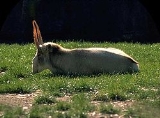
Saiga Antelope

Encyclopedia
The saiga is a Critically Endangered antelope
which originally inhabited a vast area of the Eurasia
n steppe
zone from the foothills of the Carpathians
and Caucasus
into Dzungaria
and Mongolia
. They also lived in North America
during the Pleistocene
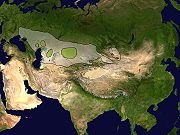
. Today the nominate subspecies (Saiga tatarica tatarica) is only found in one location in Russia (steppes of the North-West Precaspian region) and three areas in Kazakhstan (the Ural, Ustiurt and Betpak-dala populations). A proportion of the Ustiurt population migrates south to Uzbekistan and occasionally Turkmenistan in winter. It is extinct in China and southwestern Mongolia. The Mongolian subspecies (Saiga tatarica mongolica) is found only in western Mongolia.
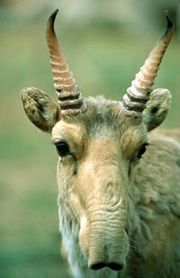 The saiga typically stands 0.6-0.8 meters at the shoulder and weighs between 36 and 63 kg. Their lifespan ranges from 6 to 10 years. Males are bigger than females and are the only sex to carry horns. The horn
s have some value as Chinese traditional medicine and for that reason Saiga are now endangered by poaching. The saiga is recognizable by an extremely unusual, over-sized, flexible nose structure. The nose
is supposed to warm up the air in winter and filter out the dust in summer.
s eating several species of plants, including some that are poisonous to other animals. They can cover considerable distances and swim across rivers, but they avoid steep or rugged areas. The mating season starts in November, when stags fight for the possession of females. The winner leads a herd of 5-50 females. In springtime the mother gives birth to, in two thirds of all cases two, or in one third, one single foal.
the saiga ranged from the British Isles
through Central Asia
and the Bering Strait
into Alaska
and the Yukon
. At the beginning of the 18th century it was still distributed from the shores of the Black Sea
, the Carpathian foothills
and the northern edge of the Caucasus into Dzungaria
and Mongolia.
 After a rapid decline they were nearly completely exterminated in the 1920s, but they were able to recover and by 1950 there were again two million of them in the steppes of the USSR.
Its population fell drastically following the collapse of the Soviet Union, due to uncontrolled hunting and demand for its horns in Chinese medicine.
At one point, some conservation groups, such as the World Wildlife Fund, encouraged the hunting of this species as its horn was presented as an alternative to that of a rhinoceros
.
Today the populations have again shrunk enormously, as much as 95% in 15 years, and the saiga is classified as critically endangered by the IUCN.
There is an estimated total number of 50,000 Saigas today, which live in Kalmykia
, three areas of Kazakhstan
and in two isolated areas of Mongolia. Another small population in the Pre-Caspian region of Russia, remains under extreme threat.
Cherny Zemli Nature Reserve was created in Russia's Kalmykia Republic in 1990s to protect the local saiga population and the President of Russia's Kalmykia Republic, Kirsan Ilyumzhinov
, announced year of 2010 in Kalmykia as Year of Saiga. In Kazakhstan, the number of saiga was recently found to be increasing, from around 21,000 at the begin of this millennium to around 81,000 in January 2010.
However, in May 2010, it was announced that an estimated 12,000 of the 26,000 Saiga population in the Ural region of Kazakhstan have been found dead. Although the deaths are currently being ascribed to pasteurellosis
, an infectious disease that strikes the lungs and intestines, the underlying trigger remains to be identified.
Kazakhstan in November 2010 reaffirmed a ban on hunting saiga antelopes, and extended this ban until 2021, as the Central Asian nation seeks to save the endangered species.
The Mongolian saiga (Saiga tatarica mongolica) is found in a small area in western Mongolia arround Sharga
and Mankhan Nature Reserve
.
Currently only the Moscow Zoo
zoo keeps saigas. Cologne
and San Diego Zoo
s had them in the past. Pleistocene Park
in northern Siberia plans to introduce the species.
was started back in the early 1990s as an informal network of researchers and conservationists to study and protect the critically endangered saiga antelope. The SCA was officially inaugurated in September 2006, and in November 2006 was granted Candidate Partner status by the Wildlife Conservation Network
. SCA also publishes a quarterly newsletter with latest updates from the field and range countries.
The organization Rewilding Europe has plans for reintroducing saiga to Europe.
Antelope
Antelope is a term referring to many even-toed ungulate species indigenous to various regions in Africa and Eurasia. Antelopes comprise a miscellaneous group within the family Bovidae, encompassing those old-world species that are neither cattle, sheep, buffalo, bison, nor goats...
which originally inhabited a vast area of the Eurasia
Eurasia
Eurasia is a continent or supercontinent comprising the traditional continents of Europe and Asia ; covering about 52,990,000 km2 or about 10.6% of the Earth's surface located primarily in the eastern and northern hemispheres...
n steppe
Steppe
In physical geography, steppe is an ecoregion, in the montane grasslands and shrublands and temperate grasslands, savannas, and shrublands biomes, characterized by grassland plains without trees apart from those near rivers and lakes...
zone from the foothills of the Carpathians
Carpathian Mountains
The Carpathian Mountains or Carpathians are a range of mountains forming an arc roughly long across Central and Eastern Europe, making them the second-longest mountain range in Europe...
and Caucasus
Caucasus
The Caucasus, also Caucas or Caucasia , is a geopolitical region at the border of Europe and Asia, and situated between the Black and the Caspian sea...
into Dzungaria
Dzungaria
Dzungaria, also called Zungaria, is a geographical region in northwest China corresponding to the northern half of Xinjiang. It covers approximately , lying mostly within Xinjiang, and extending into western Mongolia and eastern Kazakhstan...
and Mongolia
Mongolia
Mongolia is a landlocked country in East and Central Asia. It is bordered by Russia to the north and China to the south, east and west. Although Mongolia does not share a border with Kazakhstan, its western-most point is only from Kazakhstan's eastern tip. Ulan Bator, the capital and largest...
. They also lived in North America
North America
North America is a continent wholly within the Northern Hemisphere and almost wholly within the Western Hemisphere. It is also considered a northern subcontinent of the Americas...
during the Pleistocene
Pleistocene
The Pleistocene is the epoch from 2,588,000 to 11,700 years BP that spans the world's recent period of repeated glaciations. The name pleistocene is derived from the Greek and ....
. Today the nominate subspecies (Saiga tatarica tatarica) is only found in one location in Russia (steppes of the North-West Precaspian region) and three areas in Kazakhstan (the Ural, Ustiurt and Betpak-dala populations). A proportion of the Ustiurt population migrates south to Uzbekistan and occasionally Turkmenistan in winter. It is extinct in China and southwestern Mongolia. The Mongolian subspecies (Saiga tatarica mongolica) is found only in western Mongolia.
Physical characteristics
Horn (anatomy)
A horn is a pointed projection of the skin on the head of various animals, consisting of a covering of horn surrounding a core of living bone. True horns are found mainly among the ruminant artiodactyls, in the families Antilocapridae and Bovidae...
s have some value as Chinese traditional medicine and for that reason Saiga are now endangered by poaching. The saiga is recognizable by an extremely unusual, over-sized, flexible nose structure. The nose
Nose
Anatomically, a nose is a protuberance in vertebrates that houses the nostrils, or nares, which admit and expel air for respiration in conjunction with the mouth. Behind the nose are the olfactory mucosa and the sinuses. Behind the nasal cavity, air next passes through the pharynx, shared with the...
is supposed to warm up the air in winter and filter out the dust in summer.
Habitat and behavior
Saigas form very large herds that graze in semi-desert steppeSteppe
In physical geography, steppe is an ecoregion, in the montane grasslands and shrublands and temperate grasslands, savannas, and shrublands biomes, characterized by grassland plains without trees apart from those near rivers and lakes...
s eating several species of plants, including some that are poisonous to other animals. They can cover considerable distances and swim across rivers, but they avoid steep or rugged areas. The mating season starts in November, when stags fight for the possession of females. The winner leads a herd of 5-50 females. In springtime the mother gives birth to, in two thirds of all cases two, or in one third, one single foal.
Distribution
During the Ice AgeIce age
An ice age or, more precisely, glacial age, is a generic geological period of long-term reduction in the temperature of the Earth's surface and atmosphere, resulting in the presence or expansion of continental ice sheets, polar ice sheets and alpine glaciers...
the saiga ranged from the British Isles
British Isles
The British Isles are a group of islands off the northwest coast of continental Europe that include the islands of Great Britain and Ireland and over six thousand smaller isles. There are two sovereign states located on the islands: the United Kingdom of Great Britain and Northern Ireland and...
through Central Asia
Central Asia
Central Asia is a core region of the Asian continent from the Caspian Sea in the west, China in the east, Afghanistan in the south, and Russia in the north...
and the Bering Strait
Bering Strait
The Bering Strait , known to natives as Imakpik, is a sea strait between Cape Dezhnev, Chukotka Autonomous Okrug, Russia, the easternmost point of the Asian continent and Cape Prince of Wales, Alaska, USA, the westernmost point of the North American continent, with latitude of about 65°40'N,...
into Alaska
Alaska
Alaska is the largest state in the United States by area. It is situated in the northwest extremity of the North American continent, with Canada to the east, the Arctic Ocean to the north, and the Pacific Ocean to the west and south, with Russia further west across the Bering Strait...
and the Yukon
Yukon
Yukon is the westernmost and smallest of Canada's three federal territories. It was named after the Yukon River. The word Yukon means "Great River" in Gwich’in....
. At the beginning of the 18th century it was still distributed from the shores of the Black Sea
Black Sea
The Black Sea is bounded by Europe, Anatolia and the Caucasus and is ultimately connected to the Atlantic Ocean via the Mediterranean and the Aegean seas and various straits. The Bosphorus strait connects it to the Sea of Marmara, and the strait of the Dardanelles connects that sea to the Aegean...
, the Carpathian foothills
Carpathian Mountains
The Carpathian Mountains or Carpathians are a range of mountains forming an arc roughly long across Central and Eastern Europe, making them the second-longest mountain range in Europe...
and the northern edge of the Caucasus into Dzungaria
Dzungaria
Dzungaria, also called Zungaria, is a geographical region in northwest China corresponding to the northern half of Xinjiang. It covers approximately , lying mostly within Xinjiang, and extending into western Mongolia and eastern Kazakhstan...
and Mongolia.
Its population fell drastically following the collapse of the Soviet Union, due to uncontrolled hunting and demand for its horns in Chinese medicine.
At one point, some conservation groups, such as the World Wildlife Fund, encouraged the hunting of this species as its horn was presented as an alternative to that of a rhinoceros
Rhinoceros
Rhinoceros , also known as rhino, is a group of five extant species of odd-toed ungulates in the family Rhinocerotidae. Two of these species are native to Africa and three to southern Asia....
.
Today the populations have again shrunk enormously, as much as 95% in 15 years, and the saiga is classified as critically endangered by the IUCN.
There is an estimated total number of 50,000 Saigas today, which live in Kalmykia
Kalmykia
The Republic of Kalmykia is a federal subject of Russia . Population: It is the only Buddhist region in Europe. It has also become well-known as an international chess mecca because its former President, Kirsan Ilyumzhinov, is the head of the International Chess Federation .-Geography:*Area:...
, three areas of Kazakhstan
Kazakhstan
Kazakhstan , officially the Republic of Kazakhstan, is a transcontinental country in Central Asia and Eastern Europe. Ranked as the ninth largest country in the world, it is also the world's largest landlocked country; its territory of is greater than Western Europe...
and in two isolated areas of Mongolia. Another small population in the Pre-Caspian region of Russia, remains under extreme threat.
Cherny Zemli Nature Reserve was created in Russia's Kalmykia Republic in 1990s to protect the local saiga population and the President of Russia's Kalmykia Republic, Kirsan Ilyumzhinov
Kirsan Ilyumzhinov
Kirsan Nikolayevich Ilyumzhinov is a Kalmyk multi-millionaire businessman and politician. He was the President of the Republic of Kalmykia in the Russian Federation from 1993 to 2010, and he has been the President of FIDE , the world's pre-eminent international chess organization, since 1995...
, announced year of 2010 in Kalmykia as Year of Saiga. In Kazakhstan, the number of saiga was recently found to be increasing, from around 21,000 at the begin of this millennium to around 81,000 in January 2010.
However, in May 2010, it was announced that an estimated 12,000 of the 26,000 Saiga population in the Ural region of Kazakhstan have been found dead. Although the deaths are currently being ascribed to pasteurellosis
Pasteurellosis
Pasteurellosis is an infection with a species of the bacteria genus Pasteurella, which is found in humans and animals.Pasteurella multocida is carried in mouth and respiratory tract of several animals, notably cats. It is a small Gram negative bacillus with bipolar staining by Wayson stain...
, an infectious disease that strikes the lungs and intestines, the underlying trigger remains to be identified.
Kazakhstan in November 2010 reaffirmed a ban on hunting saiga antelopes, and extended this ban until 2021, as the Central Asian nation seeks to save the endangered species.
The Mongolian saiga (Saiga tatarica mongolica) is found in a small area in western Mongolia arround Sharga
Sharga Nature Reserve
Sharga Nature Reserve is a reserve in the eastern part of Mongolia. It comprises 2.860 sqkm and is located in Govi-Altai Province in the area of the Sharga sum. The reserve has been created in 1993 together with Mankhan Nature Reserve to protect the endangered Mongolian saiga.- References :*...
and Mankhan Nature Reserve
Mankhan Nature Reserve
Mankhan Nature Reserve is a reserve in the eastern part of Mongolia. It is located south of Khar Us Nuur National Park in Khovd Province on the main road betwenn Hovd City and Ulaanbaatar. Most of the area lies in the Mankhan sum. The reserve streches over 3.000 sqkm and has been created in 1993...
.
Currently only the Moscow Zoo
Moscow Zoo
The Moscow Zoo is a zoo founded in 1864 by a group of professor-biologists, K.F. Rulje, S.A. Usov and A.P. Bogdanov, from the Moscow State University. In 1919, the zoo was nationalized. In 1922, the ownership was transferred to the city of Moscow and has remained under Moscow's control ever...
zoo keeps saigas. Cologne
Cologne Zoological Garden
The Aktiengesellschaft Cologne Zoological Garden is the zoo of Cologne, Germany. It features over 7,000 animals of more than 700 species on more than 20 hectares...
and San Diego Zoo
San Diego Zoo
The San Diego Zoo in Balboa Park, San Diego, California, is one of the most progressive zoos in the world, with over 4,000 animals of more than 800 species...
s had them in the past. Pleistocene Park
Pleistocene Park
Pleistocene Park is a nature reserve south of Chersky in the Sakha Republic in northeastern Siberia, where an attempt is being made to recreate the northern steppe grassland ecosystem that flourished in the area during the last ice age.-Goals:...
in northern Siberia plans to introduce the species.
Conservation
The Saiga Conservation AllianceSaiga Conservation Alliance
The Saiga Conservation Alliance SCA is a network of researchers and conservationists working to study and protect the critically endangered Saiga Antelope and their habitat. The Saiga are often seen a major flagship species of the Central Asian and pre-Caspian steppes...
was started back in the early 1990s as an informal network of researchers and conservationists to study and protect the critically endangered saiga antelope. The SCA was officially inaugurated in September 2006, and in November 2006 was granted Candidate Partner status by the Wildlife Conservation Network
Wildlife Conservation Network
The Wildlife Conservation Network is a United States-based 5013 non-profit organization that partners with conservationists from around the world and is dedicated to developing community-based projects to help wildlife and people co-exist. WCN does this by providing their partners with capital,...
. SCA also publishes a quarterly newsletter with latest updates from the field and range countries.
The organization Rewilding Europe has plans for reintroducing saiga to Europe.
External links
- CMS Saiga Memorandum of Understanding
- EDGE of Existence "(Saiga antelope)" Saving the World's most Evolutionarily Distinct and Globally Endangered (EDGE) species
- Information Support of Saiga Preservation Programs
- CIC - International Council for Game and Wildlife Conservation
- Saiga Conservation Alliance
- Ultimate Ungulate
- WWF species profile: Saiga antelope