
All Topics  
Anteater


   Email Print
   Bookmark   Link


Anteater


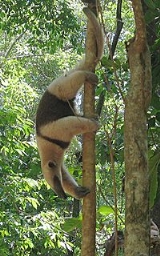
Anteaters are the four mammal
Mammal

Mammals are a class of vertebrate animals whose name is derived from their distinctive feature, mammary glands, with which they feed their young....
 species of the suborder Vermilingua commonly known for eating ant
Ant

Ants are Eusociality insects of the family Formicidae, and along with the related wasps and bees, they belong to the order Hymenoptera. Ants evolution from wasp-like ancestors in the mid-Cretaceous period between 110 and 130 million years ago and Evolutionary radiation after the rise of flowering plants....
s and termite
Termite

The termites are a group of social insects usually classified at the Taxonomy of Order Isoptera . As truly social animals, they are termed eusocial along with the ants and some bees and wasps which are all placed in the separate Order Hymenoptera....
s. Together with the sloth
Sloth

The living sloths comprise six species of medium-sized mammals that live in Central America and South America belonging to the Family two-toed sloth and three-toed sloth, part of the order Pilosa....
s, they compose the order Pilosa
Pilosa

The order Pilosa is a group of placental mammals, extant today only in the Americas. It includes the anteaters and sloths, including the recently extinct ground sloths....
. The name "anteater" is also colloquially applied to the unrelated antbear, numbat
Numbat

The Numbat , also known as the Walpurti, is a small marsupial endemic to Western Australia. The Numbat is the sole member of the genus Myrmecobius and the Family Myrmecobiidae, one of the three families that make up the order Dasyuromorphia, the generalised marsupial carnivores....
, echidna
Echidna

Echidnas , also known as spiny anteaters, are four Extant taxon mammal species belonging to the Tachyglossidae Family of the monotremes....
, and pangolin
Pangolin

Pangolins or scaly anteaters or Trenggiling are mammals in the Scientific classification Pholidota. There is only one extant family and one genus of pangolins, comprising eight species....
.

Species include the Giant Anteater
Giant Anteater

.The Giant Anteater, Myrmecophaga tridactyla, is the largest species of anteater. It is found in Central America and South America. It is the only species in the Myrmecophaga genus....
 Myrmecophaga tridactyla, about 1.8 m (6 ft) long including the tail; the tamandua
Tamandua

Tamandua is a genus of anteaters. It has two members: the Southern Tamandua and the Northern Tamandua . They live in forests and grasslands, are semi-arboreal, and possess partially prehensile tails....
 or collared Anteater Tamandua tetradactyla, about 90 cm (3 ft) long; and the Silky Anteater
Silky Anteater

Silky Anteater or Pygmy Anteater is a species of anteater from Central America and South America ranging from extreme southern Mexico south to Brazil and, possibly, Paraguay....
 Cyclopes didactylus, about 35 cm (14 in.) long.

The term "spiny anteater" is used to refer to echidnas, which consist of the Tachyglossidae family of the order Monotremata.


Discussion
Ask a question about 'Anteater'
Start a new discussion about 'Anteater'
Answer questions from other users
Full Discussion Forum


Encyclopedia


Anteaters are the four mammal
Mammal

Mammals are a class of vertebrate animals whose name is derived from their distinctive feature, mammary glands, with which they feed their young....
 species of the suborder Vermilingua commonly known for eating ant
Ant

Ants are Eusociality insects of the family Formicidae, and along with the related wasps and bees, they belong to the order Hymenoptera. Ants evolution from wasp-like ancestors in the mid-Cretaceous period between 110 and 130 million years ago and Evolutionary radiation after the rise of flowering plants....
s and termite
Termite

The termites are a group of social insects usually classified at the Taxonomy of Order Isoptera . As truly social animals, they are termed eusocial along with the ants and some bees and wasps which are all placed in the separate Order Hymenoptera....
s. Together with the sloth
Sloth

The living sloths comprise six species of medium-sized mammals that live in Central America and South America belonging to the Family two-toed sloth and three-toed sloth, part of the order Pilosa....
s, they compose the order Pilosa
Pilosa

The order Pilosa is a group of placental mammals, extant today only in the Americas. It includes the anteaters and sloths, including the recently extinct ground sloths....
. The name "anteater" is also colloquially applied to the unrelated antbear, numbat
Numbat

The Numbat , also known as the Walpurti, is a small marsupial endemic to Western Australia. The Numbat is the sole member of the genus Myrmecobius and the Family Myrmecobiidae, one of the three families that make up the order Dasyuromorphia, the generalised marsupial carnivores....
, echidna
Echidna

Echidnas , also known as spiny anteaters, are four Extant taxon mammal species belonging to the Tachyglossidae Family of the monotremes....
, and pangolin
Pangolin

Pangolins or scaly anteaters or Trenggiling are mammals in the Scientific classification Pholidota. There is only one extant family and one genus of pangolins, comprising eight species....
.

Species include the Giant Anteater
Giant Anteater

.The Giant Anteater, Myrmecophaga tridactyla, is the largest species of anteater. It is found in Central America and South America. It is the only species in the Myrmecophaga genus....
 Myrmecophaga tridactyla, about 1.8 m (6 ft) long including the tail; the tamandua
Tamandua

Tamandua is a genus of anteaters. It has two members: the Southern Tamandua and the Northern Tamandua . They live in forests and grasslands, are semi-arboreal, and possess partially prehensile tails....
 or collared Anteater Tamandua tetradactyla, about 90 cm (3 ft) long; and the Silky Anteater
Silky Anteater

Silky Anteater or Pygmy Anteater is a species of anteater from Central America and South America ranging from extreme southern Mexico south to Brazil and, possibly, Paraguay....
 Cyclopes didactylus, about 35 cm (14 in.) long.

The term "spiny anteater" is used to refer to echidnas, which consist of the Tachyglossidae family of the order Monotremata.

Classification


Order Pilosa
Pilosa

The order Pilosa is a group of placental mammals, extant today only in the Americas. It includes the anteaters and sloths, including the recently extinct ground sloths....
  • Suborder Folivora (sloth
    Sloth

    The living sloths comprise six species of medium-sized mammals that live in Central America and South America belonging to the Family two-toed sloth and three-toed sloth, part of the order Pilosa....
    s)
  • Suborder Vermilingua
    • Family Cyclopedidae
      • Genus Cyclopes
        Cyclopes

        Cyclopes may refer to:*The genus Cyclopes, of which the Silky Anteater is the only known species*The plural form of Cyclops, a one-eyed monster from Greek mythology...
        • Silky Anteater
          Silky Anteater

          Silky Anteater or Pygmy Anteater is a species of anteater from Central America and South America ranging from extreme southern Mexico south to Brazil and, possibly, Paraguay....
           (Cyclopes didactylus)
    • Family Myrmecophagidae
      Myrmecophagidae

      Myrmecophagidae is a family of anteaters, the name being derived from the Ancient Greek words for 'ant' and 'eat' . Myrmecophagids are native to Central and South America, from southern Mexico to northern Argentina....
      • Genus Myrmecophaga
        • Giant Anteater
          Giant Anteater

          .The Giant Anteater, Myrmecophaga tridactyla, is the largest species of anteater. It is found in Central America and South America. It is the only species in the Myrmecophaga genus....
           (Myrmecophaga tridactyla)
      • Genus Tamandua
        Tamandua

        Tamandua is a genus of anteaters. It has two members: the Southern Tamandua and the Northern Tamandua . They live in forests and grasslands, are semi-arboreal, and possess partially prehensile tails....
        • Northern Tamandua
          Northern Tamandua

          The Northern Tamandua is a species of tamandua anteater in the Myrmecophagidae family. It is found in Belize, Colombia, Costa Rica, Ecuador, El Salvador, Guatemala, Honduras, Mexico, Nicaragua, Panama, Peru, and Venezuela....
           (Tamandua mexicana)
        • Southern Tamandua
          Southern Tamandua

          Southern Tamandua, Collared Anteater or Lesser Anteater is a species of anteater from South America.It is a solitary animal, found in many habitats from mature to highly disturbed secondary forests and arid savannas....
           (Tamandua tetradactyla)


Gallery