
See Also

Beaver

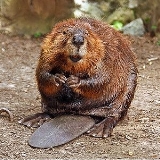
Beavers are semi-aquatic rodent Rodent

Rodentia is an order [i] of mammal [i]s . Members of the order Rodentia are called rodents. ... 

s native to North America North America

North America is a continent [i] in the Earth [i]'s northern hemisphere [i] and almost fully in the western hemisphere [i] ... 

 and Europe Europe

Europe is one of the seven traditional continent [i]s of the Earth [i]. ... 

. They are the only living members of the family Family

A family consists of a domestic group [i] of people , typically affiliated by birth or marriage, ... 

 Castoridae Castoridae

The family Castoridae contains the two living species of beaver [i] and their fossil [i] relatives. ... 

, which contains a single genus, Castor. Genetic research has shown the European and North American beaver populations to be distinct species and that hybrid Hybrid

In biology [i], hybrid has two meanings. ... 

ization is unlikely. Beavers are best known for their natural trait of building dam Dam

A dam is a barrier across flowing water that obstructs, directs or retards the flow, often creating a reservoir [i] ... 

s in river River

A river is a large natural waterway [i]. ... 

s and stream Stream

A stream, brook, beck, burn or creek, is a body of water with a detectable current [i] ... 

s, and building their homes in the eventual artificial pond Pond

A pond is a body of water smaller than a lake [i]. However the difference between a pond and a lake is ... 

. They are the third largest rodents, after the capybara Capybara

The capybara is a semi-aquatic herbivorous [i] animal, the largest of living rodent [i]s. ... 

 and the mara.

Discussions

  Discussion Features

   Ask a question about 'Beaver'

   Start a new discussion about 'Beaver'

   Answer questions about 'Beaver'

   'Beaver' discussion forum


Encyclopedia

Beavers are semi-aquatic rodent Rodent

Rodentia is an order [i] of mammal [i]s . Members of the order Rodentia are called rodents. ... 

s native to North America North America

North America is a continent [i] in the Earth [i]'s northern hemisphere [i] and almost fully in the western hemisphere [i]... 

 and Europe Europe

Europe is one of the seven traditional continent [i]s of the Earth [i]. ... 

. They are the only living members of the family Family

A family consists of a domestic group [i] of people , typically affiliated by birth or marriage, ... 

 Castoridae Castoridae

The family Castoridae contains the two living species of beaver [i] and their fossil [i] relatives. ... 

, which contains a single genus, Castor. Genetic research has shown the European and North American beaver populations to be distinct species and that hybrid Hybrid

In biology [i], hybrid has two meanings.
... 

ization is unlikely.

Beavers are best known for their natural trait of building dam Dam

A dam is a barrier across flowing water that obstructs, directs or retards the flow, often creating a reservoir [i]... 

s in river River

A river is a large natural waterway [i]. ... 

s and stream Stream

A stream, brook, beck, burn or creek, is a body of water with a detectable current [i] ... 

s, and building their homes in the eventual artificial pond Pond

A pond is a body of water smaller than a lake [i]. However the difference between a pond and a lake is ... 

. They are the third largest rodents, after the capybara Capybara

The capybara is a semi-aquatic herbivorous [i] animal, the largest of living rodent [i]s. ... 

 and the mara.

Beavers continue to grow throughout life. Adult specimens weighing over 25 kg Kilogram

The kilogram or kilogramme, is the SI base unit [i] of mass [i]. ... 

  are not uncommon. Females are as large as or larger than males of the same age, which is uncommon among mammals.

Species


The European Beaver European Beaver

The European Beaver is an endangered aquatic mammal  which was hunted almost to extinction in Europe [i] ... 

  was hunted almost to extinction Extinction

In biology [i] and ecology [i], extinction is the cessation of existence of a species [i] or group of taxa [i]... 

 in Europe Europe

Europe is one of the seven traditional continent [i]s of the Earth [i]. ... 

, both for fur and for castoreum, a secretion of its scent gland believed to have medicinal properties. However, the beaver is now being re-introduced throughout Europe. Several thousands live on the Elbe Elbe

The River Elbe is one of the major waterways of Central Europe [i]. ... 

, the Rhone Rhône River

The River Rhne, is one of the major river [i]s of Europe [i], running through Switzerland [i] and France [i] ... 

 and in parts of Scandinavia Scandinavia

Scandinavia is a region [i] in Northern Europe [i]. ... 

. In northeast Poland Poland

Poland , officially the Republic of Poland , is a country located in Central Europe [i]. ... 

 there is a thriving community of Castor fiber. They have been reintroduced in Bavaria Bavaria

The Free State [i] of Bavaria  , with an area of 70,553 km and 12.4 million inhab... 

 and The Netherlands Netherlands

The Netherlands is the Europe [i]an part of the Kingdom of the Netherlands [i] , which is formed ... 

 and are tending to spread to new locations. The beaver finally became extinct in Great Britain Great Britain

Great Britain is an island lying off the northwestern coast of mainland Europe [i] and to the east of Ireland [i] ... 

 in the sixteenth century 16th century

As a means of recording the passage of time [i], the 16th century was that century [i] which lasted from ... 

: Giraldus Cambrensis Giraldus Cambrensis

Giraldus Cambrensis , also known as Gerallt Gymro in Welsh [i] or Gerald of Wal ... 

 reported in 1188 that it was to be found only in the Teifi in Wales Wales

Wales is one of four constituent parts [i] of the United Kingdom [i]. ... 

 and in one river in Scotland Scotland

Scotland is a nation [i] in northwest Europe [i] and one of the constituent [i] countries [i] ... 

, though his observations are clearly first hand.

In October 2005, six European beavers were re-introduced to Britain in Lower Mill Estate in Gloucestershire Gloucestershire

Gloucestershire is a county in South West England [i]. ... 

, and there are plans for re-introductions in Scotland Scotland

Scotland is a nation [i] in northwest Europe [i] and one of the constituent [i] countries [i] ... 

 and Wales Wales

Wales is one of four constituent parts [i] of the United Kingdom [i]. ... 

.

The extinct North American Giant beaver Giant Beaver

The Giant Beaver was a huge species of rodent, with a length up to 2.5 m and an estimated weight of 220 ... 

  was one of largest rodents that ever evolved Evolution

In biology [i], evolution is the change in the heritable [i] traits [i] of a population [i] ... 

. It disappeared, with other large mammals in the Holocene extinction event, which began about 13,000 years ago.

Habitat

The habitat of the beaver is the riparian zone Riparian zone

Riparian zone is the interface between land and a flowing surface water body.... 

 inclusive of stream bed. The habit of the beaver for hundreds of thousands of years in the Northern Hemisphere Northern Hemisphere

The Northern Hemisphere is the half of a planet's surface that is north [i] of the equator [i] .... 

 has been to keep these watery systems healthy and in good repair, although to a human observer, seeing all of the downed trees, it might sometimes seem that the critters are doing just the opposite. Beaver work as a keystone species in an ecosystem by creating wetlands Wetland

In physical geography [i], a wetland is an environment "at the interface between truly terrestrial [i] ... 

 that are utilized by many other species. The ability of beavers to radically alter landscape is amazing. Next to humans, no other extant animal does more to shape its landscape. Introduced to an area without its natural predators, as in Tierra del Fuego Tierra del Fuego

Tierra del Fuego , an archipelago [i], 28,476 sq mi , separated from the mainland by the Strait of Magellan [i] ... 

, beavers have flooded thousands of acres of land and are considered an unstoppable plague. One notable difference in Tierra del Fuego from most of North America is that the trees found in TdF do not coppice as do the Willows, Poplars, Aspens etc of North America. Thus the "damage" by the beavers seems more severe.

Dams

The dams are created both as a protection against predators, e.g., coyotes, wolves and bears, and to provide easy access to food during winter. It is both the sound of water in motion and the current that stimulates the beavers to build. If, for example, a pipe is placed under the dam to drain it the beavers may stuff it with a tree trunk unless the pipe inlet is protected with a large cage-like filter. They may repair any damage to the dam and build it higher as long as the sound continues. However, in times of high water, they often allow spillways in the dam to flow freely. Beavers have even attempted to build dams in response to recordings of water flowing even in the absence of water .

Destroying a beaver dam without removing the beavers takes a lot of effort, especially if the dam is downstream of an active lodge. Beavers can rebuild such primary dams overnight, but may not defend secondary dams as vigorously.

Recent studies involving beaver habitual activities have indicated that beavers may respond to an array of stimuli, not just the sound of running water. In two experiments Wilson and Richard demonstrate that although beavers will pile material close to a loudspeaker emitting sounds of water running, they only do so after a considerable period of time. Additionally the beavers, when faced with a pipe allowing water to pass through their dam, eventually stopped the flow of water by plugging the pipe with mud and sticks. The beavers were observed to do this even when the pipe extended several meters upstream and near the bottom of the stream and thus produced no sound of running water.

Beaver dams can be disruptive; the flooding can cause extensive property damage, and when the flooding occurs next to a railroad roadbed, it can cause derailments by washing-out under the tracks, or when a beaver dam bursts and the resulting flash flood overwhelms a culvert. This disruption is not limited to human geography; beavers can destroy nesting habitat for endangered species, and often destroy mature trees for which they have no use.

Yet dam building activity restores wetlands, the land's most beneficial ecosystem. Such wetland benefits include flood control downstream, biodiversity , and water cleansing, both by the breakdown of toxins such as pesticides and the retention of silt by beaver dams. The latter also reduces erosion as well as decreasing turbidity that is the limiting factor for aquatic life. While beavers can create damage, part of the problem is one of perception and time scale. The damage beavers do such as the undermining of a roadway or the drowning of some trees is very visible very shortly after the beavers activity in an area starts. The benefits, mentioned below, are long term and not easily seen except by someone who is monitoring a catchment and realizes what huge positive effects beavers cause.


The beaver's effects on the environment go beyond what you would expect of a rotund, buck toothed rodent. The first part of his influence is felt when his dam creates a pond.

Flood control

A beaver dam has a certain amount of free board so when heavy rains occur, the dam fills up and gradually releases the extra stored water. Often this is all that is necessary to reduce the height of the flood wave moving down the river and will reduce or eliminate damage to human structures. But flood control is achieved in other ways as well. The surface of a stream intersects the surrounding water table. By raising the level of a stream in a certain area, the gradient of the surface of the water table is reduced and water by the beaver dam flows more slowly into the stream. This effect not only helps to reduce flood waves but also increases the water flow when there is no rain. The other way beaver dams smooth out water flow is by increasing the wetted area of the stream. This allow more water to seep into the underlying ground where its flow is slowed down. This water eventually finds its way back to the stream. Rivers with beaver dams in their head waters have lower high water and higher low water.


Wetland creation

If a beaver pond becomes too shallow due to the settling out of sediment or if the tree supply runs out in an area, the beavers will abandon the site. Eventually the dam, without the beaver to maintain it, will be breached and the water will drain out. The rich thick layer of silt, branches, dead leaves etc. behind the old dam is the ideal habitat for wetland species. Many of them will have been on the fringes of the pond. The benefits of wetlands Wetland

In physical geography [i], a wetland is an environment "at the interface between truly terrestrial [i] ... 

 are too well known to need further explanation.

The grazing meadow

As the wetland fills and dries out, pasture species colonize it and it becomes a meadow suitable for grazing. In an area with nothing but forest down to the stream edge, this provides a valuable niche for many animals which otherwise would be excluded.

The riverine forest

And finally the meadow will be colonized by riverine trees, typically aspens, willows and such species which are favoured by the beaver. At this point the beavers are likely to recolonize the area and the cycle starts over again.

Bottom land

As can be seen by the above, each time this process repeats itself, another layer of rich organic soil is added to the bottom of the valley. The valley slowly fills up and the flat area at the bottom gets wider and wider. Research is sparce on this topic, but it seems likely that much of the fabled bottom land in North America was created, or at least added to, by the efforts of the generations of beavers which lived there.

Nutrient removal

The removal of nutrients from the stream flow by beaver ponds is an interesting and very valuable process. Farming along the banks of rivers often increases the loads of phosphates, nitrates and other nutrients and these cause problems downstream when this water is extracted for drinking. Besides silt, the beaver dam collects twigs and branches from the beavers activity and leaves, notably in the fall. The main component of this material is cellulose Cellulose

Cellulose
n
is a long-chain polymer [i]ic polysaccharide [i] carbohydrate [i], of beta-glucose [i] ... 

, a polymer Polymer

Polymer is a term used to describe molecule [i]s consisting of structural unit [i]s and a large number o ... 

 of ß-glucose monomers . Many bacteria produce cellulase which can split off the glucose Glucose

Glucose , a monosaccharide [i] , is one of the most important carbohydrate [i]s in biology [i]. ... 

 and use it for energy. Just as algae get their energy from sunlight, these bacteria get their energy from cellulose and they form the base of a very similar food chain. However a source of energy is not enough for growth. These bacteria are hungry for every mollecule of nitrogen and phosporous they can grab. In this way, these, and other nutrients are fixed into the beaver pond and the surrounding ecology and removed from the stream. The capture of these nutrients helps to explain the great richness of the resulting bottom land.

Pesticide and herbicide removal

Agriculture also introduces herbicides and pesticides into our streams. Bacteria are an extremely variable lot and some of these intoxicants are metabolized and decomposed by the bacteria in the cellulose rich bottom of a beaver dam.

Denitrification

Some scientist believe that the nitrate cascade, the production of far more fixed nitrogen than the natural cycles can turn back into nitrogen gas, may be as much of a problem to our ecology as carbon dioxide production. It is likely, but not proven, that beaver dams along a stream may contribute to denitrification. In sewage plants, denitrification is achieved by passing the water through successive aerobic and anaerobic stages. Under a beaver dam, as the water seeps down into the soil, the oxygen is used up by the fauna in the rich organic layer. At some point all the oxygen is used up and the soil becomes anaerobic. This water eventually finds its way into the stream and into another beaver dam. This aerobic, anaerobic cycle continues all the way down the stream.

Beavers have been known to build very large dams, the largest known was discovered near Three Forks, Montana and was 2,140 feet long, 14 feet high, and 23 feet thick at the base. When objectionable beaver flooding occurs, modern water level control devices can be installed for a cost-effective and environmentally sound solution. Unwanted damage to trees can be prevented by wrapping chicken wire or sheet metal around the base of trees.

Lodges

The ponds created by well-maintained dams help isolate the beavers' home, their lodge, which is also created from severed branches and mud. The lodge has underwater entrances to make entry nearly impossible for any other animal . A very small amount of the lodge is actually used as a living area. Contrary to popular belief, beavers actually dig out their den with an underwater entrance after they finish building the dam and lodge structure. There are typically two dens within the lodge, one for drying off after exiting the water, and another, drier one where the family actually lives.

Danger signal

When startled or frightened, a swimming beaver will rapidly dive while forcefully slapping the water with its broad tail. This creates a loud 'slap', audible over large distances above and below water. This noise serves as a warning to other beavers in the area. Once a beaver has made this danger signal, all nearby beavers will dive and may not reemerge for some time.

Fur trade

Beaver pelts were used for barter by Native Americans Indigenous peoples of the Americas

The term Indigenous peoples of the Americas encompasses the inhabitants of the Americas [i] before the European discovery of the Americas [i] ... 

 in the 17th century 17th century

As a means of recording the passage of time [i], the 17th century was that century [i] which lasted from ... 

 to gain Europe Europe

Europe is one of the seven traditional continent [i]s of the Earth [i]. ... 

an goods. They were then shipped back to Great Britain Great Britain

Great Britain is an island lying off the northwestern coast of mainland Europe [i] and to the east of Ireland [i] ... 

 and France France

France, officially the French Republic, is a country [i] whose metropolitan territory [i] ... 

 where they were made into clothing items. Widespread hunting and trapping of beavers led to their endangerment. Eventually, the fur trade Fur trade

The fur trade is a worldwide industry involving capturing of animals for their fur.... 

 fell apart due to declining demand in Europe and the takeover of trapping grounds to support the growing agriculture sector. A small resurgence in beaver trapping has occurred in some areas where there is an over-population of beaver; trapping is only done when the fur is of value, and normally the remainder of the animal is also utilized as animal feed.

In culture

Popular western culture typically depicts the animal positively, as a good natured and industrious character such as Mr. and Mrs. Beaver who are important heroic characters in the classic fantasy novel, The Lion, the Witch and the Wardrobe The Lion, the Witch and the Wardrobe

The Lion, the Witch and the Wardrobe is a fantasy [i] novel for children by C. S. Lewis [i] ... 

. The beaver's habits, habitat and conservation status are recurring themes in The Tent Dwellers The Tent Dwellers

The Tent Dwellers is a book by Albert Bigelow Paine [i], chronicling his travels through inland Nova Scotia [i] ... 

, by Albert Bigelow Paine.

The American Beaver American Beaver

The North American Beaver [i] is a large semi-aquatic rodent [i] native to Canada [i], most of the United States [i] ... 

  is the national animal List of national animals

This is a list of national animals:
... 

 of Canada Canada

Canada is the world's second-largest [i] country by total area, occupying most ... 

; it is depicted on the Canadian five-cent piece Nickel

Nickel is a metallic chemical element [i] in the periodic table [i] that has the symbol Ni and atomic number [i] ... 

 and was on the first Canadian postage stamp Postage stamp

postage stamp is evidence of pre-paying a fee for postal [i] services. ... 

, the Three Penny Beaver. As a national symbol, the animal is a favourite choice for depicting Canadians as furry characters and was chosen to be the mascot Mascot

A mascot, originally a fetish [i]-like term for any person, animal, or thing supposed to bring luck [i], ... 

 of 1976 Summer Olympics 1976 Summer Olympics

The 1976 Summer Olympics, officially known as the Games of the XXI Olympiad, were held in 1976 [i] ... 

 held in Montreal Montreal

Montreal, or Montral in French [i], is the second largest city [i] ... 

 with the name "Amik" . It is also the symbol of many units and organizations within the Canadian Forces Canadian Forces

The Canadian Forces , abbreviated as CF are the combined armed forces [i] of Canada [i].
... 

, such as on the cap badges of the Royal 22e Régiment Royal 22e Régiment

... 

 and the Canadian Military Engineers Canadian Military Engineers

The Canadian Military Engineers is the military engineer [i]ing branch [i] of the Canadian Forces [i]... 

. However, beavers are considered a pest by some people.

Oregon Oregon

Oregon is a state [i] in the Pacific Northwest [i] region of the United States [i]. ... 

 is known as the "The Beaver State". The beaver is the state animal and its likeness appears on the state flag. It is the state mammal of New York New York

New York is a state [i] in the northeastern [i] United States [i]. ... 

 .

Due to its engineering capabilities, the beaver serves as the mascot of the Massachusetts Institute of Technology Massachusetts Institute of Technology

The Massachusetts Institute of Technology, or MIT, is a private world-leading research university [i] ... 

, California Institute of Technology California Institute of Technology

The California Institute of Technology is a private [i], coeducation [i]al university lo ... 

, Oregon State University Oregon State University

name = Oregon State University
... 

 and the University of Toronto University of Toronto

The University of Toronto is a coeducational [i] public [i] research university [i] i ... 

. It is also an emblem for London School of Economics London School of Economics

... 

 and the name of its student newspaper - The Beaver.

In the 17th century, based on a question raised by the bishop of Quebec Quebec

Quebec, or Qubec in French [i], In 1898, the Canadian Parliament passed the first ... 

, the Roman Catholic Church Roman Catholic Church

The Roman Catholic Church or Catholic Church is the Christian [i] Church [i] ... 

 ruled that the beaver was a fish Fish

A fish is a water [i]-dwelling vertebrate [i] with gills [i], that remains so throughout its life.... 

. The legal basis for the decision probably rests with the Summa Theologica Summa Theologiae

The Summa Theologiae is the most famous work of Thomas Aquinas [i]. ... 

of Thomas Aquinas Thomas Aquinas

Saint Thomas Aquinas [Thomas of Aquin, or Aquino] was an Italian [i] philosopher [i]... 

; which bases animal classification as much on habit as taxonomy. Therefore the general prohibition on the consumption of meat Meat

Meat, in its broadest modern definition, is all animal [i] tissue [i] used as food [i] ... 

 on Fridays during Lent Lent

In Western Christianity [i], Lent is the period from Ash Wednesday [i] to Holy Saturday [i], the day bef ... 

 did not apply to beaver meat.

1911 encyclopedia text

The following text is taken from the 1911 Encyclopedia Brittannica Encyclopædia Britannica Eleventh Edition

The Encyclopdia Britannica Eleventh Edition is perhaps the most famous edition of the Encyclopdia Britannica [i] ... 

.


Beaver, the largest European aquatic representative of the mammalian order RODENTIA, easily recognized by its large trowel-like, scaly tail, which is expanded in the horizontal direction.

The word is descended from the Aryan name of the animal, cf. Sanskrit babhru's, brown, the great ichneumon, Lat. fiber, Ger. Biber, Swed. bäver, Russ. bobr'; the root bhru has given "brown," and, through Romanic, "bronze" and "burnish."

The true beaver is a native of Europe and northern Asia, but it is represented in North America by a closely-allied species , chiefly distinguished by the form of the nasal bones of the skull.

Beavers are nearly allied to the squirrel Squirrel

Squirrel is the common name for rodent [i]s of the family Sciuridae [i] . ... 

s , agreeing in certain structural peculiarities of the lower jaw and skull. In the Sciuridae the two main bones of the lower half of the leg are quite separate, the tail is round and hairy, and the habits are arboreal and terrestrial. In the beavers or Castoridae these bones are in close contact at their lower ends, the tail is depressed, expanded and scaly, and the habits are aquatic.


Beavers have webbed hind-feet, and the claw of the second hind-toe double. They have poor eyesight, but a keen sense of hearing, smell, and touch.

In length beavers--European and American--measure about 2 ft. exclusive of the tail, which is about 10 inches long. They are covered with a fur to which they owe their chief commercial value; this consists of two kinds of hair--the one close-set, silky and of a greyish colour, the other much coarser and longer, and of a reddish brown.

Beavers are essentially aquatic in their habits, never travelling by land unless driven by necessity. Formerly common in England, the European beaver has
not only been exterminated there, but likewise in most of the countries of the continent, although a few remain on the Elbe Elbe

The River Elbe is one of the major waterways of Central Europe [i]. ... 

, the Rhone Rhône River

The River Rhne, is one of the major river [i]s of Europe [i], running through Switzerland [i] and France [i] ... 

 and in parts of Scandinavia. The American species
is also greatly diminished in numbers from incessant pursuit for the sake of its valuable fur.

Beavers are sociable animals, living in streams, where, so as to render the water of sufficient depth, they build dams of mud and of the stems and boughs of trees felled by their powerful incisor teeth. In the neighbourhood they make their "lodges," which are roomy chambers, with the entrance beneath the water. The mud is plastered down by the fore-feet, and not, as often supposed, by the tail, which is employed solely as a rudder.

They are mainly nocturnal, and subsist chiefly on bark and twigs or the roots of water plants.


The dam differs in shape according to the nature of particular localities. Where the water has little motion it is almost straight; where the current is considerable it is curved, with its convexity towards the stream. The materials made use of are driftwood Driftwood

Driftwood is wood [i] that has been washed onto a shore or beach, of a sea or river, by the action of wi ... 

, green willows Willow

The willows are deciduous [i] tree [i]s and shrub [i]s in the genus Salix, part of the willow ... 

, birch Birch

Birch is the name of any tree [i] of the genus Betula, in the family Betulaceae [i], closely r ... 

 and poplars; also mud and stones intermixed in such a manner as contributes to the strength of the dam; but there is no particular method observed, except that the work is carried on with a regular sweep, and that all the parts are made of equal strength.

"In places," writes Hearne, "which have been long frequented by beavers undisturbed, their dams, by frequent repairing, become a solid bank, capable of resisting a great force both of ice and water; and as the willow, poplar and birch generally take root and shoot up, they by degrees form a kind of regular planted hedge, which I have seen in some places so tall that birds have built their nests among the branches."

Their houses are formed of the same materials as the dams, with little order or regularity of structure, and seldom contain more than four old, and six or eight young beavers. It not unfrequently happens that some of the larger houses have one or more partitions, but these are only posts of the main building left by the builders to support the roof, for the apartments have usually no communication with each other except by water.


The beavers carry the mud and stones with their fore-paws and the timber between their teeth. They always work in the night and with great expedition. They cover their houses late every autumn with fresh mud, which, freezing when the frost sets in, becomes almost as hard as stone, so that neither wolves Gray Wolf

The Gray Wolf is a mammal [i] in the order Carnivora [i]. ... 

 nor wolverine Wolverine

The wolverine is the largest terrestrial species of the Mustelidae [i] or weasel family, and is also ca ... 

s can disturb their repose.

The favourite food of the American beaver is the water-lily , which bears a resemblance to a cabbage Cabbage

The cabbage is a plant of the Family Brassicaceae [i] . ... 

-stalk, and grows at the bottom of lakes and rivers. Beavers also gnaw the bark of birch Birch

Birch is the name of any tree [i] of the genus Betula, in the family Betulaceae [i], closely r ... 

, poplar Poplar

Populus is a genus of trees which includes the cottonwoods, poplars, and aspens, all of which are so... 

 and willow Willow

The willows are deciduous [i] tree [i]s and shrub [i]s in the genus Salix, part of the willow ... 

 trees; but during the summer a more varied herbage, with the addition of berries, is consumed.

When the ice breaks up in spring they always leave their embankments, and rove about until a little before the fall of the leaf, when they return to their old habitations, and lay in their winter stock of wood. They seldom begin to repair the houses till the frost sets in, and never finish the outer coating till the cold becomes severe. When they erect a new habitation they fell the wood early in summer, but seldom begin building till towards the end of August.

Castoreum is a substance contained in two pear-shaped pouches situated near the organs of reproduction, of a bitter taste and slightly foetid odour, at one time largely employed as a medicine, but now used only in perfume Perfume

Perfume is a mixture of fragrant essential oil [i]s and aroma compound [i]s, fixative [i]s, and solvent [i]... 

ry.

Fossil remains of beavers are found in the peat and other superficial deposits of England and the continent of Europe; while in the Pleistocene Pleistocene

The Pleistocene epoch [i] is part of the geologic timescale [i]. ... 

 formations of England and Siberia occur remains of a giant extinct beaver, Trogontherium cuvieri, representing a genus by itself.

Notes


References

  • 2002-12-14

External links

  • Canadian Geographic Canadian Geographic

    Canadian Geographic is the bimonthly magazine of the Royal Canadian Geographical Society [i]. ... 

     Kids
  • being the history of the beaver in the western hemisphere, by A. Radclyffe Dugmore. Illustrated with photographs from life and drawings by the author. Publisher: Philadelphia, J.B. Lippincott company; London, W. Heinemann 1914 '