
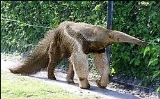
The
Giant Anteater,
Myrmecophaga tridactyla, is the largest
speciesIn biology, a species is one of the basic units of biological classification and a taxonomic rank. A species is often defined as a group of organisms capable of interbreeding and producing fertile offspring. While in many cases this definition is adequate, more precise or differing measures are...
of
anteaterAnteaters, also known as antbear, are the four mammal species of the suborder Vermilingua commonly known for eating ants and termites. Together with the sloths, they compose the order Pilosa...
. It is the only species in the genus
Myrmecophaga. It is found in
CentralCentral America is the central geographic region of the Americas. It is the southernmost, isthmian portion of the North American continent, which connects with South America on the southeast. When considered part of the unified continental model, it is considered a subcontinent...
and
South AmericaSouth America is a continent situated in the Western Hemisphere, mostly in the Southern Hemisphere, with a relatively small portion in the Northern Hemisphere. The continent is also considered a subcontinent of the Americas. It is bordered on the west by the Pacific Ocean and on the north and east...
from
HondurasHonduras is a republic in Central America. It was previously known as Spanish Honduras to differentiate it from British Honduras, which became the modern-day state of Belize...
to northern
ArgentinaArgentina , officially the Argentine Republic , is the second largest country in South America by land area, after Brazil. It is constituted as a federation of 23 provinces and an autonomous city, Buenos Aires...
. Its fossil remains have been found as far north as northwestern
SonoraSonora officially Estado Libre y Soberano de Sonora is one of the 31 states which, with the Federal District, comprise the 32 Federal Entities of Mexico. It is divided into 72 municipalities; the capital city is Hermosillo....
, Mexico.
It is a solitary animal, found in many habitats, including grasslands, deciduous forests and rainforests. It feeds mainly on
antAnts are social insects of the family Formicidae and, along with the related wasps and bees, belong to the order Hymenoptera. Ants evolved from wasp-like ancestors in the mid-Cretaceous period between 110 and 130 million years ago and diversified after the rise of flowering plants. More than...
s and
termiteTermites are a group of eusocial insects that, until recently, were classified at the taxonomic rank of order Isoptera , but are now accepted as the epifamily Termitoidae, of the cockroach order Blattodea...
s, sometimes up to 30,000 insects in a single day.
The genus name
Myrmecophaga is from
GreekGreek is an independent branch of the Indo-European family of languages. Native to the southern Balkans, it has the longest documented history of any Indo-European language, spanning 34 centuries of written records. Its writing system has been the Greek alphabet for the majority of its history;...
murmekos,
antAnts are social insects of the family Formicidae and, along with the related wasps and bees, belong to the order Hymenoptera. Ants evolved from wasp-like ancestors in the mid-Cretaceous period between 110 and 130 million years ago and diversified after the rise of flowering plants. More than...
, and
phagein, to eat.
Physiology
The giant anteater is one of few taxa of mammals without any teeth even in a
matureMature is the adjectival form of maturity, which has several meanings.Mature may also refer to:*"Mature 17+", a rating in the Entertainment Software Rating Board video game rating system*Mature, a character from The King of Fighters series...
state. An anteater instead crushes insects it consumes using hard growths found on the inside of its mouth, and its flabby stomach. Sand and small rocks have also been found in anteaters' stomachs, suggesting that these are ingested to aid digestion (possible
gastrolithA gastrolith, also called a stomach stone or gizzard stones, is a rock held inside a gastrointestinal tract. Gastroliths are retained in the muscular gizzard and used to grind food in animals lacking suitable grinding teeth. The grain size depends upon the size of the animal and the gastrolith's...
s). They have an average body temperature of 32.7
oC, which is one of the lowest of all land-living mammals. This low rate of metabolism, common in
xenarthraThe superorder Xenarthra is a group of placental mammals , existent today only in the Americas and represented by anteaters, tree sloths, and armadillos. The origins of the order can be traced back as far as the Paleogene in South America...
ns, means it is inactive for a mammal. Unlike most mammals, the giant anteater's
gastric acidGastric acid is a digestive fluid, formed in the stomach. It has a pH of 1 to 2 and is composed of hydrochloric acid , and large quantities of potassium chloride and sodium chloride...
does not contain
hydrochloric acidHydrochloric acid is a solution of hydrogen chloride in water, that is a highly corrosive, strong mineral acid with many industrial uses. It is found naturally in gastric acid....
; rather, it uses
formic acidFormic acid is the simplest carboxylic acid. Its chemical formula is HCOOH or HCO2H. It is an important intermediate in chemical synthesis and occurs naturally, most notably in the venom of bee and ant stings. In fact, its name comes from the Latin word for ant, formica, referring to its early...
produced by its prey.
It grows to a size of up to 7 feet (2.1 m) in length, with a 4 feet (1.2 m) head and torso, and a 3 foot (0.9144 m) tail. Generally it weighs from 65 to 140 lb (29.5 to 63.5 ).
The giant anteater is covered with stiff, straw-like hair which grows up to 40 cm long on the tail. Young have soft hair until they are mature. The dominant colouring may be grey or brown, but all have a diagonal black and white shoulder stripe.
The giant anteater is generally acknowledged to have a very keen sense of smell, used to locate ants, but is thought to have poor sight and hearing.
The giant anteater does not sleep in any fixed place, instead curling up in abandoned burrows and hollows. It covers its body with its long, bushy tail to sleep.
In the wild, it is nocturnal (or active at night) near human settlements, and diurnal (active during the day) elsewhere. It stays mainly on dry ground but is a strong and capable swimmer.
When threatened it does not flee, but stands up on its hind legs, using its tail to aid balance, and sometimes strikes extremely rapidly with its claws or "hugs" attackers much like a
bearBears are mammals of the family Ursidae. Bears are classified as caniforms, or doglike carnivorans, with the pinnipeds being their closest living relatives. Although there are only eight living species of bear, they are widespread, appearing in a wide variety of habitats throughout the Northern...
. An adult anteater is capable of fending off or even killing its main predators, such as the cougar.
Anatomy
Despite its name,
Myrmecophaga tridactyla, from the
GreekGreek is an independent branch of the Indo-European family of languages. Native to the southern Balkans, it has the longest documented history of any Indo-European language, spanning 34 centuries of written records. Its writing system has been the Greek alphabet for the majority of its history;...
meaning 'three-fingered ant eater', the anteater has five digits on each foot; however the middle three digits of the forefeet have elongated claws. These are extremely strong and are used to break open ant and
termiteTermites are a group of eusocial insects that, until recently, were classified at the taxonomic rank of order Isoptera , but are now accepted as the epifamily Termitoidae, of the cockroach order Blattodea...
mounds in order to feed, and provide effective defense against predators. The anteater walks on its knuckles in order to protect them, giving it a shuffling gait. Their wrist bones are adapted for knuckle-walking in much the same way as those of chimpanzees. The forefeet also have one other smaller claw, and the rear feet have five small claws.
The anteater's tongue can reach 2 feet (61 cm) in length, but has a width of only 1/2 in. The anteater can cover its tongue in a sticky saliva, allowing it to trap ants, and can extend and withdraw it up to 150 times per minute.
PangolinA pangolin , also scaly anteater or Trenggiling, is a mammal of the order Pholidota. There is only one extant family and one genus of pangolins, comprising eight species. There are also a number of extinct taxa. Pangolins have large keratin scales covering their skin and are the only mammals with...
s, the giant anteater, and the
tube-lipped nectar batThe Tube-lipped Nectar Bat is a bat from Ecuador which was first described in 2005. The species name fistulata is derived from the Latin word 'fistula', meaning 'tube'. It refers to the bat's lower lip which extends 3.3-4.8mm beyond the upper lip and is rolled into a funnel shape. The exact...
all have developed tongues which are detached from their hyoid bone and extend past their
pharynxThe human pharynx is the part of the throat situated immediately posterior to the mouth and nasal cavity, and anterior to the esophagus and larynx. The human pharynx is conventionally divided into three sections: the nasopharynx , the oropharynx , and the laryngopharynx...
deep into the
thoraxThe thorax is a division of an animal's body that lies between the head and the abdomen.-In tetrapods:...
, an example of
convergent evolutionConvergent evolution describes the acquisition of the same biological trait in unrelated lineages.The wing is a classic example of convergent evolution in action. Although their last common ancestor did not have wings, both birds and bats do, and are capable of powered flight. The wings are...
. This extension lies between the
sternumThe sternum or breastbone is a long flat bony plate shaped like a capital "T" located anteriorly to the heart in the center of the thorax...
and the
tracheaIn tetrapod anatomy the trachea, or windpipe, is a tube that connects the pharynx or larynx to the lungs, allowing the passage of air. It is lined with pseudostratified ciliated columnar epithelium cells with goblet cells that produce mucus...
.
Reproduction
It bears a single offspring after a gestation period of 190 days, which will stay near the mother until she becomes pregnant again. The baby spends much of the first part of its life riding on its mother's back, until it is nearly half her size.
The mating system of
M. tridactyla is not well known. Reproductive behavior is primarily observed in captivity.
GestationGestation is the carrying of an embryo or fetus inside a female viviparous animal. Mammals during pregnancy can have one or more gestations at the same time ....
is approximately 190 days, after which females give birth to a single young that weighs about 2.8 lb (1.3 kg). Females give birth standing up and the newborn anteater immediately climbs onto her back. Young are born with a full coat of hair and adult-like markings. Breeding occurs year-round in
captivityAnimals that live under human care are in captivity. Captivity can be used as a generalizing term to describe the keeping of either domesticated animals or wild animals. This may include for example farms, private homes and zoos...
and the wild, though seasonal breeding times have been reported in portions of their range. Inter-birth intervals can be as low as nine months.
Sexual maturitySexual maturity is the age or stage when an organism can reproduce. It is sometimes considered synonymous with adulthood, though the two are distinct...
is reached between 2.5 and 4 years. The mammary glands are lateral to the 'armpits' on the chest.
- Breeding interval: Giant anteaters can breed as often as every 9 months, though it is often longer.
- Breeding season: Giant anteaters may breed year round, or seasonally depending on region.
- Number of offspring: 1 (average)
- Gestation period: 190 days (average)
- Time to weaning: 6 months (average)
- Time to independence: 24 months (average)
- Age at sexual or reproductive maturity (female): 2.50 to 4 years
- Age at sexual or reproductive maturity (male): 2.50 to 4 years
Communication and perception
Most communication occurs between young and their mothers or during fighting. It consists of snorts, sniffs, and hisses, as well as roaring during fights. They have rather poor sight and hearing.
Food habits
Giant anteaters eat ants, termites and soft-bodied grubs. Using the long, sharp claws on their forelimbs, they open insect colonies and tree trunks. They then use the tongue to collect the
eggsAn egg is an organic vessel in which an embryo first begins to develop. In most birds, reptiles, insects, molluscs, fish, and monotremes, an egg is the zygote, resulting from fertilization of the ovum, which is expelled from the body and permitted to develop outside the body until the developing...
,
larvaA larva is a distinct juvenile form many animals undergo before metamorphosis into adults. Animals with indirect development such as insects, amphibians, or cnidarians typically have a larval phase of their life cycle...
e, and adult insects. The salivary glands secrete sticky
salivaSaliva , referred to in various contexts as spit, spittle, drivel, drool, or slobber, is the watery substance produced in the mouths of humans and most other animals. Saliva is a component of oral fluid. In mammals, saliva is produced in and secreted from the three pairs of major salivary glands,...
during feeding that coats the tongue. They only stay at one ant colony for a short period of time to avoid soldier ants, but giant anteaters can consume a few thousand insects in minutes. The tongue is attached to the
sternumThe sternum or breastbone is a long flat bony plate shaped like a capital "T" located anteriorly to the heart in the center of the thorax...
and moves very quickly, flicking 150 times per minute. They will eat
fruitIn broad terms, a fruit is a structure of a plant that contains its seeds.The term has different meanings dependent on context. In non-technical usage, such as food preparation, fruit normally means the fleshy seed-associated structures of certain plants that are sweet and edible in the raw state,...
and birds'
eggsAn egg is an organic vessel in which an embryo first begins to develop. In most birds, reptiles, insects, molluscs, fish, and monotremes, an egg is the zygote, resulting from fertilization of the ovum, which is expelled from the body and permitted to develop outside the body until the developing...
on occasion.
Threats
The
jaguarThe jaguar is a big cat, a feline in the Panthera genus, and is the only Panthera species found in the Americas. The jaguar is the third-largest feline after the tiger and the lion, and the largest in the Western Hemisphere. The jaguar's present range extends from Southern United States and Mexico...
(
Panthera onca) and the cougar (
Puma concolor) are known predators of giant anteaters. Anteaters use their immense front claws to defend themselves from predators, but their typical response to threat is to run away Verify: This contradicts statement in paragraph 7 of "physiology" heading. Their size makes them invulnerable to all but the largest of predators, jaguars and cougars primarily. They are often killed by humans, either intentionally through hunting or unintentionally through collisions with cars.
In April 2007, an anteater at the
Florencio VarelaFlorencio Varela is a city in Buenos Aires Province, Argentina. It is the head town of the Florencio Varela Partido. It forms part of the Greater Buenos Aires urban agglomeration....
Zoo near
Buenos AiresBuenos Aires is the capital and largest city of Argentina, and the second-largest metropolitan area in South America, after São Paulo. It is located on the western shore of the estuary of the Río de la Plata, on the southeastern coast of the South American continent...
,
ArgentinaArgentina , officially the Argentine Republic , is the second largest country in South America by land area, after Brazil. It is constituted as a federation of 23 provinces and an autonomous city, Buenos Aires...
attacked Melisa Casco, a zookeeper, mauling her abdomen and legs with its sharp front claws. The 19-year old zookeeper was admitted to the hospital in critical condition and died following leg amputation surgery.
Conservation status
Habitat destructionHabitat destruction is the process in which natural habitat is rendered functionally unable to support the species present. In this process, the organisms that previously used the site are displaced or destroyed, reducing biodiversity. Habitat destruction by human activity mainly for the purpose of...
is the primary threat to giant anteaters. They are listed as Appendix II by the Convention on International Trade in Endangered Species (CITES). Appendix II is defined as a species not necessarily threatened to
extinctionIn biology and ecology, extinction is the end of an organism or of a group of organisms , normally a species. The moment of extinction is generally considered to be the death of the last individual of the species, although the capacity to breed and recover may have been lost before this point...
but one that should be controlled in trade to avoid overuse. They are listed as vulnerable by the International Union for Conservation of Nature and Natural Resources (IUCN). 'Vulnerable' is defined as an estimated population reduction of 20% in the next 10 years. It is estimated that there are only as few as 5,000 left in the wild, and only 90 live in zoos across the United States.
External links
Gallery