
All Topics  
Chinchilla

 
Chinchilla

   Email Print
   Bookmark   Link


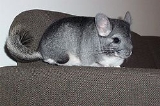
Chinchilla


Chinchillas are crepuscular
Crepuscular

Crepuscular is a term used to describe some animals that are primarily active during twilight, that is at dawn and at dusk. The word is derived from the Latin word crepusculum, meaning "twilight"....
 rodent
Rodent

Rodentia is an Order of mammals also known as rodents, characterised by two continuously growing Incisors#The_Rodent_incisor in the upper and lower jaws which must be kept short by gnawing....
s, slightly larger than ground squirrel
Ground squirrel

The ground squirrels are the members of the Sciuridae most closely related to the genus Marmota. They make up the Tribe Marmotini in the large and mainly Terrestrial animal squirrel subfamily Xerinae, and containing six living genera....
s, native to the Andes
Andes

The Andes form the world's longest exposed mountain range. They lie as a continuous chain of highland along the western coast of South America. The range is over 7,000 km long, 200-700 km wide , and of an average height of about 4,000 m ....
 mountains in South America
South America

South America is the southern continent of the Americas, situated entirely in the Western Hemisphere and mostly in the Southern Hemisphere, with a relatively small portion in the Northern Hemisphere....
. Along with their relatives, viscacha
Viscacha

Viscachas or vizcachas are rodents in the chinchilla family Chinchillidae.There are two genera and four species of viscacha.* Plains Viscacha : Resident of the Pampas of Argentina, easily differentiated from other viscachas by black and gray mustache-like facial markings....
s, they belong to the family
Family (biology)

In biological classification, family is a taxonomic rank. Exact details of formal nomenclature depend on the Nomenclature Codes which applies....
 Chinchillidae
Chinchillidae

The family Chinchillidae contains the chinchillas, viscachas, and their fossil relatives. They are restricted to southern and western South America, often in association with the Andes....
.

The animal (whose name literally means "little Chincha") is named after the Chincha people of the Andes
Andes

The Andes form the world's longest exposed mountain range. They lie as a continuous chain of highland along the western coast of South America. The range is over 7,000 km long, 200-700 km wide , and of an average height of about 4,000 m ....
, who wore its soft and dense fur. By the end of the 19th century, chinchillas had become quite rare due to hunting for their fur. Most chinchillas currently used by the fur industry for clothing and other accessories are farm-raised.

The first literature reference to chinchillas dates back to 1599 in a book published in Seville, entitled Historia Natural y Moral de las Indias, written by Father José de Acosta
José de Acosta

Jos? de Acosta , was a Spain 16th-century Society of Jesus missionary and Natural history in Latin America....
: (from Spain) "About mountain animals.


Discussion
Ask a question about 'Chinchilla'
Start a new discussion about 'Chinchilla'
Answer questions from other users
Full Discussion Forum


Encyclopedia


Chinchillas are crepuscular
Crepuscular

Crepuscular is a term used to describe some animals that are primarily active during twilight, that is at dawn and at dusk. The word is derived from the Latin word crepusculum, meaning "twilight"....
 rodent
Rodent

Rodentia is an Order of mammals also known as rodents, characterised by two continuously growing Incisors#The_Rodent_incisor in the upper and lower jaws which must be kept short by gnawing....
s, slightly larger than ground squirrel
Ground squirrel

The ground squirrels are the members of the Sciuridae most closely related to the genus Marmota. They make up the Tribe Marmotini in the large and mainly Terrestrial animal squirrel subfamily Xerinae, and containing six living genera....
s, native to the Andes
Andes

The Andes form the world's longest exposed mountain range. They lie as a continuous chain of highland along the western coast of South America. The range is over 7,000 km long, 200-700 km wide , and of an average height of about 4,000 m ....
 mountains in South America
South America

South America is the southern continent of the Americas, situated entirely in the Western Hemisphere and mostly in the Southern Hemisphere, with a relatively small portion in the Northern Hemisphere....
. Along with their relatives, viscacha
Viscacha

Viscachas or vizcachas are rodents in the chinchilla family Chinchillidae.There are two genera and four species of viscacha.* Plains Viscacha : Resident of the Pampas of Argentina, easily differentiated from other viscachas by black and gray mustache-like facial markings....
s, they belong to the family
Family (biology)

In biological classification, family is a taxonomic rank. Exact details of formal nomenclature depend on the Nomenclature Codes which applies....
 Chinchillidae
Chinchillidae

The family Chinchillidae contains the chinchillas, viscachas, and their fossil relatives. They are restricted to southern and western South America, often in association with the Andes....
.

The animal (whose name literally means "little Chincha") is named after the Chincha people of the Andes
Andes

The Andes form the world's longest exposed mountain range. They lie as a continuous chain of highland along the western coast of South America. The range is over 7,000 km long, 200-700 km wide , and of an average height of about 4,000 m ....
, who wore its soft and dense fur. By the end of the 19th century, chinchillas had become quite rare due to hunting for their fur. Most chinchillas currently used by the fur industry for clothing and other accessories are farm-raised.

The first literature reference to chinchillas dates back to 1599 in a book published in Seville, entitled Historia Natural y Moral de las Indias, written by Father José de Acosta
José de Acosta

Jos? de Acosta , was a Spain 16th-century Society of Jesus missionary and Natural history in Latin America....
: (from Spain) "About mountain animals. Chinchillas are another type of small animals such as squirrels. They have a fur (coat) that is of wonderful softness".

One of the first people to think of breeding chinchillas for profit was the Jesuit priest Juan Ignacio Molina
Juan Ignacio Molina

Fr. Juan Ignacio Molina was a Chilean Jesuit priest, natural history, historian, botanist, ornithologist and geographer....
, who was also the first person to provide an accurate description of Chinchilla in 1810. There were repeated attempts to breed these animals in captivity. The first reliable report of successful breeding attempt in captivity comes from Frederico Albert (1900), who was director of the zoological and botanical research station at Santiago, Chile. He reports in his article "La Chinchilla" about a certain Francisco Irrazaval in Santiago who had received a pair of chinchillas (presumably Chinchilla lanigera) in 1895. The first chinchilla was born that same year and the pair continued to produce 2 litters a year until the outbreak of an epidemic during the summer of 1896 ruined this excellent breeding success, and all the animals, 13 at that time, died within a period of two months.

Mathias F. Chapman, a mining engineer from California, was working in Chile in 1918 when he purchased a chinchilla as a pet and took a liking to it. He envisioned raising a whole herd of chinchillas and he applied to the Chilean government for permission to capture and transport several animals to the US. At this point, chinchillas were already close to extinction
Extinction

In biology and ecology, extinction is the death of every member of a species or group of taxon. The moment of extinction is generally considered to be the death of the last individual of that species ....
 from humans killing them for the fur trade
Fur trade

The fur trade is a worldwide industry dealing in the acquisition and sale of animal fur....
. The Chilean government was reluctant to grant trapping permission, but Chapman persisted, and eventually the government allowed him to catch them.

Chapman and a group of men searched the mountain for three years and caught only eleven chinchillas. He then took the climb down over a period of twelve months so the chinchillas could acclimate to the changing environment. He then brought the eleven wild chinchillas he had captured to the United States
United States

The United States of America is a Federal government constitutional republic comprising U.S. state and a federal district. The country is situated mostly in central North America, where its Contiguous United States and Washington, D.C., the Capital districts and territories, lie between the Pacific Ocean and Atlantic Oceans, Borders of the U...
 for breeding, where he started the first chinchilla farm. Only three of these chinchillas were female
Female

Female is the sex of an organism, or a part of an organism, which produces mobile ovum . The ova are defined as the larger gametes in a heterogamous reproduction system, while the smaller, usually motile gamete, the spermatozoon, is produced by the male....
. This was the beginning of the domestic chinchilla. Since the mid-1960s, chinchillas have become increasingly popular as house pet
PET

The term pet typically refers to a pet.PET may also refer to:...
s.

Native environment

In their native habitat, chinchillas live in burrows or crevices in rocks. They are agile jumpers and can jump very high, up to . Predators in the wild include birds of prey, skunk
Skunk

Skunks are mammals best known for their ability to excrete a strong, foul-smelling #Anal scent glands. General appearance ranges from species to species from black and white to brown or cream colored....
s, feline
Felidae

Felidae is the family of the cats; a member of this family is called a felid. Felids are the most strictly Carnivore of the sixteen mammal families in the order Carnivora....
s, snakes and canines
Canidae

Canidae is the family of the dogs; a member of this family is called a canid. They include wolf, foxes, coyotes, and jackals. The Canidae family is divided into the "true dogs" of the tribe Canini and the "foxes" of the tribe Vulpini....
. Chinchillas have a variety of defence tactics including spraying urine and releasing fur if bitten. In the wild, chinchillas have been observed eating plant
Plant

Plants are Life organisms belonging to the Kingdom Plantae. They include familiar organisms such as trees, herbs, bushes, grasses, vines, ferns, mosses, and green algae....
s, fruit
Fruit

The term fruit has different meanings dependent on context, and the term is not synonymous in food preparation and biology. In botany, which is the scientific study of plants, fruits are the ripened Ovary of flowering plants....
s, seed
Seed

A seed is a small Plant embryogenesis plant enclosed in a covering called the seed coat, usually with some Food storage. It is the product of the ripened ovule of gymnosperm and angiosperm plants which occurs after fertilization and some growth within the mother plant....
s, and small insect
Insect

Insects are the biggest class of arthropods and the only ones with wings. They are the most diverse group of animals on the planet. They are most diverse at the equator and their diversity declines toward the poles....
s, though this diet could irritate the digestive system of a domestic chinchilla whose diet should be primarily hay-based.

In nature, chinchillas live in social groups that resemble colonies but are properly called herds. Chinchilla females are significantly bigger than males. Chinchillas can breed any time of the year. At 111 days, their gestation period is long compared to other rodents. Due to this long pregnancy, chinchillas are born fully furred and with eyes open. Litters are usually small in number, predominately twins.

Chinchilla species

There are two living species of chinchilla, Chinchilla brevicaudata and Chinchilla lanigera. There is little noticeable difference between the species except that the Chinchilla brevicaudata has a shorter tail, a thicker neck and shoulders, and shorter ears. This species is currently facing extinction. The Chinchilla lanigera species, though rare, can be found in the wild. Domestic chinchillas are thought to come from the lanigera species. The Giant Chinchilla species has been hunted to extinction.

Fur industry

The international trade in chinchilla fur goes back to the 16th century. The fur from chinchillas is popular in the fur trade due to its extremely soft feel, because they have about 60 hairs sprouting from each hair follicle. The color is usually very even which makes it ideal for small garments or lining of large garments, though some large garments can be made entirely from the fur. The pelt of a chinchilla is relatively small, so many animals must be killed to make a single coat. This fact led to the extinction of one species, and put serious pressure on the other two. Though wild chinchillas are no longer hunted for their fur, domestic chinchillas are still bred for this use.

Chinchillas as pets

Domestic chinchillas can be kept as pets. Chinchillas are crepuscular
Crepuscular

Crepuscular is a term used to describe some animals that are primarily active during twilight, that is at dawn and at dusk. The word is derived from the Latin word crepusculum, meaning "twilight"....
, somewhat nocturnal and typically do not like to be disturbed during the day, which may make them less favorable as pets to some people. Chinchillas are naturally very skittish creatures and generally do not like to be held, although they can become very attached to their owners. Because of their high-strung disposition, they are not usually considered to be good pets for small children. However, chinchillas can be very friendly animals if sufficiently acclimated to human touch as kits, making them excellent pets for patient owners.

Captive chinchillas commonly live 15 years, but some have been known to live up to 20 or more. Currently (as of 2008), the world's oldest chinchilla is 27 years old and resides in the UK. The oldest chinchilla in America lived to be 26.

Chinchillas make a variety of vocalizations, including chirps, squeaks, and barks. They use these sounds to locate each other and express themselves, from a calm, loving chirp given to a potential mate to a loud, aggressive bark when threatened. Chinchilla kits often greet their parents with a very high pitched chirp, usually to indicate that they are hungry. The first scientific study on chinchilla sounds in their social environment was conducted by Dr. Bartl DVM in Germany. Since they are active at night, it is not uncommon for them to vocalize in the early hours of the morning. If irritated or frightened, the female chinchillas may cluck loudly and spray urine at the offender.

Chinchillas can be housed with others of the same sex; however, it is possible that they may fight. Fighting or getting along depends on the individual animals. If the chinchillas are either introduced when young, or gradually introduced when older, conflict can be reduced. Excessive conflict and violence is dangerous and warring chinchillas must be separated. Males and females usually get along well, although they must be spayed or neutered to avoid reproduction. Typical reproduction rates are two litters per year of 1–3 kits (3 being rare). Male kits must be separated from their mother soon after weaning to prevent mating.

Chinchillas require extensive exercise and should have a large exercise wheel (over in diameter) with solid surfaces. Chinchilla legs and toes can easily get caught in a mesh running surface and tails can get caught in spokes. Wooden sticks and chew toys are good options, but conifer and citrus woods (like cedar or orange) should be avoided because of the high content of resins, oils and phenols that are toxic for chinchillas. Birch, willow, apple tree, manzanita or kiln-dried pine are all safe woods for chinchillas to chew. Chinchillas are voracious chewers and any ingested plastic can cause blockage in the intestines.

The chinchilla lacks the ability to sweat; therefore, if temperatures get above 25°C (80°F), the chinchilla could get overheated and may suffer from heat stroke. Chinchillas dissipate heat by routing blood to their large ears, so red ears signal overheating.

Active and inquisitive by nature, chinchillas need to spend some time outside of the cage to exercise and to satisfy their curiosity.

Chinchillas can be found in a variety of colors including the standard gray (the only color found in nature), beige, white, ebony, and many others. They instinctively clean their fur by taking dust baths, in which they roll around in special chinchilla dust made of fine pumice
Pumice

File:Pumice stone444.jpgFile:Pumice stone detail444.jpgPumice is a textural term for a volcanic rock that is a solidified frothy lava typically created when super-heated, highly pressurized rock is violently ejected from a volcano....
. In the wild their dust is formed from fine ground volcanic rocks. The dust gets into their fur and absorbs oil and dirt. These baths are needed a few times a week. Chinchillas do not bathe in water because the dense fur prevents air-drying, retaining moisture close to the skin, which can cause fungus growth or fur rot. A wet chinchilla must be dried immediately with towels and a no-heat hair dryer. The fur is so thick that it resists parasites such as fleas. The fur also reduces loose dander, making chinchillas hypo-allergenic.
Chinchin
Chinchillas eat and digest desert grasses and cannot efficiently process fatty foods, high protein foods, or too many green plants. A high quality, hay-based pellet and a constant supply of loose hay will sufficiently meet all of their dietary needs. Chinchillas have very sensitive GI tracts that can be easily disrupted so it is important to maintain them on a healthy diet. Avoid chinchilla feed that includes a mixture; chinchillas may avoid the healthy high fiber pellets in favor of items like raisins and seeds. Fresh vegetables and fruit (with high moisture content) should be avoided as these can cause bloat
Bloat

Bloat is a medical condition in which the stomach becomes overstretched by excessive gas content. It is also commonly referred to as torsion, gastric torsion, and gastric dilatation-volvulus when the stomach is also twisted....
 in a chinchilla, which can be fatal. Sweets and dried fruit treats, such as raisins should be limited to two or three per week. Chinchillas also eat and drink in very small amounts, therefore, overfeeding is easy. This can lead to diarrhea
Diarrhea

In medicine, diarrhea, also spelled diarrhoea , is characterized by frequent loose or liquid bowel movements. The spelling of "diarrhea" is an appropriation of the Greek "diarrhoia" meaning "a flowing through." ....
, or in the long term, diabetes. Nuts should be avoided due to their high fat content. High protein foods and hay (such as alfalfa) can cause liver problems and should be limited.

In scientific research

The chinchilla is often used as an animal model in researching the auditory system
Auditory system

The auditory system is the sensory system for the sense of hearing ....
, because the chinchillas range of hearing (20 Hz to 30 kHz) and cochlear size is close to that of a human, and the chinchilla cochlea is fairly easy to access. Other research fields in which chinchilla is used as an animal model include study of Chagas disease
Chagas disease

'Chagas disease' is a tropical disease parasitic disease caused by the flagellate protozoan Trypanosoma cruzi. T. cruzi is commonly transmitted to humans and other mammals by an insect Vector , the hematophagy assassin bugs of the subfamily Triatominae most commonly species belonging to the Triatoma, Rhodnius, and Panstrongy...
, Gastrointestinal diseases, Pneumonia
Pneumonia

Pneumonia is an Inflammation illness of the lung. Frequently, it is described as lung parenchyma/alveolus inflammation and abnormal alveolar filling with fluid ....
, Listeriosis
Listeriosis

Listeriosis is a list of infectious diseases caused by a gram-positive, Motility bacterium, Listeria monocytogenes. Listeriosis is relatively rare and occurs primarily in newborn infants, elderly patients, and patients who are immunocompromised....
, as well as of Yersinia
Yersinia

Yersinia is a genus of bacterium in the family Enterobacteriaceae. Yersinia are Gram-negative rod shaped bacteria, a few micrometers long and fractions of a micrometer in diameter, and are facultative anaerobes....
 and Pseudomonas
Pseudomonas

Pseudomonas is a genus of gamma proteobacteria, belonging to the larger family of pseudomonads.Recently, 16S ribosomal RNA sequence analysis has redefined the taxonomy of many bacterial species....
 infections.

See also

  • Viscacha
    Viscacha

    Viscachas or vizcachas are rodents in the chinchilla family Chinchillidae.There are two genera and four species of viscacha.* Plains Viscacha : Resident of the Pampas of Argentina, easily differentiated from other viscachas by black and gray mustache-like facial markings....


External links

  • - An organization dedicated to preserving wild chinchilla populations.