
All Topics  
Maned Wolf

 
Maned Wolf

   Email Print
   Bookmark   Link


Maned Wolf


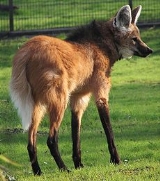
The Maned Wolf (Chrysocyon brachyurus) is the largest canid
Canidae

Canidae is the family of the dogs; a member of this family is called a canid. They include wolf, foxes, coyotes, and jackals. The Canidae family is divided into the "true dogs" of the tribe Canini and the "foxes" of the tribe Vulpini....
 of South America
South America

South America is the southern continent of the Americas, situated entirely in the Western Hemisphere and mostly in the Southern Hemisphere, with a relatively small portion in the Northern Hemisphere....
, resembling a big fox with reddish fur.

This mammal
Mammal

Mammals are a class of vertebrate animals whose name is derived from their distinctive feature, mammary glands, with which they feed their young....
 is found in open and semi-open habitats, especially grasslands with scattered bushes and trees, in south-eastern Brazil
Brazil

Brazil , officially the Federative Republic of Brazil , is a country in South America. It is the List of countries and outlying territories by total area country by geographical area, occupying nearly half of South America, the List of countries by population country, and the fourth most populous democracy in the world....
 (Mato Grosso
Mato Grosso

Mato Grosso is one of the States of Brazil of Brazil, the List of Brazilian states by area, located in the western part of the country.Neighboring states are Rond?nia, Amazonas State, Brazil, Par?, Tocantins State, Goi?s and Mato Grosso do Sul....
, Mato Grosso do Sul
Mato Grosso do Sul

Mato Grosso do Sul is one of the States of Brazil of Brazil.Neighbouring states are Mato Grosso, Goi?s, Minas Gerais, S?o Paulo and Paran? ....
, Minas Gerais
Minas Gerais

Minas Gerais was so named for its great riches in the mining industry. It is one of the 26 states of Brazil of Brazil, the second most populous and fourth largest by area in the federation....
, Goiás
Goiás

Goi?s is a States of Brazil of Brazil, located in the central part of the country. The most central of the Brazilian states and most populous of the region, Goi?s is characterized by a landscape of chapad?es ....
 and São Paulo
São Paulo (state)

is a States of Brazil in Brazil. It is the major industrial and economic powerhouse of the Brazilian economy. It is named after Paul of Tarsus. S?o Paulo has the largest population, the biggest industrial park and the biggest economic production of the country....
), Paraguay
Paraguay

Paraguay, officially the Republic of Paraguay , is one of the only two landlocked countries in South America . It lies on both banks of the Paraguay River and is bordered by Argentina to the south and southwest, Brazil to the east and northeast, and Bolivia to the northwest....
, northern Argentina
Argentina

Argentina, officially the Argentine Republic , is a country in South America, constituted as a federation of 23 provinces and an autonomous city....
, Bolivia
Bolivia

The Republic of Bolivia , named after Sim?n Bol?var, is a landlocked country in central South America. It is bordered by Brazil on the north and east, Paraguay and Argentina on the south, and Chile and Peru on the west....
 east and north of the Andes
Andes

The Andes form the world's longest exposed mountain range. They lie as a continuous chain of highland along the western coast of South America. The range is over 7,000 km long, 200-700 km wide , and of an average height of about 4,000 m ....
, and far south-eastern Peru
Peru

Peru , officially the Republic of Peru , is a country in western South America. It is bordered on the north by Ecuador and Colombia, on the east by Brazil, on the southeast by Bolivia, on the south by Chile, and on the west by the Pacific Ocean....
 (Pampas del Heath only). It formerly occurred in Uruguay
Uruguay

Uruguay is a country located in the southeastern part of South America. It is home to 3.46 million people, of whom 1.7 million live in the capital Montevideo and its metropolitan area....
. IUCN lists it as near threatened
Near Threatened

Near Threatened is a conservation status assigned to species or lower taxa that may be considered threatened species with extinction in the near future, although it does not currently qualify for the threatened status....
, while it is considered vulnerable by the Brazilian government (IBAMA
Ibama

Brazilian Institute of Environment and Renewable Natural Resources is the Brazilian Ministry of the Environment's enforcement agency. Its acronym is "IBAMA"....
).


Discussion
Ask a question about 'Maned Wolf'
Start a new discussion about 'Maned Wolf'
Answer questions from other users
Full Discussion Forum


Encyclopedia


The Maned Wolf (Chrysocyon brachyurus) is the largest canid
Canidae

Canidae is the family of the dogs; a member of this family is called a canid. They include wolf, foxes, coyotes, and jackals. The Canidae family is divided into the "true dogs" of the tribe Canini and the "foxes" of the tribe Vulpini....
 of South America
South America

South America is the southern continent of the Americas, situated entirely in the Western Hemisphere and mostly in the Southern Hemisphere, with a relatively small portion in the Northern Hemisphere....
, resembling a big fox with reddish fur.

This mammal
Mammal

Mammals are a class of vertebrate animals whose name is derived from their distinctive feature, mammary glands, with which they feed their young....
 is found in open and semi-open habitats, especially grasslands with scattered bushes and trees, in south-eastern Brazil
Brazil

Brazil , officially the Federative Republic of Brazil , is a country in South America. It is the List of countries and outlying territories by total area country by geographical area, occupying nearly half of South America, the List of countries by population country, and the fourth most populous democracy in the world....
 (Mato Grosso
Mato Grosso

Mato Grosso is one of the States of Brazil of Brazil, the List of Brazilian states by area, located in the western part of the country.Neighboring states are Rond?nia, Amazonas State, Brazil, Par?, Tocantins State, Goi?s and Mato Grosso do Sul....
, Mato Grosso do Sul
Mato Grosso do Sul

Mato Grosso do Sul is one of the States of Brazil of Brazil.Neighbouring states are Mato Grosso, Goi?s, Minas Gerais, S?o Paulo and Paran? ....
, Minas Gerais
Minas Gerais

Minas Gerais was so named for its great riches in the mining industry. It is one of the 26 states of Brazil of Brazil, the second most populous and fourth largest by area in the federation....
, Goiás
Goiás

Goi?s is a States of Brazil of Brazil, located in the central part of the country. The most central of the Brazilian states and most populous of the region, Goi?s is characterized by a landscape of chapad?es ....
 and São Paulo
São Paulo (state)

is a States of Brazil in Brazil. It is the major industrial and economic powerhouse of the Brazilian economy. It is named after Paul of Tarsus. S?o Paulo has the largest population, the biggest industrial park and the biggest economic production of the country....
), Paraguay
Paraguay

Paraguay, officially the Republic of Paraguay , is one of the only two landlocked countries in South America . It lies on both banks of the Paraguay River and is bordered by Argentina to the south and southwest, Brazil to the east and northeast, and Bolivia to the northwest....
, northern Argentina
Argentina

Argentina, officially the Argentine Republic , is a country in South America, constituted as a federation of 23 provinces and an autonomous city....
, Bolivia
Bolivia

The Republic of Bolivia , named after Sim?n Bol?var, is a landlocked country in central South America. It is bordered by Brazil on the north and east, Paraguay and Argentina on the south, and Chile and Peru on the west....
 east and north of the Andes
Andes

The Andes form the world's longest exposed mountain range. They lie as a continuous chain of highland along the western coast of South America. The range is over 7,000 km long, 200-700 km wide , and of an average height of about 4,000 m ....
, and far south-eastern Peru
Peru

Peru , officially the Republic of Peru , is a country in western South America. It is bordered on the north by Ecuador and Colombia, on the east by Brazil, on the southeast by Bolivia, on the south by Chile, and on the west by the Pacific Ocean....
 (Pampas del Heath only). It formerly occurred in Uruguay
Uruguay

Uruguay is a country located in the southeastern part of South America. It is home to 3.46 million people, of whom 1.7 million live in the capital Montevideo and its metropolitan area....
. IUCN lists it as near threatened
Near Threatened

Near Threatened is a conservation status assigned to species or lower taxa that may be considered threatened species with extinction in the near future, although it does not currently qualify for the threatened status....
, while it is considered vulnerable by the Brazilian government (IBAMA
Ibama

Brazilian Institute of Environment and Renewable Natural Resources is the Brazilian Ministry of the Environment's enforcement agency. Its acronym is "IBAMA"....
). It is the only species
Species

In biology, a species is one of the basic units of biological classification and a taxonomic rank. A species is often defined as a group of organisms capable of interbreeding and producing fertile offspring....
 in the genus
Genus

A genus is a low-level taxonomic rank used in the classification of living and fossil organisms. The taxonomic ranks are domain , kingdom , phylum, class , order , family , genus, and species....
 Chrysocyon. It is locally known as aguará guazú (meaning “large fox”) in the Guarani
Guaraní

Guaran? are a group of culture related indigenous peoples of South America, distinguished from the related Tupi people by their use of the Guaran? language....
 language, as "lobo guará" in Portuguese
Portuguese language

Portuguese is a Romance language that originated in what is now Galicia and Portugal. It is derived from the Latin language spoken by the Romanization Pre-Roman peoples of the Iberian Peninsula around 2000 years ago....
 and as "lobo de crin" in Spanish
Spanish language

Spanish or Castilian is a Romance languages that originated in northern Spain, and gradually spread in the Kingdom of Castile and evolved into the principal language of government and trade....
.

Description

The Maned Wolf has often been described as "a Red Fox
Red Fox

The Red Fox is a mammal of the order Carnivora. In the British Isles, where there are no longer any other native wild canids, it is referred to simply as "the fox"....
 on stilts
Stilts

Stilts are poles, posts or pillars used to allow a person or structure to stand at a certain distance above the ground. Walking stilts are poles equipped with steps for the feet to stand on, or straps to attach them to the legs, for the purpose of walking while elevated above a normal height....
" due to its similar coloration and overall appearance, though it is much larger than a Red Fox and belongs to a different genus. The adult animal stands almost tall at the shoulder, and weighs . The long legs are probably an adaptation to the tall grasslands of its native habitat.

The Maned Wolf's fur is reddish brown to golden orange on the sides, with long, black legs and a distinctive black mane
Mane

Mane can have the following meanings:*The mane is used to describe the line of hair along the spine of the neck, starting behind the ears and ending just above the withers....
. The coat is further marked with a whitish tuft at the tip of the tail and a white "bib" beneath the throat. The mane is erectile, and is typically used to enlarge the wolf's profile when threatened or when displaying aggression.

Habits


Hunting and territoriality

Unlike other large canids (such as the Gray Wolf
Gray Wolf

The grey wolf or gray wolf , also known as the timber wolf or simply wolf, is the largest wild member of the Canidae family. It is an ice age survivor originating during the Late Pleistocene around 300,000 years ago....
, the African Hunting Dog, or the Dhole
Dhole

The Dhole , also known as the Asiatic Wild Dog, Indian Wild Dog or Red Dog is a mammal of the order Carnivora, and the only member of the genus Cuon....
) the Maned Wolf does not form packs. It hunts alone, usually between sundown and midnight. It kills its prey by biting on the neck or back, and shaking it violently if necessary. Monogamous pairs may defend a shared territory of about , though the wolves themselves may seldom meet, outside of mating. The territory is crisscrossed by paths that the wolves create as they patrol at night. Several adults may congregate in the presence of a plentiful food source; a fire-cleared patch of grassland, for example, which would leave small vertebrate prey exposed to foraging wolves.

Both male and female Maned Wolves use their urine
Urine

Urine is a liquid waste product of the body secreted by the kidneys by a process of filtration from blood called urination and excreted through the urethra....
 to communicate, e.g. to mark their hunting paths, or the places where they have buried hunted prey. The urine has a very distinctive smell, which some people liken to hops
Hops

Hops are the female flower cones, also known as strobiles, of the hop . They are used primarily as a flavoring and stability agent in beer, though hops are also used for various purposes in other beverages and Herbalism....
 or cannabis
Cannabis

Cannabis is a genus of flowering plants that includes three putative species, Cannabis sativa L., Cannabis indica Lam., and Cannabis ruderalis Janisch....
. The responsible substance is very likely a pyrazine
Pyrazine

Pyrazine is a heterocyclic aromatic organic compound.Pyrazine is a symmetrical molecule with point group D2h. It is found in folic acid in the form of pterin....
, which occurs in both plants. (In the Rotterdam Zoo, this smell once set the police on a hunt for cannabis smokers.)

Reproduction

The mating season ranges from November to February. Gestation
Gestation

Gestation is the carrying of an embryo or fetus inside a female viviparous animal. Mammals during mammalian pregnancy can have one or more gestations at the same time ....
 lasts 60 to 65 days, and a litter may have up to 2 to 6 black-furred pups, each weighing about .

Diet

The Maned Wolf specializes in small and medium-sized prey, including small mammals (typically rodent
Rodent

Rodentia is an Order of mammals also known as rodents, characterised by two continuously growing Incisors#The_Rodent_incisor in the upper and lower jaws which must be kept short by gnawing....
s and hare
Hare

Hares and jackrabbits are leporids belonging to the genus Lepus. Very young hares, less than one year old, are called leverets....
s), bird
Bird

Birds are wing, Bipedalismal, endothermic , vertebrate animals that lay egg . There are around 10,000 living species, making them the most numerous tetrapod vertebrates....
s, and even fish
Fish

A fish is any marine biology vertebrate animal that is typically ectothermic , covered with scale , and equipped with two sets of paired fins and several unpaired fins....
. A large fraction of its diet (over 50%, according to some studies) is vegetable matter, including sugarcane, tubers, and fruit (especially the Wolf Apple
Wolf Apple

The Wolf Apple is common in the Brazilian savanna. The plant is called lobeira or fruta-de-lobo in Portuguese language. Wolf Apples are so named because they are a favored fruit of the Maned Wolf, and may account for a large fraction of the animal's diet ....
 (Solanum lycocarpum).. Captive Maned Wolves were traditionally fed meat-heavy diets and developed bladder stones. Zoo diets now feature fruits and vegetables, as well as meat and dog chow.

Relations with other species

The Maned Wolf participates in symbiotic relationships with the plants that it feeds on, as it carries the seeds of various plants, and often defecates on the nests of leafcutter ant
Leafcutter ant

Leafcutter ants are social insects found in warmer regions of the Americas. These unique ants have evolved an advanced agriculture system based on ant-fungus mutualism....
s. The ants then use the dung to fertilize their fungus gardens, and later discard the seeds onto refuse piles just outside their nest. This process significantly increases the germination rate of the seeds. The wolf is particularly susceptible to renal
Kidney

The kidneys are Organ that have numerous biological roles. Their primary role is to maintain the homeostasis balance of bodily fluids by filtering and secreting Metabolomics#Metabolitess and minerals from the blood and excreting them, along with water , as urine....
 nematode
Nematode

The "roundworms" or "nematodes" are the most diverse phylum of body cavity, and one of the most diverse of all animals. Nematode species are very difficult to distinguish; over 80,000 have been described, of which over 15,000 are parasite....
 infections, a potentially fatal parasite. The Maned Wolf is not a true, common prey species for any other predator, though it may be attacked or killed by feral domestic dogs. The Cougar is a potential competitor.

Relations with humans

The Maned Wolf is said to be a potential chicken
Chicken

The chicken is a Domestication fowl. Recent evidence suggests that domestication of the chicken was under way in Vietnam over 10,000 years ago....
 thief; it was once also considered a threat to cattle
Cattle

Cattle, colloquially referred to as cows, are domestication ungulates, a member of the subfamily Bovinae of the family Bovidae. They are raised as livestock for meat , dairy products , leather and as draft animals ....
 and sheep
Sheep

#REDIRECT Domestic sheep...
, though this is now known to be false. In Brazil, the animal was historically hunted down for some body parts, notably the eyes, that were believed to be good luck charms. However, as it is now classified as vulnerable by the Brazilian government, it is afforded protection from poachers. Wolves are also threatened by habitat loss and being run over by cars. Wolves risk both physical harm and catching diseases from domestic dogs. The Maned Wolf is generally shy and flees when alarmed, and it poses little direct threat to man. It occurs in several protected areas, including the national parks of Caraça and Emas
Emas National Park

The Emas National Park is a national park and a UNESCO World Heritage Site located between the states of Goi?s and Mato Grosso do Sul in the Brazil, Center-West Region of Brazil, between 17?50??18?15?S and 52?39??53?10?W....
 in Brazil. The Maned Wolf is well represented in captivity, and has been bred successfully at a number of zoos, particularly in Argentina.

Taxonomy

The Maned Wolf is not closely related to any other canid. It is apparently a survivor from the Pleistocene
Pleistocene

The Pleistocene is the epoch from 1.8 million to 10,000 years Before Present covering the world's recent period of repeated glaciations. The name pleistocene is derived from the Greek and ....
 fauna of large South American mammals; its closest living relative is the Bush Dog
Bush Dog

The Bush Dog is a canid found in Central America and South America, including Panama, Colombia, Venezuela, Bolivia, Peru , Ecuador, the Guianas, Paraguay, Ordinal direction Argentina , and Brazil ....
 (genus Speothos
Speothos

'Speothos' is a genus of canid found in Central America and South America. The genus includes the living Bush Dog, Speothos venaticus, as well as an extinct Pleistocene species, Speothos pacivorus....
), with a more distant relationship to other South American canines (the Short-eared Dog
Short-eared Dog

The Short-eared Dog , also known as the Short-eared Fox or the Short-eared Zorro, is a canid species endemism to the Amazon River drainage basin....
, the Crab-eating Fox
Crab-eating Fox

The Crab-eating Fox , also known as the Forest Fox, Wood Fox, and the Common Fox, is a medium-sized Canidae found in the central part of South America....
 and the 'false foxes' or Pseudalopex
Pseudalopex

Lycalopex is the genus name for some South America members of the Canidae family. The common name for the genus is zorro, from Spanish language, and raposa, from Portuguese language, both words standing for fox....
).

Gallery


External links

  • ARKive - .
  • Consorte-McCrea, Adriana G. Canid News, Vol. 2, 1994. Accessed March 12, 2007.
  • Gorog, Antonia. Animal Diversity Web. Accessed March 12, 2007.