

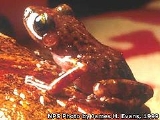
Leptodactylidae

Encyclopedia
Leptodactylidae is a diverse family
of frog
s that probably diverged from other hyloids
during the Cenozoic
era, or possibly at the end of the Mesozoic
. There are roughly 50 genera
, one of which is Eleutherodactylus
, the largest vertebrate
genus, with over 700 species. In total, there are approximately 1100 leptodactylid species, which are widely distributed throughout Mexico
, the Caribbean
, and Central
and South America
. The family is often considered paraphyletic and has no morphological synapomorphies. The family includes terrestrial, burrowing, aquatic, and arboreal members, inhabiting a wide range of different habitats.
Several of the genera within Leptodactylidae lay their eggs in foam nests. These can be in crevices, on the surface of water, or on forest floors. These foam nests are some of the most varied among frogs. When eggs hatch in nests on the forest floor, the tadpole
s remain within the nest, without eating, until metamorphosis
. In the genus Eleutherodactylus
, the eggs undergo direct development and hatch directly into miniature frogs, with no free-living tadpole stage.
Leptodactylids are well represented in the fossil record, and one specimen from the genus Eleutherodactylus was wholly preserved in amber 37 million years ago.
Family (biology)
In biological classification, family is* a taxonomic rank. Other well-known ranks are life, domain, kingdom, phylum, class, order, genus, and species, with family fitting between order and genus. As for the other well-known ranks, there is the option of an immediately lower rank, indicated by the...
of frog
Frog
Frogs are amphibians in the order Anura , formerly referred to as Salientia . Most frogs are characterized by a short body, webbed digits , protruding eyes and the absence of a tail...
s that probably diverged from other hyloids
Hyloidea
Hyloidea is a superfamily of frogs....
during the Cenozoic
Cenozoic
The Cenozoic era is the current and most recent of the three Phanerozoic geological eras and covers the period from 65.5 mya to the present. The era began in the wake of the Cretaceous–Tertiary extinction event at the end of the Cretaceous that saw the demise of the last non-avian dinosaurs and...
era, or possibly at the end of the Mesozoic
Mesozoic
The Mesozoic era is an interval of geological time from about 250 million years ago to about 65 million years ago. It is often referred to as the age of reptiles because reptiles, namely dinosaurs, were the dominant terrestrial and marine vertebrates of the time...
. There are roughly 50 genera
Genus
In biology, a genus is a low-level taxonomic rank used in the biological classification of living and fossil organisms, which is an example of definition by genus and differentia...
, one of which is Eleutherodactylus
Eleutherodactylus
Eleutherodactylus is a genus of frogs in the Leptodactylidae family. It is typically described as the largest vertebrate genus on Earth, with over 700 species...
, the largest vertebrate
Vertebrate
Vertebrates are animals that are members of the subphylum Vertebrata . Vertebrates are the largest group of chordates, with currently about 58,000 species described. Vertebrates include the jawless fishes, bony fishes, sharks and rays, amphibians, reptiles, mammals, and birds...
genus, with over 700 species. In total, there are approximately 1100 leptodactylid species, which are widely distributed throughout Mexico
Mexico
The United Mexican States , commonly known as Mexico , is a federal constitutional republic in North America. It is bordered on the north by the United States; on the south and west by the Pacific Ocean; on the southeast by Guatemala, Belize, and the Caribbean Sea; and on the east by the Gulf of...
, the Caribbean
Caribbean
The Caribbean is a crescent-shaped group of islands more than 2,000 miles long separating the Gulf of Mexico and the Caribbean Sea, to the west and south, from the Atlantic Ocean, to the east and north...
, and Central
Central America
Central America is the central geographic region of the Americas. It is the southernmost, isthmian portion of the North American continent, which connects with South America on the southeast. When considered part of the unified continental model, it is considered a subcontinent...
and South America
South America
South America is a continent situated in the Western Hemisphere, mostly in the Southern Hemisphere, with a relatively small portion in the Northern Hemisphere. The continent is also considered a subcontinent of the Americas. It is bordered on the west by the Pacific Ocean and on the north and east...
. The family is often considered paraphyletic and has no morphological synapomorphies. The family includes terrestrial, burrowing, aquatic, and arboreal members, inhabiting a wide range of different habitats.
Several of the genera within Leptodactylidae lay their eggs in foam nests. These can be in crevices, on the surface of water, or on forest floors. These foam nests are some of the most varied among frogs. When eggs hatch in nests on the forest floor, the tadpole
Tadpole
A tadpole or polliwog is the wholly aquatic larval stage in the life cycle of an amphibian, particularly that of a frog or toad.- Appellation :...
s remain within the nest, without eating, until metamorphosis
Metamorphosis
Metamorphosis is a biological process by which an animal physically develops after birth or hatching, involving a conspicuous and relatively abrupt change in the animal's body structure through cell growth and differentiation...
. In the genus Eleutherodactylus
Eleutherodactylus
Eleutherodactylus is a genus of frogs in the Leptodactylidae family. It is typically described as the largest vertebrate genus on Earth, with over 700 species...
, the eggs undergo direct development and hatch directly into miniature frogs, with no free-living tadpole stage.
Leptodactylids are well represented in the fossil record, and one specimen from the genus Eleutherodactylus was wholly preserved in amber 37 million years ago.
Classification
Family LEPTODACTYLIDAE- Subfamily CeratophryinaeCeratophryinaeThe Ceratophryinae, known as common horned frogs, are a subfamily of the leptodactylid frogs. All species in this subfamily live in South America. Fossils of the giant Beelzebufo from Cretaceous Madagascar suggest that the subfamily may have once ranged throughout the prehistoric supercontinent of...
- Horned Frogs - Subfamily CycloramphinaeCycloramphinaeCycloramphinae is a subfamily of leptodactylid frogs found in South America.-Genera:* Crossodactylodes Cochran, 1938.* Crossodactylus Duméril & Bibron, 1841.* Cycloramphus Tschudi, 1838.* Hylodes Fitzinger, 1826....
- Subfamily EleutherodactylinaeEleutherodactylinaeThe 801 described members of family Eleutherodactylidae make up 27% of all neotropical frog species, most of which are grouped in the genus Eleutherodactylus.-Genera:...
- Robber Frogs - Subfamily LeptodactylinaeLeptodactylinaeLeptodactylinae is a subfamily of leptodactylid frogs.-Genera:* Adenomera Steindachner, 1867.* Edalorhina Jiménez de la Espada, 1871.* Hydrolaetare Gallardo, 1963.* Leptodactylus Fitzinger, 1826.* Limnomedusa Fitzinger, 1843....
- Subfamily TelmatobiinaeTelmatobiinaeTelmatobiinae was originally a large subfamily of leptodactylid frogs. The subfamily has since undergone extensive revision and most genera have been placed elsewhere. The remaining two genera present in this group have maintained the Telmatobiinae subfamily name but have been placed in a new...
- Water Frogs