

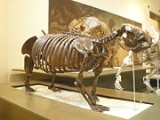
Megalocnus

Encyclopedia
The ground sloth
s of the extinct genus
Megalocnus ("Great Sloth") were among the largest of the Caribbean ground sloths
, with individuals estimated to have weighed up to 90 kg (198.4 lb) when alive. Two species are known, M. rodens of Cuba
, and M. zile of Hispaniola
. Subfossil
s of M. rodens indicate survival well into the Holocene
, prompting speculation that they may have survived in the montane
forest
s of the Cuban highlands until the 15th or 16th century. However, the most recent AMS
radiocarbon
date reported is 4190 BP
, calibrated to c. 4700 BP. This is similar to the most recent date reported for a Hispaniolan sloth, 4391 BP, calibrated to c. 5000 BP, for the small and probably arboreal Neocnus comes, and some 1200 years after the earliest known date for human occupation of Cuba, 5140 BP, calibrated to c. 5900 BP.
Their relatives include other Caribbean ground sloths, such as Acratocnus
, Mesocnus, Miocnus
, Neocnus, Parocnus, and Paulocnus.
Ground sloth
Ground sloths are a diverse group of extinct sloths, in the mammalian superorder Xenarthra. Their most recent survivors lived in the Antilles, where it has been proposed they may have survived until 1550 CE; however, the youngest AMS radiocarbon date reported is 4190 BP, calibrated to c. 4700 BP...
s of the extinct genus
Genus
In biology, a genus is a low-level taxonomic rank used in the biological classification of living and fossil organisms, which is an example of definition by genus and differentia...
Megalocnus ("Great Sloth") were among the largest of the Caribbean ground sloths
Pilosans of the Caribbean
The mammalian order Pilosa, which includes the sloths and anteaters, includes various species from the Caribbean region. Many species of sloths are known from the Greater Antilles, all of which went extinct over the last millennia, but some sloths and anteaters survive on islands closer to the...
, with individuals estimated to have weighed up to 90 kg (198.4 lb) when alive. Two species are known, M. rodens of Cuba
Cuba
The Republic of Cuba is an island nation in the Caribbean. The nation of Cuba consists of the main island of Cuba, the Isla de la Juventud, and several archipelagos. Havana is the largest city in Cuba and the country's capital. Santiago de Cuba is the second largest city...
, and M. zile of Hispaniola
Hispaniola
Hispaniola is a major island in the Caribbean, containing the two sovereign states of the Dominican Republic and Haiti. The island is located between the islands of Cuba to the west and Puerto Rico to the east, within the hurricane belt...
. Subfossil
Subfossil
Subfossil refers to remains whose fossilization process is not complete, either for lack of time or because the conditions in which they were buried were not optimal for fossilization....
s of M. rodens indicate survival well into the Holocene
Holocene
The Holocene is a geological epoch which began at the end of the Pleistocene and continues to the present. The Holocene is part of the Quaternary period. Its name comes from the Greek words and , meaning "entirely recent"...
, prompting speculation that they may have survived in the montane
Montane
In biogeography, montane is the highland area located below the subalpine zone. Montane regions generally have cooler temperatures and often have higher rainfall than the adjacent lowland regions, and are frequently home to distinct communities of plants and animals.The term "montane" means "of the...
forest
Forest
A forest, also referred to as a wood or the woods, is an area with a high density of trees. As with cities, depending where you are in the world, what is considered a forest may vary significantly in size and have various classification according to how and what of the forest is composed...
s of the Cuban highlands until the 15th or 16th century. However, the most recent AMS
Accelerator mass spectrometry
Accelerator mass spectrometry differs from other forms of mass spectrometry in that it accelerates ions to extraordinarily high kinetic energies before mass analysis. The special strength of AMS among the mass spectrometric methods is its power to separate a rare isotope from an abundant...
radiocarbon
Radiocarbon dating
Radiocarbon dating is a radiometric dating method that uses the naturally occurring radioisotope carbon-14 to estimate the age of carbon-bearing materials up to about 58,000 to 62,000 years. Raw, i.e. uncalibrated, radiocarbon ages are usually reported in radiocarbon years "Before Present" ,...
date reported is 4190 BP
Before Present
Before Present years is a time scale used in archaeology, geology, and other scientific disciplines to specify when events in the past occurred. Because the "present" time changes, standard practice is to use AD 1950 as the origin of the age scale, reflecting the fact that radiocarbon...
, calibrated to c. 4700 BP. This is similar to the most recent date reported for a Hispaniolan sloth, 4391 BP, calibrated to c. 5000 BP, for the small and probably arboreal Neocnus comes, and some 1200 years after the earliest known date for human occupation of Cuba, 5140 BP, calibrated to c. 5900 BP.
Their relatives include other Caribbean ground sloths, such as Acratocnus
Acratocnus
Acratocnus is an extinct genus of ground sloth found in Cuba, Hispaniola and Puerto Rico.-Classification:Like all of the Antillean sloths, Acratocnus is a member of the family Megalonychidae, whose sole surviving genus is Choloepus, representing the two-toed tree sloths.-Location:The species of...
, Mesocnus, Miocnus
Miocnus
Miocnus is an extinct genus of giant ground sloths of the family Megalonychidae endemic to Cuba during the Pleistocene epoch through very early Pliocene epoch, living from 1.8 Mya—11,000 years ago, existing for approximately .-Taxonomy:...
, Neocnus, Parocnus, and Paulocnus.